Category Archives: traffic

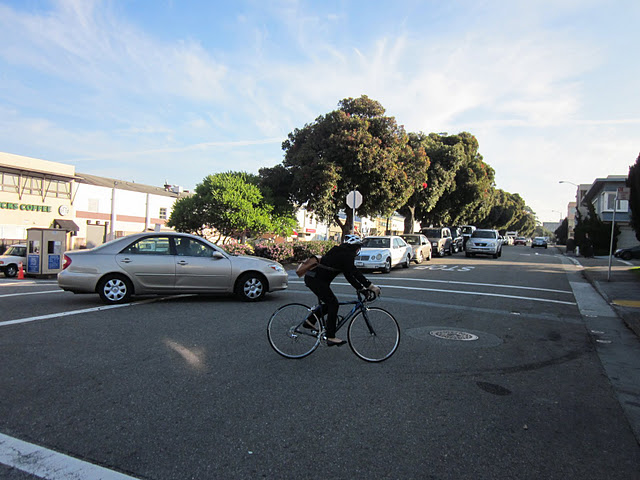
Welcome to 2012

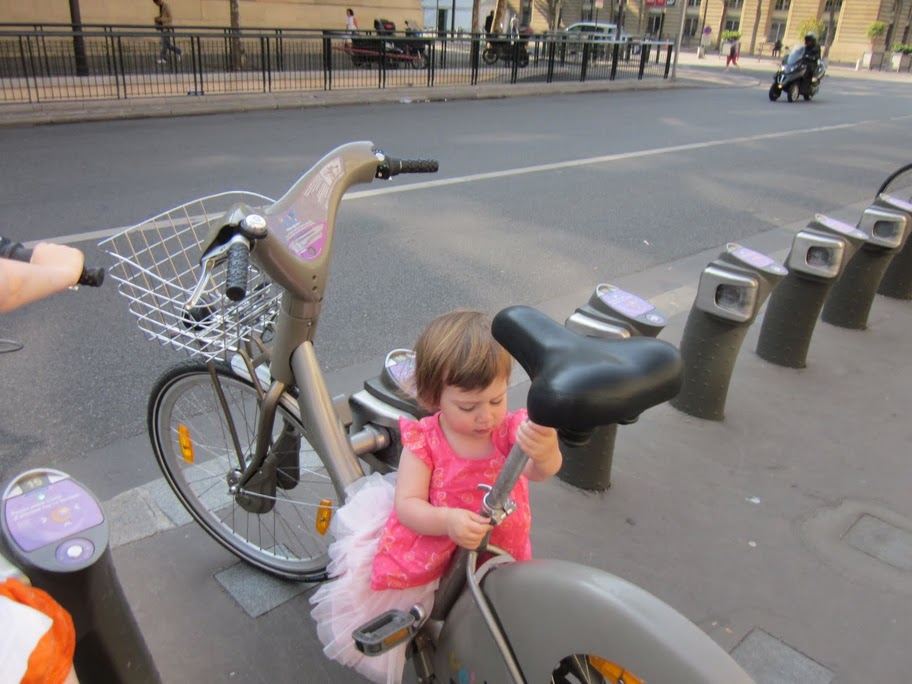
In charge at Paris Velib

Historically the highest-value benefit to membership in the San Francisco Bicycle Coalition for us was the 10% discount at Rainbow Grocery. Although I find Rainbow’s extensive array of vitamins and supplements a little disconcerting, the crowds on the weekends overwhelming, and the prices on certain items laughably outrageous, we like shopping there. The employee-owners always seem cheerful and happy to help with questions, the selection is unbelievable, and with thoughtful shopping there are deals aplenty. I also find it sort of entertaining that by making a philosophical commitment to not selling meat they’ve spared themselves losses from shoplifting, which is probably part of the reason I’m getting such great prices on rye flakes and sea salt.

I find myself increasingly unwilling to patronize stores that treat children like second-class citizens—kids are people, albeit small and incontinent people—and on this front going to Rainbow is always a pleasure. E.g.

My daughter: “I’M IN CHARGE! I’M IN CHARGE!”

Me: “This is an employee-owned cooperative.”

My daughter: “I’M IN CHARGE! I’M IN CHARGE!”

Rainbow employee-owner: “Okay, you’re in charge.”

Rainbow ended the SFBC discount on December 31, 2011, and although they had their reasons, we were disappointed. So on the last week of the year we headed over to get some soy sauce and SAF instant yeast. Although I found two other kinds of yeast I had to get help to find the SAF, which was with the dried fruit, obviously. Afterward, the guy who had found it for us spotted my daughter’s collection of temporary tattoos and they spent a few minutes comparing their ink.

At checkout the cashier reminded me that the discount was ending soon, and I said that it was a shame for us, as we’d only recently realized that we could bike in the city with our kids. “Biking in this town is too dangerous,” he exclaimed. Sigh. But this wasn’t an entrée into the usual finger-shaking about potentially killing our kids; instead, he said he’d stopped riding years ago, that it was safer in the 1980s. That was a surprise. But, but, I said, all the new bike lanes? Seemed to help? Too much traffic now, he replied.

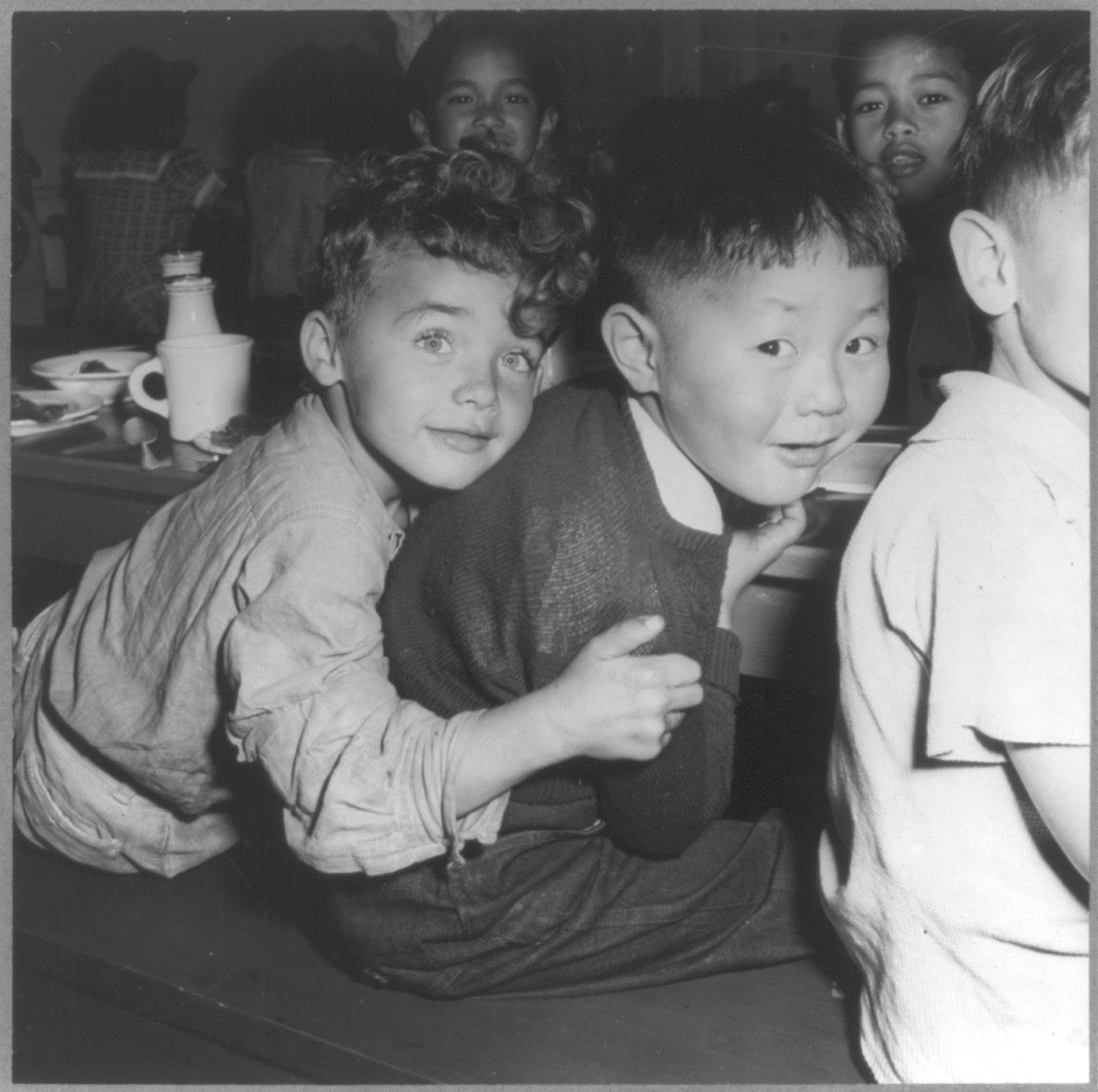
Dorothea Lange photographed our son's school in 1942; 70 years later it looks the same

Point taken, I guess, traffic is in fact outrageous, although I’ve seen worse. I’m not sure that the solution is to suffer along with everyone else, however. One option, which we tried when our son was much younger, is to ensure that everything you need is within walking distance. That worked for a while but eventually became unfeasible; for one, we were unable to get a placement in a neighborhood elementary school (not that I am complaining, as our placement is wonderful and as recently discovered, within bicycle range). And as a pedestrian I noticed traffic as well, often in the form of cars whizzing down what were originally intended to be quiet residential streets in an effort to get off the congested major thoroughfares. Taking Muni everywhere keeps you out of a car but not out of traffic.

At this point it seems as though everyone realizes something needs to change, but change is painful. We’ve found that our bicycles opened up a world of options for us, but a year ago, if anyone had told me that, I would have said they were delusional. Short of sending everyone to Copenhagen, I have no idea how to expand people’s sense of possibility. But I see more bicycles every day. Is it something I notice because I notice bicycles now, or is it something anyone would see?

We may have lost the Rainbow discount, but we’ve made back that discount and then some. Last week I did something I would never have conceived as either possible or desirable one year ago: I turned in my coveted (and expensive) all-campus faculty parking pass. Between that and our savings on gas, our relatively extravagant bicycle and accessory purchases are actually saving us money. That wasn’t an explicit goal but it’s another way bikes have made our lives better.

4 Comments

Filed under family biking, San Francisco, traffic

Keeping an eye on the streets

Crosswalk, schmosswalk

I’ve become more interested in traffic the more I ride my bike. As a pedestrian the only thing I really cared about was how many cars were inching into the crosswalk. Too many, is the consistent answer. I really resent this, given that even on the day after Thanksgiving I was 30-40 times lighter than a compact car, and I am soft and squishy rather than protected by a steel exoskeleton. Would it kill you to leave me some space to cross the street when the walking man says go? By comparison, riding the bike feels at least as safe and much faster.

As an occasional driver, I primarily notice traffic; it’s always brutal. My mom, who lives in a much smaller town, won’t drive in the city at all, not even during hours that I consider sedate. Driving also involves looking for parking, an endeavor that typically makes me wish that traffic was still my biggest problem.

There is a bike light at this intersection, thank goodness, but I still hate it with the fiery passion of a thousand burning suns

I never noticed until fairly recently, when I started thinking about traffic laws and noticing traffic as I rode, what total irreverent scofflaws San Francisco drivers are when it comes to red lights. They’ve never put me in any danger personally (yet?), so it’s more a point of interest, but I did for a couple of days keep a running tally of road users I observed treating traffic laws as optional.

Wednesday

  • Cars running red lights: 2
  • Bicycles running red lights: 1 (also: no helmet, riding after dark without lights, and crossing Masonic –a street notorious for probably half the “car-hits-bicycle” incidents in the entire city–this rider is unlikely to survive the winter)
  • Bicycle riding on the sidewalk: 1 (also pulling one of the few trailers I’ve ever seen outside of Golden Gate Park with kids inside; I sympathize with the problem—the trailer won’t fit in the bike lane!—but maybe better to put those kids on the bike, take an alternate route, whatever)

Thursday

  • Cars running red lights: 3
  • Bicycles running red lights: 0
  • Bicycles riding on the sidewalk: 0

Etc. While this is totally unscientific, my sense is that cyclists running red lights may not be as epidemic as advertised, although I am not exactly haunting hipster hotspots. I find it interesting that I never noticed cars running red lights as a walker and occasional driver, although I do notice it now, whatever form of transportation I’m using.

I find the San Francisco attitude toward running red lights novel, as I wasn’t counting gunning for the yellow and continuing through the intersection even after the light turned red. Short of having spikes pop up from the crosswalk when the light turns red, those seem inevitable. What I counted was stopping at a red light for a while and then, I don’t know, getting bored or something? At which point cars just headed off into the intersection, in a couple of cases into oncoming traffic. In one case the car made a left turn into cross traffic. “I’ve waited long enough, dammit!” The first time I just stared in disbelief—I was at the same light, and although I decided to wait for the green, because I am boring like that, I still caught up to this adventurous driver a block later, waiting behind someone who had apparently not yet lost patience with his own red light. After the second time I started keeping count. The other weekend while we were on our way to the North Bay, a driver started honking wildly and flipping us off as we drove through a green light, because in doing so we’d prevented him from making a left turn on the red. It’s still hard for me to think about this without breaking out into nervous laughter. Really, crazy left-turn guy? REALLY?

I’m on the road maybe an hour or two a day, yet my sense already is that traffic cameras could earn the City and County of San Francisco a non-trivial amount of cash.

Leave a comment

Filed under San Francisco, traffic

Herewith, my experience identifying danger and good will while biking in the city

My rush-hour bicycle commute

At the town hall we attended recently, there was mention of cyclists blowing through red lights, and I’ll admit that sometimes I feel like throwing certain people under the bus on this issue, figuratively speaking. This complaint is not made up of whole cloth; I have watched bikes blow through red lights on occasion, although my commute route, which is largely made up of separated bike lanes on quiet streets, does not really draw that kind of cyclist. It is not a route made for people with a lust for danger. (And the flip side, of course, is that making more streets bike-friendly makes people with a lust for danger wander off elsewhere, at high speeds, until eventually, I assume, they experiment with freeway riding and die before reproducing.) At the time the question came up, however, I thought that it was pretty easy to identify a cyclist who is going to blow through a red light or otherwise play by their own rules; some clues:

  1. Not wearing a helmet
  2. Tight pants OR lycra OR extra baggy pants + down jacket on undersized BMX
  3. Fixie
  4. Riding in the Tenderloin

In the opposite corner, obeying traffic laws, you have:

  1. Wearing a helmet
  2. Wearing clothes that could be worn in a traditional office environment (alternatively: naked)
  3. Child seat or trailer-bike
  4. Riding in the rain

Completely unpredictable are: tourists, easily spotted due to their matching bicycles with identical Blazing Saddles handlebar bags.

But this made me think of the flip side: can I classify cars the same way? Yes indeed. Goodness knows I have witnessed no shortage of cars behaving badly, particularly during rush hour, the time of day I am most likely to have moments when I wish I was riding on a giant bus capable of mowing down anything else on the road. And say what you will about Muni drivers’ casual attitude toward punctuality, they have certainly not shrunk from attempting things like that in the past. Cars most likely to break the law in interesting ways, tailgate, run red lights and stop signs, and generally make my cycling experience less pleasant:

  1. Taxis and livery cars
  2. Any car that could be described using the term “German engineering”
  3. Garbage trucks

On the other hand, cars most likely to yield to cyclists/not tailgate/actually wait their turns at a four-way stop sign:

  1. Utility and contractor trucks (e.g. PG&E, Bob the Builder)
  2. Muni buses
  3. Cars with “bicycles in their hair” to quote my daughter (for some reason, cars with “bicycles on their butts” do not qualify for this category)

Hello Kitty does not run red lights

That said, in general I find that even when I’m outside my usual quiet and bike-laned streets, San Francisco drivers are very considerate and friendly, and I say this having missed some cross-traffic on occasion when I started cycling in the city, particularly at poorly-signed intersections at the top of hills (cars come up so fast, relatively speaking). I apologize to my fellow road users and endeavor daily to never do anything similar again. Happily for me, the hardest part of getting used to biking in San Francisco is getting used to the traffic and to a lesser extent, the wind. To my surprise, the hills are currently coming in at only third place. Dealing with drivers is usually not a big problem, at least for helmeted, child-seated, work-clothed me.  City traffic can be scary even with the protection of a 2-ton vehicle and overall most drivers seem to remember that when they see a bicycle.

I’ve lived in many cities now (Seattle in my childhood, Little Rock, Minneapolis, Chicago, Boston, Paris, Munich, the list is much longer but I lose track) and although we settled in San Francisco for professional reasons, part of the reason it’s been such a great place to live is that the city often feels like it’s making an effort to show that it likes us. It’s been true as we’ve wound through some difficult moments (finding housing, having a baby, the public school lottery, all of which ended better than we could have hoped) and it’s true again, as we’ve grown so much closer to it, riding our bikes.

2 Comments

Filed under commuting, San Francisco, traffic

Separated bike ways

Learning about bike lane options

If you take your kids to a city planning meeting, evidently they’ll take your picture.

We attended the SF MTA’s open house for separated bikeways on Oak and Fell the other weekend. Matt commutes along the panhandle of Golden Gate Park, through the Wiggle (“the Wiggle is the Bomb”), and up Market Street to the Financial District. The ugliest part of this trip by far is the three blocks of Oak (eastbound) and Fell (westbound) that separate the panhandle from the Wiggle, although Market Street is pretty intense as well. Advocacy to make this section of the city safer has been going on for years, and the MTA is now proposing separated bikeways on Oak and Fell, which would, not to put too fine a point on it, be awesome. Maybe I’m unadventurous and unwilling to exercise my rights to Take The Lane, but when riding down Market Street with a kid on the back of the bike, I prefer the segregated bike lane to having Muni buses huff at my neck. Oak and Fell, same same, but with a much higher ratio of stressed out car commuters. As this is Matt’s daily commute route, he was pretty interested in the plans.

This was our first visit to one of these, and evidently they were trying out a new open house format instead of a hearing; there were staff there to describe the proposals, swaths of paper on the wall for comments, and maps where people could make specific geographic suggestions (e.g. “get the tow trucks always parked in the bike lane at this corner to go away” or “put mirrors on poles here so cyclists can see cars coming and I don’t have to stare death in the eyes every morning please”). And given that it was held in a school gymnasium, there were lots of balls for the kids to throw around. I’ve been to public hearings before and I assumed that the kids would last 15 minutes at most, but given the format and toys we stayed for almost an hour. An interesting discovery as we’ve begun biking more is how much more willing we are to just drop by places outside of a walking radius if we don’t feel confident the kids are going to have a good time. In the event of meltdown just hop back on the bike, and boom, we’re having fun again.

My daughter’s unwillingness to remove her helmet made it clear that we were there as bicyclists. Self-identified as a competing interest were a handful of local residents; this was my first introduction to people in San Francisco who are hostile to bicycling when they were outside of their cars.

The plans themselves looked good to me; the general outline was to remove a lane of parking on both streets, possibly permanently or possibly just during daytime hours, and make the space a separated bike lane. I thought the proposal to make the bike lanes two-way given that they would both be on one-way streets was crazy, I admit. But even as an occasional driver along these streets, I would love to see a parking lane removed; every time a car tries to park in traffic, it creates a tailback that can go as far back as Golden Gate Park. And there is always, always traffic on Oak.

I think it would be fair to say that residents along those blocks viewed the possibility of having a parking lane removed with less equanimity. One woman in particular asked me how many times I blew through red lights (for the record: never, dude, my kids are on my bike), complained that cyclists should be paying for any street improvements by being forced to register and insure their bikes, complained about the dismantling of the Embarcadero Freeway et al and suggested more freeways in the city (seriously?), and insisted that there didn’t need to be any connection between the panhandle and the Wiggle because cyclists could just use one of the existing sharrows that went up a steep hill. “If you want to bike in San Francisco, you’ll just have to learn to go uphill.” Etc. I suppose if you want to maintain a population of cyclists who are young, fearless, and scofflaws, policies like this would be a good way to ensure that outcome.

My husband and I have never been very attached to cars, having lived without one for years. Even Matt’s parents are a one-car family, as we are now, which always seemed like plenty of car to me, if not too much at times. We pay to park our car and it is definitely not cheap, although I suspect we’re not paying full freight. We have lived places where parking was free to us but I’ve never expected it, certainly not in a dense city like San Francisco. So we found it bizarre to hear people demanding that they be entitled to free parking on the street near their homes, which was the main message I got from the residents attending the meeting. Apparently we are loony. The secondary message from the same people was that they wanted reduced car traffic, which sounded like a good idea to me, albeit completely antithetical to providing lots of free parking. People always over-consume things that are free. This concept is day 1 of any micro-economics class, an easy introductory topic because absolutely no one needs to have it explained. Lots of free parking=lots of driving.

I don’t really mind paying for parking just like I don’t really mind paying for the water and power that we use at home; sure, it would be great for me to pay nothing, but I recognize that these are either limited or expensive resources. In some ways the battle over “free” parking reminds me of the fierce hostility, when I was a child, toward the city’s new garbage pickup policy, which involved paying by the frequency of pickup and the size of the can. You would have thought that producing unlimited garbage and paying a flat rate for pickup was a right enshrined in the Constitution from the spittle-flecked invective hurled at local government during that first year. Now of course it seems totally reasonable to everyone to pay for garbage pickup based on volume (on the West Coast, at least; I have heard, although I still have difficulty believing it, that this is not yet standard practice on the other side of the country—one person told me that even water was unmetered, which I refuse to believe because it is completely absurd, like paying a flat monthly fee for the right to drive into any gas station at any time and fill up anything from a lawn mower to a Hummer). I’ve never heard anyone say a bad word against user fees as long as they are abstract, but the rubber really seems to hit the road when people realize that they’re going to be charged for things that they themselves use.

Regardless, walking into a community meeting to complain about how good life once was back when the Embarcadero Freeway overshadowed the waterfront, plus asking random cyclists how often they break the law, is probably enough of a credibility-buster that I suspect it’s not worth worrying about people like this as long as there is even one person on the other side of the issue who appears to be basically sane (also, it’s probably a demonstration of the dark mirror). If I walked into a room full of strangers and asked everyone there whether they were the one of the drivers who blew through a 4-way stop sign yesterday rather than wait their legal turn behind me, I would, with good reason, be viewed as a crank. I suspect my kids will see separated bike lanes throughout the city as they grow up. Here in the city, there seems to be an increasing recognition that a bicycle on the road is not as much “one less car” as “one less traffic jam.”

3 Comments

Filed under commuting, family biking, San Francisco, traffic

Choosing a bike

Not suitable for adult riders

We started biking in San Francisco with nothing but the sense that it would be a nice idea. While the SFBC says that 7 out of 10 city residents are bikers, we were one of the few families we knew who didn’t have a bike or three lying around. Actually we did have one bike; my brother-in-law gave our son a balance bike for his second birthday. He eventually learned to enjoy riding it around our old (flat) neighborhood, and we kept it when we moved. Our daughter still likes riding it around the (flat) garage. But a balance bike with 12” wheels that perfectly fits a 2-year-old wasn’t going to get us to school and work.

Choosing a bike was starting to be a critical problem. Before we went to Europe and rediscovered biking, we had been talking seriously about getting a second car. We found the idea pretty depressing, frankly. It would cost a lot of money, which was reason enough to despair. Moreover faculty housing only allows us a single parking space (which was, nonetheless, a big increase from the usual allotment of zero), meaning that if we had a second car we’d have to search for street parking in our neighborhood, which is always flooded with cars looking for hospital parking. And we were one-car people (at most) by nature. We live near public transit and we like walking. Matt works in clean energy and I sit on the campus sustainability committee. We had gone years before kids without a car at all. We had suffered through the daunting San Francisco school lottery to minimize our commutes (old joke: “What does every kid in San Francisco get on their 5th birthday?” Answer: “A new address in Marin.”) We put our daughter in preschool a block from our house.

But we also both have jobs nowhere near each other, and there is no effective public transit option to get to our son’s early start-time school, and it was too far to walk. Matt travels frequently for work, and even with heavy exercise of our car share membership, conveniently located on campus, arranging our lives was getting increasingly difficult. Matt’s travel schedule was ramping up for fall. Moreover, after insistent begging, we’d agreed to sign our son up for soccer in the fall. But his soccer practice ended up being nowhere near any of us, and it was going to run until 5:30pm on a day that we were both in off-site meetings until 5:00pm. It was impossible for us to pick up both kids in time on that timetable with one vehicle. It was time to make a decision.

We had some guidance, thanks to our son’s school, which has a handful of regular bike commuters. Our PTA president brought his two girls to school on a tricked-out Kona Ute, which looked simply awesome. But we don’t have the mad skills to put together custom child seats. They have since upgraded to a triple tandem, and that’s a sight to see. Our principal rides to the district offices on a bike (sparing the parking hassles ordinarily involved with this trip) and at least one teacher is coming to school by BART+bike, but they were riding solo. We turned to the internet, like all parents stuck at home after the kids go to sleep, ending up almost immediately at Totcycle, which helpfully listed a range of options for family biking. Unlike the Danes, this family lived in a place with hills—my hometown of Seattle—which as it happens, narrowed down our options considerably.

"Responsible" parents would not live on this hill (it's steeper than it looks)

The #1 choice in terms of practicality for families with young kids who live where it’s flat and have some dosh is evidently the Bakfiets or equivalent. I loved the idea of having the kids in front, the massive cargo room, and a rain cover, but even the people who want to sell you one say that it’s not suitable for serious hills. One retailer said that he wouldn’t sell to people who lived in San Francisco because even though “responsible” parents knew well enough to avoid steep hills, there would always be some “irresponsible” parents who tried to bomb down one and not be able to stop. As one of the many San Francisco parents who lives on a steep hill and thus cannot under any circumstances avoid it, I found this comment pretty annoying. It was also clear that with this kind of bike all but the strongest riders would end up walking up our hill every night on the way home, which didn’t sound like much fun. In addition, our son, at age 6, was old enough to be getting kind of big for this option, and frankly it was pricey. So box bike: out.

The #1 choice in terms of practicality for families who live where there are hills, already have a bike, and don’t want to drop a few grand is apparently the Xtracycle conversion. You can get two kids on an Xtracycle, even if they’re older, even with a significant age difference, and still move cargo and make it up a hill. Alternatively, if your kids are both young enough, there’s the mamabike, an idea we loved but that our kids had probably outgrown. But we didn’t have a donor bike to Xtracycle,  and that meant we’d have to buy a bike just to convert it, which seemed like twice the shopping and decision effort. And we are not handy. Alternatively, we could buy a longtail ready-made, like the Ute, Radish, Mundo, or the super-trendy Big Dummy. But for a number of reasons specific to our situation, a longtail didn’t seem ideal. The first was that my husband, who wanted to use the bike to commute to work, had limited space in his office, and a longtail bike wasn’t going to fit. He’d have to take his chances locking it on the street. The second, as pathetic is this is going to sound, is that we had an elevator option. By chance, the university bike cage is at the bottom of the steep hill where we live, while the main campus and hospital are at the top. As a result, bikes are allowed on the elevators. But the elevators are pretty small, and a longtail was simply not going to fit. Finally, we both liked the idea of being able to put a bike on the bus rack in the event of a flat, serious rain, or a wind advisory day. (For the same kinds of reasons, plus hills, we ruled out the Madsen, a bucket bike that lets you store your spawn in the back, which otherwise looked pretty appealing.) Nonetheless, given our desire to haul two kids on a bike and get up and down hills, this looked like our best bet. But because of the downsides, we simply couldn’t get up the willpower to make a decision and actually buy a longtail.

Would you take a trailer on this street? It's a designated bike route!

For a real low-budget option, there’s the inevitable advice to put the kids in a bike trailer, especially if you’re the kind of person who doesn’t mind picking up stuff on craigslist (guilty as charged), and of course, if you already have a bike. There are always lots of trailers on craigslist, which suggests how popular they are to actually use (not very). But people who live in the suburbs seem to love bike trailers, and that’s what Consumer Reports and the American Academy of Pediatrics recommend, claiming that the trailer won’t tip over if the bike does, that the kids are somewhat protected if the trailer does roll over, and that the bike is more stable with a trailer than a child seat. Both sources seemed pretty sanguine about the downsides of trailers, namely that they’re hard for drivers to see, that they’re wide enough to make the bike less maneuverable and often wider than a bike lane, that they increase braking time, and that they tip over when you need to turn quickly or hit a bump or a pothole. Some additional downsides that they don’t mention are that road debris gets kicked up into low-riding trailers, that kids can fight like demons in a crowded space without parental intervention, and that in terms of a shared cycling experience, well, there isn’t one. But it’s true that they can carry lots of stuff and keep kids out of the rain. Nevertheless, reading that list of advantages v. disadvantages couldn’t make it more apparent that the people arguing for trailers didn’t live in cities, where drivers and cyclists are always in close proximity, bike lanes are on-street and usually narrow, you always need to be able to turn quickly, and potholes are rampant. Pretty much the only place we’ve ever seen a bike trailer in San Francisco is Golden Gate Park during weekend street closures, and then only on the recently repaved streets. Having spent time in many major cities of the world, I would generalize that to all cities; people who live in cities don’t put kids in trailers. They put them on their bikes. Finally, in case all that wasn’t enough, our son was getting too big for a trailer.

Given our dithering, a lot of people suggested that we try a bike plus trailer-bike for its relatively low cost and  low commitment. We saw a lot of this combination around the city, because it keeps kids from doing dangerous things in traffic and gives some (limited) assist going uphill. We were stuck on the issue of hauling our son. Although at six he is technically old enough to bike by himself, he’d never really learned to ride anything but a balance bike, and personality-wise, we knew he would be slow to pick up riding. Just convincing him to get on the balance bike back in the day had taken several months, and although he no longer fits on it, he is perfectly happy to continue trying to ride it given that he’s put in all that effort. Unlike our daughter, he is naturally cautious, and as a result, has never developed the kind of close and familiar relationship with local ER doctors that she enjoys. “Oh yes,” they say now, every time we return to have yet another heart-stopping injury treated, “It’s the little girl who loves band-aids.” However we knew from experience that he liked being a passenger.  The other issue with our son is that his drop-off and pickup were at different sites; he goes to school in the morning and takes a bus to his off-site after-school program in the afternoon. From a practical standpoint this was fantastic, because his after-school program is across the street from the campus where I work, meaning that I can walk across the street to pick him up and then we could take the university shuttle home. But it meant that we couldn’t bike with him to school and then pick him up and bike home, because we couldn’t get a bike from school to after-school. And he is too big for most bicycle child seats. A trailer-bike would at least fit into Matt’s office because it could be removed, ditto the elevator and the bus rack. But it would be a hassle and we worried that he would be just as reluctant to get on a trailer-bike as any other bike his size. Plus reports from parents suggested that the combination could get pretty tippy. That was the last thing we needed with a kid who was nervous about riding rather than being carried anyway. The more we thought about it, the more the choice seemed clear: our best option was a longtail, and we’d let our son learn to ride when he was ready.  We would suck up the inconvenience and risk of parking on the street, being unable to take the elevator, and being unable to throw the bike on the bus.

1 Comment

Filed under commuting, family biking, San Francisco, traffic

The hum of the city

Why the hum of the city? Snob alert: having lived overseas (exchange students, extended work exchanges), my husband and I were both skeptical about the ability of a short stay in any country to have much effect on people. Spending a year plus living in Paris was life-changing for us. My husband’s one-week college vacation in Mexico? Not so much. We ended up on a short stay in Europe with our kids because of a series of work-related coincidences; I had business in Copenhagen, my husband had business in Paris, the dates of both were flexible, and neither of us wanted to travel without our kids for a week (or stay at home as single parents while the other was away). So we doubled down and booked our trips back to back, spending the money we would almost certainly have spent on two weeks of extra child care, and then some (ugh), to fly our kids along with us.

In the apartment courtyard

We arrived in Copenhagen on a Sunday and so the absence of traffic was no surprise. The city was pretty much silent, except for the occasional bus roaring by and the hum of bicycle wheels going by on the pavement. We walked to our rental apartment after taking the train in from the airport because there were no cabs on a Sunday–carrying the two-year-old and our bags and more or less dragging our tired and cranky six-year-old. Thank goodness we’re light packers. The first unwelcome pedestrian surprise was that street lights are timed for bicycles, which meant we ended up with a long wait at every intersection.

On Monday I walked to the hospital. At that point, the absence of traffic WAS a surprise. Even in the middle of rush hour, the sound of the city was something close to… silence. I saw a car maybe once every few minutes, except on the busiest streets. Even then they were hugely outnumbered by bicycles. In San Francisco we live on the university campus, right on top of the hospital, and when we moved in getting used to the noise was challenging. All night long there are ambulances, all day long there is shuttle bus and Muni traffic, plus the usual garbage trucks, delivery trucks and the every day collection of people driving to work. Virtually everyone drives to the hospital–we drove there when I was in labor. It seemed like the right thing to do at the time. But in Copenhagen there were basically no cars on the roads. The hospital parking lot had space for about 12 of them. And what I heard walking there was all the sounds of a city that are normally drowned out by the roar of engines. Sure, there were bicycles, bicycles, bicycles, but they are so quiet that we spent our first few days nearly jumping out of our skins when cyclists appeared out of nowhere, not really, but that’s how it seemed. We weren’t listening for the low whirr of wheels on the pavement. Now that I know to listen for the sounds of the city, I hear them in San Francisco, when traffic dies down or on quiet streets: people talking, the clink of glasses in cafes, the sounds of deliveries coming in at the door. Sounds like these make the city scale down, suddenly, to human level. Without the sounds of cars, a busy pedestrian street in San Francisco is like rural Main Street, but with much better food and more diversity.

So: the hum of the city. Our kids immediately took to the bicycles and tricycles strewn around the apartment courtyard; there was even a mini-box bike. We rented bicycles, and it’s a measure of how different cycling is in Copenhagen that renting bikes with child seats is no big deal, although it takes an extra day to install them. We got on the bikes and suddenly felt like we were a part of the city; everything was accessible. We went to the National Museum, the canals, and the center of the city. We biked out to see the Little Mermaid statue. Our kids nearly spent every minute of the rides screaming “whee!” and pounding on our backs or hugging us, at least until they fell asleep. And we could talk to them the whole time because our bicycles whizzed along at a low hum. We thought that a short stay in Copenhagen wouldn’t change our lives but it did. While we were there, we fell in love with the hum of the city, a sound we’d never really heard before. And we fell in love with bicycles.

10 Comments

Filed under Copenhagen, family biking, traffic