Category Archives: commuting

San Francisco destinations: Laurel Heights

My office, hulking over the landscape

The university where I work is sprawled across the city on multiple campuses. This has some up-sides: I can take one of the university shuttles to many locations in San Francisco, which is often handy, and they all have bike racks, so if I’m feeling lazy or especially traffic-phobic it’s easy enough to ride to a campus location near where I’m headed and use the bike for the last leg. It has some down-sides: my department is also spread across the city on various campuses, and so I can go months without seeing some of my co-workers, or for that matter, my department chair. And there are often days when I am expected to be at multiple campuses. On one terrible day I had non-negotiable meetings at five different campuses. I didn’t get a lot of work done that day.
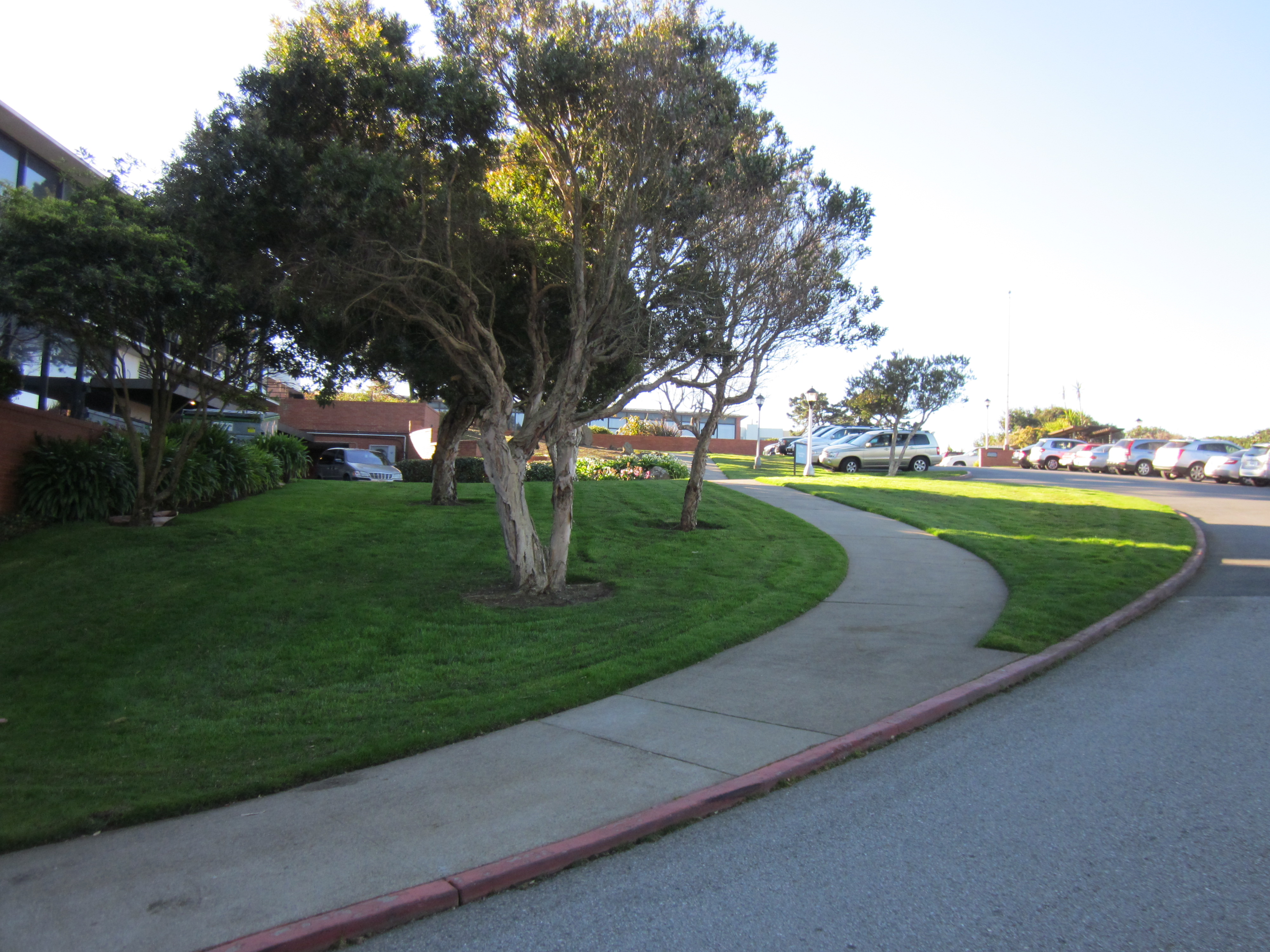
On campus, headed up

My main work site is at Laurel Heights, which is a weird little neighborhood in San Francisco. Like most of my regular destinations in the city, it has the word “heights” in the name, and this word is not an affectation in San Francisco. Getting there involves some climbing, although it’s not as bad as where we live. Nobody offers an elevator option for bicycles in this neighborhood.

Laurel Heights is the site of a former cemetery, Laurel Hill Cemetery, which was surrounded by cemeteries in an area formerly known as “the silent city.” In San Francisco’s 1906 earthquake, even the cemeteries were damaged, with shattered tombstones strewn about. In the next few decades, the cemeteries became run down and were viewed by local business owners as discouraging development and encouraging juvenile delinquency. To be fair, there had been advocacy to remove cemeteries from San Francisco since the 1880s, as they were viewed as health risks. In 1937, a ballot initiative, Proposition 43, passed. It allowed the city to move all the cemeteries (or more accurately, the remains interred in them) and open the land they’d been located on for development. Most of the bodies were transferred to Colma on the San Francisco Peninsula, City of the Dead, San Francisco’s necropolis. “It’s Great to Be Alive in Colma!” is the town’s actual motto.

Of their bones are houses made

Some of the rest of the bodies were victims of the time; remains from the Chinese Cemetery were wrapped in canvas and sent to China by Pacific Mail Steamer. I have a friend whose great-whatever-grandparents arrived in San Francisco after dynamiting the path of the railroads across North America, and whose family has lived in San Francisco ever since, only in his generation finally moving out of Chinatown. He is more native San Franciscan than anyone else I know. Doubtless some families like his found their dead relatives sent across the ocean.
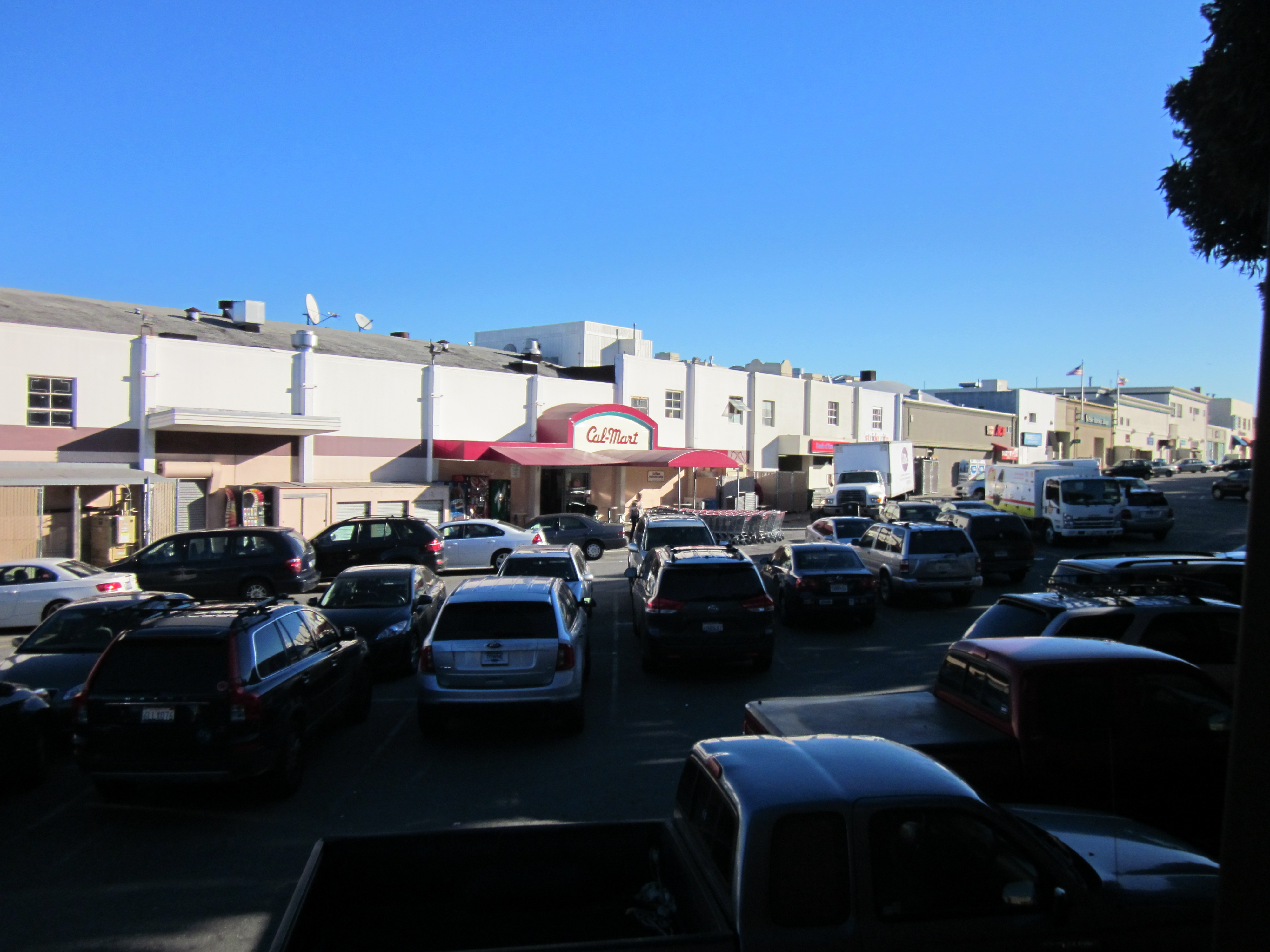
Modernism in the city: a strip mall

As a result of all this, most of the neighborhood was developed long after the rest of the city, and it is an odd 1950s modernist enclave in a city famed primarily for its Victorian houses and their look-likes. The building I work in was built and then abandoned by Firemen’s Fund Insurance Company, and it may now be part of a medical center, but it still looks like an insurance company headquarters inside and out. It is huge and black and sprawling and can be seen looming over its neighbors from as far east as Nob Hill. Across the street is a huge Muni depot, always filled with hundreds of buses. Laurel Heights contains one of San Francisco’s few strip malls, although in keeping with the city’s style, the only national chain store there is a Starbucks, and it is anchored by two excellent independent grocery stores. I end up doing most of our grocery shopping on my lunch break, and I now have an extensive collection of panniers, insulated bags and cargo nets to haul everything home on the bike. This was complicated by finding bags that would fit on the rack under the child seats that I’m always swapping on and off, and is worthy of another post.

View from the cafeteria

I like working in Laurel Heights. Before we moved into university housing, we lived here as well. It is a very quiet corner of the city, and although it is on the wrong side of the fog line, it is less pounded by relentless fog than the Sunset (a misnomer if there ever was one; you’ll rarely see the sun in the Sunset). Unlike the campuses with hospitals, it is always quiet here. And although I wish we had a library on site, there are still many amenities. Like all medical center campuses, it offers a cafeteria serving cheap, healthy, and rather unappetizing food (I’m not sure why this is, but it’s been the case at every hospital I’ve ever worked, including the Panem Institute in Copenhagen and Cook County Hospital in Chicago). The Laurel Heights cafeteria has a nice view of the city. There is a child care center on site, and I was able to walk downstairs to visit and play with my daughter every day when she was enrolled there as an infant. And although this is one of the few campuses without a bike cage, bike parking options are more than respectable, although they get crowded fast. We have a lovely view of Golden Gate Bridge from the mail room.

Bike parking at 8:30 am

There are weird quirks about working here, some of which are annoying. The neighbors ferociously resisted the university moving to the site; I am told by my dentist, who’s been here forever, that there was suspicion that we would all be torturing monkeys and releasing strains of smallpox (I don’t know anyone who does either of these things). As a result, every window in the building is glued and bolted shut permanently, even though there are no wet labs on this site and the only viruses in the entire building are on the computers. It would be nice to be able to open a window.

Spot the dead bodies...

My office overlooks a small garden and parking lot. When an older colleague stopped by once, he laughed out loud at the view from my window.  He is a San Francisco native, born at UC Hospital long before it was converted to classrooms and offices or condemned. And he has been working at this campus since it opened, in a swank office with a drop-dead view of Golden Gate Bridge befitting his stature as the director of California’s Poison Control System. He told me that years ago, right outside my window, when they were repaving the parking lot, he suddenly saw a bulldozer stop dead and every worker swarm over to it like ants at a picnic. It turned out that the bulldozer had hit a tombstone.  They searched for some time but never found an associated body. But now I have yet another good reason not to drive to work.

2 Comments

Filed under commuting, destinations, San Francisco

Scofflaws

Driving to ride a bicycle. This makes no sense to me.

My commute to work and back is largely on a quiet bike lane, a broad road with surprisingly few cars and a large collection of bicycles. Based on the clothing choices of the riders and the crust of mirrors, panniers, and lights on the bikes, I presume these fellow road users are all headed to office and teaching jobs like mine. Even on the (slight) downhills, we all proceed at the measured pace that suggests that in all likelihood, none of us got a full night’s sleep, as is SOP in a household with children under the age of five.

Every once in a while, however, the smooth road, limited elevation changes, and infrequent traffic signals seem to draw a different kind of rider on our evening ride home, a type displaying substantially more ambition. The other day as I left my office I met with a pair of riders in the full lycra kit, riding bicycles that to my eyes looked as though they might collapse in a stiff wind. From the moment we converged they showed evidence of having arrived from a different planet, one without traffic signals. They blew through every stop sign without even slowing down or taking a break in their chit chat, even when other cars or bicycles were patiently waiting their turns. They paid only slightly more attention to red lights, slowing on occasion but otherwise treating them a polite suggestion to be aware of fast-moving traffic while crossing.

Traffic scofflaws, whether in cars or on bikes, annoy me (and everyone else). Even worse is when the people in question are as slow as I am, and this is pretty slow, as I am opposed to sweating when I can possibly avoid it. At the very least, if you are going to blow through red lights, you should have the decency to go fast enough that I’m not stuck behind you for over a mile. And I was in fact stuck behind these tiresome riders, who were riding side-by-side to prevent boring, law-abiding commuters from passing. What is it with lycra?

An outfit I cannot imagine wearing

There are, I’ll admit, a few lycra-clad riders who seem aware of the rules of the road. Occasionally on my ride home I will see a man in lycra who is 70 years old if he is a day, riding a bicycle that was evidently designed to go fast, although I have yet to see evidence of this actually happening. This lovely man is still having a bit of trouble with this bicycle, and it is painful at times to watch him stop carefully at every intersection, as clipping his shoes into and out of his pedals is not something he’s fully mastered yet. But I respect his effort and will ride more slowly than usual when I am behind him, as I figure he can use all the encouragement he can get, and being passed by a mom in dress clothes on a cargo bike with a kid on the back is probably something of a blow to the ego. So I usually wait until he’s having more trouble with the pedals than usual at a stop light to pass.

This is my kind of ride.

One of the advantages of riding around with major weight on my bike is that I have gotten much stronger, although I am slow. This pays off in a big way on the hills, especially on the occasions when I am riding without my kids. On the day I was stuck behind the annoying roadie couple, I was riding alone. And after a mile or so of mostly flat riding, we finally hit a real hill. The two of them split to crunch up it slowly on bicycles that weighed less than my pannier, standing in the pedals for leverage. So I passed them. Next time bring your “A” game, roadies.

Leave a comment

Filed under commuting, family biking, San Francisco

Riding to school on the Bobike Junior

A while back Matt tore a muscle in his calf, and he’s been limping around ever since. He can walk short distances, but ideally wouldn’t be walking as much as he is, and that’s slowed his recovery. He hasn’t been able to ride his bike for at least two weeks. He’s not happy about it.

Headed for the big hill on the Bobike Junior

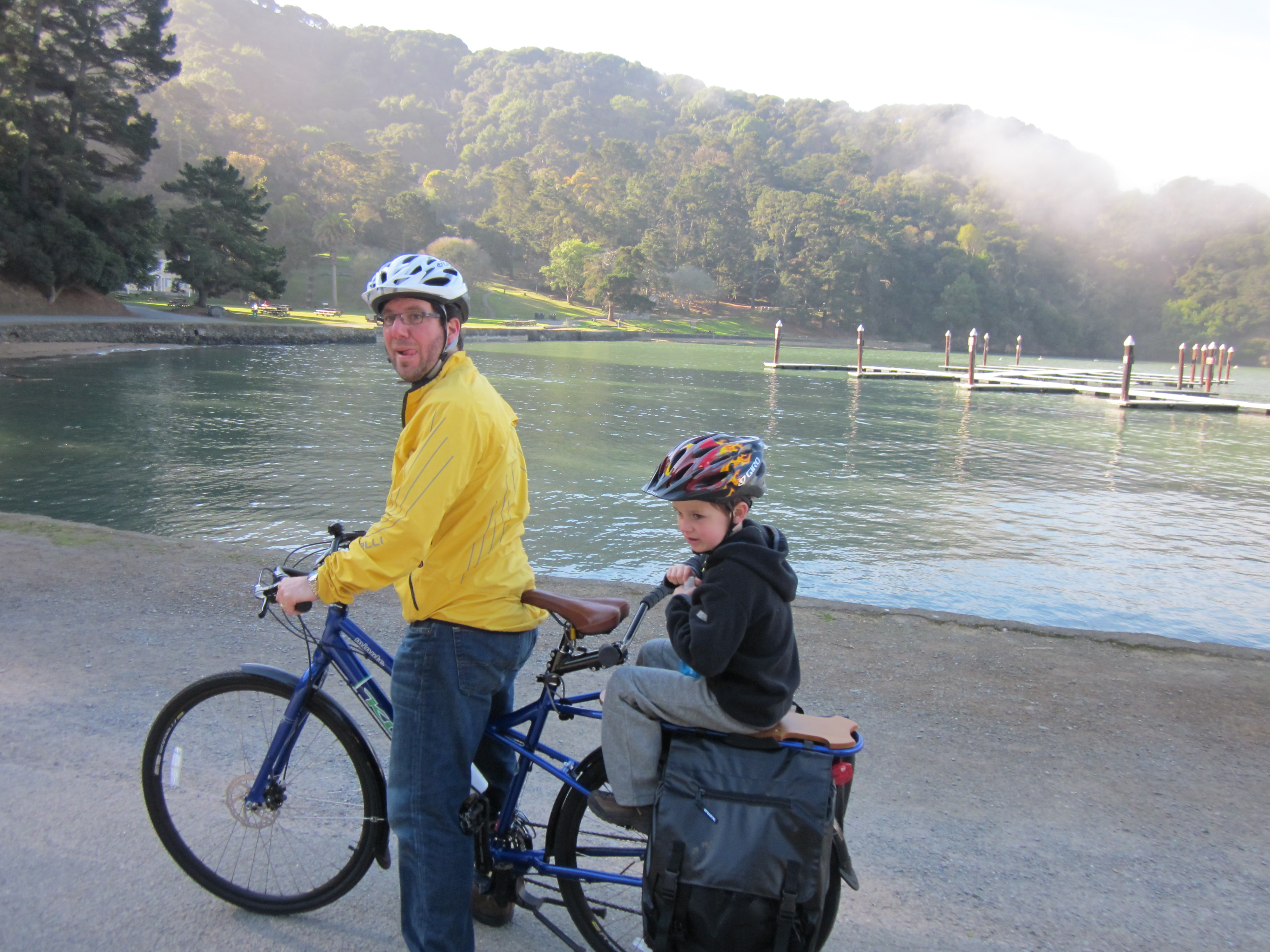
Our son’s school is on the way to Matt’s office (more or less) so normally they ride together, Matt drops him off, then continues on to work. He also typically does the pickup at after-school, and they ride home through Golden Gate Park. The MinUte is always ready to pop a kid (or even two, if they’re old enough to hold on) on the back.

So for the last couple of weeks, I have been doing most of our son’s drop-offs and some of the pickups. It’s been nice to have this extra time with him in the morning. I hadn’t used the Bobike Junior regularly; it pops on and off the bike in less than a minute, and for regular commutes it is mostly off. But for the last week it has been on my bike full-time. On our morning rides, we bomb down the hill from our house as a starter (no worries: the neighbors already have Child Protective Services on speed dial) and head into Golden Gate Park, over to the Panhandle, then up to Alamo Square and back down to Japantown. This is a very cool ride; in the early morning, when it’s still half-light, the park is still thin on other bicycle commuters and the trees hide the car traffic on either side.

Waiting for the light in the panhandle

Our son can be very chatty on the bike, and he enjoys the view. He is sometimes irritated by the pannier encroaching on his foot rest, and the other day, he entertained himself by lightly kicking my calf on every pedal stroke. “I don’t want to ride with the pannier again!” he yelled. “I don’t want to shove a backpack in your face,” I answered. I forget what else we talked about, and now only remember that we were laughing so hard that we were bothering the joggers, who normally reside exclusively in iPod land. We learned later that one of his classmates saw us while driving by (we arrived at school only a minute later than they did, which still astonishes me). Her dad told me that she asked why she couldn’t ride to school too.

I like the way the Breezer takes the hills, so when we’re headed up to Alamo Square and the lights are timed right, we can jump up the incline pretty fast. That day we raced a garbage truck. We lost, but held our lead for longer than I expected, given that I had a 1st grader and his school gear on the back.

The loathsome eastern approach to my office

After his drop-off I head up to work, taking the grim eastward approach to Laurel Heights, which packs all of the elevation in at once at Post Street, then drops me off at the intersection of California and Presidio, a nightmarish snarl that usually leaves me walking my bike through the intersection rather than attempting to ride it. Thank goodness I have a step-through frame: hit the red light, slither off to one side, walk the bike through the crosswalks, hop back on.

People always ask me whether the folded Junior is a battery pack

I am still vaguely amazed that a seat like the Bobike Junior even exists. It solves an unusual problem; most parents with kids our son’s age would have them riding to school on their own bikes. Traffic and hills and the transition to after-school make that impossible for us, but I don’t think our situation is exactly typical. And yet thanks to the canny Dutch, we’ve found an out-of-the-box solution that’s both effective and a lot of fun.

29 Comments

Filed under Bobike, Breezer, commuting, family biking, San Francisco

These are the ways we ride to school

First day of first grade

We have found that our son’s elementary school contains an embarrassment of riches (for the record, this is an under-enrolled Title I public school in San Francisco, not the usual candidate for perceived awesomeness, a complete sleeper of a school). These riches extended, we learned this year, to a range of bicycle commute strategies with kids.

Bicycle commuting to school in San Francisco is not like it is in other locales. Kids enrolled in lower grades can’t usually ride on their own, due to traffic and hills and distance; this is a citywide school, and some families are coming from quite far away. Moreover, the after-school programs at our school are mostly off-site, and students take the bus from the school, meaning that there’s no way to take a kid’s bike along after school lets out. Finally, we haven’t yet had bike racks installed at the school (we’re on the list) so there’s no place to leave a bike even if kids could ride. The teachers who ride bring their bikes into the school building, but this isn’t something that would work for a bunch of kids.

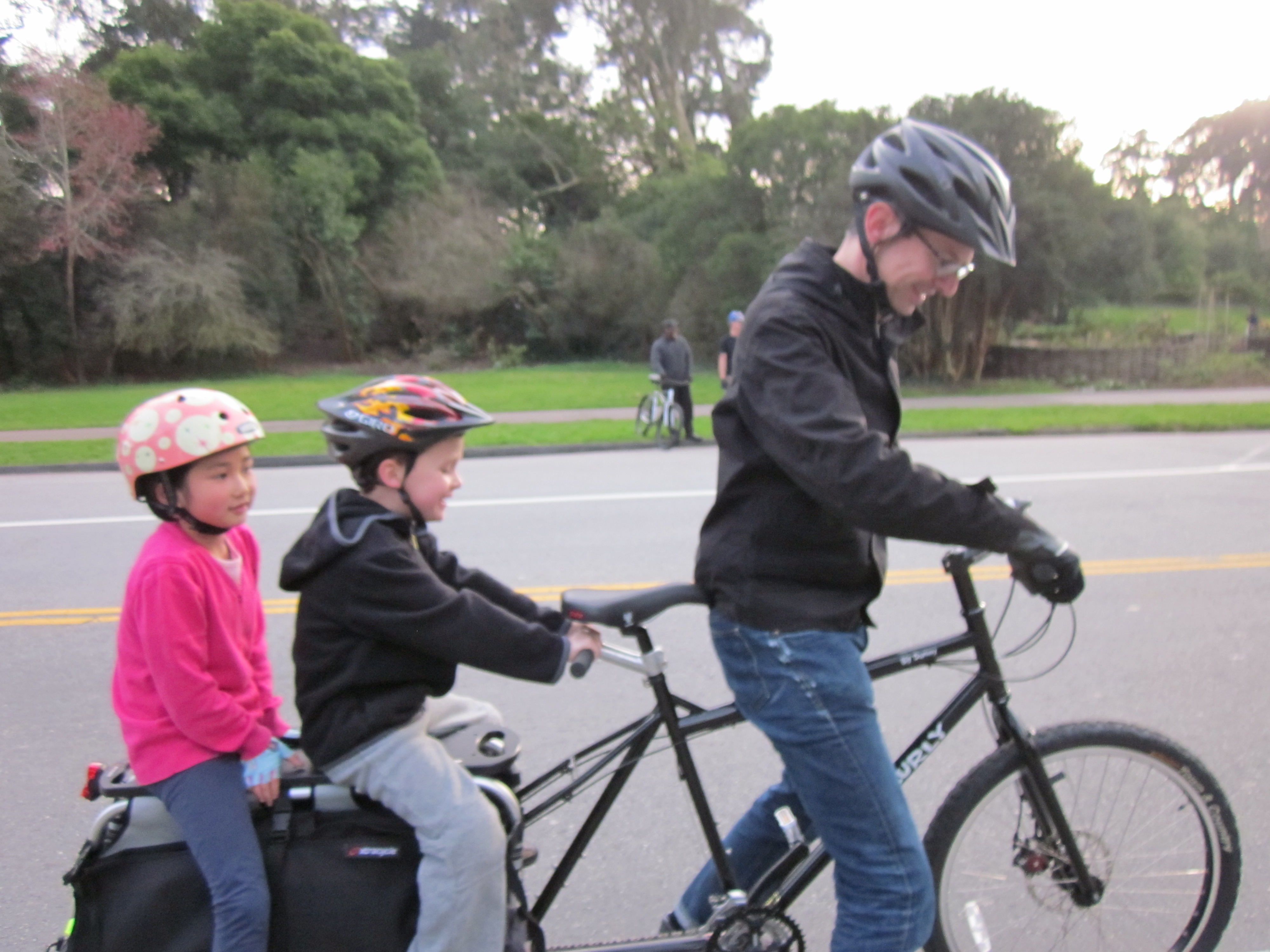
So typically we all have to ride with the kids with us somehow, and as I’ve mentioned before, city people rarely use trailers (they ride below the sight line of cars, tip on uneven pavement, don’t fit in the bike lane, etc. etc.) That means kids on our bikes. It is more challenging than the run-of-the-mill bicycle commute to school, but it’s worth it. We are often ad hoc, but we are ready to roll. Herewith, a morning’s worth of photos; an incomplete list of the ways we ride to school.

School bike #1: Bike Friday triple tandem

#1 (and by far the coolest):  Bike Friday triple tandem. Our PTA treasurer and his partner ride this bike with their daughters, who are in kindergarten and 2nd grade. They say it is the best way to commute with two kids to school in the city, and I believe them. It is easier for their dad, who is about 6’ tall, to captain, than it is for their mom, who is more like 5’4”. She reports that she needs help on the hills from the girls and she needs to concentrate while riding. The girls have to synchronize their pedaling with the parent who’s captaining; this is, I am told, not necessary on all tandems, but it is necessary on the Bike Friday [update: not exactly true; my brother-in-law wrote to tell me that any tandem could be retrofitted to have freewheel cranks that let one rider stop pedaling]. Our kids desperately want a triple tandem.

How they afforded it: They used to ride the girls to school on a tricked-out Kona Ute, which they bought and modified by hand while their youngest was still in preschool. They sold the Ute to finance the tandem, which they got for about 1/3 the list price by buying it used on eBay after searching for a used triple tandem for some time. The seller, based in LA, was unwilling to ship it, but they had a cousin in LA they visit regularly. He picked it up, and on their next visit, they took it home with them. The Bike Friday packs up in a suitcase!

How they store it: Bike storage is no joke in San Francisco. The girls’ aunt lives on the same block they do and has extra storage space, so they keep the big bikes at her place (they also have an adult tandem that they found used for free and had their bike shop fix up).

School bike #2: Surly Big Dummy

#2: Surly Big Dummy. Our friend Shirley takes her girls (1st grade and 2nd grade) to school on the deck of her Big Dummy. While they’re in school, she takes the Dummy out to do errands. I have talked about the Dummy before. It is a fun bike.

How they afforded it: They have a car that was in a horrible accident and needs several thousand dollars in repairs. Last year, they decided to skip the repairs and drive it until it failed and buy a Big Dummy (plus another bike to come) with the money they saved. When the car dies, they will be car-free.

How they store it: “It’s a problem.” They have a very small garage space with their rental apartment and squeeze the bike alongside (I presume that they don’t care about the finish of the car as it’s effectively totaled). When the car finally dies and is hauled away, however, they’ll have a very generous bike stable.

School bike #3: Giant + spare saddle on the top tube

#3: Giant with a spare saddle. One of the kindergarten dads has bolted a spare saddle to the top tube of his bike. He puts his daughter on board and takes her to school that way. When I talked with him about it, he said that although his method was totally inappropriate for long rides, their commute to school is a gradual descent over about 10 blocks and so he just coasts slowly the whole way, then drops her off, pops off the spare saddle and commutes to work.
How they afforded it: He had a spare saddle lying around anyway: this modification was free. If you had to buy one, I don’t know, $10-$20?

How they store it: No extra storage needs; it’s just a normal bike with a saddle on the top tube!

School bike #4: Kona MinUte

#4: Kona MinUte: I’ve written about our MinUte before. We ride our son to school on the back deck; we added stoker bars and some foot-pegs. This is a great bike and a flexible set-up.

How we afforded it: We bought bikes in lieu of a second car we’d been saving to buy (thank goodness).

How we store it: The MinUte isn’t much longer than a normal bike and thus has no real storage issues; Matt keeps it in a shared cubicle at his office, for example. But at home we are rich in space suitable only for bicycle storage thanks to a vituperative 50-year grudge match between the university (we live in university housing) and the local neighborhood association that prevents the partially-conditioned basement under our building, which the university was legally obligated to make ADA-accessible, from being used for a more practical purpose such as housing, or, for that matter, parking more cars.

School bike #5: Breezer Uptown 8 with Bobike Junior

#5: Breezer Uptown 8 with Bobike Junior. I haven’t written much about riding with the Bobike Junior before, as it usually makes more sense for Matt to ride our son to school on the MinUte. But with his recent injury, I’ve been handling the daily trip to school, while Matt walks our daughter to preschool then takes the N-Judah to work.

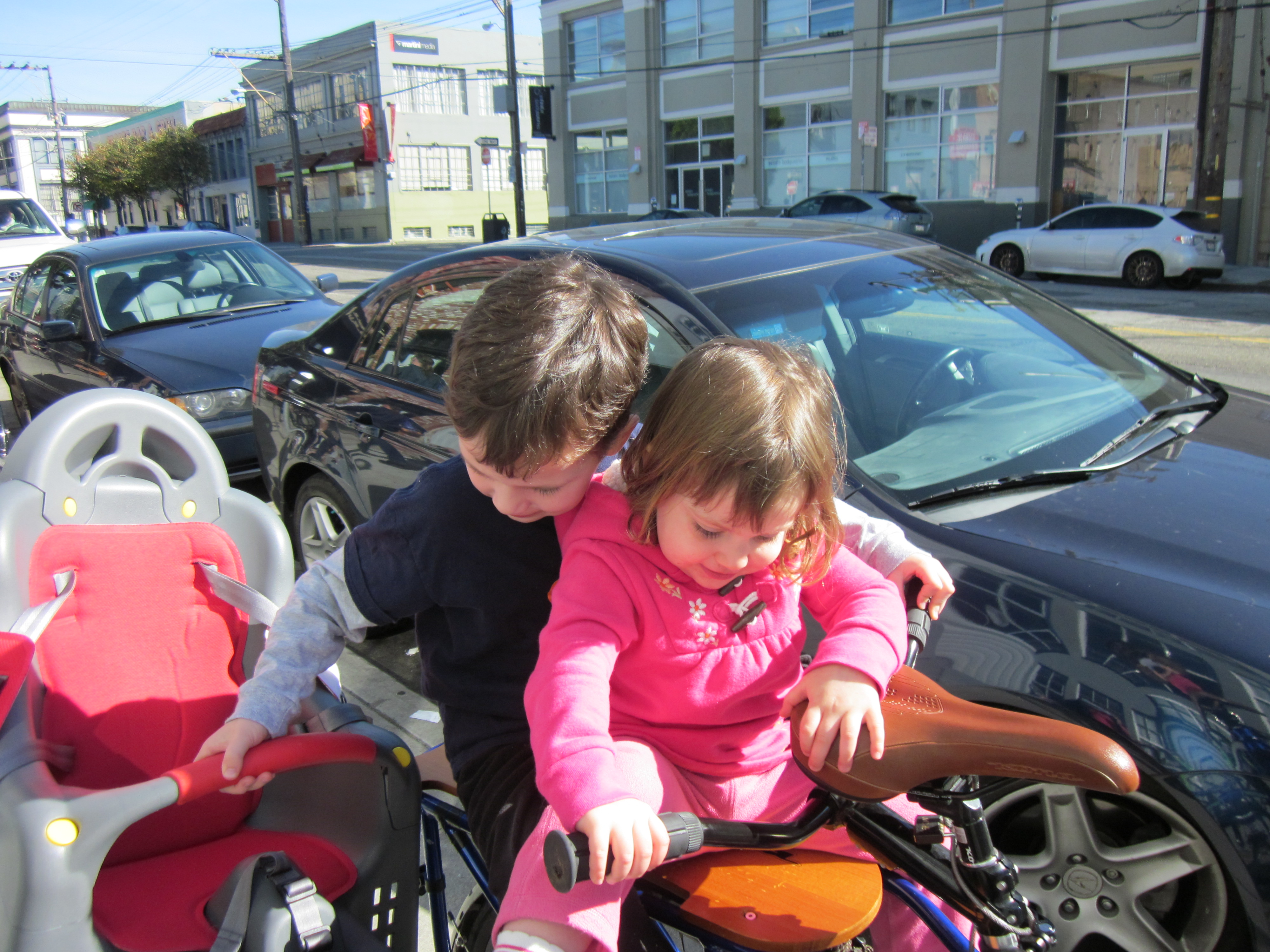
The Bobike Junior takes some getting used to, as the seat rides high, which makes the bike more tippy. It felt unstable at first. But as I’ve gotten used to it, I’ve come to love this seat. My son rides very close to me, almost as close as a backpack, and I like that when we start the ride, he hugs me from behind. It is easy to have a conversation with him because he is so close. I can turn to talk with him at stoplights and he comments on the ride, encouraging me to go faster downhill (I’m cautious; I don’t have disc brakes). It is a bit of a hassle to fit a pannier underneath this seat, and once it’s on, it encroaches a little on his foot pegs. Nonetheless, I will happily ride with my son on the Junior until he won’t tolerate it anymore.

That said, I have a suspicion that this seat might be less appealing to a shorter rider. I am 5’7.5” (to be painfully precise) and that is apparently tall enough that I can handle loads put higher on the bike without much trouble. When our friends with the triple tandem had their Kona Ute, they report that the mom had trouble handling the bike with the girls up so high on the back; she is ~3-4 inches shorter than I am. I’ve noticed that shorter people often mention they prefer to keep the load down lower, but on the other hand, there is a metronome effect. The lower loads are more stable, but if you lose control, it is a nightmare righting the bike again. The higher loads are less stable, but if you lose control, it is much less trouble righting the bike again (assuming you are tall enough). I find that I like the ease of righting the bike given that my kids bounce around a little, but some people prefer just the opposite. This is not something I’ve seen discussed much but I suspect it may be part of the reason people have strong opinions about the Xtracycle/Yuba lines (lower loads) versus the Ute and regular bikes with child seats (higher loads).

How we afforded it, how we store it: See above, blah blah, didn’t get a planned second car, it’s a normal-length bike so no atypical storage concerns, but we have tons of bicycle storage space as a side effect of a long-running town-gown battle.

These are some of the ways we ride to school. And this explains, I imagine, why our kids are begging to get a bike as obscure as a triple tandem.

14 Comments

Filed under Bobike, Breezer, cargo, commuting, family biking, Kona, San Francisco

Bike v. bike: Yuba Mundo v4 meets the Surly Big Dummy

It's fun to say "Mundo"

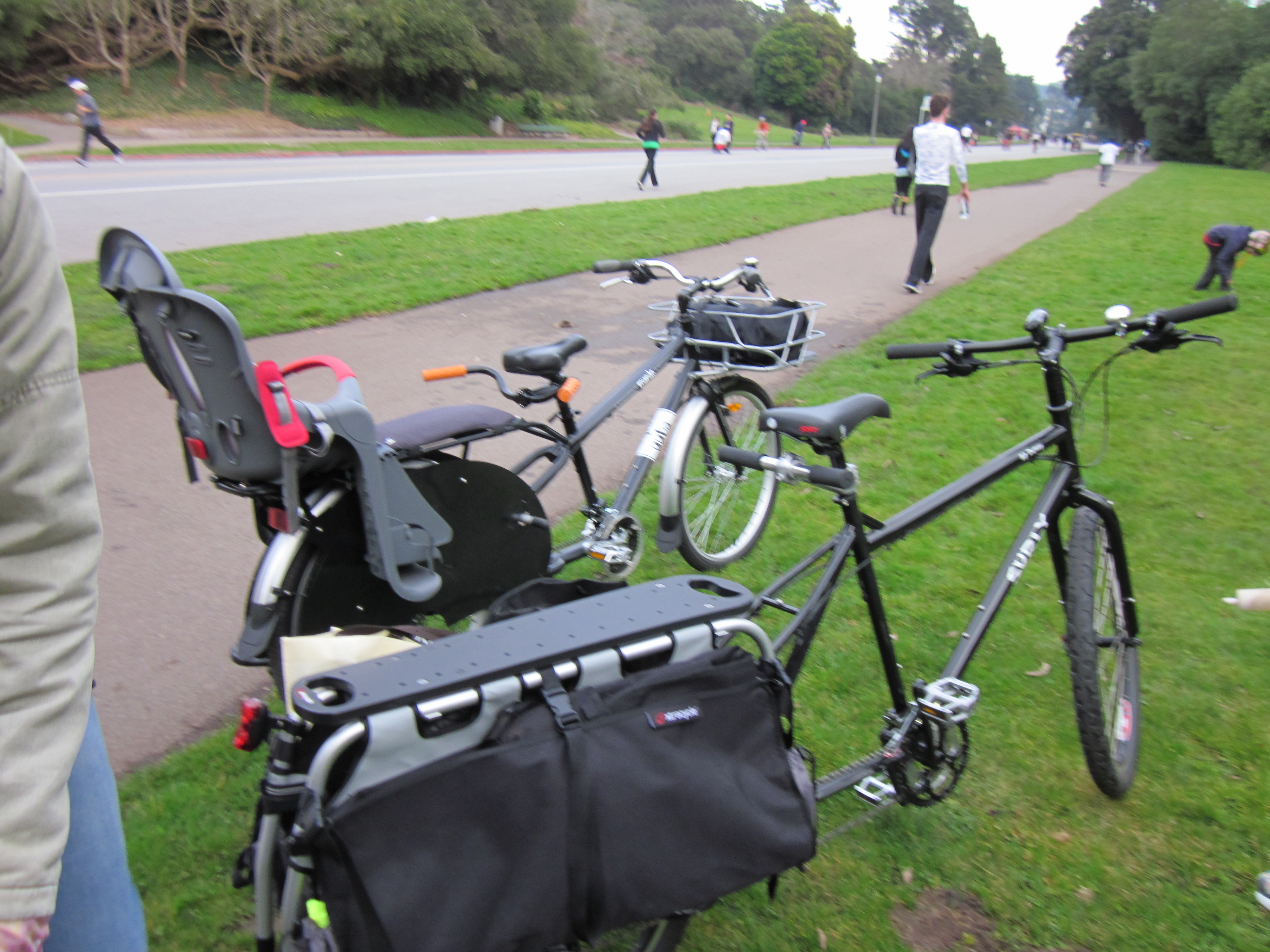
Last week, while hauling around on the loaner Mundo, we met up with our friends from school who recently bought a Big Dummy. They were interested in the Mundo and we were interested in the Dummy. We all met up at Golden Gate Park on Sunday at Sunday Skate to compare the bikes.

Shirley takes her girls (1st and 2nd grade) to school every day on the deck of the Big Dummy. On weekends, her husband B.D. rides the bike and she rides on the deck, with the girls riding alongside on their own bikes. She says she gets some great videos this way, and it is an awesome sight to see them riding en masse. The ride to school with the kids on deck is mostly downhill, but she’s got to get them back home again, and they live on Lone Mountain. There is evidently some pushing, but she’s made it up many hills with her legs alone, and reports receiving applause from passing drivers for this accomplishment. I went up to Alamo Square with my two kids on the Mundo: where is my applause? Honestly, there is no justice in the universe.

Two big bikes roll into a park...

So anyway, that afternoon they rode around on the Mundo for a while and I rode a bit on the Dummy. We were in the park, so we didn’t try any hills, but it was still an interesting comparison. These bikes look similar in some ways, but they are wildly different. If I had to summarize briefly (not my strongest suit), I would say that the Mundo is like an ox, and the Dummy is like a horse. They’re both useful, but sometimes you want the carrying capacity of an ox and sometimes you want the speed of a horse.

Learning to ride the Mundo was not easy for me (not just me). It is a heavy bike that feels more like a wagon sometimes, hard to start and slow to stop, although once the momentum kicks in, riding it is mellow enough. Getting on the Dummy felt like getting on a regular bicycle that just happened to be somewhat longer than usual. I couldn’t ride the Dummy with much of a load, because Shirley and B.D. are taller than I am, and none of us are the kind of people who carry Allen wrenches everywhere we go to adjust the seat height (as if that were not obvious). The frame size was fine, but I didn’t feel comfortable putting my daughter on a bike that I had to hop down from at a stop, and for that matter, they didn’t have a child seat. So I rode it mostly unloaded. It felt fast, and it was easy to pick up and ride.

Business in front, party in back

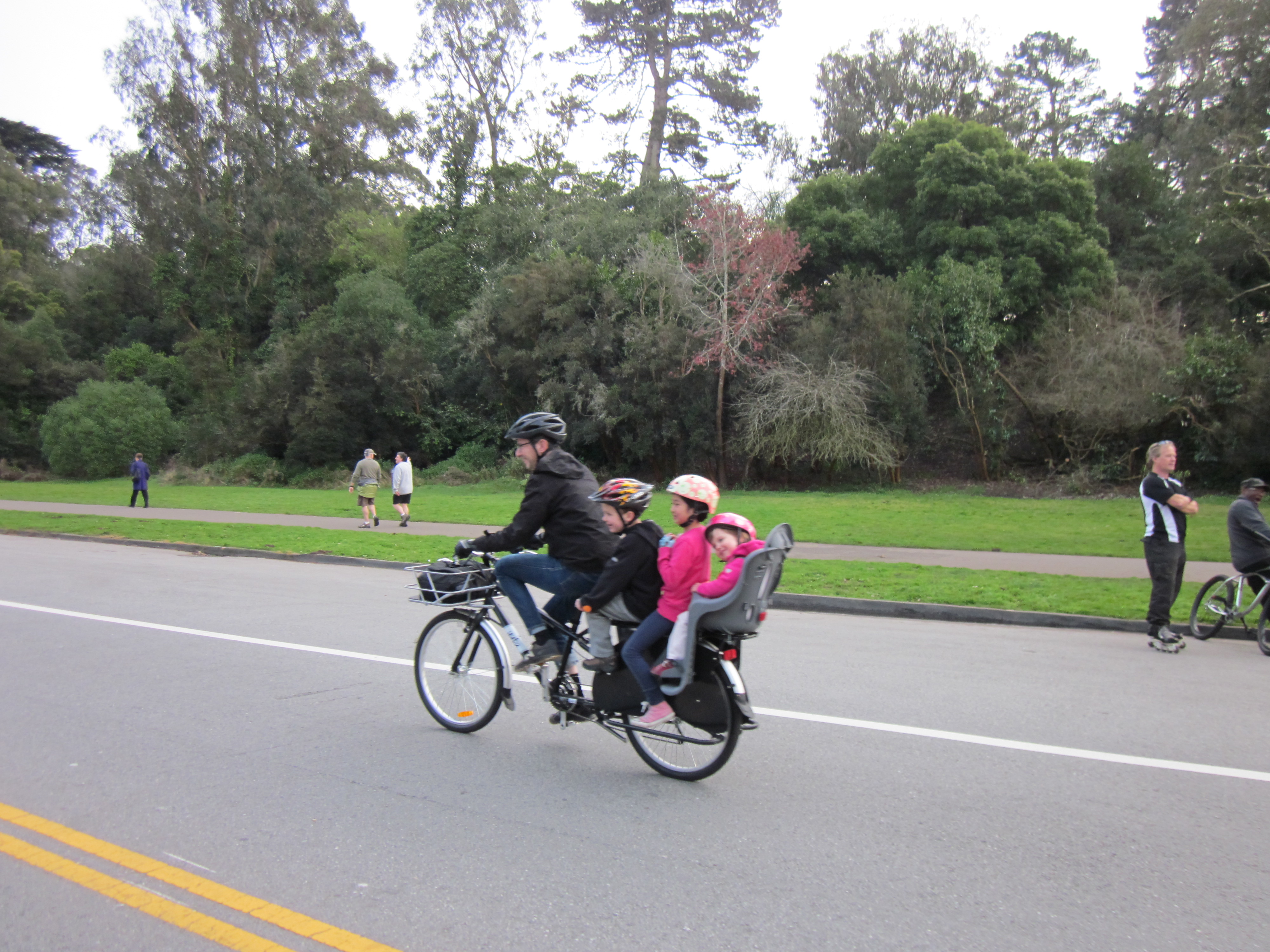
But B.D. and Shirley could ride both bikes fully loaded, and their opinions are more informed anyway. They liked riding the Mundo, particularly the fact that it could carry three kids effortlessly. They feel that two older kids is the maximum safe load on their Dummy. Because they’re used to riding a cargo bike already, they picked up riding the Mundo much more quickly than I did. They too found the Bread Basket disconcerting at first, and almost tipped the bike figuring it out (I am not alone!) But like me, they loved the carrying capacity it added with kids on board. The kids all agreed that the Mundo was awesome, and wanted to pile on as a foursome, which we did not allow them to do. We have limits: only three kids per bicycle! For that matter, they agreed the Dummy was awesome.

Okay, next bike

Both Shirley and B.D. liked the feel of riding the Dummy better, and we all agreed it was more nimble. They also noted that the Dummy had better components, including both a lighter frame and disc brakes (optional and an extra charge on the Mundo). I concur that disc brakes should not be optional on a cargo bike in San Francisco. But, as B.D. pointed out, “The Mundo is $1,000 cheaper!” And it comes with fenders and a double-kickstand that is fearsomely stable, but hard to use: this was the only part on either bicycle that I could operate better than they could, having practiced. Neither bicycle, to everyone’s annoyance, comes with hub dynamo lights. “Why doesn’t our bike have lights?” asked Shirley. “Why doesn’t ours?” I replied. Goodness knows you’re not going to be worrying about weight or drag with either bicycle.

After riding the Mundo, we realized what the MinUte can do (it is parked)

Which bicycle would I get if money were no object? Trick question: we’d get the Kona MinUte again. We have realized lately that we’ve underestimated the MinUte; it can do far more than we’d realized. I can ride it! With both kids on board! This is a story for another day. But it’s an honest answer in some ways: I think that both bikes are designed for families that have different needs than we do.

We are a small family living in a city with extensive shopping; by preference, we get groceries several times a week in small quantities, and we carry, at most, two children. And we live on a mountain. And we are car-light, not car-free. If we were a suburban/small city family with 3 kids, particularly if they were older and we were more experienced riders: no question, the Mundo. If we were a city family like Shirley and B.D., with more serious shopping loads and a different kind of commute, we’d get the Big Dummy. If we wanted to haul furniture or heavy loads regularly, we’d get the Mundo. If we took long rides, especially off-road, we’d get the Big Dummy—B.D. took their kids on the mountain biking trails around the Palace of the Legion of Honor on the Dummy, and they all had a great time. None of us would attempt that kind of ride on the Mundo.

And of course, if money is an issue, the Mundo’s price is dramatically cheaper, even with the shouldn’t-be-optional disc brake upgrade. If money isn’t as much of a concern, the Big Dummy has more range, and it is a lot easier to ride.

I couldn’t be more pleased I got the chance to ride both bikes, and our kids were crushed when we had to pack it up at dusk (no hub dynamo lights on these bikes! curse The Man!) Riding around on cargo bikes with our kids is the best way we’ve found yet to entertain ourselves on a weekend afternoon. I would never have imagined this and it is hard to explain. Shirley and B.D. had the same difficulty that I do communicating how wonderful it feels to ride with our kids, completely different from any other mode of transportation or even any other activity. We still can’t believe it’s cheaper and easier than driving, and we keep wondering what the catch is. Like them, I am so grateful that we started this wild ride.

11 Comments

Filed under commuting, family biking, Kona, San Francisco, Yuba Mundo

San Francisco hills and grades

When we started riding our bikes, we feared San Francisco topography. We expected to need the elevator that goes up the hill to our neighborhood every day, and that was one of the reasons we avoided a real cargo bike, which was too long to fit in it. A while ago Stacy at A Simple Six asked me about our experience riding on hills, and whether we’d looked at electric assists for our bikes. I was surprised to realize, when she asked, how long it had been since we’d thought much about the hills on our regular route that much. We got stronger, and now we ride. I can’t remember the last time I took the elevator unless I was walking.

And yet. The hill where we live is no joke. If I’m carrying a kid home, I prefer to shower or at least swipe a wet washcloth even if I ride very slowly (even though my office is on a different hill, it’s not as intimidating and sweating is not an issue unless I’m somehow possessed with the idea of going fast).  I cheerfully gave up feeling guilty about not ever managing to talk myself into HIIT at the gym given that it’s required several days a week just to get home. Moreover, there are places in the city that we simply will not go.

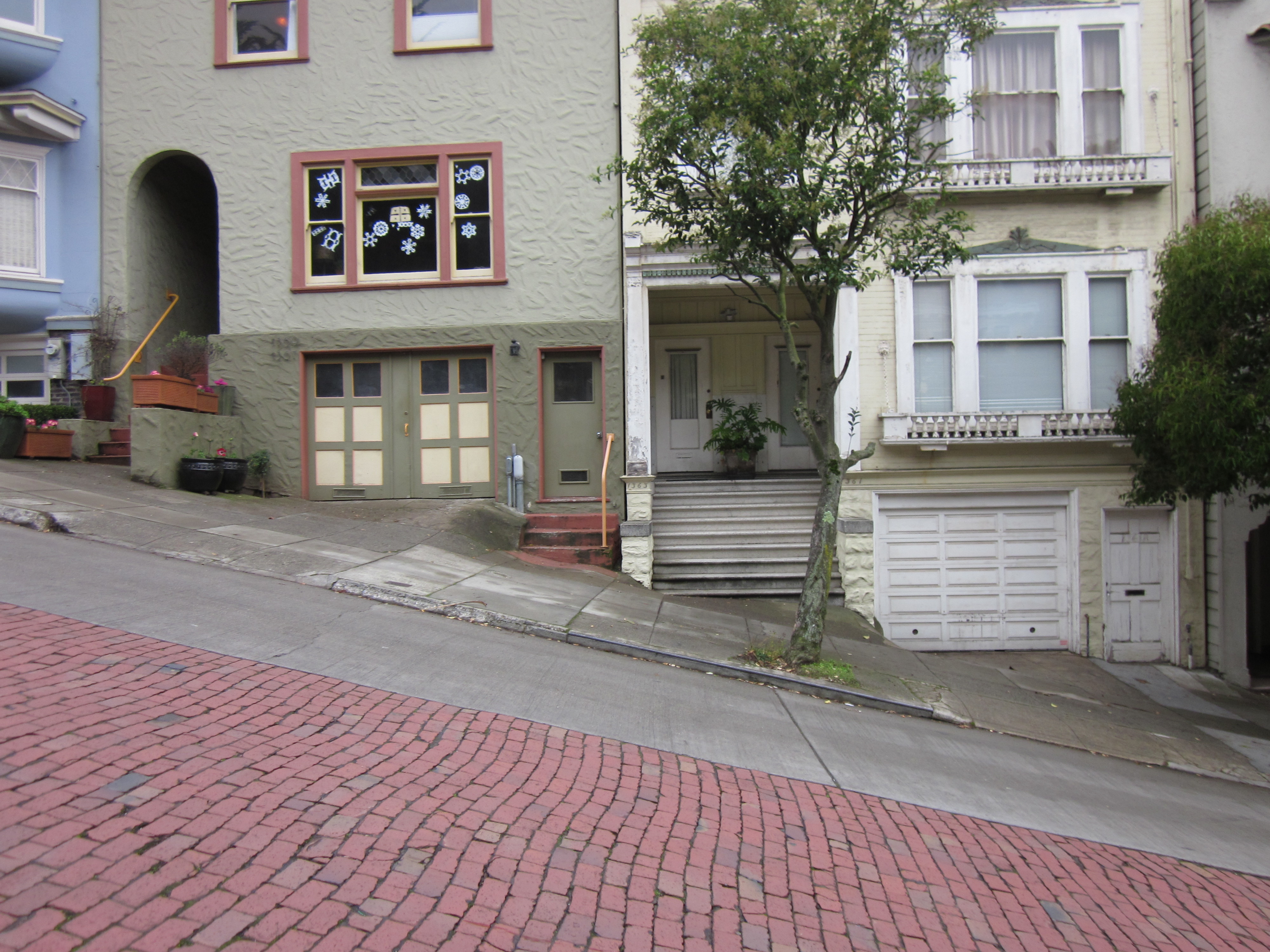
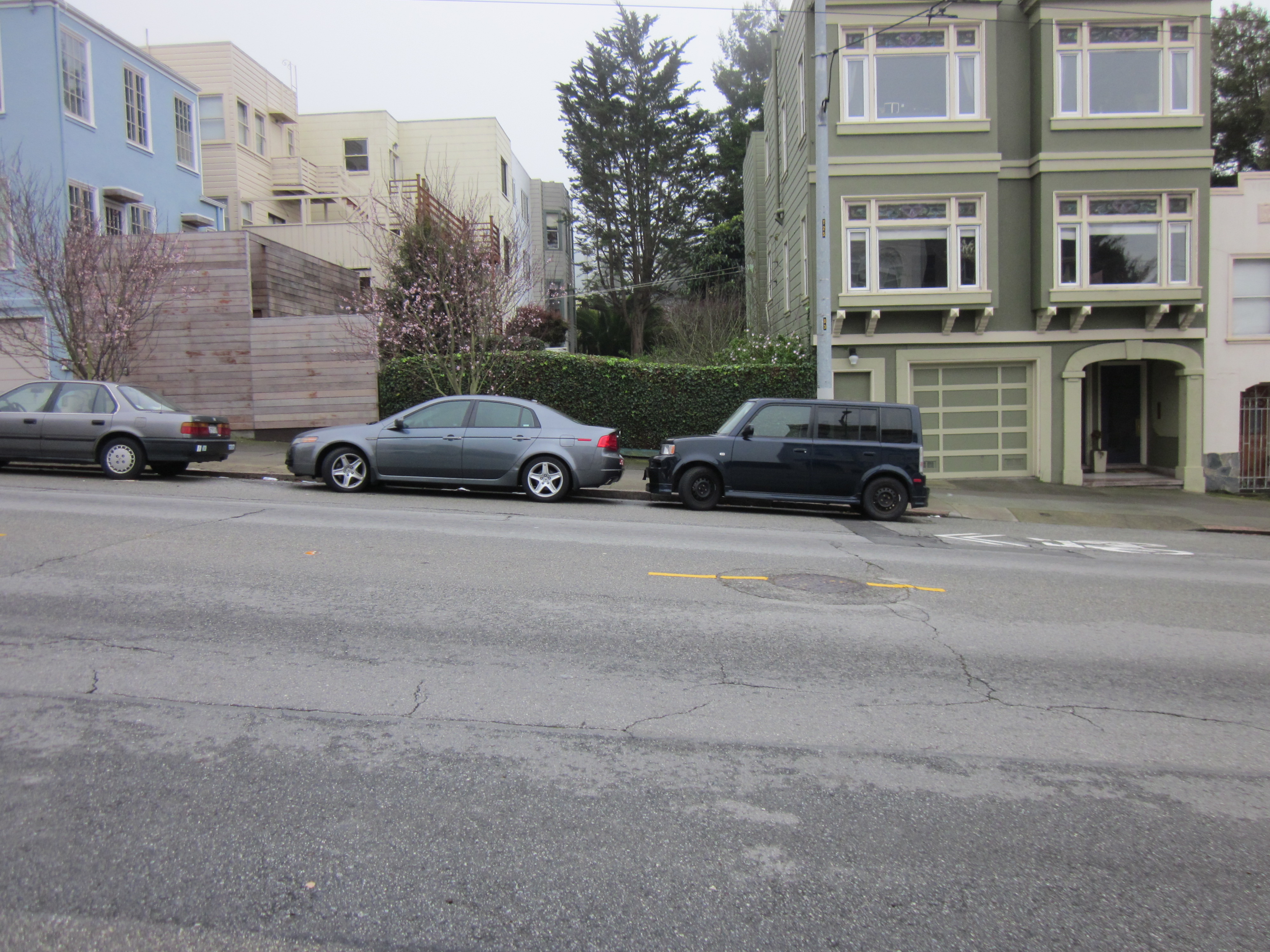
What do I mean by hills? Here’s a sampling from around our neighborhood. Grades are drawn from veloroutes and the SFBC city map.

Hill #1: 25% grade (probably)

Hill #1: This is one of the direct routes to our home. We do not ride our bikes up this hill. We don’t drive up this hill. My students tell me they will detour three blocks to avoid walking up this hill. It is difficult to get an accurate grade, because it is bordered by the campus, and thus not surveyed by the city, but when veloroutes isn’t saying the grade is 35%+ (I find this unlikely), it claims it is 25%, which I find more plausible.

This hill has become the hideout for campus smokers (smoking is forbidden on the hospital campus) because no one else wants to go there. Taking this photograph was unpleasant as I was surrounded by secondhand smoke.

Hill #2: 17% grade

Hill #2: This is the other direct route to our home. We do not ride our bikes up this hill. We do drive up this hill when we’re in the car, and when relevant, we’ll walk up it. It is supposedly about a 17% grade. Like Hill #1, it is easy to photograph from the side because cars are not allowed to parallel park. Instead, one side of the street is nose-in 90-degree parking, and the other side is reserved for two travel lanes. This is what the City and County of San Francisco does when the streets are so steep that cars might actually roll down them while parked, even if the wheels were curbed.

Hill #3: 13% grade

Hill #3: A pretty direct route to our home. We have ridden our bikes up this hill with our kids aboard, once, in my case, with both kids aboard. That was an experience I would prefer not to repeat. This hill is estimated to run about a 13% grade, which still requires nose-in parking on one side of the street only (thus no cars in the photo) but is not so immediately off-putting to the experienced local that the thought of finding alternate routes seemed required. We walk up and down this hill several times a week and have never given it a second thought when driving. However once we learned there was a reasonably convenient detour that spread the same elevation over two blocks instead of one, we started taking that route almost exclusively. But our kids love bombing down this hill in the morning. Yeah, we’re bad parents.

Hill #4: less than 10% grade

Hill #4: On the alternate route home. This hill is less than 10% grade, and pretty typical for the streets around the city. Unless you’re in the flats of the Financial District/SoMa/China Basin (or headed there through Golden Gate Park and along the Wiggle), you’ll be going up and down a few hills like this on a typical ride in San Francisco. There are two hills like this on my way to work; one pretty short (behind the Conservatory of Flowers) and one long, extended haul up to Laurel Heights.

Cars are parallel-parked on both sides of the street; I view this as a sign that I can probably ride a potential route, even if I’m carrying one or both kids, and so far that’s been a safe assumption. That doesn’t mean the experience will be pleasant, as my efforts to drag myself up Post Street and Fulton Street have proved, pretty definitively. So far I haven’t had to get off and push, but there have been close shaves.

Hill #5: same old, same old, less than 10% grade

Hill #5: More of the same, another less than 10% grade. Again, parallel parking means that I can ride up this hill without having my heart leap out of my chest and leave me lying on the ground gasping like a fish out of water, at least on a good day. Note that all of the cars have curbed their wheels; this is the law in San Francisco, and the fine for failing to do so is so draconian that even as an occasional driver, I cannot stop myself from doing it, even it means that I spend a minute trying to figure out which direction on a flat street is closest to downhill. Matt once got a ticket for leaving his wheels straight on a flat stretch of street between two hills because he couldn’t figure out which way to turn them. He contested that ticket and won, but if you’re visiting, well, if you’re visiting you probably shouldn’t be driving in the city, you won’t enjoy it.

But if you simply can’t help yourself, good luck to you, and curb your wheels. A tremor (they’re pretty common) will shift cars a bit all over the city, which means car alarms galore, but curbed wheels mean that those parked cars won’t careen down the hill taking out a swath of other cars and pedestrians. So basically I’m pro-curbing.

Going up hills on a bike, even relatively low-key ones like these, requires some thinking if you have kids on the back. I used to regularly come close to popping wheelies as I started up the hill due to all the weight in the rear. Now I compensate by pushing down hard on the handlebars as a counterbalance as I approach; it’s only the moments when I’m distracted by something and forget that I realize that I’ve developed the habit.

Part of the reason that I am concerned about having the ability to haul our kids on the bikes for years to come, even though our son is old enough to ride, is the hills. Our kids are strong and they’ve never known any other terrain. They see us riding these hills and they accept them as normal. However I suspect it may take some time before they’re really comfortable going up several of them in a single ride on their own. I would be delighted to be proven wrong, but I think it’s safest to be prepared to bail them out.

18 Comments

Filed under commuting, San Francisco

Three, three, three

Daddy made it home in time for cupcakes

Today was our daughter’s birthday. Now she is three.

What she wanted for her birthday (among other things, including: a big girl bed, playdates with her closest preschool friends, a trip to the ice cream store) was to ride on the Yuba Mundo to school with her brother for morning Rajio Taiso (since that video was shot, the middle yard has been replaced with an edible garden and the wall has been painted over with a mural, but the tradition continues in the lower yard).

Since we started riding and our daughter started preschool near our house, her chances to visit his school, which she loves, have dropped significantly. Each of our bikes currently carries one kid, and the prospect of riding all the way there just to turn around and go back home is not especially appealing anyway. So trips to school have pretty much been reserved for times when one of us is on the road and the other drives both kids to school, as the alternative of dropping her off at preschool before 7am is unappealing to say the least.

But for now, we have a bike that carries two kids (and then some) and it was her birthday, and she was already disappointed that Matt was out of town. So I packed up the bike the night before, and in the morning, loaded up both kids. Just getting to the street in the morning on such a long bike is an undertaking, particularly when Matt is away. By the time I got outside, I realized it was raining. Fortunately the kids were in multiple layers.

All aboard!

Getting our son to school is a non-trivial trip, although most of it is a pleasant ride along the Panhandle before morning rush hour. However there is no avoiding the hills between home and school, and at some point we have to soldier up and pick the best of a bad lot. Our best route is a steep climb up to Alamo Square, then back down. On a bike that weighs over 50 pounds. With two kids on the back. In the rain. Round trip. I figured I could push the bike if I had to.

It turns out that with that kind of load, forgetting the rain gear was zero problem for me as the rider. I was so overheated after I got to the top of Alamo Square that the rain was turning into steam about six inches from my body, like a low-rent halo.  But I managed to make it up to the top without stopping. Yeah! I’m a mule!

When I stopped at the light on the downhill, a couple pulled up in a car next to me, and rolled down a window. Both were laughing. “Did you know that your little one signals when you do?” asked the passenger. “Like this!” laughed the driver, sticking out his left arm. “It’s SO cute!” I had no idea, but I was delighted.

Although it was a grind of a ride, it was a lot of fun. Along the path in the Panhandle it’s easy to talk with the kids because there’s no traffic noise, and for some reason, the acoustics of the Yuba Mundo are pretty good; I can hear both kids and they can chat with each other. Their conversations often make no sense to me, but they seem to enjoy them. And commuting on a long bike with two kids on the back is apparently more than twice as entertaining to the world at large as commuting with only one. Other riders frequently commented (“WOW!”), drivers stopped in the street to stare and grin and wave. As our friends with the Bug Dummy note, everybody loves a parade. I never enjoyed our driving commute, so it’s nice to feel that we’re now improving someone else’s, although it feels like cheating to get congratulated for doing something we love. Our son’s entrée into the schoolyard felt like escorting a visiting monarch, as kids walking to the school yelled his name and pumped their fists in the air when they saw us ride by. “Cool bike!” they shouted.

Riding back up the hill to Alamo Square was harder. It’s steeper on the return side, and I was tired. About halfway up I stopped for a while and invited my daughter to enjoy the view. “Are you going slowly, mommy?” she asked. She is no dummy.

By the time we got to the Panhandle again the bicycle commute was in full swing in the opposite direction. My daughter had taken to singing me songs, mostly Particle Man, a song that does not yet bore me even though she knows only two words. “Particle Man! Particle Man! Particle Man! Particle Man!” We saw hundreds of riders, mostly on their way to work, and with the rain, poison-frog-yellow Ortlieb panniers had sprouted off the side of many bikes like horizontal mushrooms.

"I'm a present!"

Every once in a while I’d see a dad (only dads for some reason) with a child seat on the back of the bike, or with a trailer-bike. I’ve realized that parent riders recognize each other instantly. They rang their bells in salute, we smiled and waved hello! Hello! My daughter was thrilled with the attention, which she seemed to take as worldwide recognition of her birthday. “I’m three!” she yelled. “I’m three!”

It was a hard ride, but I never could have imagined how much fun it turned out to be. There are so few of us with children in San Francisco; it’s not a family city. People give up on the schools without even visiting (our son’s lovely school is, astonishingly, under-enrolled). Parents flee the commute, not realizing they could ride as we do. We few, we happy few.

3 Comments

Filed under commuting, family biking, San Francisco, Yuba Mundo

At last, it rains

The untouchable Novara Stratus makes its debut

In November and December, expecting the winter rain to start at any time, we prepared for the season by buying cycling rain gear. At that point, for some reason, prices were amazing, which is the only reason we were even vaguely prepared. Our rain jackets were purchased for half off regular price, and waterproof pants were even cheaper; I think mine cost $10? My mom sewed rain pants with cartoons of angry dinosaurs on them for our son. He tried to wear them as pajamas but we had to nix that.

And then: nada.

We were beginning to think it was another drought year. December was warm and dry, great for riding, but leading us to fear a return to the days when restaurants wouldn’t bring a glass of water and people were encouraged not to water their driveways. Evidently in the Inland Empire and SoCal, people water their driveways. Watering lawns during daytime hours and washing cars were also discouraged. But also: watering driveways. I have lived in California now for years, off and on, and I still don’t understand this state.

I was starting to feel kind of stupid. It looked as though we’d dropped a lot of dosh and shopping effort on rain gear we wouldn’t need until next year, or in the event of a real multi-year drought, several years. We were preparing for real Northern California rain, too, not the endless drizzle of my Pacific Northwest childhood, but the insane barrel-of-water-dropped-on-your-head downpours that scared the daylights out of me when I first moved here. These kinds of rains left my waterproof shoes filled with water that was then impossible to remove and once led me to attempt to dry my soaking wet clothes on the (forbidden) space heater in my office. It turns out there’s a reason they tell you not to dry clothes on a space heater, who knew? My entire outfit ended up with giant brown-edged holes in it. People across the hall complained about the smell and sent the department manager to investigate. I skulked home in my gym clothes. It was a low moment.

This year the rains came late but seem eager to make up for lost time. And I smelled the sweet scent of victory over the elements. I rode to work in the pouring rain but with waterproof pants, jacket, and boots, I was feeling great. There are some extra issues to consider: I can’t see as well; giant puddles at the edge of the road mean taking the lane more often; braking is best done early and often. On the other hand, there are many fewer cars on the road, and they are slower and more considerate. And once I stripped off the rain pants and jacket, no one believed I had ridden to work.

Empty racks=rainy season

It turns out that it’s fun to ride in the rain with the right clothes and the right bike. I haven’t spent so much time outdoors in serious rain since we were kids visiting my grandparents and didn’t care about getting soaked in the local thunderstorms: they’d just hose us off in their laundry sink. For the last several years I was always scurrying from one covered place to another when it poured. But seeing the world in the rain is pretty. The city smells green. I had forgotten.

Matt checked in after taking our son to school geared up as I was, and sent his impressions:

“The ride this morning in the pouring rain was actually great… especially after 3 days of driving 4 hours a day! [Matt had to drop off and pick up both kids while I was away.] The investment in gear has totally paid off — rain jacket and pants, bike shoes, smart wool socks, thermal gloves — I was completely dry from neck to toe.  Only remaining gaps are a) goggles or some other solution to keep my glasses from fogging over (I just took them off eventually, but then the rain gets in your eyes); and b) a helmet cover (optional, but would be nice to have dry hair on days when I have to show up a little more dressed up and collected).

The boy loves his rain pants and boots so much, he insisted on keeping them on in the classroom.  With the balaclava, he’s even better covered than me on top.”

Riding in a San Francisco winter offers fewer challenges, I realize, than riding in other winter climates. It snows here about once every 30 years, if we’re lucky, and temperatures are unassuming. But it’s nice to conquer our little challenges even so. And of course we’ll always have the hills.

2 Comments

Filed under commuting, family biking, San Francisco, Uncategorized

The Breezer Uptown 8 (step-through)

Nice bikes… too nice

I knew what I wanted: a bicycle with all of the bells and whistles that commuters typically have to add to bicycles, unless they buy heavy, expensive Dutch bicycles: lights that didn’t need to be charged, gears that couldn’t drop off the chain, ability to hold tons of weight. Basically a dorkcycle.

It was easier to find the child seats I wanted, thanks to our European experience. And in retrospect there is good advice out there suggesting that you pick the child seat before the bike anyway. We’d become familiar with the Bobike Maxi, but our son, nearing six, had aged out of that seat. At that point most people stuck the kid on a trailer bike or their own bike, but we had length and school drop off and pick up problems that made that idea a non-starter. The other option to haul older kids was a longtail bike (and this idea still has some appeal) but my husband was riding a sorta-kinda cargo bike that seemed to be meeting that need.

Bobike has a seat that doesn’t get much attention in the US, the Bobike Junior. It holds a kid aged 6-10 weighing up to 75 pounds. It looked like what I wanted, assuming that I could find a bike that would take the weight. This is not a cheap child seat, but we were looking at using it for not one but two kids over the next decade, and what’s more we’d bought car seats around the same price point that didn’t get as much use. (And of course, if we’d bought a second car, we probably would have had to double our car seat collection too.) It seemed insanely difficult to find reviews of this seat in English, but eventually I found someone who’d not just noticed it and thought it looked interesting and then balked at the price, but actually hauled a kid on it for years. That was the indefatigable Adrienne of Change Your Life, Ride A Bike, who not only sang the praises of the Junior, but lived in San Francisco and recommended a local bike shop that stocked it. I had previously assumed that the seat was only available in the US from the family biking Promised Land of Clever Cycles in Portland, Oregon.

Both of these were helpful recommendations. The Bobike Junior is an outstanding seat, and the only way that I could imagine hauling an older child on a normal bike. And Ocean Cyclery has been great to us, as one of the few San Francisco shops we’ve visited that has extensive familiarity with child seats (owned by an American/Dutch couple with kids of their own), welcomes kids who show up in the shop and start tearing around, and stocks an extensive selection of bikes set up for both commuters and kids themselves. The last time we visited, the bike in the front window was a commuter step through with a Bobike Mini on the front and a Bobike Maxi on the back. Other than shops with “Dutch” somewhere in the name, I’ve never seen anything similar elsewhere. And although I try to harp on price too much, reminding myself that we could buy a dozen bicycles without hitting the price point or storage problems we’d face acquiring a second car, Dutch bicycles sell at prices that made me concerned making a bad decision, especially given their weight. Maybe they’re a good value on a per pound basis. Whereas Ocean primarily carried bicycles with price tags way under $1,000.

Moreover, Ocean carried a line of commuter bicycles that I’d never seen in person, but was reading crazy-good reviews about from all over the place: Breezer. I do research for a living, and at this point have descended to the kind of intellectual tail-eating where I conduct systematic reviews and read articles about how to process too much information. As a result I no longer trust my own individual judgment much because research tells me it’s much less reliable than the experiences of lots of other people. And lots and lots of other people liked the Breezer Uptown. Big, heavy men liked it and said it hauled 300 pounds without a shudder. Almost everyone said that riding an Uptown was like riding a couch, in terms of nonexistent saddle soreness or lower back pain. It had a mountain bike pedigree and was, as a result, geared for hills. It came with every commuting accessory: fenders, dynamo lights, internal gears, a chain guard, even a rear wheel lock. And even loaded up with all of those extras, the bike weighed only 35 pounds; light enough that even after adding two child seats, I’d still only have achieved the weight of the single-speed Dutch bikes we’d rented in Europe when they were carrying nothing at all. I could imagine lifting this bike (and I do in fact lift it every time I park it at work).

There were, admittedly, comments that the Breezer Uptown was unlovely, with all the practicality and style of a vacuum cleaner. And it was not a bicycle that was setting any land speed records. These concerns struck me as aesthetic and irrelevant. I was looking for a dorkcycle, and anyone riding a bicycle in the United States is already hopelessly unfashionable anyway. I wanted to haul 75 pounds of children plus our gear up the non-trivial hill we lived on every day. I didn’t care if the bicycle looked like a cinder block if it was comfortable to ride and could climb. If anything, having a bicycle that didn’t turn heads might reduce the odds of it being stolen. Bicycle thefts in our neighborhood have progressed to the point where prevention means U-locking your bike inside a safety coffin in your bedroom.

Ocean Cyclery had a Breezer on the floor that I could try, although they warned me I was too tall for the medium frames they had in stock and it wasn’t really ready to ride. The shop is located near a weird but friendly test ride: a street converted from an old horse-racing track in the middle of the city that made a perfect 1-mile loop, with a couple of hills heading on and off. They were right that the frame was too small for me, and the front fender was loose and rattled the entire time, but even so the bike was more comfortable than anything else I’d been on in my visits to seven other bike shops in San Francisco. The owner thought my desire to put two child seats on the front and back was a nifty idea; it was something he’d wanted to do with his own kids before realizing they were too far apart in age. And unlike every other bike shop where I’d proposed this idea, he immediately understood why this meant I’d need a step-through frame. After hearing where we lived, he thought (and my brother-in-law confirmed) that the 8-speed was the best bet to get me home every evening.

I made a deposit on a Breezer Uptown 8 that afternoon. Buying a new bike in the late fall meant that the price was way below list; in the same range as the (estimated, wildly varying) price of buying a used bike of dubious provenance and trying to upgrade it to something like what I wanted, and astonishingly, cheaper than buying it online and having to assemble it myself (which I couldn’t do anyway). Bonus! The owner was sure it would arrive and be ready before my husband’s next trip to China, making it possible for me to ride my son to school while Matt was away. Of course it was late. We drove to school that entire week.

As always, my bike needs more stuff hanging off it

When the bike arrived, my daughter was ecstatic. On my first ride she insisted on climbing aboard and shrieking, “I’m riding it! I’m riding it!” until my significantly more cautious son couldn’t take the humiliation any longer and jumped aboard despite the absence of the stoker bars he’d grown accustomed to. He likes riding the Bobike Junior on my bike. I like this bike too.

I did not dip my toe slowly into bicycle commuting. My first few rides were with both kids on board up hills with double-digit grades. Because I was totally ignorant I did that with the hub dynamo lights on, which meant even more drag. Even so, I did not have to walk. For the first month I never took off either child seat, even when the kids weren’t riding along, because I didn’t know how, meaning that I was regularly hauling an extra 20 pounds no matter what. I take my son to school on this bike once a week, haul my daughter around all weekend long, and on days that they’re not on board, load up two panniers and a front basket with most of our weekly groceries. I ride this bike pretty much everywhere but the Tenderloin (where it would be covered with piss and/or vomit if I were lucky enough not to have it stolen) and the Mission (where it would simply be stolen). I have never been saddle-sore, and only rarely, after a long ride with kids and gear, have I felt any pain at all after riding. Braking on the downhills with a kid on the back can be unnerving—it takes quite a bit more preparation than it does when riding alone—and I’ve nearly popped a wheelie going up some steeper hills in the city with one of them on the back, but more informed people tell me that these things would happen on any bicycle.

Off road, on road

The Breezer, as I’d hoped when I bought a bike tricked out with every commuting accessory known to nerds, makes it easier to ride my bike most of the time than to drive our car. Thanks to the Bobike oeuvre, that’s true even when I’m going somewhere with one kid in tow. When I step onto this bike I feel like I’m ten feet tall. The lights come on with the flick of a switch. The lock is always on board, although given where we live I think that all bikes should come with a U-lock holder in lieu of the largely-decorative rear wheel lock. Even with kids on board, it glides up the endless San Francisco hills, and I can even afford to keep the lights on. I’ve only had to walk it once, when I lost momentum because Matt was weaving in front of me (and he had reason). As I’ve gotten stronger I’ve been able to reserve the first gear more and more for heavy loads. I wouldn’t call this a fast bike, but I’m just trying to get to work with my teaching clothes looking decent, and anyway I ride through Golden Gate Park most days and it’s gorgeous there, so I’m in no special hurry. And once I started taking the child seats off when the kids weren’t on board, my commute got noticeably faster. On days when I’m whizzing down the hill out of the park past a row of stopped cars, our household’s Pixar obsession has led me to yell, “Ride like the wind, Bullseye!”

I can imagine that someday when the kids are older and riding on their own I may want a prettier, faster bike. For the foreseeable future I feel like I’ve made the right decision, even though this bike, like Matt’s Kona, isn’t always everything I want it to be. I would be happier if the bike could still carry both kids at once, and if the rear rack were longer so it fit panniers when the Bobike Maxi is attached (panniers do at least fit under the Junior) or if came with a front rack. The front light could be brighter. I would happily swap the top two gears for an even lower first gear. These are not big complaints.

When I am riding around the city, my Danish helmet and our child seats draw lots of attention and compliments. No one has ever complimented me on my Breezer. I cannot bring myself to care.

22 Comments

Filed under Bobike, Breezer, commuting, family biking, reviews, San Francisco

Figuring out commuter bikes

When we got Matt’s bike (the Kona MinUte) we assumed that we would switch off riding it for a while to get used to bicycle commuting. When we realized that I couldn’t ride the MinUte and our daughter wasn’t safe on it without installing a child seat anyway, that plan went out the window. Moreover, the obvious fun that Matt was having with our son was making our daughter crazy with envy. We were ready to ride.

Still, although we were still thousands of dollars under the budget for even the used car we’d been thinking about buying earlier in the year, and thus willing to buy a second bike in relatively short order, I was nervous about making a bad decision. We knew nothing about bicycles except that riding the Kona was going pretty well for Matt. And I tend to perseverate about even the simplest decisions, an occupational hazard of years working as a researcher. Typically I can get around my own unwillingness to buy anything because it might be the wrong thing by picking up something cheap on craigslist. But my brother-in-law, the only person we knew who was really informed about bicycles, thought that that was a really bad idea because (a) used frames could be rusted or crushed and we’d never know (b) we also didn’t know what size bike I should be riding and (c) we are not handy and had no idea what a working bicycle should do.

Paper: the only material we are comfortable working with

Saying we are not handy is an understatement. Matt once electrocuted himself while changing an ancient lightbulb while we were living in Paris, right in front of the building handyman, who made him go lie down and had me check his pupils for the next several hours. In middle school I got my hair caught in a buffer in shop class, forcing the instructor to sprint for the emergency switch that shut down the building’s power, pulling a chunk of my own scalp out, and earning myself notoriety for years afterward in the form of a safety sign placed directly above that machine and a marquee mention, by name, in the “Terrifying Things That Could Happen To You In Shop Class If You Don’t Put Safety First” annual lecture. Rarely have two people been better matched to desk jobs than we are.

So I started reading reviews. I didn’t know anything about bicycles, but after a lot of reading, I finally progressed to the point that I knew very little about bicycles. My primary goal was to get to work every day with a minimum of bother and to carry my kids and happily that makes a lot of stuff that you can read about bicycles totally irrelevant. There was actually a class of bicycle for people like me: the commuter bicycle. These bicycles, at their lowest maintenance point, which was my ideal point, came with

  • gears that lived inside the rear wheel and instead of on rings that might drop a chain (hub gears)
  • lights that turned on and ran by themselves whenever the wheels of the bike turned (hub dynamo lights)
  • chain guards (even hub gears needed a chain; a guard would keep it from getting dirty and catching my dress pants)
  • fenders (to prevent the stripe of mud blown up my back by the tires after hitting a puddle, so familiar from my years of childhood biking in the Pacific Northwest)
  • step-through frames, for days I wanted to wear a skirt without embarrassment, and to make it plausible to mount a front child seat and a rear child seat at the same time and still get on the bike
  • rear racks to hold panniers and eliminate the sweaty back that would result from carrying a messenger bag
  • a kick stand to hold the bike up in the event that I wanted to ever put anything on that rear rack
  • if I was lucky, a rear wheel lock that kept the wheel from turning when I was away from the bike (in San Francisco, using a rear wheel lock as the only lock would be roughly comparable to attaching a bicycle to a chain-link fence with Scotch tape, but in combination with a U-lock and a cable lock, would presumably politely suggest to bike thieves that they might consider another bicycle)

These accessories all add weight, so I quickly passed on the kind of advice that had people removing what I’d always assumed were essential bike parts, like brakes, to ensure that they were riding something that weighed less than my children did at birth. Even so, unfortunately for me, bicycles that possessed most or all of the commuter extras seemed to come in one of two categories: beautiful slender bicycles rated to carry my weight and a laptop and not much else, meaning that they wouldn’t safely carry my kids (we heard a couple of horrifying stories from parents on campus about the spokes on their rear wheel simply snapping in two, one after the other, as they tried to wheel forward after putting the kid in the seat on bikes like these), or heavy Dutch-style steel bicycles rated to carry a few hundred pounds that were never designed to get up San Francisco hills.

A summary of a conversation repeated at seven different San Francisco bicycle shops:

“I want a bicycle with child seats that I can use to drop my kids off at school and then go to work.”

“Okay, where do you live?”

“Parnassus Heights.”

“Then that would be an aluminum bike.”

(I would be remiss if I didn’t mention that some people do in fact ride heavy steel Dutch bikes up San Francisco hills. However they never seem to have the kind of load on them that I wanted to haul, namely 75 pounds of children plus 20 pounds of child seats on the front and back, plus all of our nontrivial gear. I am immensely grateful that there are people importing practical bicycles like these to the US, and would love to ride one in another city. But although at 130 pounds I’m not outrageously heavy myself, doubling the weight on the bike without doubling my leg strength seemed like a dubious plan given that the bicycles themselves were no slouches in the weight department. I regularly portage tired kids on long walks and thus did not fear picking up a bicycle in the 30-45 pound range and putting it on a bike rack or carrying it up the stairs. That’s easy dead weight relative to a squirming kid. But figuring out the weight of Dutch bicycles was like watching a nauseating burlesque as the reviews rolled in; they weighed 45 pounds, or maybe 55 pounds, or okay, 68 pounds, and yeah, okay, their riders were walking up a lot of hills. And I had experience riding a Dutch bicycle overseas. My experience suggested that I would be walking up a lot of hills. And this was before adding 20 pounds of child seats or either kid. Maybe one day when I am stronger or when my kids are old enough to ride alone.)

(I would also be remiss if I didn’t mention that there are apparently handy people in this world who convert bicycles that can’t carry a lot of weight into bicycles that can carry a lot of weight by upgrading all of the components, ideally, it seemed, after rescuing a vintage frame preserved for decades under a bag of lawn fertilizer in a grandparent’s garage and swapping spare parts with similarly-minded aficionados through an internet-based mystery-bag-style barter economy. Sometimes this process seemed to involve tools like blowtorches. As wonderfully frugal as that sounded, I had no idea what parts were even involved in this transition, we are, as noted, totally not handy in an actively self-destructive kind of way, and we didn’t have any bicycles lying around to upgrade anyway. All our grandparents were dead and their garages had been emptied by ruthless estate sale agents. Instead we were eager to Support Our Local Bike Shops. You’re welcome.)

At least I knew what I wanted: a bicycle that could safely carry ~250 pounds, that came stock with accessories that made it possible to just wheel out the door without too much thought (hub gears, definitely hub dynamo lights, a chain guard), that was geared to handle serious hills, and that ideally didn’t weigh more than about 40 pounds, since I was planning to add 20 pounds to it before even leaving the shop. My brother-in-law said that there were bicycles all over Germany that fit this description, but they were so ugly that no one in the US would sell them. I wanted an ugly bicycle right here in these United States. Eventually I stumbled upon one.

5 Comments

Filed under commuting, family biking, San Francisco