Category Archives: traffic

#virtualfamilybikegangride

Park panda

Saturday was the #virtualfamilybikegangride. Thanks for the inspiration, cargo biking families! I had a complicated morning, because I had to give a talk on campus just after Matt and my son left for a week in Boston. This violated one of my parenting principles, which is Do Not Work On Weekends (Especially When Your Spouse Is Out Of Town And You Must Pay A Sitter), but it made my department chair and my dean happy, and this is worth something too, given that I am currently up for review. And I was home in time to make lunch and attempt to get my daughter down for a nap. No nap, unfortunately, but the effort meant we got a late start.

"I say 'Cheese!' and 'Shy cookie!'"

For a change of pace, we took the Kona MinUte, now that my daughter is old enough to ride on the deck safely. At my kids’ current ages (3 and 6.5) the medium-tail really shines, as it can carry either or both of them without any need to attach a child seat. There are things I would change about that bike (e.g. compatibility with bus rack, better brakes, more stable kickstand, chain guard, dynamo lights, front basket—and even making the possible changes would run a tab higher than the list price of the bike), but it is very easy to use for multiple purposes, and that alone makes it probably our best ride almost all of the time.
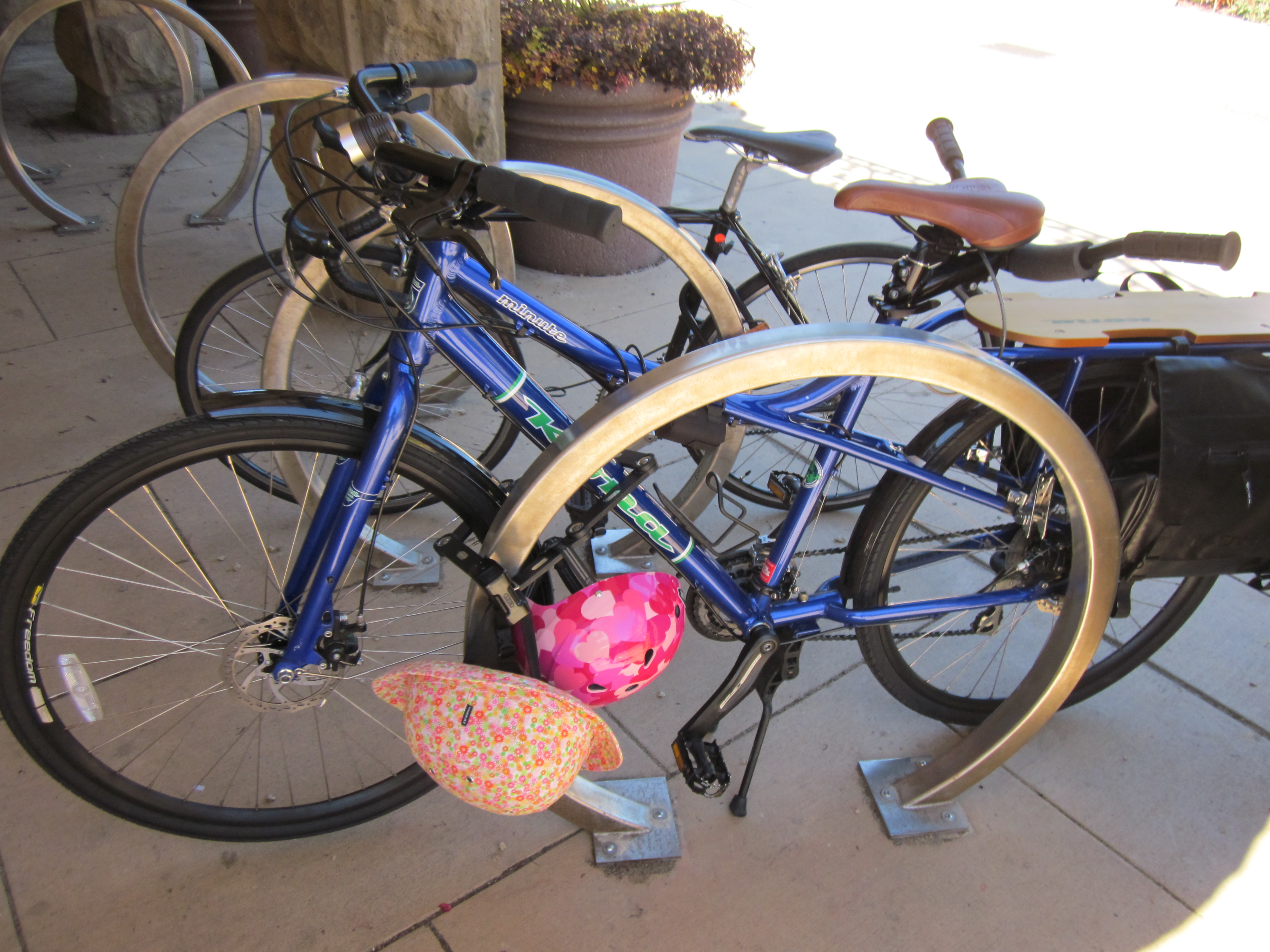
Bikes and helmets locked; let's play!

My daughter wanted to go to the park, and was thrilled at the chance to ride Daddy’s bike. We headed to the Koret Children’s Quarter at Golden Gate Park, a quick downhill from home. I am always amazed to find ample bike parking there, as it is packed with both people and bikes, but I think that most people must be unaware of the racks under the Sharon Building, or just like to keep their bikes on the playground itself. Also there are mostly kids’ bikes on the playground, which suggests that a lot of people are driving with the bikes in the car.
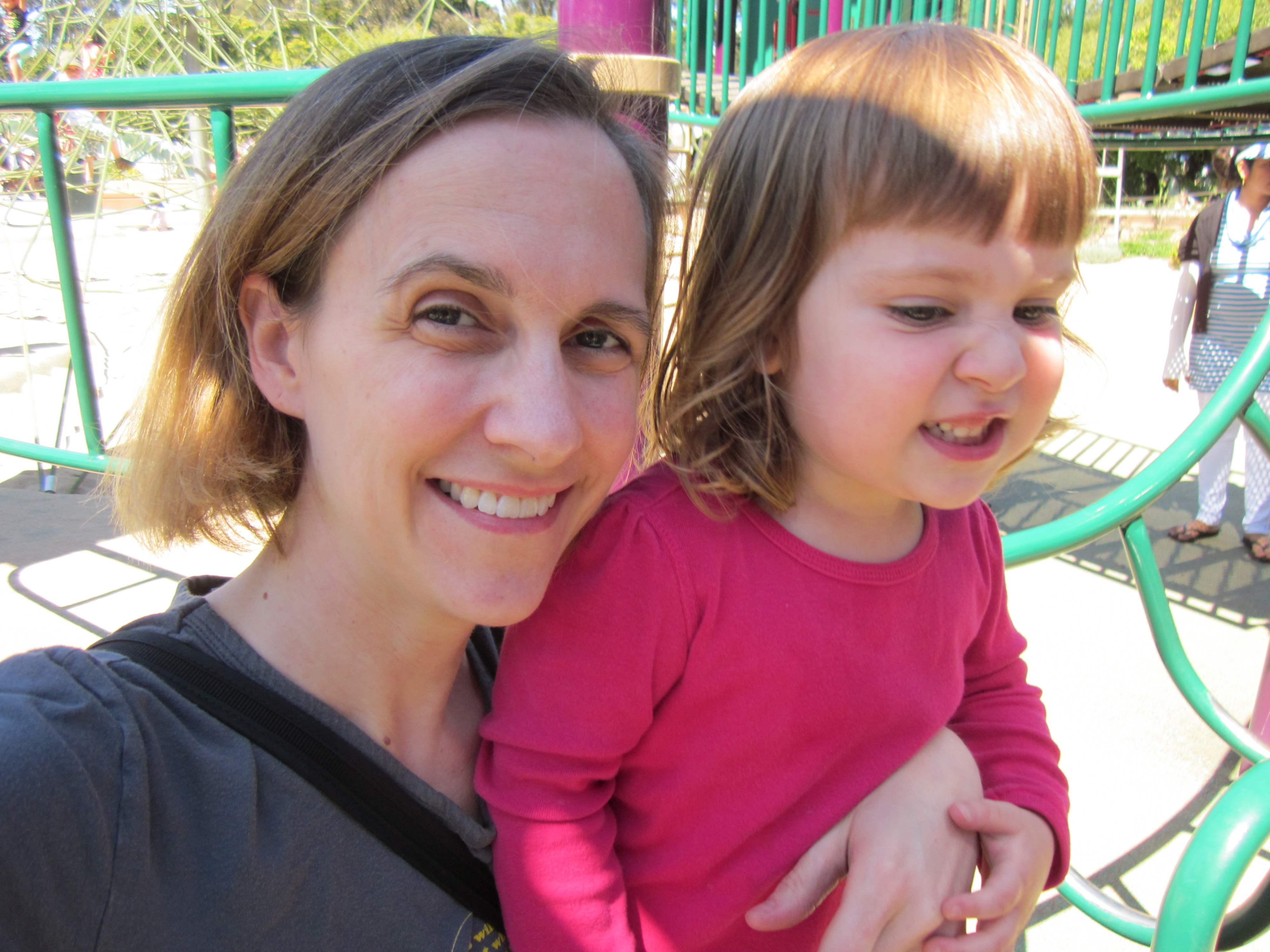
Happy happy.

The weather was unbelievable for San Francisco, sunny and warm, verging on hot. And I was struck once again as we arrived at how effortless it is to travel this city by bicycle, assuming you’re not facing a hill. We rode past dozens of cars circling for parking or stopped, complete with fuming drivers, hopped off, locked up the bike and helmets, and went to play. No waiting, and easy. And for the first time all day, even as I watched my daughter express her lust for danger by climbing up various ladders and ropes, hanging off monkey bars, jumping off decks and barreling down giant slides, I felt relaxed.
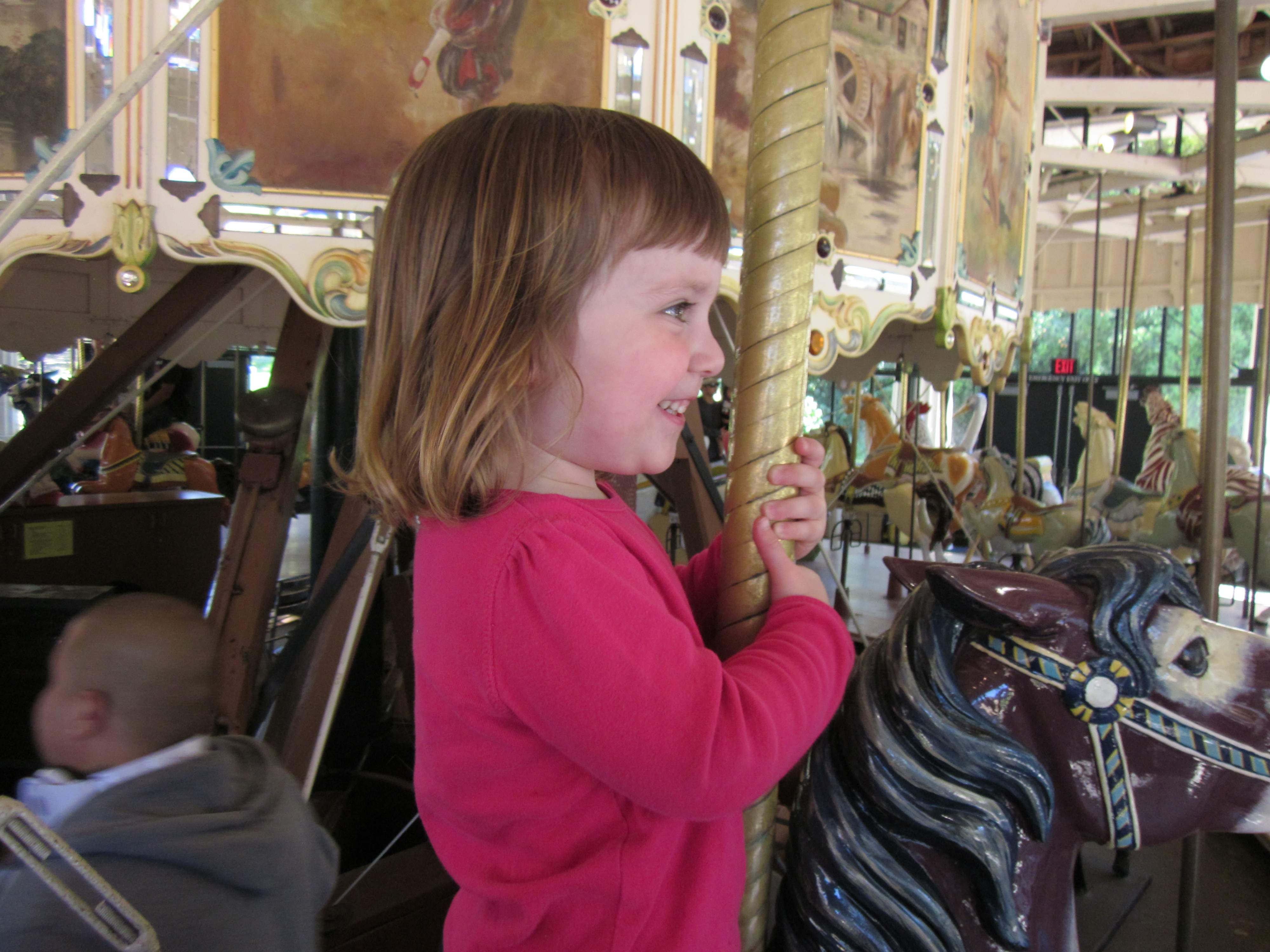
Delighted to get a second ride.

After some time on the playground we headed to the carrousel, and as we are regulars there, even got a free second ride on request. (Nothing will ever top the day, years ago, that we were the first and only family to arrive one morning and the operator ran the carrousel for my son for almost 20 minutes nonstop, blasting Tom Waits rather than the usual Julius Fucik. But my daughter, who was as yet unborn on that occasion, was delighted just the same.)

Slowing down at the Academy

I wasn’t sure where to go next, except that we should ride somewhere, and after some consideration (and probably because it was getting seriously hot by San Francisco standards) my daughter decided on the California Academy of Sciences. We visited the Rainforest (a poor choice given it was even hotter than the outdoors), went to the aquarium to see colored jellyfish (“Medusas!” yelled one little girl) and even saw a pregnant daddy seahorse, which was hanging out in the seadragon tank, presumably as encouragement. Although it was getting toward dinner time, we stopped at the café for a pink jellyfish cookie, then headed home.

My goal while Matt is away is usually just to keep the kids occupied enough that they don’t obsess about his absence. With our son away as well I was concerned that our daughter would be more lonely than usual, but she was cheerful all day long. As sometimes happens, I screwed up at bedtime. But when I went in later to check on her, she forgave me, as she always does.
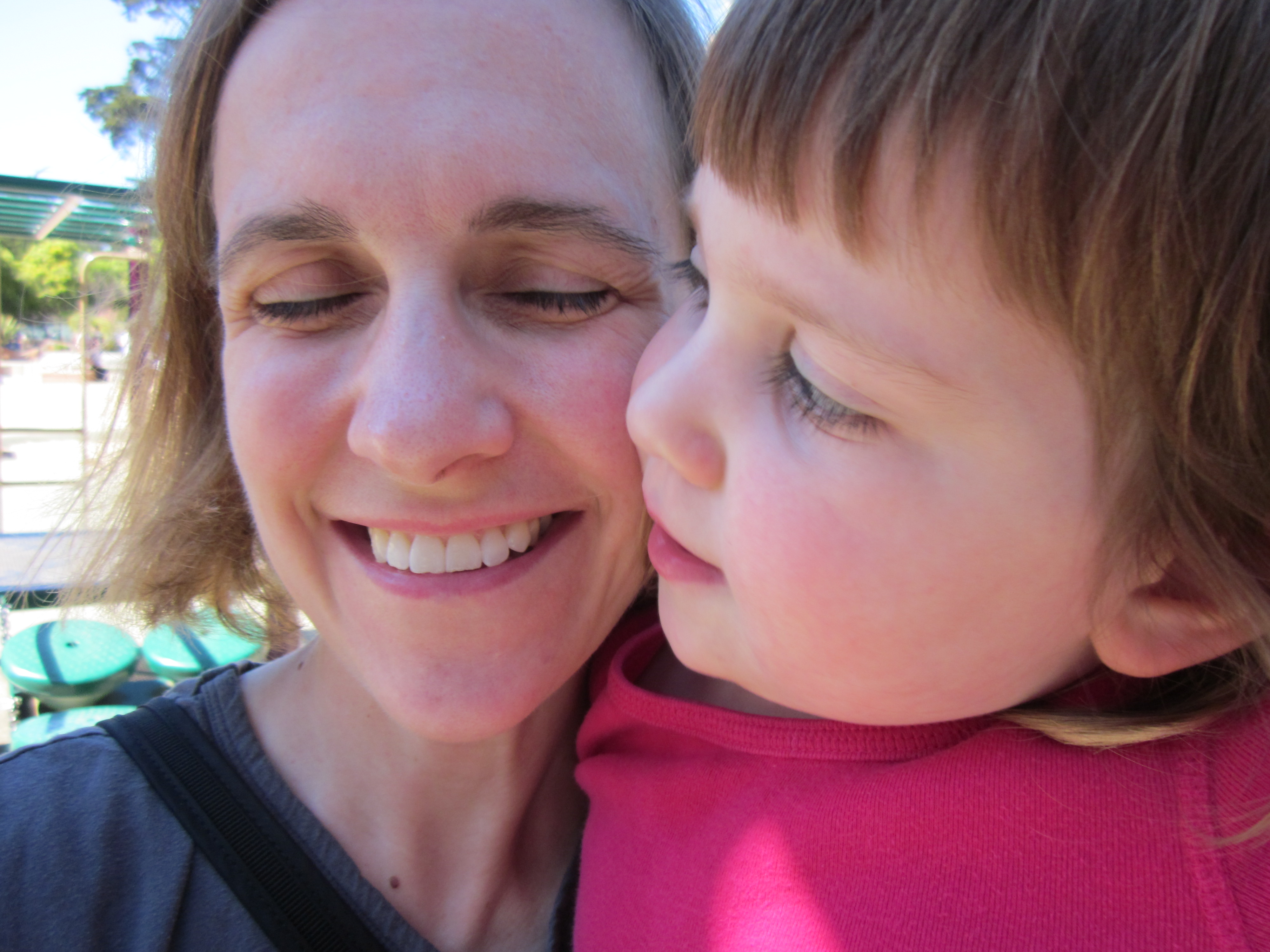
"I love you and you love me," my daughter says. "We love each other." Yes, we do.

For most of the rest of 30 days of biking, I will be either commuting or riding with my daughter. When I have time alone with her, I am always struck with amazement that we have this brave and strong little girl, who lights up our lives like a second sun. I couldn’t ask for better company.

1 Comment

Filed under cargo, family biking, Kona, rides, San Francisco, traffic

420

Oh yes. One of this kind of day.

On Friday, April 20th, I had one of those driving days. I had to be at one meeting in the morning and another across town in the afternoon, and the combination of tight timing, high dress standards, and steep hills made riding a bike implausible. The second meeting was the campus sustainability awards committee. Because I was driving for the first time in two weeks to attend a sustainability award meeting, I figured I would win the irony award. Despite that things were going reasonably well at first.

I had planned to pick up my son early from school after my last meeting, because he and Matt were heading to Boston for a week to visit an uncle’s new memorial, and I wanted to spend some time with him before he left. But then I got an emergency call that my in-laws, who were supposed to pick up our daughter at preschool, were nowhere to be found. And it was an early pickup day, and preschool was closing. I was across town and had no transportation but the car. This was a situation I would come to regret.

Golden Gate Park looks so innocent from campus

So I started to drive back across town to pick her up, with the clock ticking and fees for late pickup piling up. Traffic was unbearable, even for San Francisco. By the time I reached Golden Gate Park, I realized the problem: I was trying to drive across Golden Gate Park at 4:20pm on 4/20. A haze of marijuana smoke lay over the park like thick fog. I didn’t reach preschool until a half-hour later. I have not yet had the courage to ask how much a pickup that late will cost us.

Matt picked up our son, late, and they rode his bike through the park. He said that even that was significantly slower than usual, as walking stoners kept darting into the road and driving stoners with out-of-state plates kept circling randomly looking for parking, which was nowhere to be found for miles in any direction. They seemed confused to make this discovery.

Getting closer to the front of the line

My son, when I asked if there was anything I could do to make up our lost afternoon, requested a quesadilla from the Mexican restaurant. His favorite Mexican is a block from the park. Sigh. I rode my bike down through the traffic, which was stopped dead in every direction. It was a bad day to drive for anyone. I waited behind 100 stoners in line at the Mexican restaurant for 30 minutes, which was a trial. Their conversations alone, if you could call them that, were numbing. They had trouble organizing their orders. At least it was a quick ride home. That’s 20 days of biking now.

We had a similar experience last year, and the year before, on 4/20. I think given that we live so close to the park, I will have to black out that date on my calendar. Next year maybe we’ll rent a car and drive to Danville for the day.

2 Comments

Filed under commuting, San Francisco, traffic

Life in a northern town

Back in the day, people in Bellingham lived in stumps. Totally not kidding.

Over spring break, while Matt was in China, I went to visit my mom in Bellingham, Washington, where I grew up. When I was a child, it was a pretty small place, mostly populated by bombed out Vietnam War veterans and hippies. I mean this literally. My high school geography teacher was deaf from his years in a bomber. We knew people who kept goats, and sometimes the goats lived with them inside.  We foraged for berries and clams a few blocks from our house. The town was, at the time, remote.

My kids loved finding bivalves on the beach

This has changed. It is now a destination of sorts, at least for retirees. The university has grown from a glorified teaching college to a desirable place to get an education statewide. There are restaurants without the word “shack” in their names. Parts of the city have expanded so dramatically that I get lost on the new roads leading to new developments with new schools. The beaches are lined with condos. There are people who actually commute from Bellingham to Seattle, although it is 90 minutes away by car without traffic. If some parts of the US are emptying out, other parts are filling up.

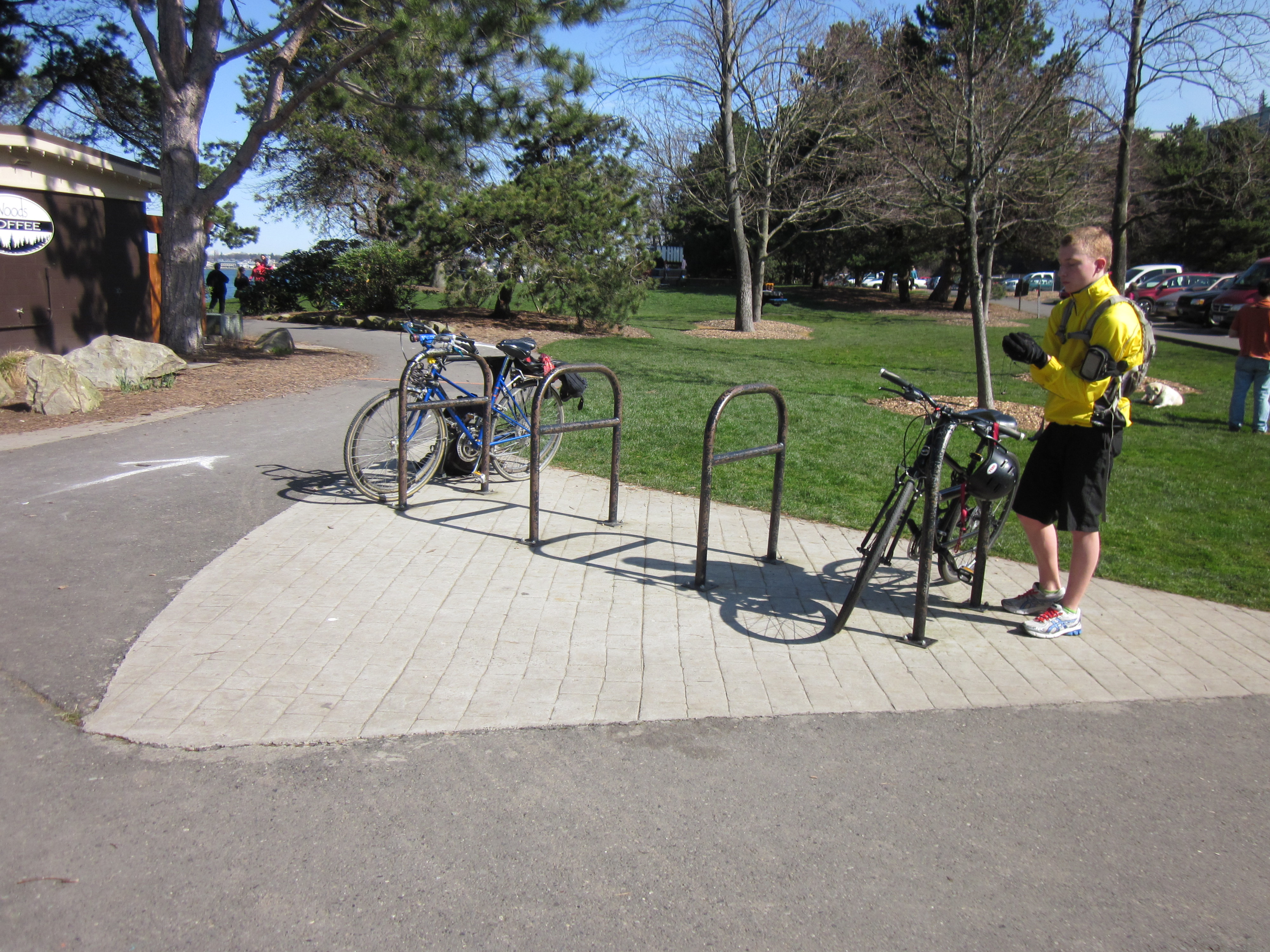
Bike racks outside a downtown restaurant

When I got older I became itinerant. Since I graduated from high school, I have never lived more than three years in one place. My mom has lived in Bellingham for 35 years.  We try to visit, but manage it only rarely. On this trip I realized that although I remembered how to get around the older parts of town, I had forgotten a lot about it. It is not an accident that this was the place I learned to ride my bike. Although it is hilly, it is a bicycle-friendly place, and then some.

Bike racks at the beach

Bicycle-friendly encompasses a lot of things. I regret that I was unable to get a picture of the most outlandish bicycle I saw, which was a tandem bicycle with a gas motor rigged in the stoker position that sounded like leaf blower, dragging a stripped trailer behind. Although I spotted (and heard and smelled) this bike three times in a single week, I missed a photo because it was always moving at about 25 mph in car traffic.  Less outlandish was the couple at my mom’s church with infant twin boys, who had commuted with them in a trailer almost since they were born. (Although trailers are a poor choice for kids in San Francisco, I would feel safe with my kids in a trailer in a small town.)

Life out of balance at the county museum

While I was in town I mostly drove, because my mom hasn’t ridden a bike in years, does not currently own a bike, and lives at the top of a hill far from public transit, which is pretty limited anyway. My mom has a Prius and after driving it for a week I decided that (a) I hate driving and (b) I hate driving a Prius, which has terrible sight lines and a weird turning radius, and made me feel even more like a road hazard than usual. And getting the kids into and out of the car was a huge hassle compared to loading a bike. Going to Seattle to visit Family Ride was a relief.

But I was pleased to see all the ways that Bellingham welcomes bikes for those who choose to ride them, and encourage people who are on the fence. There are ample bike lanes and extensive bike racks. Riding bikes is subsidized, more than in San Francisco. This would be a great place to live for a biking family. While I was there, the paper covered a local move by bicycle.

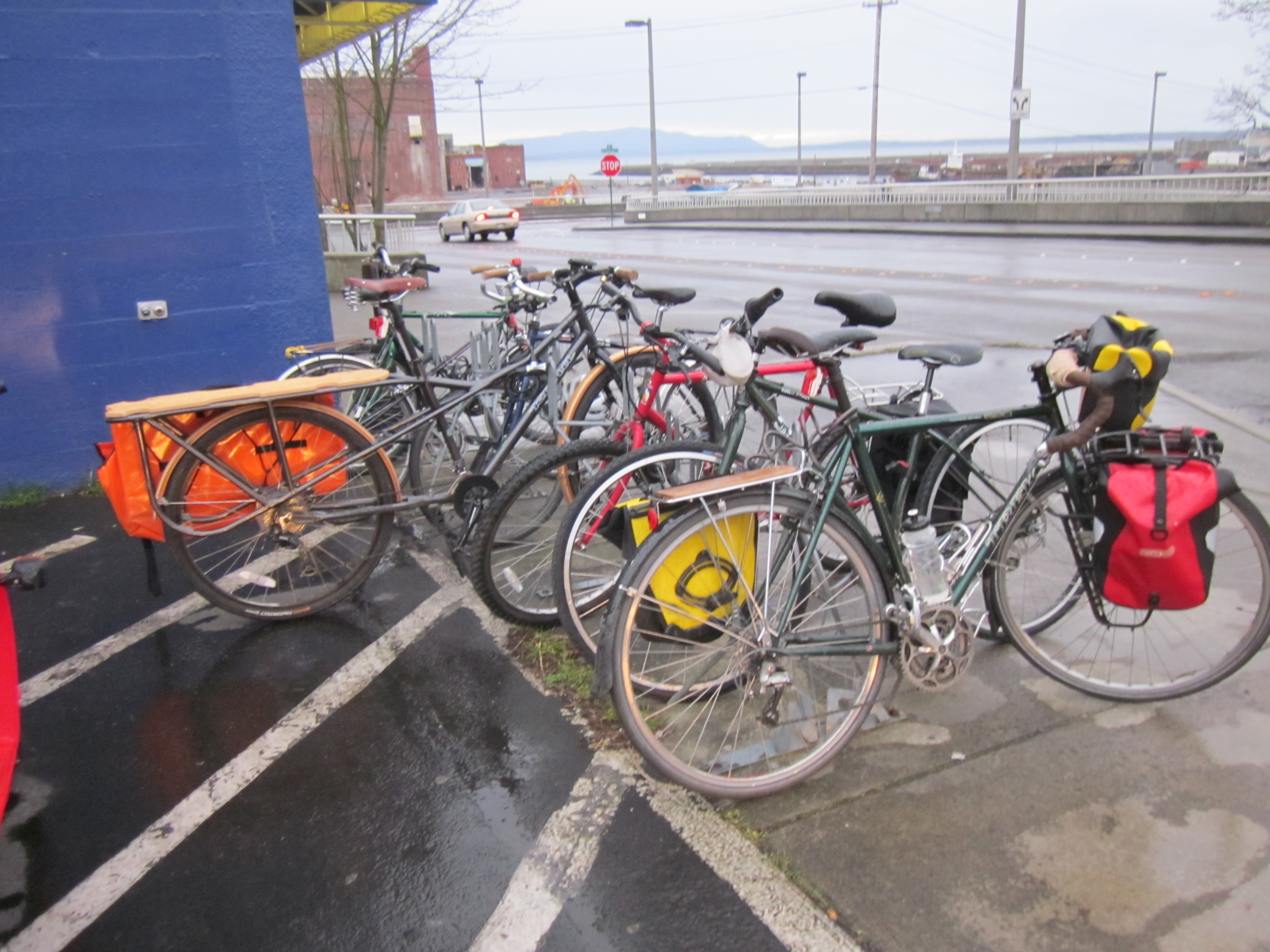
Full bike racks for a yoga class

Another example: while I was in town I took some yoga classes at a studio in town. They offered free mat rentals to anyone who arrived by bike, bus, or public transit, because “it’s harder to bring your own mat that way.” A lot of people took them up on that offer. The studio, 3 Oms, was a lovely place, although my limited time there meant I had a limited choice of classes, and ended up in some inappropriate ones. The intermediate class focusing on learning new postures I visited while my daughter was napping was learning Astavakrasana (“one of the easiest arm balance poses!”), or, in my case, not learning Astavakrasana. But this kind of support for alternative transit was not unusual; I saw it all over town.

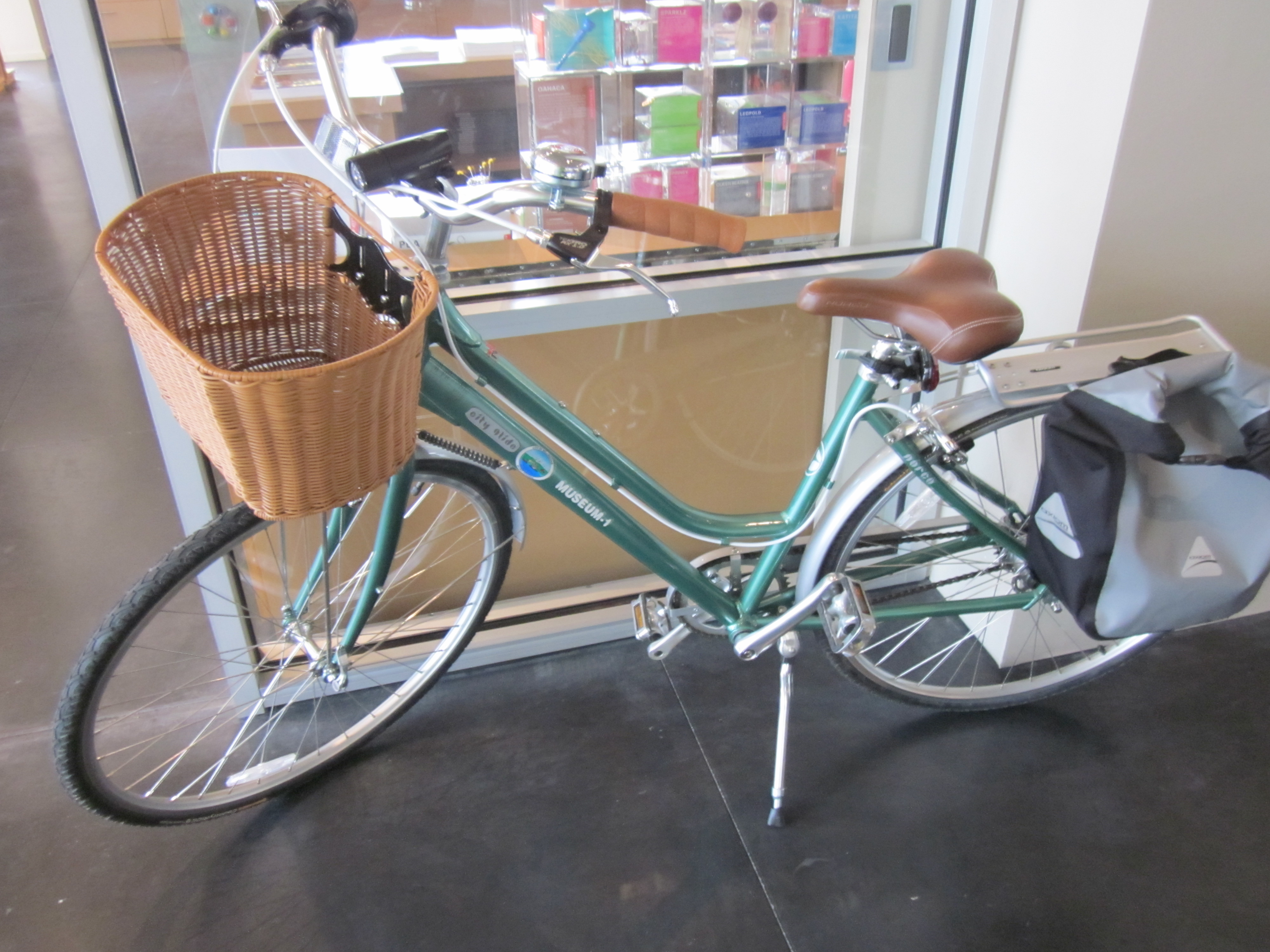
Museum-1: nice ride

And again: when we visited the county museum, I spotted a lovely commuter bicycle by the entry desk. The woman working there told me that it was purchased by the city for employees to use for errands and lunches around town. The museum had only one, but the Department of Public Works, with more employees, had four, and so on. She said she used it frequently, and wished she could afford one of her own.

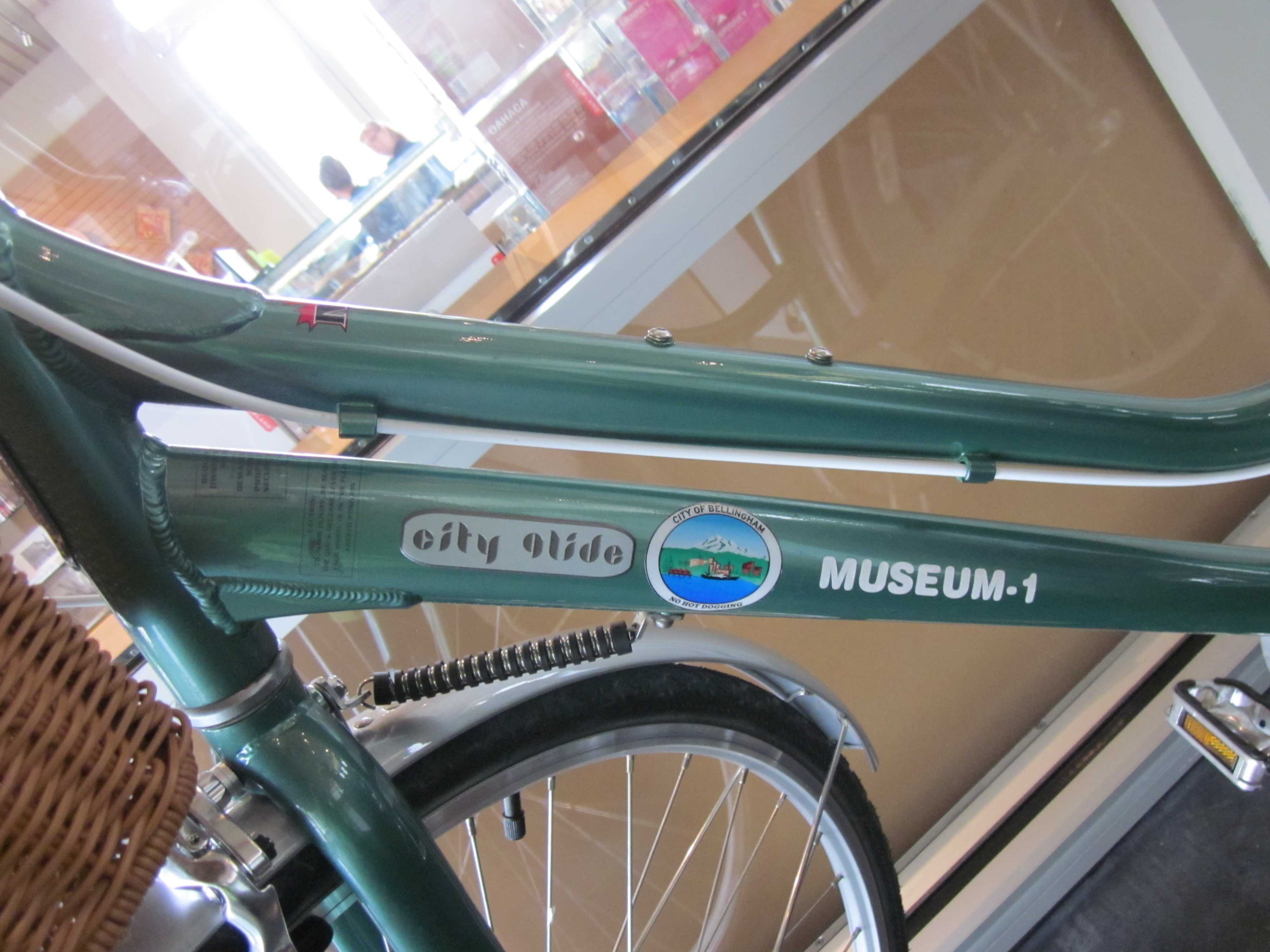
Museum-1 up close, with city seal

On closer look, I could spot the city logo. For obvious reasons, they did not bother to lock this bike up.

My kids love visiting Bellingham. This always surprises me a little, as there is not much to do, relative to the city, but they like skipping school and seeing their grandmother and picking up pinecones in the woods around her condo and occasionally going a day or two without eating any vegetables. Although in the past I’ve sometimes gotten bored during a week in Bellingham, I found I enjoyed myself too. And at the end of the week, I even found a place to rent a cargo bike with an electric assist. Next time we visit, we’ll be cruising around in style.

A variety of cargo bike choices

4 Comments

Filed under commuting, family biking, traffic, Uncategorized

I do, in fact, wear a helmet

It looked even less like a helmet when it was fitted wrong

I never really liked the look of helmets. But I never really liked the look of rain pants, either, and I wear those. When we rode bikes in Copenhagen, we didn’t wear helmets, mostly because we got blank stares from the bike shop owners when we asked about renting them (they did, however, have helmets for the kids to rent).

The blank stares reflected the fact that there is little reason to wear a helmet while riding a bicycle in Copenhagen, where there is extensive protected bicycle infrastructure and drivers know that hurting or killing someone who is not in a car would have consequences. Like losing a driver’s license. Pedestrians and bicycle riders in North America may now laugh bitterly.

So I was delighted to discover that there was a helmet I would not be depressed to wear, by a Danish company no less, the Yakkay. It costs a freaking fortune, compared to other helmets, but honestly, even expensive helmets are not that expensive compared to other things, like, say, a tank of gas these days. The Yakkay does not look like a helmet. It looks like a goofy hat (see also the Lazer CityZen). My kids call my Yakkay the hat-helmet. It has some advantages over a traditional helmet; one of them is that like a hat, it provides ample sun protection. It can also be difficult to fit correctly, which is a hassle and annoying for an expensive helmet, but not really a long term kind of problem.

My kids think my helmet looks goofy. I can't argue with that.

What I did not anticipate when I started wearing this helmet is the widespread perception by the rest of the world that I wasn’t wearing a helmet at all, and “the rest of the world” includes bike shop owners. I get lots of compliments on my “hat,” and occasionally, I get dirty looks or comments about how I should be wearing a helmet if I’m riding with my kids. This IS a helmet, I say, rapping my knuckles on it. “OH!” is the typical reply. “That’s COOL!” But I have begun to realize there are a lot of people who pass judgment without bothering to ask.

Why wear a helmet at all? My mother was surprised that this was actually a serious question. Of course bicycle riders should wear helmets, right? I don’t think it’s so clear-cut, but there are some reasons one could go either way.

Why not? It’s not clear whether helmets are really that protective, relative to the costs. There’s no such thing as a risk-free activity, and we all make choices that balance cost, safety, and convenience. People may drive (less safe) instead of riding the bus (more safe); people eat processed food (less safe) rather than preparing food themselves (more safe); people cross against the light in the crosswalk or fail to make a complete stop at stop signs. Some people find the cost of purchasing and the inconvenience of remembering to carry a helmet not worth the potential increase in safety. Bicycling simply isn’t that dangerous in most circumstances, and helmets don’t protect against many of the likely risks. A culture that demands helmets make bike share programs much more difficult, and creates the perception that riding a bike is a dangerous thing to do, rather than just another form of transportation. Pedestrians and drivers don’t wear helmets, despite the fact that in some circumstances their need for them may be greater. My colleagues at SF General joke darkly that pedestrians in the city probably should be wearing helmets, at least in certain neighborhoods.

Which brings me to the opposite question: why? The short answer to that question for me is that I don’t live in Copenhagen. In a city like San Francisco, where trauma physicians can make a serious argument that pedestrians should be wearing helmets to walk across the street, wearing a helmet while riding a bike starts to look pretty reasonable. I’m going faster than a pedestrian, so if I’m hit I’ll land harder, and I don’t have the same legal right-of-way.

Not that that necessarily matters. Recently, while riding the university shuttle, I watched the driver mosey between two parked trucks into an intersection only to stop dead just before mowing down a man in a wheelchair. “Oh my god!” he cried. “I didn’t even see him!” Seriously? Dude, it is your JOB to drive safely enough that you don’t mow down people in wheelchairs in the crosswalk. But “I didn’t even see him” is the driver’s equivalent of the “Get Out Of Jail Free” card in Monopoly. It works when mowing down pedestrians and wheelchairs and it works when mowing down bicyclists.

San Francisco, like a lot of cities, is undergoing a commuting shift. There are more bicycles on the road than there used to be, and there are, sadly, drivers who view that as an unacceptable imposition on the world that they were used to experiencing. With the protection of a two-ton vehicle, these drivers can express their opinions very dangerously indeed. That’s no reason to get off the road, but it does make me modify some of my choices. I don’t ride my bike on Masonic, for example, or any of the other streets in San Francisco that are widely recognized as high-speed arterials for driving. And I wear a helmet.

My son's helmet has flames on it, and he'll wear it everywhere he can.

There’s also the issue that although wearing helmets is optional (but encouraged) for adult riders in San Francisco, it is required for children. We are very fortunate that our children have never objected to wearing helmets, which is by no means a universal sentiment among the small. They like playing dress-up and we let them pick their own helmets (within their size range), and that helped. But part of the reason we’ve been so fortunate is that we ourselves wear helmets and have never given the impression that it’s an imposition or a hassle. It’s just something we do before we get on the bike, like checking the brakes or packing the lock. Many of the parents who have complained about their kids not wearing helmets admit that they themselves either don’t wear helmets or that they complain about it. We’d much rather wear helmets without complaint than risk not riding at all because our kids refuse to wear their helmets.

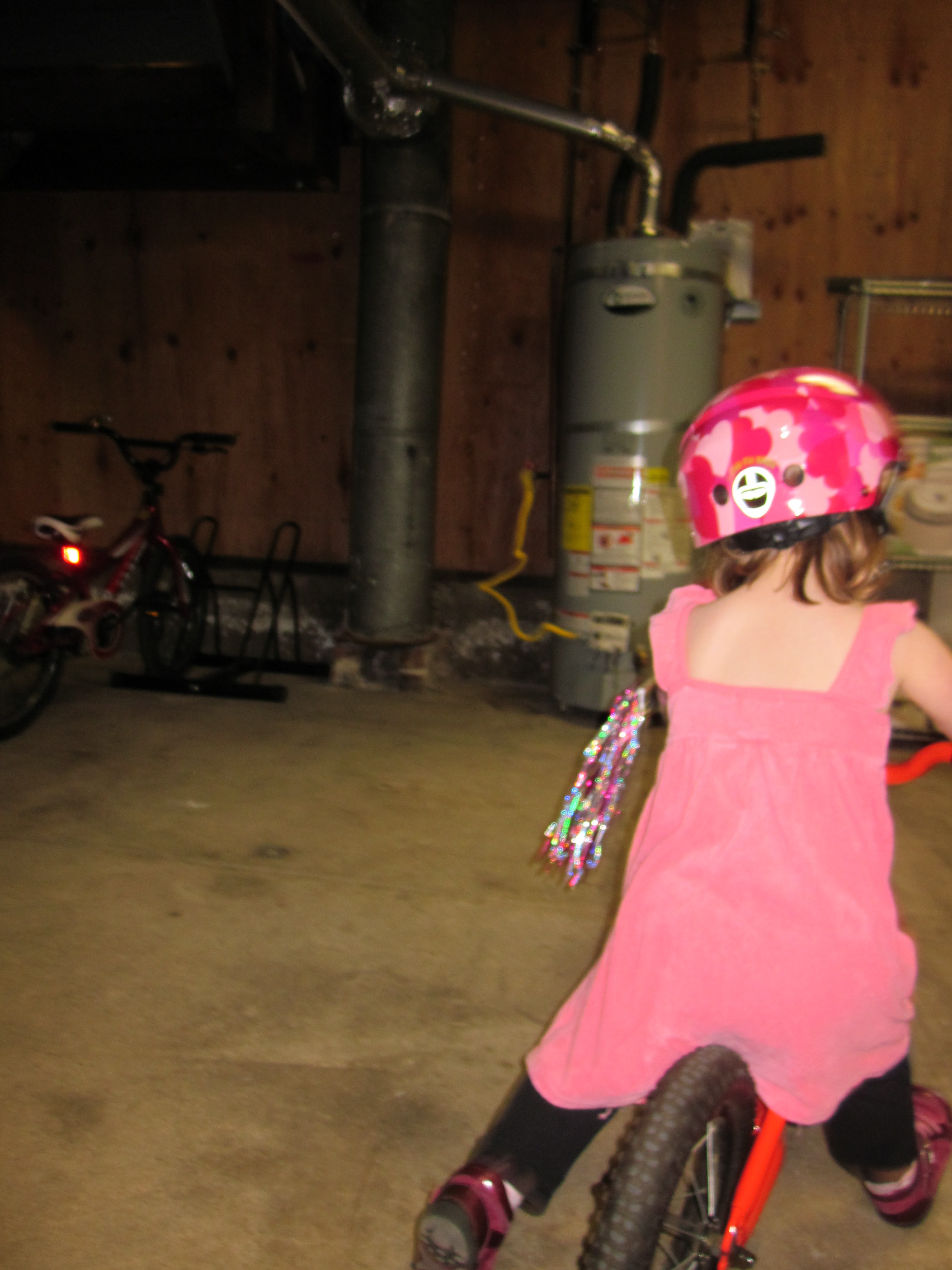
My daughter wears her helmet while practicing riding her balance bike in the basement, because it has pink hearts on it.

I do a lot more stupid things to fit in and smooth our daily lives than wearing a helmet when I ride a bike. My helmet is either cute or goofy, depending on whom you ask, and it keeps the sun off my face, and that makes wearing it even less of a burden. It provides some extra protection against accidents (just as a helmet would for a pedestrian or driver), and weighed against the marginal imposition it makes on my life, I choose to wear the helmet every time.

Other people make different choices based on their life circumstances, and I have zero problem with that. I don’t judge other riders for not wearing helmets, and I’ll defend their choice when it comes up in conversation with people whose knee-jerk response to seeing a bicycle rider without one is to call them crazy or stupid. That said, I won’t ride with adults who aren’t wearing helmets when I’m with my kids, as the idea that wearing helmets could be optional is a can of worms I am not ready to open with them.

So I have this crazy hat-helmet, and in the tempest in a teapot that is the question of whether bicycle riders should wear helmets or not, I now get to experience the moral high ground and various minor inconveniences of wearing a helmet as well as the opprobrium of people who think I’m setting a bad example for my kids and risking my own life by not wearing a helmet at all. It is not something I expected when I bought the Yakkay, but I can live with that too. Knowing what I know now, I will not, however, ever buy their kids’ model, even though I think it’s super-cute.

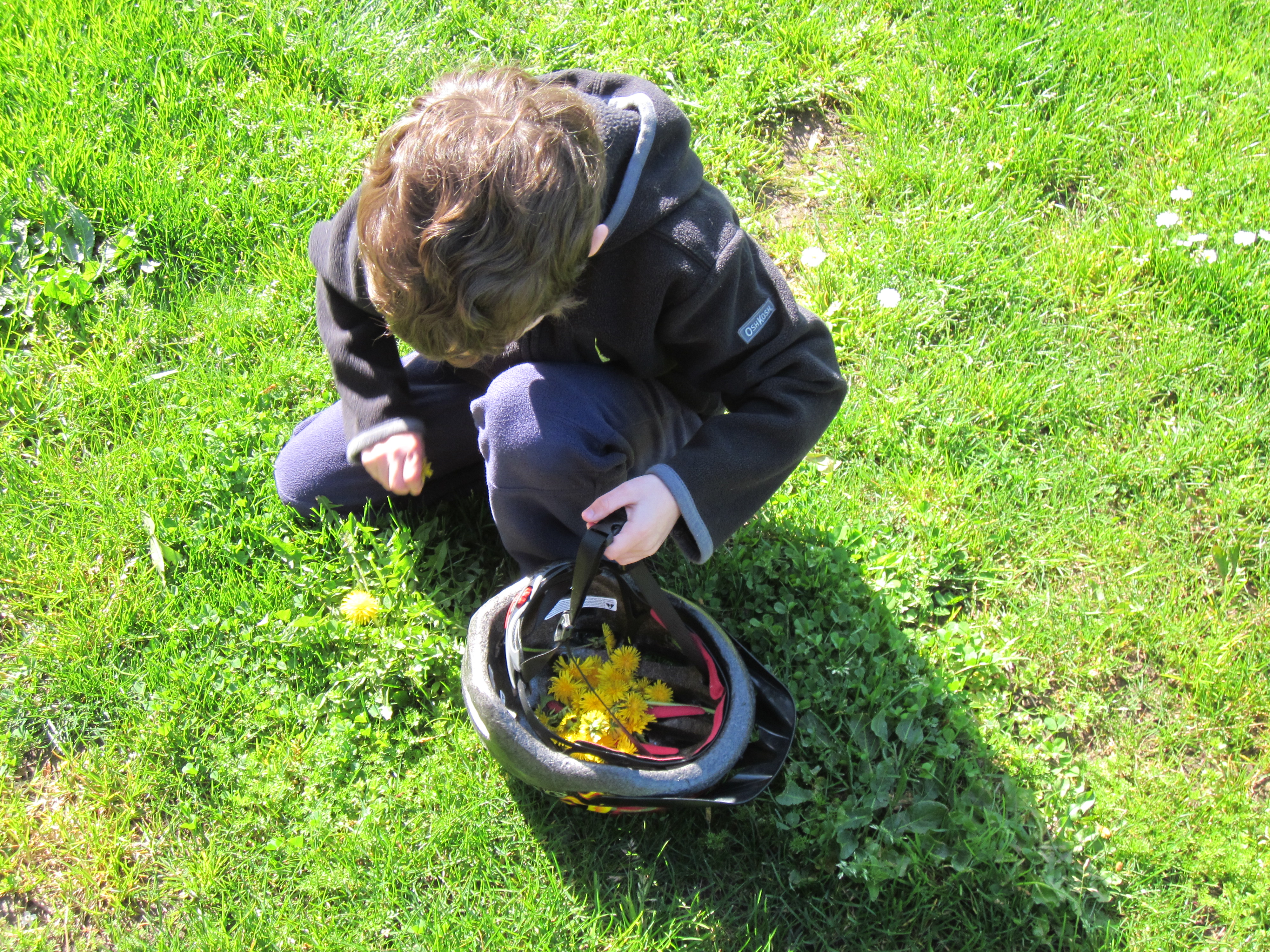
Helmets are also handy while picking dandelions in the park.

I think that there are much bigger problems to worry about in North American cycling than helmets or the lack of them. I find advocacy about helmets, whether pro or con, tiring. When cities in the US have the infrastructure to make cycling feel safer, like extensive protected bike lanes and stronger legal protections, I suspect that bicycle helmets will become a quaint relic of a more dangerous time, used only by certain specialists, much like chainmail.

Until that happens, my feeling is that arguing about whether or not to wear helmets is like arguing about whether a red fire truck is more visible than a neon green fire truck. Maybe one color will make drivers pull over more quickly and thus help get the truck to its destination a little more quickly, but a better use of everyone’s time would be preventing the fire in the first place.

2 Comments

Filed under commuting, family biking, San Francisco, traffic

It is in no way an overstatement to call Portland the bicycling capital of North America

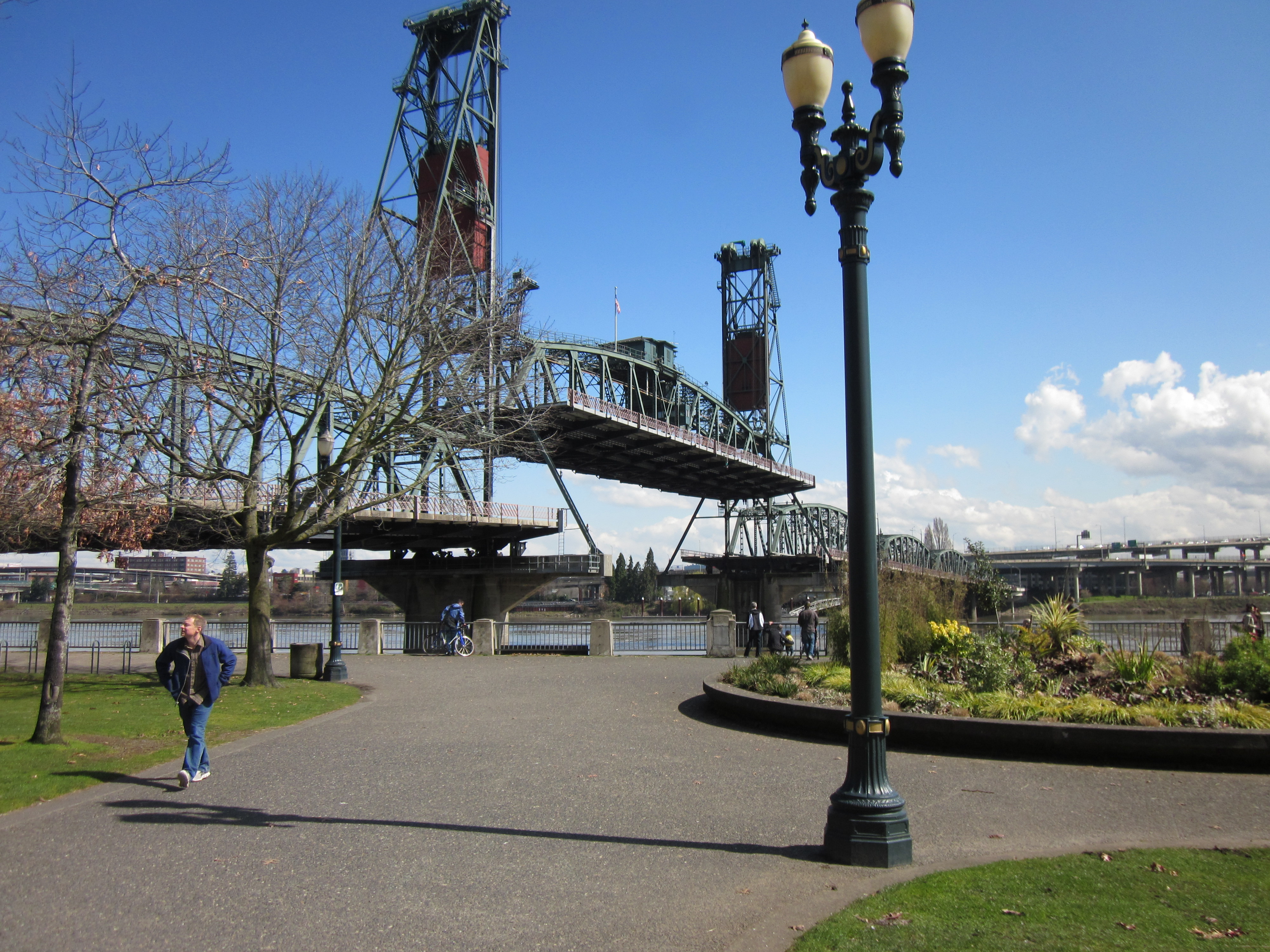
Watching the Hawthorne bridge go up

Technically I was in Portland to attend a professional conference, but in case it wasn’t obvious, I blew off some of the part that involved sitting in windowless hotel rooms listening to other people talk.

Due to a rare convergence of travel schedules, my kids were in Washington with my mom while Matt was flying to China. But I had a pretty non-negotiable commitment to give a talk on Saturday morning in Portland, so I wasn’t going anywhere until then. So on Thursday and Friday, for the first time that I can remember, I had minimal work obligations and zero responsibility for my kids. And I was in a city filled with awesome bike shops and a bunch of friends from graduate school that happened to be experiencing a freak early spring. The result was that most of the time I bounced around Portland feeling as giddy as a dental patient on nitrous oxide, without any of the painful drilling.

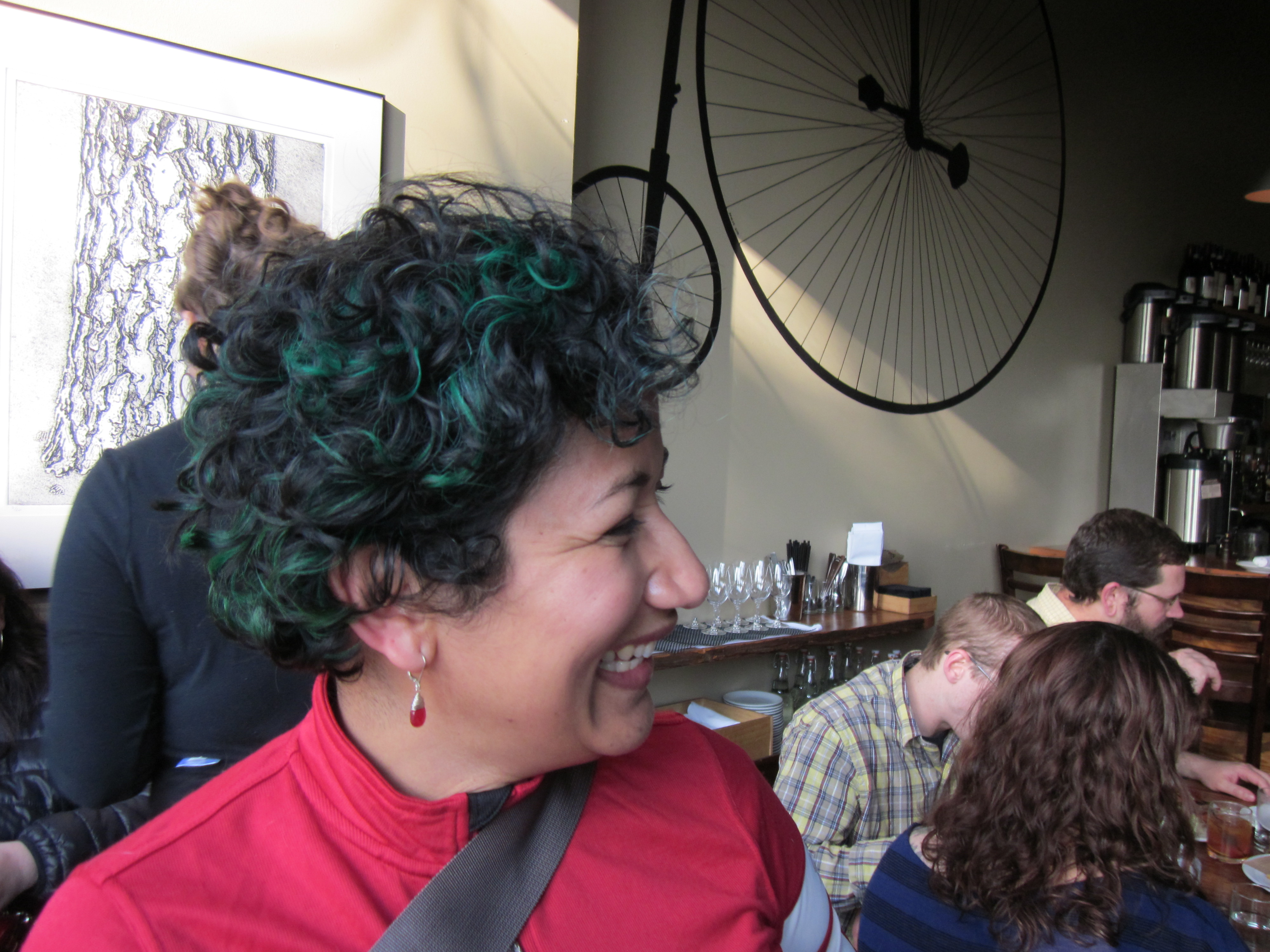
Jackie has green hair (pics or it didn't happen? no problem)

My friend Todd, who lives in Portland, got conscripted to be the cargo on a cargo bike, but my friend Jackie, who also lives in Portland, actually rides a bike of her own. This is something of an understatement, as she regularly rides Cycle Oregon. She has a road bike like a real racer and wears lycra. In fact she has three bikes. When she told me she was impressed that I commuted on my bicycle, my reaction was complete disbelief. I’m pretty pleased with myself if I cover 5 miles; she sends us updates on her long rides every ten miles or so. Sometimes there are several of these in a single day.

Anyway given that I had a rental bike in Portland it seemed like it would be fun to ride it to meet her somewhere, and so that’s what I did. She picked a restaurant between her house and my hotel and gave me what seemed to be pretty implausible directions, which I summarized mentally as, “It’s complicated, so do what the other bicycles are doing.” It seemed kind of optimistic to assume that there would be enough other riders around to make the route obvious, but boy, was I wrong.

Follow those bicycles (or barring that, the 15 others behind me)

I am used to riding in car traffic, but rarely ride in bicycle traffic. Even in the Panhandle, which I used to consider a busy route, the bikes are pretty spread out. But riding in Portland during commute hours was actually a little unnerving, because there were dozens of bicycles in the lane. At more than one point during my ride I wanted to stop and get a picture of one of Portland’s many weird and wonderful bike lane markers, which include disembodied riders without bicycles, riders wearing helmets and riders not wearing helmets without any apparent rhyme or reason, riders with the heads of dogs, riders flying off their bicycles jauntily, etc. But I couldn’t figure out how to politely stop to snap a photo. That never happens to me in San Francisco.

Full bike corrals on every corner, 40 acres, and a mule

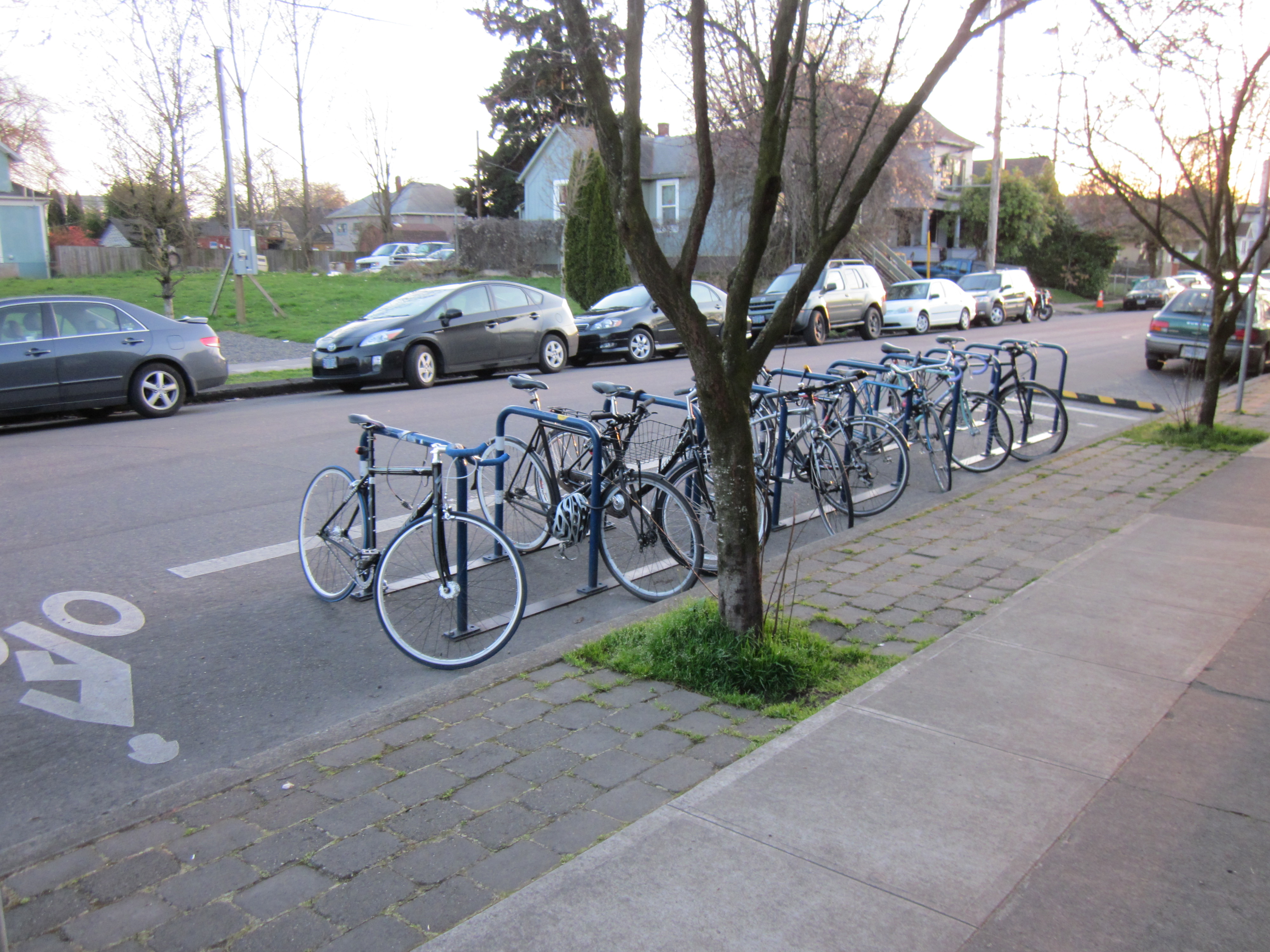
Jackie picked an amazing restaurant, of course. And its bathrooms were in a hallway shared with a yoga studio featuring a row of inside bike parking against the wall. And those bathrooms had showers. Really, Portland? Really? It is rare that I have the occasion to feel like a yokel after living in San Francisco for several years. But I might as well have been barefoot and wearing a straw hat and overalls with all the gaping I did when I saw things like this. Portland has ripped out street parking for cars to put in bike corrals. And it’s not just a demonstration project, it’s all over the place. And those bike corrals are full.

What better advertisement for your bike shop than a beer bike?

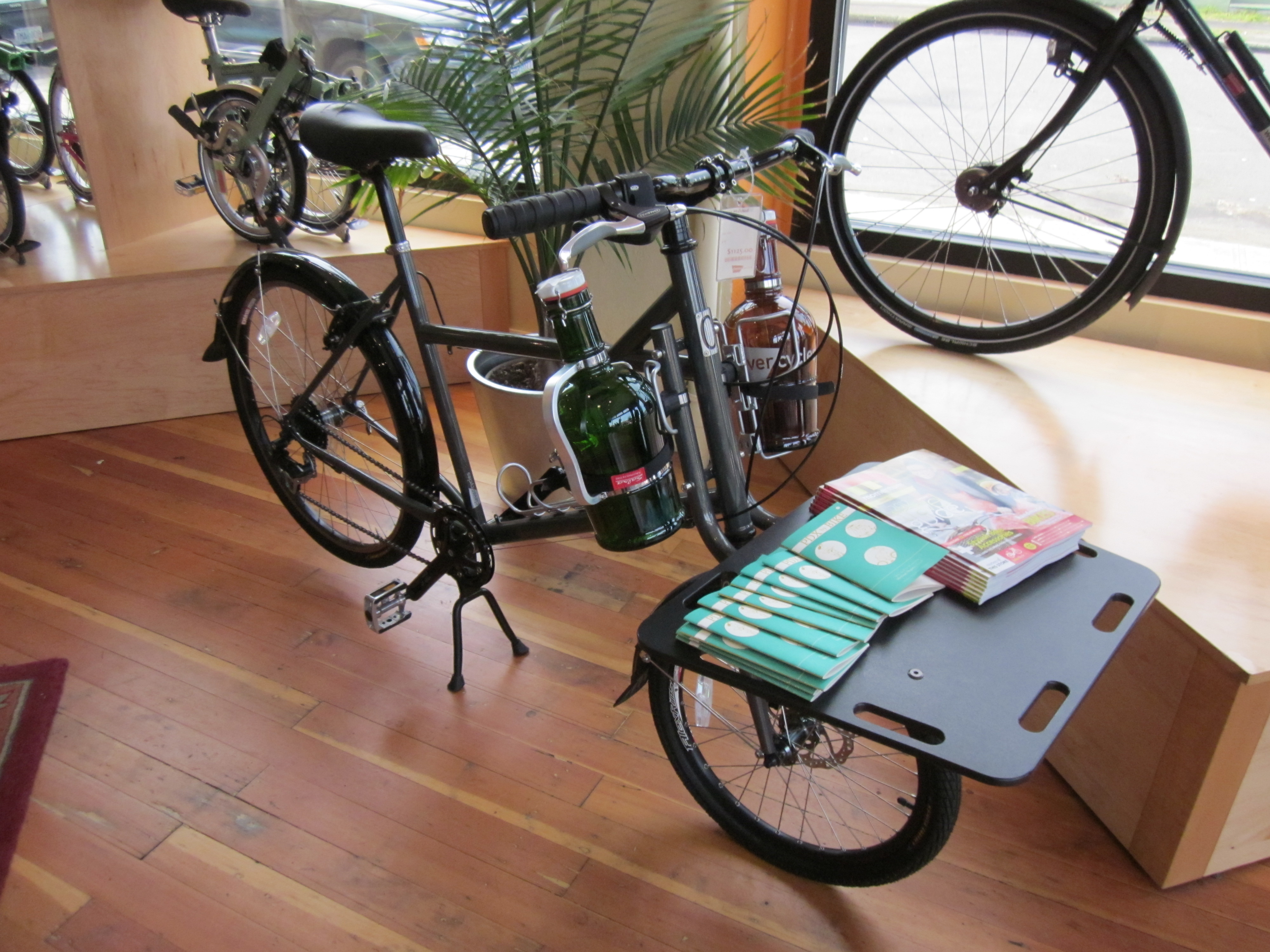
After dinner Jackie proposed that we ride over to see another grad school friend she sees regularly but I hadn’t seen in years. Steve lives in a pretty neighborhood with his lovely wife and two charming little girls, and was making dinner for them when we appeared unannounced on his front porch. They are in the school lottery for a Japanese bilingual program for the girls, and so we had lots to talk about. Jackie, who speaks excellent Japanese, thought it wasn’t such a hard language. I, who can speak just enough Japanese that I might be able to find a bathroom and not starve if air-dropped into Tokyo, disagreed, as did Steve. Steve offered us beers. Everyone offered me beer constantly while I was in Portland, it’s even more of a thing than the bikes. These twin obsessions were perfectly merged in a bike I saw at Clever Cycles rigged to carry two growlers. I’m not a huge beer fan and people always seemed vaguely disbelieving when I declined their offers, like I’d just belched in their faces but they were too polite to comment.

I asked Steve what he’d been up to for the last few years; I hadn’t seen him since before we’d had kids. “Oh, nothing much,” he said.

“He won a Pulitzer and was a finalist for a second one,” said Jackie.

This is why I don’t get to live in Portland. I am insufficiently awesome.

Modified Portland bike lane marker

I rode back to my hotel that night buzzing on all of it. Even late in the evening there were many other riders on the trip back, and we all expressed disbelief at the amazing weather. We could do this because like me, those riders all stopped at traffic signals. On the trip back across Portland’s Steel Bridge I passed three pedicab drivers, who urged me politely to pass. I got back to the hotel and checked my bike into the bell room (“of course we have bicycle parking here!”)

I realize that living in one place long enough can make a city’s charms less obvious, and people in Portland complain that there is still a lot of work to do. But to my outside eyes, it looks like paradise.

2 Comments

Filed under commuting, traffic, travel

Free riders

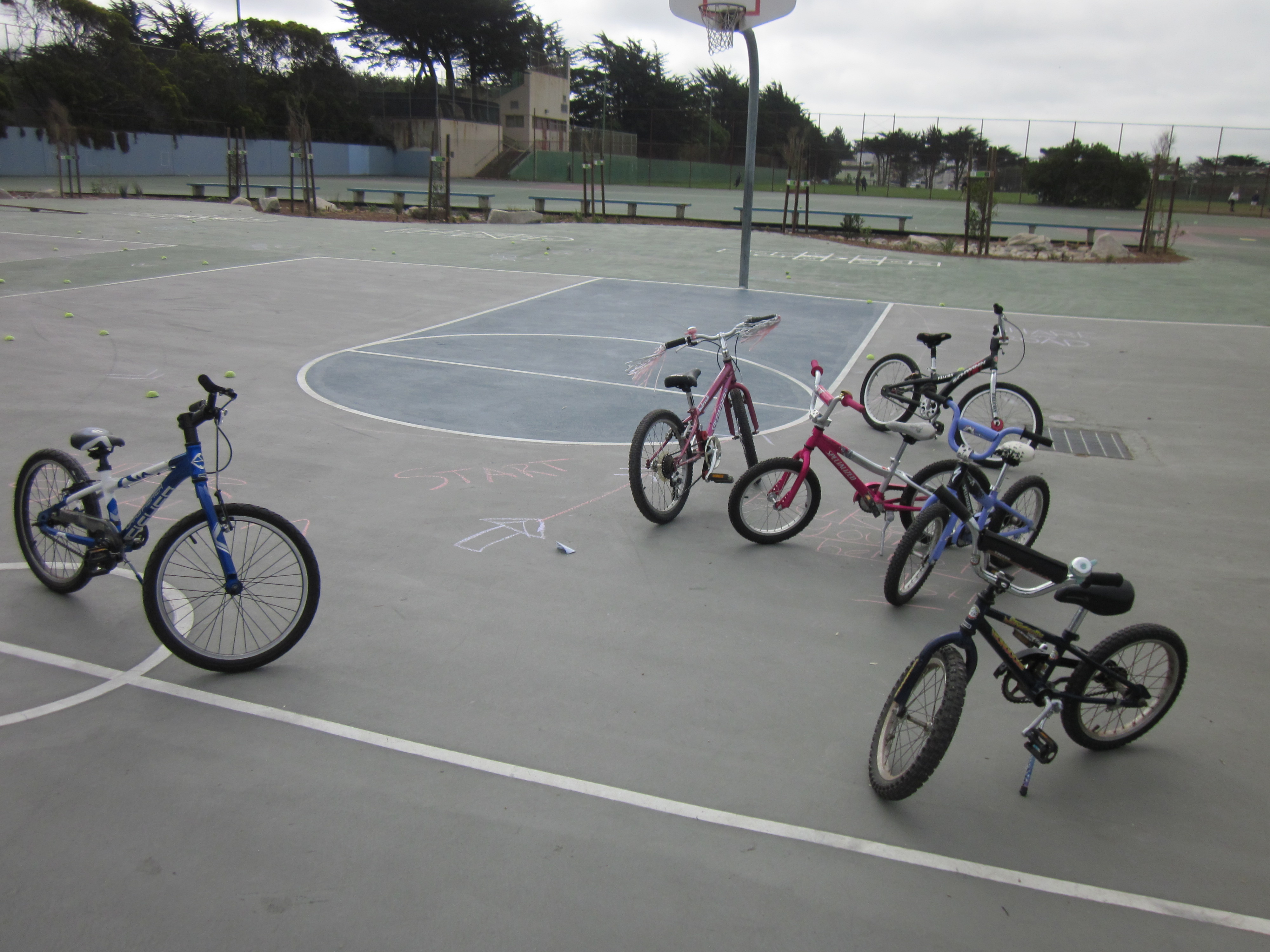
A passel of kids' bikes waiting for riders

On Saturday I went back to the Outerlands, specifically to Sunset Elementary School, to attend one of the San Francisco Bicycle Coalition’s Family Biking Series classes, On Road with your Children. To my astonishment, I was asked to attend in a vaguely instructional capacity.

I find it a somewhat depressing comment about the number of families in San Francisco with school-age children (there aren’t many) that I would be considered even vaguely qualified for this assignment. The guy who built up the tricked-out Kona Ute our PTA treasurer used to ride was there. The co-owner of Ocean Cyclery, which sold us my Breezer and our child seats was there. I was outclassed. I can, it is true, research any topic into submission, because doing research is my job and because I’m compulsive. But research is no substitute for experience, so this class involved some ugly duckling moments. The class met at the back of the school, and I had trouble even finding it until other people showed up so I could follow them. The parents teaching the class had been riding bikes for years and it showed; they were more graceful on their bikes than I have ever even aspired to be. And I found out that I was wearing my helmet wrong. All in all, it was a humbling experience.

Lubricating chains: virtually all of them were rusty, because the Sunset is permanently socked in by fog

And it was a hugely informative experience. I didn’t bring my kids; they were at their swim lessons. It is just as well. Neither of them is competent enough on a bike yet to keep up with the kids who showed up for the class. (We are the blind leading the blind over here.) I will, however, take my son when he is more skilled. SFBC’s instructor for this class is fantastic, warm and lively and hugely competent at wrangling both kids and parents. Apparently he has been leading these classes for years. It shows.

This kind of thing isn't helping with the helmet either

Matt and I signed our son up for summer bicycle camp this year. We didn’t thrust this upon him; he has been angling to attend bike camp since he heard that such a thing existed. But we’re all pretty excited about it. We are having trouble teaching him to ride safely because we live on a great big honking hill. Our efforts to talk him into going down to the park, where it’s flatter, to ride always fizzle; his enthusiasm evaporates with the walk down and on the rare occasions when we’re successful, he is too tired to walk back home. Although it is ridiculous to drive such a short distance we would do it, but he hates riding in the car. Bike camp seems to resolve a lot of problems at once; most importantly, it’s taught by someone much more qualified than we are.

Practicing riding in a crowd

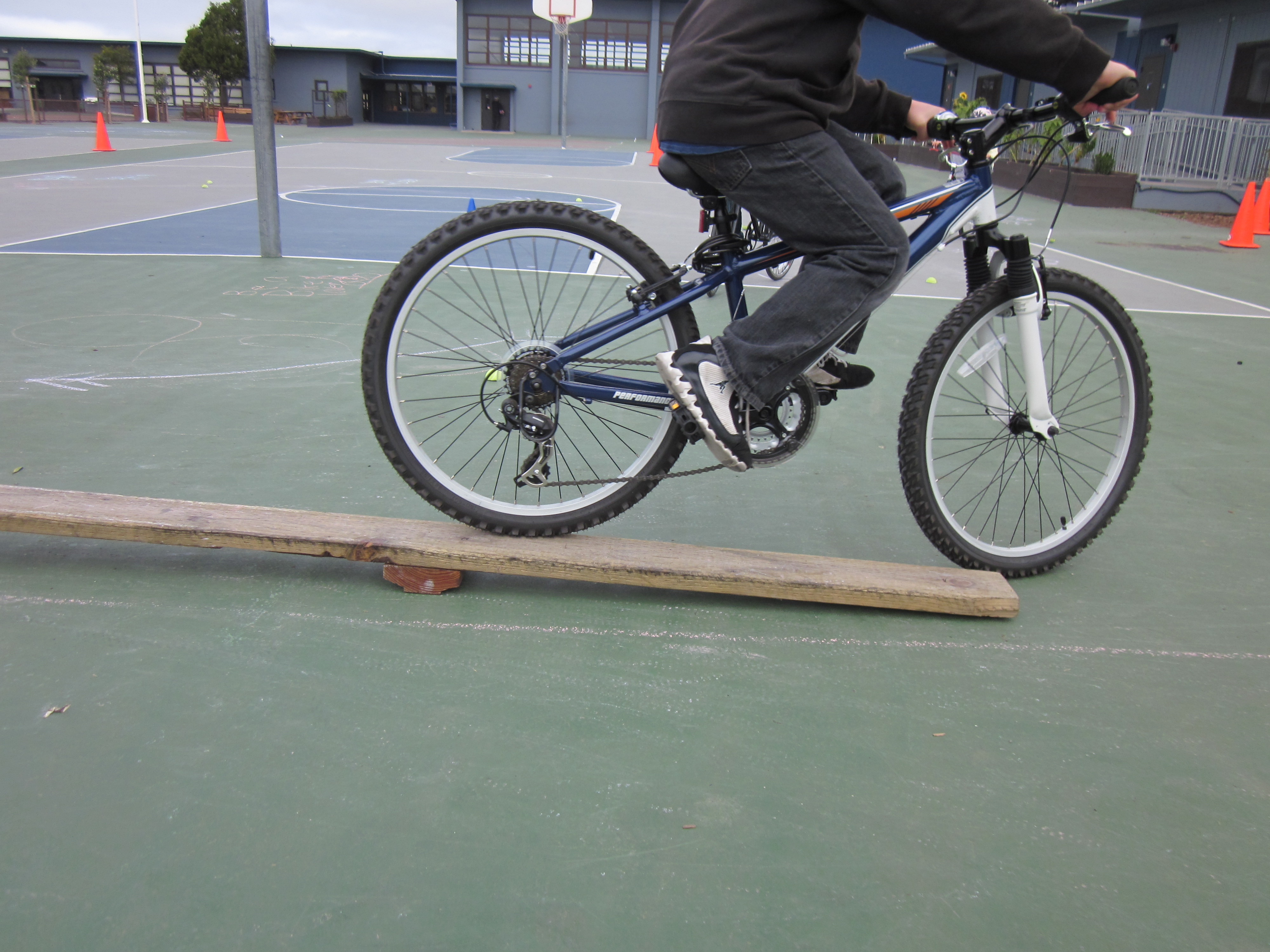
We had both harbored ambitions that at the end of a summer at bike camp, our son would be qualified to ride his own bike to school. Attending this class disabused me of this fantasy. The area around the school was slightly hilly, but nothing particularly troublesome for an adult rider used to the city. It was much more difficult for the kids, who were, I realized, mostly riding bicycles that weighed more than half what they do. I have ridden a heavy bike before, and remember how hard it was to start and stop and get up hills, but at least I had a lot of gears to use. The kids did not. No one is selling ultra-light bikes for kids, so I don’t see any realistic way for mine to handle anything more than minor elevation on their own. And the hills along our commute to school are anything but minor.

Practicing riding while looking for cars behind

What’s more, supervising kids on the streets of San Francisco was terrifying. The area around the school is very lightly trafficked, but at stop signs things fell apart. The kids attempted to wave drivers ahead of them, then lurched out into the intersection as those cars actually moved, or waited for cars to stop, then tried to take their turn only to be rushed by drivers who’d grown impatient. There are a lot of decent people behind the wheel in San Francisco, but a lot of jerks as well. I suspect that these kids, as well as our son, would learn to navigate neighborhood streets like these with more practice. But we go through much more serious traffic on our route to school, and I would not trust my kids in some of those intersections for years to come.

Bumpity bump

Overall, I realized that riding in the city is too much to expect our kids to do alone at this age. Our son will not be riding to school on his own bike next year, or the year after. He wants to pedal, so a trailer-bike or tandem may be in our future. But he will not be riding solo.

We are going to be working harder as he grows, and that is daunting. We had talked about possibly not needing an electric assist if our son began riding his own bike. But I cannot imagine hauling my kids up and down the hills to school without help once their combined weight exceeds 100 pounds. We are now in the position where buying a bike accessory that costs more than our bikes themselves seems inevitable.

Despite this, I find I don’t mind the thought of keeping them on our bikes longer. My children have been growing away from me since the day they were born. Even in the newborn barnacle months, they were already exploring the world. It is thrilling to watch them grow more independent, but I know that eventually they will tire of being hugged, of sitting on our laps, of being picked up. My son is in first grade and already conscious that being affectionate with parents is not something that older children do. But when we’re walking or riding up a hill, all of this is forgotten. They look at the climb and want to be small again. “Mommy, will you carry me?” they ask. And I say, yes, I will carry you. I’ll carry you up the hill. I could carry you forever.

2 Comments

Filed under commuting, family biking, rides, San Francisco, traffic

Figuring out what safety means

Despite my best efforts, my daughter survives another weekend unscathed

A while ago we were riding around with the kids on the weekend, on the way home from a party with friends. One street was closed to cars for a block party, and we swung in to check it out. The kids were hoping for a bouncy house, no luck. But we did see a friend of my son’s from preschool and stopped to talk with his parents. When we last saw them they were miserable about their school lottery placement, but as often happens, they were able to transfer to a school they preferred mid-year, and they were feeling good.

A neighbor of theirs walked up to me, looked at my daughter in her child seat, and said, “My god, that’s totally unsafe!”

I looked over at his two sons, who had just begun whizzing wildly around on scooters, jumping sidewalks and nearly topping toddlers, all without the benefit of helmets, elbow pads, or knee pads. He looked over at them too.

“Ha ha,” he said after a moment. “I was just kidding.”

“Of course you were,” I replied.

There is reasonable evidence that the health benefits of cycling outweigh the risks (de Hartog et al 2010, Environmental Health Perspectives—open access), at least for the person doing the pedaling. The question of whether it’s safer for children isn’t directly addressed in that paper. But we know enough people who have had car accidents in which their children were hurt or killed that I no longer feel that cars are necessarily safe.

A practical city car, unless you have kids

I didn’t always feel this way. We have a minivan because when our son was born, continuing to drive him in our 2-door Honda Civic no longer seemed appropriate. Our struggles to get him into and out of the car seat were incredibly frustrating. At the time, we were living in the suburbs and always sharing the road with massive SUVs.  After my maternity leave ended, we had stumbled into a situation we’d never faced before: both of us were commuting by car. It was in many ways a difficult time for us. Although it ended well, with a move to San Francisco less than a year later, at which point we sold the Civic, the legacy of that period remains with us in the form of our minivan.

Just barely fits in our parking space

We bought a minivan when we wanted a new car because it was touted as a safe car for children. It was built from 2.2 tons of steel and had side curtain air bags. It felt like the right size in the suburbs; it was, in fact, a medium-sized car in that area. And it was much easier to get a car seat in a minivan than anything else on the road. But it is a wildly inappropriate car in the city; as one example, just to get it in our garage space, we have to flip in the side mirrors. And in this environment I no longer feel it is safe; the constant dings and scratches we pick up in parking garages and on sharp turns makes driving it feel like wearing a sombrero in a crowded bar.

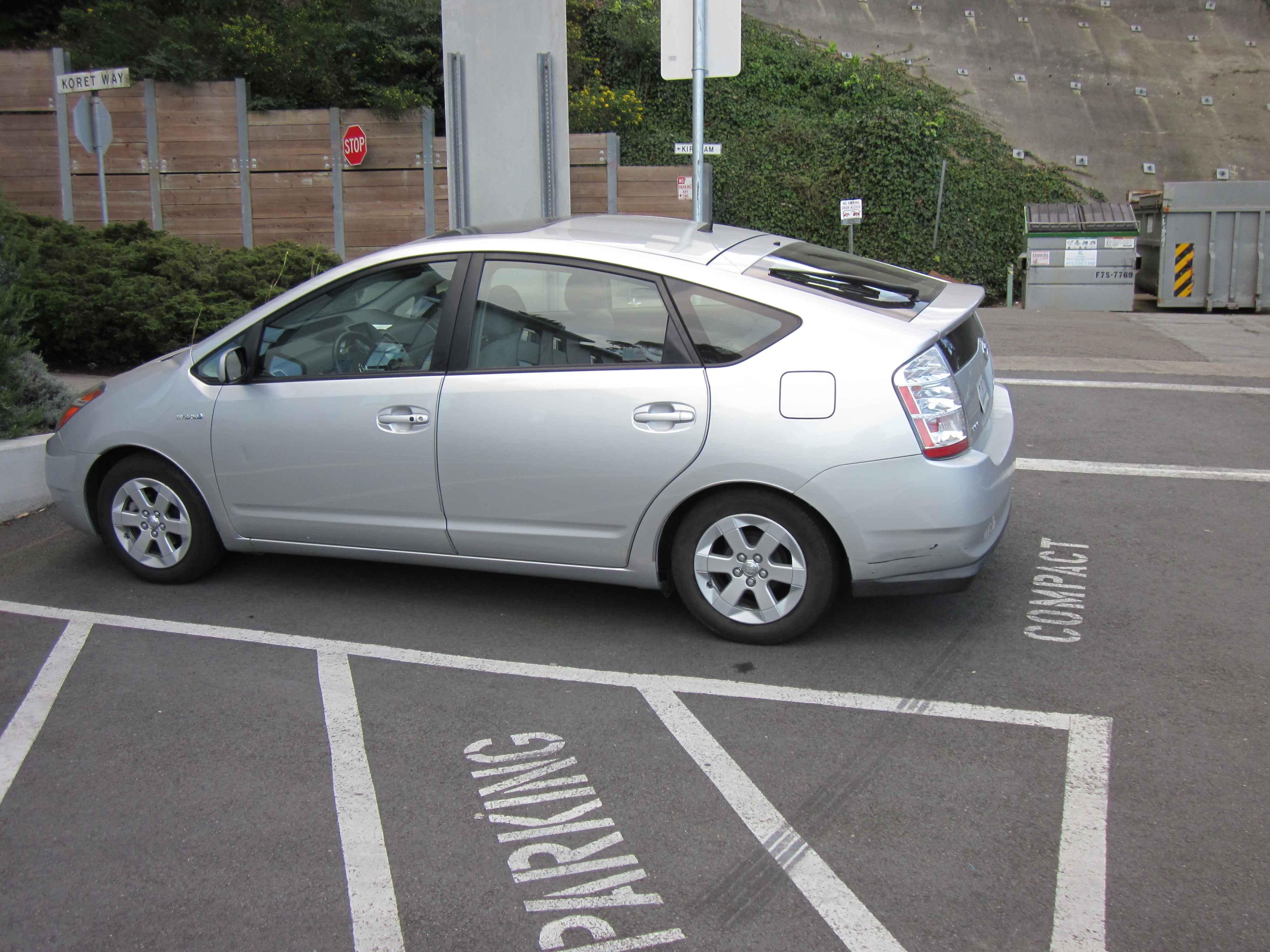
Technically a Prius is a compact car

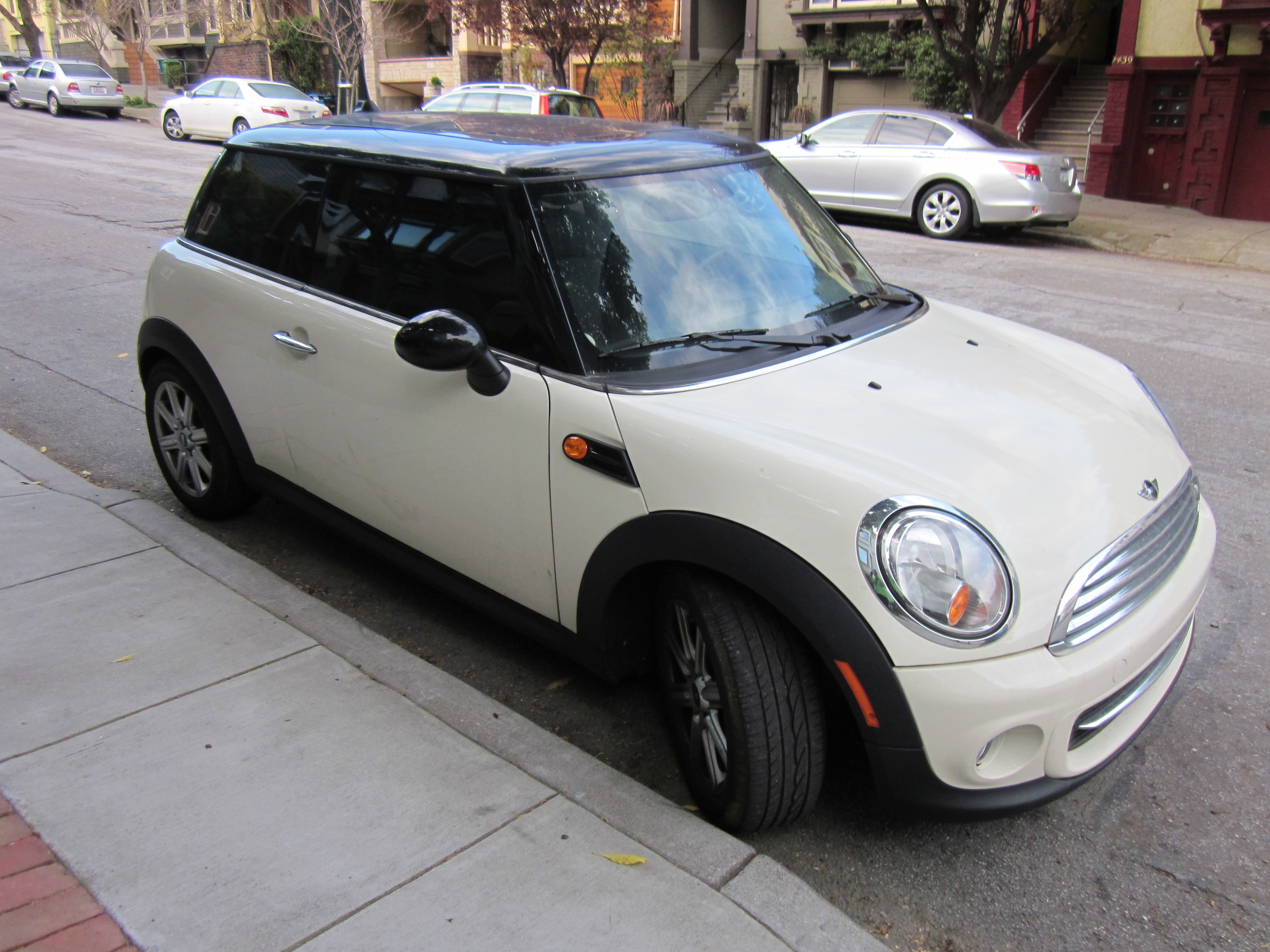
I would consider getting rid of a car entirely and seeing how relying on City Carshare worked out for us. Matt thinks this is insane. We do agree that it would make sense, in principle, to trade the minivan for something else. My inclination would be something cheap and small and used, one of the many style-free little cars one can buy for thousands less than the residual value of the minivan. This would lower the financial hit if wanted to put electric assists on our bicycles, which are now our primary means of transportation. Matt’s preference is a 2012 Prius, the plug-in hybrid version. There is no way that I would be willing to buy any new car now that I know what happens to cars in the city. Admittedly I’ve never been a fan of buying new cars anyway. And university housing is unlikely to agree to install a charging station no matter what we might want. Matt likes the idea of driving a Prius, particularly the low gas costs given how much he travels for business (these costs are reimbursed, but it takes a while, and that’s annoying on principle alone). Such a car would, it’s true, fit easily into our parking space. As we’re unable to agree, we continue to drag out the minivan when we want a car. It’s not a fuel efficient vehicle and although we now typically fill it up less than once a month, gas is expensive. But at least it’s paid for.

But the point: I no longer feel it is a safe vehicle. I’m not sure when this happened. But when I recently heard a colleague say she doesn’t feel safe driving with her kids in their small car, and will only put them in the minivan, my first reaction was disbelief. She lives in a very different situation and her kids spend a lot of time on the freeway, so upon reflection I realized why we felt so differently. I would have felt the same way a few years ago. But my worries about my kids now involve things like Nature Deficit Disorder. That’s why I send my son to nature camp on school holidays.

When I arrived at the library at 8am the bike racks were almost full (but those U-locks without bicycles are not reassuring)

As I’ve begun riding my bicycle more, I’ve noticed that my attitude toward driving has changed as well. I think on bicycle time and I almost never travel in rush-hour traffic, so I’m never in a hurry. By default I yield to almost everyone on the road, whether pedestrian, bicycle, or cross-traffic. Occasionally I get honked at for being unwilling to mow down some poor soul in a wheelchair who’s crossing at the crosswalk, but I can live with that. I often get appreciative waves from cyclists, which is nice, and reminds me I should do that more often when I’m on the bike myself. I don’t listen to music and neither of us let the kids yell in the back anymore. This is probably how we should have been driving all along. Despite all of this, I now feel that our car is often an unsafe (if sometimes necessary) way to travel. The shift in perspective is unnerving, but it also feels right.

4 Comments

Filed under commuting, family biking, San Francisco, traffic

If you lived here, you’d be home now

An intrepid rider in the Tenderloin--she was moving very fast

Recently I read a fascinating piece on the evolution of pedestrian and traffic rights. There was, evidently, once a time when the road was reserved primarily for the use of street cars and pedestrians. Automobiles were an unwelcome intruder on this territory, mowing down children with the temerity to play in the street as they had for centuries. The article claimed that the automobile industry at the time responded to the resulting public outrage by literally rewriting the rules of road, creating the idea that pedestrians should be confined to crosswalks, and that anyone who dared use the roads as they always had was a rube. This was before my time.

I am recent convert to riding my bicycle but a lifelong pedestrian, as we almost all are, albeit some of us in much more limited doses. I live in a large city, so the “couch to garage to garage to store” experience is rarely an available option. But I have lived in the suburbs, although I found the experience confining. And even in suburbs designed around the car, people walk in traffic, if only through parking lots. People are, at root, pedestrians. My children learned to walk before they could speak.

Tandems and surreys and bicycles, oh my! A quiet Sunday in Golden Gate Park

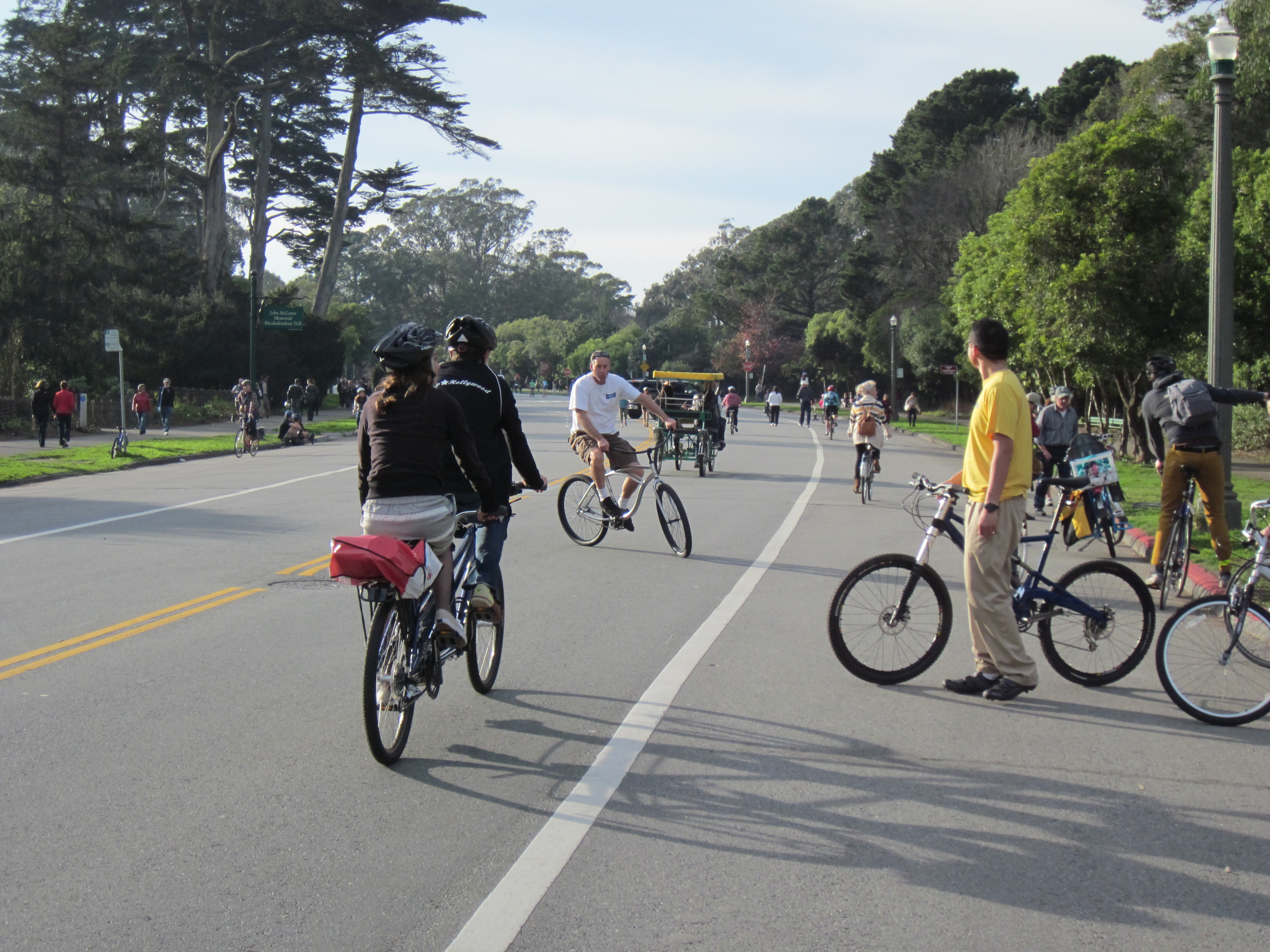
It was difficult for me to imagine a road without the right of way for cars. San Francisco offers many weekends where the streets are closed to cars in Golden Gate Park and for Sunday Streets, but although these are entertaining, they are places and times when cars are entirely absent. (And despite people’s avowed affection for their own cars, these events are very, very popular.) I cannot imagine a city where cars were still there, but placed on an equal footing with other road users. I think I would like that world.

San Francisco does, however, have a place where pedestrians act as though they lived in that world. That place is the Tenderloin. The Tenderloin is a grim wasteland in the middle of San Francisco. It is not just possible but probable that you will see people on the sidewalk  shooting up while walking through, something that despite years of working with needle exchanges, I had rarely seen done without apology or restraint under the open air before moving to San Francisco. One evening when Matt and I were walking through the Tenderloin to a concert, a man walked up carrying a mattress, dropped it heavily on the ground in front of us, and then passed out on top of it. I have spent more time in the Tenderloin lately as part of my increased work with homeless shelters, which are packed into this part of the city as though they were kennels.

These pedestrians entered the intersection after the light turned green and crossed at their own measured pace

In the Tenderloin pedestrians largely treat traffic signals as optional, whether due to despair or to drugs. It’s rare that I’m willing to ride my bicycle in the Tenderloin (it would be stripped if I parked it), but I do walk there when I have meetings in the area and on occasion we drive through. And one thing you notice immediately is that drivers are typically more cautious, as a green light in the Tenderloin does not necessarily mean go. People wander out into the streets whenever they reach a corner whether or not the light is favorable, or to chat when the sidewalks get crowded. Cars tend to move very slowly. Admittedly some of them are looking to score. When I am driving through I move with the same slow caution, although I have no desire to purchase street drugs or sex. My caution is by no means universal—pedestrians are killed by drivers in this area frequently—but it is a different experience to drive and walk there than it is in other neighborhoods. Walking there is not necessarily better: the entire neighborhood reeks of waste, catcalls and propositions are inevitable, and the weight of human despair can be overwhelming. But the omnipresent threat of cars is somewhat lighter. Driving is fine as long as you’re not in a hurry. I have learned to accept this but people often freak out while driving through the Tenderloin, and these people usually want to leave in a hurry.

I do not think about the Tenderloin when I think about safe streets. Like everyone else who does not default to car travel, I imagine a world where drivers were at least prosecuted for killing pedestrians or cyclists, although most cities in the United States apparently feel that this is too much to ask. When I am ambitious I imagine San Francisco with an overlay of Copenhagen. I still miss the experience of moving through Copenhagen, which felt both liberating and safe. It was in many ways the friendliest place we have ever been, and I don’t doubt that that was related to the bicycles; most of the city felt scaled to people.  I like to imagine the city’s streets being quiet enough to hold a conversation with my son when we are walking through a crosswalk. San Francisco’s major streets are painfully noisy. I often imagine a night without the howl of car alarms or the blatting of motorcycle pipes. These are pleasant fantasies.

But in some ways, I realize that the Tenderloin represents a different approach to the same problem, an escalation of pedestrian demands for the right to safe streets. It is a terrifying thing to watch; in the inevitable cross-fire, a car might get dinged but the pedestrian is usually killed. Very few people would be willing to take the same risks unless they too had nothing to lose. I find my time in the Tenderloin increasingly fascinating because it reflects not only the needs of desperate people, but of the costs of transportation design that ignores actual residents entirely.

Leave a comment

Filed under San Francisco, traffic

Legoland California

Legoland from the Sky Cruiser

Our son is old enough to appreciate the cult of Lego now so the big incentive for him to get in a plane to San Diego at some risk to his personal safety was the promise of getting to visit Legoland. I had no idea what to expect and neither did he; at our most specific, I would say we were all imagining a place where there were a lot of Legos to play with.

At the risk of ruining the surprise, Legoland is not like that. It’s like a Lego-themed Disneyland. Admission is heart-stoppingly expensive. There is a weird tie-in with Volvo, raising the question of whether all Scandinavians signed some kind of blood oath of mutual commercial support (but if you’re visiting San Diego and going to Legoland, try to rent a Volvo).

VIP Volvo parking

Although the whole experience primarily made me miss the charms of Fairyland, the most underrated amusement park attraction ever, we had the good fortune of visiting Legoland on what was evidently the least busy day of its entire history, and never waited for even a second in line for a single ride, attraction, or concession, so I have no complaints.

Our kids thought it was awesome, and there is a lot of thought put into what would entertain them.

"Yes, we have no bananas..." (I have no idea why this song, no)

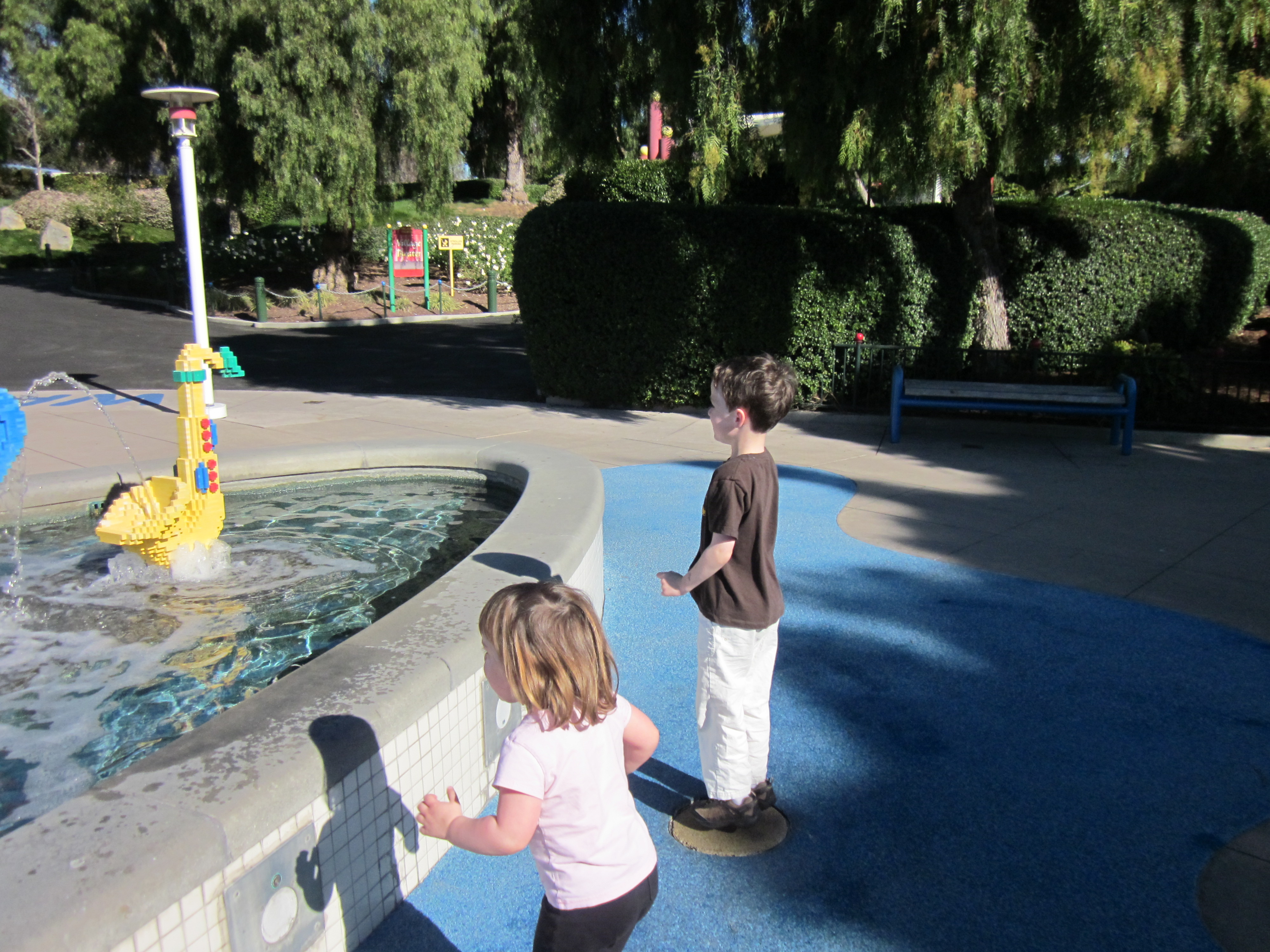
In the water play area, very welcome on a hot day, they can step on dots in the ground to make the fountains go or make music play. The rides are pitch-perfect for a six-year old boy, involving helicopters and boats and trains and fire engines.

However the Volvo sponsorship deal led to some weird moments for us. This was particularly true for the rides that involved driving; kids of various ages can drive little cars around a track, for example, and at the end of the ride they are issued little driver’s licenses.

Legoland driving school

There were, on occasion, opportunities to pedal things, but they were always purely decorative, like on the train in the sky, a surreal experience where a train car with helicopter blades mounted on the tail fin rode on an elevated track through the park, ostensibly moving thanks to the two riders pedaling but in fact powered by an engine. Our kids were both disappointed to discover it was not in fact a train that you pedaled like a bike.

Why include pedals at all if they don't do anything?

Like nearly every amusement park I’ve ever seen, Legoland was surrounded by a sea of parking, and if there’s a way to get there other than by car I can’t figure it out. We were traveling from the city proper by rental car, and expected that we would drive, but it startled me a little. As mentioned our usual amusement park venue is Fairyland, which is so old-school that parking was an obvious afterthought and you can walk there from a nearby BART station (if you are used to city distances, at least; a recent visit from a suburban family member reminded us that there are people who view a half-mile walk with a preschooler and no stroller as something akin to a polar expedition).

Although we had a nice time, I found myself confused by the whole experience (and it was reassuring to read that we are not the only people thinking about this). Have the scales fallen from our eyes? Is it as crazy as it seems to me that we were alone in the carpool lane both there and back yet driving the smallest car on the road? It’s hard not to think of hundreds or thousands of people driving alone in giant trucks as laughable overkill, as if people were walking through the streets with rocket launchers strapped to their back for “personal protection.”

Legoland helicopters can be moved up, down, and around

Is it as bizarre as it seems that the pedals on the Legoland rides were all purely decorative while the controls to operate a small car worked and the ones for a helicopter ride that actually flew it up and down and in circles were functional?  Or am I now a bicycle-crazed crank?

I have a feeling I know the answer to that. At the same time, I don’t feel crazy. That should be worth something. At my old office I somehow got on speed dial at the locked psychiatric ward across the street, and would end up with endless messages on my office voice mail from the King of Hawai’i. He said his name was Raymond, and he would croon nonsense songs into the ether while complaining that I never visited. These calls were the introduction to a wide cast of characters in inpatient lockdown, all of whom seemed harmless enough, although finding a dozen random messages in my voicemail box every morning got to be annoying. Eventually the psych ward staff figured it out and changed the speed dial settings (which I heard happening in the background of the last message). But my point: these people knew that they were off the charts crazy and they didn’t shrink from telling my voicemail about it. When I think about transportation, I don’t think that cars are bad, although I think they’re overused and inappropriate for many conditions (it’s a rare day I don’t ride my bike faster than the cars on the road in San Francisco, and I am slow and frequently carrying an extra person). It doesn’t feel crazy to me to think this, but the reaction I get is often comparable to announcing that I am the King of Hawai’i, and I’ve got a lovely song for you today…

Leave a comment

Filed under reviews, traffic

If it’s Thursday, we must be in San Diego

In the last year Matt has racked up unbelievable amounts of international business travel. From my personal perspective this is a hassle because it means I’ve spent more weeks than I care to count as a single parent. From a more optimistic perspective his travel represents an unexpected windfall in the form of hundreds of thousands of frequent flyer miles.

Sunset at Pacific Beach

At some point, realizing that our work schedules had turned our winter break into no break at all, we decided to take a real vacation over MLK weekend. Thanks to Matt’s miles, the cost of this vacation was $5 apiece in booking fees and a few days of entertainment plus eating every meal in a restaurant. We decided that was a price we were willing to pay. We didn’t want to leave the time zone because that always turns the kids into zombies and we wanted to be warm. Hello, San Diego!

I don’t leave San Francisco much and when I do it’s typically for conference travel, which is so stylized that I never really see the city I’m staying in—arrive at airport, take public transit or shared van with colleagues to conference hotel, meetings meetings meetings, meals in hotel restaurant, reverse on the way home. Many of my colleagues try to enjoy the conference destination but at this point in my life if I have to travel alone somewhere I prefer to go back home ASAP to be with the kids. So this was the first time in a long, long time that I had spent free-form time outside of the greater Bay Area, except for last summer’s trip to Europe. And I have to admit I’ve found it unnerving.

Oh yes, car culture

We stayed in a hotel with extensive grounds notable for its heavy reliance on golf carts, but every trip away from the property was a jarring reintroduction to Southern California car culture. Nearly everything commercial in San Diego appeared to be located in a strip mall. Every street seemed to have at least four lanes and traffic moved blisteringly fast except at rush hour, when we were the only car in the carpool lane and the rest of the traffic was at a standstill. Is this what the rest of America is like?

Despite the heavy emphasis on cars in San Diego, particularly huge trucks, it seems like a nice place to ride a bicycle in many ways. The city itself seems to lack hills entirely; it was no accident that we had trouble spotting a bicycle with gears in San Diego, even in a bicycle shop. There are bicycle lanes everywhere, albeit not with a lot of actual bicycles in them, and since they’re marked about once a mile it would be easy to confuse them with a break-down lane if they weren’t so narrow.

All bicycles end up at the beach

Except at rush hour, San Diego is a small city that doesn’t have serious traffic, which would be a relief. Admittedly my judgment as to what constitutes serious traffic might be a little skewed.

In addition, San Diego, like the rest of Southern California, is so image-conscious that we actually saw a street cleaner out buffing the streets. I’ll bet potholes aren’t much of a concern. California may be experiencing a state budget crisis beyond all precedent, forcing public elementary schools in impoverished neighborhoods to pack over 40 kids into kindergarten classrooms, but fortunately having streets as smooth as glass is the city’s last bulwark against the end of civilization.

No parking, bike lane

Unlike many cities, San Diego primarily stripes its bicycle lanes against curbs where there is no parking, eliminating the dreaded door zone. Unless our son is on board, as he is eagle-eyed and relentless in his self-appointed task of scanning for potential door-bike incidents, I ride as far to the left-hand side of the bike lane as possible when we are at home in San Francisco. And I get no small amount of huffiness from drivers about my determined leftward drift on sharrow streets, where the risk of being doored is greatest—without the visual reminder of a bike lane drivers fling open their doors into traffic with casual abandon.

I never knew that the sharrow arrows in San Francisco were positioned to protect riders from the door zone if they ride on top of the arrow itself until I read it on the SFMTA website. It makes perfect sense, but it does put you right near the middle of the street, and if I didn’t know that was the goal even after I’d started riding regularly I suppose it’s hopeless to expect full-time drivers to know.

What is that thing?

We have changed. In San Diego despite having no intentions to do anything in particular, we ended up renting bicycles (of a sort) almost every day.

3 Comments

Filed under family biking, traffic