Tag Archives: family biking

Riding to the Bicycle Music Festival

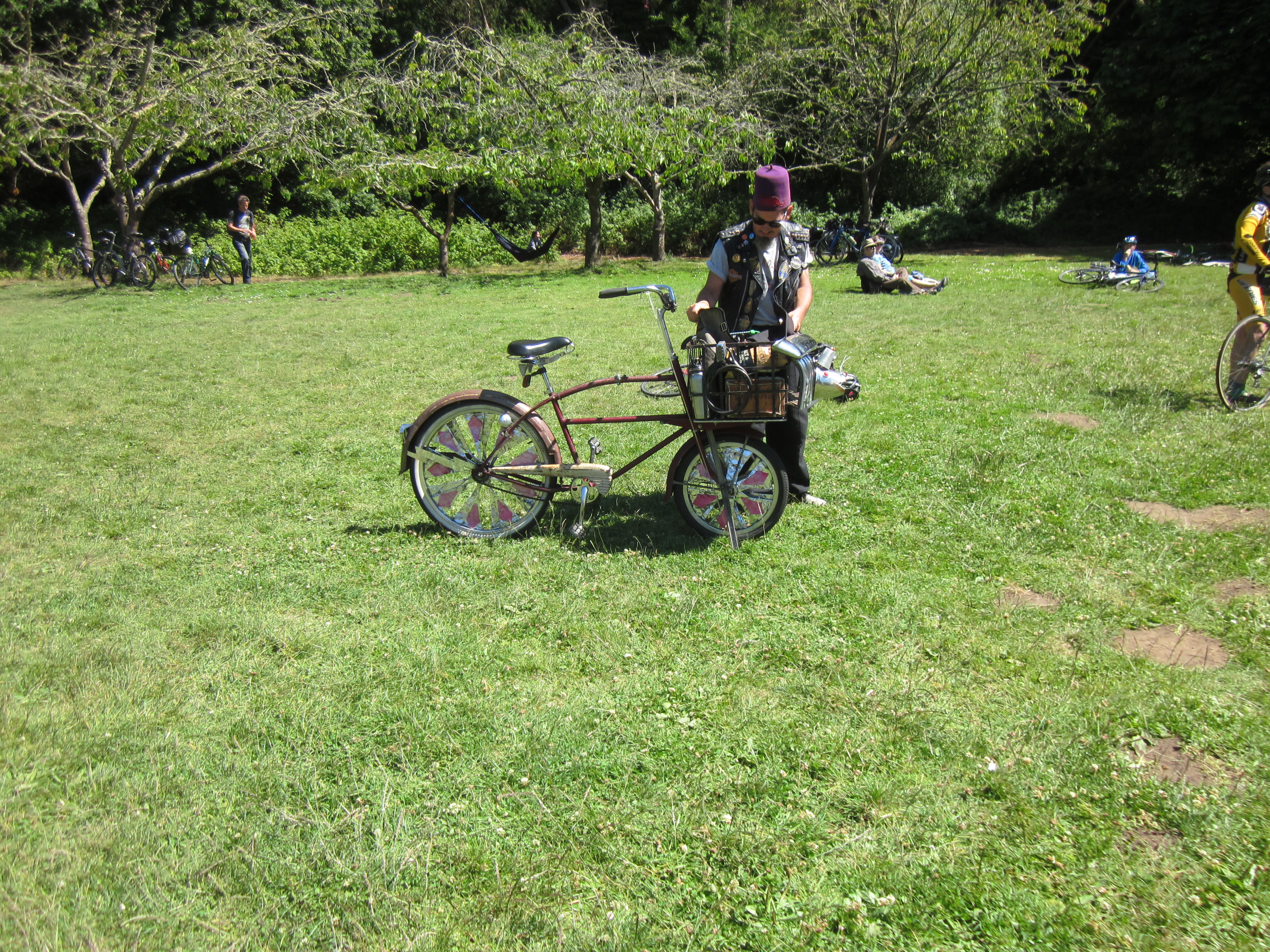
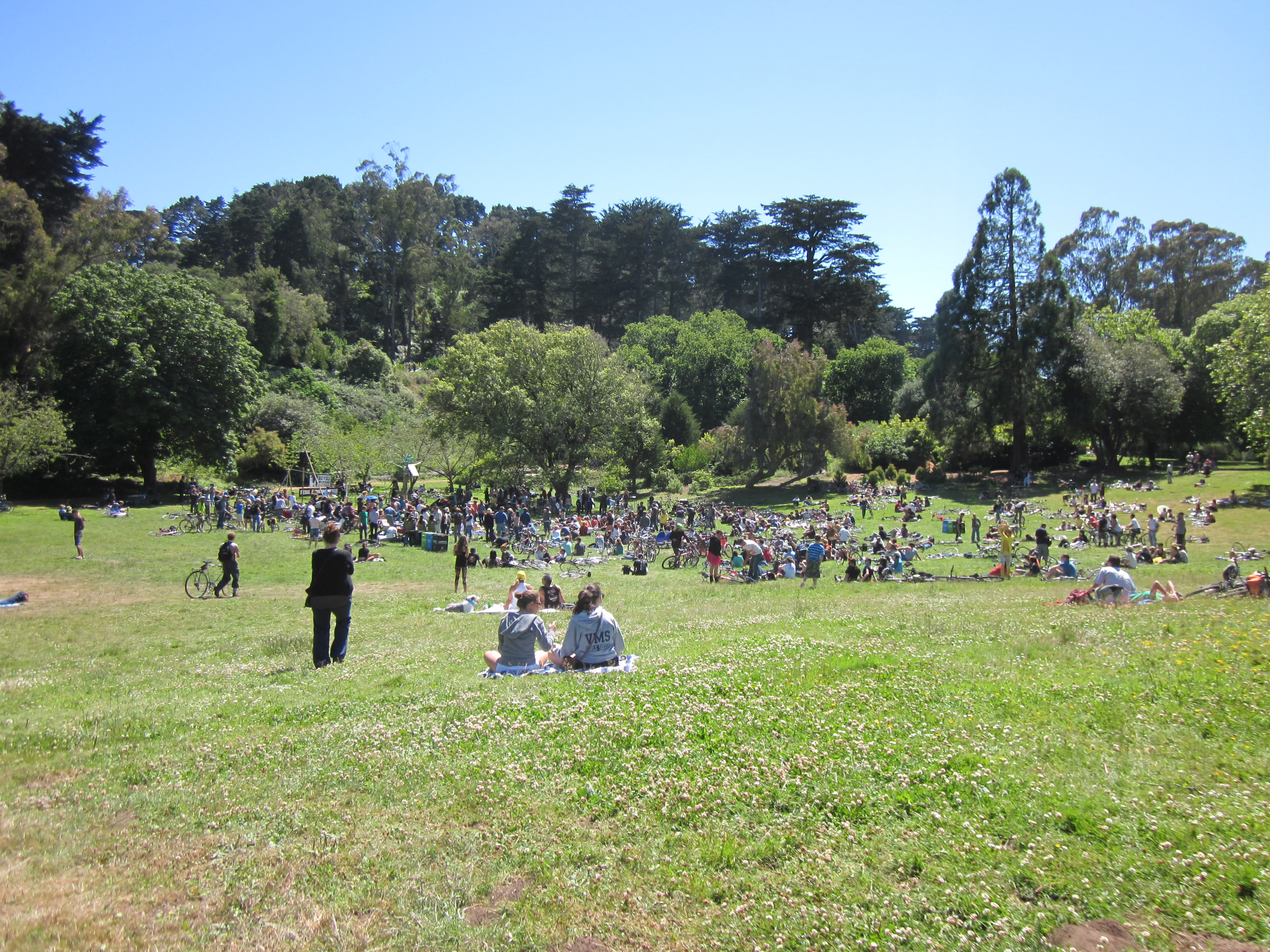
The Bicycle Music Festival at Log Cabin Meadow

On Saturday, Matt headed off to China for work again. Saturday was also the last day I spent with my son before his departure for grandma (and grandpa) camp in Berkeley. After three weeks at wheelkids, what he wanted to do with the day was show off his new bike riding skills. Okay by me! So after the morning rush of seeing Matt off, and my daughter’s afternoon nap, we rode down to Golden Gate Park for the Bicycle Music Festival.

Pedal!

The Bicycle Music Festival has amplified music, but it’s all bicycle-powered. I had hoped that kids would have the opportunity to ride the generator-bikes, but they all seemed custom, and sized only for adults. And incidentally, I have never seen so many electric assist bicycles in one place in my life. If they’re electric-assist bicycles, is the festival really human-powered? Certainly I can’t imagine any other way to manage the musical parade across town, but it’s an interesting philosophical question.

Is it a picnic or a bicycle festival? Even hundreds of bicycles are unobtrusive.

Pretty much everyone came to the Bicycle Music Festival by bicycle, and brought them onto the Log Cabin Meadow with them. And yet, although the numbers of bicycles were visually impressive, it looked nothing like its closest automobile equivalent, which to me would be tailgating. A group of people with an equal number of bicycles looks like a big picnic. A group of people with an equal number of cars looks like a parking lot full of cars.

Haven’t we seen you somewhere before?

These days we are starting to recognize some of our neighborhood bikes and we’re in that odd place where we nod to acquaintances when we recognize their bikes, although we don’t really know them. It’s like that weird relationship you end up having with other dog owners at the dog park or other parents at the children’s playground.

Riding in the JFK bike lane (the portion open to cars)

It turned out that the actual music at the Bicycle Music Festival was not that attractive to kids, or at least it wasn’t at the time we came. My son could not have less interest in spoken word/rap, even if it was ostensibly about bicycles. Instead he rode around for a while through the field, winding around other bicycles in a self-guided obstacle course. I had no idea he’d picked up off-road riding at camp.

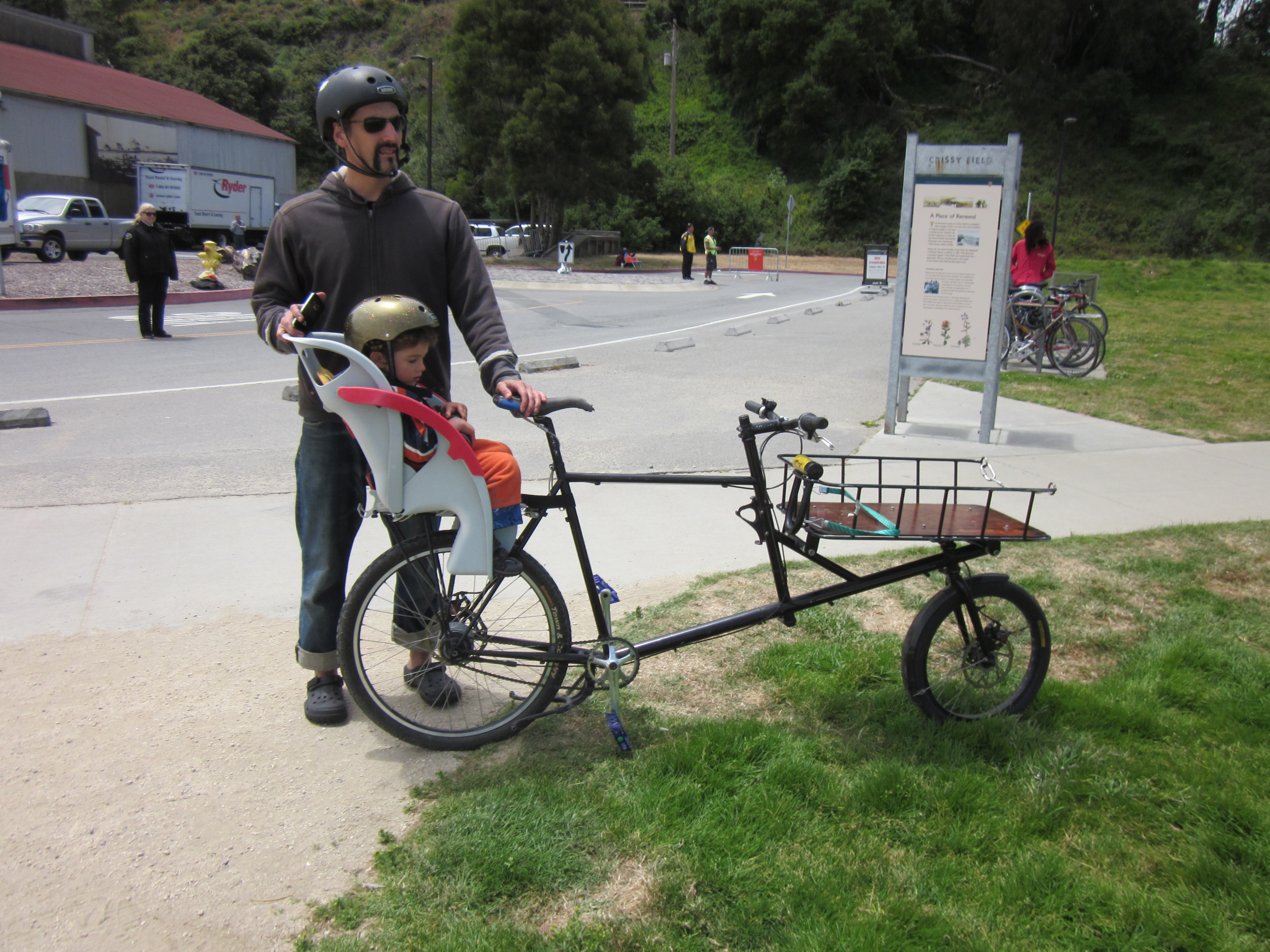
The kids did like this Mundo converted to sound stage. I wouldn’t ride it without an electric assist either.

He quickly grew tired of the festival and asked to ride around the park more. Now that it’s summer, most of JFK Drive is closed off to cars on both Saturday and Sunday, so no problem. We rode to the waterfall and back, and then headed home.

I was initially nervous about taking our son on actual streets to and from Golden Gate Park, but three weeks at wheelkids seems to have worked something close to a miracle. He now rides a straight line, stops at stop signs before the line without falling over, uses hand signals, and watches oncoming traffic. He’s not perfect (he’s six!) but I was impressed.  On hills he stands to get leverage, and although he couldn’t make it home without walking—it’s a single-speed bicycle—he rode a good portion of it. And he got back on the bike for the last stretch near home. He’s not ready for the traffic and hills on the route to school, but he’s closer than I would have hoped. I give full props to wheelkids for this, because we came nowhere near teaching him this stuff on our own. And he loved it.

Check it out! Stopped at a stop sign all by himself!

When we got home, we headed out for sushi and noodles at our neighborhood joint. And who showed up but Adrienne from Change Your Life, Ride A Bike! It was great to meet her; reading her stories about riding with her youngest in San Francisco is part of what gave us the confidence to try riding with our kids in the city. Big city, small world.

2 Comments

Filed under destinations, electric assist, family biking, rides, San Francisco, Yuba Mundo

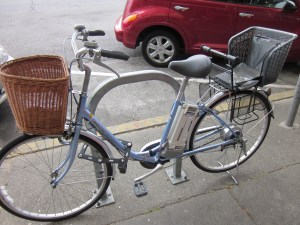
Bridgestone Assista, the electric mamachari (my craigslist bike)

The Bridgestone Assista, brought to us by the Land of the Rising Sun

Last month I mentioned that I bought a mamachari. When I saw it on craigslist, I assumed that given the less-than-a-new-bike-at-Walmart price that there must be something wrong with the electric assist. I was wrong and there was not. So for the past three weeks I’ve had the option, when I want to, of riding an electric pedal-assist bicycle. It is even better than I dared to hope.

This particular bike and its assist do not work miracles. My mamachari is a single-speed and it weighs 65 pounds. The motor, which sits in the rear hub, is not especially powerful compared to the BionX-assisted Big Dummy I rode in Portland; it is several years old and a first generation pedal-assist and evidently Japanese bicycles limit the power anyway. It does not have a throttle: if you want power, you have to pedal. With a 35 pound preschooler on the back the combined weight makes this bike really slow, even with the assist. Guys wearing lycra on light road bikes pass us going uphill, although we pass regular commuters. On mild to moderate hills the assist is helpful although not always necessary, but even with the assist it is still work to crank that much weight up a steep hill.

This is the only road to our daughter’s preschool.

All that said, this bike is a game-changer, because on the mamachari I fear no San Francisco grade. On a pedal-assist bike, San Francisco flattens out to something approximating a normal city. My daughter is getting regular rides to preschool because we now have a bike that’s capable of taking the hill safely. When Matt took her up to school once on the Kona MinUte, having her weight on the back meant he had to fight against having the front wheel lift right off the ground (this has happened to me on other hills). Plus he nearly passed out from the effort and has refused to ever do it again. On the mamachari, not only do we have the assist, but the weight of the battery, which is low on the bike and further forward, ensures that the front wheel stays safely on the ground. It is a lot of work even so—my heart rate usually doubles on the way up and I always end up short of breath—but I don’t break a sweat.

This is the battery; the English words are basically decorative

My mamachari was imported from Japan by a coworker of the woman who sold it to me. She works at Lawrence Berkeley Labs, which is about 2/3s of the way up a very long and steep hill. We live in San Francisco, which has countless hills that are steeper, but very few of them are long. The Bridgestone Assista does not seem to have been designed for the kind of extended use needed to haul it up the hill to LBL, so the previous owner of this bike wired a backup battery into the front basket that kicks in when the original battery’s charge runs down, and used the assist for the entire trip (I found her electrical skills awe-inspiring). The range on this bike is now apparently about 20 miles with hills, although I have yet to use the backup battery.

The pedal assist controller: Off at the top, On in the middle, and Eco at the bottom. The bars next to the plug symbol indicate how much charge is left in the battery.

This bike is really, truly a Japanese bike and it has some quirks. The electric assist controller and the battery charging instructions are written entirely in Japanese and my Japanese is pretty rudimentary, so I had to get some help with translation. The kanji and katakana on the controller read: “Off,” “On,” and “Eco.” Because the bike has no gears, I think of the pedal assist as creating three virtual gears: “Cruising,” “Going up a hill,” and “Riding into a headwind.” In Japan traffic is on the left, so the brake cables were reversed, which was especially disconcerting when I got it because the front brake wasn’t working at all. (Before I replaced the brake, riding the mamachari was a bizarre inversion of normal life because I casually rode it uphill and carefully walked it down.) The mamachari has 650b wheels, which are standard in Japan, and big wheels look odd to me on such a slow bike. And this bike is meant to meander. You sit bolt upright on a mamachari and putter along. It’s very relaxing.

This is the motor in the rear hub; it’s not particularly powerful, so it’s fairly unobstrusive

There are lot of ways that it’s clear that the bike is meant to be disposable. The wheels are junk (and would be hard to replace, given the quirky size and the integrated rear hub motor) and the original brake levers were plastic. They felt like they would snap in half when I was pulling them (without much effect at first). When I had the front brake replaced the bike shop also switched out the brake levers for metal ones, and that feels a lot safer. It has a hub dynamo front light that looks pretty ratty and works, uh, most of the time. The fenders are plastic.

And yet I am amazed at all the ways that a “disposable” Japanese bike is relentlessly awesome.
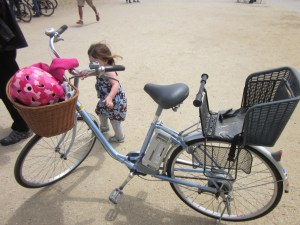
The back rest on this seat can flip over to convert it to a giant rear rack basket

The back support of the rear child seat (with integrated waterproof cushion) can be flipped over to turn the seat into a huge rear basket when a child is not on board. The rear wheel lock is virtually hands-free, and so well-machined that it makes Dutch rear wheel locks and the one on my Breezer look like something out of the Stone Age. Plus it is integrated with the battery lock, so when the rear wheel is locked the battery cannot be removed.

With the low step-through, getting on this bike is like sitting down on a comfy chair

The kickstand reminds me of a giant paperclip but it is bombproof. I can put my daughter on board and watch her lever herself to the side until she is almost out of the seat and the bike does not even wobble. The seat has the largest springs I’ve ever seen and riding the mamachari literally feels like bouncing on an exercise ball.  And for reasons I don’t understand, the mamachari is rock-stable at low speeds and can take corners more tightly than even my Brompton. And this is without even mentioning the giant front basket. I can’t put panniers on the mamachari but haven’t yet missed them.  The Bridgestone frame is also the prettiest and lowest step-through I have ever seen. Even the bell is mellow.

Why pink power? She just really likes the color pink; apparently it’s part of being three. The girls in her preschool all fight over who likes pink the most; it’s a thing.

When I ride this bike people ask me where to buy it (craigslist, or barring that, Japan), or if they can buy it from me (no). It is easily the most coveted bike we own, at least in our demographic, and although the mamachari initially left our local bike shop unimpressed, they have been reassessing it in light of its popularity. My daughter begs to ride the mamachari at every opportunity. When we are on the streets she shouts to everyone she sees, “I’m riding a mamachari!!!” And then she turns to me and says, “Turn on the pink power, mommy. I want to go FAST!” And yet the mamachari is a bike that is so obviously only cool to parents that no bike thief would be interested in stealing it. Why is no one importing these bikes?!?

To my surprise, my mamachari even has a pedigree of sorts. My brother-in-law wrote to tell me about it. “You now own a distant cousin to what bicycle aficionados consider the greatest production bike brand that ever was: Bridgestone USA. It was an office of three in Walnut Creek (or maybe it was San Leandro) that designed bikes to be built by Bridgestone Japan and sold only in the US. They were around for about a decade and were super duper smart bikes like never before or after (Kona and Salsa are the closest thing to them now). Bridgestones were known to be the best bang for the buck at any price range and were spec’ed in ways where nothing ever needed to be changed out at the time of purchase and nothing was on there just because it was new or cool. They also were the winningest bikes in history for folks who paid for their own rides (like amateur world champions), while at the same time being the only brand to really push utility bikes in the US. I had one in Minneapolis and it was most awesome. I should have kept because it’s now a serious collector’s item. If Bridgestone USA was still around, I suspect you’d be riding one or three.”

Riding the mamachari is crazy-fun.

The mamachari is the ride of choice on our trips to preschool, of course, because of preschool hill, which is why I bought it in the first place. But it is also my ride of choice on a new route in San Francisco, because it can take any hill that I didn’t realize was there from reading the map, because it is relatively uninteresting to bike thieves, and because it can carry almost anything I might want to borrow or buy (a dozen library books? no problem). I still usually ride the Breezer on my ordinary commute; I’m used to those hills and the mamachari is overkill. The Breezer is also the only mule that can haul the trailer-bike. And the Brompton serves its own niche, so it will always have a place in our lives.

Even without the assist, the mamachari would be fun to ride on weekends, when we’re going someplace flat, because it is such a mellow ride and because it is so easy to haul kids and other stuff. Yet although I adore this bike, it may not be with us forever. Having tasted the freedom that the assist gives us, I want a lighter pedal-assist bike with gears, so I don’t need to rely on the motor quite so much on moderate hills. Plus, to be honest, the combination of the weight plus a weak motor means that it can’t really go up every hill in the city, although it’s close. But I’d be better off on a frame that is designed for people who are bigger than the average Japanese mama—at 5’7” and change I’m a bit tall for this bike. Plus the mamachari is too heavy to go on a bus bike rack, which maxes out at 55 pounds.
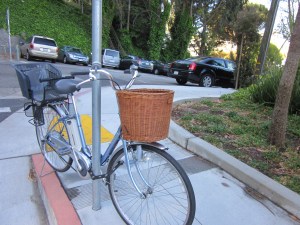
The mamachari locked up after its daily conquest of preschool hill.

Although I will keep this bike at least until my daughter outgrows the rear seat, I think the mamachari’s ultimate destiny may be to carry my 5’2” mother up the somewhat mellower hills of my hometown. After all, in Japan it could be called either a mamachari or an obachari. And that way I would never have to part with it entirely. I am attached to all our bikes to some extent, but the mamachari, the first bike I ever felt confident enough to buy used on craigslist, the first bike that could ever haul our daughter up to her preschool, the bike that laughs at most San Francisco hills, and the bike that has already taken me to more new destinations than any other, is already special. It may have been intended to be disposable, but I’ll love it forever.

21 Comments

Filed under commuting, family biking, reviews, San Francisco

Road rage redux (now with less road rage)

After my Thursday morning commute I had pretty mixed feelings about heading out again to pick up my son from bike camp. It is a little grueling no matter what because for that pickup I have to head straight uphill for several blocks to get over to the Presidio. But I figured it couldn’t be too bad, because half the route is in a separated bike lane along the Marina. And I was right: things got better.

Funny, you don’t look 75 years old.

I like riding along the Marina, which has a wide, flat multi-use path to the side of the main road along the water. There are always lots of tourists heading to and from the Golden Gate Bridge, and I love seeing their goofy smiles as they stare over to the bridge and to Alcatraz Island and watch the ferries pass by. They look like I feel. And en route to Fort Mason I can see the city unwinding down the hills like a long white skirt. People sometimes say San Francisco looks like a young girl. You can almost see it smiling.

Yes, you can carry a six-year-old on a Brompton (assuming you don’t mind looking goofy, but let’s face it, you already look goofy)

There was still a surprising amount of car hostility on the road, although nothing like the morning, but if no one is honking I find that pretty easy to ignore. And once my son is on board the Brompton most people are so overcome by disbelief that it is apparently hard to stay hostile. The wheelkids staff managed to get a photo of me with my son on the IT Chair; although he used to be too nervous to ride it, he has developed a new fearlessness about bicycles and wants to ride every bike he sees.

We rode through the flats for a while and then hitched a ride on Muni before the biggest hill. I’m not sure I could get up it with him as a passenger, and he was so exhausted after a long day’s ride that he nearly passed out anyway.

I’m glad I got back on the bike.

Leave a comment

Filed under Brompton, commuting, family biking, Muni, San Francisco

Kids on bike racks: jump in the pool!

This has become a familiar sight.

I don’t remember when I noticed my kids liked climbing on bike racks. I assumed at first it was just my kids, until I started seeing photos of other peoples’ kids also climbing on bike racks. What is it with kids and bike racks?

The attraction is so strong that we have seriously considered installing a bike rack in our basement. It would make it easy to lock the bikes but the thought of drilling into concrete is pretty unappealing. And of course our basement floods, so it could end up looking a little gross.

When I commented on one of A Simple Six’s photos of her kids climbing on a bike rack, she suggested I create a Flickr pool, and I thought, yeah, right. What I know about Flickr could be written in crayon on the rim of a shot glass, to quote David Foster Wallace. But in the spirit of lifelong learning I recently went to Flickr and figured out how to create a “Kids on bike racks” group pool. Do you have a picture of kids treating a bike rack like a jungle gym? Or a ballet bar? Or a tunnel? If so, I’d love to see it.

4 Comments

Filed under family biking

Destinations: Redwood Regional Park Girls’ Camp

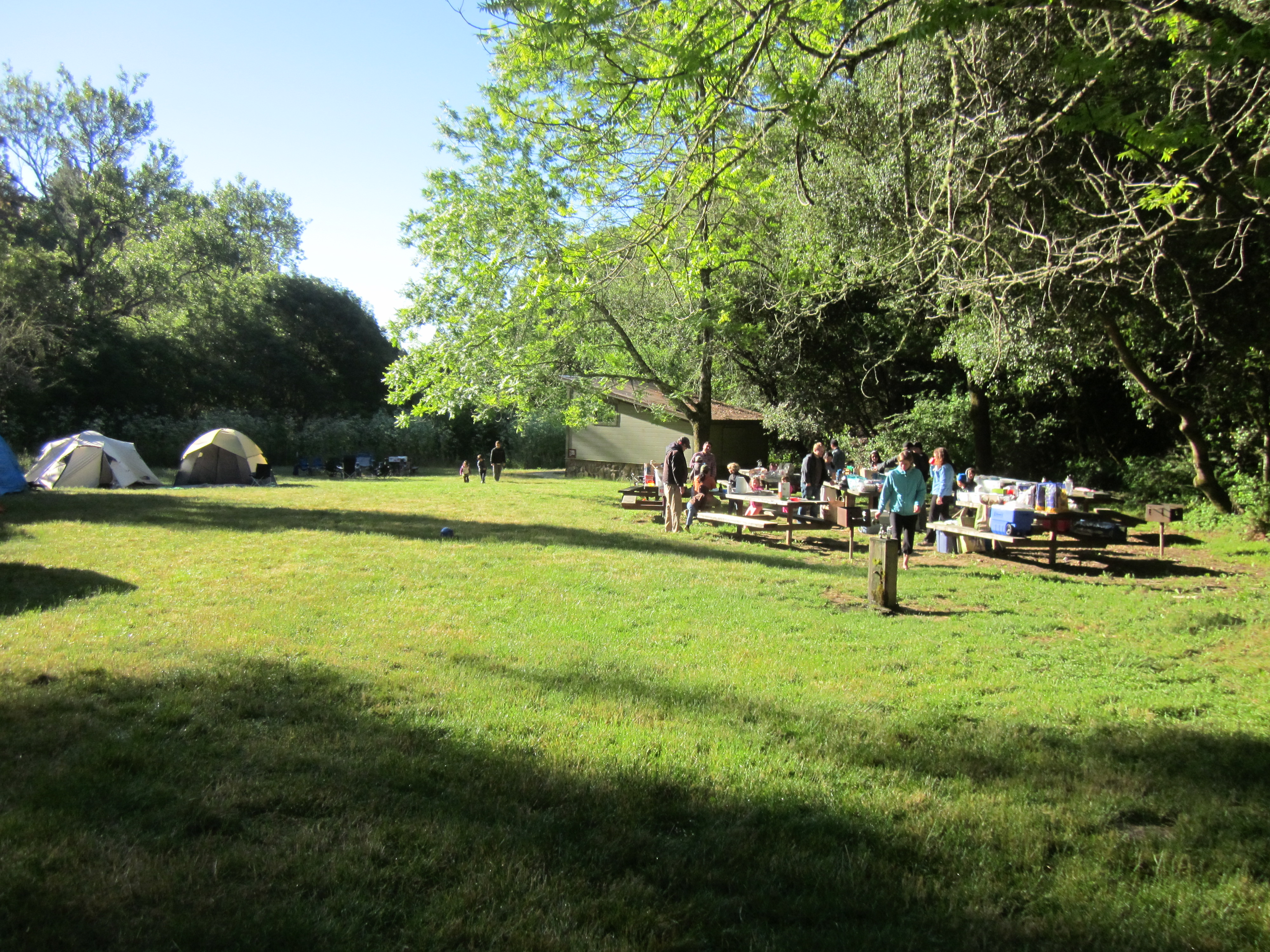
At the entrance to Redwood Regional Park Girls’ Camp

A week ago we headed to Redwood Regional Park with a group of families from our son’s school on a camping trip. I had ambitions, initially, of trying to cargo bike into the campsite. Anyone who knows anything about the Oakland hills is now laughing.

The trip to Redwood goes up steep hills on roads with names like “Snake” which are meant to evoke the serpentine path they follow up a hill so steep that attempting to scale it even in a motorized vehicle involves a nauseating number of switchbacks. Redwood Regional Park’s gates are at the ridge, and from there the way in is basically straight downhill in the other direction. The paths down into the park, although portions can be ridden or driven, are not only extremely steep but deeply rutted and narrow. So yeah, we drove and walked in.

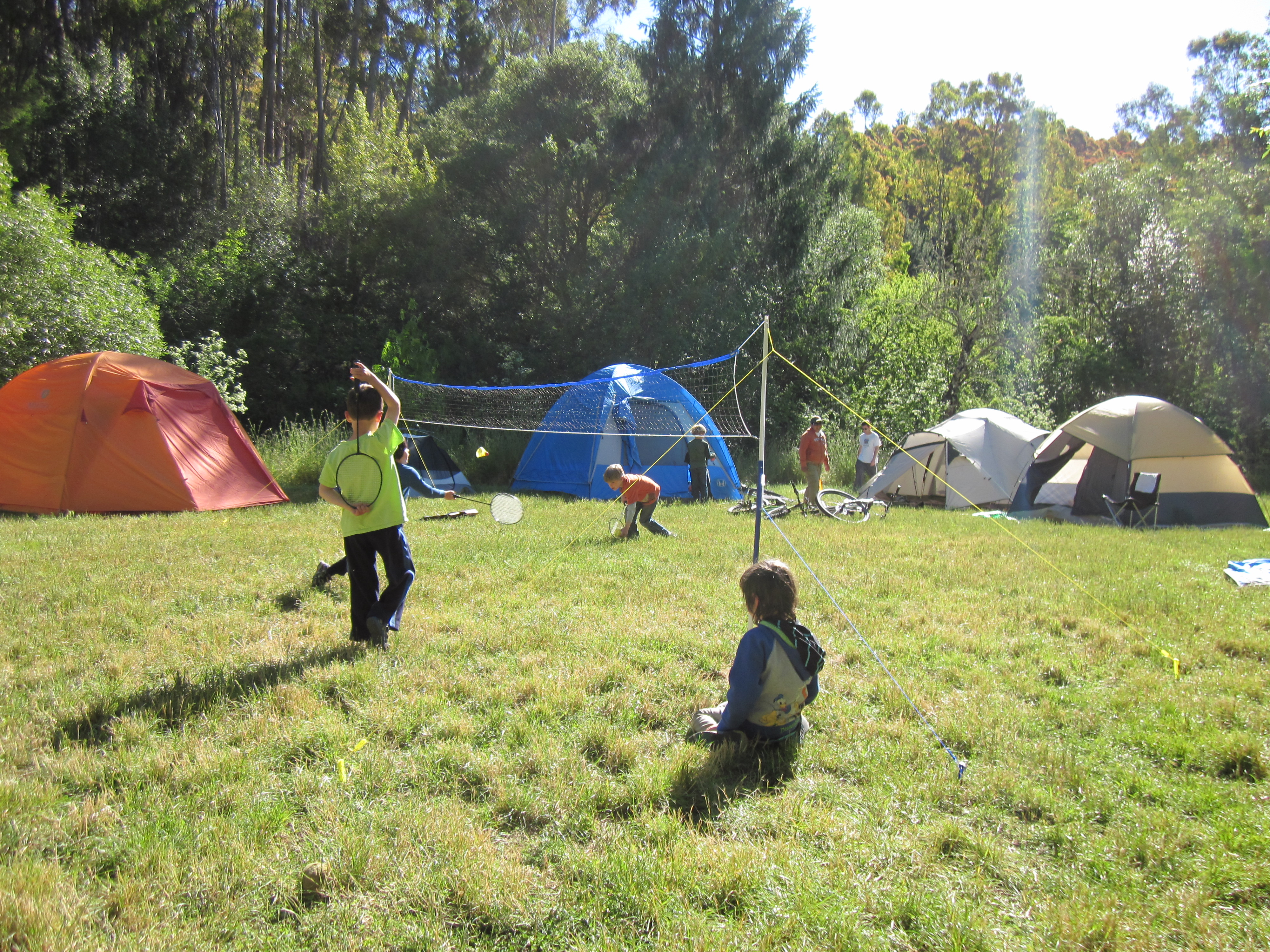
Tents up: time to explore them

Girls’ Camp is about a half-mile from the Skyline Gate, straight downhill. If you reserve the campsite, you get a code to open the padlock to the Stream Trail entrance. Only two cars are allowed to park overnight at the site, but by shuttling back and forth all of the families we camped with were able to portage down, empty out their gear, and then head back up to park at Skyline Gate overnight (you also get overnight parking passes).

Parking was near the bathroom at the far end

The camp site itself can hold up to 75 people, and with 30 or so we were nowhere near this limit. Girls’ Camp has a bathroom and cold running water, as well as tables, benches, and grills. Next to the firepit at the far end there is a shelter that the kids used as a stage and a place to run around.  This site is in the middle of a well-traveled trail, but by evening anyone not camping is gone, and we had the park to ourselves. The site itself is beautiful, and Oakland parks are almost completely free of bugs other than yellow jackets (which stung two kids over the weekend, but I think this is atypical).

Some kind of game involving balls was played, but let’s not get hung up on the details

We hadn’t been camping with our two kids before and this was a great introduction. They spent the first few hours checking out all of the tents and spotting bunnies in the woods. The tombstone family had brought a badminton/volleyball net and for much of our stay the older boys played these two games simultaneously.

For some reason it was extremely important that we carry this stick around

One of our friends is the Martha Stewart of family camping and had stopped at the Civic Center farmers’ market, where she had picked up, among other things, four dozen free-range organic eggs for $12. I had always shunned the Civic Center market because of its historic live-chicken-slaughtering reputation, but apparently the city cracked down on that and now the Heart of the City market is the place to shop. At any rate we all ate well. The first night the kids spent hours making s’mores which in the case of our kids may well have been the peak experience of their lives to date.

We had planned to stay two nights, but learned on the first night that our daughter is still too young for overnight camping. For two hours straight after bedtime she was so amped up she was yelling randomly, “I have a bike! I saw a bee! Stop bothering me! I need to sleep! Did you see the bunny! I saw a bee! Stop bothering me!” Of course she was up at the crack of dawn. Our only consolation was that the other three year old held his two-hour screaming fest at midnight, making us only the second-most obnoxious family at Girls’ Camp.

Walking along the Stream Trail

So on the second day we hiked the Stream Trail out and back, which was beautiful. We returned to head further into the park to the Roberts swimming pool, and deciding to quit while we were ahead, packed up after dinner and headed home. Both kids slept like the dead in the house, thankfully, although our son turned up in our bed and did his level best to shove both of us out of it. We still had a great time.

It is, evidently possible to ride bikes in Redwood, although not to ride them the way we do. One family had brought mountain bikes and took a side trip; mom drove them uphill to the start of the trail and then drove downhill to wait for them at the end. There is so much gender politics wrapped up in that story I can’t hope to unpack it all. But it struck me as the mirror image of much of bike commuting in the United States. Mom is the sag wagon. If people couldn’t rely on that free ride, how different would bicycling be?

Lots of families looking for shade

Sometime, when our kids are older and our daughter might sleep through the night, we will try camping again. Although Redwood is beautiful, another possibility was the destination of another family in our group the next week: Angel Island. The only way onto Angel Island is by ferry, and only walkers and cyclists can ride the ferry.  That would be a different kind of trip, but we had such a good time, we’d like to try it again once sleep is a real possibility.

5 Comments

Filed under family biking, San Francisco

Getting in the game

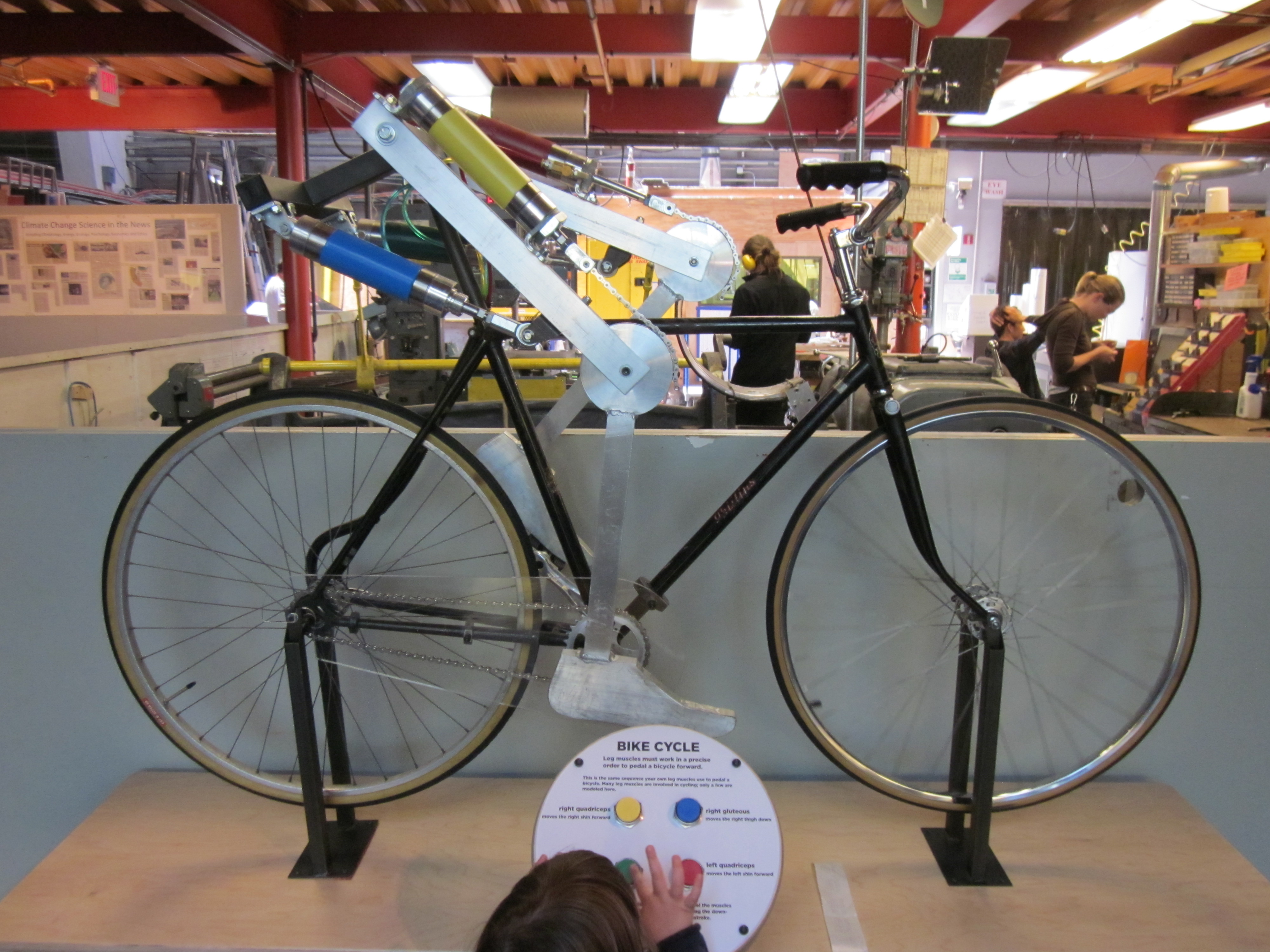
The Exploratorium offers a chance to make a robot ride a bike. Why not people?

Something I hear more often than I expected is other bike riders saying they’re not really advocates for cycling. They claim that their advocacy is just to be out riding. I totally support people riding bikes, but it surprises me that so many people don’t want to advocate for cycling. The reasons people for not advocating for something they love strike me as not much different that the reasons people give for driving instead of riding their bikes. It’s not that it’s particularly hard to do either, although of course it’s easier to do the same things that we’ve always done. Weekend leisure riders who drive a car to work every day are definitely making a contribution by making riding bicycles look normal, and everyday bike commuters who avoid advocacy are doing the same, but I’ve always felt that if it’s something I love–and I do love riding my bicycle–why would I stop there?

It would take too much time, I don’t have the right bike, there are no showers at my office, there are hills, I drive a Prius instead.

It would take too much time, I don’t know what to say, I don’t know what I’m doing, it’s too hard, I ride my bike a lot instead.

Car-free Presidio: more like this, please.

Are they reasons or are they excuses? I’m not sure I’m one to judge, but I’m trying to do more. I figure that if I have the time to write a tweet I have the time to request a bike rack using the city’s online request form (my link is San Francisc0-specific, but Google pops up similar links for dozens of cities). If I have the time to write an email, let alone a blog post, I have the time to write a letter to the mayor and the head of Muni supporting the proposed separated Fell-Oak bike lanes. If I have the money to buy a new bike bell (or a new bike, cough cough), I have enough money to join the San Francisco Bicycle Coalition and contribute to occasional fundraising drives. If I have the time to ask questions at the bike shop about my bike, I have the time to ask my credit union whether they could start making loans to get other people on bikes.

So I do all of these things, and occasionally things change for the better, and evidently this makes me an advocate. I am not in the league of A Simple Six, who is writing city bike plans and organizing community meetings and meeting with city officials one-on-one, or Family Ride and Tiny Helmets, who are starring in the local films and television news (and how cool is all of that?), but I once attended a hearing. Just like riding, I’m figuring it out as I go along. And although it’s not the same, I think that in its own way it’s just as rewarding as riding a bike.

Leave a comment

Filed under advocacy, commuting, family biking, San Francisco

Trailer-bike: Roland add+bike

Breezer Uptown 8 and Bobike Maxi and Roland add+bike: Three countries on one bike (four if you count the Japanese front rack)

There’s a new bicycle accessory in the house. In response to my son’s requests for an opportunity to pedal, we got a trailer-bike. Technically he’s old enough to ride by himself, but given the traffic and hills around San Francisco, none of us felt ready for that.

Although we saw the promise of trailer-bikes early-on, we had difficulty finding one we liked. The ones that mounted to the stem of the adult’s bike (Adams Trail-a-Bike, Weehoo) were unstable in both our personal experience and in other parents’ more harrowing experiences. And we couldn’t mount a rear child seat over one (ditto for the Trail-Gator). The Burley Piccolo mounts solidly to a custom rack, but the knob-mount is huge and meant that again we couldn’t mount a child seat over one—or for that matter, use the top of the rack. The FollowMe tandem looked more promising, but reviewers noted it was extremely heavy even without the bike attached, making it tough to go up hills—not that it mattered, as word from the only US distributor of the FollowMe tandem, Clever Cycles (Portland), was that they were out of stock and would be for the foreseeable future.

This is the Roland add+bike’s attachment to the rear rack

I don’t remember where I heard about the Roland add+bike, but when I did I noticed two things right away: first, it mounted to the rack, like the Piccolo, which made it more stable. Second, the mounting point was nearly flat and sat at the end of the rack, making it possible to mount a child seat for our daughter over it and to use the entire rack, like the FollowMe. It cost a little less, in US dollars, than a Piccolo. The downside, and this was a big downside, was that it was only sold in Germany.

But fortune smiled. Ever since high school I have had a good friend in Munich, Oli. We were, by coincidence, exchange students in each others’ high schools. One month after I learned about the Roland, Oli wrote to say he was visiting San Francisco to complete an audit, and would we like to meet while he was in town? I asked him if wanted to stay with us and if he’d heard of the Roland. He had. He said he’d love to stay with us, as his company was blanching at the cost of hotel rooms in San Francisco, and in return he’d be delighted to bring us a Roland add+bike from Munich as one of his checked bags. Win-win!

Our kids were thrilled to have someone so tall to carry them around.

Oli, as it happens, loves bikes as much as we do. He and his wife imported their own Bakfiets from the Netherlands to Munich for commuting with their three daughters. “We call it… the FERRARI!” Within a week, he’d found us a used Roland add+bike and its custom rack on German eBay for the unbelievable price of 77 Euros. It was a single speed model. (The Roland also comes in 3-speed and 7-speed models, both of which have internally geared hubs! On a trailer-bike!) But for that kind of savings we could live without gears. Oli said that used Rolands are cheap in Germany now because the fenders and chain guards are made of plastic, and everyone is concerned about potential BPA exposure. I was so thrilled that the trailer-bike came with fenders and a chain guard—totally non-standard in the US—that I was willing to tell our kids not to lick the parts. Also: unbeatable value!

Up, up, and away! Matt needed the car to catch up to us on this hill.

The Roland rack is the custom rear rack we fitted on the Breezer when upgrading a half-dozen other things. Our bike shop complained that this was, ultimately, not a particularly easy job. But it totally worked. When we picked up the Breezer, we brought the Roland with us and built a giant articulated bike right there on the sidewalk: Breezer+Bobike Maxi+Roland. After the bike shop adjusted the handlebars to our son’s height, we took it for a spin. It was quite a sight. Everyone ran out of the shop to watch.

This rod drops into a metal through-hole in the rear rack. The divot in the rod is for a smaller, sprung rod that is mounted horizontally below the rack itself, and which prevents the attachment rod from bouncing out on bumps.

The Roland is by far the nicest trailer-bike I have ever seen, and it boggles my mind that no one is importing it. The custom rack is very heavy-duty, and at the rear there is a metal through-hole welded to the rack itself. A rod points down from the latch-point of the trailer bike, and slips into the through-hole. It locks into place where a second rod springs into a divot on the side of the attachment rod to secure it. Although the weight of the trailer-bike alone would probably hold everything in position, the extra attachment-point makes it even more secure. (This is all very hard to explain in words; check out the pictures for details.) Once in place the trailer-bike can rotate through turns because the rod turns inside the through-hole.

Matt tried out riding the Breezer with the Roland add+bike–this is the end of the Wiggle (the unpleasant part).

As mentioned, the Roland is pretty plush by American standards. A chain guard and fender are standard. There are lots of accessories available, including a kid-sized rear rack for panniers, not to mention a cargo kickstand for the trailer-bike itself, as well as extra metal mounts—as this part is small and cheap to ship overseas, we are already thinking of ordering one and drilling a hole into the Kona MinUte’s deck for it. Why not? Our son loves this trailer-bike. He is thrilled to be pedaling without the stress of dealing with traffic, and with, let’s face it, with an adult power assist to get him up the hills.

Like any trailer-bike, the Roland adds extra weight, and this is not necessarily insignificant. Being able to carry two kids and two panniers plus whatever I can stuff in the new front basket means the Breezer can now really haul, and this is fantastically practical. However with the Bobike Maxi and my daughter on the back, in addition to my son on the Roland, getting up real hills is hard work even with a stoker, although it’s no problem where it’s flat. Even with the extra work, this is a welcome additional option for carrying two kids on one bike, especially if they’re squabbling, which can be a problem when they’re sharing the deck on the Kona MinUte. (That can be a problem on any longtail bike; it isn’t a MinUte-specific concern.)

So overall: we adore the Roland. I would suggest that anyone who is interested in a trailer-bike and who has access to a willing German get one. Apparently they’re cheap right now on German eBay. But I realize this isn’t the most helpful suggestion. It’s like suggesting that someone take their preschooler to school on an authentic Japanese mamachari. It is wildly unlikely that anyone who doesn’t have my recent phenomenal bicycle luck could find either one. At the same time, given the reaction I’ve gotten to both, it astonishes me that there are not already dozens of entrepreneurs rushing to import them.

Let’s ride!

Last but not least, the Roland has done something I didn’t think was possible. It has made my Breezer look cool. I have accepted that the Breezer is the least visibly impressive of all our bicycles; it has been compared to a vacuum cleaner, and this was not intended as a compliment. Yet I appreciate its practicality, and I ride it more than any of our other bicycles. For the first time ever, though, when I was riding the Breezer loaded up with a rear child seat and a trailer-bike in my own personal parade, people shouted “Cool bike!” as we rode by. And it was very sweet to have our most underrated bike finally get the appreciation it deserved.

21 Comments

Filed under Bobike, Breezer, family biking, trailer-bike

Mission Sunday Streets with Loop-Frame Love

People of the family bike en route to Mission Sunday Streets

This year, Sunday Streets is in the Mission four months in a row. Sunday Streets in San Francisco has become so popular since it started in 2008 that it will happen twice in July–both in the Mission and in the Bayview/Dogpatch, down near my sister and brother-in-law’s condo. We are so there.

But the June Mission Sunday Streets was special. Gil Penalosa, credited with founding the entire Sunday Streets movement in 1995 when he developed Bogota’s Ciclovia, came to visit San Francisco to see Mission Sunday Streets (the Chronicle article I linked is appallingly dismissive, referring to Penalosa as a “wobbly” cyclist, which I doubt very much, but anyway). And Loop-Frame Love came down from Seattle to visit us! Okay, she was really in town for a conference, but close enough. I am sort of spacey at times and hadn’t realized that she was a scientist [swoon] but it meant we had three things to talk about: bicycles, kids, and science! How cool is that? Please come back soon, Loop-Frame Love, and stay longer next time. San Francisco has been very good to us, but it lacks Seattle’s incredible family biking community. We’re working on it.

Loop-Frame Love gives our daughter a lift uphill.

Our last visit to Mission Sunday Streets was great, but June’s Sunday Streets was even more impressive. There were thousands more people and many more family bikes out. This time we did not miss the capoeira demonstration. One of our son’s classmates who lives nearby is in one of the children’s classes and took a turn, and we saw some other friends there, including the school librarian. Our PTA president was there (sans triple tandem). From there we returned to Dynamo Donuts at the other end of the route, then turned around to go back.

Because we started much later in the day this year, on our way back we saw the streets reopening to cars. It was sadder than I had thought it would be. A police car and two motorcycles swept down the street with lights and sirens shooing happy pedestrians onto the sidewalk, where they piled up in crowds that struggled to move. On a few side streets people resisted. It is surprisingly depressing to watch a living street return to being a dead space. Cars use streets but they don’t interact with them. No one dances in a street occupied by moving cars.

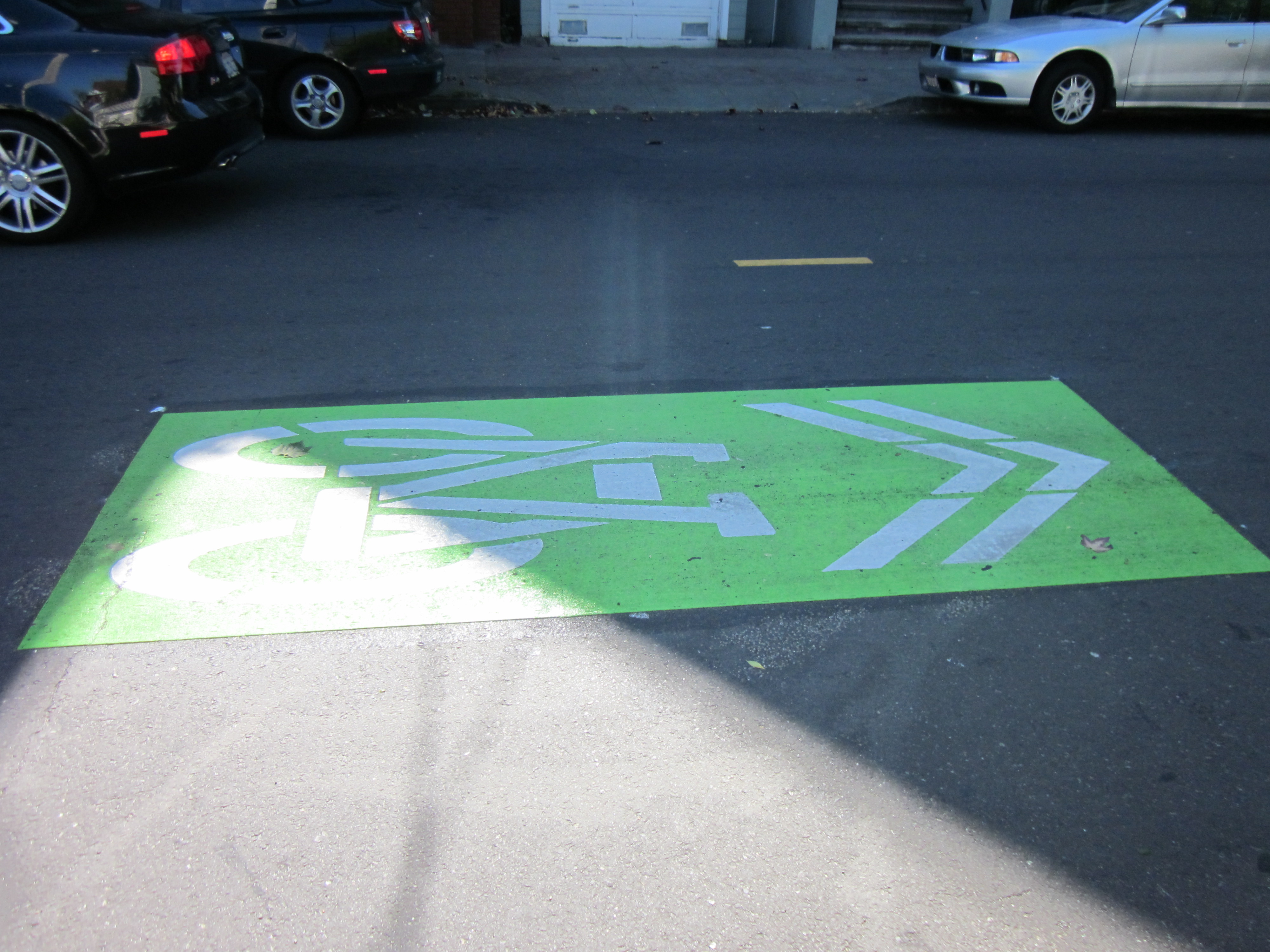
New sharrow marker along the Wiggle: you can’t miss it.

Loop-Frame Love rode the Brompton (sans IT Chair) most of the afternoon. We also got to show off the new sharrow markers in the Wiggle, which make the route much, much clearer. There have been complaints about the shade of green, which is indeed very jarring. But given that drivers around this area routinely drive into the Muni tunnels despite warning signs, speed bumps, and the absence of a road, then get stuck for hours and block the trains, my sense is there is no much thing as too much visibility on any San Francisco street. That is, unless it is a Sunday Street, and there are not yet nearly enough of those.

Leave a comment

Filed under Brompton, destinations, family biking, San Francisco, traffic

Family bikes we have seen

I am getting a little better about taking pictures of interesting family bikes we see around the city. Some of them are ridden by people we know, and some of them seem to be just passing through. There are now more manufacturers in the US focused on creating bicycles that work for families–Xtracycle (almost everything) and Surly (Big Dummy), Kona (Ute and MinUte) Yuba (Mundo, elMundo, maybe the as-yet-unrevealed Boda Boda), Metrofiets, KidzTandem–but it’s not a hugely developed market, especially as kids get older. So people often work out their own strategies, and they’re sometimes even more interesting.

Purple tandem with a trailer-bike attachment

This isn’t the best photo, but this bike belongs to a family we know and is a tandem with a trailer-bike attached. The dad is a former mountain bike racer and we see them during member hours at the Academy of Sciences sometimes. Matt caught this picture of one of their many bikes during a party at a mutual friend’s house in the Presidio, although he didn’t see them riding it.

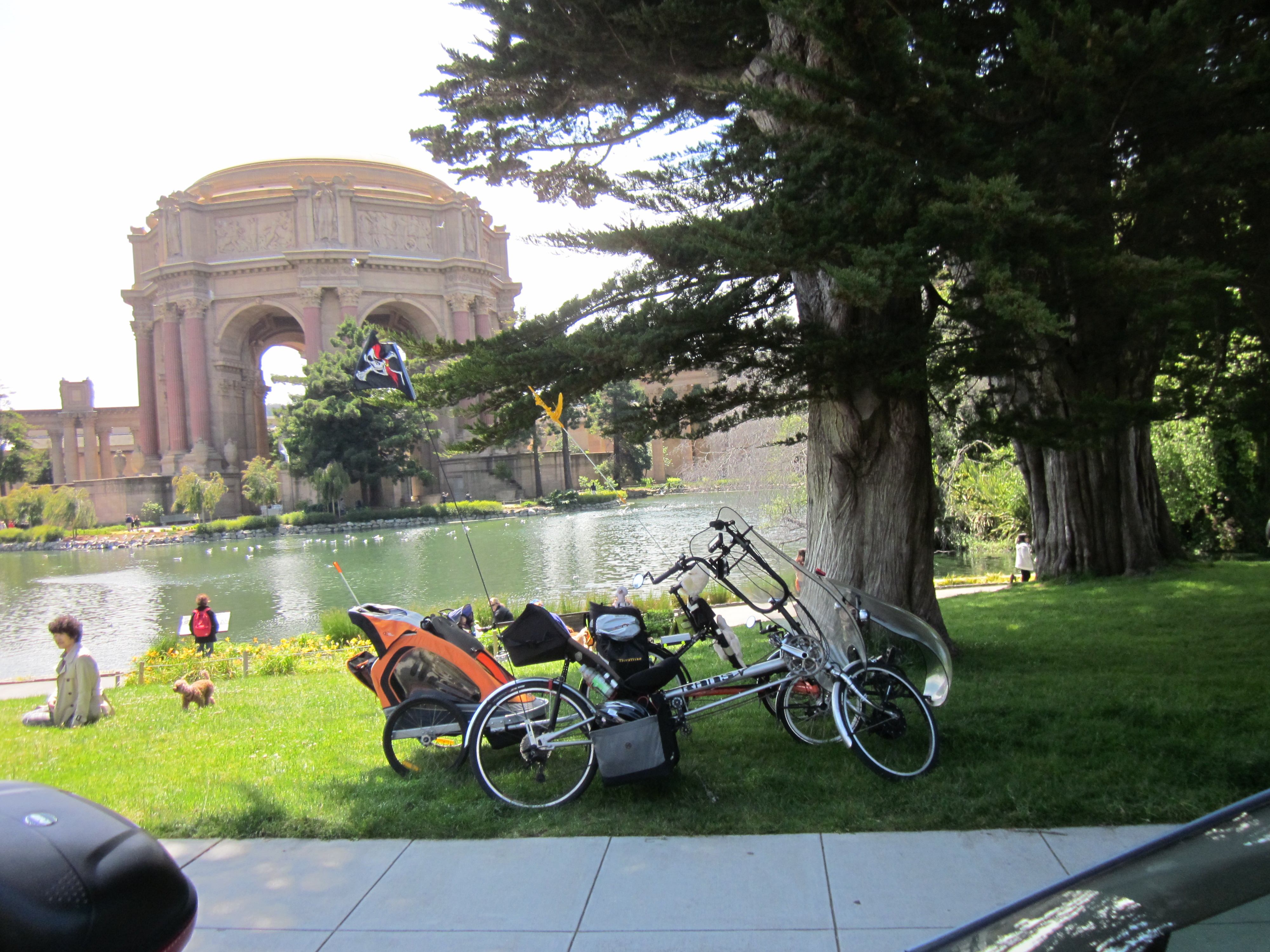
Two recumbents and a trailer at the Palace of Fine Arts

I think these two recumbent bicycle pirates were just passing through, because I’ve never seen them before or since. But these recumbents had a kid trailer (there was a small helmet inside and stuffed animals), and both bikes had an electric assist; one in the front hub and one in the rear hub. I didn’t find the riders but would have liked to ask them the difference. They had very large battery packs which supports my suspicion that they were only visiting San Francisco. Also they were recumbent bicycles, and I’ve never met anyone who liked riding those in city traffic. Yay, tail pipe exhaust. Woo hoo, unlikely to be seen by drivers.

Custom Bilenky kitted out for a family ride

Last but not least is the custom Bilenky I spotted at the Golden Gate Bridge anniversary party, with a child seat added to the rear rack. The dad who was riding it said he had gotten it before he was a parent, but with that much cargo space it seems reasonable enough to squeeze a child seat on somewhere. I have seen pictures of cargo bikes (and cargo scooters) with kids on the front deck, but his son was young and a rear seat is probably safer at that age.

I have a lead on another wild family bike, but no photos yet: to be continued, I hope.

Leave a comment

Filed under family biking, San Francisco, Uncategorized

Upgrading the Breezer Uptown 8

That’s right, my Breezer didn’t have enough stuff hanging off it yet. I needed more.

One day when we were visiting our local bike shop, Everybody Bikes, I was complaining that it was getting increasingly difficult to get up hills as our kids gained weight every month. My Breezer Uptown 8 handles hills well with reasonable loads (like a single rider and a preschooler) but it was getting to be a slog with a 6.5 year old on the back. The shop owner suggested I gear the bike down. But it has an internal hub, I said. Oh, you can still change out the rear cog for a larger one, he said, and that would give you the equivalent of two extra low gears (at the cost of losing the two highest gears, which I never used: whatever). The cost? About $20. Whoa. Sign me up!

What’s more, the brakes were getting soft, again. This issue seems to crop up every couple of months. The Breezer’s brakes aren’t as bad as the original brakes on the Kona MinUte, but San Francisco does seem to eat through bicycle stopping power.

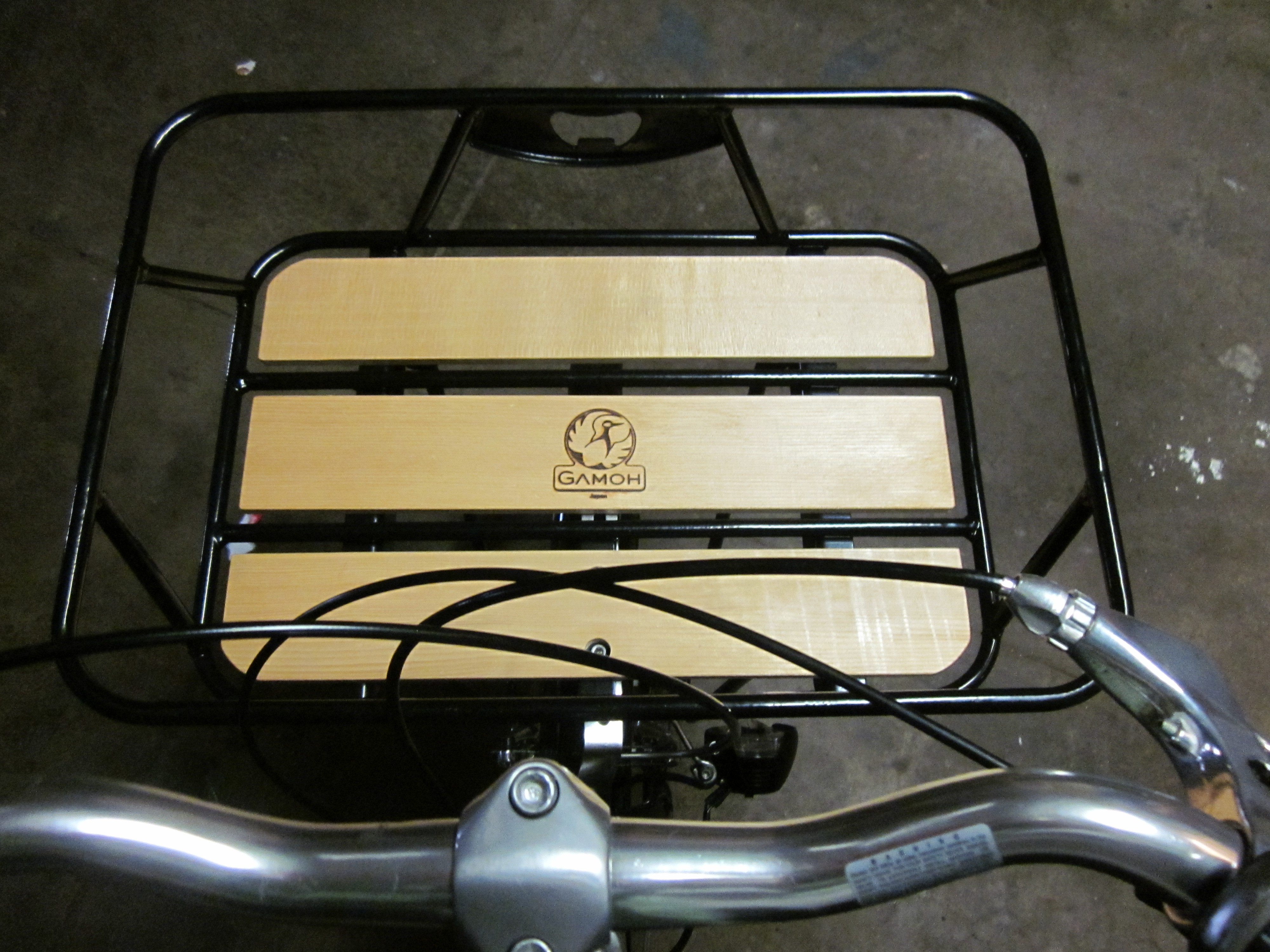
My new front basket, the Soma Gamoh.

I also wanted to be able to carry more cargo on the bike. They suggested a front basket. Putting one on would require rewiring the front dynamo light, but they could do that with some time.

And my kids wanted a cargo kickstand. They hated my little stock one-legged kickstand; they thought it was too wobbly, which was true. And that would argue for a front wheel stabilizer, for basically the same reason.

At last, a kickstand that is not pathetic.

Finally, we wanted to attach the custom rear rack for our new trailer-bike. And that meant rewiring the rear dynamo light, which attached to the stock rack.

This had all turned into a kind of major project, but upon reflection it seemed worth it. Two weeks ago the Breezer went into the shop for all these changes at once. For much of last week I came back for tweaks (the front light stopped working, then started again, the kickstand wasn’t in, then it came in, we had to fit the adjustable trailer-bike handlebars to our son, ad infinitum). Now the Breezer is back in action, and while some of the modifications are a bit kludgy—there was no pretty way to attach a stabilizer on my big fat down tube, and a trailer-bike always looks ad hoc—they all make the bike work better. The gearing change alone would have been worth it.

This is the Frankenstein of wheel stabilizers, but it gets the job done. Anyway no one has ever waxed rhapsodic about the Breezer’s clean lines.

Lowering the gears turned out to be the cheapest adjustment I have ever made to my bike, and the most practical. The rear cog original to the Breezer has 18 teeth, while my new rear cog has 22 teeth. It didn’t seem to me like four teeth would make a difference, but ignorance like that is why I don’t work at a bike shop. It makes a massive difference. I have had to completely relearn my gears, but the un-laden Breezer now cruises up serious hills like they’re barely there, and that’s without my first gear making much of an appearance—I’m almost always able to keep the granny gear in reserve. Laden up with a kid on the back or the trailer-bike (a bonus 30 pounds) or a heavy bag in the front basket, going up hills is significantly more challenging, so no worries: this bike will still keep me honest.

The new fork-mount for the headlight is unlovely but very effective.

The dynamo lights had to be rearranged to fit around the front rack, but this has actually increased my visibility. And the front cargo rack, a Soma Gamoh, is large enough to hold two grocery bags. It’s not frame-mounted, but it can take a lot of weight with the fork-mount. Combined with my two panniers I doubt that I’ll ever have to shuttle home after a grocery run again, especially now that the bike is geared to take the extra weight up hills. And the improved brakes will now stop me on the way back down.

Because I’m ignorant, I’d never realized it was possible to make these kinds of changes to a bike. Apparently some bikes aren’t worth upgrading, and last week I overheard a conversation with another customer in which our shop told him exactly that. Nevertheless: I used to get frustrated by the limitations of our bikes. Now I don’t bother getting annoyed until I’ve asked whether it’s something that can be changed.  It’s been enlightening for me to realize that having a local bike shop hanging with us through the last several months means that we can often remake our bikes into the rides that we need them to be.

12 Comments

Filed under bike shops, Breezer, cargo, commuting, family biking, San Francisco