Tag Archives: hills

Preschool rider

This is the way we don't ride to preschool

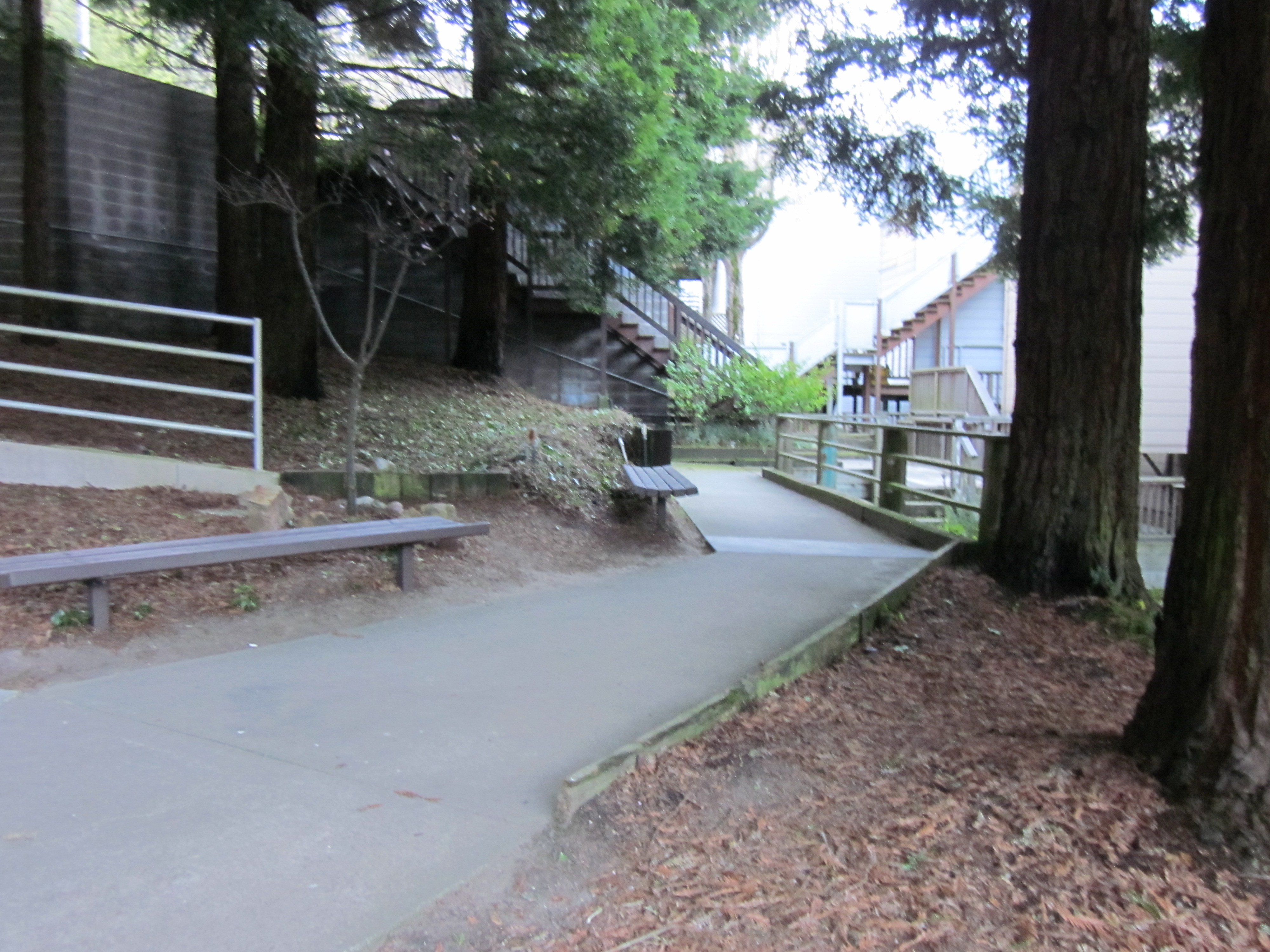
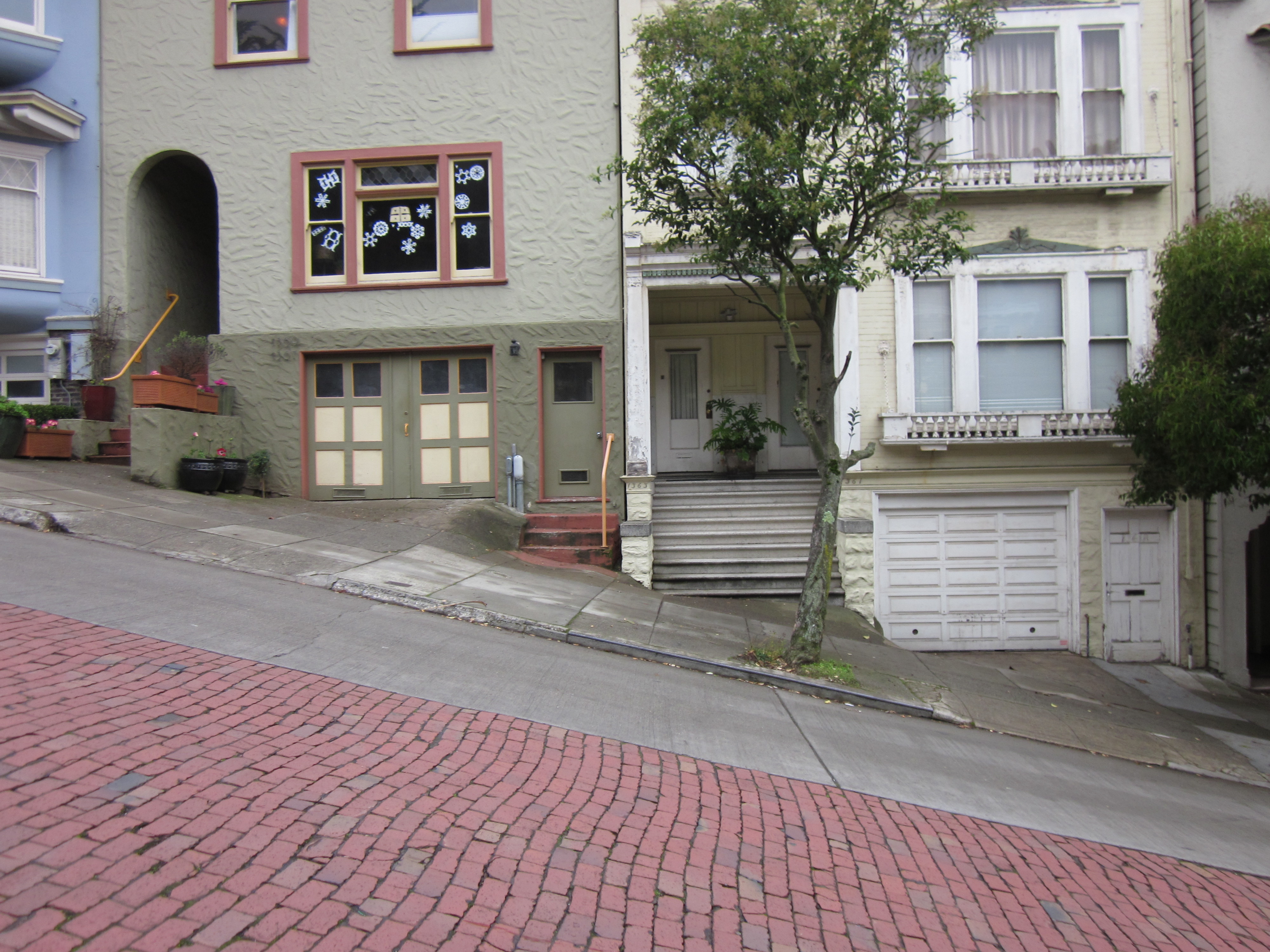
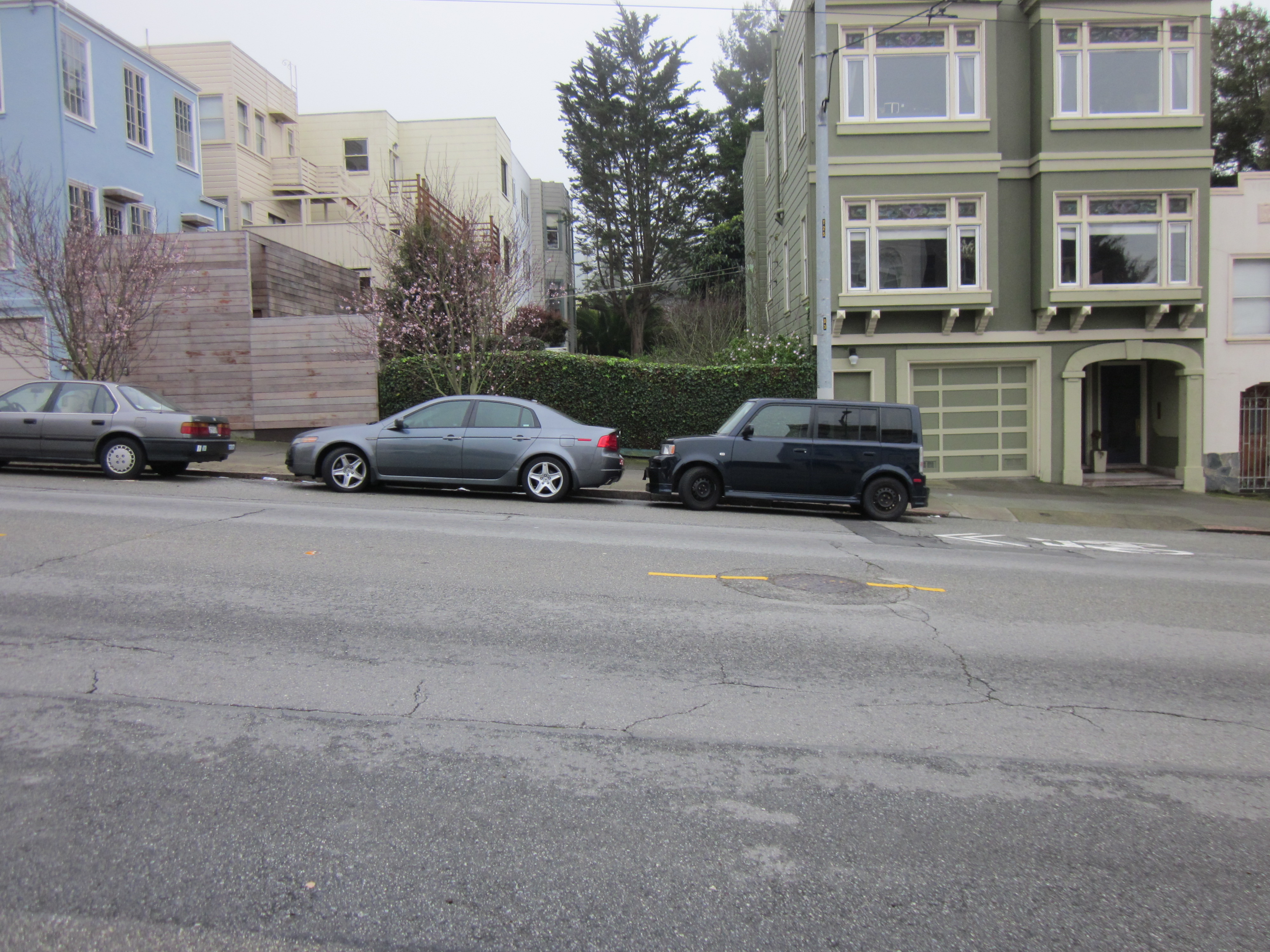
For months our daughter has begged for a bike ride to preschool, and for just as long we have dismissed the idea as impractical. It is a smooth start up a slight incline, but once you turn the corner, the hill up to her school is extremely daunting. The usual nose-in parking by cars to prevent roll-aways, given the incline, implies that the hill is almost untouchable by anything but Tour riders (and not Tour de FU riders—totally NSFW) or electric bikes. Cars can make it, of course—but often parents park in a lower lot and take the freight elevator up. It’s not even fun to drive up that hill.

One preschooler on a Kona MinUte

But today when I was walking out the door, Matt came home from dropping off our son at nature camp for the furlough day. He had taken a new, hilly route back and was already pretty overheated. But he wasn’t too concerned about it because he is working from home today.

Headed up the shallow hill on the approach

As usual she asked for a ride on the MinUte and he said, “Why not?” So today she got her first ride to preschool on the bike. She had a blast. But Matt almost popped a wheelie with that much weight on the back on a steep hill. She may have been the first child ever to arrive at our preschool by bike. Maybe with some weight added in a front basket to balance the bike better we could try it again, though.

Leave a comment

Filed under commuting, family biking, Kona, San Francisco

Destinations: Splendid Cycles

Little shop, big idea

I really had no idea what to expect when I visited Splendid Cycles. You can’t tell much about a bike shop will be like from a website (assuming one exists), although you can get a sense of what they sell. And I liked what they were selling. Joel, one of the owners, seemed pretty nice when I emailed him (and turned out to be just as nice in person). Yet visiting the store made it clear how much I have been missing by relying on the internet to learn about cargo bikes.

The average bike shop I have visited tries to have something for everyone, and that often means aiming directly at the market of people who are thinking about getting a bike for the first time. But it is fairly difficult to hit the price point that novices think is reasonable for a new bike (as I’ve mentioned before, based on talking to non-riders, of which there are many up the hill in my neighborhood, that price is: $100). But almost all bike shops seem to have a few bikes near the front door in the $300 range or so, not too overwhelming for the perennially broke college student, but a pretty stripped-down machine by any measure. The other day while chasing down my daughter in a bike shop I overheard a family discussing why two bikes that to their eyes looked identical were priced at $350 and $700 respectively. Like me several months ago, they had no idea.

Ahearne Cycle Truck: not a kid-carrier, but hauls other cargo

However cargo bikes are more expensive than other bikes. At their cheapest, new cargo bikes run about $1,000. The price difference reflects the fact that these bikes are capable of doing much more than carrying a student around campus. When you’re hauling real weight, on other places than the seat, everything has to be somewhat higher quality and differently designed, or you end up like my colleagues who tried to put child seats on their bikes and immediately broke all their spokes. And as cargo bikes become more capable, and as you add more accessories, like child seats and cargo bags, their prices rapidly rocket past that $1000 mark even for the least expensive models.

(As with everything else, handy people have more options. People who feel comfortable working on bikes can pick up bikes or trailers or Xtracycle FreeRadicals on craigslist and turn them into something greater than the sum of their parts. I admire their skill, but I’m not one of these people. And I would guess that in this I’m like most parents, unless by happy coincidence they happen to be bike mechanics or living with one.)
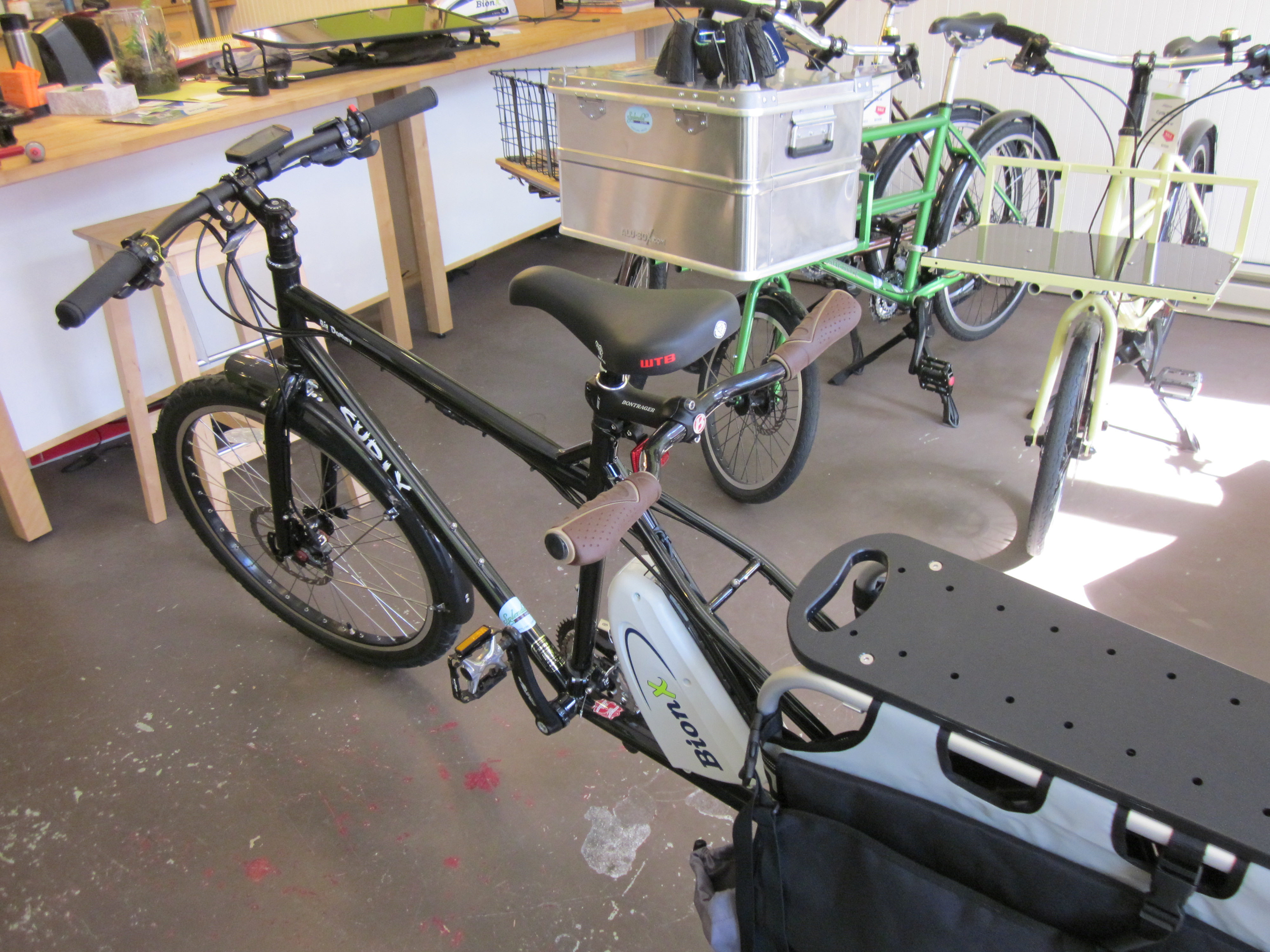
Big Dummy with BionX: definitely a family-friendly bike (also: seating for visitors, nice touch)

Which brings me to Splendid Cycles, because it is the only bike shop I’ve ever seen that is exclusively selling bikes that replace family cars, but that still retain most of the advantages of ordinary bicycles. For our lives right now, visiting Splendid Cycles was a revelation.  We don’t use our bikes just to noodle around the park on weekends (although that’s fun too), we use them to move ourselves and our stuff and our kids around town. I had always assumed that this required certain compromises: going more slowly, adding after-market accessories to make a Franken-bike, giving up going up and down hills, or being unable to get the bike inside if you live above ground floor. You can get a heavy Dutch bike if you live on the ground floor, in the flats, and don’t mind going slowly. Or you can cobble together family bikes from child seats and odds and ends like we’ve done and maneuver through traffic and actually make it up real hills, slowly, if you’re strong. Or you can go to Splendid Cycles and be blown away by seeing a dozen bikes that don’t require you to make those compromises.
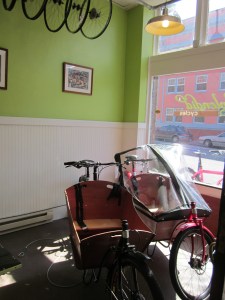
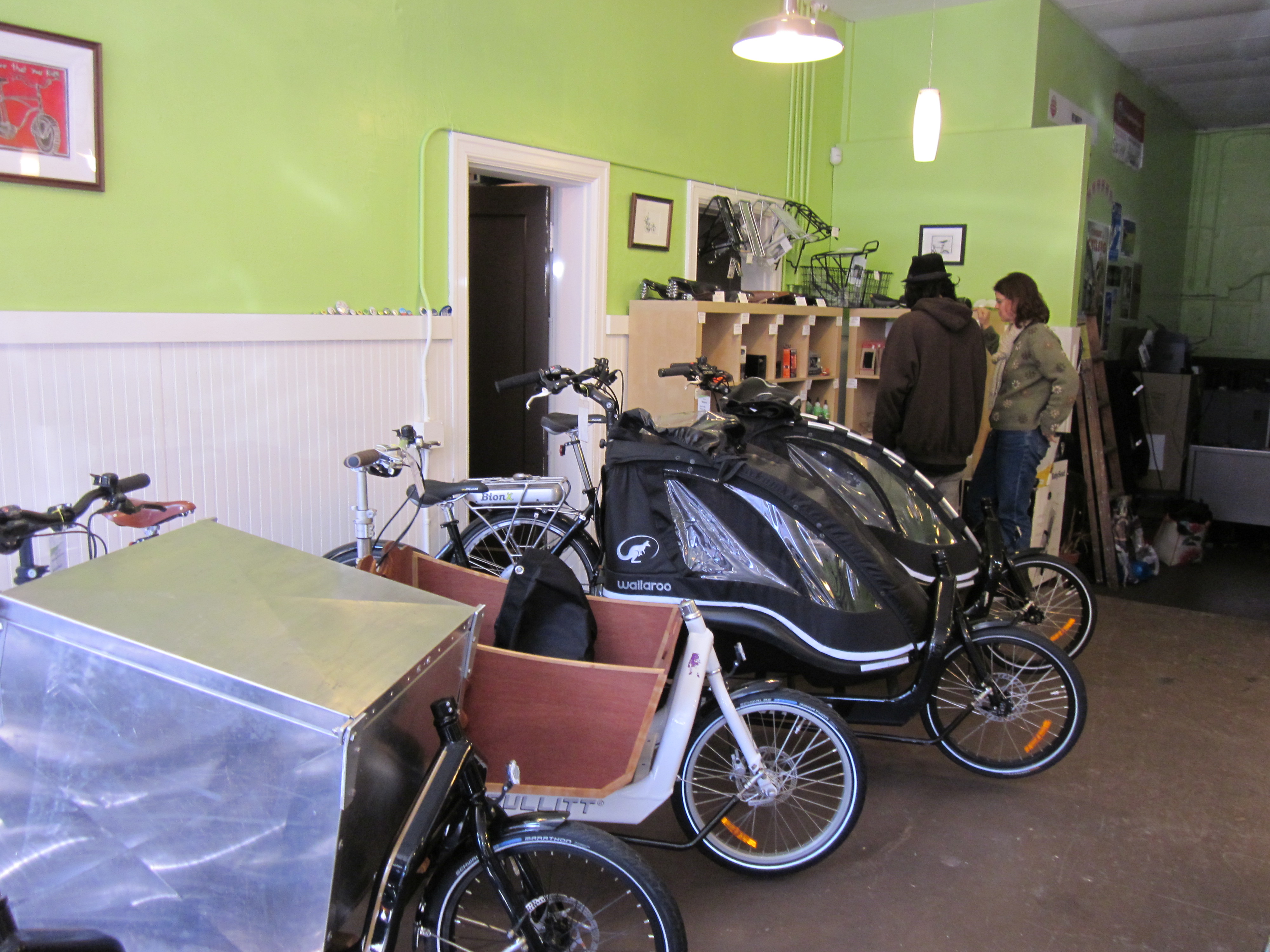
Metrofiets cargo bikes

Splendid Cycles carries Metrofiets cargo bikes, which I had heard of but never seen in person before. As cool as they are, I realized immediately when I saw them that a Metrofiets would never fit through our narrow basement door. (Less than one minute in the shop and I’d already justified a trip across Portland.) The Winther Wallaroo looked even better for carrying kids, with outstanding seating, but had the same problem from my perspective: unlikely to make it into our basement. They carry Ahearne Cycle Trucks, which look pretty clever for carrying cargo but are not really designed to carry kids, so those aren’t our bikes either.

They had a Big Dummy, which is designed to haul kids, among other things, and another one of which I used to carry my own kids across Seattle a week later.
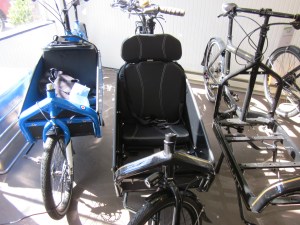
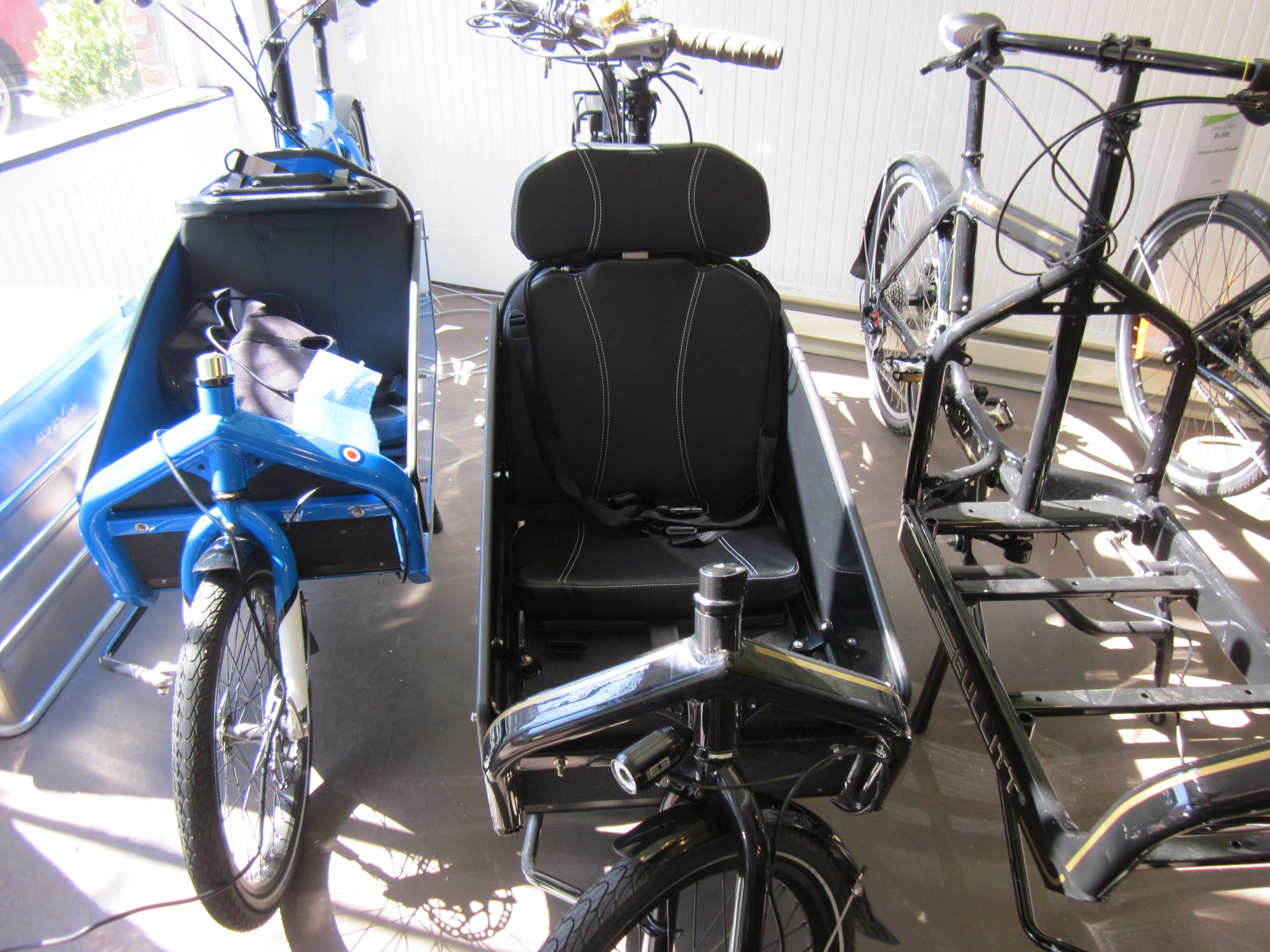
Bullitts, both with and without child seat

And rounding out the kid carriers, they had a bike I’d never seen before, the Bullitt. From the perspective of a city rider, this is probably the most interesting bike they sell. The Bullitt is narrow and lightweight; even with the child seat on it could probably be carried it up a flight of stairs. It can make it through traffic pinch points and climb hills. It is not perfect for our needs; the narrow child compartment probably limits its capacity to one of our (now older) kids. On the other hand, you could put a trailer-bike on the back (Joel’s great idea, not mine, he was full of them). It could be a great dad bike, but I can’t imagine riding it while pregnant; it does not have a step-through frame. But if you’re done having kids it would be something to consider.
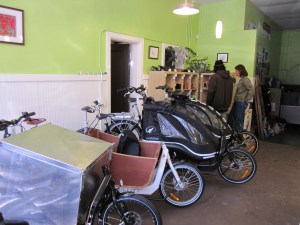
Wallaroos, rigged for all-weather riding

Walking into Splendid Cycles opened an incredible sense of possibility; there were so many bikes we’d never imagined that could do what we wanted them to do. Our kids would have loved this shop; getting them out of a Wallaroo, once spotted, would be almost impossible. And to top it off, at Splendid Cycles they know a lot about electric assists, which make these bikes reasonable options for people who live on hills. I didn’t understand the strengths and limitations of the BionX and whether it could handle San Francisco elevations when I walked into Splendid Cycles. Now I do, and yes it can. Overall I learned more about both cargo bikes and electric assists in person at Splendid Cycles than I’d learned in hours of reading reviews. It was amazing to be able to talk to Joel, who wasn’t figuring this out as he went along like we’ve been; he’d already thought about what was involved in riding with kids or cargo in traffic and on hills and had put together a half-dozen bikes, which were sitting right there, with electric assists, to solve our kinds of problems.

This kind of expertise and fit for our needs comes at a price. And at one point that kind of price left me in shock, but I now realize that these bikes are worth it. They cost as much as the first car I drove, but that car was a junker, whereas these bikes are as reliable as bicycles can be.  Furthermore, the bikes are more practical for moving around the city than that car. These are true car replacements, except we’d never have to worry about parking again.

Thanks to Matt’s bike maintenance class, we’ve recently learned more about the compromises manufacturers have to make to get the price of cargo bikes down around $1,000 (crappy brakes, tires more likely to get flats, etc.), and we’re now spending money to upgrade the MinUte to become more like the bike we want. So in many cases it’s a choice between paying up front for quality or paying later for repairs and upgrades. There are legitimate reasons to choose one or the other, but it wasn’t a choice we realized we were making at the time.

From my perspective, Splendid Cycles isn’t a Portland destination so much as a destination in its own right. It would justify a trip to Portland by itself for the right family. I met a father from Eugene visiting the shop who’d decided just that. It was definitely worth visiting given that I was already in Portland.

Worth the trip

Joel pointed out that Oregon has no sales tax, and that having Splendid Cycles ship a bike somewhere would cost less than the sales tax in less enlightened locales. I am an employee of the state of California and thus feel guilty for even mentioning such a thing, but for less tormented souls, this is yet another reason to talk to Splendid Cycles about cargo bikes.

There are lots of reasons to be impressed by Portland’s bike culture, but its breadth still amazes me. I never imagined a bike shop like this could exist. Splendid Cycles has put all its chips on our kind of bicycles. It is a bet that the world will change to make space for many families like ours, and that one day hauling kids on bikes will be as unremarkable here in the US as it is in cities like Amsterdam and Copenhagen. I don’t think this will happen here while our kids are young enough to ride on our bikes, and I am envious that Portland can support a shop like this. I wish there was a Splendid Cycles in every city.

1 Comment

Filed under bike shops, cargo, destinations, electric assist, family biking

Electric assist: BionX PL350

Portland's bike shops make me want to gut myself in envy

I am not usually good at getting to the point, so let me try here: I am so buying the BionX.

Despite the fact that I have speculated about electric assist a lot, until this week I had never tried one. I knew enough to know that I wanted a pedelec system (which works only when you’re pedaling) rather than an off-on throttle (where pedaling is irrelevant). Otherwise I might as well just buy a scooter. I just want to be a little stronger, so that going uphill is less of a Bataan death march at the end of a long day, or to ride with my daughter to preschool.

Surly Big Dummy with BionX

So before I went to Portland I wrote to Splendid Cycles, knowing that they carried cargo bikes with electric assists. Joel, one of the owners, said I was welcome to take one of their bikes up a hill in Portland (and they do have some hills there). They could not have been nicer, all their bikes are amazing, and most of them would be appropriate for hauling kids and/or cargo up the side of a mountain. I ended up riding a Big Dummy with the BionX PL350, a system widely praised in reviews, apparently the most responsive of pedelec systems. It adds about 17 pounds to the bike, counting both the motor and the battery. (BionX also has a 15 pound version with comparable power and a longer battery life. It costs more.)

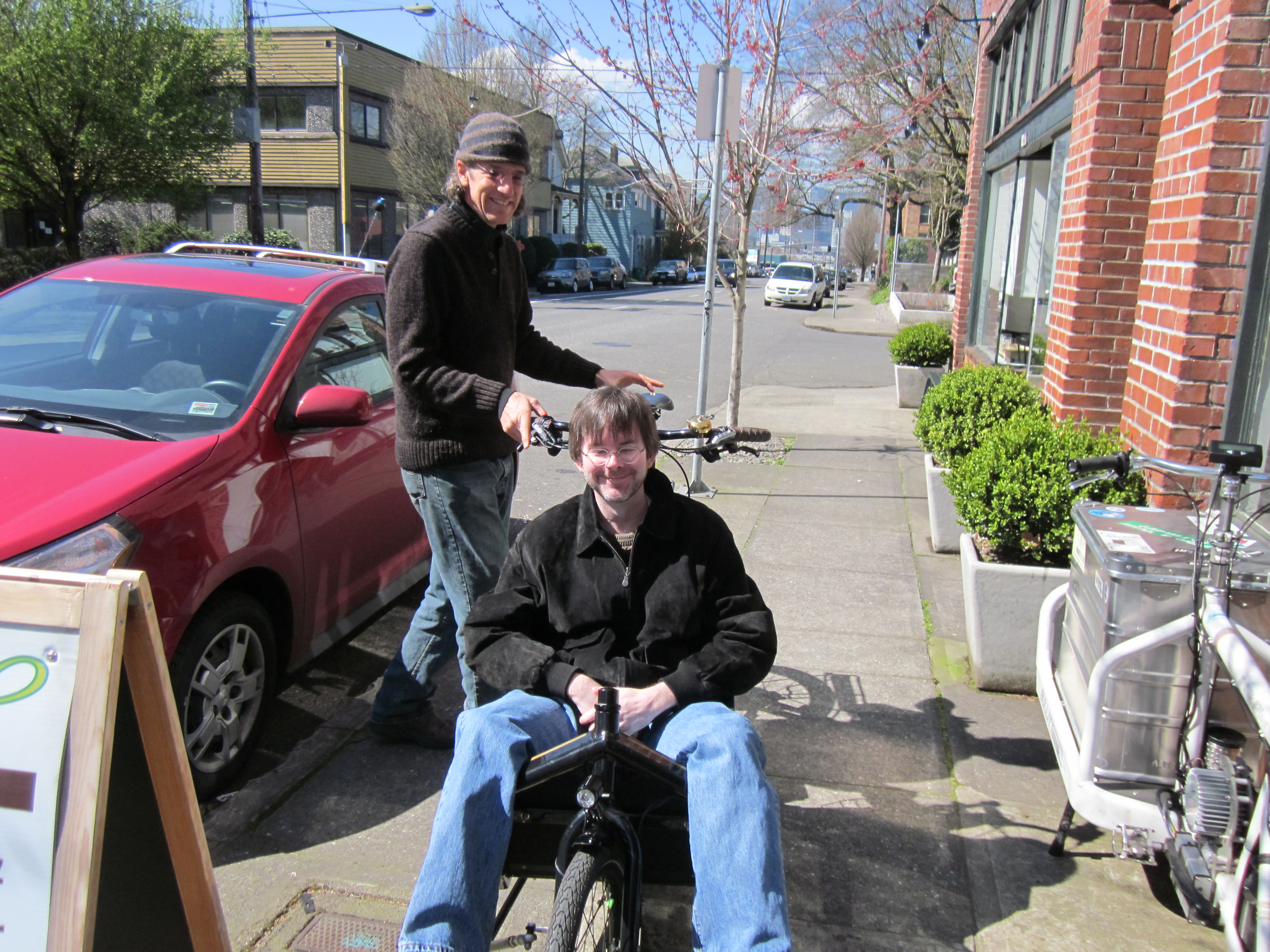
Todd on the Bullitt (I took this picture for his wife)

Joel rode an assisted Bullitt, which is very cool in its own right; it was the first box bike I’ve ever seen in person that I have thought would be practical in San Francisco, as it is lightweight and narrow (and fast). Because my kids were already in up in Washington with my mom, I was cargo-less. So I brought my friend Todd along. Todd and I went to grad school together and although we are both pretty junior he’s now the chair of his department at Lewis & Clark. Guess which one of us makes our advisers proud? But he remains a relentlessly good sport about the crazy things that I propose. At 145 pounds, Todd is cargo overkill, the equivalent of almost four kids. But better too much weight than too little; my kids are growing.

Todd doesn’t really ride bikes, so Joel carried him in the Bullitt while I was figuring out how to use the BionX on the way to the hills. And I carried him back to the shop on the Big Dummy.

Most of Portland, to my mind, is pretty flat. The neighborhood streets we first rode on certainly were; on those streets, on an unloaded Big Dummy, turning on the BionX was wildly entertaining, but hardly seemed necessary. You turn it up and you go a little faster. It’s like magically getting stronger without the bother of having to train. There are four levels on the way up, which are activated by pushing the + button. I perceived them as ranging from “I barely notice anything” to “I barely need to pedal.” There are also four levels in the other direction (push the – button), for regenerative braking to charge the battery a little; this was fun, because it meant that I barely needed to use the brakes.

And then we got to the first hill. Todd hopped off the Bullitt and onto the Dummy. From a dead start on an incline, I could barely move the bike. With the assist on level 1, we were moving slowly. And with it ramped up to level 4, getting both of us up the hill was like going up a slight incline with an unloaded bike. It was unbelievable. On the way down, the regenerative brakes slowed us to a crawl even though together with the bike we weighed ~350 pounds.

On the second, steeper, longer hill, still with Todd on board, I was already moving on the way up, and managed to make it about 100 (very painful) feet before I switched on the assist. Near the top of that hill I was back at level 4, moving pretty quickly, and laughing so hard I couldn’t speak. And it was at that point that I realized that I would, if necessary, give up almost anything else I owned to have this assist.

Although there are hills in Portland, the city has built switchback ramps to make the climbing easier. Let us take a moment and contemplate this.

The BionX doesn’t take the experience of hills away; it was still work to get up that second hill. But even with a person who weighs more than I do on the back, on a heavy bike, going up was manageable, and it didn’t make me want to die. It made we want to find an even bigger hill and storm up that one too. I didn’t want Todd to get back in the Bullitt; it was more fun to talk with him on the Dummy. He commented that the motor was completely silent. “If I didn’t know it was there,” he said, “I’d just think you had really strong legs.”

With Todd on board I ended up keeping the assist on level 1 or 2 for the stop signs, even on the flatter ride back. Starting a bike loaded with kids has always been slow for me; it takes time to get that much weight moving. But with the extra boost of the assist, we took off at the intersections at the pace of a racer.

The BionX has some quirks. Some of them are counter-intuitive. It is responsive to pressure on the pedals, so to get more assist on the way uphill, I learned to shift up to a higher gear. The harder I pushed, the harder the motor worked. This happens automatically at intersections, but on the hills sometimes I geared down low enough that I wasn’t getting as much help. I suspect gearing down to reduce the assist would actually be a useful way to train to ride hills unassisted if one were so inclined.

There is an awful lot going on at the right handlebar grip on a BionXed bike; occasionally I found myself changing the assist level when I meant to shift gears, or shifting gears when I’d intended to brake. I’m guessing that this kind of thing is temporary.

Finally, the motor cut out once. We were on a flat street, fortunately, and when I asked Joel what happened he said the sensor had jogged loose. He nudged it and the assist starting working again. There is a reason it is so twitchy, evidently, but I didn’t understand the explanation. However it is also apparently possible to set up the control so that it doesn’t cut out like that.

Todd drove me back downtown after our ride, patiently listening to me babble gibberish, which was something along the lines of “OMIGOD OMIGOD OMIGOD!!!” I couldn’t stop grinning, not even when I was sideswiped by a jogger on the walk back to the hotel. I found myself laughing randomly when I tried to explain what riding with the BionX was like to other people. I’m laughing now.

The BionX would change our lives. A lot of our remaining driving miles are, “No way am I riding up THAT hill” trips. Joel said he’d taken a fully loaded Bullitt+BionX up a 25% grade. We have a hill like that near home and we find alternative routes even when we’re driving. He noted that the BionX could get overheated on steep, extended climbs (>20 minutes) in hot weather, at which point it would reduce the assist level to protect the motor from overheating. But our hills are short and broken-up with stop lights, and it never gets hot in San Francisco. With really serious cargo loads an EcoSpeed would be better, but two kids and groceries are evidently not what people have in mind when they talk about serious cargo.

How much do I love this assist? I would have bought one on the spot if it would work on the Breezer, even if I had had to talk Splendid Cycles into prying one off of a bike in the shop. But I will have to give up my Breezer to use a BionX; it won’t work with an internally geared hub. That’s not going to happen right away—there’s the non-trivial issue of figuring out what bike to ride instead—but it is most assuredly going to happen.

7 Comments

Filed under bike shops, cargo, electric assist, family biking

Electric. Bicycle. Culture clash.

It's Electric! (boogie boogie boogie)

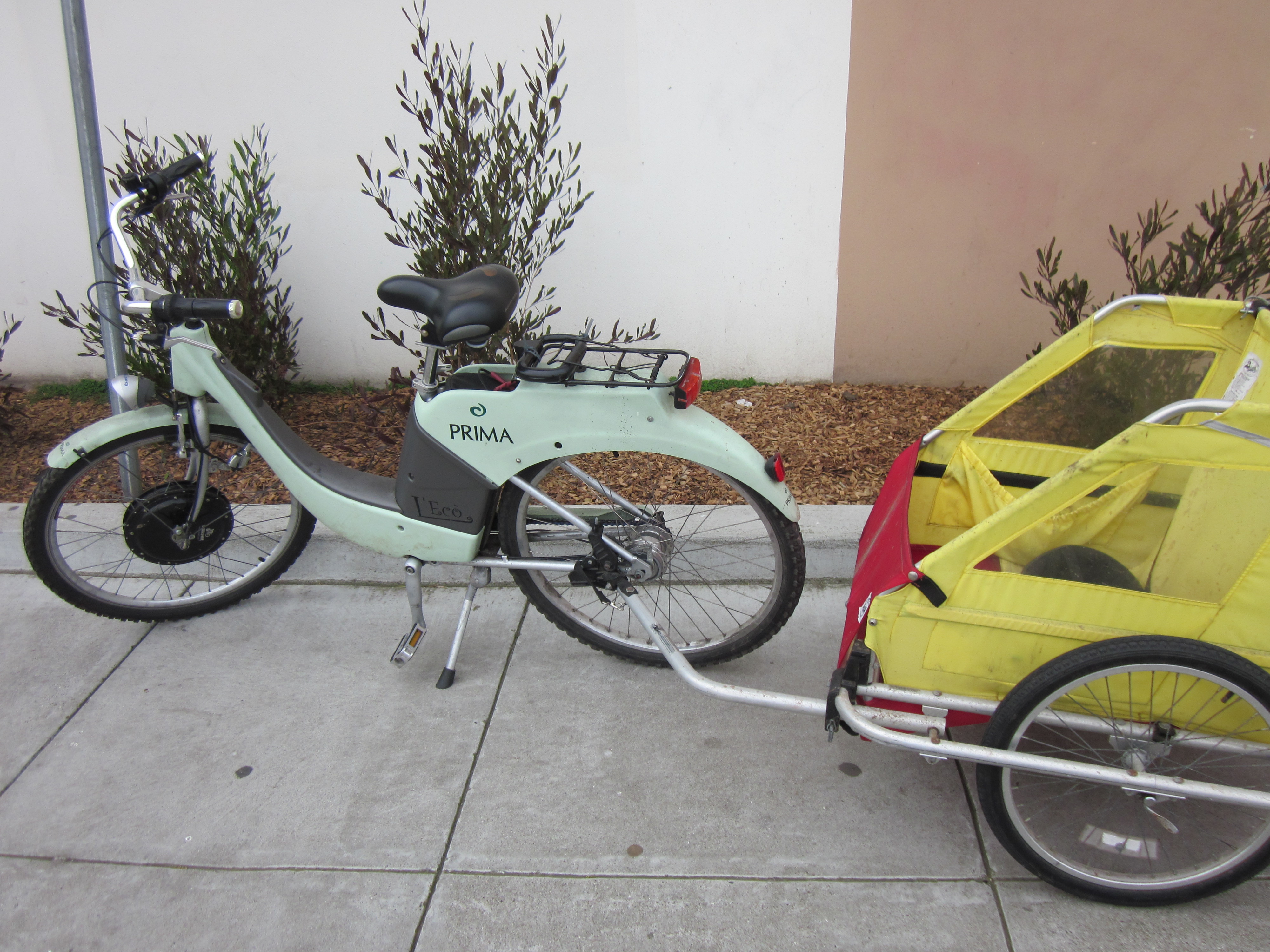
While I was getting lost on the way to Saturday’s class on getting kids on the road, I wandered through the park and library next door, and up to the middle school. There I saw an electric bike with a child trailer attached on the rear. Both of these are such rare sights that I immediately took a picture. Right after I did, the bike’s owner wandered out.

I asked him about his bike and he said he’d gotten it some time ago from a store in Oakland that was briefly importing electric bikes from Europe, and found them such poor sellers that it dumped them all at bargain basement prices. But he’d found the factory motor installed in it too weak, so he’d replaced it with a much more powerful motor, then upgraded the battery to boot. Worth it to buy even with the upgrades, he said, because the bike had a great compartment for the battery integrated into the frame. Then he said he’d just taken the bike up the hill with his two kids and their backpacks in the trailer, without even pedaling.

I was getting the sense that I was in the presence of someone who actually knew something about electric bikes, and this turned out to be the case. His name was Nick, he said, and he wrote columns for a new website, electricbike.com. Sure enough, he does. And then some. Well now.

It turned out he was a car mechanic but he loves bikes more. He thought car culture was crazy. “I tell people their car needs a $2800 repair, and they groan and tell me to do what I have to do. I tell them I can put an electric motor on their bike for $1000 and I’ll throw in the labor for free, and they tell me that it’s too expensive.” He was the first major fan I’ve ever met of electric bikes, and consistent with the tinkering evident in his own bicycle, he was not a fan of BionX, which as a closed system doesn’t allow swapping out parts. Talking to him was worth the embarrassment of showing up late for a class I was supposed to be helping to teach.

I mentioned meeting him to the other parents who were teaching the class. Like almost everyone with kids in the city, they were pretty excited about the prospect of electric assist, although none of us actually had one. Great for seniors riding in the city, said one. Another couple had an 8 year old and 5 year old, and they were commuting to school on a tandem with an Xtracycle FreeRadical on the back, which sounded like a totally awesome ride to me. But the dad, who teaches at Sunset, complained that the Xtracycled tandem was actually harder to get up hills than their old Xtracycled bike with both kids on the back.

What he really wanted for the school commute was a Metrofiets.  Who doesn’t? But they were put off by the cost, and I hear that: I find the cost of a Metrofiets daunting, and university professors typically make more than elementary school teachers (for reasons that elude me).  Nonetheless, unlike me, they were actually willing to make the trip down the Peninsula to Bay Area Cargo Bikes to test ride one, something I’ve avoided as I figure it could only lead me to want to buy another bicycle.

Families on bikes in the heart of the city

They’d been thinking about electric assist, and knew they’d need it if they actually got a box bike, but were having a hard time getting over the feeling that using a motor was somehow cheating. I knew exactly what they meant. It feels like I should be able to ride my bicycle without an electric assist, even though I know that my kids’ current weight is nearing the limit of my abilities. To me and to them, an electric assist felt less like a cool accessory and more like a necessary evil. It felt like compromising the bike for some reason. Heck, some riders feel that way about fenders, or for that matter, brakes. We had all seen the Xtracycle with the red handlebars and an electric assist riding in traffic every morning (there aren’t that many family bikes in this town; you start to get to know them). Not only did we all find that a little scary, it seemed kind of annoying that the guy on that bike doesn’t even bother to pedal.

Looking over downtown San Francisco

What’s more, thinking about the cost of an electric assist really irritated me for some reason. It took me a while to figure out why. Eventually I realized, and this is embarrassing: it was resentment. Parents in other, flatter cities can carry their kids without paying for electric assists, why couldn’t we? Isn’t it enough that we already have a much higher cost of living? When I tell people outside the Bay Area the average rent for a two-bedroom apartment in San Francisco ($3275 as of last month), they typically gasp in disbelief, and say, “I could buy a mansion for that where we live!” Yes, I knew that already, thanks for sharing. We live surrounded by fog 11 months of the year and pay $4.50/gallon for gas (albeit rarely). San Francisco is one of the few places in the country where I know couples who are both well-paid lawyers and who are nonetheless raising their kids underneath the stairs, Harry Potter-style, of a 1-bedroom apartment, because that’s what they can afford. We all make compromises to live here. On top of all that, I have to drop a grand on electric assist when everyone else in the world can haul kids on their bikes fueled only by righteousness and an extra serving of oatmeal in the morning?

This is embarrassing to admit because we are happy to be here. Lots of people say they would be thrilled to trade places with us (although when push comes to shove they usually balk at the prospect of raising their kids in a garret under the stairs). So we’re going to pay more to ride our bikes than we would elsewhere. Why should this be any different from anything else that costs more in the city?

San Francisco isn't Copenhagen

Anyway, I got none of this angst from the electric bike mechanic, or from his website. It was all about the thrill of having a motor. He pointed out that the cost of using an electric assist was bupkis: “You spend more on power if you forget to turn the light in the closet off in the morning.” I now realize that part of the issue with electric bikes is trying to reconcile bicycle culture, which views motors with suspicion because they’re related to cars, which have a bad habit of mowing people down, and mechanic culture, which views bicycles as a neat way to use motors without having to register a vehicle, get a license, or avoid mountain bike trails. But if it’s going to happen anywhere, it will happen here, in the City by the Bay, Gam Saan, with its countless hills.

5 Comments

Filed under electric assist, family biking, San Francisco

Free riders

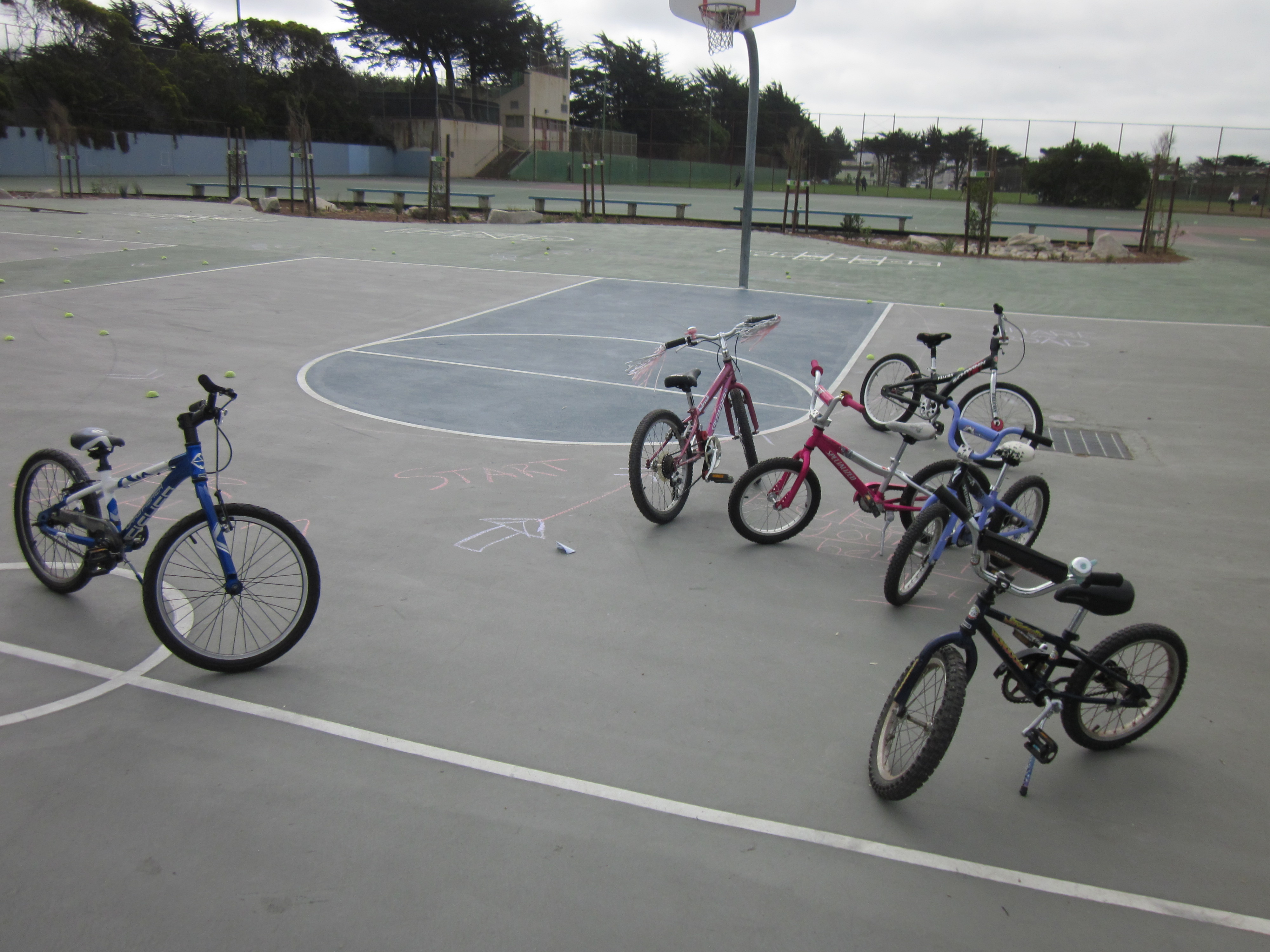
A passel of kids' bikes waiting for riders

On Saturday I went back to the Outerlands, specifically to Sunset Elementary School, to attend one of the San Francisco Bicycle Coalition’s Family Biking Series classes, On Road with your Children. To my astonishment, I was asked to attend in a vaguely instructional capacity.

I find it a somewhat depressing comment about the number of families in San Francisco with school-age children (there aren’t many) that I would be considered even vaguely qualified for this assignment. The guy who built up the tricked-out Kona Ute our PTA treasurer used to ride was there. The co-owner of Ocean Cyclery, which sold us my Breezer and our child seats was there. I was outclassed. I can, it is true, research any topic into submission, because doing research is my job and because I’m compulsive. But research is no substitute for experience, so this class involved some ugly duckling moments. The class met at the back of the school, and I had trouble even finding it until other people showed up so I could follow them. The parents teaching the class had been riding bikes for years and it showed; they were more graceful on their bikes than I have ever even aspired to be. And I found out that I was wearing my helmet wrong. All in all, it was a humbling experience.

Lubricating chains: virtually all of them were rusty, because the Sunset is permanently socked in by fog

And it was a hugely informative experience. I didn’t bring my kids; they were at their swim lessons. It is just as well. Neither of them is competent enough on a bike yet to keep up with the kids who showed up for the class. (We are the blind leading the blind over here.) I will, however, take my son when he is more skilled. SFBC’s instructor for this class is fantastic, warm and lively and hugely competent at wrangling both kids and parents. Apparently he has been leading these classes for years. It shows.

This kind of thing isn't helping with the helmet either

Matt and I signed our son up for summer bicycle camp this year. We didn’t thrust this upon him; he has been angling to attend bike camp since he heard that such a thing existed. But we’re all pretty excited about it. We are having trouble teaching him to ride safely because we live on a great big honking hill. Our efforts to talk him into going down to the park, where it’s flatter, to ride always fizzle; his enthusiasm evaporates with the walk down and on the rare occasions when we’re successful, he is too tired to walk back home. Although it is ridiculous to drive such a short distance we would do it, but he hates riding in the car. Bike camp seems to resolve a lot of problems at once; most importantly, it’s taught by someone much more qualified than we are.

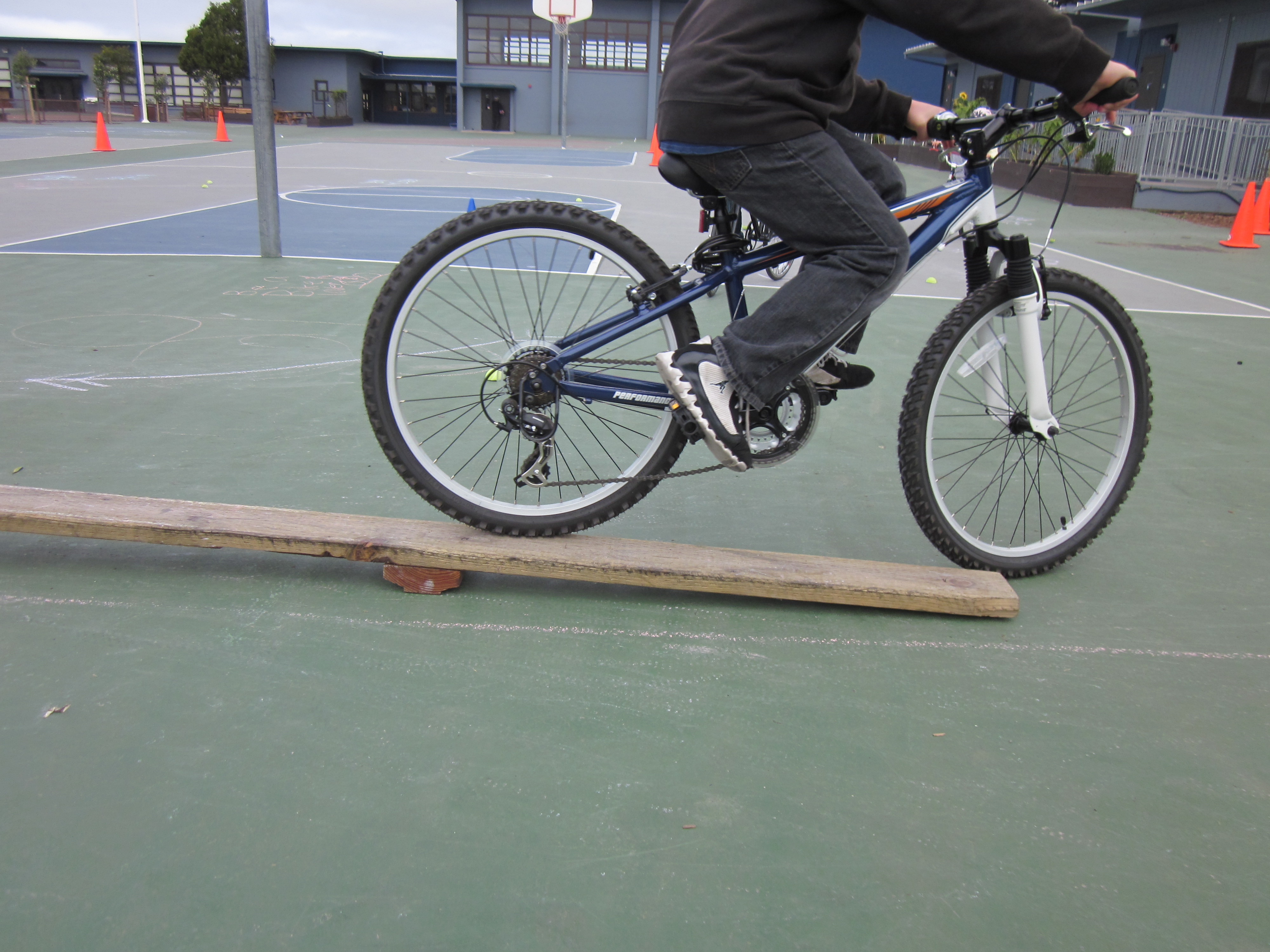
Practicing riding in a crowd

We had both harbored ambitions that at the end of a summer at bike camp, our son would be qualified to ride his own bike to school. Attending this class disabused me of this fantasy. The area around the school was slightly hilly, but nothing particularly troublesome for an adult rider used to the city. It was much more difficult for the kids, who were, I realized, mostly riding bicycles that weighed more than half what they do. I have ridden a heavy bike before, and remember how hard it was to start and stop and get up hills, but at least I had a lot of gears to use. The kids did not. No one is selling ultra-light bikes for kids, so I don’t see any realistic way for mine to handle anything more than minor elevation on their own. And the hills along our commute to school are anything but minor.
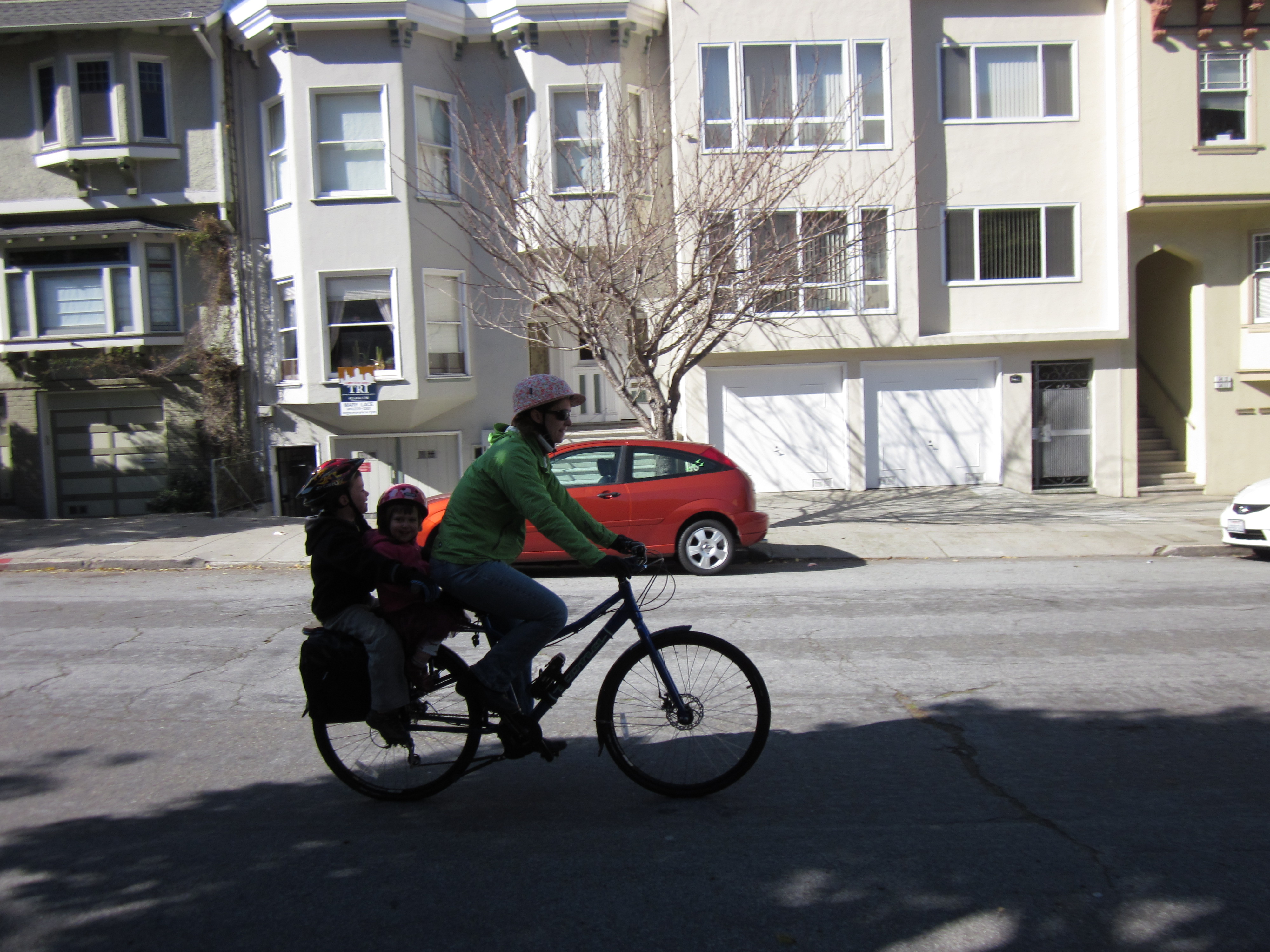
Practicing riding while looking for cars behind

What’s more, supervising kids on the streets of San Francisco was terrifying. The area around the school is very lightly trafficked, but at stop signs things fell apart. The kids attempted to wave drivers ahead of them, then lurched out into the intersection as those cars actually moved, or waited for cars to stop, then tried to take their turn only to be rushed by drivers who’d grown impatient. There are a lot of decent people behind the wheel in San Francisco, but a lot of jerks as well. I suspect that these kids, as well as our son, would learn to navigate neighborhood streets like these with more practice. But we go through much more serious traffic on our route to school, and I would not trust my kids in some of those intersections for years to come.

Bumpity bump

Overall, I realized that riding in the city is too much to expect our kids to do alone at this age. Our son will not be riding to school on his own bike next year, or the year after. He wants to pedal, so a trailer-bike or tandem may be in our future. But he will not be riding solo.

We are going to be working harder as he grows, and that is daunting. We had talked about possibly not needing an electric assist if our son began riding his own bike. But I cannot imagine hauling my kids up and down the hills to school without help once their combined weight exceeds 100 pounds. We are now in the position where buying a bike accessory that costs more than our bikes themselves seems inevitable.

Despite this, I find I don’t mind the thought of keeping them on our bikes longer. My children have been growing away from me since the day they were born. Even in the newborn barnacle months, they were already exploring the world. It is thrilling to watch them grow more independent, but I know that eventually they will tire of being hugged, of sitting on our laps, of being picked up. My son is in first grade and already conscious that being affectionate with parents is not something that older children do. But when we’re walking or riding up a hill, all of this is forgotten. They look at the climb and want to be small again. “Mommy, will you carry me?” they ask. And I say, yes, I will carry you. I’ll carry you up the hill. I could carry you forever.

2 Comments

Filed under commuting, family biking, rides, San Francisco, traffic

San Francisco destinations: Parnassus Heights

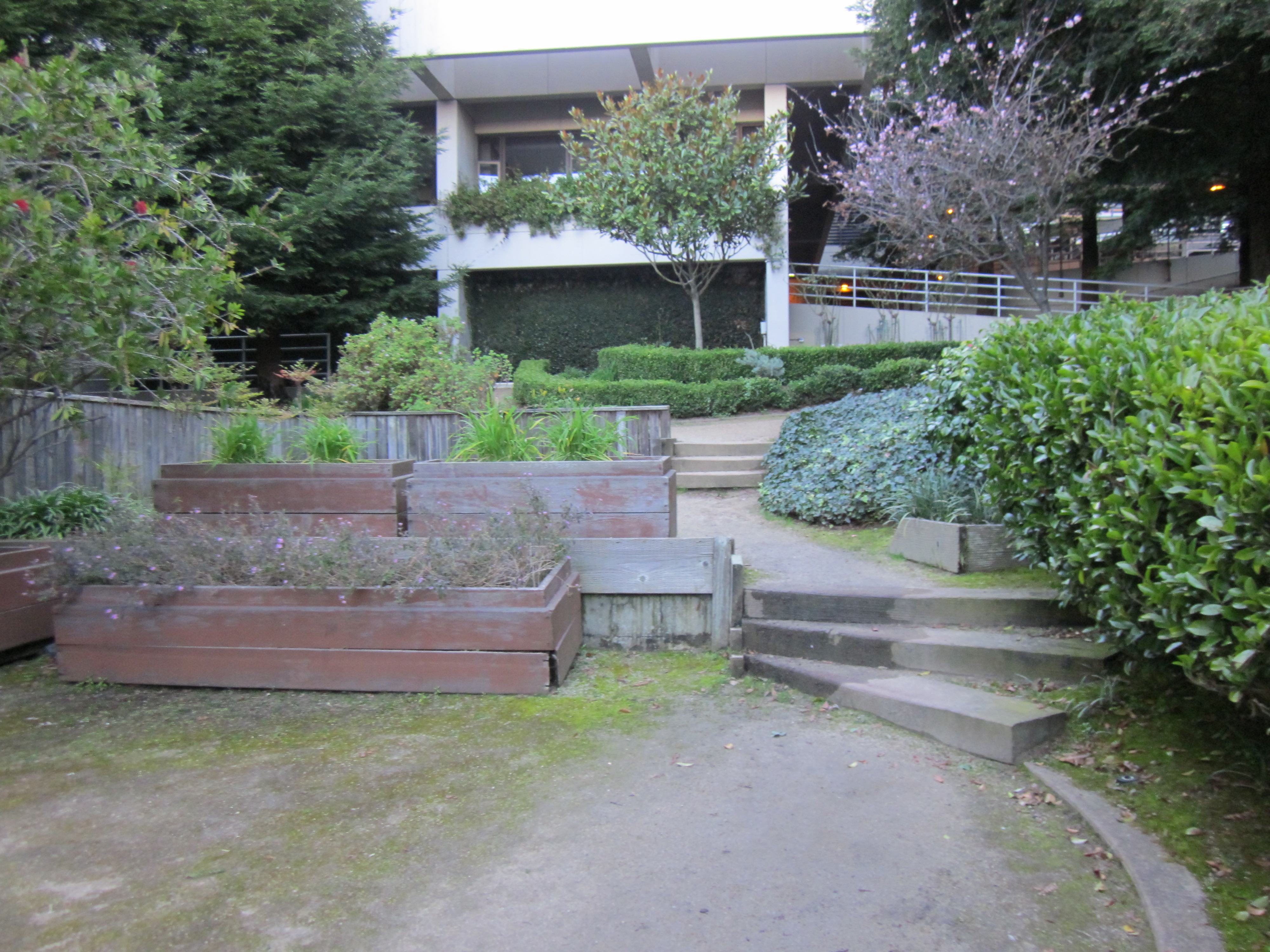
The route to preschool: Staircase #1

We live on the main campus of the university where I work, at the inflection point between the approach to the mountain, which is steep, and the mountain itself, which is really steep. We’ll ride our bikes up to where we live (I wrote about the hills we face on that trip) but after that we pretty much throw up our hands. For short distances, we walk, and for longer distances, we take the shuttle or we drive. Unless and until we get an electric assist, this is unlikely to change.

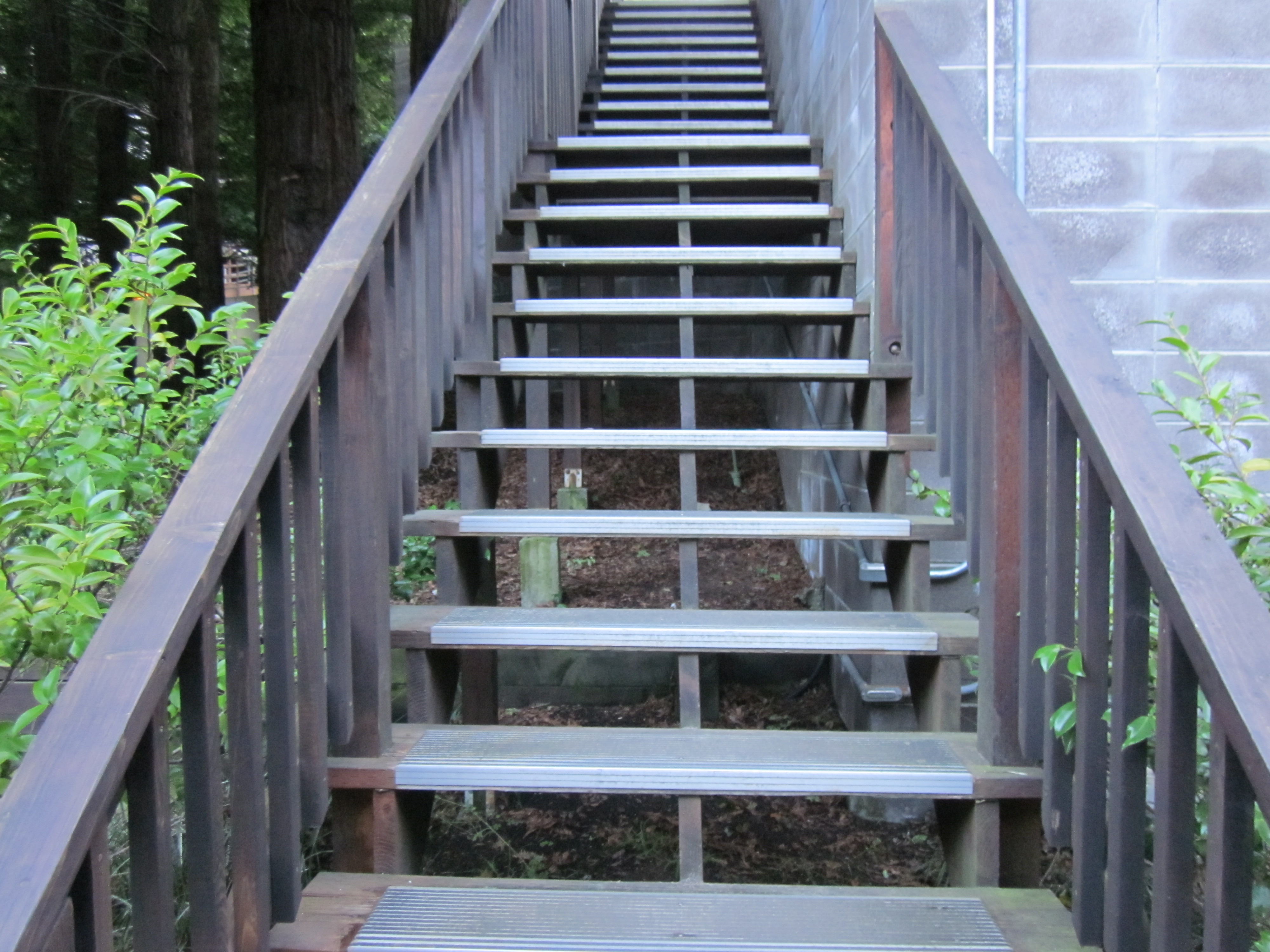
The route to preschool: Staircase #2

This frustrates my daughter, whose preschool is a couple of blocks straight uphill from our house, because no matter how many times she requests a bike commute to school or back, it has never happened. Even when we return from a ride to our son’s school in the morning, we park the bike in the basement and walk her up to preschool. Maybe someday we’ll have the foresight to walk a bike up the hill and blast on down with her on board at the end of the day, but we haven’t managed it yet. Also I would only feel safe doing that shortly after a brake tune-up. It’s a straight shot down.

The route to preschool: Staircase #3

At least it is a very pretty walk. Much of the campus is difficult place to build anything, although the university has managed to pack more clinical and lab space onto the site than anyone ever thought was possible. Nevertheless a lot of trees were left standing around.

The university was founded in 1868, but only moved to the Parnassus site thirty years later, in 1898. The land was donated by San Francisco’s mayor at the time, Adolph Sutro. His motives may not have been pure; the land around Golden Gate Park, which he owned, was largely undeveloped at the time, and putting a university there spurred development that might not otherwise have been as lucrative. At the time, many faculty members viewed the Parnassus shelf as hopelessly inaccessible—then as now, it seemed insane to put a hospital halfway up a mountain. But no one was turning down free land.

One block up from us: Why not commute by zipline?

Many of our neighbors live in buildings that are the equivalent of several stories above us, even though they are only a block away. One of my daughter’s classmates lives in an apartment complex above the preschool, on a hill that is so steep that it has been reinforced with steel bars to prevent mudslides from burying a portion of the campus in the rainy season. I once suggested that she run a zipline from their apartment window to the preschool for a quicker commute in the morning.

I have been locked out of this building more times than I care to remember

The Parnassus campus is extensive and labyrinthine, and after five years working at this university, I still have difficulty navigating it. When my children were babies I had many frustrating experiences trying to find the pumping stations for nursing mothers scattered around campus, which were thick on the ground but almost impossible to locate. Eventually I learned enough about the campus that I was able to find my way around by getting in the general neighborhood of a room using the letter and number code, then asking people to direct me to the exact location like a bat taking soundings. This is how I navigate the campus to this day, and although I used to find myself locked out of buildings on a steep hill with no apparent path back to campus on a monthly basis, that now happens to me only about once a year.

This driveway block is too penny-ante to draw the tow truck, but our neighbors aren't going anywhere by car

Parking around urban hospitals is always difficult and expensive, and this one is no exception. As a result, I have lost count of the number of times that we have missed work meetings, pediatrician appointments or been late to school because someone parked in our building’s driveway. It is better when we ride our bikes, but there are, astonishingly, ways to block even a bicycle from leaving our building.  However the university is very aggressive about protecting its right of way, and our children have come to love the sight of the tow truck barreling up the hill to remove yet another car.

I would never have imagined that a site like this would draw more than a trivial number of bicycle commuters. Before I moved here I thought that Seattle, where I grew up, had a discouraging number of hills, but the hills around this campus really mean business. Yet the 200 bicycle parking spaces on campus, which are spread across a bike cage and several racks, are woefully inadequate, and there are bicycles locked to parking meters and fences for several blocks on either side of campus. The university is currently building a new bike cage twice the size of the existing one, and new racks are put in almost monthly, on nearly every level surface. Yet this is nowhere near meeting demand.

7:45am, and the bike racks are filling up

I believe that infrastructure drives bicycle commuting. We are more likely to ride in places that have bike lanes, especially when we’re carrying our kids. Parnassus Heights makes it clear that infrastructure also works in reverse. The campus is such an appalling place for cars that many people simply give up driving, even if that means riding a bike up the side of a mountain. Even my colleagues who commute from the suburbs park in the garage at the level of Golden Gate Park, take the elevator up, and walk around campus rather than attempting to drive to their ultimate destination. We can park in our building, but find that it is rarely worth it to drive anywhere else unless we’re leaving the city altogether. And there’s no guarantee that someone won’t be blocking the driveway anyway.

This campus brought to you by MC Escher

But this is a shift in perspective that makes sense only in hindsight. I still have conversations with my son’s classmates’ parents that make me realize this. When they see us on the bike in the morning, these parents sometimes ask, “Did you really bike from your place? Over the hill?” And I am thinking, well, where else? We didn’t sleep in the park last night. Yet at one point, taking a loaded cargo bike up any hill seemed insane to us as well. But now my perspective is: at least we don’t have to go all the way up.

Leave a comment

Filed under commuting, destinations, San Francisco

Thinking about electric assist

Okay on the flats, but for the hills we'll need more power

If I could name the #1 thing that makes parents we know in San Francisco who’ve never attempted family biking perk up and say they want to try, it is the words “electric assist.” The other week I said those words in passing to another mom at our daughter’s preschool who has almost no experience riding. She has now told me every day that I’ve seen her since that she is hounding her husband to shop for an electric bike for them when he returns from his current business trip.

Discussions about riding bikes in San Francisco always involve hills, to some extent. This is especially the case if you live, as we do, on a mountain. Mt. Sutro: it’s right there in the name. It burns us, Precious! We’ve learned to ride them, but these hills aren’t easy. If we lived higher up the mountain like some of our neighbors, I would be riding an electric bike right now. Nonetheless hills are at least consistent. Unlike the wind or the traffic, they are predictable. They aren’t going anywhere. I keep thinking that people can get used to anything, but there are destinations in the city we avoid unless we’re driving. And there are times we give up. Last weekend Matt couldn’t face the prospect of riding to the hardware store, which is halfway up the other side of our hill, leaving him the unenviable choice of riding up and down and back, or down and up and back, or driving. Despite the hell that is finding parking in that neighborhood, he drove.

It's easier on the way down

Our friends have a Big Dummy to take their kids to school, and they live on Lone Mountain. They take their kids, their groceries, and on occasion each other, up Lone Mountain. And they tell me they push that bike a lot. They are philosophical about it and call it upper body training. They are opposed to many electric assists for environmental reasons, but they are the exception. Our friends who live on Potrero Hill or nearer the top of Mt. Sutro have said they’d be riding their bicycles daily if they had any idea how to arrange an assist. I myself had no idea. But our kids are getting heavier, and I think it’s time to learn. The only other semi-practical option was suggested by my brother-in-law, who noted that Lance Armstrong became a much better hill climber after getting cancer and losing 20 pounds. I suppose that I could conceivably hack weight off my own frame for a year or so at the same rate my kids were gaining without losing much leg strength. But as a woman in America I really don’t need any more reasons to obsess about body weight, and this strategy would only work for so long anyway.

Option #1a: Buy a new electric bike. There is a new shop (and some established ones) in San Francisco dedicated to electric bikes. But when I look at their bike lines, they do not seem practical for family use. Most seem to lack basics like rear racks, and overall remind me of the Bikeyface cartoon about “ordinary black lace panty” bikes (not that there’s anything wrong with that). Perhaps one day this will change.  But the word on dedicated electric bikes is that the bikes themselves are often cheaply made. To keep the price point less terrifying, the money is in the motor.

Option #1b: Buy a new electric cargo bike. Both Kona and Yuba make electric cargo bikes, the Electric Ute and the El Mundo, respectively. These are obviously suited to family use, and they are both respectable manufacturers who primarily make bikes rather than slapping some bike components onto a motor. These bikes are expensive relative to the non-electric versions (all electric bikes are expensive) but they seem to offer some economies of scale; the electric versions cost less than it would cost to buy a non-electric version and add a comparable motor to it. If you’re looking for a new cargo bike, these seem like competitive options. However we have a cargo bike that we like, and living in the city makes us reluctant to commit to a really long bike like the Ute or the Mundo.

Option 2: Add a motor to the bike. This is the direction we’re leaning if we electrify: we have bikes we like right now, and if we wanted to upgrade/change bikes later, we could move the motor, potentially sparing ourselves the cost of upgrading more than once. But the market for add-on electric assists is massively confusing to me. Older reviews suggest that some manufacturers offered pedal assist (e.g. BionX, Stokemonkey) and some offered throttle assist (e.g. eZee, nearly everyone else). Not sure what’s up with the random capitalization by these manufacturers. What that means as I read it:

  • pedal assist motors make you stronger as you pedal, but won’t work unless you’re pedaling
  • throttle assists operate with a switch on the handlebars and move the bike along whether or not you’re pedaling.

But evidently this is moot now because primarily pedal-assist motors now offer the option of moving your bike whether or not you’re pedaling (BionX) and primarily throttle assist motors now offer what some are calling “the European option” of only working when you’re pedaling (eZee), a term which I can only assume refers to some legal restriction on electric assist bikes in Continental locales. As a bonus, the major brands all seem to offer head and tail lights that plug into the battery. Whoo hoo!

As a result I have started thinking about electric assists in the simplest possible terms for a total noob like me: front wheel, back wheel, and inbetween.

Front wheel motors

You can buy these all over the place, including on Amazon; eZee is apparently the market leader. The El Mundo uses an eZee motor; some models are evidently powerful enough to move a loaded cargo bike. An important caution: You shouldn’t put a front wheel motor on an aluminum front fork. It will break while you’re riding and fling you headfirst onto the ground. GOOD TO KNOW! This is mentioned occasionally on sources like online bicycle forums and on the websites of what appear to be reputable electric bike shops, but is not routinely mentioned in the advertising for these motors. The electric assist market is a Wild West indeed.

Costs for these motors seem to range from $400 or so for a low-power version with heavy batteries (not cargo-bike friendly) to $1500 or so for a high-torque version with lighter weight batteries. Installation not included, and given that people are evidently mounting them on aluminum forks on occasion, I would be inclined to find a reputable bike shop for installation even if I weren’t hopelessly unhandy. Who knows what else could go wrong?

The Kona has an aluminum fork: no front wheel motor on our MinUte. The Breezer has a steel front fork (the specs said “chromoly” which I had to look up, because in case it’s not totally clear by now, I’m clueless; another option is to see if a magnet sticks to your fork, if yes, your fork is steel). So we could put a front wheel motor on the Uptown.

Rear wheel motors

The market leader in rear wheel motors is apparently BionX. It is primarily a pedal assist motor, but the newer versions claim you can use it without pedaling if you want. The BionX motor comes in various powers, some suitable for cargo bikes and hills, others less so. BionX appears to be sort of the Apple of electric assists; expensive and incompatible with other systems, but stylish and easy to use. The newest versions have cool features like locking the rear wheel when you walk away with the console, making the bike more difficult to steal.  Reviews suggest that riding with the BionX is a lot of fun; you pick a level of assist (25% extra to 300% extra) and when you push down hard on the pedals, the battery sends out that much extra power to make riding easier. This would be super-handy at stop lights as well as on the hills. This motor only works on bicycles that use a derailleur on the rear rather than an internally geared hub.

Cost seems to range from $1000 for a system that might not move a loaded cargo bike uphill to $2000 for the top-of-the-line system with lots of torque and security features, installation not included.

My Breezer has an internally geared hub and I like it: no BionX for the Uptown. The Kona MinUte has a derailleur so we could put a rear wheel motor on it. How can you tell if you have an internally geared hub? It’s like true love; you already know.

Inbetween

Let’s say you have an aluminum front fork and an internally geared hub and no desire to buy a new bike. Or you are carrying very heavy loads. Apparently there are also motors called mid-drive motors that attach to the chain. They are recommended for cargo bikes because they have a lot of torque. The only two I have heard of are the EcoSpeed and the now-out-of-production Stokemonkey. The Stokemonkey, if it were possible to find one used, is pedal-assist only (a discussion of the pros and cons of this for one family, relative to the eZee kit, is here). And evidently really, really powerful; it took a loaded cargo bike up Russian Hill! That’s over a 30% grade.

Costs are heart-stopping even for electric assists. The EcoSpeed runs over $3k. Installation is evidently challenging. It’s not for the faint of heart, unless of course you live in Portland, where all these motors are made, and where presumably any bike mechanic could install one with their eyes closed in exchange for a pint of artisanal beer sold from a Metrofiets.

Should we get an electric assist? I don’t know. They’re expensive, and that’s daunting. But we’d probably ride a lot more, and that is worth something too. We fear the hills more and more as the kids grow. We are fortunate that there are at least bike shops in San Francisco that seem to specialize in electric motors. Both Big Swingin’ Cycles and The New Wheel will put a BionX on a bike, and Electric Bicycle Outlet will install an eZee kit. Maybe it’s time for us to actually visit one of them.

2 Comments

Filed under cargo, electric assist, family biking, San Francisco

Loaner bike: The Yuba Mundo v4 (hello, goodbye)

Two cargo bikes squeeze into a bike rack...

Last night the loaner Yuba Mundo went home to Marin. It was fun while it lasted. I had, until a couple of weeks ago, never ridden a real longtail before, and as I’ve mentioned, it takes some getting used to. Our friends who were used to riding a Surly Big Dummy liked it a lot. “It carries three kids and you don’t even notice! And it’s cheap!” They are, of course, very used to riding with two kids on the back. In fact they rarely do anything else. My brother-in-law hated the Mundo. “I hate this bike,” he said. It was unclear whether it was the bike itself or the experience of riding any kind of long bike with two kids on the back. With hindsight I lean toward the latter.

After riding it for two weeks, the Mundo grew on me. I conclude after this experience that big bikes have a significant learning curve. If you’re in the market for one, especially as a first bike, it’s something to consider. A case in point: I dropped the Mundo with both kids on it. In front of our local bike shop. The bike shop guys ran out in horror and offered us their shop Ute as a loaner to get home. It was mortifying. At first I thought it was just me, so it was reassuring to hear from Family Ride and A Simple Six that this is one of those things that just happens sometimes. The kids were unharmed although startled. I now put this experience in the same category as dropping the baby off the bed. When I was in grad school my advisor told those of us who were expecting that one day, a while after our kids were born, we would put them on the bed and they would roll off. “It happens to everyone,” he said. “I’m telling you now so you don’t beat yourself up about it. They’ll be fine.”

Fully loaded

I really liked having the ability to carry two kids and a load of groceries in San Francisco (and this is particularly appealing for younger kids who need child seats). It is pretty amazing. People who live in flat areas with no hills to speak of love their box bikes (bakfiets, Madsens), but almost everyone agrees that those bikes won’t climb real hills, and getting down them on the other side raises safety issues. San Francisco has real hills. The Mundo may be heavy, but it cranks up the hills; I never had to walk it. Based on our experience so far, I now believe that people who live in hilly terrain should buy bikes from companies based in the San Francisco Bay Area, or maybe Seattle.

(There is evidently one exception to the “box bikes won’t climb” rule, the custom Metrofiets. Down in SoCal, Bike Temecula is riding a Metrofiets with a BionX electric assist. Although that bike is unquestionably one of the coolest things I’ve ever seen on two wheels, it is not cheap. A Metrofiets with kid seats costs $5k WITHOUT the electric assist [update: Metrofiets notes below that the price is just under $4k; Splendid Cycles lists the box with child seat as an add-on for $665 and a harness as an add-on for $100]. We could buy normal bikes with electric assists for everyone in our family for that kind of cash. Or a used car, were we so inclined, which we are not. Where we’d store any of those things is a different question entirely.)

There are things I would change about the Yuba Mundo. My personal pet peeve is dynamo lights; I think all family bikes should have them, and the Mundo does not (it’s not even an option). In San Francisco, the bike should be fitted with disc brakes (this is an option, and not an expensive one, either). The child seat mount would be infinitely better if it were possible to slide the seats forward and back, possibly on rails? I would have preferred the Peanut seat about 6 inches forward from where it was, because it leaned beyond the rear tire, which made the bike wag. And when I had only my daughter on board, I would have liked to slide it all the way forward, which would have made it much easier to get up steep hills and to talk to her.

There are also a lot of things to like about this bike just as it is. It can move major-league weight, way more even than other long tail bikes. And you don’t even feel it except at the starts and stops. This is pretty amazing, especially considering the weight of kids and their gear. My two kids together are ~80lbs stark naked, but outside the house they always have clothing on, and on any kind of trip we add in lunches and book bags and toys. The weight adds up fast, particularly if you want to stop and pick up groceries. (And if the weight gets out of hand as the kids get older, Yuba sells an electric version, the elMundo.) The Bread Basket was unnerving to ride with at first, but absolutely awesome. When it was loaded up I barely noticed riding over potholes or Muni tracks. Our son loved the soft seat cushion and wants one for the MinUte. And the bike acoustics are good; this may sound like an odd concern, but it’s useful to be able to hear the kid in the back. Our kids liked riding on this bike. They called it The Beast.

Yuba sometimes bills the Mundo as a minivan replacement, but I don’t quite agree with that. Minivans are plusher. The Mundo reminds me more of a pickup truck; stripped down but effective at moving stuff where you need to go. Yuba is like the Ikea of bicycle manufacturing, peeling off everything optional to keep the bike at a price point that does not make novice riders laugh in disbelief. As long-term recovering cheapskates (we’re so cheap that we bought our Ikea furniture on craigslist, given that the kids are going to trash it anyway), I like that there’s a cargo bike manufacturer with this business model.

In contrast, a bike like the Surly Big Dummy is more of a station wagon concept car, which can be customized to do anything you want, but only if you know what to ask for and can swallow the price. The minivan of bikes is the box bike.

Classic San Francisco pinch point

Would we get a Mundo? No, but that’s not a knock against it, but a statement about our lifestyle. We wouldn’t get a Mundo for the same reason we don’t have a back yard. We’ve made a choice to live in a large city, and that choice involves some compromises. We have, by city standards, amazing bicycle storage, but even we had to rearrange that space around the Mundo.  San Francisco has serious traffic, and maneuvering a big bike through it led to some frustrating moments; another bike would whiz through a pinch point in front of me, and I would realize I had to wait until it cleared. Parking the bike, even at bike racks, always involved a little jiggering around tight corners and other bikes—I was in that situation when the Mundo fell over. There is a lot of starting and stopping in the city, and that is difficult with a heavy bike. The Kona MinUte, we’ve realized, may represent the outside range of bikes that we can handle in San Francisco. I wasn’t surprised when the Yuba rep told me that most of their customers lived in inner-ring suburbs or smaller cities. That seems like this bike’s ideal stomping ground. The Costco run holds no fears for the Mundo.

We are lucky devils indeed to live in San Francisco, and being shut out of a few categories of bicycle seems like a small price to pay for the privilege. I’m glad we had the chance to try the Yuba Mundo, and although we won’t miss figuring out where to put it, all of us, especially the kids, will miss having the chance to ride it sometimes.

5 Comments

Filed under cargo, family biking, reviews, Yuba Mundo

Riding to school on the Bobike Junior

A while back Matt tore a muscle in his calf, and he’s been limping around ever since. He can walk short distances, but ideally wouldn’t be walking as much as he is, and that’s slowed his recovery. He hasn’t been able to ride his bike for at least two weeks. He’s not happy about it.

Headed for the big hill on the Bobike Junior

Our son’s school is on the way to Matt’s office (more or less) so normally they ride together, Matt drops him off, then continues on to work. He also typically does the pickup at after-school, and they ride home through Golden Gate Park. The MinUte is always ready to pop a kid (or even two, if they’re old enough to hold on) on the back.

So for the last couple of weeks, I have been doing most of our son’s drop-offs and some of the pickups. It’s been nice to have this extra time with him in the morning. I hadn’t used the Bobike Junior regularly; it pops on and off the bike in less than a minute, and for regular commutes it is mostly off. But for the last week it has been on my bike full-time. On our morning rides, we bomb down the hill from our house as a starter (no worries: the neighbors already have Child Protective Services on speed dial) and head into Golden Gate Park, over to the Panhandle, then up to Alamo Square and back down to Japantown. This is a very cool ride; in the early morning, when it’s still half-light, the park is still thin on other bicycle commuters and the trees hide the car traffic on either side.

Waiting for the light in the panhandle

Our son can be very chatty on the bike, and he enjoys the view. He is sometimes irritated by the pannier encroaching on his foot rest, and the other day, he entertained himself by lightly kicking my calf on every pedal stroke. “I don’t want to ride with the pannier again!” he yelled. “I don’t want to shove a backpack in your face,” I answered. I forget what else we talked about, and now only remember that we were laughing so hard that we were bothering the joggers, who normally reside exclusively in iPod land. We learned later that one of his classmates saw us while driving by (we arrived at school only a minute later than they did, which still astonishes me). Her dad told me that she asked why she couldn’t ride to school too.

I like the way the Breezer takes the hills, so when we’re headed up to Alamo Square and the lights are timed right, we can jump up the incline pretty fast. That day we raced a garbage truck. We lost, but held our lead for longer than I expected, given that I had a 1st grader and his school gear on the back.

The loathsome eastern approach to my office

After his drop-off I head up to work, taking the grim eastward approach to Laurel Heights, which packs all of the elevation in at once at Post Street, then drops me off at the intersection of California and Presidio, a nightmarish snarl that usually leaves me walking my bike through the intersection rather than attempting to ride it. Thank goodness I have a step-through frame: hit the red light, slither off to one side, walk the bike through the crosswalks, hop back on.

People always ask me whether the folded Junior is a battery pack

I am still vaguely amazed that a seat like the Bobike Junior even exists. It solves an unusual problem; most parents with kids our son’s age would have them riding to school on their own bikes. Traffic and hills and the transition to after-school make that impossible for us, but I don’t think our situation is exactly typical. And yet thanks to the canny Dutch, we’ve found an out-of-the-box solution that’s both effective and a lot of fun.

29 Comments

Filed under Bobike, Breezer, commuting, family biking, San Francisco

San Francisco hills and grades

When we started riding our bikes, we feared San Francisco topography. We expected to need the elevator that goes up the hill to our neighborhood every day, and that was one of the reasons we avoided a real cargo bike, which was too long to fit in it. A while ago Stacy at A Simple Six asked me about our experience riding on hills, and whether we’d looked at electric assists for our bikes. I was surprised to realize, when she asked, how long it had been since we’d thought much about the hills on our regular route that much. We got stronger, and now we ride. I can’t remember the last time I took the elevator unless I was walking.

And yet. The hill where we live is no joke. If I’m carrying a kid home, I prefer to shower or at least swipe a wet washcloth even if I ride very slowly (even though my office is on a different hill, it’s not as intimidating and sweating is not an issue unless I’m somehow possessed with the idea of going fast).  I cheerfully gave up feeling guilty about not ever managing to talk myself into HIIT at the gym given that it’s required several days a week just to get home. Moreover, there are places in the city that we simply will not go.

What do I mean by hills? Here’s a sampling from around our neighborhood. Grades are drawn from veloroutes and the SFBC city map.

Hill #1: 25% grade (probably)

Hill #1: This is one of the direct routes to our home. We do not ride our bikes up this hill. We don’t drive up this hill. My students tell me they will detour three blocks to avoid walking up this hill. It is difficult to get an accurate grade, because it is bordered by the campus, and thus not surveyed by the city, but when veloroutes isn’t saying the grade is 35%+ (I find this unlikely), it claims it is 25%, which I find more plausible.

This hill has become the hideout for campus smokers (smoking is forbidden on the hospital campus) because no one else wants to go there. Taking this photograph was unpleasant as I was surrounded by secondhand smoke.

Hill #2: 17% grade

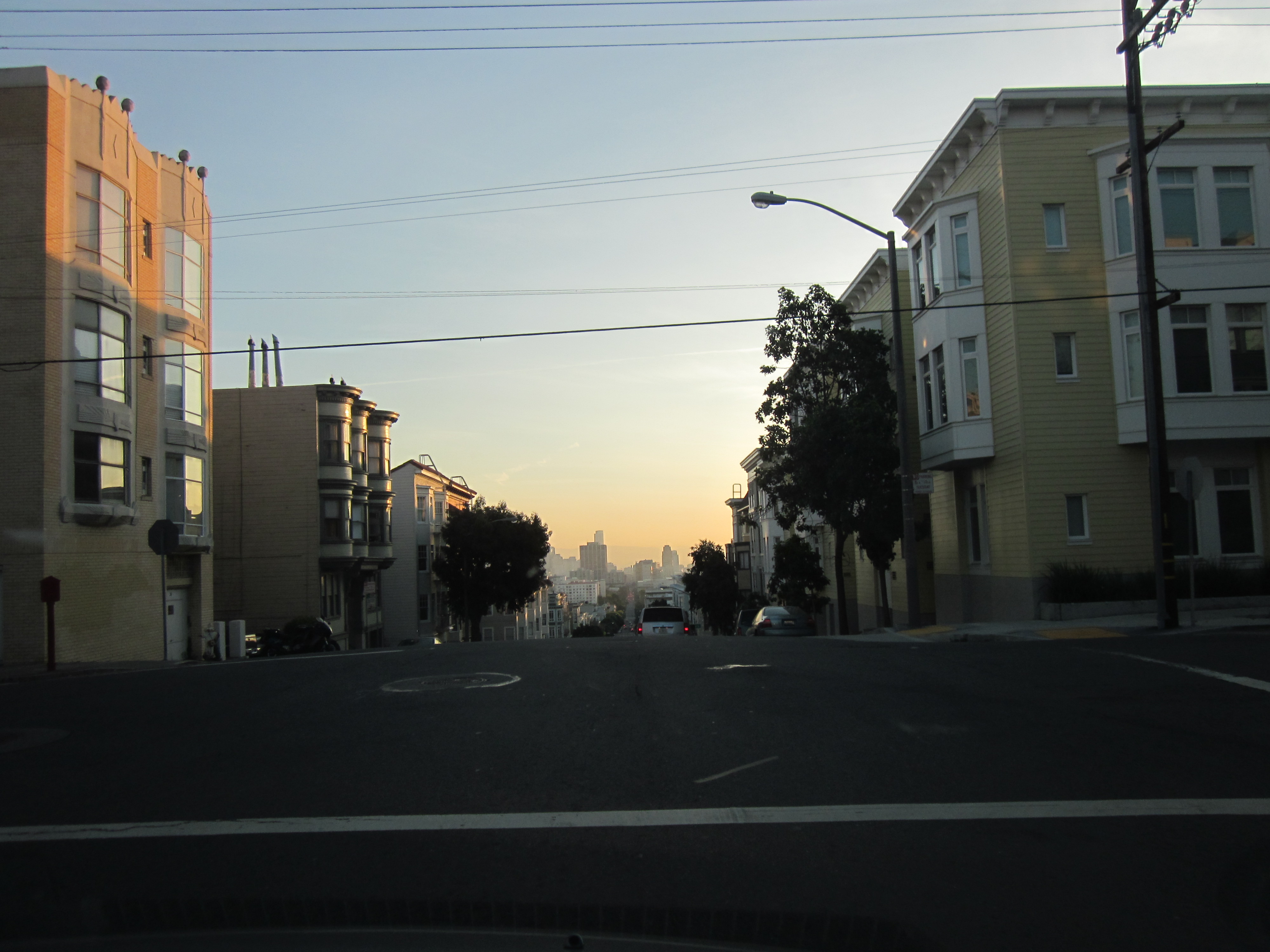
Hill #2: This is the other direct route to our home. We do not ride our bikes up this hill. We do drive up this hill when we’re in the car, and when relevant, we’ll walk up it. It is supposedly about a 17% grade. Like Hill #1, it is easy to photograph from the side because cars are not allowed to parallel park. Instead, one side of the street is nose-in 90-degree parking, and the other side is reserved for two travel lanes. This is what the City and County of San Francisco does when the streets are so steep that cars might actually roll down them while parked, even if the wheels were curbed.

Hill #3: 13% grade

Hill #3: A pretty direct route to our home. We have ridden our bikes up this hill with our kids aboard, once, in my case, with both kids aboard. That was an experience I would prefer not to repeat. This hill is estimated to run about a 13% grade, which still requires nose-in parking on one side of the street only (thus no cars in the photo) but is not so immediately off-putting to the experienced local that the thought of finding alternate routes seemed required. We walk up and down this hill several times a week and have never given it a second thought when driving. However once we learned there was a reasonably convenient detour that spread the same elevation over two blocks instead of one, we started taking that route almost exclusively. But our kids love bombing down this hill in the morning. Yeah, we’re bad parents.

Hill #4: less than 10% grade

Hill #4: On the alternate route home. This hill is less than 10% grade, and pretty typical for the streets around the city. Unless you’re in the flats of the Financial District/SoMa/China Basin (or headed there through Golden Gate Park and along the Wiggle), you’ll be going up and down a few hills like this on a typical ride in San Francisco. There are two hills like this on my way to work; one pretty short (behind the Conservatory of Flowers) and one long, extended haul up to Laurel Heights.
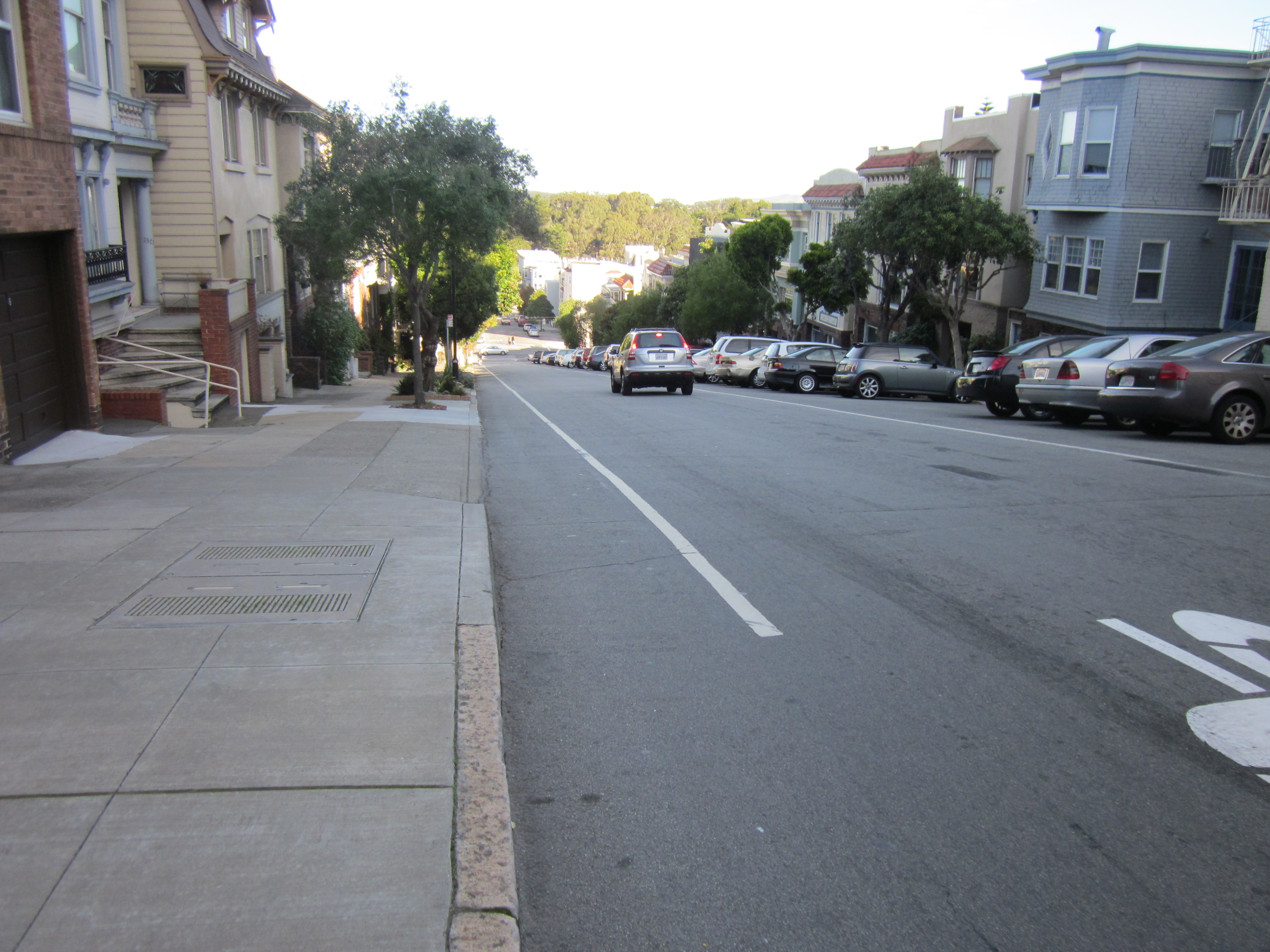
Cars are parallel-parked on both sides of the street; I view this as a sign that I can probably ride a potential route, even if I’m carrying one or both kids, and so far that’s been a safe assumption. That doesn’t mean the experience will be pleasant, as my efforts to drag myself up Post Street and Fulton Street have proved, pretty definitively. So far I haven’t had to get off and push, but there have been close shaves.

Hill #5: same old, same old, less than 10% grade

Hill #5: More of the same, another less than 10% grade. Again, parallel parking means that I can ride up this hill without having my heart leap out of my chest and leave me lying on the ground gasping like a fish out of water, at least on a good day. Note that all of the cars have curbed their wheels; this is the law in San Francisco, and the fine for failing to do so is so draconian that even as an occasional driver, I cannot stop myself from doing it, even it means that I spend a minute trying to figure out which direction on a flat street is closest to downhill. Matt once got a ticket for leaving his wheels straight on a flat stretch of street between two hills because he couldn’t figure out which way to turn them. He contested that ticket and won, but if you’re visiting, well, if you’re visiting you probably shouldn’t be driving in the city, you won’t enjoy it.

But if you simply can’t help yourself, good luck to you, and curb your wheels. A tremor (they’re pretty common) will shift cars a bit all over the city, which means car alarms galore, but curbed wheels mean that those parked cars won’t careen down the hill taking out a swath of other cars and pedestrians. So basically I’m pro-curbing.

Going up hills on a bike, even relatively low-key ones like these, requires some thinking if you have kids on the back. I used to regularly come close to popping wheelies as I started up the hill due to all the weight in the rear. Now I compensate by pushing down hard on the handlebars as a counterbalance as I approach; it’s only the moments when I’m distracted by something and forget that I realize that I’ve developed the habit.

Part of the reason that I am concerned about having the ability to haul our kids on the bikes for years to come, even though our son is old enough to ride, is the hills. Our kids are strong and they’ve never known any other terrain. They see us riding these hills and they accept them as normal. However I suspect it may take some time before they’re really comfortable going up several of them in a single ride on their own. I would be delighted to be proven wrong, but I think it’s safest to be prepared to bail them out.

18 Comments

Filed under commuting, San Francisco