
The Packster 60
Over the winter break, we got the chance to test ride one of the recent new entrants in the front-loading cargo bike market, the Packster. The New Wheel in San Francisco loaned it to us while the EdgeRunner was getting a tuneup. Thanks, New Wheel! This is the first front-loading cargo bike they’ve stocked. Back when we were shopping for a family bike, the front-loading options were pretty limited, at least in the United States: a Bakfiets.nl (inappropriate for San Francisco hills, as are all of its European knockoffs); a Metrofiets (fun bike, but oversized for our needs); and a Bullitt (what we ended up getting.) Since then, we’ve tried out new entrants like the Urban Arrow and not-exactly-bikes like the Butchers & Bicycles tricycle, and been unable to try some of the new ones like Douze. And there have been various now-you-see-it-now-you-don’t attempts to enter the market, which have permanently put me off reviewing bikes that are not yet in production. It’s still a pretty thin market.
The Packster 60 is one of two Packsters; there is also a Packster 80 (bigger,) and a similar model from the same company, which is higher-end and more expensive, called the Load.
Riese & Müller is a German company, and the bikes have Bosch assists, which are also German. The Jewish half of our family has been slow to make peace with German cars, and Bosch did not exactly win their hearts and minds during World War II either, however in the last decade or so there has been something of a rapprochement, enough of one, at least, that no one was scowling at the prospect of seeing their grandchildren on a German bike. Personally, while I have continued lust in my heart for the German postal and baker bikes, I have found most of the assisted bikes from Germany to be unsettlingly large and sort of overwhelming. Until last week, I guess I should say. My feelings about the Packster in six words: German engineering applied to a bicycle.
What I like about this bike:
- In short: German engineering. This is a term that can mean different things to different people. One of the most obvious indications for us was when I was riding with the kids and my daughter complained that we were going “too fast.” And I thought, “What do you mean we’re going too fast, we’re going maybe 9-10mph.” Then I looked at the controller and realized we were actually booking along at about 17mph. It’s the German way. When I was an exchange student in high school my host father was driving on the Autobahn and I said something about how I thought people were allowed to drive faster, and his daughter looked over at me and said, “We’re going 180kph.” Which we were. I had mixed feelings about this for a while until I got back on the EdgeRunner and realized I didn’t feel the speed on the Packster because the bike is pretty impervious to external shocks. The suspension fork on the front wheel helps with that. It glides over rough pavement. The parts don’t rattle. The frame doesn’t twitch. Everything is stable. I never noticed the shifting or the pedals. We just rode, and the bike didn’t get in the way. It is subtle, but once you’ve experienced it, it’s hard to go back. I could spout a bunch of details about the quality of the parts, but why bother when that stuff is on the company’s website. The parts are awesome. Everything works better than you would expect. It’s great.
-

Here we are loaded up: two kids, groceries, and my stuff.
The front box is great, wide enough but not too wide. We still haul our two kids in the standard Bullitt box, which is narrower on rainy days. Four years ago I would not have imagined that this was possible with them now at the ages of 11 and 7 years, but what did I know? It can be done and it’s what they want. That said, there was way less drama about “get your ELBOW out of my FACE!” with both of them in the wider Packster box. And although I was initially concerned that the wider box would interfere with our ability to get through tight spaces, it’s not so wide that it limited our mobility much. Front loaders in general are fantastic because it’s easy to talk to the kids and see what they’re doing.
-

Quick release adjustment on the seat (there’s a similar one on the handlebars)
The Packster has a number of features to help riders of various heights feel comfortable. These include a low step over (nice in general, necessary if you want to do something like put a child seat on a rear rack) and quick-release adjustable height handlebar stem and seat post.
-

NuVinci gearing on the right
The integrated NuVinci gearing and Bosch middrive assist work together seamlessly and go pretty much anywhere. (For some reason Bosch ranks its levels of assist from lowest to highest as “Eco,” “Tour,” “Sport,” and “Turbo” instead of the more logical 1-4 range. It is annoying and non-intuitive. Hindu-Arabic numerals were good enough for Brahmagupta so they’re good enough for me, and thus I will refer to the assist levels by numbers from here on out.) I’ve ridden an EdgeRunner with the infinite NuVinci + Bosch middrive assist before and didn’t have a good experience, probably because (I learned later) Xtracycle is shipping those bikes with a front cog that it is the wrong size for climbing. I have been informed by more than one person that swapping it (which many bike shops now do as a matter of course) makes a huge difference. And I thought that the Butchers & Bicycles trike I rode had that combo but it turned out to be a different assist. Anyway, this time I understood what the fuss was about. This combination makes for an incredibly smooth experience in which you can gear down and power up to go up hills, and gear up and power down on the way back down. Even with two kids on the bike I was able to shift down and stay at a level 2 assist to get up moderate hills without (a) slowing down enough that I worried about tipping or (b) feeling like I was going to pass out or (c) both. After that success, I took the Packster (unloaded) up our old preschool hill, a hill that has tacoed the rear wheels of at least two unassisted bikes hauling trailers, and that many assisted bikes have failed to scale. For that, I needed to use level 4 and gear way down, and it was not exactly effortless, but I could have done it with a kid on board, and Matt could do it with two kids. The Packster says: veni, vidi, vici.
-

Here’s the box with seat cushions and restraints.
Do you have range anxiety when you think about riding an assisted bike, worrying that you’ll ride to one end of town and find you’re out of battery power? If so, this is the bike for you. The Riese & Müller front loaders can accept a second battery, meaning that whatever the normal range of the bike (typically 20-35 miles, depending on load and terrain), it can be doubled. That second battery isn’t free, of course, but for people with long commutes, or people like us who sometimes find ourselves riding distances beyond what we’d ever initially imagined, it could be worth it.
- Do you worry about your pants catching in the chain? I used to until I realized that I could just wear skinny pants all the time. Matt and I both ride enough that we tear through the crotches of our pants pretty regularly, so it didn’t take long to resolve that problem. However the Packster has a belt drive, so I could probably wear palazzo pants if I owned this bike. Belt drives have other advantages as well: smooth operation, longevity, no rust and no need for lubrication (I could wear white palazzo pants), and reduced weight.
-

Front, with suspension and an outstanding light
There are really great accessories, and most of them are included in the price of the bike. The wired front and rear lights are incredible. I don’t often have a chance to test ride bikes at night, but because this one stayed with us for about a week, I did, and the throw on the front light of the Packster is the best I’ve ever experienced; it lit up exactly the section of the road I needed to see to get around. The kickstand is sprung so that it’s easy to release down, and ranks in the stability range of the Bakfiets.nl, making it almost impossible to tip over, even when three or four kids swarm it. Because the stand uses an enclosed frame, you can also lock it to a ground puck through the kickstand—we recently started locking our bikes to floor pucks in the wake of several hot prowl thefts of cargo bikes from garages in our neighborhood. It has a rear wheel lock, which is of course totally inadequate as a primary lock here in San Francisco, but is enough in combination with another lock to discourage many bike thieves. The pedals and saddle are nothing special, but they’re perfectly adequate. If you are so inclined, you can add three-point restraints and a cushioned bench seat to the box (the bike I rode had these.) There is also a rain cover available. Although: no bell!
-

Locked to a floor anchor through the kickstand: this is cool.
Thus far, the Packster is the only cargo bike I’ve ever been able to bunny hop onto a curb. I usually would never even attempt such a thing, but while I was riding the bike back to the shop, I got stuck behind two broken down buses, which had led to an epic traffic meltdown. After waiting a few minutes in the completely stopped car traffic, I figured I had nothing to lose by trying to drag the bike onto the sidewalk and walk it past the buses. I could barely believe it when the front wheel popped right up over the curb and glided up to the sidewalk. My bet is that this is related to the suspension on the front fork, but who cares why it works, the fact that it did work was totally awesome.
- The Packster is surprisingly easy to park for a front loader. I was edgy when The New Wheel handed it off with a standard U-lock, which can be problematic for our other big bikes. However my cargo lock had gone with my bike to the shop for a tune-up, so I didn’t have a choice. While the Packster has a pretty hefty frame, the rear of the bike is pretty lean (the loaner had no rear rack, but I don’t think a standard rear rack would add any volume here,) so we had no trouble backing it into almost any rack or parking meter to lock up. The usual caveats apply about trying to lift it up a flight of stairs, though, meaning: no way. Yet combined with its ability to hop over curbs, the Packster is shockingly maneuverable for a long john.
-

This is a very clean look, and easy to operate as well.
It looks cool. Although I try not to get hung up on aesthetics, there is value to having a bike that I look at and say “I want to ride that.” I was particularly impressed by the way all the wiring has been corralled in front. In the past I have referred to the advice I once read to “buy the cool bike.” I think liking your bike is especially relevant for cargo bikes, which are sometimes kind of big and intimidating, and are used to haul loads that understandably may give people pause. In my case, that’s two squirming kids who are old enough to make their own fun, often by fighting with each other. Beauty is in the eye of the beholder, of course, and my sense is that bikes with curvy frames seem friendlier than sharp-edged bikes like the Packster, but after years of drive-by parenting I’m actually not interested in looking any more approachable than I already do. Anyway, I found myself wanting to ride this bike.
What I don’t like about this bike:

Nice controller, oh look, we cracked it.
Almost everything on the list of things that I didn’t like about the Packster could be summarized as first generation issues, meaning that they’re either aesthetic or correctable annoyances. One of the ones that hit us on the second day was the fact that this particular bike looks interesting enough, particularly loaded up, that people around us could be, frankly, jerks. When I was riding with the kids in Golden Gate Park I tried to ride to a bike rack to park, but was stopped by a guy standing in front of me on the street to “get a closer look at the bike.” I answered a couple of his questions, at which point he stopped talking and just stood there staring at us (as mentioned above: I’m already way too approachable.) Then I said, “I’d like to get to the racks over there!” He said, “Oh!” and stepped back, and then just as I started riding again, STEPPED RIGHT BACK OUT IN FRONT OF US. And because I am evidently way too nice a person I didn’t run him over, so instead we all went down. My kids started screaming, the guy immediately vaporized, and the controller cracked. I’m sorry, New Wheel. Anyway, I put this problem in the same category as vandalism and I hope anyone who happens to buy the bike will mow him down for me next time. And generally: beware of looky-loos.
- As always, I note that there is a learning curve for bikes with linkage steering. Don’t look at the front wheel, look at your destination. I can’t tell anymore how easy or hard it is to pick up the steering on a particular make or model, because once I mastered it on the Bullitt I had no trouble with any of the others. Some lucky souls pick it up right away, some people (me) struggle for a few days, and how quickly a person picks it up seems completely unrelated to experience riding other bikes, so who knows. The possibility of dropping the bike on a test ride is real and it’s something to keep in mind. I expect that owning a bike shop that sells front loaders offers a real challenge to one’s equanimity during test rides.
- Similarly, the turning radius on all front loaders is pretty terrible, what with the long wheel base, and this bike is no exception. Tight U-turns are a thing of the past.
-
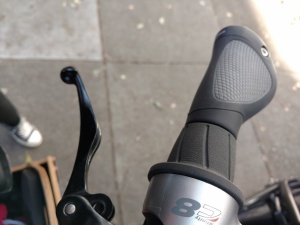
It may be hard to see, but this is too much reach.
At several points while I was riding I wondered if Riese & Müller had a single woman test ride this bicycle before bringing it to market, or even a non-German person, by which I mean a smaller person. Although there are signals that it’s intended to be accessible to people of a range of heights, including the low step over height of the frame and the quick releases to adjust the seat and handlebar heights, one miss that stood out for me was the huge reach required to reach the brake levers. I felt uncomfortable going down steep hills for this reason and for a woman, I have long fingers; I could reach a tenth on the piano back in high school, an advantage that kept me playing far longer than my talent supported. Dialing that back to a shorter reach is something that any bike shop that wants to sell this bike to moms should probably do (and I know it can be done.) Similarly, the box is a sort of origami structure held together by what I assume (based on what my neighbor stores in our shared garage) is a motorcycle tie-down strap. The ratchet (cam?) that secures it is placed at the back left of the box. This is perfectly positioned for anyone who is swinging a leg over the top bar to hit their right foot on it as they dismount. Several times. Ouch. I presume that the (tall, German) men who designed the bike were always lifting their leg over the back of the bike to dismount so this never came up for them. I learned to pull back on the dismount after a while, but it kind of ticked me off.
-

So many times I hit that thing on the dismount
While the kickstand is rock solid and goes down to support with a mere touch of the foot, it can be tricky to get back up. What’s supposed to happen is that you push the bike forward and it snaps up automatically. What actually happens depends on what type of surface happens to be under the bike. When we were on rough asphalt, the kickstand gripped enough that it popped right up. When we were on smooth cement, like on the sidewalk, it sort of dragged along and wouldn’t go up without riding for a while, or without me sticking a foot under it to nudge it before I got on. I suspect that applying some kind of grip tape on the bottom of the kickstand would provide enough friction to resolve this, but as is, it’s finicky.
-
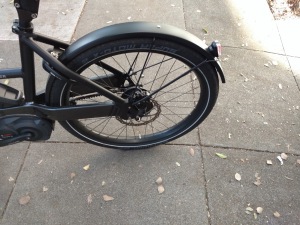
Incredibly stiff and annoying rear wheel lock
Although the Packster mostly rides like a dream, the wheel lock and battery attachments are very stiff. I like having a rear wheel lock but I loathed trying to operate this one so much that I almost gave up on it. It was bizarre because the U-lock I was using was also made by Abus and was easy to operate. Yet only the fact that I did not actually own the bike combined with the high levels of bike theft in San Francisco made me endure messing with that wheel lock. The plug attachment for the battery is also persnickety and hard to connect. Similarly, the quick release adjustments on the handlebars and seat post, while awesome in principle, are not particularly intuitive or easy to operate. I felt a weird dissonance between the times that I was riding the bike (this bike is great!) and the times that I was getting on the bike, getting off the bike, or locking up the bike and charging it (this bike is so annoying!) Some of this may be the fact that it was just unboxed and not everything is working smoothly yet. My experience with the older Abus U-lock would support this hypothesis, however although the battery plug seems designed to be annoying.
-

Note that at this level, we were constantly doing a helmet v. handlebars contest
While the bike itself sometimes assumes a tall rider, the accessories are sized for the littlest kids. We did not have the rain cover on the bike that I test rode, which is just as well, because I could tell just by looking at the photo that older kids like mine would not fit under it. My daughter’s attempt to try the three-point restraints left her laughing maniacally at how impossible it was. While my kids appreciated the width of the box, their legs were a bit cramped. The box is a bit shallower than we’re used to as well, so although it was possible to put both kids and a pile of groceries in the bike, we weren’t breaking any maximum load records. And because I didn’t figure out how to make height adjustments until I returned the bike (see above), the handlebars and brake levers struck their helmets when we were riding together. At the highest height point there’s clearance for tall kids (and short adults) but I couldn’t get it there when we had the bike. Overall, the length and width of the Packster 60 is roughly comparable to the Bullitt, but the standard box is shorter, shallower, and wider, although the Packster 80 would presumably be longer.
- The model I rode was better sprung for riding unloaded than loaded, which was interesting. This is pretty nitpicky, because the ride is great regardless, however the handling improved when it was unloaded; in this it is unlike our Bullitt. When I returned the bike to The New Wheel they mentioned that Riese & Müller supply stiffer springs that could be installed in front that would probably reverse this, making the ride better loaded than unloaded. If I were planning to use this bike for heavy loads (and why get it if not?) I would want to make that switch.
- The Bosch middrive assist is not silent. The higher levels of assist are extremely not silent. I had a boyfriend in college who later went to law school and after he graduated he took a job at a big firm and decided to buy an “affordable” sports car with his new salary, a Mazda Miata. As we still hung out at times, I rode with him in it occasionally and thus I had the opportunity to experience why it was an “affordable” sports car: the engine noise was like a chorus of howling demons. By comparison, the Bosch at level 4 I would classify as more like the whining of a moderately annoyed demon. For a bicycle, it’s pretty loud; relative to cars, it’s not offensive, but relative to other bicycles, it’s a Miata.
- Occasionally, the general awesomeness of the ride was interrupted by a weird thunking sound from the gears on hill starts. It never persisted, and it didn’t happen often, but it was unnerving.
- Last and certainly not least, this bike, like all front loaders, is pretty expensive. The version I rode is priced at $5900, which does include the lights and whatnot. However the kid accessories like the rain cover and so on are extra, as is a second battery; I can’t price those accessories as the bike just came out so I couldn’t find them listed.
Things I can only speculate about:
- As always, with a new bike on the market, I can’t speak to reliability. That said, this is not a one-off manufacturer, the parts are all pretty high-end, and German engineering has a reputation for reliability, recent exceptions like Volkswagen notwithstanding. Personally I wouldn’t feel any real concern.
- I’m not sure how well the Packster would handle a fully loaded start on a steep hill, although it is great starting from zero on moderate hills, and for those living outside of San Francisco, that’s probably more than enough. After I dumped the bike my kids were not eager to get back in the box for extended test rides, so the steepest hills I rode were all without them on board. Our usual bikes are BionX assisted, and we use the boost buttons to make the steep uphill starts. As a comparison I tried making a steep start from a dead stop with the assist dialed up to 4 and the gearing down low, and the Packster took off pretty fast. However where we live, I’d want to test ride it with the kids on board before I felt completely confident. If that’s relevant, The New Wheel has the Packster I rode sitting out in front and available for test rides at 420 Cortland Avenue in Bernal Heights.
I realized how I felt about the Packster when I rode back to the shop to pick up the EdgeRunner and they wheeled it out. The EdgeRunner is super-practical and maneuverable, but I admit, although I am fond of it, it looked like a beat-up warthog next to the shiny new Packster, and also, I realized once I started riding it that it squeaks and rattles a bit at higher speeds. These are not things that I noticed about it before I rode the Packster. It is unquestionably true that the abuse we put our bikes through is a big factor in that. Nonetheless, I curse my lost innocence.
We’re not in the market for a new cargo bike, and I am increasingly longing to return to the days of solo biking. So the question I ask myself when I test ride is more along of the lines of who it would best serve. It would serve a family like ours, it turns out. So I asked myself whether I would want it as a replacement for one of our cargo bikes in the (not unlikely, actually) event that one was stolen. It’s a close call. The Packster and Bullitt ride differently, both in appealing ways, however the Packster climbs more smoothly than our BionX assisted Bullitt (the middrive Bullitt may be different), can be upgraded to have double the range, is less expensive (assuming a single battery,) and the slightly wider box would probably eke out a year or so more of carrying two older kids at once. Thanks to the belt drive, I could wear wide-leg pants, should I ever be so inclined. I’d have to live with noise from the middrive on the hills, and plugging in the battery would irritate the crap out of me, but these seem like acceptable tradeoffs. The answer at this point, weirdly, comes down to the rain cover: our kids wouldn’t fit under the Packster’s rain cover. This is probably the closest miss ever for a bike I’ve test ridden. The rain cover would stop me from buying it, unless Riese & Müller come up with a better one. For families with smaller kids though, or hardier ones, it’s a fantastic choice.


 Hum of the city