
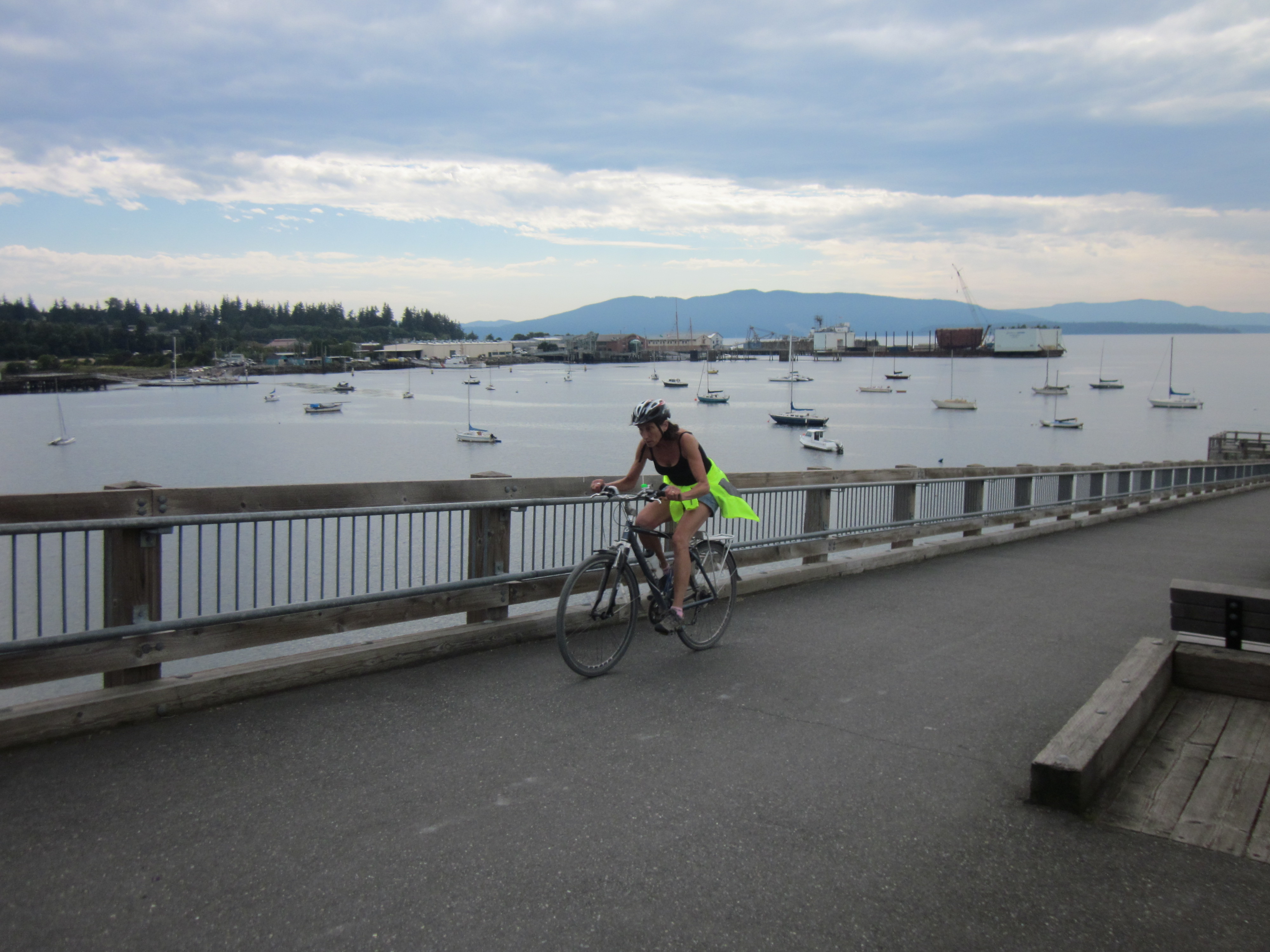
This what hills in Bellingham look like. A 10% grade according to the signs, not too bad, especially given the killer views.
I complain a lot about going up San Francisco hills. What can I say? It often sucks. Something I’ve only mentioned in passing, but that we think about quite a lot nonetheless, is going downhill. While going uphill is literally a pain in the legs (and chest, when gasping for air) it is not as dangerous as going downhill can be.
We carry our kids on our bikes, and we go down steep hills regularly. We learned quickly that loaded cargo bikes (and trailers) need extra time and distance to stop when going downhill. It can be deeply disconcerting to brake and brake and brake, and only slowly drift to a stop. At first there were occasions that we overshot the lines at stop signs and red lights, and we are cautious riders. At times we take less steep routes on the way down than we do on the way up. We learned good braking habits very quickly and have internalized them to the point that I often forget to mention them.
Although we are scrupulous about maintaining our brakes, they occasionally fail. We replace pads on the bikes with caliper brakes on a schedule that raises eyebrows among people from outside San Francisco—roughly once a month—and that meets with knowing sighs among friends who ride in the city. The stock disc brakes on the Kona MinUte failed repeatedly and were on an every-other-week maintenance schedule until our local bike shop finally lost patience, called Kona, and asked for a credit to upgrade us to hydraulic brakes. And they got us one, which made the upgrade expensive rather than wildly expensive. The new brakes are amazing, with unbelievable stopping power, and the MinUte now only needs a brake adjustment every other month. We never, ever skip this maintenance.
The other problem that can crop up going downhill, which mercifully we have never experienced, is shimmy, aka death wobble. This is when the bike starts shaking uncontrollably and violently while going down hills, and is the kind of thing that typically only road racers experience, because it usually happens at high speeds. But some bikes can also shimmy at lower speeds, say, the kind of speed that a loaded cargo bike would approach while rolling down a steep hill. Having a top tube apparently provides stability that helps reduce the risk of shimmy, which is why I’ve been encouraged to abandon step-through frames. Better brakes help too. But the risk can only be reduced, not eliminated.
As annoying as all of this can be, we have gotten used to it. However these issues arose again when we started calling around asking about family bikes we could test ride, and why there were so few electric assist cargo bikes designed to handle steep hills in the US. There aren’t many electric assist cargo bikes anyway. When you start asking about taking them up mountains, or adding an electric assist to a bike like a Bakfiets, bike shops often get very quiet. A few shops claimed that electric assists were only designed for mild hills and to go longer distances, not to haul heavy loads up steep hills. This is clearly not true, as there are electric assist cargo bikes all over Europe designed for hills: e.g. an assisted Workcycles FR8, an iBullitt, and according to the German bakery we visited in Bellingham, every delivery bike used in Germany. The whole situation was starting to tick me off. I could get strong enough to haul my kids on long distance rides (and I have). I cannot get strong enough to haul my kids up truly steep hills as they get heavier, and even if I wanted to, putting them on the back of the bike on a steep hill has sometimes led to the front wheel lifting off the ground. They’re not strong enough to ride uphill themselves, and there’s too much traffic for them to be safe even if they could. People who want to ride an extra couple of miles don’t need an electric assist like people who live on the top of steep hills do. WTF, bike manufacturers?
I give Portland family bike shops (and a couple of San Francisco bike shops, Everybody Bikes and The New Wheel) credit here because when I asked this they gave me honest answers. It is, evidently, not a huge problem to put an electric assist on a bike to get it up a steep hill. It can, however, be a huge problem getting the bike+cargo back down that same hill safely. We rolled our eyes a little when we heard that because we’re already going down those kinds of hills fully loaded, so no new news here. But manufacturers are apparently concerned about the limits of bicycle brakes going downhill. The brakes on many cargo bikes are not up to the task; as proof, there’s our experience with the MinUte.
Evidently manufacturers are also concerned about the liability they’d face if someone who wasn’t attuned to these problems had the worst happen going downhill on an assisted cargo bike. Personally I think that’s a copout. I know parents who’ve been pulled or pushed down hills by trailers, who’ve broken spokes or had rear wheels taco or screwed up frames and gearing carrying kids up and down steep hills (cough cough… me). They don’t sue the bike or trailer or wheel manufacturers. They start looking for a better cargo bike. But there are currently very few better bikes, at least in the US, and the ones that do exist have appeared in the last year or two. So most parents in our situation have either kludged something together or started driving.
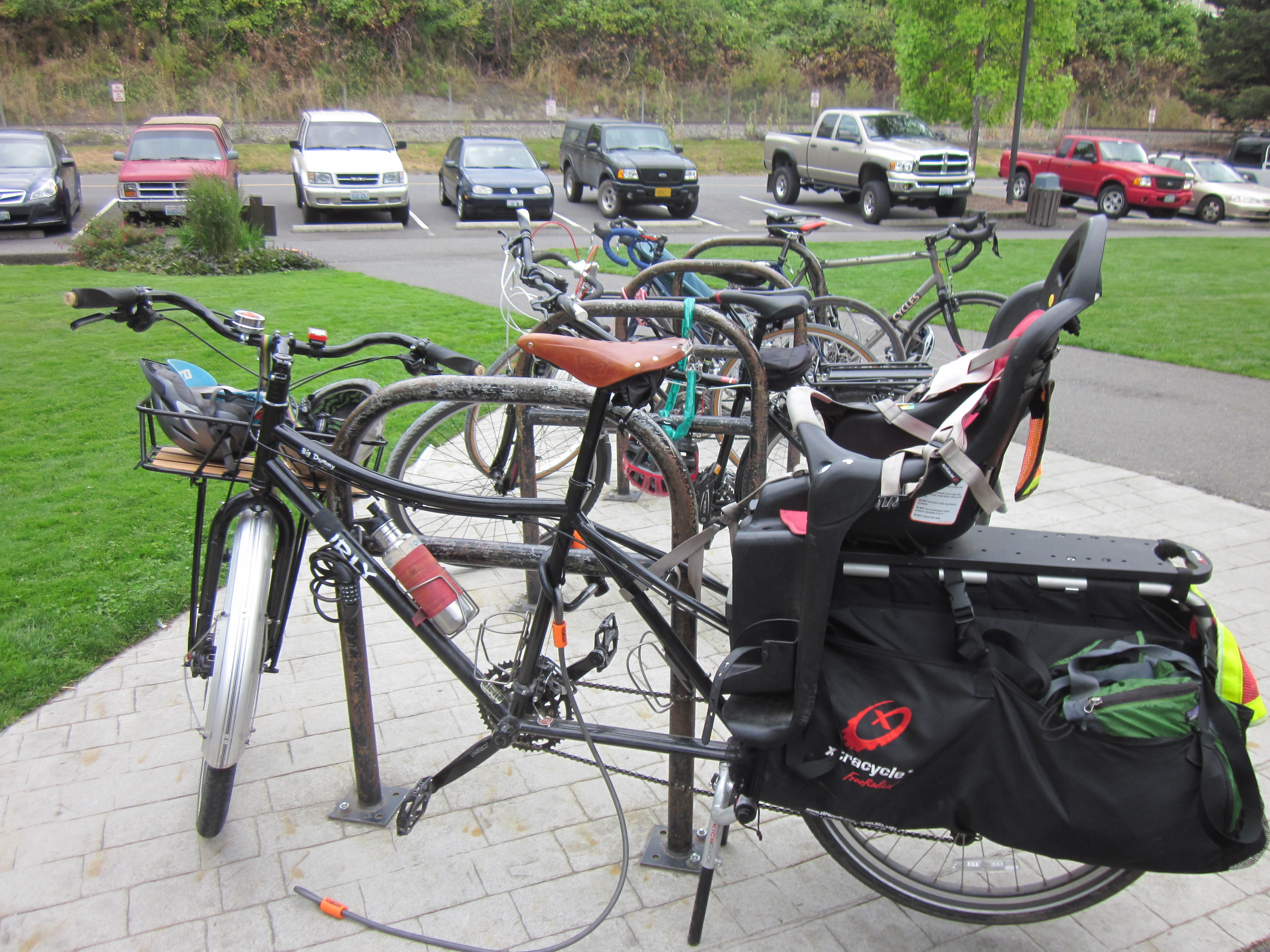
A Big Dummy in Bellingham: it is no accident that you can spot this bike all over in hilly cities
At any rate, although we’ll be trying out a lot of family bikes over the next couple of weeks, we have been told in advance that many of them aren’t going to work for us. Xtracycle and assist a commuter bike? Wobbles and fishtails when loaded on steep hills. Bakfiets and trikes? The brakes can’t handle steep downhills and can’t be upgraded, and the bikes themselves are so heavy that better brakes might not work effectively even if they could be added. And so forth. Although we’ll be riding lots of bikes for our own edification, the list of plausible candidates that we could take home to the hills of San Francisco is actually very short, at least for now. I don’t like this, but I have to live with it.







 Hum of the city