Category Archives: family biking

Free riders

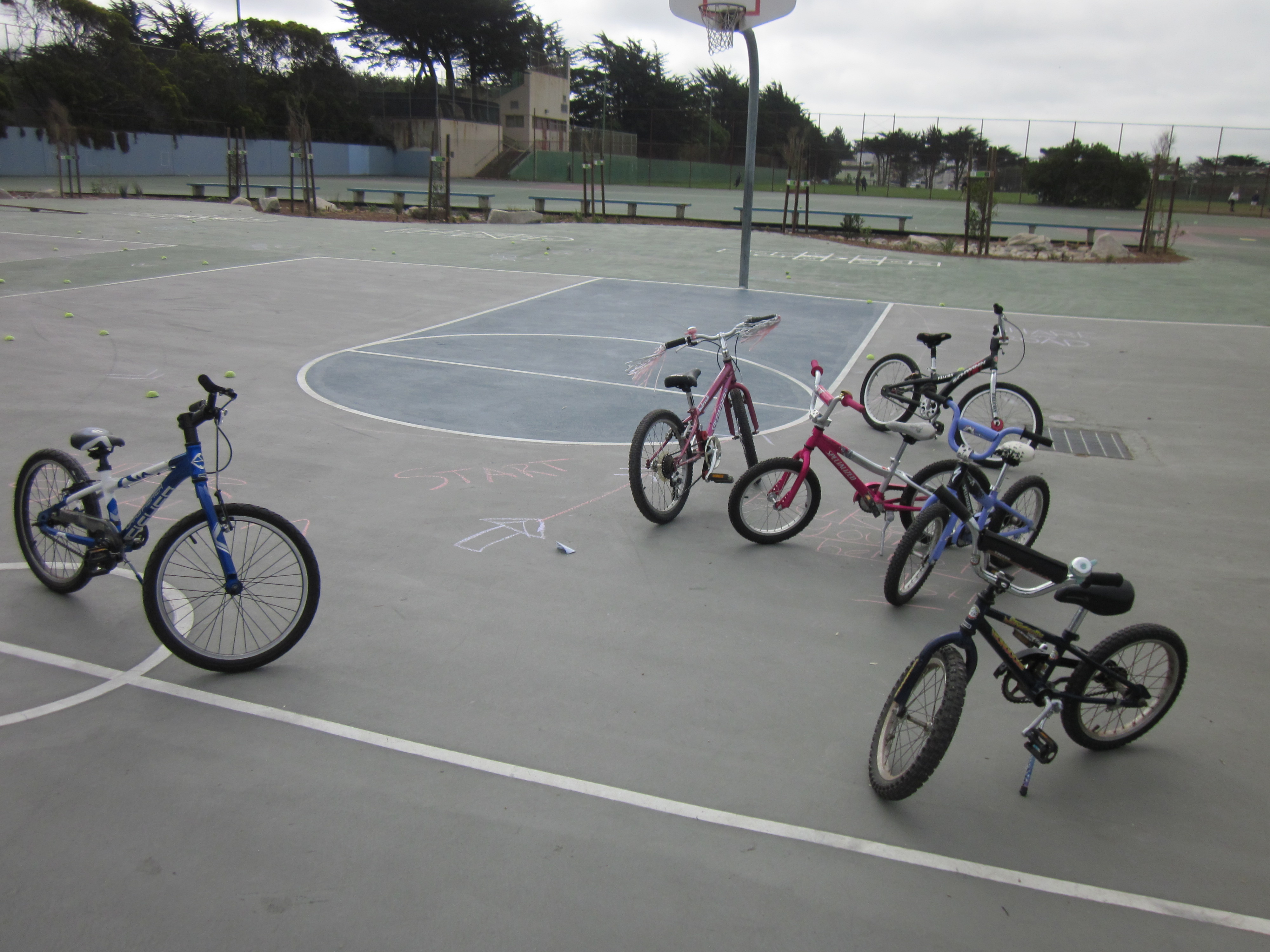
A passel of kids' bikes waiting for riders

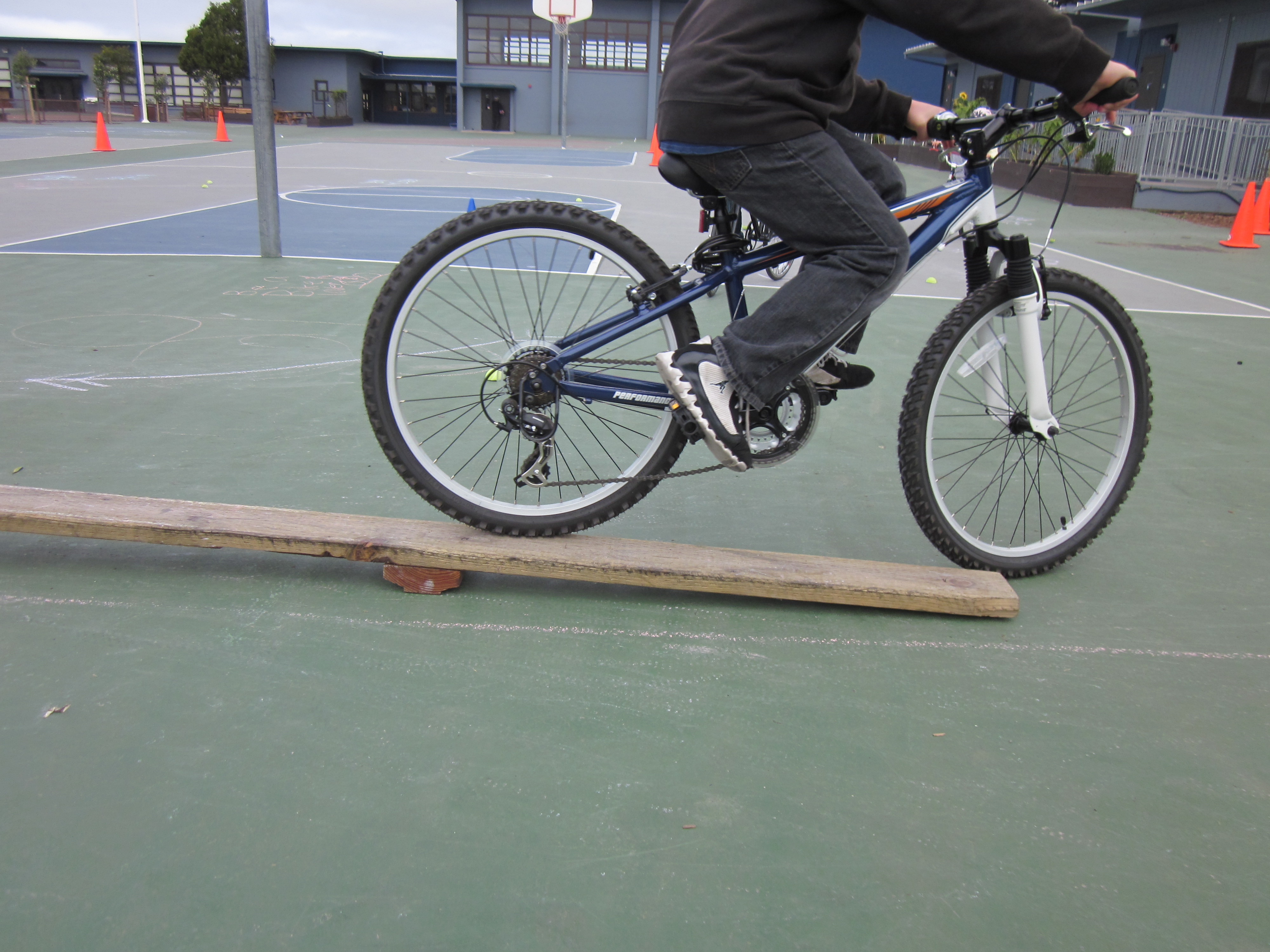
On Saturday I went back to the Outerlands, specifically to Sunset Elementary School, to attend one of the San Francisco Bicycle Coalition’s Family Biking Series classes, On Road with your Children. To my astonishment, I was asked to attend in a vaguely instructional capacity.

I find it a somewhat depressing comment about the number of families in San Francisco with school-age children (there aren’t many) that I would be considered even vaguely qualified for this assignment. The guy who built up the tricked-out Kona Ute our PTA treasurer used to ride was there. The co-owner of Ocean Cyclery, which sold us my Breezer and our child seats was there. I was outclassed. I can, it is true, research any topic into submission, because doing research is my job and because I’m compulsive. But research is no substitute for experience, so this class involved some ugly duckling moments. The class met at the back of the school, and I had trouble even finding it until other people showed up so I could follow them. The parents teaching the class had been riding bikes for years and it showed; they were more graceful on their bikes than I have ever even aspired to be. And I found out that I was wearing my helmet wrong. All in all, it was a humbling experience.

Lubricating chains: virtually all of them were rusty, because the Sunset is permanently socked in by fog

And it was a hugely informative experience. I didn’t bring my kids; they were at their swim lessons. It is just as well. Neither of them is competent enough on a bike yet to keep up with the kids who showed up for the class. (We are the blind leading the blind over here.) I will, however, take my son when he is more skilled. SFBC’s instructor for this class is fantastic, warm and lively and hugely competent at wrangling both kids and parents. Apparently he has been leading these classes for years. It shows.

This kind of thing isn't helping with the helmet either

Matt and I signed our son up for summer bicycle camp this year. We didn’t thrust this upon him; he has been angling to attend bike camp since he heard that such a thing existed. But we’re all pretty excited about it. We are having trouble teaching him to ride safely because we live on a great big honking hill. Our efforts to talk him into going down to the park, where it’s flatter, to ride always fizzle; his enthusiasm evaporates with the walk down and on the rare occasions when we’re successful, he is too tired to walk back home. Although it is ridiculous to drive such a short distance we would do it, but he hates riding in the car. Bike camp seems to resolve a lot of problems at once; most importantly, it’s taught by someone much more qualified than we are.

Practicing riding in a crowd

We had both harbored ambitions that at the end of a summer at bike camp, our son would be qualified to ride his own bike to school. Attending this class disabused me of this fantasy. The area around the school was slightly hilly, but nothing particularly troublesome for an adult rider used to the city. It was much more difficult for the kids, who were, I realized, mostly riding bicycles that weighed more than half what they do. I have ridden a heavy bike before, and remember how hard it was to start and stop and get up hills, but at least I had a lot of gears to use. The kids did not. No one is selling ultra-light bikes for kids, so I don’t see any realistic way for mine to handle anything more than minor elevation on their own. And the hills along our commute to school are anything but minor.

Practicing riding while looking for cars behind

What’s more, supervising kids on the streets of San Francisco was terrifying. The area around the school is very lightly trafficked, but at stop signs things fell apart. The kids attempted to wave drivers ahead of them, then lurched out into the intersection as those cars actually moved, or waited for cars to stop, then tried to take their turn only to be rushed by drivers who’d grown impatient. There are a lot of decent people behind the wheel in San Francisco, but a lot of jerks as well. I suspect that these kids, as well as our son, would learn to navigate neighborhood streets like these with more practice. But we go through much more serious traffic on our route to school, and I would not trust my kids in some of those intersections for years to come.

Bumpity bump

Overall, I realized that riding in the city is too much to expect our kids to do alone at this age. Our son will not be riding to school on his own bike next year, or the year after. He wants to pedal, so a trailer-bike or tandem may be in our future. But he will not be riding solo.

We are going to be working harder as he grows, and that is daunting. We had talked about possibly not needing an electric assist if our son began riding his own bike. But I cannot imagine hauling my kids up and down the hills to school without help once their combined weight exceeds 100 pounds. We are now in the position where buying a bike accessory that costs more than our bikes themselves seems inevitable.

Despite this, I find I don’t mind the thought of keeping them on our bikes longer. My children have been growing away from me since the day they were born. Even in the newborn barnacle months, they were already exploring the world. It is thrilling to watch them grow more independent, but I know that eventually they will tire of being hugged, of sitting on our laps, of being picked up. My son is in first grade and already conscious that being affectionate with parents is not something that older children do. But when we’re walking or riding up a hill, all of this is forgotten. They look at the climb and want to be small again. “Mommy, will you carry me?” they ask. And I say, yes, I will carry you. I’ll carry you up the hill. I could carry you forever.

2 Comments

Filed under commuting, family biking, rides, San Francisco, traffic

Retro child seat

Possibly the world's most awesome child seat

I spotted this achingly cool child seat on a bike parked at a construction site near campus. I couldn’t believe it. The black leather seat, the chrome back–it looks like it was lifted from a modernist bar for preschoolers. It totally outclasses the Huffy.

I remember when I was young, my parents took my sister and me on bike rides in the wire baskets on the handlebars of their bikes. It was horribly uncomfortable, of course, and I sincerely doubt those baskets were rated for the weight of children. But it was a lot of fun nonetheless. Some of my earliest memories are from those rides; seeing the trees dripping with moss during my family’s brief time in Louisiana, or bumping along on the gravel road that led to our house in the Seattle suburbs (this was long before they were built up for hordes of Microsoft employees).

Our parents sometimes tried to take us on walks when we were young, but like most kids our age, we simply didn’t have the stamina to go very far. My parents’ bicycles, with a kid in each front basket, gave them range. Now that we are parents, our bicycles make us free as well.

The seats we use for our children, however, lack style, even compared to a wire front basket. They’re plastic. Putting our kids on the back of the Kona MinUte is an improvement. But overall, the child seat market resembles nothing more than the toys that you can buy at big box stores: giant plastic sandboxes in the shape of turtles, or plastic play kitchens with colors that fade within a few months. There are twee alternatives, of course, like the wooden play kitchens that mimic everything about the plastic ones except the price, which is ten times higher. But I’d prefer to sidestep this market altogether.

This child seat, which looks pretty vintage, is in a class by itself. If my parents had had seats like this they could have ridden with us for hours. I’ve never seen anything like it before. But I want one.

Leave a comment

Filed under family biking, San Francisco

People love to talk about bicycles

Unable to stop talking about bicycles since July 2011

I have found that I need to be careful when asking people about their bicycles, particularly as a way to make conversation, unless I’m sure I have some time available. Unlike many topics, the topic of bicycles inspires long-winded stories from even the most reserved people I know. I am, of course, no exception.

Example #1: My son’s school principal is a wonderful man in many ways, warm and caring. But he is not particularly chatty and hates public speaking, two quirks that have probably kept him from applying his prodigious talents at one of San Francisco’s more renowned public schools.

Some other parents have mentioned that he sometimes rides his bike to the district office at Civic Center to avoid the nightmare that is parking down there, and when he held the door for me as I was leaving the school one morning after dropping off my son, I asked him if he still did that. Oh yes, he said, and he was off. He told me that he used to commute by bike exclusively, until recently one of his sons decided to stop driving and donated his car back to his parents. “I’ll admit it’s faster for me to drive,” he said—true in his case because he’s arriving to open the school every morning well before 7am (ours is an early start-time school).

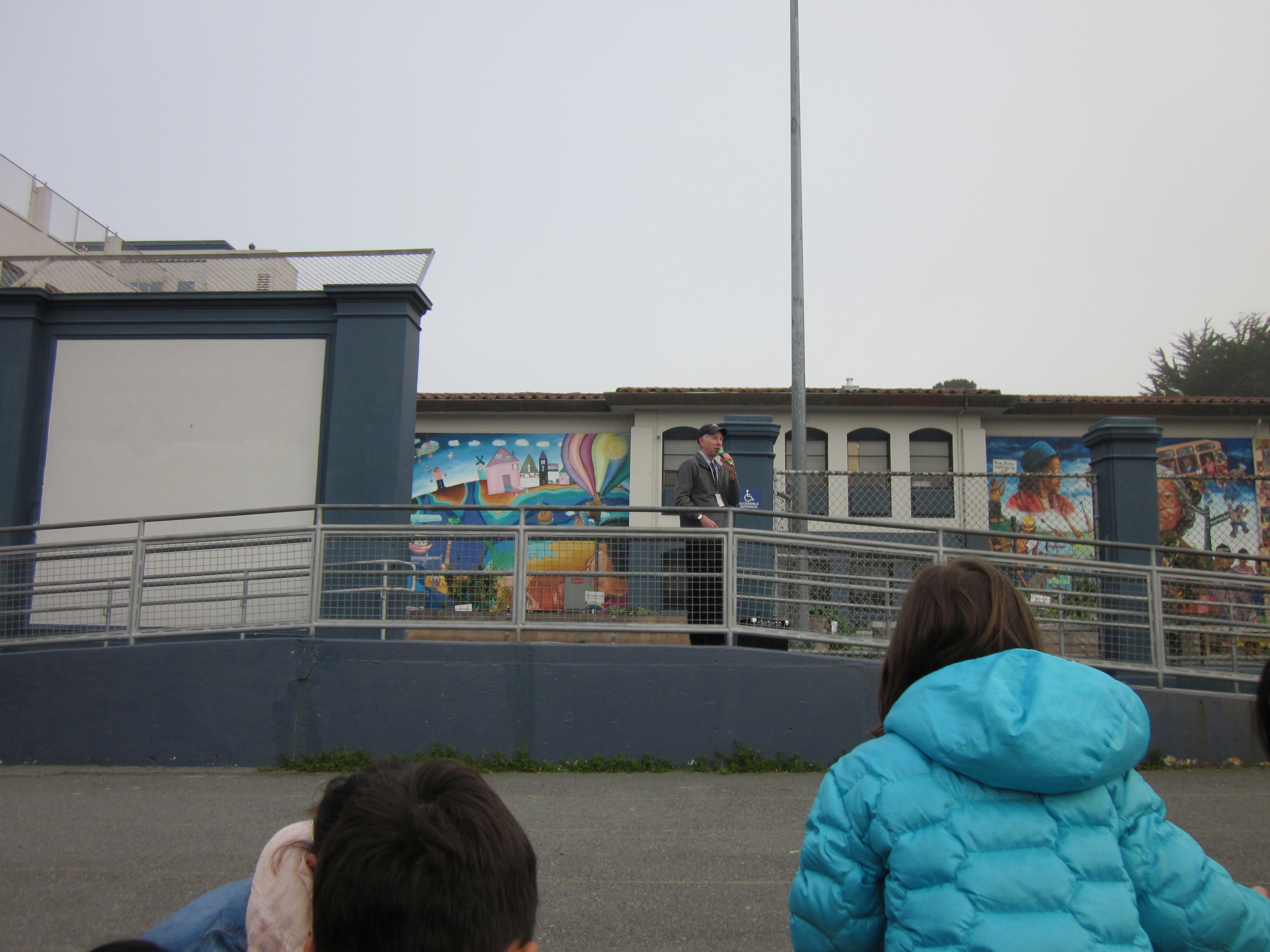
Morning assembly

But the story he really wanted to tell me was about his old bike, which he kept in the school yard before the bike racks were installed, “a total junker” covered with rust and just functional enough to make the run down to Civic Center and back. He evidently kept the bike unlocked in the yard for almost two years, until recently it was stolen. “Someone must have spent two hours sawing through the fence to steal my bike, which was worth $20 at most! It was complete junk!” He was amused and so was I.

This conversation was more than twice as long as any other I’ve ever had with him, and he seemed unaware that he was holding the door open for me the entire time, for over 10 minutes.

Even gerbils like to ride tandems

Example #2: My department is spread across multiple campuses, an inconvenience that allowed our dean to negotiate some prime real estate for our operations on many of them. Recently one of my colleagues moved from another campus over to ours. She is an unassuming person who quietly controls several million dollars in federal grants and has published hundreds of papers, and until last week I knew virtually nothing else about her.

I saw her after she moved in last Friday, and complimented her on the small sculpture of a tandem bicycle on her desk. It turns out that she is a serious touring tandem cyclist, and she and her husband have ridden their bikes on trips across multiple continents (I didn’t even know she was married). She had many excellent photos of their rides over the last several years.

When I mentioned we were interested in riding with our children, she immediately rattled off the names of two rental agencies in the Bay Area that offered adult tandems, and volunteered to look up the names of the stores where they had purchased their bikes, “They all offer test rides! That’s how we figured out we wanted to buy one. Some of them must have kids’ tandems. I will ask the next time we’re there.”

Transportation is a topic that never gets old; we all have to go places, just as we have to eat and sleep. But most of my conversations with my colleagues about transportation involve my nodding politely and commiserating about their difficult drives from the suburbs to San Francisco. “It takes me an hour to drive across the bridge most days, but it’s so much better than when I lived in Houston and drove three hours to work each way!” Conversations like this eventually make me want to gouge out my own eyes. I’ve found I’m pleased to spend some unexpected extra time talking about riding bicycles instead. Bicycles make people happy.

1 Comment

Filed under commuting, family biking, San Francisco

San Francisco destinations: Rosa Parks Elementary School

Welcome to Rosa Parks

We started riding our bikes in large part to solve the riddle involved in getting our son to his elementary school. For the first year, we all went to kindergarten together. Our daughter was in child care downstairs at my office, so we’d drive to school, play on the yard until the bell rang, then I’d drop Matt off for the express bus and head to my office. Matt would take the express bus back, pick up our son at after-school, and I’d meet them with our daughter in the campus parking lot. This worked pretty well, although it was time-consuming, until we enrolled our daughter in preschool closer to home. At that point things got more complicated.

From the outside, just another urban public school

San Francisco is one of the cities in the United States that operates a public school lottery system. I know there are others (Cambridge, Los Angeles, Champaign, Berkeley, etc.) but this is the one we know best. There is no guaranteed neighborhood assignment. So at that time you toured a bunch of schools, listed up to seven that you liked, and hoped you got one. If you didn’t, you would be assigned to the closest school with openings. This can be intimidating but also offers huge opportunity. There are citywide schools that offer more than the general education curriculum, including foreign language education, K-8 schools, a Montessori school, etc. Most schools are pretty good and some are terrible, but because people hate the lottery system so violently, the perception is that only a few highly-desired schools are acceptable and the rest are hellholes.

For people who appreciate the charms of being underrated, this misperception offers an enormous opportunity to beat the system. We found it surprisingly easy to find schools we liked that none of the other preschool parents we knew had even heard of, let alone toured or listed on their applications.
From the inside, a garden

There is a lot of herd mentality with a school lottery. There are about a dozen schools of the 100 or so in the city that get over half of the first choice requests from parents. They tend to have higher test scores. Parents we know like high test scores: they seem objective. But it only takes a little reading to realize that they are highly correlated with demographics. Schools that don’t have a lot of poor students have high test scores; schools that have more have lower scores. After reading some articles I realized that I could easily derive a formula: for every percentage point of students getting free and reduced price lunches, expect a 5 point drop in API (from a max of 1000). I made this up but it works pretty well in most circumstances (schools with a large share of Chinese-American kids tend to outperform their demographics, however).

San Francisco Unified School District enrolls about 60% free and reduced price lunch students. The school nearest us has ~10% free and reduced price lunch students. Its test scores are ~950, as expected. It is wildly popular and completely oversubscribed. On tours they indicate that parents are expected to contribute $1000 to the PTA annually, which I’m sure discourages certain families from even applying. On the flip side, we a toured Spanish immersion program in the Mission that had ~80% free and reduced price lunch students. Its test scores were, predictably, ~600. Poor students do poorly, because they tend to be English language learners, because they’re hungry, because they may be in transitional housing and lack heat and light, whatever. Wealthy students with educated parents do well no matter where they are (and the state has the demographic breakdowns to prove it at the Department of Education website). There are just more of them at certain schools.

My son learned to eat vegetables by growing them

I have a different perspective on all of this now, but at the time, like many parents facing the lottery, we pretty much lost our minds. Like everyone else at our preschool, we wanted the brass ring schools, the ones that had great scores. We knew it wasn’t that important, really, but a school with high test scores seemed like, if nothing else, a useful insurance policy. And it’s hard to buck the tide. Other parents said things like, “Well, 900 API is like an A, and you want an A school for your kids, right? You wouldn’t accept a B or a C school.” And thanks to relentless fundraising those schools had money to burn; their facilities were nicer, the selection of extra-curricular activities was better, and afterschool programs had won awards. It seemed easy enough to look past the occasional signs of near-rabid parental intensity to get the goodies.

Despite this, we did take the (in hindsight excellent) advice from Parents for Public Schools to tour every school within a reasonable commute distance, no matter what its test scores or perceived popularity. The internet is not your friend during the school search. With hindsight, it told us nothing useful, and often made us doubt ourselves for no good reason.
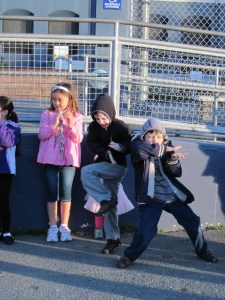
Morning PE--the Cha Cha Slide

Our favorite tour by far in our busy pre-kindergarten tour season was Rosa Parks. It is not a school that had traditionally gotten any buzz in the San Francisco parent community. Middle-class families like ours tend to shun schools named after civil rights leaders, strongly preferring schools named after dead philanthropists or expensive tree-lined neighborhoods at nose-bleed elevations. I like to imagine SFUSD opening a new school named “The John D and Catherine T MacArthur Nob Hill Academy.” Even if it were in the Tenderloin, I’ll bet it would be hugely popular with parents.

What we liked about Rosa Parks on our tour:

  • A state class size reduction grant ensured that all classrooms were capped at 20 students
  • A beautiful historic building with ample space, including both a cafeteria and gymnasium; we had toured schools without either and wondered what they did on rainy days or for assemblies
  • A sunny and well-stocked library, staffed by a full-time librarian and media technology teacher
  • Daily Japanese language education by native speaking senseis, funded by the district; by 5th grade, at least one Rosa Parks student had passed the Japanese Language Proficiency Test
  • A new edible garden program funded by a major grant, now expanded with a chicken coop and new plantings in what was formerly blank blacktop on the upper yard
  • UCSF graduate students teach science in the upper grades—this is the only school where this happens, and their faculty advisor insists that it is only school where it ever will happen
  • Grammy-nominated artist Anthony Brown teaches jazz at the school—again, Rosa Parks is the only school with this program
  • More parents than visitors on the tour, which suggested to us both that we could get in and that parents were engaged
  • Representation by LGBT families (LGBT parents have the same effect on schools that they have on real estate)
  • Harder to describe, but a peaceful feeling: students were engaged in their work rather than throwing spitballs (which actually happened on one of our tours) even when we visited a room with a substitute; upper grade students were eager to show us their letters to Japanese pen pals; kids walked down the halls instead of running
  • A warm principal who reminded me of Mr. Rogers; later, when I called the teachers’ union for their opinion on schools (we didn’t want to walk into a labor dispute), we learned he was highly regarded by teachers as well. Last week he led an impromptu ballet class for my daughter and another preschooler in the hall after drop-off.
  • Academy-award winning PTA president. Parents who attended last year’s a garden workday got to hold the Oscar. Did you know that Barbie doll clothes fit an Oscar? I didn’t either, but her kids figured it out right away.
  • An enormously rich history that deserves another post on its own; Rosa Parks, formerly Raphael Weill, was the site where Dorothea Lange came to document the process of Japanese internment, where one of America’s most distinctive photographers, John Gutmann, took some stunning pictures, and where San Francisco schools began their re-integration in the 1960s
  • Parents I wanted to hang out with, maybe the best indicator of all
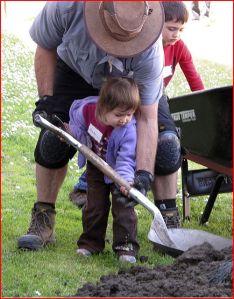
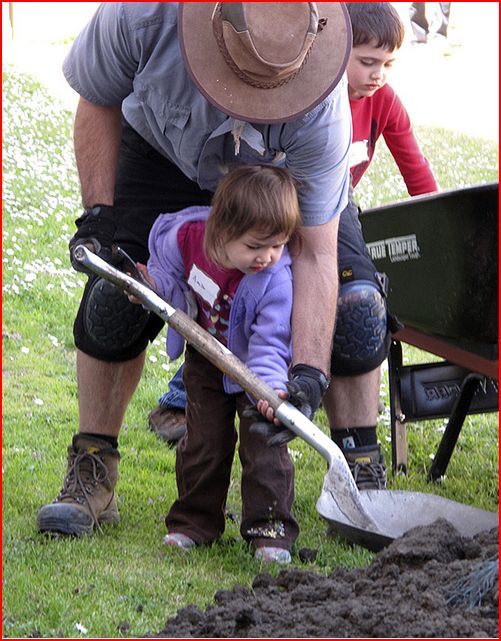
Building the upper yard garden

There were 12 people on our tour of Rosa Parks. The parent representatives said they were thrilled with this turnout. We had toured another school with well over 100 other people, in which the parent leading the tour complained how few of us showed up.  He wasn’t joking.

More than one person on our tour asked why there were so few of us and why, historically, no one had applied—the year prior to our enrollment Rosa Parks received fewer applicants than there were places available. The parents leading the tour sort of sighed and said that the combination of neighborhood and low test scores meant most people never even visited. We knew low test scores were explained by the high proportion of English language learners and SpEd students, so they didn’t bother us much. They had nothing to do with what our son would learn in a supportive environment. The neighborhood was admittedly a little grimmer than we’d hoped for, but I’d seen worse.
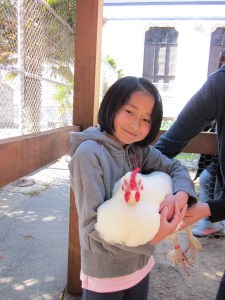
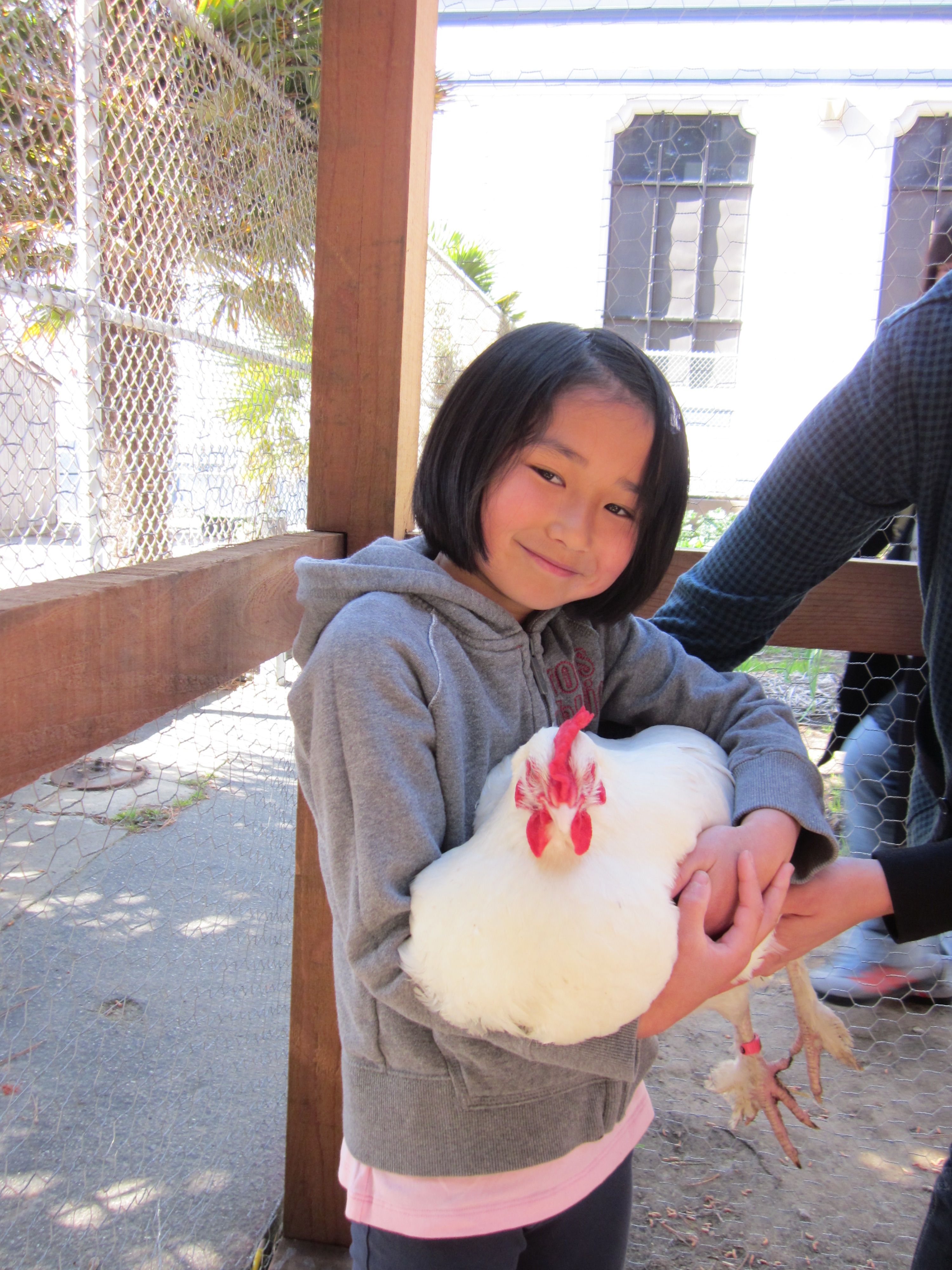
Now we have chickens. Yes, we are that trendy.

An unspoken reason for low enrollment (there were other schools in worse neighborhoods with worse test scores that were considered much more desirable) was the fact that the school was 40% African American and 20% Latino. Less than 10% of families were “white” as the district defined it, and many of those were Middle Eastern families where the women wore hijab and everyone spoke Arabic. When I mentioned touring this school to other white and Asian-American parents we knew who’d actually heard of it, there were, on occasion, curled lips, and comments I would be embarrassed to repeat. Last year I overheard one of my co-workers complaining to all and sundry that the district had assigned her to a horrific Title I school, Rosa Parks, and she wouldn’t be caught dead sending her son there. When I asked her what she didn’t like about it, she admitted, somewhat sheepishly, that she’d never visited. I told her we were very happy there.

Although it was not in our neighborhood (we live near the obscenely popular nosebleed schools, and knowing that our odds of getting into a school that people spoke about using exclamation points!!! were near-zero, we had expanded our range), Rosa Parks made our list. It was the school where we were placed in the first round assignment, not surprising given that only 44 families applied for the 40 available kindergarten spaces, and many of those were placed in schools they’d ranked higher. After a week of emotional flailing about not getting a school closer to home, we enrolled.

New upper yard garden, still in progress

It would be a huge understatement to say that we have never regretted this decision.

We could not have asked for a better environment for our son, who was nervous about the transition to kindergarten. He joined a wonderful group of children and we adore them all. As long as he is with them, I have no fears about his voyage through the rest of the city’s school system. His teachers have been more caring and supportive than we had dreamed was possible. He is excelling academically despite being one of the youngest children in his class. Working in the school garden has led him to eat new vegetables, sometimes with gusto, a battle we had assumed was permanently lost. In his first year he went on over a dozen field trips (making me feel like I was rooked as a child). He tries to trick us by speaking in Japanese at home and strangers in Japantown compliment us on his accent.

That would have been enough. But for us as parents, there was more. Sometime in the middle of our son’s kindergarten year, I realized that not only did I know the names of all of our son’s classmates, I knew the names of all their parents. And I knew the names and ages of all his classmates’ siblings. I often knew where those siblings attended preschool, or if they were older, the names of their teachers.

First week of first grade

And I liked all of these people, some mildly because I barely knew them, some quite a lot because I knew them well. I liked how they were raising their kids, and I liked that I saw them in the classrooms when I volunteered, and I liked that his kindergarten teacher sometimes had more chaperones for field trips than she had expected. I found that I didn’t mind attending school events like PTA meetings and work days that I had always assumed I would dread. Two parents organized a drop-in Friday coffee klatch, which continues. When I think about school community now, I think about a crying kindergartner being successfully comforted by another classmate’s dad, or watching my daughter meet and play with her future classmates before she turned two.

Rosa Parks was not our first choice school, but it should have been. We hit the jackpot.

In our second year, the school became (marginally) more popular, and even though it was located in a not-terrific neighborhood, parking in the morning was getting more challenging. We couldn’t carpool in the morning anymore, and driving our son was making us crazy.

New bike racks filling up on a Saturday morning

When we returned from Copenhagen with what seemed to us like a novel idea to start bike commuting, we were surprised to realize that other parents at the school were already way ahead of us. Some were riding cargo bikes to school with their kids on the back, or tandems, or trailer-bikes, or jury-rigged bikes with their kids on the top tube. Our principal rides his bike to district offices to avoid having to park there. We had, astonishingly, never even noticed. These families had already asked the district to install bike racks.

Rosa Parks in 1942, but looking much the same 70 years later

Rosa Parks is a school in transition. It is still in a borderline neighborhood, its test scores have jumped but are still nothing anyone would brag about, and the community is still rough around the edges. But I yield to no one in the value I place on a good education for my children, and I am confident that we have chosen well. And we are in transition, too. Rosa Parks is the right place for us. We are, in many ways now, enjoying the ride.

3 Comments

Filed under commuting, destinations, family biking, San Francisco

The Kona MinUte, six months later

Maiden voyage of the Kona MinUte + 3

[Update: Our Kona MinUte was stolen from a rack at Yerba Buena Gardens in San Francisco on November 16, 2012.]

When we bought the MinUte, it did a lot of what we wanted, but not everything we wanted. Most importantly, it seemed to be a one-person bike. Only Matt could ride it. We had hoped for a bike that I could use to take our son to school when he was away. Eventually that spot was filled by the Breezer Uptown + Bobike Junior.

With hindsight, it was odd that I couldn’t ride his bike. I am only 1.5 inches shorter than Matt is (5’7.5″ v. 5’9″), and both of us have successfully ridden bikes owned by people far shorter and taller than each other, respectively. But the seat on the MinUte simply couldn’t be lowered to a point where I could reach the pedals. Once again my brother-in-law resolved the problem. When we were complaining about it on a ride with him, he looked at the bike, and noted that the seat wouldn’t lower because the shim holding the stoker bars onto the seat post was too long; it extended way beyond the height of the stoker attachment and blocked the seat from moving. “You just need to have the shim cut down,” he said. I have never doubted that we are mechanically inept, but still.

Our other issue with the MinUte was that our daughter couldn’t safely ride on the back without a child seat, and this model was new enough that installing one using the Xtracycle accessories would have required a lot of tinkering. But she recently turned three, and as other parents have noted, this is an age when many kids start being able to understand the need to hold on. She had also indicated in no uncertain terms that she wanted to try riding the MinUte deck, jumping proudly off staircase landings onto it before we developed the good sense to move the bike far, far away from anyplace above ground level.

So while Matt’s injured calf was keeping him off the bike anyway, we took the MinUte over to Everybody Bikes to ask them to cut down the shim. “Oh, sure,” they said. They’d had no idea we’d ever want to adjust the seat height for me. “Of course you could ride it.” It turns out that the stoker bars take up a lot of room on the seat post regardless, and even lowered all the way to the stoker attachment, the seat was a bit higher than I’d prefer while carrying kids. I like to be able to get a foot flat on the ground even while I’m on the seat, and I’m happy to give up pedaling power for that extra bit of safety. But even though the seat was higher than I wanted, after that adjustment I rode the MinUte all the way home solo. No problem. Okay, then.

Matt was headed on a two-week trip to Atlanta and Miami, and that seemed like the perfect time to try riding with both kids. So the next day I rode both kids down to the farmer’s market. I still wasn’t totally comfortable on the bike, but they thought it was an awesome ride, and aside from a brief scuffle over the handlebar grips, they enjoyed each other’s company. Matt griped that he didn’t have a bike anymore, “Mommy has all the bikes.” I assumed that that was the injury talking, as he had had no prior plans to check the bike through on his tour of the U.S. Southeast.

Not seen in this photo: scuffling over handlebar grips

My kids got sick while he was away, and a kid who won’t get off the toilet, put on shoes or take off pajamas is not a kid who will or should ride a bike. And there were a couple of days I had meetings across town where the only possibility of even arriving late after dropping off the kids meant I had to drive the car. But I did, eventually, haul both kids on the MinUte to my son’s school, then my daughter solo back to her preschool. It was awesome.

The MinUte rides like a normal bike even with almost 100 pounds of kids and their gear on the back deck. I only felt the extra weight when I was turning corners; it turns out you need way, way more turning radius than usual with that kind of load. To my astonishment, I did not feel it much on the hills. On the way up to Alamo Square with both kids on the back I didn’t even need to drop to first gear. This bike likes to climb. I wouldn’t have needed to drop to first gear on the way back up with only one kid, either, if someone who shall remain nameless hadn’t decided to take off a mitten and throw it into the middle of the road, which required some backtracking.

This raises another point worth mentioning: riding with a three-year-old, at least MY three-year-old, on the deck instead of a child seat is not all sunshine and roses. With her brother behind her to catch flung mittens and otherwise impose basic safety precautions, I was willing to ride at something approaching normal speeds. Once we dropped him off I was riding very slowly indeed. One of her preschool teachers is a big fan of superheroes and as a result we and random strangers have been hearing a lot of speeches along the lines of, “I’m NOT a little girl! I’m an AMAZON PRINCESS! I’m WONDER WOMAN!” I’ll admit that this is a little rude at times but it’s also so totally righteous I pretty much let it slide. Anyway, Amazon princesses apparently see no need to sit down while riding and strongly prefer to hot dog it while heading up or down hills. Whereas I  had no desire to return to the Emergency Department for the third time in a month, and spent most of the ride saying, “You need to sit down. Sit down, please. I’m not starting the bike again until you sit down.”

[Aside: I’ve noticed that superheroes, with the notable exception of Batman, are not big on driving. Admittedly they don’t ride bicycles either, but still, as role models go, it could be worse.]

In the shop for a brake adjustment. Again.

And this brings up a more serious issue. BikeRadar recently reviewed the MinUte, and although they were basically positive, they noted that the disc brakes that come with the bike are kind of junky, and we agree. They have failed on Matt once, with our son on the back, and now he has them adjusted monthly, and they always need it. He wants new hydraulic brakes way more than he wants an electric assist. If we’d known this in advance we would have asked for an upgrade on the brakes before we first picked up the bike. As cargo bikes go the MinUte is pretty inexpensive even with this extra cost. Still it bugs me that any cargo bike would come standard with crappy brakes. Maybe it would be less of an issue for people who weren’t dealing with the kinds of hills that we are. I wouldn’t know.

While we were having new brakes installed, we also would have gotten a wheel stabilizer for the front wheel (the little spring that keeps the front wheel from flopping). These are very inexpensive, but although they come standard on the Kona Ute, one was not included on the MinUte even though there are hookups. The bike is a little too tippy with kids on the back when the front wheel can swing around. Yeah, it’s fallen over. The kids are fine. We’re getting a wheel stabilizer.

The MinUte can really haul; it’s not up to the loads of a regular cargo bike, but we live in the city and we’re not making Costco runs or moving furniture. It can certainly carry a week’s worth of groceries plus a kid or two. It makes it harder to get up the hill home, but that’s why that first gear is so low.

But maybe you’re not up for that kind of trip. Can you put it on a bus bike rack instead? No, you cannot. Matt tried for over 10 minutes to get it on the university shuttle bus rack, infuriating two dozen medical students in the process, and failed. It’s short enough to fit in a shared office cubicle but it’s still a longtail, and that means it’s too long to ride the bus. [UPDATE: We were wrong! Yes, you can put it on a bus bike rack. But it’s complicated. I posted an update explaining here.]

Look who’s back in the game

Matt has mixed feelings about the panniers. On the one hand they fit the bike perfectly, are totally waterproof, fold up beautifully when empty, and hold unbelievable amounts of stuff when full (and the kids’ legs just dangle over them). On the other hand, there’s no shoulder strap to carry them if you want to take them off the bike and they don’t look particularly professional when he brings them into the office. The tubes on the rear rack are thick enough that normal panniers won’t fit unless you can modify them somehow. Last week we saw a Ute outfitted with Xtracycle freeloaders, however, and I eyeballed while we were parked next to it that they’d fit on the MinUte as well.

Overall, six months after we bought, the MinUte is doing more than we had thought it could. And even though I only ride it while he’s away, Matt is so possessive of this bike that he thinks we should get a second one.

40 Comments

Filed under commuting, family biking, Kona, reviews

Figuring out what safety means

Despite my best efforts, my daughter survives another weekend unscathed

A while ago we were riding around with the kids on the weekend, on the way home from a party with friends. One street was closed to cars for a block party, and we swung in to check it out. The kids were hoping for a bouncy house, no luck. But we did see a friend of my son’s from preschool and stopped to talk with his parents. When we last saw them they were miserable about their school lottery placement, but as often happens, they were able to transfer to a school they preferred mid-year, and they were feeling good.

A neighbor of theirs walked up to me, looked at my daughter in her child seat, and said, “My god, that’s totally unsafe!”

I looked over at his two sons, who had just begun whizzing wildly around on scooters, jumping sidewalks and nearly topping toddlers, all without the benefit of helmets, elbow pads, or knee pads. He looked over at them too.

“Ha ha,” he said after a moment. “I was just kidding.”

“Of course you were,” I replied.

There is reasonable evidence that the health benefits of cycling outweigh the risks (de Hartog et al 2010, Environmental Health Perspectives—open access), at least for the person doing the pedaling. The question of whether it’s safer for children isn’t directly addressed in that paper. But we know enough people who have had car accidents in which their children were hurt or killed that I no longer feel that cars are necessarily safe.

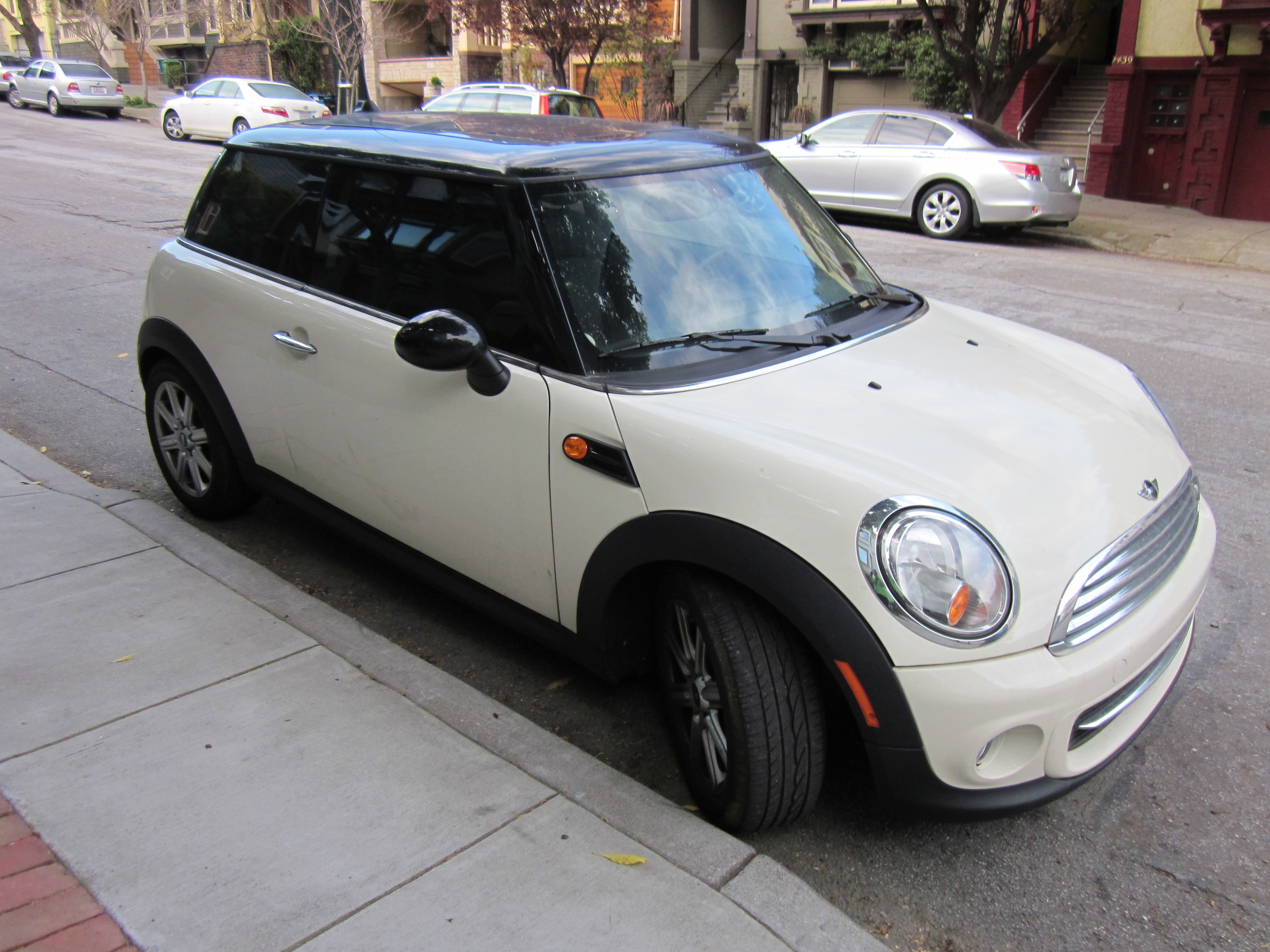
A practical city car, unless you have kids

I didn’t always feel this way. We have a minivan because when our son was born, continuing to drive him in our 2-door Honda Civic no longer seemed appropriate. Our struggles to get him into and out of the car seat were incredibly frustrating. At the time, we were living in the suburbs and always sharing the road with massive SUVs.  After my maternity leave ended, we had stumbled into a situation we’d never faced before: both of us were commuting by car. It was in many ways a difficult time for us. Although it ended well, with a move to San Francisco less than a year later, at which point we sold the Civic, the legacy of that period remains with us in the form of our minivan.

Just barely fits in our parking space

We bought a minivan when we wanted a new car because it was touted as a safe car for children. It was built from 2.2 tons of steel and had side curtain air bags. It felt like the right size in the suburbs; it was, in fact, a medium-sized car in that area. And it was much easier to get a car seat in a minivan than anything else on the road. But it is a wildly inappropriate car in the city; as one example, just to get it in our garage space, we have to flip in the side mirrors. And in this environment I no longer feel it is safe; the constant dings and scratches we pick up in parking garages and on sharp turns makes driving it feel like wearing a sombrero in a crowded bar.

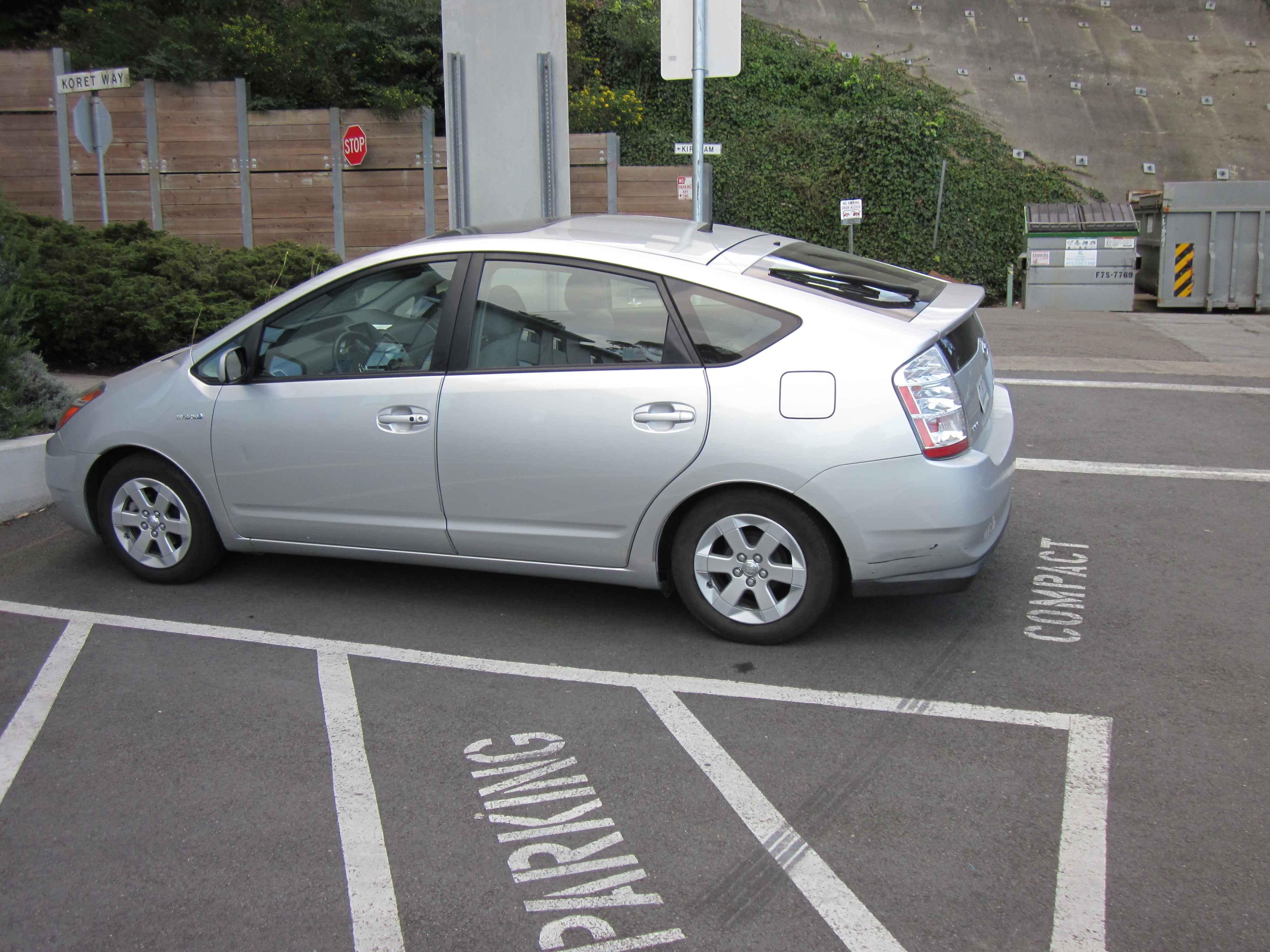
Technically a Prius is a compact car

I would consider getting rid of a car entirely and seeing how relying on City Carshare worked out for us. Matt thinks this is insane. We do agree that it would make sense, in principle, to trade the minivan for something else. My inclination would be something cheap and small and used, one of the many style-free little cars one can buy for thousands less than the residual value of the minivan. This would lower the financial hit if wanted to put electric assists on our bicycles, which are now our primary means of transportation. Matt’s preference is a 2012 Prius, the plug-in hybrid version. There is no way that I would be willing to buy any new car now that I know what happens to cars in the city. Admittedly I’ve never been a fan of buying new cars anyway. And university housing is unlikely to agree to install a charging station no matter what we might want. Matt likes the idea of driving a Prius, particularly the low gas costs given how much he travels for business (these costs are reimbursed, but it takes a while, and that’s annoying on principle alone). Such a car would, it’s true, fit easily into our parking space. As we’re unable to agree, we continue to drag out the minivan when we want a car. It’s not a fuel efficient vehicle and although we now typically fill it up less than once a month, gas is expensive. But at least it’s paid for.

But the point: I no longer feel it is a safe vehicle. I’m not sure when this happened. But when I recently heard a colleague say she doesn’t feel safe driving with her kids in their small car, and will only put them in the minivan, my first reaction was disbelief. She lives in a very different situation and her kids spend a lot of time on the freeway, so upon reflection I realized why we felt so differently. I would have felt the same way a few years ago. But my worries about my kids now involve things like Nature Deficit Disorder. That’s why I send my son to nature camp on school holidays.

When I arrived at the library at 8am the bike racks were almost full (but those U-locks without bicycles are not reassuring)

As I’ve begun riding my bicycle more, I’ve noticed that my attitude toward driving has changed as well. I think on bicycle time and I almost never travel in rush-hour traffic, so I’m never in a hurry. By default I yield to almost everyone on the road, whether pedestrian, bicycle, or cross-traffic. Occasionally I get honked at for being unwilling to mow down some poor soul in a wheelchair who’s crossing at the crosswalk, but I can live with that. I often get appreciative waves from cyclists, which is nice, and reminds me I should do that more often when I’m on the bike myself. I don’t listen to music and neither of us let the kids yell in the back anymore. This is probably how we should have been driving all along. Despite all of this, I now feel that our car is often an unsafe (if sometimes necessary) way to travel. The shift in perspective is unnerving, but it also feels right.

4 Comments

Filed under commuting, family biking, San Francisco, traffic

Thinking about electric assist

Okay on the flats, but for the hills we'll need more power

If I could name the #1 thing that makes parents we know in San Francisco who’ve never attempted family biking perk up and say they want to try, it is the words “electric assist.” The other week I said those words in passing to another mom at our daughter’s preschool who has almost no experience riding. She has now told me every day that I’ve seen her since that she is hounding her husband to shop for an electric bike for them when he returns from his current business trip.

Discussions about riding bikes in San Francisco always involve hills, to some extent. This is especially the case if you live, as we do, on a mountain. Mt. Sutro: it’s right there in the name. It burns us, Precious! We’ve learned to ride them, but these hills aren’t easy. If we lived higher up the mountain like some of our neighbors, I would be riding an electric bike right now. Nonetheless hills are at least consistent. Unlike the wind or the traffic, they are predictable. They aren’t going anywhere. I keep thinking that people can get used to anything, but there are destinations in the city we avoid unless we’re driving. And there are times we give up. Last weekend Matt couldn’t face the prospect of riding to the hardware store, which is halfway up the other side of our hill, leaving him the unenviable choice of riding up and down and back, or down and up and back, or driving. Despite the hell that is finding parking in that neighborhood, he drove.

It's easier on the way down

Our friends have a Big Dummy to take their kids to school, and they live on Lone Mountain. They take their kids, their groceries, and on occasion each other, up Lone Mountain. And they tell me they push that bike a lot. They are philosophical about it and call it upper body training. They are opposed to many electric assists for environmental reasons, but they are the exception. Our friends who live on Potrero Hill or nearer the top of Mt. Sutro have said they’d be riding their bicycles daily if they had any idea how to arrange an assist. I myself had no idea. But our kids are getting heavier, and I think it’s time to learn. The only other semi-practical option was suggested by my brother-in-law, who noted that Lance Armstrong became a much better hill climber after getting cancer and losing 20 pounds. I suppose that I could conceivably hack weight off my own frame for a year or so at the same rate my kids were gaining without losing much leg strength. But as a woman in America I really don’t need any more reasons to obsess about body weight, and this strategy would only work for so long anyway.

Option #1a: Buy a new electric bike. There is a new shop (and some established ones) in San Francisco dedicated to electric bikes. But when I look at their bike lines, they do not seem practical for family use. Most seem to lack basics like rear racks, and overall remind me of the Bikeyface cartoon about “ordinary black lace panty” bikes (not that there’s anything wrong with that). Perhaps one day this will change.  But the word on dedicated electric bikes is that the bikes themselves are often cheaply made. To keep the price point less terrifying, the money is in the motor.

Option #1b: Buy a new electric cargo bike. Both Kona and Yuba make electric cargo bikes, the Electric Ute and the El Mundo, respectively. These are obviously suited to family use, and they are both respectable manufacturers who primarily make bikes rather than slapping some bike components onto a motor. These bikes are expensive relative to the non-electric versions (all electric bikes are expensive) but they seem to offer some economies of scale; the electric versions cost less than it would cost to buy a non-electric version and add a comparable motor to it. If you’re looking for a new cargo bike, these seem like competitive options. However we have a cargo bike that we like, and living in the city makes us reluctant to commit to a really long bike like the Ute or the Mundo.

Option 2: Add a motor to the bike. This is the direction we’re leaning if we electrify: we have bikes we like right now, and if we wanted to upgrade/change bikes later, we could move the motor, potentially sparing ourselves the cost of upgrading more than once. But the market for add-on electric assists is massively confusing to me. Older reviews suggest that some manufacturers offered pedal assist (e.g. BionX, Stokemonkey) and some offered throttle assist (e.g. eZee, nearly everyone else). Not sure what’s up with the random capitalization by these manufacturers. What that means as I read it:

  • pedal assist motors make you stronger as you pedal, but won’t work unless you’re pedaling
  • throttle assists operate with a switch on the handlebars and move the bike along whether or not you’re pedaling.

But evidently this is moot now because primarily pedal-assist motors now offer the option of moving your bike whether or not you’re pedaling (BionX) and primarily throttle assist motors now offer what some are calling “the European option” of only working when you’re pedaling (eZee), a term which I can only assume refers to some legal restriction on electric assist bikes in Continental locales. As a bonus, the major brands all seem to offer head and tail lights that plug into the battery. Whoo hoo!

As a result I have started thinking about electric assists in the simplest possible terms for a total noob like me: front wheel, back wheel, and inbetween.

Front wheel motors

You can buy these all over the place, including on Amazon; eZee is apparently the market leader. The El Mundo uses an eZee motor; some models are evidently powerful enough to move a loaded cargo bike. An important caution: You shouldn’t put a front wheel motor on an aluminum front fork. It will break while you’re riding and fling you headfirst onto the ground. GOOD TO KNOW! This is mentioned occasionally on sources like online bicycle forums and on the websites of what appear to be reputable electric bike shops, but is not routinely mentioned in the advertising for these motors. The electric assist market is a Wild West indeed.

Costs for these motors seem to range from $400 or so for a low-power version with heavy batteries (not cargo-bike friendly) to $1500 or so for a high-torque version with lighter weight batteries. Installation not included, and given that people are evidently mounting them on aluminum forks on occasion, I would be inclined to find a reputable bike shop for installation even if I weren’t hopelessly unhandy. Who knows what else could go wrong?

The Kona has an aluminum fork: no front wheel motor on our MinUte. The Breezer has a steel front fork (the specs said “chromoly” which I had to look up, because in case it’s not totally clear by now, I’m clueless; another option is to see if a magnet sticks to your fork, if yes, your fork is steel). So we could put a front wheel motor on the Uptown.

Rear wheel motors

The market leader in rear wheel motors is apparently BionX. It is primarily a pedal assist motor, but the newer versions claim you can use it without pedaling if you want. The BionX motor comes in various powers, some suitable for cargo bikes and hills, others less so. BionX appears to be sort of the Apple of electric assists; expensive and incompatible with other systems, but stylish and easy to use. The newest versions have cool features like locking the rear wheel when you walk away with the console, making the bike more difficult to steal.  Reviews suggest that riding with the BionX is a lot of fun; you pick a level of assist (25% extra to 300% extra) and when you push down hard on the pedals, the battery sends out that much extra power to make riding easier. This would be super-handy at stop lights as well as on the hills. This motor only works on bicycles that use a derailleur on the rear rather than an internally geared hub.

Cost seems to range from $1000 for a system that might not move a loaded cargo bike uphill to $2000 for the top-of-the-line system with lots of torque and security features, installation not included.

My Breezer has an internally geared hub and I like it: no BionX for the Uptown. The Kona MinUte has a derailleur so we could put a rear wheel motor on it. How can you tell if you have an internally geared hub? It’s like true love; you already know.

Inbetween

Let’s say you have an aluminum front fork and an internally geared hub and no desire to buy a new bike. Or you are carrying very heavy loads. Apparently there are also motors called mid-drive motors that attach to the chain. They are recommended for cargo bikes because they have a lot of torque. The only two I have heard of are the EcoSpeed and the now-out-of-production Stokemonkey. The Stokemonkey, if it were possible to find one used, is pedal-assist only (a discussion of the pros and cons of this for one family, relative to the eZee kit, is here). And evidently really, really powerful; it took a loaded cargo bike up Russian Hill! That’s over a 30% grade.

Costs are heart-stopping even for electric assists. The EcoSpeed runs over $3k. Installation is evidently challenging. It’s not for the faint of heart, unless of course you live in Portland, where all these motors are made, and where presumably any bike mechanic could install one with their eyes closed in exchange for a pint of artisanal beer sold from a Metrofiets.

Should we get an electric assist? I don’t know. They’re expensive, and that’s daunting. But we’d probably ride a lot more, and that is worth something too. We fear the hills more and more as the kids grow. We are fortunate that there are at least bike shops in San Francisco that seem to specialize in electric motors. Both Big Swingin’ Cycles and The New Wheel will put a BionX on a bike, and Electric Bicycle Outlet will install an eZee kit. Maybe it’s time for us to actually visit one of them.

2 Comments

Filed under cargo, electric assist, family biking, San Francisco

Scofflaws

Driving to ride a bicycle. This makes no sense to me.

My commute to work and back is largely on a quiet bike lane, a broad road with surprisingly few cars and a large collection of bicycles. Based on the clothing choices of the riders and the crust of mirrors, panniers, and lights on the bikes, I presume these fellow road users are all headed to office and teaching jobs like mine. Even on the (slight) downhills, we all proceed at the measured pace that suggests that in all likelihood, none of us got a full night’s sleep, as is SOP in a household with children under the age of five.

Every once in a while, however, the smooth road, limited elevation changes, and infrequent traffic signals seem to draw a different kind of rider on our evening ride home, a type displaying substantially more ambition. The other day as I left my office I met with a pair of riders in the full lycra kit, riding bicycles that to my eyes looked as though they might collapse in a stiff wind. From the moment we converged they showed evidence of having arrived from a different planet, one without traffic signals. They blew through every stop sign without even slowing down or taking a break in their chit chat, even when other cars or bicycles were patiently waiting their turns. They paid only slightly more attention to red lights, slowing on occasion but otherwise treating them a polite suggestion to be aware of fast-moving traffic while crossing.

Traffic scofflaws, whether in cars or on bikes, annoy me (and everyone else). Even worse is when the people in question are as slow as I am, and this is pretty slow, as I am opposed to sweating when I can possibly avoid it. At the very least, if you are going to blow through red lights, you should have the decency to go fast enough that I’m not stuck behind you for over a mile. And I was in fact stuck behind these tiresome riders, who were riding side-by-side to prevent boring, law-abiding commuters from passing. What is it with lycra?

An outfit I cannot imagine wearing

There are, I’ll admit, a few lycra-clad riders who seem aware of the rules of the road. Occasionally on my ride home I will see a man in lycra who is 70 years old if he is a day, riding a bicycle that was evidently designed to go fast, although I have yet to see evidence of this actually happening. This lovely man is still having a bit of trouble with this bicycle, and it is painful at times to watch him stop carefully at every intersection, as clipping his shoes into and out of his pedals is not something he’s fully mastered yet. But I respect his effort and will ride more slowly than usual when I am behind him, as I figure he can use all the encouragement he can get, and being passed by a mom in dress clothes on a cargo bike with a kid on the back is probably something of a blow to the ego. So I usually wait until he’s having more trouble with the pedals than usual at a stop light to pass.

This is my kind of ride.

One of the advantages of riding around with major weight on my bike is that I have gotten much stronger, although I am slow. This pays off in a big way on the hills, especially on the occasions when I am riding without my kids. On the day I was stuck behind the annoying roadie couple, I was riding alone. And after a mile or so of mostly flat riding, we finally hit a real hill. The two of them split to crunch up it slowly on bicycles that weighed less than my pannier, standing in the pedals for leverage. So I passed them. Next time bring your “A” game, roadies.

Leave a comment

Filed under commuting, family biking, San Francisco

Loaner bike: The Yuba Mundo v4 (hello, goodbye)

Two cargo bikes squeeze into a bike rack...

Last night the loaner Yuba Mundo went home to Marin. It was fun while it lasted. I had, until a couple of weeks ago, never ridden a real longtail before, and as I’ve mentioned, it takes some getting used to. Our friends who were used to riding a Surly Big Dummy liked it a lot. “It carries three kids and you don’t even notice! And it’s cheap!” They are, of course, very used to riding with two kids on the back. In fact they rarely do anything else. My brother-in-law hated the Mundo. “I hate this bike,” he said. It was unclear whether it was the bike itself or the experience of riding any kind of long bike with two kids on the back. With hindsight I lean toward the latter.

After riding it for two weeks, the Mundo grew on me. I conclude after this experience that big bikes have a significant learning curve. If you’re in the market for one, especially as a first bike, it’s something to consider. A case in point: I dropped the Mundo with both kids on it. In front of our local bike shop. The bike shop guys ran out in horror and offered us their shop Ute as a loaner to get home. It was mortifying. At first I thought it was just me, so it was reassuring to hear from Family Ride and A Simple Six that this is one of those things that just happens sometimes. The kids were unharmed although startled. I now put this experience in the same category as dropping the baby off the bed. When I was in grad school my advisor told those of us who were expecting that one day, a while after our kids were born, we would put them on the bed and they would roll off. “It happens to everyone,” he said. “I’m telling you now so you don’t beat yourself up about it. They’ll be fine.”

Fully loaded

I really liked having the ability to carry two kids and a load of groceries in San Francisco (and this is particularly appealing for younger kids who need child seats). It is pretty amazing. People who live in flat areas with no hills to speak of love their box bikes (bakfiets, Madsens), but almost everyone agrees that those bikes won’t climb real hills, and getting down them on the other side raises safety issues. San Francisco has real hills. The Mundo may be heavy, but it cranks up the hills; I never had to walk it. Based on our experience so far, I now believe that people who live in hilly terrain should buy bikes from companies based in the San Francisco Bay Area, or maybe Seattle.

(There is evidently one exception to the “box bikes won’t climb” rule, the custom Metrofiets. Down in SoCal, Bike Temecula is riding a Metrofiets with a BionX electric assist. Although that bike is unquestionably one of the coolest things I’ve ever seen on two wheels, it is not cheap. A Metrofiets with kid seats costs $5k WITHOUT the electric assist [update: Metrofiets notes below that the price is just under $4k; Splendid Cycles lists the box with child seat as an add-on for $665 and a harness as an add-on for $100]. We could buy normal bikes with electric assists for everyone in our family for that kind of cash. Or a used car, were we so inclined, which we are not. Where we’d store any of those things is a different question entirely.)

There are things I would change about the Yuba Mundo. My personal pet peeve is dynamo lights; I think all family bikes should have them, and the Mundo does not (it’s not even an option). In San Francisco, the bike should be fitted with disc brakes (this is an option, and not an expensive one, either). The child seat mount would be infinitely better if it were possible to slide the seats forward and back, possibly on rails? I would have preferred the Peanut seat about 6 inches forward from where it was, because it leaned beyond the rear tire, which made the bike wag. And when I had only my daughter on board, I would have liked to slide it all the way forward, which would have made it much easier to get up steep hills and to talk to her.

There are also a lot of things to like about this bike just as it is. It can move major-league weight, way more even than other long tail bikes. And you don’t even feel it except at the starts and stops. This is pretty amazing, especially considering the weight of kids and their gear. My two kids together are ~80lbs stark naked, but outside the house they always have clothing on, and on any kind of trip we add in lunches and book bags and toys. The weight adds up fast, particularly if you want to stop and pick up groceries. (And if the weight gets out of hand as the kids get older, Yuba sells an electric version, the elMundo.) The Bread Basket was unnerving to ride with at first, but absolutely awesome. When it was loaded up I barely noticed riding over potholes or Muni tracks. Our son loved the soft seat cushion and wants one for the MinUte. And the bike acoustics are good; this may sound like an odd concern, but it’s useful to be able to hear the kid in the back. Our kids liked riding on this bike. They called it The Beast.

Yuba sometimes bills the Mundo as a minivan replacement, but I don’t quite agree with that. Minivans are plusher. The Mundo reminds me more of a pickup truck; stripped down but effective at moving stuff where you need to go. Yuba is like the Ikea of bicycle manufacturing, peeling off everything optional to keep the bike at a price point that does not make novice riders laugh in disbelief. As long-term recovering cheapskates (we’re so cheap that we bought our Ikea furniture on craigslist, given that the kids are going to trash it anyway), I like that there’s a cargo bike manufacturer with this business model.

In contrast, a bike like the Surly Big Dummy is more of a station wagon concept car, which can be customized to do anything you want, but only if you know what to ask for and can swallow the price. The minivan of bikes is the box bike.

Classic San Francisco pinch point

Would we get a Mundo? No, but that’s not a knock against it, but a statement about our lifestyle. We wouldn’t get a Mundo for the same reason we don’t have a back yard. We’ve made a choice to live in a large city, and that choice involves some compromises. We have, by city standards, amazing bicycle storage, but even we had to rearrange that space around the Mundo.  San Francisco has serious traffic, and maneuvering a big bike through it led to some frustrating moments; another bike would whiz through a pinch point in front of me, and I would realize I had to wait until it cleared. Parking the bike, even at bike racks, always involved a little jiggering around tight corners and other bikes—I was in that situation when the Mundo fell over. There is a lot of starting and stopping in the city, and that is difficult with a heavy bike. The Kona MinUte, we’ve realized, may represent the outside range of bikes that we can handle in San Francisco. I wasn’t surprised when the Yuba rep told me that most of their customers lived in inner-ring suburbs or smaller cities. That seems like this bike’s ideal stomping ground. The Costco run holds no fears for the Mundo.

We are lucky devils indeed to live in San Francisco, and being shut out of a few categories of bicycle seems like a small price to pay for the privilege. I’m glad we had the chance to try the Yuba Mundo, and although we won’t miss figuring out where to put it, all of us, especially the kids, will miss having the chance to ride it sometimes.

5 Comments

Filed under cargo, family biking, reviews, Yuba Mundo

Riding to school on the Bobike Junior

A while back Matt tore a muscle in his calf, and he’s been limping around ever since. He can walk short distances, but ideally wouldn’t be walking as much as he is, and that’s slowed his recovery. He hasn’t been able to ride his bike for at least two weeks. He’s not happy about it.

Headed for the big hill on the Bobike Junior

Our son’s school is on the way to Matt’s office (more or less) so normally they ride together, Matt drops him off, then continues on to work. He also typically does the pickup at after-school, and they ride home through Golden Gate Park. The MinUte is always ready to pop a kid (or even two, if they’re old enough to hold on) on the back.

So for the last couple of weeks, I have been doing most of our son’s drop-offs and some of the pickups. It’s been nice to have this extra time with him in the morning. I hadn’t used the Bobike Junior regularly; it pops on and off the bike in less than a minute, and for regular commutes it is mostly off. But for the last week it has been on my bike full-time. On our morning rides, we bomb down the hill from our house as a starter (no worries: the neighbors already have Child Protective Services on speed dial) and head into Golden Gate Park, over to the Panhandle, then up to Alamo Square and back down to Japantown. This is a very cool ride; in the early morning, when it’s still half-light, the park is still thin on other bicycle commuters and the trees hide the car traffic on either side.
Waiting for the light in the panhandle

Our son can be very chatty on the bike, and he enjoys the view. He is sometimes irritated by the pannier encroaching on his foot rest, and the other day, he entertained himself by lightly kicking my calf on every pedal stroke. “I don’t want to ride with the pannier again!” he yelled. “I don’t want to shove a backpack in your face,” I answered. I forget what else we talked about, and now only remember that we were laughing so hard that we were bothering the joggers, who normally reside exclusively in iPod land. We learned later that one of his classmates saw us while driving by (we arrived at school only a minute later than they did, which still astonishes me). Her dad told me that she asked why she couldn’t ride to school too.

I like the way the Breezer takes the hills, so when we’re headed up to Alamo Square and the lights are timed right, we can jump up the incline pretty fast. That day we raced a garbage truck. We lost, but held our lead for longer than I expected, given that I had a 1st grader and his school gear on the back.

The loathsome eastern approach to my office

After his drop-off I head up to work, taking the grim eastward approach to Laurel Heights, which packs all of the elevation in at once at Post Street, then drops me off at the intersection of California and Presidio, a nightmarish snarl that usually leaves me walking my bike through the intersection rather than attempting to ride it. Thank goodness I have a step-through frame: hit the red light, slither off to one side, walk the bike through the crosswalks, hop back on.

People always ask me whether the folded Junior is a battery pack

I am still vaguely amazed that a seat like the Bobike Junior even exists. It solves an unusual problem; most parents with kids our son’s age would have them riding to school on their own bikes. Traffic and hills and the transition to after-school make that impossible for us, but I don’t think our situation is exactly typical. And yet thanks to the canny Dutch, we’ve found an out-of-the-box solution that’s both effective and a lot of fun.

29 Comments

Filed under Bobike, Breezer, commuting, family biking, San Francisco