Category Archives: reviews

We tried it: Metrofiets

“I want to ride it! I want to ride it!”

Oregon has a few homegrown box bikes, or at least did once. CETMA makes two cargo bikes that can be rigged to carry kids, the Largo (long) and the Margo (not long). However CETMA is moving to California and going off line for a while. Joe Bike used to make Boxbikes and Shuttlebugs, but doesn’t anymore. I realize I need to write yet another post (in my nonexistent free time, these cargo bike write-ups take forever): Bikes we didn’t try and why. There is also Metrofiets, a custom box-bike that appears to be a bigger operation than the other two.

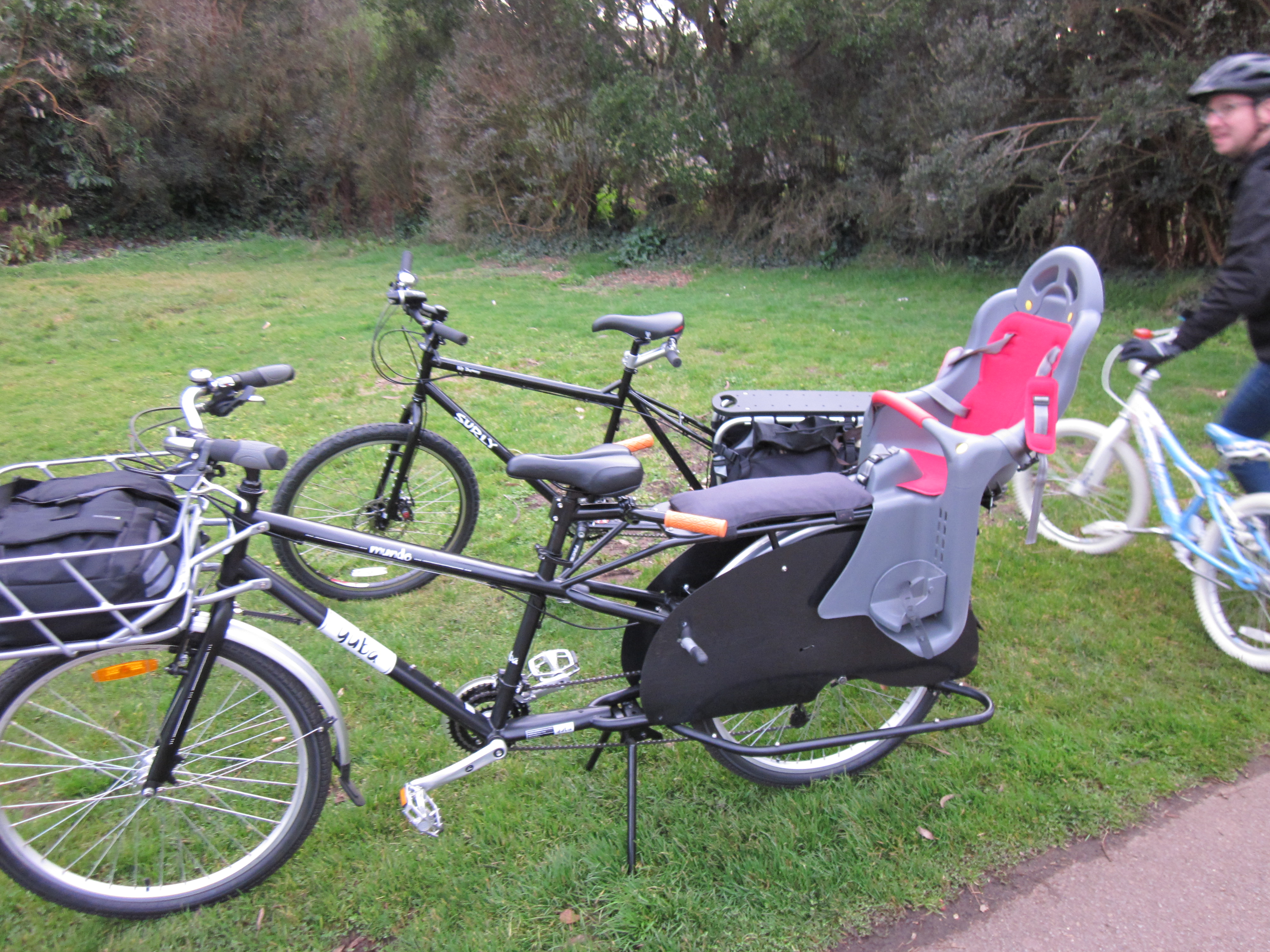
There was, evidently, some controversy when the Metrofiets first came out, with claims that it was a knockoff of the Bakfiets. I can only assume that anyone who believed this has never ridden both bicycles, because although they look similar, they are so wildly different to ride that it was almost unnerving to try them back-to-back as we did. On a Bakfiets your posture is very upright, and the handlebars have almost an ape-hanger feel to them. On a Metrofiets everything is reversed, so you sit upright but everything is way down low. I had a little Goldilocks moment: “That bike is toooo high. This bike is toooo low.” Actually there are advantages and disadvantages to both postures, but seriously: you might get confused about which bike is which in the shop, but you’ll never have any doubt which one you’re riding.
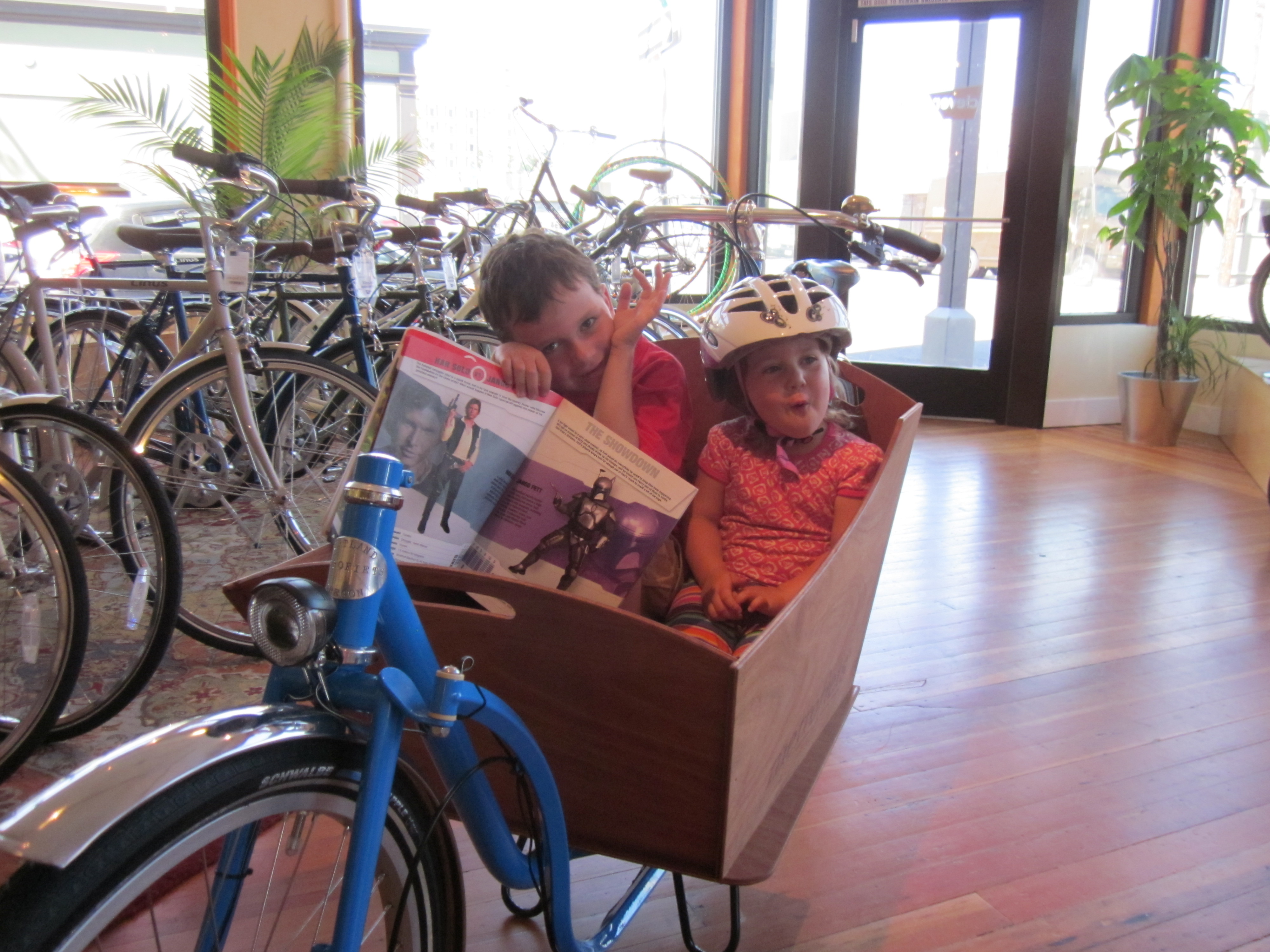
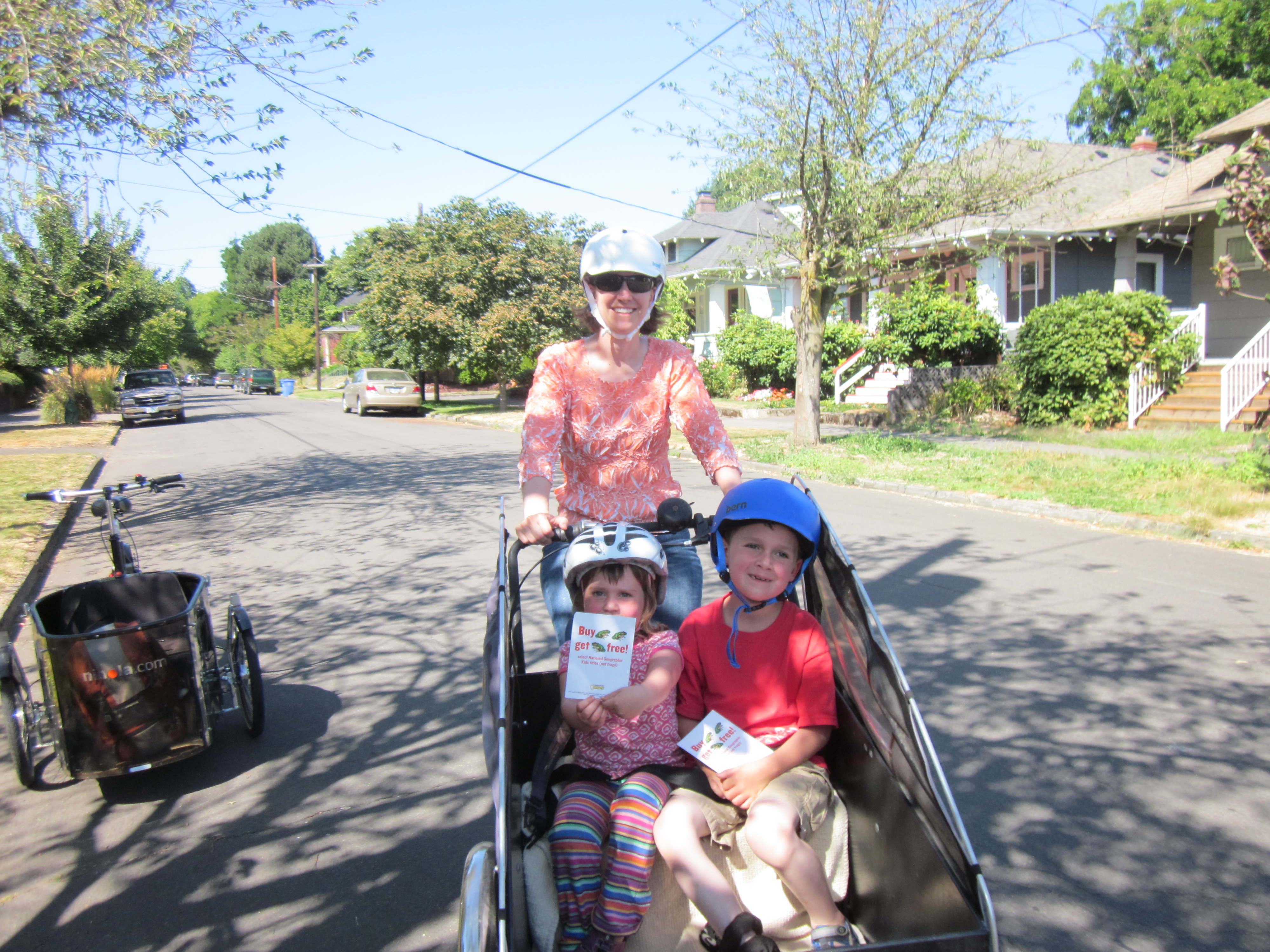
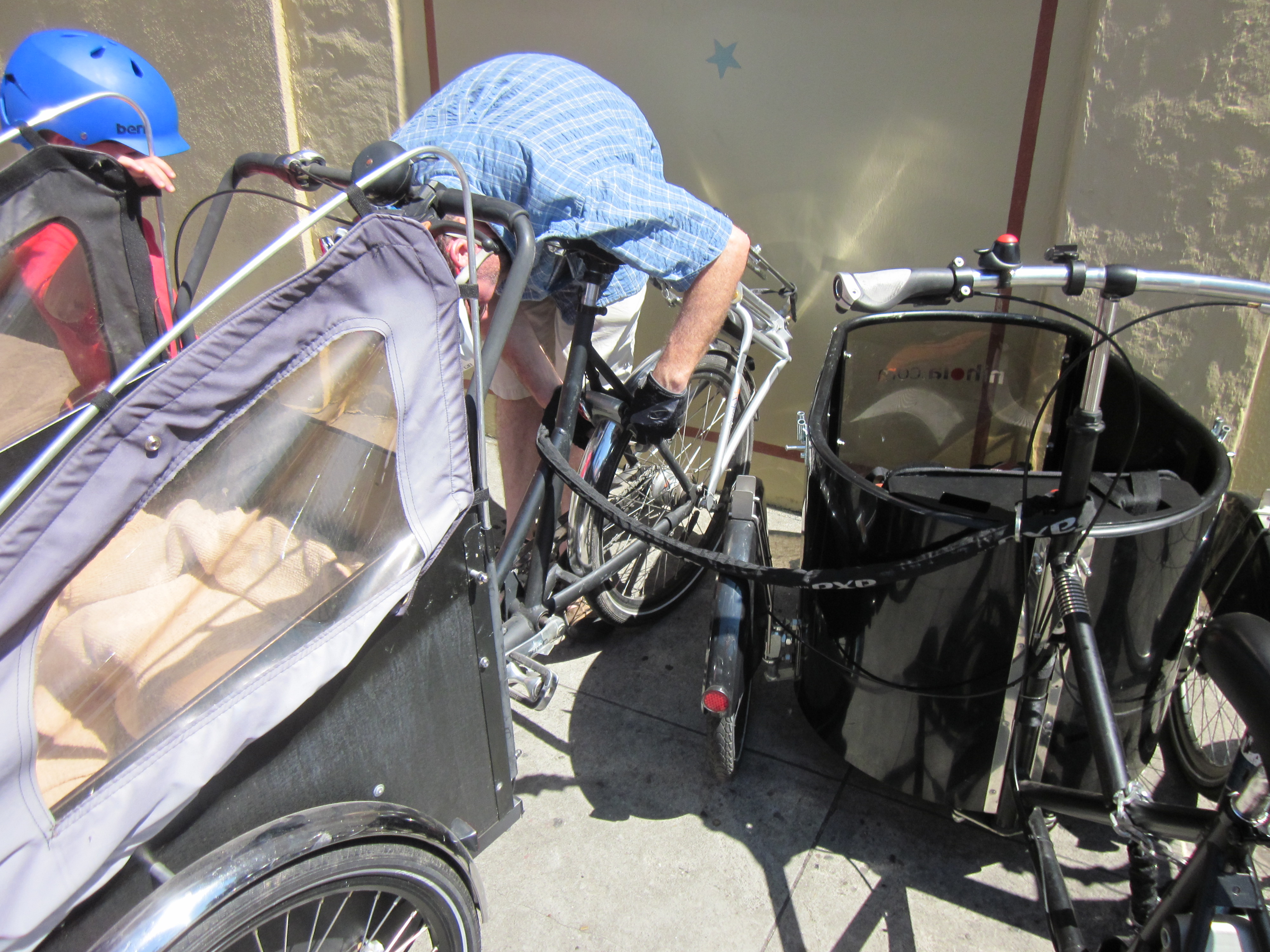
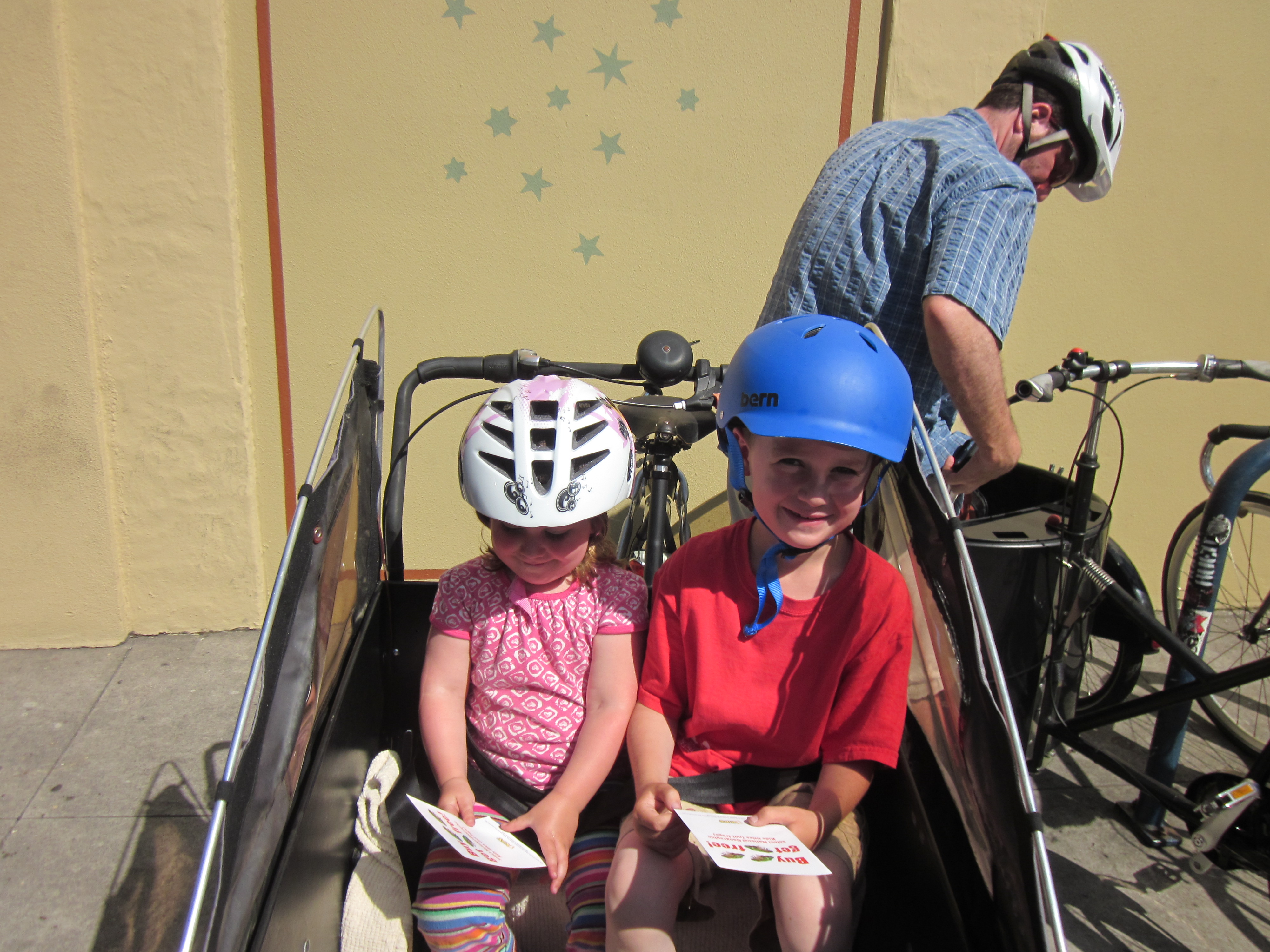
Hanging out in Metrofiets. My kids view box bikes as couches; they kick back, get a little reading in, just relax, basically.

The Metrofiets is a box-bike, meaning that the kids are in front like they would be if you were pushing a wheelbarrow. As I’ve mentioned before and will probably continue to blather about ad nauseum, having the kids in front is awesome. The Metrofiets is one of the longest box-bikes we tried, at 8’10”, which the lovely people at Clever Cycles helped me measure, and then, because none of us could believe the Metrofiets was almost a foot longer than a Bakfiets, we rolled them right next to each other to check. It is. The box is also a couple of inches wider.

The Metrofiets is an American bike: designed in Portland, made in the Pacific Northwest, and built using U.S. steel. The Metrofiets guys, whom I kept messaging but missing in person, are incredibly nice, and I love that they are building this bike. It is intended to be sportier than the traditional kid-hauler. Portland is not without hills, and in a wild departure from the Dutch oeuvre, they actually imagined that people riding a bike like this might want to go up and down some of them.

The Metrofiets is largely a custom bike, and that has pros and cons and also makes assessing it significantly more complicated. It is also a very pretty bike, and I don’t think I would feel comfortable leaving it outside overnight, and I would lock it up very securely at any time of day in a city. Most cargo bikes weigh a ton, and this one is no exception, so once again if you got this bike, you would want some kind of walk-in storage.

The pros of the Metrofiets:

  • The Metrofiets is a box bike that can climb hills, and it has disc brakes. Finally! Having the handlebars down low (at first there was a real bear-on-a-tricycle feel to it) meant we could lean up into an incline. It is a heavy bike and won’t be setting any land speed records, but it’s not going to feel like a death march. The bike we rode had an internally geared hub with a more limited range, so it wasn’t set up ideally for going up steep hills, and thus we only rode on pretty mild ones. However there is an option with a lot more gears on a derailleur and the potential was obvious. This bike was actually one we could ride in San Francisco with two kids on board.
  • The Metrofiets was designed with the expectation that people might want to put an electric assist on the bike, and a lot of people do. Although Clever Cycles does not sell assisted bikes (right now), and Splendid Cycles had not yet sold an assisted Metrofiets, assisted Metrofiets are fairly common (given that it’s an uncommon bike) and can be purchased either directly from the company or from Bay Area Cargo Bikes.
  • Kids love box bikes (and so do I). My kids liked this bike a lot. However the box has higher sides than the Bakfiets box and the kids sit much lower; neither kid could self-load into this box.
  • The Metrofiets offers a very big box. The version we rode wasn’t set up with seatbelts, but it did have a bench, and seeing my kids on it made me realize that this box could comfortably hold two older kids side-to-side with a lot of elbow room. Although I was concerned that I would not be able to handle a wide bike, given that I’d had trouble with wide longtails, having additional width in front was not an issue for me because I could see it (however, we did have some concern as to whether this bike would fit through our narrow basement door). Kids, odd-sized loads: all of these would be no problem.
  • The cargo space is very modular; although some people use this bike for hauling kids, there were lots of other ways to use it as well: Metrofiets bikes hold a beer bar, a talk show, a coffee cart, and so forth. People have an awful lot of fun with this bike.
  • Like other box bikes, there’s room behind the rider for a rack or child seat or a trailer-bike, adding to its hauling capability and making it possible to separate squabbling kids.
  • The Metrofiets moves pretty nimbly given that it’s really a gigantic bike. It has a 24” front wheel, unlike most other box bikes that put a 20” wheel near/under the box, which apparently increases the speed somewhat. The steering is pretty responsive, and so it turned much more tightly than seemed possible at first. That is not to say it turned on a dime.
  • The frame, although not a step-through, has a lot of room above the top tube for shorter riders. The bike we rode came with fenders and dynamo lights, the kinds of things that decrease the hassle of getting on the bike.
  • There is an optional rain/cold weather cover (which I’ve only seen in photos).
  • The Metrofiets is primarily sold as a custom bike, which means that you can ask the builders to make it into the bike you want. Color choices are infinite, obviously, but more than that, you could ask for a second bench seat to pile in more kids, lap belts only, five-point child restraints, a locking bench, a keg dispenser: whatever. None of these things are likely to be free, but if you know that you want something specific, you can almost certainly get it made for the bike.

The cons of the Metrofiets:

  • Like all front-loading box bikes the Metrofiets has linkage steering, meaning that the front wheel isn’t directly connected to the handlebars, but linked to them by a mechanism running under the box. Linkage steering is not intuitive and on this particular bike, even though I rode it after two days’ practice, it took a while before I was able to ride without weaving wildly across the street (please don’t let me dump the bike, please don’t let me dump the bike…) It’s harder to learn than a Bakfiets and easier to learn than a Bullitt (which: argh!) But it’s fun once it’s familiar.
  • Even after you get used to the linkage steering, the Metrofiets tends to wander during a ride. The word that came to mind for me was “noodly.” The steering was noodly. When I came back to Clever Cycles they said that that word comes up frequently in test rides of the Metrofiets. For me this was a negative, but it isn’t for everyone; Matt (as well as many other people who try it) liked it. He called it “fish-heading” (as opposed to fish-tailing) and he said he enjoyed the way the bike tracked slightly back and forth like a sine wave while he rode, as catching the wave eased the turns. For me it was just weird.
  • The Metrofiets is almost a foot longer than many box bikes and all of that extra length is in front of the rider. This can be unnerving at intersections, because we had to push the bike way out into the road to see oncoming traffic and whether it was okay to start after a stop (and a couple of times I guessed wrong). It was extremely unnerving at busy intersections with a kid in the box. I didn’t think that an extra ten inches would matter that much before I rode the bike, but after I did I realized it mattered a lot. This would probably not be an issue in the suburbs and probably isn’t even a big issue in Portland, but it would often be frustrating in San Francisco.
  • The center-stand on the Metrofiets was the worst of all the box bikes we tried. It is way under the front box and not really accessible unless you get off the bike, hold the handlebars, walk forward while balancing the loaded bike, and then stab underneath the box with one foot for it. I asked Clever Cycles whether I was doing it wrong, because it was so frustrating, and they said no, that’s how it works. The stand itself is a very thick bent wire. It is hard to push down and it is not always clear when it’s fully engaged so that it’s safe to let go of the bike. To start riding, you can’t push forward to disengage it, you have to walk to the side of the box, raise it, and after that get on the bike.
  • The box is all wood, even the bottom, and like the Madsen, that meant it echoed while we were riding, even with kids on board as sound dampeners. The box also lacked drainage holes (I’m guessing they’d drill some of those for free though).
  • Like all the front box bikes this bike is very wide, plus it’s extra-long, and that makes it hard to park in traditional bike racks or even non-traditional spots. And as mentioned this is a big bike you don’t want to lift. People do lift it, there’s a picture of someone holding a bike over his head on the Metrofiets website, but I can’t see that being a daily thing.
  • No chainguard. Seriously?

    Although the bike we were riding came with an internally geared hub and had a single front ring, there was no chain guard. WTF, Metrofiets? Again, this is a custom bike so adding anything is possible, but that was an odd omission given the collection of we-make-life-easier included accessories like lights and fenders.

  • Front box bikes are expensive. Custom bikes are expensive. The total damage when you add the two together is sobering. The bike we rode was priced at $4200, and we would want to add an electric assist to that, which would set us back at least another $1400-$2000 (probably the higher end, because heavier bikes need more powerful assists). Not to mention the anticipated extra costs for adding seat belts for the kids and some kind of noise dampener for the box. And a chain guard.
  • The Metrofiets is primarily sold as a custom bike, and that’s a con as well as a pro. You can ask it to be built into the bike you want, but a lot of people who aren’t experienced (family) riders won’t know what they want. If you want to start riding with your kids and still have questions like “Does my 5-year-old need a child seat or can she just sit on the rear deck of my longtail?” (Answer: put her on the deck with a pair of handlebars to grab off the rider’s seat; cheaper, more fun, will last longer), figuring out which options you might want on a custom bike is overwhelming. Xtracycle really nailed some of the issues involved with family biking when it started offering kits for different kinds of riding on their website (one child seat, two child seats, dog, groceries, surfboard, etc.) By the standards of people who order custom bikes, we ourselves are marginal. We know a lot of the things we want and my job description is “researcher” but we don’t have the years of experience with bicycles that we’d need to get the most out of a custom bike. I can’t see myself redesigning the kickstand, for example, even though I’d want a better one.

Gorgeous, but not necessarily making things easy.

So, the Metrofiets. It started out as one of the very few bikes we knew was a real possibility when we started investigating cargo bikes. Sight unseen, the Metrofiets was my brother-in-law’s pick for us. It could handle hills, could easily carry two kids (and much more), and could be assisted. Having a box bike would be a useful complement to our existing mid-tail bike, the Kona MinUte. And because we had just sold our car and gotten more than enough from that to cover buying this bike and then some, the eye-popping price wasn’t impossible. Yes, I realize that we’re incredibly fortunate.

On the other hand, we had some concerns about the bike that we didn’t expect: the Metrofiets is awfully long in front which makes it feel less safe at intersections, it would likely be the most difficult option to park away from home, we both disliked the kickstand, and the steering would take more getting used to than we’d hoped.  Although the width of the bike wasn’t an issue while riding, it might not fit through our basement door. (At some point I realized it would be possible to ride around with our garage door opener hooked to a bike. It would be weird, but feasible, not to mention kind of funny; then again, maybe less fun after the novelty wore off.) Finally, getting this bike would require us to make some decisions about customization that we didn’t feel fully qualified to make.

After riding the Metrofiets I wasn’t left with a strong sense that this was the bike for us, but we didn’t rule it out either.

10 Comments

Filed under family biking, reviews

We tried it: Bakfiets

Matt and I both test-rode the Bakfiets. We had plenty of time, because our daughter had no interest in getting out of it.

One of the big advantages of going to Portland to try out a bunch of cargo bikes is the opportunity to test ride a lot of different box bikes. Box bikes, aka long johns, aka “those bikes that look like wheelbarrows” are thick on the ground in Portland, with at least five different kinds, of which we tried riding four (Bakfiets, Bullitt, Metrofiets, and Winther Wallaroo, but we missed the Cetma Largo/Margo). The Bakfiets is the most storied of these, occupying the same place that in the world of box bikes that Kleenex occupies in the world of facial tissues. If people know only one kind of box bikes, they know Bakfiets. Heck, Bakfiets means box bike.

Box bikes put the load and the length in front, hence the wheelbarrow analogy, and this involves some mental adjustment, because you’re pushing the kids out in front at intersections. I found it easiest to think of riding box bikes like pushing a stroller. The length in the front of these bikes is in fact roughly comparable to the length of a stroller. As box bikes go, even the Bakfiets long (which is the one we tried) is on the shorter end, at 8 feet end to end. However, unlike a stroller, you can talk with your kids when you’re riding a box bike with them. I never really got the attraction of this until I actually tried it myself. Having the kids in the front of the bike is awesome.

The Bakfiets is a Dutch bike, with the traditional Dutch riding posture, which is bolt upright and gives an expansive view of the road. When I first got on the Bakfiets, I thought, “Whoa! This bike is tall!” Also traditionally Dutch is its design, which aims directly for indestructible without even a nod towards nimble or lightweight. The Bakfiets weighs about 90 pounds and is intended to live outdoors in the Netherlands. You can leave this bike outdoors in this country as well; weather won’t bother it. However bike theft insurance isn’t as developed in the US as it is much of Europe, so if that is a concern, you’d want to have some kind of walk-in storage for it, because no way would you want to haul this bike up or down any kind of stairs.

My two kids, ages 3.5 and almost-7, had plenty of room on a Bakfiets bench.

The Bakfiets’ indestructibility means that it has pretty nice components. That also means that this bike is not cheap. There is no free lunch in the world of cargo bikes. What you get for your money with a Bakfiets is kid-hauling capability and ease that no other bike we’ve ever ridden can match. However this bike was also designed for an environment where the only inclines are the dikes preventing the ocean from washing away the entire country, which no one has any reason to climb regularly. That means you’ll be hating life every time you hit a hill on a Bakfiets.

The pros of the Bakfiets:

  • Kids love this bike. Love it, love it, love it. Our kids loved all the front-loading box bikes we tried, as well as the trikes, but they loved the Bakfiets most of all. When we walked into Clever Cycles it was the first bike they wanted to try, and once they got in, they didn’t want to get out. The heights of seats inside different box bikes vary, but after generations of testing Bakfiets apparently has it just right. Flip the seats up and there’s plenty of room to nap. With two benches and two kids there’s room to split up fighting kids (and they’re in front where they can be supervised anyway). The only downside of the Bakfiets box from our perspective is that the sides are high enough that my daughter couldn’t self-load, and my son, who could, wanted us there for security.
  • The kickstand on the Bakfiets is incredibly stable. It has four resting points, and when it’s down, the bike is as solid as a building. It can be engaged and disengaged with one foot while you are on the bike and holding the handlebars, minimizing the risk of tipping the bike and dumping the kids. It locks up and down with a THUNK so there is no doubt whether it’s where you want it to be.
  • Like all box bikes, it comes with a box, which means that you can throw all kinds of stuff in there without worrying about does it fit, did I tie it down, did I remember the panniers, and so forth. The Bakfiets has a big box, too, and the seats fold up, meaning that without a kid on board it’s actually larger than the trunk of many cars, and since it’s open on the top, it’s actually a lot more accessible. What’s more, you can drop a car seat in this bike and haul infants.
  • Four kids in the box, one on a rear seat, and one on a Follow-Me tandem. Ride on, party bike! If you want to haul lots of kids, the Bakfiets has no equal.

    The back of the bike is like a normal bike, but because a Bakfiets is designed to carry serious weight, it can haul a lot more. That means that in addition to putting kids in the front box, you can stick a rear seat on the back, and/or a trailer-bike. The front box is supposed to hold up to three kids, but you can get four in there. That’s up to six kids on the bike, plus whatever cargo you can pack under the seats and on the rear rack. At which point you will move very slowly. But still! The bike can carry more kids than a minivan! And it’s a million times cooler.

  • The payoff to all that weight is stability while riding. It offers a slow and stately ride. In addition, the Bakfiets has minimal startup wobble, even heavily loaded. It is certainly possible to dump this bike, but I didn’t manage it, and I was dumping my kids at a pace that was really starting to bother me on this trip—this is a hazard when switching bikes every few hours, because each one has a learning curve.
  • The bike is designed to be grab-and-go for pretty much everyone. Everything you could want while riding is included. It has dynamo lights, an internally geared hub, a full chain guard, and fenders. The child seat and seat belts are built right into the box. The Bakfiets has a step-through frame that makes it accessible to riders of varying heights from very short to very tall. The box comes with a rubber (?) floor that keeps the box from echoing while the bike is moving. There are drainage holes in each corner.
  • The Bakfiets has a rain/cold weather cover. It is so effective that one mom who had previously ridden in a cold-weather climate said her kids rode inside the box in t-shirts in freezing weather, and sometimes complained of the heat. But this was no problem, as it turns out, because the cover can also be vented from the back when it gets too hot inside.

The cons of the Bakfiets:

  • All front box bikes have linkage steering. This involves a non-trivial learning curve. The wheel is way out in front, on the far end of the front box, and when you turn the handlebars, unlike a normal bike, the turn connects to the front wheel indirectly through the linkage. Family Ride told me that when she first got on a Bakfiets she ran it into a wall. I would have done the same thing myself if I hadn’t spent the previous two days figuring out linkage steering on other box bikes. (Don’t take a first test-ride of any cargo bike with the kids on board. Seriously.) That said, of all the box bikes we tried, the steering on the Bakfiets was by far the easiest to pick up. This is partially because unlike normal bikes, with these bikes you don’t really want to lean much into turns; this amplifies the turn and then the bike starts to oscillate until you hit something or fall over. But you sit up so high on a Bakfiets that it’s already difficult to lean much into turns. Anyway, when trying out a bike with linkage steering (a) try not to lean into turns, just move the handlebars, and (b) don’t look at the front wheel, look where you want to go. After a little while you get used to it, really.
  • A much bigger problem is hills. The first time I hit a short incline on the Bakfiets I automatically leaned over to push, at which point I hit my chest on the handlebars. There’s that upright posture again. This bike does not climb. Although it is technically possible to stand while riding on hills it doesn’t help much. Going uphill on this bike involves suffering, and I didn’t even try it on a steep hill. Granted, Portland has many more hills than Chicago or Sacramento, but Bakfiets riders that we met complained about the kinds of hills that denizens of San Francisco like us only even think about when our son is on his single-speed bike, and which I would otherwise classify as an-incline-not-really-a-hill. Moreover, the roller brakes standard on a Bakfiets (which would be difficult to replace) will not effectively slow a bike of this weight on a steep downhill. I’m not sure that any brakes would. No one who sells Bakfiets bikes was willing to even consider putting an electric assist on one for us. It can be done and it has been done, and it’s certainly an option for people who want to extend their range in flatter locales. But we were informed that if we put an assist on a Bakfiets where we live there would be no safe way to get back down the hills that we could then climb. “This bike isn’t for you,” said people whose livelihood is selling family bikes.
  • Like all cargo bikes with a box, this bike is wide and thus tough to park. I had also worried about riding with a box bike, after my experience feeling like the Yuba Mundo was too wide for San Francisco bike lanes. It turned out that that kind of width only bothers me when it’s behind me where I can’t see it. The Bakfiets has a wide box, but that never felt like a problem while riding, although it would be a tight squeeze through our narrow basement door (but possible).
  • The Bakfiets is in many ways a car replacement. This comes at a price. The Bakfiets we rode was listed at $3500 for black, $3750 for cream. That’s not out of line if it’s actually replacing a car, and by comparison to a car it’s actually pretty reasonable. But it’s not cheap, even for a cargo bike; you can buy an assisted Yuba elMundo, for example, for almost $1000 less, and it can do some of the same things while also going up many  hills. And you can stick a trailer on the back of a bike for far less than an elMundo, even if you decide to put an electric assist on that bike. And so forth. Cargo bikes tend to retain their value, so a Bakfiets will have decent resale value, but still, you’ve got to put down the money first (or get a bicycle loan) unless you find one used. And if you manage to find a used one it will still be expensive thanks to the fact that cargo bikes usually have good resale value.
  • Finally, the Bakfiets is so well-designed for hauling kids that it is almost single-use. There are cargo-conversion accessories, but I found it difficult to imagine wanting to ride this bike much after my kids were old enough to want to ride exclusively on their own bikes. Most of the longtails and some of the other box bikes seemed more versatile; I could imagine using them for other things long after the kids outgrew them. You would definitely get a lot of years out of this bike no matter what; you can stick a car seat in the box from birth and kids seem happy to ride in it until they’re nine or ten, and with a couple of years between kids that’s an awfully long run. But it’s not forever, and our youngest is already three years old.

What do you mean, it’s time to get out now?

Overall, I liked the Bakfiets a lot. Matt liked it less, mostly because of the upright posture, which does not appeal to him much. We are conditioned to think about hills all the time. But we both agreed that this bike was absolutely amazing for carrying children. And as far as our kids were concerned, when a Bakfiets was in sight, other bikes might as well not exist. They could be coaxed into investigating other box bikes and the trikes, and a tandem always gets their attention, but the longtails were dead to them. The Bakfiets is the family bike that other bikes aspire to be.

And of course we will not be buying one. Nobody in Portland wanted to sell us a Bakfiets, and the reason was obvious. Hills and older children are the sticking points of cargo bikes (and bikes with trailers); the Bakfiets handles older kids without a hitch, but it cannot handle the steep hills of San Francisco. However if you happen to live someplace where a Bakfiets is a plausible option, it is definitely worth a ride.

24 Comments

Filed under family biking, reviews

We tried it: Madsen

My kids didn’t want to ride a bike until they saw it and said, “Oh, okay, it’s a cool bike.”

The Madsen is unlike any other bike on the market I’ve ever seen. It is like a reverse box bike, with the box in the back instead of the front. A longbox rather than a longtail? The Madsen has been reviewed before, by more experienced riders than we are, and on a newer model to boot. But we got to try riding a (first generation) Madsen for a day or so thanks to the generosity of The Main Tank, who loaned hers to us during our stay in Seattle, so I thought I’d write about it anyway. And here’s a 2014 review of an assisted Madsen from a family of six!

Before we went on our trip, I sent a list of every cargo bike I could find to my brother-in-law, who then looked up all their specifications and told us which he thought we should seriously consider. He was fascinated by the box in back design of the Madsen. He was less impressed by the quality of the components. This is the way it is: less expensive cargo bikes have lower-quality parts. Whether that matters depends somewhat on the conditions in which you ride. San Francisco is hard on bikes, and so this is something that’s come to matter a lot to us. Like a lot of people where we live, we have spent a fair bit of money upgrading our original cargo bike, the Kona MinUte. Most of that went into replacing the brakes. We are tireless and tiresome evangelists on the subject of hydraulic disc brakes. If we got a Madsen it’s likely we’d end up spending a fair bit of money upgrading parts on it as well.

The Madsen is a fun bike to ride in certain conditions, it is inexpensive enough to be a good entry-level cargo bike, and riding it is much less hassle than hauling a trailer.

My son could self-load, my daughter could not.

The Madsen is a bike I had only ever seen in Seattle, although I recently learned one family has one in the East Bay and another family will soon be riding a Madsen with BionX in San Francisco courtesy of The New Wheel. Davey Oil pointed out not long ago that cities have certain family-bike personalities and he was dead on. Seattle has Madsens and Surly Big Dummies (at least 5 of each at the Seattle Cargo Bike Roll Call). Portland has child trailers, trailer-bikes, and box bikes: Bakfiets and Bullitt and Metrofiets. San Francisco has commuter bikes with child seats, trailer-bikes, family tandems, Xtracycles (even an Xtracycled family tandem), and in the last year, a spate of Yuba Mundos and elMundos. But you almost never see child trailers here.

The pros of the Madsen:

  • The Madsen’s rear box can hold four kids (!) with seatbelts on two benches. This exceeds even the recommended load in the box of a Bakfiets (although people have been known to put four kids, and then some, on a Bakfiets as well). If you only have two kids, they can sit across from each other and get some space if they are prone to fighting. In addition, forward-facing kids aren’t shoved into the butt or back of the rider, thanks to the length of the box. This is a minivan-replacement.
  • The box can also hold enough groceries to handle the needs of the once-a-week suburban family shopper, with few hassles about oddly-shaped items, balancing the load or packing it into bags. It’s like the trunk of a car: you can just toss everything in there. This is an advantage of all the box bikes and it is significant.
  • The Madsen bucket is integrated with the frame, so going downhill doesn’t mean being flung back and forth by the weight in the rear, unlike when riding a normal bike with a trailer. This was a relief. The Madsen also has a front disc brake, which makes going down hills safer.
  • Kids like riding in the Madsen, probably because the view is good. They sit up high enough to get a view and they’re not squashed against the rider.
  • The kickstand is very stable. It’s easy to load kids in and out of the box with it down.
  • The Madsen has a 20” rear wheel, which makes it an excellent candidate for adding a rear hub motor with high torque for climbing hills. When I talked with The New Wheel they said they were very excited about the potential of a Madsen with BionX in San Francisco. However if you do this, it would be a very good idea to upgrade the brakes to get back down the steep hills you would then be able to climb.
  • The step-through frame makes this bike very accessible to even the shortest of riders, and easy to ride in a skirt. The bike has both fenders and a chain guard, thankfully. You can add a front rack for cargo that you don’t want kids to handle.
  • The price is on the low end for cargo bikes, currently running $1,150 to $1,750 on their website, depending on how popular a color you choose. At the end of the year Madsen tends to have big sales on their bikes, and the price can drop to $1000.

The cons of the Madsen:

  • Not just for kids: Biking with Brad takes Family Ride for a spin

    The Madsen is a terrible climber, with only nine gears on a rear derailleur. It wallows. Riding this bike uphill was miserable. It was a relief that I rode it while Biking With Brad, who has a BionX assisted Big Dummy and is a very nimble rider, and who reached over and actually pushed us up a few of the steeper hills. Although this bike is a great candidate for electric assist, it’s unlikely to make it up any steep hills unassisted if something ever happens to the motor or battery.

  • A bike with a heavy load in the rear can be unstable while walking the bike, starting, and stopping. I dumped my kids twice, fortunately on grass both times (they’re fine), but it freaked them out and I had a little panic attack about hurting them and potentially damaging a bike that had been loaned to me.
  • The rear kickstand is a hassle to put up and down. It’s under the bucket, meaning you have to get off the loaded bike to engage it. After dropping the bike I had issues with this.
  • The Madsen I rode was very wobbly at low speeds, particularly while starting. The front tire did not track straight. Biking with Brad said that when he asked the Madsen makers about that, they said that some of their bikes were like that and some weren’t and they didn’t know why. Uh, okay.
  • The rear box is split across the center because the rear wheel runs underneath it. That means that the box is really more like two narrow boxes side by side. On the up side, no fighting over leg room by kids sitting next to each other. On the down side, they don’t have a ton of leg room left to fight over. Moreover, some larger bulky items that seem like they should fit in the box won’t really fit.
  • Like a bike trailer, the Madsen is easy to catch on corners and needs a lot of room to maneuver.
  • While riding, the box is really noisy, even with kids inside to dampen the echo somewhat.
  • There are no holes in the bottom of the box, which means that stuff can collect down there (falling leaves, garbage, water) that’s tough to get out without putting the bike on its side. If it were my bike I might drill holes in the bottom so I could hose it out and so that it wouldn’t flood in the rain, because…
  • Madsen has apparently been claiming for years that they’re planning to release some kind of rain cover, but no sign of it yet. Both trailers and other box bikes have covers for carrying kids in cold and wet conditions.

The Madsen got a lot of attention. One woman asked if we’d built it ourselves. Ha ha! No.

When I first looked at the Madsen it seemed to have many of the same pros and cons as a trailer, but riding it made me realize it’s actually very different. Compared with the mountain bike + trailer we tried, it was much harder to go uphill and much safer going downhill. The Madsen held twice as many kids, while the trailer was much less likely to tip. The trailer had better weather protection, but the Madsen was more fun for the kids on a sunny day because they could see more. A trailer is quieter. However if you like the color pink or buy at the end of the year, it is possible to buy a Madsen for less than the cost of a bike plus a trailer, assuming that you don’t already have a bike.

I felt no real desire to get a Madsen after trying it, although it was fun to ride for a while. It was too much of a struggle on the hills. I got the sense that a number of families in Seattle who started with Madsens eventually moved to Xtracycles or Big Dummies. I think the Madsen would be best for hauling kids who are younger than mine (ages 3.5 years and almost 7 years) in an area without significant hills. However, older kids and hills are the sticking points for most of the cargo bikes we tried, so this isn’t a complaint that’s specific to the Madsen. Overall, the ages of our kids and the local terrain make the Madsen a poor choice for us. So while this is clearly the right bike for some families, it’s wasn’t right for ours.

21 Comments

Filed under electric assist, family biking, reviews

We tried it: Christiania and Nihola cargo tricycles

Over a year after our return from Copenhagen, we finally got to ride a Christiania.

I knew coming in to our cargo bike test rides that we weren’t going to be buying a tricycle. If there is one thing that is fairly certain, it is that trikes can’t handle steep hills. But we wanted to try all the cargo options, if only to get a basis for comparison. Also, we had really, really wanted to rent a Christiania while we were in Copenhagen and no bike shop we found would let us.

One kid plus a backpack does not test the capacity of the Nihola.

In Portland, however, it was easy to test-ride a trike, because Emily Finch offered us the chance to use their family’s Christiania when she learned we were coming to Portland. How sweet is that? She herself rides a Bakfiets, but her husband got the Christiania when he was new to riding. While we were at it, we rented a Nihola from Clever Cycles (Clever Cycles is amazing). Matt and I each rode one for a few miles from the shop to the Hawthorne shopping district for lunch, then we switched off and headed back.

This is about as far forward as you want the weight in the cargo box to go.

Tricycles have a reputation for being more stable than bikes among new riders, which is only half-true. Trikes are statically stable and dynamically unstable (whereas bikes are statically unstable and dynamically stable). When trikes are stopped they rest on three wheels, like a footstool with three legs. For this reason you’ll never see a trike with a kickstand. They have a single hand brake with a parking latch, and coaster brakes. When trikes are moving, however, they are unstable. They sway and shimmy. My father-in-law, who is a physics professor at UC Berkeley, explained this to me as partially a function of the third wheel. All wheels have inherent lateral instability from the centripetal force of their movement. Add a third wheel and you increase that instability by 50% (my summary of his explanation elides a lot but is much shorter).

This guy with no legs whizzed by us on a hand-powered delta trike. Impressive and depressing at the same time.

Whether you will like a trike depends on whether you expect to be stopped or moving most of the time. It also depends on a lot on how fast you want to ride. We found that the top speed of a loaded tricycle was only slightly faster than brisk walking (although it was much less effort). Given this pace, it was tiring to think about taking it for a ride longer than a mile or two.

I would rule out a tricycle if facing any hill steeper than a speed bump. This isn’t because they are poor climbers, although they are, in fact, terrible climbers. I radically redefined my definition of a hill while riding these trikes to: any incline whatsoever. More distressing was that even in the fairly flat environs of southeast Portland, while going down mild hills in the Christiania at maybe 5 miles/hour, I experienced shimmy for the first time. And it scared the crap out of me. A shimmying bike starts to tremble uncontrollably and stops responding to attempts to steer, swinging wildly across the road. Slowing down the trike helps, but good luck getting much braking power from coaster brakes and a single hand brake. The Nihola handled the hills better. I would say it was roughly comparable to a very heavy bike with bad brakes.

The Nihola on the move

On the flats, however, a trike offers a pleasant and meandering ride. If you’re not in much of a hurry, it can be quite pleasant to putter along. The trikes came with chainguards and fenders but not lights. You never have to get out of the saddle at stops, which is a nice break if you do a lot of stop-and-go riding. Riding posture is bolt upright. Trikes are heavy and can carry a lot of weight, and you don’t really feel that (unless you’re going uphill, in which case you TOTALLY feel it, it’s like dragging an anchor). In a place like Chicago or Copenhagen, I can imagine that a trike could be an appealing option. They can, however, be slow to start at intersections after a full stop. At Clever Cycles they advised that we stand up on the pedals and use our body weight to get them started, and this was good advice.

Both the Nihola and Christiania are tadpole tricycles with two wheels and a cargo box in the front rather than delta tricycles with two wheels in the back. Our kids liked the trikes and couldn’t wait to ride them, but they couldn’t climb into them by themselves. Our son could almost make it into the Christiania trike, but it nearly fell forward from his weight when he tried. This was an unexpected downside of the tricycle experience. We had assumed that trikes were always stable while parked, but they can actually fall forward. After that we lifted both kids in ourselves, placing them toward the back of the cargo box, which was between all three wheels.

The front view from the Nihola

Both the Christiania and Nihola have seats for two children. The Christiania box is wider, with more elbow room. Given our kids’ sizes it was like sharing a love seat and they liked having that space. The Nihola is narrower but has a clear front, which improves the view for riders. There is arguably room for two more kids sitting on the floor in front of the seat, although this would be a very tight squeeze in the Nihola, and would probably lead to kicking and screaming in either trike on a long ride (but no one would take a cargo tricycle on a long ride). Both trikes offer rain canopies with a lot of headroom for kids as well. Having the kids in front is awesome. We have never had such great rides with them as we have with them in front. We could always hear what they’re saying and they could always hear us.

As one might expect, tricycles also need enormous amounts of space when parked, and reversing them involves something like 35-point turns.

Both tricycles are very wide, and as a result we stayed off busy streets with narrow bike lanes or sharrows, opting instead to follow some of Portland’s excellent neighborhood greenways on our trip. No way would I want to ride either trike in city traffic.

Both the Christiania and Nihola have internally geared hubs rather than a derailleur. Weirdly, they both shifted with a significant time lag, although it was more delayed on the Nihola than the Christiania. So we would shift gears, and I don’t know, the trike would think about that for a while? And then several seconds later the gears would change. It was strange and made going up hills (riding a tricycle on a hill of any kind TOTALLY SUCKS) even more unpleasant.

Riding the Christiania in the bike lane means using the entire bike lane.

The steering on the Christiania is bizarre and yet fun. There is a bar across the back of the cargo box and you shove it away from the upcoming turn to corner the bike (push left to go right). It takes a little getting used to at first but is very responsive. It feels kind of liberating to swing the bar from side to side. Whee! The steering on the Nihola uses regular handlebars, which made me realize immediately why the Christiania used the leverage of a wide bar across the box. It was difficult to get the Nihola to turn at all. At one point I took a speed bump a little too fast, rolled away to one side, and couldn’t straighten the trike before ramming into the curb. (Hitting a curb with a wheel isn’t dangerous, but it was annoying.)

The Christiania offers a lot of elbow room.

Overall, the Christiania was bigger and easier to steer, while the Nihola was marginally better on hills and has a neat clear front and thus a better view. However if I were forced to get one, I would pick the Christiania over the Nihola, because I would never take either tricycle anywhere that wasn’t flat anyway. These are very nice tricycles, and I’m delighted we had the chance to try them. For better or for worse, however, we live in a place where they are completely inappropriate, and we are unlikely to ever ride one again.

18 Comments

Filed under cargo, family biking, reviews, travel

We tried it: Specialized Hardrock and a Burley Bee trailer

What’s this?

In our effort to try every cargo bike configuration we could get our hands on, we started out traditionally. While in Bellingham, we rented a mountain bike with a child trailer. My kids have ridden on many different cargo bikes now, plus a couple of bikes rigged as child haulers after the fact (Brompton with IT Chair, city bikes with child seats) but this was their first trip in an actual trailer, and my first time hauling them.

The Specialized Hardrock is a mountain bike. For the purpose of hauling a trailer around town, it was not everything I could have wished for: it had no kick stand, no chain guard, no fenders, no lights, and no bell. The brakes evoked a howling chorus of demons with their shrieking and the saddle was indistinguishable from an anvil.

The full rig

However, renters can’t be choosers and after riding the many gravel-strewn bike paths of Bellingham (which are BEAUTIFUL! Seriously, there is no reason to ever get in a car in Bellingham, it was amazing!) I came to appreciate the knobby tires and front suspension. The bike was very light, which made it an excellent climber, as well as easy to pick up when I had to drop it on the ground to stop riding because there was no tree or post to lean against. Also the pedals were okay, and the shifting was smooth.

While I have little basis for comparison, the Burley Bee, by comparison, seemed much better designed for our use. It helped that the shop had just replaced its rental trailer. Our ride was this particular Bee’s maiden voyage, and it was, as a result, spotless. Evidently the Bee is the entry-level Burley double trailer, but it seemed to have everything that we would want in a trailer, if we wanted a trailer, and I actually sort of do want one now.

Seemed cramped to me, but the kids had no problem with it.

My kids were fascinated by the Bee from the moment they saw it. Luckily my kids get along well so the fact that they were crammed in there pretty tightly was not a problem from their perspective until they’d been riding for almost three hours. During that time we took a few bakery, playground and farmers market breaks, plus multiple stops to put the cover on, take the cover off, put the cover on, take the cover off (they were yanking my chain). Anyway, by the end of the ride they were hitting each other and crying, but they lasted longer than I’d expected.

The pros of this setp:

  • A double trailer can fit two older kids (currently almost 7 years and 3.5 years) without too much squeezing. My son is older than the advised age range for trailers but skinny and tall.
  • It is very, very difficult to tip a trailer over and dump the kids on the ground. I did not manage to do it. Go me!
  • The kids adored the wind and rain screens, and could not stop talking about the potential of this particular rig to keep them from getting wet and cold in the winter. The trailer eliminated their primary concern about not having a car anymore. I thought that although the covers were tensioned with elastic rather than zippered they were well designed and quick to attach and remove. The design of the trailer itself was actually very clever, allowing me to add and remove the front covers without anything coming loose or flapping.
  • The Burley Bee has a junk drawer.

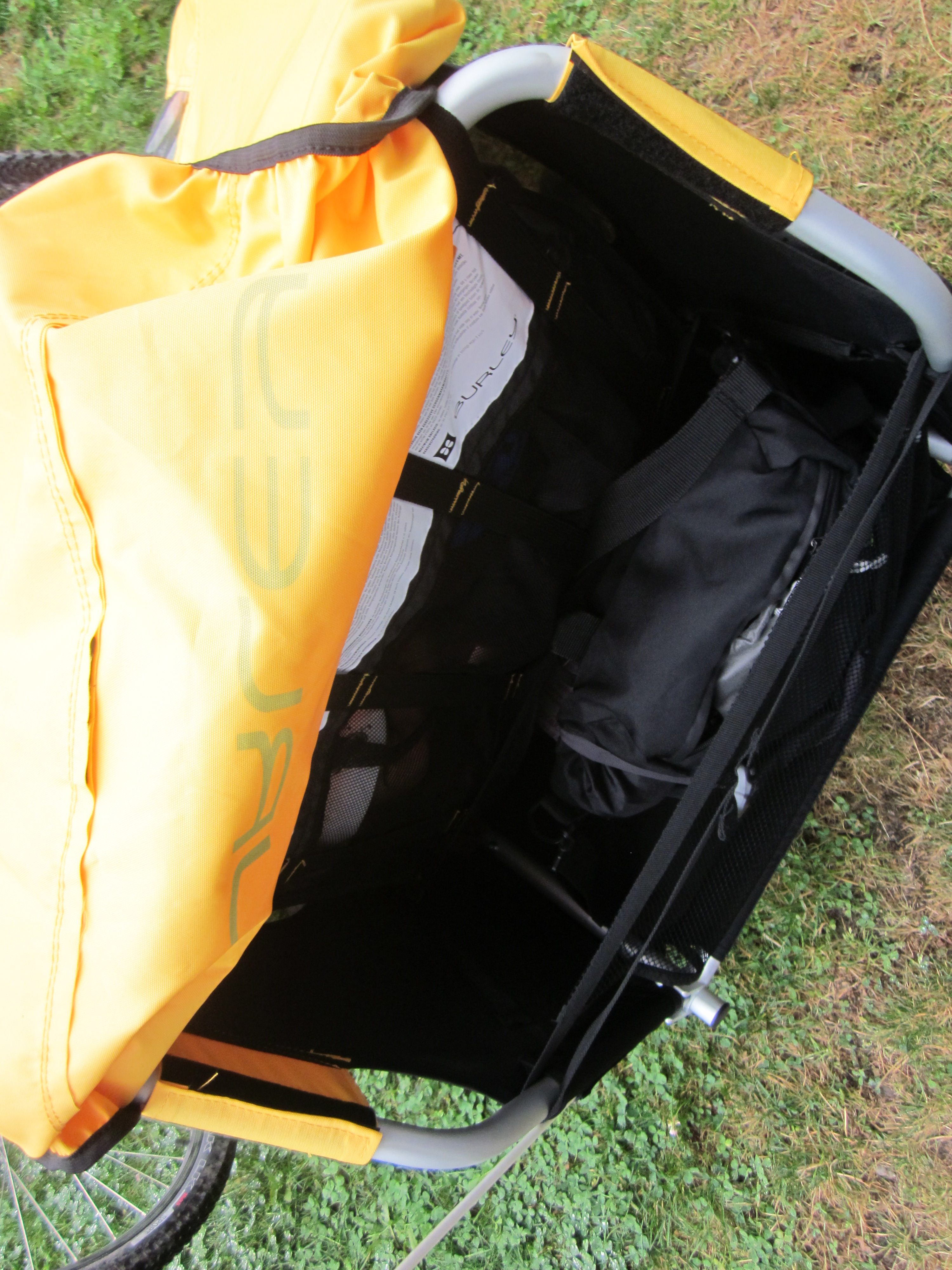
    The Burley Bee comes with a fairly large storage pocket behind the kids seats that can hold a couple of grocery bags, toys, garbage, souvenir rocks, jackets, etc. This was really handy and it appears to be waterproof.

  • There are storage pockets on one side of the kids to hold smaller items (but only on one side, which was a really bad design decision).
  • For quite a while my kids considered the ride an absolute blast, and entertained each other by singing songs and chatting.
  • The Burley trailer seemed quite well made, with strong seams and stiff fabric. Admittedly ours was brand new. The Bee trailer we were riding doesn’t offer a stroller-conversion option (this would never be needed for its purpose as a bike shop rental trailer) but some of the higher-end Burley models do.
  • It was simple to convert the trailer from carrying one kid to two kids. The belts allow two kids side by side, one kid on one side, or one kid in the center. Putting one kid to the side didn’t mess up the balance as far as I could tell.
  • This is the biggest hill we climbed in the trailer.

    Attached to a lightweight mountain bike, it was relatively easy to pull the fully-loaded (probably 120+ pounds counting trailer, kids and gear stuffed in the back pocket) trailer up a moderate hill—we went up a long slope connecting a multi-use path over the water back to city streets. The sign said it was a 10% grade, and the trip kicked my heart rate up but did not make me sweat.

The cons of this setup:

  • Attached to a lightweight mountain bike, it was at times terrifying going down hills with the trailer, especially on gravel. Once the weight of the trailer, which was pushing me, flung my bike back and forth like the end of a whip. I ended up aiming the bike toward a strong fence at the bottom to stop us—we slid up alongside where I grabbed it and almost toppled over. The kids cheered and asked to do it again because the trailer itself was very stable. However from my perspective this was a big downside. It might be less of an issue with a heavier bike, but I suspect in that case it would be much harder getting up hills.
  • There are pockets in the rear of the trailer compartment to fit helmets but they did not work well for either of my kids, who complained that their heads were pushed too far forward. If it were just my son, who is beyond the age/weight/size limit, I wouldn’t worry, but my daughter also complained, and she is in the appropriate age range. They also asked why they had to wear helmets given that they were in a trailer, when they don’t have to wear helmets in a pedi-cab. I didn’t have a good answer for that.
  • The kids are there but not all there, if that makes sense.

    It was not easy to talk with them while they were in the trailer. My kids are extremely chatty and I missed their conversation, although given that I was solo parenting there was also an element of relief to have some time when someone wasn’t saying, “Mommy! Mommy? MOMMY!” With a trailer you’re with your kids but not WITH your kids. It’s like having them in the next room.

  • The trailer turned like a semi, often caught on fence corners on the multi-use path, and parking it at normal bike racks when we stopped was a nightmare. Bike racks are currently designed for ordinary bikes and not cargo-anything, including trailers. Parking meters and signs are not any better. Even the narrowest double trailer is about 30” wide, and there are places that that just won’t fit.
  • Even though the Burley Bee was brand new, the fabric floor sagged somewhat when loaded. I suspect it would eventually catch on bumps. I have heard there are trailers with solid floors.
  • Eventually, kids crammed in a trailer will fight. At one point when we were with Family Ride in Seattle, her kids, who were in her trailer, began shrieking, “AAAAAAA! GET ME OUT NOW! AAAAAAA! GET ME OUT NOW! GET ME OUT NOW!” as we climbed up a hill. They were almost louder than passing cars, and it was difficult to extricate them on a busy street. I was riding her Big Dummy with only my daughter on board, so it was relatively easy to pop one kid out and drop him on the Dummy once we could pull over. But in a situation with only one adult it could have been very ugly. An experience like this can really make a person think hard about dropping a couple hundred dollars on a trailer, if that person is me.
  • “Stop. Please stop. I really don’t want to have to ask you again.”

    An older, taller kid like my son could reach forward with his feet while in the trailer and put them on the rear tire. This was a bad idea on several levels but it didn’t stop him. (It never does.)

  • The vast majority of the conversation with my kids consisted of their requests for me to stop and take the cover off, put the cover on, now just the wind screen but not the rain cover, now we want the rain cover, we want the covers off. Some of this was the novelty value and I’m sure it would wear off a little, but it got tiresome to keep stopping the bike.

So there are some downsides, particularly for our situation, which is admittedly atypical (we have no car, we live on the side of a mountain in a large city that has no neighborhood schools or school buses and thus we face a long commute with kids, etc.) And yet the trailer has some appeal. Mostly I see its value for traveling.

There are some downsides, but this setup is probably a lot cheaper and more versatile than a triple tandem with S&S couplers.

It is extremely hard to travel with a cargo bike. They aren’t allowed on trains, they often don’t fit on cars, and planes are out of the question. Trailers can usually be collapsed into a travel-friendly package. Most of the places we travel, like my mom’s, are places my kids could ride by themselves, except that it’s virtually impossible to rent kids’ bikes. Believe me, we have asked. With the Brompton and a trailer we could travel and not have to worry as much about renting a car or getting rides.

I can also see the value of a trailer for days that my kids would otherwise object to riding somewhere, particularly cold and rainy days. I would want to think hard about the routes we might take with a trailer, given the pounding it gave my rental bike going downhill, but with a heavier bike it could work very well for foul weather. And having the extra cargo capacity could be extremely useful.

Hey mountain bike, I haven’t forgotten that you made me look even more like a dork than usual.

So at this point I am seriously considering keeping an eye out for a used trailer. I can’t imagine it would be worth buying one new for the kinds of uses we’re considering. However if we could find one for the price of a week’s rental in Bellingham, I suspect it would be worth having around.
10 Comments

Filed under family biking, reviews, travel

Bridgestone Assista, the electric mamachari (my craigslist bike)

The Bridgestone Assista, brought to us by the Land of the Rising Sun

Last month I mentioned that I bought a mamachari. When I saw it on craigslist, I assumed that given the less-than-a-new-bike-at-Walmart price that there must be something wrong with the electric assist. I was wrong and there was not. So for the past three weeks I’ve had the option, when I want to, of riding an electric pedal-assist bicycle. It is even better than I dared to hope.

This particular bike and its assist do not work miracles. My mamachari is a single-speed and it weighs 65 pounds. The motor, which sits in the rear hub, is not especially powerful compared to the BionX-assisted Big Dummy I rode in Portland; it is several years old and a first generation pedal-assist and evidently Japanese bicycles limit the power anyway. It does not have a throttle: if you want power, you have to pedal. With a 35 pound preschooler on the back the combined weight makes this bike really slow, even with the assist. Guys wearing lycra on light road bikes pass us going uphill, although we pass regular commuters. On mild to moderate hills the assist is helpful although not always necessary, but even with the assist it is still work to crank that much weight up a steep hill.

This is the only road to our daughter’s preschool.

All that said, this bike is a game-changer, because on the mamachari I fear no San Francisco grade. On a pedal-assist bike, San Francisco flattens out to something approximating a normal city. My daughter is getting regular rides to preschool because we now have a bike that’s capable of taking the hill safely. When Matt took her up to school once on the Kona MinUte, having her weight on the back meant he had to fight against having the front wheel lift right off the ground (this has happened to me on other hills). Plus he nearly passed out from the effort and has refused to ever do it again. On the mamachari, not only do we have the assist, but the weight of the battery, which is low on the bike and further forward, ensures that the front wheel stays safely on the ground. It is a lot of work even so—my heart rate usually doubles on the way up and I always end up short of breath—but I don’t break a sweat.

This is the battery; the English words are basically decorative

My mamachari was imported from Japan by a coworker of the woman who sold it to me. She works at Lawrence Berkeley Labs, which is about 2/3s of the way up a very long and steep hill. We live in San Francisco, which has countless hills that are steeper, but very few of them are long. The Bridgestone Assista does not seem to have been designed for the kind of extended use needed to haul it up the hill to LBL, so the previous owner of this bike wired a backup battery into the front basket that kicks in when the original battery’s charge runs down, and used the assist for the entire trip (I found her electrical skills awe-inspiring). The range on this bike is now apparently about 20 miles with hills, although I have yet to use the backup battery.

The pedal assist controller: Off at the top, On in the middle, and Eco at the bottom. The bars next to the plug symbol indicate how much charge is left in the battery.

This bike is really, truly a Japanese bike and it has some quirks. The electric assist controller and the battery charging instructions are written entirely in Japanese and my Japanese is pretty rudimentary, so I had to get some help with translation. The kanji and katakana on the controller read: “Off,” “On,” and “Eco.” Because the bike has no gears, I think of the pedal assist as creating three virtual gears: “Cruising,” “Going up a hill,” and “Riding into a headwind.” In Japan traffic is on the left, so the brake cables were reversed, which was especially disconcerting when I got it because the front brake wasn’t working at all. (Before I replaced the brake, riding the mamachari was a bizarre inversion of normal life because I casually rode it uphill and carefully walked it down.) The mamachari has 650b wheels, which are standard in Japan, and big wheels look odd to me on such a slow bike. And this bike is meant to meander. You sit bolt upright on a mamachari and putter along. It’s very relaxing.
This is the motor in the rear hub; it’s not particularly powerful, so it’s fairly unobstrusive

There are lot of ways that it’s clear that the bike is meant to be disposable. The wheels are junk (and would be hard to replace, given the quirky size and the integrated rear hub motor) and the original brake levers were plastic. They felt like they would snap in half when I was pulling them (without much effect at first). When I had the front brake replaced the bike shop also switched out the brake levers for metal ones, and that feels a lot safer. It has a hub dynamo front light that looks pretty ratty and works, uh, most of the time. The fenders are plastic.

And yet I am amazed at all the ways that a “disposable” Japanese bike is relentlessly awesome.

The back rest on this seat can flip over to convert it to a giant rear rack basket

The back support of the rear child seat (with integrated waterproof cushion) can be flipped over to turn the seat into a huge rear basket when a child is not on board. The rear wheel lock is virtually hands-free, and so well-machined that it makes Dutch rear wheel locks and the one on my Breezer look like something out of the Stone Age. Plus it is integrated with the battery lock, so when the rear wheel is locked the battery cannot be removed.

With the low step-through, getting on this bike is like sitting down on a comfy chair

The kickstand reminds me of a giant paperclip but it is bombproof. I can put my daughter on board and watch her lever herself to the side until she is almost out of the seat and the bike does not even wobble. The seat has the largest springs I’ve ever seen and riding the mamachari literally feels like bouncing on an exercise ball.  And for reasons I don’t understand, the mamachari is rock-stable at low speeds and can take corners more tightly than even my Brompton. And this is without even mentioning the giant front basket. I can’t put panniers on the mamachari but haven’t yet missed them.  The Bridgestone frame is also the prettiest and lowest step-through I have ever seen. Even the bell is mellow.

Why pink power? She just really likes the color pink; apparently it’s part of being three. The girls in her preschool all fight over who likes pink the most; it’s a thing.

When I ride this bike people ask me where to buy it (craigslist, or barring that, Japan), or if they can buy it from me (no). It is easily the most coveted bike we own, at least in our demographic, and although the mamachari initially left our local bike shop unimpressed, they have been reassessing it in light of its popularity. My daughter begs to ride the mamachari at every opportunity. When we are on the streets she shouts to everyone she sees, “I’m riding a mamachari!!!” And then she turns to me and says, “Turn on the pink power, mommy. I want to go FAST!” And yet the mamachari is a bike that is so obviously only cool to parents that no bike thief would be interested in stealing it. Why is no one importing these bikes?!?

To my surprise, my mamachari even has a pedigree of sorts. My brother-in-law wrote to tell me about it. “You now own a distant cousin to what bicycle aficionados consider the greatest production bike brand that ever was: Bridgestone USA. It was an office of three in Walnut Creek (or maybe it was San Leandro) that designed bikes to be built by Bridgestone Japan and sold only in the US. They were around for about a decade and were super duper smart bikes like never before or after (Kona and Salsa are the closest thing to them now). Bridgestones were known to be the best bang for the buck at any price range and were spec’ed in ways where nothing ever needed to be changed out at the time of purchase and nothing was on there just because it was new or cool. They also were the winningest bikes in history for folks who paid for their own rides (like amateur world champions), while at the same time being the only brand to really push utility bikes in the US. I had one in Minneapolis and it was most awesome. I should have kept because it’s now a serious collector’s item. If Bridgestone USA was still around, I suspect you’d be riding one or three.”

Riding the mamachari is crazy-fun.

The mamachari is the ride of choice on our trips to preschool, of course, because of preschool hill, which is why I bought it in the first place. But it is also my ride of choice on a new route in San Francisco, because it can take any hill that I didn’t realize was there from reading the map, because it is relatively uninteresting to bike thieves, and because it can carry almost anything I might want to borrow or buy (a dozen library books? no problem). I still usually ride the Breezer on my ordinary commute; I’m used to those hills and the mamachari is overkill. The Breezer is also the only mule that can haul the trailer-bike. And the Brompton serves its own niche, so it will always have a place in our lives.

Even without the assist, the mamachari would be fun to ride on weekends, when we’re going someplace flat, because it is such a mellow ride and because it is so easy to haul kids and other stuff. Yet although I adore this bike, it may not be with us forever. Having tasted the freedom that the assist gives us, I want a lighter pedal-assist bike with gears, so I don’t need to rely on the motor quite so much on moderate hills. Plus, to be honest, the combination of the weight plus a weak motor means that it can’t really go up every hill in the city, although it’s close. But I’d be better off on a frame that is designed for people who are bigger than the average Japanese mama—at 5’7” and change I’m a bit tall for this bike. Plus the mamachari is too heavy to go on a bus bike rack, which maxes out at 55 pounds.

The mamachari locked up after its daily conquest of preschool hill.

Although I will keep this bike at least until my daughter outgrows the rear seat, I think the mamachari’s ultimate destiny may be to carry my 5’2” mother up the somewhat mellower hills of my hometown. After all, in Japan it could be called either a mamachari or an obachari. And that way I would never have to part with it entirely. I am attached to all our bikes to some extent, but the mamachari, the first bike I ever felt confident enough to buy used on craigslist, the first bike that could ever haul our daughter up to her preschool, the bike that laughs at most San Francisco hills, and the bike that has already taken me to more new destinations than any other, is already special. It may have been intended to be disposable, but I’ll love it forever.

21 Comments

Filed under commuting, family biking, reviews, San Francisco

Bungee net: best bicycle accessory ever?

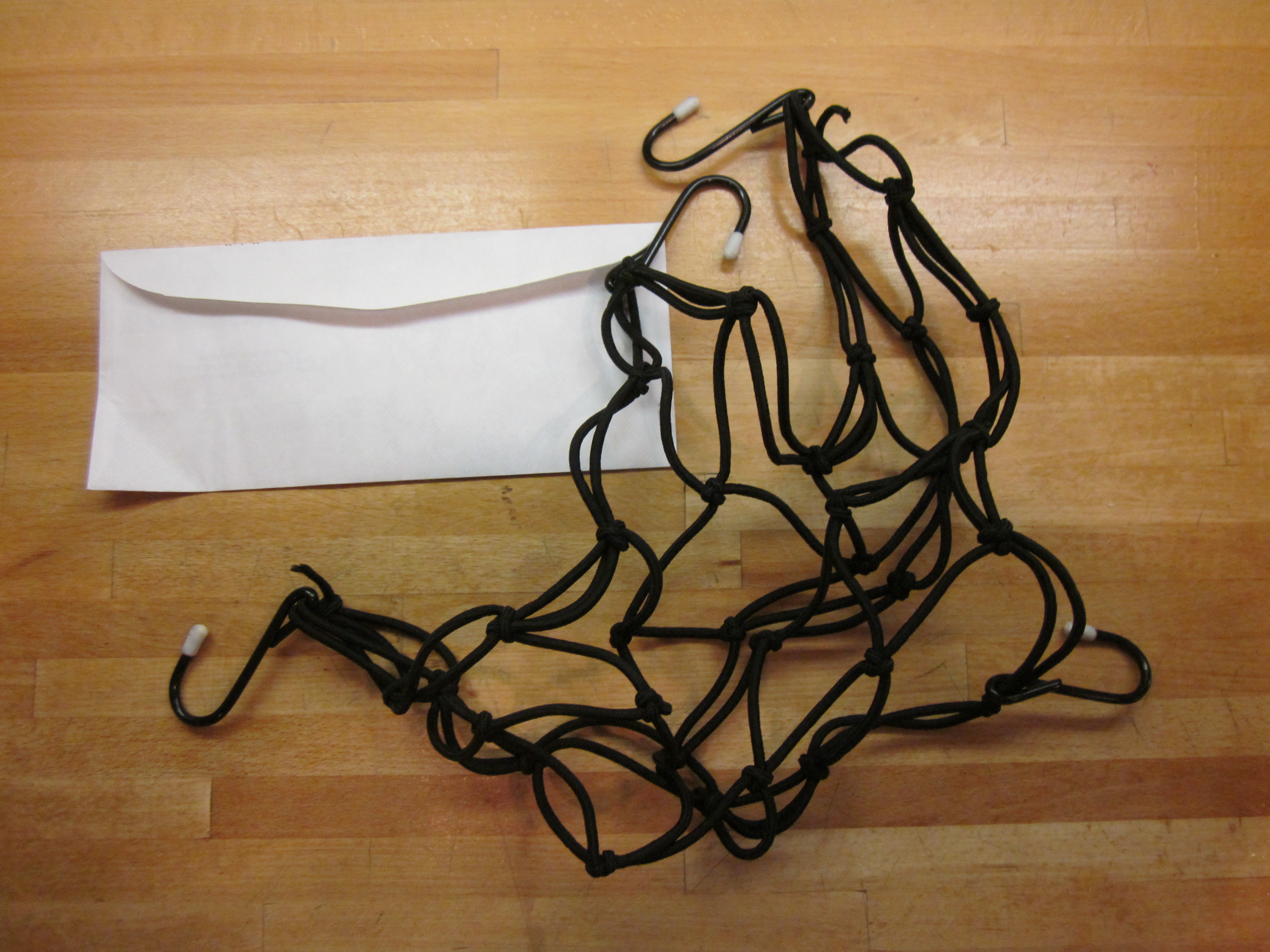
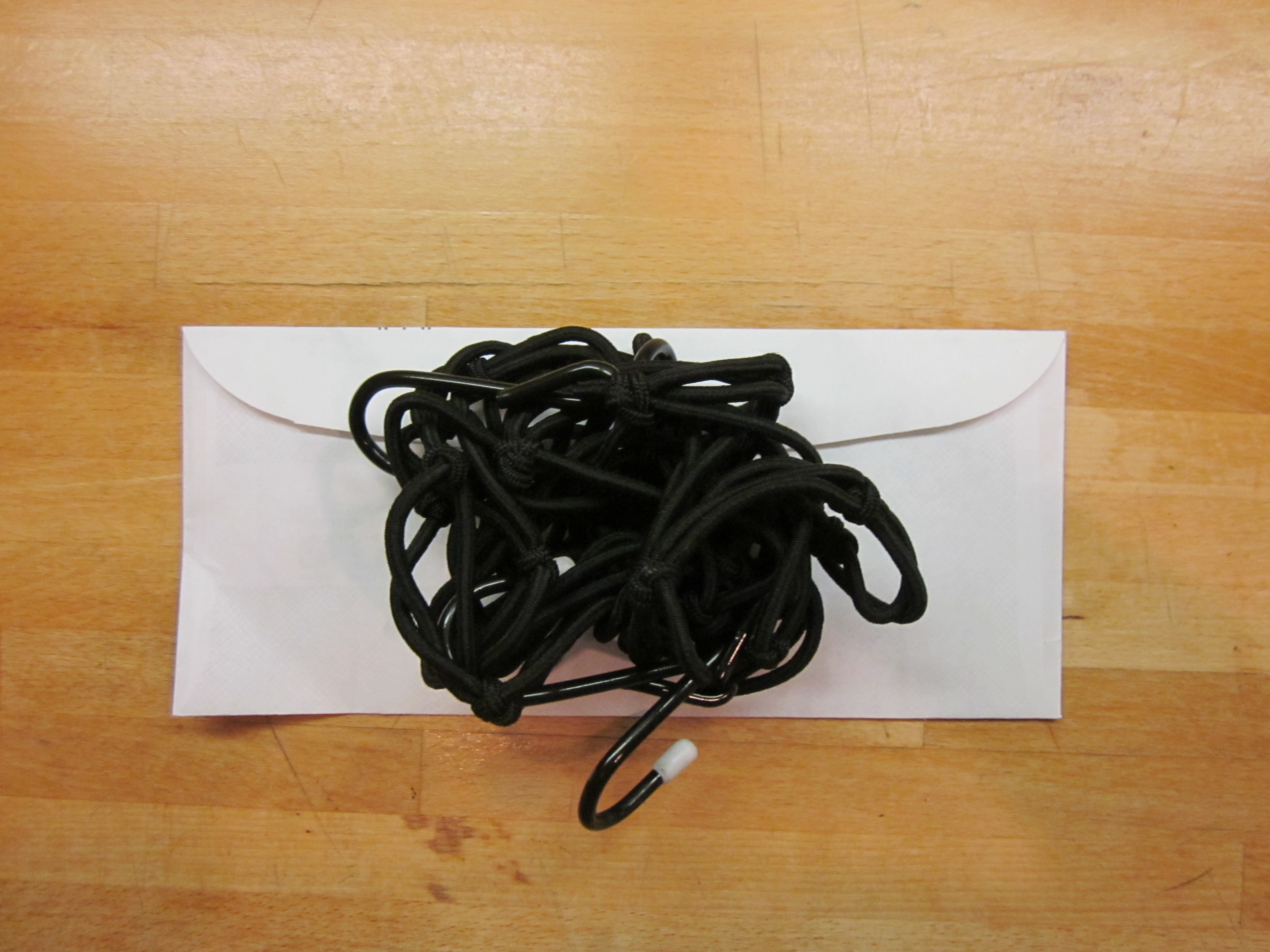
Bungee net unscrunched (with business envelope for scale)

For a long time we were hacking our way through carrying stuff on our bike. If it fit in a pannier: great. If it didn’t: not so great. We started experimenting with bungee cords when we carried our Christmas tree home on the Kona MinUte. But things slid around. The Christmas tree was okay with enough cords, but a bag of groceries or a box of CSA vegetables was a disaster.

I don’t remember why I thought to try a bungee net. It may have been during the period when I was scouring Amazon for any recommended bicycle accessory that would help us carry things. (I have an Amazon Prime membership through work, and during this time I tested the patience of both my office receptionist and of Amazon’s generous return policy.) I think the bungee net cost maybe $6. It is possibly the best money I’ve ever spent on my bicycle.

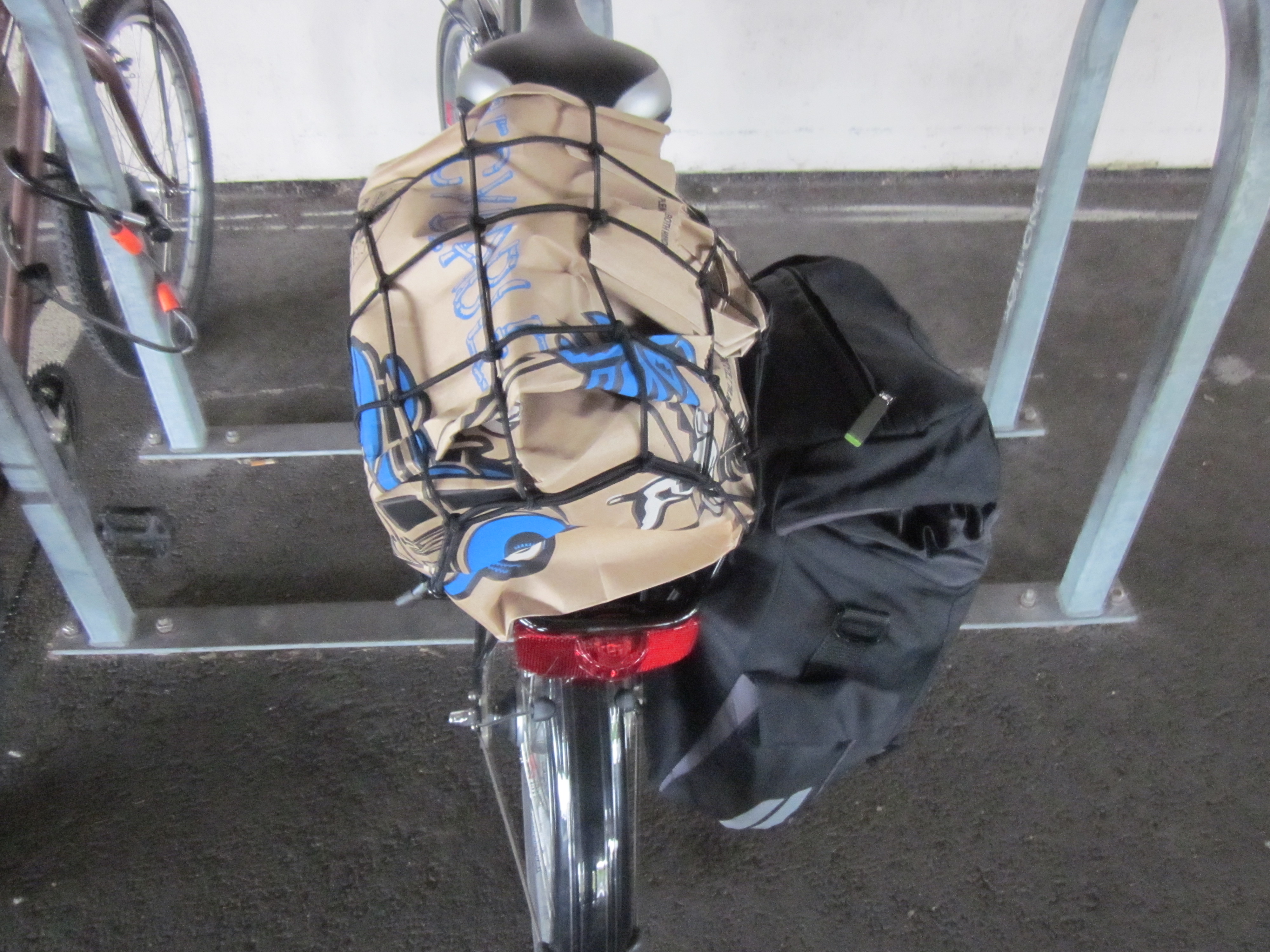
Yet another day when I overestimated my pannier and ended up with an extra bag of groceries: bungee net to the rescue

Most of my grocery shopping happens at work—there are three grocery stores within walking distance, hooray for urban living, and they are never crowded on weekdays at lunch time. But I tend to overestimate my ability to carry groceries on the bike, even if I remember a second pannier, and frequently ended up putting the bike on the shuttle and carrying a couple of bags of groceries and some boxes on board. This is a hassle and the timing never worked well. Enter the bungee net.

I have yet to discover the limits of my bungee net. We have used it to carry a box containing 20 pounds of apples on the rack, various bulky items including a bulk pack of pull-ups (when the preschool still demanded them for naps), and I strap paper grocery bags directly to the rack when I go out of town and come home to discover that no one has been to the store in my absence so we need milk and fruit and vegetables and cheese and yogurt and cereal and bread. We used it once to hold a balance bike on the MinUte deck. Nothing has ever fallen off, except for one time when we neglected to use all four hooks.

Bungee net rolled up for travel, usually in one of my pockets

Now I think that every bicycle should come standard with a bungee net, maybe as a gift with purchase. Some of my more intrepid co-workers have used one to strap items directly to their bicycle frames. I carry mine on trips where I’m not sure I’ll be riding a bicycle, just in case. Is it the best bicycle accessory ever? It’s definitely in contention.

3 Comments

Filed under cargo, commuting, reviews

The Kona MinUte, six months later

Maiden voyage of the Kona MinUte + 3

[Update: Our Kona MinUte was stolen from a rack at Yerba Buena Gardens in San Francisco on November 16, 2012.]

When we bought the MinUte, it did a lot of what we wanted, but not everything we wanted. Most importantly, it seemed to be a one-person bike. Only Matt could ride it. We had hoped for a bike that I could use to take our son to school when he was away. Eventually that spot was filled by the Breezer Uptown + Bobike Junior.

With hindsight, it was odd that I couldn’t ride his bike. I am only 1.5 inches shorter than Matt is (5’7.5″ v. 5’9″), and both of us have successfully ridden bikes owned by people far shorter and taller than each other, respectively. But the seat on the MinUte simply couldn’t be lowered to a point where I could reach the pedals. Once again my brother-in-law resolved the problem. When we were complaining about it on a ride with him, he looked at the bike, and noted that the seat wouldn’t lower because the shim holding the stoker bars onto the seat post was too long; it extended way beyond the height of the stoker attachment and blocked the seat from moving. “You just need to have the shim cut down,” he said. I have never doubted that we are mechanically inept, but still.

Our other issue with the MinUte was that our daughter couldn’t safely ride on the back without a child seat, and this model was new enough that installing one using the Xtracycle accessories would have required a lot of tinkering. But she recently turned three, and as other parents have noted, this is an age when many kids start being able to understand the need to hold on. She had also indicated in no uncertain terms that she wanted to try riding the MinUte deck, jumping proudly off staircase landings onto it before we developed the good sense to move the bike far, far away from anyplace above ground level.

So while Matt’s injured calf was keeping him off the bike anyway, we took the MinUte over to Everybody Bikes to ask them to cut down the shim. “Oh, sure,” they said. They’d had no idea we’d ever want to adjust the seat height for me. “Of course you could ride it.” It turns out that the stoker bars take up a lot of room on the seat post regardless, and even lowered all the way to the stoker attachment, the seat was a bit higher than I’d prefer while carrying kids. I like to be able to get a foot flat on the ground even while I’m on the seat, and I’m happy to give up pedaling power for that extra bit of safety. But even though the seat was higher than I wanted, after that adjustment I rode the MinUte all the way home solo. No problem. Okay, then.

Matt was headed on a two-week trip to Atlanta and Miami, and that seemed like the perfect time to try riding with both kids. So the next day I rode both kids down to the farmer’s market. I still wasn’t totally comfortable on the bike, but they thought it was an awesome ride, and aside from a brief scuffle over the handlebar grips, they enjoyed each other’s company. Matt griped that he didn’t have a bike anymore, “Mommy has all the bikes.” I assumed that that was the injury talking, as he had had no prior plans to check the bike through on his tour of the U.S. Southeast.

Not seen in this photo: scuffling over handlebar grips

My kids got sick while he was away, and a kid who won’t get off the toilet, put on shoes or take off pajamas is not a kid who will or should ride a bike. And there were a couple of days I had meetings across town where the only possibility of even arriving late after dropping off the kids meant I had to drive the car. But I did, eventually, haul both kids on the MinUte to my son’s school, then my daughter solo back to her preschool. It was awesome.

The MinUte rides like a normal bike even with almost 100 pounds of kids and their gear on the back deck. I only felt the extra weight when I was turning corners; it turns out you need way, way more turning radius than usual with that kind of load. To my astonishment, I did not feel it much on the hills. On the way up to Alamo Square with both kids on the back I didn’t even need to drop to first gear. This bike likes to climb. I wouldn’t have needed to drop to first gear on the way back up with only one kid, either, if someone who shall remain nameless hadn’t decided to take off a mitten and throw it into the middle of the road, which required some backtracking.

This raises another point worth mentioning: riding with a three-year-old, at least MY three-year-old, on the deck instead of a child seat is not all sunshine and roses. With her brother behind her to catch flung mittens and otherwise impose basic safety precautions, I was willing to ride at something approaching normal speeds. Once we dropped him off I was riding very slowly indeed. One of her preschool teachers is a big fan of superheroes and as a result we and random strangers have been hearing a lot of speeches along the lines of, “I’m NOT a little girl! I’m an AMAZON PRINCESS! I’m WONDER WOMAN!” I’ll admit that this is a little rude at times but it’s also so totally righteous I pretty much let it slide. Anyway, Amazon princesses apparently see no need to sit down while riding and strongly prefer to hot dog it while heading up or down hills. Whereas I  had no desire to return to the Emergency Department for the third time in a month, and spent most of the ride saying, “You need to sit down. Sit down, please. I’m not starting the bike again until you sit down.”

[Aside: I’ve noticed that superheroes, with the notable exception of Batman, are not big on driving. Admittedly they don’t ride bicycles either, but still, as role models go, it could be worse.]

In the shop for a brake adjustment. Again.

And this brings up a more serious issue. BikeRadar recently reviewed the MinUte, and although they were basically positive, they noted that the disc brakes that come with the bike are kind of junky, and we agree. They have failed on Matt once, with our son on the back, and now he has them adjusted monthly, and they always need it. He wants new hydraulic brakes way more than he wants an electric assist. If we’d known this in advance we would have asked for an upgrade on the brakes before we first picked up the bike. As cargo bikes go the MinUte is pretty inexpensive even with this extra cost. Still it bugs me that any cargo bike would come standard with crappy brakes. Maybe it would be less of an issue for people who weren’t dealing with the kinds of hills that we are. I wouldn’t know.

While we were having new brakes installed, we also would have gotten a wheel stabilizer for the front wheel (the little spring that keeps the front wheel from flopping). These are very inexpensive, but although they come standard on the Kona Ute, one was not included on the MinUte even though there are hookups. The bike is a little too tippy with kids on the back when the front wheel can swing around. Yeah, it’s fallen over. The kids are fine. We’re getting a wheel stabilizer.

The MinUte can really haul; it’s not up to the loads of a regular cargo bike, but we live in the city and we’re not making Costco runs or moving furniture. It can certainly carry a week’s worth of groceries plus a kid or two. It makes it harder to get up the hill home, but that’s why that first gear is so low.

But maybe you’re not up for that kind of trip. Can you put it on a bus bike rack instead? No, you cannot. Matt tried for over 10 minutes to get it on the university shuttle bus rack, infuriating two dozen medical students in the process, and failed. It’s short enough to fit in a shared office cubicle but it’s still a longtail, and that means it’s too long to ride the bus. [UPDATE: We were wrong! Yes, you can put it on a bus bike rack. But it’s complicated. I posted an update explaining here.]

Look who’s back in the game

Matt has mixed feelings about the panniers. On the one hand they fit the bike perfectly, are totally waterproof, fold up beautifully when empty, and hold unbelievable amounts of stuff when full (and the kids’ legs just dangle over them). On the other hand, there’s no shoulder strap to carry them if you want to take them off the bike and they don’t look particularly professional when he brings them into the office. The tubes on the rear rack are thick enough that normal panniers won’t fit unless you can modify them somehow. Last week we saw a Ute outfitted with Xtracycle freeloaders, however, and I eyeballed while we were parked next to it that they’d fit on the MinUte as well.

Overall, six months after we bought, the MinUte is doing more than we had thought it could. And even though I only ride it while he’s away, Matt is so possessive of this bike that he thinks we should get a second one.

40 Comments

Filed under commuting, family biking, Kona, reviews

Loaner bike: The Yuba Mundo v4 (hello, goodbye)

Two cargo bikes squeeze into a bike rack...

Last night the loaner Yuba Mundo went home to Marin. It was fun while it lasted. I had, until a couple of weeks ago, never ridden a real longtail before, and as I’ve mentioned, it takes some getting used to. Our friends who were used to riding a Surly Big Dummy liked it a lot. “It carries three kids and you don’t even notice! And it’s cheap!” They are, of course, very used to riding with two kids on the back. In fact they rarely do anything else. My brother-in-law hated the Mundo. “I hate this bike,” he said. It was unclear whether it was the bike itself or the experience of riding any kind of long bike with two kids on the back. With hindsight I lean toward the latter.

After riding it for two weeks, the Mundo grew on me. I conclude after this experience that big bikes have a significant learning curve. If you’re in the market for one, especially as a first bike, it’s something to consider. A case in point: I dropped the Mundo with both kids on it. In front of our local bike shop. The bike shop guys ran out in horror and offered us their shop Ute as a loaner to get home. It was mortifying. At first I thought it was just me, so it was reassuring to hear from Family Ride and A Simple Six that this is one of those things that just happens sometimes. The kids were unharmed although startled. I now put this experience in the same category as dropping the baby off the bed. When I was in grad school my advisor told those of us who were expecting that one day, a while after our kids were born, we would put them on the bed and they would roll off. “It happens to everyone,” he said. “I’m telling you now so you don’t beat yourself up about it. They’ll be fine.”

Fully loaded

I really liked having the ability to carry two kids and a load of groceries in San Francisco (and this is particularly appealing for younger kids who need child seats). It is pretty amazing. People who live in flat areas with no hills to speak of love their box bikes (bakfiets, Madsens), but almost everyone agrees that those bikes won’t climb real hills, and getting down them on the other side raises safety issues. San Francisco has real hills. The Mundo may be heavy, but it cranks up the hills; I never had to walk it. Based on our experience so far, I now believe that people who live in hilly terrain should buy bikes from companies based in the San Francisco Bay Area, or maybe Seattle.

(There is evidently one exception to the “box bikes won’t climb” rule, the custom Metrofiets. Down in SoCal, Bike Temecula is riding a Metrofiets with a BionX electric assist. Although that bike is unquestionably one of the coolest things I’ve ever seen on two wheels, it is not cheap. A Metrofiets with kid seats costs $5k WITHOUT the electric assist [update: Metrofiets notes below that the price is just under $4k; Splendid Cycles lists the box with child seat as an add-on for $665 and a harness as an add-on for $100]. We could buy normal bikes with electric assists for everyone in our family for that kind of cash. Or a used car, were we so inclined, which we are not. Where we’d store any of those things is a different question entirely.)

There are things I would change about the Yuba Mundo. My personal pet peeve is dynamo lights; I think all family bikes should have them, and the Mundo does not (it’s not even an option). In San Francisco, the bike should be fitted with disc brakes (this is an option, and not an expensive one, either). The child seat mount would be infinitely better if it were possible to slide the seats forward and back, possibly on rails? I would have preferred the Peanut seat about 6 inches forward from where it was, because it leaned beyond the rear tire, which made the bike wag. And when I had only my daughter on board, I would have liked to slide it all the way forward, which would have made it much easier to get up steep hills and to talk to her.

There are also a lot of things to like about this bike just as it is. It can move major-league weight, way more even than other long tail bikes. And you don’t even feel it except at the starts and stops. This is pretty amazing, especially considering the weight of kids and their gear. My two kids together are ~80lbs stark naked, but outside the house they always have clothing on, and on any kind of trip we add in lunches and book bags and toys. The weight adds up fast, particularly if you want to stop and pick up groceries. (And if the weight gets out of hand as the kids get older, Yuba sells an electric version, the elMundo.) The Bread Basket was unnerving to ride with at first, but absolutely awesome. When it was loaded up I barely noticed riding over potholes or Muni tracks. Our son loved the soft seat cushion and wants one for the MinUte. And the bike acoustics are good; this may sound like an odd concern, but it’s useful to be able to hear the kid in the back. Our kids liked riding on this bike. They called it The Beast.

Yuba sometimes bills the Mundo as a minivan replacement, but I don’t quite agree with that. Minivans are plusher. The Mundo reminds me more of a pickup truck; stripped down but effective at moving stuff where you need to go. Yuba is like the Ikea of bicycle manufacturing, peeling off everything optional to keep the bike at a price point that does not make novice riders laugh in disbelief. As long-term recovering cheapskates (we’re so cheap that we bought our Ikea furniture on craigslist, given that the kids are going to trash it anyway), I like that there’s a cargo bike manufacturer with this business model.

In contrast, a bike like the Surly Big Dummy is more of a station wagon concept car, which can be customized to do anything you want, but only if you know what to ask for and can swallow the price. The minivan of bikes is the box bike.

Classic San Francisco pinch point

Would we get a Mundo? No, but that’s not a knock against it, but a statement about our lifestyle. We wouldn’t get a Mundo for the same reason we don’t have a back yard. We’ve made a choice to live in a large city, and that choice involves some compromises. We have, by city standards, amazing bicycle storage, but even we had to rearrange that space around the Mundo.  San Francisco has serious traffic, and maneuvering a big bike through it led to some frustrating moments; another bike would whiz through a pinch point in front of me, and I would realize I had to wait until it cleared. Parking the bike, even at bike racks, always involved a little jiggering around tight corners and other bikes—I was in that situation when the Mundo fell over. There is a lot of starting and stopping in the city, and that is difficult with a heavy bike. The Kona MinUte, we’ve realized, may represent the outside range of bikes that we can handle in San Francisco. I wasn’t surprised when the Yuba rep told me that most of their customers lived in inner-ring suburbs or smaller cities. That seems like this bike’s ideal stomping ground. The Costco run holds no fears for the Mundo.

We are lucky devils indeed to live in San Francisco, and being shut out of a few categories of bicycle seems like a small price to pay for the privilege. I’m glad we had the chance to try the Yuba Mundo, and although we won’t miss figuring out where to put it, all of us, especially the kids, will miss having the chance to ride it sometimes.

5 Comments

Filed under cargo, family biking, reviews, Yuba Mundo

We have a visitor! (Yuba Mundo)

We have continued the string of injuries with Matt now out of commission due to an errant dodgeball at one of our son’s classmate’s 7th birthday party. Hello again, N-Judah.

Hello, Mundo! Let's go for a ride

However. A while back a representative of Yuba Bicycles, just across the bridge, wrote to ask whether I would care to borrow one of their bikes and write about what it was like to ride it in the city. Would I! But honestly, it seemed implausible. Let’s be clear: I know almost nothing about bicycles. This cannot be overstated. Many days, I am just grateful that I managed to get to work in the morning without tipping over.

(The other days I have been known to tip over. It’s less common than it used to be. At least I am strong, and get compliments from my son when he’s riding the Bobike Junior that “You go up the hills faster than Daddy.” Yeah! I’m sure that has nothing at all to do with the fact that my Breezer weighs 10 pounds less than the MinUte. Cough, cough.)

And yet, fortuitously, despite my skepticism, I picked up this loaner last Friday. It has taken some getting used to. I have an internal hub on my bike and this does not. I had no idea how to shift, you know, like normal people, and for the first ride, we sounded like the bicycle equivalent of a car without a muffler. In my defense, someone informed suggested that the gears probably needed adjustment, which I am about as qualified to do as I would be to repair the Mars Rover.

Even outdoors, it kind of dominates the landscape

The Mundo is a big, big bike. It is heavy, and lurks in our basement like a small car. We are extremely fortunate that we can keep our increasingly ridiculous (albeit temporary) collection of bicycles in a very large locked ADA-accessible garage. Thanks to 50+ years of battles with the local neighborhood association, the university is not allowed to use the space to add another parking place (other residents’ preference) or a studio apartment (university housing’s preference). Thanks to a major flood last year that left everything 6-12 inches underwater for a few days, no one on our block, ourselves included, has the boxes of random crap on the floor anymore that typically litter garages. As a result it’s like a bicycle bar scene down there right now, assuming that people in bars were regularly U-locked to standpipes, that is.

Because I am all about overkill, we decided to see just how much we could do over the weekend on a bicycle that I cannot lift, can just barely ride (getting better…), and yes, tipped over. More than once.

So on Saturday morning we rode 5 miles to our kids’ swim class, to brunch with my sister and brother-in-law, to Rainbow Grocery to stock up, downtown to get a mystery box, and then back home. Our daughter slept for most of the ride home in her child seat. I learned that the bike lanes and traffic South of Market are flat, but terrifying.

Saddle up!

On Sunday we went to Golden Gate Park to see the Sunday Skate and meet friends from school with their Big Dummy, where we rolled up, unbelievably, right next to another Yuba Mundo. Then we stacked various combinations of our four kids on different bikes and rode them around until it started getting dark. The Yuba Mundo lacks dynamo lights, which has also taken some getting used to. I learned that my kids can hold a thought in their heads longer than I had thought possible, assuming that thought is: “Can we get roller skates?”

Further updates on all of these experiences pending. Riding this bike has been a fascinating experience. Having other people ride it (family members, friends, all of whom are more informed than I am) has been even more so–their opinions vary dramatically, based largely, it seems, on how much experience they have riding cargo bikes.

I thought I got a lot of comments about my ride when I was carrying one kid, but it’s a whole new world carrying two and a few bags of groceries. Perhaps a signature moment of San Francisco was while we riding near the ballpark. A City CarShare Prius carrying two white-haired couples came to a dead stop in the lane next to us, at which point all the passengers started waving wildly to my kids while chattering in Cantonese. Presumably they were saying “Would you look at that bike!”

4 Comments

Filed under Breezer, cargo, family biking, Kona, reviews, San Francisco, Yuba Mundo