Surly Xtracycled Karate Monkey with Stokemonkey electric assist–so many kinds of awesome!
Now that I am getting out and about more, I can continue my effort to catalog every unusual bike in San Francisco. There are more interesting hobbies, I’ll admit, but it entertains me (my other hobby is the even more obscure effort to catalog every word that means its own opposite, e.g. sanction).
This bike isn’t a kid-hauler, which is my favorite kind of bicycle by far, but it could have been (update from a more observant friend: yes it is! check out those stoker bars). I was not familiar with the Surly Karate Monkey before I saw this Xtracycle outside a café one weekend morning. But check it out: it’s a Stokemonkeyed Karate Monkey! That’s an awful lot of monkeys on one bike. It must own the hills. I couldn’t tell whether the box was a battery backup, but this bike looks like it gets around. The sticker references a shop in Seattle. You’re a long way from home, monkeys.
[Note: As of April 2014, release of the Ridekick child trailer has been postponed to 2015.]
When I thought about getting back on the bike after my injury, I thought immediately about electric assist. We live on a big hill. I was surprised that I could get up part of it on the Brompton by myself when I tried riding for the first time last weekend. But a little more experimentation made it clear that I wasn’t able to ride up all of it. This is better than I’d expected, but still: not useful. It doesn’t help much to go partway up the hill. And when I tried to walk the bike up the hill instead, it made the pins in my leg ache so badly that I had to lie down. This was predictable but still unwelcome.
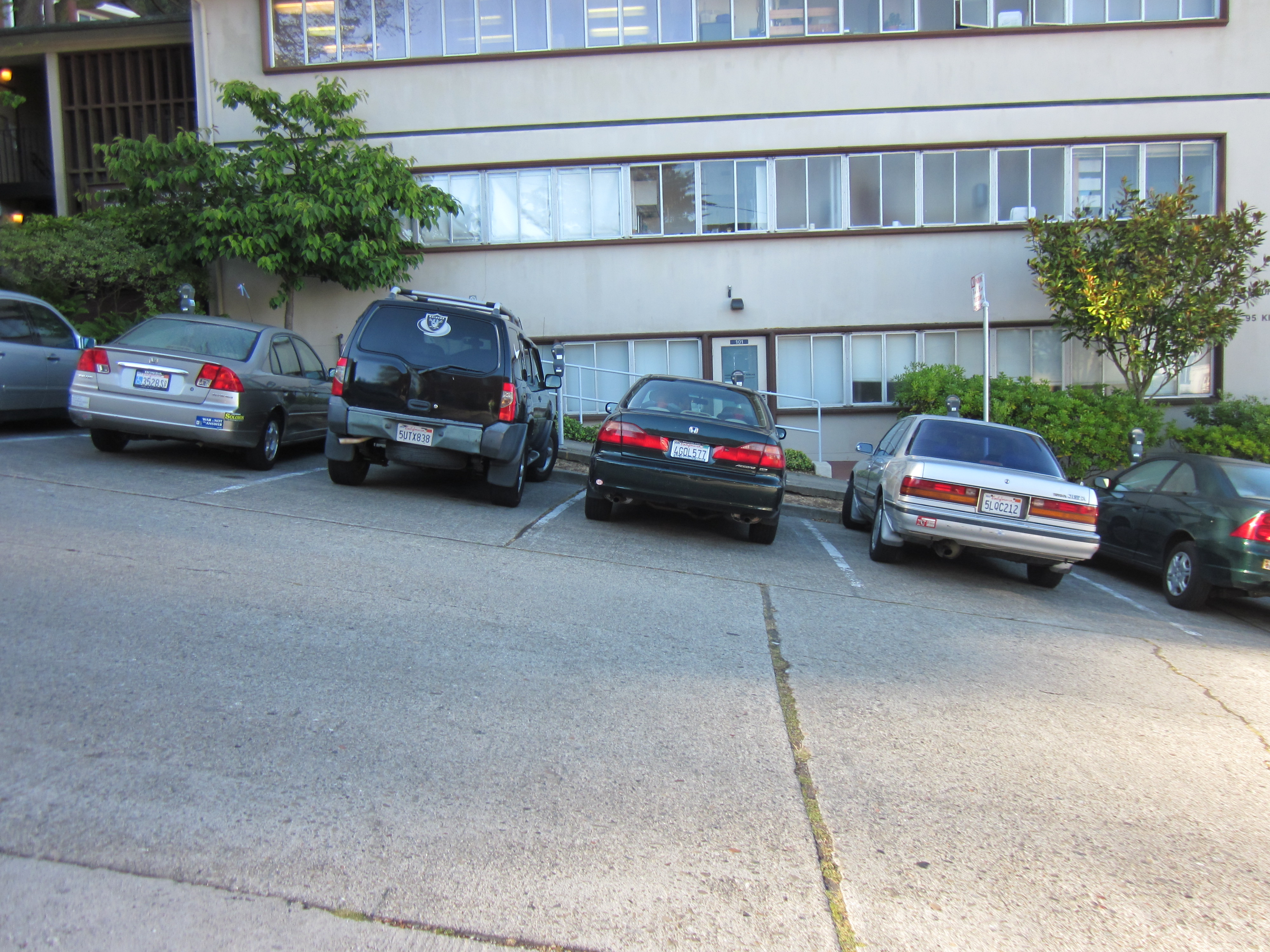
A mid-drive spotted near work
What’s more, it’s not very useful to be riding again if I can’t pick up and drop off a kid occasionally. I figured I would get my strength back eventually, but in the meantime I needed a better solution. Option one is a new mid-drive electric-assist bike, but that’s really expensive for short-term use and depending on how much strength I got back, could potentially be overkill in the long term. Ideally I wanted a temporary assist that I could stick on the Brompton, which is basically the only bike we have that I can use right now given my limited strength and range of motion. I did try getting on the MinUte, and technically it’s possible, but it wouldn’t be safe yet with a kid on the deck. I can get on and off the Bullitt, but it’s too heavy for me to ride for the time being.
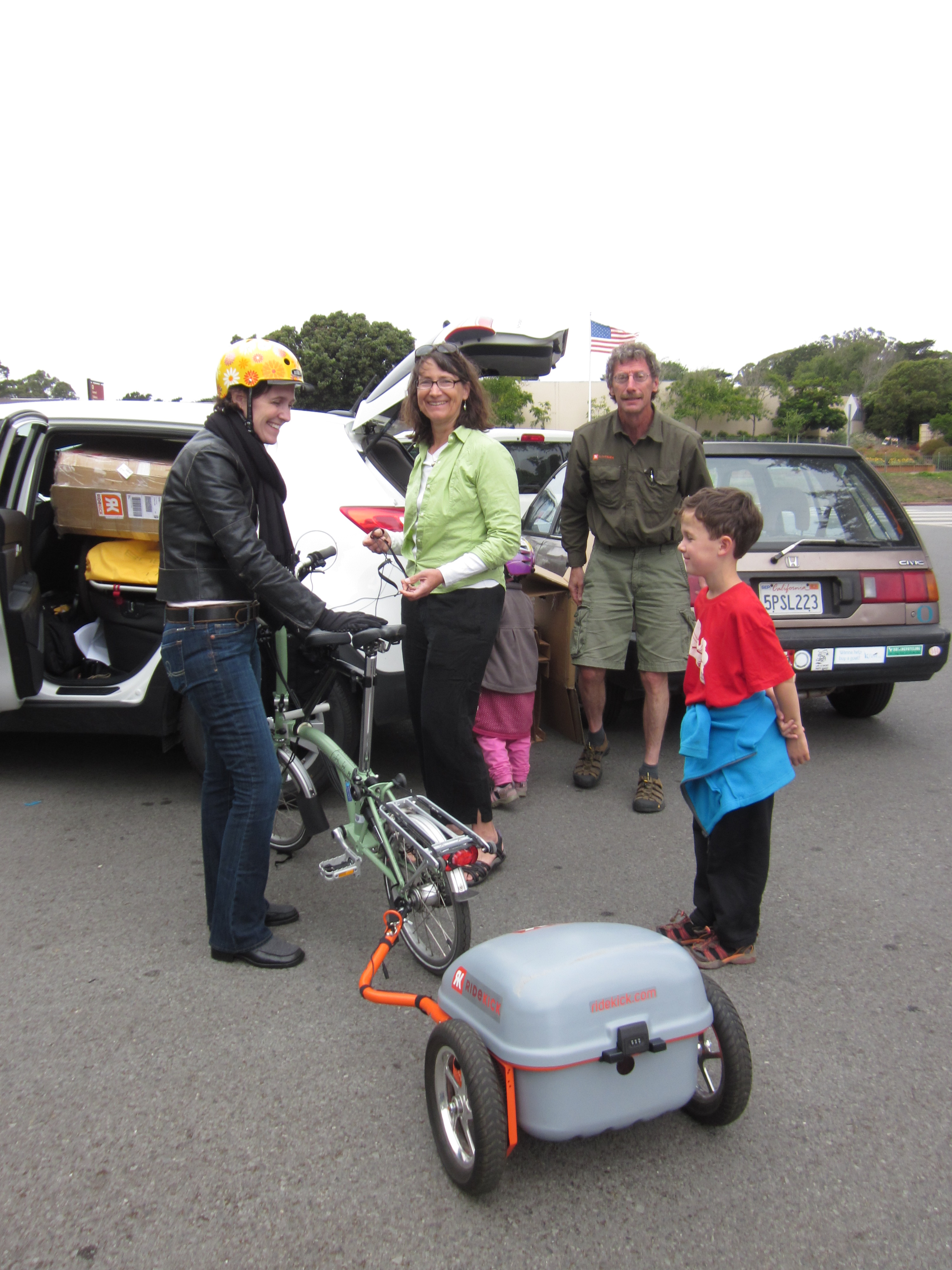
Introducing: the Ridekick electric assist trailer!
I knew what I wanted, but unfortunately I didn’t know of any temporary, immediate on-off electric assists currently in production. At least, I didn’t until a blog reader pointed me to the Ridekick trailer (thanks David!) The only Ridekick currently on the market is a small cargo trailer with an electric assist built in. It was cute and it looked like it would do what I wanted, but when I went to their website, I saw that they were taking pre-orders for what looked like my rehabilitation holy grail: an electric assist child trailer.
This is a complete stealth assist system, if you want to look super-tough on hills.
Although I’m not the world’s biggest child trailer fan (hard to see in city traffic, don’t always fit in urban bike lanes, won’t make it up many San Francisco steep uphills, can be terrifying on many San Francisco steep downhills, we prefer to have the kids in front), we had been considering getting a bike trailer for travel, and for upgrading our one-kid bikes to two-kid bikes on occasion. The trailer also has the advantage of offering weather protection, just like the Bullitt, but in a far more portable package. The Ridekick assisted child trailer also seemed way more promising than an ordinary trailer because with an assist we’d no longer have to worry about drag on the bike. The pull of a weighted trailer can really be a problem on hills and in strong winds, both of which San Francisco has in abundance. And if the assist were up to it, I could attach it to any bike and make it up hills with one or both kids even in my reduced state.
So I wrote to Ridekick, hoping against hope that the child trailer was close enough to production that I could get one by August. The answer was no. But they were coming to San Francisco in August with the prototype to look for venture capital funding, and would I like to try it? Yes!
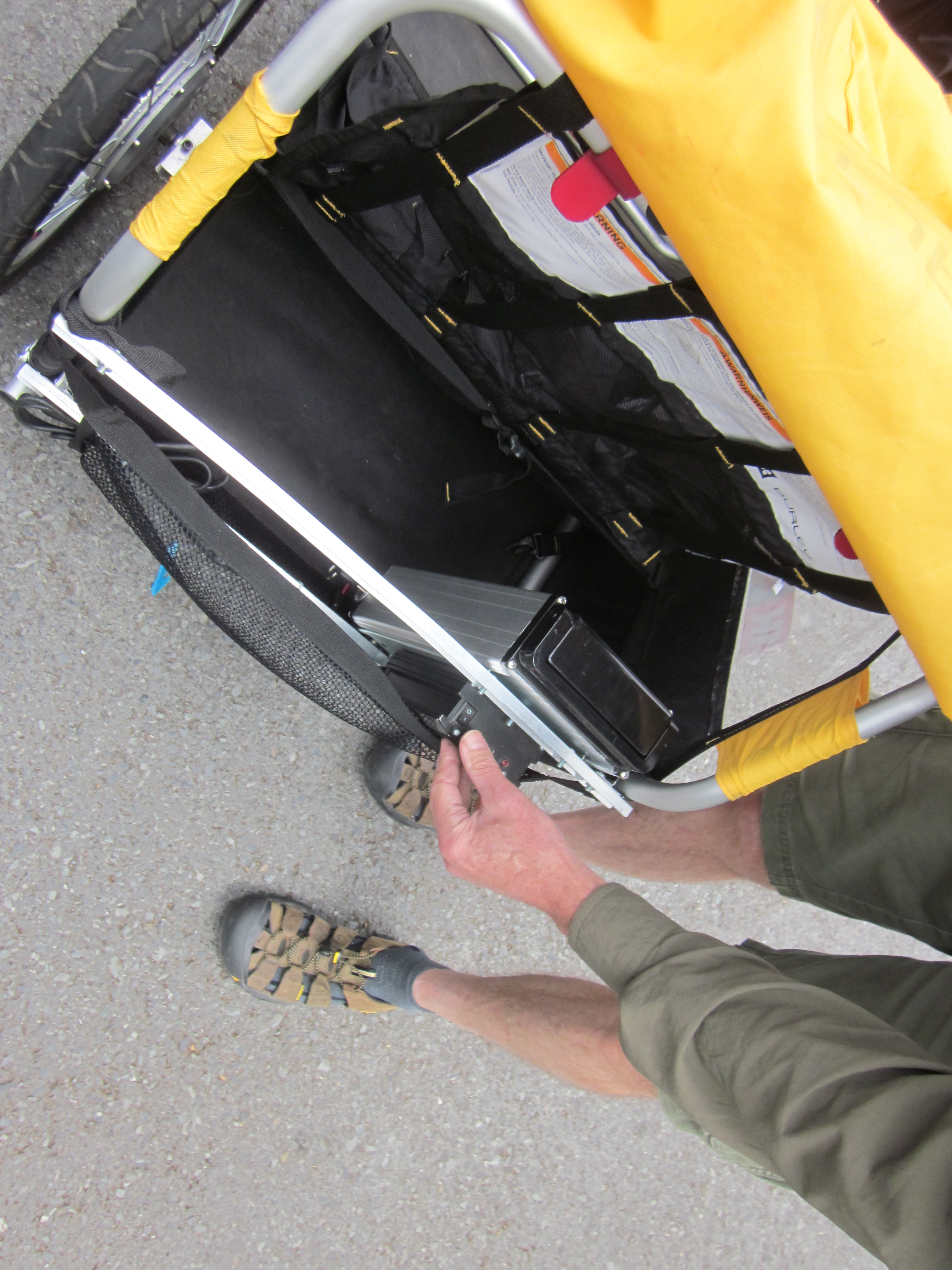
This is the cargo hold with the battery for the assist.
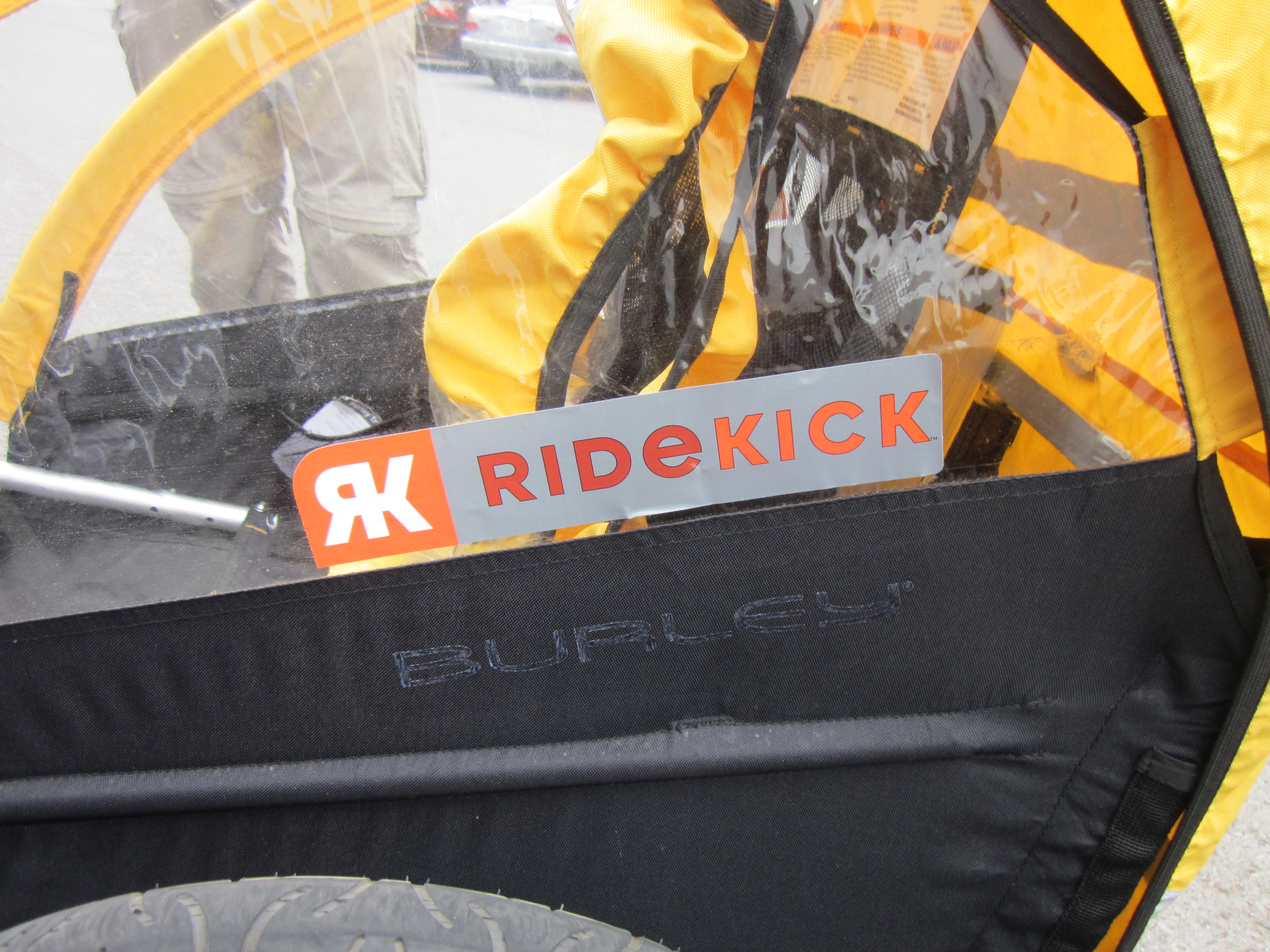
We met Dee and Mark from Ridekick in Golden Gate Park. They are great people. The prototype trailer that they brought is built up from the same Burley Bee model that we rented last year when we visited my mom in Bellingham. To my surprise, the assist doesn’t really intrude into the trailer’s cargo space. There’s a lithium ion battery with an on-off controller attached, about the size of a hardback book, that slides into the rear cargo compartment and that’s basically it. There is a throttle attachment that they Velcro-tied onto our handlebars, and then strung the wire for it back along the frame with more Velcro ties. It clipped into the wire coming from the motor at the rear wheel bolt, which is the same place that the trailer itself attaches. For novices like me: a Burley trailer attaches with a hitch plate that is threaded onto the same bolt that holds the rear wheel onto the bicycle frame. The trailer frame has a drop-in pin that goes through the hole in the hitch plate, with a back-up strap that loops around the bicycle frame in case it fails. Ridekick estimates that the trailer can go about 15 miles on a charge, depending very much on local conditions (how much weight and how big a hill?)
Technically both boys are too old for the trailer, but we never pay attention to stuff like that.
“Oh, if I must.”
My kids hadn’t ridden in a trailer for a year and were thrilled to get back in one. They also brought a friend. For our first test ride, we attached the assisted trailer to the Kona MinUte and then Matt took the two 7-year-olds for a spin through Golden Gate Park.
Something I may not have mentioned before is that Matt is less enamored of new bike experiences than I am. He mostly just treats all the experimentation I do like my weird hobby. He’s not big into optimizing his riding experience. The first bike he got was the Kona MinUte, and when it was stolen, he bought another one just like it. I got him a new pannier for Christmas one year when he complained that the ones that come standard on the MinUte were not office-appropriate (definitely true), but he has never used it. When we got the Bullitt he said for two months that we should have replaced the car instead, although he has since come around. So Matt was actually pretty grouchy about coming down to Golden Gate Park on a Saturday morning for “another bike thing.” He had had other plans.
It is in this context that I say that Matt loved the Ridekick child trailer from the moment he started riding with it. Generally neither of us is a big fan of throttle assists (the kind that go when you push the button, whether you are pedaling or not), but in the context of pulling well over a hundred pounds of weight behind the bike, the throttle assist is extremely appealing, especially at intersections. At steep intersections it is sometimes impossible for us to start a heavily loaded bicycle, even with the BionX, because the BionX doesn’t kick in until your speed exceeds 2 mph. Although Golden Gate Park is a little thin on steep hills—its grades top out at about 12%—Matt took it on a moderate hill, probably 10% grade, behind the Conservatory and had no trouble hauling both 7-year-olds up. When you’re riding with an assisted trailer, you don’t have to feel like you’re dragging an anvil.
It was a struggle to get him out of the trailer so his sister could have a turn.
When he came back I took our daughter for a solo turn around the park on the bike. Despite the fact that I was on the MinUte, which is a huge hassle to get on and off for me at the moment, I loved the Ridekick child trailer too. It resolves a lot of child trailer problems all at once. There’s no drag from the trailer unless you want to work harder. When you get tired, you can have it push you along for a little while. Taking breaks like this, interspersed with pedaling, got me up the same hill behind the Conservatory that Matt had ridden. That felt amazing! And it’s something that is currently completely out of reach for me on an unassisted bicycle.
There is probably a limit to the Ridekick’s capabilities. We have the advantage that we are using to riding up hills, and so we just need an extra boost now and again when we have extra weight on the bike. Even I, in my reduced state, tended to use the assist for a while, then pedal solo for a little bit, then repeat. My guess is that a weak rider could burn it out on the steepest hills, given that Matt has overheated the BionX on the steeper hills in our neighborhood occasionally. We’d have to ride with it a lot more to be sure. Then again, how many families really deal with hills like ours on a regular basis?
In the world of trailers, which tend to be useful but not that fun, the Ridekick assisted child trailer is a killer app, both useful AND fun. Normal trailers drag, and pulling them can be exhausting. As a result, even though most cargo bikes ride like tanks, cargo bikes are a lot easier. Still, in a situation where one parent drops off and another one picks up, you’d need two cargo bikes (which is exactly what we have now, but that’s a big commitment to start). But an assisted child trailer? Awesome! The assist means that riding is not a chore, it could be passed between parents’ bikes as needed, and it can keep the kids warm and dry, all for a (suggested) price of a single unassisted cargo bike. And as a rehab tool, it would be amazing.
If we could have, we would have bought it on the spot. But there is only one in the entire world. Our kids were crushed. “Can we keep it, please?” our daughter begged. “It goes fast! Can we keep it?” Alas, no.
Evidently Ridekick has gotten a fair bit of interest from parents who would like an aftermarket kit to assist their existing trailers. This doesn’t surprise me, but they still don’t even have the basic model in production. Ideally they could find a partner with an existing child trailer company (e.g. Burley, Chariot, Wike) and add the assist option to their standard product lineup. I’m sure there is sufficient demand.
This trailer is so much fun!
How cool is the Ridekick assisted child trailer? It’s so cool that if it had been on the market when we started riding with our kids, we might never have gotten cargo bikes. Even with my misgivings about the width of trailers versus bike lanes and having the kids behind me in city traffic instead of in front, having a trailer that could glide up hills, as well as being able to swap it between bikes, would be worth compromising in other areas. I have zero regrets about getting cargo bikes, especially given that the Ridekick child trailer isn’t actually available yet, but an assisted trailer would have been a much lower stakes way to ease into family biking, and it would travel well. I could be biased by the fact that this trailer allowed me to ride up hills that I couldn’t have otherwise attempted, but I loved the Ridekick.
It’s been 3.5 months since I, in the words of one friend, “got run-ded over.” For all that people worry about the dangers of commuting I actually got hit while riding around Golden Gate Park on a Sunday afternoon. Go figure. You can never tell.
After my second surgery–looking much better with the external fixator removed.
I had no idea what I was in for when we were sent to San Francisco General in April. I thought that at worst I’d get a cast on my leg and go home that evening. Maybe I should have been more aware when we jumped the trauma queue—did you know that they don’t even ask your name when you get admitted through trauma? I was Trauma Romeo and our son was Trauma Sierra. I’m still amazed that I spent two weeks in the hospital—nobody spends two weeks in the hospital anymore. Two surgeries later, two months stuck in bed on the continuous passive motion machine, and many physical therapy visits later, and here I am: back to full weight bearing. Admittedly I have a bad limp. That’s okay. I have a cane; it looks very hard core.
Let’s draw the curtain of charity over what I looked like getting on and off the bike.
Last Friday I got tired of waiting around. We had test rides to do over the weekend (more on that later), and that meant it was time to get back on the bike. My range of motion is not all that it could be, so for now I’m on the Brompton, because it has a nice low step-over.
My right leg is pretty atrophied, and that makes starting from a full stop very hard. But to my surprise I can still make it up a moderate hill unassisted on the Brompton. I’m still kind of nervous on the streets, and the less said about left turns, the better. But I’m back on the bike.
I still can’t ride a bike, but I see them all the time: BionX Mundo!
I was getting a little frustrated the other week. The stress of waiting for the x-rays scheduled for this week was starting to get to me. If they looked good, I’d have to wait one more week before I started partial weight bearing again (July 23rd!) If they didn’t, I’d have to wait seven weeks or more (I preferred not to know!) That kind of uncertainty can really eat away at a person’s composure.
Gas powered scooter: I can’t ride this either, and I don’t want to.
I asked many times whether there was anything I could do to improve my odds. The answer was basically no. Sure, both smoking and taking NSAIDs reduce bone growth—now you know–but I am tobacco-free and I have plenty of narcotics for pain. My physical therapists were pretty straight-up about the fact that no amount of their suggested exercises would help. Those exercises were to improve my range of motion, and I was doing them so diligently that I got kicked out of physical therapy until I could bear weight again. I have always been the kind of person who does the homework. But bone regrowth, unfortunately, is not the kind of thing that rewards diligence.
On Tuesday, after a sleepless night, I went to the x-rays and my appointment with my surgeon. The x-rays took a long time. The plate in my leg is so large that the technicians couldn’t capture it in one shot, so they ended up taking twice as many x-rays as they had planned. For that kind of thing you get two lead aprons. Lead aprons are heavy.
Happily my surgeon is not the kind of guy to burlesque. He dashed in, checked my range of motion and said I could start partial weight bearing (25%) that very day. One week early! Yes!
It’s okay to walk slowly. We get distracted.
Learning to walk again after three months without my foot touching the ground is harder than I had hoped. After spending Tuesday afternoon limping around I was so tired I spent all of Wednesday passed out in bed. I was warned that my foot would be sensitive, and that was an understatement. At first, putting weight on my right foot felt like walking on shards of glass. I don’t really care. I can now move around at the pace of a distracted toddler, which is perfect, because I have kids. Yesterday I walked across the room carrying a glass of water for the first time in months. I can even go a few steps holding onto a wall. Sure, this is all totally pathetic, but I’m not proud. Next week I can go up to 50% weight bearing. And so on.
I CAN ride the bus by myself now. I’m a big girl!
Unfortunately, I still can’t ride a bike. I was told this was a balance issue and I have to be fully-weight bearing. But a stationary bike is supposedly fine, which whatever, how is a stationary bike going to get me anywhere? So mid-August it is. In the meantime, though, this walking thing? It’s really great.
My kids are evidently getting to be really fast on those scooters.
I have been incapacitated for 12 weeks now, and it is really starting to chafe. Even though I can go into the office now (thanks to my new compression stocking) and that is fun, I find that I am irritable. I can only maintain a good attitude for so long. And when people tell me things like, “You should just be grateful that you’re alive! And that your son is okay!” I kind of want to punch them in the face. Yeah, sure, it could have been worse, but that doesn’t mean I’m happy that my entire summer was ruined and I can’t go out with my kids and that after three months I still have weeks to go before I can try walking again. Maybe I shouldn’t have weaned myself off all of those narcotics.
Going ice skating? Wear cashmere!
Then again: I have forgotten the entire month of May. Seriously, my son was asking me questions about some things that happened then, things in which evidently I had some involvement, and I had no memory of them whatsoever. I do remember that in June I bought my daughter an entire new wardrobe on eBay after my mom mentioned that a four-year-old probably shouldn’t be showing so much VPL or sporting crop tops. Normally I would go to the local consignment store and pick up stuff in her new size, but I couldn’t leave the house. Luckily for me, there are scads of amazing deals on eBay for people who have nothing but time. She’ll be spending the next year or so in secondhand cashmere. Nonetheless, thank goodness our son goes to a uniform school.
These are the appropriate costumes for 1-legged airplane rides on your parents’ bed.
There are things that I can do, although they are limited. Given that I can only use my left leg, and that university housing still hasn’t gotten around to putting grab bars in the bathroom despite our requests, I can do pistol squats on that leg until I fall asleep from boredom. That means, as I learned recently, that I can give my kids one-legged airplane rides in bed. That’s fun. And we can watch movies, when they’re into that. I can read them bedtime stories. I can give them rides on the cool electric cart that I use at the grocery store (although the competition for those carts has been fierce lately). That’s about it.
The Bullitt+Roland heading out to Great Highway’s Sunday Streets last weekend. They saw lots of friends.
Matt takes them out to do all the fun things I wish I could do. They’ve been swimming at city pools and ice skating and last weekend, they went to Sunday Streets on the Bullitt with the Roland add+bike attached. Poor Matt is getting worn down by the constant attention the Bullitt draws, and sticking the Roland on the back only adds to the effect. That will be our commute vehicle next year, so with any luck it will get a little more familiar to people on our usual route.
We won’t miss her old preschool, although we’ll miss her old friends (nearly all of whom are leaving as well).
Some good things have happened, although I get the news secondhand. Our daughter has finally started at her new preschool. After the for-profit takeover of her old preschool I would have been happy with anywhere that let her go to the bathroom when she needed to and anyplace where her teachers didn’t tell her than she was “wasting mommy and daddy’s money” when she didn’t listen and she wasn’t told to “turn and face the wall” any time that she talked to another kid in line. But her new preschool is apparently awesome even by standards much higher than our radically downsized ones. She looks forward to going and she’s surrounded by her future Rosa Parks classmates—it’s a Japanese immersion preschool and a feeder for the school.
On the other hand, if the San Francisco summer continues along these lines, skirts and shorts are a non-issue.
I am also grateful for my colleagues, who make me happy every time I’m in the office that I work in academic medicine. I have scars on my right leg that look like a giant red zipper running from the ankle to above the knee, and they can’t stop telling me how great they look. Sure, they’re saying that because they’ve seen so much worse, but I don’t mind. One person told me it looked like a shaving accident. This is so far from the truth that when I reported it to Matt, he laughed so hard that he almost stopped breathing. But the person who said it was speaking the truth as he saw it, and that makes me feel okay about wearing skirts to work again one of these days.
The kids collected jellyfish at Ocean Beach over the weekend. I couldn’t go.
I have x-rays next week and if they look good I will get permission to start putting weight on my leg the week afterward. And according to my surgeon, who is also a bike commuter, if I can walk, I can ride. Sure, there’s the minor matter of what bike—I suspect I won’t have the strength to get the Brompton up our hill for a while, I know I don’t have the range of motion to get on the Kona because the top tube is so high and the stoker bars mean I can’t swing my leg around the back, and Matt sometimes needs the Bullitt so I can’t ride it every day. Maybe I could put an assist on the Brompton?
Thanks for the electric carts and the cargo bike parking, Rainbow.
And one more piece of good news: just before I was hit, I wrote to Rainbow Grocery after a difficult Bullitt parking experience asking them if they’d reserve the end spots on their racks for cargo bikes and bikes with trailers. A friend of mine sent me a picture of the racks just the other day, and the new sign on them that gently requests that the big spaces be saved for big bikes. So life goes on, with or without me.
Shortly before I was hit, we marched in the Cherry Blossom Parade with our son’s school.
This week, for the first time in two months, I headed back to the office. There’s a lot that I still can’t do, and among those things is going out two days in a row. Nonetheless, it is great to be out of the house and moving around.
The good news is that I am now more than halfway through the non-weight bearing weeks (assuming my x-rays continue to show bone regrowth). As soon I as can walk again in late July, my surgeon says I can ride a bike again as well.
I’ve now met a few people who’ve had similar injuries. I am really happy that all of them are walking again, and none with visible limps. There are evidently long term consequences: I will never be able to wear high heels again (whatever), I’m unlikely to get my full strength back (still hoping that this one is wrong), and I’ll get early-onset arthritis (which I’ll deal with when the time comes). It could have been worse.
Interestingly enough, I am the only person anyone knows of who’s been hurt this way on a bicycle. A couple of people got similar injuries on motorcycles, but the vast majority had their legs shattered while riding in cars. They have asked me whether I’m afraid to ride a bicycle again, because they themselves were afraid to get in their cars. This is a hard question to answer.
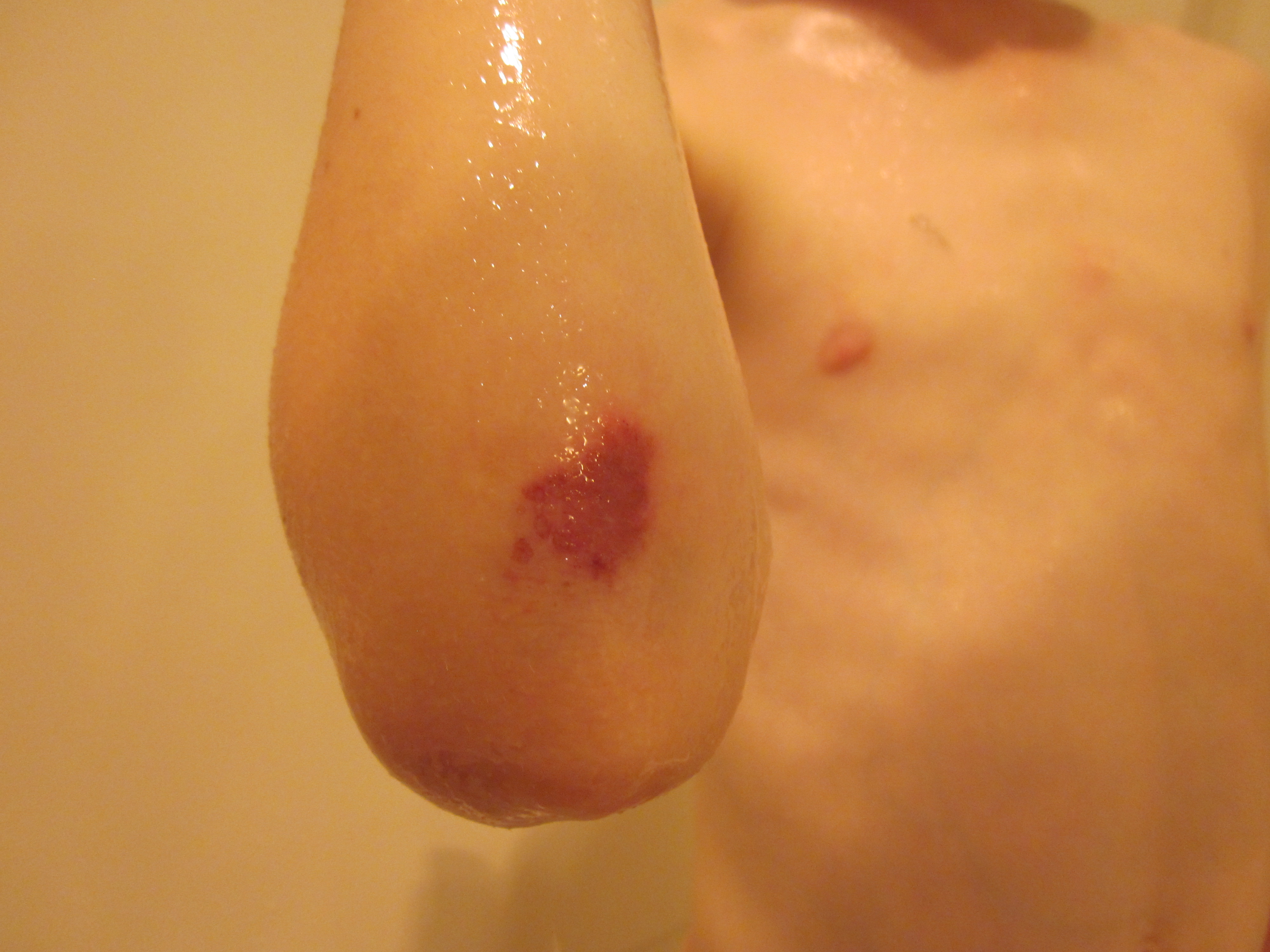
The photos of my leg are too gruesome to post, but my son had scrapes like these all over the right side of his body.
I was rear ended by a driver who claims he did not see me or the stop sign a few feet in front of us–I was coming to a stop, while he’d evidently planned to whiz right through the intersection at 15 mph. This is pretty bad, and although it probably would have been less bad if we were in a car, part of the reason he was going only 15mph is because it was on a street with lots of pedestrians (one of whom was a sheriff’s deputy in the crosswalk) and a protected bike lane. I had only gotten out of that protected lane to make a left turn at the stop sign. If we were hurt in a car, statistically speaking, it would likely have been on a different kind of street at a much higher speed. The NHTSA estimates that the average American driver has a 30% chance of being in a serious car accident in their lifetimes. Those are terrible odds.
That said I suspect that I’ll be making Copenhagen left turns exclusively for a long time to come. The way that I was hurt was the least likely car-on-bike collision on the books, but the thought of stopping at an intersection in front of cars now makes me edgy.
A commuter bike with two Bobike seats, just like Family Ride! I’m still jealous.
I still would like to be back on a bike though. Most of my rare trips out now involve riding in a car or a bus (my right leg is the hurt one, so I can’t drive myself) and they’re fine, but it’s seeing other people riding bicycles that makes me wistful. Heck, I’d like to walk again. It has been so long that I wonder whether I will have forgotten how.
One of the few advantages of being stuck at home in bed has been the opportunity to do massive amounts of reading. Sometimes it’s hopeless, because when I’m really doped up even trashy movies go above my head. But I’m getting a little more coherent and have been reading more interesting material, thanks to the San Francisco Public Library’s extensive collection and generous hold policy, and Matt’s willingness to stop by and pick up whatever I’ve ordered. He suggested I write about some of these books and call it Bad Hit Lit Crit. For the name alone I thought it was worth it.
Garbology (Edward Humes)
Picking up (Robin Nagle)
Rubbish! (William Rathje and Cullen Murphy)
So this year has turned out to be less about bikes and more about waste. That’s primarily because I won’t be riding a bike for a few months while I’m recovering from the broken leg. However even while stuck at home I can try to minimize our garbage. It’s harder—every time the physical therapist comes over we end up with a pile of medical waste that goes to the landfill, and the post-injury reliance on takeout dinners isn’t helping matters either—but it’s certainly possible.
Something that has struck me ever since I joined the university zero waste committee is that everyone supports reducing garbage. When I mention my zero waste assignment people immediately tell me that they recycle a lot. That’s only a small part of what I think about when I think about waste reduction but the response is interesting. When I mention that we bike with our kids there’s about a 50-50 chance people will be concerned rather than supportive. But waste reduction is a totally non-controversial idea, even among people who fill up an extra-large garbage bin every week. It’s not obvious to me why. The US is a huge country with a lot of middle-of-nowhere: objectively speaking, it’s not likely we’ll ever run out of room for landfills, and judging by our actions, we have a lot of stuff that we’d like to throw away. However nobody really seems happy about that.
Garbology, Picking Up, and Rubbish! approach the issue of waste from different perspectives. Garbology discusses the immense volume of waste produced by Americans and attempts to come to grips with how it’s handled. Picking Up follows one woman’s investigation of sanitation in New York City, which ends with her taking a job picking up trash in the city. And Rubbish! reviews the studies of the University of Arizona’s Garbage Project, which sorts through household waste and takes samples of the contents of various landfills. All of these books are fascinating.
There is an urban myth that dealing with garbage is a modern problem, which all of these books make clear is not the case. Despite the former existence of “rag and bone men” and other professions that recycled certain kinds of waste, there is ample anthropological and photographic evidence that waste was a massive and disgusting problem nearly everywhere until well into the 20th century. Garbage filled the streets and gutters of New York over a foot deep, and rubbish dumped into waterways was a persistent problem in multiple municipalities. Landfills are the source of most information about pre-literate societies. Until very recently, the idea of zero waste would have drawn blank stares.
An unnerving point made by all of these books is that despite the invisible nature of garbage collection, most households and businesses would collapse without regular pickup. Municipal sanitation strikes make this point fairly quickly (Picking Up). On average, Americans produce over 7 pounds of garbage per person every day of the year (Garbology). With our recent zero waste efforts our household could last for months if we had our own compost heap, but because we use municipal composting our situation would get ugly quickly without weekly pickup. (When we move, for this reason and others, it will be to a place with a yard.) Without weekly pickup, virtually every home in the US could serve as a case study of hoarders.
The things people throw away can be counter-intuitive. In the face of food shortages, people waste more food, presumably because people stock up more of scarce foods than they can really use (Rubbish!). People who eat repetitive diets waste less food. People throw away empty candy wrappers after Halloween and uneaten candy (still in the wrappers) after Valentine’s Day. Everyone grossly underestimates how much food they throw away, while simultaneously under-reporting their consumption of processed foods and over-reporting their consumption of produce. Hazardous waste, in the form of personal care products (nail polish), auto care products (oil) and lawn care products (weed killer) makes up a startling large share of ordinary household waste despite efforts to separate it. And very little degrades in a landfill; 50-year-old guacamole will not brown and newspapers remain legible after decades. Waste placed in a landfill is forever.
When I think about what bothers me about waste I realize it is two things: finality and a lack of respect. It takes time, effort and raw materials to create the things we purchase and use. Bringing something home and then throwing it away is disrespectful of the resources used to create it. I find this increasingly distressing when thinking about disposable packaging, which has only one purpose—to carry something from one place to another—and which lasts forever, particularly plastic packaging. Even worse, reusable packaging can easily replace its disposable counterpart. Food waste is even more disturbing; there are hungry people everywhere, and there is no reason to buy more food than we can or should consume.
The lack of respect we show to the things we throw away is equaled by the lack of respect shown to sanitation workers. Despite their enormous contributions to public health, they are often invisible. People prefer not to see them or speak to them. (One exception to that general rule is parents with young children; ever since our son was six months old we have been on a first-name basis with the people who pick up our bins thanks to his fascination with trucks.)
The more I learn about garbage the clearer it becomes that nothing really disappears. Things are stored in landfills instead of being stored in our homes but they are still there. It is difficult for me to look at a full garbage can the same way after realizing that everything in it will be around virtually forever, even if I can no longer see it. And given the quantity of things we throw away, by volume, waste is probably the greatest product of our society.
Waste is rarely something that we’re charged for directly, but it is not costless. There are still places where stores provide “free” bags although San Francisco is no longer one of them. Once I started shopping with reusable bags, the costs of packaging became evident: I could buy a pound of salad greens in bulk for $6 or a quarter-pound of salad greens in a plastic clamshell for $5. The first time I bought soap in bulk I realized that I’d been rooked for years: 20 ounces of organic dish soap in an old repurposed vinegar bottle cost me $1.52, while a new plastic bottle of the same soap cost $5 for 12 ounces. Our zero waste efforts reduced our costs because there was less to buy (goodbye, processed food) and because the things we could buy were closer to their original state (and thus cheaper) and because we weren’t paying the invisible costs of packaging. If we were responsible for our own garbage pickup costs (it is illegal for San Francisco landlords to pass garbage costs on to renters) we could save even more by switching to the smallest possible garbage can. Packaging costs invisible money at purchase and visible money in weekly garbage pickup costs. Avoiding packaging saves not only those costs, but the costs of buying things spontaneously that we have no need for and would ultimately throw away.
More important than the financial savings for me, however, is the greater sense of peace with how we are living. Although I can’t necessarily pinpoint why, throwing things away feels uncomfortable and somehow wrong. Now we rarely fill up the small garbage can under the kitchen sink in a week, even with our recent reliance on takeout. Some weeks we’re equally unlikely to fill the even smaller recycling bin. Those are good weeks. Now that I understand that away is not gone, generating less waste feels important. The things we have left in our wake have historically been things I would not want to be remembered by—crumpled plastic bags are an ugly legacy. Nevertheless, in the long term, both people and societies are known primarily by what they place in landfills. When I think about that, I want what we leave behind to have both meaning and purpose.
The last few weeks have been trying. My leg did not break simply, but dramatically. Both my tibia and fibula snapped in two, and above the breaks, the bones shattered into fragments. I was admitted to the hospital from the emergency room and went into surgery the next morning, where surgeons drilled into the unbroken ends of the bones and my femur to attach an external fixator. Because I was unable to move my leg with the weight of the fixator, I stayed in the hospital until the swelling went down enough that it could be replaced with internal fixation in a second surgery, specifically, a metal plate along the side of my tibia holding the bone fragments in place with a dozen screws. For much of this time I was given doses of narcotics so strong that I could barely string words into sentences. They did not really control the pain. This level of injury is apparently not unusual for people who get hit by cars, whether they are on foot, on a bike, or in another car.
When I was released from the hospital I was told that I could get full function in my leg back if I followed instructions. The most important one is no weight bearing for 12 weeks, with extensive home physical therapy. I initially had hopes that I would be able to work from home. But between the narcotics, which induce narcolepsy every time I try to read anything more detailed than my discharge instructions, and 6+ hours of physical therapy each day, this hasn’t happened and isn’t likely to happen for some time. I was told to stay at home except for medical appointments because the fracture is so fragile still that even being bumped on the sidewalk would be a significant risk. I’ve gone to the grocery store twice after my appointments—I was out anyway, and grocery stores have cool electric carts to ride that keep me off the leg—and passed out after each trip. I can’t work, I can’t take the kids to school, I have difficulty moving around the house, I’m constantly sleepy, and for at least four hours each day I’m stuck in a continuous passive motion machine, lying flat on my back. It’s been 3 weeks and I have 9 to go.
As frustrating as this is, it’s not a complete disaster. That’s because I have good insurance.
I work for a medical center and had a choice of several health insurance plans. Because I work in a medical center, I know how much a serious condition can ring up in expenses. I only considered the two plans that had no lifetime coverage limit. As a result, no matter how much my care costs, the insurance company will not cut me off. And I’m sure it will cost a lot. We haven’t seen many bills yet, but just the ambulance ride to the ER that I took with my son cost $5000. Add two surgeries, two weeks in the hospital, several weeks of home physical therapy, all the assistive technology, and an expected 18 months of follow-up and the numbers become staggering. There will be a financial reckoning for us at the end of this, of course, but there’s no point at which everything becomes solely my personal responsibility.
Because I am a professor, I also had the chance to buy affordable disability insurance. It’s cheap because it takes a lot to get professors to stop working. I like my job and it makes me crazy that I can’t do it. I will get back to work as soon as I’m allowed to drag myself into the office. Disability insurance doesn’t cover my whole salary, but it will ensure that twelve weeks off the job don’t topple us into bankruptcy. Being disabled is expensive. Matt has had to take time off work, we have had to line up sitters to take the kids to and from school, and there has been a lot of takeout. There was a co-pay for our son’s ER visit, I’m taking a dozen new medications, and Matt has had to arrange extra car rentals and rides that ferry me to various medical appointments. It adds up. I never thought I’d need disability insurance. Now I know better.
In a perfect world, the drivers who cause messes like these would be responsible for all of the associated costs. Unfortunately, not everyone is hit in front of dozens of witnesses as I was. Many drivers hit and run. Even drivers who don’t can be laughably underinsured. Most states require low levels of liability insurance, maybe enough to cover the cost of an ambulance ride to the hospital. And the kind of irresponsible driver who rams into a pedestrian or cyclist is probably not the kind of person who chooses anything more than minimum coverage required by law.
So I am very lucky: this situation is awful, but whatever happens with the driver’s insurance, I have coverage for my medical costs and part of my income is replaced when I can’t work. Not everyone is so fortunate. While everyone should have access to affordable health insurance, not everyone does. And disability insurance is even harder to come by: self-employed people often find they can’t buy it for any price. People who have the option to buy either or both kinds of policies would be crazy not to, especially if they have dependents. But what about people who can’t?
There is another way to get insurance for these kinds of worst-case scenarios, although it is more complicated. If you are hit by an uninsured or underinsured driver and have auto insurance of your own, any costs incurred for treatment can be covered through your uninsured motorist coverage, even if you were on foot or on a bike. Even people who don’t own a car can buy a named non-owner auto insurance policy—these policies are cheap, and also cover car rentals. For further insurance, especially for the self-employed who can’t buy disability coverage, an umbrella liability insurance policy will provide up to a million dollars that can be used for expenses that go beyond what any auto insurance policy will pay. These policies pay out after the fact, and that can take a while. But they will protect against bankruptcy and keep your kids off the street. And like named non-owner auto insurance policies, umbrella liability coverage is typically inexpensive.
I didn’t know much about any of this until I got injured. I never thought it would matter: I’m healthy and active and rarely sick. Why would I need disability insurance? I was lucky that my employer more or less defaults everyone into decent coverage. In hindsight, knowing what I know now, I realize that I could have made better choices.
I am bitter about losing time off work and the vacation time I had planned to spend with my children this summer. I am frustrated that I am stuck at home in bed every day and useless, and that there are many more weeks of this to come. I am angry when I’m in pain, which is a lot of the time, and that I haven’t even been able to take a shower for a month. I am depressed that while I can expect full range of motion to return in my right leg, I will probably never get my full strength back—I may not be able to ride an unassisted bike again. But I’m not afraid that we’ll go broke. And because of that, I can usually remind myself that this is temporary, and things will get better eventually. Despite my ignorance, it turns out that we were prepared for disaster. And we’re all still alive. It could have been much worse.
After two weeks in the hospital, I have returned to our place. Despite the fact that I wasn’t allowed to leave until I showed I was able to hobble up and down stairs on crutches, doing this at home, where we have many, many stairs, has left me exhausted. It will be months yet before life is back to normal. I will not be allowed to put any weight on my right leg until August. At that point the real physical therapy will begin. The good news is that my surgeon (also a bike commuter!) expects I’ll regain full function.
Aside from the injury itself, we feel very fortunate. Our families have cleared their schedules to spend time helping us, friends have been ferrying our kids to school and back, and my coworkers made sure my hospital stay was as comfortable as it could have been. I am grateful, too, that we know so many people who have broken their ankles, knees, and hips, and who have loaned us crutches, a bath chair, and other bits of assistive technology that I never imagined needing before.
I really appreciate all the well wishes. I had no idea so many people were reading the blog and found it valuable. It was a very welcome thing to learn during a difficult time. Thanks so much.
I’m not sure what, if anything, I could write about for quite a while. Although I’m likely to have lots of spare time in the next few months, I won’t be able to spend any of it riding a bike. And it’s a bit embarrassing to think about zero waste after spending so much time in the hospital, a place where a single bandage change filled a large garbage can. Moreover, I’m mostly bed-bound for the next two weeks (coming soon: a synopsis of ceiling cracks!) I’m open to suggestions.
In the meantime, locals can still catch Matt and the kids out on the Bullitt. Be sure to tell him he’s awesome if you do. Thanks for hanging in.
Last Sunday, while my son and I were riding in Golden Gate Park, we were rear ended by a car. The driver stopped, we have a police report, and our son was released from the ER that night. I have a shattered leg and will be hospitalized for some time. As much as I wish I could keep writing and riding, I’m going to have to take a break from both for a while. I hope to catch up in due time.













 Hum of the city