Tag Archives: bike commuting

Protected bike lanes on JFK Drive

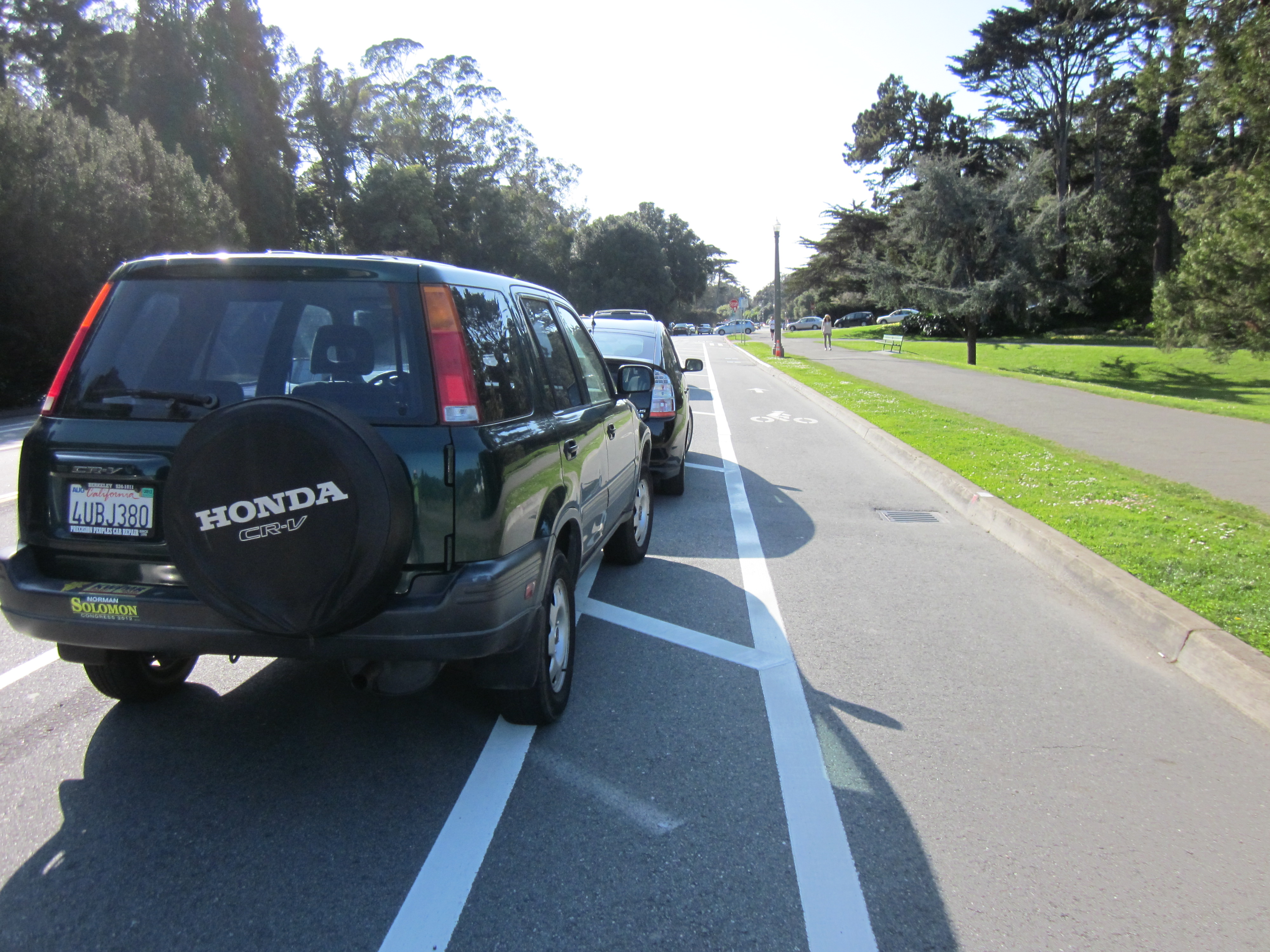
Most (not all) cars seem to understand the new lane markers

Recently San Francisco striped new separated bike lanes on JFK Drive in Golden Gate Park, which is a bicycle arterial through the western half of the city for commuters, including me. Thanks, San Francisco Bicycle Coalition! We take this route around the park with the kids on the weekends, but many more people take it east to the Panhandle on weekdays, and from there to the Wiggle and downtown. San Francisco is only 7×7 miles, so even people living at Ocean Beach can reasonably ride a bike all the way to work on this route, which is largely parkland, and now features protected bike lanes as well.

The new striping put two-way car traffic in the center of the road, with a parking lane to the side of each car travel lane. Then there is a buffer zone for car doors (so awesome!), a constant risk in the park, and a bicycle lane on the right at the edge of the road.

Am I a bicycle?

Figuring out the new system is apparently a struggle for some drivers. Although the bike lane is clearly marked, some people just can’t get over the idea of parking against the curb. This driver ignored all the cars appropriately parked in the strip to the left, not to mention an open parking space immediately to the left, in order to block the bike lane. It’s rare that I would advocate for a narrower bike lane, but maybe that might help this person get the point. Maybe not, though, as the car is parked right on top of a bike lane marker (an oppressed bicycle).

We don't need no stinkin' buffer zone

Still, having ridden these new lanes all week, I like them. Although I find it annoying that nearly all the cars park over the line so that they’re sitting in the door buffer zone to the right. Apparently drivers don’t really like being forced into moving car traffic when they’re stepping out of a parked car. The doorers now get to experience the consequences of dooring. Welcome to my world.

Leave a comment

Filed under advocacy, commuting, San Francisco

Preschool rider

This is the way we don't ride to preschool

For months our daughter has begged for a bike ride to preschool, and for just as long we have dismissed the idea as impractical. It is a smooth start up a slight incline, but once you turn the corner, the hill up to her school is extremely daunting. The usual nose-in parking by cars to prevent roll-aways, given the incline, implies that the hill is almost untouchable by anything but Tour riders (and not Tour de FU riders—totally NSFW) or electric bikes. Cars can make it, of course—but often parents park in a lower lot and take the freight elevator up. It’s not even fun to drive up that hill.

One preschooler on a Kona MinUte

But today when I was walking out the door, Matt came home from dropping off our son at nature camp for the furlough day. He had taken a new, hilly route back and was already pretty overheated. But he wasn’t too concerned about it because he is working from home today.

Headed up the shallow hill on the approach

As usual she asked for a ride on the MinUte and he said, “Why not?” So today she got her first ride to preschool on the bike. She had a blast. But Matt almost popped a wheelie with that much weight on the back on a steep hill. She may have been the first child ever to arrive at our preschool by bike. Maybe with some weight added in a front basket to balance the bike better we could try it again, though.

Leave a comment

Filed under commuting, family biking, Kona, San Francisco

Destinations: Splendid Cycles

Little shop, big idea

I really had no idea what to expect when I visited Splendid Cycles. You can’t tell much about a bike shop will be like from a website (assuming one exists), although you can get a sense of what they sell. And I liked what they were selling. Joel, one of the owners, seemed pretty nice when I emailed him (and turned out to be just as nice in person). Yet visiting the store made it clear how much I have been missing by relying on the internet to learn about cargo bikes.

The average bike shop I have visited tries to have something for everyone, and that often means aiming directly at the market of people who are thinking about getting a bike for the first time. But it is fairly difficult to hit the price point that novices think is reasonable for a new bike (as I’ve mentioned before, based on talking to non-riders, of which there are many up the hill in my neighborhood, that price is: $100). But almost all bike shops seem to have a few bikes near the front door in the $300 range or so, not too overwhelming for the perennially broke college student, but a pretty stripped-down machine by any measure. The other day while chasing down my daughter in a bike shop I overheard a family discussing why two bikes that to their eyes looked identical were priced at $350 and $700 respectively. Like me several months ago, they had no idea.

Ahearne Cycle Truck: not a kid-carrier, but hauls other cargo

However cargo bikes are more expensive than other bikes. At their cheapest, new cargo bikes run about $1,000. The price difference reflects the fact that these bikes are capable of doing much more than carrying a student around campus. When you’re hauling real weight, on other places than the seat, everything has to be somewhat higher quality and differently designed, or you end up like my colleagues who tried to put child seats on their bikes and immediately broke all their spokes. And as cargo bikes become more capable, and as you add more accessories, like child seats and cargo bags, their prices rapidly rocket past that $1000 mark even for the least expensive models.

(As with everything else, handy people have more options. People who feel comfortable working on bikes can pick up bikes or trailers or Xtracycle FreeRadicals on craigslist and turn them into something greater than the sum of their parts. I admire their skill, but I’m not one of these people. And I would guess that in this I’m like most parents, unless by happy coincidence they happen to be bike mechanics or living with one.)

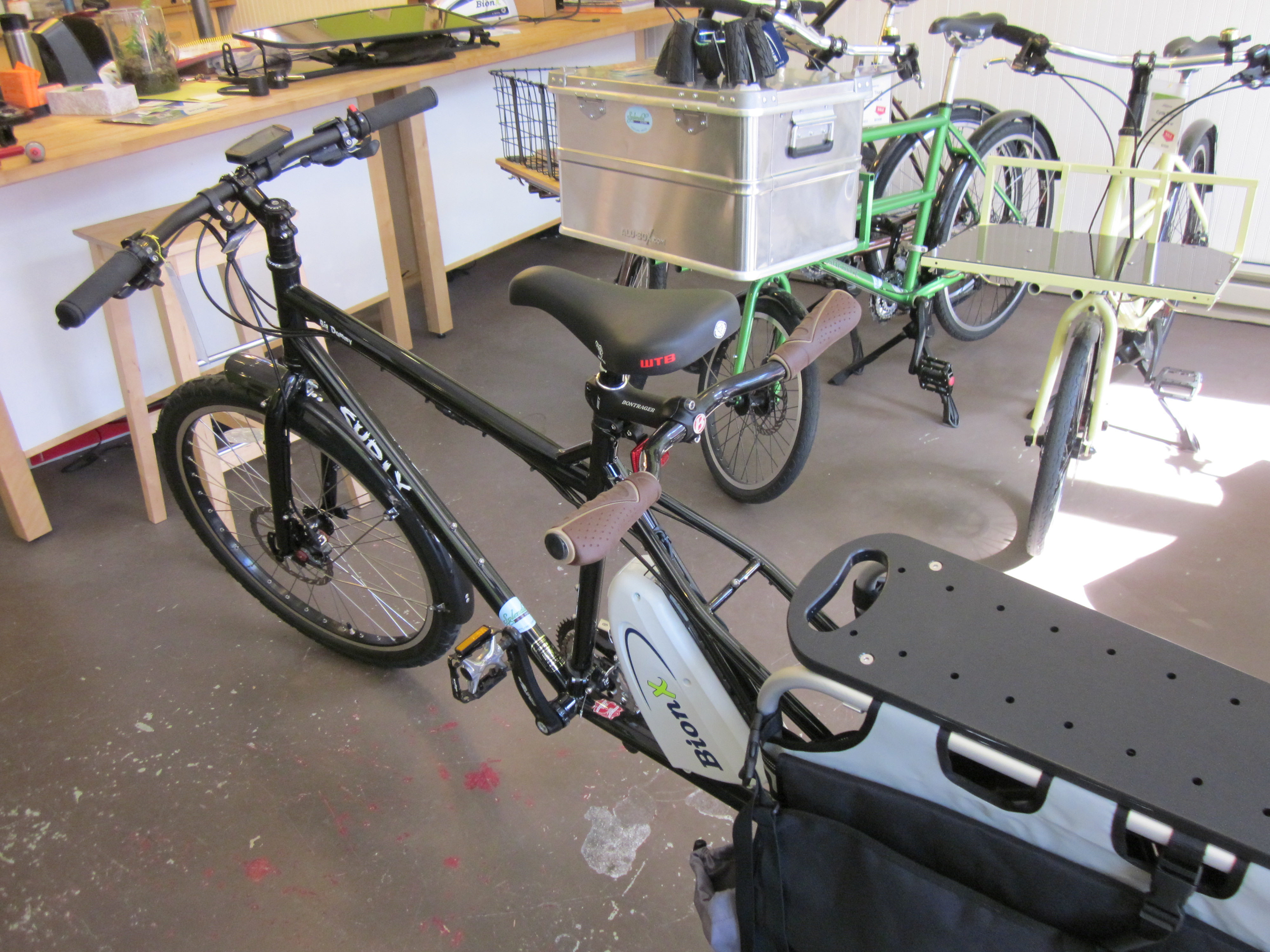
Big Dummy with BionX: definitely a family-friendly bike (also: seating for visitors, nice touch)

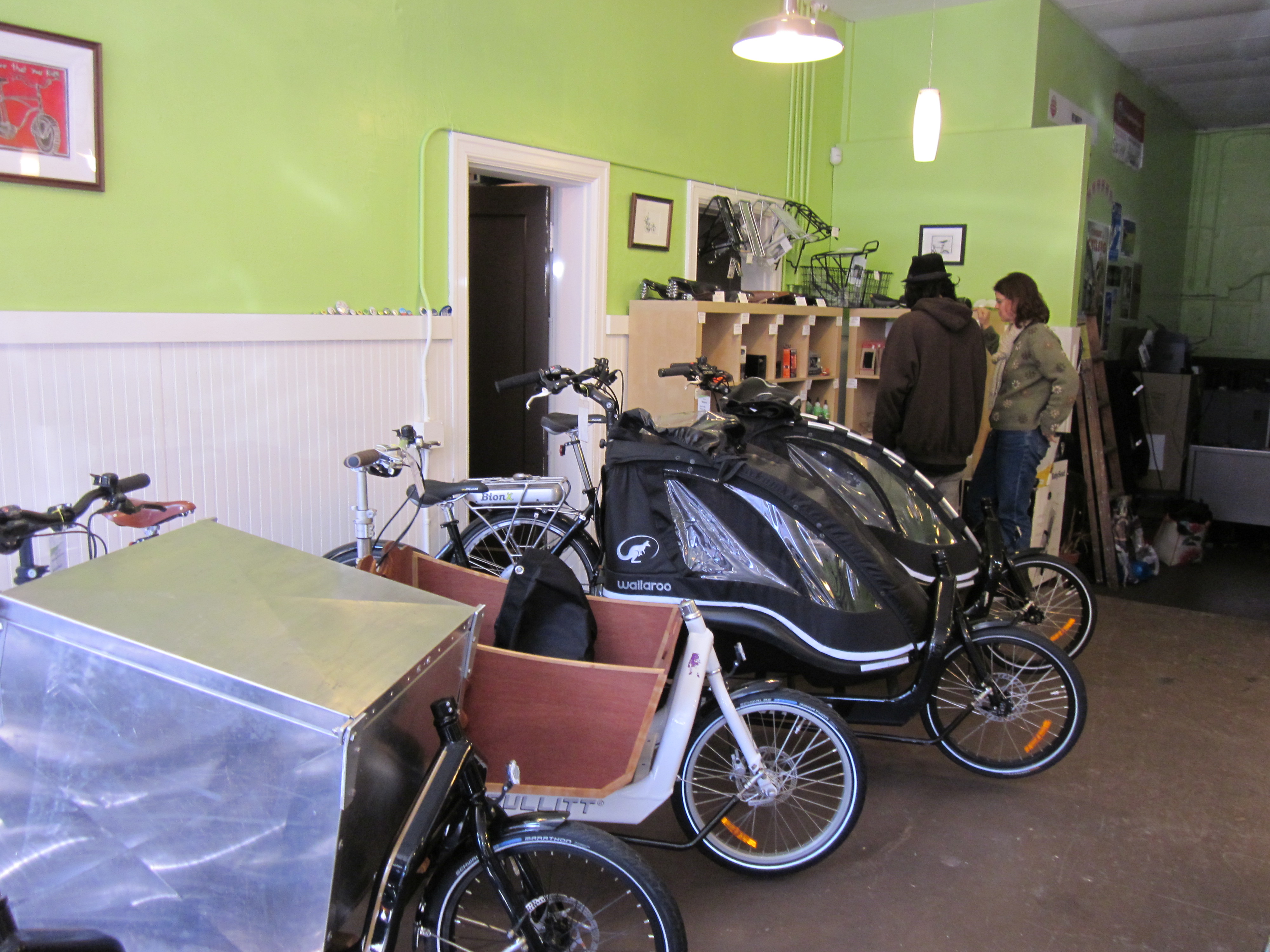
Which brings me to Splendid Cycles, because it is the only bike shop I’ve ever seen that is exclusively selling bikes that replace family cars, but that still retain most of the advantages of ordinary bicycles. For our lives right now, visiting Splendid Cycles was a revelation.  We don’t use our bikes just to noodle around the park on weekends (although that’s fun too), we use them to move ourselves and our stuff and our kids around town. I had always assumed that this required certain compromises: going more slowly, adding after-market accessories to make a Franken-bike, giving up going up and down hills, or being unable to get the bike inside if you live above ground floor. You can get a heavy Dutch bike if you live on the ground floor, in the flats, and don’t mind going slowly. Or you can cobble together family bikes from child seats and odds and ends like we’ve done and maneuver through traffic and actually make it up real hills, slowly, if you’re strong. Or you can go to Splendid Cycles and be blown away by seeing a dozen bikes that don’t require you to make those compromises.

Metrofiets cargo bikes

Splendid Cycles carries Metrofiets cargo bikes, which I had heard of but never seen in person before. As cool as they are, I realized immediately when I saw them that a Metrofiets would never fit through our narrow basement door. (Less than one minute in the shop and I’d already justified a trip across Portland.) The Winther Wallaroo looked even better for carrying kids, with outstanding seating, but had the same problem from my perspective: unlikely to make it into our basement. They carry Ahearne Cycle Trucks, which look pretty clever for carrying cargo but are not really designed to carry kids, so those aren’t our bikes either.

They had a Big Dummy, which is designed to haul kids, among other things, and another one of which I used to carry my own kids across Seattle a week later.

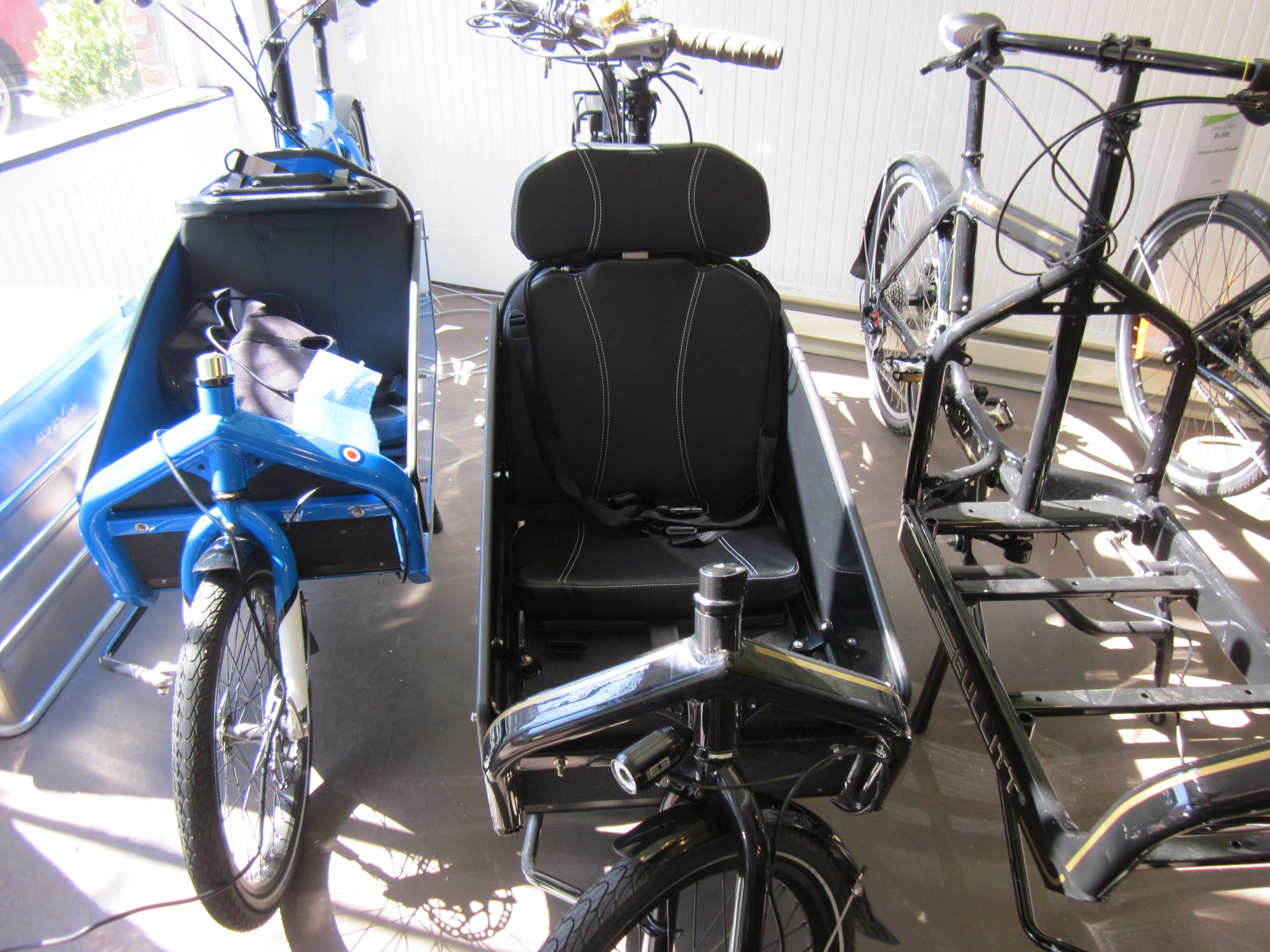
Bullitts, both with and without child seat

And rounding out the kid carriers, they had a bike I’d never seen before, the Bullitt. From the perspective of a city rider, this is probably the most interesting bike they sell. The Bullitt is narrow and lightweight; even with the child seat on it could probably be carried it up a flight of stairs. It can make it through traffic pinch points and climb hills. It is not perfect for our needs; the narrow child compartment probably limits its capacity to one of our (now older) kids. On the other hand, you could put a trailer-bike on the back (Joel’s great idea, not mine, he was full of them). It could be a great dad bike, but I can’t imagine riding it while pregnant; it does not have a step-through frame. But if you’re done having kids it would be something to consider.

Wallaroos, rigged for all-weather riding

Walking into Splendid Cycles opened an incredible sense of possibility; there were so many bikes we’d never imagined that could do what we wanted them to do. Our kids would have loved this shop; getting them out of a Wallaroo, once spotted, would be almost impossible. And to top it off, at Splendid Cycles they know a lot about electric assists, which make these bikes reasonable options for people who live on hills. I didn’t understand the strengths and limitations of the BionX and whether it could handle San Francisco elevations when I walked into Splendid Cycles. Now I do, and yes it can. Overall I learned more about both cargo bikes and electric assists in person at Splendid Cycles than I’d learned in hours of reading reviews. It was amazing to be able to talk to Joel, who wasn’t figuring this out as he went along like we’ve been; he’d already thought about what was involved in riding with kids or cargo in traffic and on hills and had put together a half-dozen bikes, which were sitting right there, with electric assists, to solve our kinds of problems.

This kind of expertise and fit for our needs comes at a price. And at one point that kind of price left me in shock, but I now realize that these bikes are worth it. They cost as much as the first car I drove, but that car was a junker, whereas these bikes are as reliable as bicycles can be.  Furthermore, the bikes are more practical for moving around the city than that car. These are true car replacements, except we’d never have to worry about parking again.

Thanks to Matt’s bike maintenance class, we’ve recently learned more about the compromises manufacturers have to make to get the price of cargo bikes down around $1,000 (crappy brakes, tires more likely to get flats, etc.), and we’re now spending money to upgrade the MinUte to become more like the bike we want. So in many cases it’s a choice between paying up front for quality or paying later for repairs and upgrades. There are legitimate reasons to choose one or the other, but it wasn’t a choice we realized we were making at the time.

From my perspective, Splendid Cycles isn’t a Portland destination so much as a destination in its own right. It would justify a trip to Portland by itself for the right family. I met a father from Eugene visiting the shop who’d decided just that. It was definitely worth visiting given that I was already in Portland.

Worth the trip

Joel pointed out that Oregon has no sales tax, and that having Splendid Cycles ship a bike somewhere would cost less than the sales tax in less enlightened locales. I am an employee of the state of California and thus feel guilty for even mentioning such a thing, but for less tormented souls, this is yet another reason to talk to Splendid Cycles about cargo bikes.

There are lots of reasons to be impressed by Portland’s bike culture, but its breadth still amazes me. I never imagined a bike shop like this could exist. Splendid Cycles has put all its chips on our kind of bicycles. It is a bet that the world will change to make space for many families like ours, and that one day hauling kids on bikes will be as unremarkable here in the US as it is in cities like Amsterdam and Copenhagen. I don’t think this will happen here while our kids are young enough to ride on our bikes, and I am envious that Portland can support a shop like this. I wish there was a Splendid Cycles in every city.

1 Comment

Filed under bike shops, cargo, destinations, electric assist, family biking

I do, in fact, wear a helmet

It looked even less like a helmet when it was fitted wrong

I never really liked the look of helmets. But I never really liked the look of rain pants, either, and I wear those. When we rode bikes in Copenhagen, we didn’t wear helmets, mostly because we got blank stares from the bike shop owners when we asked about renting them (they did, however, have helmets for the kids to rent).

The blank stares reflected the fact that there is little reason to wear a helmet while riding a bicycle in Copenhagen, where there is extensive protected bicycle infrastructure and drivers know that hurting or killing someone who is not in a car would have consequences. Like losing a driver’s license. Pedestrians and bicycle riders in North America may now laugh bitterly.

So I was delighted to discover that there was a helmet I would not be depressed to wear, by a Danish company no less, the Yakkay. It costs a freaking fortune, compared to other helmets, but honestly, even expensive helmets are not that expensive compared to other things, like, say, a tank of gas these days. The Yakkay does not look like a helmet. It looks like a goofy hat (see also the Lazer CityZen). My kids call my Yakkay the hat-helmet. It has some advantages over a traditional helmet; one of them is that like a hat, it provides ample sun protection. It can also be difficult to fit correctly, which is a hassle and annoying for an expensive helmet, but not really a long term kind of problem.
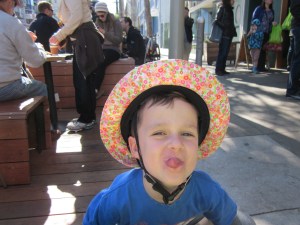
My kids think my helmet looks goofy. I can't argue with that.

What I did not anticipate when I started wearing this helmet is the widespread perception by the rest of the world that I wasn’t wearing a helmet at all, and “the rest of the world” includes bike shop owners. I get lots of compliments on my “hat,” and occasionally, I get dirty looks or comments about how I should be wearing a helmet if I’m riding with my kids. This IS a helmet, I say, rapping my knuckles on it. “OH!” is the typical reply. “That’s COOL!” But I have begun to realize there are a lot of people who pass judgment without bothering to ask.

Why wear a helmet at all? My mother was surprised that this was actually a serious question. Of course bicycle riders should wear helmets, right? I don’t think it’s so clear-cut, but there are some reasons one could go either way.

Why not? It’s not clear whether helmets are really that protective, relative to the costs. There’s no such thing as a risk-free activity, and we all make choices that balance cost, safety, and convenience. People may drive (less safe) instead of riding the bus (more safe); people eat processed food (less safe) rather than preparing food themselves (more safe); people cross against the light in the crosswalk or fail to make a complete stop at stop signs. Some people find the cost of purchasing and the inconvenience of remembering to carry a helmet not worth the potential increase in safety. Bicycling simply isn’t that dangerous in most circumstances, and helmets don’t protect against many of the likely risks. A culture that demands helmets make bike share programs much more difficult, and creates the perception that riding a bike is a dangerous thing to do, rather than just another form of transportation. Pedestrians and drivers don’t wear helmets, despite the fact that in some circumstances their need for them may be greater. My colleagues at SF General joke darkly that pedestrians in the city probably should be wearing helmets, at least in certain neighborhoods.

Which brings me to the opposite question: why? The short answer to that question for me is that I don’t live in Copenhagen. In a city like San Francisco, where trauma physicians can make a serious argument that pedestrians should be wearing helmets to walk across the street, wearing a helmet while riding a bike starts to look pretty reasonable. I’m going faster than a pedestrian, so if I’m hit I’ll land harder, and I don’t have the same legal right-of-way.

Not that that necessarily matters. Recently, while riding the university shuttle, I watched the driver mosey between two parked trucks into an intersection only to stop dead just before mowing down a man in a wheelchair. “Oh my god!” he cried. “I didn’t even see him!” Seriously? Dude, it is your JOB to drive safely enough that you don’t mow down people in wheelchairs in the crosswalk. But “I didn’t even see him” is the driver’s equivalent of the “Get Out Of Jail Free” card in Monopoly. It works when mowing down pedestrians and wheelchairs and it works when mowing down bicyclists.

San Francisco, like a lot of cities, is undergoing a commuting shift. There are more bicycles on the road than there used to be, and there are, sadly, drivers who view that as an unacceptable imposition on the world that they were used to experiencing. With the protection of a two-ton vehicle, these drivers can express their opinions very dangerously indeed. That’s no reason to get off the road, but it does make me modify some of my choices. I don’t ride my bike on Masonic, for example, or any of the other streets in San Francisco that are widely recognized as high-speed arterials for driving. And I wear a helmet.
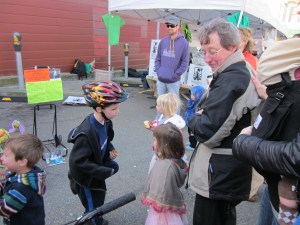
My son's helmet has flames on it, and he'll wear it everywhere he can.

There’s also the issue that although wearing helmets is optional (but encouraged) for adult riders in San Francisco, it is required for children. We are very fortunate that our children have never objected to wearing helmets, which is by no means a universal sentiment among the small. They like playing dress-up and we let them pick their own helmets (within their size range), and that helped. But part of the reason we’ve been so fortunate is that we ourselves wear helmets and have never given the impression that it’s an imposition or a hassle. It’s just something we do before we get on the bike, like checking the brakes or packing the lock. Many of the parents who have complained about their kids not wearing helmets admit that they themselves either don’t wear helmets or that they complain about it. We’d much rather wear helmets without complaint than risk not riding at all because our kids refuse to wear their helmets.
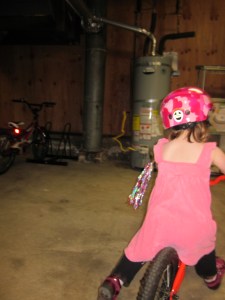
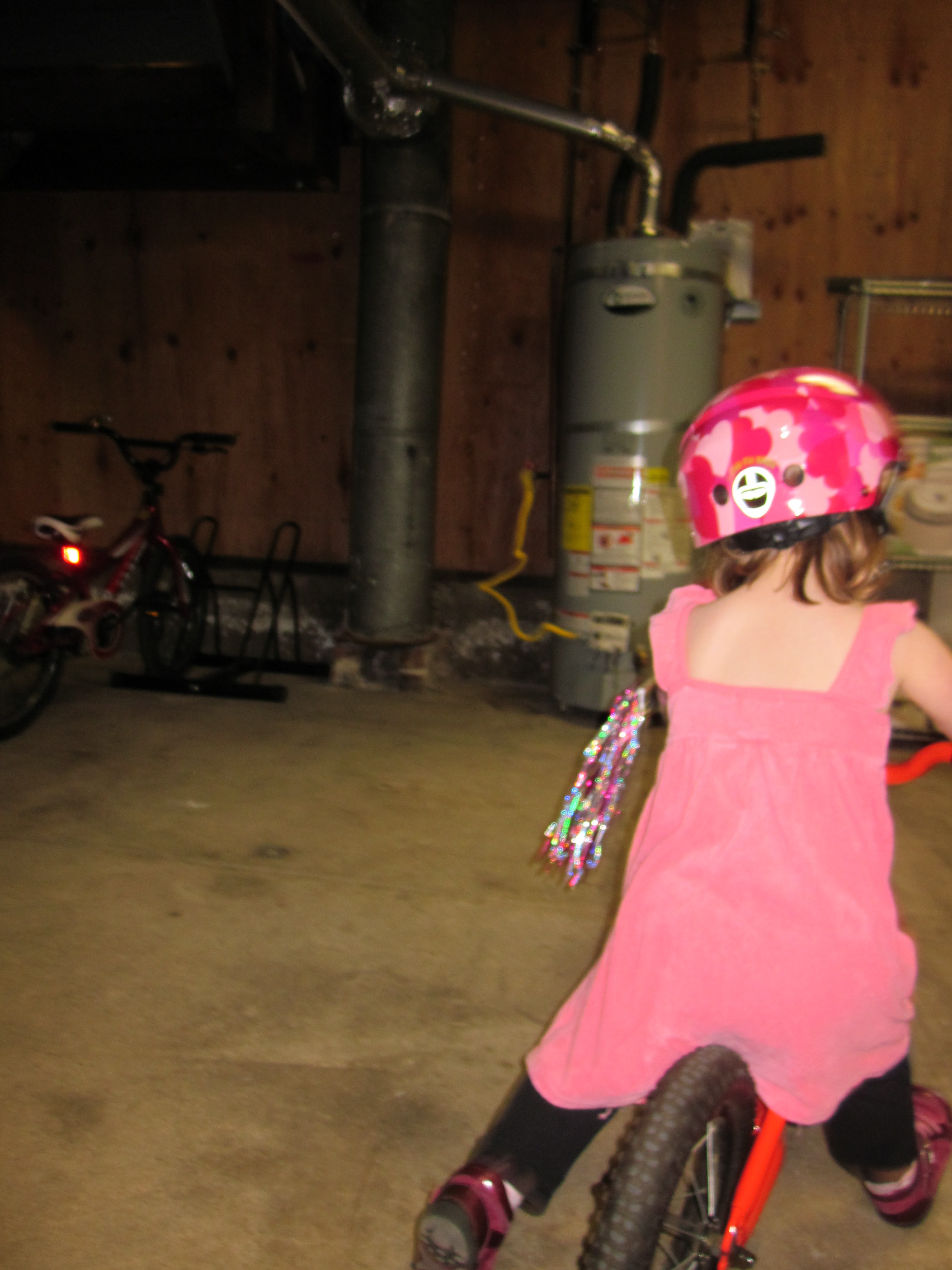
My daughter wears her helmet while practicing riding her balance bike in the basement, because it has pink hearts on it.

I do a lot more stupid things to fit in and smooth our daily lives than wearing a helmet when I ride a bike. My helmet is either cute or goofy, depending on whom you ask, and it keeps the sun off my face, and that makes wearing it even less of a burden. It provides some extra protection against accidents (just as a helmet would for a pedestrian or driver), and weighed against the marginal imposition it makes on my life, I choose to wear the helmet every time.

Other people make different choices based on their life circumstances, and I have zero problem with that. I don’t judge other riders for not wearing helmets, and I’ll defend their choice when it comes up in conversation with people whose knee-jerk response to seeing a bicycle rider without one is to call them crazy or stupid. That said, I won’t ride with adults who aren’t wearing helmets when I’m with my kids, as the idea that wearing helmets could be optional is a can of worms I am not ready to open with them.

So I have this crazy hat-helmet, and in the tempest in a teapot that is the question of whether bicycle riders should wear helmets or not, I now get to experience the moral high ground and various minor inconveniences of wearing a helmet as well as the opprobrium of people who think I’m setting a bad example for my kids and risking my own life by not wearing a helmet at all. It is not something I expected when I bought the Yakkay, but I can live with that too. Knowing what I know now, I will not, however, ever buy their kids’ model, even though I think it’s super-cute.
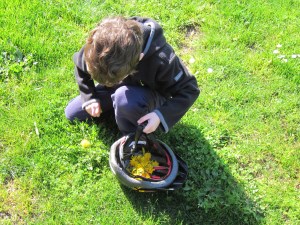
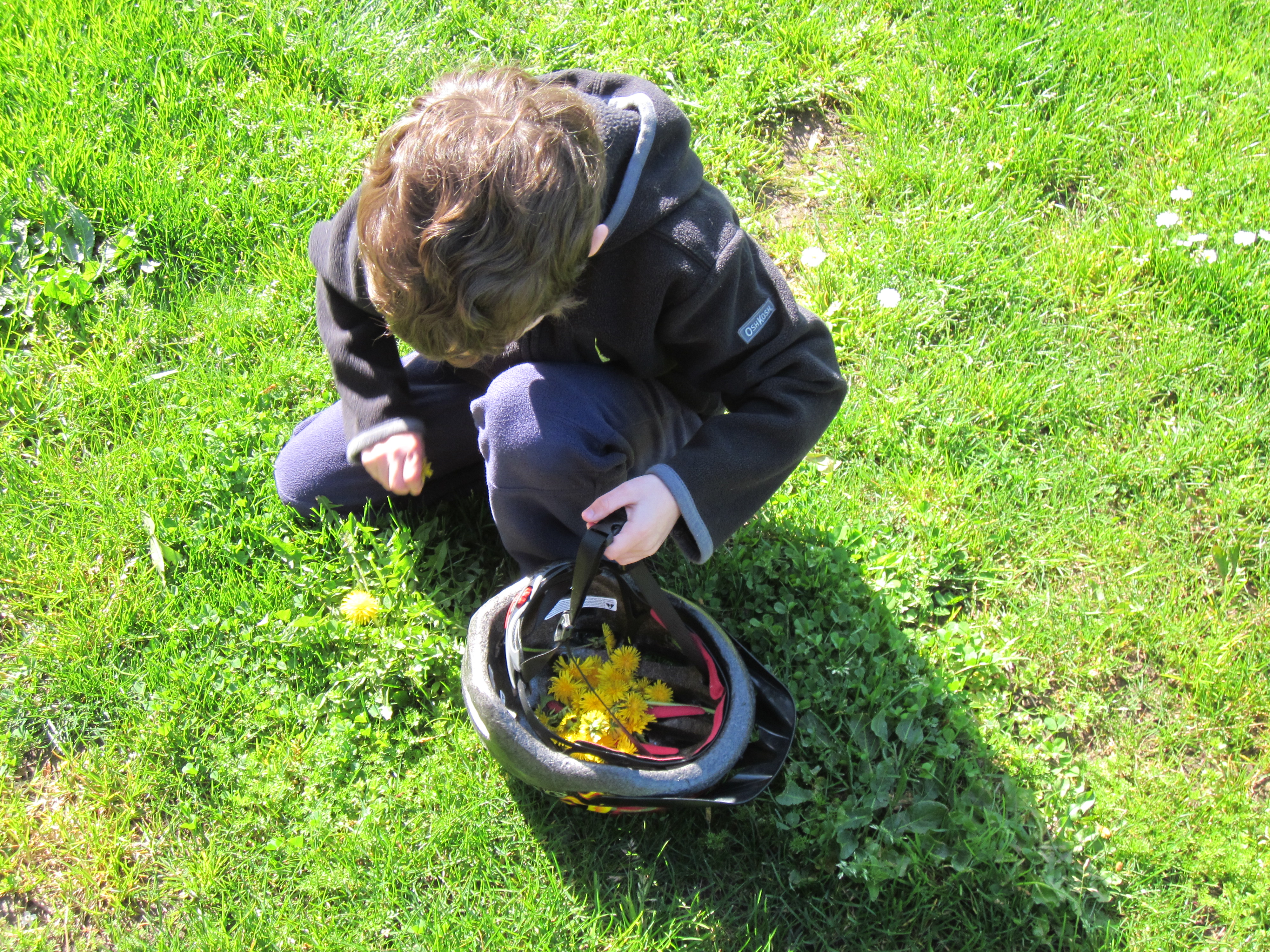
Helmets are also handy while picking dandelions in the park.

I think that there are much bigger problems to worry about in North American cycling than helmets or the lack of them. I find advocacy about helmets, whether pro or con, tiring. When cities in the US have the infrastructure to make cycling feel safer, like extensive protected bike lanes and stronger legal protections, I suspect that bicycle helmets will become a quaint relic of a more dangerous time, used only by certain specialists, much like chainmail.

Until that happens, my feeling is that arguing about whether or not to wear helmets is like arguing about whether a red fire truck is more visible than a neon green fire truck. Maybe one color will make drivers pull over more quickly and thus help get the truck to its destination a little more quickly, but a better use of everyone’s time would be preventing the fire in the first place.

2 Comments

Filed under commuting, family biking, San Francisco, traffic

It is in no way an overstatement to call Portland the bicycling capital of North America

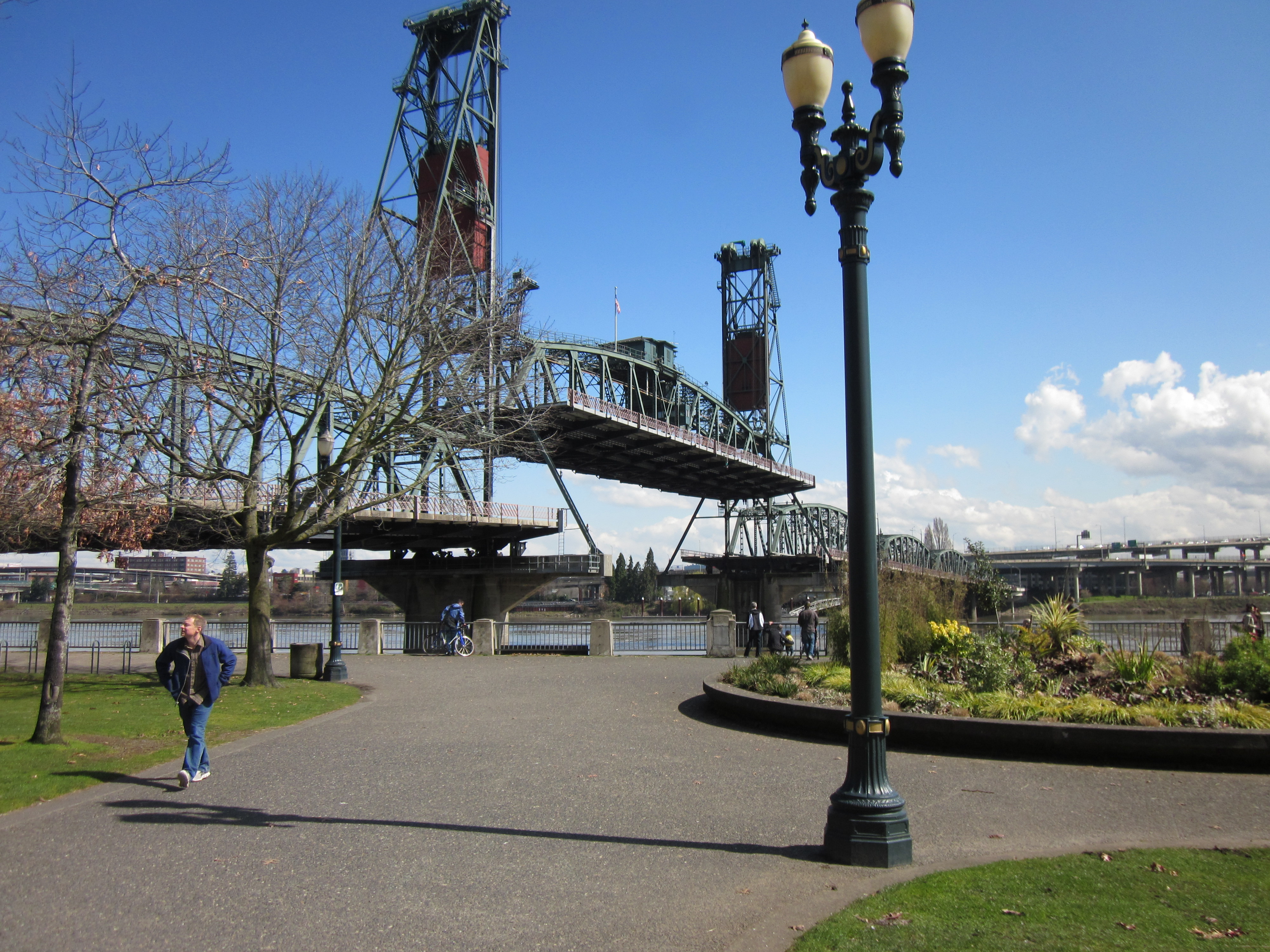
Watching the Hawthorne bridge go up

Technically I was in Portland to attend a professional conference, but in case it wasn’t obvious, I blew off some of the part that involved sitting in windowless hotel rooms listening to other people talk.

Due to a rare convergence of travel schedules, my kids were in Washington with my mom while Matt was flying to China. But I had a pretty non-negotiable commitment to give a talk on Saturday morning in Portland, so I wasn’t going anywhere until then. So on Thursday and Friday, for the first time that I can remember, I had minimal work obligations and zero responsibility for my kids. And I was in a city filled with awesome bike shops and a bunch of friends from graduate school that happened to be experiencing a freak early spring. The result was that most of the time I bounced around Portland feeling as giddy as a dental patient on nitrous oxide, without any of the painful drilling.

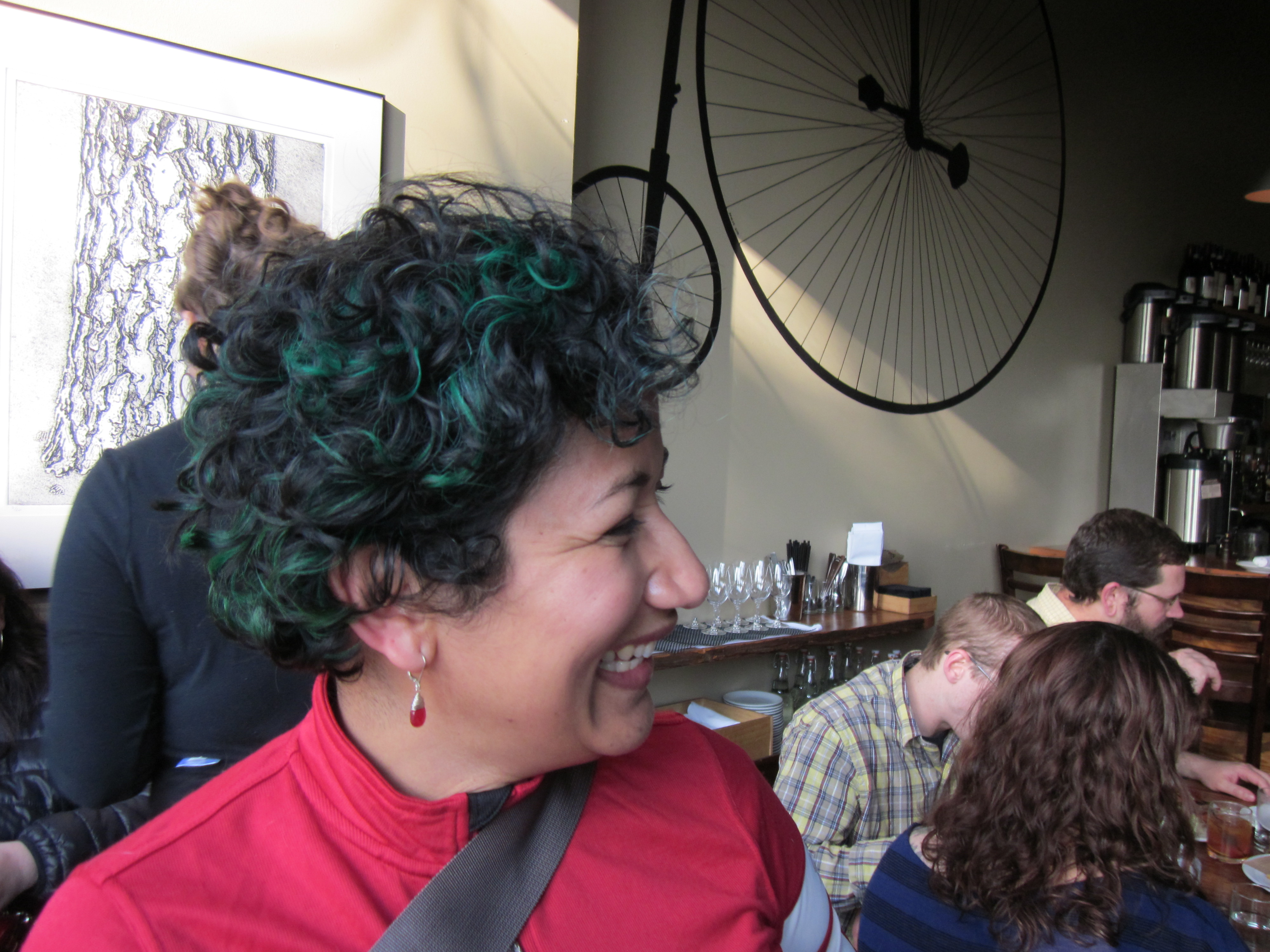
Jackie has green hair (pics or it didn't happen? no problem)

My friend Todd, who lives in Portland, got conscripted to be the cargo on a cargo bike, but my friend Jackie, who also lives in Portland, actually rides a bike of her own. This is something of an understatement, as she regularly rides Cycle Oregon. She has a road bike like a real racer and wears lycra. In fact she has three bikes. When she told me she was impressed that I commuted on my bicycle, my reaction was complete disbelief. I’m pretty pleased with myself if I cover 5 miles; she sends us updates on her long rides every ten miles or so. Sometimes there are several of these in a single day.

Anyway given that I had a rental bike in Portland it seemed like it would be fun to ride it to meet her somewhere, and so that’s what I did. She picked a restaurant between her house and my hotel and gave me what seemed to be pretty implausible directions, which I summarized mentally as, “It’s complicated, so do what the other bicycles are doing.” It seemed kind of optimistic to assume that there would be enough other riders around to make the route obvious, but boy, was I wrong.

Follow those bicycles (or barring that, the 15 others behind me)

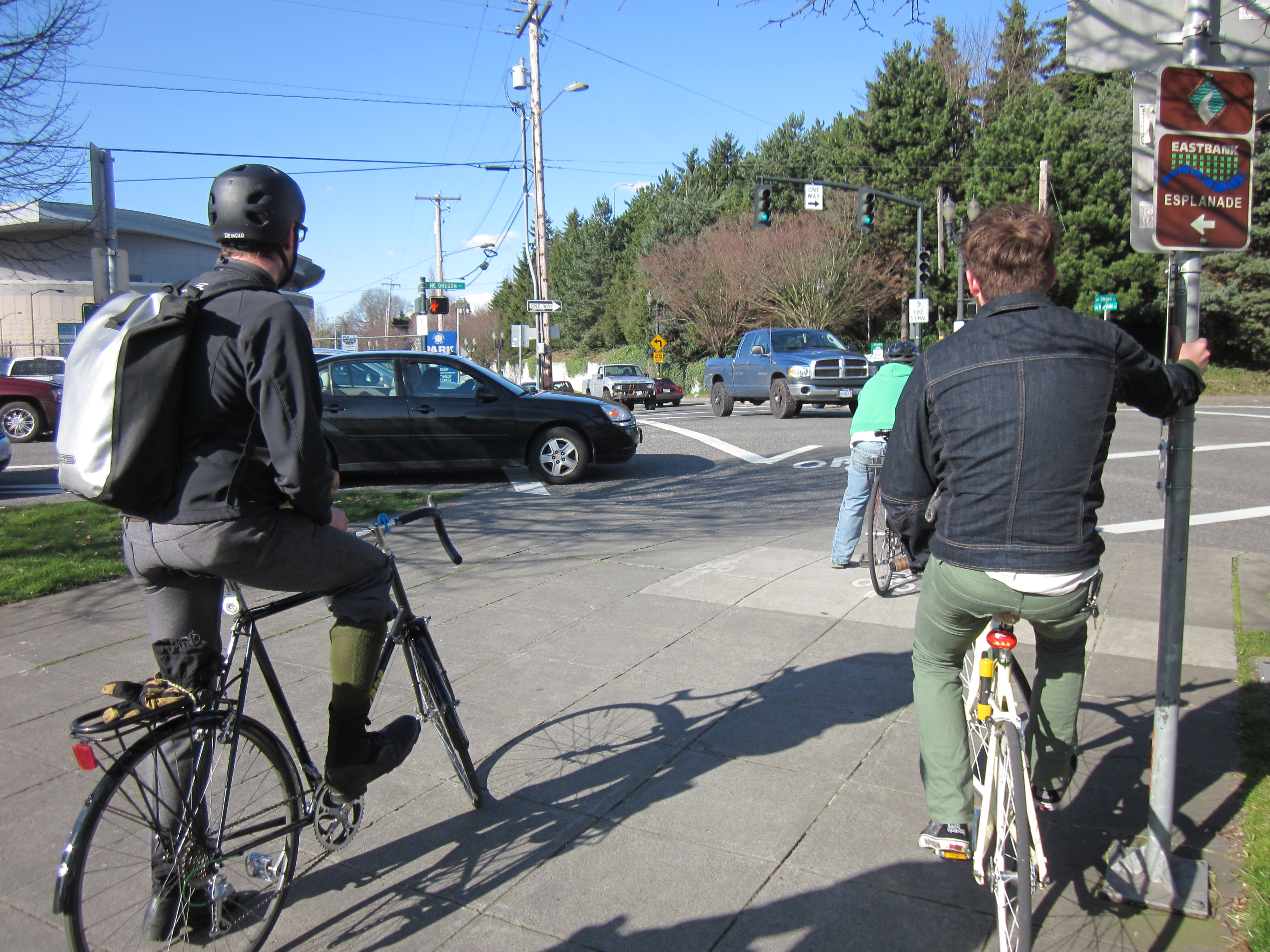
I am used to riding in car traffic, but rarely ride in bicycle traffic. Even in the Panhandle, which I used to consider a busy route, the bikes are pretty spread out. But riding in Portland during commute hours was actually a little unnerving, because there were dozens of bicycles in the lane. At more than one point during my ride I wanted to stop and get a picture of one of Portland’s many weird and wonderful bike lane markers, which include disembodied riders without bicycles, riders wearing helmets and riders not wearing helmets without any apparent rhyme or reason, riders with the heads of dogs, riders flying off their bicycles jauntily, etc. But I couldn’t figure out how to politely stop to snap a photo. That never happens to me in San Francisco.

Full bike corrals on every corner, 40 acres, and a mule

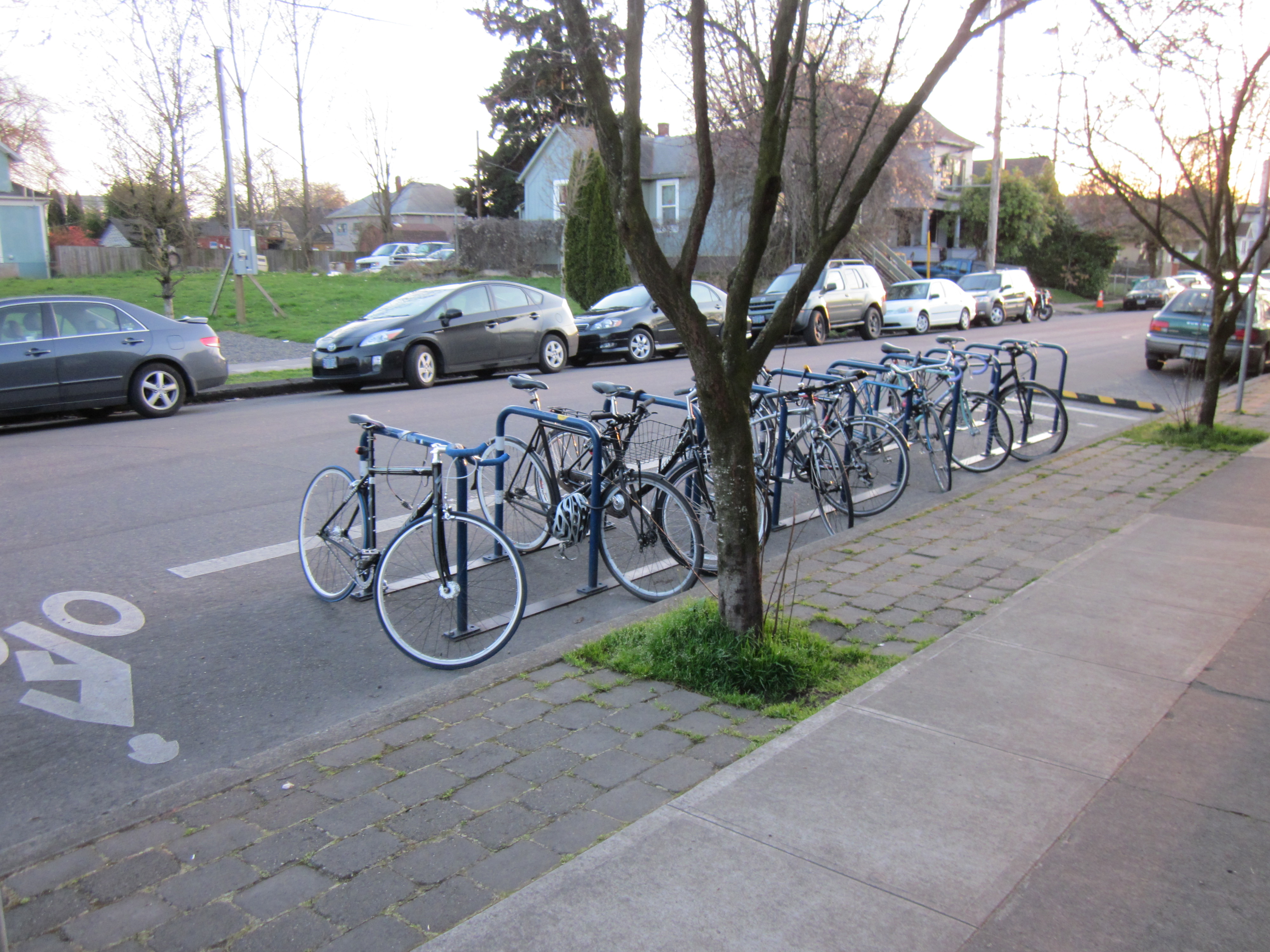
Jackie picked an amazing restaurant, of course. And its bathrooms were in a hallway shared with a yoga studio featuring a row of inside bike parking against the wall. And those bathrooms had showers. Really, Portland? Really? It is rare that I have the occasion to feel like a yokel after living in San Francisco for several years. But I might as well have been barefoot and wearing a straw hat and overalls with all the gaping I did when I saw things like this. Portland has ripped out street parking for cars to put in bike corrals. And it’s not just a demonstration project, it’s all over the place. And those bike corrals are full.

What better advertisement for your bike shop than a beer bike?

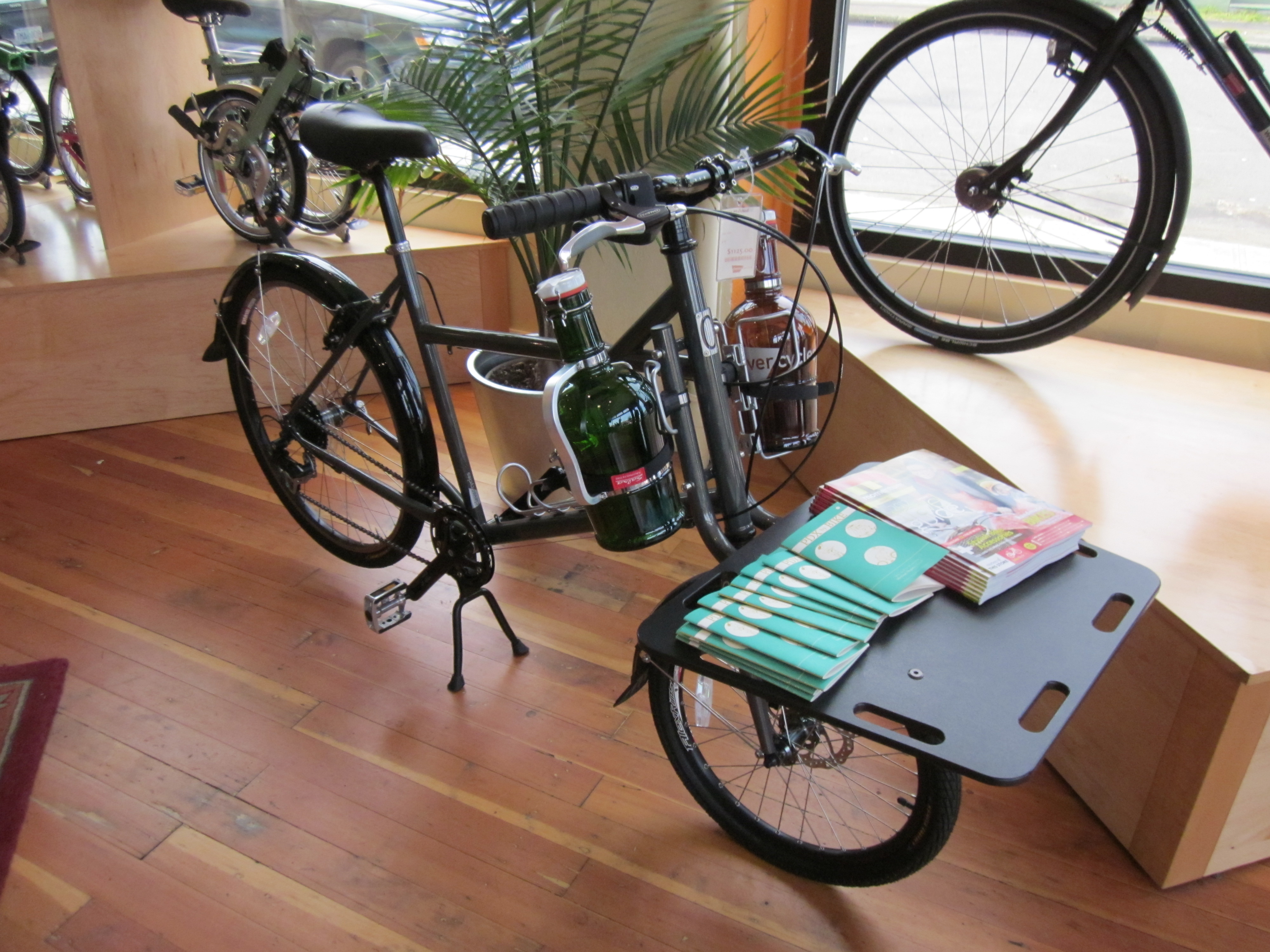
After dinner Jackie proposed that we ride over to see another grad school friend she sees regularly but I hadn’t seen in years. Steve lives in a pretty neighborhood with his lovely wife and two charming little girls, and was making dinner for them when we appeared unannounced on his front porch. They are in the school lottery for a Japanese bilingual program for the girls, and so we had lots to talk about. Jackie, who speaks excellent Japanese, thought it wasn’t such a hard language. I, who can speak just enough Japanese that I might be able to find a bathroom and not starve if air-dropped into Tokyo, disagreed, as did Steve. Steve offered us beers. Everyone offered me beer constantly while I was in Portland, it’s even more of a thing than the bikes. These twin obsessions were perfectly merged in a bike I saw at Clever Cycles rigged to carry two growlers. I’m not a huge beer fan and people always seemed vaguely disbelieving when I declined their offers, like I’d just belched in their faces but they were too polite to comment.

I asked Steve what he’d been up to for the last few years; I hadn’t seen him since before we’d had kids. “Oh, nothing much,” he said.

“He won a Pulitzer and was a finalist for a second one,” said Jackie.

This is why I don’t get to live in Portland. I am insufficiently awesome.

Modified Portland bike lane marker

I rode back to my hotel that night buzzing on all of it. Even late in the evening there were many other riders on the trip back, and we all expressed disbelief at the amazing weather. We could do this because like me, those riders all stopped at traffic signals. On the trip back across Portland’s Steel Bridge I passed three pedicab drivers, who urged me politely to pass. I got back to the hotel and checked my bike into the bell room (“of course we have bicycle parking here!”)

I realize that living in one place long enough can make a city’s charms less obvious, and people in Portland complain that there is still a lot of work to do. But to my outside eyes, it looks like paradise.

2 Comments

Filed under commuting, traffic, travel

San Francisco destinations: Roll San Francisco

Welcome to Roll San Francisco

The bike shop my sister hauled me to on Saturday has an interesting concept. Roll doesn’t sell bicycles as much as it sells services. It’s not a business model I’d ever considered.

Most bike shops, to my mind, are kind of 20th-century enterprises. They tend to have limited websites, if any, and don’t bother to post inventory or prices anywhere. A few lack the attention to cleanliness and presentation that you would find at even the most slovenly used car dealership. Virtually all of them seem naively optimistic about the level of knowledge that new customers bring in the door. These aren’t always bad things—I for one would happily never set foot in a used car dealership again in my life—but they can be off-putting. It had been a long time since I’d ridden a bike when I bought one, and I certainly could have used reminders that I would need a lock and should pump up my tires once a week. There is a certain hobbyist flair to the bicycle shop (and in many cases, bicycle manufacturing) enterprise that leads me to believe that many of the people involved grew up thinking that “business” was a dirty word.

They fix unicycles, don't they? (Because someone asked them to.)

My sister was excited about Roll because the owners have thought about some of these issues. They recognized, rightly I think, that there is an abundance of stores in San Francisco that can sell you a bike, and that they didn’t want to compete with them. They do have a couple of bicycles for sale (literally: they had two bicycles for sale) but they are mostly about what happens after you buy the bike. They’ll repair anything, and by anything I mean that one of their current jobs was blasting the rust off a frame that someone found in an attic, which had been made by his grandfather, which they would then build up into a functioning bike. They posted the prices of all the services they could think of right on their website (admittedly not yet updated to include blasting rust from a 50-year old frame). They are open from 8am to 7pm so that you can drop a non-functioning bike off in the morning before leaving for work, and pick it up on the way home. You can make an appointment in advance online. Transparency! Availability! Online scheduling! What’s not to like?

Front and center

The owner we spoke with, Renita, was a long-time bike commuter who had evidently been saving up a list of her irritations with traditional bike shops for a while. There is, for example, just one other bike shop in the city I know that keeps comparable hours; that is Warm Planet, which is open 7am-8pm M-F because they primarily serve Caltrain commuters (they offer free valet bicycle parking). Traditional bike shop business hours (Renita: “They’re better than banker’s hours”) have annoyed me as well; once when my tire was low after I arrived at work, I figured I might as well pick up a pump to keep at the office. But the bike shop near my office didn’t officially open until 2pm, and I was warned that I’d be lucky if they actually showed up by then. I had a class to teach that afternoon, so I ended up getting a pump during lunch at the hardware store in Laurel Village. Good thing I don’t have Presta valves.

Bicycle surgical unit, complete with sink to scrub in

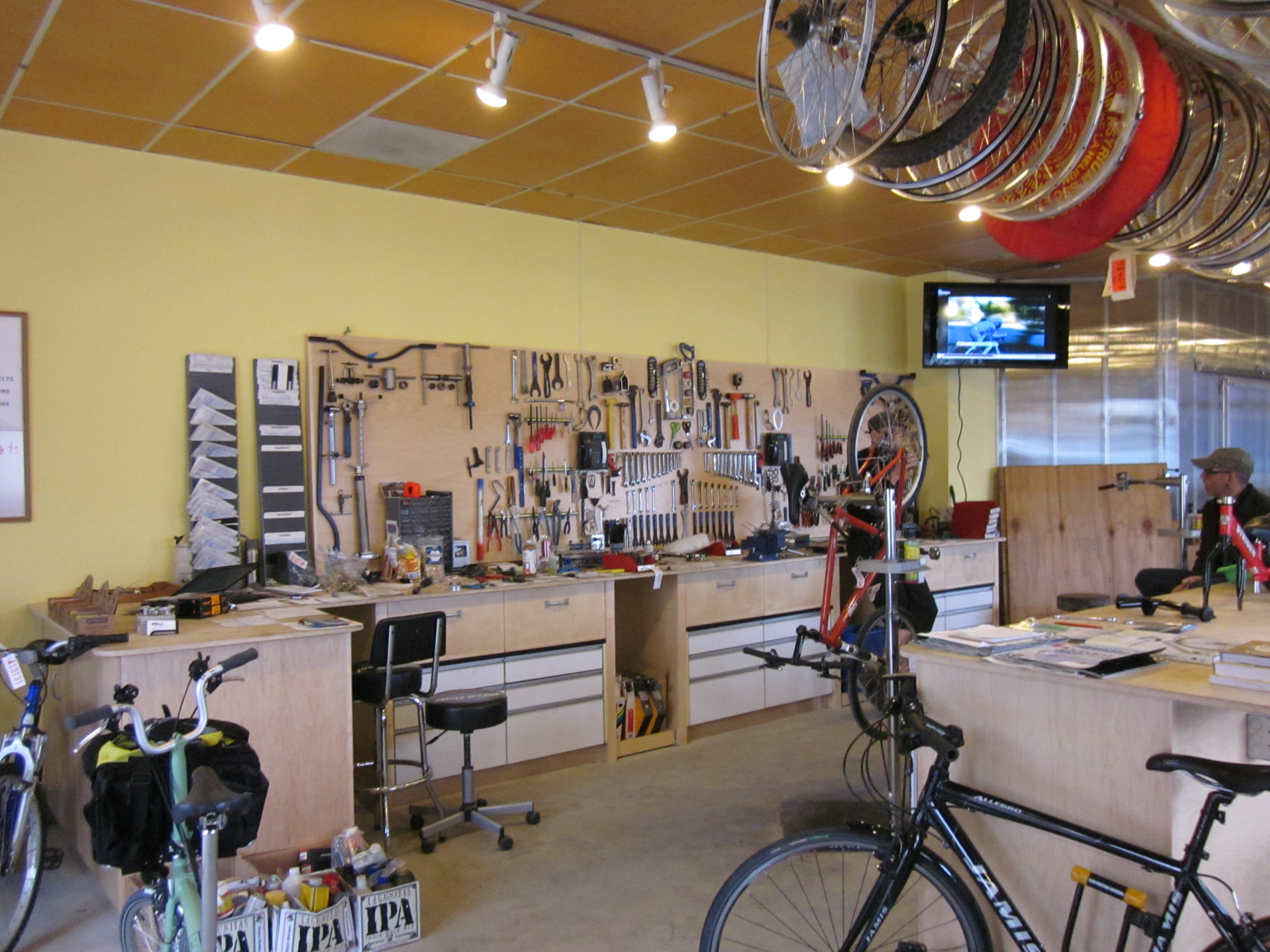
I mostly spoke to Renita, because Sam, the mechanic, was keeping busy working on bikes. They are evidently doing a land-office business, because they just hired a second full-time mechanic. The shop was packed with bikes when we came in, but it was not overwhelming. Renita was justifiably proud of their setup, noting that they wanted to put the bike stands and tools up front, where everyone could see them, rather than hidden in the back. There is a back cubby, however, where they do all the scary things that no one wants to watch that involve tools like saws. I could not help thinking of this room as the operating theater.

Step up to the bar

She was also proud that they had something else I had never seen in a bicycle shop before: seating and books, as well as a television that played bike-oriented shows (at the time we were there, an incredibly boring bike race). I am used to standing around bike shops waiting to be helped and staring at the walls by now, but have never enjoyed it. Including seating was an inspired move, particularly given that they wanted a space where women and kids would feel welcome. My sister and I agreed: mission accomplished. They even have a child seat in stock, a Topeak. It’s not the model I would have chosen (either Bobike or Yepp would be better) but it’s nice that they made the effort.

And they aren’t snobs. Like Sosuke in Ponyo, they love all the bicycles. Hence the custom Seven we spotted between two decidedly-not-custom bikes, a Giant and a Cannondale.

The frame-mounted front rack, my new Holy Grail

When I saw the front rack on a Storck (which I was told was the only aluminum frame Storck model, like I would know that Storck primarily makes carbon bikes, which I guess I know now) I asked if they installed frame-mounted front baskets. Sure, she said, they had a metal fabricator on call that could create one and add it to any bike. (I’ve since realized that a Soma Gamoh would serve our needs more than adequately. But FYI.)

We don’t live anywhere near Potrero Hill and getting to this shop would be a five-mile slog for us. This would not be ideal if our bikes actually needed repair, but I understand why locals seem to be swarming it. My sister has a bike mechanic hanging out at home in the form of my brother-in-law, but I imagine she’ll be back for larger jobs he’d prefer not to do. Overall, although I can’t speak to the quality of their work from just wandering around taking pictures, I was impressed. This is a different kind of bike shop, and it’s different in a good way.

5 Comments

Filed under bike shops, destinations, San Francisco

Another day, another commute

Usually cheerful, but not always

For the last couple of weeks Matt has been taking our son to school, because I’ve had various committee meetings at the end of the term (e.g. Admissions, and here’s my tip for getting into graduate school: Follow The Instructions.) When my son found out that I would be taking him to school this morning, he was not happy. “I don’t want to ride on your bike,” he said. When we asked him why, he said that I was too slow going downhill, that he didn’t like slinging his backpack over the back of the Bobike Junior, that my bike didn’t have a double kickstand, and then the rest of his complaints trailed off into vague mutterings. What can I say? He dislikes change. Also: he’s right. My bike is slower than Matt’s.

But things improved once we got moving, as they usually do. It is quiet in the morning but there’s always a lot to see in the city.

We trailed behind a backhoe for a while in Golden Gate Park, and all kids love construction equipment. My son’s mood improved markedly at this point. (The city is re-striping a separated bike lane across the park.)

As we were headed into the Panhandle, we were passed by an electric bike (a Hebb Electro Glide, if I read the logo right); the rider was pedaling slowly and moving fast, and we both found that fun to watch.

After that, we caught up with a recumbent hand-cranked bike ridden by a man with one leg (presumably custom, certainly nothing I recognized). We kept up for a while, but he blew past us and another bike on the way up the hill to Alamo Square. It was extremely impressive.

Sweet new bike racks!

When we got to school, we locked up at the new bike racks, along with another early arrival. By the time we reached the playground, my son was cheerful again.

It’s harder for me after dropping him off. My commute to work from his school goes up Webster, an arterial frequented by some of the nastiest drivers in the city. I have yet to go three blocks on that street without someone blasting a horn, apparently because I exist. One driver once honked at me and shook her fist while I was walking my bike through the crosswalk with the light. Getting off Webster I turn onto Post, and go several blocks uphill on a steadily increasing grade. To pile insult on injury, there are always multiple trucks parked in the bike lane. Once I get to the top of the hill, the only way to enter the campus is by making two left turns on busy thoroughfares (or riding on the sidewalk, but this is illegal in San Francisco, and the potential fine is large).

It’s annoying, but it beats driving.

Leave a comment

Filed under Bobike, Breezer, commuting, family biking, San Francisco

Where bicycles are free

Oppressed bicycle

When Family Ride tweeted about Seattle’s only bike lane marker without a helmet (Amsterdamize!) I became briefly obsessed with street markings in San Francisco. I had a memory of a helmetless bike lane marker down in the Mission somewhere, but I haven’t found it yet. In the meantime I realized that there was a minor war apparent in San Francisco’s bike lane and sharrow markings. Ground zero is Golden Gate Park.

Free bicycle

From the north side of the park, riding on streets and up the hill behind the Conservatory of Flowers, street markings are dominated by the typical rider with a helmet on a bike. But on entering the park and for several blocks south, the bicycles have cast off their riders. These roads are owned by the forces of Bicycle Liberation. In Golden Gate Park, bicycles roam free.

It is particularly disconcerting to reach the top of the hill and see a free bicycle marker head-to-head with a ridden bicycle marker. I now imagine being knocked off my bicycle by freedom fighting cycles every time I get to the top of the hill. They’ll get me when I’m tired. No helmet could protect me.

A compromise of sorts

There is a demilitarized zone on the north edge of the park where the markers avoid the controversy altogether by simply writing the words, “BIKE LANE.” I realize that it’s unfashionable these days to use words instead of symbols on street markings, but this does sidestep the question of whether bicycles should be ridden. Perhaps one day this area will be the Camp David used to broker out a compromise between humans and bicycles.

San Francisco tries to be respectful of all oppressed minorities. I cannot count the times that I have been asked by non-residents what the Q in LGBTQ, now the abbreviation of choice in the city, stands for. Mostly people get the Lesbian Gay Bisexual and Transgender parts (although not always). When I report that the Q stands for queer and questioning, I know that the conversation will take a hiatus while my questioners gasp for air through their laughter. “Questioning?!?” they wheeze. Well, all cities have their little quirks, and in my opinion San Francisco could do worse than recognizing that some people are on the fence. At least this is easier than trying to explain what a Romeo flat is.

At any rate, it seems that free bicycles have made inroads into City Hall, because new bicycle lane markings are now evenly split between free bicycles and ridden bicycles. I have no idea how it will all pan out, but plan to ride my captive bicycle for as long as this is allowed.

4 Comments

Filed under commuting, San Francisco

Riding in the rain

On the road and all is well again

This week and next it’s all about the rain here in San Francisco (and after that, I’m going out of town). I’ve written before that I like riding in the rain, and this is true. I’ve realized, though, that I don’t like getting ready to ride in the rain. There are so many more accessories to worry about.

In the morning I put on the rain jacket, the rain pants, and the rain boots, and put my work shoes into the pannier inside a plastic bag. Then I put the waterproof cover on the pannier. Yesterday when I got outside I realized that my keys were inside the pannier, so I had to take off the waterproof cover, fish out my keys, lock the door, put them back in the pannier, and replace the waterproof cover on the (now wet) pannier.

When I get to work I take off the waterproof cover on the pannier, then the rain jacket, the rain pants, and the rain boots and hang everything up to dry. Then dig my work shoes out of the plastic bag and put them on.  Criminy, what a hassle. Thankfully the university has covered bike parking on all campuses, so there’s no need to cover the seat.

My son wears his rain pants all day, but he doesn’t work at a medical center. Also his rain pants have cool cartoon dinosaurs on them (my mom made them). Elementary school is the life! I might be able to get away with cartoon dinosaurs if I were at the medical center; I could pretend that they were a new kind of scrubs. But women’s rain pants only seem to come in solids. Whose idea was that?

Golden Gate Park is beautiful in any weather

It is often worth it once I’m on the bike, however, because I don’t really have to slow down much, and cars do, so relatively speaking, I feel like I’ve gained bionic powers. It does not feel worth it when it is both windy and raining and I have to shift down to first gear on a flat street, because I am being blown backwards and I can’t see anything.

But when I get to work and am finally rearranged, there is, at last, victory, because on really rainy days, the only dry people in the office are the bike commuters. The drivers and shuttle bus riders get drenched walking from the parking lot to the office.  Back before I started riding my bike I hated the rain because I was always getting soaked; just walking to the shuttle stop would fill my shoes with water. Now the rainy season is a hassle, but not much more. I never thought to buy real rain gear until I started riding my bike, but now I wear it even on the walk up to preschool. And it makes all the difference.

Leave a comment

Filed under commuting, San Francisco

San Francisco destinations: Parnassus Heights

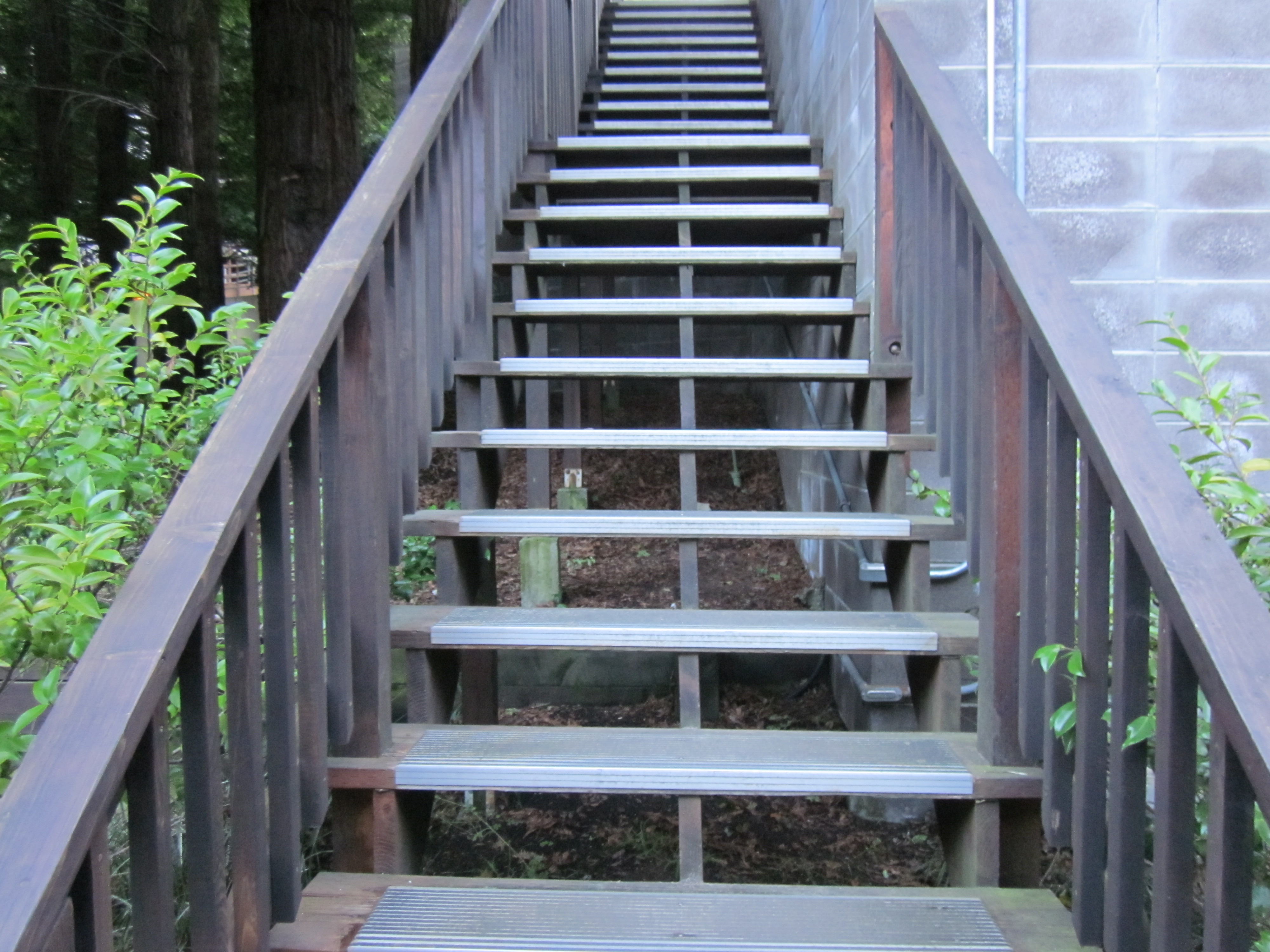
The route to preschool: Staircase #1

We live on the main campus of the university where I work, at the inflection point between the approach to the mountain, which is steep, and the mountain itself, which is really steep. We’ll ride our bikes up to where we live (I wrote about the hills we face on that trip) but after that we pretty much throw up our hands. For short distances, we walk, and for longer distances, we take the shuttle or we drive. Unless and until we get an electric assist, this is unlikely to change.

The route to preschool: Staircase #2

This frustrates my daughter, whose preschool is a couple of blocks straight uphill from our house, because no matter how many times she requests a bike commute to school or back, it has never happened. Even when we return from a ride to our son’s school in the morning, we park the bike in the basement and walk her up to preschool. Maybe someday we’ll have the foresight to walk a bike up the hill and blast on down with her on board at the end of the day, but we haven’t managed it yet. Also I would only feel safe doing that shortly after a brake tune-up. It’s a straight shot down.

The route to preschool: Staircase #3

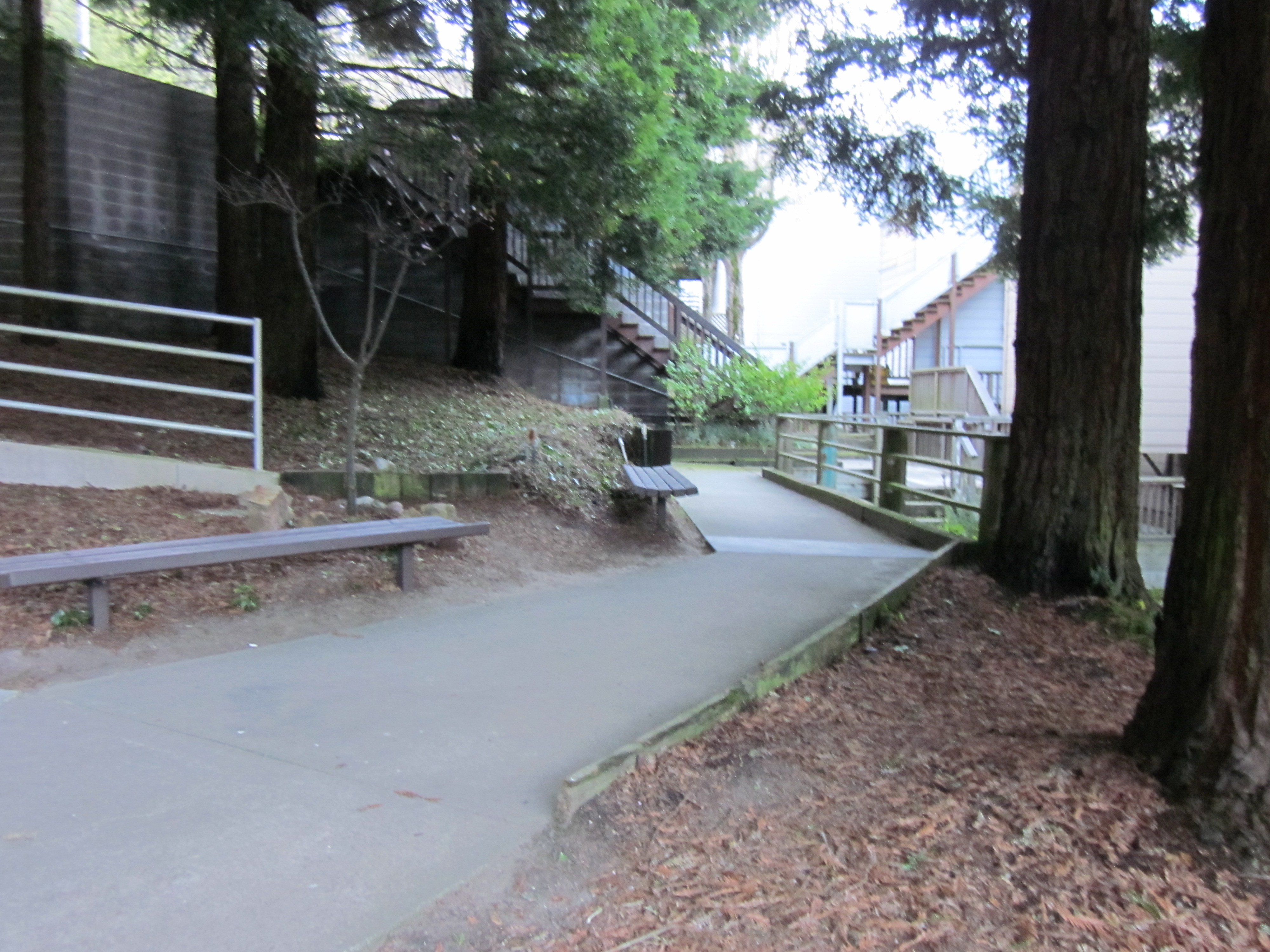
At least it is a very pretty walk. Much of the campus is difficult place to build anything, although the university has managed to pack more clinical and lab space onto the site than anyone ever thought was possible. Nevertheless a lot of trees were left standing around.

The university was founded in 1868, but only moved to the Parnassus site thirty years later, in 1898. The land was donated by San Francisco’s mayor at the time, Adolph Sutro. His motives may not have been pure; the land around Golden Gate Park, which he owned, was largely undeveloped at the time, and putting a university there spurred development that might not otherwise have been as lucrative. At the time, many faculty members viewed the Parnassus shelf as hopelessly inaccessible—then as now, it seemed insane to put a hospital halfway up a mountain. But no one was turning down free land.

One block up from us: Why not commute by zipline?

Many of our neighbors live in buildings that are the equivalent of several stories above us, even though they are only a block away. One of my daughter’s classmates lives in an apartment complex above the preschool, on a hill that is so steep that it has been reinforced with steel bars to prevent mudslides from burying a portion of the campus in the rainy season. I once suggested that she run a zipline from their apartment window to the preschool for a quicker commute in the morning.

I have been locked out of this building more times than I care to remember

The Parnassus campus is extensive and labyrinthine, and after five years working at this university, I still have difficulty navigating it. When my children were babies I had many frustrating experiences trying to find the pumping stations for nursing mothers scattered around campus, which were thick on the ground but almost impossible to locate. Eventually I learned enough about the campus that I was able to find my way around by getting in the general neighborhood of a room using the letter and number code, then asking people to direct me to the exact location like a bat taking soundings. This is how I navigate the campus to this day, and although I used to find myself locked out of buildings on a steep hill with no apparent path back to campus on a monthly basis, that now happens to me only about once a year.

This driveway block is too penny-ante to draw the tow truck, but our neighbors aren't going anywhere by car

Parking around urban hospitals is always difficult and expensive, and this one is no exception. As a result, I have lost count of the number of times that we have missed work meetings, pediatrician appointments or been late to school because someone parked in our building’s driveway. It is better when we ride our bikes, but there are, astonishingly, ways to block even a bicycle from leaving our building.  However the university is very aggressive about protecting its right of way, and our children have come to love the sight of the tow truck barreling up the hill to remove yet another car.

I would never have imagined that a site like this would draw more than a trivial number of bicycle commuters. Before I moved here I thought that Seattle, where I grew up, had a discouraging number of hills, but the hills around this campus really mean business. Yet the 200 bicycle parking spaces on campus, which are spread across a bike cage and several racks, are woefully inadequate, and there are bicycles locked to parking meters and fences for several blocks on either side of campus. The university is currently building a new bike cage twice the size of the existing one, and new racks are put in almost monthly, on nearly every level surface. Yet this is nowhere near meeting demand.

7:45am, and the bike racks are filling up

I believe that infrastructure drives bicycle commuting. We are more likely to ride in places that have bike lanes, especially when we’re carrying our kids. Parnassus Heights makes it clear that infrastructure also works in reverse. The campus is such an appalling place for cars that many people simply give up driving, even if that means riding a bike up the side of a mountain. Even my colleagues who commute from the suburbs park in the garage at the level of Golden Gate Park, take the elevator up, and walk around campus rather than attempting to drive to their ultimate destination. We can park in our building, but find that it is rarely worth it to drive anywhere else unless we’re leaving the city altogether. And there’s no guarantee that someone won’t be blocking the driveway anyway.
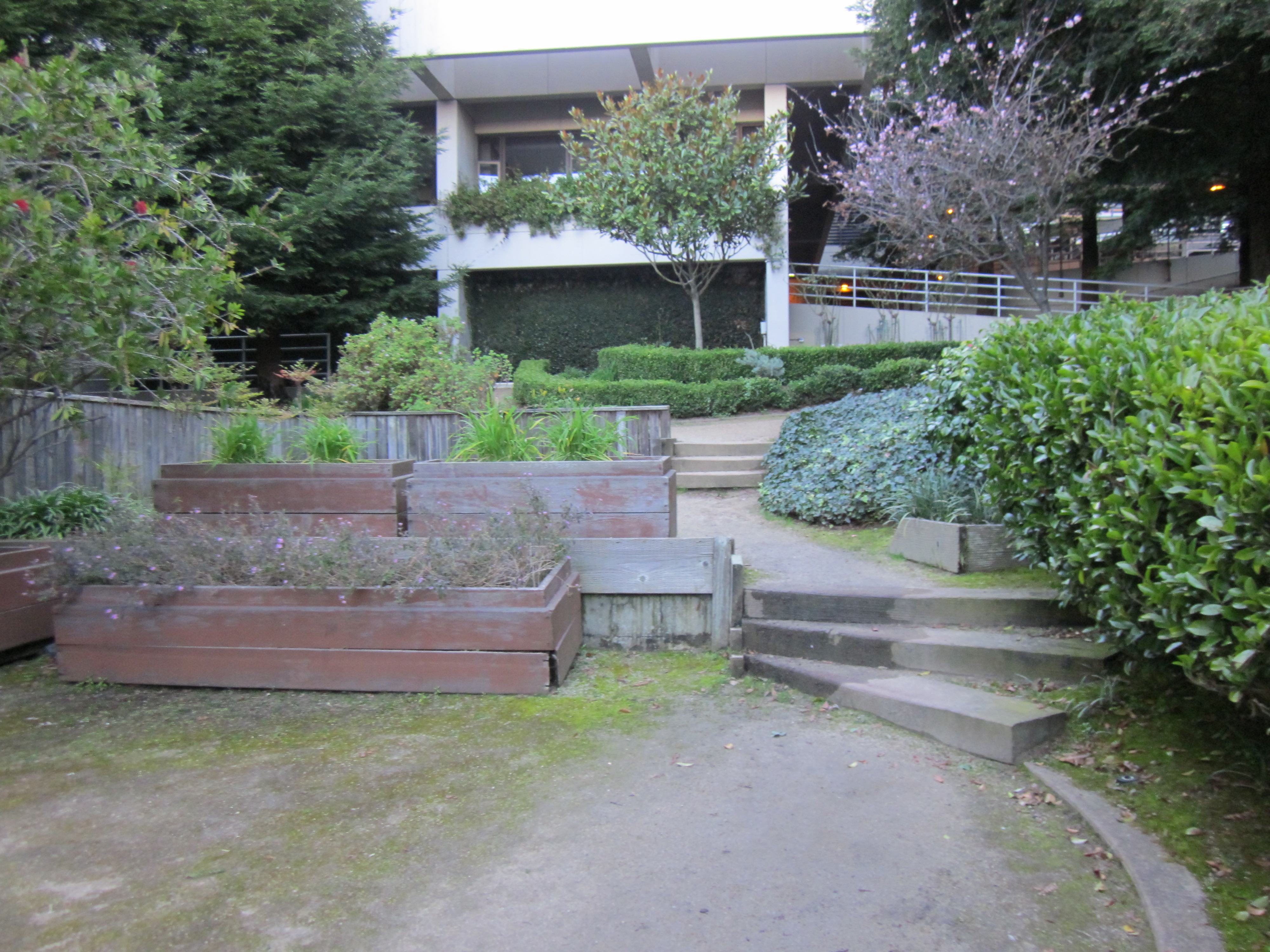
This campus brought to you by MC Escher

But this is a shift in perspective that makes sense only in hindsight. I still have conversations with my son’s classmates’ parents that make me realize this. When they see us on the bike in the morning, these parents sometimes ask, “Did you really bike from your place? Over the hill?” And I am thinking, well, where else? We didn’t sleep in the park last night. Yet at one point, taking a loaded cargo bike up any hill seemed insane to us as well. But now my perspective is: at least we don’t have to go all the way up.

Leave a comment

Filed under commuting, destinations, San Francisco