Tag Archives: electric assist

Spotted in Hayes Valley: The Faraday Porteur

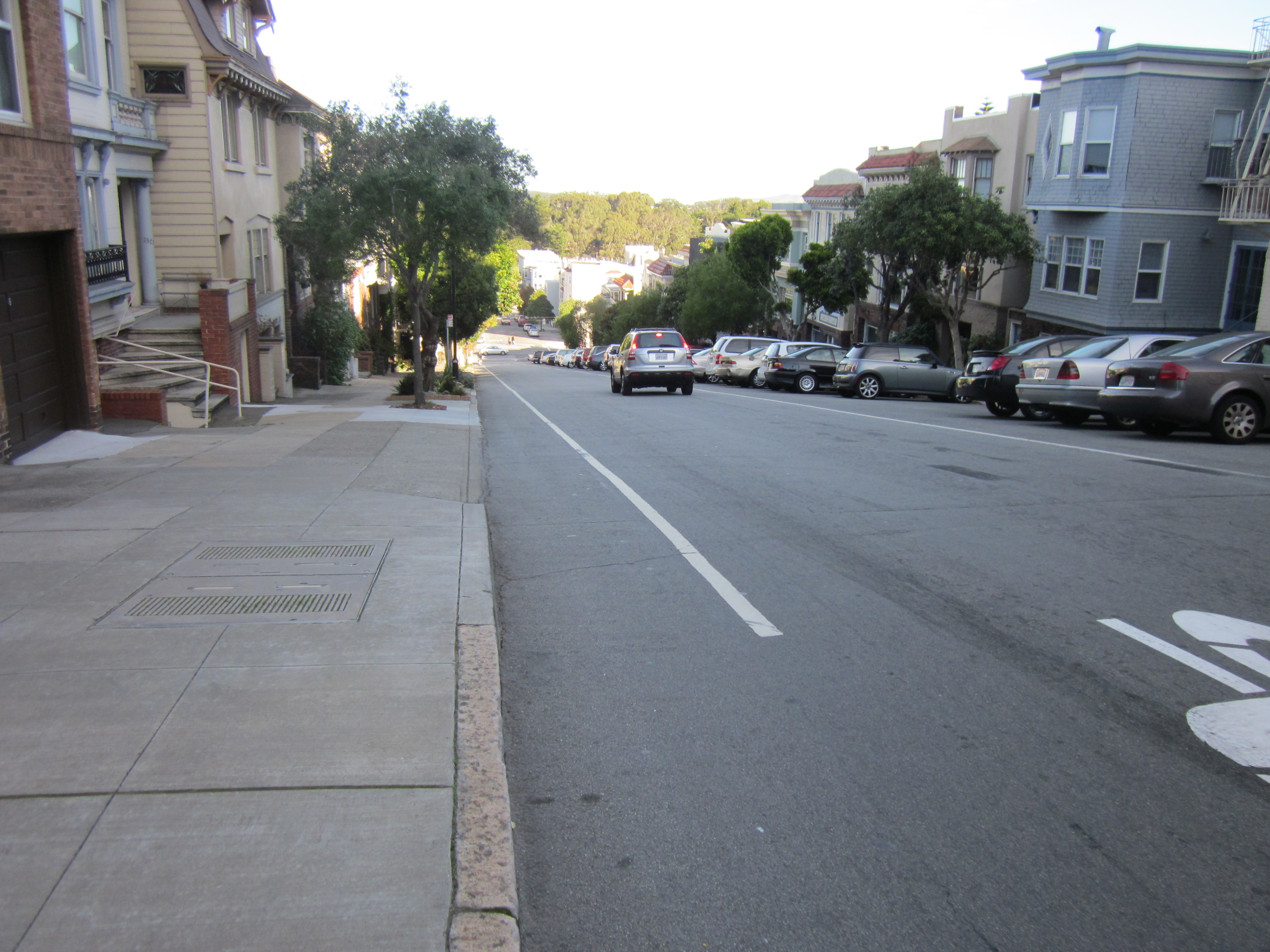
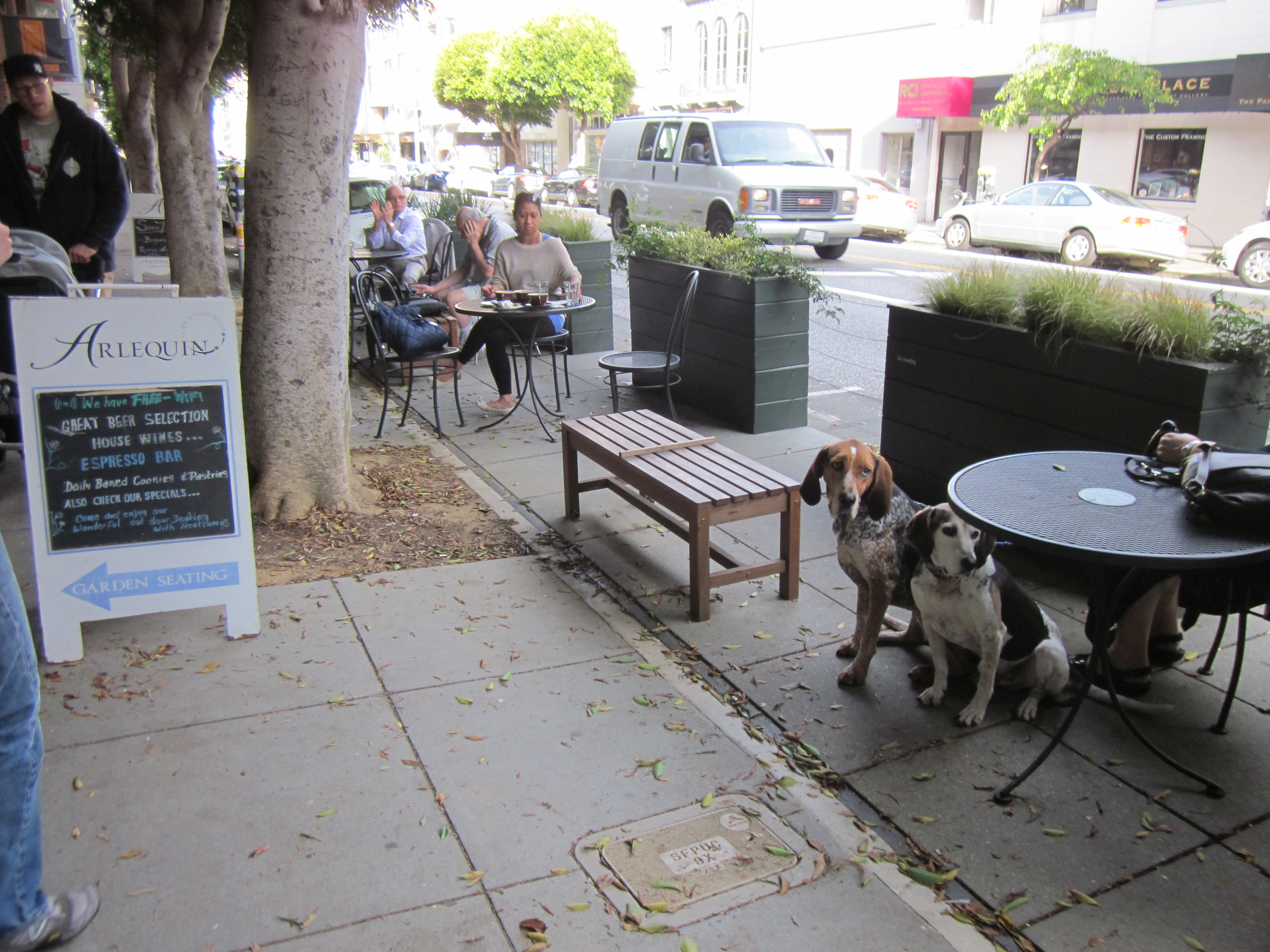
New Hayes Valley parklet (not the park built on a closed street)

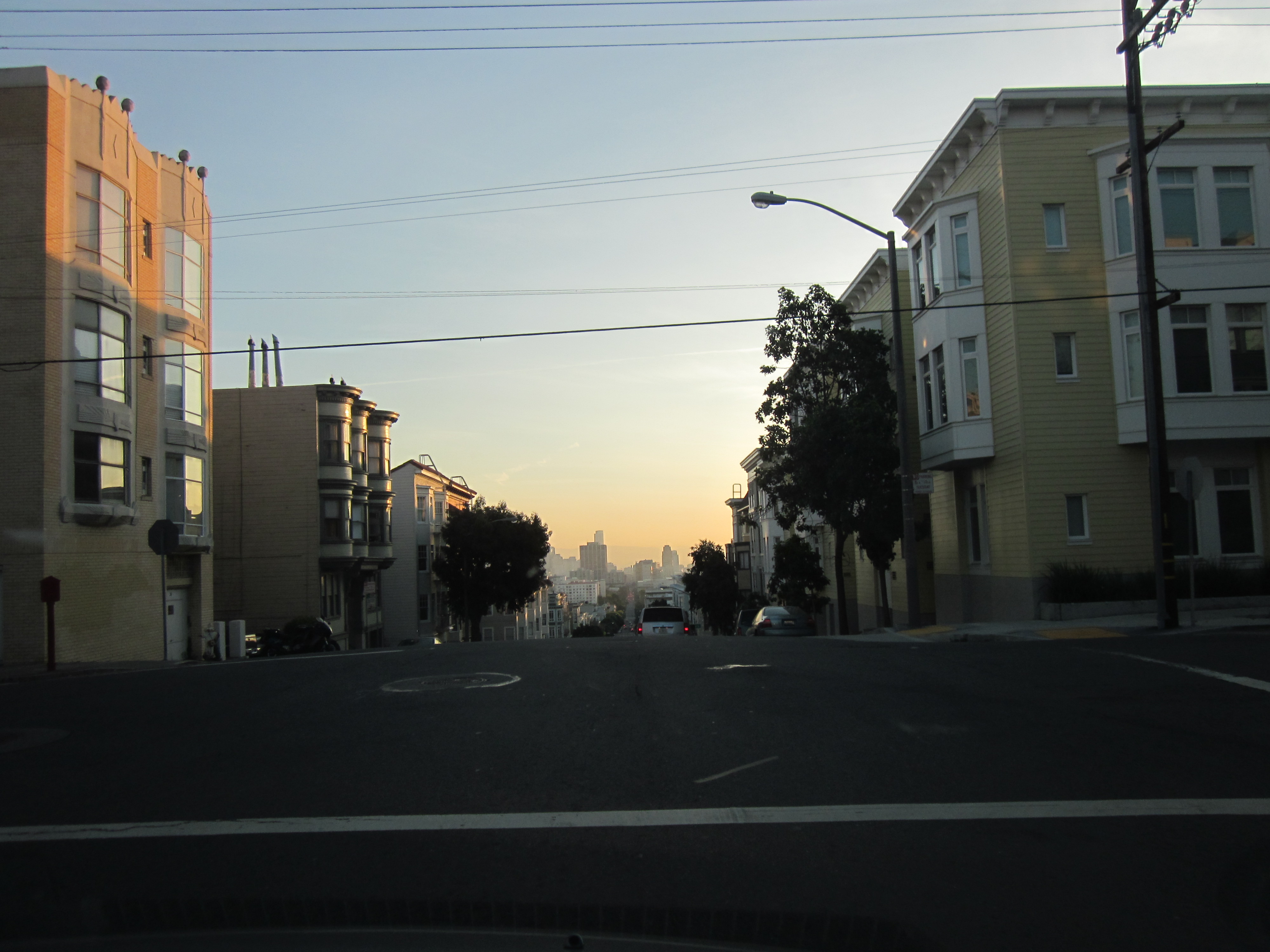
Although I don’t get much chance to socialize with adults given that we have two little kids, I try to meet my sister every once in a while. The last time, she suggested we meet in Hayes Valley, near Civic Center. I hadn’t been to Hayes Valley in a long time, and it turns out it’s a nice ride over. The entire neighborhood has been shifting in character from a seedy strip off the freeway to a shopping and dining destination. Part of that transition involved closing off a major street to car traffic, and building a park where the cars used to be. It was filled with families, even though Hayes Valley itself is more of a hipster neighborhood, packed with expensive housewares stores, wine shops, and expensive restaurants. It is a fantastic place to hang out, and I was not the only person who thought to ride my bike there: the racks and parking meters were packed.  It was one of the rare summer days in San Francisco that was not foggy and cold, and I pitied the drivers stuck in their cars, fuming as they searched for parking. That used to be me.

The Faraday Porteur

I met my sister at Propellor, which is kind of a hyper-local version of Design Within Reach. Propellor was an odd location to find a bicycle, other than the one I’d locked up outside, but a bicycle there was. It was, in fact, an electric bicycle, the Faraday Porteur, a creation of IDEO/Rock Lobster that was the Oregon Manifest People’s Choice winner. Oregon Manifest was a 2011 competition intended to encourage designers to create the ultimate utility bike. Given that hauling kids was not even a criterion in the Oregon Manifest, it was hard for me to take much of an interest. But although the Faraday reflects the goals of the Manifest rather than of many actual utility cyclists, it is an interesting bike nonetheless.

There are some issues that arise when attempting to market a bike in a modern housewares store. The main one is that the people staffing the store clearly had no idea what they had in their window, other than that it was an electric bike, and then only because it said so on the sign. I had a lot of questions, and they didn’t have a lot of answers. Eventually they found a brochure, and that helped. They are planning to sell the Faraday, which is actually going into production. With luck they’ll have someone in the store who can explain what it actually does by then. I’m interested to see how the whole sales process goes. They’re clearly reaching a market of people who would not normally spend a lot of time in bike stores. What will happen after one of them actually buys a bike is something of a mystery.
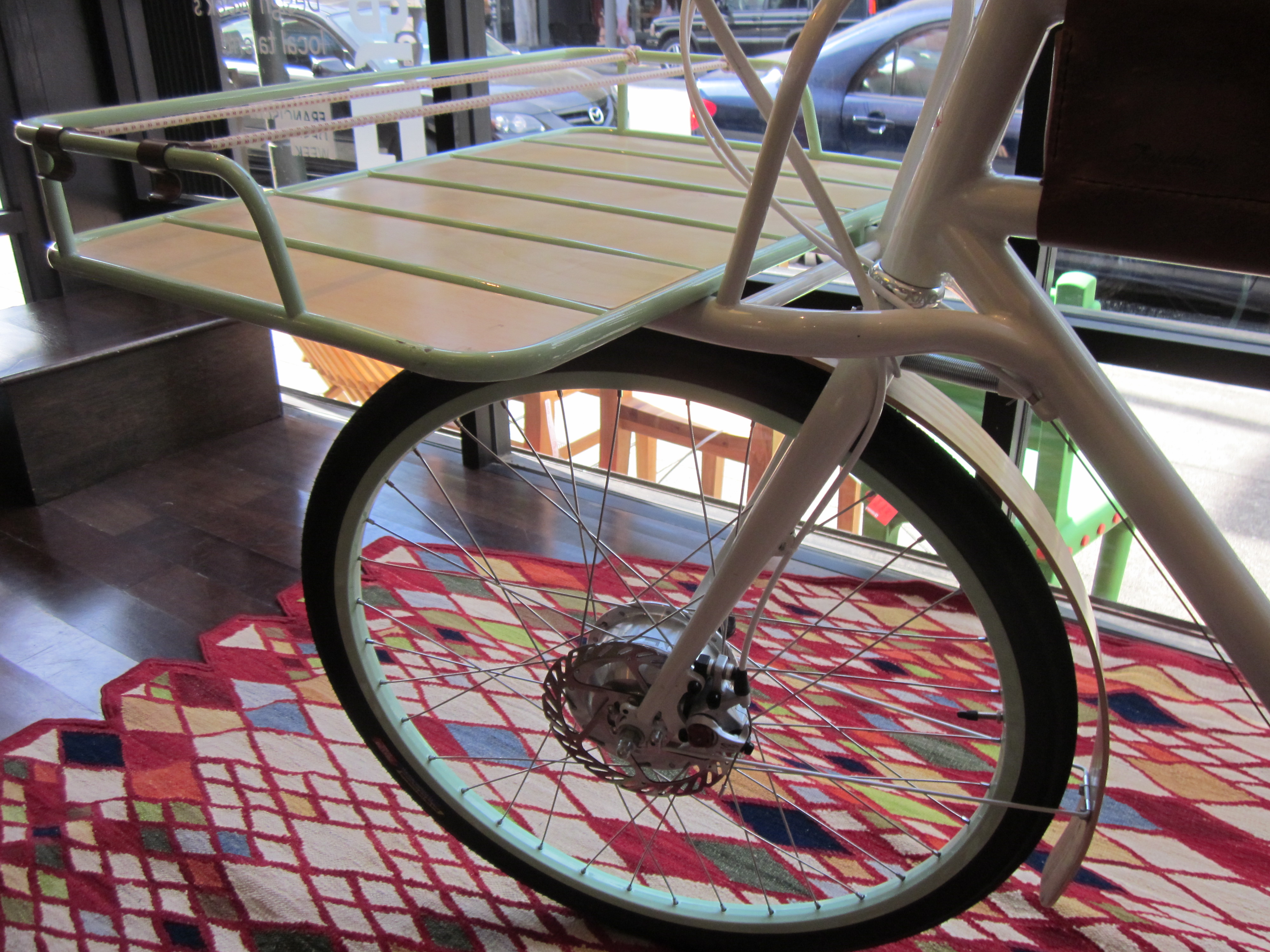
Front hub motor, apparently

The Faraday Porteur is clearly an effort to make utility bikes seem cool. I recognized from the front hub that it was an electric bicycle even without seeing the sign, but couldn’t spot the batteries. The brochure revealed that they were packed into the double top tube.  Although I think packing the batteries in the frame is a fantastic idea, I wonder about the choice to put them in a double top tube. You can forget about adding a rear child seat given that frame; you’d roundhouse your kid every time you got on the bike. Putting that much weight in the top tube seems like it would make the bike harder to balance, and my brother-in-law wondered what happened when someone needed to replace the battery. And the whole bike seemed designed for a sporty ride; there’s no way to ride upright on that frame. Maybe it’s meant to appeal to people who would otherwise ride fixies?

Those quibbles aside, there is a lot the Faraday gets right. The frame-mounted front rack comes off and on with one hand, and it is large enough to haul serious cargo. The mount for that rack has two headlights built into it, and the rear of the bike has an integrated taillight. They were very, very sweet. The electric assist (which is a pedal assist, but I got that from the website, not from the confused staff at the store) is beautifully integrated into the bike, looking exactly like a left-hand shifter. It’s not a particularly powerful assist, but for this kind of bike, I doubt it needs to be. And there is no question: this is a very pretty bike.

Pretty, but vague on the details

The Faraday got a lot of attention while we were there, from people who didn’t have my kinds of questions. Theirs were more along the lines of, “When will you have them in stock?” and, “How much will they cost?” The store couldn’t answer those questions either.

In a neighborhood like Hayes Valley, a bike built to carry a case of beer easily, rather than a kid, is right on target. The Faraday, which takes the brutality out of climbing the city’s hills and makes it possible to haul everything a single person could need,  was clearly making riding a bike seem practical to people who would never consider it otherwise. I hope they sell thousands of them, and that the next time I’m in Hayes Valley, I see them everywhere.

1 Comment

Filed under cargo, commuting, electric assist, San Francisco

San Francisco destinations: The New Wheel

This is actually quite an accurate depiction of what it’s like to ride an electric-assist bicycle in San Francisco.

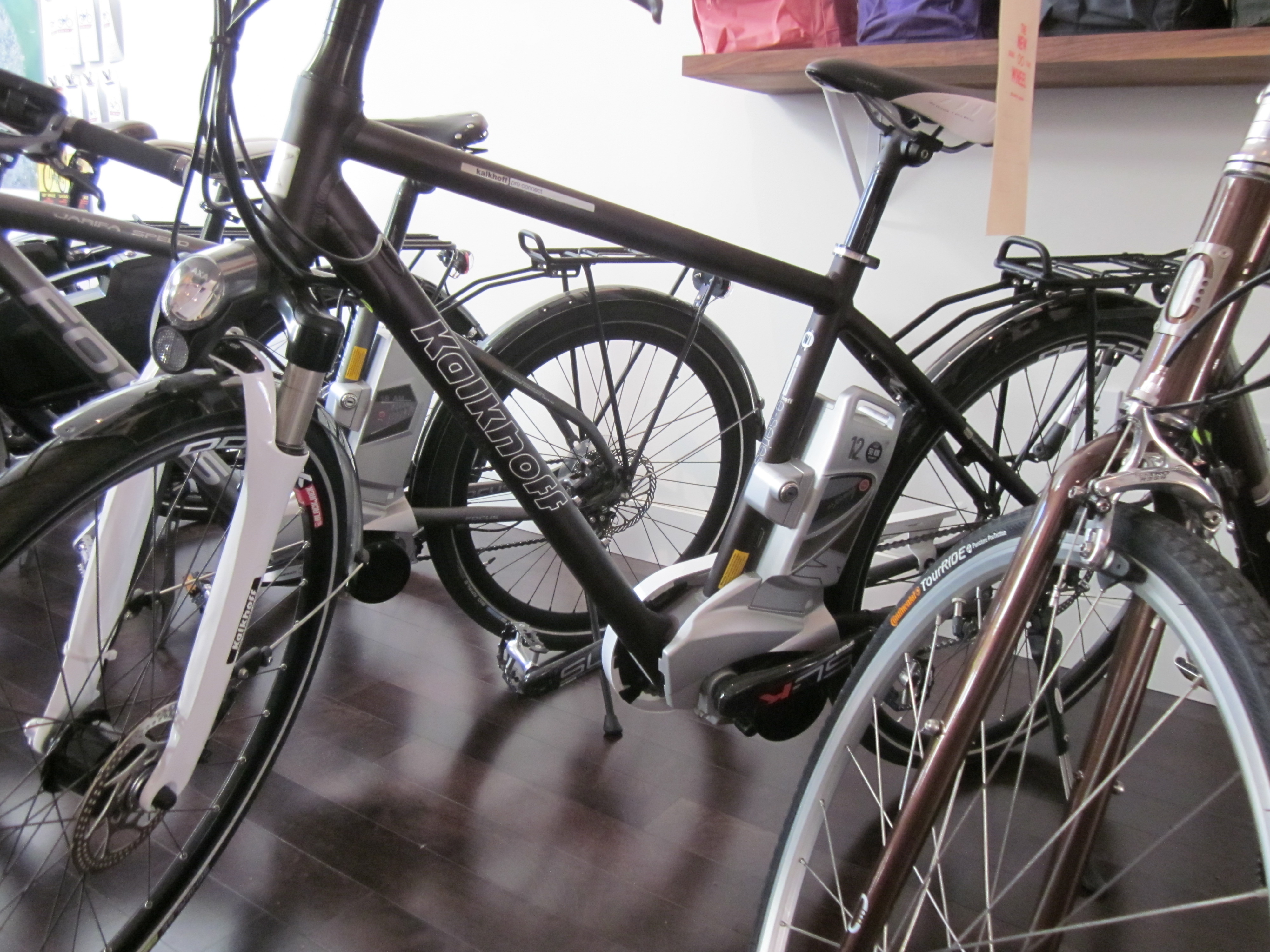
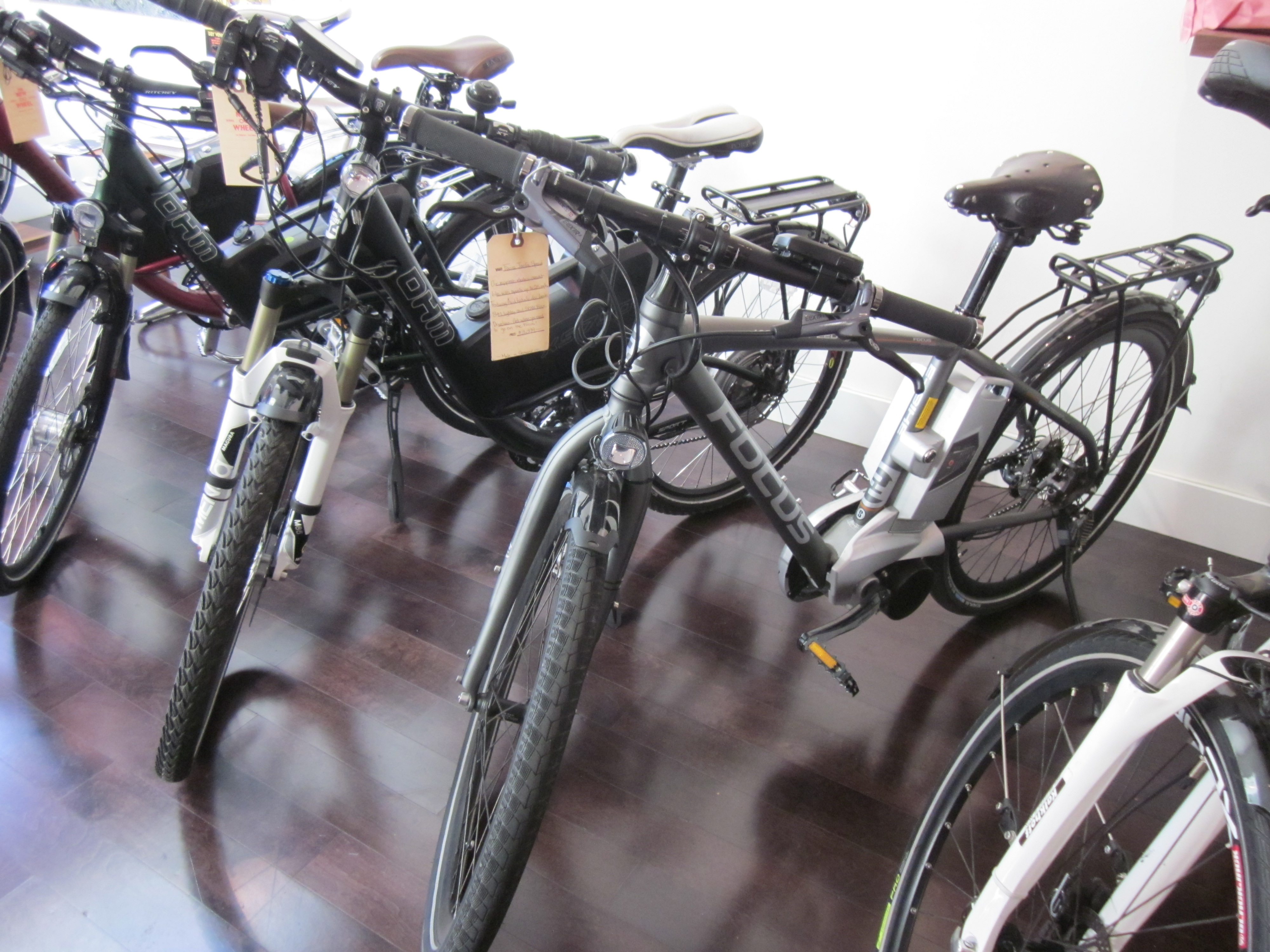
A few weeks ago, we checked out a new bike shop in San Francisco, The New Wheel. The New Wheel is marketing itself to a particular niche in San Francisco, and I suspect they will be successful. They sell only electric pedal-assist bicycles.

For this trip I rounded up two other families from our daughter’s preschool to keep us company and so I could get the opinions of people who’d never ridden electric-assist bikes before. Preschool was the obvious place to recruit other families interested in electric-assist bikes; as Matt puts it, the building “looks down on us like a Tibetan monastery.” From asking around, we knew that other biking parents (okay, dads) had tried to haul kids up that hill in trailers and on bikes. Like us, they’d given up after a couple of tries.

Electric-assist bikes: interesting!

Cyclists in San Francisco do not give up easily. There is no avoiding the hills in this city, and there are a few intrepid riders who climb preschool hill every day solo. But not pulling a trailer, which one dad reported actually dragged him back down the hill while he was attempting to pedal up. I have discussed before the reasons that parents in the city don’t typically ride with trailers (can’t be seen in traffic, don’t fit in bike lanes): that’s another. Let’s not even discuss what it would be like back going down that same hill. In summary it would be fair to say that there is intense interest in electric-assist bikes in our preschool community.

So we all headed to The New Wheel one Sunday. It was fascinating. In a lot of ways, The New Wheel is not yet our kind of shop. Although they are interested in the family market, they are most strongly focused right now on pedal-assist bikes for commuters. They can attach a child seat or a trailer or a Burley Piccolo to their bikes, but they don’t offer cargo bikes. It turns out that there is a reason for this.

These are the kinds of bikes they sell.

What I learned from the owners at The New Wheel is that there is a wide range of reliability in electric assists for bicycles, and particularly in batteries. As they are focused not just on selling equipment but maintaining it, there is a very short list of systems that they felt were worth selling: BionX and Panasonic. BionX motors sit in the rear hub and respond to torque on the pedals; the harder you push, the more help you get. I’ve written about riding with the BionX before. The mid-drive motors attach to the chain, and add power throughout the gear range. These are stronger motors, but they are significantly more expensive and they work best when riders maintain a steady cadence. After trying one, I can attest that doing that involves a learning curve.

For the time being, this is the only kind of family bike that The New Wheel is selling.

Because they are very interested in the family market they had considered stocking the Yuba elMundo, which comes with the eZee assist. However they found that customers had so much trouble with eZee motors and batteries, which evidently have a nasty habit of cutting out in the middle of the hills where people need them most, that they are negotiating with Yuba to develop and sell a BionX-assisted Mundo instead. The trade-off for increased reliability, of course, is a higher price.

Having this discussion with them made it pretty clear that for our needs, a BionX system is probably our best choice. After-market mid-drive motors, although they themselves are great, evidently have some of the same battery issues that other systems do, namely that there are not many consistently good ones, and no one is currently making cargo bikes with the integrated Panasonic assists. So it would seem that BionX is the most reliable option for cargo bikes, unless you know a lot about batteries or get lucky.

All these bikes have the motor integrated into the design; the mid drive motors are placed inside a massive chain guard.

All of the bikes The New Wheel sells are built as electric-assist bicycles from the ground up, and they all come with integrated BionX motors (e.g. the Ohm line) or integrated Panasonic mid-drive motors (the German bikes). They felt both of these systems worked well on steep hills. The mid-drive motors were more useful for weaker riders. One of their customers, an older woman with a recent hip replacement, was using one of their mid-drive motor-assisted bikes to commute up to the top of the Berkeley hills every day. That is an extremely long and unforgiving grade.

Having already tried a BionX-assisted bike in Portland, I went out for a test ride with one of the preschool dads, Paul, on a mid-drive bike. He took an Ohm with a BionX assist. I was very curious about how it would feel to ride with the more powerful mid-drive motor. The New Wheel is conveniently located in Bernal Heights, next to some brutally steep slopes. After taking some time to figure out how our respective assists worked, we rode up and down the hills for a while. It was such a hoot!

When I rode with a BionX, I liked that it felt seamless with the pedaling and was almost completely silent. Other than feeling like I’d grown massively stronger, I barely noticed the BionX was there.

I rode the extremely girly “Emotion” bike. I’m not particularly proud, but this kind of marketing leaves something to be desired. Bad manufacturer; no cookie!

The mid-drive motor was different. It makes a slight rattling sound as the chain runs through the motor, which I found kind of annoying. It was hard to tell that it was more powerful, because the assist felt so subtle. I suspect for riders who are already used to going up hills, there may be less difference between the two systems until the cargo load gets quite substantial. And it was hard for me to maintain a steady cadence and pressure instead of reacting to the hill by gearing down and pushing harder, which meant that I wasn’t getting the greatest benefit from the system. As a result, Paul consistently passed me on the way uphill even though I had a stronger motor.

So although I liked riding up hills with the mid-drive motor, especially hills that I could barely move on by myself (I tried turning the assist off halfway up the hill a couple of times; it was unspeakably brutal), I didn’t like it any better than riding a BionX-assisted bike. Yet I suspect that I would feel very differently about these two systems if I were a novice rider. The owners of The New Wheel said that in fact they steer experienced riders to the BionX-assisted bikes like the Ohms, and novice riders to the mid-drives. I suspect that’s because if you have practice going up hills already, you’d have to relearn how to ride effectively with the mid-drive motors. Basically you have to convince yourself that neither the motor nor the hill is there, and just pedal blissfully on. In contrast, if you’re getting an electric bike in order to start riding a bike again, you don’t have to unlearn any existing hill-climbing habits. This information, by itself, was worth a trip to The New Wheel.

My son’s desire for this bike has not waned in the slightest.

I would be remiss if I didn’t also mention that The New Wheel is really, truly committed to family biking, even if they don’t yet stock any real family-hauling bikes. The proof was in their children’s bikes, which were the nicest I have ever seen. The preschoolers could not stop riding their gorgeous balance bikes. Our son test-rode a beautiful 20” Torker (not listed on their website) and has been begging us ever since to trade in his Jamis for this bike. He is willing to put his entire saved allowance to the cause. This was, however, not even the nicest bike available; they do not currently stock, but they do sell, a German bike for kids that comes with an internally geared hub, dynamo lights, fenders, a double-kickstand, and a chain guard. They said they didn’t stock it because they assumed that no one would be willing spend that much money on a kid’s bike. I only wish The New Wheel had been in business when we bought our son’s bike last Christmas. It would have spared us a trip across the bay and he’d be on a better bike right now. At any rate, if you are looking for a child’s bike, I have never seen a higher-quality collection. And they also have very nice children’s helmets, and they know how to fit them, too.

The New Wheel: stop by and check it out!

If I were in the market for an electric-assist commuter bike to handle the steepest San Francisco hills, I would start at The New Wheel. It is a great shop with incredibly nice owners and they are impressively informed about electric assists. We will almost certainly return when it is time to buy another kid’s bike. My only regret is that they do not yet sell family-hauling cargo bikes that can handle steep hills. For that, you still have to go to Portland.

10 Comments

Filed under bike shops, destinations, electric assist, family biking, San Francisco, trailer-bike, Yuba Mundo

What fresh hell is this?

On Sunday my son and I headed downtown on the Kona MinUte to Japanese class. I thought, “Gee, I hadn’t remembered the MinUte being this bumpy to ride.” Then I heard a swish-swish-swish sound, and asked my son if he was sticking something in the spokes (hey, it’s happened). Nope. Flat tire. When did I lose all my bike karma?

Studying Japanese on the train downtown

Fortunately we weren’t far from home, so I walked the bike back up the hill and then we walked back down the hill to the streetcar stop. We were late, but Muni came through; thankfully, there was no parade downtown this week. It had been so long since we tried this that I had forgotten one of the advantages of riding Muni: we ended up studying Japanese all the way into downtown, which made for a stellar class. A passenger across from us knew Japanese and helped as well. (Experiences like this explain why people keeping leaving their hearts in San Francisco.)

Blue Public Bike with a Bobike Junior seat

On our way up from the train station I saw a woman whose bike had a Bobike Junior seat on it, the first other than mine that I’ve seen. She said she knew a couple of other people with Juniors as well, and she was still hauling her nine-year-old son (!) on hers. They were headed to Sunday Streets as volunteers.

The downside of riding Muni is the waiting. On the way home it took as long for our train to arrive as it would have to ride all the way home (thanks in part to one train going offline right before it arrived at the station, horribly frustrating my son, who believed the arrival time board).

For novelty value, my daughter rode on the MinUte for about 10 minutes before returning to her plush mamachari seat.

After we got home Matt and the kids enjoyed a rousing game of “put the bike tube underwater in the tub to find the hole” and then my son asked to go out for a ride. Sure!

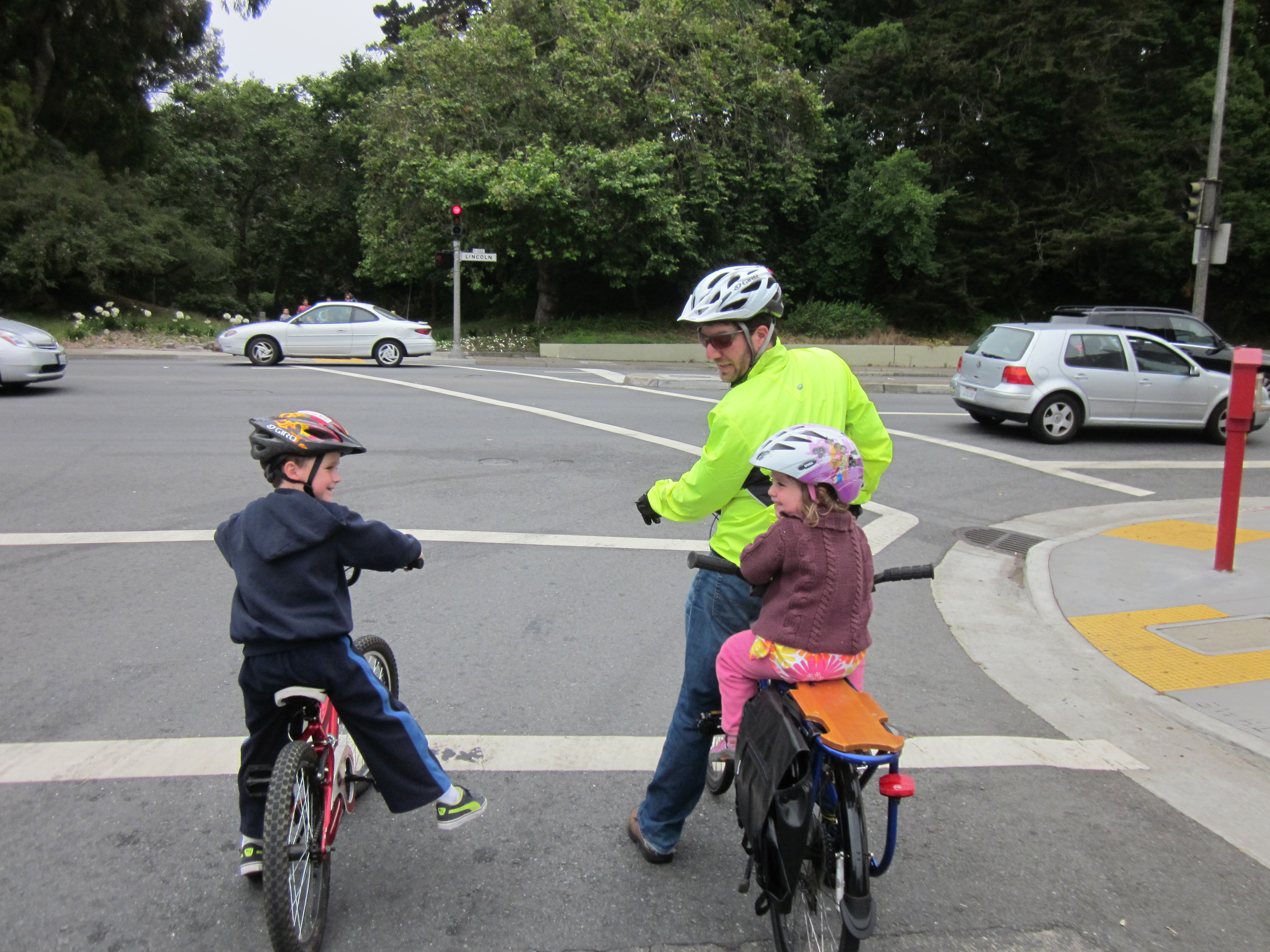
We headed to Golden Gate Park to show him the drop-off site for this month’s summer camp, check out waterfalls, and visit the bison.  This was an impressive ride for a six-year-old, even with the street closure, at over six miles.

Riding with my son has made me reassess my definition of hills. I would have said before this weekend that this was a pretty flat ride, with a slight downhill heading west and a slight uphill heading east. After watching my son, who had to get off the bike and walk some of those “slight uphills,” as well as take multiple rest stops, I realized I’ve lost perspective by comparing them to my daily commute. It was a brutal ride for a little kid on a single-speed bike, but he never complained.

Although it was raining and cold, my kids wanted ice cream.

So we bought both kids ice cream when we got to the bottom of the hill heading home, and we took the long way around on that last leg. And we saw my son’s first grade teacher, who is native Japanese. “A mamachari!” she said.

Our son wants a bike with gears. Although I despair that it seems like we can’t manage to find a bike with any longevity (except the MinUte! and the Brompton. I don’t think it’s a coincidence that those are also our most expensive bikes. Mamachari TBD.) I can’t argue with this. How much farther and faster could he go on a better bike?

Leave a comment

Filed under family biking, Kona, San Francisco

I didn’t kill the Breezer (phew), but even so

I had to walk the Breezer to the shop with my daughter in the backpack and the rear wheel seized up. It was exhausting.

So the good news is that I didn’t kill the internal hub on the Breezer. The bad news is that I have apparently been, entirely unintentionally, straining the bike well beyond its limits with the loads I’ve put on it. Our bike shop was concerned that the frame wasn’t meant to take that kind of weight and would eventually break. I have learned that this actually happens sometimes. Yeah. Oops. At a minimum they were sure I’d kill the hub eventually. The Breezer is a great commuter bike, but it has limits.

Here is the sobering summary from my brother-in-law: “You realize you carry more on your bikes sometimes than would fit in a SmartCar, right? I was just thinking yesterday that while you are not at all aggro, you may be the most aggressive cyclist I know in terms of what you are willing to try with your bike (you make full face mask downhillers look like wusses).”

He has obviously never met the mom who carries six kids and the shopping, and who makes my typical load look like a grocery bag full of paper towels. Admittedly she’s riding a bike designed for that.

My poor Breezer, asked to carry loads it was never meant to bear.

Anyway, there was, shall we say, strong advocacy from both our bike shop and family members that I should get a real cargo bike and stop trying to force my Franken-bike to do things it was never designed to do. Matt expressed similar concerns when he called from China. It is something that I had begun to suspect already, as I was trying to flag a cab in the Tenderloin and wondering whether I’d ever be able to ride the Breezer again.

Having proven that I’m up for riding fully-loaded through the seasons even on what is evidently a wholly inadequate bike, I am willing to consider bikes that are much more expensive than I would have a year ago as a primary bike. Also I learned what people pay for mountain and road bikes used only for entertainment value, which: whoa. For reasons of structural stability, I have been encouraged to learn to love the top tube. I’m also sure I want an electric assist.

Wanted: a cargo bike that can handle both hills and sand dunes

So we are now in the market for a new cargo bike. I’m not at all sure what kind. I was putting off another bike until finding out whether I’ll get the new position my department recommended, which is equivalent to my current position but with much more job security. At the last check-in, my department chair was optimistic that the university would offer a verdict “maybe even as soon as 2013.” Given that timeline and the fact that I thought the Breezer would carry two on child seat+trailer-bike for years to come, I wasn’t exactly scouring the market for its replacement. But circumstances conspire.

Two kids, now aged 3 and 6.5, too much traffic for them to commute solo, serious hills, a not-very-wide basement door (fortunately walk-in) and many pinch points and narrow bike lanes are the main issues we deal with when riding our bikes in San Francisco. I welcome any suggestions for bikes that could handle the challenge. Long, narrow, and assisted was one person’s summary of the best bike for me, and I suspect that’s right on.

10 Comments

Filed under Breezer, cargo, commuting, electric assist, family biking, San Francisco, traffic

More bicycles in Beijing

Matt is in China, and that can only mean it’s time for another update of bicycles in Beijing. Last time Matt went to the tourist bicycle center of Beijing and caught some righteous triple tandems. This trip’s theme is practical bicycles spotted on the road. These seem to involve two things: electric assists and passengers.

Bicycle, moving toward a scooter aesthetic

There is a wide range of electric bicycles, and while some of them are primarily for occasional assistance up the hills, in Beijing the bicycle part seems like the afterthought. This bike has pedals, but it’s moving more toward a scooter aesthetic. And those giant batteries have to be sealed lead acid, an environmental disaster.

Definitely more like a scooter than a bicycle

Going even further along the spectrum is this bike, which looks more like a moped than a bike, although those pedals do seem to turn, I presume for legal reasons. But credit where it’s due: this bike, like the other, can carry a passenger and has a dedicated front basket. These are not the overpowered machines lacking space for even a briefcase that litter San Francisco sidewalks. They’re meant to haul, not to look cute, and I’m guessing they’re a lot cheaper than the Vespas parked next door to us.

Carrying older kids on the bike is okay

And in Beijing, evidently, it’s normal to carry even older kids on the back of the bike. I sometimes regret that our kids will be on our bikes for so long, which reflects the traffic and hills of San Francisco, but I’m beginning to think that this is inevitable for people living in a city that doesn’t have extensive bicycle infrastructure (e.g. Amsterdam, Copenhagen, Tokyo). Sure, it would be better if our kids had more independence, but you have to work with what you’ve got.

Riding with a baby in traffic

These moms make me think that the fears of riding in traffic are relative. I’ve gotten more confident riding in city traffic here, but riding in Beijing would probably give me a heart attack. And parents from smaller cities would probably have heart attacks here. We get used to the circumstances around us. It’s not like kids have never died in cars.

Pedaling a paddleboat is a kind of pedaling.

Matt still has yet to ride a bicycle in Beijing. But at least this time he’s pedaling.

2 Comments

Filed under electric assist, family biking, traffic, travel

Bellingham destinations: Kulshan Cycles

Surprise! We visited a bike shop in Bellingham! Unbelievable, right?

There are places in Bellingham that I recognize and places I don’t. It’s been about 20 years since I lived there, and like anywhere else it changes. From my jaded urban perspective many of these changes are improvements; it is possible, for example, to get a decent meal in a restaurant, if you aim squarely at the paper-napkin-but-the-heavy-kind level. With this target firmly in mind we headed one evening to a brewpub. We were not the only people who had this idea, it turned out, and the place was packed; even if the only patrons had been riders of the bicycles parked in front, they wouldn’t have been able to seat us. So they gave us a beeper and told us we could go anywhere within four blocks for the next hour. We took the kids outside because they were being raucous. It was the best decision we could have made, because a block away was Kulshan Cycles.

This is only 1/3 of the store.

Kulshan Cycles was a store that I did recognize. It turns out they’ve been in business in the same location for 37 years, longer than my family has lived in Bellingham. I had a vague memory of going in once before, but whatever I remember pales in comparison to reality. It was in some ways the strangest bike shop I’ve ever visited.

A display like this is always a good sign.

In San Francisco, bike shops specialize. There is a shop that sells only folding bikes, and a shop that only  does repairs, a couple that sell only electric bikes, and about a bazillion that specialize in either mountain bikes or fixies. Bellingham is not big enough to have specialty bike stores. Instead, it has Kulshan, which does absolutely everything. I know just enough about bikes now that I was blown away by the diversity.

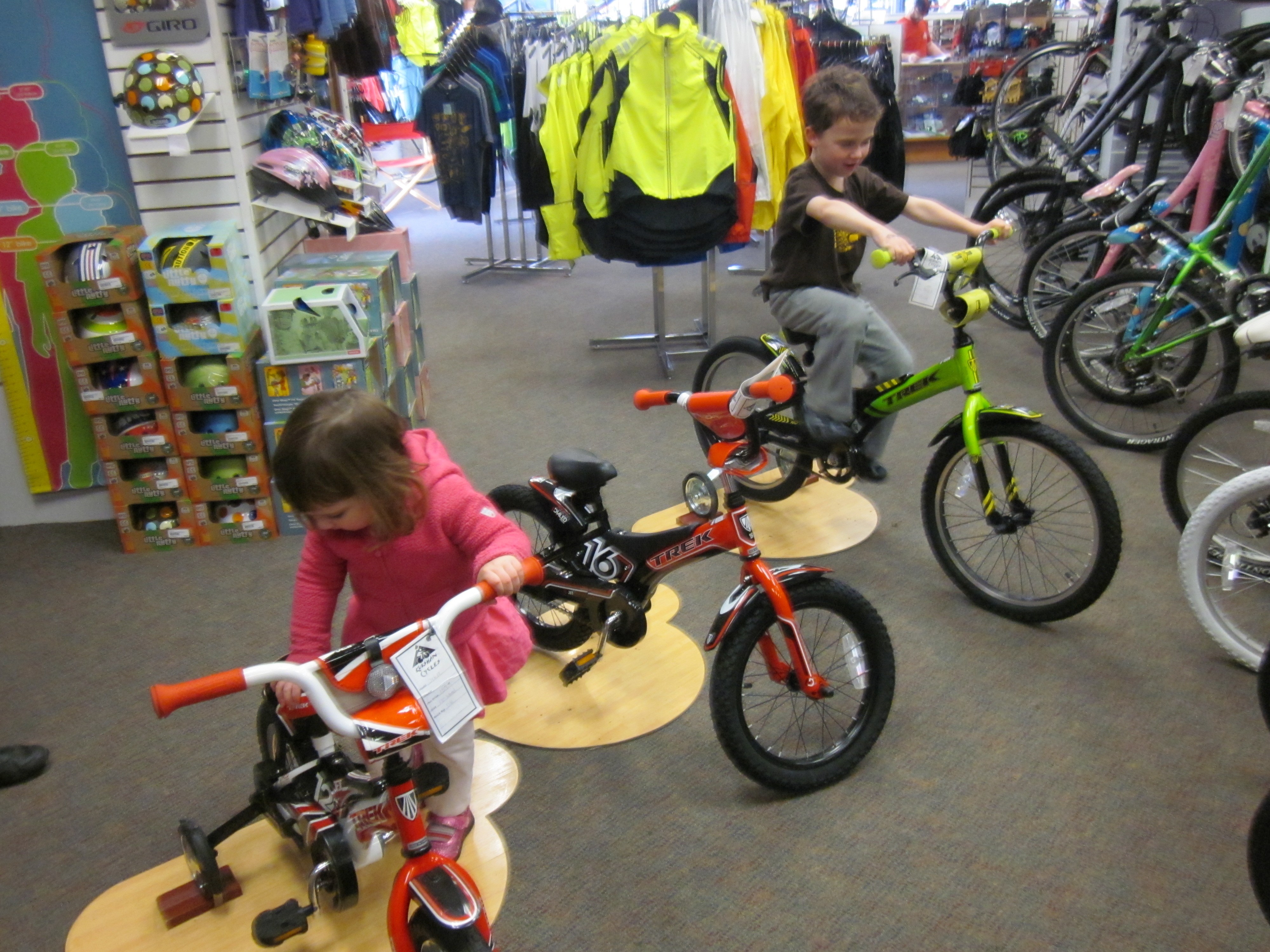
We had to drag them off these bikes, literally.

My kids ran to the kids’ bike section. The display bikes in various sizes made the only practical use of training wheels I’ve ever seen—the store had attached them to boards so that kids could use them like stationary bikes. Mine spun on those bikes for about 40 minutes, and it was very easy to see which bike fit each kid. In the meantime I walked around their enormous store, increasingly impressed.

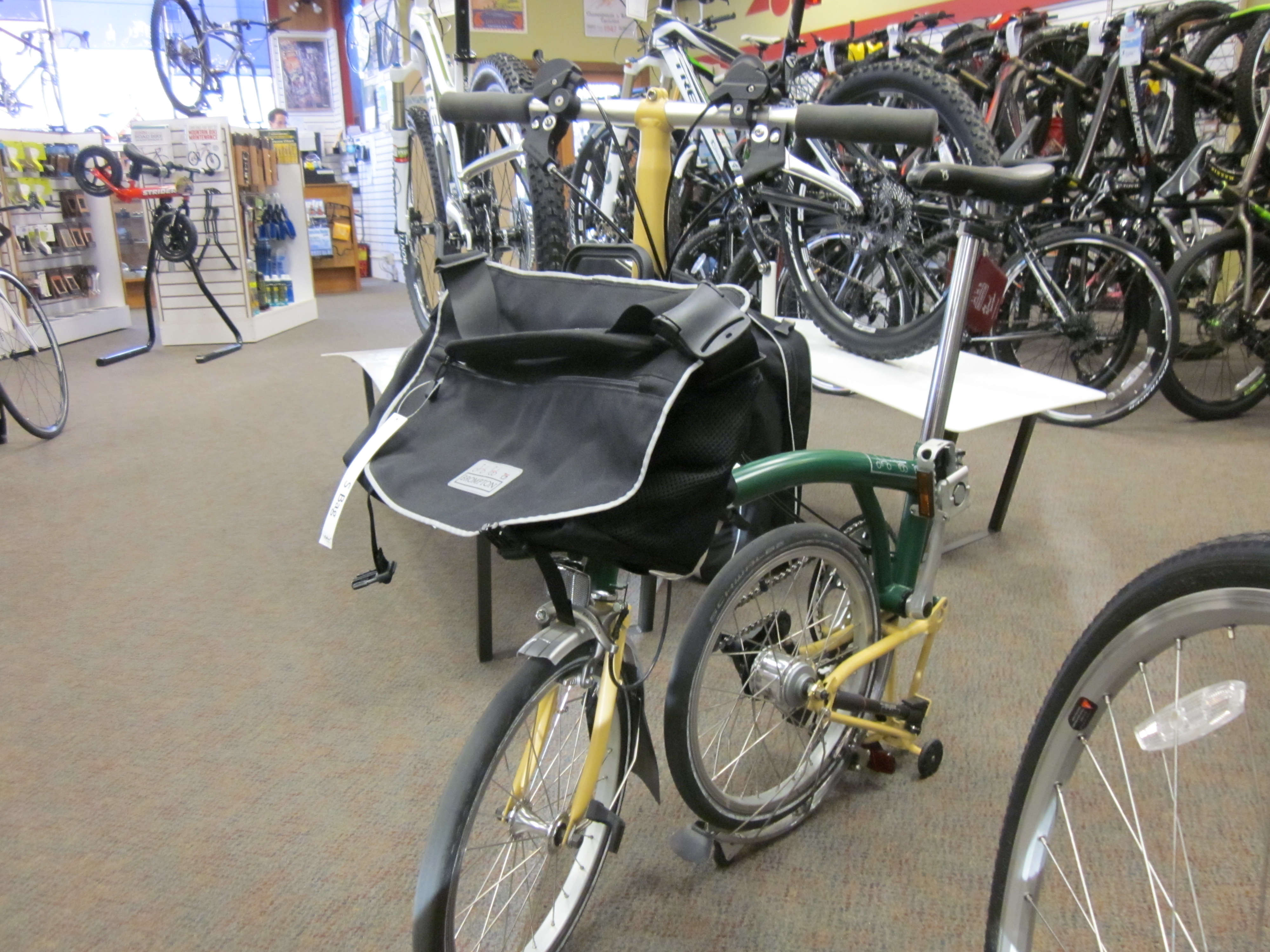
This Brompton featured my high school colors. Nice touch.

They sell Bromptons, and had a display Brompton that I could practice folding and unfolding. And speaking of the UK, they sell Pashleys, which I had only ever heard of before, as heavy 3-speed English bicycles are about as practical as Hummers in San Francisco. They’re not very practical in Bellingham either, which is hilly, but they had one just in case.

Well hello there.

They sell mountain bikes. They sell commuter bikes, and nice ones at that. And they sell many cargo bikes! An orange Batavus Personal Delivery, which I knew listed at over $1000 (later I checked: list is $1300) was on sale for $750! It’s also not a good climber, which perhaps explains the screaming deal. But if you are in the market for a Bat, I’m guessing that even with shipping it would be tough to beat this price. They had a Trek Transport, which I’d never seen in person before. They had nearly every Surly under the sun in stock, but had recently sold their Big Dummy.

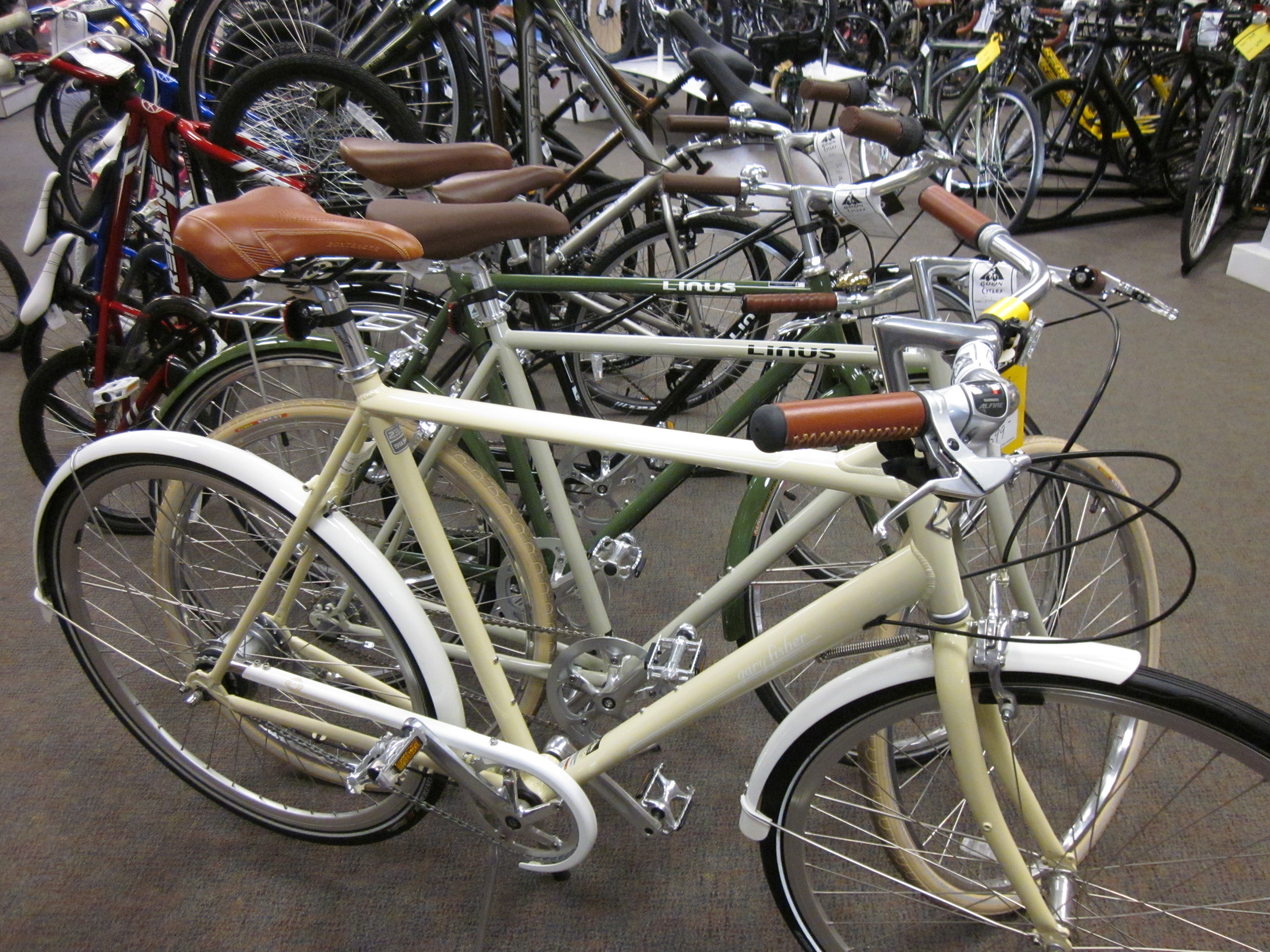
Pretty commuter bikes

At this point I had started talking to the guys on the floor. One of them told me he had built his own Xtracycle-type bike the year before the FreeRadical came out, and had put a child seat for his son on it. Then he showed me the child seats they sold; a rack-mounted seat even cheaper than the Topeak (which I now think of as the finger-slicer). They stocked that particular seat because that was what had sold historically, but had ordered and installed Yepp seats for customers recently.

Unicycles: are they more or less practical than fixies? Discuss.

I told them I was blown away by the selection. “Oh, have you seen our overpriced fixies?” they laughed, pulling out a bike painted the same flat black color as cars that speed on country roads late at night with their headlights off. I know nothing about fixies except that they have no gears and that in San Francisco they are primarily ridden by people who hate children, but evidently this one was an exemplar of the genre, as it cost $3000. And this was at a bike shop willing to sell a Bat for almost half-off. In San Francisco I presume it would sell for $5000.

When I told them I was visiting from San Francisco, they asked if I had an electric assist on my cargo bike. Because it turns out that they also sell electric assists, primarily the BionX, and given the local topography, that market has been growing. They had a loaner Trek with a BionX in the back that they let customers use for a few days if they were thinking about electric bikes, and did I want to borrow it? It was very tempting, but that bike didn’t have child seats, and they’d need a day to put them on, and we didn’t have another day.

Trailers and child seats

Would they rent it to me on a future visit? They were willing to consider it. Will I be calling them to try to rent a bike the next time I’m headed to Bellingham? You bet. But if that doesn’t come through, it turns out that there are other shops that rent bikes in town: Fairhaven Bike & Ski (which is the same vintage as Kulshan, and also offers rental trailers), Jack’s Bicycles, and Fanatik, none of which I visited but all of which I will check out if necessary, because the next time we visit Bellingham, we’ll be rolling on two wheels.

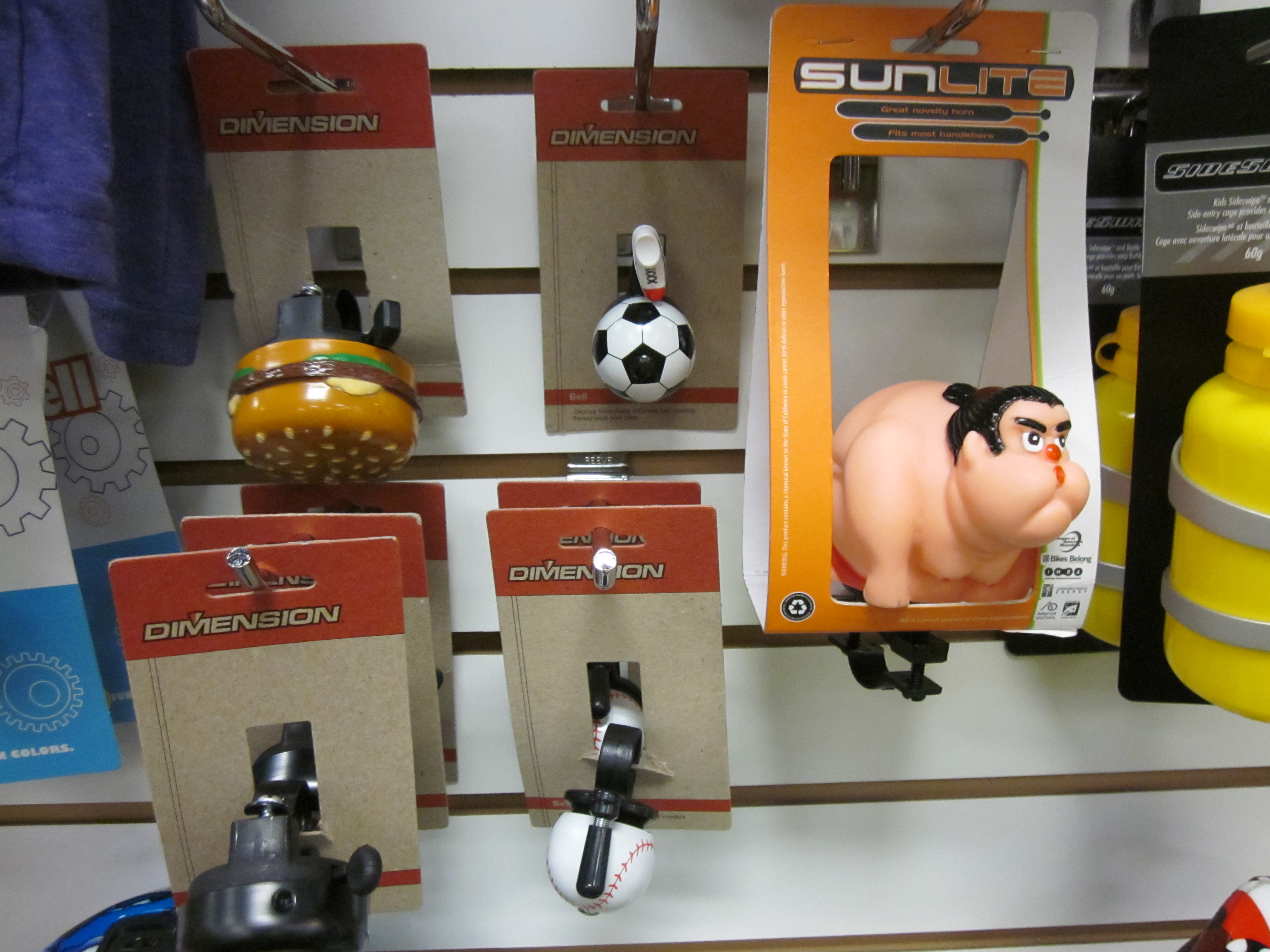
My son wanted the Sumo wrestler horn. I told him he already had a horn.

In the meantime, Kulshan has unicycles. They have beach cruisers. They have Sumo bike horns. They have multiple child trailers, which make sense to use outside of major cities. They have t-shirts with bike-friendly messages in sizes down to infant. They had a balance bike displayed on a repair stand, and that made me laugh. The employees were clever and friendly and funny and happy to see kids in the store. I liked Kulshan Cycles. Not every small city has a bike shop like this, but all of them should.

Leave a comment

Filed under bike shops, cargo, commuting, destinations, electric assist, family biking, folding bicycle, travel

Electric assist: BionX PL350

Portland's bike shops make me want to gut myself in envy

I am not usually good at getting to the point, so let me try here: I am so buying the BionX.

Despite the fact that I have speculated about electric assist a lot, until this week I had never tried one. I knew enough to know that I wanted a pedelec system (which works only when you’re pedaling) rather than an off-on throttle (where pedaling is irrelevant). Otherwise I might as well just buy a scooter. I just want to be a little stronger, so that going uphill is less of a Bataan death march at the end of a long day, or to ride with my daughter to preschool.

Surly Big Dummy with BionX

So before I went to Portland I wrote to Splendid Cycles, knowing that they carried cargo bikes with electric assists. Joel, one of the owners, said I was welcome to take one of their bikes up a hill in Portland (and they do have some hills there). They could not have been nicer, all their bikes are amazing, and most of them would be appropriate for hauling kids and/or cargo up the side of a mountain. I ended up riding a Big Dummy with the BionX PL350, a system widely praised in reviews, apparently the most responsive of pedelec systems. It adds about 17 pounds to the bike, counting both the motor and the battery. (BionX also has a 15 pound version with comparable power and a longer battery life. It costs more.)

Todd on the Bullitt (I took this picture for his wife)

Joel rode an assisted Bullitt, which is very cool in its own right; it was the first box bike I’ve ever seen in person that I have thought would be practical in San Francisco, as it is lightweight and narrow (and fast). Because my kids were already in up in Washington with my mom, I was cargo-less. So I brought my friend Todd along. Todd and I went to grad school together and although we are both pretty junior he’s now the chair of his department at Lewis & Clark. Guess which one of us makes our advisers proud? But he remains a relentlessly good sport about the crazy things that I propose. At 145 pounds, Todd is cargo overkill, the equivalent of almost four kids. But better too much weight than too little; my kids are growing.

Todd doesn’t really ride bikes, so Joel carried him in the Bullitt while I was figuring out how to use the BionX on the way to the hills. And I carried him back to the shop on the Big Dummy.

Most of Portland, to my mind, is pretty flat. The neighborhood streets we first rode on certainly were; on those streets, on an unloaded Big Dummy, turning on the BionX was wildly entertaining, but hardly seemed necessary. You turn it up and you go a little faster. It’s like magically getting stronger without the bother of having to train. There are four levels on the way up, which are activated by pushing the + button. I perceived them as ranging from “I barely notice anything” to “I barely need to pedal.” There are also four levels in the other direction (push the – button), for regenerative braking to charge the battery a little; this was fun, because it meant that I barely needed to use the brakes.

And then we got to the first hill. Todd hopped off the Bullitt and onto the Dummy. From a dead start on an incline, I could barely move the bike. With the assist on level 1, we were moving slowly. And with it ramped up to level 4, getting both of us up the hill was like going up a slight incline with an unloaded bike. It was unbelievable. On the way down, the regenerative brakes slowed us to a crawl even though together with the bike we weighed ~350 pounds.

On the second, steeper, longer hill, still with Todd on board, I was already moving on the way up, and managed to make it about 100 (very painful) feet before I switched on the assist. Near the top of that hill I was back at level 4, moving pretty quickly, and laughing so hard I couldn’t speak. And it was at that point that I realized that I would, if necessary, give up almost anything else I owned to have this assist.

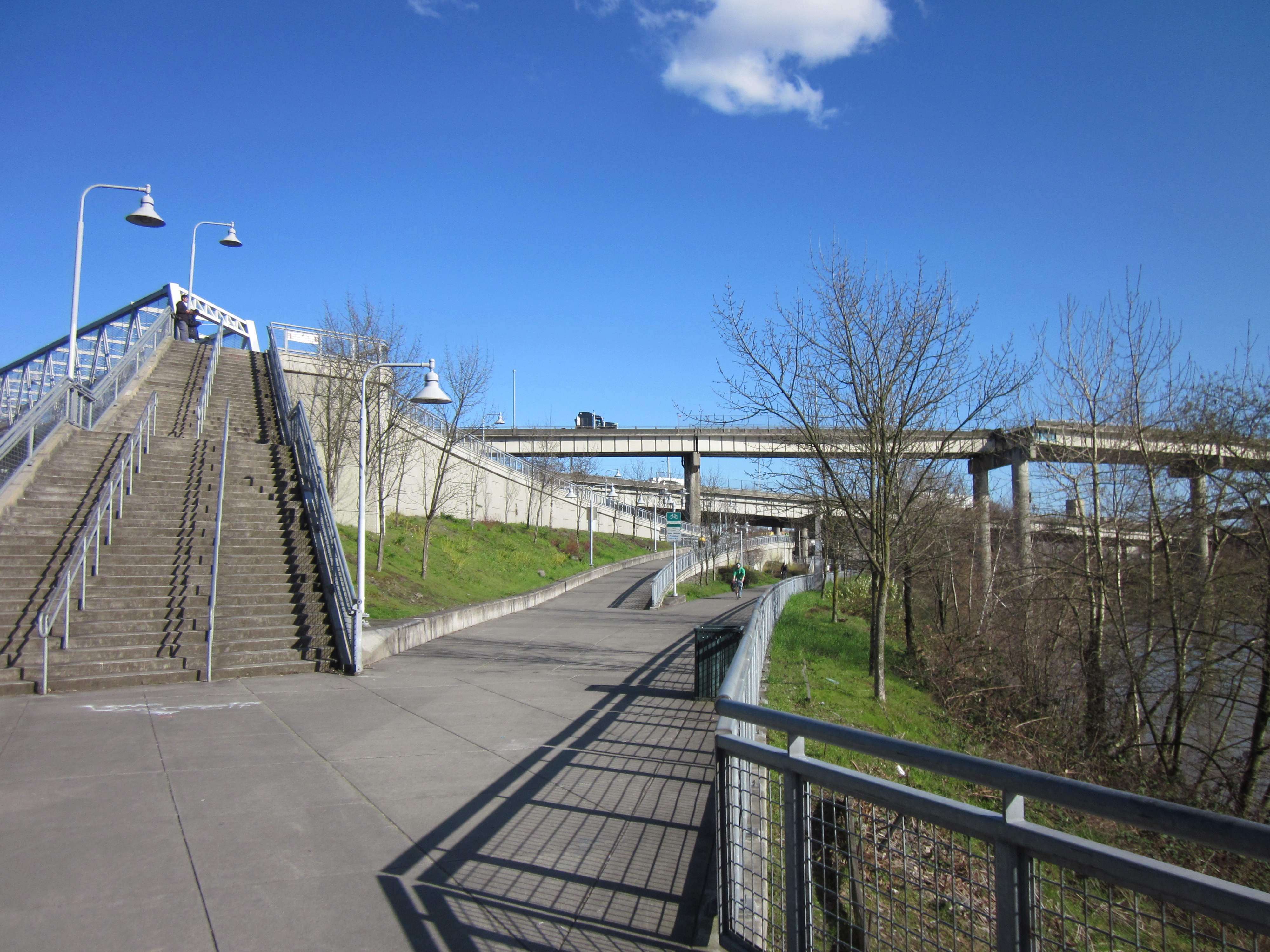
Although there are hills in Portland, the city has built switchback ramps to make the climbing easier. Let us take a moment and contemplate this.

The BionX doesn’t take the experience of hills away; it was still work to get up that second hill. But even with a person who weighs more than I do on the back, on a heavy bike, going up was manageable, and it didn’t make me want to die. It made we want to find an even bigger hill and storm up that one too. I didn’t want Todd to get back in the Bullitt; it was more fun to talk with him on the Dummy. He commented that the motor was completely silent. “If I didn’t know it was there,” he said, “I’d just think you had really strong legs.”

With Todd on board I ended up keeping the assist on level 1 or 2 for the stop signs, even on the flatter ride back. Starting a bike loaded with kids has always been slow for me; it takes time to get that much weight moving. But with the extra boost of the assist, we took off at the intersections at the pace of a racer.

The BionX has some quirks. Some of them are counter-intuitive. It is responsive to pressure on the pedals, so to get more assist on the way uphill, I learned to shift up to a higher gear. The harder I pushed, the harder the motor worked. This happens automatically at intersections, but on the hills sometimes I geared down low enough that I wasn’t getting as much help. I suspect gearing down to reduce the assist would actually be a useful way to train to ride hills unassisted if one were so inclined.

There is an awful lot going on at the right handlebar grip on a BionXed bike; occasionally I found myself changing the assist level when I meant to shift gears, or shifting gears when I’d intended to brake. I’m guessing that this kind of thing is temporary.

Finally, the motor cut out once. We were on a flat street, fortunately, and when I asked Joel what happened he said the sensor had jogged loose. He nudged it and the assist starting working again. There is a reason it is so twitchy, evidently, but I didn’t understand the explanation. However it is also apparently possible to set up the control so that it doesn’t cut out like that.

Todd drove me back downtown after our ride, patiently listening to me babble gibberish, which was something along the lines of “OMIGOD OMIGOD OMIGOD!!!” I couldn’t stop grinning, not even when I was sideswiped by a jogger on the walk back to the hotel. I found myself laughing randomly when I tried to explain what riding with the BionX was like to other people. I’m laughing now.

The BionX would change our lives. A lot of our remaining driving miles are, “No way am I riding up THAT hill” trips. Joel said he’d taken a fully loaded Bullitt+BionX up a 25% grade. We have a hill like that near home and we find alternative routes even when we’re driving. He noted that the BionX could get overheated on steep, extended climbs (>20 minutes) in hot weather, at which point it would reduce the assist level to protect the motor from overheating. But our hills are short and broken-up with stop lights, and it never gets hot in San Francisco. With really serious cargo loads an EcoSpeed would be better, but two kids and groceries are evidently not what people have in mind when they talk about serious cargo.

How much do I love this assist? I would have bought one on the spot if it would work on the Breezer, even if I had had to talk Splendid Cycles into prying one off of a bike in the shop. But I will have to give up my Breezer to use a BionX; it won’t work with an internally geared hub. That’s not going to happen right away—there’s the non-trivial issue of figuring out what bike to ride instead—but it is most assuredly going to happen.

7 Comments

Filed under bike shops, cargo, electric assist, family biking

Electric. Bicycle. Culture clash.

It's Electric! (boogie boogie boogie)

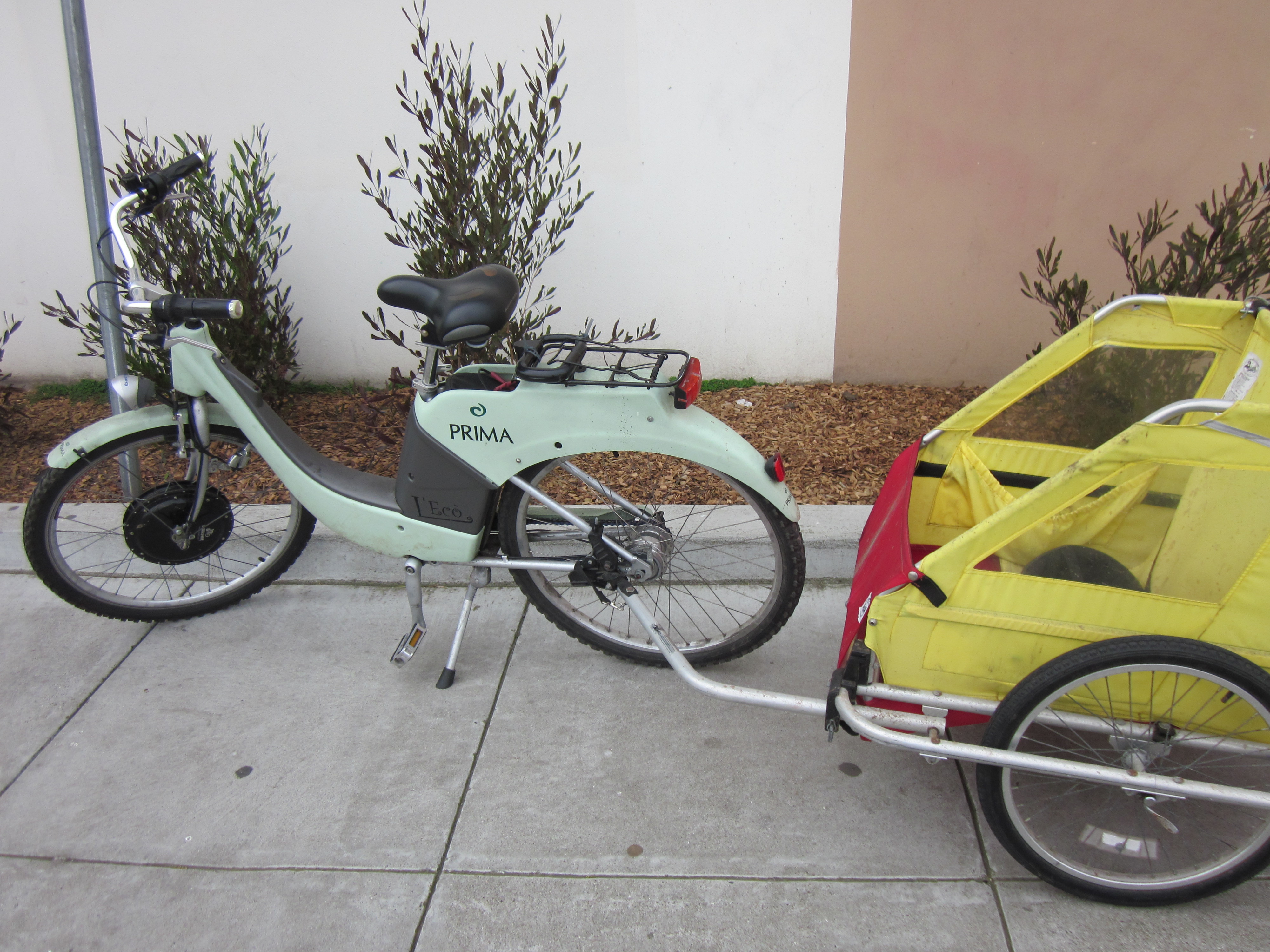
While I was getting lost on the way to Saturday’s class on getting kids on the road, I wandered through the park and library next door, and up to the middle school. There I saw an electric bike with a child trailer attached on the rear. Both of these are such rare sights that I immediately took a picture. Right after I did, the bike’s owner wandered out.

I asked him about his bike and he said he’d gotten it some time ago from a store in Oakland that was briefly importing electric bikes from Europe, and found them such poor sellers that it dumped them all at bargain basement prices. But he’d found the factory motor installed in it too weak, so he’d replaced it with a much more powerful motor, then upgraded the battery to boot. Worth it to buy even with the upgrades, he said, because the bike had a great compartment for the battery integrated into the frame. Then he said he’d just taken the bike up the hill with his two kids and their backpacks in the trailer, without even pedaling.

I was getting the sense that I was in the presence of someone who actually knew something about electric bikes, and this turned out to be the case. His name was Nick, he said, and he wrote columns for a new website, electricbike.com. Sure enough, he does. And then some. Well now.

It turned out he was a car mechanic but he loves bikes more. He thought car culture was crazy. “I tell people their car needs a $2800 repair, and they groan and tell me to do what I have to do. I tell them I can put an electric motor on their bike for $1000 and I’ll throw in the labor for free, and they tell me that it’s too expensive.” He was the first major fan I’ve ever met of electric bikes, and consistent with the tinkering evident in his own bicycle, he was not a fan of BionX, which as a closed system doesn’t allow swapping out parts. Talking to him was worth the embarrassment of showing up late for a class I was supposed to be helping to teach.

I mentioned meeting him to the other parents who were teaching the class. Like almost everyone with kids in the city, they were pretty excited about the prospect of electric assist, although none of us actually had one. Great for seniors riding in the city, said one. Another couple had an 8 year old and 5 year old, and they were commuting to school on a tandem with an Xtracycle FreeRadical on the back, which sounded like a totally awesome ride to me. But the dad, who teaches at Sunset, complained that the Xtracycled tandem was actually harder to get up hills than their old Xtracycled bike with both kids on the back.

What he really wanted for the school commute was a Metrofiets.  Who doesn’t? But they were put off by the cost, and I hear that: I find the cost of a Metrofiets daunting, and university professors typically make more than elementary school teachers (for reasons that elude me).  Nonetheless, unlike me, they were actually willing to make the trip down the Peninsula to Bay Area Cargo Bikes to test ride one, something I’ve avoided as I figure it could only lead me to want to buy another bicycle.

Families on bikes in the heart of the city

They’d been thinking about electric assist, and knew they’d need it if they actually got a box bike, but were having a hard time getting over the feeling that using a motor was somehow cheating. I knew exactly what they meant. It feels like I should be able to ride my bicycle without an electric assist, even though I know that my kids’ current weight is nearing the limit of my abilities. To me and to them, an electric assist felt less like a cool accessory and more like a necessary evil. It felt like compromising the bike for some reason. Heck, some riders feel that way about fenders, or for that matter, brakes. We had all seen the Xtracycle with the red handlebars and an electric assist riding in traffic every morning (there aren’t that many family bikes in this town; you start to get to know them). Not only did we all find that a little scary, it seemed kind of annoying that the guy on that bike doesn’t even bother to pedal.

Looking over downtown San Francisco

What’s more, thinking about the cost of an electric assist really irritated me for some reason. It took me a while to figure out why. Eventually I realized, and this is embarrassing: it was resentment. Parents in other, flatter cities can carry their kids without paying for electric assists, why couldn’t we? Isn’t it enough that we already have a much higher cost of living? When I tell people outside the Bay Area the average rent for a two-bedroom apartment in San Francisco ($3275 as of last month), they typically gasp in disbelief, and say, “I could buy a mansion for that where we live!” Yes, I knew that already, thanks for sharing. We live surrounded by fog 11 months of the year and pay $4.50/gallon for gas (albeit rarely). San Francisco is one of the few places in the country where I know couples who are both well-paid lawyers and who are nonetheless raising their kids underneath the stairs, Harry Potter-style, of a 1-bedroom apartment, because that’s what they can afford. We all make compromises to live here. On top of all that, I have to drop a grand on electric assist when everyone else in the world can haul kids on their bikes fueled only by righteousness and an extra serving of oatmeal in the morning?

This is embarrassing to admit because we are happy to be here. Lots of people say they would be thrilled to trade places with us (although when push comes to shove they usually balk at the prospect of raising their kids in a garret under the stairs). So we’re going to pay more to ride our bikes than we would elsewhere. Why should this be any different from anything else that costs more in the city?

San Francisco isn't Copenhagen

Anyway, I got none of this angst from the electric bike mechanic, or from his website. It was all about the thrill of having a motor. He pointed out that the cost of using an electric assist was bupkis: “You spend more on power if you forget to turn the light in the closet off in the morning.” I now realize that part of the issue with electric bikes is trying to reconcile bicycle culture, which views motors with suspicion because they’re related to cars, which have a bad habit of mowing people down, and mechanic culture, which views bicycles as a neat way to use motors without having to register a vehicle, get a license, or avoid mountain bike trails. But if it’s going to happen anywhere, it will happen here, in the City by the Bay, Gam Saan, with its countless hills.

5 Comments

Filed under electric assist, family biking, San Francisco

Thinking about electric assist

Okay on the flats, but for the hills we'll need more power

If I could name the #1 thing that makes parents we know in San Francisco who’ve never attempted family biking perk up and say they want to try, it is the words “electric assist.” The other week I said those words in passing to another mom at our daughter’s preschool who has almost no experience riding. She has now told me every day that I’ve seen her since that she is hounding her husband to shop for an electric bike for them when he returns from his current business trip.

Discussions about riding bikes in San Francisco always involve hills, to some extent. This is especially the case if you live, as we do, on a mountain. Mt. Sutro: it’s right there in the name. It burns us, Precious! We’ve learned to ride them, but these hills aren’t easy. If we lived higher up the mountain like some of our neighbors, I would be riding an electric bike right now. Nonetheless hills are at least consistent. Unlike the wind or the traffic, they are predictable. They aren’t going anywhere. I keep thinking that people can get used to anything, but there are destinations in the city we avoid unless we’re driving. And there are times we give up. Last weekend Matt couldn’t face the prospect of riding to the hardware store, which is halfway up the other side of our hill, leaving him the unenviable choice of riding up and down and back, or down and up and back, or driving. Despite the hell that is finding parking in that neighborhood, he drove.
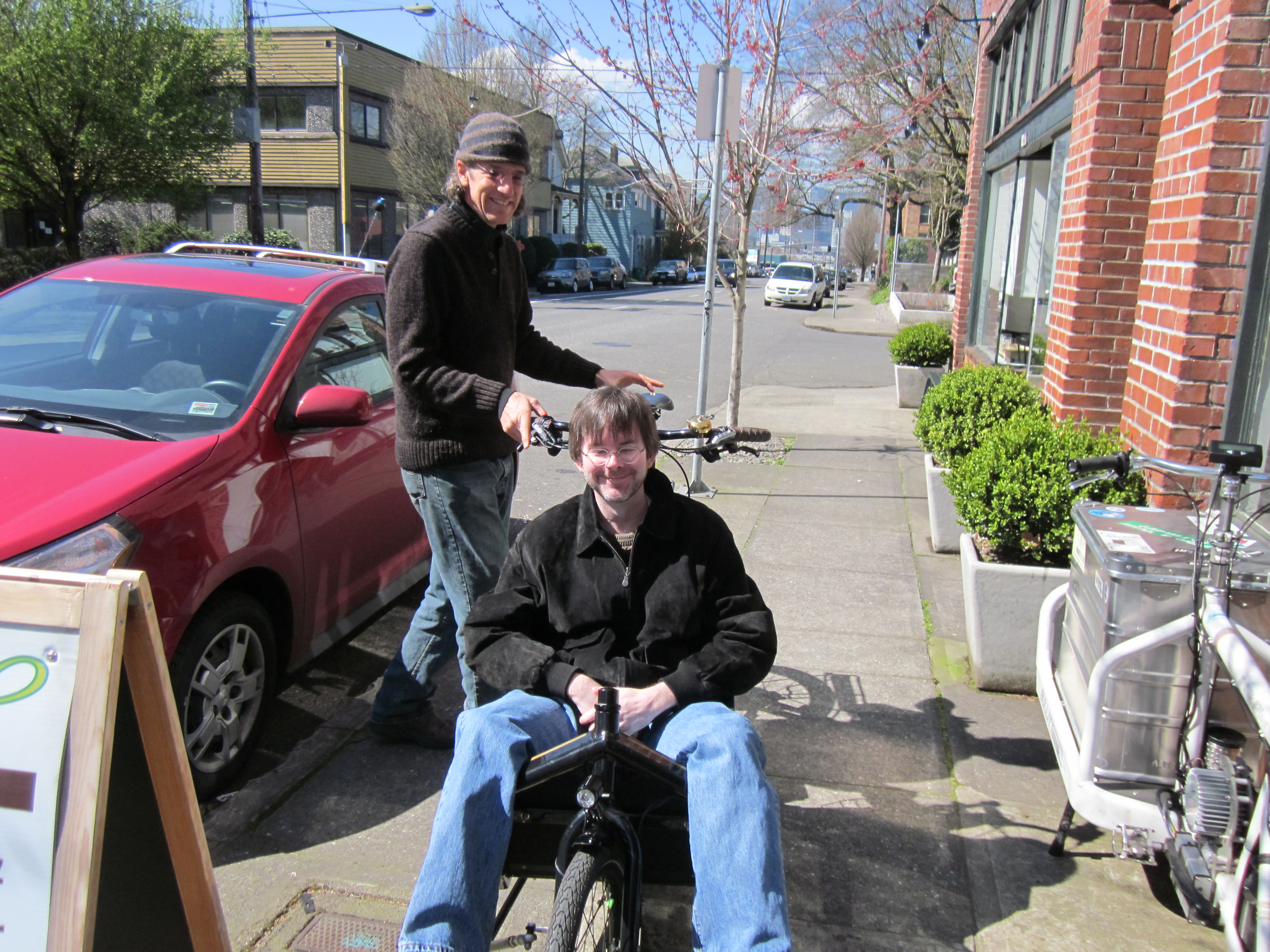
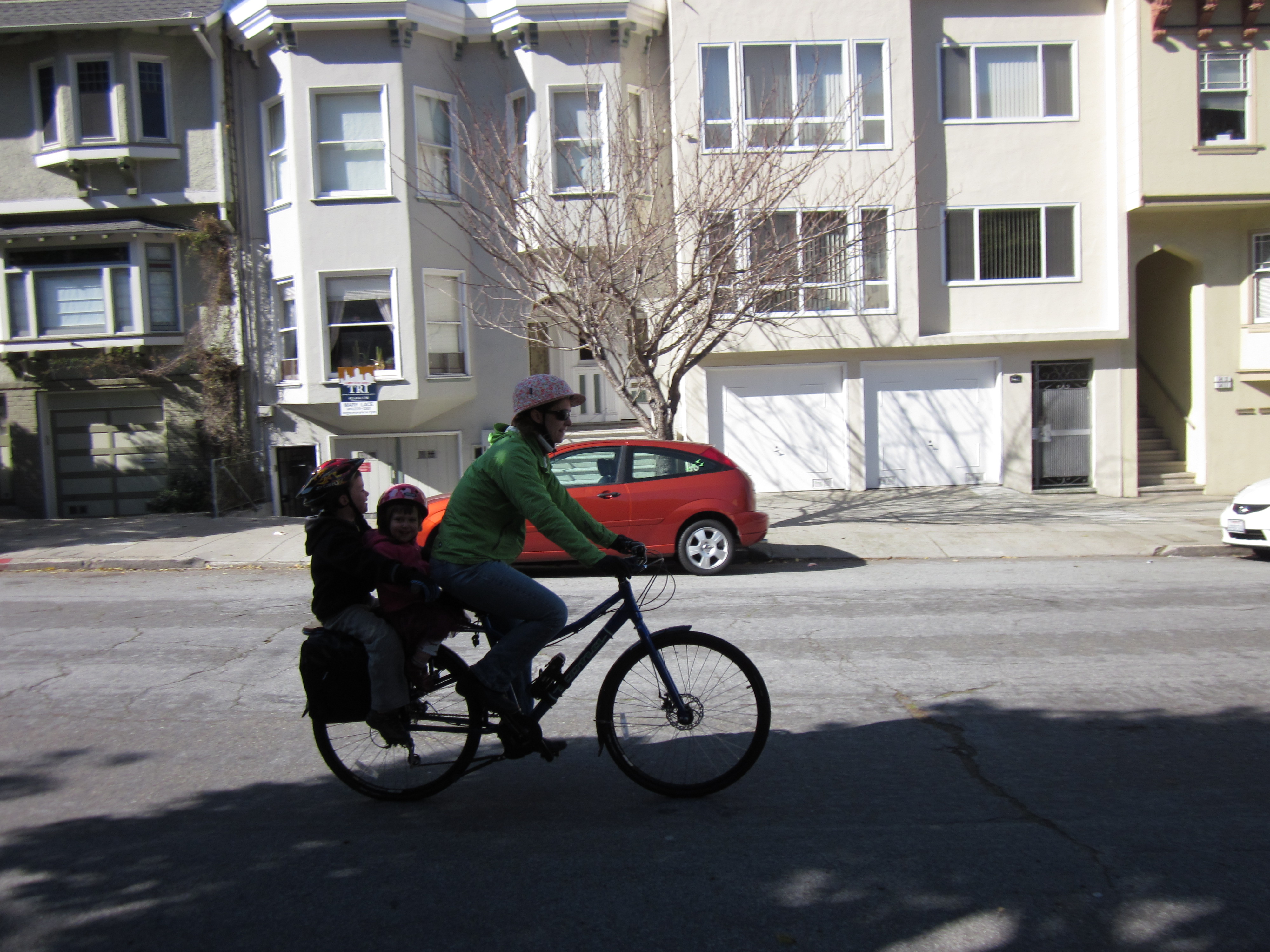
It's easier on the way down

Our friends have a Big Dummy to take their kids to school, and they live on Lone Mountain. They take their kids, their groceries, and on occasion each other, up Lone Mountain. And they tell me they push that bike a lot. They are philosophical about it and call it upper body training. They are opposed to many electric assists for environmental reasons, but they are the exception. Our friends who live on Potrero Hill or nearer the top of Mt. Sutro have said they’d be riding their bicycles daily if they had any idea how to arrange an assist. I myself had no idea. But our kids are getting heavier, and I think it’s time to learn. The only other semi-practical option was suggested by my brother-in-law, who noted that Lance Armstrong became a much better hill climber after getting cancer and losing 20 pounds. I suppose that I could conceivably hack weight off my own frame for a year or so at the same rate my kids were gaining without losing much leg strength. But as a woman in America I really don’t need any more reasons to obsess about body weight, and this strategy would only work for so long anyway.
Option #1a: Buy a new electric bike. There is a new shop (and some established ones) in San Francisco dedicated to electric bikes. But when I look at their bike lines, they do not seem practical for family use. Most seem to lack basics like rear racks, and overall remind me of the Bikeyface cartoon about “ordinary black lace panty” bikes (not that there’s anything wrong with that). Perhaps one day this will change.  But the word on dedicated electric bikes is that the bikes themselves are often cheaply made. To keep the price point less terrifying, the money is in the motor.

Option #1b: Buy a new electric cargo bike. Both Kona and Yuba make electric cargo bikes, the Electric Ute and the El Mundo, respectively. These are obviously suited to family use, and they are both respectable manufacturers who primarily make bikes rather than slapping some bike components onto a motor. These bikes are expensive relative to the non-electric versions (all electric bikes are expensive) but they seem to offer some economies of scale; the electric versions cost less than it would cost to buy a non-electric version and add a comparable motor to it. If you’re looking for a new cargo bike, these seem like competitive options. However we have a cargo bike that we like, and living in the city makes us reluctant to commit to a really long bike like the Ute or the Mundo.

Option 2: Add a motor to the bike. This is the direction we’re leaning if we electrify: we have bikes we like right now, and if we wanted to upgrade/change bikes later, we could move the motor, potentially sparing ourselves the cost of upgrading more than once. But the market for add-on electric assists is massively confusing to me. Older reviews suggest that some manufacturers offered pedal assist (e.g. BionX, Stokemonkey) and some offered throttle assist (e.g. eZee, nearly everyone else). Not sure what’s up with the random capitalization by these manufacturers. What that means as I read it:

  • pedal assist motors make you stronger as you pedal, but won’t work unless you’re pedaling
  • throttle assists operate with a switch on the handlebars and move the bike along whether or not you’re pedaling.

But evidently this is moot now because primarily pedal-assist motors now offer the option of moving your bike whether or not you’re pedaling (BionX) and primarily throttle assist motors now offer what some are calling “the European option” of only working when you’re pedaling (eZee), a term which I can only assume refers to some legal restriction on electric assist bikes in Continental locales. As a bonus, the major brands all seem to offer head and tail lights that plug into the battery. Whoo hoo!

As a result I have started thinking about electric assists in the simplest possible terms for a total noob like me: front wheel, back wheel, and inbetween.

Front wheel motors

You can buy these all over the place, including on Amazon; eZee is apparently the market leader. The El Mundo uses an eZee motor; some models are evidently powerful enough to move a loaded cargo bike. An important caution: You shouldn’t put a front wheel motor on an aluminum front fork. It will break while you’re riding and fling you headfirst onto the ground. GOOD TO KNOW! This is mentioned occasionally on sources like online bicycle forums and on the websites of what appear to be reputable electric bike shops, but is not routinely mentioned in the advertising for these motors. The electric assist market is a Wild West indeed.

Costs for these motors seem to range from $400 or so for a low-power version with heavy batteries (not cargo-bike friendly) to $1500 or so for a high-torque version with lighter weight batteries. Installation not included, and given that people are evidently mounting them on aluminum forks on occasion, I would be inclined to find a reputable bike shop for installation even if I weren’t hopelessly unhandy. Who knows what else could go wrong?

The Kona has an aluminum fork: no front wheel motor on our MinUte. The Breezer has a steel front fork (the specs said “chromoly” which I had to look up, because in case it’s not totally clear by now, I’m clueless; another option is to see if a magnet sticks to your fork, if yes, your fork is steel). So we could put a front wheel motor on the Uptown.

Rear wheel motors

The market leader in rear wheel motors is apparently BionX. It is primarily a pedal assist motor, but the newer versions claim you can use it without pedaling if you want. The BionX motor comes in various powers, some suitable for cargo bikes and hills, others less so. BionX appears to be sort of the Apple of electric assists; expensive and incompatible with other systems, but stylish and easy to use. The newest versions have cool features like locking the rear wheel when you walk away with the console, making the bike more difficult to steal.  Reviews suggest that riding with the BionX is a lot of fun; you pick a level of assist (25% extra to 300% extra) and when you push down hard on the pedals, the battery sends out that much extra power to make riding easier. This would be super-handy at stop lights as well as on the hills. This motor only works on bicycles that use a derailleur on the rear rather than an internally geared hub.

Cost seems to range from $1000 for a system that might not move a loaded cargo bike uphill to $2000 for the top-of-the-line system with lots of torque and security features, installation not included.

My Breezer has an internally geared hub and I like it: no BionX for the Uptown. The Kona MinUte has a derailleur so we could put a rear wheel motor on it. How can you tell if you have an internally geared hub? It’s like true love; you already know.

Inbetween

Let’s say you have an aluminum front fork and an internally geared hub and no desire to buy a new bike. Or you are carrying very heavy loads. Apparently there are also motors called mid-drive motors that attach to the chain. They are recommended for cargo bikes because they have a lot of torque. The only two I have heard of are the EcoSpeed and the now-out-of-production Stokemonkey. The Stokemonkey, if it were possible to find one used, is pedal-assist only (a discussion of the pros and cons of this for one family, relative to the eZee kit, is here). And evidently really, really powerful; it took a loaded cargo bike up Russian Hill! That’s over a 30% grade.

Costs are heart-stopping even for electric assists. The EcoSpeed runs over $3k. Installation is evidently challenging. It’s not for the faint of heart, unless of course you live in Portland, where all these motors are made, and where presumably any bike mechanic could install one with their eyes closed in exchange for a pint of artisanal beer sold from a Metrofiets.

Should we get an electric assist? I don’t know. They’re expensive, and that’s daunting. But we’d probably ride a lot more, and that is worth something too. We fear the hills more and more as the kids grow. We are fortunate that there are at least bike shops in San Francisco that seem to specialize in electric motors. Both Big Swingin’ Cycles and The New Wheel will put a BionX on a bike, and Electric Bicycle Outlet will install an eZee kit. Maybe it’s time for us to actually visit one of them.

2 Comments

Filed under cargo, electric assist, family biking, San Francisco