Tag Archives: family biking

We tried it: Madsen

My kids didn’t want to ride a bike until they saw it and said, “Oh, okay, it’s a cool bike.”

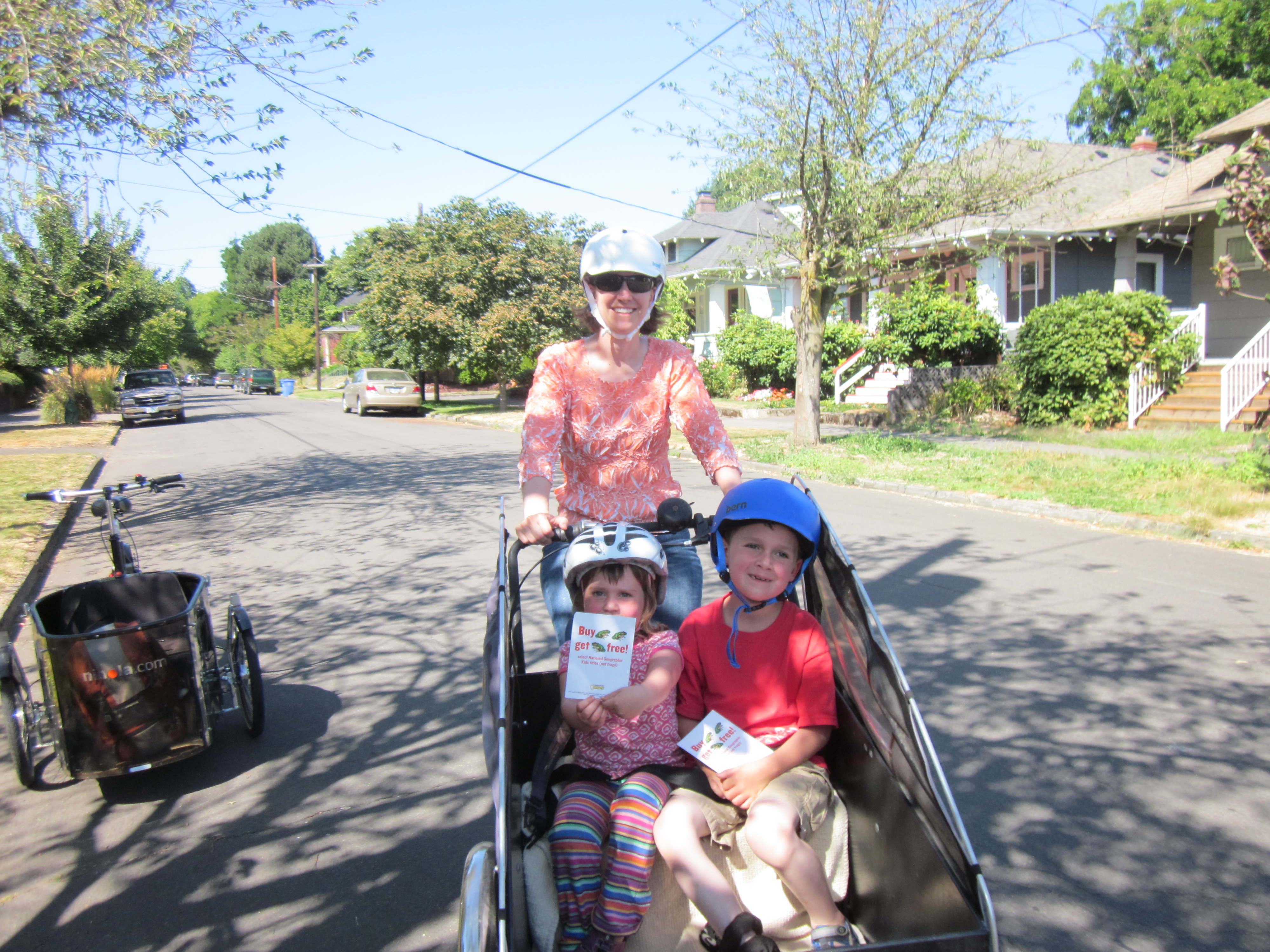
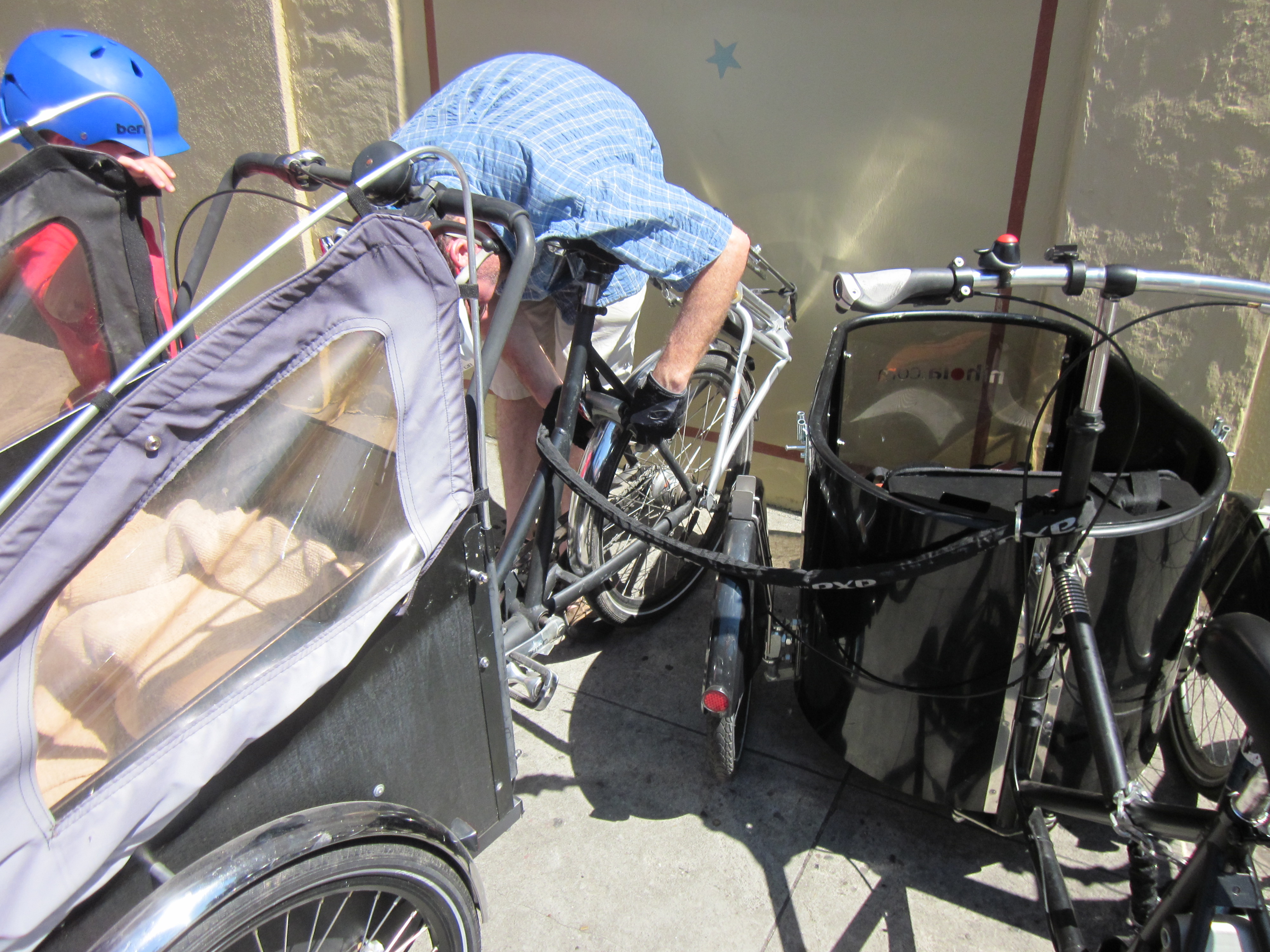
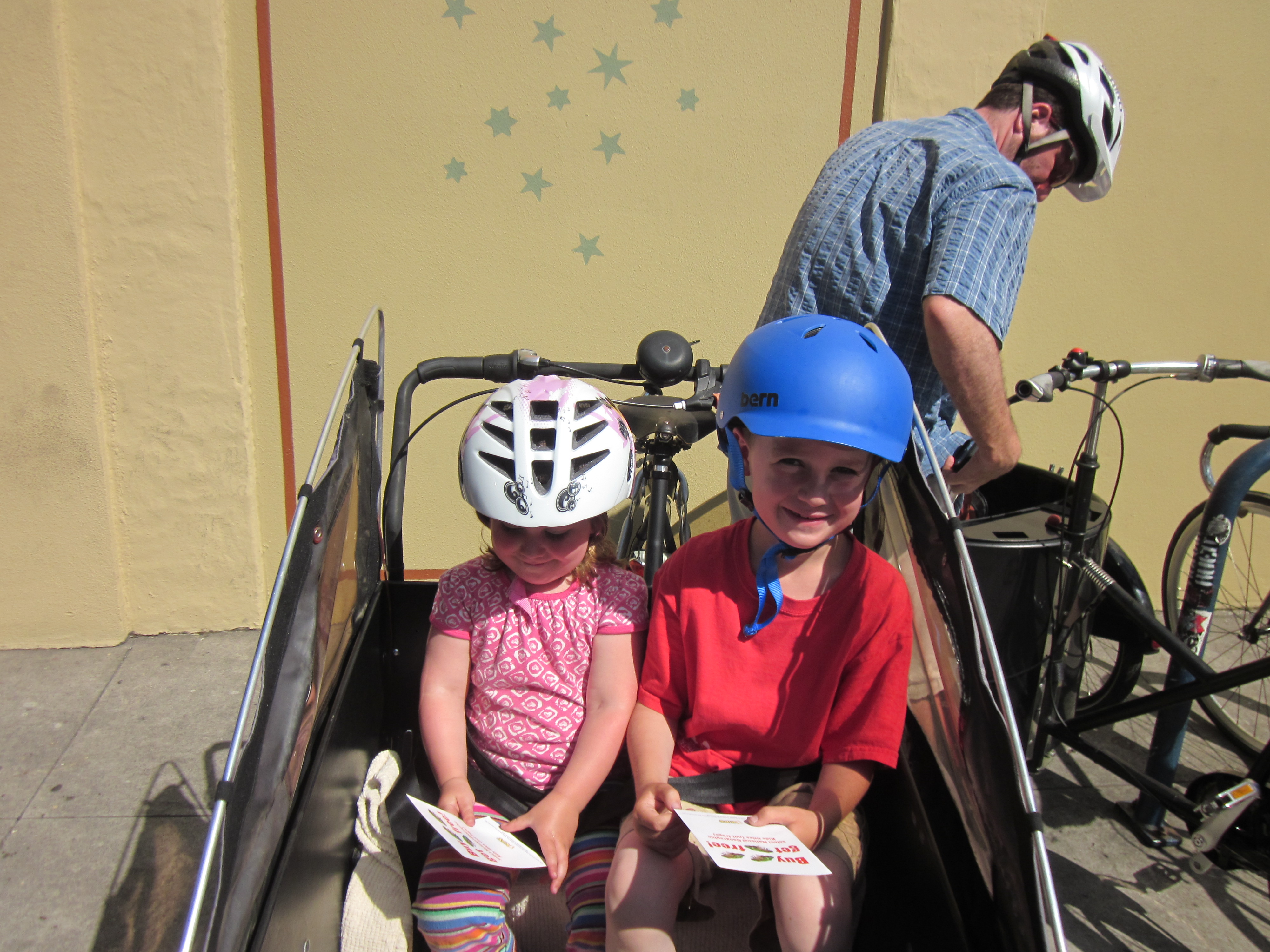
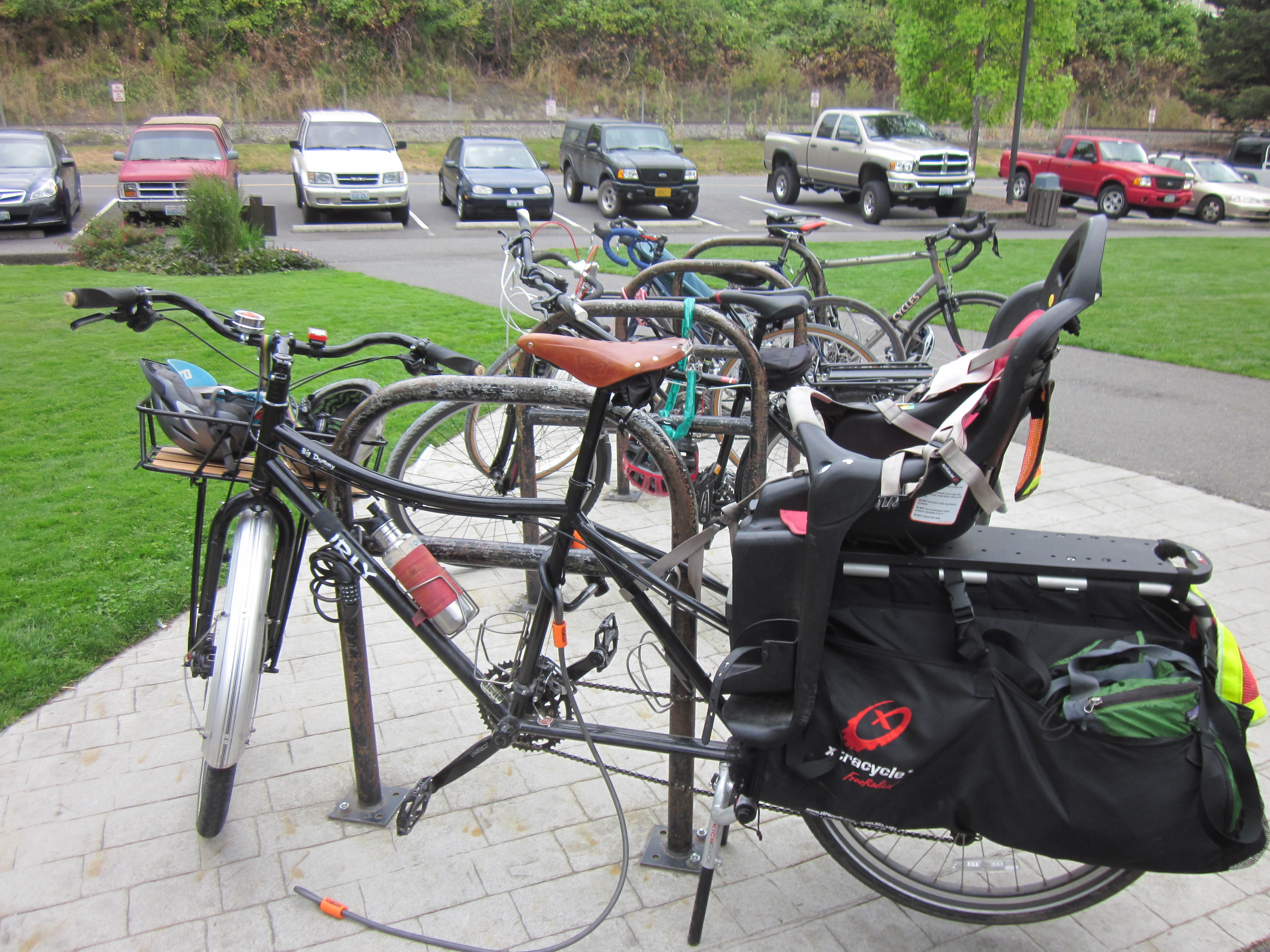
The Madsen is unlike any other bike on the market I’ve ever seen. It is like a reverse box bike, with the box in the back instead of the front. A longbox rather than a longtail? The Madsen has been reviewed before, by more experienced riders than we are, and on a newer model to boot. But we got to try riding a (first generation) Madsen for a day or so thanks to the generosity of The Main Tank, who loaned hers to us during our stay in Seattle, so I thought I’d write about it anyway. And here’s a 2014 review of an assisted Madsen from a family of six!

Before we went on our trip, I sent a list of every cargo bike I could find to my brother-in-law, who then looked up all their specifications and told us which he thought we should seriously consider. He was fascinated by the box in back design of the Madsen. He was less impressed by the quality of the components. This is the way it is: less expensive cargo bikes have lower-quality parts. Whether that matters depends somewhat on the conditions in which you ride. San Francisco is hard on bikes, and so this is something that’s come to matter a lot to us. Like a lot of people where we live, we have spent a fair bit of money upgrading our original cargo bike, the Kona MinUte. Most of that went into replacing the brakes. We are tireless and tiresome evangelists on the subject of hydraulic disc brakes. If we got a Madsen it’s likely we’d end up spending a fair bit of money upgrading parts on it as well.

The Madsen is a fun bike to ride in certain conditions, it is inexpensive enough to be a good entry-level cargo bike, and riding it is much less hassle than hauling a trailer.

My son could self-load, my daughter could not.

The Madsen is a bike I had only ever seen in Seattle, although I recently learned one family has one in the East Bay and another family will soon be riding a Madsen with BionX in San Francisco courtesy of The New Wheel. Davey Oil pointed out not long ago that cities have certain family-bike personalities and he was dead on. Seattle has Madsens and Surly Big Dummies (at least 5 of each at the Seattle Cargo Bike Roll Call). Portland has child trailers, trailer-bikes, and box bikes: Bakfiets and Bullitt and Metrofiets. San Francisco has commuter bikes with child seats, trailer-bikes, family tandems, Xtracycles (even an Xtracycled family tandem), and in the last year, a spate of Yuba Mundos and elMundos. But you almost never see child trailers here.

The pros of the Madsen:

  • The Madsen’s rear box can hold four kids (!) with seatbelts on two benches. This exceeds even the recommended load in the box of a Bakfiets (although people have been known to put four kids, and then some, on a Bakfiets as well). If you only have two kids, they can sit across from each other and get some space if they are prone to fighting. In addition, forward-facing kids aren’t shoved into the butt or back of the rider, thanks to the length of the box. This is a minivan-replacement.
  • The box can also hold enough groceries to handle the needs of the once-a-week suburban family shopper, with few hassles about oddly-shaped items, balancing the load or packing it into bags. It’s like the trunk of a car: you can just toss everything in there. This is an advantage of all the box bikes and it is significant.
  • The Madsen bucket is integrated with the frame, so going downhill doesn’t mean being flung back and forth by the weight in the rear, unlike when riding a normal bike with a trailer. This was a relief. The Madsen also has a front disc brake, which makes going down hills safer.
  • Kids like riding in the Madsen, probably because the view is good. They sit up high enough to get a view and they’re not squashed against the rider.
  • The kickstand is very stable. It’s easy to load kids in and out of the box with it down.
  • The Madsen has a 20” rear wheel, which makes it an excellent candidate for adding a rear hub motor with high torque for climbing hills. When I talked with The New Wheel they said they were very excited about the potential of a Madsen with BionX in San Francisco. However if you do this, it would be a very good idea to upgrade the brakes to get back down the steep hills you would then be able to climb.
  • The step-through frame makes this bike very accessible to even the shortest of riders, and easy to ride in a skirt. The bike has both fenders and a chain guard, thankfully. You can add a front rack for cargo that you don’t want kids to handle.
  • The price is on the low end for cargo bikes, currently running $1,150 to $1,750 on their website, depending on how popular a color you choose. At the end of the year Madsen tends to have big sales on their bikes, and the price can drop to $1000.

The cons of the Madsen:

  • Not just for kids: Biking with Brad takes Family Ride for a spin

    The Madsen is a terrible climber, with only nine gears on a rear derailleur. It wallows. Riding this bike uphill was miserable. It was a relief that I rode it while Biking With Brad, who has a BionX assisted Big Dummy and is a very nimble rider, and who reached over and actually pushed us up a few of the steeper hills. Although this bike is a great candidate for electric assist, it’s unlikely to make it up any steep hills unassisted if something ever happens to the motor or battery.

  • A bike with a heavy load in the rear can be unstable while walking the bike, starting, and stopping. I dumped my kids twice, fortunately on grass both times (they’re fine), but it freaked them out and I had a little panic attack about hurting them and potentially damaging a bike that had been loaned to me.
  • The rear kickstand is a hassle to put up and down. It’s under the bucket, meaning you have to get off the loaded bike to engage it. After dropping the bike I had issues with this.
  • The Madsen I rode was very wobbly at low speeds, particularly while starting. The front tire did not track straight. Biking with Brad said that when he asked the Madsen makers about that, they said that some of their bikes were like that and some weren’t and they didn’t know why. Uh, okay.
  • The rear box is split across the center because the rear wheel runs underneath it. That means that the box is really more like two narrow boxes side by side. On the up side, no fighting over leg room by kids sitting next to each other. On the down side, they don’t have a ton of leg room left to fight over. Moreover, some larger bulky items that seem like they should fit in the box won’t really fit.
  • Like a bike trailer, the Madsen is easy to catch on corners and needs a lot of room to maneuver.
  • While riding, the box is really noisy, even with kids inside to dampen the echo somewhat.
  • There are no holes in the bottom of the box, which means that stuff can collect down there (falling leaves, garbage, water) that’s tough to get out without putting the bike on its side. If it were my bike I might drill holes in the bottom so I could hose it out and so that it wouldn’t flood in the rain, because…
  • Madsen has apparently been claiming for years that they’re planning to release some kind of rain cover, but no sign of it yet. Both trailers and other box bikes have covers for carrying kids in cold and wet conditions.

The Madsen got a lot of attention. One woman asked if we’d built it ourselves. Ha ha! No.

When I first looked at the Madsen it seemed to have many of the same pros and cons as a trailer, but riding it made me realize it’s actually very different. Compared with the mountain bike + trailer we tried, it was much harder to go uphill and much safer going downhill. The Madsen held twice as many kids, while the trailer was much less likely to tip. The trailer had better weather protection, but the Madsen was more fun for the kids on a sunny day because they could see more. A trailer is quieter. However if you like the color pink or buy at the end of the year, it is possible to buy a Madsen for less than the cost of a bike plus a trailer, assuming that you don’t already have a bike.

I felt no real desire to get a Madsen after trying it, although it was fun to ride for a while. It was too much of a struggle on the hills. I got the sense that a number of families in Seattle who started with Madsens eventually moved to Xtracycles or Big Dummies. I think the Madsen would be best for hauling kids who are younger than mine (ages 3.5 years and almost 7 years) in an area without significant hills. However, older kids and hills are the sticking points for most of the cargo bikes we tried, so this isn’t a complaint that’s specific to the Madsen. Overall, the ages of our kids and the local terrain make the Madsen a poor choice for us. So while this is clearly the right bike for some families, it’s wasn’t right for ours.
21 Comments

Filed under electric assist, family biking, reviews

Home again, home again, jiggety-jig

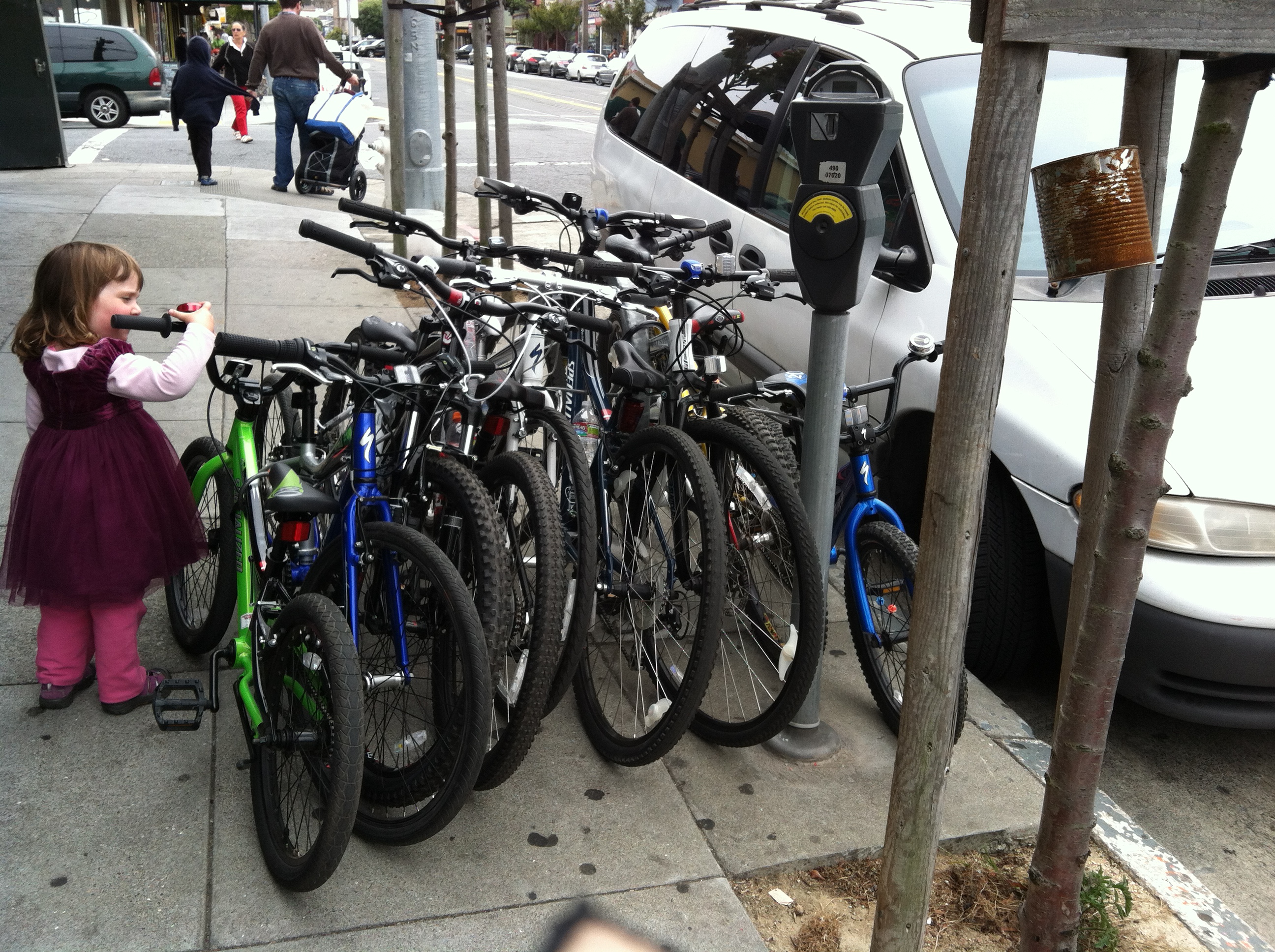
They’re running out of bike racks at the farmers market.

We got up on Sunday to catch a 5:30am flight from Portland to San Francisco. The kids wore their pajamas for the whole trip. When we got home, we remembered that we’d left nothing in the fridge when we left but soy sauce, lemons, and ollalieberry jam. So even before napping, we headed to the farmers market (fortunately a Sunday market) and the grocery store to buy: everything.

Staying in Portland made us want to live in Portland. Matt loved the idea that we might actually buy a house, and I loved the idea that we might actually have a yard where we could garden. And there were all those bikes. We even saw a double trail-a-bike, something I had heard existed but never spotted in the wild. And all those clearly marked bike paths, that made it possible for newbies like us to get where we were going, eventually.

San Francisco greeted us with fog and temperatures in the mid-50sF (where they have remained). It was a culture shock to return to such a dense city, in both a good and a bad way. There are no unattached houses in our neighborhood and no front yards. It is impossible to grow tomatoes on this side of the fog line, and anything metal left outside grows rust and/or moss. But having such an easy walk to the farmers market and the grocery store was so nice. We always see friends there, and Sunday was no exception. Everyone admired our bike trailer/hand cart. In California, the produce is always local. And when we couldn’t bring ourselves to actually make dinner after making the week’s lunches, we walked across the street for sushi.

The last couple of family bikes after our late departure

San Francisco has more bikes now too, it turns out. This morning was our son’s first day of second grade. I can’t believe how much he’s grown! I ruined my street cred by renting a City CarShare to carry all our gear on the first day of school (I couldn’t get both it and my daughter there on the Brompton). But Matt rode with our son to school on the MinUte, joined by at least five new biking families! Three Yuba Mundos (at least one assisted), one Trail-Gator, one trailer. One mom asked, “Are you Hum of the city?” Well, whoa. Yes I am. My name is Dorie, by the way, and I need to update that About page.

Before we left on our trip, our kids begged to plant poppies. We found some pots and bought some seeds and prepared to console them when such sun-loving plants gave up before blooming. But when we returned, we found, to our enduring surprise, the first flower. We are glad to be home.

2 Comments

Filed under family biking, San Francisco

We tried it: Christiania and Nihola cargo tricycles

Over a year after our return from Copenhagen, we finally got to ride a Christiania.

I knew coming in to our cargo bike test rides that we weren’t going to be buying a tricycle. If there is one thing that is fairly certain, it is that trikes can’t handle steep hills. But we wanted to try all the cargo options, if only to get a basis for comparison. Also, we had really, really wanted to rent a Christiania while we were in Copenhagen and no bike shop we found would let us.

One kid plus a backpack does not test the capacity of the Nihola.

In Portland, however, it was easy to test-ride a trike, because Emily Finch offered us the chance to use their family’s Christiania when she learned we were coming to Portland. How sweet is that? She herself rides a Bakfiets, but her husband got the Christiania when he was new to riding. While we were at it, we rented a Nihola from Clever Cycles (Clever Cycles is amazing). Matt and I each rode one for a few miles from the shop to the Hawthorne shopping district for lunch, then we switched off and headed back.

This is about as far forward as you want the weight in the cargo box to go.

Tricycles have a reputation for being more stable than bikes among new riders, which is only half-true. Trikes are statically stable and dynamically unstable (whereas bikes are statically unstable and dynamically stable). When trikes are stopped they rest on three wheels, like a footstool with three legs. For this reason you’ll never see a trike with a kickstand. They have a single hand brake with a parking latch, and coaster brakes. When trikes are moving, however, they are unstable. They sway and shimmy. My father-in-law, who is a physics professor at UC Berkeley, explained this to me as partially a function of the third wheel. All wheels have inherent lateral instability from the centripetal force of their movement. Add a third wheel and you increase that instability by 50% (my summary of his explanation elides a lot but is much shorter).

This guy with no legs whizzed by us on a hand-powered delta trike. Impressive and depressing at the same time.

Whether you will like a trike depends on whether you expect to be stopped or moving most of the time. It also depends on a lot on how fast you want to ride. We found that the top speed of a loaded tricycle was only slightly faster than brisk walking (although it was much less effort). Given this pace, it was tiring to think about taking it for a ride longer than a mile or two.

I would rule out a tricycle if facing any hill steeper than a speed bump. This isn’t because they are poor climbers, although they are, in fact, terrible climbers. I radically redefined my definition of a hill while riding these trikes to: any incline whatsoever. More distressing was that even in the fairly flat environs of southeast Portland, while going down mild hills in the Christiania at maybe 5 miles/hour, I experienced shimmy for the first time. And it scared the crap out of me. A shimmying bike starts to tremble uncontrollably and stops responding to attempts to steer, swinging wildly across the road. Slowing down the trike helps, but good luck getting much braking power from coaster brakes and a single hand brake. The Nihola handled the hills better. I would say it was roughly comparable to a very heavy bike with bad brakes.

The Nihola on the move

On the flats, however, a trike offers a pleasant and meandering ride. If you’re not in much of a hurry, it can be quite pleasant to putter along. The trikes came with chainguards and fenders but not lights. You never have to get out of the saddle at stops, which is a nice break if you do a lot of stop-and-go riding. Riding posture is bolt upright. Trikes are heavy and can carry a lot of weight, and you don’t really feel that (unless you’re going uphill, in which case you TOTALLY feel it, it’s like dragging an anchor). In a place like Chicago or Copenhagen, I can imagine that a trike could be an appealing option. They can, however, be slow to start at intersections after a full stop. At Clever Cycles they advised that we stand up on the pedals and use our body weight to get them started, and this was good advice.

Both the Nihola and Christiania are tadpole tricycles with two wheels and a cargo box in the front rather than delta tricycles with two wheels in the back. Our kids liked the trikes and couldn’t wait to ride them, but they couldn’t climb into them by themselves. Our son could almost make it into the Christiania trike, but it nearly fell forward from his weight when he tried. This was an unexpected downside of the tricycle experience. We had assumed that trikes were always stable while parked, but they can actually fall forward. After that we lifted both kids in ourselves, placing them toward the back of the cargo box, which was between all three wheels.

The front view from the Nihola

Both the Christiania and Nihola have seats for two children. The Christiania box is wider, with more elbow room. Given our kids’ sizes it was like sharing a love seat and they liked having that space. The Nihola is narrower but has a clear front, which improves the view for riders. There is arguably room for two more kids sitting on the floor in front of the seat, although this would be a very tight squeeze in the Nihola, and would probably lead to kicking and screaming in either trike on a long ride (but no one would take a cargo tricycle on a long ride). Both trikes offer rain canopies with a lot of headroom for kids as well. Having the kids in front is awesome. We have never had such great rides with them as we have with them in front. We could always hear what they’re saying and they could always hear us.

As one might expect, tricycles also need enormous amounts of space when parked, and reversing them involves something like 35-point turns.

Both tricycles are very wide, and as a result we stayed off busy streets with narrow bike lanes or sharrows, opting instead to follow some of Portland’s excellent neighborhood greenways on our trip. No way would I want to ride either trike in city traffic.

Both the Christiania and Nihola have internally geared hubs rather than a derailleur. Weirdly, they both shifted with a significant time lag, although it was more delayed on the Nihola than the Christiania. So we would shift gears, and I don’t know, the trike would think about that for a while? And then several seconds later the gears would change. It was strange and made going up hills (riding a tricycle on a hill of any kind TOTALLY SUCKS) even more unpleasant.

Riding the Christiania in the bike lane means using the entire bike lane.

The steering on the Christiania is bizarre and yet fun. There is a bar across the back of the cargo box and you shove it away from the upcoming turn to corner the bike (push left to go right). It takes a little getting used to at first but is very responsive. It feels kind of liberating to swing the bar from side to side. Whee! The steering on the Nihola uses regular handlebars, which made me realize immediately why the Christiania used the leverage of a wide bar across the box. It was difficult to get the Nihola to turn at all. At one point I took a speed bump a little too fast, rolled away to one side, and couldn’t straighten the trike before ramming into the curb. (Hitting a curb with a wheel isn’t dangerous, but it was annoying.)

The Christiania offers a lot of elbow room.

Overall, the Christiania was bigger and easier to steer, while the Nihola was marginally better on hills and has a neat clear front and thus a better view. However if I were forced to get one, I would pick the Christiania over the Nihola, because I would never take either tricycle anywhere that wasn’t flat anyway. These are very nice tricycles, and I’m delighted we had the chance to try them. For better or for worse, however, we live in a place where they are completely inappropriate, and we are unlikely to ever ride one again.

18 Comments

Filed under cargo, family biking, reviews, travel

We tried it: Specialized Hardrock and a Burley Bee trailer

What’s this?

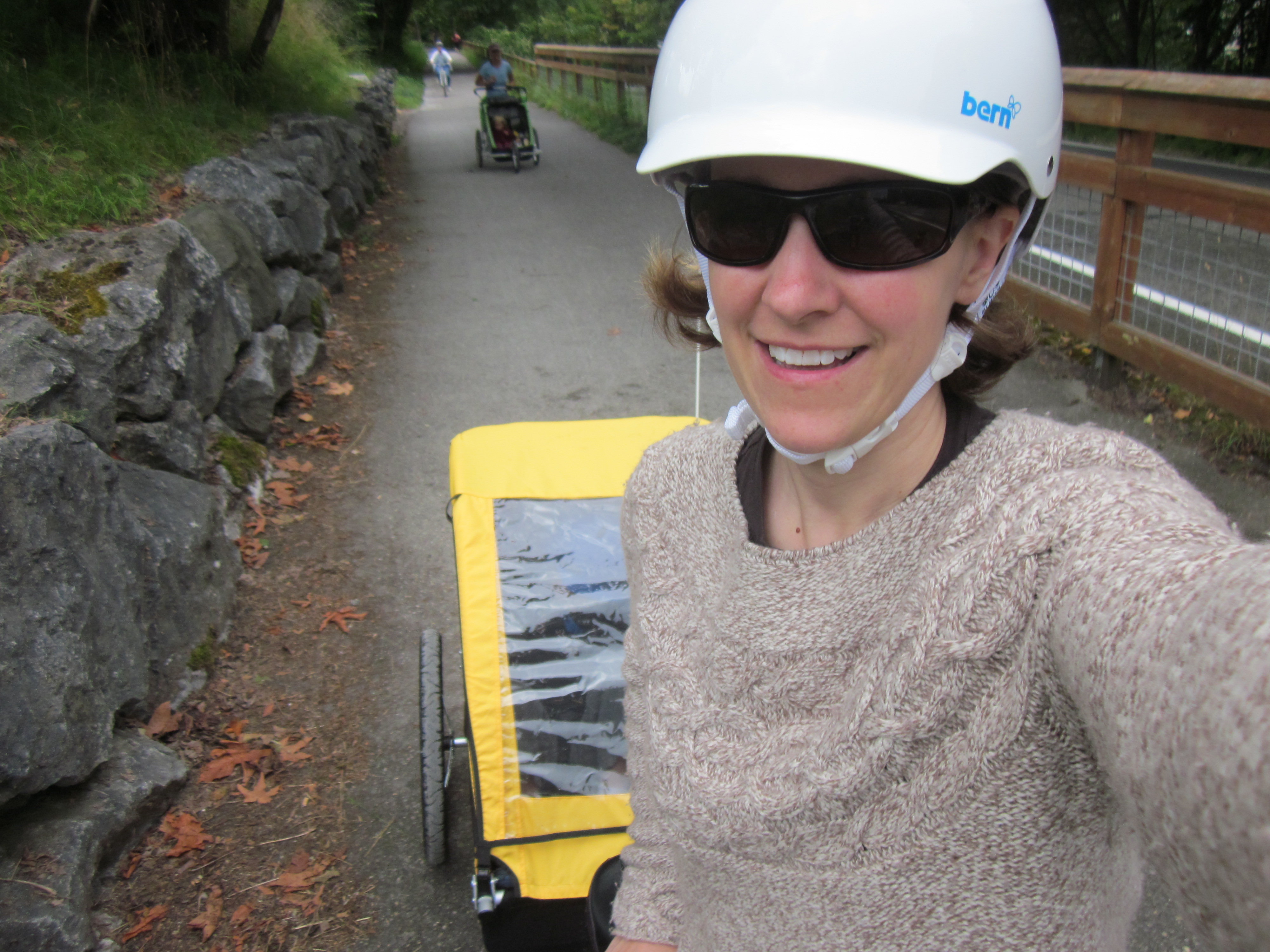
In our effort to try every cargo bike configuration we could get our hands on, we started out traditionally. While in Bellingham, we rented a mountain bike with a child trailer. My kids have ridden on many different cargo bikes now, plus a couple of bikes rigged as child haulers after the fact (Brompton with IT Chair, city bikes with child seats) but this was their first trip in an actual trailer, and my first time hauling them.

The Specialized Hardrock is a mountain bike. For the purpose of hauling a trailer around town, it was not everything I could have wished for: it had no kick stand, no chain guard, no fenders, no lights, and no bell. The brakes evoked a howling chorus of demons with their shrieking and the saddle was indistinguishable from an anvil.

The full rig

However, renters can’t be choosers and after riding the many gravel-strewn bike paths of Bellingham (which are BEAUTIFUL! Seriously, there is no reason to ever get in a car in Bellingham, it was amazing!) I came to appreciate the knobby tires and front suspension. The bike was very light, which made it an excellent climber, as well as easy to pick up when I had to drop it on the ground to stop riding because there was no tree or post to lean against. Also the pedals were okay, and the shifting was smooth.

While I have little basis for comparison, the Burley Bee, by comparison, seemed much better designed for our use. It helped that the shop had just replaced its rental trailer. Our ride was this particular Bee’s maiden voyage, and it was, as a result, spotless. Evidently the Bee is the entry-level Burley double trailer, but it seemed to have everything that we would want in a trailer, if we wanted a trailer, and I actually sort of do want one now.

Seemed cramped to me, but the kids had no problem with it.

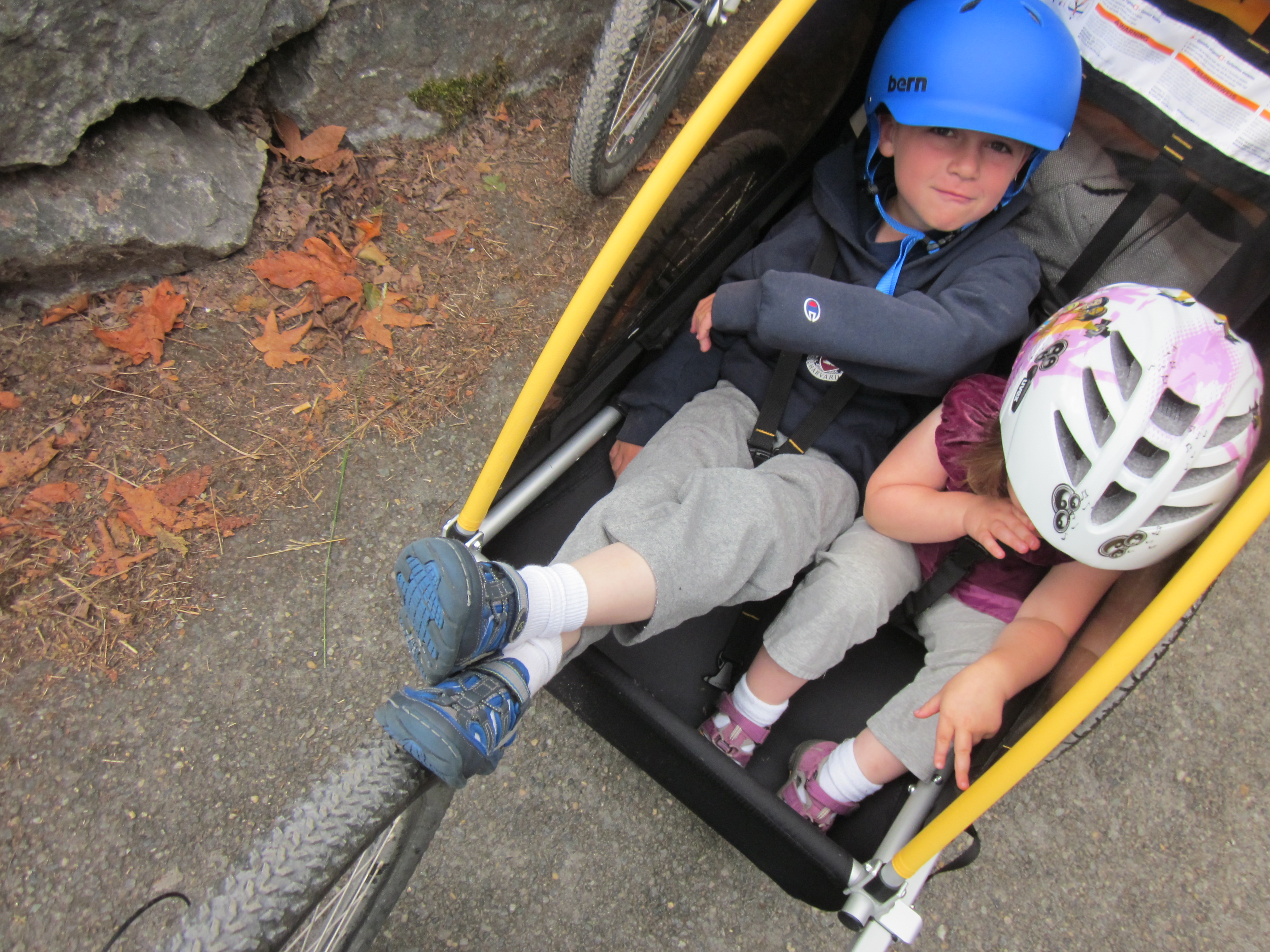
My kids were fascinated by the Bee from the moment they saw it. Luckily my kids get along well so the fact that they were crammed in there pretty tightly was not a problem from their perspective until they’d been riding for almost three hours. During that time we took a few bakery, playground and farmers market breaks, plus multiple stops to put the cover on, take the cover off, put the cover on, take the cover off (they were yanking my chain). Anyway, by the end of the ride they were hitting each other and crying, but they lasted longer than I’d expected.

The pros of this setp:

  • A double trailer can fit two older kids (currently almost 7 years and 3.5 years) without too much squeezing. My son is older than the advised age range for trailers but skinny and tall.
  • It is very, very difficult to tip a trailer over and dump the kids on the ground. I did not manage to do it. Go me!
  • The kids adored the wind and rain screens, and could not stop talking about the potential of this particular rig to keep them from getting wet and cold in the winter. The trailer eliminated their primary concern about not having a car anymore. I thought that although the covers were tensioned with elastic rather than zippered they were well designed and quick to attach and remove. The design of the trailer itself was actually very clever, allowing me to add and remove the front covers without anything coming loose or flapping.
  • The Burley Bee has a junk drawer.

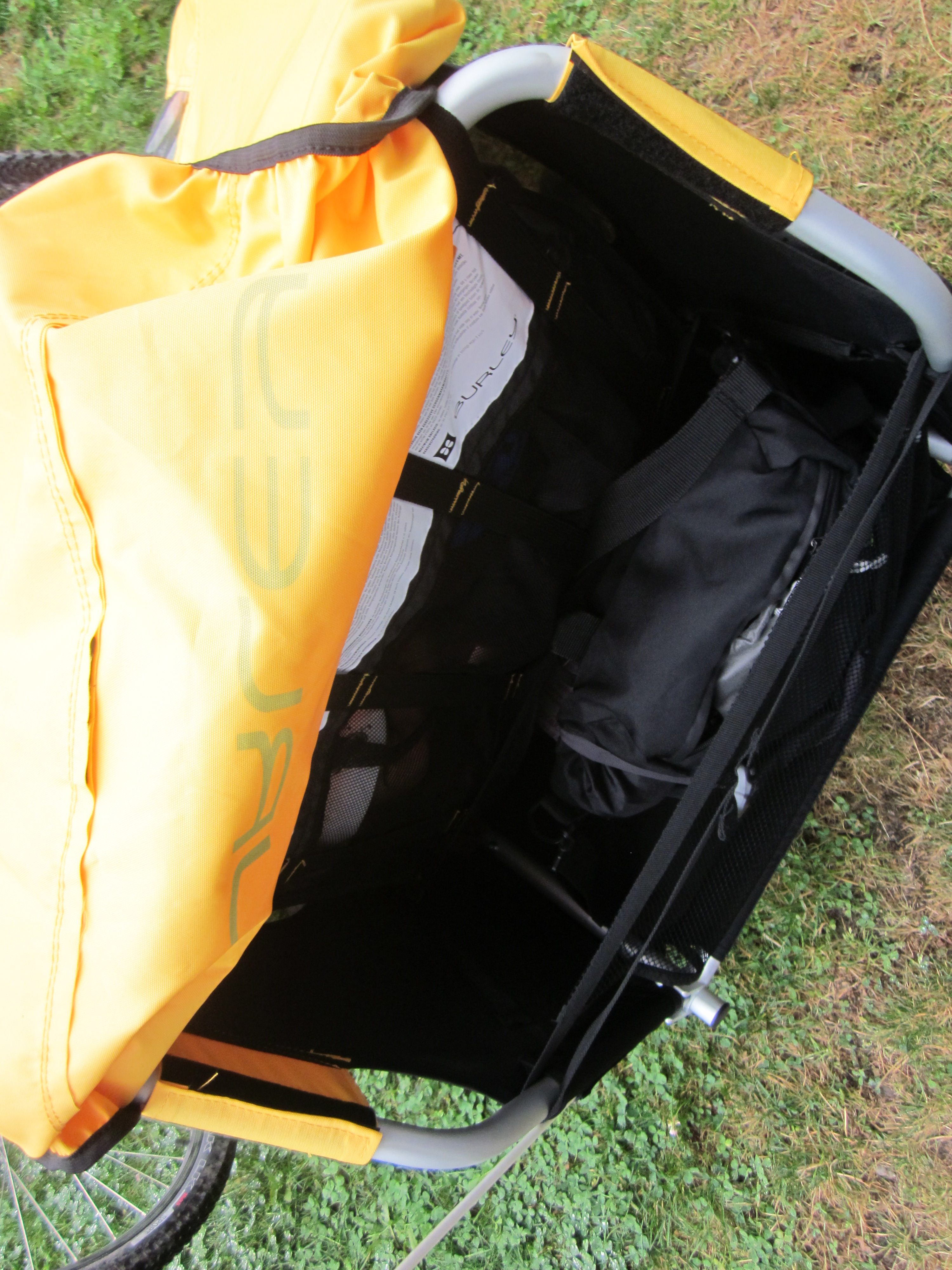
    The Burley Bee comes with a fairly large storage pocket behind the kids seats that can hold a couple of grocery bags, toys, garbage, souvenir rocks, jackets, etc. This was really handy and it appears to be waterproof.

  • There are storage pockets on one side of the kids to hold smaller items (but only on one side, which was a really bad design decision).
  • For quite a while my kids considered the ride an absolute blast, and entertained each other by singing songs and chatting.
  • The Burley trailer seemed quite well made, with strong seams and stiff fabric. Admittedly ours was brand new. The Bee trailer we were riding doesn’t offer a stroller-conversion option (this would never be needed for its purpose as a bike shop rental trailer) but some of the higher-end Burley models do.
  • It was simple to convert the trailer from carrying one kid to two kids. The belts allow two kids side by side, one kid on one side, or one kid in the center. Putting one kid to the side didn’t mess up the balance as far as I could tell.
  • This is the biggest hill we climbed in the trailer.

    Attached to a lightweight mountain bike, it was relatively easy to pull the fully-loaded (probably 120+ pounds counting trailer, kids and gear stuffed in the back pocket) trailer up a moderate hill—we went up a long slope connecting a multi-use path over the water back to city streets. The sign said it was a 10% grade, and the trip kicked my heart rate up but did not make me sweat.

The cons of this setup:

  • Attached to a lightweight mountain bike, it was at times terrifying going down hills with the trailer, especially on gravel. Once the weight of the trailer, which was pushing me, flung my bike back and forth like the end of a whip. I ended up aiming the bike toward a strong fence at the bottom to stop us—we slid up alongside where I grabbed it and almost toppled over. The kids cheered and asked to do it again because the trailer itself was very stable. However from my perspective this was a big downside. It might be less of an issue with a heavier bike, but I suspect in that case it would be much harder getting up hills.
  • There are pockets in the rear of the trailer compartment to fit helmets but they did not work well for either of my kids, who complained that their heads were pushed too far forward. If it were just my son, who is beyond the age/weight/size limit, I wouldn’t worry, but my daughter also complained, and she is in the appropriate age range. They also asked why they had to wear helmets given that they were in a trailer, when they don’t have to wear helmets in a pedi-cab. I didn’t have a good answer for that.
  • The kids are there but not all there, if that makes sense.

    It was not easy to talk with them while they were in the trailer. My kids are extremely chatty and I missed their conversation, although given that I was solo parenting there was also an element of relief to have some time when someone wasn’t saying, “Mommy! Mommy? MOMMY!” With a trailer you’re with your kids but not WITH your kids. It’s like having them in the next room.

  • The trailer turned like a semi, often caught on fence corners on the multi-use path, and parking it at normal bike racks when we stopped was a nightmare. Bike racks are currently designed for ordinary bikes and not cargo-anything, including trailers. Parking meters and signs are not any better. Even the narrowest double trailer is about 30” wide, and there are places that that just won’t fit.
  • Even though the Burley Bee was brand new, the fabric floor sagged somewhat when loaded. I suspect it would eventually catch on bumps. I have heard there are trailers with solid floors.
  • Eventually, kids crammed in a trailer will fight. At one point when we were with Family Ride in Seattle, her kids, who were in her trailer, began shrieking, “AAAAAAA! GET ME OUT NOW! AAAAAAA! GET ME OUT NOW! GET ME OUT NOW!” as we climbed up a hill. They were almost louder than passing cars, and it was difficult to extricate them on a busy street. I was riding her Big Dummy with only my daughter on board, so it was relatively easy to pop one kid out and drop him on the Dummy once we could pull over. But in a situation with only one adult it could have been very ugly. An experience like this can really make a person think hard about dropping a couple hundred dollars on a trailer, if that person is me.
  • “Stop. Please stop. I really don’t want to have to ask you again.”

    An older, taller kid like my son could reach forward with his feet while in the trailer and put them on the rear tire. This was a bad idea on several levels but it didn’t stop him. (It never does.)

  • The vast majority of the conversation with my kids consisted of their requests for me to stop and take the cover off, put the cover on, now just the wind screen but not the rain cover, now we want the rain cover, we want the covers off. Some of this was the novelty value and I’m sure it would wear off a little, but it got tiresome to keep stopping the bike.

So there are some downsides, particularly for our situation, which is admittedly atypical (we have no car, we live on the side of a mountain in a large city that has no neighborhood schools or school buses and thus we face a long commute with kids, etc.) And yet the trailer has some appeal. Mostly I see its value for traveling.

There are some downsides, but this setup is probably a lot cheaper and more versatile than a triple tandem with S&S couplers.

It is extremely hard to travel with a cargo bike. They aren’t allowed on trains, they often don’t fit on cars, and planes are out of the question. Trailers can usually be collapsed into a travel-friendly package. Most of the places we travel, like my mom’s, are places my kids could ride by themselves, except that it’s virtually impossible to rent kids’ bikes. Believe me, we have asked. With the Brompton and a trailer we could travel and not have to worry as much about renting a car or getting rides.

I can also see the value of a trailer for days that my kids would otherwise object to riding somewhere, particularly cold and rainy days. I would want to think hard about the routes we might take with a trailer, given the pounding it gave my rental bike going downhill, but with a heavier bike it could work very well for foul weather. And having the extra cargo capacity could be extremely useful.

Hey mountain bike, I haven’t forgotten that you made me look even more like a dork than usual.

So at this point I am seriously considering keeping an eye out for a used trailer. I can’t imagine it would be worth buying one new for the kinds of uses we’re considering. However if we could find one for the price of a week’s rental in Bellingham, I suspect it would be worth having around.

10 Comments

Filed under family biking, reviews, travel

Homesick for the north, homesick for the south

Our first trailer ride

From Bellingham to Seattle to Portland: we have arrived, and so excited to see daddy again. I haven’t had much chance to update while gamboling around the Pacific Northwest mostly solo with two kids, but I’ve also been constrained by the constant barrage of fun. I grew up in Seattle and Bellingham and I was overwhelmed by homesickness. They are both really good places to ride bikes with kids.

So eight family bikers lock up together…

We stayed with my mom and rented a bike and trailer (the kids loved their first trailer ride). Then we stayed with the always awesome Family Ride and rode a Madsen, her pink Big Dummy, and a MinUte. We went to a Seattle Summer Streets and got to see Jen of Loop-Frame Love again. At the Seattle Cargo Bike Road Call my kids rode in a Cetma cargo bike and a Bakfiets and got chauffeured by Davey Oil around Gas Works Park in an amazing electric-assist trike. My son got to ride a handful of kids’ bikes and learned how to shift gears! Then we took an Amtrak ride south from Seattle to Portland. It is a good way to travel with kids, especially given that they seated us near the bathroom, which made it easy to clean up various spills.

Barbecue in Portland

Matt, although he is a committed Californian, loves Portland. He arrived before we did and went grocery shopping for us. Seeing the rib joint nearby, with its “Try our new vegetarian fare!” sign was almost enough by itself to convince him Portland should be our new home. We have seen many, many family bikes, mostly of the traditional variety with child seats and trailers, but I’ve always liked child seats on bikes. I’m coming around to trailers as well, at least in flat cities with limited car traffic.

My kids were the ones chanting “Amtrak! Amtrak! Amtrak! Amtrak!” in car #9 for most of the ride down from Seattle. I apologize.

We’ll be here for a week trying out even more cargo bikes, not to mention cargo trikes. The kids are so excited to see their dad again after a week away that I might even have some time to write about all that’s happened (and to answer a bunch of questions I’ve been asked in the comments).  In the meantime I hope everyone else is having a week just as awesome.

And I almost forgot: I just found out that San Francisco will be holding its first Kidical Mass on September 28th! Thanks so much, MizShan! The ride will meet at 6pm at the fountain at the southeast corner of Justin Hermann Plaza and head to Dolores Park. We will be there!

3 Comments

Filed under family biking, San Francisco, travel

Uphill, downhill: the limits of cargo bikes

This what hills in Bellingham look like. A 10% grade according to the signs, not too bad, especially given the killer views.

I complain a lot about going up San Francisco hills. What can I say? It often sucks. Something I’ve only mentioned in passing, but that we think about quite a lot nonetheless, is going downhill. While going uphill is literally a pain in the legs (and chest, when gasping for air) it is not as dangerous as going downhill can be.

We carry our kids on our bikes, and we go down steep hills regularly. We learned quickly that loaded cargo bikes (and trailers) need extra time and distance to stop when going downhill. It can be deeply disconcerting to brake and brake and brake, and only slowly drift to a stop. At first there were occasions that we overshot the lines at stop signs and red lights, and we are cautious riders. At times we take less steep routes on the way down than we do on the way up. We learned good braking habits very quickly and have internalized them to the point that I often forget to mention them.

Although we are scrupulous about maintaining our brakes, they occasionally fail. We replace pads on the bikes with caliper brakes on a schedule that raises eyebrows among people from outside San Francisco—roughly once a month—and that meets with knowing sighs among friends who ride in the city. The stock disc brakes on the Kona MinUte failed repeatedly and were on an every-other-week maintenance schedule until our local bike shop finally lost patience, called Kona, and asked for a credit to upgrade us to hydraulic brakes. And they got us one, which made the upgrade expensive rather than wildly expensive. The new brakes are amazing, with unbelievable stopping power, and the MinUte now only needs a brake adjustment every other month. We never, ever skip this maintenance.

The other problem that can crop up going downhill, which mercifully we have never experienced, is shimmy, aka death wobble. This is when the bike starts shaking uncontrollably and violently while going down hills, and is the kind of thing that typically only road racers experience, because it usually happens at high speeds. But some bikes can also shimmy at lower speeds, say, the kind of speed that a loaded cargo bike would approach while rolling down a steep hill. Having a top tube apparently provides stability that helps reduce the risk of shimmy, which is why I’ve been encouraged to abandon step-through frames. Better brakes help too. But the risk can only be reduced, not eliminated.

As annoying as all of this can be, we have gotten used to it. However these issues arose again when we started calling around asking about family bikes we could test ride, and why there were so few electric assist cargo bikes designed to handle steep hills in the US. There aren’t many electric assist cargo bikes anyway. When you start asking about taking them up mountains, or adding an electric assist to a bike like a Bakfiets, bike shops often get very quiet. A few shops claimed that electric assists were only designed for mild hills and to go longer distances, not to haul heavy loads up steep hills. This is clearly not true, as there are electric assist cargo bikes all over Europe designed for hills: e.g. an assisted Workcycles FR8, an iBullitt, and according to the German bakery we visited in Bellingham, every delivery bike used in Germany. The whole situation was starting to tick me off. I could get strong enough to haul my kids on long distance rides (and I have). I cannot get strong enough to haul my kids up truly steep hills as they get heavier, and even if I wanted to, putting them on the back of the bike on a steep hill has sometimes led to the front wheel lifting off the ground. They’re not strong enough to ride uphill themselves, and there’s too much traffic for them to be safe even if they could. People who want to ride an extra couple of miles don’t need an electric assist like people who live on the top of steep hills do. WTF, bike manufacturers?

I give Portland family bike shops (and a couple of San Francisco bike shops, Everybody Bikes and The New Wheel) credit here because when I asked this they gave me honest answers. It is, evidently, not a huge problem to put an electric assist on a bike to get it up a steep hill. It can, however, be a huge problem getting the bike+cargo back down that same hill safely. We rolled our eyes a little when we heard that because we’re already going down those kinds of hills fully loaded, so no new news here. But manufacturers are apparently concerned about the limits of bicycle brakes going downhill. The brakes on many cargo bikes are not up to the task; as proof, there’s our experience with the MinUte.

Evidently manufacturers are also concerned about the liability they’d face if someone who wasn’t attuned to these problems had the worst happen going downhill on an assisted cargo bike. Personally I think that’s a copout. I know parents who’ve been pulled or pushed down hills by trailers, who’ve broken spokes or had rear wheels taco or screwed up frames and gearing carrying kids up and down steep hills (cough cough… me). They don’t sue the bike or trailer or wheel manufacturers. They start looking for a better cargo bike. But there are currently very few better bikes, at least in the US, and the ones that do exist have appeared in the last year or two. So most parents in our situation have either kludged something together or started driving.

A Big Dummy in Bellingham: it is no accident that you can spot this bike all over in hilly cities

At any rate, although we’ll be trying out a lot of family bikes over the next couple of weeks, we have been told in advance that many of them aren’t going to work for us. Xtracycle and assist a commuter bike? Wobbles and fishtails when loaded on steep hills. Bakfiets and trikes? The brakes can’t handle steep downhills and can’t be upgraded, and the bikes themselves are so heavy that better brakes might not work effectively even if they could be added. And so forth. Although we’ll be riding lots of bikes for our own edification, the list of plausible candidates that we could take home to the hills of San Francisco is actually very short, at least for now. I don’t like this, but I have to live with it.

11 Comments

Filed under commuting, family biking, San Francisco, Uncategorized

We are having fun yet

Hey! Hi! Howzitgoin?

Recumbent with cargo trailer and a Burley tandem. Love it!

We are on the first leg of our Pacific Northwest tour, which comes with limited bike riding. But there have been walks on the beach and farmers market visits and many interesting bikes sighted. We’ve seen child trailers galore (this is the right kind of town for them—limited traffic, wide bike lanes), a Bullitt with a plastic crate to haul a kid strapped on, trailer-bikes, recumbent bikes, and mountain and commuter bikes galore. Kids ride their own bikes a lot, even at very young ages. It’s not a big deal given that they don’t have to contend with city traffic or monster hills.

“I’ll pretend to cry, okay?”

We have been chauffeured by my mom in her car, mostly, given that we are here without bikes. But in an effort to experience the authentic traditions of family biking in these United States, we are scheduled to rent a bike with a child trailer. Okay, granted, a trailer is the only option available for a family bike ride in this town. Still it seems only fair to try riding the ways most families do in this country, so we have a basis for comparison.

The junior scientists will investigate this trailer thing.

I’ll be honest: my kids are nonplussed by this idea. They view trailers with a combination of fascinated disbelief and confused longing. They viewed the child care room at our gym the same way. Having never spent any time there (I only work out during my lunch hour at work, figuring that I spend enough time away from my kids when I’m being paid for it—I have no desire to ditch them during my free time), they viewed it as a destination of mysterious wonders. So one day we dropped them off at the Ikea kids’ playspace when we were visiting Berkeley so they could try out the whole drop-in child care experience. It is fair to say that when we returned the bloom was off the rose.

And we’re off!

My kids like climbing in bike trailers when we’re visiting a store that has some. They get along pretty well most of the time so I’m not too worried about their squeezing into a tight space for a short-term rental. But I’m curious what they’ll think of a trailer compared to bike seats. There’s no question that trailers are the most common child-carrying option for bicycles in the United States. I guess it’s a measure of our distance from the mainstream that even by the standards of outrageous family weirdness and deprivation—we have no car!—we are bizarre by the standards of families who bike everywhere. Our kids have never ridden in a bike trailer. Yet! But soon.

Leave a comment

Filed under family biking, travel

North by northwest

Playing on the beach is on the agenda.

Tomorrow we are headed north to the Pacific Northwest. And by “we” I mean me and the kids, because my husband is going to China again (something to look forward to: even more bicycles in Beijing!) Whenever I can manage it, I like to visit my mom while he is away, because it keeps the adult: child ratio at 1:1, and because the kids always have a blast at her place. You’re the best, mom!

We had such a good time visiting Family Ride last time we were at my mom’s that we planned a stop in Seattle. Luckily for us, she was already planning a Cargo Bike Roll Call for August 11th, and so now we can attend—our first ever.

Although this is impressive, it is actually the kind of thing we’re trying to avoid.

And from there, we are going down to Portland to meet Matt after he flies back from China. When I was advised to stop using the Breezer as a kid-hauler, we had a bit of a mental kerfuffle about how to find a new cargo bike. We eventually decided that when Matt returned from China, we would all meet up in Portland, which has not one, not two, but THREE family bike shops that allow the kind of hard-core test riding that we want to do before making a decision. What’s more, after I went to Portland last spring and came back bouncing off the ceiling Matt decided he wanted to visit too. It’s arguably a waste of his frequent flyer miles, which could take us somewhere more exotic, but not changing time zones will be a relief.

The Brompton + IT Chair is a great short-hauler with an almost 2nd grader (but longer trips are a bit much).

Portland in August does not lack for cargo biking adventure. There will be a Portland Cargo Bike Roll Call when we’re in town on August 16th, and a Kidical Mass ride on August 18th. We’ll have just enough time to squeeze both in before heading home for the start of the new school year. We’ve packed our helmets and made our rental reservations. Excitement among the small is at explosive levels.

Updates here are likely to be sporadic at best over the next two weeks. But on our return, I will write up our impressions of the half-dozen or so cargo bikes we plan to ride. See you on the other side!

4 Comments

Filed under bike shops, family biking, travel

Another one bites the dust

Oh mamachari, I can’t quit you.

A couple of weeks ago, I noticed that the battery on the mamachari was getting a lot less range per charge. I use the motor pretty sparingly, only to go uphill, and while it used to go around the city several times without needing to be recharged, now it could go only once. And it was getting worse. I fully charged the battery one morning before taking my son to summer camp. On the way home, on the first hill, the battery gave out. So I rode home, up a mountain, with 50 pounds of my son on the back of an unassisted single-speed 65 pound bicycle. It was hell.

On Friday I charged up the battery to full and went to pick up my daughter. A half-block from home, the battery gave out. The mamachari’s assist is dead. RIP. Even the backup battery doesn’t work now, because it’s wired through the factory installed battery.

RIP, Bridgestone battery, You exceeded expectations.

This wasn’t completely unexpected. The woman who sold it to me told me the mamachari was six years old with all its original parts, and the bike was really cheap. We both knew the battery was on its last legs, and I have used it a lot over the last couple of months, more than I had planned. I’m mostly impressed that it lasted this long at all. It’s been used as an almost daily commuter by three families for six years, all of whom were carrying children, in the Berkeley Hills and on really steep hills in San Francisco. Most electric assist bicycles warranty the batteries for only two years. It had an amazing run.

I started thinking about whether I wanted to try to replace the battery on this bike when the range started to drop. I decided that I like the mamachari enough that the answer was yes. How to do that was the question. It is a Japanese bike, and parts for those aren’t exactly thick on the ground in the United States.

Luckily for me, there is Mama Bicycle in Japan. I learned a lot about mamacharis from his blog, and he recently posted that he has been looking for a way to export mamacharis overseas. If he can figure out a way to do it, I’m sure he will make a fortune. I know a dozen families in our preschool alone who would buy one. However shipping a heavy bike like a mamachari is problematic. But all I needed was a battery—that could be presumably be shipped as a normal parcel, assuming he was willing. And he was! Mama Bicycle is the best! If you’re in the market for a mamachari outside of Japan, he is your guy.

When I sent a photo of my bike, he identified the model on sight. Happily, Bridgestone sells replacement batteries for its bikes in Japan, and it’s legal to ship them to the US. Mamachari batteries aren’t cheap, even in Japan. But I can’t begrudge the cost given that the bike itself was. Moreover, if this replacement battery lasts as long as the first one did, the cost per month of my new battery will be equivalent to a couple of Muni rides each month. I ride the mamachari way more often than that. (Plus we are flush because we just sold the minivan, which makes it hard to begrudge the cost of a new battery to get the mamachari back online.)

Wanted: a bike to carry these two charmers

In the short to medium term, however, we’re in a bit of a bind bicycle-wise. The Breezer has been vetoed as a child carrier by our bike shop given the strain I’ve put on it already. The mamachari is out of commission until a new battery arrives from Japan, which I imagine will take quite a while by economy shipping. That means that all our bike riding is now on the Kona MinUte and the Brompton + IT Chair. The MinUte is great but it’s primarily Matt’s bike. The Brompton is what I’m riding now, and although it is still completely awesome, riding with a kid on board gets a little cramped on rides longer than a couple of miles. And while it’s not as bad going uphill as a mamachari with a dead battery (nothing else I’ve ever ridden is that bad) it’s not the greatest bike on steep inclines either. And even though the MinUte owns the hills, it gets a little cramped for two kids at once. There has been squabbling.

What we really need for the long term is an electric assist bike that one of us can use to carry both kids. And now that we have some ready cash on hand, that’s exactly what we intend to get. When our local bike shop told us we should stop using the Breezer as a child carrier and get a real cargo bike, we realized we needed a new strategy for the next school year. Our local bike shop doesn’t sell any cargo bike other than the Kona Ute and MinUte and never will. They suggested we find someplace that did.

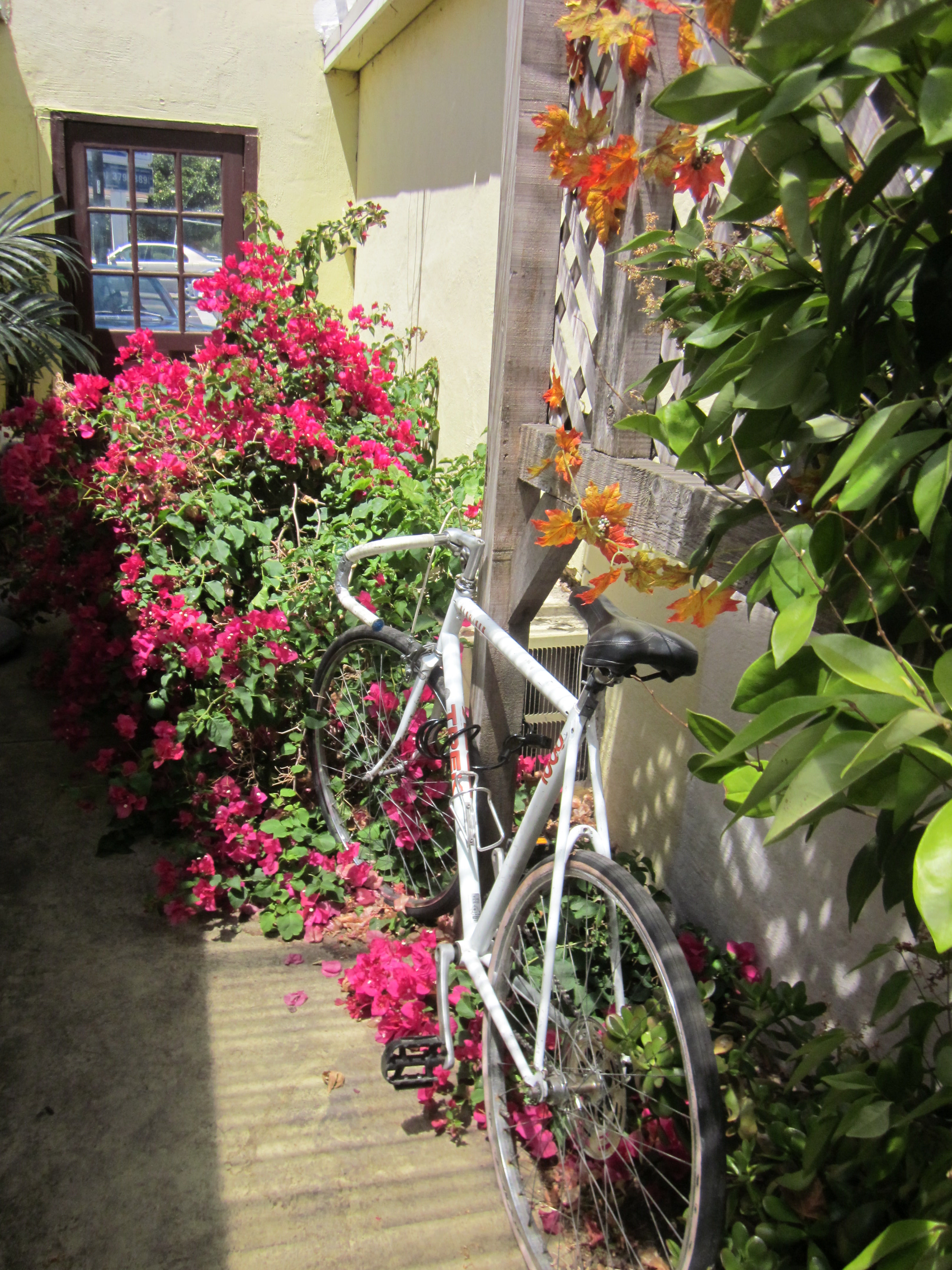
We spotted this bike parked in the flowers at lunch while we were in the South Bay last week. Not a family bike, but it was so pretty there.

So next week, we are headed to Seattle and Portland and their many family bike shops to try out every cargo bike we can find (and if you’re a local, we’d love to meet you while we’re there! We’ll be attending both cities’ August Cargo Bike Roll Calls and the Portland Kidical Mass.) This isn’t the only reason we’re going: we’re also visiting my mom and we have friends in the area who’ve never met our kids. However the bike issue, in combination with the tens of thousands of frequent flyer miles Matt has racked up going to China for work, made the decision to head north pretty easy. With any luck, by the time that school starts we will have a family bike that can take all of us anywhere we want to go.

15 Comments

Filed under bike shops, electric assist, family biking, San Francisco

New helmet

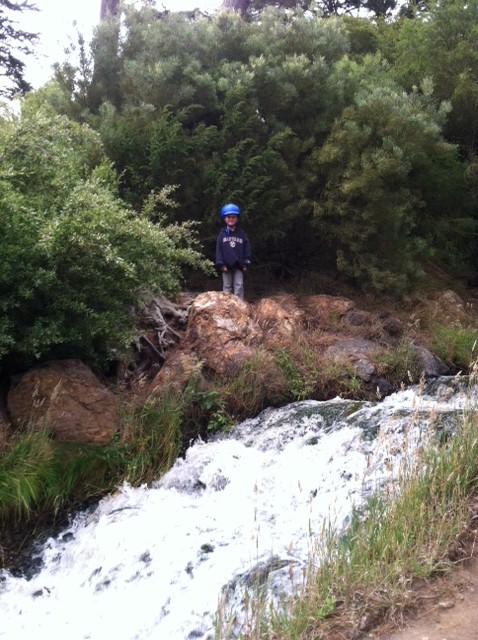
My son likes the outdoors too. And he likes climbing up the hidden waterfalls of Golden Gate Park. With his helmet. Safety first!

I’ve been commuting more with my son on the Brompton. This raised an unexpected issue. He’s tall enough that the top of his head touches my chin. I can see over him fine, and it’s certainly easy to make conversation. All of that is good. He is taller than his sister, and that makes pedaling around his legs more of a challenge, but that’s okay. And for some reason when he’s in front he’s more supportive on the hills. “You can make it, mommy! Keep pedaling!”

But there has been an unexpected downside to our commute. His helmet is one of those aero-style Giros that bumps out in the back, and has a sharp edge where the plastic decoration stops and the uncovered foam begins. When we rode together his helmet was cutting open my chin. My chin was bleeding because of my son’s helmet. It was the world’s most implausible bike injury.

We’re taking a trip soon and mailing our helmets in advance. Having a spare helmet was starting to sound like a good idea. Shopping for a helmet with a smooth back, which was my personal goal for his new helmet, was much harder. For some reason the aero-style with the back bump is all the rage in kids’ helmets locally. I had to go online, and that raised issues with fit. My son has a giant head. I picked stores with generous return policies (Amazon and Real Cyclist) and ended up using them as we worked our way up through the sizes that were supposed to fit him based on head circumference and did not. Eventually we found a Bern helmet that fit him in blue (he really wanted a blue helmet). It was an adult size small.

I love this helmet. It has never cut my chin. It’s as smooth as glass. I kissed it while we were riding on Friday, I was so grateful not to be gouged. I liked it so much I got one just like it for my spare helmet. Matchy matchy.

My son likes both his helmets. Specifically he likes having two helmets. Sometimes he wears them both in one day (not at the same time). As long as he wears the Bern while he’s riding the Brompton, that’s just fine.

1 Comment

Filed under Brompton, commuting, family biking, San Francisco