Tag Archives: family biking

Bicycles in Beijing

Rental tandems in the Huohai lake historic district

While I was riding around Portland and Seattle (more to come), Matt was in China for business. Because he knows I love bicycles, he took some pictures of the ones he saw while he was in Beijing. Most of Beijing is evidently terrifying by any mode of transit, and Matt claims that even standing still and breathing there feels risky. However a portion of the city, the Huohai lake historic district, is off-limits to cars and thus packed with bikes, bikes, bikes. He sent me these photos labeled “Copenhagen East.”

Little bike, big seat

In virtually all of the photos I’ve seen of bikes in China, riders have not shrunk from carrying passengers on bikes, even if said bikes were technically not designed for this purpose. The rear seat on this bicycle is disconcertingly far back on the rear wheel, which must make the bike itself fishtail like crazy. So I find it especially impressive, or alternatively crazy, that the rear seat is large enough that it could almost certainly carry a second adult. And that seat does not lack style. Compared to the sea of gray plastic child seats I see mounted on rear racks in this country, it is a nice change of pace for the child seat to outclass the bike.

Three-seat tandems, city-bike style

But if you really want to ride in style, you can rent a three-seater tandem. Compare these rides to the surreys you see in American parks: there is no comparison. I especially like that they come with fenders, chainguards, and front baskets, as though they were actually viable commuter vehicles, which seems pretty improbable. But it’s nice that that’s the assumption; tandems in this country seem primarily targeted to the road biking set. This is a shame given that kids love tandems.

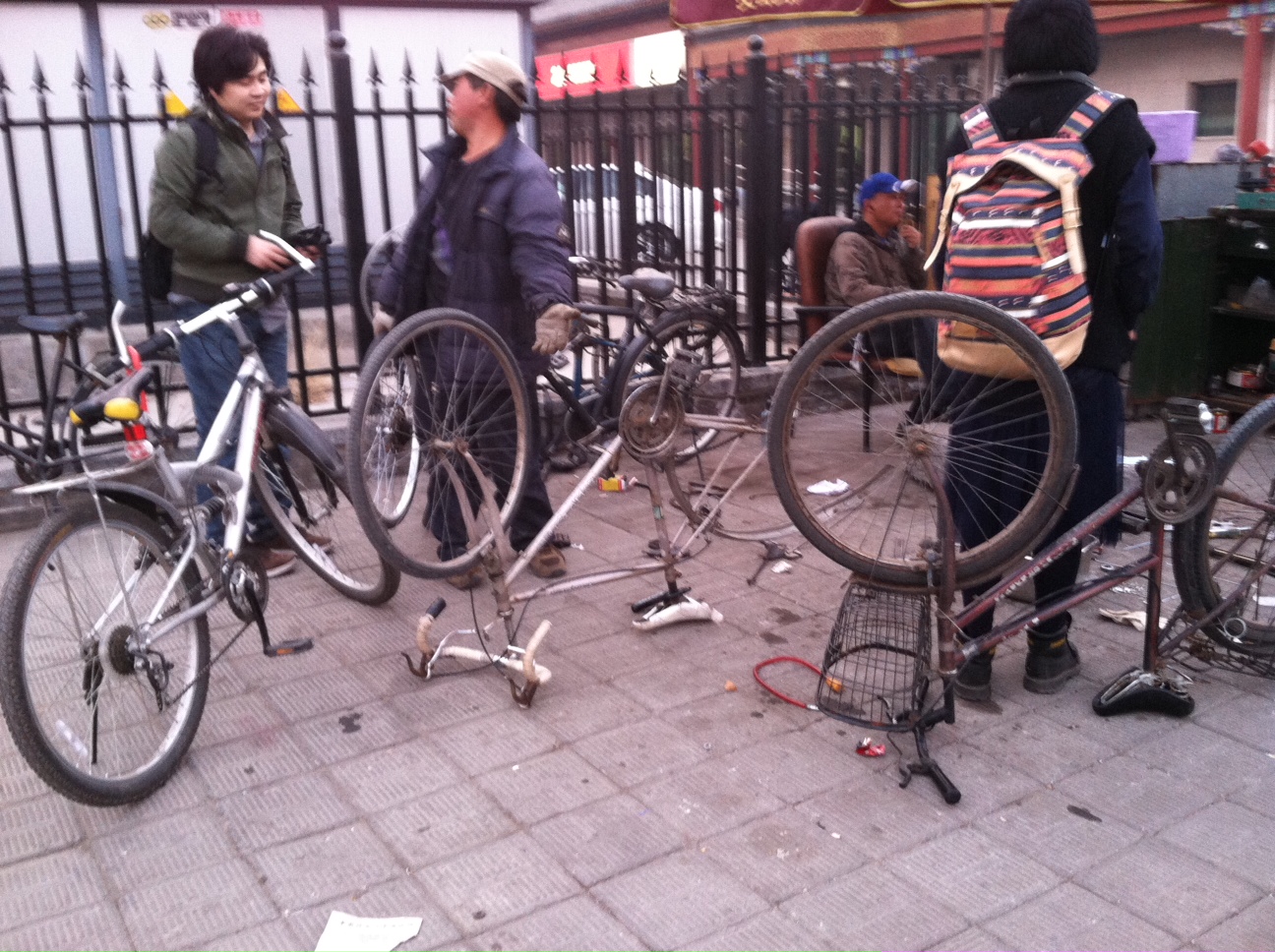
Really basic bike shop: no walls, no ceiling

By contrast, the bike shops of the lake district are a lot more ad hoc. In Portland they put everything on cargo bikes, and I imagine that this is handy when you have a flat by the side of the road: rolling bike shop to the rescue! But in Beijing a bike shop is evidently a guy on the sidewalk. Despite having a lot less real estate at his disposal than even a tiny San Francisco bike shop, this guy has nonetheless provided customer seating. I thought that was a classy touch.

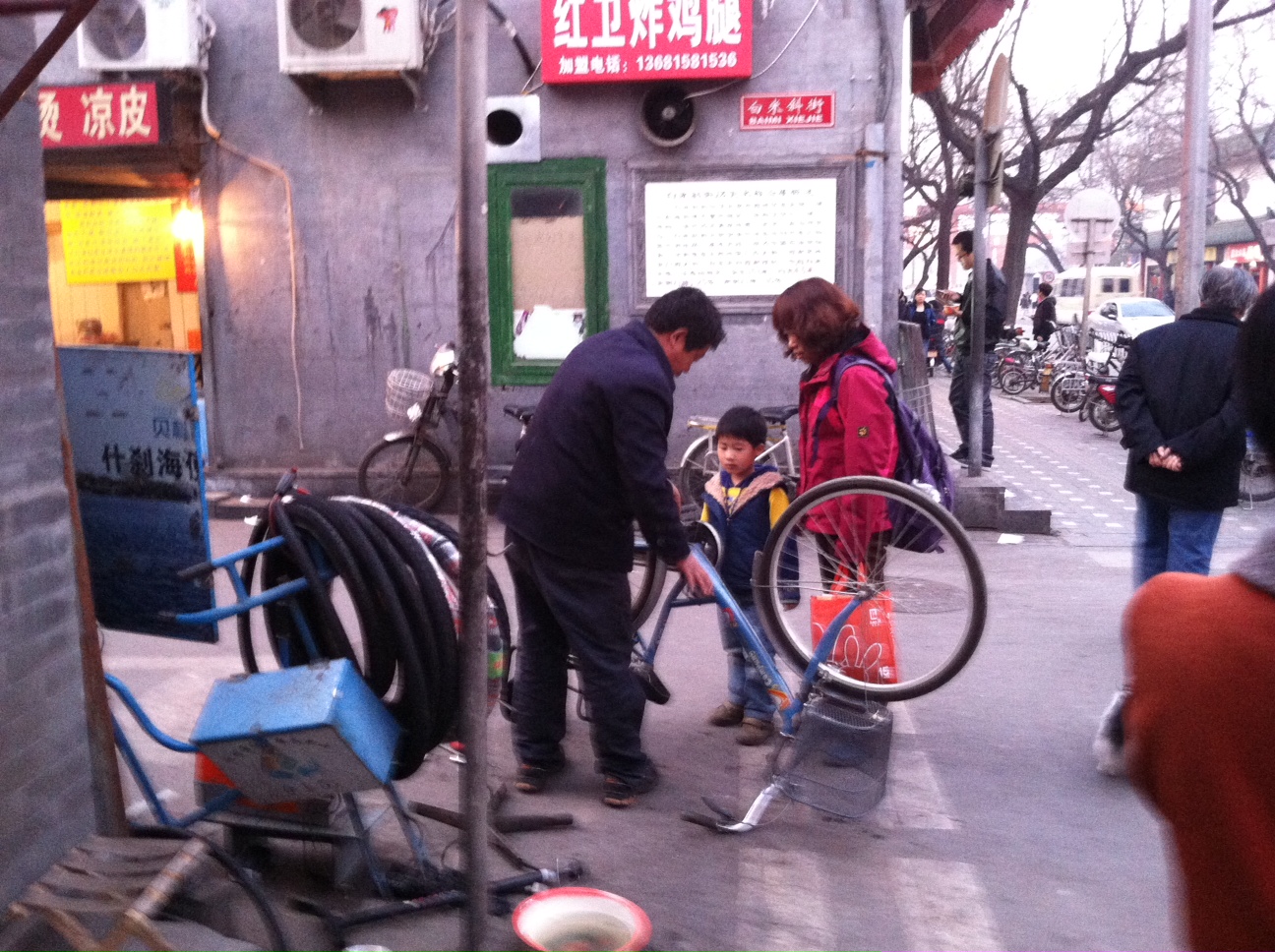
Maintenance lessons for the next generation

In keeping with the customer-focused theme, the owner of this open-air shop started giving a young customer a bike maintenance lesson while Matt was there snapping photos. I like that they’re working on another mama-bike–you can see it’s balanced on the child seat in the back, and has the usual commuter accessories: fenders, chainguard, front basket. The bikes in all of these photos probably sell for the equivalent of less than $100, and every single one of them is a more practical commuter than over 90% of the fixies I see in San Francisco’s Financial District. The US is a great country, but also crazy.

Soft and Lazy Restaurant, clearly catering to the tourist trade

Unlike me, Matt was not able to bail on many of his business obligations to ride bikes around a strange city, more’s the pity. So his impressions of actually riding a bicycle in Beijing will have to wait for another time–there will be at least two more extended trips this year, and I have faith that eventually he’ll make it out of the taxi. He said he came back feeling much like this perhaps-too-honestly-advertised restaurant. Chinglish: it’s funny because it’s true.

1 Comment

Filed under bike shops, commuting, destinations, travel

I do, in fact, wear a helmet

It looked even less like a helmet when it was fitted wrong

I never really liked the look of helmets. But I never really liked the look of rain pants, either, and I wear those. When we rode bikes in Copenhagen, we didn’t wear helmets, mostly because we got blank stares from the bike shop owners when we asked about renting them (they did, however, have helmets for the kids to rent).

The blank stares reflected the fact that there is little reason to wear a helmet while riding a bicycle in Copenhagen, where there is extensive protected bicycle infrastructure and drivers know that hurting or killing someone who is not in a car would have consequences. Like losing a driver’s license. Pedestrians and bicycle riders in North America may now laugh bitterly.

So I was delighted to discover that there was a helmet I would not be depressed to wear, by a Danish company no less, the Yakkay. It costs a freaking fortune, compared to other helmets, but honestly, even expensive helmets are not that expensive compared to other things, like, say, a tank of gas these days. The Yakkay does not look like a helmet. It looks like a goofy hat (see also the Lazer CityZen). My kids call my Yakkay the hat-helmet. It has some advantages over a traditional helmet; one of them is that like a hat, it provides ample sun protection. It can also be difficult to fit correctly, which is a hassle and annoying for an expensive helmet, but not really a long term kind of problem.

My kids think my helmet looks goofy. I can't argue with that.

What I did not anticipate when I started wearing this helmet is the widespread perception by the rest of the world that I wasn’t wearing a helmet at all, and “the rest of the world” includes bike shop owners. I get lots of compliments on my “hat,” and occasionally, I get dirty looks or comments about how I should be wearing a helmet if I’m riding with my kids. This IS a helmet, I say, rapping my knuckles on it. “OH!” is the typical reply. “That’s COOL!” But I have begun to realize there are a lot of people who pass judgment without bothering to ask.

Why wear a helmet at all? My mother was surprised that this was actually a serious question. Of course bicycle riders should wear helmets, right? I don’t think it’s so clear-cut, but there are some reasons one could go either way.

Why not? It’s not clear whether helmets are really that protective, relative to the costs. There’s no such thing as a risk-free activity, and we all make choices that balance cost, safety, and convenience. People may drive (less safe) instead of riding the bus (more safe); people eat processed food (less safe) rather than preparing food themselves (more safe); people cross against the light in the crosswalk or fail to make a complete stop at stop signs. Some people find the cost of purchasing and the inconvenience of remembering to carry a helmet not worth the potential increase in safety. Bicycling simply isn’t that dangerous in most circumstances, and helmets don’t protect against many of the likely risks. A culture that demands helmets make bike share programs much more difficult, and creates the perception that riding a bike is a dangerous thing to do, rather than just another form of transportation. Pedestrians and drivers don’t wear helmets, despite the fact that in some circumstances their need for them may be greater. My colleagues at SF General joke darkly that pedestrians in the city probably should be wearing helmets, at least in certain neighborhoods.

Which brings me to the opposite question: why? The short answer to that question for me is that I don’t live in Copenhagen. In a city like San Francisco, where trauma physicians can make a serious argument that pedestrians should be wearing helmets to walk across the street, wearing a helmet while riding a bike starts to look pretty reasonable. I’m going faster than a pedestrian, so if I’m hit I’ll land harder, and I don’t have the same legal right-of-way.

Not that that necessarily matters. Recently, while riding the university shuttle, I watched the driver mosey between two parked trucks into an intersection only to stop dead just before mowing down a man in a wheelchair. “Oh my god!” he cried. “I didn’t even see him!” Seriously? Dude, it is your JOB to drive safely enough that you don’t mow down people in wheelchairs in the crosswalk. But “I didn’t even see him” is the driver’s equivalent of the “Get Out Of Jail Free” card in Monopoly. It works when mowing down pedestrians and wheelchairs and it works when mowing down bicyclists.

San Francisco, like a lot of cities, is undergoing a commuting shift. There are more bicycles on the road than there used to be, and there are, sadly, drivers who view that as an unacceptable imposition on the world that they were used to experiencing. With the protection of a two-ton vehicle, these drivers can express their opinions very dangerously indeed. That’s no reason to get off the road, but it does make me modify some of my choices. I don’t ride my bike on Masonic, for example, or any of the other streets in San Francisco that are widely recognized as high-speed arterials for driving. And I wear a helmet.

My son's helmet has flames on it, and he'll wear it everywhere he can.

There’s also the issue that although wearing helmets is optional (but encouraged) for adult riders in San Francisco, it is required for children. We are very fortunate that our children have never objected to wearing helmets, which is by no means a universal sentiment among the small. They like playing dress-up and we let them pick their own helmets (within their size range), and that helped. But part of the reason we’ve been so fortunate is that we ourselves wear helmets and have never given the impression that it’s an imposition or a hassle. It’s just something we do before we get on the bike, like checking the brakes or packing the lock. Many of the parents who have complained about their kids not wearing helmets admit that they themselves either don’t wear helmets or that they complain about it. We’d much rather wear helmets without complaint than risk not riding at all because our kids refuse to wear their helmets.

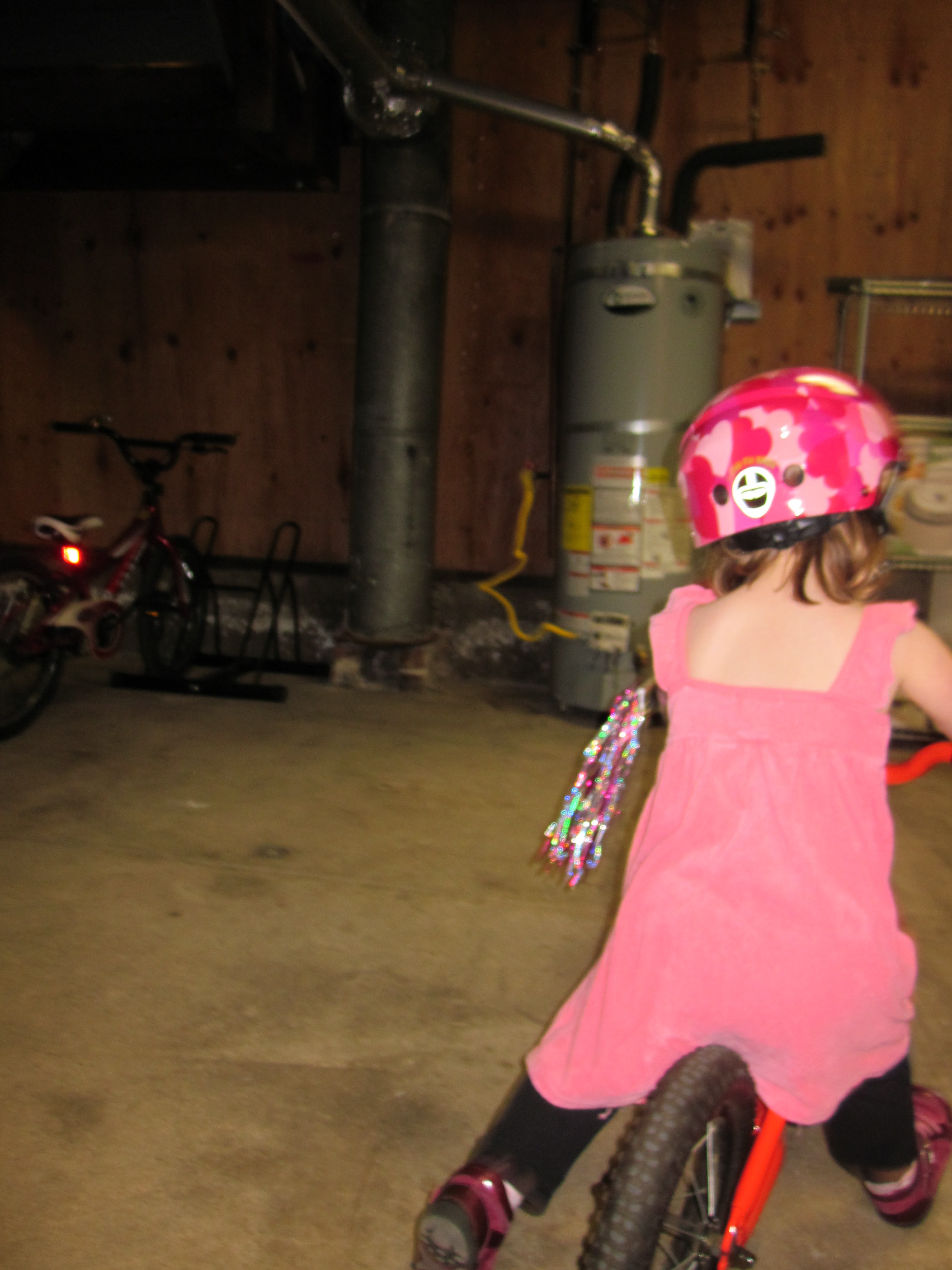
My daughter wears her helmet while practicing riding her balance bike in the basement, because it has pink hearts on it.

I do a lot more stupid things to fit in and smooth our daily lives than wearing a helmet when I ride a bike. My helmet is either cute or goofy, depending on whom you ask, and it keeps the sun off my face, and that makes wearing it even less of a burden. It provides some extra protection against accidents (just as a helmet would for a pedestrian or driver), and weighed against the marginal imposition it makes on my life, I choose to wear the helmet every time.

Other people make different choices based on their life circumstances, and I have zero problem with that. I don’t judge other riders for not wearing helmets, and I’ll defend their choice when it comes up in conversation with people whose knee-jerk response to seeing a bicycle rider without one is to call them crazy or stupid. That said, I won’t ride with adults who aren’t wearing helmets when I’m with my kids, as the idea that wearing helmets could be optional is a can of worms I am not ready to open with them.

So I have this crazy hat-helmet, and in the tempest in a teapot that is the question of whether bicycle riders should wear helmets or not, I now get to experience the moral high ground and various minor inconveniences of wearing a helmet as well as the opprobrium of people who think I’m setting a bad example for my kids and risking my own life by not wearing a helmet at all. It is not something I expected when I bought the Yakkay, but I can live with that too. Knowing what I know now, I will not, however, ever buy their kids’ model, even though I think it’s super-cute.

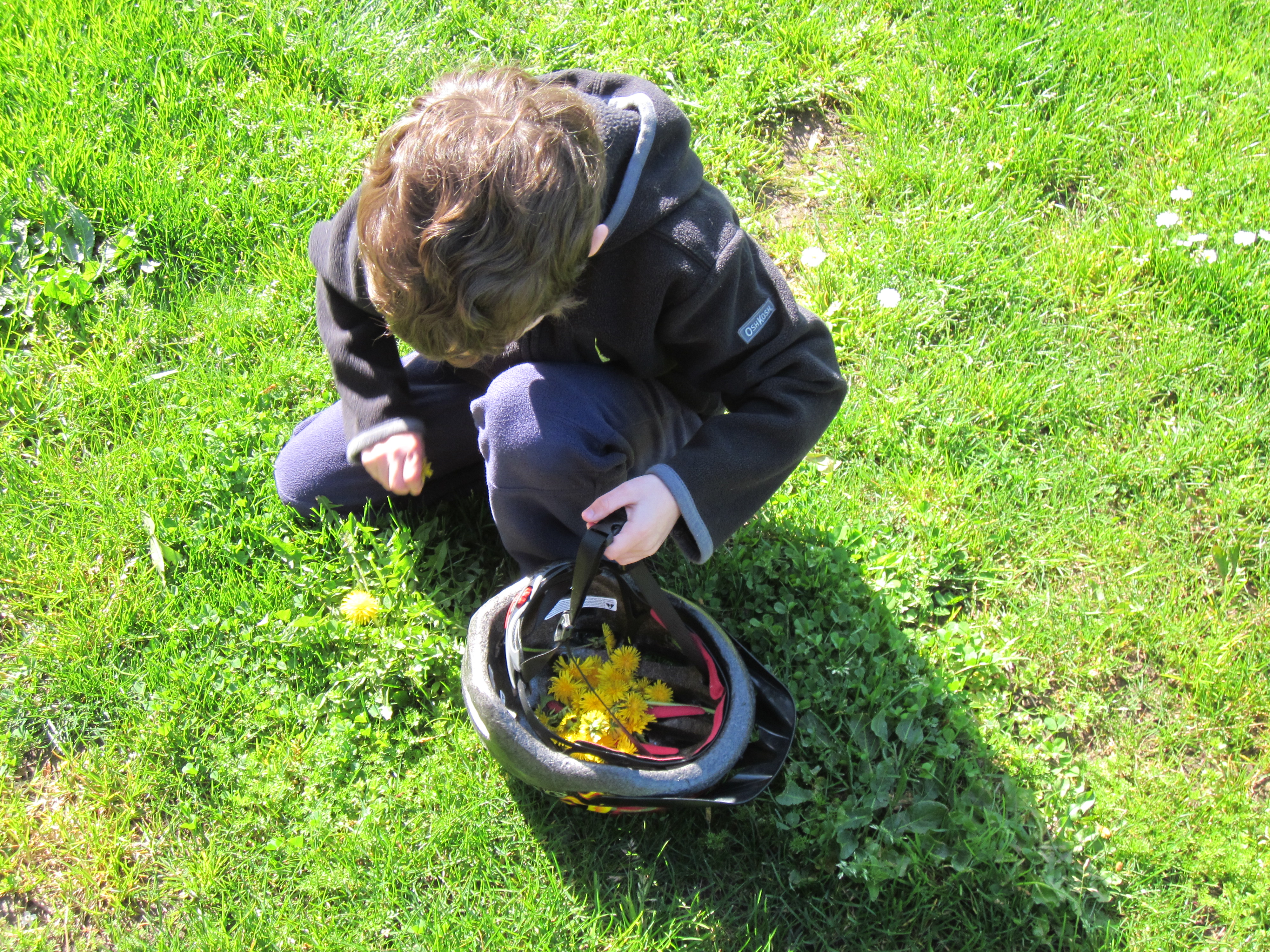
Helmets are also handy while picking dandelions in the park.

I think that there are much bigger problems to worry about in North American cycling than helmets or the lack of them. I find advocacy about helmets, whether pro or con, tiring. When cities in the US have the infrastructure to make cycling feel safer, like extensive protected bike lanes and stronger legal protections, I suspect that bicycle helmets will become a quaint relic of a more dangerous time, used only by certain specialists, much like chainmail.

Until that happens, my feeling is that arguing about whether or not to wear helmets is like arguing about whether a red fire truck is more visible than a neon green fire truck. Maybe one color will make drivers pull over more quickly and thus help get the truck to its destination a little more quickly, but a better use of everyone’s time would be preventing the fire in the first place.

2 Comments

Filed under commuting, family biking, San Francisco, traffic

Electric assist: BionX PL350

Portland's bike shops make me want to gut myself in envy

I am not usually good at getting to the point, so let me try here: I am so buying the BionX.

Despite the fact that I have speculated about electric assist a lot, until this week I had never tried one. I knew enough to know that I wanted a pedelec system (which works only when you’re pedaling) rather than an off-on throttle (where pedaling is irrelevant). Otherwise I might as well just buy a scooter. I just want to be a little stronger, so that going uphill is less of a Bataan death march at the end of a long day, or to ride with my daughter to preschool.

Surly Big Dummy with BionX

So before I went to Portland I wrote to Splendid Cycles, knowing that they carried cargo bikes with electric assists. Joel, one of the owners, said I was welcome to take one of their bikes up a hill in Portland (and they do have some hills there). They could not have been nicer, all their bikes are amazing, and most of them would be appropriate for hauling kids and/or cargo up the side of a mountain. I ended up riding a Big Dummy with the BionX PL350, a system widely praised in reviews, apparently the most responsive of pedelec systems. It adds about 17 pounds to the bike, counting both the motor and the battery. (BionX also has a 15 pound version with comparable power and a longer battery life. It costs more.)

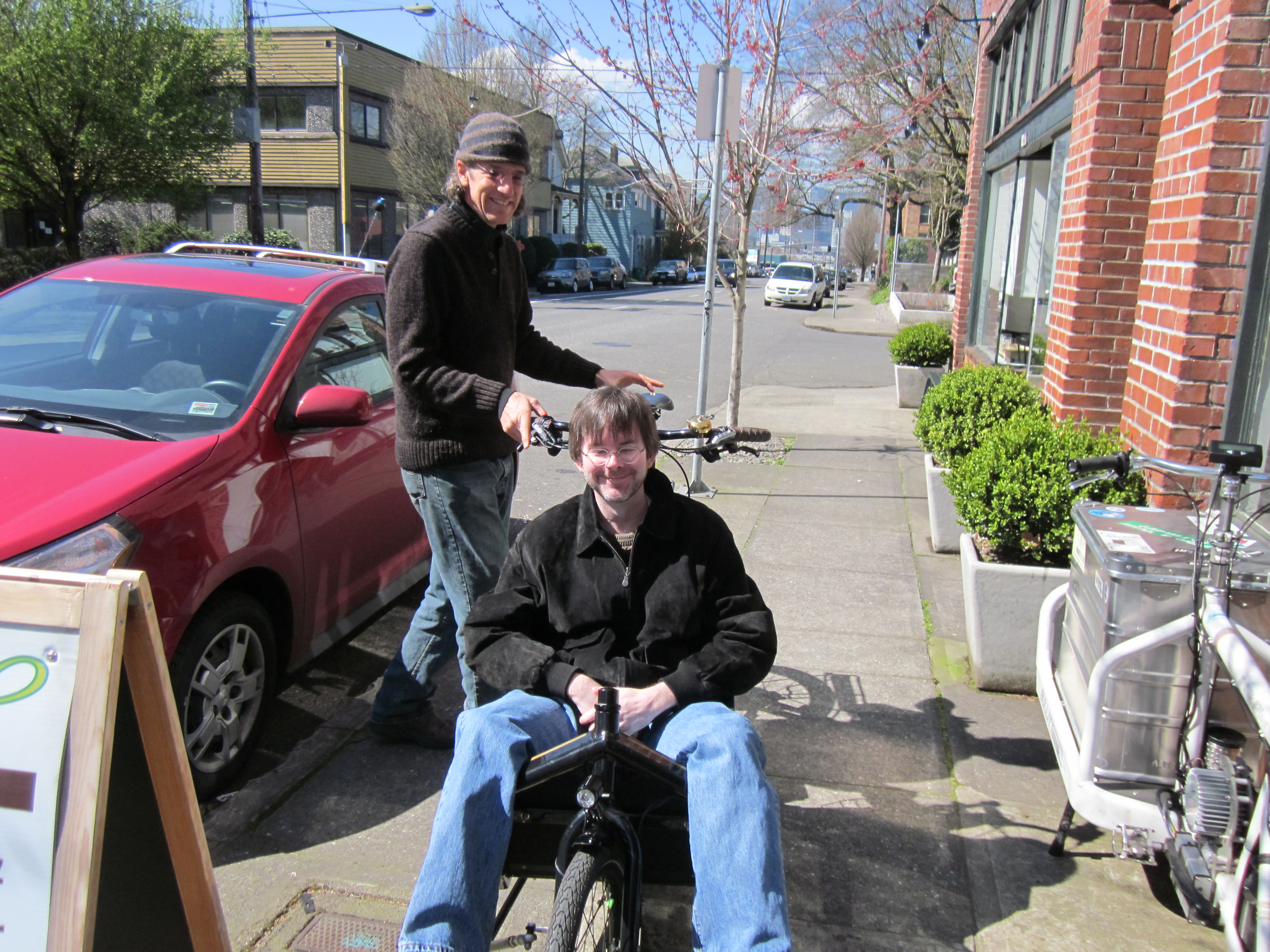
Todd on the Bullitt (I took this picture for his wife)

Joel rode an assisted Bullitt, which is very cool in its own right; it was the first box bike I’ve ever seen in person that I have thought would be practical in San Francisco, as it is lightweight and narrow (and fast). Because my kids were already in up in Washington with my mom, I was cargo-less. So I brought my friend Todd along. Todd and I went to grad school together and although we are both pretty junior he’s now the chair of his department at Lewis & Clark. Guess which one of us makes our advisers proud? But he remains a relentlessly good sport about the crazy things that I propose. At 145 pounds, Todd is cargo overkill, the equivalent of almost four kids. But better too much weight than too little; my kids are growing.

Todd doesn’t really ride bikes, so Joel carried him in the Bullitt while I was figuring out how to use the BionX on the way to the hills. And I carried him back to the shop on the Big Dummy.

Most of Portland, to my mind, is pretty flat. The neighborhood streets we first rode on certainly were; on those streets, on an unloaded Big Dummy, turning on the BionX was wildly entertaining, but hardly seemed necessary. You turn it up and you go a little faster. It’s like magically getting stronger without the bother of having to train. There are four levels on the way up, which are activated by pushing the + button. I perceived them as ranging from “I barely notice anything” to “I barely need to pedal.” There are also four levels in the other direction (push the – button), for regenerative braking to charge the battery a little; this was fun, because it meant that I barely needed to use the brakes.

And then we got to the first hill. Todd hopped off the Bullitt and onto the Dummy. From a dead start on an incline, I could barely move the bike. With the assist on level 1, we were moving slowly. And with it ramped up to level 4, getting both of us up the hill was like going up a slight incline with an unloaded bike. It was unbelievable. On the way down, the regenerative brakes slowed us to a crawl even though together with the bike we weighed ~350 pounds.

On the second, steeper, longer hill, still with Todd on board, I was already moving on the way up, and managed to make it about 100 (very painful) feet before I switched on the assist. Near the top of that hill I was back at level 4, moving pretty quickly, and laughing so hard I couldn’t speak. And it was at that point that I realized that I would, if necessary, give up almost anything else I owned to have this assist.

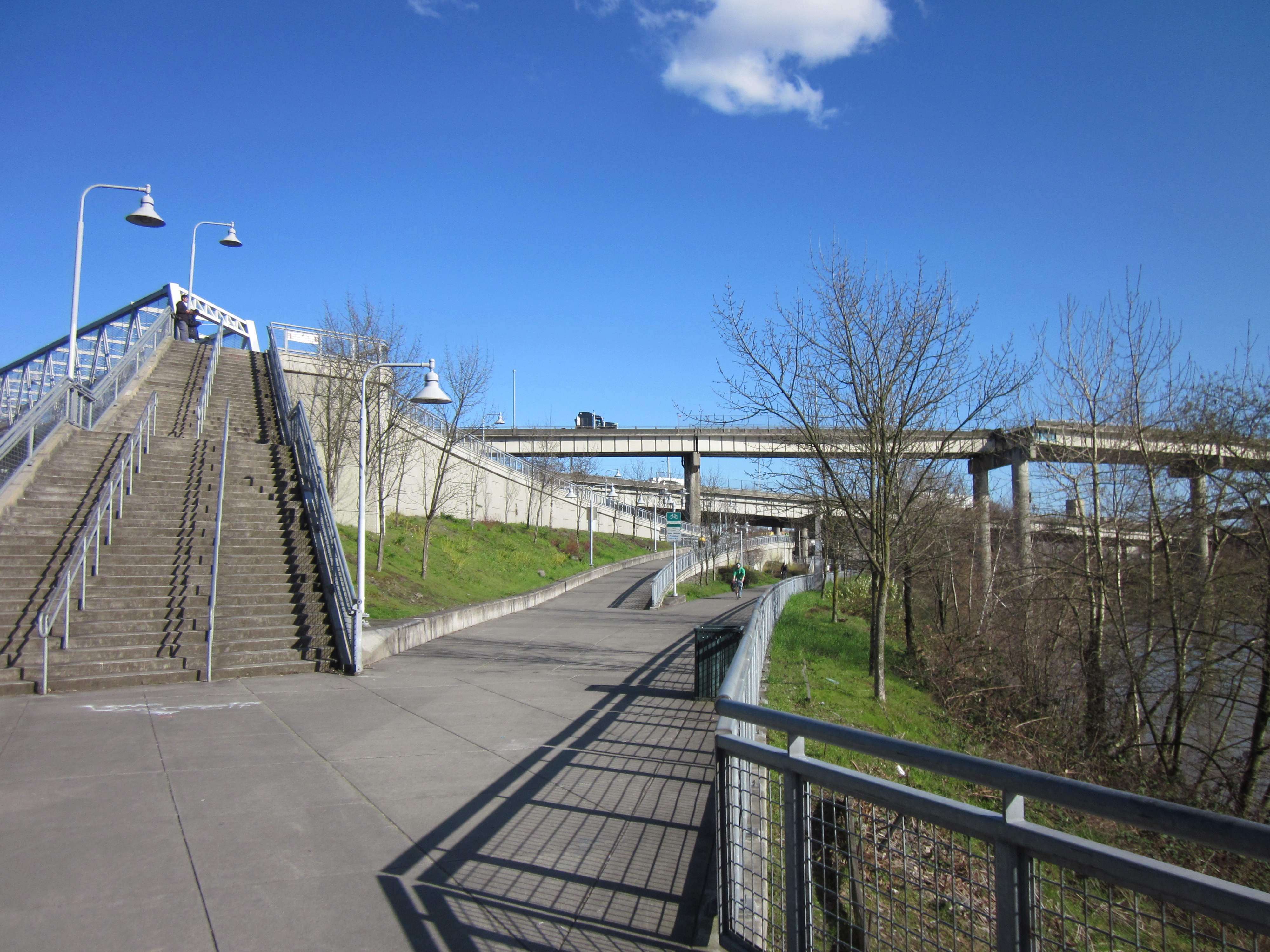
Although there are hills in Portland, the city has built switchback ramps to make the climbing easier. Let us take a moment and contemplate this.

The BionX doesn’t take the experience of hills away; it was still work to get up that second hill. But even with a person who weighs more than I do on the back, on a heavy bike, going up was manageable, and it didn’t make me want to die. It made we want to find an even bigger hill and storm up that one too. I didn’t want Todd to get back in the Bullitt; it was more fun to talk with him on the Dummy. He commented that the motor was completely silent. “If I didn’t know it was there,” he said, “I’d just think you had really strong legs.”

With Todd on board I ended up keeping the assist on level 1 or 2 for the stop signs, even on the flatter ride back. Starting a bike loaded with kids has always been slow for me; it takes time to get that much weight moving. But with the extra boost of the assist, we took off at the intersections at the pace of a racer.

The BionX has some quirks. Some of them are counter-intuitive. It is responsive to pressure on the pedals, so to get more assist on the way uphill, I learned to shift up to a higher gear. The harder I pushed, the harder the motor worked. This happens automatically at intersections, but on the hills sometimes I geared down low enough that I wasn’t getting as much help. I suspect gearing down to reduce the assist would actually be a useful way to train to ride hills unassisted if one were so inclined.

There is an awful lot going on at the right handlebar grip on a BionXed bike; occasionally I found myself changing the assist level when I meant to shift gears, or shifting gears when I’d intended to brake. I’m guessing that this kind of thing is temporary.

Finally, the motor cut out once. We were on a flat street, fortunately, and when I asked Joel what happened he said the sensor had jogged loose. He nudged it and the assist starting working again. There is a reason it is so twitchy, evidently, but I didn’t understand the explanation. However it is also apparently possible to set up the control so that it doesn’t cut out like that.

Todd drove me back downtown after our ride, patiently listening to me babble gibberish, which was something along the lines of “OMIGOD OMIGOD OMIGOD!!!” I couldn’t stop grinning, not even when I was sideswiped by a jogger on the walk back to the hotel. I found myself laughing randomly when I tried to explain what riding with the BionX was like to other people. I’m laughing now.

The BionX would change our lives. A lot of our remaining driving miles are, “No way am I riding up THAT hill” trips. Joel said he’d taken a fully loaded Bullitt+BionX up a 25% grade. We have a hill like that near home and we find alternative routes even when we’re driving. He noted that the BionX could get overheated on steep, extended climbs (>20 minutes) in hot weather, at which point it would reduce the assist level to protect the motor from overheating. But our hills are short and broken-up with stop lights, and it never gets hot in San Francisco. With really serious cargo loads an EcoSpeed would be better, but two kids and groceries are evidently not what people have in mind when they talk about serious cargo.

How much do I love this assist? I would have bought one on the spot if it would work on the Breezer, even if I had had to talk Splendid Cycles into prying one off of a bike in the shop. But I will have to give up my Breezer to use a BionX; it won’t work with an internally geared hub. That’s not going to happen right away—there’s the non-trivial issue of figuring out what bike to ride instead—but it is most assuredly going to happen.

7 Comments

Filed under bike shops, cargo, electric assist, family biking

San Francisco destinations: Everybody Bikes

Perhaps not the most practical use of the shop pump

I have mentioned before that our local bike shop is Everybody Bikes. This place belongs in our San Francisco destinations because we are there so often we have started to feel like stalkers. We’ll love you even if you get that restraining order, Everybody Bikes! However my son, who can be very literal, finds their name inappropriate.

“Not everybody bikes in San Francisco,” he says. “Their store should be in Copenhagen, not in San Francisco. That’s where everybody really bikes.”

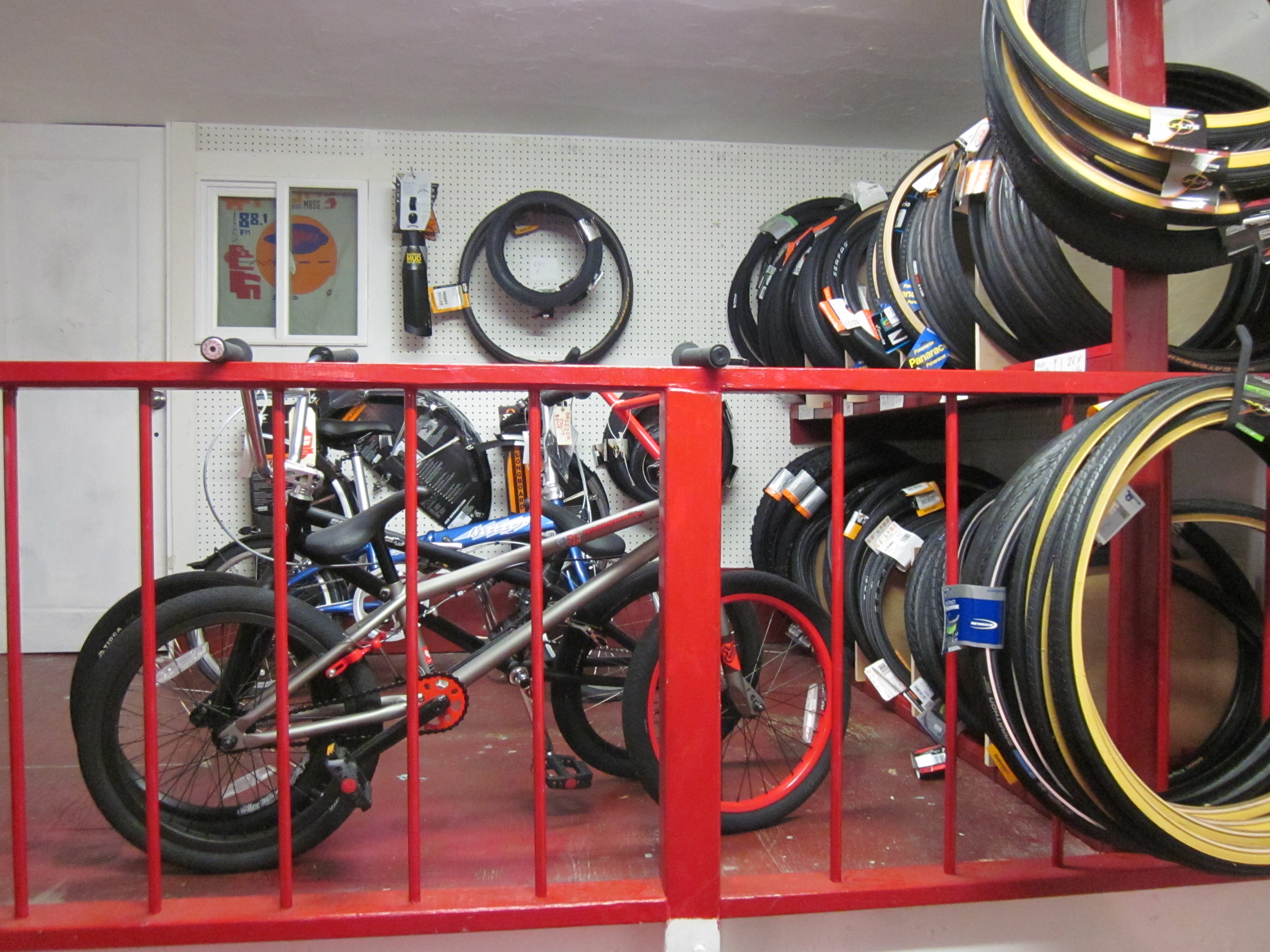
Tires, small bikes and a folder in the attic

Our initial visit to Everybody Bikes came at the strenuous urging of my brother-in-law, who had bought his commuter there a few months earlier, when they opened. Unlike us, he knows a lot about bikes, and he was very impressed with their work. On first impression, we were not as infatuated. When we walked in the door, we immediately noticed that they primarily stocked mountain bikes (this has changed). They did not have child seats. Moreover, the hipster vibe was very strong. The shop’s owners wore the kind of tight pants that always make me want to check for gangrenous toes, accessorized with heavy black plastic glasses, knit skullcaps, and Rorschach facial hair. As a parent these visual cues make me twitchy. These looked to be the kind of people who screamed “Breeder!” at moms in minivans during Critical Mass rides.

The view from the spiral staircase

What’s more, on our first visit they weren’t too familiar with children. We usually bring toys for our kids when we are stopping in a store, but this is hopeless in a bike shop: no toy in our possession compares to bike accessories. Our kids bolted for the bike bells and pumps (we figured they could do little damage in this section of the store); one of the owners visibly flinched and asked us to please get them to play somewhere else. This was tough to do; the store is roughly the size of a suburban walk-in closet.

Since then, we have all gotten to know each other a little better. Despite our initial reservations (and, evidently, theirs) we’ve realized we’re fortunate to have a shop like this within walking distance. When we lived in Berkeley, our apartment was down the street from an independent hardware store legendary for its service. When I came in to buy nails one day, I saw one of the owners signing tentatively with a deaf customer. When she left, I commented that I didn’t know he knew how to sign. Oh, I just started taking a class because she moved into the neighborhood, he said. Everybody Bikes is like that hardware store. What they don’t know, they’re ready to learn. And although this is changing, family biking has a fairly steep learning curve. They’ve been game to help us figure it out.

Upstairs where the training wheels hide

Our kids made the shop owners nervous at first, but they have gotten more comfortable with families. They carry a couple of balance bikes and children’s bikes, and from day one they were able to fit a kid’s helmet. They are good-natured about our daughter’s efforts to pump air into the hole in the sidewalk at their front door, and endlessly concerned that both kids not injure themselves on the store’s spiral staircase or on our bikes. This is a hopeless cause in the case of our daughter, but we all make an effort. They have learned that kids need frequent bathroom visits and always volunteer theirs. Like Trader Joe’s, they offer stickers, and we have probably a hundred “Everybody Bikes” stickers now in various corners and drawers. I see other families in the shop now, and this attention isn’t unique to us.

The owners might look like hipsters, but they don’t act like them. They take the shop’s Kona Ute to the farmer’s market and to street fairs and give free bike tune-ups. They offer a bicycle maintenance class, which Matt is taking this year. They open the store for neighborhood movie nights and art shows (okay, this is kind of hipster-esque). When we talk to the owners at the door, neighbors walk by and greet them by name. We’re not the only people around here who like them. They stock more commuter bikes now, and a month ago I watched a family walk in and order a Linus from them that they planned to rig up with child seats. I’ll admit that I still wish they actually stocked child seats, but they’ll order and install them.

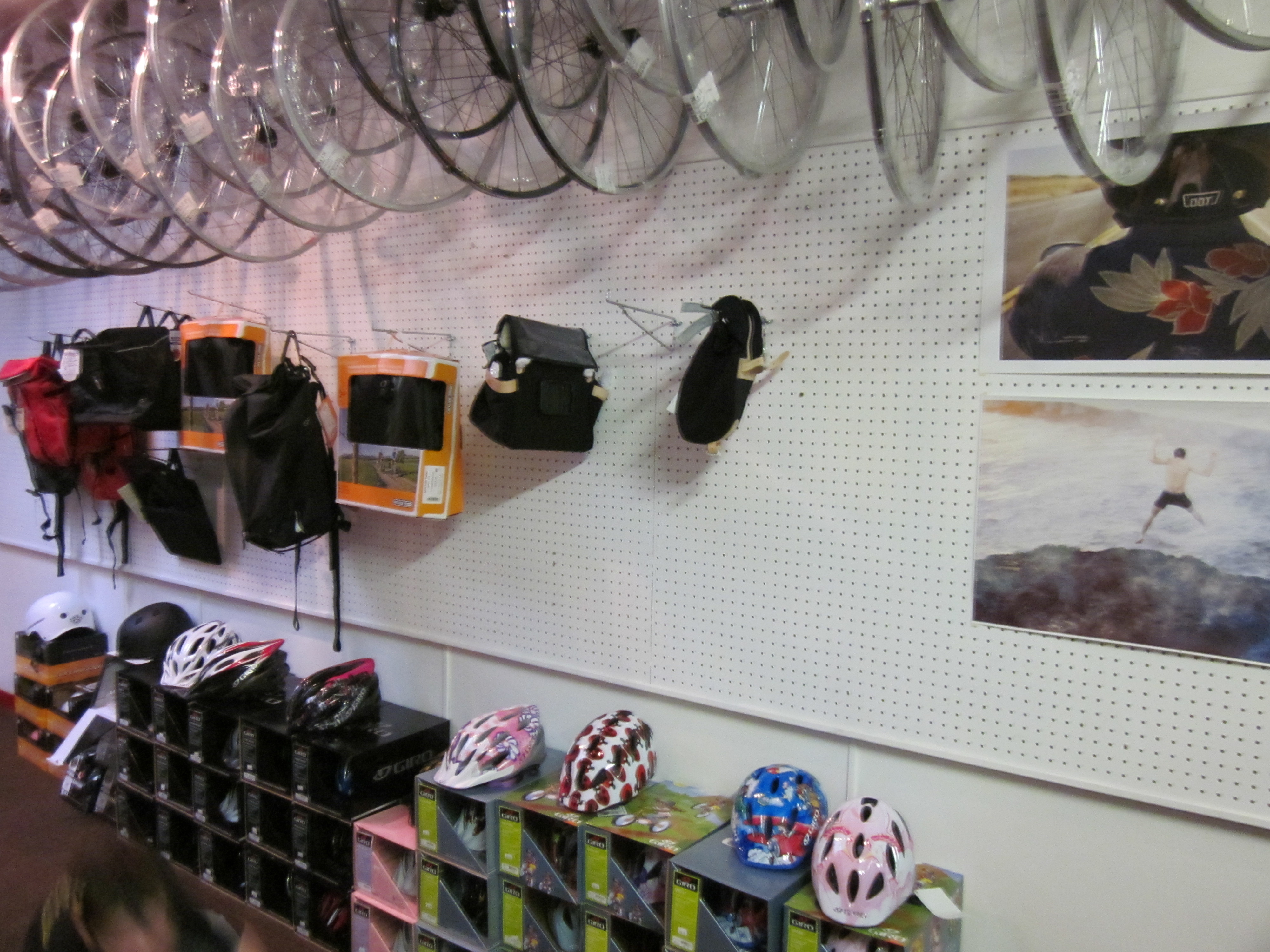
A variety of kids' helmets

The Sunset is one of the few places where families are relatively thick on the ground in San Francisco, and because they aspire to be a neighborhood bike shop, they’ll work out issues that come up when riding with kids. They’d never set up a Kona MinUte to carry kids before (ours was the first MinUte they’d ever sold, and they gave us a great price), but they found really nice stoker bars for us. When the footpegs they wanted to fit on the bike were out of stock, they found and ordered an alternative on eBay. They keep adjusting the MinUte’s crappy brakes for free. San Francisco can be hard on bicycles. They keep us moving, and they are unbelievably nice.

Everybody Bikes took over their location from an extremely successful and much-beloved shop, Roaring Mouse Cycles, when it moved to larger digs in the Presidio. Roaring Mouse would be a tough act for any bike shop to follow, but they have managed it with grace. When other parents in the neighborhood ask us where we got our MinUte or where to buy a kids’ helmet, we’re always delighted to tell them to head over to Everybody Bikes, at 15th and Irving, where they’ll be treated like human beings even if they are as clueless as we were.

1 Comment

Filed under destinations, family biking, Kona, San Francisco

Electric. Bicycle. Culture clash.

It's Electric! (boogie boogie boogie)

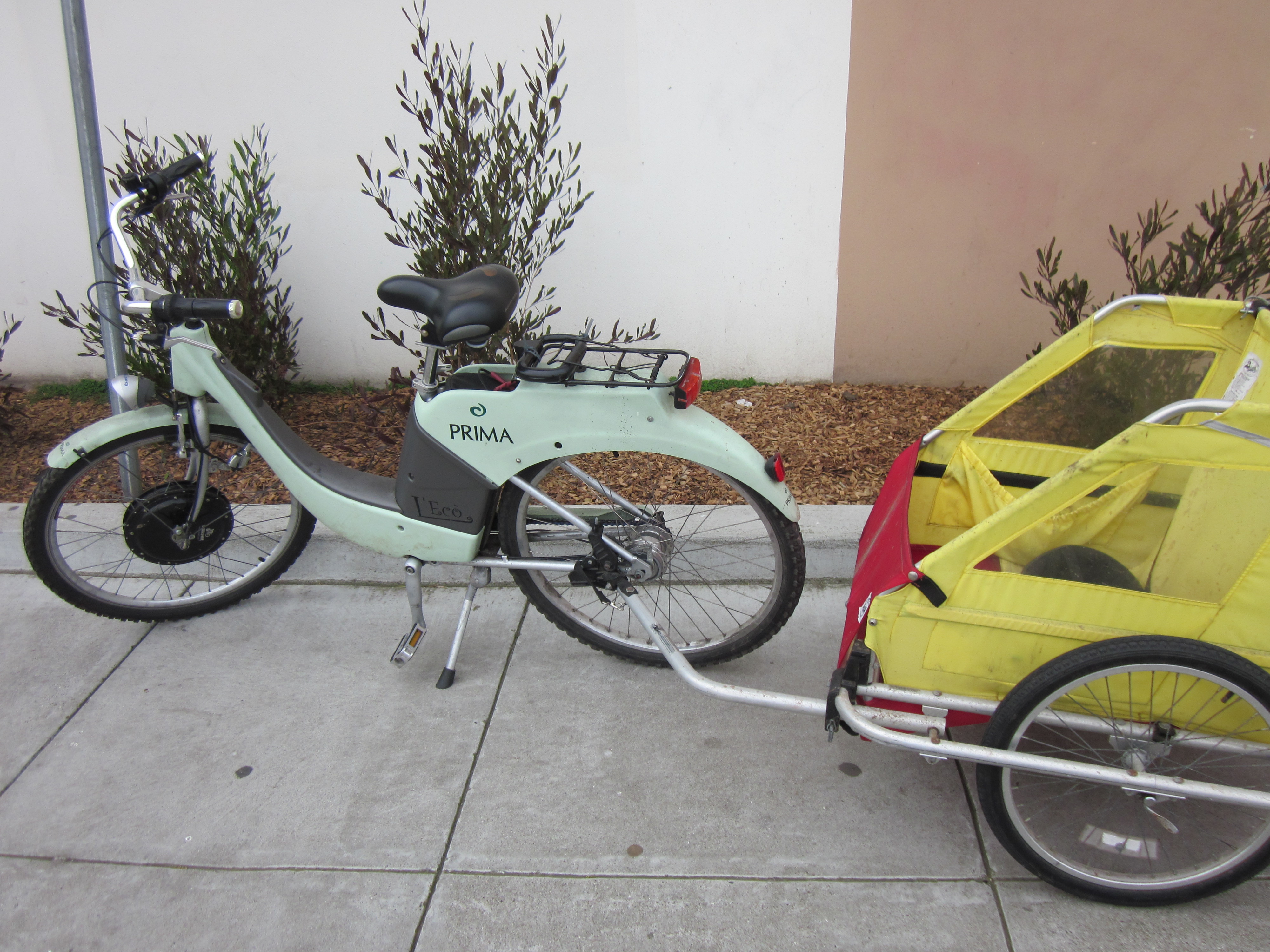
While I was getting lost on the way to Saturday’s class on getting kids on the road, I wandered through the park and library next door, and up to the middle school. There I saw an electric bike with a child trailer attached on the rear. Both of these are such rare sights that I immediately took a picture. Right after I did, the bike’s owner wandered out.

I asked him about his bike and he said he’d gotten it some time ago from a store in Oakland that was briefly importing electric bikes from Europe, and found them such poor sellers that it dumped them all at bargain basement prices. But he’d found the factory motor installed in it too weak, so he’d replaced it with a much more powerful motor, then upgraded the battery to boot. Worth it to buy even with the upgrades, he said, because the bike had a great compartment for the battery integrated into the frame. Then he said he’d just taken the bike up the hill with his two kids and their backpacks in the trailer, without even pedaling.

I was getting the sense that I was in the presence of someone who actually knew something about electric bikes, and this turned out to be the case. His name was Nick, he said, and he wrote columns for a new website, electricbike.com. Sure enough, he does. And then some. Well now.

It turned out he was a car mechanic but he loves bikes more. He thought car culture was crazy. “I tell people their car needs a $2800 repair, and they groan and tell me to do what I have to do. I tell them I can put an electric motor on their bike for $1000 and I’ll throw in the labor for free, and they tell me that it’s too expensive.” He was the first major fan I’ve ever met of electric bikes, and consistent with the tinkering evident in his own bicycle, he was not a fan of BionX, which as a closed system doesn’t allow swapping out parts. Talking to him was worth the embarrassment of showing up late for a class I was supposed to be helping to teach.

I mentioned meeting him to the other parents who were teaching the class. Like almost everyone with kids in the city, they were pretty excited about the prospect of electric assist, although none of us actually had one. Great for seniors riding in the city, said one. Another couple had an 8 year old and 5 year old, and they were commuting to school on a tandem with an Xtracycle FreeRadical on the back, which sounded like a totally awesome ride to me. But the dad, who teaches at Sunset, complained that the Xtracycled tandem was actually harder to get up hills than their old Xtracycled bike with both kids on the back.

What he really wanted for the school commute was a Metrofiets.  Who doesn’t? But they were put off by the cost, and I hear that: I find the cost of a Metrofiets daunting, and university professors typically make more than elementary school teachers (for reasons that elude me).  Nonetheless, unlike me, they were actually willing to make the trip down the Peninsula to Bay Area Cargo Bikes to test ride one, something I’ve avoided as I figure it could only lead me to want to buy another bicycle.

Families on bikes in the heart of the city

They’d been thinking about electric assist, and knew they’d need it if they actually got a box bike, but were having a hard time getting over the feeling that using a motor was somehow cheating. I knew exactly what they meant. It feels like I should be able to ride my bicycle without an electric assist, even though I know that my kids’ current weight is nearing the limit of my abilities. To me and to them, an electric assist felt less like a cool accessory and more like a necessary evil. It felt like compromising the bike for some reason. Heck, some riders feel that way about fenders, or for that matter, brakes. We had all seen the Xtracycle with the red handlebars and an electric assist riding in traffic every morning (there aren’t that many family bikes in this town; you start to get to know them). Not only did we all find that a little scary, it seemed kind of annoying that the guy on that bike doesn’t even bother to pedal.

Looking over downtown San Francisco

What’s more, thinking about the cost of an electric assist really irritated me for some reason. It took me a while to figure out why. Eventually I realized, and this is embarrassing: it was resentment. Parents in other, flatter cities can carry their kids without paying for electric assists, why couldn’t we? Isn’t it enough that we already have a much higher cost of living? When I tell people outside the Bay Area the average rent for a two-bedroom apartment in San Francisco ($3275 as of last month), they typically gasp in disbelief, and say, “I could buy a mansion for that where we live!” Yes, I knew that already, thanks for sharing. We live surrounded by fog 11 months of the year and pay $4.50/gallon for gas (albeit rarely). San Francisco is one of the few places in the country where I know couples who are both well-paid lawyers and who are nonetheless raising their kids underneath the stairs, Harry Potter-style, of a 1-bedroom apartment, because that’s what they can afford. We all make compromises to live here. On top of all that, I have to drop a grand on electric assist when everyone else in the world can haul kids on their bikes fueled only by righteousness and an extra serving of oatmeal in the morning?

This is embarrassing to admit because we are happy to be here. Lots of people say they would be thrilled to trade places with us (although when push comes to shove they usually balk at the prospect of raising their kids in a garret under the stairs). So we’re going to pay more to ride our bikes than we would elsewhere. Why should this be any different from anything else that costs more in the city?

San Francisco isn't Copenhagen

Anyway, I got none of this angst from the electric bike mechanic, or from his website. It was all about the thrill of having a motor. He pointed out that the cost of using an electric assist was bupkis: “You spend more on power if you forget to turn the light in the closet off in the morning.” I now realize that part of the issue with electric bikes is trying to reconcile bicycle culture, which views motors with suspicion because they’re related to cars, which have a bad habit of mowing people down, and mechanic culture, which views bicycles as a neat way to use motors without having to register a vehicle, get a license, or avoid mountain bike trails. But if it’s going to happen anywhere, it will happen here, in the City by the Bay, Gam Saan, with its countless hills.

5 Comments

Filed under electric assist, family biking, San Francisco

Free riders

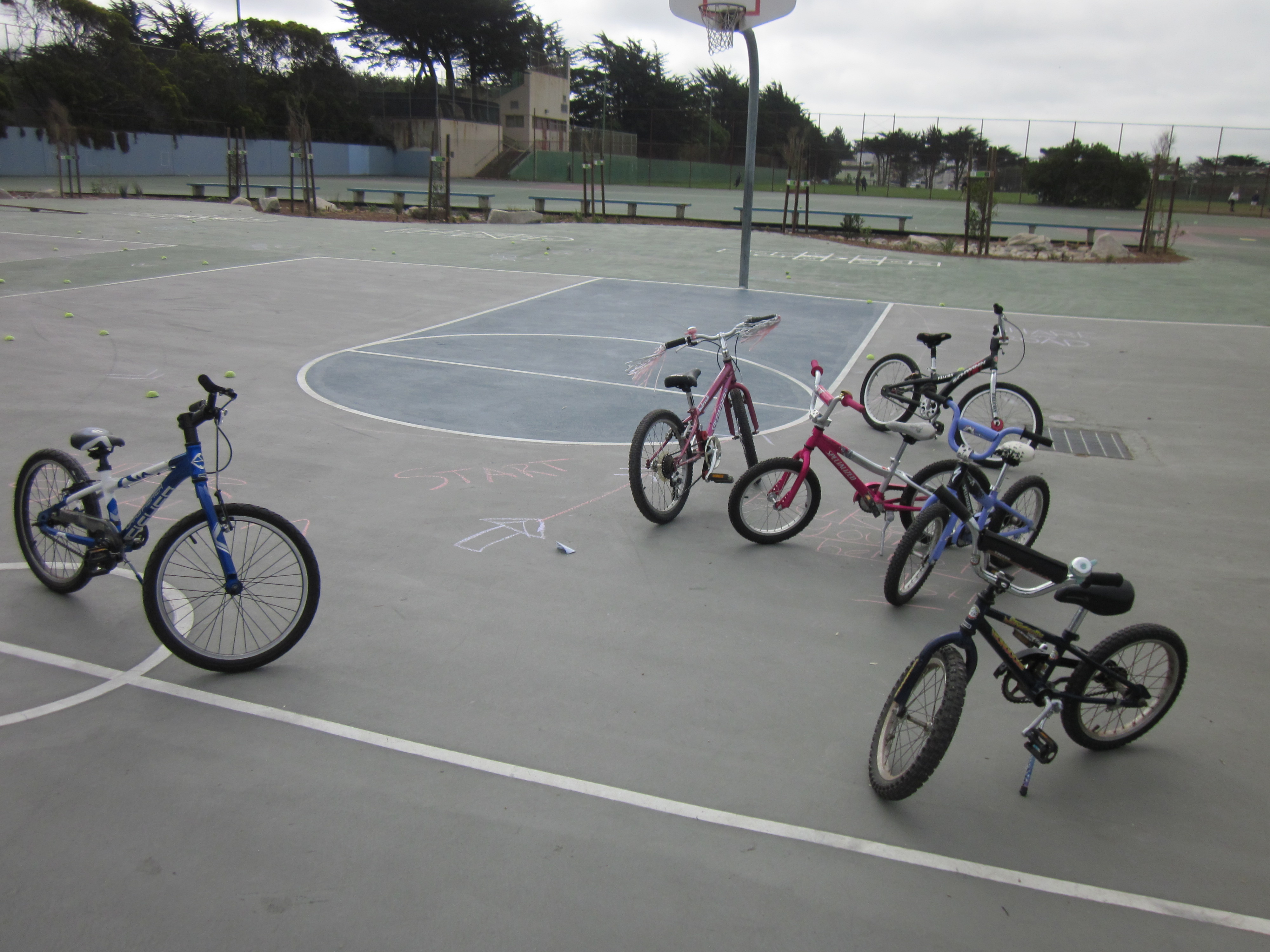
A passel of kids' bikes waiting for riders

On Saturday I went back to the Outerlands, specifically to Sunset Elementary School, to attend one of the San Francisco Bicycle Coalition’s Family Biking Series classes, On Road with your Children. To my astonishment, I was asked to attend in a vaguely instructional capacity.

I find it a somewhat depressing comment about the number of families in San Francisco with school-age children (there aren’t many) that I would be considered even vaguely qualified for this assignment. The guy who built up the tricked-out Kona Ute our PTA treasurer used to ride was there. The co-owner of Ocean Cyclery, which sold us my Breezer and our child seats was there. I was outclassed. I can, it is true, research any topic into submission, because doing research is my job and because I’m compulsive. But research is no substitute for experience, so this class involved some ugly duckling moments. The class met at the back of the school, and I had trouble even finding it until other people showed up so I could follow them. The parents teaching the class had been riding bikes for years and it showed; they were more graceful on their bikes than I have ever even aspired to be. And I found out that I was wearing my helmet wrong. All in all, it was a humbling experience.

Lubricating chains: virtually all of them were rusty, because the Sunset is permanently socked in by fog

And it was a hugely informative experience. I didn’t bring my kids; they were at their swim lessons. It is just as well. Neither of them is competent enough on a bike yet to keep up with the kids who showed up for the class. (We are the blind leading the blind over here.) I will, however, take my son when he is more skilled. SFBC’s instructor for this class is fantastic, warm and lively and hugely competent at wrangling both kids and parents. Apparently he has been leading these classes for years. It shows.

This kind of thing isn't helping with the helmet either

Matt and I signed our son up for summer bicycle camp this year. We didn’t thrust this upon him; he has been angling to attend bike camp since he heard that such a thing existed. But we’re all pretty excited about it. We are having trouble teaching him to ride safely because we live on a great big honking hill. Our efforts to talk him into going down to the park, where it’s flatter, to ride always fizzle; his enthusiasm evaporates with the walk down and on the rare occasions when we’re successful, he is too tired to walk back home. Although it is ridiculous to drive such a short distance we would do it, but he hates riding in the car. Bike camp seems to resolve a lot of problems at once; most importantly, it’s taught by someone much more qualified than we are.

Practicing riding in a crowd

We had both harbored ambitions that at the end of a summer at bike camp, our son would be qualified to ride his own bike to school. Attending this class disabused me of this fantasy. The area around the school was slightly hilly, but nothing particularly troublesome for an adult rider used to the city. It was much more difficult for the kids, who were, I realized, mostly riding bicycles that weighed more than half what they do. I have ridden a heavy bike before, and remember how hard it was to start and stop and get up hills, but at least I had a lot of gears to use. The kids did not. No one is selling ultra-light bikes for kids, so I don’t see any realistic way for mine to handle anything more than minor elevation on their own. And the hills along our commute to school are anything but minor.

Practicing riding while looking for cars behind

What’s more, supervising kids on the streets of San Francisco was terrifying. The area around the school is very lightly trafficked, but at stop signs things fell apart. The kids attempted to wave drivers ahead of them, then lurched out into the intersection as those cars actually moved, or waited for cars to stop, then tried to take their turn only to be rushed by drivers who’d grown impatient. There are a lot of decent people behind the wheel in San Francisco, but a lot of jerks as well. I suspect that these kids, as well as our son, would learn to navigate neighborhood streets like these with more practice. But we go through much more serious traffic on our route to school, and I would not trust my kids in some of those intersections for years to come.

Bumpity bump

Overall, I realized that riding in the city is too much to expect our kids to do alone at this age. Our son will not be riding to school on his own bike next year, or the year after. He wants to pedal, so a trailer-bike or tandem may be in our future. But he will not be riding solo.

We are going to be working harder as he grows, and that is daunting. We had talked about possibly not needing an electric assist if our son began riding his own bike. But I cannot imagine hauling my kids up and down the hills to school without help once their combined weight exceeds 100 pounds. We are now in the position where buying a bike accessory that costs more than our bikes themselves seems inevitable.

Despite this, I find I don’t mind the thought of keeping them on our bikes longer. My children have been growing away from me since the day they were born. Even in the newborn barnacle months, they were already exploring the world. It is thrilling to watch them grow more independent, but I know that eventually they will tire of being hugged, of sitting on our laps, of being picked up. My son is in first grade and already conscious that being affectionate with parents is not something that older children do. But when we’re walking or riding up a hill, all of this is forgotten. They look at the climb and want to be small again. “Mommy, will you carry me?” they ask. And I say, yes, I will carry you. I’ll carry you up the hill. I could carry you forever.

2 Comments

Filed under commuting, family biking, rides, San Francisco, traffic

Retro child seat

Possibly the world's most awesome child seat

I spotted this achingly cool child seat on a bike parked at a construction site near campus. I couldn’t believe it. The black leather seat, the chrome back–it looks like it was lifted from a modernist bar for preschoolers. It totally outclasses the Huffy.

I remember when I was young, my parents took my sister and me on bike rides in the wire baskets on the handlebars of their bikes. It was horribly uncomfortable, of course, and I sincerely doubt those baskets were rated for the weight of children. But it was a lot of fun nonetheless. Some of my earliest memories are from those rides; seeing the trees dripping with moss during my family’s brief time in Louisiana, or bumping along on the gravel road that led to our house in the Seattle suburbs (this was long before they were built up for hordes of Microsoft employees).

Our parents sometimes tried to take us on walks when we were young, but like most kids our age, we simply didn’t have the stamina to go very far. My parents’ bicycles, with a kid in each front basket, gave them range. Now that we are parents, our bicycles make us free as well.

The seats we use for our children, however, lack style, even compared to a wire front basket. They’re plastic. Putting our kids on the back of the Kona MinUte is an improvement. But overall, the child seat market resembles nothing more than the toys that you can buy at big box stores: giant plastic sandboxes in the shape of turtles, or plastic play kitchens with colors that fade within a few months. There are twee alternatives, of course, like the wooden play kitchens that mimic everything about the plastic ones except the price, which is ten times higher. But I’d prefer to sidestep this market altogether.

This child seat, which looks pretty vintage, is in a class by itself. If my parents had had seats like this they could have ridden with us for hours. I’ve never seen anything like it before. But I want one.

Leave a comment

Filed under family biking, San Francisco

San Francisco destinations: Rosa Parks Elementary School

Welcome to Rosa Parks

We started riding our bikes in large part to solve the riddle involved in getting our son to his elementary school. For the first year, we all went to kindergarten together. Our daughter was in child care downstairs at my office, so we’d drive to school, play on the yard until the bell rang, then I’d drop Matt off for the express bus and head to my office. Matt would take the express bus back, pick up our son at after-school, and I’d meet them with our daughter in the campus parking lot. This worked pretty well, although it was time-consuming, until we enrolled our daughter in preschool closer to home. At that point things got more complicated.

From the outside, just another urban public school

San Francisco is one of the cities in the United States that operates a public school lottery system. I know there are others (Cambridge, Los Angeles, Champaign, Berkeley, etc.) but this is the one we know best. There is no guaranteed neighborhood assignment. So at that time you toured a bunch of schools, listed up to seven that you liked, and hoped you got one. If you didn’t, you would be assigned to the closest school with openings. This can be intimidating but also offers huge opportunity. There are citywide schools that offer more than the general education curriculum, including foreign language education, K-8 schools, a Montessori school, etc. Most schools are pretty good and some are terrible, but because people hate the lottery system so violently, the perception is that only a few highly-desired schools are acceptable and the rest are hellholes.

For people who appreciate the charms of being underrated, this misperception offers an enormous opportunity to beat the system. We found it surprisingly easy to find schools we liked that none of the other preschool parents we knew had even heard of, let alone toured or listed on their applications.
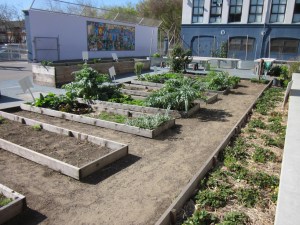
From the inside, a garden

There is a lot of herd mentality with a school lottery. There are about a dozen schools of the 100 or so in the city that get over half of the first choice requests from parents. They tend to have higher test scores. Parents we know like high test scores: they seem objective. But it only takes a little reading to realize that they are highly correlated with demographics. Schools that don’t have a lot of poor students have high test scores; schools that have more have lower scores. After reading some articles I realized that I could easily derive a formula: for every percentage point of students getting free and reduced price lunches, expect a 5 point drop in API (from a max of 1000). I made this up but it works pretty well in most circumstances (schools with a large share of Chinese-American kids tend to outperform their demographics, however).

San Francisco Unified School District enrolls about 60% free and reduced price lunch students. The school nearest us has ~10% free and reduced price lunch students. Its test scores are ~950, as expected. It is wildly popular and completely oversubscribed. On tours they indicate that parents are expected to contribute $1000 to the PTA annually, which I’m sure discourages certain families from even applying. On the flip side, we a toured Spanish immersion program in the Mission that had ~80% free and reduced price lunch students. Its test scores were, predictably, ~600. Poor students do poorly, because they tend to be English language learners, because they’re hungry, because they may be in transitional housing and lack heat and light, whatever. Wealthy students with educated parents do well no matter where they are (and the state has the demographic breakdowns to prove it at the Department of Education website). There are just more of them at certain schools.

My son learned to eat vegetables by growing them

I have a different perspective on all of this now, but at the time, like many parents facing the lottery, we pretty much lost our minds. Like everyone else at our preschool, we wanted the brass ring schools, the ones that had great scores. We knew it wasn’t that important, really, but a school with high test scores seemed like, if nothing else, a useful insurance policy. And it’s hard to buck the tide. Other parents said things like, “Well, 900 API is like an A, and you want an A school for your kids, right? You wouldn’t accept a B or a C school.” And thanks to relentless fundraising those schools had money to burn; their facilities were nicer, the selection of extra-curricular activities was better, and afterschool programs had won awards. It seemed easy enough to look past the occasional signs of near-rabid parental intensity to get the goodies.

Despite this, we did take the (in hindsight excellent) advice from Parents for Public Schools to tour every school within a reasonable commute distance, no matter what its test scores or perceived popularity. The internet is not your friend during the school search. With hindsight, it told us nothing useful, and often made us doubt ourselves for no good reason.
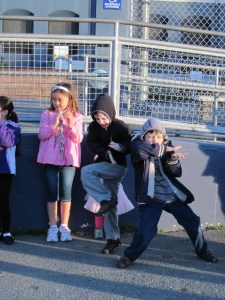
Morning PE--the Cha Cha Slide

Our favorite tour by far in our busy pre-kindergarten tour season was Rosa Parks. It is not a school that had traditionally gotten any buzz in the San Francisco parent community. Middle-class families like ours tend to shun schools named after civil rights leaders, strongly preferring schools named after dead philanthropists or expensive tree-lined neighborhoods at nose-bleed elevations. I like to imagine SFUSD opening a new school named “The John D and Catherine T MacArthur Nob Hill Academy.” Even if it were in the Tenderloin, I’ll bet it would be hugely popular with parents.

What we liked about Rosa Parks on our tour:

  • A state class size reduction grant ensured that all classrooms were capped at 20 students
  • A beautiful historic building with ample space, including both a cafeteria and gymnasium; we had toured schools without either and wondered what they did on rainy days or for assemblies
  • A sunny and well-stocked library, staffed by a full-time librarian and media technology teacher
  • Daily Japanese language education by native speaking senseis, funded by the district; by 5th grade, at least one Rosa Parks student had passed the Japanese Language Proficiency Test
  • A new edible garden program funded by a major grant, now expanded with a chicken coop and new plantings in what was formerly blank blacktop on the upper yard
  • UCSF graduate students teach science in the upper grades—this is the only school where this happens, and their faculty advisor insists that it is only school where it ever will happen
  • Grammy-nominated artist Anthony Brown teaches jazz at the school—again, Rosa Parks is the only school with this program
  • More parents than visitors on the tour, which suggested to us both that we could get in and that parents were engaged
  • Representation by LGBT families (LGBT parents have the same effect on schools that they have on real estate)
  • Harder to describe, but a peaceful feeling: students were engaged in their work rather than throwing spitballs (which actually happened on one of our tours) even when we visited a room with a substitute; upper grade students were eager to show us their letters to Japanese pen pals; kids walked down the halls instead of running
  • A warm principal who reminded me of Mr. Rogers; later, when I called the teachers’ union for their opinion on schools (we didn’t want to walk into a labor dispute), we learned he was highly regarded by teachers as well. Last week he led an impromptu ballet class for my daughter and another preschooler in the hall after drop-off.
  • Academy-award winning PTA president. Parents who attended last year’s a garden workday got to hold the Oscar. Did you know that Barbie doll clothes fit an Oscar? I didn’t either, but her kids figured it out right away.
  • An enormously rich history that deserves another post on its own; Rosa Parks, formerly Raphael Weill, was the site where Dorothea Lange came to document the process of Japanese internment, where one of America’s most distinctive photographers, John Gutmann, took some stunning pictures, and where San Francisco schools began their re-integration in the 1960s
  • Parents I wanted to hang out with, maybe the best indicator of all
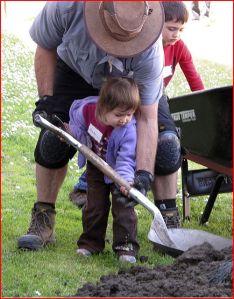
Building the upper yard garden

There were 12 people on our tour of Rosa Parks. The parent representatives said they were thrilled with this turnout. We had toured another school with well over 100 other people, in which the parent leading the tour complained how few of us showed up.  He wasn’t joking.

More than one person on our tour asked why there were so few of us and why, historically, no one had applied—the year prior to our enrollment Rosa Parks received fewer applicants than there were places available. The parents leading the tour sort of sighed and said that the combination of neighborhood and low test scores meant most people never even visited. We knew low test scores were explained by the high proportion of English language learners and SpEd students, so they didn’t bother us much. They had nothing to do with what our son would learn in a supportive environment. The neighborhood was admittedly a little grimmer than we’d hoped for, but I’d seen worse.
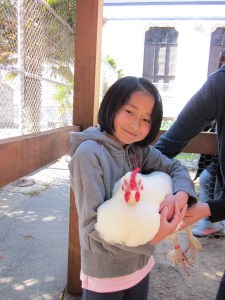
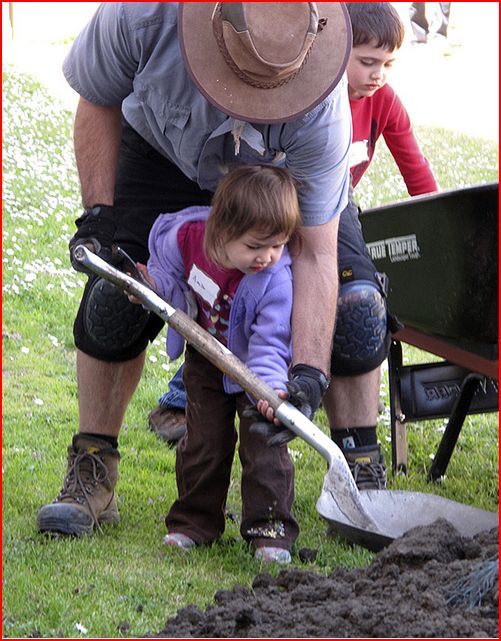
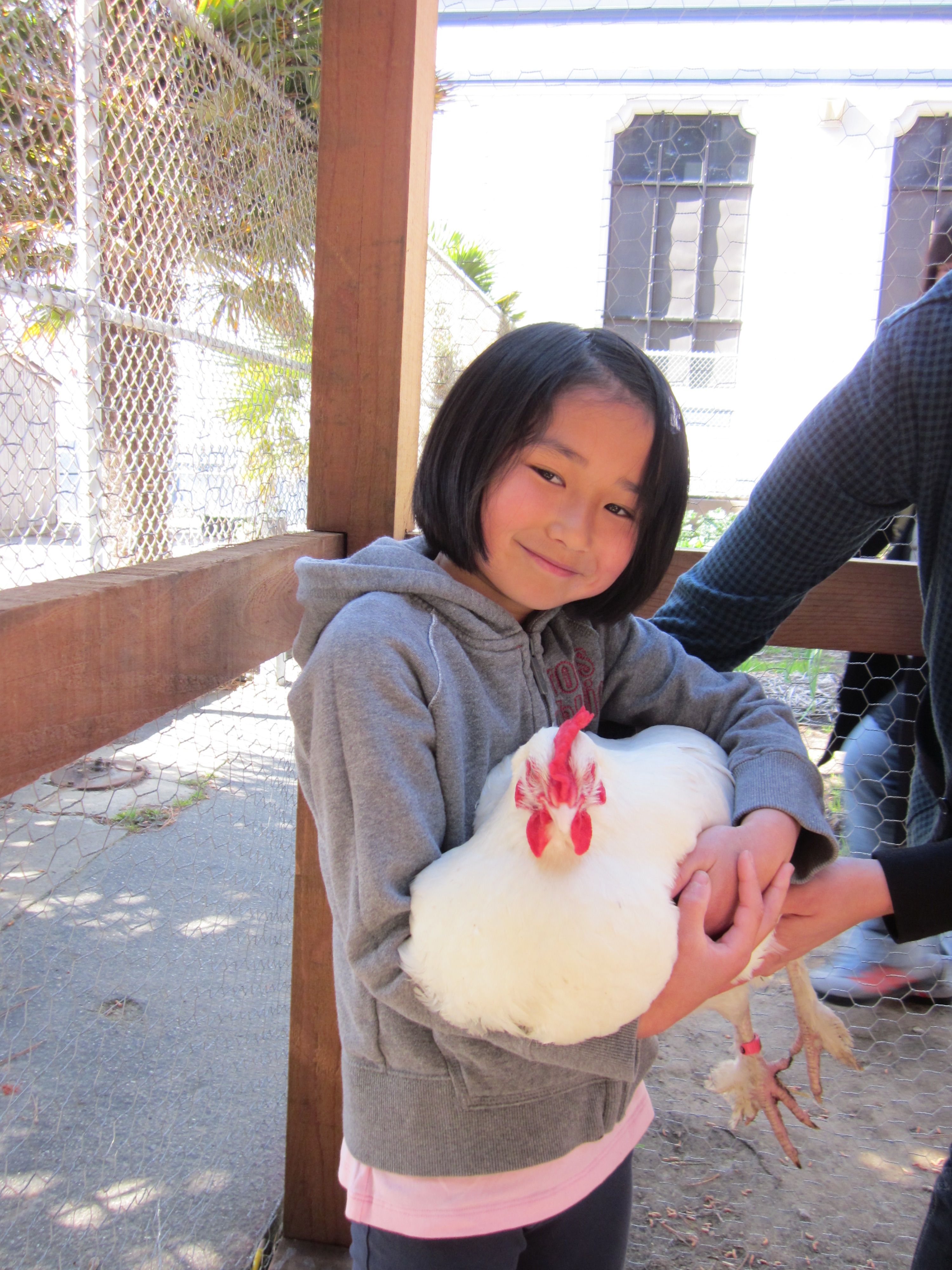
Now we have chickens. Yes, we are that trendy.

An unspoken reason for low enrollment (there were other schools in worse neighborhoods with worse test scores that were considered much more desirable) was the fact that the school was 40% African American and 20% Latino. Less than 10% of families were “white” as the district defined it, and many of those were Middle Eastern families where the women wore hijab and everyone spoke Arabic. When I mentioned touring this school to other white and Asian-American parents we knew who’d actually heard of it, there were, on occasion, curled lips, and comments I would be embarrassed to repeat. Last year I overheard one of my co-workers complaining to all and sundry that the district had assigned her to a horrific Title I school, Rosa Parks, and she wouldn’t be caught dead sending her son there. When I asked her what she didn’t like about it, she admitted, somewhat sheepishly, that she’d never visited. I told her we were very happy there.

Although it was not in our neighborhood (we live near the obscenely popular nosebleed schools, and knowing that our odds of getting into a school that people spoke about using exclamation points!!! were near-zero, we had expanded our range), Rosa Parks made our list. It was the school where we were placed in the first round assignment, not surprising given that only 44 families applied for the 40 available kindergarten spaces, and many of those were placed in schools they’d ranked higher. After a week of emotional flailing about not getting a school closer to home, we enrolled.

New upper yard garden, still in progress

It would be a huge understatement to say that we have never regretted this decision.

We could not have asked for a better environment for our son, who was nervous about the transition to kindergarten. He joined a wonderful group of children and we adore them all. As long as he is with them, I have no fears about his voyage through the rest of the city’s school system. His teachers have been more caring and supportive than we had dreamed was possible. He is excelling academically despite being one of the youngest children in his class. Working in the school garden has led him to eat new vegetables, sometimes with gusto, a battle we had assumed was permanently lost. In his first year he went on over a dozen field trips (making me feel like I was rooked as a child). He tries to trick us by speaking in Japanese at home and strangers in Japantown compliment us on his accent.

That would have been enough. But for us as parents, there was more. Sometime in the middle of our son’s kindergarten year, I realized that not only did I know the names of all of our son’s classmates, I knew the names of all their parents. And I knew the names and ages of all his classmates’ siblings. I often knew where those siblings attended preschool, or if they were older, the names of their teachers.

First week of first grade

And I liked all of these people, some mildly because I barely knew them, some quite a lot because I knew them well. I liked how they were raising their kids, and I liked that I saw them in the classrooms when I volunteered, and I liked that his kindergarten teacher sometimes had more chaperones for field trips than she had expected. I found that I didn’t mind attending school events like PTA meetings and work days that I had always assumed I would dread. Two parents organized a drop-in Friday coffee klatch, which continues. When I think about school community now, I think about a crying kindergartner being successfully comforted by another classmate’s dad, or watching my daughter meet and play with her future classmates before she turned two.

Rosa Parks was not our first choice school, but it should have been. We hit the jackpot.

In our second year, the school became (marginally) more popular, and even though it was located in a not-terrific neighborhood, parking in the morning was getting more challenging. We couldn’t carpool in the morning anymore, and driving our son was making us crazy.

New bike racks filling up on a Saturday morning

When we returned from Copenhagen with what seemed to us like a novel idea to start bike commuting, we were surprised to realize that other parents at the school were already way ahead of us. Some were riding cargo bikes to school with their kids on the back, or tandems, or trailer-bikes, or jury-rigged bikes with their kids on the top tube. Our principal rides his bike to district offices to avoid having to park there. We had, astonishingly, never even noticed. These families had already asked the district to install bike racks.

Rosa Parks in 1942, but looking much the same 70 years later

Rosa Parks is a school in transition. It is still in a borderline neighborhood, its test scores have jumped but are still nothing anyone would brag about, and the community is still rough around the edges. But I yield to no one in the value I place on a good education for my children, and I am confident that we have chosen well. And we are in transition, too. Rosa Parks is the right place for us. We are, in many ways now, enjoying the ride.

3 Comments

Filed under commuting, destinations, family biking, San Francisco

The Kona MinUte, six months later

Maiden voyage of the Kona MinUte + 3

[Update: Our Kona MinUte was stolen from a rack at Yerba Buena Gardens in San Francisco on November 16, 2012.]

When we bought the MinUte, it did a lot of what we wanted, but not everything we wanted. Most importantly, it seemed to be a one-person bike. Only Matt could ride it. We had hoped for a bike that I could use to take our son to school when he was away. Eventually that spot was filled by the Breezer Uptown + Bobike Junior.

With hindsight, it was odd that I couldn’t ride his bike. I am only 1.5 inches shorter than Matt is (5’7.5″ v. 5’9″), and both of us have successfully ridden bikes owned by people far shorter and taller than each other, respectively. But the seat on the MinUte simply couldn’t be lowered to a point where I could reach the pedals. Once again my brother-in-law resolved the problem. When we were complaining about it on a ride with him, he looked at the bike, and noted that the seat wouldn’t lower because the shim holding the stoker bars onto the seat post was too long; it extended way beyond the height of the stoker attachment and blocked the seat from moving. “You just need to have the shim cut down,” he said. I have never doubted that we are mechanically inept, but still.

Our other issue with the MinUte was that our daughter couldn’t safely ride on the back without a child seat, and this model was new enough that installing one using the Xtracycle accessories would have required a lot of tinkering. But she recently turned three, and as other parents have noted, this is an age when many kids start being able to understand the need to hold on. She had also indicated in no uncertain terms that she wanted to try riding the MinUte deck, jumping proudly off staircase landings onto it before we developed the good sense to move the bike far, far away from anyplace above ground level.

So while Matt’s injured calf was keeping him off the bike anyway, we took the MinUte over to Everybody Bikes to ask them to cut down the shim. “Oh, sure,” they said. They’d had no idea we’d ever want to adjust the seat height for me. “Of course you could ride it.” It turns out that the stoker bars take up a lot of room on the seat post regardless, and even lowered all the way to the stoker attachment, the seat was a bit higher than I’d prefer while carrying kids. I like to be able to get a foot flat on the ground even while I’m on the seat, and I’m happy to give up pedaling power for that extra bit of safety. But even though the seat was higher than I wanted, after that adjustment I rode the MinUte all the way home solo. No problem. Okay, then.

Matt was headed on a two-week trip to Atlanta and Miami, and that seemed like the perfect time to try riding with both kids. So the next day I rode both kids down to the farmer’s market. I still wasn’t totally comfortable on the bike, but they thought it was an awesome ride, and aside from a brief scuffle over the handlebar grips, they enjoyed each other’s company. Matt griped that he didn’t have a bike anymore, “Mommy has all the bikes.” I assumed that that was the injury talking, as he had had no prior plans to check the bike through on his tour of the U.S. Southeast.

Not seen in this photo: scuffling over handlebar grips

My kids got sick while he was away, and a kid who won’t get off the toilet, put on shoes or take off pajamas is not a kid who will or should ride a bike. And there were a couple of days I had meetings across town where the only possibility of even arriving late after dropping off the kids meant I had to drive the car. But I did, eventually, haul both kids on the MinUte to my son’s school, then my daughter solo back to her preschool. It was awesome.

The MinUte rides like a normal bike even with almost 100 pounds of kids and their gear on the back deck. I only felt the extra weight when I was turning corners; it turns out you need way, way more turning radius than usual with that kind of load. To my astonishment, I did not feel it much on the hills. On the way up to Alamo Square with both kids on the back I didn’t even need to drop to first gear. This bike likes to climb. I wouldn’t have needed to drop to first gear on the way back up with only one kid, either, if someone who shall remain nameless hadn’t decided to take off a mitten and throw it into the middle of the road, which required some backtracking.

This raises another point worth mentioning: riding with a three-year-old, at least MY three-year-old, on the deck instead of a child seat is not all sunshine and roses. With her brother behind her to catch flung mittens and otherwise impose basic safety precautions, I was willing to ride at something approaching normal speeds. Once we dropped him off I was riding very slowly indeed. One of her preschool teachers is a big fan of superheroes and as a result we and random strangers have been hearing a lot of speeches along the lines of, “I’m NOT a little girl! I’m an AMAZON PRINCESS! I’m WONDER WOMAN!” I’ll admit that this is a little rude at times but it’s also so totally righteous I pretty much let it slide. Anyway, Amazon princesses apparently see no need to sit down while riding and strongly prefer to hot dog it while heading up or down hills. Whereas I  had no desire to return to the Emergency Department for the third time in a month, and spent most of the ride saying, “You need to sit down. Sit down, please. I’m not starting the bike again until you sit down.”
[Aside: I’ve noticed that superheroes, with the notable exception of Batman, are not big on driving. Admittedly they don’t ride bicycles either, but still, as role models go, it could be worse.]
In the shop for a brake adjustment. Again.

And this brings up a more serious issue. BikeRadar recently reviewed the MinUte, and although they were basically positive, they noted that the disc brakes that come with the bike are kind of junky, and we agree. They have failed on Matt once, with our son on the back, and now he has them adjusted monthly, and they always need it. He wants new hydraulic brakes way more than he wants an electric assist. If we’d known this in advance we would have asked for an upgrade on the brakes before we first picked up the bike. As cargo bikes go the MinUte is pretty inexpensive even with this extra cost. Still it bugs me that any cargo bike would come standard with crappy brakes. Maybe it would be less of an issue for people who weren’t dealing with the kinds of hills that we are. I wouldn’t know.

While we were having new brakes installed, we also would have gotten a wheel stabilizer for the front wheel (the little spring that keeps the front wheel from flopping). These are very inexpensive, but although they come standard on the Kona Ute, one was not included on the MinUte even though there are hookups. The bike is a little too tippy with kids on the back when the front wheel can swing around. Yeah, it’s fallen over. The kids are fine. We’re getting a wheel stabilizer.

The MinUte can really haul; it’s not up to the loads of a regular cargo bike, but we live in the city and we’re not making Costco runs or moving furniture. It can certainly carry a week’s worth of groceries plus a kid or two. It makes it harder to get up the hill home, but that’s why that first gear is so low.

But maybe you’re not up for that kind of trip. Can you put it on a bus bike rack instead? No, you cannot. Matt tried for over 10 minutes to get it on the university shuttle bus rack, infuriating two dozen medical students in the process, and failed. It’s short enough to fit in a shared office cubicle but it’s still a longtail, and that means it’s too long to ride the bus. [UPDATE: We were wrong! Yes, you can put it on a bus bike rack. But it’s complicated. I posted an update explaining here.]

Look who’s back in the game

Matt has mixed feelings about the panniers. On the one hand they fit the bike perfectly, are totally waterproof, fold up beautifully when empty, and hold unbelievable amounts of stuff when full (and the kids’ legs just dangle over them). On the other hand, there’s no shoulder strap to carry them if you want to take them off the bike and they don’t look particularly professional when he brings them into the office. The tubes on the rear rack are thick enough that normal panniers won’t fit unless you can modify them somehow. Last week we saw a Ute outfitted with Xtracycle freeloaders, however, and I eyeballed while we were parked next to it that they’d fit on the MinUte as well.

Overall, six months after we bought, the MinUte is doing more than we had thought it could. And even though I only ride it while he’s away, Matt is so possessive of this bike that he thinks we should get a second one.

40 Comments

Filed under commuting, family biking, Kona, reviews

Figuring out what safety means

Despite my best efforts, my daughter survives another weekend unscathed

A while ago we were riding around with the kids on the weekend, on the way home from a party with friends. One street was closed to cars for a block party, and we swung in to check it out. The kids were hoping for a bouncy house, no luck. But we did see a friend of my son’s from preschool and stopped to talk with his parents. When we last saw them they were miserable about their school lottery placement, but as often happens, they were able to transfer to a school they preferred mid-year, and they were feeling good.

A neighbor of theirs walked up to me, looked at my daughter in her child seat, and said, “My god, that’s totally unsafe!”

I looked over at his two sons, who had just begun whizzing wildly around on scooters, jumping sidewalks and nearly topping toddlers, all without the benefit of helmets, elbow pads, or knee pads. He looked over at them too.

“Ha ha,” he said after a moment. “I was just kidding.”

“Of course you were,” I replied.

There is reasonable evidence that the health benefits of cycling outweigh the risks (de Hartog et al 2010, Environmental Health Perspectives—open access), at least for the person doing the pedaling. The question of whether it’s safer for children isn’t directly addressed in that paper. But we know enough people who have had car accidents in which their children were hurt or killed that I no longer feel that cars are necessarily safe.

A practical city car, unless you have kids

I didn’t always feel this way. We have a minivan because when our son was born, continuing to drive him in our 2-door Honda Civic no longer seemed appropriate. Our struggles to get him into and out of the car seat were incredibly frustrating. At the time, we were living in the suburbs and always sharing the road with massive SUVs.  After my maternity leave ended, we had stumbled into a situation we’d never faced before: both of us were commuting by car. It was in many ways a difficult time for us. Although it ended well, with a move to San Francisco less than a year later, at which point we sold the Civic, the legacy of that period remains with us in the form of our minivan.

Just barely fits in our parking space

We bought a minivan when we wanted a new car because it was touted as a safe car for children. It was built from 2.2 tons of steel and had side curtain air bags. It felt like the right size in the suburbs; it was, in fact, a medium-sized car in that area. And it was much easier to get a car seat in a minivan than anything else on the road. But it is a wildly inappropriate car in the city; as one example, just to get it in our garage space, we have to flip in the side mirrors. And in this environment I no longer feel it is safe; the constant dings and scratches we pick up in parking garages and on sharp turns makes driving it feel like wearing a sombrero in a crowded bar.

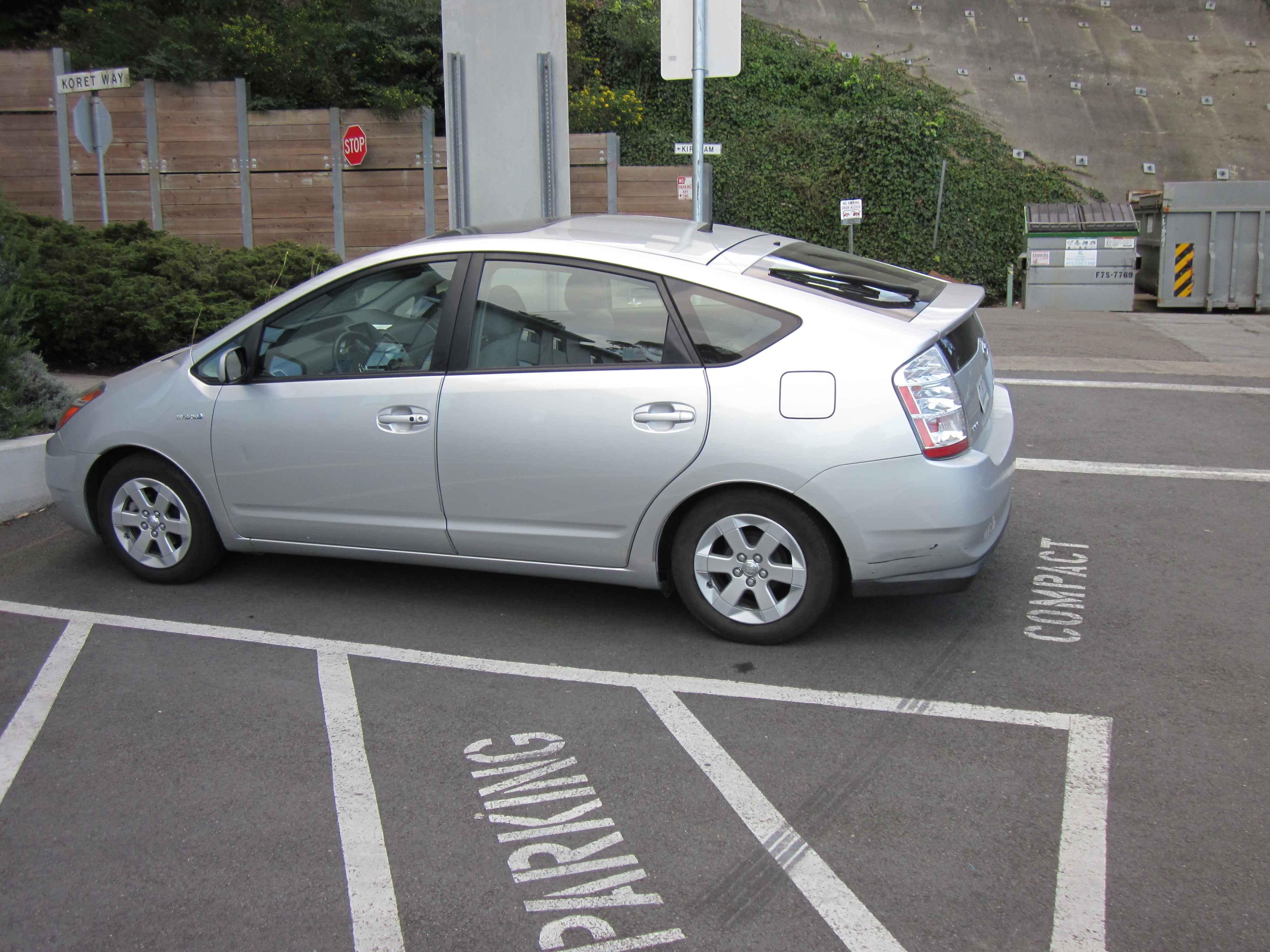
Technically a Prius is a compact car

I would consider getting rid of a car entirely and seeing how relying on City Carshare worked out for us. Matt thinks this is insane. We do agree that it would make sense, in principle, to trade the minivan for something else. My inclination would be something cheap and small and used, one of the many style-free little cars one can buy for thousands less than the residual value of the minivan. This would lower the financial hit if wanted to put electric assists on our bicycles, which are now our primary means of transportation. Matt’s preference is a 2012 Prius, the plug-in hybrid version. There is no way that I would be willing to buy any new car now that I know what happens to cars in the city. Admittedly I’ve never been a fan of buying new cars anyway. And university housing is unlikely to agree to install a charging station no matter what we might want. Matt likes the idea of driving a Prius, particularly the low gas costs given how much he travels for business (these costs are reimbursed, but it takes a while, and that’s annoying on principle alone). Such a car would, it’s true, fit easily into our parking space. As we’re unable to agree, we continue to drag out the minivan when we want a car. It’s not a fuel efficient vehicle and although we now typically fill it up less than once a month, gas is expensive. But at least it’s paid for.

But the point: I no longer feel it is a safe vehicle. I’m not sure when this happened. But when I recently heard a colleague say she doesn’t feel safe driving with her kids in their small car, and will only put them in the minivan, my first reaction was disbelief. She lives in a very different situation and her kids spend a lot of time on the freeway, so upon reflection I realized why we felt so differently. I would have felt the same way a few years ago. But my worries about my kids now involve things like Nature Deficit Disorder. That’s why I send my son to nature camp on school holidays.

When I arrived at the library at 8am the bike racks were almost full (but those U-locks without bicycles are not reassuring)

As I’ve begun riding my bicycle more, I’ve noticed that my attitude toward driving has changed as well. I think on bicycle time and I almost never travel in rush-hour traffic, so I’m never in a hurry. By default I yield to almost everyone on the road, whether pedestrian, bicycle, or cross-traffic. Occasionally I get honked at for being unwilling to mow down some poor soul in a wheelchair who’s crossing at the crosswalk, but I can live with that. I often get appreciative waves from cyclists, which is nice, and reminds me I should do that more often when I’m on the bike myself. I don’t listen to music and neither of us let the kids yell in the back anymore. This is probably how we should have been driving all along. Despite all of this, I now feel that our car is often an unsafe (if sometimes necessary) way to travel. The shift in perspective is unnerving, but it also feels right.

4 Comments

Filed under commuting, family biking, San Francisco, traffic