Yearly Archives: 2012

One less minivan

The minivan goes to SoCal. Trucks on trucks! If only the kids had seen this.

Hey! Hi there! What’s new? There are some big changes here at the Hum household. Not only did I almost break a bike (although it’s back and usable now, I can hear it creaking if I go uphill loaded, so I don’t do that anymore—but give me time, maybe I can still manage to snap the frame in two!), we gave up our minivan last week.

Now we are a car-free family.

Yeah, I wasn’t expecting that either.

Oh, the places we go: Golden Gate Park Carrousel

We had been talking about getting rid of the minivan for quite a while and replacing it with something more economy-sized that would be better for city driving. We bought the minivan new, in early 2006, and knew it was still worth a reasonable amount. In May we contacted our credit union, which has an auto-purchasing service (thank goodness, because we are lazy), and asked whether it would be possible to sell the minivan and use the proceeds to buy a smaller car. From the used car values we saw online, it seemed as though this could be a zero-cost transaction.

They said they would have no trouble selling the minivan, which was still worth a fair bit, even more than I’d expected—they shopped it around the state, found several dealers who wanted it, and had them bid for it. But their efforts to find us a used small car with good mileage were less successful. Everyone wanted cars like that, and the used market was almost nonexistent. The cars that they found had been driven to death and/or were priced nearly the same as new ones. They suggested that if we wanted to get a car in decent condition with good gas mileage, we’d be better off buying new, although they’d keep looking.

Oh, the places we go: The F Castro line streetcars, imported from Italy

I had no interest in buying a new car. We have learned in the past few years what happens to cars in San Francisco. The city is cruel to vehicles of all kinds. Multiple pieces of our minivan had been replaced when they were hit while it was parked. So we sat around and waited for updates.

Three weeks ago, we took the minivan in for an oil change. The shop noted that it was time for the 60,000 mile tune-up, which they estimated would cost $1,500 or so. We also received our insurance bill for the next six months, which was $600 (auto insurance in San Francisco is expensive). We were looking at spending over $2,000 to maintain a car that we drove maybe once a week, couldn’t park in our tiny space without flipping in the side mirrors just to get through the garage door, and didn’t even LIKE.
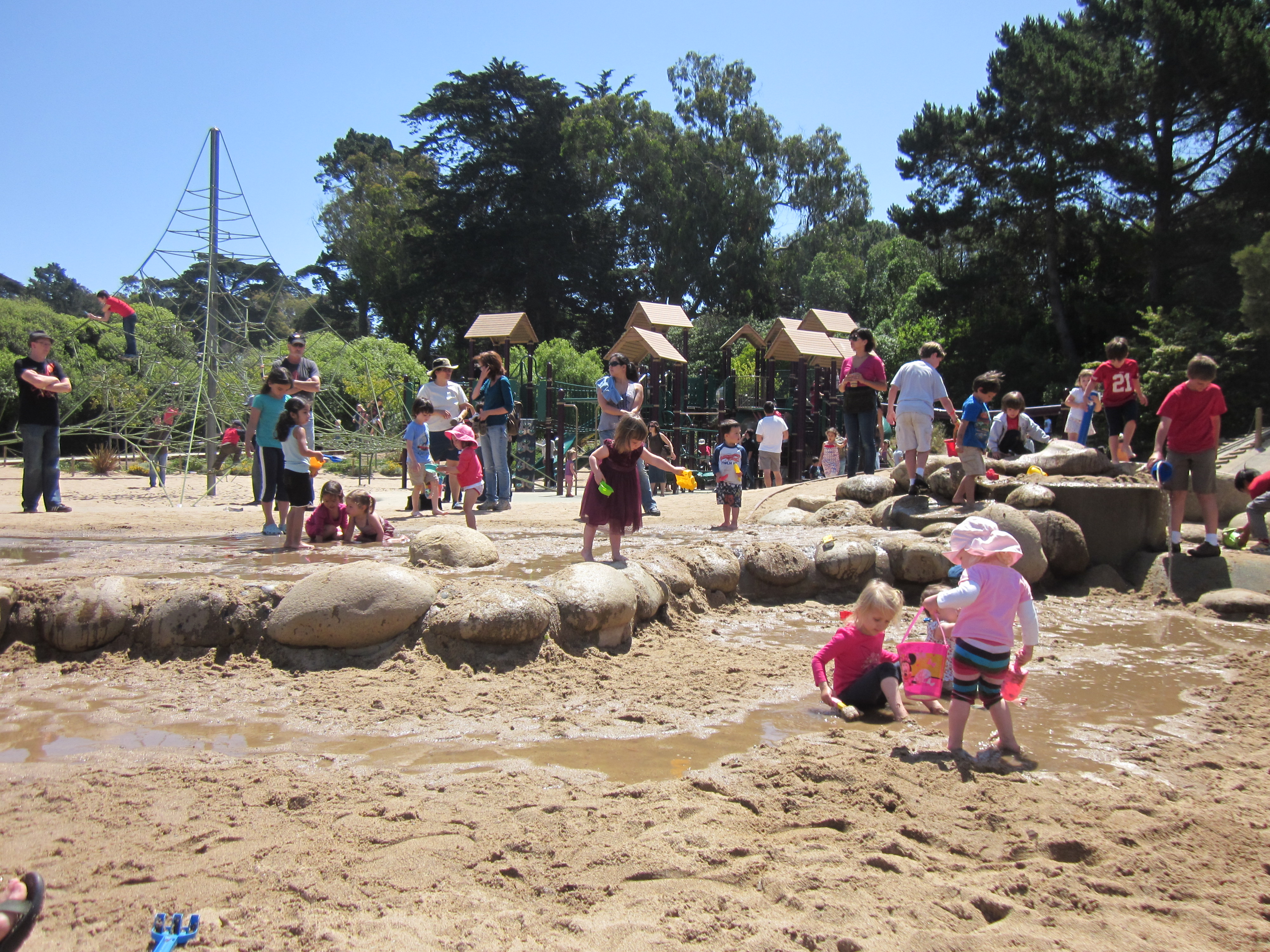
Oh, the places we go: The Children’s Playground at Sharon Meadow

At that point we began wondering it whether would make more sense to just sell it and use City CarShare and Muni until we found something we wanted to buy. The bus stop is 100 feet from our front door, the street car line is two blocks away, and there are three City CarShare pods within three blocks. We have bikes that we ride with our kids all the time. How bad could it be? We called the credit union and they said: sounds reasonable to us.

So two weeks ago we sent in the paperwork with the final mileage to sell the car. Last Friday, a dealer transporter showed up and drove it away on a truck. During these last two weeks, we began to wonder if we really wanted another car after all.

The first week was very hard, partly, I suspect, because the car was still sitting in the garage but we couldn’t drive it anywhere, having submitted the final mileage, the title and the registration. The kids knew it was going away and were confused that they couldn’t take a last ride. But that was the same week that I calculated what it was costing us to own a car that spent most of the time sitting in the garage, and it was sobering.

  • Insurance: $100/month
  • Gas: $50-$100/month (depending on business trips; the minivan had horrible mileage)
  • Maintenance and repairs: $100-$200/month
  • Depreciation: $200/month (given the price we paid on purchase and the price we were offered)

Oh, the places we go: my brother-in-law’s birthday dinner at StrEAT Food, south of Market

We bought the minivan for cash and so we never had interest payments, and by university policy, parking for one car is bundled into our rent. And yet an older, paid-off car that we drove only occasionally was costing us $400-$600 each month. That kind of money would pay for a lot of rental cars and taxi rides, more than I could imagine needing. And that was without even considering that we would walk away with a big windfall if we didn’t get another car.

After some discussion, we thought: well, it’s worth a shot. Even if we decide to get another car eventually, every month that we can put that off saves us ~$500, less whatever we spend on public transit, rental cars, and taxi rides. At a minimum, waiting a few months would fund a very nice family vacation.

And so here we are. With every day that passes the thought of getting another car seems less interesting. Despite some terrible bike karma in the last two weeks (broken bike, flat tires, you name it) everything is basically fine. We were planning to get another family bike anyway. We have found all kinds of cool new travel alternatives: car sharing, ride sharing, public and semi-public transit. All of them seem pretty appealing compared to buying a car that will sit unused in a garage most of the time. And even if we use them quite a lot (we haven’t), they are much, much cheaper than owning the car.
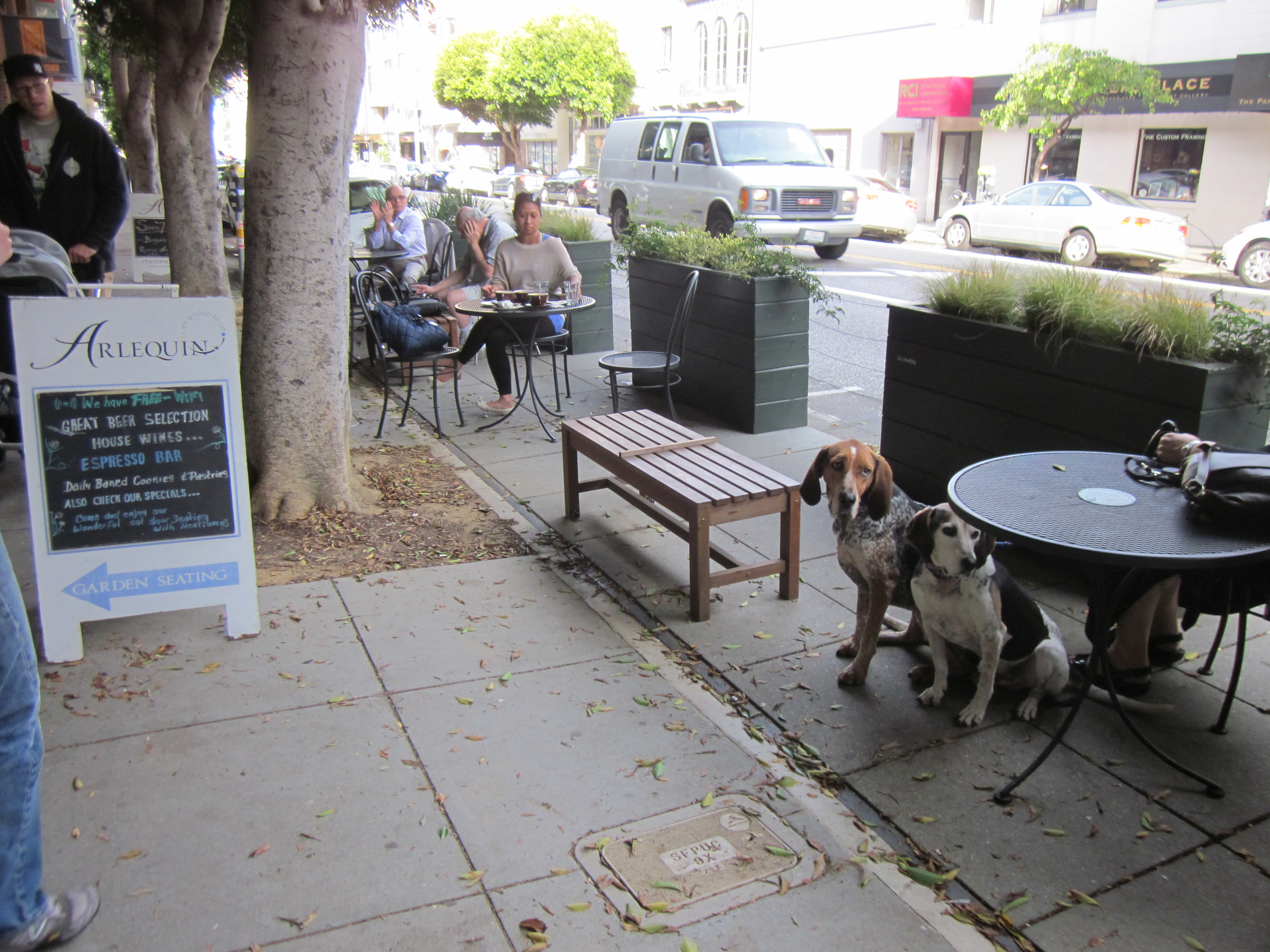
Oh, the places we go: Hayes Valley

There aren’t a lot of families who choose to go without a car if they can afford one, even in San Francisco. Most people insist it is impossible: Muni is unreliable at best, the hills are too intense for biking, taxi service is horrible, and car sharing services are too inconvenient or expensive. You hear the same stories, with different verses, when people talk about living without a car in suburban or rural areas: public transit is dreadful or nonexistent, riding bikes is too dangerous, everything is too far away, taxi service and car sharing are too expensive or too hard to find. Nearly everyone says families in America can’t survive without cars. Can they?

Oh, the places we go: “Look!” yells my daughter. “It’s my emergency room!”

A year ago, we were preparing for a trip to Copenhagen, a city we had no idea was full of bike commuters. If you had asked whether we could live without a car I would have said it was not possible. Not possible. How would we get our kids to school? How would we shop? It was hard enough with one car. What a difference a year makes.

How long will we last? Let’s find out.

14 Comments

Filed under car-free, family biking, San Francisco

How wide is a bike lane?

What you see is not always what you get.

I was reading an article about bike lanes recently, which claimed that the newest bike lanes in San Francisco (on Kirkham Street) were 6 feet (183cm) wide, which is the new city standard.

It also claimed that most of the existing bike lanes in the city were 5 feet (152cm) wide, which I’ll admit, I thought was cracked. I ride in a lot of bike lanes in this city, and I would eat my helmet if they were all 5 feet wide. Time to take out the tape measure!

After stopping in various awkward places around my commute, I concluded that bike lanes are the opposite of trees: the older they are, the narrower they are.

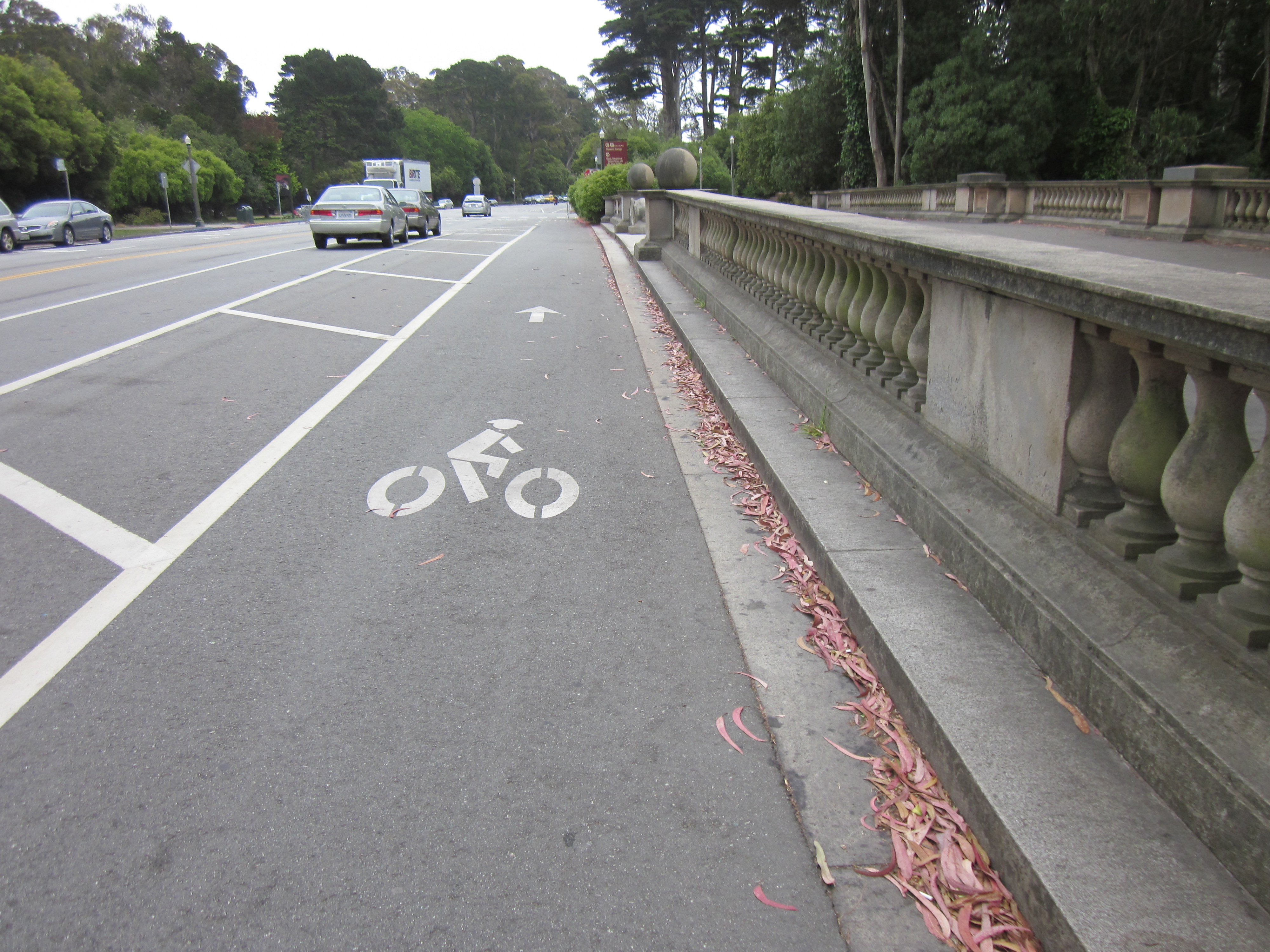
  • On Arguello and Sacramento north of Golden Gate Park: 4 feet (122cm) travel width
  • New JFK bike lanes within Golden Gate Park: 5 feet (152cm) travel width
  • According to the article above, the new Kirkham bike lanes: 6 feet (183cm)–I didn’t measure

The protected bike lanes on JFK Drive rarely feel crowded.

My feeling is that the narrowest 4 foot lanes are by far the majority within San Francisco right now, although admittedly I don’t ride as much South of Market, and they’ve striped a lot of lanes down there in the last few years. If the lane has a marker reading “BIKE LANE” or a picture of an un-helmeted bike rider you’ve hit a 4 foot lane for sure, although some of them have been repainted with a helmeted rider. I would guess the odds of these lanes being restriped to a greater width are pretty slim. Most of the attention right now is rightly concentrated on creating new lanes and expanding the network.

Why does it matter? Two major reasons: car doors and traffic.

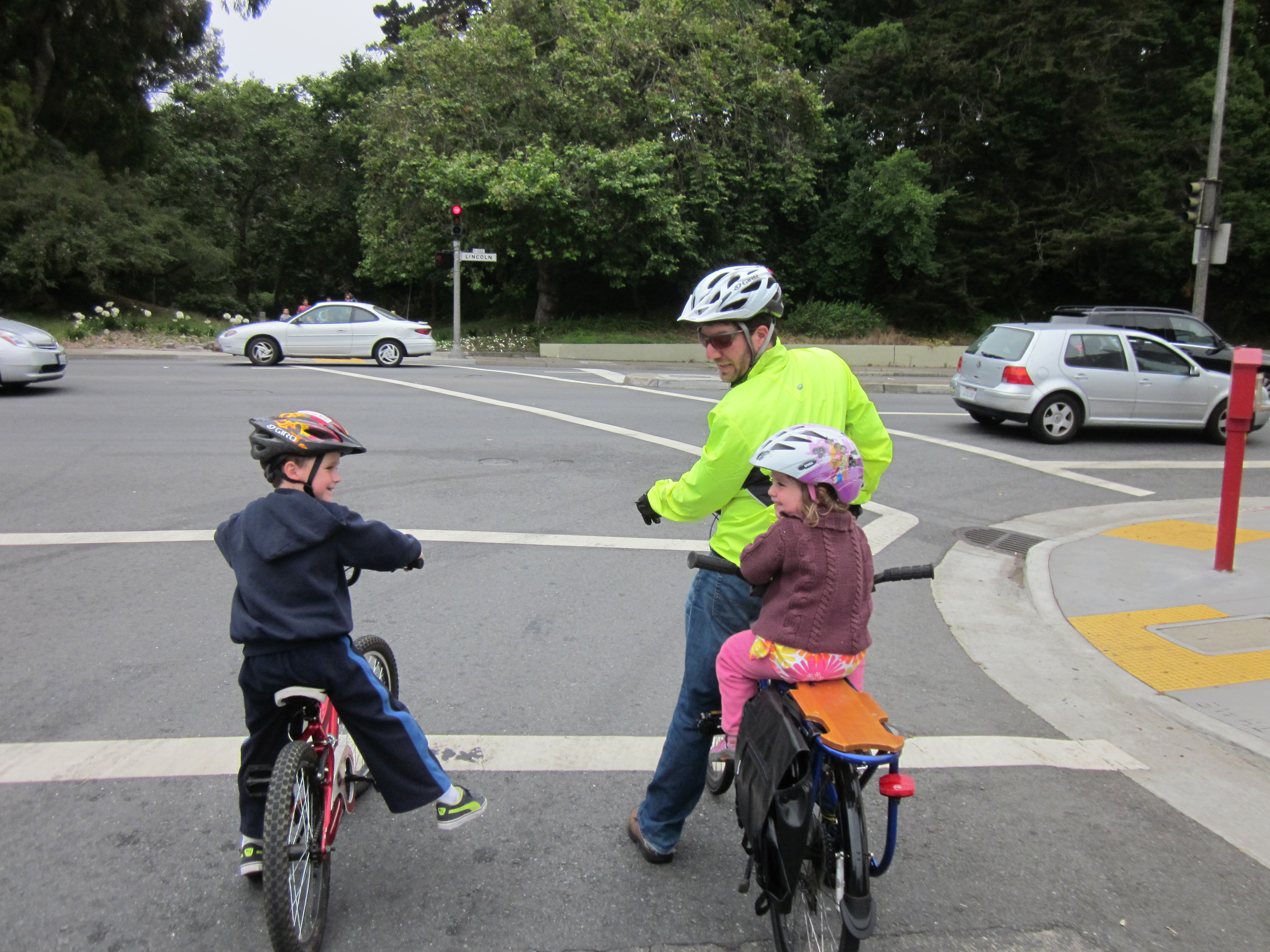
In the new JFK bike lanes, 5 feet of width is plenty: they’re right against the curb and cars park on the left, they’re protected from the door zone with a buffer zone, and so there is plenty of space for me to ride alongside my son, or for another rider to pass us.

In the 4 foot lanes in the city, and even some of the new 5 foot lanes things can get hairier.

At the dotted line, the cyclists move left and the cars turning right (if there were any) move to the right before heading into the intersection.

These lanes are primarily to the left of parked cars, and an opened door can easily cut the bike lane in half, giving a rider an effective width of a 2 foot (61cm) to 2.5 foot (76cm) travel lane. Dooring incidents are relatively low on weekdays as San Francisco drivers are conscious of bike commuters. Dooring incidents are rampant on weekends when out-of-towners drive into the city and leave their doors hanging open in the bike lanes for no apparent reason, maybe to air out their cars. It’s a mystery, and they get angry when we ask them, politely, to stop blocking traffic.

These lanes are also striped to merge at intersections, allowing cars to turn right and bicycles to move left, which is why San Francisco doesn’t have the right-hook issues that other cities do. As long as everyone signals it is a little complicated but works fine: when the line becomes dashed, turning cars move right and bikes pass them on the left to go to the front of the intersection. (Moving forward in the intersection is a safety move to prevent a car further back in queue from turning right in front of a bicycle moving straight, the dreaded right-hook.) But this merge dance results in cars blocking the right half of the bike lane: once again, the bike lane effectively narrows to half its width whenever a car is turning right. Cars can’t usually pull right up to the curb for a right turn as they would when parking, or they’d run over the corner and pedestrians, so they’re partially in the bike lane.

When a bus moves into the right lane for pickups or turns, it takes some guts (and a narrow bike) to move to the left as suggested when heading straight.

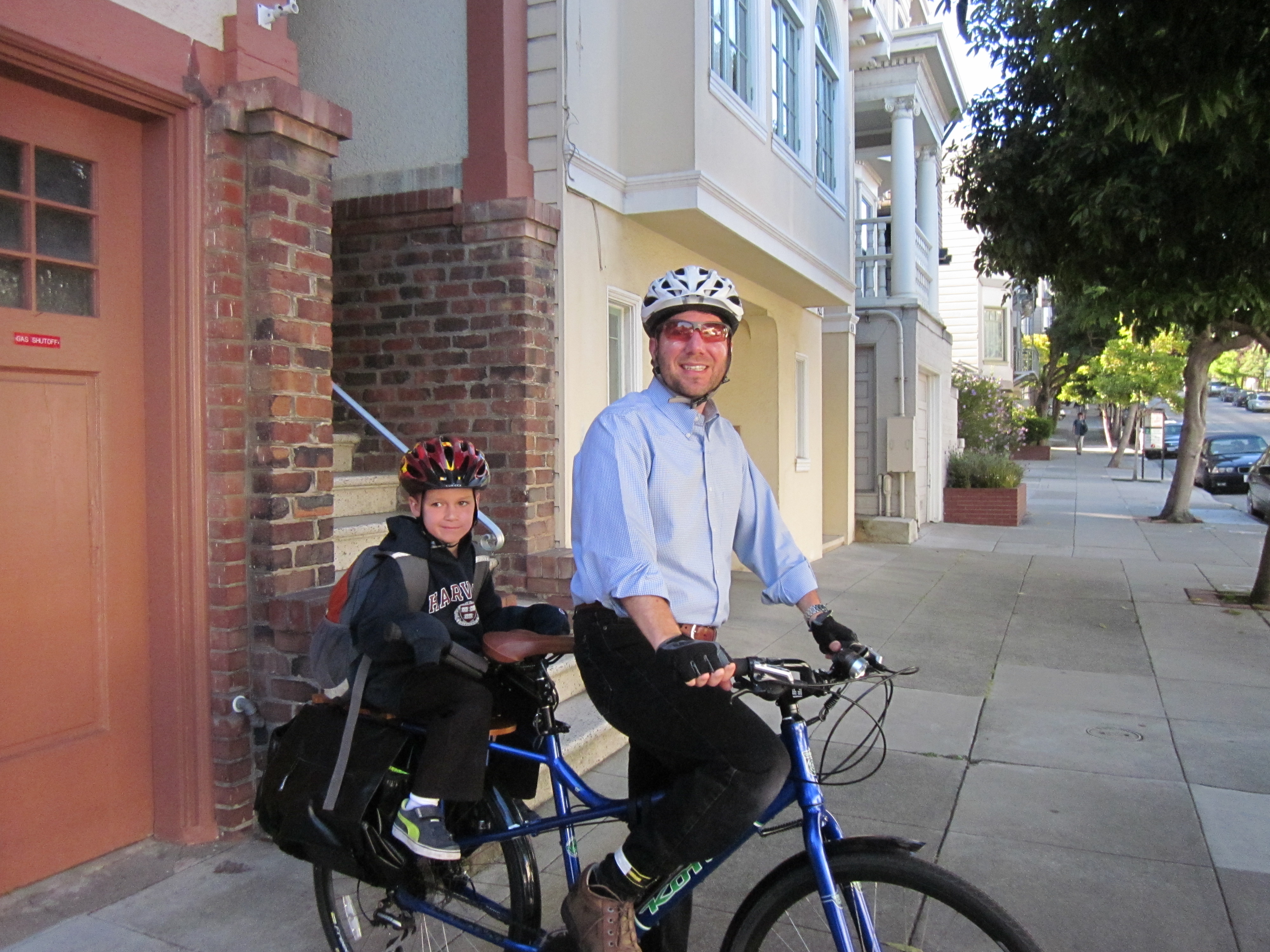
Why does this matter? Most bikes can effectively navigate a 2 foot bike lane, but cargo bikes like our Kona MinUte can be more problematic; the bags on the side hang out several inches when full, making the bike up to 25″ (65cm) wide. I prefer to keep them in the folded position while I’m riding even though they can hold less that way. Then the bike is 16″ (40cm) wide, which is no problem (or I can fill one but not the other.) Matt typically keeps both filled but is actively looking for a better replacement for the stock bags due to their width. Can you put FreeLoaders on a MinUte?

I also had real problems getting the Yuba Mundo through these pinch points when it was visiting. For a long time I couldn’t figure it out: long-tail bikes are basically the same width as other bikes and we were using the front Bread Basket for cargo, so we didn’t have the MinUte rear bag problem. Why was I feeling caught at intersections all of the time and forced to stop behind turning cars (blocking other bikes behind me)? I hated taking the lane from the bike lane when the kids were on deck; cargo bikes are slow to start when laden, and drivers understandably get a little annoyed when riders swing in and out of the bike lanes. And I was the only bike doing it.

I only recently realized that my issue was the Mundo’s Side Loaders. To keep heavy loads off the ground or carry bicycles or give kids a place to rest their feet, the Mundo has two bars sticking out from each side of the rear deck, so the frame’s total width is over 20” (51cm). If you add a pair of full GoGetter bags, the bike’s width increases to over 35” (90cm). I didn’t even have the GoGetter bags, and 20.5” isn’t that much wider than an ordinary bike, but it was changing the way I rode. And yet: I didn’t feel like the Bread Basket in front, at 19″ (48cm) was the problem, even though it was almost as wide. And Yuba notes that the Side Loaders are supposed to be no wider than the rider’s feet on the pedals. Was it just that I couldn’t see the wide load in back?

Why does it matter? We are trying to figure out a new family bike, and width is apparently an issue. Most family bikes and cargo bikes are much wider than an ordinary bike. My problem, even if it was just perceptual, was the same problem people have with child trailers in San Francisco: at 28”-32” (70-82cm) they’re often wider than the space available in the bike lane, and as a rider, you can’t see whether they’re going to make it through. We have an additional issue: no trailer on the market would fit through our narrow basement door, which when opened is just shy of 28″ wide.

Could I handle a wide bike in normal bike lanes, when I arrived at intersections where the lane is cut in half? Would it be easier if the load were in front where I could see it? These are San Francisco problems, but they’re real for us.

4 Comments

Filed under commuting, San Francisco, traffic

The reason they’re building more bike parking where I work

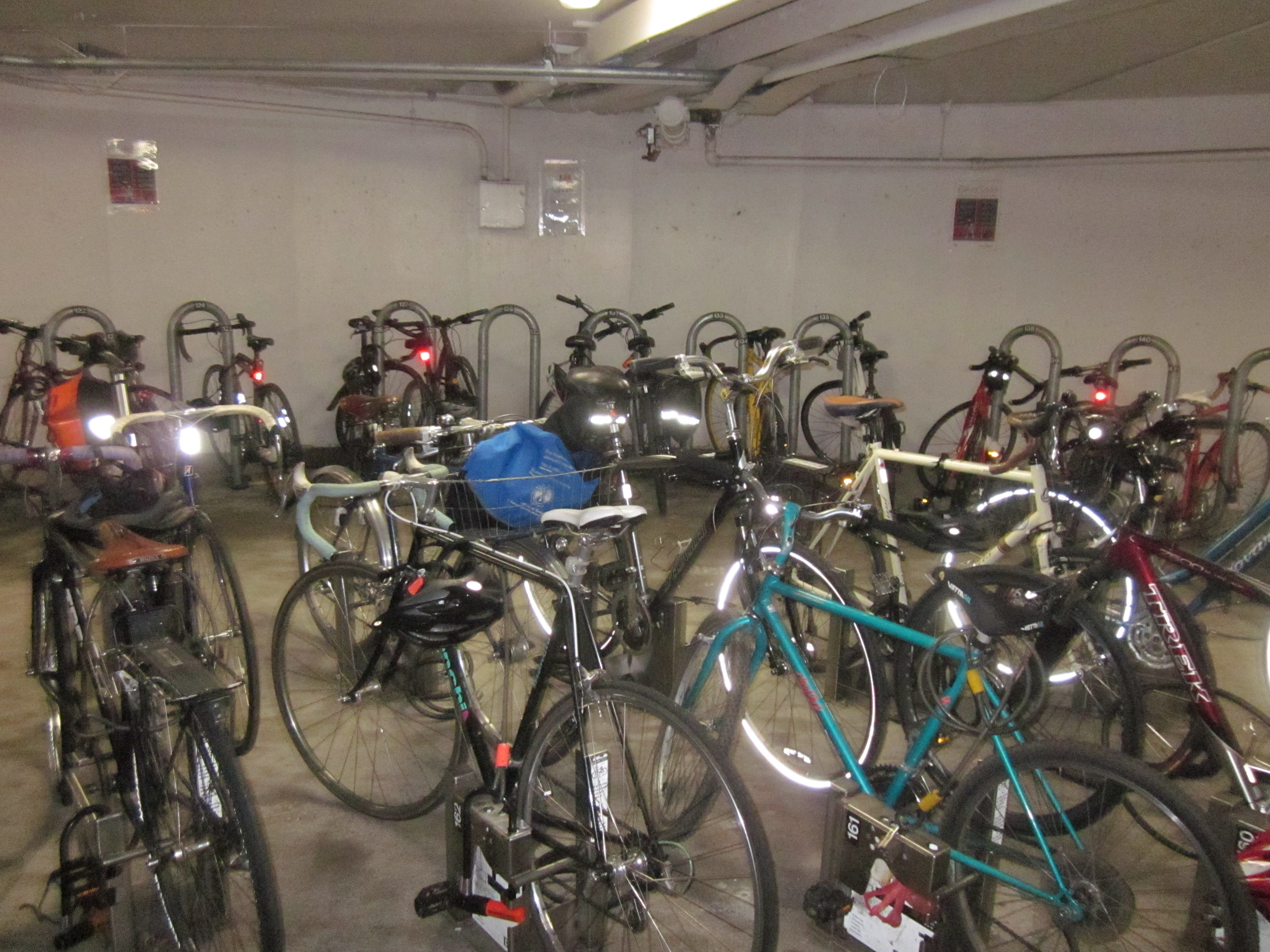
This is the main campus bike cage.

I took these photos of the two major bike cages on the main campus around 9am one morning. These bike cages can be made accessible to any campus employee who shows up at the subterranean parking garage office during the random hours they are open. They re-magnetize your campus ID to allow entry and give you a parking sticker. This is free, but it took me almost a month to get there during a time they were actually open. I assume that it’s not much easier for other people.

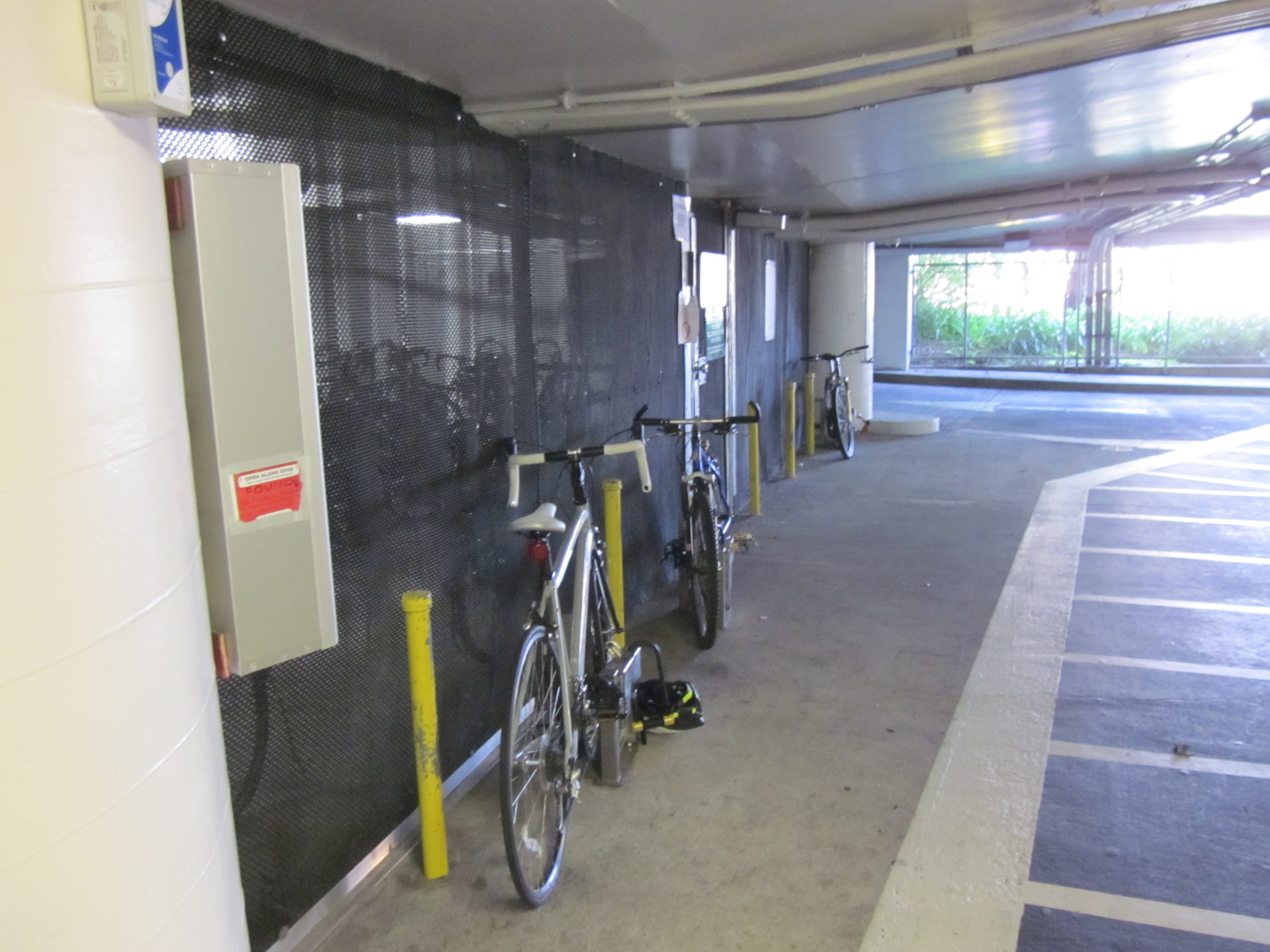
This is the second bike cage (slightly smaller)

All of this actually does not seem to be much of a deterrent. The bike cages nearly always look like this, unless it is later in the day, when there are even more bikes. They thin out a little late at night, but a medical center is open 24 hours a day, so there are always bicycles there. The cages are regularly inspected by campus security, and bikes left longer than a few days with a campus sticker result in a call to the owner; bikes without a sticker get confiscated in the short term, and sold after a year unclaimed. This is not long-term bike storage.

More racks outside the bike cages

Outside the main cages is overflow parking. The bike cages are monitored by parking attendants and by remote cameras. There is never enough bike parking.

2 Comments

Filed under commuting, San Francisco

Book review: Traffic; why we drive the way we do

This is a street designed for traffic.

I recently started reading paper books again, the kind found at the neighborhood library, rather than scanning the digital library and downloading books without having to leave the relative comfort of home. The paper library is still substantially more diverse than the digital library, with a much broader selection of non-fiction in particular, although admittedly it appears to offer less in the realm of evangelical romance novels (which are surprisingly difficult to identify based solely on title and cover art; this is why now I only download books that have gotten a good review somewhere, sometime).

Even though we rarely drive, it still really ticks me off that drivers park their cars right in our driveway, like, daily. Drivers who are really committed can even block the bikes.

While in this less ephemeral realm I picked up a copy of Tom Vanderbilt’s Traffic, which is one of the most fascinating books I’ve read in quite a while. For a long time I have accepted that getting on an airplane is the psychological equivalent of locking myself into a small prison cell, and I have prepared myself for flights accordingly. I drive more frequently than I fly (every week or so rather than every few months) but I hadn’t really thought before about how putting myself in a car is somewhat equivalent. I also only recently learned that cyclists call drivers “cagers,” which has a certain dark accuracy.

Riding a bike means never being stuck in traffic.

Vanderbilt discusses the many illusions of driving, including the expectation that early merging is more efficient than late merging, and the efforts of traffic engineers to reprogram people who resent late mergers and create traffic jams to force them out of merged lanes (I used to be one of these people). Even more fascinating was the illusion of queuing in traffic, where whichever lane you pick appears to be moving more slowly than all of the others. Ultimately, it turns out that they’re all moving at the same speed, but because everyone ends up waiting far longer than they end up passing—that’s what makes it heavy traffic—no one perceives the underlying equity.

This made me realize that one of the pleasures of cycling is never having to queue except at stop lights. Speaking as someone who cycled in Copenhagen, where bicycle traffic is thick, I can testify that this benefit is not an artifact of only having few riders on the road. Part of this is undoubtedly another counter-intuitive discovery by those who study traffic: slower speeds lead to faster movement; below certain speeds, there are no traffic jams. The rest is just inherent.

This is a street designed for people. Drivers complain that parklets are “too close to the road.”

It was particularly terrifying to read about just how awful most drivers are, which is something you can often ignore in the car because you’re busy being an awful driver yourself: trying to settle down kids, program acceptable music, talk to passengers, talk on the phone, or worse yet text. But I definitely notice it as a cyclist and pedestrian. Given that there is no feedback that all the dangerous things drivers do are dangerous until they actually hit something, why wouldn’t most drivers believe they’re doing a good job? Even when they do hit something, the fact that it doesn’t happen every day makes people believe the non-collision days are more meaningful. And my friends who work at power companies tell me that even people who hit utility poles argue that the pole was at fault (“It was too close to the curb!” or if seriously drunk, “The pole was in the road.”)

My husband is not a MAMIL

It was painfully familiar to read Vanderbilt’s discussion of how women end up creating and suffering in the worst traffic because of what is referred to as “serve passenger” driving. Taking the kids to school, picking up dry cleaning, doing the grocery shopping: these trips involve the most traffic—school pickup and dropoff zones are particularly notorious—because everyone needs to do them at the same time, and they are the least compatible with ride-sharing. And that’s before even mentioning parking. This is why there are dark jokes about the kinds of hardcore cyclists (Middle-Aged Men In Lycra, or MAMILs) who are able to commute the way they enjoy because their wives are doing all of the errands by car.

Doing errands by bike means never having to look for parking.

Although my husband handles his own dry cleaning and many other household tasks, he does far more business travel than I do, and when he’s away I do almost everything alone. This is part of the reason we’re in the market for a new family bike, and it’s part of the reason I get so annoyed that the market for bikes like these is so thin. I think there are more models of Trek Madone alone than there are family bikes of any brand. (I only recently learned that the Madone is a model of racing bike made by Trek that costs like $5k, and there are apparently a million versions, all of which sell like Big Gulps.)

My son will grow up riding his bicycle for transportation just like I did.

In my personal experience, when I transitioned to commuting primarily by bike I actually saved time, not to mention frustration, because I avoided so much traffic en route. In addition, as a working parent there is almost no other time to exercise. But it’s not possible to do these kinds of errands—picking up two kids at two different schools, etc., with a mountain bike or even a so-called commuter bike. You need something that can haul non-traditional cargo, like cartons of milk, kids themselves, and whatever fragile and emotionally significant popsicle-stick-and-cotton-ball art projects that they want to bring home unscathed.

At the end of this book, I understood why Vanderbilt apparently transitioned to riding a bicycle and public transit. I would have done the same thing if I hadn’t already. Public transit is unequivocally safer and the majority of research suggests cycling is as well (although people find this difficult to believe, or at least “not where I live!”–urban people insist they’d ride if they lived in the country where there’s less traffic, rural people insist they’d ride if they lived in the city where there are bike lanes, etc.) And either option is dramatically less grueling than driving.

When I was first hired at my university I went to a talk for junior faculty by a senior professor (who later won a Nobel Prize) about how to balance work and family. Although many of the things she did were not possible for me (e.g. having her first child at age 45—too late already!) her strongest advice was, “Kill your commute.” Do whatever it took to move close enough to work and school that almost all your time was spent doing something you valued (research, patient care, spending time with kids) rather than something you didn’t (driving, or more likely, sitting in traffic). And we took that advice. We moved from a large house in the suburbs to a small apartment in San Francisco that cost over 50% more per month, and my husband, after a long stint of unemployment and underemployment, found a new job within city limits. We slogged through the San Francisco public school lottery. (And we did all this before we had bikes. Between the hills of San Francisco and the absence of family bikes nationwide, cycling wasn’t an ambition for us at the time.) It was a long road, but our lives are infinitely better for it.

Streets can change. People can change.

Most people wouldn’t have to move and sell a car and change their jobs and their kids’ (pre)schools to change their commutes, as we did. And some of the best changes, which involve transforming streets themselves, are not individual decisions but collective decisions: removing parking, adding bike lanes, creating parklets, developing bike share programs, lowering speed limits, and narrowing roads. But having seen the result of changes like these, in our own lives in San Francisco and after visiting cities like Copenhagen and even Paris that have implemented them, those changes are most assuredly worth it. They scale cities back down to human size. Calming streets is really calming people. It takes the stress out of living.

8 Comments

Filed under advocacy, cargo, commuting, Copenhagen, family biking, San Francisco, traffic

What fresh hell is this?

On Sunday my son and I headed downtown on the Kona MinUte to Japanese class. I thought, “Gee, I hadn’t remembered the MinUte being this bumpy to ride.” Then I heard a swish-swish-swish sound, and asked my son if he was sticking something in the spokes (hey, it’s happened). Nope. Flat tire. When did I lose all my bike karma?

Studying Japanese on the train downtown

Fortunately we weren’t far from home, so I walked the bike back up the hill and then we walked back down the hill to the streetcar stop. We were late, but Muni came through; thankfully, there was no parade downtown this week. It had been so long since we tried this that I had forgotten one of the advantages of riding Muni: we ended up studying Japanese all the way into downtown, which made for a stellar class. A passenger across from us knew Japanese and helped as well. (Experiences like this explain why people keeping leaving their hearts in San Francisco.)

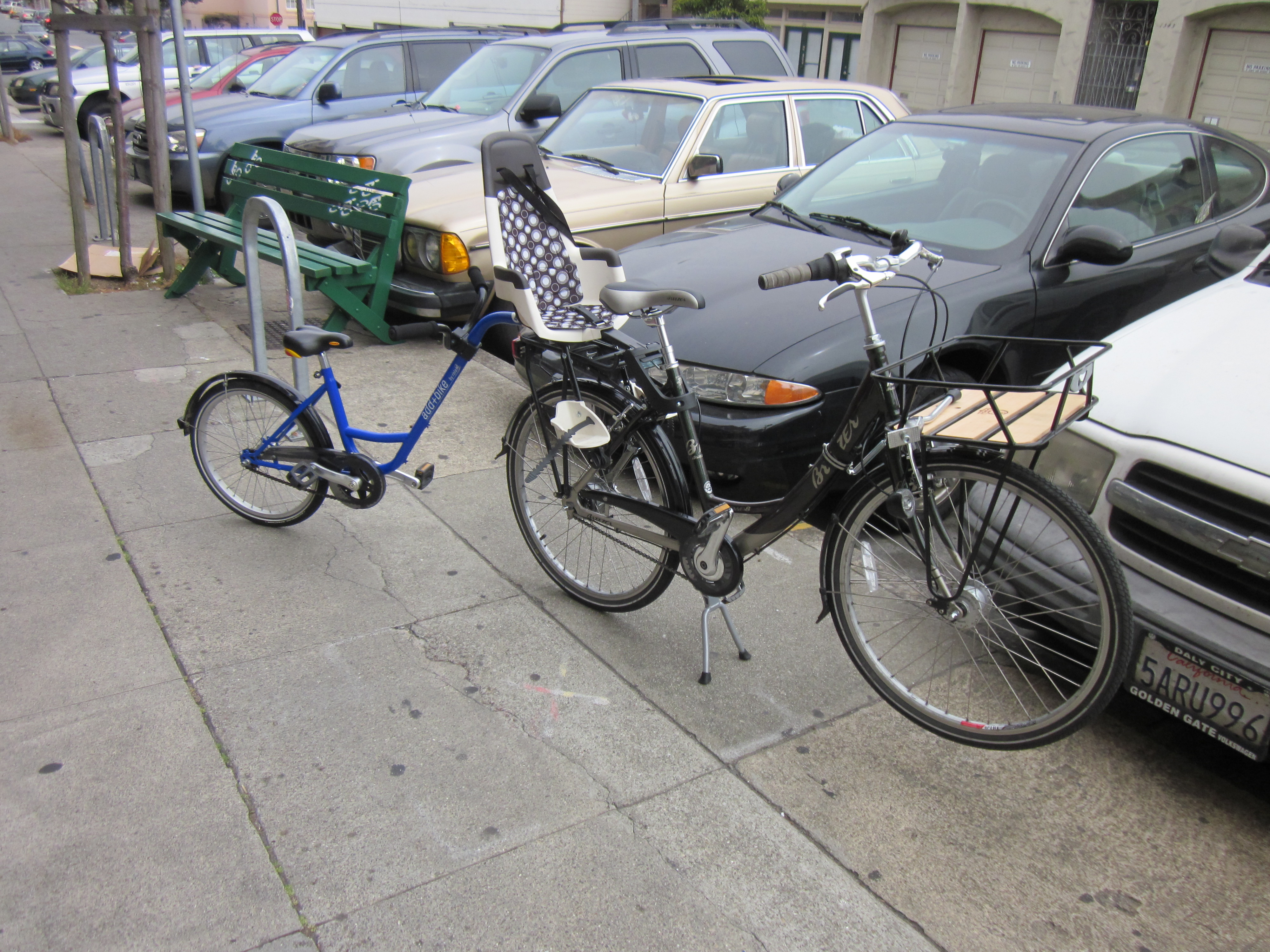
Blue Public Bike with a Bobike Junior seat

On our way up from the train station I saw a woman whose bike had a Bobike Junior seat on it, the first other than mine that I’ve seen. She said she knew a couple of other people with Juniors as well, and she was still hauling her nine-year-old son (!) on hers. They were headed to Sunday Streets as volunteers.

The downside of riding Muni is the waiting. On the way home it took as long for our train to arrive as it would have to ride all the way home (thanks in part to one train going offline right before it arrived at the station, horribly frustrating my son, who believed the arrival time board).

For novelty value, my daughter rode on the MinUte for about 10 minutes before returning to her plush mamachari seat.

After we got home Matt and the kids enjoyed a rousing game of “put the bike tube underwater in the tub to find the hole” and then my son asked to go out for a ride. Sure!

We headed to Golden Gate Park to show him the drop-off site for this month’s summer camp, check out waterfalls, and visit the bison.  This was an impressive ride for a six-year-old, even with the street closure, at over six miles.

Riding with my son has made me reassess my definition of hills. I would have said before this weekend that this was a pretty flat ride, with a slight downhill heading west and a slight uphill heading east. After watching my son, who had to get off the bike and walk some of those “slight uphills,” as well as take multiple rest stops, I realized I’ve lost perspective by comparing them to my daily commute. It was a brutal ride for a little kid on a single-speed bike, but he never complained.

Although it was raining and cold, my kids wanted ice cream.

So we bought both kids ice cream when we got to the bottom of the hill heading home, and we took the long way around on that last leg. And we saw my son’s first grade teacher, who is native Japanese. “A mamachari!” she said.

Our son wants a bike with gears. Although I despair that it seems like we can’t manage to find a bike with any longevity (except the MinUte! and the Brompton. I don’t think it’s a coincidence that those are also our most expensive bikes. Mamachari TBD.) I can’t argue with this. How much farther and faster could he go on a better bike?

Leave a comment

Filed under family biking, Kona, San Francisco

I didn’t kill the Breezer (phew), but even so

I had to walk the Breezer to the shop with my daughter in the backpack and the rear wheel seized up. It was exhausting.

So the good news is that I didn’t kill the internal hub on the Breezer. The bad news is that I have apparently been, entirely unintentionally, straining the bike well beyond its limits with the loads I’ve put on it. Our bike shop was concerned that the frame wasn’t meant to take that kind of weight and would eventually break. I have learned that this actually happens sometimes. Yeah. Oops. At a minimum they were sure I’d kill the hub eventually. The Breezer is a great commuter bike, but it has limits.

Here is the sobering summary from my brother-in-law: “You realize you carry more on your bikes sometimes than would fit in a SmartCar, right? I was just thinking yesterday that while you are not at all aggro, you may be the most aggressive cyclist I know in terms of what you are willing to try with your bike (you make full face mask downhillers look like wusses).”

He has obviously never met the mom who carries six kids and the shopping, and who makes my typical load look like a grocery bag full of paper towels. Admittedly she’s riding a bike designed for that.

My poor Breezer, asked to carry loads it was never meant to bear.

Anyway, there was, shall we say, strong advocacy from both our bike shop and family members that I should get a real cargo bike and stop trying to force my Franken-bike to do things it was never designed to do. Matt expressed similar concerns when he called from China. It is something that I had begun to suspect already, as I was trying to flag a cab in the Tenderloin and wondering whether I’d ever be able to ride the Breezer again.

Having proven that I’m up for riding fully-loaded through the seasons even on what is evidently a wholly inadequate bike, I am willing to consider bikes that are much more expensive than I would have a year ago as a primary bike. Also I learned what people pay for mountain and road bikes used only for entertainment value, which: whoa. For reasons of structural stability, I have been encouraged to learn to love the top tube. I’m also sure I want an electric assist.

Wanted: a cargo bike that can handle both hills and sand dunes

So we are now in the market for a new cargo bike. I’m not at all sure what kind. I was putting off another bike until finding out whether I’ll get the new position my department recommended, which is equivalent to my current position but with much more job security. At the last check-in, my department chair was optimistic that the university would offer a verdict “maybe even as soon as 2013.” Given that timeline and the fact that I thought the Breezer would carry two on child seat+trailer-bike for years to come, I wasn’t exactly scouring the market for its replacement. But circumstances conspire.

Two kids, now aged 3 and 6.5, too much traffic for them to commute solo, serious hills, a not-very-wide basement door (fortunately walk-in) and many pinch points and narrow bike lanes are the main issues we deal with when riding our bikes in San Francisco. I welcome any suggestions for bikes that could handle the challenge. Long, narrow, and assisted was one person’s summary of the best bike for me, and I suspect that’s right on.

10 Comments

Filed under Breezer, cargo, commuting, electric assist, family biking, San Francisco, traffic

A day in the life of the mamachari

The coldest winter I ever spent was a summer in San Francisco.

This morning after I dropped my daughter off at preschool and was riding to a meeting I got stopped by another cyclist, who pointed at the rear basket and asked, “Is that a child seat? Where can I get one?” I was sorry to tell her that it was made in Japan, and to the best of my knowledge, isn’t imported to the US. Then she realized I had an assist. “Is that a motor?” And I said, yes, I used it to get my daughter to preschool at the top of Mt. Sutro every morning, it was perfect for that ride. “Where can I get a bike like that?” she asked.

Now that I am riding with my daughter to preschool every day for drop-off and pick-up the mamachari is being seen by many more parents. While walking out of preschool last night I was talking with another mom, and she stopped dead when she saw my bike.  “Wait! That child seat! Is that a motor? I want that bike!”

Passenger panda in Golden Gate Park

As I was telling her that I got it on craigslist and it came from Japan, etc., a classmate’s dad walked up and said, “I NEED that bike. I NEED IT!”

We saw another classmate of my daughter’s on the way home and stopped to say hi, but couldn’t get much of a conversation over his pleas to his mom.

“Mommy I want HER bike! We need to get HER bike! Get me her bike, please!”

I think of moments like these every time someone tells me that US bicycle manufacturers don’t make family bikes because there’s no demand for them. Yeah, right. (Thank goodness this is changing.)

10 Comments

Filed under electric assist, family biking, San Francisco

More bicycles in Beijing

Matt is in China, and that can only mean it’s time for another update of bicycles in Beijing. Last time Matt went to the tourist bicycle center of Beijing and caught some righteous triple tandems. This trip’s theme is practical bicycles spotted on the road. These seem to involve two things: electric assists and passengers.

Bicycle, moving toward a scooter aesthetic

There is a wide range of electric bicycles, and while some of them are primarily for occasional assistance up the hills, in Beijing the bicycle part seems like the afterthought. This bike has pedals, but it’s moving more toward a scooter aesthetic. And those giant batteries have to be sealed lead acid, an environmental disaster.

Definitely more like a scooter than a bicycle

Going even further along the spectrum is this bike, which looks more like a moped than a bike, although those pedals do seem to turn, I presume for legal reasons. But credit where it’s due: this bike, like the other, can carry a passenger and has a dedicated front basket. These are not the overpowered machines lacking space for even a briefcase that litter San Francisco sidewalks. They’re meant to haul, not to look cute, and I’m guessing they’re a lot cheaper than the Vespas parked next door to us.

Carrying older kids on the bike is okay

And in Beijing, evidently, it’s normal to carry even older kids on the back of the bike. I sometimes regret that our kids will be on our bikes for so long, which reflects the traffic and hills of San Francisco, but I’m beginning to think that this is inevitable for people living in a city that doesn’t have extensive bicycle infrastructure (e.g. Amsterdam, Copenhagen, Tokyo). Sure, it would be better if our kids had more independence, but you have to work with what you’ve got.

Riding with a baby in traffic

These moms make me think that the fears of riding in traffic are relative. I’ve gotten more confident riding in city traffic here, but riding in Beijing would probably give me a heart attack. And parents from smaller cities would probably have heart attacks here. We get used to the circumstances around us. It’s not like kids have never died in cars.

Pedaling a paddleboat is a kind of pedaling.

Matt still has yet to ride a bicycle in Beijing. But at least this time he’s pedaling.

2 Comments

Filed under electric assist, family biking, traffic, travel

SF Pride: another year, another disaster

Breezer and trailer-bike: seemed like a good idea, but it didn’t work out that way.

We have struggled with getting to the SF Pride Parade for years. One year we stupidly tried to drive there: it was a disaster. Last year we tried to take Muni instead: it was also a disaster. The trains are packed, and the route is a long way for kids to stand, and we couldn’t get a return train, so we ended up carrying the kids through the downtown crowds to find an alternate way home. This year I thought I had it figured out: we were going to ride the bike. We were meeting my in-laws downtown: they would watch my daughter while my son and I were in Japanese class, then we’d all walk over post-Dykes on Bikes to watch the parade (the noise of Dykes on Bikes freaks the kids out, and I’m not much of a fan of it either).

With a week’s worth of clothes and books to haul for my son, and his newfound desire to ride, the obvious choice for the trip was the Breezer with Bobike Maxi plus trailer-bike. I loaded up the front basket with my son’s stuff, piled on the kids, and within a block of home, realized that the tires needed a lot more air than they had to handle that kind of load. We turned around and went back. While I was getting the pump, the bike fell over. I’m not sure whether to blame the wheel stabilizer (which isn’t that stable even with the basket unloaded) or the kids for this one, but it turned out to be no ordinary fall.

By the time we hit the Panhandle, the Breezer was making a buzzing noise every time the wheels turned. When we investigated it appeared to be a bent fender. So I tried to whack it back into place with moderate success and we continued on. Everything seemed okay until we got to the Tenderloin, when the gears started grinding and the chain fell off. I don’t enjoy putting the kids on the sidewalk to watch drug deals while I futz with a bike, but I didn’t have a lot of options. Mother of the year! When I got the chain back on, I realized that the damage must have been much more severe than I’d realized—the gears kept grinding and it was hard to shift. But we had little choice at that point: the buses we passed had broken down, and we’d hit the street closures by that point anyway, so there was no other alternative.

Yet another electric bicycle spotted at Golden Gate Park: I wish I’d had one on Nob Hill.

We finally got to Japanese class (late) and afterward, were all so exhausted that we skipped the parade and went out to lunch. I thought about trying to get home another way, but there were no cabs available around the parade route and transit was much too packed to allow us to board with a bike and a trailer-bike (maybe not even without them). I figured that if I’d made it there I could ride home.

My in-laws told me the parade was now over, so I assumed we could ride down Market Street on the way home, which is mostly flat, sparing my gears. This turned out to be totally not true; the parade just keeps going. So I headed up Nob Hill. About halfway to the top the chain fell off. And fell off. And fell off. I ended up walking up the rest of the hill and back down, figuring that I could manage the downhill Polk Street bike lane. But by the time I got there, the rear wheel had completely seized up. I was in the middle of the Tenderloin with a broken bike and a preschooler who desperately wanted a nap. I needed a cab.

This was a bike-friendly cab: it had the new “don’t door the bicycles” window sticker.

Hailing a cab in the Tenderloin is a challenge under the best of circumstances. Hailing a cab in the Tenderloin during the Pride Parade was harder: every cab that passed was already carrying a fare. I also wanted an SUV cab big enough to haul the Breezer and trailer-bike if possible, because leaving them in the Tenderloin would mean that I’d probably never see them again. Two very nice older gentlemen who’d been hanging out on a stoop helped me, but it still took almost a half hour. I have never been happier to see a car than when an empty SUV cab finally stopped for us. The driver helped us load the bikes and agreed to ignore the fact that my daughter was going to have to ride without a car seat. I have never given anyone a bigger tip. “You’re a long way from home,” he said. “It’s not that far with a working bike,” I said, “But right now, it definitely is.”

I still have no idea what happened to the Breezer (I have an appointment at the bike shop tomorrow). My guess is that whatever it is will be expensive. I am trying not to think about that right now. Sunday made my brush with road rage last week feel like meandering through Golden Gate Park during a street closure. I have never been more miserable or exhausted on a bike ride. And I can’t help feeling disappointed by the Breezer. I worry that our needs for a bike (the ability to haul up to two kids plus cargo) are beyond its capabilities. It’s really a commuter bike and not a family bike.

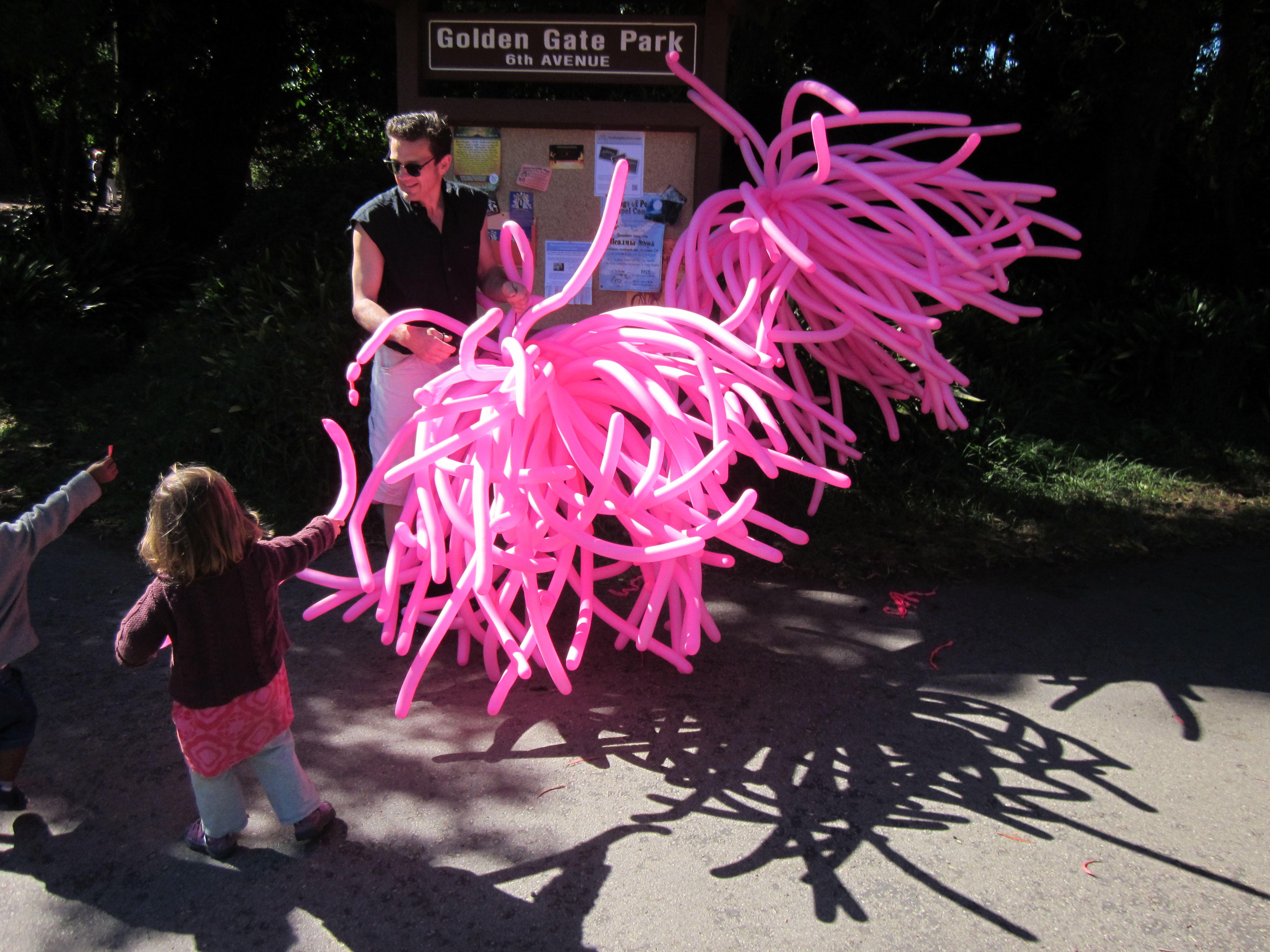
This man was handing out leftover Pride parade balloons to all the kids. Very exciting!

I almost couldn’t bring myself leave home after all of that, but we’d agreed to meet our Big Dummy-riding friends from school for Sunday Skate in the late afternoon.  Once we got there, we had a great time. My daughter loves their youngest daughter, and we ended up riding to a nearby restaurant for dinner. The only downside of the whole evening was that everyone else was out on bikes as well, so the nearest parking was a half-block away. Oh, the humanity.

I sometimes think that the number of bikes I have now is a bit excessive but I’m reconsidering.  If I didn’t have another bike, I wouldn’t have even left the house that afternoon, let alone by bike, and I was glad that I did.

2 Comments

Filed under Breezer, cargo, family biking, San Francisco, traffic, trailer-bike

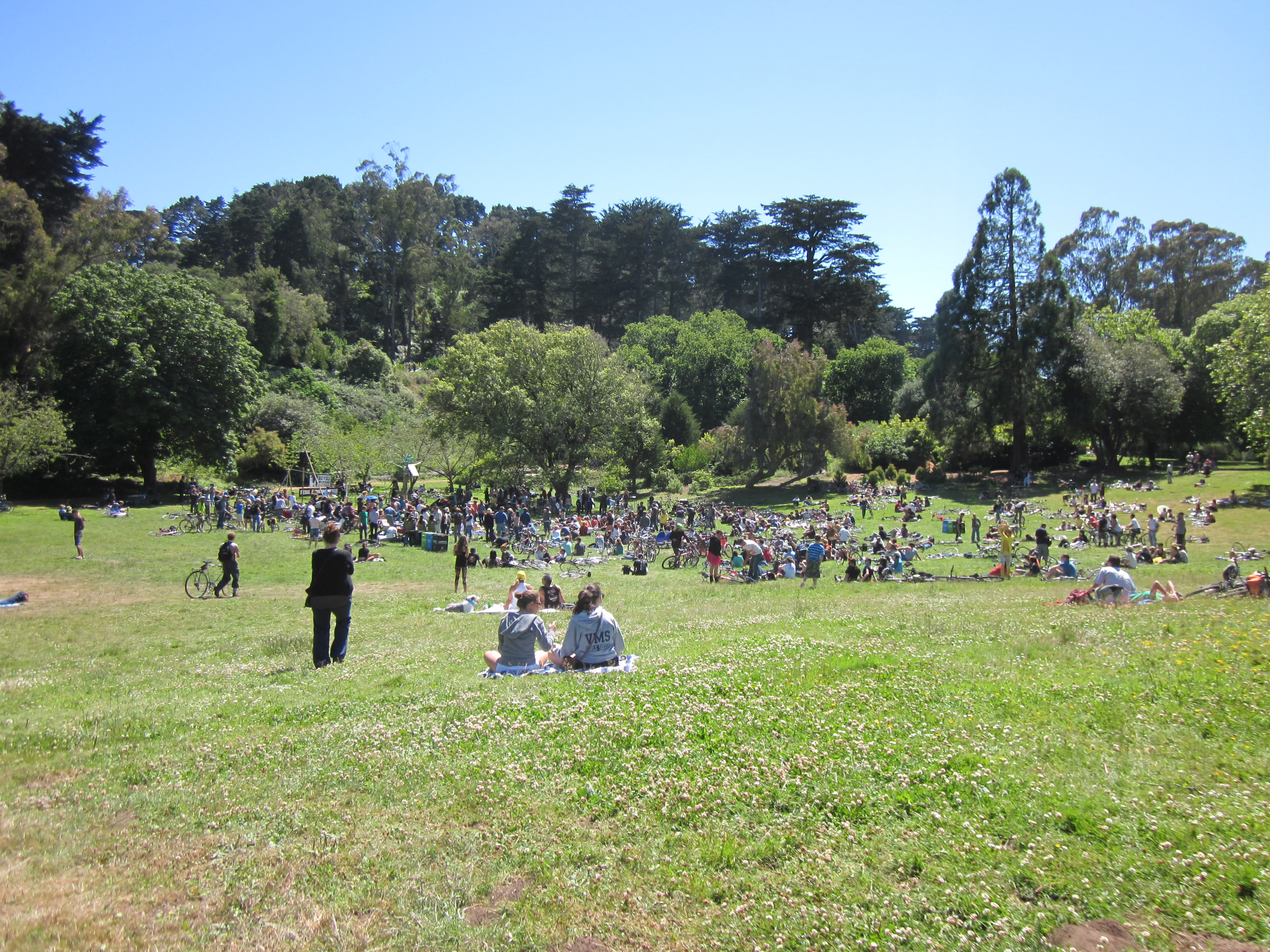
Riding to the Bicycle Music Festival

The Bicycle Music Festival at Log Cabin Meadow

On Saturday, Matt headed off to China for work again. Saturday was also the last day I spent with my son before his departure for grandma (and grandpa) camp in Berkeley. After three weeks at wheelkids, what he wanted to do with the day was show off his new bike riding skills. Okay by me! So after the morning rush of seeing Matt off, and my daughter’s afternoon nap, we rode down to Golden Gate Park for the Bicycle Music Festival.

Pedal!

The Bicycle Music Festival has amplified music, but it’s all bicycle-powered. I had hoped that kids would have the opportunity to ride the generator-bikes, but they all seemed custom, and sized only for adults. And incidentally, I have never seen so many electric assist bicycles in one place in my life. If they’re electric-assist bicycles, is the festival really human-powered? Certainly I can’t imagine any other way to manage the musical parade across town, but it’s an interesting philosophical question.

Is it a picnic or a bicycle festival? Even hundreds of bicycles are unobtrusive.

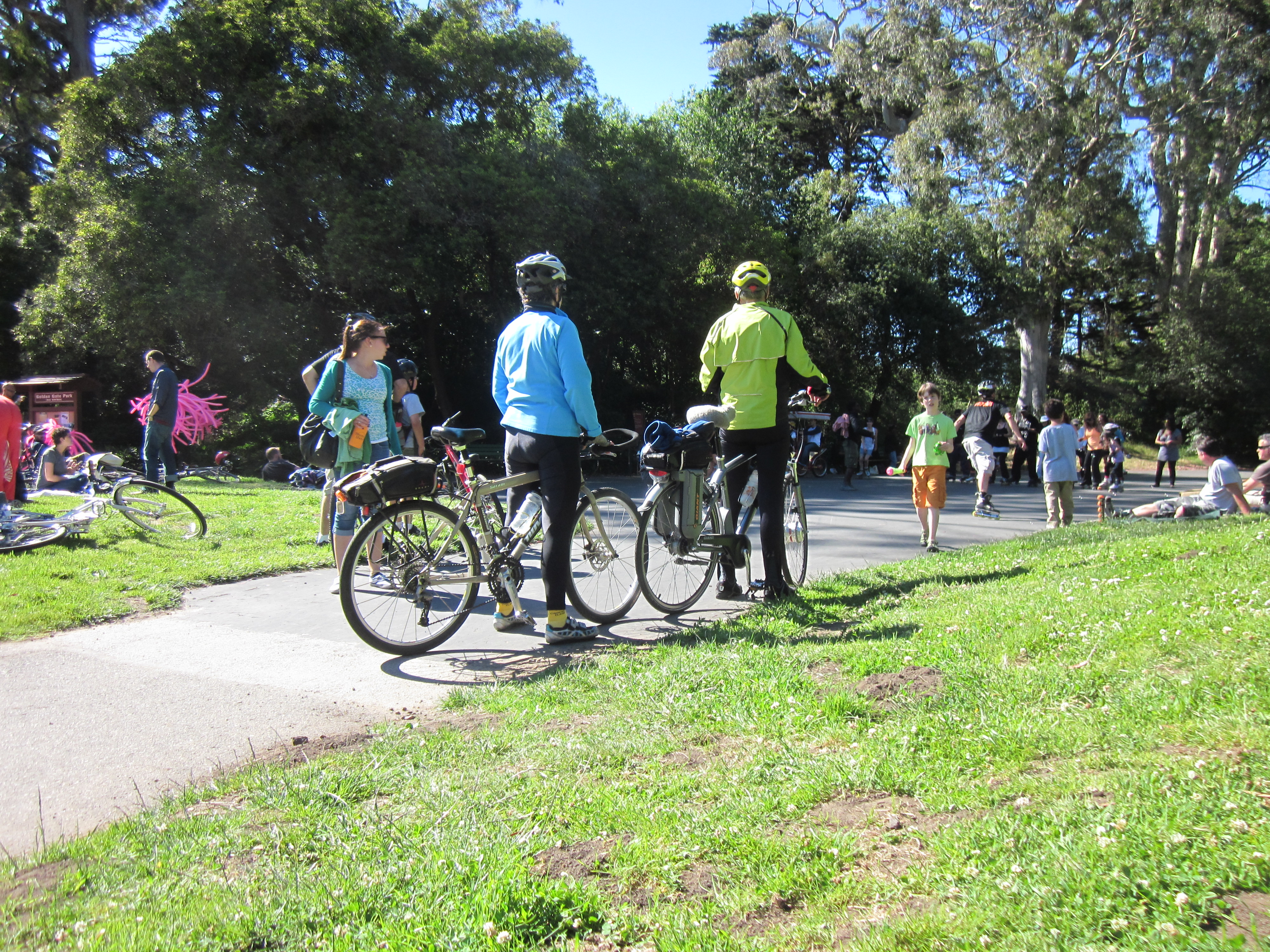
Pretty much everyone came to the Bicycle Music Festival by bicycle, and brought them onto the Log Cabin Meadow with them. And yet, although the numbers of bicycles were visually impressive, it looked nothing like its closest automobile equivalent, which to me would be tailgating. A group of people with an equal number of bicycles looks like a big picnic. A group of people with an equal number of cars looks like a parking lot full of cars.

Haven’t we seen you somewhere before?

These days we are starting to recognize some of our neighborhood bikes and we’re in that odd place where we nod to acquaintances when we recognize their bikes, although we don’t really know them. It’s like that weird relationship you end up having with other dog owners at the dog park or other parents at the children’s playground.

Riding in the JFK bike lane (the portion open to cars)

It turned out that the actual music at the Bicycle Music Festival was not that attractive to kids, or at least it wasn’t at the time we came. My son could not have less interest in spoken word/rap, even if it was ostensibly about bicycles. Instead he rode around for a while through the field, winding around other bicycles in a self-guided obstacle course. I had no idea he’d picked up off-road riding at camp.

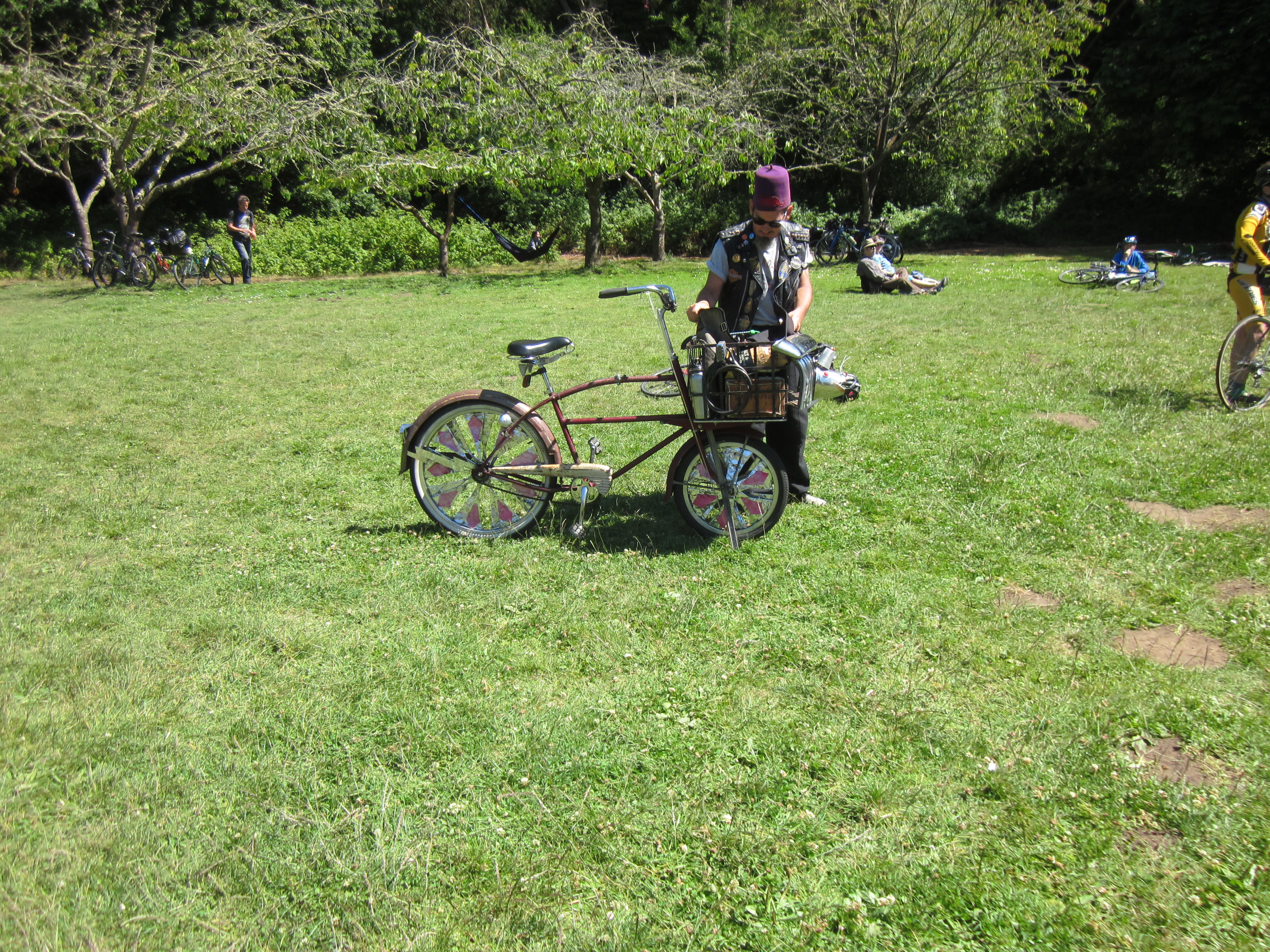
The kids did like this Mundo converted to sound stage. I wouldn’t ride it without an electric assist either.

He quickly grew tired of the festival and asked to ride around the park more. Now that it’s summer, most of JFK Drive is closed off to cars on both Saturday and Sunday, so no problem. We rode to the waterfall and back, and then headed home.

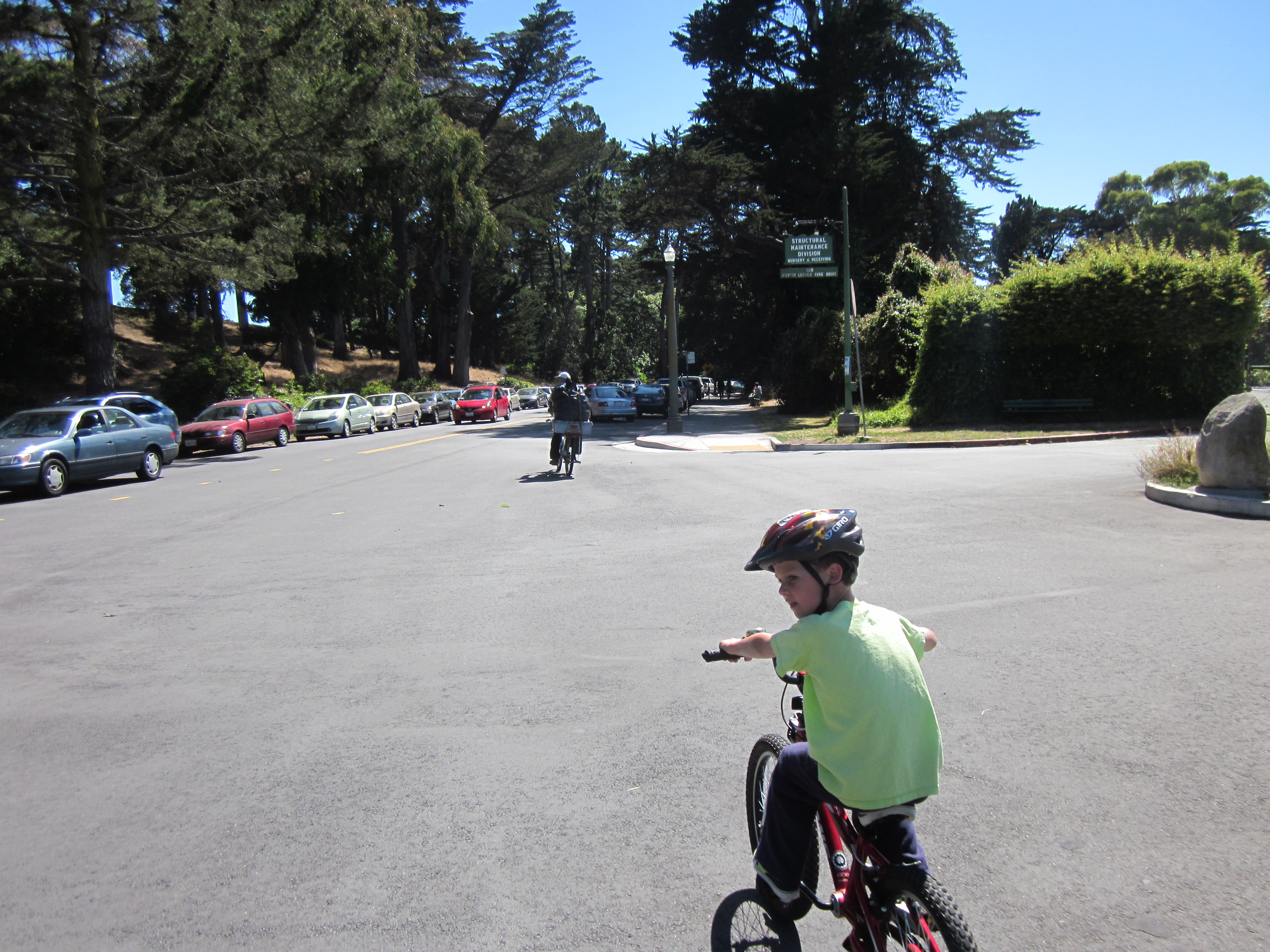
I was initially nervous about taking our son on actual streets to and from Golden Gate Park, but three weeks at wheelkids seems to have worked something close to a miracle. He now rides a straight line, stops at stop signs before the line without falling over, uses hand signals, and watches oncoming traffic. He’s not perfect (he’s six!) but I was impressed.  On hills he stands to get leverage, and although he couldn’t make it home without walking—it’s a single-speed bicycle—he rode a good portion of it. And he got back on the bike for the last stretch near home. He’s not ready for the traffic and hills on the route to school, but he’s closer than I would have hoped. I give full props to wheelkids for this, because we came nowhere near teaching him this stuff on our own. And he loved it.

Check it out! Stopped at a stop sign all by himself!

When we got home, we headed out for sushi and noodles at our neighborhood joint. And who showed up but Adrienne from Change Your Life, Ride A Bike! It was great to meet her; reading her stories about riding with her youngest in San Francisco is part of what gave us the confidence to try riding with our kids in the city. Big city, small world.

2 Comments

Filed under destinations, electric assist, family biking, rides, San Francisco, Yuba Mundo