Category Archives: commuting

Women and men

Results not typical

Results not typical

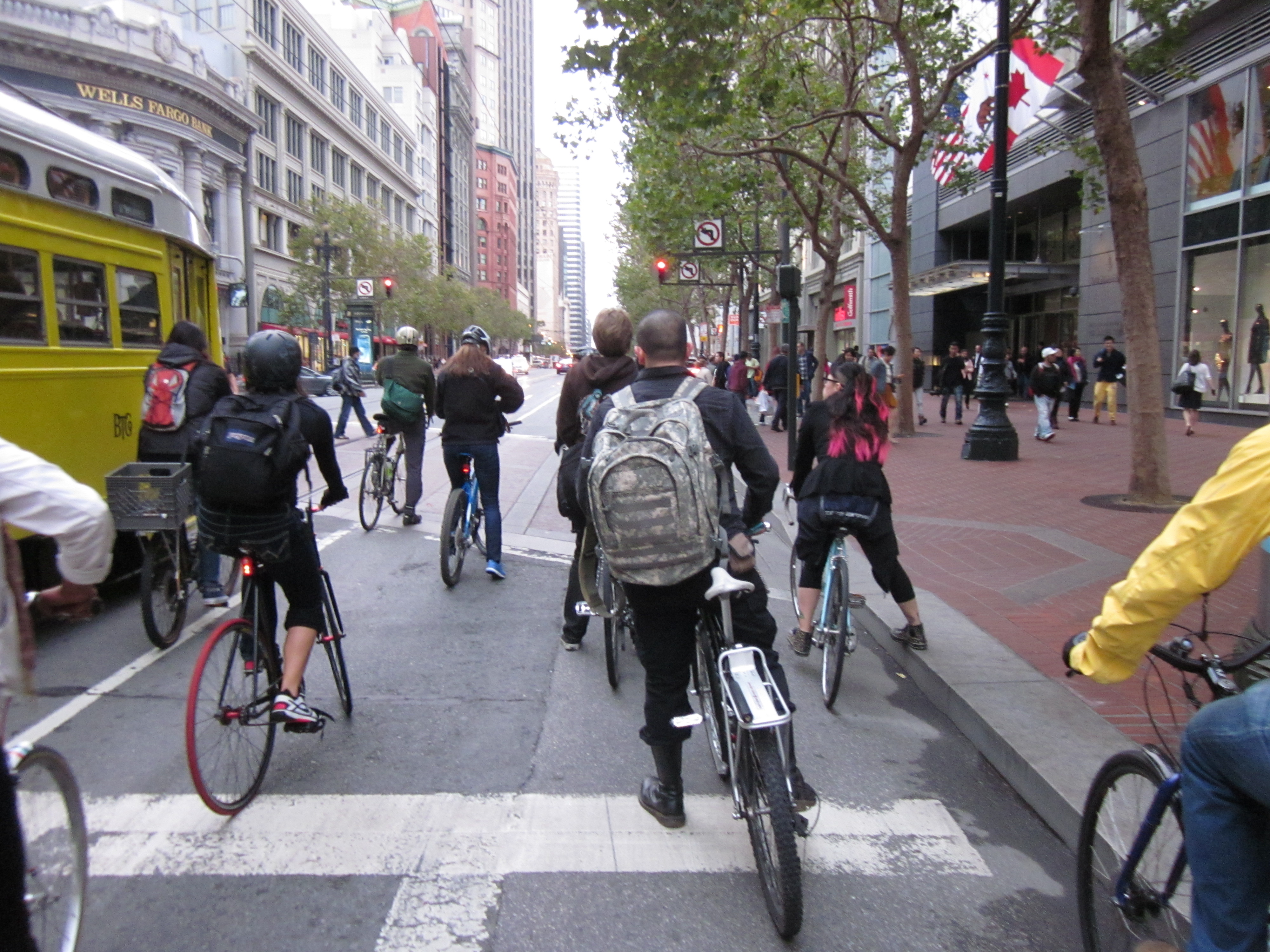
Riding around San Francisco I’ve noticed a difference between women and men on my daily routes. Put in the starkest possible terms, the difference is that women follow traffic rules. It’s not true for everyone, but as a percentages game, if you’re wondering whether a rider in San Francisco will stop at a red light, the odds are pretty good that she will and he won’t.

I am one of the tedious people; I stop at red lights and stop signs. It doesn’t seem to slow me down much compared to the people buzzing through them—I always catch up to them by the next intersection—and I figure the extra margin of safety is worth starting and stopping more often. I understand why some people don’t; it is beyond tiresome to be honked at regularly by drivers behind me who did not expect or want me to stop at traffic signals, which happens at least once a week. But I guess I’m just a slave to authority.  Plus I figure I have my hands full already dealing with the thousands of drivers in this city who think they have the right of way when they’re turning left at an intersection and my bike is going straight in the opposite direction. Which for the record, they don’t. So if you’re in a car and wondering why I don’t just go already when the light turns green, now you know.

Sometimes I am simply appalled what I see. Last week while riding to work I ended up behind a man on an Xtracycle with, yes, a child seat and stoker bars on the deck, but thankfully, no kids on board at the time. He jumped every red light on our route, but sadly never got far enough ahead of me that I didn’t have to see him anymore. While he was running one red light, the driver of a pickup truck that had started to cross the intersection on the green braked suddenly as he popped out. “What the hell do you think you’re doing?!?” Xtracycle dad screamed at the driver. At the next red light, he actually stopped, but only to take a drink of water and spit it out onto the car stopped next to him. It was closest thing to bicycle road rage I’ve ever seen, and it was deeply unnerving to think that this man rode with children.

Someone's going to run this light.

Anyone going to run this light?

The next day I rode the same route behind a woman in the full roadie kit. Unlike the dad on the Xtracycle, she stopped at every red light, occasionally sighing like I do when men on bikes jumped past us to run the red light. Then she’d calmly reel them before we reached the next light (I usually ride this street with the electric assist turned off, but I was so interested that I turned it on to keep up with her).

I have days when every intersection is like this. I stop at a red light, and if there are any women on bikes nearby, they stop too. If there are men on bikes nearby (unless they happen to be my husband), they blow through the red. Then I catch up with them at the next intersection and we do the same thing all over again. What on earth do you think you’re gaining? I think. Why is this difference so gendered? I wonder. But there it is.

7 Comments

Filed under commuting, San Francisco

Soldiering on

Destination unknown

Destination unknown

I have been feeling embattled over the last few weeks. Blah blah blah housing, blah blah blah office move. Our daughter’s preschool changed hands and for the last week, has been run by a for-profit corporation. (We are familiar with the company and did not have a good experience.) As a result of this transition, many of our friends from preschool are leaving the city over the next six months.

At one point I said, “Well, at least everyone’s healthy.” Jinx. Our son ended up in the emergency department, on oxygen, with a tentative diagnosis of pneumonia. It wasn’t pneumonia, and after a week at home he was feeling better, thank goodness.

Going in circles, for now.

Going in circles, for now

The weather has been colder as well. It makes it just that extra bit harder to get on the bike. But given that we’ve chosen to live without a car, we mostly do it anyway.  We just keep swimming, more or less literally last Thursday morning, when the rain was coming down so hard that the street turned white. But my rain gear is incrementally improving every season, and I got to work dry. By mid-morning it was sunny again.

So far the preschool situation is hanging fire. There are many new teachers who are stymied when we show up on the bike every morning, who cannot really believe yet that there are people who ride to school (admittedly the hill is a beast even with the assist). But nothing bad has happened yet.

This week I finally ended up meeting with my school’s dean. I wanted to know where things were going, professionally speaking. It was a very reassuring conversation. Among other things, it turns out that a dean is more powerful than the university housing office. Things are going to be okay.

What we sent to the landfill last week: medical waste from ER visit, birthday party odds and ends, random odds and ends, and a XL serving of smug.

This is the total of what we sent to the landfill last week: medical waste from ER visit, birthday party odds and ends, and an extra-large serving of smug.

We keep doing what we’re doing. We are buying no new plastic and thus producing much less garbage, and to my surprise this transition has been fairly painless. Our son is fervently on board, for reasons I haven’t really figured out. We’ll be rooting out odds and ends of pre-packaged things for some time yet, but using up what we already have is good preparation for our eventual move. Riding with my daughter to the cheese shop last week (which sells cheese and hummus and crackers in bulk and is delighted to put them in our containers and basically makes this whole endeavor far less onerous) I thought: oh my god, we are those people. I am riding my bike with my kid on board to buy self-consciously local food in reusable glass jars and cloth bags. It must look appallingly smug. What’s next, an annual pilgrimage to Burning Man?

But a synonym for “smug” is “contented.” We soldier on, and it feels like life coming into balance.

5 Comments

Filed under car-free, commuting, family biking, San Francisco

The city and the city

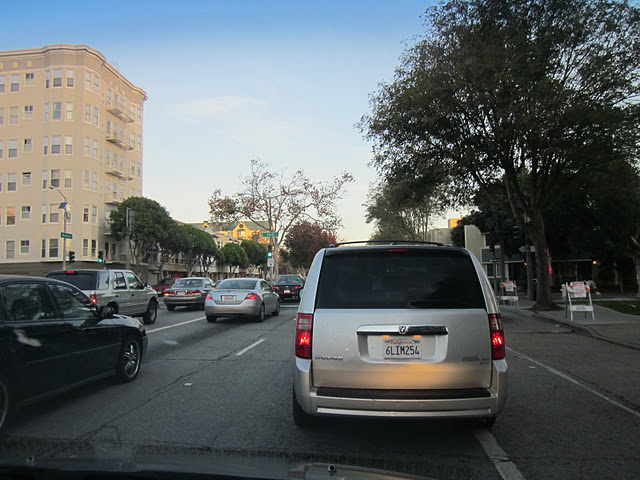
This is light traffic by the standards of a driving commute in San Francisco.

This is light traffic by the standards of a driving commute in San Francisco.

Today, thanks to a complicated sequence of planned afternoon events, I took the shuttle to work. I was surprised to realize that this is the first time I’ve ridden a bus instead of a bike in months.

The university shuttle, compared to Muni, is fairly palatial. You always get a seat, there are no stops between most destinations, and people are quiet. A lot of people work on the shuttle, but now that we drive so rarely, I’ve found that I, like the kids, tend to get a little carsick. So I looked out the windows instead, which helps.

The city that I saw on the shuttle is very different than the city I see on a bike. The bus got caught in traffic at one point, which was unnerving (San Francisco keeps postponing the implementation of Bus Rapid Transit lanes). And most of what I saw on the way to work was roads and cars, an endless expanse of gray asphalt and metal. It was unpleasant. The bus is high enough that I could look down on cars, which were filled, almost without exception, with drivers texting on their cell phones. I did not find that reassuring. And from my perspective, every car I saw, even the “compact” cars, was comically oversized for its typical load of one or two people. People on foot sprinted across major intersections. The city I traveled in today is filled with noise and fumes and traffic. It feels dangerous and unwelcoming.

At the Japanese Tea Garden in Golden Gate Park

At the Japanese Tea Garden in Golden Gate Park

I normally ride to work through Golden Gate Park and on back streets, and aside from a few transitions on major roads, the trip is quiet. I ride either in the park or on back streets lined with trees. My city is mostly filled with bird song and nature and brief conversations with people walking to work. “Please,” I say, “go ahead.”

No cars allowed

No cars allowed

I live in one place, but it contains two cities. I realize now why I haven’t ridden the shuttle in months. Why would I want to?

Leave a comment

Filed under commuting, San Francisco, traffic, Uncategorized

How to get a bike for free

One of these things is not like the other.

One of these things is not like the other.

Recently I visited San Francisco’s waste management center. My university is a shared governance institution (often more in name than in deed) so I am expected to do service. One of my appointments is to the campus-wide Sustainability Committee. I also had to pick a sub-committee, and I asked for Transportation, because I am all about the bikes. But everybody wanted Transportation and I’m pretty junior, so they put me on Zero Waste instead. Anyway, all members of the Zero Waste sub-committee were asked to take a tour of San Francisco’s waste management centers. My first field trip!

San Francisco’s waste management is run by Recology, one of the country’s largest employee-owned cooperatives. San Francisco diverts 80% of its waste from landfills, better than any other municipality in the US and most countries in the world. The city’s goal is to be zero-waste by 2020. The university, which is Recology’s 2nd largest account, is hanging in at 63%. San Francisco has reached this point by implementing aggressive recycling efforts (including prosecuting recycling poachers), creating a hugely successful composting program (in part by instituting a $1,000 minimum fine for throwing compostables in landfill bins), and to a certain extent, by taking advantage of a quirk in how diversion rates are calculated (albeit no more than other cities and countries do).

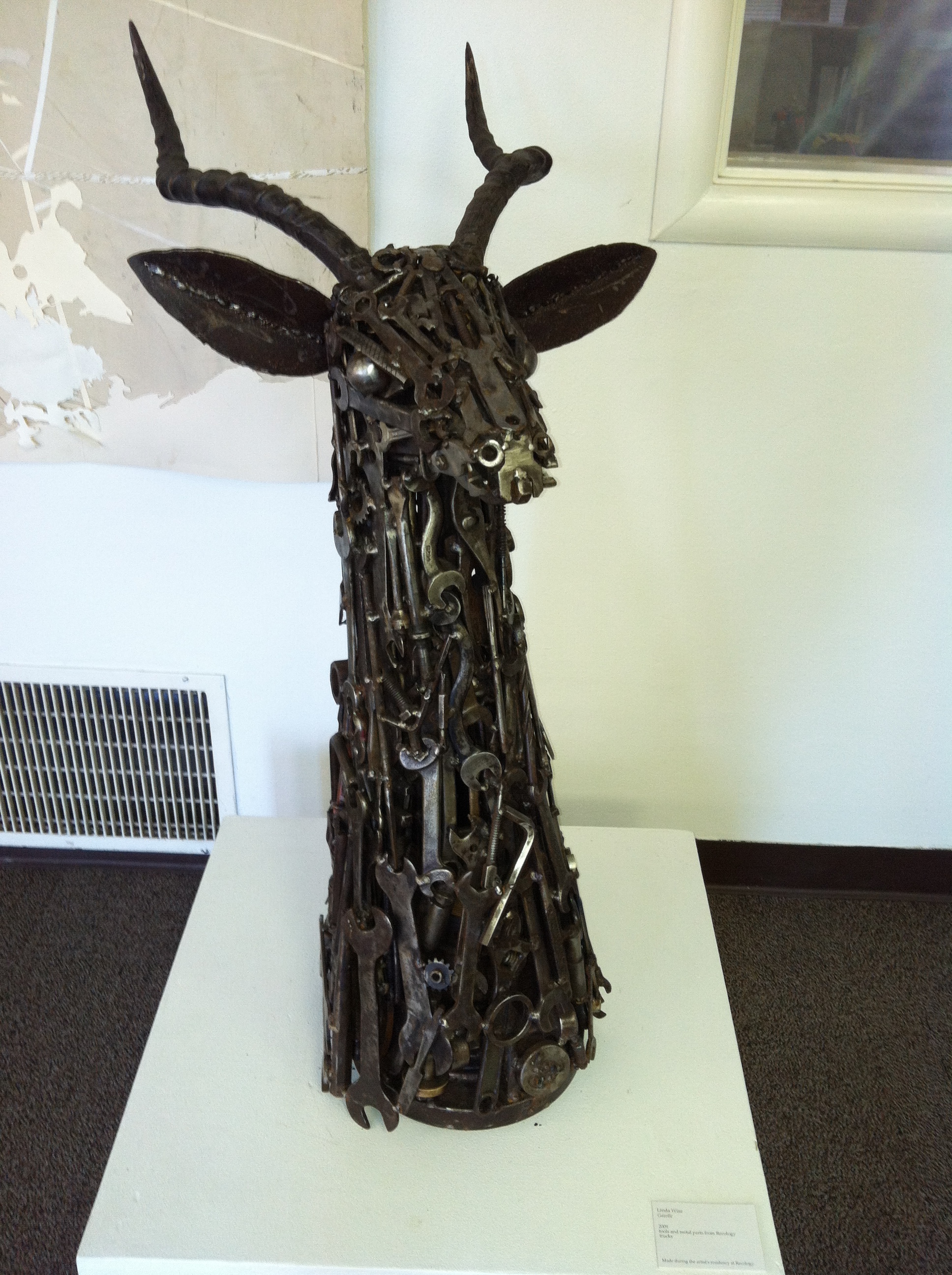
This is some of the art made from found materials at the transfer station.

This is some of the art made from found materials at the transfer station.

Our tour was absolutely fascinating. Recology does not allow photos of most of its operations, because there are apparently trade secrets in the world of waste management. I realize that the dump is not a traditional tourist attraction, but if you happen to be in San Francisco, it is definitely worth checking out.

Our visit started at the business office, where we picked up hard hats and met the sales staff. “I’m Maria,” said one woman who looked like a supermodel heading down the catwalk. “I handle the city accounts, and I’m a dumpster diver.” From there we headed to the recycling transfer station.

If you have seen Toy Story 3, the recycling transfer station will feel somewhat familiar. Trucks enter the building (1/3 of its power is generated by solar panels on the roof, because that is how Recology rolls) and dump recyclables onto the floor. From there they are moved by giant front loaders onto even more giant conveyer belts that sort out paper, plastics, metal and glass as they lift materials to the second floor. The Toy Story 3 feeling comes both from being surrounded by garbage and from feeling like a tiny mote in a giant machine. The amount of material being moved through the transfer station is simply mind-boggling. It was difficult to grasp its scale. On the second floor, the materials the machines could not handle are hand-sorted. Watching this process made me despair for humanity, as my fellow San Francisco residents seem unable to grasp the concept of what belongs in the recycling. Dozens of workers attempted to pick out plastic bags, clothing, plastic bottles of motor oil, ad infinitum, from paper destined for bundling and eventual recycling. It was impossible. They aim for 90% appropriate materials in the bales, we were told. That should be easier than it is. The relentless efforts of the hundreds of garbage-snatching seagulls didn’t help matters either.
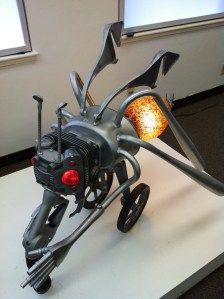
Is artistic reuse recycling, upcycling, or something else entirely?

Is artistic reuse recycling, upcycling, or something else entirely?

Recycling is a tricky concept. Some things are recycled and some are only kind of recycled. Glass and metal containers and shards are melted down and turned into more glass and metal containers. Concrete is smashed into sand and turned into more concrete. Although the process is energy intensive, these are closed loops.  These products are recycled. Paper is kind of recycled. High quality paper, like office paper, is usually turned into low-quality paper, like paper bags. Low-quality paper is turned into even lower-quality paper, like tissues and toilet paper. The tissues can go into the compost, but the toilet paper goes to landfill by way of the sewer system. The more non-paper waste that gets mixed into the paper, the less likely it can be reclaimed for higher-quality recycled paper. Rigid plastic is down-cycled. Assuming it isn’t thrown away outright, it gets one more use; bottles turn into plastic lumber or carpet or fleece, but once these materials wear out, they all go to the landfill. And soft plastics all go directly to the landfill, although only after Recology workers spend six hours out of every 24 picking plastic bags out of the recycling machinery. Less than thirty minutes into the tour, I was completely convinced that I should never buy another item wrapped in soft plastic. This is surprisingly hard, even in San Francisco.

The university facilities representative leading our group was less sanguine about San Francisco’s 80% diversion rate. Diversion rates are calculated by weight, and San Francisco recycles a lot of concrete. By volume, the endless sea of plastic is a much bigger problem, and landfills, of course, are packed by size and not by weight. Other universities in California also claim diversion rates of 80% but only, he said, “because they tear down buildings or repave parking lots every year.” Construction and demolition, as well as aggressive composting at San Francisco’s many restaurants and parks, boosts the calculated diversion rate. He estimated, glumly, that San Francisco residents are recycling and composting at most 40% of the waste that they could. And that this is the best rate in the country.
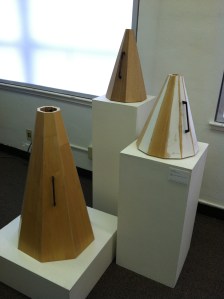
More art from reclaimed waste

More art from reclaimed waste

From the recycling transfer station, we headed to the main facility, where household waste, compost and landfill waste are packed up for their eventual destinations. Recology served us a nice lunch on plates and silver diverted from landfill, showed us an upbeat little movie, and answered questions. I was not brazen enough to ask whether the food was dumpster-dived, but after seeing what people throw away in this city, I would not be surprised if it was. We had lots of questions. I learned that you can recycle (okay, down-cycle) dental floss containers because they are rigid plastic; removing the metal cutter is nice but not necessary. Dental floss itself, however, is uniformly made of plastic and messes with sorting machinery and should always go in the landfill bin. Toothpaste tubes, tetrapaks: landfill. The soft plastics “recycling” bins at grocery stores that supposedly send plastic bags to be turned into park benches? Our facilities representative reported that almost no store will say where they’re actually going, so they’re probably being sent straight to the landfill.

The most hated word at Recology turned out to be “biodegradable.” Nearly everything is biodegradable eventually, they said. But people think that means it can be composted. It cannot. “Compostable” is a legally binding term in the state of California; if an item says it is compostable and it’s not, the state will levy massive fines. Biodegradable is a weasel word intended to sidestep the law. So “biodegradable” materials and bioplastics: landfill. The plastic keeps the biological material from composting, and the biological material contaminates the plastic. That was depressing.

More art from the gallery

More art from the gallery

Much less depressing was the visit to the Artist in Residence program, where artists are sponsored to create projects out of whatever they can find on site. Much of the art was wildly impressive, and there are regular shows where it can be viewed, as well as an outdoor sculpture garden. Many of the other sites showed where visitors came to drop off household waste sorted through it; construction debris is sorted, furniture is donated to thrift stores, electronic waste and batteries are sorted by type. Recology was also pioneering Styrofoam recycling; clean packing materials were compressed into thin, heavy sticks that could be used for things like crown molding. The process is hopelessly expensive and energy-intensive so it’s more of a demonstration project than a feasible way to handle waste, but it was interesting. The inevitable seagulls were controlled by an on-site falconer who kept four hawks circling all day. Recology had tried bottle rockets, netting and dogs, but the hawks were the most effective. We did not get to tour the compost transfer station, probably the biggest success of the program; San Francisco’s compost is used by California wineries and farms. And I got to take some compost home to show my kids what putting food waste in the compost bin, which they do diligently, really meant. They were completely floored.

Our old seat cushion went to the Pit. Is there any alternative?

Our old seat cushion went to the Pit. Is there a better alternative?

Our last stop was The Pit. Everything that goes into a black bin in San Francisco is dumped, unsorted, into The Pit, shoveled into tractor-trailers, and trucked to the landfill. The Pit is huge. It runs 24 hours a day and seven days a week. There is a smell. Trucks enter at the top level and drop their loads. The sounds of breaking glass and the efforts of occasional seagulls to snatch food make it pretty clear that a lot of what’s in The Pit could be recycled or composted (efforts to assess it suggest that two-thirds of what’s in The Pit could be diverted). Bulldozers shovel the waste into waiting tractor-trailers below. The process never stops. It is difficult to describe the feeling of watching massive piles of trash build and be shoveled away, endlessly. It turns out that material in landfills does not biodegrade. Everything that goes into the landfill is forever. I will never look at a garbage can the same way again.

This is how we shop now.

This is how we shop now.

I see now why were asked, as part of our service on the Zero Waste sub-committee, to visit Recology. This is the best that the United States currently has to offer in terms of waste management, and that was sobering. At home, post-tour, we are now uncompromising in using cloth produce bags (we had always used cloth grocery bags) at the farmer’s market and we don’t shop at Trader Joe’s much anymore, because there’s almost nothing to buy there that’s not wrapped in plastic. We now buy milk and yogurt in glass, and everything else in bulk. But mostly, we are buying less, because everything we buy must eventually be handled somehow, and packaging is not free.  It is probably not a coincidence that this month’s grocery bill is half of last month’s.

I am familiar with life-changing experiences by now, and this one didn’t require a trip to Copenhagen. I only had to ride across town.

But I promised to tell how to get a bike for free. The answer is to work for Recology. One of the tour guides mentioned that he never had to take his own bike to site visits and lock it outside, because he could always pick out a nice bike from the garbage. Recology workers never have to worry about San Francisco’s rampant bike theft. He admitted that the last bike he picked up was better than his commuter bike, “way more gears for the hills.” It’s entirely possible that anyone could show up at the dump and ask for a bike.

This is our refrigerator post-tour. We are trying harder.

This is our refrigerator post-tour. We are trying harder. (The glass jars are sold by Cole Hardware in San Francisco for thrift store prices, luckily for us.)

At Recology they suggest people stop calling the things in bins “garbage.” A better word for the many unnecessary things we throw away is “waste.” And a free bike is the least of it.

10 Comments

Filed under advocacy, commuting, San Francisco, zero waste

Safety in numbers

What makes any bicycle safe on any street?

What makes any bicycle safe on any street?

There is a theory in cycling literature that there is a safety in numbers effect for bicycles. This stems from the observation that where bicycles are not commonly found on streets, injury rates are higher, and where bicycles are commonly found on streets, injury rates are lower. Thus, goes the logic, if you get more people riding then all of them will be safer, presumably because drivers will know to watch for them.

I’ve always been suspicious of this theory, as it seems to confuse correlation and causality (although correlation can serve as a big causal hint). There are a lot of omitted variables that could both increase the number of bikes on the road and increase safety, like creating separated cycle tracks and instituting strict liability for drivers that hit cyclists and pedestrians. If people assess, correctly, that the infrastructure and legal system protects them, they’re both more likely to ride and they’re more likely to be safe, but increasing the number of bikes on the road wasn’t really what increased safety. If people jumped on bikes without that infrastructure or legal protection, I’m not sure they’d see the same effects.

This is the kindergarten bicycle crew at Rosa Parks each morning. I also feel safer when I join their impromptu bike train.

This is part of the kindergarten bicycle crew at Rosa Parks each morning. I also feel safer when I join their impromptu bike train.

I thought of this last weekend when I was taking my daughter to her ballet class and suddenly found myself in a pack of over a dozen lycra-clad road cyclists on a major street. There were too many of us to stay in the bike lane, and so the fastest riders moved left into the car lane. Not all these cyclists were riding together—they came and went in small clusters—but everyone in the group was watching out for each other, and signaled to other riders (including me) when to move around turning cars and hazards in the street. Thanks, lycra-clad roadie guys!

I listened to them chat as we rode along. It was a pleasant ride, and I realized I did actually feel safer in a big group of cyclists. I knew someone would warn me if there were any obvious dangers in the road, and cars hung back rather than rushing to pass. That was very different from the same trip the week before, and from my ride home along the same route. Maybe there’s something to the safety in numbers theory after all.

1 Comment

Filed under commuting, San Francisco, traffic

Meet the new bike

We are classy, classy people.

We are classy, classy people.

When Matt’s bike was stolen, my first thought (after, “Thank goodness we checked it was insured when the Bullitt came!”) was “What are we going to replace it with?”

Matt’s first thought was, “Where is that box of wine we just bought? I need to drink it all now.”

In the realm of people who have had bikes stolen, we were incredibly fortunate. Our renters insurance was up-to-date, and our agent had just assured us a few weeks prior that the bikes were covered. In addition, we have always carried replacement-value insurance. When Matt talked to the police, they told him that the frame had almost certainly been cut, making the bike itself not worth the effort of recovering (assuming such a thing was even possible). When he called our local bike shop, Everybody Bikes, they immediately put together a summary of the cost of the bike and value of the upgrades and sent it to our insurance company. (Thanks, Michael!) And in the meantime, given that we have a spare bike or two now, Matt had something to ride.

So the sequence of events went like this.

  • Friday afternoon: bike stolen.
  • Friday evening: Matt got a police report, filed an insurance claim, and commenced drinking.
  • Saturday: our bike shop sent a valuation of the bike to State Farm.
  • Monday:  State Farm called us saying that our claim was approved and they were sending us a check.
  • The following Friday: we got the check for the value of the bike less our deductible in the mail.

Thank you, State Farm! And I am grateful to our agent, Ken Bullock, as well. You never really know whether the insurance is going to be there until you need it, and I’m really glad it was.

Over the weekend, once Matt sobered up a little, we talked about a replacement bike. The first question was whether he wanted a midtail or a longtail as a replacement. Matt is still very fond of the Big Dummy, and considered it or the Edgerunner as options. But we both thought that another midtail bike would have the most longevity for our needs. Matt expects he will ride that size of bike on his commute for years to come. It can pick up groceries as well as an extra person but doesn’t really look like a cargo bike, it’s lightweight compared to a real cargo bike, and it’s transit-friendly. I’d like one too someday, for the same reasons (although we are so done with new bikes this year).

Which midtail was the question: there used to be one, but now there are three. Another MinUte or one of the others?

Matt loved the look and features of the Kinn Cascade Flyer and so did I, but it wasn’t going to solve the problem of getting him on a bike soon. The most obvious issue was there weren’t any in the Bay Area, and it’s not clear when or if they’ll be showing up here–the first production run of 30 bikes has sold (I asked), although a demo is supposed to appear in town eventually and more bikes will be produced in the spring. The second problem was that the bike appeared to be under-geared for San Francisco. I learned recently there is an option to get a Kinn with mountain-bike gearing, but we didn’t know that at the time.

Load up the Boda Boda.

Load up the Boda Boda.

We had just ridden the Yuba Boda Boda for a few weeks, and this bike is not without its charms. The main issue for Matt, which made him rule out this bike with little discussion, is that he really hates the cruiser aesthetic and the Boda Boda is designed to look like a cruiser. This is one of those reasons to reject a bike that seems silly on one level and totally reasonable on another. Our other concern was that the Boda Boda is also under-geared for San Francisco, and Matt didn’t want an electric assist bike. The Boda Boda is a great choice in San Francisco if you know you’re going for the assist, but if you’re not it would require regearing (and that would be a pain). And Matt is tall enough that he didn’t care about having a step-through frame.

The same bike, but different

The same bike, but different

We bought our first MinUte because it was the only available midtail at the time. Ultimately we bought another MinUte to replace it because it was still the best midtail for us over a year later. The MinUte is geared for San Francisco hills (the gearing is probably one of its best features).  Kona has significantly upgraded some of the things that bothered us about the old bike: for example, it has a new Yepp-compatible deck option and a dramatically better kickstand. And although we were initially worried about our ability to actually order a bike given that it was the end of the year, our bike shop actually had one last MinUte frame kicking around. We got a pity discount and they added the same upgrades we’d put on the first bike all at once. It was ready to ride in a couple of days.

There are still things I would change about the bike if I could. But I also realized that the Kona MinUte, despite being the bike we’ve both ridden the longest, is the only bike I’ve never really reviewed like the many other bikes we’ve test-ridden. So that’s coming up soon. In the meantime, even though the new MinUte looks a little different than our first bike, it’s still familiar. And it’s nice to have it back.

8 Comments

Filed under bike shops, commuting, family biking, Kona, San Francisco

Hum of the city #1

I’ve written before that I call this blog Hum of the City because I fell in love with the sounds I could only hear when there weren’t cars rushing by. I noticed these all the time when we were in Copenhagen, but only rarely in San Francisco.

This morning we stopped as usual at the intersection of Stanyan and Oak/Fell in Golden Gate Park on the way to school. This is a ferociously busy intersection for cars, with eight lanes of traffic running east/west and six lanes running north/south, plus two cloverleafs. We have to move into the (partially protected) bike lane marked in the east/west center lane to enter the Panhandle path. This intersection makes me edgy, and it’s so noisy we can’t talk there.

There is a moment in the light cycle, however, when all the cars have to stop and the roar of car engines dies. In that moment this morning, I suddenly heard the squawking of San Francisco’s wild parrots. They don’t usually come so far west!

And then the lights turned green, and it was like they were never there at all.

6 Comments

Filed under commuting, family biking, San Francisco

Happy belated birthday to Hum of the city!

October 2012: Splendid Cycles delivers our Bullitt

Hey, I forgot my blog’s birthday. I’m so embarrassed! What can I say? There’s been some other stuff happening. Thank you, California, for funding public schools.

I started writing about riding our bikes on November 2, 2011. Writing about riding bikes isn’t as fun as actually riding bikes, but I have no complaints. It’s been a pretty great year, with lots of chances to meet other families, ride in other cities, and pick up some new bikes. And hey, we sold our car. I totally wasn’t expecting that. Last weekend, we met up with another San Francisco biking family we’ve known for a few years, and found out they just sold their car too.

I don’t delude myself that the United States is on the cusp of a wholesale transition to using bikes for transportation, even though it would make sense in many places. And I sympathize to some extent. Riding bikes is still pretty freaky and counter-cultural even in a place like San Francisco, which is so laughably counter-cultural that conservative media commentators practically cross themselves just saying the name.

Our two kids on our first bike, the Kona MinUte, laughing all the way

But we’re not alone out there. Last weekend I was out with a mom from our son’s school while she test-rode a Yuba Boda Boda. She sold her car on Friday and ordered the Boda Boda. When I asked why she wanted to buy a bike instead of a replacement car, she said, “There are so few chances to have fun once you grow up. Riding a bike is fun!” I couldn’t have said it better myself.

Thanks for hanging with me, bikey people.

5 Comments

Filed under commuting, family biking, San Francisco

Bicycles in Bellingham

August in Bellingham

We visited Bellingham, Washington, where I grew up, last August. It has changed dramatically since my childhood. I think it is at least twice as large as it used to be, just for starters. Although there was always a university there in my memory, it has grown larger too—what used to be gravel parking lots for commuter students have been taken over by campus buildings, and the student population now lives there year round.

The German bakery in Bellingham used this bike for deliveries. They imported it from Germany, where postal workers use them.

I rode my bike as a child in Bellingham, often for transportation, and as in many small towns at the time, this wasn’t considered unusual.  Our parents didn’t consider driving us around to be part of their responsibilities, and the city buses were irregular, so it was ride or walk, and we did both. This was well before the time that kids were supposed to wear helmets, so none of us ever did. We also didn’t lock our bikes, because there wasn’t any bike theft. And I never had lights on my bike either, because there was a curfew and kids weren’t allowed out after dark.

This lone wolf was riding in the bike lanes.

When we rented bikes in Bellingham last summer I could not believe how much had changed. I rode on streets as a child because that was what was available, and the streets were mostly quiet. On larger and busier streets that connected neighborhoods, there were bike lanes. I rode on those too.

The greenway markers tell you how to get from here to there.

Now there is no need for many of those bike lanes, because in the time I have been away, the city of Bellingham has built greenways that are completely separated from the streets. Even though they don’t cover the whole city, they go almost everywhere I wanted to be. The city has a fair number of hills, but none of them are very steep, and the extensive infrastructure meant that bike commuters were visible everywhere.

Bicycles and pedestrians only on this shopping plaza, which also hosts a farmers market

Riding the greenways, and the quiet streets, I realized that people in Bellingham have no reason whatsoever to own a car (although almost all of them do). There are paths and bike lanes to take people nearly everywhere in the main part of town with minimal exposure to cars. There is always bike parking at your destination.  Most of the interesting places to shop and visit are on dedicated pedestrian plazas—cars no, bike corrals yes. Admittedly many stores are a few blocks from the greenways, and it’s often necessary to ride on streets briefly, and of course my perspective on what constitutes serious traffic may be somewhat skewed. It still impressed me.

The bike shop on the greenway

What interested me most was how many stores, restaurants and housing developments were oriented toward the bicycle and pedestrian greenways instead of the streets where cars were allowed. As we rode closer to downtown, parallel to streets we had driven on earlier in the week, I realized that what I had thought were abandoned buildings or warehouses were instead a community bike shop, a strip of small restaurants and bars, and a bakery. Opposite them were condo buildings that opened onto the greenway from walking plazas.

This the return route from downtown; the bay is to the right.

Bellingham does not lack for natural beauty. It runs in a narrow strip between the water and the mountains. The greenways run along the water and through woods, and the buildings that pop up along the trail seem tucked into a world without roads. Even in terrible weather (and the weather was often terrible during our stay, either hot and muggy or cold and raining) riding those greenways felt like stepping into the Shire.

This part of the city can only be seen from the bike path.

Riding in Bellingham felt very bucolic, although it’s not perfect. From a car, it seems like many other small cities, even though there are a lot of bikes on the roads. There are strip malls and wide roads with speeding cars, and far too many crosswalks with lights too short to allow anyone to get across without sprinting. Yet when we got on the rental bikes I realized that there was a smaller second city built in parallel, inaccessible to cars and human-scaled. I have always visited Bellingham because my mom lives there, and had little other interest in the city. But now I have another reason to visit. I want to figure out how to export their infrastructure back to San Francisco.

3 Comments

Filed under commuting, travel

Bicycles in São Paulo

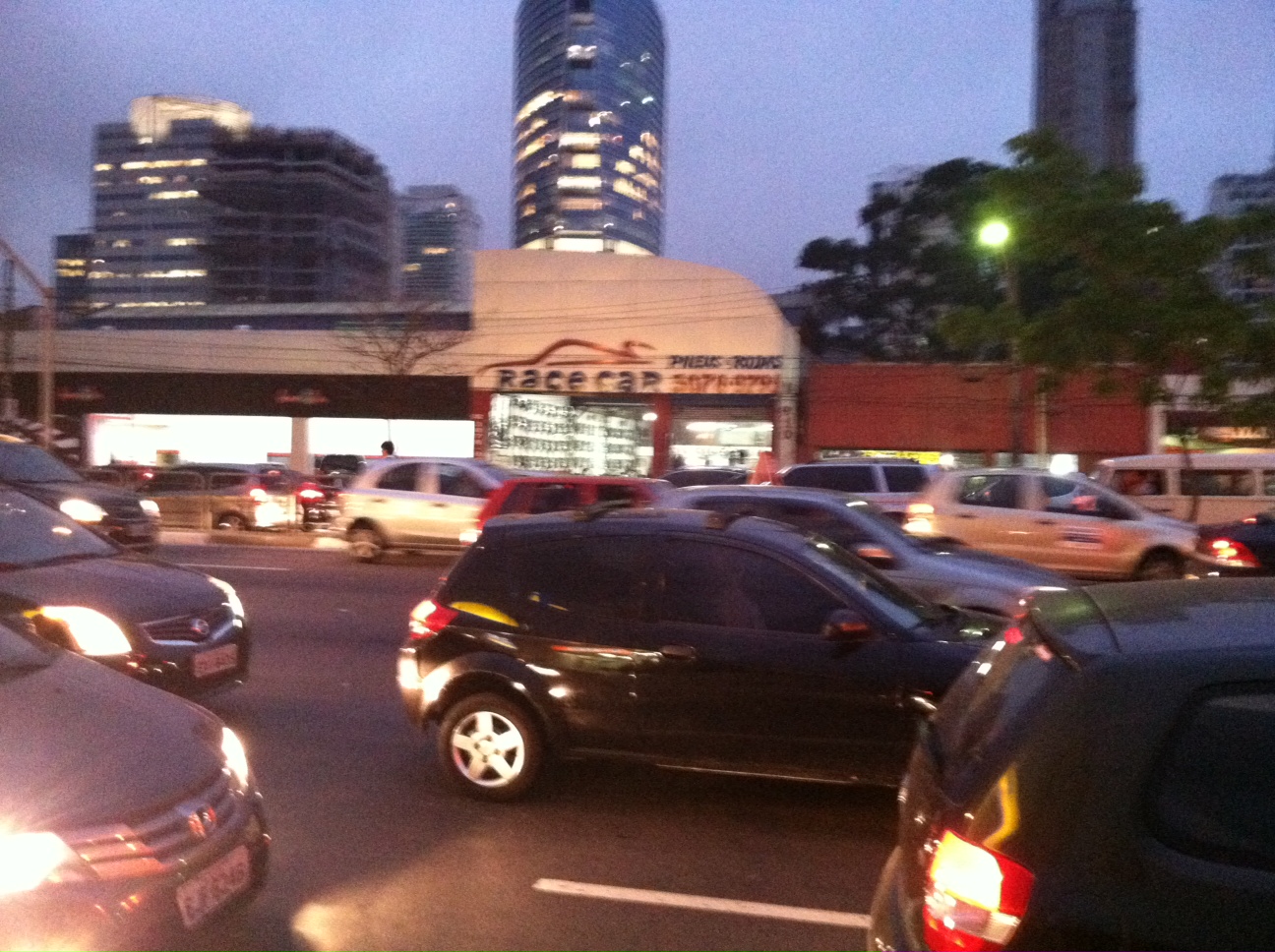
Last month Matt went to São Paulo, Brazil. He always asks what he should bring back from these overseas trips, and I always say “pictures of bicycles.” (The kids ask for chocolate and foreign currency.) São Paulo is the largest city in Brazil and the 7th largest city in the world, home to 11 million people. Here’s what Wikipedia has to say: “The city, which is also colloquially known as “Sampa” or “Cidade da Garoa” (city of drizzle), is also known for its unreliable weather, the size of its helicopter fleet, its architecture, gastronomy, severe traffic congestion, and multitude of skyscrapers.”

The view of the street from everywhere in the city

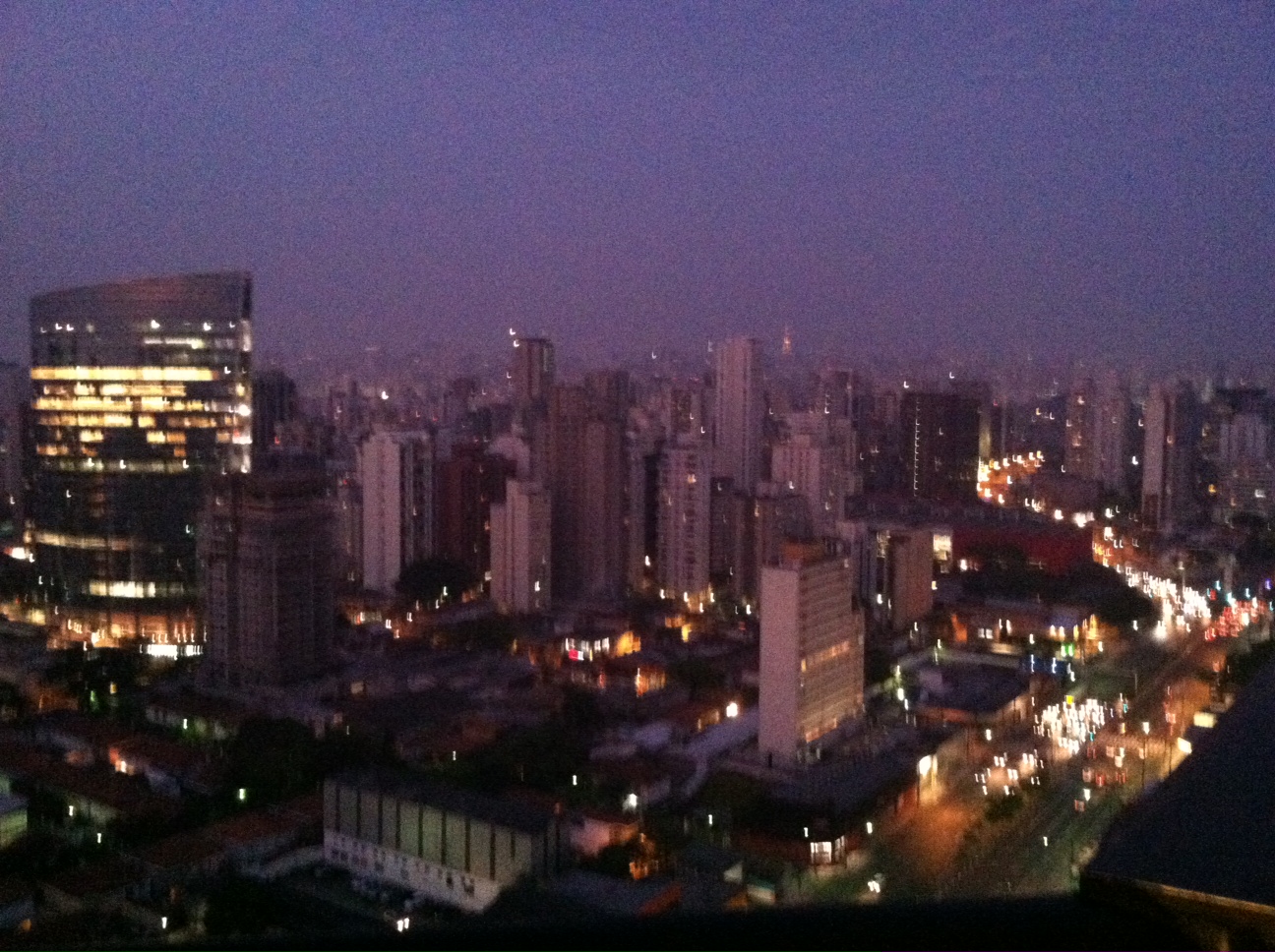
Here’s what Matt wrote on arrival: “São Paulo is an extremely pedestrian (and bike) unfriendly place, with crushingly bad traffic at all hours as a result.  The joke running around the conference this morning was, ‘What time’s your flight? 9 pm?! Then, you’d better leave for the airport now!’ It’s so bad, even my dinky second tier business hotel has a helipad on the roof (and I could see a half dozen on other nearby rooftops).  It’s clearly a motor vehicle culture.

On my 40 minute rush hour walk, I passed 4 or 5 giant auto tire and rim shops, a deluxe two story Ducati dealership, several motor bike accessory stores, miles of tail lights, and exactly two moving bicycles… both commuters in work apparel with helmets riding on the sidewalk for safety.

Hope you weren’t planning a long ride.

I have not seen a single bike lane yet, though I’m told one exists on Ave Paulista, the main financial street.

Lots of lane splitting motorbikes everywhere, though, often riding their horns constantly.  Our bus driver remarked that one or two are killed every day!”

Here’s a bike lane he found later.

Ha ha ha ha! Yeah, it’s not funny. I’m laughing just to keep from crying here.

I have commented that I don’t feel particularly threatened by San Francisco car traffic. I wouldn’t feel so sanguine about riding a bike everywhere. After seeing Matt’s photos I can’t imagine riding a bike for transportation in São Paulo.

These bike share bikes would be perfect for commuting, but they never leave the city park.

However there are bicycles there. But like many parts of the United States, they’re apparently viewed exclusively as toys. People drive to the park, where they can rent bicycles. That’s because São Paulo, unlike U.S. cities, has had a bike share program since 2009. I’m torn between envy and despair–it’s a city with bike share, but there isn’t the slightest practical application for it.

Now that’s my kind of bike.

Here’s Matt, after finally finding someplace in a city of 11 million people where he actually wanted to spend some time. “I spent today in Ibirapuera, the Golden Gate Park of São Paulo. It was a gorgeous, sunny day and people were out in droves, jogging, biking, skating, etc.”  If you build it, they will come.

Beggars can’t be choosers seems to be the philosophy here.

Just like Golden Gate Park, there’s also this weird phenomenon where the city has built separated bike lanes where they’re least needed and that don’t go anywhere interesting. “In addition to separated bike lanes on the main walking paths, there was one area that seemed to be a bike only circuit path — not long enough for a ride but one father was teaching his young son to ride on it.” Like the parents of São Paulo, I like taking my kids to practice on trails like these, but how depressing it must be for the children there to learn to ride a bike only to discover they can’t go anywhere.

Some bike lanes are just another way to say, “Go away.”

There were a few other places with a little bit of bicycle infrastructure, but I get the sense it would be fair to call it ad hoc. “This ‘bike lane’ was in a pedestrian plaza — probably more to keep bikes away from peds than anything.  Even on a Sunday with lighter traffic, there were very few bikes in evidence on actual streets… A few on sidewalks, again (including one who was trying to pedal through a crowded market with shopping bags dangling from the handlebars).”

A view from the helipad

A view from Matt’s hotel’s helipad tells the story: this is a city that hasn’t thought much about transportation. Seriously thinking about transportation in a major city makes it apparent that a car-centric model is unsustainable. You can see that in São Paulo in the flight to helicopter commuting. But this is hardly more sustainable. Transportation planners tend to take trips to cities with a reputation for doing things right, like Amsterdam or Paris (which has removed tens of thousands of parking places in the last few years to make room for bike lanes). I’m sure that this is more appealing than visiting cities like São Paulo, where no one can go anywhere. But I suspect there would be a lot to learn nonetheless.

Riding our bikes to school started us down this road.

Transportation interests me because it is a necessary thing, like eating or sleeping. Except in the most extreme cases (like among the comatose), we all have to move around the world. For years I accepted that this experience would be tolerable at best. We would get in the car and drive, dealing with traffic and parking and road rage, because that was just the price of living. Sure, it could be nice to be out of the weather sometimes, but we still had to deal with that same weather once we got out of the car. And we paid several hundred dollars each month for this experience because we thought we had to.
I’m late to this party, but happy to be here now.

It is no overstatement to say that discovering that there was another way to move through the world changed our lives. I get on the bike and the trip is… fun! When I walk into work I’m not tired. I love our bikes. I can’t imagine going back.

2 Comments

Filed under commuting, traffic