Category Archives: electric assist

We tried it: Surly Big Dummy (with and without BionX electric assist)

Matt takes three kids for a spin on our rental Big Dummy at the Portland Cargo Bike Roll Call.

Over the last year I’ve had the chance to ride a Surly Big Dummy multiple times, both with and without an electric assist. Our friends from school have lent theirs, and Family Ride has let me use her incredible pink Big Dummy for long rides in Seattle. And twice I’ve ridden a BionX assisted Big Dummy from Splendid Cycles (the first electric-assisted bicycle I ever rode), once for a day and more recently, for a week. The Big Dummy makes frequent appearances in family biking communities in the hilly cities of the northwestern United States.

The Big Dummy grew out of the Xtracycle platform. Xtracycle pioneered the longtail bike concept in the United States with the development of the FreeRadical, which is a longtail attachment that can be fitted to virtually any bike, even a folding bike (useful for people who want cargo bikes, yet live in small apartments with limited storage space—preassembled versions are sold by Warm Planet Bikes in San Francisco). I met someone while commuting home last year who claimed he was riding with one of the first FreeRadicals ever sold. He had his daughter on deck in a child seat, but he had the bike for over a decade. The original wooden deck looked a bit battered but it was working fine.

Biking with Brad shows off a Big Dummy at Seattle’s Cargo Bike Roll Call

Xtracycle’s system is open technology. Surly was the first company to turn Xtracycle’s FreeRadical attachment into a complete bicycle frame. The advantage of having the longtail as part of a complete frame is basically the same advantage of having a complete cargo bike rather than a bike and a trailer, although less dramatic. The FreeRadical is really a separate part, so it’s harder to carry as much weight, and the bike can flex, particularly on hills. Flex means that different parts of the bicycle no longer move in the same plane, which can be disconcerting; under challenging enough conditions, the frame can even break apart. Typically flex is not a big concern for people commuting to work on bicycles, because they’re traveling relatively slowly and they don’t weigh that much. But put a hundred extra pounds on the back of the bike and head up or down a steep hill and suddenly you do have a problem.

Because we live and work on San Francisco hills and want to carry kids whose total weight is approaching 100 pounds, we were discouraged from riding an Xtracycled bike on the grounds that it would not feel stable—70 pounds is apparently where people start to feel the flex, and our kids together weigh more than that. This concern includes Xtracycle’s Radish, which is a bicycle frame attached to a FreeRadical; purchasing a Radish is mostly a way to get a FreeRadical without already owning a donor bike. However there are many San Francisco families in flatter parts of the city who are very happy with Xtracycled bikes. One family we met attached their FreeRadical to a tandem bike after their kids got too big for the Xtracycle to carry them safely. However they report that the Xtratandem is extremely tiring to ride.

The issues that kept us from seriously considering the Xtracycle FreeRadical/Radish are much less significant with the Big Dummy. Because the bike is a complete frame, it has far less flex. Getting a Big Dummy would also allow us to feel solidarity with our family biking neighbors to the north, because these bikes are all over Seattle. And although getting a Big Dummy so I could feel like I have something in common with other family bikers is arguably sort of pathetic, getting the same gear as Family Ride actually has real merit as a decision rule, because she rides everywhere.

The pros of the Big Dummy:

  • The Big Dummy is very easy to ride. There is almost no learning curve; the first time I got on one I just started riding. The first time I rode one with my kids on board was a little trickier; when they get excited, as they always do when trying out a new bike, they jump around a lot. Dynamic loads are much more hassle than static loads. But nonetheless I managed it pretty quickly, and by quickly I mean less than a block. It also corners pretty neatly, even when laden, although with a load all longtails are going to swing out a little wider.
  • The Big Dummies we’ve ridden have really nice components, which make them a pleasure to ride. Shifting is instantaneous, braking is fast and effective, and the bike rides smoothly.
  • The Big Dummy can climb! Family Ride has taken me up the hill to her place a few times now; it’s a long and moderate grade of ten blocks or so. In March, riding that hill on her unassisted bike with my kids was no problem, although I wasn’t breaking any land speed records, and for most of it I didn’t need the lowest gear. In August, when it was significantly hotter, I wilted. She had my son and her youngest on Engine Engine Engine while I had her oldest and my daughter on the Big Dummy, and they dropped me like a lead ingot. It never gets hot in San Francisco. But I made it eventually.
  • On this trip I really started to notice the difference between fast cargo bikes and slow cargo bikes. These are relative terms; no cargo bike is going to go fast by the standards of a road race. The Big Dummy is a fast cargo bike. I really noticed it when I was out with Biking with Brad and Family Ride, both on their Big Dummies, while I was riding the Madsen, which is definitely not a fast cargo bike. When I rode a loaner MinUte in Seattle with my kids and Family Ride was back on her Big Dummy, we could cover serious territory. Maybe I should learn to relax a little and enjoy the ride, but I decided instead that I like the fast cargo bikes.
  • Yes, that is a pinata. I am not worthy to hang out with these people.

    It is astonishing what you can pack on a Big Dummy (this applies to the entire Xtracycle line). The standard bags on the bike, which are called FreeLoaders, fold flat when not in use, expand only as much as needed when loaded, and can carry more than the trunks of many cars the way that Family Ride packs them. She said she got compliments on her loads from homeless guys with shopping carts. Now I have something in common with Seattle’s destitute. Two kids, dozens of pool toys, a large bag of snacks, four towels, a change of clothes for four kids? No problem. Two kids, two kids’ bikes, a piñata, another large bag of snacks, and various other odds and ends I’ve forgotten? Also no problem. Xtracycle, like Yuba, has side bars to keep a heavy load from dragging on the ground or to act as footrests, but they are optional and detachable. I would never use them in San Francisco because I hate having extra width behind me while negotiating narrow bike lanes (personal preference), but they would be useful in other locales. We also liked the FreeLoaders more than we had expected when we rode the Big Dummy in Portland, although unlike a box bike, you do actually have to load them; it’s not throw and go. Oh the humanity.

  • When using the BionX assist, the Big Dummy made us feel like we had cycling superpowers. Normally riding a cargo bike means accepting that even without the kids on board we’ll be slower than everything else on the road, except maybe people on crutches, if only because the bike weighs a lot more. The apartment in Portland we stayed in for the week was almost six miles from where we wanted to be most of the time, because there was an international tree climbing competition in the neighborhood that week (Portlandia!) and basically everything in the city was booked. So we had several evenings when we stayed out later than we should have and had to book back all that way with two tired kids. On Portland’s neighborhood greenways, which allow bikes to go for dozens of blocks without hitting a single stop sign, we could crank up the BionX assists and make it home faster than we’d ever dreamed. “Wow!” Matt yelled at one point, “You know those times when you’re running late and wish there was some magic way you could get there on time? NOW YOU CAN!” Also, being able to hit the throttle and make it through busy intersections with no drag from cargo could be worth the price of an electric assist all by itself. I love the BionX. I would sell our car for one. Oh wait, we already did that. Never mind.
  • Like the Mundo/elMundo, the Big Dummy is pretty short for a cargo bike at about seven feet long, and when not fully loaded with packed bags or the Wide Loaders, it’s also the same width. It can be parked at ordinary bike racks. Bumping it up onto a curb is not a big deal. We ride in the city and this kind of maneuverability is very appealing. As with all cargo bikes except possibly midtails, carrying it up stairs is a complete non-starter, so some kind of walk-in parking is a must. But as with the Mundo or Bullitt, almost walk-in parking would probably be okay with the Big Dummy.
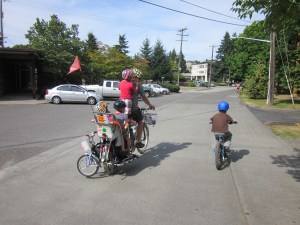
  • Three kid party on the Big Dummy! And that’s my son riding his first geared bike alongside.

    Like most of the longtails, it’s possible to carry three kids on this bike by putting an infant seat on the front and two kids on the back, with or without child seats. As with the Mundo we have on occasion piled three kids on the back of Big Dummies but this is more of a “riding with friends” than a “riding with siblings” kind of thing. Riding packed tightly on the rear deck of a bike with friends is a nonstop party. Riding packed tightly on the rear deck of a bike with your sibling(s) is an opportunity to get payback for whatever imagined slights happened earlier in the day.

  • The Big Dummy is designed to use the Xtracycle line of accessories , which can be overwhelming but is also fantastic. In addition to the extremely cool bags, the child seats that attach to the deck (Yepp) are very swank; they are rubberized with drainage holes to shed water easily, and very nap-inducing for tired kids, although unfortunately, like all rear seats, they are not very nap-friendly once the kids actually fall asleep, as their heads loll forward and they jerk awake, etc. New accessories like the Hooptie give every kid on the deck a handhold. People who like carrying even more stuff can attach an actual Side Car. The catalog is too deep to do justice to here.
  • Unlike many cargo bikes, the Big Dummy comes in multiple frame sizes to fit shorter and taller riders. Just like with t-shirts, one size fits all means that for most people the fit is not going to be great. So you can adjust the seat, but the handlebars may still be too close or too far away, or it can be hard to stand over the top tube. With this bike, fit shouldn’t be a problem.

The cons of the Big Dummy:

  • The kids in back are behind you, by design. This is less fun than having the kids in front, and it means it can be hard to intervene during arguments. With two kids on a longtail the fighting is nowhere near what it can reach on a midtail, with the kids right on top of each other, however. I don’t mean to imply that my kids fight all the time; they actually get along very well. It’s just that the fights stick with me, plus they can totally ruin a ride.
  • Even more than other longtails I have ridden, it is hard to hear the kids in back. A conversation I attempted to have with my daughter on one ride illustrates the problem. “Mommy?” “Yes?” [car passes us with a SWOOSH] “I’m sorry, sweetheart, I didn’t hear you when the car passed. Can you say that again?” “Okay. Mommy?” “Yes?” SWOOSH. “I am so sorry. I missed that again. Could you please say it one more time?” “Okay. Mommy?” “Yes?” SWOOSH. ARGH!
  • The stock kickstand on the Big Dummy is dreadful. It is barely better than the kickstand on a commuter bike. We both hated that we couldn’t trust the bike we rode in Portland to hold any cargo unless one of us was holding it upright. It made loading the bike without two adults around nearly impossible. There is an excellent solution: the appallingly-named aftermarket Rolling Jackass centerstand, which deploys with a hand control on the handlebars (sheer genius!) and releases when the rider rocks forward. The Rolling Jackass is the best longtail stand I have ever seen, the only stand even in the same league as the Bakfiets/Bullitt stands, and I would not get a Big Dummy without it. Too bad it costs $350, not including installation. Xtracycle also sells a KickBack center stand for $150. The Rolling Jackass is better.
  • Even with the Rolling Jackass-enabled Big Dummy (I feel like a mean drunk throwing around all these ridiculous product names), my three-year-old daughter could not get herself onto the bike. This isn’t necessary but it’s nice when the younger ones can get in and out by themselves.
  • The Xtracycle line of accessories focuses on stuff that attaches to the longtail, and pretty much ignores the front of the bike. Surly isn’t traditionally a company that’s focused on the cargo biking community, and thus the Big Dummy does not have a standard front basket or rack. There are all kinds of aftermarket front baskets and racks, but almost none are frame mounted, like the Yuba Bread Basket. Frame-mounted baskets can carry more weight and loading them up doesn’t knock the bike off balance. Having no option for a front frame-mounted rack or basket is an annoying oversight on the Big Dummy. Yuba is on a real tear when it comes to developing desirable family bikes because of accessories like the Bread Basket.
  • There is no rain cover or sun shade for kids riding on a Big Dummy. Some handy parents have developed their own using plumbing supplies and sewing machines. The Yepp seats have lots of holes to use as attachment points. I’m not a handy parent.
  • Classical scholars among us will recall the story of Milo of Croton, who taught himself to carry a bull using progressive resistance training, lifting a calf every day from the day it was born until it grew up. At which point he killed and ate it. I digress. I thought of Milo because of the difference in my experience riding the Big Dummy in March versus in August. Together, my kids were ten pounds lighter in March. I had a lot more trouble getting the bike uphill in August. Some of that was the heat, but it was easier when I swapped out my oldest for Family Ride’s oldest, who is several pounds lighter. I began wondering whether being able to carry my kids at their current weights and beyond was the kind of thing I could work up to, or whether they were already near the limit of what I could reasonably carry on the bike. My go-to source for questions like “how much can the bike REALLY carry?” is the excellent summary of cargo bikes by Joe Bike. It said that the Big Dummy was stable with loads on the back up to 100 pounds. Hmm. With my kids plus their gear, we were already at the 100-pound mark, with years of riding to go. An electric assist would make it easier, but was I going to be pushing the bike beyond where I should? I have already broken one bike. That’s how we got here. On the other hand, I saw some riders, including my own husband, carrying three kids on the Big Dummy for short trips at least, and together those kids surely weighed more than 100 pounds. So this was hard to assess.
  • We dumped the kids on the Big Dummy when we lost control of the bike trying to start on mild hills. I did it on Family Ride’s bike. My son ended up with a bad scrape. After he saw the blood, he insisted on riding Engine Engine Engine for the rest of the day. I felt horrible. Matt, showing far more foresight, dumped the kids and the bike on some grass alongside the road, and they were shaken but fine. For some reason bikes with the weight on the back are much easier for us to tip. Sure, everybody does it sometimes, but twice in one week was a little more often than I like to admit.
  • The Big Dummy has a high top tube rather than a step-through frame. I hesitate to call this a con because the top tube is what makes the frame strong and there are different frame sizes so it should fit even shorter people. Yet even the smallest frame could be an issue for people closer to the five foot mark (not us), because at some point you’d have to lean the bike to swing a leg over the top tube. That would be a recipe for disaster with two kids on board, and as noted it’s not possible for kids of all ages to get on by themselves after the rider gets on.
  • Like most of the cargo bikes we tried that were not the Bakfiets, the Big Dummy lacked many of the accessories that commuting easier. The bike we rode in Portland had fenders, but no lights or chain guard. Family Ride has wired her Big Dummy with dynamo lights, but has struck out trying to find a chain guard. I bike to work in dress pants several days a week. I want a chain guard. It does not seem like that much to ask.
  • The Big Dummy is one of the more expensive longtails at $2000 for the base model we rode without assist, $3500 with the BionX assist. You get some very nice parts for that price and I don’t think it’s unreasonable, but it is still almost $1000 more than a Yuba Mundo. The accessories we’d want for hauling two kids (child seat, bags, etc.—the Xtracycle Family package, plus stoker bars for the oldest) looked to run about $650. A Rolling Jackass center stand would add $350. So an assisted Big Dummy set up to haul our kids and groceries would total about $4500 (before adding dynamo lights).

This the the Big Dummy we rode in Portland, looking very staid in comparison to its siblings in Seattle.

The Big Dummy is a great bike, but it didn’t completely sweep us off our feet (a turn of phrase one could use literally in this context). I assumed coming into our cargo bike test rides that we would ride a bunch of bikes and a clear and obvious choice would emerge. And I thought it was most likely that bike would be the Big Dummy. This didn’t happen. The Big Dummy could clearly work for us, but we had some nagging concerns.

Our experience riding the Big Dummy made me wonder about riding it on the hills in San Francisco. In Portland, even Matt had to crank up the assist to the highest level to comfortably make it up the biggest hill we found when he had both kids on board. And there are much steeper hills than that in San Francisco, and the kids are getting bigger. However it was really hot in Portland (100 degrees) and we nearly passed out from that alone. It will never, ever be that hot in San Francisco. It is a major news event when it gets to 80 degrees here. And families in Seattle are obviously getting their heavily loaded bikes up some serious hills. And I got an unassisted Dummy up some of those hills with two kids on board when it was cooler. So maybe this wouldn’t be a problem.

Five kids on two Big Dummies. Who wouldn’t want to join this kind of party?

Another issue that bothered us was that we both dumped the kids. If it had been just me, I wouldn’t have worried as much. But Matt has much more upper body strength than I do, as well as more experience with heavier loads, and we did not expect that that would happen with him. We both felt very wobbly on the front loading box bikes but we never dumped the kids. We both felt confident on the longtails and yet we kept dropping the kids. I had no idea which issue would be easier to resolve. Stuff like this can really mess with your head.

I suspect that it is unsatisfying to read: “We tried a dozen cargo bikes and after several days we still didn’t know what to buy.” I know that it was incredibly frustrating to experience it. Yet we did eventually choose a cargo bike.

8 Comments

Filed under electric assist, family biking, reviews

We tried it: Yuba elMundo

I didn’t manage to get good photos of the elMundo I rode, so here’s a nice-looking Mundo. Imagine a battery behind the tube holding up the seat and you’re mostly there.

I have said before that Yuba is the Ikea of bicycle manufacturers. This sometimes gets taken as a slur against Yuba, but I intend no disrespect. Ikea meets a market demand that no one previously realized was there: at certain points in their lives, people want cheap furniture that looks decent. Yuba realized there was a market demand that no other manufacturer was meeting directly: inexperienced riders wanted inexpensive bikes that could carry a bunch of stuff.

Xtracycle pioneered that market with the FreeRadical longtail extension, but there are some limitations to their model. The first is that the FreeRadical will fishtail and flex under weight (that means you feel like the bike will fall apart while riding it loaded, even if it won’t—although with sufficient weight, in difficult conditions, it actually might). The second is that installing it onto an existing bike frame, or for that matter even understanding how it works, requires a certain baseline level of comfort with bicycles. Xtracycle attempted to address the second problem with the release of the Radish, but as the Radish is simply a FreeRadical attached to a bike frame, there are still problems with flex. They addressed the problems with flex by partnering with Surly to create the Big Dummy, which uses a solid frame, but that bike is substantially more expensive, and offers some complicated choices. Having talked to a lot of inexperienced riders, I can attest that although the Xtracycle line of products is incredible (seriously, it’s awesome), it can seem very confusing.

Enter the Mundo. Yuba keeps it simple. (I rode a Mundo for a couple of weeks earlier this year and reviewed it here.) For $1200 you get a bike with a strong frame that can carry massive amounts of weight, mountain bike gears to climb hills, fenders for foul weather, and a lot of cargo and kid-carrying options (these cost extra). Hitting that price point means that Yuba has made certain compromises: there is no free lunch in the world of cargo bikes. For one thing, the bike is heavy, and even with a lot of gears, getting up steep hills involves major-league suffering. Thus Yuba created the elMundo, the electric-assist version of the Mundo.

I found riding the elMundo fascinating. If you’ve read my review of the Mundo, most of the reasons the Mundo wasn’t the right bike for us are still an issue with the electric assist version.  The elMundo is not our future bike. However our situation is somewhat unusual, and after riding the elMundo I think that unless there is a sea change in what other manufacturers are doing, it will soon dominate the family/cargo bike market.  That is in large part because Yuba has created a bike that is simple enough, cheap enough, and capable enough that it is drawing in people who had previously never imagined that they might commute by bike with their kids. There aren’t a lot of choices to make with the Yuba line, and that can be a good thing.

The pros of the elMundo:

  • Longtails ride a lot like normal bikes. The learning curve is minimal. I’ve gotten comments that I harped excessively on getting used to a bike in my reviews of front box bikes, but I think it’s important for people to have a sense of how long that might take, or they will rule certain bikes out the first time they get on them. (There are multiple attempted reviews of the Bullitt, for example, that essentially say: “Yuck, I couldn’t ride it.”) The elMundo is no exception to the general “easy to ride” rule; although of course it gets tougher with the kids on deck because they squirm and that can mess with balance.
  • Both the Mundo and elMundo can carry major amounts of weight without the bike feeling unstable or fishtailing. Yuba claims that you can carry over 400 pounds of cargo on the rear deck. A very nice (although somewhat out of date) summary of cargo bikes from JoeBike notes that cargo bikes can usually safely carry rather less weight than their manufacturers suggest, and other bike shop owners have told me the same thing. However the Mundo line is still rated to carry twice what other longtail bikes can.
  • Unbeatable price! The elMundo lists for $2600, basically the price of a Mundo with the assist thrown in at what must be very near manufacturer cost. There is no other electric assist cargo bike I have heard of that approaches this figure. For example, the hopefully-soon-to-be-released Xtracycle Edgerunner, which looks to be a very nice assisted longtail, is supposed to list for $3500. That’s a good price for an assisted cargo bike too, but it’s still almost $1,000 more than the elMundo. Novice riders in particular are extremely price-sensitive.
  • The elMundo, like the Mundo, has good acoustics. This sounds like a weird thing to say, but having the kids behind you instead of front means that you can’t see what they’re doing. Being able to hear them reasonably well as a rider helps smooth the ride (kids, left unobserved together, will eventually fight). Plus it’s entertaining. You as the rider still can’t be heard by them, but it’s better than nothing.
  • The elMundo has a good kickstand, which now comes standard (the older versions of the Mundo had the better kickstand as a more expensive option). Poor kickstands are legion among longtail and midtail bikes. Putting live weight on a bike is different from putting dead weight on it, and having a decent kickstand is critical to being able to load the bike safely with two younger kids, or being able to add cargo to a bike with kids on it (and kids come with a lot of stuff). You can’t put the kickstand down without getting off the bike, but the bike is unlikely to topple while parked.
  •  The electric assist, which works using a twist-throttle on the right hand grip, is very simple to operate and powers smoothly up mild to moderate hills. The further you turn the throttle, the more power you get from the motor. I always overheated getting the Mundo up San Francisco hills, which was extremely undesirable given that I commute in work clothing. The elMundo is better.
  • Both the Mundo and elMundo are relatively short for cargo bikes, at just shy of 7 feet, and that means that they are much less painful to park and store. Although the Mundo is wide in back, you’ll be able to fit it into a normal bike corral if you roll in forward. However you will still need walk-in parking, or close to walk-in parking, and there is no way you could carry the bike upstairs. The Mundo takes up a lot of room at the conventional San Francisco “bike rack”, which is a parking meter, but it won’t completely block the sidewalk as a Bakfiets or trike would.
  • The elMundo (as well as the Mundo) can take an infant seat on the front, which makes it possible to carry three kids (two on the deck, one in front) with minimal squabbling.
  • The elMundo can carry a lot of cargo in addition to kids. Yuba’s Go-Getter bags, which are Mundo-specific panniers on the rear rack, are gigantic and don’t sag because they are supported by the side beams on either side of the rear wheel. If you don’t like the Go-Getter bags, you can install Xtracycle FreeLoaders (this would be my choice). The optional front Bread Basket is frame-mounted. It takes some getting used to, because it doesn’t turn with the bike’s front wheel, but that frame mount means that it can carry a lot of weight. For example, friends with an elMundo bungeed a 16” kid bike with training wheels to it last weekend. We carried a week’s worth of shopping on a Bread Basket.
  • The Mundo and elMundo have some nice design features. For example, the side beams that stick out on either side of the rear wheel can be used as footrests for riders on the deck or as a way to easily haul a second bike. The bike is accessible to riders of a range of heights with an adjustment of the quick-release seat. A front wheel stabilizer to keep the bike from toppling due to the weight of the front wheel is standard. The deck and optional foot boards are made from bamboo; very pretty. The color choices (orange and black) are more attractive than most. And if you don’t have much storage space, the Yuba can be balanced “standing up” on the back of the frame (photo here), assuming that you don’t have a child seat on the end of the deck.

The cons of the Mundo:

  • The eZee electric assist on the elMundo is underpowered. I had heard reports that it failed on steep hills, which I believe. It struggled on moderate hills, slowing substantially on the longer ones, even with no kids on deck or other cargo. (My definition of a moderate hill is roughly 10% grade, which is maybe atypical but is consistent with San Francisco topography. However note that the bike was unloaded.) Ultimately I climbed hills faster by turning on the assist for a while, then turning it off and pedaling for a bit, then turning it on again, etc. This worked but did not improve my mood. A BionX assist is much more efficient and did not struggle at all on comparable grades, even with a two-kids-and-all-their-gear load. However a BionX assist is substantially more expensive, and a BionX rear wheel is only rated to carry 220 pounds. Given that safe cargo weight limits on longtails can be exaggerated this might not make much practical difference. However several hundred dollars in price difference for a BionX assist is not trivial.
  • The eZee battery is very wide, and that means that the elMundo has lost the Mundo’s front triple ring, because there is not room at the back for the chain to run freely with three front rings. The elMundo has only seven gears in the back instead of the 21 gears on the Mundo (3 in front x 7 in back). Converting a Mundo into a elMundo costs ~$2000 at San Francyclo, more than the $1400 price difference between the two bikes at purchase, in part because of the parts swap on the front ring.
  • The eZee assist is a throttle assist rather than a pedal assist. (There are after-market eZee assists that have a pedal-assist option, and evidently at least one person has put one on a Mundo, but I’m focusing on the stock elMundo.) This is a personal preference, but I am much happier using a pedal assist, in part because the effort of pedaling is multiplied when riding instead of replaced. When I turned the throttle on I stopped pedaling, and this made riding the elMundo feel like switching between a bike and a moped.
  • Front hub motors like the eZee are somewhat noisy. The sound of the motor, when it was on, negated some of the good acoustics I liked when riding the bike unassisted. The motor wasn’t nearly as obnoxious as after-market mid-drive motors—the one I tried was like a Vespa—but it was louder than manufacturer-installed mid-drive motors like the Panasonic, and I found even that mild rattle vaguely annoying when I tried it.
  • The Mundo and elMundo both have cheap parts. What that means from a practical perspective is that they can be less than fun to ride at times. There is mild rattling while the bike is moving and I noticed bad pavement more than usual (and this bike was better maintained than the Mundo I rode earlier in the year). When I tried to shift gears, sometimes it worked and sometimes it didn’t. That probably wouldn’t matter much to me if I lived in Chicago, where people can ride for hours without changing gears, but I live in San Francisco, and I rarely ride for more than a few minutes without needing to shift. Having ridden bikes with better components, and discussed these issues with the shop, I feel confident that this is not my incompetence; instead, it’s that the stock gearing uses cheap parts. Similarly, the stock brakes on the elMundo are terrible. Not only is there a rim brake on the front wheel, the rear disc brake was weak and slow to stop the bike, even when it was unloaded (the Madsen has a similar setup, which I also disliked, but the brakes on the Madsen worked better; I have no idea why). Again, maybe a San Francisco-specific issue; I am paranoid about bicycle stopping power.
  • The elMundo felt sluggish. This is difficult to explain, and I doubt that I would have noticed if I hadn’t spent a few weeks riding many other cargo bikes. However after that my conclusion was that some bikes like to go fast (Big Dummy, Bullitt), and some bikes want to go slowly (Bakfiets, elMundo, Mundo). I felt like I was constantly fighting the elMundo to get up to the speed I wanted to travel.
  • When I rode the Mundo, I had issues with the side loader bars that stick out from either side of the rear wheel. In many ways these are very handy, because they provide nice footrests and support the Go-Getter bags. However for me their width was frustrating on city streets in narrow bike lanes. I was never sure whether I could thread through pinch points in traffic, particularly at intersections when cars move to the right curb and block half the lane. With Go-Getter bags the problem is exacerbated, as they’re so big that the width of the bike in the rear then becomes almost 36 inches, wider than most bicycle trailers. For this reason, I thought that the Mundo, when I rode it, was more of a suburban or small city bike than a big city bike.
  • From a parental perspective, riding with the kids in back is less fun than riding with the kids in front, because you can’t really talk to them. Moreover you can’t easily break up fights. Technically there is room on the back deck for three kids (and the Mundo/elMundo can certainly handle the weight) but putting three kids in close proximity like that is like putting both of our kids on the deck of our Kona MinUte: sometimes we get lucky and they get along swimmingly on a long ride, and sometimes they start smashing helmets in less than a minute, at which point we have to walk the bike.
  • With a longtail loading the bike is more complicated than it is with a box bike. Box bikes don’t have any issues with, say, a mega-pack of toilet paper. However if you ride a longtail there’s always going to be some repacking with bulky items.
  • My daughter, who is three, can’t climb up to the deck and into the child seat unassisted. It is useful when kids can load themselves onto the bike, although this issue is less critical given that the elMundo has a good kickstand.
  • Both the Mundo and elMundo are very difficult to walk while loaded and to start up an incline while loaded without tipping over. I dumped my kids on the Mundo, and given time, the same thing would happen with the elMundo. Although I often feared dumping my kids with the front box bikes, it never actually happened. Longtails are less stable than box bikes.
  • The top tube on the Mundo and elMundo is fairly high. That’s part of the reason it can carry so much weight without complaint, and that’s no small thing, but I suspect that shorter riders would have trouble getting on and off the bike for this reason. It involved more contortion than I would have liked and I’m 5’7”. Update: Check out the comments below for a nice discussion of how a 5’2″ rider gets on and off the bike.
  • Like most of the longtails, the elMundo comes without any of the commuting accessories that make bikes easier to ride in a lot of situations.  Although fenders are standard, there is no chainguard, there are no dynamo lights, and neither one appears to be an option. Adding a child seat is $170, the Go-Getter bags are $130 each, the front Bread Basket is $130, stoker bars for an older kid are $60, and seat cushions for the deck are $30 per kid. Getting the bike to the point where it can carry two kids and a reasonable amount of cargo would cost a fair bit on top of the list price of the bike.  And there is no rain cover for the kids. And I’d still have to tie up my pants.

When I rode the Madsen, I realized pretty quickly that I wouldn’t be comfortable riding it in San Francisco without substantially upgrading the parts. And frankly that seemed like too much work given that there were other choices. The same is true for the elMundo. Yuba sells a frame kit, and it is possible to buy that and build it up with much higher-quality parts: better brakes, better gearing, better tires, probably dynamo lights, a stronger assist, and so forth. I suspect that would resolve many of my issues with the elMundo: it could stop quickly, could climb hills better, wouldn’t resist shifting gears, and probably wouldn’t be as sluggish. The question is how much that would cost.

BionX Mundo. Nice!

Some parents at our son’s school recently bought a customized Mundo with excellent parts that had been returned to the shop by another customer.  The shop (Roaring Mouse) had also installed a BionX assist. It is a beautiful bike and they have zero problems climbing San Francisco hills—I saw the mom at Sunday Streets last weekend pedaling casually up to Alamo Square—but they said that their bike was quite expensive even though the price had been significantly reduced because it was a customer return. I suspect that a Yuba Mundo/elMundo upgraded to the point that I’d enjoy riding it would cost at least as much as a Surly Big Dummy. At which point I have to ask: why not buy a Big Dummy? It would be a lot easier.

And yet. I am picky about these issues because I live and work on steep hills in what I am told is the second hilliest city in the world (and this is not a competition you want to win). My situation is not typical, perhaps not even in San Francisco. I see a LOT of Mundos and increasingly, elMundos, in the city now, primarily in the Richmond and the Sunset. Families who live in these areas and commute to local schools and/or along the Wiggle have no need for a bike that can scale steep hills. There are few serious grades in those parts of the city, the streets are wide and mostly empty of moving cars, and they can rent a car if they want to go to the Randall Museum. I would be surprised if families who live on Nob Hill or Potrero Hill could make an elMundo work for them without serious after-market modifications, but there are lots of families who don’t need to go those places.

The elMundo is cheap and its parts are sufficient for most riders. This bike makes it easy to take up commuting by bike with kids, and in flat cities, the same is true of the Mundo. There are no complicated decisions to make, riding it is painless, the bike is inexpensive, and it will get most people where they need to go smoothly. This is why I think the elMundo will be a category-killer.

11 Comments

Filed under electric assist, family biking, reviews, San Francisco, Yuba Mundo

The mamachari returns

The resurrected mamachari graces the California Academy of Sciences bike racks.

When I left for our Pacific Northwest trip the mamachari was out of commission. With no working battery, my 65 pound single-speed bike was technically functional, but I had no interest in taking it out on hilly neighborhood streets.

Before we left I had written to Mama Bicycle, who has written many times about his willingness to try to export mamacharis to a soon-to-be-appreciative world. I asked him if he could identify a replacement for my mamachari’s battery, and if there was one, ship to the US. He was delighted to do it. I don’t think that bicycle people could possibly be nicer. Unquestionably, if you are interested in a mamachari and you live outside of Japan, he is your guy.

Oh, how I love Japantown. If Japan is anything like it, it must be totally awesome.

When I sent photos of the Bridgestone battery he identified the model immediately, found that they were still being sold in Japan, and figured out how to send one. I was so impressed! My mamachari’s battery is a NiCd, fortunately, which meant it was legal to send by air from Japan to the US (evidently newer lithium-ion batteries have an occasional spontaneous combustion issue, so they’re harder to ship). Nickel-cadmium batteries have their issues (charge memory, safe disposal, weight, range), but they have a couple of points in their favor too. One is that they seem to last forever—the original battery on my bike was in continual use for about six years. The other is that they’re fairly cheap. Even with the non-trivial cost of overseas shipping, it cost less than the least expensive lithium-ion battery sold in the US. For several more years with this bike it seemed more than worth the cost.

Although he was confident that he had identified and shipped the correct battery, I was nonetheless a little nervous about getting a battery shipped from Japan sight unseen. What if it wasn’t the right model, and I’d wasted my money on a battery that didn’t fit my bike? And I’m guessing he may have had some anxiety about shipping one to me, too, especially given that he couldn’t ask for payment until it arrived (his Paypal account had to be upgraded to take US dollars and it took a while).

New battery on top; old battery below. The only difference is that the new one holds a charge.

When I returned to San Francisco, our office receptionist was very excited to announce he had a package for me from Japan. I opened it up when I got home, and I’ll be: it looked identical to the old battery. It fit into the battery compartment perfectly. After a few hours of charging, I took it down to the basement, loaded it, and took the bike for a spin around our basement. WOW! Evidently the old battery was under-charging for quite a while, because the mamachari was suddenly extremely peppy.

The new battery didn’t have a connection to the backup battery like the old one, so given that and the new battery’s increased range and power, I took the spare battery off the bike. Now I’m riding a 50 pound mamachari. It makes a difference.

“I need a bike!”

We are back to having three working bikes: MinUte, Brompton, and mamachari. On Labor Day, when we were out with a neighbor, his son wanted to show off his new bike-riding skills. She hadn’t ridden a bike for over 20 years and she is short. So we loaned her the mamachari (the obvious choice as it is single-speed, hard to tip, and can nonetheless get up almost any hill) and headed to Golden Gate Park. She took off with a bit of a wobble, but after a block began yelling, “I need a bike! I need a bike! Look at me, I’m riding! I so need a bike!” Two hours later she was still yelling, “I need a bike!” By the end of the afternoon, another friend we’d met at the park had arranged to loan her their old folder.

So thank you so much, Mama Bicycle! You are awesome! The mamachari’s return has not only made our lives better, it also recruited another parent to family biking in its first week back in action.

And check out what I spotted at Western Addition Sunday Streets! Another (unassisted) mamachari!

My daughter loves being able to ride to preschool again. Like my son, when she arrives on a bicycle she is treated like royalty. Their friends jump up and down, waving wildly. “Turn on the pink power, mommy!” she yells. “I’m riding the mamachari! I’m riding the mamachari! Look at me, I’m riding the mamachari!”

16 Comments

Filed under electric assist, family biking, San Francisco

We tried it: Bullitt (with BionX electric assist)

Hello, Bullitt!

While we were in Portland, we rented bikes from Splendid Cycles for the week. They knew the geography of San Francisco, and their suggestions were that we try riding a BionX-assisted Big Dummy and a BionX-assisted Bullitt. The Big Dummy was an obvious choice, beloved of hilly-city families up and down the west coast, but the Bullitt was a dark horse if there ever was one. The Bullitt is a serious cargo bike, the choice of San Francisco bike couriers, and it can carry a lot of weight. (Here is a great review by Josh Volk of Slow Hand Farms, whom we later met, and another from Wisconsin, and another from a dad in New Zealand.) However both a quick once-over and a detailed review by Totcycle made it clear that the standard Bullitt setup is so narrow that carrying two older kids at once in its box was improbable at best. One kid, sure: even my friend Todd has ridden in the box of the Bullitt, and he’s taller than I am. But two kids? Why couldn’t we rent a BionX-assisted Metrofiets or Winther Wallaroo?

You can actually fit a 3.5 year old and an almost-7 year old in the box of a Bullitt, but it’s a tight squeeze.

Joel at Splendid Cycles suggested that we could put a trailer-bike on a Bullitt for our son (rapidly approaching seven years old, and tall), and that appealed to him. There is also an alternative box built in Portland that holds two kids, which is about the size of a Bakfiets box. Joel encouraged us to give the Bullitt a try because, as he put it, the bike was “a hill-climbing monster.” But I wasn’t sure that I wanted to haul a trailer-bike every day. Given the length of the Bullitt, the combination would be like riding Family Ride’s Engine Engine Engine (bike + trailer-bike + trailer) everywhere we went. My son had another idea: he wanted to try straddling the top tube, like another kid at his school who rides a spare saddle that her dad sticks on the top tube of his mountain bike (see school bike #3 in this post). The Bullitt actually appears to be designed for that, with two footrests behind the box for a short passenger. However I was skeptical that our son would actually follow through. It was months before he would even get on the front seat of the Brompton. Once he did, he loved it, but I wasn’t going to buy a bike based on the hope that one day, before he grew up, he might like straddling the top tube. And even if he got on, I thought it was unlikely that he would be willing to ride that way for more than ten minutes or so.

This is an awesome way to ride with two kids if you’re used to a front seat. Conversation yes, fighting no.

I rarely have occasion to eat as much crow as I did that week in Portland for doubting my son’s willingness to ride what we ultimately referred to as the Bullitt’s jump seat. It was difficult to pry him off that top tube once we were confident enough to ride the bike with both kids on it. He rode it standing for multiple trips of 5-7 miles. All that practice on the Brompton IT Chair definitely paid off.

The Bullitt is the lightest of the cargo bikes we tried by a long shot (it’s an aluminum frame). Even loaded down with a cargo box, child seat, and BionX hub and battery, it weighed maybe 65 pounds.  That’s light enough that it is slightly more flexible than other box bikes when it comes to storage, as it’s not a nightmare to bump it up a step or two or onto a curb to park it, and it’s narrow enough to make it through any doorway with ease. And this is definitely not a bike I would feel comfortable leaving outside all night in San Francisco. Well, okay, actually there is no bike that would fit this description. But anyway, anyone who got this bike would ideally have walk-in parking. However, unlike the other box bikes, it wouldn’t be the end of the world if it was almost-walk-in parking. Nonetheless it needs a lot of space: like the Bakfiets, the Bullitt is 8 feet long.

The pros of the Bullitt:

  • The Bullitt climbs like a monkey! I try to keep this a family-friendly blog, but OMFG! At first I was skeptical, because we did have a BionX assist on this bike, and that wasn’t a fair comparison to anything but the BionX-assisted Big Dummy we were also riding. So to test my perception I turned off the assist for a while. That slowed me down, but just to the speed of an unloaded regular bike. It was easier than the Big Dummy with the same load on hills, even using the same level of assist. With two kids on board and the assist turned off I could still get up the only hill of note we found in Portland during our stay, Alameda Ridge (a moderate but short hill roughly comparable to the western approach to Alamo Square in San Francisco), without dropping down to the bike’s lowest gear. I barely used the smallest front ring on the Bullitt while we were in Portland. With the BionX this bike was unstoppable.
  • Bike goes fast!  It felt pretty hardcore to drop road bikes while my daughter was leafing through the complete Curious George collection in the box in front of me. More than any other bike I’ve ever ridden, this bike wanted to GO.
  • According to a friend we saw in Portland who is not really that into bikes, “That is a sexy, sexy bike.” Like Totcycle, I wondered if I was cool enough to ride this bike. When I was having trouble with the steering on a hairpin turn one afternoon, I nearly ran over another rider. I yelled, “Sorry!” and he replied, “SWEET RIDE!” This proves that people in Portland are extremely nice. But this was a common response to the Bullitt even from people I wasn’t mowing down at the time. And people do very weird and wonderful things with the Bullitt in its cargo form, e.g. the Sperm bike.
  • The Bullitt may be 8 feet long, but it turns on a dime (assuming a competent rider). It cornered better than the Big Dummy, which is no slouch in that department either.
  • The components on the Bullitt are the nicest of any bike I’ve ever ridden. It was an experience that forever spoiled me for cheap bike parts. Hydraulic disc brakes (even though they needed adjustment on our rental bike) stopped the bike instantly, and shifting on the bike was as simple as thinking “I need to shift.” The handlebars are on a quick-release for different riders or steeper climbs. Like all the long johns, the Bullitt swallows rough pavement and potholes, but even in that very competitive group it had the smoothest ride of all the bikes we rode. The child seat was a tight squeeze for two kids but luxurious for one, like a leather armchair. The box had a sound dampened floor, so there were no echoes even when the bike was unloaded, and had slits along the sides so water and crumbs didn’t pile up. There are two different rain covers available for kids.
  • The Bullitt’s centerstand is almost as good as the best-in-class Bakfiets centerstand. It doesn’t rest on four points, so it isn’t quite as stable, but it is easy to pop down from the seat (even with a kid standing on the top tube in front) and pushing the bike forward releases it. Being able to prop the bike up without getting off is very useful on a loaded bike. Being able to trust it when you walk away (I’m looking at you, Kona MinUte) is even more useful.
  • The actual couch in the apartment might as well not have been there.

    The bike is very narrow (this is also a con). That means it can fit in small spaces, including bike corrals. Our rental apartment didn’t have space in the attached storage shed for two cargo bikes, so we wheeled the Bullitt through a tight hallway and parked it indoors every night. With the centerstand down, the kids treated it like a spare couch. They called it the Bullitt-fiets.

  • This is the point where I do my usual paean to the wonders of having the kids in front. It’s easier to talk with them. It’s also easier to keep them from fighting, although in their preferred 1-in-the-box-1-on-the-top-tube configuration there was no fighting.
  • Like other front box bikes, it’s possible to mount a trailer-bike or a rear child seat (or both) behind the rider which allows you to pile on more kids. The Bullitt can carry 400 pounds; weight is not an issue.
  • Box bikes have boxes; this one is no exception. With or without a kid in there you can throw all kinds of stuff in there willy-nilly, with no worries about weird load shapes or having to pack carefully. One kid can nap easily; throw a pillow in there and they’re out. (Two kids might if they’re tired enough not to hit each other when they get drowsy, but I wouldn’t count on it.)
  • Climb in, climb out. Climb in, climb out. Climb in, climb out. Joel and Barb at Splendid Cycles are VERY patient people.

    The Bullitt has the lowest box of any of the box bikes we tried, which meant that even our three-year-old could climb in and out unassisted (and she did). That was handy. Other people’s toddlers did the same thing when they walked by the parked bike, to my amusement and their parents’ mortification.

  • Thanks in part to the extremely low center of gravity (even the child seat sits at the bottom of the box), the Bullitt is hard to tip once you get moving, even with one kid lurching around inside the box after removing her seatbelt or the other one actually JUMPING UP AND DOWN on the footrests behind the box while a distracted parent is crossing an intersection. Or both of them doing those things at the same time. We had many occasions to be sorry that we had ever called that top tube placement “the jump seat” because our normally cautious son viewed that term as an engraved invitation. Nonetheless, despite some close shaves, we never dropped this bike, not even on difficult starts.

The cons of the Bullitt:

  • Like all front-loading box bikes, the Bullitt has linkage steering, so the front wheel is connected to the handlebars through an attachment that runs under the box. It seems in principle that once you’ve figured it out once, you’ve got it, but the Bullitt is not that simple. It messed with us. Splendid Cycles has a whole Bullitt tutorial where Joel goes out with new riders and coaches them through the first few blocks of mortal terror (for me, anyway), and it is both totally necessary and totally inadequate. The first few blocks with the Bullitt were awful. It was a bona fide miracle that I didn’t dump the bike (that and the fact that I have learned from hard experience to keep the seat way down on the first test ride of any bike).  Apparently many people are not so lucky. It must require serious reserves of zen-like inner calm to watch people take your expensive bikes out of the shop, panic as they lose control of the steering, and drop them on the ground every single day.
  • Seriously, the learning curve on this bike is painful. After the first day of riding, I thought, okay, I’ve got it now. So it made me feel wildly inadequate to get up every morning for the next few days and have to spend a few blocks learning to ride the bike AGAIN. I had my son run alongside the bike for the first block those mornings just to feel stable enough to put him on board. By the sixth day it was better. Six days? Almost three weeks later I’m still carrying an impressive set of bruises on my legs from those rides. I felt like I had a dysfunctional relationship with this bike: “I hate myself for loving you, Bullitt!” I assumed at first it was just my incompetence. Then we went to the Portland Cargo Bike Roll Call, where I talked to Josh Volk (see his review of the Bullitt above), who is super-nice. He volunteered, without prompting, that he loved his Bullitt with the passion of a thousand burning suns but it had a serious learning curve; he’d been riding bikes for years, and riding a Bullitt for three months every day, and he still couldn’t ride it no-hands. Granted, I have never even had the ambition to ride no-hands on a bike with my kids on board, but I found this conversation a little depressing. [Update: With hindsight it seems that a big part of my problem was learning to ride with two kids jumping around on the bike at the same time. Other people report getting comfortable with the steering far more quickly. Also, Josh can now ride no-hands, see the comments.]
  • The Bullitt is a narrow bike. This is a pro when you’re trying to squeeze through small spaces or fit into a normal bike corral, but a con when you’re trying to carry multiple kids. Both of my kids could fit in the box but like a trailer, fighting was inevitable after a while. If our son hadn’t fallen in love with riding over the top tube, this bike would have been a complete non-starter. You could probably fit two younger kids in there though. But with the box set up to carry kids, the Bullitt can’t carry as much as other box bikes, because the box is so much smaller. Take off the sides and you can carry almost anything, but then you have to worry about the kids tumbling off the side. There is the option of getting a custom two-kid box, Bakfiets-sized, built in Portland. But the sample box had no sound dampening, no drainage holes, and no rain cover, and is much less well-integrated with the rest of the bike. Plus you’d give up some of the advantages of a narrow bike. Still, a possibility.
  • Only relatively tall people can ride this bike given the height of the top tube. The recommended shortest rider is evidently around 5’4”, but I suspect you’d want a couple of inches more to feel really comfortable. I’m a little over 5’7” and had no issues other than the usual contortion over the top tube, which is comparable to the one on the Surly Big Dummy or Yuba Mundo, maybe a little lower. Matt, who’s a couple of inches taller, was also fine. But that’s us; not everyone is as tall.
  • Despite the many nice components on the Bullitt, it is set up a lot like a courier bike: there were no lights and no chain guard. It did have fenders. Lights are easy to add but cost extra. A chain guard is harder to manage with the mountain bike gearing we were using (and loved). There is an internal hub option that makes it possible to mount a standard chain guard. In a less hilly locale than San Francisco, going with the internal hub would be the obvious choice. But I often bike to work in dress pants and we do live in San Francisco.
  • The kind of mind-blowingly awesome components that came on the Bullitt do not run cheap. The list price of the bike we rode, which came with hydraulic disc brakes, mountain-bike gearing, fenders, a Brooks saddle (!), and the BionX electric assist, was $5400. Without the assist the bike runs $3100-$3800, roughly comparable to a Bakfiets. The bike we rode was on sale (scratch and dent after too many test rides?) for $4650, a screaming deal by comparison to list price. That’s not that far from the price of a good commuter electric bike like the Ohm, with the Bullitt having far greater cargo and kid hauling capacity. Nonetheless it’s a head-spinning chunk of change. We were in the fortunate position of having cleared far more cash than this from the sale of our minivan, so the price of every bike we looked at was affordable for us, but I don’t think our situation is that common.

It was a party every day on the Bullitt.

At the end of the week, I was surprised at how much I liked this bike. My kids found an unexpected configuration where they both fit easily on the Bullitt, and they loved riding it. I was used to riding the Brompton with my son in front, so having him standing over the top tube was no problem for me. He’d fit there for a couple of years to come, plus we could add his trailer-bike rack to it, and that would also allow us to carry standard panniers. But Matt, who does not take our kids on the Brompton, did not like carrying our son in front, and putting both kids in the box was not particularly fun for anyone. And although the Bullitt was a ton of fun to ride by the afternoon of each day, every morning it made me feel like I was relearning how to ride my old yellow banana-seat Schwinn on the day my parents took off the training wheels.

Should we get this bike in the expectation that when we were used to it, we’d get the payoff of laughing at every hill in San Francisco?  Would our son tire of riding standing up if we did? It would be great to have the cargo flexibility of a box bike to match our midtail, and we loved having the kids in front. But this was not the only box bike that would work for us, and it would be an unconventional choice to haul two kids. Yet although the Bullitt wasn’t a bike I considered very seriously at first, I found it hard to rule it out after riding it for a while. The Bullitt is just so… cool.

[This is the bike we bought.]

22 Comments

Filed under bike shops, electric assist, family biking, reviews

Our hills are bigger than your hills

I don’t know why I even bothered to write a post about the hills in our neighborhood, which top out at a pathetic 25% grade, when it turns out that someone else had already measured the grades of San Francisco for me. Down at the other end of the city, near a certain electric bike shop, there are hills that laugh at junior-league slopes like Mt. Sutro.

The steepest street in San Francisco? 41% grade. That’s right. We broke the 40% mark. Unless you live here too, your city just got pwned.

Go ahead, tell me a bicycle with electric assist is cheating. I’ll see you at the top of Bradford Street. Or rather, I’ll see you FROM the top of Bradford Street.

5 Comments

Filed under electric assist, San Francisco

We tried it: Madsen

My kids didn’t want to ride a bike until they saw it and said, “Oh, okay, it’s a cool bike.”

The Madsen is unlike any other bike on the market I’ve ever seen. It is like a reverse box bike, with the box in the back instead of the front. A longbox rather than a longtail? The Madsen has been reviewed before, by more experienced riders than we are, and on a newer model to boot. But we got to try riding a (first generation) Madsen for a day or so thanks to the generosity of The Main Tank, who loaned hers to us during our stay in Seattle, so I thought I’d write about it anyway. And here’s a 2014 review of an assisted Madsen from a family of six!

Before we went on our trip, I sent a list of every cargo bike I could find to my brother-in-law, who then looked up all their specifications and told us which he thought we should seriously consider. He was fascinated by the box in back design of the Madsen. He was less impressed by the quality of the components. This is the way it is: less expensive cargo bikes have lower-quality parts. Whether that matters depends somewhat on the conditions in which you ride. San Francisco is hard on bikes, and so this is something that’s come to matter a lot to us. Like a lot of people where we live, we have spent a fair bit of money upgrading our original cargo bike, the Kona MinUte. Most of that went into replacing the brakes. We are tireless and tiresome evangelists on the subject of hydraulic disc brakes. If we got a Madsen it’s likely we’d end up spending a fair bit of money upgrading parts on it as well.

The Madsen is a fun bike to ride in certain conditions, it is inexpensive enough to be a good entry-level cargo bike, and riding it is much less hassle than hauling a trailer.

My son could self-load, my daughter could not.

The Madsen is a bike I had only ever seen in Seattle, although I recently learned one family has one in the East Bay and another family will soon be riding a Madsen with BionX in San Francisco courtesy of The New Wheel. Davey Oil pointed out not long ago that cities have certain family-bike personalities and he was dead on. Seattle has Madsens and Surly Big Dummies (at least 5 of each at the Seattle Cargo Bike Roll Call). Portland has child trailers, trailer-bikes, and box bikes: Bakfiets and Bullitt and Metrofiets. San Francisco has commuter bikes with child seats, trailer-bikes, family tandems, Xtracycles (even an Xtracycled family tandem), and in the last year, a spate of Yuba Mundos and elMundos. But you almost never see child trailers here.

The pros of the Madsen:

  • The Madsen’s rear box can hold four kids (!) with seatbelts on two benches. This exceeds even the recommended load in the box of a Bakfiets (although people have been known to put four kids, and then some, on a Bakfiets as well). If you only have two kids, they can sit across from each other and get some space if they are prone to fighting. In addition, forward-facing kids aren’t shoved into the butt or back of the rider, thanks to the length of the box. This is a minivan-replacement.
  • The box can also hold enough groceries to handle the needs of the once-a-week suburban family shopper, with few hassles about oddly-shaped items, balancing the load or packing it into bags. It’s like the trunk of a car: you can just toss everything in there. This is an advantage of all the box bikes and it is significant.
  • The Madsen bucket is integrated with the frame, so going downhill doesn’t mean being flung back and forth by the weight in the rear, unlike when riding a normal bike with a trailer. This was a relief. The Madsen also has a front disc brake, which makes going down hills safer.
  • Kids like riding in the Madsen, probably because the view is good. They sit up high enough to get a view and they’re not squashed against the rider.
  • The kickstand is very stable. It’s easy to load kids in and out of the box with it down.
  • The Madsen has a 20” rear wheel, which makes it an excellent candidate for adding a rear hub motor with high torque for climbing hills. When I talked with The New Wheel they said they were very excited about the potential of a Madsen with BionX in San Francisco. However if you do this, it would be a very good idea to upgrade the brakes to get back down the steep hills you would then be able to climb.
  • The step-through frame makes this bike very accessible to even the shortest of riders, and easy to ride in a skirt. The bike has both fenders and a chain guard, thankfully. You can add a front rack for cargo that you don’t want kids to handle.
  • The price is on the low end for cargo bikes, currently running $1,150 to $1,750 on their website, depending on how popular a color you choose. At the end of the year Madsen tends to have big sales on their bikes, and the price can drop to $1000.

The cons of the Madsen:

  • Not just for kids: Biking with Brad takes Family Ride for a spin

    The Madsen is a terrible climber, with only nine gears on a rear derailleur. It wallows. Riding this bike uphill was miserable. It was a relief that I rode it while Biking With Brad, who has a BionX assisted Big Dummy and is a very nimble rider, and who reached over and actually pushed us up a few of the steeper hills. Although this bike is a great candidate for electric assist, it’s unlikely to make it up any steep hills unassisted if something ever happens to the motor or battery.

  • A bike with a heavy load in the rear can be unstable while walking the bike, starting, and stopping. I dumped my kids twice, fortunately on grass both times (they’re fine), but it freaked them out and I had a little panic attack about hurting them and potentially damaging a bike that had been loaned to me.
  • The rear kickstand is a hassle to put up and down. It’s under the bucket, meaning you have to get off the loaded bike to engage it. After dropping the bike I had issues with this.
  • The Madsen I rode was very wobbly at low speeds, particularly while starting. The front tire did not track straight. Biking with Brad said that when he asked the Madsen makers about that, they said that some of their bikes were like that and some weren’t and they didn’t know why. Uh, okay.
  • The rear box is split across the center because the rear wheel runs underneath it. That means that the box is really more like two narrow boxes side by side. On the up side, no fighting over leg room by kids sitting next to each other. On the down side, they don’t have a ton of leg room left to fight over. Moreover, some larger bulky items that seem like they should fit in the box won’t really fit.
  • Like a bike trailer, the Madsen is easy to catch on corners and needs a lot of room to maneuver.
  • While riding, the box is really noisy, even with kids inside to dampen the echo somewhat.
  • There are no holes in the bottom of the box, which means that stuff can collect down there (falling leaves, garbage, water) that’s tough to get out without putting the bike on its side. If it were my bike I might drill holes in the bottom so I could hose it out and so that it wouldn’t flood in the rain, because…
  • Madsen has apparently been claiming for years that they’re planning to release some kind of rain cover, but no sign of it yet. Both trailers and other box bikes have covers for carrying kids in cold and wet conditions.

The Madsen got a lot of attention. One woman asked if we’d built it ourselves. Ha ha! No.

When I first looked at the Madsen it seemed to have many of the same pros and cons as a trailer, but riding it made me realize it’s actually very different. Compared with the mountain bike + trailer we tried, it was much harder to go uphill and much safer going downhill. The Madsen held twice as many kids, while the trailer was much less likely to tip. The trailer had better weather protection, but the Madsen was more fun for the kids on a sunny day because they could see more. A trailer is quieter. However if you like the color pink or buy at the end of the year, it is possible to buy a Madsen for less than the cost of a bike plus a trailer, assuming that you don’t already have a bike.

I felt no real desire to get a Madsen after trying it, although it was fun to ride for a while. It was too much of a struggle on the hills. I got the sense that a number of families in Seattle who started with Madsens eventually moved to Xtracycles or Big Dummies. I think the Madsen would be best for hauling kids who are younger than mine (ages 3.5 years and almost 7 years) in an area without significant hills. However, older kids and hills are the sticking points for most of the cargo bikes we tried, so this isn’t a complaint that’s specific to the Madsen. Overall, the ages of our kids and the local terrain make the Madsen a poor choice for us. So while this is clearly the right bike for some families, it’s wasn’t right for ours.

21 Comments

Filed under electric assist, family biking, reviews

Another one bites the dust

Oh mamachari, I can’t quit you.

A couple of weeks ago, I noticed that the battery on the mamachari was getting a lot less range per charge. I use the motor pretty sparingly, only to go uphill, and while it used to go around the city several times without needing to be recharged, now it could go only once. And it was getting worse. I fully charged the battery one morning before taking my son to summer camp. On the way home, on the first hill, the battery gave out. So I rode home, up a mountain, with 50 pounds of my son on the back of an unassisted single-speed 65 pound bicycle. It was hell.

On Friday I charged up the battery to full and went to pick up my daughter. A half-block from home, the battery gave out. The mamachari’s assist is dead. RIP. Even the backup battery doesn’t work now, because it’s wired through the factory installed battery.

RIP, Bridgestone battery, You exceeded expectations.

This wasn’t completely unexpected. The woman who sold it to me told me the mamachari was six years old with all its original parts, and the bike was really cheap. We both knew the battery was on its last legs, and I have used it a lot over the last couple of months, more than I had planned. I’m mostly impressed that it lasted this long at all. It’s been used as an almost daily commuter by three families for six years, all of whom were carrying children, in the Berkeley Hills and on really steep hills in San Francisco. Most electric assist bicycles warranty the batteries for only two years. It had an amazing run.

I started thinking about whether I wanted to try to replace the battery on this bike when the range started to drop. I decided that I like the mamachari enough that the answer was yes. How to do that was the question. It is a Japanese bike, and parts for those aren’t exactly thick on the ground in the United States.

Luckily for me, there is Mama Bicycle in Japan. I learned a lot about mamacharis from his blog, and he recently posted that he has been looking for a way to export mamacharis overseas. If he can figure out a way to do it, I’m sure he will make a fortune. I know a dozen families in our preschool alone who would buy one. However shipping a heavy bike like a mamachari is problematic. But all I needed was a battery—that could be presumably be shipped as a normal parcel, assuming he was willing. And he was! Mama Bicycle is the best! If you’re in the market for a mamachari outside of Japan, he is your guy.

When I sent a photo of my bike, he identified the model on sight. Happily, Bridgestone sells replacement batteries for its bikes in Japan, and it’s legal to ship them to the US. Mamachari batteries aren’t cheap, even in Japan. But I can’t begrudge the cost given that the bike itself was. Moreover, if this replacement battery lasts as long as the first one did, the cost per month of my new battery will be equivalent to a couple of Muni rides each month. I ride the mamachari way more often than that. (Plus we are flush because we just sold the minivan, which makes it hard to begrudge the cost of a new battery to get the mamachari back online.)

Wanted: a bike to carry these two charmers

In the short to medium term, however, we’re in a bit of a bind bicycle-wise. The Breezer has been vetoed as a child carrier by our bike shop given the strain I’ve put on it already. The mamachari is out of commission until a new battery arrives from Japan, which I imagine will take quite a while by economy shipping. That means that all our bike riding is now on the Kona MinUte and the Brompton + IT Chair. The MinUte is great but it’s primarily Matt’s bike. The Brompton is what I’m riding now, and although it is still completely awesome, riding with a kid on board gets a little cramped on rides longer than a couple of miles. And while it’s not as bad going uphill as a mamachari with a dead battery (nothing else I’ve ever ridden is that bad) it’s not the greatest bike on steep inclines either. And even though the MinUte owns the hills, it gets a little cramped for two kids at once. There has been squabbling.

What we really need for the long term is an electric assist bike that one of us can use to carry both kids. And now that we have some ready cash on hand, that’s exactly what we intend to get. When our local bike shop told us we should stop using the Breezer as a child carrier and get a real cargo bike, we realized we needed a new strategy for the next school year. Our local bike shop doesn’t sell any cargo bike other than the Kona Ute and MinUte and never will. They suggested we find someplace that did.

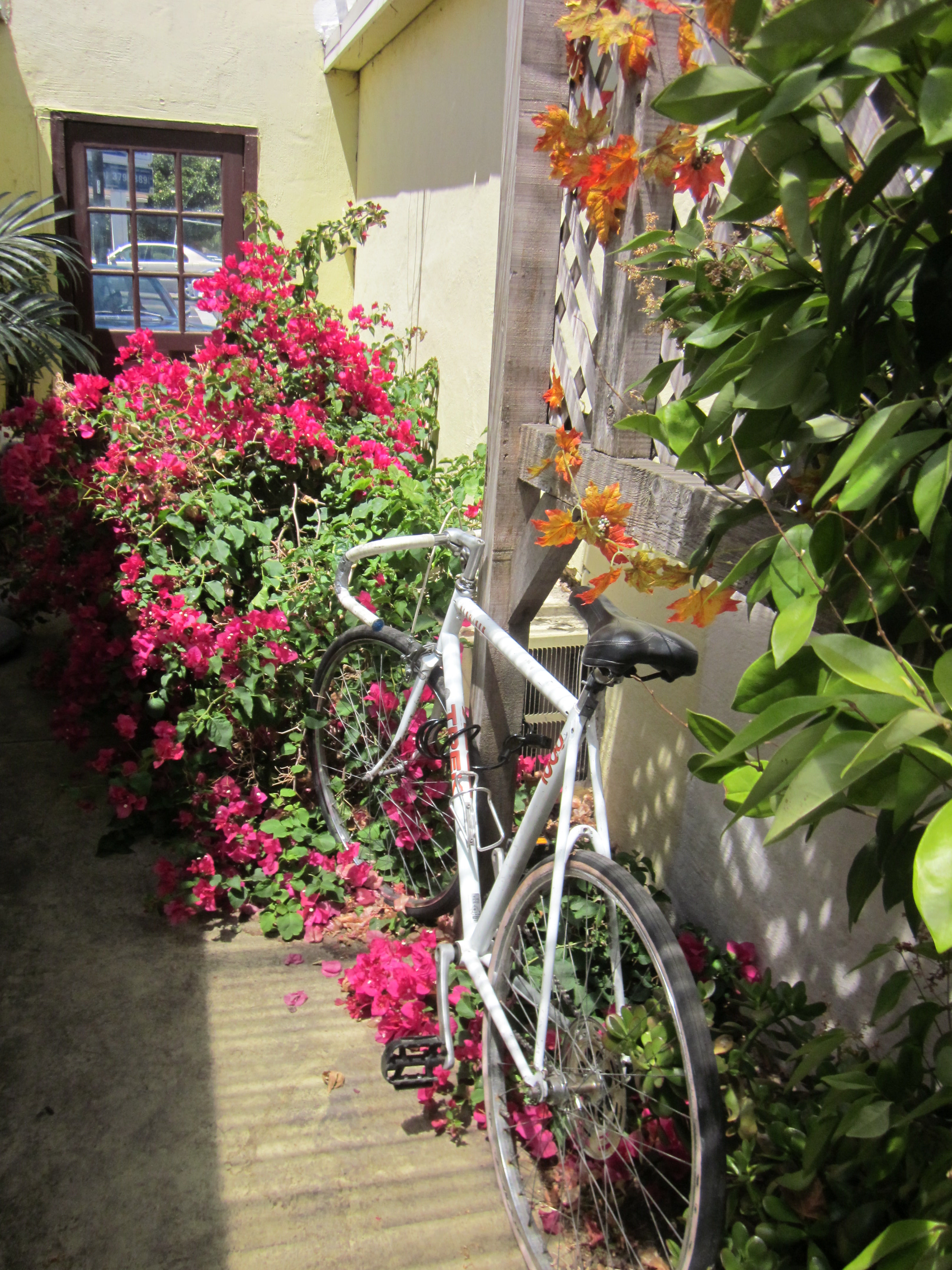
We spotted this bike parked in the flowers at lunch while we were in the South Bay last week. Not a family bike, but it was so pretty there.

So next week, we are headed to Seattle and Portland and their many family bike shops to try out every cargo bike we can find (and if you’re a local, we’d love to meet you while we’re there! We’ll be attending both cities’ August Cargo Bike Roll Calls and the Portland Kidical Mass.) This isn’t the only reason we’re going: we’re also visiting my mom and we have friends in the area who’ve never met our kids. However the bike issue, in combination with the tens of thousands of frequent flyer miles Matt has racked up going to China for work, made the decision to head north pretty easy. With any luck, by the time that school starts we will have a family bike that can take all of us anywhere we want to go.

15 Comments

Filed under bike shops, electric assist, family biking, San Francisco

It’s electric!

The bike in front is electric, and arrived just in time for the Electric Slide at Sunday Skate.

I’ve been seeing a lot more electric bicycles around San Francisco. I’ve been seeing a lot more bicycles, period, around San Francisco. Part of that is the season, of course, but there’s also this bicycle boom that everyone’s been talking about. San Francisco ridership has supposedly increased 71%. And every new bike lane that gets striped in this city (8th Street lanes just went in to rave reviews) makes this more likely to continue.

Just another July afternoon in San Francisco. They don’t call it Fog City for nothing.

When I look up some of the steeper hills in this town I often find the prospect of riding my bike daunting, at least when the kids are on board. Having grown up in the Seattle area, I’m rarely fazed by any local weather. (Our bike shop complains that many people give up riding at the first hint of fog. If I felt that way I’d ride maybe 15 days a year.)

Mild to moderate hills are okay too, although they grow less fun as I add live weight. But there are also the steep hills. And there are a lot of them. They are off-putting. This is especially true at the end of a long day at work, as the route home ranges from mildly uphill to steeply uphill most of the way back. On days that it feels like too much, sometimes I put the bike on the shuttle.

Occasionally I hear people say that unless you live or work on a steep hill, you can avoid riding the hills in San Francisco. My first thought is, “It’s more like live AND work on steep hills, actually.” My second thought is to wonder what they’re smoking and where I can get some. I suppose if you lived in the Mission and never went anywhere else but the Financial District that this could be true. My understanding is that this is, predictably, the chosen stomping ground of San Francisco’s fixie community. And it’s certainly possible if you drive everywhere that isn’t flat, but that isn’t really avoiding the hills, is it? If you have kids, there is the school commute unless you homeschool, and the museums and birthday parties regardless, and many people have been known to want to leave their immediate neighborhood occasionally as a matter of personal preference. Technically it’s POSSIBLE to live housebound, even with children, but it hardly seems worth it. I do not find it surprising that people who say that they avoided the hills in San Francisco are always people who used to live in San Francisco. There’s no point in paying city rents if you’re not going to go anywhere.

BionX: a handy upgrade for a pretty bike.

I now realize that I have come relatively late to the idea of electric assist in San Francisco, because I have been seeing assisted bikes everywhere this summer. Other people were smarter than we were, and simply paid upfront to enjoy the ride. On the way to work I’m sometimes passed by a relaxed gentleman in a suit and tie sitting bolt upright on his bike, peacefully meandering up the steepest part of the hill up as I turn off, panting, to take the longer, shallower incline. He confirmed when I asked, that yes, he rides a pedal-assist electric bicycle (it is silent, and he is a lot faster than I am, so it was hard to get a good look). “I love it!” he said. When I look at bikes parked at racks around the city now, there is usually at least one with a motor and battery. Some friends whose daughter attends a top-of-a-hill school recently started commuting on a trailer-bike attached to an e-bike. They plan to buy a second matched set when  their youngest starts kindergarten in August.

When we started down this road, I had little idea that there even was such a thing as an electric-assist bicycle. This is the problem with getting the inspiration to commute by bike while in Copenhagen. The more I talk to people we know, the more I realize that I am not the only one who didn’t realize there was a way to handle the steepest hills that didn’t involve being a Tour de France rider on a bike that weighs less than a newborn baby. But this is changing fast, and I suspect the realization that an electric-assist bicycle can easily move a family up to the top of Mt. Sutro or Potrero Hill will eventually become common knowledge.

I read a review of The New Wheel that said adding electric assist to a bicycle makes San Francisco as flat as Copenhagen.  I think this is true. Electric assist makes riding a bike in San Francisco accessible even to parents hauling kids, groceries, and gear. Many of the incentives to ride a bike in the city (extensive bike lanes, mild weather, a new bike share program, respectful drivers, horrific traffic, and wildly expensive auto parking) are already in hand or in progress. Even still, nearly every American city still has something missing that could turn bicycles from a lunatic fringe activity to a normal way to get around. In San Francisco, I’d put money on that something being electric assist.

2 Comments

Filed under commuting, electric assist, San Francisco

Spotted in Hayes Valley: The Faraday Porteur

New Hayes Valley parklet (not the park built on a closed street)

Although I don’t get much chance to socialize with adults given that we have two little kids, I try to meet my sister every once in a while. The last time, she suggested we meet in Hayes Valley, near Civic Center. I hadn’t been to Hayes Valley in a long time, and it turns out it’s a nice ride over. The entire neighborhood has been shifting in character from a seedy strip off the freeway to a shopping and dining destination. Part of that transition involved closing off a major street to car traffic, and building a park where the cars used to be. It was filled with families, even though Hayes Valley itself is more of a hipster neighborhood, packed with expensive housewares stores, wine shops, and expensive restaurants. It is a fantastic place to hang out, and I was not the only person who thought to ride my bike there: the racks and parking meters were packed.  It was one of the rare summer days in San Francisco that was not foggy and cold, and I pitied the drivers stuck in their cars, fuming as they searched for parking. That used to be me.

The Faraday Porteur

I met my sister at Propellor, which is kind of a hyper-local version of Design Within Reach. Propellor was an odd location to find a bicycle, other than the one I’d locked up outside, but a bicycle there was. It was, in fact, an electric bicycle, the Faraday Porteur, a creation of IDEO/Rock Lobster that was the Oregon Manifest People’s Choice winner. Oregon Manifest was a 2011 competition intended to encourage designers to create the ultimate utility bike. Given that hauling kids was not even a criterion in the Oregon Manifest, it was hard for me to take much of an interest. But although the Faraday reflects the goals of the Manifest rather than of many actual utility cyclists, it is an interesting bike nonetheless.

There are some issues that arise when attempting to market a bike in a modern housewares store. The main one is that the people staffing the store clearly had no idea what they had in their window, other than that it was an electric bike, and then only because it said so on the sign. I had a lot of questions, and they didn’t have a lot of answers. Eventually they found a brochure, and that helped. They are planning to sell the Faraday, which is actually going into production. With luck they’ll have someone in the store who can explain what it actually does by then. I’m interested to see how the whole sales process goes. They’re clearly reaching a market of people who would not normally spend a lot of time in bike stores. What will happen after one of them actually buys a bike is something of a mystery.

Front hub motor, apparently

The Faraday Porteur is clearly an effort to make utility bikes seem cool. I recognized from the front hub that it was an electric bicycle even without seeing the sign, but couldn’t spot the batteries. The brochure revealed that they were packed into the double top tube.  Although I think packing the batteries in the frame is a fantastic idea, I wonder about the choice to put them in a double top tube. You can forget about adding a rear child seat given that frame; you’d roundhouse your kid every time you got on the bike. Putting that much weight in the top tube seems like it would make the bike harder to balance, and my brother-in-law wondered what happened when someone needed to replace the battery. And the whole bike seemed designed for a sporty ride; there’s no way to ride upright on that frame. Maybe it’s meant to appeal to people who would otherwise ride fixies?

Those quibbles aside, there is a lot the Faraday gets right. The frame-mounted front rack comes off and on with one hand, and it is large enough to haul serious cargo. The mount for that rack has two headlights built into it, and the rear of the bike has an integrated taillight. They were very, very sweet. The electric assist (which is a pedal assist, but I got that from the website, not from the confused staff at the store) is beautifully integrated into the bike, looking exactly like a left-hand shifter. It’s not a particularly powerful assist, but for this kind of bike, I doubt it needs to be. And there is no question: this is a very pretty bike.

Pretty, but vague on the details

The Faraday got a lot of attention while we were there, from people who didn’t have my kinds of questions. Theirs were more along the lines of, “When will you have them in stock?” and, “How much will they cost?” The store couldn’t answer those questions either.

In a neighborhood like Hayes Valley, a bike built to carry a case of beer easily, rather than a kid, is right on target. The Faraday, which takes the brutality out of climbing the city’s hills and makes it possible to haul everything a single person could need,  was clearly making riding a bike seem practical to people who would never consider it otherwise. I hope they sell thousands of them, and that the next time I’m in Hayes Valley, I see them everywhere.

1 Comment

Filed under cargo, commuting, electric assist, San Francisco

San Francisco destinations: The New Wheel

This is actually quite an accurate depiction of what it’s like to ride an electric-assist bicycle in San Francisco.

A few weeks ago, we checked out a new bike shop in San Francisco, The New Wheel. The New Wheel is marketing itself to a particular niche in San Francisco, and I suspect they will be successful. They sell only electric pedal-assist bicycles.

For this trip I rounded up two other families from our daughter’s preschool to keep us company and so I could get the opinions of people who’d never ridden electric-assist bikes before. Preschool was the obvious place to recruit other families interested in electric-assist bikes; as Matt puts it, the building “looks down on us like a Tibetan monastery.” From asking around, we knew that other biking parents (okay, dads) had tried to haul kids up that hill in trailers and on bikes. Like us, they’d given up after a couple of tries.

Electric-assist bikes: interesting!

Cyclists in San Francisco do not give up easily. There is no avoiding the hills in this city, and there are a few intrepid riders who climb preschool hill every day solo. But not pulling a trailer, which one dad reported actually dragged him back down the hill while he was attempting to pedal up. I have discussed before the reasons that parents in the city don’t typically ride with trailers (can’t be seen in traffic, don’t fit in bike lanes): that’s another. Let’s not even discuss what it would be like back going down that same hill. In summary it would be fair to say that there is intense interest in electric-assist bikes in our preschool community.

So we all headed to The New Wheel one Sunday. It was fascinating. In a lot of ways, The New Wheel is not yet our kind of shop. Although they are interested in the family market, they are most strongly focused right now on pedal-assist bikes for commuters. They can attach a child seat or a trailer or a Burley Piccolo to their bikes, but they don’t offer cargo bikes. It turns out that there is a reason for this.

These are the kinds of bikes they sell.

What I learned from the owners at The New Wheel is that there is a wide range of reliability in electric assists for bicycles, and particularly in batteries. As they are focused not just on selling equipment but maintaining it, there is a very short list of systems that they felt were worth selling: BionX and Panasonic. BionX motors sit in the rear hub and respond to torque on the pedals; the harder you push, the more help you get. I’ve written about riding with the BionX before. The mid-drive motors attach to the chain, and add power throughout the gear range. These are stronger motors, but they are significantly more expensive and they work best when riders maintain a steady cadence. After trying one, I can attest that doing that involves a learning curve.

For the time being, this is the only kind of family bike that The New Wheel is selling.

Because they are very interested in the family market they had considered stocking the Yuba elMundo, which comes with the eZee assist. However they found that customers had so much trouble with eZee motors and batteries, which evidently have a nasty habit of cutting out in the middle of the hills where people need them most, that they are negotiating with Yuba to develop and sell a BionX-assisted Mundo instead. The trade-off for increased reliability, of course, is a higher price.

Having this discussion with them made it pretty clear that for our needs, a BionX system is probably our best choice. After-market mid-drive motors, although they themselves are great, evidently have some of the same battery issues that other systems do, namely that there are not many consistently good ones, and no one is currently making cargo bikes with the integrated Panasonic assists. So it would seem that BionX is the most reliable option for cargo bikes, unless you know a lot about batteries or get lucky.

All these bikes have the motor integrated into the design; the mid drive motors are placed inside a massive chain guard.

All of the bikes The New Wheel sells are built as electric-assist bicycles from the ground up, and they all come with integrated BionX motors (e.g. the Ohm line) or integrated Panasonic mid-drive motors (the German bikes). They felt both of these systems worked well on steep hills. The mid-drive motors were more useful for weaker riders. One of their customers, an older woman with a recent hip replacement, was using one of their mid-drive motor-assisted bikes to commute up to the top of the Berkeley hills every day. That is an extremely long and unforgiving grade.

Having already tried a BionX-assisted bike in Portland, I went out for a test ride with one of the preschool dads, Paul, on a mid-drive bike. He took an Ohm with a BionX assist. I was very curious about how it would feel to ride with the more powerful mid-drive motor. The New Wheel is conveniently located in Bernal Heights, next to some brutally steep slopes. After taking some time to figure out how our respective assists worked, we rode up and down the hills for a while. It was such a hoot!

When I rode with a BionX, I liked that it felt seamless with the pedaling and was almost completely silent. Other than feeling like I’d grown massively stronger, I barely noticed the BionX was there.

I rode the extremely girly “Emotion” bike. I’m not particularly proud, but this kind of marketing leaves something to be desired. Bad manufacturer; no cookie!

The mid-drive motor was different. It makes a slight rattling sound as the chain runs through the motor, which I found kind of annoying. It was hard to tell that it was more powerful, because the assist felt so subtle. I suspect for riders who are already used to going up hills, there may be less difference between the two systems until the cargo load gets quite substantial. And it was hard for me to maintain a steady cadence and pressure instead of reacting to the hill by gearing down and pushing harder, which meant that I wasn’t getting the greatest benefit from the system. As a result, Paul consistently passed me on the way uphill even though I had a stronger motor.

So although I liked riding up hills with the mid-drive motor, especially hills that I could barely move on by myself (I tried turning the assist off halfway up the hill a couple of times; it was unspeakably brutal), I didn’t like it any better than riding a BionX-assisted bike. Yet I suspect that I would feel very differently about these two systems if I were a novice rider. The owners of The New Wheel said that in fact they steer experienced riders to the BionX-assisted bikes like the Ohms, and novice riders to the mid-drives. I suspect that’s because if you have practice going up hills already, you’d have to relearn how to ride effectively with the mid-drive motors. Basically you have to convince yourself that neither the motor nor the hill is there, and just pedal blissfully on. In contrast, if you’re getting an electric bike in order to start riding a bike again, you don’t have to unlearn any existing hill-climbing habits. This information, by itself, was worth a trip to The New Wheel.

My son’s desire for this bike has not waned in the slightest.

I would be remiss if I didn’t also mention that The New Wheel is really, truly committed to family biking, even if they don’t yet stock any real family-hauling bikes. The proof was in their children’s bikes, which were the nicest I have ever seen. The preschoolers could not stop riding their gorgeous balance bikes. Our son test-rode a beautiful 20” Torker (not listed on their website) and has been begging us ever since to trade in his Jamis for this bike. He is willing to put his entire saved allowance to the cause. This was, however, not even the nicest bike available; they do not currently stock, but they do sell, a German bike for kids that comes with an internally geared hub, dynamo lights, fenders, a double-kickstand, and a chain guard. They said they didn’t stock it because they assumed that no one would be willing spend that much money on a kid’s bike. I only wish The New Wheel had been in business when we bought our son’s bike last Christmas. It would have spared us a trip across the bay and he’d be on a better bike right now. At any rate, if you are looking for a child’s bike, I have never seen a higher-quality collection. And they also have very nice children’s helmets, and they know how to fit them, too.

The New Wheel: stop by and check it out!

If I were in the market for an electric-assist commuter bike to handle the steepest San Francisco hills, I would start at The New Wheel. It is a great shop with incredibly nice owners and they are impressively informed about electric assists. We will almost certainly return when it is time to buy another kid’s bike. My only regret is that they do not yet sell family-hauling cargo bikes that can handle steep hills. For that, you still have to go to Portland.

10 Comments

Filed under bike shops, destinations, electric assist, family biking, San Francisco, trailer-bike, Yuba Mundo