Tag Archives: family biking

Transportation resources for car-free (and car-light) families, in San Francisco and beyond

When we sold our minivan, one of the things that made it easier not to replace it was the discovery of all kinds of new ways to get around the city without our own car. Realizing there were all these options that offered a safety net helped us finally make a decision. The resources below are so ridiculously exhaustive that we would be hard-pressed to use them all regularly, so we don’t. When we need to get somewhere, we primarily ride our bikes, walk, or take transit, in that order. Every once in a while, for a longer trip, we rent a car from City CarShare or Matt rents one from an agency for a business trip.  Everything else listed below fills in the occasional gaps. For example: my employer, as part of its commitment to reducing car commuting, will reimburse the cost of a ride home from work in the event that a non-driver has a sick kid or bicycle breakdown. I am willing to use some of the more expensive services I’ve listed in emergency situations because time is an issue, and because I know that I’ll be reimbursed. Other companies in San Francisco have similar programs, but they’re poorly advertised, so check with HR before you decide to smack me for being so lucky.

Overall, our bikes are the best transportation choice on most occasions: they are personal vehicles that we can use at our discretion, they’re largely immune to traffic, and we can always find parking. This is why it’s often faster to ride a bike than to drive in San Francisco. But there are occasions that these other options really shine, and they might work even better for other families, and they’re so interesting I thought they were worth documenting in this outrageously long post.

Some useful tools for the car-free family:

  • Cash: Transportation is one of the final holdouts of a cash economy, along with Chinese restaurants, cooperative bakeries, and gambling. I carry around more cash than in the past.
  • Credit card: That said, the majority of ride-sharing services don’t work unless you have a credit card on file.
  • Transit cards: The miserable days when we had to make sure we had two singles in order to ride Muni disappeared when we purchased Clipper cards.
  • Smartphone: I did not get a smartphone until last week, because I live in my own personal Dark Ages. But there is no question that it makes the car-free life easier. Now I can look up bike routes, the next bus, or schedule a car ride instantly. The BayTripper and PocketMuni apps are particularly helpful, as is Bikesy (the bike route mapper for Baytripper).
  • RideSafer travel vests or other portable car seats: We got RideSafer travel vests  as car seat replacements for our trip to Europe last year because they were light enough to meet luggage weight restrictions on European

    Using the RideSafer travel vests in our San Diego rental car.

    airlines. But they are incredibly handy for travel with kids; two fold up small enough to fit in a backpack with room to spare for snacks. Although the kids find them uncomfortable on long trips, they are perfect for short rides. They are pricey but we travel enough out of state that it was worth it to us (also, look for sales; we paid much less than the current price). The vests only work for older kids (arguably 2.5 years and up). However, when we traveled with our son as a baby, we took an infant car seat without the base with us—these styles of car seat all have instructions for installation by seatbelt. And after hearing the stories of such car seats releasing from their bases in collisions, I now suspect that he was safer that way. On occasions when we take longer drives with our kids (e.g. to the Monterey Bay Aquarium) we use regular folding car seats, which now spend most of their time in storage.

  • Folding cart/stroller: It’s nice to have a way to haul kids and/or groceries around. When our kids don’t want to ride a bike to the farmers’ market, we take the stroller and pile up purchases underneath, or we take a folding shopping cart (ours actually works as a cargo-only bike trailer as well).
  • Named non-owner auto insurance policy: If you don’t own a car, but drive, you can still buy auto insurance. We’re on the fence about whether to get a policy like this. It’s not necessary for a lot of car sharing services, which have great insurance (better than you could buy as an individual). But if you’re in a situation where you rent a lot, and have to use national rental agencies, it could be a good deal.

Just the basics (for the more interesting options, skip down to #8)

1. Feet

  • What they are: Look down.
  • When to use them: Local shopping and neighborhood restaurants, visiting local friends and attractions
  • How they work: If you’re able-bodied you know this already.
  • Pros: Good exercise; helps us learn about the neighborhood; we live in San Francisco so everything we need to live is within walking distance
  • Cons: Limited range (especially if kids are involved); limited ability to carry stuff; slow
  • What it costs: Free!
  • Good to know: We can walk further than we think we can, even when carrying a grumpy six-year-old uphill.
  • Personal experience: We like walking; early dates with my husband were long walks.

2. Bicycles (the practical kind, not the road racing/mountain biking kind)

  • What they are: Those things on two wheels most people learned to ride as kids; but if you didn’t, the San Francisco Bicycle Coalition will teach you how to ride in a couple of hours.
  • When to use them: Virtually anytime, although in San Francisco it can be a little tricky to get outside city limits on bikes when heading east
  • How they work: Hop on and ride off
  • Pros: Good exercise; faster than cars in traffic; never worry about parking; some bikes can carry more than cars; kids love riding on bikes
  • Cons: Can take some practice to learn to ride in the street with cars; can fuel an obsession that becomes more expensive than planned (although way cheaper than a car) and unnerves friends and colleagues; theft is a problem in San Francisco (although a recent arrest has improved matters dramatically)
  • What it costs: Ranges dramatically, from $50 for a beater bike found on craigslist (quality unknown) to $3,500 for a snazzy new cargo bike, but without kids almost everyone will do fine walking out of the local bike shop on a $500 commuter, with kids ditto on a $1500 cargo bike. Any decent bike shop will let you test ride extensively before purchase. Electric assists for hills and heavy loads run $500-$5,000, but most reliable models run $1,000-$2,000. Maintenance and repair costs are bupkis, even for electric assist bikes, which recharge for pennies.
  • Good to know: If you’re hauling kids you probably need more bike than you think you do. Many people buy a first bike that’s inadequate for their needs and have to replace it (guilty as charged). But even the most wildly expensive cargo bike with electric assist costs less than the estimated cost of car ownership for a year. And also less than an amateur road bike.
  • Also good to know: If you fear breakdowns, you can buy nationwide bicycle roadside assistance from Better World Club.
  • Personal experience: This is our favorite way to get around.

3. Public transit (around here, primarily the San Francisco Municipal Transportation Agency, aka Muni, but also systems around the bay for trips outside the city including BART, Cal Train, and Golden Gate Transit)

  • What it is: Buses, street cars, trains
  • When to use it: When it’s too far to walk; when the bike breaks down; when feeling lazy or when the hill situation or route is unclear in advance; when we have lots of time
  • How it works: Find a route using a trip planner (Baytripper app, 511 through Google Maps), head to the nearest stop, pay, and get on. In SF, the Pocket Muni smartphone app can identify how close the next bus (or whatever) is.
  • Pros: Inexpensive; accessible; nice views; riding historic streetcars and cable cars is a thrill; meet an incredibly diverse cross-section of city residents, most of whom are kind
  • Cons: Horribly unreliable (Pocket Muni can help, but still); aging equipment that breaks down; dirty; the most useful routes are often incredibly crowded; meet an incredibly diverse cross-section of city residents, some of whom are mean and/or insane
  • What it costs: In SF, $2 for adults, 75 cents for kids but cable car rides are $5; to go outside the city, costs vary but are still cheap. Fares are cash and exact change only unless you buy a Clipper card.
  • Good to know: Public transportation is like getting work done at a dental school: the price is right, there are no perks, the service is as promised but it takes a long time.
  • Personal experience: Very useful, but flawed (however I feel the same way about cars)

4. Taxis

  • What they are: Cars driving around that will take you wherever you want to go on a fare schedule negotiated with the city in advance
  • When to use them: Only when we’re desperate
  • How they work: Call in advance for a pickup and hope someone actually comes, hail one on the street and hope it actually stops
  • Pros: Only car service legally allowed to pick up street hails; gets you anywhere you want to go at a predictable price
  • Cons: San Francisco’s taxi fleet is notorious for poor availability, the willingness of dispatchers to lie about sending a taxi for a pickup, the unwillingness of drivers to pick up people that don’t look rich and well-groomed, etc. The cars themselves are often filthy and I say this as a Muni rider. Drivers pay little attention to traffic laws or speed limits. All taxis in San Francisco are supposed to take credit card payments but trying to pay that way can anger drivers enough that they threaten passengers and/or throw their belongings on the ground. This has happened to me.
  • What it costs: $3.50 at pickup then 55 cents per fifth of a mile or minute of wait time, plus tip
  • Good to know: You can do better, see below.
  • Personal experience: Primarily hellish, although there have been exceptions

5. City CarShare (see also: Zipcar)

  • What it is: A membership service for borrowing cars. These are parked around the city in reserved parking places.
  • When to use it: When we have a reason to drive somewhere.
  • How it works: Apply for membership and pay the fee; if you don’t drive like a maniac and have a valid credit card, you’re in. Once enrolled, members can reserve any car in the system online or by phone (there is a smartphone app for droid phones, but not yet for iOS). They send you a key fob in the mail; when your reservation begins, swipe it on the reader in the front window to unlock the car. At the end of the reservation, swipe the fob on the reader to check the car back in.
  • Pros: For occasional drivers who live or work near pods, it’s much cheaper than owning a car and more convenient. For complicated trips (hauling six kids, going to Ikea) there are pickup trucks and minivans to rent. For people who like cars, there are interesting vehicles to drive: Mini Coopers, Smart cars, electric cars.
  • Cons: Need to schedule trips in advance and be aware when the reservation is ending or there will be late fees. Cars must be dropped off at the pod of origin, so all trips must be round trips, and members are responsible for parking in the interim. Not all members are responsible about bringing vehicles back on time or refilling the gas tank, which can be a hassle (although people who don’t live near a university like we do report fewer problems of this nature). Car sharing can be expensive for frequent users. May not be worth joining if pods are far away (unless you have a Brompton!)
  • What it costs: We pay an annual membership fee plus a set rate when using a car ($1-$9/hour) plus a mileage fee (35 cents/mile). Each membership comes with a certain number of “day trips” allowing a 24-hour rental ($48-$70/day plus 10 cents/mile) and more day trips can be purchased for $12 each. Membership includes insurance, maintenance, roadside assistance, tolls, and gas (or charging if an electric vehicle). Fees are charged at the end of the month to a credit card on file.
  • Good to know: Car share services have reciprocal relationships with their counterparts in other cities. Zipcar is more expensive and has poorer insurance than local nonprofit options.
  • Personal experience: Good; historically we’ve rented through City CarShare once every couple of months, although this has now increased to 1-2 times/month.

6. Rental car agencies

  • What they are: An ad hoc service for borrowing cars
  • When to use them: Longer-term rentals or business/out-of-state travel
  • How they work: Call or book online to reserve a car, hope we get something like what we requested
  • Pros: Lots of different cars available; no extra charges for long trips
  • Cons:  Most agencies require customers to come to them but don’t provide rides, which can be inconvenient (exceptions: City Rent-A-Car in SF, Enterprise nationwide). Insurance and gas are the responsibility of the renter. Cars tend to be in poor condition (relative to car-share vehicles) and it is obvious that some people smoke in them. Rental agencies tend to dump gas guzzlers onto renters who book economy cars, which is a drag as the renter pays for gas.
  • What they cost: Varies, in SF usually ~$40/day on weekends or ~$400/week plus gas, insurance for an economy car; credit card payment required
  • Good to know: Local agencies like City Rent-A-Car typically have better prices, cars, and service than national chains; airport pickups involve substantial additional fees
  • Personal experience: Tolerable, used for business trips but only because Matt’s company makes the reservations

7. Limousines/livery cars

  • What they are: Private car service for passenger trips
  • When to use them: When scheduling a one-way trip in advance, e.g. to the airport, in which case they are almost as cheap as cabs or airport shuttles for a family of four but vastly more reliable (at least in San Francisco)
  • How it works: Call a dispatcher or book online, usually several hours in advance
  • Pros: Cars usually come when scheduled or earlier; cars are clean; drivers obey traffic laws
  • Cons: Some services are more reliable than others; expensive; with kids a portable car seat may be needed although some provide child seats on request
  • What it costs: $55-$65 for an airport ride regardless of the number of passengers; other pricing is hourly or zone-based and typically comparable to or slightly more expensive than a cab (we only use these for airport trips so I’m ignorant); credit card payment required, tips often included
  • Good to know: Dealing with individual companies is a thing of the past thanks to Uber; see below.
  • Personal experience: We decided it was worth the money to take limos to the airport after a couple of incidents where cabs and airport shuttles didn’t bother to show up.

Peer-to-peer and beyond (this is where things get interesting!)

8. Bike trailer loans: If you’re a member of the San Francisco Bicycle Coalition, you can reserve and borrow Burley Travoy or Bikes at Work trailers for heavy cargo loads. Included for no additional cost with membership! (no personal experience)

9. Bike rentals: City CarShare is rolling out an e-bike plus cargo trailer rental option late in 2012, rates to be determined. Most of the other bike rental options in San Francisco are geared to tourists, but might be useful for family visiting from out of town; check Yelp for deals. San Francisco universities have relationships with a local bike shop that allows students and other visitors to rent a Trek 7.3FX commuter bike for a day ($25), multiple days ($12.50/day), or a semester ($175), contact milanal@lombardisports.com. (no personal experience)

10. Employer and transit shuttles: Some employers and neighborhoods offer free shuttle service to various locations throughout the city. Amtrak also takes people across the bay for no charge. If you’re near the route, these are the best deals in the city. Technically I work for the state so although my employer’s shuttles are primarily for staff and patients, anyone can ride them—see also PresidiGo, SF City and County, Nordstrom. Driver quality is better than cabs but worse than limos. In San Francisco, check university websites or Yelp for details on shuttle rules and routes, or ask around. Personal experience: Excellent

11. Casual carpool/slugging

  • What it is: Some cities, like San Francisco and DC, have established ad hoc car pool locations for regular commuters. In the Bay Area, drivers pick up passengers in order to use the car pool lanes on the bridges into the city.
  • When to use it: When you want to get into the city more quickly and cheaply than you could alone and the routes and times make sense
  • How it works: Head to a pickup location as a driver/passenger, then pick-up the next two people in line/hop in the next car that pulls up. Drop off/get out at the drop-off site.
  • Pros: Cheap; fast
  • Cons: The etiquette around payment of carpool tolls has not yet been established for passengers (some drivers ask for a contribution). Some people freak out about the idea of getting into a stranger’s car, although this is mitigated by the fact that drivers typically pick up two passengers (women passengers often refuse to join a two-seater vehicle in the casual carpool line; I know I did when I was using casual carpool).  The routes and times don’t work for everyone.
  • What it costs: As a passenger, up to $1, but often free. Drivers pay normal commuting costs but a lower toll.
  • Good to know: It’s nice that such cooperative arrangements can spring up organically, isn’t it? Sure, it’s not everyone riding their bike or transit to work, but casual carpool gets lots of cars off the road and reduces traffic.
  • Personal experience: I rode casual carpool for several months when we lived in Berkeley and it was pleasant enough.

12. Zimride

  • What it is: A formalized casual carpool; drivers taking long trips or regular commutes post rides to potential passengers
  • When to use it: Long road trips in lieu of Greyhound; also, large employers use the service to arrange regular carpools
  • How it works: Check out the website for posted rides and dates; sign up if there’s one that works and arrange pick-up/drop-off with the driver
  • Pros: Cheaper than driving alone; less grungy than the bus; can get picked up somewhere near where you live
  • Cons: Somewhat complicated to arrange; some people freak out about getting into a stranger’s car; ride timing dependent on the driver
  • What it costs: Varies; check website but SF to LA seems to run ~$50 per passenger (by comparison Greyhound is $45-$65 for the same trip, plus the cost to get to the station)
  • Good to know: There’s definitely a college student vibe to this service. Lots of discussion of music; unlike casual carpool, don’t assume you’ll be listening to NPR on this ride.
  • Personal experience: Nada, although my employer runs all its carpools through Zimride, which suggests it is decent.

13. Sidecar/Lyft

  • What it is: Peer-to-peer donation-based ridesharing
  • When to use it: When we want a lift across town for less than the cost of a cab that’s quicker than public transit, or when we don’t want to stand on the bus
  • How it works: You need a smartphone. Download the app and create an account with your credit card information. When you want a ride, open the app and request one. It will tell you how far away the nearest driver is and suggest a donation based on past community standards. If you accept, the driver will swing by within a few minutes and take you to your destination. The donation is charged to your card on file.
  • Pros: Cheaper than a cab, faster than public transit
  • Cons: Mainly the usual freak-outs about getting into a stranger’s car, although drivers are screened, interviewed, and rated after every ride by the service and by their passengers (personally I’ve had much worse experiences in taxi cabs than I’ve ever had while ride sharing). Negotiating the suggested donation can be tricky if driver and passenger don’t agree. Taking kids can be an issue if you don’t have a portable car seat as suggested above.
  • What it costs: Varies, check the apps but seems to run approximately $1/minute; e.g. the community average for a trip from the Inner Sunset farmers’ market to the Financial District was $22, compared to an estimated taxi fare of $32 before tip
  • Good to know: Sidecar seems to have better coverage in San Francisco. Lyft is associated with the successful Zimride, but seems organized to primarily appeal to college students.
  • Personal experience: I looked up a ride with Sidecar recently when my sister’s rental car was hit and I thought I needed a quick way home; although I didn’t book, they said they had a car three minutes away and would get me home for $8. Further updates as events warrant. I suspect I’ll use this service eventually.

14. Homobiles: Moes gettin hoes where they needz to goez! [ho status optional]

  • What it is: A donation-based ride-sharing service for the LGBTIQQ community and friends in San Francisco. Homobiles was started after its founder heard too many stories of cab drivers in San Francisco refusing to stop in the Castro, or stopping and then soliciting passengers for sexual favors, or kicking same sex couples out for kissing in the car, or commenting negatively on bondage gear, or sharing unsavory opinions about the gay community, and so forth.
  • When to use it: When you want a cab but don’t want a cab driver
  • How it works: Text (or call) a request for a pick with your location, number of passengers, and any special requests to Homobiles at 415/574-5023. They’ll text back with your pickup time if they have a driver available (sometimes they don’t, but at least they’ll tell you) and off you go.
  • Pros: This is a donation-based service that wants people to feel safe, so they’ll give you a ride even if you can’t pay. No one will hassle you for looking queer, obviously. Some of their cars have bike racks.
  • Cons: Cash only. Sometimes there’s no driver available. Taking kids can be an issue if you don’t have a portable car seat. The name might freak out relatives from less urban locales.
  • What it costs: $1/minute anywhere in the city. $30 flat fee to San Francisco Airport (this may be our future airport shuttle!) Tips not included.
  • Good to know: Drivers will sell you a Homobiles t-shirt or hanky as a fundraiser (like every other ride sharing service, they’re being sued by SF taxi companies, but they’re they only one without venture capital backing).
  • Personal experience: Haven’t used it yet, but I’ve heard nothing but accolades.

15. Uber

  • What it is: A smartphone app-based booking service for limos
  • When to use it: When you don’t have the cash handy for Homobiles or they don’t have a driver available, or you really want to ride in a shiny black car with water bottles
  • How it works: You need a smartphone. Download the app and create an account with your credit card information. When you want a ride, open the app and request one. It will tell you how far away the nearest driver is, what kinds of vehicles are available (for more than 4 people, request an SUV) and the fare. If you book, the driver will swing by within a few minutes and take you to your destination. A tip is included and the bill is charged to your card, with an emailed receipt; this is a cash-free transaction.
  • Pros: Same as limousines/livery cars but with rock-solid reliability and enforcement of good driving behavior (passengers are asked to rank the driver after the ride). Uber prides itself on having cars available at all times, no matter what, even on New Year’s Eve or during Pride.
  • Cons: Expensive; taking kids can be an issue if you don’t have a portable car seat
  • What it costs:$8 base fare, plus $4.90/mile while moving and $1.25/minute in traffic; $15 minimum fare and $10 cancellation fee
  • Good to know: Uber has coupon codes for new members that give $10-$20 off your first ride.
  • Personal experience: None yet, seems pricey (but great reviews on Yelp). I tried to order ice cream for my kids on Uber’s ice cream truck day but they were too busy, which frankly runs contrary to their whole “we will get you a car no matter what” image. I’ll cut them some slack as it was the first time they tried that, but still, hmm.

16. Getaround/Relay Rides

  • What it is: Peer-to-peer carsharing
  • When to use it: Primarily when you want to rent a car for longer periods than are cost-effective using a car sharing service
  • How it works: This is a more informal version of traditional car share. People who have cars available that they don’t use regularly make them available to people who want to rent one. Rates are set by the car owner and listed on the website. When you join (you’ll need a Facebook account) you can pick from a list of available vehicles and request a reservation. Getaround lets you pick up certain cars using your smartphone and an ID reader, but both services default to meeting the car owner and handing over the key. Drive during the reservation window and then return the car as the owner requested. The service provides insurance but the renter is typically responsible for gas.
  • Pros: Typically cheaper than all-day rental using a car-sharing service; much better insurance for the car-free than traditional rental car agencies; often closer to home than other options; owners are usually more relaxed about late drop-offs than car share services are
  • Cons: Handing off keys can be a hassle for non-smartphone enabled cars; rates are somewhat unpredictable; limited availability in some neighborhoods
  • What it costs: Typically $6-$12/hour in San Francisco, with daily rates of $35-$60 (although Getaround’s rental Tesla is much more). Weekly rates are also available. Where we live it’s cheaper than traditional car-sharing for day trips and more expensive for hourly trips.
  • Good to know: Getaround has better coverage and some keyless entry cars in both San Francisco and Portland, which makes renting for short periods more appealing. Relay Rides is national. Car-light folks can rent out their cars.
  • Personal experience: My sister rented a car through Getaround when we took a weekend day trip and it was more exciting than we’d planned, but that wasn’t Getaround’s fault. $50 for the day, and unusually, gas was included. I would rent through Getaround again, especially for longer trips.

Other interesting options that San Francisco does not have yet, but that are available in other cities

17. Bike share

  • What it is: Short term city-sponsored bicycle rentals available from pods scattered in popular travel corridors
  • When to use it: When you have a short one-way trip that’s still too far to walk or would take too long
  • How it works: Typically you buy a membership card, then swipe it to release a bike from one of the locked racks. Ride it to your destination and check it in at a nearby rack. Short trips are free or nearly so and longer trips are expensive. If there’s no space at a given rack, you can get free minutes to ride it to the next closest rack and check the bike in there.
  • Pros: Inexpensive, easy, fun to ride
  • Cons: It might be hard to carry a large load. You probably can’t ride with kids.
  • What it costs: Varies; free to a few dollars.
  • Good to know: California has no helmet law for adults, so don’t let not having a helmet stop you from trying a bike if that’s what it takes.
  • Personal experience: None, unfortunately, but you can bet I’ll try it when San Francisco rolls out its bike share program, supposedly later in 2012. Or maybe 2013. Or maybe never. Sob.

18. Car2go

  • What it is: A short-term rental program for Smart cars run by Daimler
  • When to use it: When you want to drive one-way, alone or with one passenger
  • How it works: You sign up, pay the annual fee, and get a member card to check into cars (typical rules about not driving like a maniac apply here). Cars can be reserved in advance online or by phone, or just wander around until you see a Car2go car with a green light on the reader, wave your card, enter a PIN, and drive off. Park the car in any legal parking spot at your destination, but there’s no need to pay a meter; Daimler negotiates an annual parking fee for its cars with the city and pays it in advance. Members get a gas card with the car and receive credits for filling up if the tank is less than a quarter full.
  • Pros: Seems very useful for last-mile travel for people who don’t want to carry a folding bike; or for emergency sick-kid pickups—e.g. I could schedule a car pickup for us at school and use the time it takes the driver to get to school to drive myself over from work with Car2go
  • Cons: Limited availability; only an option in a few cities; Smart cars only hold two people and there’s no way to install a car seat
  • What it costs:  Rates are the cheapest combination of 35 cents/minute, $13/hour, $66/day (plus 45 cents/mile if you drive the car over 150 miles per day), plus tax.
  • Good to know: Car2go membership recently became transferable throughout the cities where it’s in operation: if you’re a Car2go member in Washington DC, you can also drive Car2go vehicles in San Diego.
  • Personal experience: None, because it isn’t available in San Francisco, unfortunately.

Available anywhere, but use with caution

19 and last on my list: Mooching

My personal feeling is that if I regularly feel the urge to mooch rides, then we’re not really ready to live without our own car. We had one car for over five years, and in that time I can count on my fingers the number of times we asked for a ride, hinted that we wanted one (particularly with kids in tow: who has a spare car seat anyway?), or asked to borrow a car. Given all of the options available to us now, if we start to find ourselves consistently begging rides, I suspect that would be a sign that we should buy a car again.

That said, I don’t see anything wrong with getting a ride occasionally, particularly when we’re traveling. We were very grateful when a friend offered us a lift late at night last year when we were in Paris and we faced a long train ride back carrying two sleepy kids. There are times that people make an unsolicited offer to drive me somewhere, like at work when everyone is headed to another campus for a department meeting. And in those cases I usually say yes because I enjoy their company. And on the occasions that I have a rental car, I’ll often ask people whether they want a lift where I’m going, for exactly the same reason.

Thanks for asking, and thanks for sharing the ride, friends!

3 Comments

Filed under car-free, commuting, family biking, San Francisco

San Francisco destinations: The New Wheel

This is actually quite an accurate depiction of what it’s like to ride an electric-assist bicycle in San Francisco.

A few weeks ago, we checked out a new bike shop in San Francisco, The New Wheel. The New Wheel is marketing itself to a particular niche in San Francisco, and I suspect they will be successful. They sell only electric pedal-assist bicycles.

For this trip I rounded up two other families from our daughter’s preschool to keep us company and so I could get the opinions of people who’d never ridden electric-assist bikes before. Preschool was the obvious place to recruit other families interested in electric-assist bikes; as Matt puts it, the building “looks down on us like a Tibetan monastery.” From asking around, we knew that other biking parents (okay, dads) had tried to haul kids up that hill in trailers and on bikes. Like us, they’d given up after a couple of tries.

Electric-assist bikes: interesting!

Cyclists in San Francisco do not give up easily. There is no avoiding the hills in this city, and there are a few intrepid riders who climb preschool hill every day solo. But not pulling a trailer, which one dad reported actually dragged him back down the hill while he was attempting to pedal up. I have discussed before the reasons that parents in the city don’t typically ride with trailers (can’t be seen in traffic, don’t fit in bike lanes): that’s another. Let’s not even discuss what it would be like back going down that same hill. In summary it would be fair to say that there is intense interest in electric-assist bikes in our preschool community.

So we all headed to The New Wheel one Sunday. It was fascinating. In a lot of ways, The New Wheel is not yet our kind of shop. Although they are interested in the family market, they are most strongly focused right now on pedal-assist bikes for commuters. They can attach a child seat or a trailer or a Burley Piccolo to their bikes, but they don’t offer cargo bikes. It turns out that there is a reason for this.

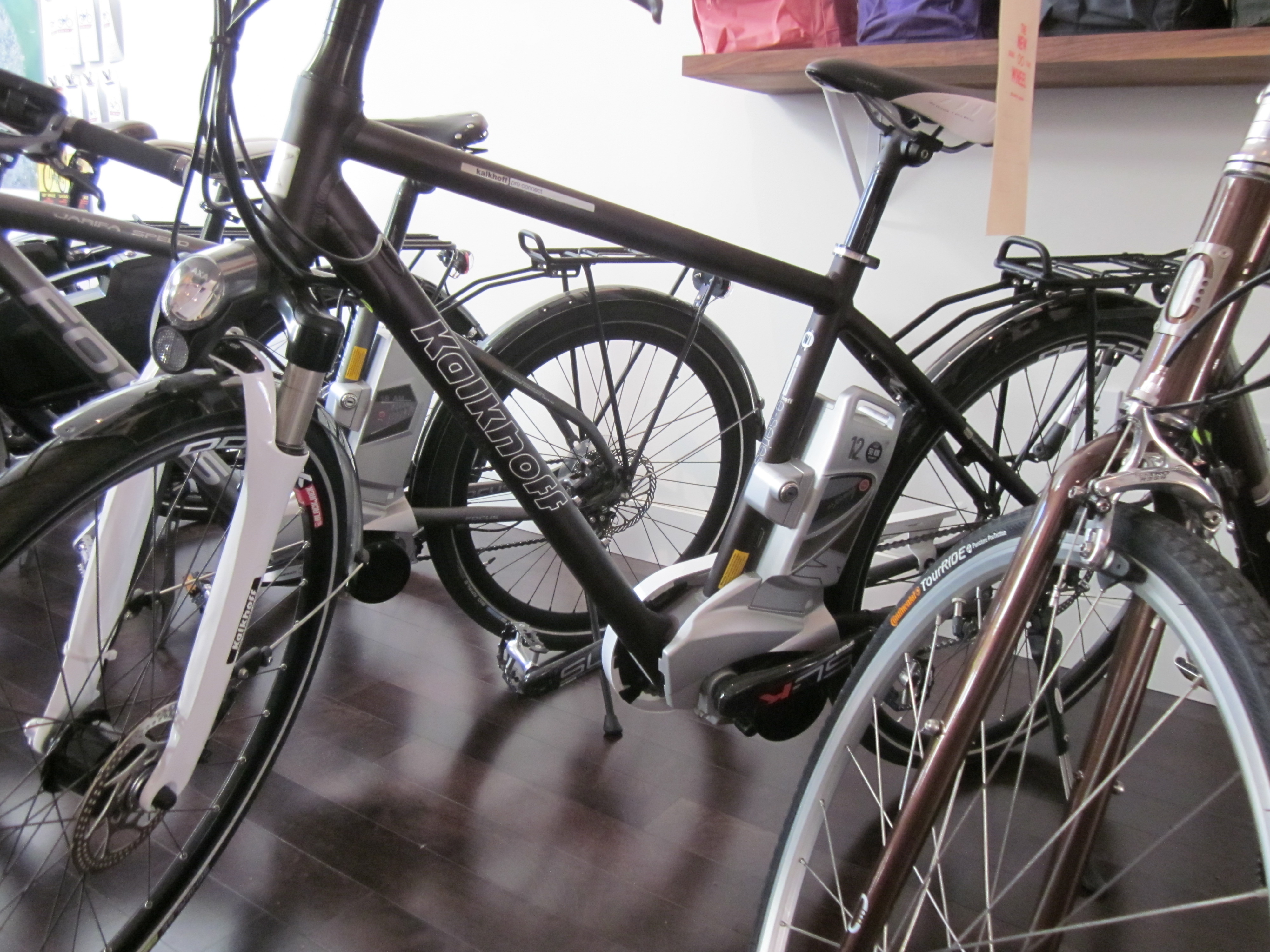
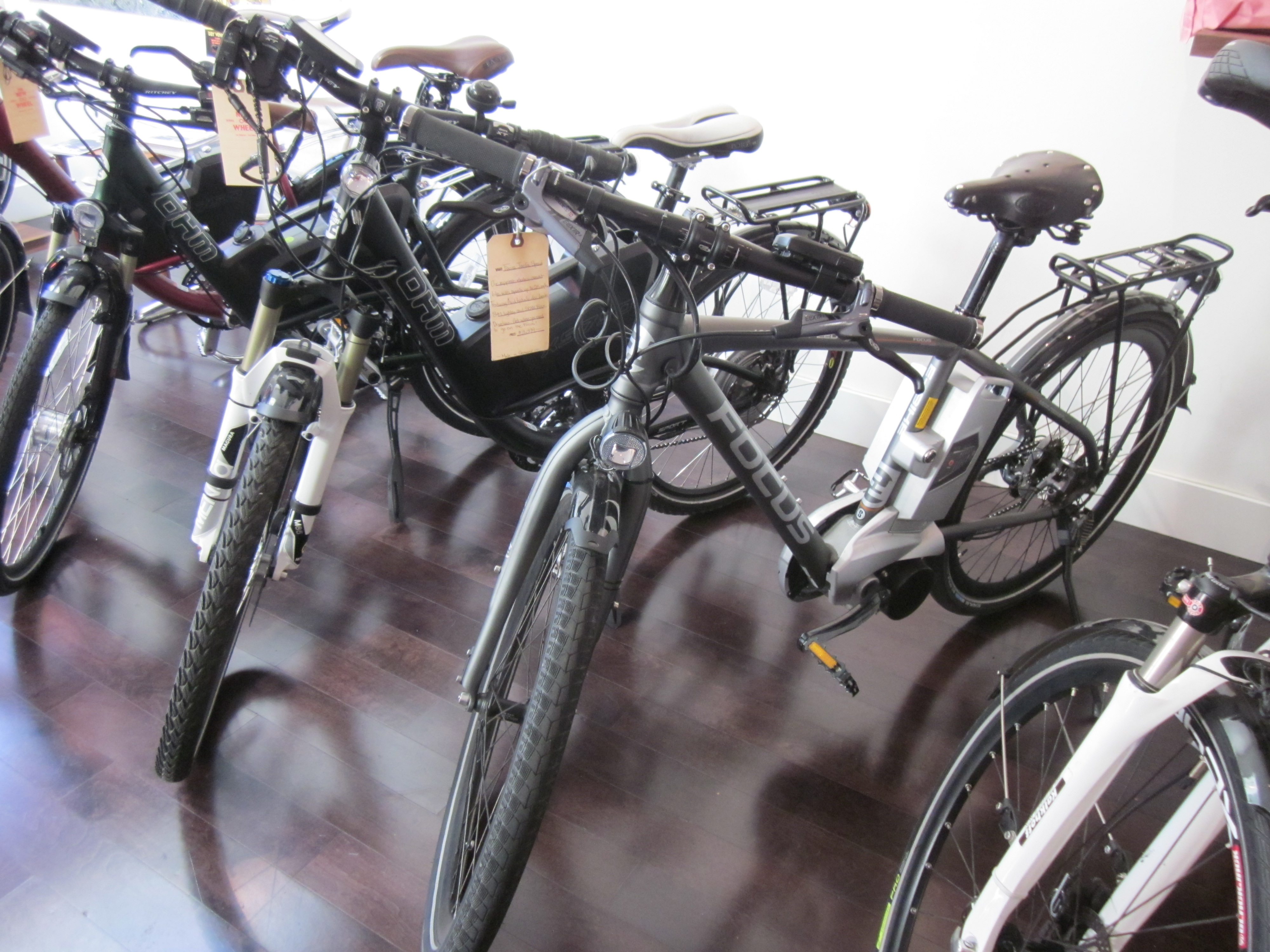
These are the kinds of bikes they sell.

What I learned from the owners at The New Wheel is that there is a wide range of reliability in electric assists for bicycles, and particularly in batteries. As they are focused not just on selling equipment but maintaining it, there is a very short list of systems that they felt were worth selling: BionX and Panasonic. BionX motors sit in the rear hub and respond to torque on the pedals; the harder you push, the more help you get. I’ve written about riding with the BionX before. The mid-drive motors attach to the chain, and add power throughout the gear range. These are stronger motors, but they are significantly more expensive and they work best when riders maintain a steady cadence. After trying one, I can attest that doing that involves a learning curve.

For the time being, this is the only kind of family bike that The New Wheel is selling.

Because they are very interested in the family market they had considered stocking the Yuba elMundo, which comes with the eZee assist. However they found that customers had so much trouble with eZee motors and batteries, which evidently have a nasty habit of cutting out in the middle of the hills where people need them most, that they are negotiating with Yuba to develop and sell a BionX-assisted Mundo instead. The trade-off for increased reliability, of course, is a higher price.

Having this discussion with them made it pretty clear that for our needs, a BionX system is probably our best choice. After-market mid-drive motors, although they themselves are great, evidently have some of the same battery issues that other systems do, namely that there are not many consistently good ones, and no one is currently making cargo bikes with the integrated Panasonic assists. So it would seem that BionX is the most reliable option for cargo bikes, unless you know a lot about batteries or get lucky.

All these bikes have the motor integrated into the design; the mid drive motors are placed inside a massive chain guard.

All of the bikes The New Wheel sells are built as electric-assist bicycles from the ground up, and they all come with integrated BionX motors (e.g. the Ohm line) or integrated Panasonic mid-drive motors (the German bikes). They felt both of these systems worked well on steep hills. The mid-drive motors were more useful for weaker riders. One of their customers, an older woman with a recent hip replacement, was using one of their mid-drive motor-assisted bikes to commute up to the top of the Berkeley hills every day. That is an extremely long and unforgiving grade.

Having already tried a BionX-assisted bike in Portland, I went out for a test ride with one of the preschool dads, Paul, on a mid-drive bike. He took an Ohm with a BionX assist. I was very curious about how it would feel to ride with the more powerful mid-drive motor. The New Wheel is conveniently located in Bernal Heights, next to some brutally steep slopes. After taking some time to figure out how our respective assists worked, we rode up and down the hills for a while. It was such a hoot!

When I rode with a BionX, I liked that it felt seamless with the pedaling and was almost completely silent. Other than feeling like I’d grown massively stronger, I barely noticed the BionX was there.

I rode the extremely girly “Emotion” bike. I’m not particularly proud, but this kind of marketing leaves something to be desired. Bad manufacturer; no cookie!

The mid-drive motor was different. It makes a slight rattling sound as the chain runs through the motor, which I found kind of annoying. It was hard to tell that it was more powerful, because the assist felt so subtle. I suspect for riders who are already used to going up hills, there may be less difference between the two systems until the cargo load gets quite substantial. And it was hard for me to maintain a steady cadence and pressure instead of reacting to the hill by gearing down and pushing harder, which meant that I wasn’t getting the greatest benefit from the system. As a result, Paul consistently passed me on the way uphill even though I had a stronger motor.

So although I liked riding up hills with the mid-drive motor, especially hills that I could barely move on by myself (I tried turning the assist off halfway up the hill a couple of times; it was unspeakably brutal), I didn’t like it any better than riding a BionX-assisted bike. Yet I suspect that I would feel very differently about these two systems if I were a novice rider. The owners of The New Wheel said that in fact they steer experienced riders to the BionX-assisted bikes like the Ohms, and novice riders to the mid-drives. I suspect that’s because if you have practice going up hills already, you’d have to relearn how to ride effectively with the mid-drive motors. Basically you have to convince yourself that neither the motor nor the hill is there, and just pedal blissfully on. In contrast, if you’re getting an electric bike in order to start riding a bike again, you don’t have to unlearn any existing hill-climbing habits. This information, by itself, was worth a trip to The New Wheel.

My son’s desire for this bike has not waned in the slightest.

I would be remiss if I didn’t also mention that The New Wheel is really, truly committed to family biking, even if they don’t yet stock any real family-hauling bikes. The proof was in their children’s bikes, which were the nicest I have ever seen. The preschoolers could not stop riding their gorgeous balance bikes. Our son test-rode a beautiful 20” Torker (not listed on their website) and has been begging us ever since to trade in his Jamis for this bike. He is willing to put his entire saved allowance to the cause. This was, however, not even the nicest bike available; they do not currently stock, but they do sell, a German bike for kids that comes with an internally geared hub, dynamo lights, fenders, a double-kickstand, and a chain guard. They said they didn’t stock it because they assumed that no one would be willing spend that much money on a kid’s bike. I only wish The New Wheel had been in business when we bought our son’s bike last Christmas. It would have spared us a trip across the bay and he’d be on a better bike right now. At any rate, if you are looking for a child’s bike, I have never seen a higher-quality collection. And they also have very nice children’s helmets, and they know how to fit them, too.

The New Wheel: stop by and check it out!

If I were in the market for an electric-assist commuter bike to handle the steepest San Francisco hills, I would start at The New Wheel. It is a great shop with incredibly nice owners and they are impressively informed about electric assists. We will almost certainly return when it is time to buy another kid’s bike. My only regret is that they do not yet sell family-hauling cargo bikes that can handle steep hills. For that, you still have to go to Portland.

10 Comments

Filed under bike shops, destinations, electric assist, family biking, San Francisco, trailer-bike, Yuba Mundo

One less minivan

The minivan goes to SoCal. Trucks on trucks! If only the kids had seen this.

Hey! Hi there! What’s new? There are some big changes here at the Hum household. Not only did I almost break a bike (although it’s back and usable now, I can hear it creaking if I go uphill loaded, so I don’t do that anymore—but give me time, maybe I can still manage to snap the frame in two!), we gave up our minivan last week.

Now we are a car-free family.

Yeah, I wasn’t expecting that either.

Oh, the places we go: Golden Gate Park Carrousel

We had been talking about getting rid of the minivan for quite a while and replacing it with something more economy-sized that would be better for city driving. We bought the minivan new, in early 2006, and knew it was still worth a reasonable amount. In May we contacted our credit union, which has an auto-purchasing service (thank goodness, because we are lazy), and asked whether it would be possible to sell the minivan and use the proceeds to buy a smaller car. From the used car values we saw online, it seemed as though this could be a zero-cost transaction.

They said they would have no trouble selling the minivan, which was still worth a fair bit, even more than I’d expected—they shopped it around the state, found several dealers who wanted it, and had them bid for it. But their efforts to find us a used small car with good mileage were less successful. Everyone wanted cars like that, and the used market was almost nonexistent. The cars that they found had been driven to death and/or were priced nearly the same as new ones. They suggested that if we wanted to get a car in decent condition with good gas mileage, we’d be better off buying new, although they’d keep looking.

Oh, the places we go: The F Castro line streetcars, imported from Italy

I had no interest in buying a new car. We have learned in the past few years what happens to cars in San Francisco. The city is cruel to vehicles of all kinds. Multiple pieces of our minivan had been replaced when they were hit while it was parked. So we sat around and waited for updates.

Three weeks ago, we took the minivan in for an oil change. The shop noted that it was time for the 60,000 mile tune-up, which they estimated would cost $1,500 or so. We also received our insurance bill for the next six months, which was $600 (auto insurance in San Francisco is expensive). We were looking at spending over $2,000 to maintain a car that we drove maybe once a week, couldn’t park in our tiny space without flipping in the side mirrors just to get through the garage door, and didn’t even LIKE.

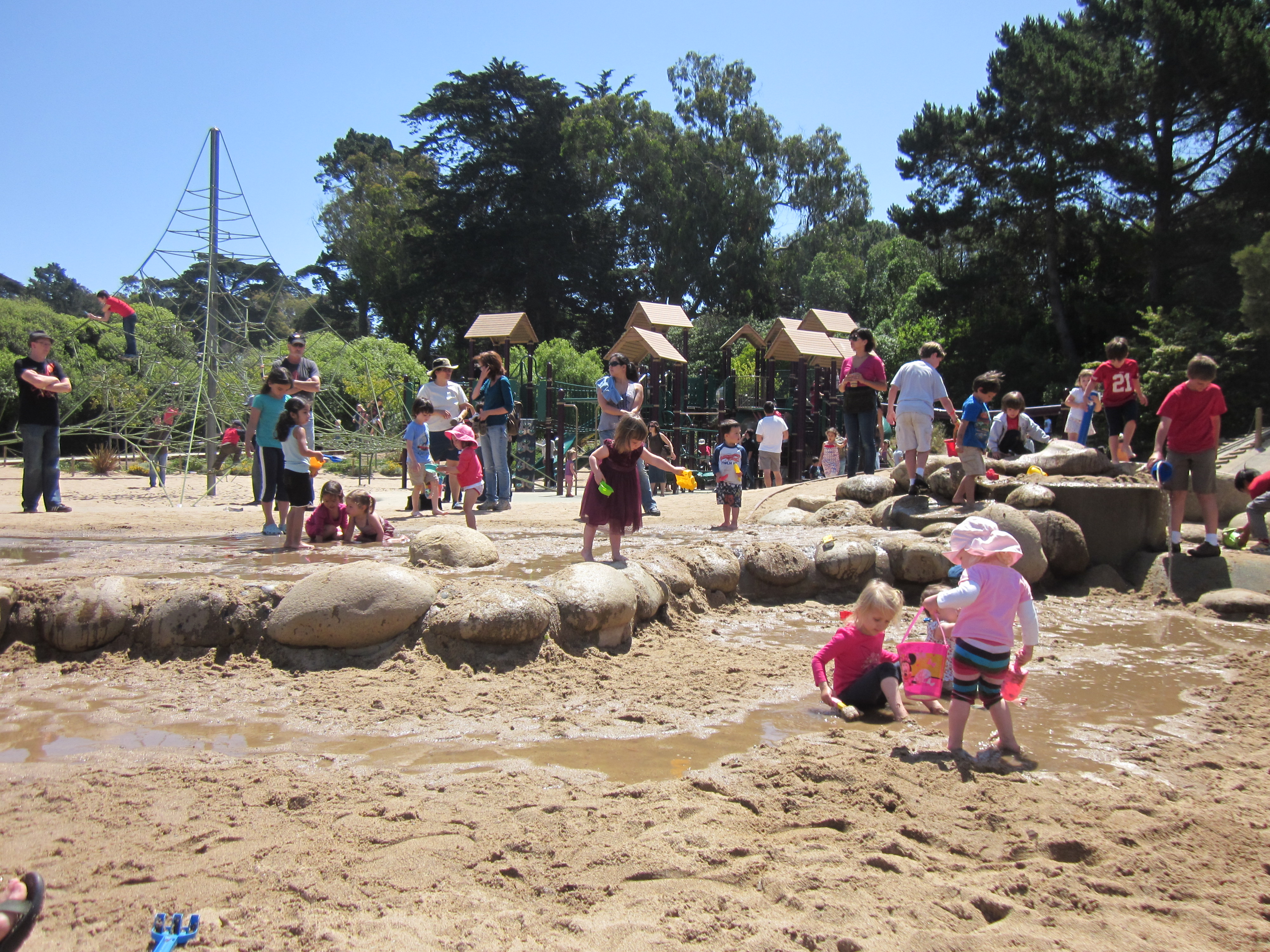
Oh, the places we go: The Children’s Playground at Sharon Meadow

At that point we began wondering it whether would make more sense to just sell it and use City CarShare and Muni until we found something we wanted to buy. The bus stop is 100 feet from our front door, the street car line is two blocks away, and there are three City CarShare pods within three blocks. We have bikes that we ride with our kids all the time. How bad could it be? We called the credit union and they said: sounds reasonable to us.

So two weeks ago we sent in the paperwork with the final mileage to sell the car. Last Friday, a dealer transporter showed up and drove it away on a truck. During these last two weeks, we began to wonder if we really wanted another car after all.

The first week was very hard, partly, I suspect, because the car was still sitting in the garage but we couldn’t drive it anywhere, having submitted the final mileage, the title and the registration. The kids knew it was going away and were confused that they couldn’t take a last ride. But that was the same week that I calculated what it was costing us to own a car that spent most of the time sitting in the garage, and it was sobering.

  • Insurance: $100/month
  • Gas: $50-$100/month (depending on business trips; the minivan had horrible mileage)
  • Maintenance and repairs: $100-$200/month
  • Depreciation: $200/month (given the price we paid on purchase and the price we were offered)

Oh, the places we go: my brother-in-law’s birthday dinner at StrEAT Food, south of Market

We bought the minivan for cash and so we never had interest payments, and by university policy, parking for one car is bundled into our rent. And yet an older, paid-off car that we drove only occasionally was costing us $400-$600 each month. That kind of money would pay for a lot of rental cars and taxi rides, more than I could imagine needing. And that was without even considering that we would walk away with a big windfall if we didn’t get another car.

After some discussion, we thought: well, it’s worth a shot. Even if we decide to get another car eventually, every month that we can put that off saves us ~$500, less whatever we spend on public transit, rental cars, and taxi rides. At a minimum, waiting a few months would fund a very nice family vacation.

And so here we are. With every day that passes the thought of getting another car seems less interesting. Despite some terrible bike karma in the last two weeks (broken bike, flat tires, you name it) everything is basically fine. We were planning to get another family bike anyway. We have found all kinds of cool new travel alternatives: car sharing, ride sharing, public and semi-public transit. All of them seem pretty appealing compared to buying a car that will sit unused in a garage most of the time. And even if we use them quite a lot (we haven’t), they are much, much cheaper than owning the car.

Oh, the places we go: Hayes Valley

There aren’t a lot of families who choose to go without a car if they can afford one, even in San Francisco. Most people insist it is impossible: Muni is unreliable at best, the hills are too intense for biking, taxi service is horrible, and car sharing services are too inconvenient or expensive. You hear the same stories, with different verses, when people talk about living without a car in suburban or rural areas: public transit is dreadful or nonexistent, riding bikes is too dangerous, everything is too far away, taxi service and car sharing are too expensive or too hard to find. Nearly everyone says families in America can’t survive without cars. Can they?

Oh, the places we go: “Look!” yells my daughter. “It’s my emergency room!”

A year ago, we were preparing for a trip to Copenhagen, a city we had no idea was full of bike commuters. If you had asked whether we could live without a car I would have said it was not possible. Not possible. How would we get our kids to school? How would we shop? It was hard enough with one car. What a difference a year makes.

How long will we last? Let’s find out.

14 Comments

Filed under car-free, family biking, San Francisco

How wide is a bike lane?

What you see is not always what you get.

I was reading an article about bike lanes recently, which claimed that the newest bike lanes in San Francisco (on Kirkham Street) were 6 feet (183cm) wide, which is the new city standard.

It also claimed that most of the existing bike lanes in the city were 5 feet (152cm) wide, which I’ll admit, I thought was cracked. I ride in a lot of bike lanes in this city, and I would eat my helmet if they were all 5 feet wide. Time to take out the tape measure!

After stopping in various awkward places around my commute, I concluded that bike lanes are the opposite of trees: the older they are, the narrower they are.

  • On Arguello and Sacramento north of Golden Gate Park: 4 feet (122cm) travel width
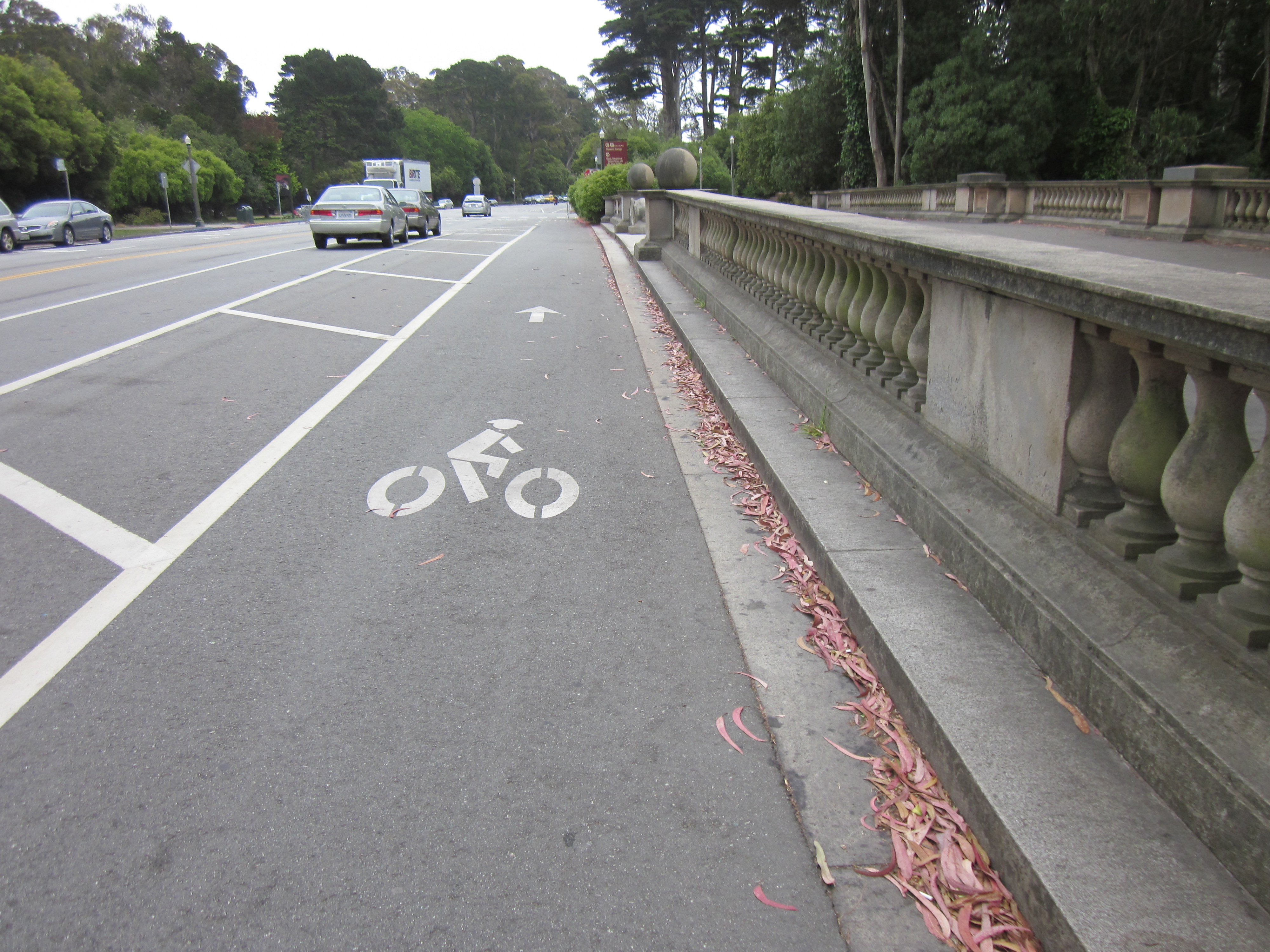
  • New JFK bike lanes within Golden Gate Park: 5 feet (152cm) travel width
  • According to the article above, the new Kirkham bike lanes: 6 feet (183cm)–I didn’t measure

The protected bike lanes on JFK Drive rarely feel crowded.

My feeling is that the narrowest 4 foot lanes are by far the majority within San Francisco right now, although admittedly I don’t ride as much South of Market, and they’ve striped a lot of lanes down there in the last few years. If the lane has a marker reading “BIKE LANE” or a picture of an un-helmeted bike rider you’ve hit a 4 foot lane for sure, although some of them have been repainted with a helmeted rider. I would guess the odds of these lanes being restriped to a greater width are pretty slim. Most of the attention right now is rightly concentrated on creating new lanes and expanding the network.

Why does it matter? Two major reasons: car doors and traffic.

In the new JFK bike lanes, 5 feet of width is plenty: they’re right against the curb and cars park on the left, they’re protected from the door zone with a buffer zone, and so there is plenty of space for me to ride alongside my son, or for another rider to pass us.

In the 4 foot lanes in the city, and even some of the new 5 foot lanes things can get hairier.

At the dotted line, the cyclists move left and the cars turning right (if there were any) move to the right before heading into the intersection.

These lanes are primarily to the left of parked cars, and an opened door can easily cut the bike lane in half, giving a rider an effective width of a 2 foot (61cm) to 2.5 foot (76cm) travel lane. Dooring incidents are relatively low on weekdays as San Francisco drivers are conscious of bike commuters. Dooring incidents are rampant on weekends when out-of-towners drive into the city and leave their doors hanging open in the bike lanes for no apparent reason, maybe to air out their cars. It’s a mystery, and they get angry when we ask them, politely, to stop blocking traffic.

These lanes are also striped to merge at intersections, allowing cars to turn right and bicycles to move left, which is why San Francisco doesn’t have the right-hook issues that other cities do. As long as everyone signals it is a little complicated but works fine: when the line becomes dashed, turning cars move right and bikes pass them on the left to go to the front of the intersection. (Moving forward in the intersection is a safety move to prevent a car further back in queue from turning right in front of a bicycle moving straight, the dreaded right-hook.) But this merge dance results in cars blocking the right half of the bike lane: once again, the bike lane effectively narrows to half its width whenever a car is turning right. Cars can’t usually pull right up to the curb for a right turn as they would when parking, or they’d run over the corner and pedestrians, so they’re partially in the bike lane.

When a bus moves into the right lane for pickups or turns, it takes some guts (and a narrow bike) to move to the left as suggested when heading straight.

Why does this matter? Most bikes can effectively navigate a 2 foot bike lane, but cargo bikes like our Kona MinUte can be more problematic; the bags on the side hang out several inches when full, making the bike up to 25″ (65cm) wide. I prefer to keep them in the folded position while I’m riding even though they can hold less that way. Then the bike is 16″ (40cm) wide, which is no problem (or I can fill one but not the other.) Matt typically keeps both filled but is actively looking for a better replacement for the stock bags due to their width. Can you put FreeLoaders on a MinUte?

I also had real problems getting the Yuba Mundo through these pinch points when it was visiting. For a long time I couldn’t figure it out: long-tail bikes are basically the same width as other bikes and we were using the front Bread Basket for cargo, so we didn’t have the MinUte rear bag problem. Why was I feeling caught at intersections all of the time and forced to stop behind turning cars (blocking other bikes behind me)? I hated taking the lane from the bike lane when the kids were on deck; cargo bikes are slow to start when laden, and drivers understandably get a little annoyed when riders swing in and out of the bike lanes. And I was the only bike doing it.

I only recently realized that my issue was the Mundo’s Side Loaders. To keep heavy loads off the ground or carry bicycles or give kids a place to rest their feet, the Mundo has two bars sticking out from each side of the rear deck, so the frame’s total width is over 20” (51cm). If you add a pair of full GoGetter bags, the bike’s width increases to over 35” (90cm). I didn’t even have the GoGetter bags, and 20.5” isn’t that much wider than an ordinary bike, but it was changing the way I rode. And yet: I didn’t feel like the Bread Basket in front, at 19″ (48cm) was the problem, even though it was almost as wide. And Yuba notes that the Side Loaders are supposed to be no wider than the rider’s feet on the pedals. Was it just that I couldn’t see the wide load in back?

Why does it matter? We are trying to figure out a new family bike, and width is apparently an issue. Most family bikes and cargo bikes are much wider than an ordinary bike. My problem, even if it was just perceptual, was the same problem people have with child trailers in San Francisco: at 28”-32” (70-82cm) they’re often wider than the space available in the bike lane, and as a rider, you can’t see whether they’re going to make it through. We have an additional issue: no trailer on the market would fit through our narrow basement door, which when opened is just shy of 28″ wide.

Could I handle a wide bike in normal bike lanes, when I arrived at intersections where the lane is cut in half? Would it be easier if the load were in front where I could see it? These are San Francisco problems, but they’re real for us.

4 Comments

Filed under commuting, San Francisco, traffic

Book review: Traffic; why we drive the way we do

This is a street designed for traffic.

I recently started reading paper books again, the kind found at the neighborhood library, rather than scanning the digital library and downloading books without having to leave the relative comfort of home. The paper library is still substantially more diverse than the digital library, with a much broader selection of non-fiction in particular, although admittedly it appears to offer less in the realm of evangelical romance novels (which are surprisingly difficult to identify based solely on title and cover art; this is why now I only download books that have gotten a good review somewhere, sometime).

Even though we rarely drive, it still really ticks me off that drivers park their cars right in our driveway, like, daily. Drivers who are really committed can even block the bikes.

While in this less ephemeral realm I picked up a copy of Tom Vanderbilt’s Traffic, which is one of the most fascinating books I’ve read in quite a while. For a long time I have accepted that getting on an airplane is the psychological equivalent of locking myself into a small prison cell, and I have prepared myself for flights accordingly. I drive more frequently than I fly (every week or so rather than every few months) but I hadn’t really thought before about how putting myself in a car is somewhat equivalent. I also only recently learned that cyclists call drivers “cagers,” which has a certain dark accuracy.

Riding a bike means never being stuck in traffic.

Vanderbilt discusses the many illusions of driving, including the expectation that early merging is more efficient than late merging, and the efforts of traffic engineers to reprogram people who resent late mergers and create traffic jams to force them out of merged lanes (I used to be one of these people). Even more fascinating was the illusion of queuing in traffic, where whichever lane you pick appears to be moving more slowly than all of the others. Ultimately, it turns out that they’re all moving at the same speed, but because everyone ends up waiting far longer than they end up passing—that’s what makes it heavy traffic—no one perceives the underlying equity.

This made me realize that one of the pleasures of cycling is never having to queue except at stop lights. Speaking as someone who cycled in Copenhagen, where bicycle traffic is thick, I can testify that this benefit is not an artifact of only having few riders on the road. Part of this is undoubtedly another counter-intuitive discovery by those who study traffic: slower speeds lead to faster movement; below certain speeds, there are no traffic jams. The rest is just inherent.

This is a street designed for people. Drivers complain that parklets are “too close to the road.”

It was particularly terrifying to read about just how awful most drivers are, which is something you can often ignore in the car because you’re busy being an awful driver yourself: trying to settle down kids, program acceptable music, talk to passengers, talk on the phone, or worse yet text. But I definitely notice it as a cyclist and pedestrian. Given that there is no feedback that all the dangerous things drivers do are dangerous until they actually hit something, why wouldn’t most drivers believe they’re doing a good job? Even when they do hit something, the fact that it doesn’t happen every day makes people believe the non-collision days are more meaningful. And my friends who work at power companies tell me that even people who hit utility poles argue that the pole was at fault (“It was too close to the curb!” or if seriously drunk, “The pole was in the road.”)

My husband is not a MAMIL

It was painfully familiar to read Vanderbilt’s discussion of how women end up creating and suffering in the worst traffic because of what is referred to as “serve passenger” driving. Taking the kids to school, picking up dry cleaning, doing the grocery shopping: these trips involve the most traffic—school pickup and dropoff zones are particularly notorious—because everyone needs to do them at the same time, and they are the least compatible with ride-sharing. And that’s before even mentioning parking. This is why there are dark jokes about the kinds of hardcore cyclists (Middle-Aged Men In Lycra, or MAMILs) who are able to commute the way they enjoy because their wives are doing all of the errands by car.

Doing errands by bike means never having to look for parking.

Although my husband handles his own dry cleaning and many other household tasks, he does far more business travel than I do, and when he’s away I do almost everything alone. This is part of the reason we’re in the market for a new family bike, and it’s part of the reason I get so annoyed that the market for bikes like these is so thin. I think there are more models of Trek Madone alone than there are family bikes of any brand. (I only recently learned that the Madone is a model of racing bike made by Trek that costs like $5k, and there are apparently a million versions, all of which sell like Big Gulps.)

My son will grow up riding his bicycle for transportation just like I did.

In my personal experience, when I transitioned to commuting primarily by bike I actually saved time, not to mention frustration, because I avoided so much traffic en route. In addition, as a working parent there is almost no other time to exercise. But it’s not possible to do these kinds of errands—picking up two kids at two different schools, etc., with a mountain bike or even a so-called commuter bike. You need something that can haul non-traditional cargo, like cartons of milk, kids themselves, and whatever fragile and emotionally significant popsicle-stick-and-cotton-ball art projects that they want to bring home unscathed.

At the end of this book, I understood why Vanderbilt apparently transitioned to riding a bicycle and public transit. I would have done the same thing if I hadn’t already. Public transit is unequivocally safer and the majority of research suggests cycling is as well (although people find this difficult to believe, or at least “not where I live!”–urban people insist they’d ride if they lived in the country where there’s less traffic, rural people insist they’d ride if they lived in the city where there are bike lanes, etc.) And either option is dramatically less grueling than driving.

When I was first hired at my university I went to a talk for junior faculty by a senior professor (who later won a Nobel Prize) about how to balance work and family. Although many of the things she did were not possible for me (e.g. having her first child at age 45—too late already!) her strongest advice was, “Kill your commute.” Do whatever it took to move close enough to work and school that almost all your time was spent doing something you valued (research, patient care, spending time with kids) rather than something you didn’t (driving, or more likely, sitting in traffic). And we took that advice. We moved from a large house in the suburbs to a small apartment in San Francisco that cost over 50% more per month, and my husband, after a long stint of unemployment and underemployment, found a new job within city limits. We slogged through the San Francisco public school lottery. (And we did all this before we had bikes. Between the hills of San Francisco and the absence of family bikes nationwide, cycling wasn’t an ambition for us at the time.) It was a long road, but our lives are infinitely better for it.

Streets can change. People can change.

Most people wouldn’t have to move and sell a car and change their jobs and their kids’ (pre)schools to change their commutes, as we did. And some of the best changes, which involve transforming streets themselves, are not individual decisions but collective decisions: removing parking, adding bike lanes, creating parklets, developing bike share programs, lowering speed limits, and narrowing roads. But having seen the result of changes like these, in our own lives in San Francisco and after visiting cities like Copenhagen and even Paris that have implemented them, those changes are most assuredly worth it. They scale cities back down to human size. Calming streets is really calming people. It takes the stress out of living.

8 Comments

Filed under advocacy, cargo, commuting, Copenhagen, family biking, San Francisco, traffic

What fresh hell is this?

On Sunday my son and I headed downtown on the Kona MinUte to Japanese class. I thought, “Gee, I hadn’t remembered the MinUte being this bumpy to ride.” Then I heard a swish-swish-swish sound, and asked my son if he was sticking something in the spokes (hey, it’s happened). Nope. Flat tire. When did I lose all my bike karma?

Studying Japanese on the train downtown

Fortunately we weren’t far from home, so I walked the bike back up the hill and then we walked back down the hill to the streetcar stop. We were late, but Muni came through; thankfully, there was no parade downtown this week. It had been so long since we tried this that I had forgotten one of the advantages of riding Muni: we ended up studying Japanese all the way into downtown, which made for a stellar class. A passenger across from us knew Japanese and helped as well. (Experiences like this explain why people keeping leaving their hearts in San Francisco.)

Blue Public Bike with a Bobike Junior seat

On our way up from the train station I saw a woman whose bike had a Bobike Junior seat on it, the first other than mine that I’ve seen. She said she knew a couple of other people with Juniors as well, and she was still hauling her nine-year-old son (!) on hers. They were headed to Sunday Streets as volunteers.

The downside of riding Muni is the waiting. On the way home it took as long for our train to arrive as it would have to ride all the way home (thanks in part to one train going offline right before it arrived at the station, horribly frustrating my son, who believed the arrival time board).

For novelty value, my daughter rode on the MinUte for about 10 minutes before returning to her plush mamachari seat.

After we got home Matt and the kids enjoyed a rousing game of “put the bike tube underwater in the tub to find the hole” and then my son asked to go out for a ride. Sure!

We headed to Golden Gate Park to show him the drop-off site for this month’s summer camp, check out waterfalls, and visit the bison.  This was an impressive ride for a six-year-old, even with the street closure, at over six miles.

Riding with my son has made me reassess my definition of hills. I would have said before this weekend that this was a pretty flat ride, with a slight downhill heading west and a slight uphill heading east. After watching my son, who had to get off the bike and walk some of those “slight uphills,” as well as take multiple rest stops, I realized I’ve lost perspective by comparing them to my daily commute. It was a brutal ride for a little kid on a single-speed bike, but he never complained.

Although it was raining and cold, my kids wanted ice cream.

So we bought both kids ice cream when we got to the bottom of the hill heading home, and we took the long way around on that last leg. And we saw my son’s first grade teacher, who is native Japanese. “A mamachari!” she said.

Our son wants a bike with gears. Although I despair that it seems like we can’t manage to find a bike with any longevity (except the MinUte! and the Brompton. I don’t think it’s a coincidence that those are also our most expensive bikes. Mamachari TBD.) I can’t argue with this. How much farther and faster could he go on a better bike?

Leave a comment

Filed under family biking, Kona, San Francisco

I didn’t kill the Breezer (phew), but even so

I had to walk the Breezer to the shop with my daughter in the backpack and the rear wheel seized up. It was exhausting.

So the good news is that I didn’t kill the internal hub on the Breezer. The bad news is that I have apparently been, entirely unintentionally, straining the bike well beyond its limits with the loads I’ve put on it. Our bike shop was concerned that the frame wasn’t meant to take that kind of weight and would eventually break. I have learned that this actually happens sometimes. Yeah. Oops. At a minimum they were sure I’d kill the hub eventually. The Breezer is a great commuter bike, but it has limits.

Here is the sobering summary from my brother-in-law: “You realize you carry more on your bikes sometimes than would fit in a SmartCar, right? I was just thinking yesterday that while you are not at all aggro, you may be the most aggressive cyclist I know in terms of what you are willing to try with your bike (you make full face mask downhillers look like wusses).”

He has obviously never met the mom who carries six kids and the shopping, and who makes my typical load look like a grocery bag full of paper towels. Admittedly she’s riding a bike designed for that.

My poor Breezer, asked to carry loads it was never meant to bear.

Anyway, there was, shall we say, strong advocacy from both our bike shop and family members that I should get a real cargo bike and stop trying to force my Franken-bike to do things it was never designed to do. Matt expressed similar concerns when he called from China. It is something that I had begun to suspect already, as I was trying to flag a cab in the Tenderloin and wondering whether I’d ever be able to ride the Breezer again.

Having proven that I’m up for riding fully-loaded through the seasons even on what is evidently a wholly inadequate bike, I am willing to consider bikes that are much more expensive than I would have a year ago as a primary bike. Also I learned what people pay for mountain and road bikes used only for entertainment value, which: whoa. For reasons of structural stability, I have been encouraged to learn to love the top tube. I’m also sure I want an electric assist.

Wanted: a cargo bike that can handle both hills and sand dunes

So we are now in the market for a new cargo bike. I’m not at all sure what kind. I was putting off another bike until finding out whether I’ll get the new position my department recommended, which is equivalent to my current position but with much more job security. At the last check-in, my department chair was optimistic that the university would offer a verdict “maybe even as soon as 2013.” Given that timeline and the fact that I thought the Breezer would carry two on child seat+trailer-bike for years to come, I wasn’t exactly scouring the market for its replacement. But circumstances conspire.

Two kids, now aged 3 and 6.5, too much traffic for them to commute solo, serious hills, a not-very-wide basement door (fortunately walk-in) and many pinch points and narrow bike lanes are the main issues we deal with when riding our bikes in San Francisco. I welcome any suggestions for bikes that could handle the challenge. Long, narrow, and assisted was one person’s summary of the best bike for me, and I suspect that’s right on.

10 Comments

Filed under Breezer, cargo, commuting, electric assist, family biking, San Francisco, traffic

A day in the life of the mamachari

The coldest winter I ever spent was a summer in San Francisco.

This morning after I dropped my daughter off at preschool and was riding to a meeting I got stopped by another cyclist, who pointed at the rear basket and asked, “Is that a child seat? Where can I get one?” I was sorry to tell her that it was made in Japan, and to the best of my knowledge, isn’t imported to the US. Then she realized I had an assist. “Is that a motor?” And I said, yes, I used it to get my daughter to preschool at the top of Mt. Sutro every morning, it was perfect for that ride. “Where can I get a bike like that?” she asked.

Now that I am riding with my daughter to preschool every day for drop-off and pick-up the mamachari is being seen by many more parents. While walking out of preschool last night I was talking with another mom, and she stopped dead when she saw my bike.  “Wait! That child seat! Is that a motor? I want that bike!”

Passenger panda in Golden Gate Park

As I was telling her that I got it on craigslist and it came from Japan, etc., a classmate’s dad walked up and said, “I NEED that bike. I NEED IT!”

We saw another classmate of my daughter’s on the way home and stopped to say hi, but couldn’t get much of a conversation over his pleas to his mom.

“Mommy I want HER bike! We need to get HER bike! Get me her bike, please!”

I think of moments like these every time someone tells me that US bicycle manufacturers don’t make family bikes because there’s no demand for them. Yeah, right. (Thank goodness this is changing.)

10 Comments

Filed under electric assist, family biking, San Francisco

More bicycles in Beijing

Matt is in China, and that can only mean it’s time for another update of bicycles in Beijing. Last time Matt went to the tourist bicycle center of Beijing and caught some righteous triple tandems. This trip’s theme is practical bicycles spotted on the road. These seem to involve two things: electric assists and passengers.

Bicycle, moving toward a scooter aesthetic

There is a wide range of electric bicycles, and while some of them are primarily for occasional assistance up the hills, in Beijing the bicycle part seems like the afterthought. This bike has pedals, but it’s moving more toward a scooter aesthetic. And those giant batteries have to be sealed lead acid, an environmental disaster.

Definitely more like a scooter than a bicycle

Going even further along the spectrum is this bike, which looks more like a moped than a bike, although those pedals do seem to turn, I presume for legal reasons. But credit where it’s due: this bike, like the other, can carry a passenger and has a dedicated front basket. These are not the overpowered machines lacking space for even a briefcase that litter San Francisco sidewalks. They’re meant to haul, not to look cute, and I’m guessing they’re a lot cheaper than the Vespas parked next door to us.

Carrying older kids on the bike is okay

And in Beijing, evidently, it’s normal to carry even older kids on the back of the bike. I sometimes regret that our kids will be on our bikes for so long, which reflects the traffic and hills of San Francisco, but I’m beginning to think that this is inevitable for people living in a city that doesn’t have extensive bicycle infrastructure (e.g. Amsterdam, Copenhagen, Tokyo). Sure, it would be better if our kids had more independence, but you have to work with what you’ve got.

Riding with a baby in traffic

These moms make me think that the fears of riding in traffic are relative. I’ve gotten more confident riding in city traffic here, but riding in Beijing would probably give me a heart attack. And parents from smaller cities would probably have heart attacks here. We get used to the circumstances around us. It’s not like kids have never died in cars.

Pedaling a paddleboat is a kind of pedaling.

Matt still has yet to ride a bicycle in Beijing. But at least this time he’s pedaling.

2 Comments

Filed under electric assist, family biking, traffic, travel

SF Pride: another year, another disaster

Breezer and trailer-bike: seemed like a good idea, but it didn’t work out that way.

We have struggled with getting to the SF Pride Parade for years. One year we stupidly tried to drive there: it was a disaster. Last year we tried to take Muni instead: it was also a disaster. The trains are packed, and the route is a long way for kids to stand, and we couldn’t get a return train, so we ended up carrying the kids through the downtown crowds to find an alternate way home. This year I thought I had it figured out: we were going to ride the bike. We were meeting my in-laws downtown: they would watch my daughter while my son and I were in Japanese class, then we’d all walk over post-Dykes on Bikes to watch the parade (the noise of Dykes on Bikes freaks the kids out, and I’m not much of a fan of it either).

With a week’s worth of clothes and books to haul for my son, and his newfound desire to ride, the obvious choice for the trip was the Breezer with Bobike Maxi plus trailer-bike. I loaded up the front basket with my son’s stuff, piled on the kids, and within a block of home, realized that the tires needed a lot more air than they had to handle that kind of load. We turned around and went back. While I was getting the pump, the bike fell over. I’m not sure whether to blame the wheel stabilizer (which isn’t that stable even with the basket unloaded) or the kids for this one, but it turned out to be no ordinary fall.

By the time we hit the Panhandle, the Breezer was making a buzzing noise every time the wheels turned. When we investigated it appeared to be a bent fender. So I tried to whack it back into place with moderate success and we continued on. Everything seemed okay until we got to the Tenderloin, when the gears started grinding and the chain fell off. I don’t enjoy putting the kids on the sidewalk to watch drug deals while I futz with a bike, but I didn’t have a lot of options. Mother of the year! When I got the chain back on, I realized that the damage must have been much more severe than I’d realized—the gears kept grinding and it was hard to shift. But we had little choice at that point: the buses we passed had broken down, and we’d hit the street closures by that point anyway, so there was no other alternative.

Yet another electric bicycle spotted at Golden Gate Park: I wish I’d had one on Nob Hill.

We finally got to Japanese class (late) and afterward, were all so exhausted that we skipped the parade and went out to lunch. I thought about trying to get home another way, but there were no cabs available around the parade route and transit was much too packed to allow us to board with a bike and a trailer-bike (maybe not even without them). I figured that if I’d made it there I could ride home.

My in-laws told me the parade was now over, so I assumed we could ride down Market Street on the way home, which is mostly flat, sparing my gears. This turned out to be totally not true; the parade just keeps going. So I headed up Nob Hill. About halfway to the top the chain fell off. And fell off. And fell off. I ended up walking up the rest of the hill and back down, figuring that I could manage the downhill Polk Street bike lane. But by the time I got there, the rear wheel had completely seized up. I was in the middle of the Tenderloin with a broken bike and a preschooler who desperately wanted a nap. I needed a cab.

This was a bike-friendly cab: it had the new “don’t door the bicycles” window sticker.

Hailing a cab in the Tenderloin is a challenge under the best of circumstances. Hailing a cab in the Tenderloin during the Pride Parade was harder: every cab that passed was already carrying a fare. I also wanted an SUV cab big enough to haul the Breezer and trailer-bike if possible, because leaving them in the Tenderloin would mean that I’d probably never see them again. Two very nice older gentlemen who’d been hanging out on a stoop helped me, but it still took almost a half hour. I have never been happier to see a car than when an empty SUV cab finally stopped for us. The driver helped us load the bikes and agreed to ignore the fact that my daughter was going to have to ride without a car seat. I have never given anyone a bigger tip. “You’re a long way from home,” he said. “It’s not that far with a working bike,” I said, “But right now, it definitely is.”

I still have no idea what happened to the Breezer (I have an appointment at the bike shop tomorrow). My guess is that whatever it is will be expensive. I am trying not to think about that right now. Sunday made my brush with road rage last week feel like meandering through Golden Gate Park during a street closure. I have never been more miserable or exhausted on a bike ride. And I can’t help feeling disappointed by the Breezer. I worry that our needs for a bike (the ability to haul up to two kids plus cargo) are beyond its capabilities. It’s really a commuter bike and not a family bike.

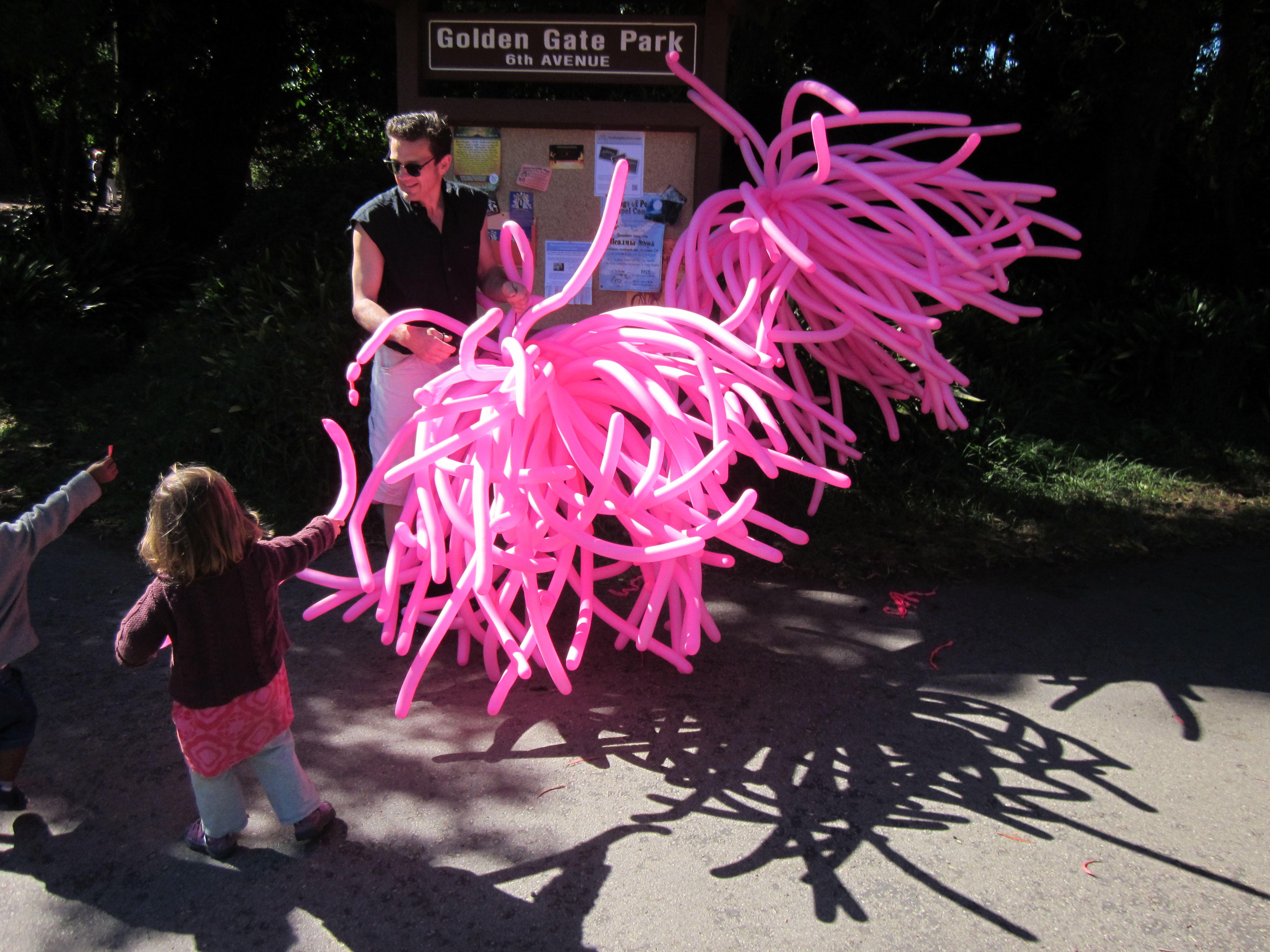
This man was handing out leftover Pride parade balloons to all the kids. Very exciting!

I almost couldn’t bring myself leave home after all of that, but we’d agreed to meet our Big Dummy-riding friends from school for Sunday Skate in the late afternoon.  Once we got there, we had a great time. My daughter loves their youngest daughter, and we ended up riding to a nearby restaurant for dinner. The only downside of the whole evening was that everyone else was out on bikes as well, so the nearest parking was a half-block away. Oh, the humanity.

I sometimes think that the number of bikes I have now is a bit excessive but I’m reconsidering.  If I didn’t have another bike, I wouldn’t have even left the house that afternoon, let alone by bike, and I was glad that I did.

2 Comments

Filed under Breezer, cargo, family biking, San Francisco, traffic, trailer-bike