Category Archives: commuting

Car-free role models

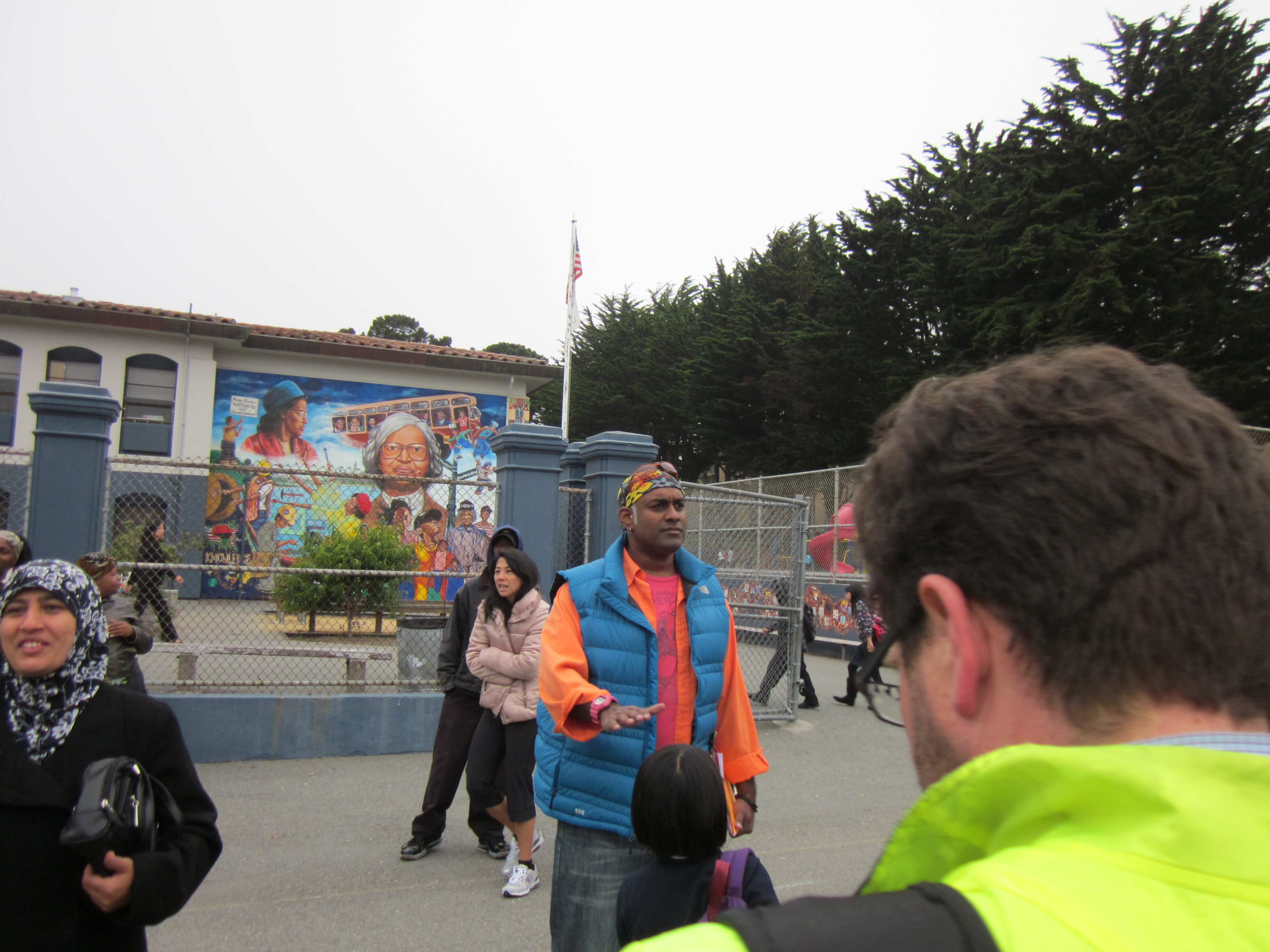
My son’s 2nd grade teacher rounds up the class.

I’ve liked all of my son’s teachers in elementary school. His kindergarten teacher taught reading so well that most of the class was above grade-level at the end of the year. The legacy of that is still visible in my son, who is currently obsessed with reading three books at a time and can only be dragged away for mealtimes when we literally pull them from his hands. His first grade teacher, who grew up in Japan and only moved to the US a few years ago, amused her class endlessly by having them correct her English spelling and grammar (which was difficult, as it is nearly perfect). But the most interesting teacher so far is his second grade teacher.

At Rosa Parks teachers make classroom assignments, and they accept parental requests. When my son finished first grade, our son asked for the first time that we request a particular teacher; he wanted the woman, not the man. When we talked to his first grade teacher, she was unconvinced, and so despite his request we left his placement to her judgment. Our son was disappointed in August to learn that he’d gotten his first male teacher. At the time, he knew his current teacher only as a large figure with a loud voice; he seemed scary. That impression lasted about an hour on the first day of school this year.

“We have that same taillight on our bikes!” says a girl in the class.

My son’s teacher is, in fact, a big guy with a booming voice, and he does not take an iota of crap from any of his students. He is also, to their delight, goofy. He wears sarongs and pink glitter nail polish and plays guitar in class. He reads them books way beyond their grade level and his default assumption is that they are capable and independent. The kids adore him. And although he commutes from Berkeley every day, he (along with his wife and daughter) is car-free. He takes BART across the bay and rides his bike from the station to school. He is by no means the only bike commuter at the school. However it means a lot to my son that his beloved teacher, like us, does not own a car. It makes him feel cutting-edge instead of deprived.

When people visiting from out of town see my son’s teacher for the first time they are intimidated by his size. Within a few minutes, when they start noticing details like the nail polish, and the way kids crowd around him, they grow envious. Is this what sending kids to school in San Francisco means, they ask, that your kids get teachers like this. And I suppose it does. I know that growing up in a small town I never had a teacher half as cool.

Living in San Francisco has other perks. “Guess where he’s from?” asked one parent early in the year. “The United States,” said another. “No, he’s not,” said the first. “Well, he’s from Texas,” said a third. “Exactly!” said the first.

Welcome to the real America.

Leave a comment

Filed under car-free, commuting, San Francisco

Shrader Valve

This is the Panhandle bike path marking for the upcoming Shrader Valve.

The connection from the Panhandle to Golden Gate Park is a bit complicated. Before the western edge of the Panhandle, bikes veer off the path to the right at Shrader Street. The bike light at Shrader Street directs you into a marked bike lane on Fell Street, which in turn leads to the protected bike lanes of Golden Gate Park. The turn is called the Shrader Valve.

Starting from Market Street at the Ferry Building, through the Wiggle to the Panhandle, and through the Shrader Valve to Golden Gate Park, you can ride a bike in marked lanes on a relatively flat route from San Francisco Bay at the eastern edge of the city to Ocean Beach at the western edge, and back again.

Bike light is green! Follow the arrow into the Fell Street bike lane, and it’s a straight shot from there to the ocean.

I finally got a picture of the Shrader Valve intersection this afternoon on the way home from Western Addition Sunday Streets. It’s not just for tires anymore!

2 Comments

Filed under commuting, San Francisco

Role models

On the first day of school our son asked to go by bike.

We have not been involved with family biking that long. One could argue that we make up for lost time with intensity. We have no car anymore, and we ride somewhere pretty much every day, although I know myself too well to track days or mileage, because that would inevitably lead to compulsion and madness. I learned that the hard way when my employer was handing out free pedometers. The day mine broke snapped me out of an obsession that had had me pacing around our bedroom at 11:59pm every night to break my steps record from each previous day.

Because I don’t track miles and I’m not riding a bike to get in shape, I am enjoying myself and so is everyone else. I realized that the other day when my kids found some old packing paper, spread it out into a makeshift course in the living room, and started racing each other using a ride-on hot wheels truck and a ride-on bumblebee. They called out, “I’m winning!” “No, I’m beating YOU! I turned on my electric assist!” “I’m pedaling faster than you!”

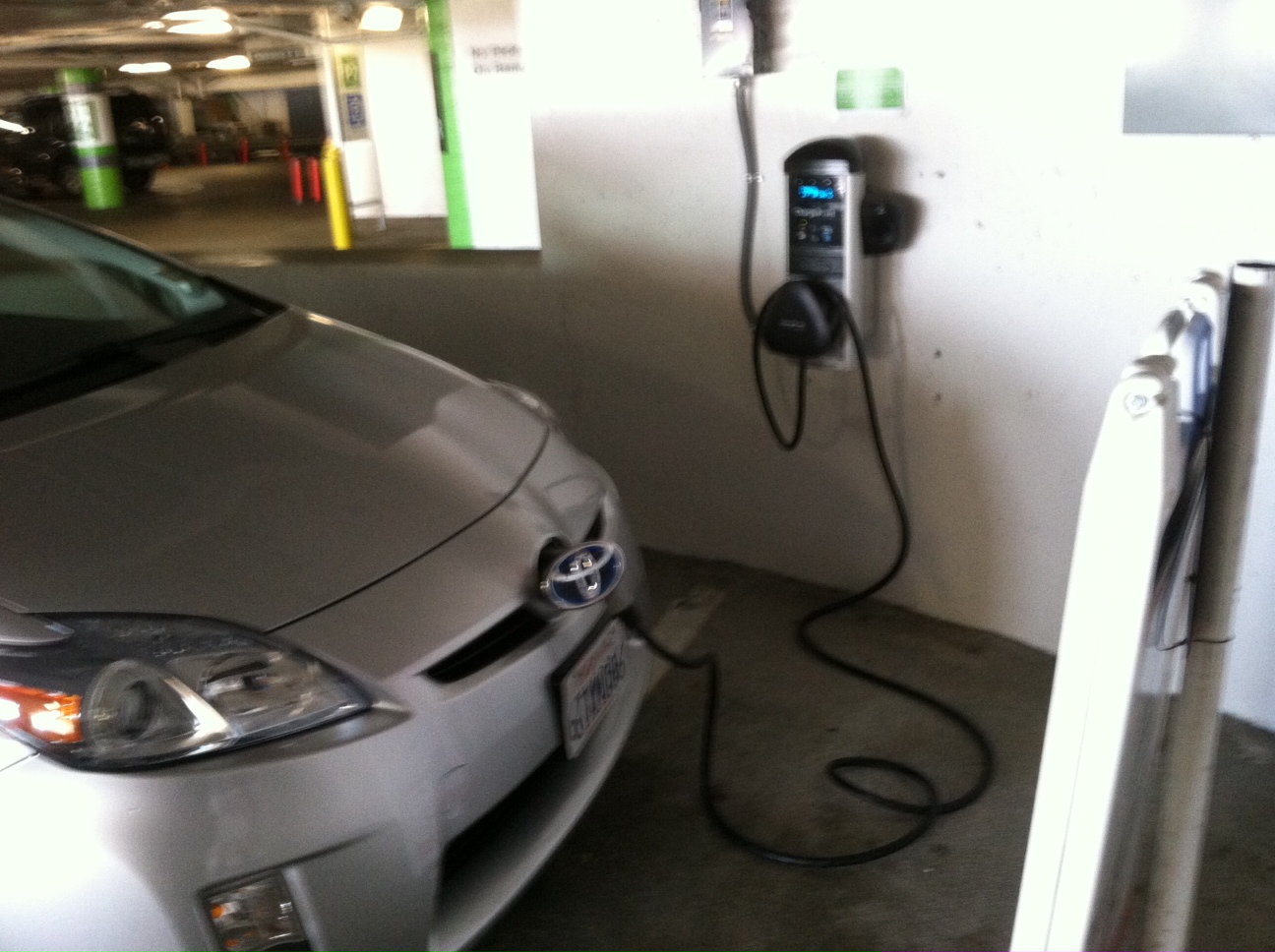
Our default rental car is now this plug-in hybrid (City Carshare is offering these at their lowest rate).

We have been in cars a lot in the last month: rides to the airport, rides to the train station, a week at my mom’s, a trip to Marin. We rented a car last week for one of our more intensive grocery runs, which involved refilling a gallon jug of olive oil and serious inroads into the bulk food bins. Altogether it’s worked to out about a dozen car days this month (although those were mostly clumped together while traveling, and astonishingly, all of them together still cost less than the lowest monthly tab of owning the minivan). This is apparently not enough driving to dislodge my kids’ new self-perception that riding a bike is what’s normal. On our trip to Marin, my daughter asked me whether it was possible to buy a car with electric assist that would make it go faster. I said that’s not really how electric cars work, and suggested that cars went fast enough already, but she remained unimpressed.

Although I’m not opposed to using a car occasionally, pretty obviously, not owning one has been liberating. When we drive I remember that being in a car kind of sucks: hello traffic, parking, and road rage. I definitely appreciate the increased range and time-savings over long distances (we won’t take BART to visit my in-laws again, it takes twice as long and is almost as expensive as renting a car), but altogether I’d rather be doing something else. My daughter’s preschool is closed this week, so on Monday we rode down to the Academy of Sciences, parked the bike at the (empty) rack by the front door, and walked right in. Watching other parents struggle out of their cars several blocks away or the subterranean parking lot, I thought, “I’m glad we’re not doing that anymore.”

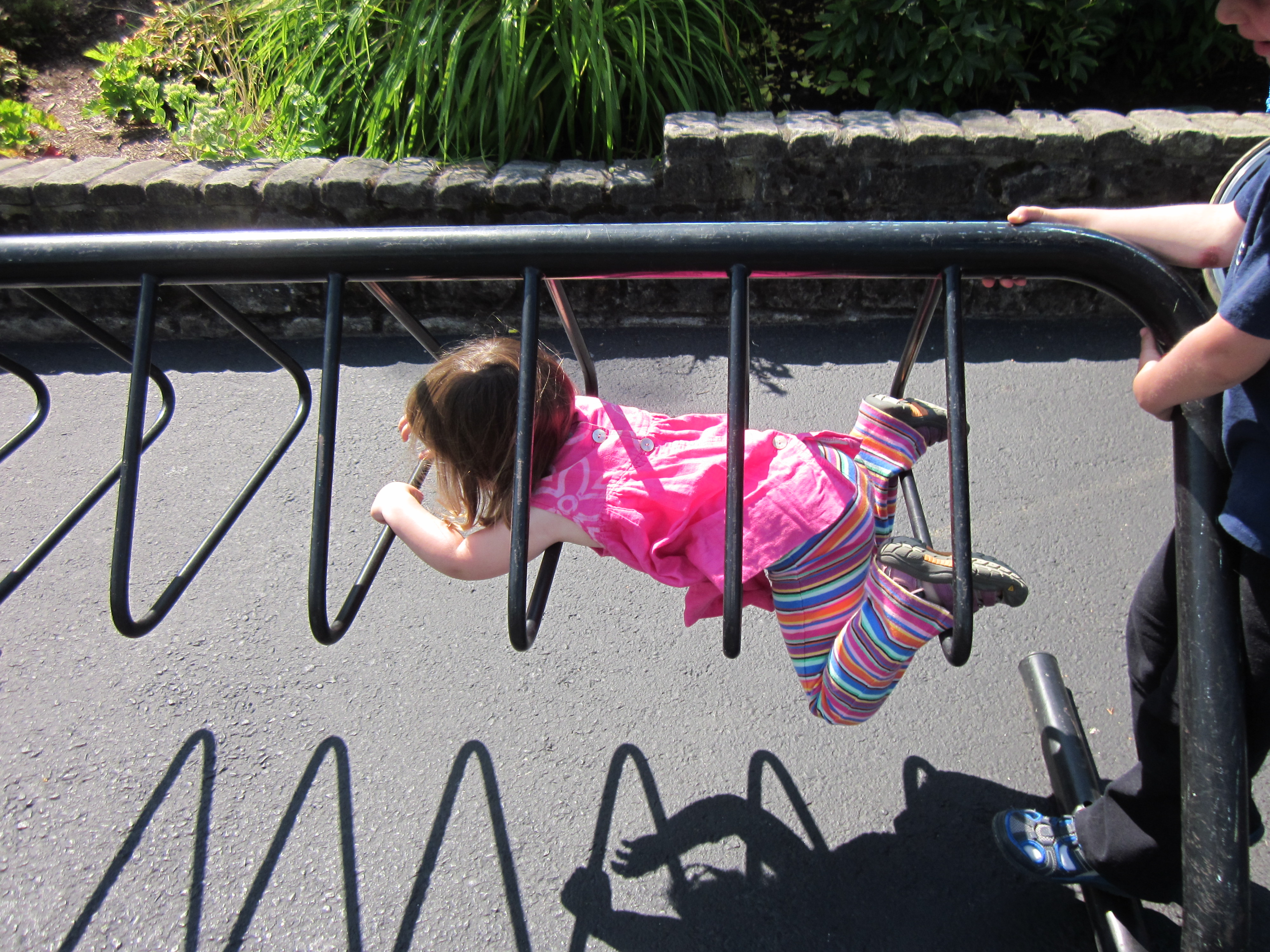
Kids on bike racks: it never gets old.

But that’s just me. Our kids get to live this way because it makes our lives easier, not because they chose it, although they were the inspiration. My kids are simpatico with our vegetarianism (which I realize is hopelessly retro of us in this brave new world of “primal” eating). I wondered if they would resist life without a car. We don’t spend much time talking about more general reasons we might want to reduce driving, as our daughter is three and our son worries way too much about doing the right thing already. We do our thing, and we told them we will rent a car whenever they want. And it turns out that’s fine with them. They like riding the bike and taking the bus and walking; it means we can pay more attention to them.

I have these occasional terrifying moments as a parent when I realize that literally everything we do defines our children’s understanding of what is normal. We view life as easier and better not that we drive (much) less and so do they. I like that our transportation choices are now more closely aligned with other things we want in our lives: quieter streets, cleaner air, and streets designed for people. And we are not totally unaware of the environmental implications. Without getting too deeply into our world views here, we have a compost bin and we’ve been known to use it.

She came up with this all by herself, before I had the chance to show her Loop Frame Love, who pioneered the bike rack tunnel.

So it turns out I like being this kind of role model. I like being happy with my commute and I like that I can share it with my kids. I like saving money. I like feeling less tied to things. And I like watching my kids pretend that their toy trucks are really bicycles.

(A shout-out goes to the infinitely readable Davey Oil for inspiring some of these thoughts.)

6 Comments

Filed under car-free, commuting, family biking, San Francisco

Uphill, downhill: the limits of cargo bikes

This what hills in Bellingham look like. A 10% grade according to the signs, not too bad, especially given the killer views.

I complain a lot about going up San Francisco hills. What can I say? It often sucks. Something I’ve only mentioned in passing, but that we think about quite a lot nonetheless, is going downhill. While going uphill is literally a pain in the legs (and chest, when gasping for air) it is not as dangerous as going downhill can be.

We carry our kids on our bikes, and we go down steep hills regularly. We learned quickly that loaded cargo bikes (and trailers) need extra time and distance to stop when going downhill. It can be deeply disconcerting to brake and brake and brake, and only slowly drift to a stop. At first there were occasions that we overshot the lines at stop signs and red lights, and we are cautious riders. At times we take less steep routes on the way down than we do on the way up. We learned good braking habits very quickly and have internalized them to the point that I often forget to mention them.

Although we are scrupulous about maintaining our brakes, they occasionally fail. We replace pads on the bikes with caliper brakes on a schedule that raises eyebrows among people from outside San Francisco—roughly once a month—and that meets with knowing sighs among friends who ride in the city. The stock disc brakes on the Kona MinUte failed repeatedly and were on an every-other-week maintenance schedule until our local bike shop finally lost patience, called Kona, and asked for a credit to upgrade us to hydraulic brakes. And they got us one, which made the upgrade expensive rather than wildly expensive. The new brakes are amazing, with unbelievable stopping power, and the MinUte now only needs a brake adjustment every other month. We never, ever skip this maintenance.

The other problem that can crop up going downhill, which mercifully we have never experienced, is shimmy, aka death wobble. This is when the bike starts shaking uncontrollably and violently while going down hills, and is the kind of thing that typically only road racers experience, because it usually happens at high speeds. But some bikes can also shimmy at lower speeds, say, the kind of speed that a loaded cargo bike would approach while rolling down a steep hill. Having a top tube apparently provides stability that helps reduce the risk of shimmy, which is why I’ve been encouraged to abandon step-through frames. Better brakes help too. But the risk can only be reduced, not eliminated.

As annoying as all of this can be, we have gotten used to it. However these issues arose again when we started calling around asking about family bikes we could test ride, and why there were so few electric assist cargo bikes designed to handle steep hills in the US. There aren’t many electric assist cargo bikes anyway. When you start asking about taking them up mountains, or adding an electric assist to a bike like a Bakfiets, bike shops often get very quiet. A few shops claimed that electric assists were only designed for mild hills and to go longer distances, not to haul heavy loads up steep hills. This is clearly not true, as there are electric assist cargo bikes all over Europe designed for hills: e.g. an assisted Workcycles FR8, an iBullitt, and according to the German bakery we visited in Bellingham, every delivery bike used in Germany. The whole situation was starting to tick me off. I could get strong enough to haul my kids on long distance rides (and I have). I cannot get strong enough to haul my kids up truly steep hills as they get heavier, and even if I wanted to, putting them on the back of the bike on a steep hill has sometimes led to the front wheel lifting off the ground. They’re not strong enough to ride uphill themselves, and there’s too much traffic for them to be safe even if they could. People who want to ride an extra couple of miles don’t need an electric assist like people who live on the top of steep hills do. WTF, bike manufacturers?

I give Portland family bike shops (and a couple of San Francisco bike shops, Everybody Bikes and The New Wheel) credit here because when I asked this they gave me honest answers. It is, evidently, not a huge problem to put an electric assist on a bike to get it up a steep hill. It can, however, be a huge problem getting the bike+cargo back down that same hill safely. We rolled our eyes a little when we heard that because we’re already going down those kinds of hills fully loaded, so no new news here. But manufacturers are apparently concerned about the limits of bicycle brakes going downhill. The brakes on many cargo bikes are not up to the task; as proof, there’s our experience with the MinUte.

Evidently manufacturers are also concerned about the liability they’d face if someone who wasn’t attuned to these problems had the worst happen going downhill on an assisted cargo bike. Personally I think that’s a copout. I know parents who’ve been pulled or pushed down hills by trailers, who’ve broken spokes or had rear wheels taco or screwed up frames and gearing carrying kids up and down steep hills (cough cough… me). They don’t sue the bike or trailer or wheel manufacturers. They start looking for a better cargo bike. But there are currently very few better bikes, at least in the US, and the ones that do exist have appeared in the last year or two. So most parents in our situation have either kludged something together or started driving.

A Big Dummy in Bellingham: it is no accident that you can spot this bike all over in hilly cities

At any rate, although we’ll be trying out a lot of family bikes over the next couple of weeks, we have been told in advance that many of them aren’t going to work for us. Xtracycle and assist a commuter bike? Wobbles and fishtails when loaded on steep hills. Bakfiets and trikes? The brakes can’t handle steep downhills and can’t be upgraded, and the bikes themselves are so heavy that better brakes might not work effectively even if they could be added. And so forth. Although we’ll be riding lots of bikes for our own edification, the list of plausible candidates that we could take home to the hills of San Francisco is actually very short, at least for now. I don’t like this, but I have to live with it.

11 Comments

Filed under commuting, family biking, San Francisco, Uncategorized

The costs of living without a car

In brief: they are significantly less than living with one.

We don’t even need to park the bike at our son’s summer camp. Matt just rides into the middle of the field to pick him up. The other kids were so jealous.

I wrote earlier about the monthly costs of keeping our minivan ($400-$600/month), but I realized I forgot one expense: parking. Parking for one car is included in our rent at home, and although the market value of that space is ~$250/month, we’re not allowed to rent it if we don’t use it so it’s a wash. But whenever we drove the minivan anywhere else, we almost always had to pay to park. Our weekday driving primarily came when Matt drove to work because he was going out of the city for business. However, even though he’s not normally a car commuter, if he stopped at the office before or after, paying for parking was his responsibility. Because hey, it was just his normal commute, right? The same was true for me. The cost of parking where we work is $15-$20 per day. It worked out to between $50-$100 per month, conservatively. Plus on the weekends we had to feed meters. So the cost of owning the car was really somewhere between $450-$700/month, depending on how much we drove. It shocks me just writing those numbers. And we owned the minivan outright, so no car payments in that calculation. (If you ignore depreciation and only count actual out-of-pocket expenses it was still $250-$500/month.)

A portion of our newfound savings, admittedly, went to a new helmet.

This is still better than when we were car commuting and paying $140/month for a campus parking permit on top of the occasional downtown parking. My god, that car was expensive! No wonder Uber is making a killing in San Francisco. I could take daily limo rides without running up a $600-$850 monthly tab (or $400-$650 ignoring depreciation again).

Anyway, now that Matt has to rent a car for his business trips, the company pays for parking the rental car at the office, because he obviously wouldn’t be driving a rental car on his regular commute. Ha. Ha ha.

My son, passed out on my lap on Muni. (The Brompton continues to reign supreme in practicality; there was only space on the bus bike rack for one more bike–my son’s.)

In this first car-free month I was curious how much alternative transportation would cost us. It was a weird month. Matt had a series of meetings in the South Bay, so got a rental car for one week through work. By coincidence that was the same week that his mother went in for brain surgery in Redwood City, so there was a lot of extra driving to see her on top of those meetings. And we took a long BART ride one weekend to visit her in Berkeley after she went home. What can I say? We worry. We had planned to rent a car (and will next time we go; the round trip on BART is 4+ hours) but the San Francisco Marathon shut down the city. The MinUte went back to the bike shop while the N-Judah line was under construction, so we tried out ride sharing one weekend. And our son had a week of bike camp across town when Matt was away, which given the need to carry his bike implied a couple of trips using car share as well–we tried it once on Muni but (a) it’s so slow that we were late and the camp called us wondering where he was and (b) he was exhausted all day after riding over from the bus stop. And then the mamachari died.

Coming out of the tunnel on BART

I realize that every month is unique in its own way, but ironically, we drove more in July without a car than in any of the previous three months when we actually owned one. However no one else we know has brain surgery plans and the N-Judah is back in business, so this was probably an expensive month by the standards of car-free life, although having our bike collection radically thinned isn’t helping. Overall I hope that the next few months are much less exciting regardless of cost. (Matt’s mom is fine, by the way, although her surgery would have been better timed around Halloween, when she could have gotten some serious mileage out of the staples ringing her scalp. Oh well, hindsight.)

So our transportation costs for the month (rounded up to whole numbers):

  • fares for extra Muni and BART rides: $44
  • City CarShare rentals, meter parking, and Lyft ride: $48
  • maintenance on the Kona MinUte (bent derailleur repair): $24
  • rental car through work (including parking): $0 for us!

The total damage (for a very heavy month of auto  travel by our  standards even without the rental car through work): $116. Seriously? And we actually drove more than usual? Well hello, college savings. Even if we didn’t own bikes and took car share, ride share and Muni everywhere, we’d still save money by not owning a car. I am still sideswiped by disbelief. No pun intended.

4 Comments

Filed under car-free, commuting, San Francisco

New helmet

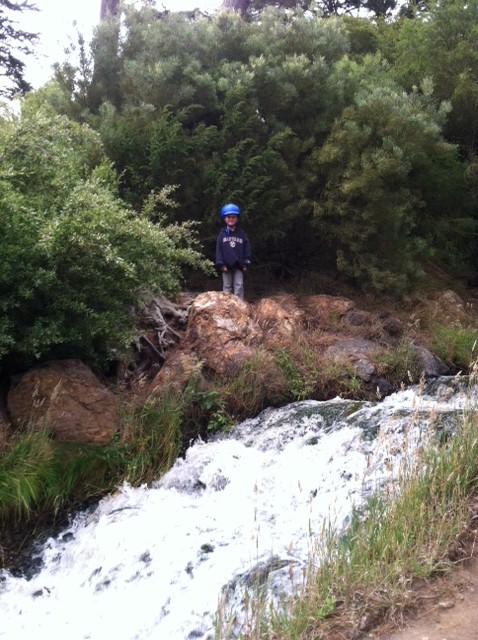
My son likes the outdoors too. And he likes climbing up the hidden waterfalls of Golden Gate Park. With his helmet. Safety first!

I’ve been commuting more with my son on the Brompton. This raised an unexpected issue. He’s tall enough that the top of his head touches my chin. I can see over him fine, and it’s certainly easy to make conversation. All of that is good. He is taller than his sister, and that makes pedaling around his legs more of a challenge, but that’s okay. And for some reason when he’s in front he’s more supportive on the hills. “You can make it, mommy! Keep pedaling!”

But there has been an unexpected downside to our commute. His helmet is one of those aero-style Giros that bumps out in the back, and has a sharp edge where the plastic decoration stops and the uncovered foam begins. When we rode together his helmet was cutting open my chin. My chin was bleeding because of my son’s helmet. It was the world’s most implausible bike injury.

We’re taking a trip soon and mailing our helmets in advance. Having a spare helmet was starting to sound like a good idea. Shopping for a helmet with a smooth back, which was my personal goal for his new helmet, was much harder. For some reason the aero-style with the back bump is all the rage in kids’ helmets locally. I had to go online, and that raised issues with fit. My son has a giant head. I picked stores with generous return policies (Amazon and Real Cyclist) and ended up using them as we worked our way up through the sizes that were supposed to fit him based on head circumference and did not. Eventually we found a Bern helmet that fit him in blue (he really wanted a blue helmet). It was an adult size small.

I love this helmet. It has never cut my chin. It’s as smooth as glass. I kissed it while we were riding on Friday, I was so grateful not to be gouged. I liked it so much I got one just like it for my spare helmet. Matchy matchy.

My son likes both his helmets. Specifically he likes having two helmets. Sometimes he wears them both in one day (not at the same time). As long as he wears the Bern while he’s riding the Brompton, that’s just fine.

1 Comment

Filed under Brompton, commuting, family biking, San Francisco

Learning to love the outdoors

Check it out! It’s July in San Francisco! Wind and fog, check. Record low temperatures, check. We’re still having fun.

For most of my life I’ve considered myself an indoor sort of person. I viewed central heating as one of the greatest wonders of the modern age, and wished my parents used ours much more aggressively. And although I walked to school for most of my childhood, I rarely enjoyed it. In my dreams, there were enclosed, climate-controlled, clear tubes for pedestrians that would take me wherever I wanted to go.

When I moved to the Twin Cities in college I couldn’t have been more surprised to learn that such things actually existed, in the form of the Minneapolis skyway system. Who knew?

So anyway, for most of my life I enjoyed walking but hated being outdoors most of the time, which I admit is sort of schizo. This ambivalence hasn’t always led me to make the most healthful choices. When I was in the middle of writing my dissertation, I went for a few days without leaving the apartment at all, which was just as appalling as it sounds.

Last weekend we went to the coast to visit family, but forgot it would be even windier next to the Pacific Ocean. 60 degrees and a dust storm.

I’ve come around in the last few years, assisted by the resolutely temperate climate of San Francisco. It’s frequently foggy and windy, but rarely cold and never hot. Before we ever started riding bikes I walked to work through Golden Gate Park, which is time consuming but has no shortage of great views. We also live close enough to the park that I’ve often taken walks there in the evening after the kids went to bed when Matt was working late. After dark, it’s just me and the skunks.

I’ve been surprised to find that starting to ride our bikes around the city has done something I never expected: it’s made me want to be outside every day. There are days that I don’t ride a bike, often when we’re walking around the neighborhood instead. But I can’t remember the last time I didn’t feel an overwhelming urge to spend some time outdoors before noon.

Exploring the mini-woods the campus planted in lieu of giving us all backyards. My kids like being outside already. (This hill drains right into our basement, incidentally.)

I started riding thinking that the freedom of riding the bike, which to me mostly meant not being dependent on the bus schedule or stuck in traffic, was worth the extra time outdoors (and that it would be good for me anyway). I couldn’t have been more surprised to learn that all that extra time outdoors made me want to be outdoors even more.

1 Comment

Filed under commuting, San Francisco

It’s electric!

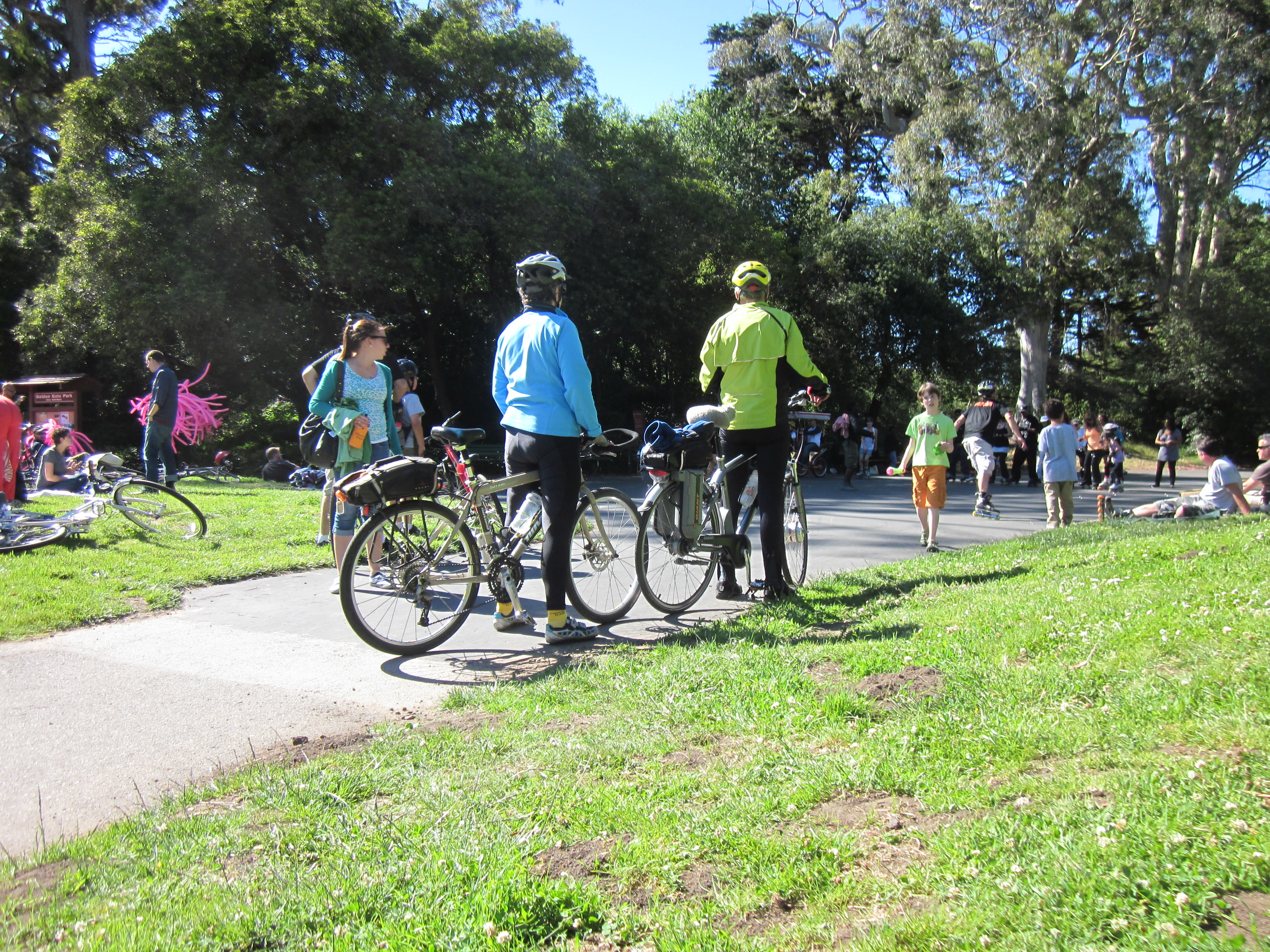
The bike in front is electric, and arrived just in time for the Electric Slide at Sunday Skate.

I’ve been seeing a lot more electric bicycles around San Francisco. I’ve been seeing a lot more bicycles, period, around San Francisco. Part of that is the season, of course, but there’s also this bicycle boom that everyone’s been talking about. San Francisco ridership has supposedly increased 71%. And every new bike lane that gets striped in this city (8th Street lanes just went in to rave reviews) makes this more likely to continue.

Just another July afternoon in San Francisco. They don’t call it Fog City for nothing.

When I look up some of the steeper hills in this town I often find the prospect of riding my bike daunting, at least when the kids are on board. Having grown up in the Seattle area, I’m rarely fazed by any local weather. (Our bike shop complains that many people give up riding at the first hint of fog. If I felt that way I’d ride maybe 15 days a year.)

Mild to moderate hills are okay too, although they grow less fun as I add live weight. But there are also the steep hills. And there are a lot of them. They are off-putting. This is especially true at the end of a long day at work, as the route home ranges from mildly uphill to steeply uphill most of the way back. On days that it feels like too much, sometimes I put the bike on the shuttle.

Occasionally I hear people say that unless you live or work on a steep hill, you can avoid riding the hills in San Francisco. My first thought is, “It’s more like live AND work on steep hills, actually.” My second thought is to wonder what they’re smoking and where I can get some. I suppose if you lived in the Mission and never went anywhere else but the Financial District that this could be true. My understanding is that this is, predictably, the chosen stomping ground of San Francisco’s fixie community. And it’s certainly possible if you drive everywhere that isn’t flat, but that isn’t really avoiding the hills, is it? If you have kids, there is the school commute unless you homeschool, and the museums and birthday parties regardless, and many people have been known to want to leave their immediate neighborhood occasionally as a matter of personal preference. Technically it’s POSSIBLE to live housebound, even with children, but it hardly seems worth it. I do not find it surprising that people who say that they avoided the hills in San Francisco are always people who used to live in San Francisco. There’s no point in paying city rents if you’re not going to go anywhere.

BionX: a handy upgrade for a pretty bike.

I now realize that I have come relatively late to the idea of electric assist in San Francisco, because I have been seeing assisted bikes everywhere this summer. Other people were smarter than we were, and simply paid upfront to enjoy the ride. On the way to work I’m sometimes passed by a relaxed gentleman in a suit and tie sitting bolt upright on his bike, peacefully meandering up the steepest part of the hill up as I turn off, panting, to take the longer, shallower incline. He confirmed when I asked, that yes, he rides a pedal-assist electric bicycle (it is silent, and he is a lot faster than I am, so it was hard to get a good look). “I love it!” he said. When I look at bikes parked at racks around the city now, there is usually at least one with a motor and battery. Some friends whose daughter attends a top-of-a-hill school recently started commuting on a trailer-bike attached to an e-bike. They plan to buy a second matched set when  their youngest starts kindergarten in August.

When we started down this road, I had little idea that there even was such a thing as an electric-assist bicycle. This is the problem with getting the inspiration to commute by bike while in Copenhagen. The more I talk to people we know, the more I realize that I am not the only one who didn’t realize there was a way to handle the steepest hills that didn’t involve being a Tour de France rider on a bike that weighs less than a newborn baby. But this is changing fast, and I suspect the realization that an electric-assist bicycle can easily move a family up to the top of Mt. Sutro or Potrero Hill will eventually become common knowledge.

I read a review of The New Wheel that said adding electric assist to a bicycle makes San Francisco as flat as Copenhagen.  I think this is true. Electric assist makes riding a bike in San Francisco accessible even to parents hauling kids, groceries, and gear. Many of the incentives to ride a bike in the city (extensive bike lanes, mild weather, a new bike share program, respectful drivers, horrific traffic, and wildly expensive auto parking) are already in hand or in progress. Even still, nearly every American city still has something missing that could turn bicycles from a lunatic fringe activity to a normal way to get around. In San Francisco, I’d put money on that something being electric assist.

2 Comments

Filed under commuting, electric assist, San Francisco

Transportation resources for car-free (and car-light) families, in San Francisco and beyond

When we sold our minivan, one of the things that made it easier not to replace it was the discovery of all kinds of new ways to get around the city without our own car. Realizing there were all these options that offered a safety net helped us finally make a decision. The resources below are so ridiculously exhaustive that we would be hard-pressed to use them all regularly, so we don’t. When we need to get somewhere, we primarily ride our bikes, walk, or take transit, in that order. Every once in a while, for a longer trip, we rent a car from City CarShare or Matt rents one from an agency for a business trip.  Everything else listed below fills in the occasional gaps. For example: my employer, as part of its commitment to reducing car commuting, will reimburse the cost of a ride home from work in the event that a non-driver has a sick kid or bicycle breakdown. I am willing to use some of the more expensive services I’ve listed in emergency situations because time is an issue, and because I know that I’ll be reimbursed. Other companies in San Francisco have similar programs, but they’re poorly advertised, so check with HR before you decide to smack me for being so lucky.

Overall, our bikes are the best transportation choice on most occasions: they are personal vehicles that we can use at our discretion, they’re largely immune to traffic, and we can always find parking. This is why it’s often faster to ride a bike than to drive in San Francisco. But there are occasions that these other options really shine, and they might work even better for other families, and they’re so interesting I thought they were worth documenting in this outrageously long post.

Some useful tools for the car-free family:

  • Cash: Transportation is one of the final holdouts of a cash economy, along with Chinese restaurants, cooperative bakeries, and gambling. I carry around more cash than in the past.
  • Credit card: That said, the majority of ride-sharing services don’t work unless you have a credit card on file.
  • Transit cards: The miserable days when we had to make sure we had two singles in order to ride Muni disappeared when we purchased Clipper cards.
  • Smartphone: I did not get a smartphone until last week, because I live in my own personal Dark Ages. But there is no question that it makes the car-free life easier. Now I can look up bike routes, the next bus, or schedule a car ride instantly. The BayTripper and PocketMuni apps are particularly helpful, as is Bikesy (the bike route mapper for Baytripper).
  • RideSafer travel vests or other portable car seats: We got RideSafer travel vests  as car seat replacements for our trip to Europe last year because they were light enough to meet luggage weight restrictions on European

    Using the RideSafer travel vests in our San Diego rental car.

    airlines. But they are incredibly handy for travel with kids; two fold up small enough to fit in a backpack with room to spare for snacks. Although the kids find them uncomfortable on long trips, they are perfect for short rides. They are pricey but we travel enough out of state that it was worth it to us (also, look for sales; we paid much less than the current price). The vests only work for older kids (arguably 2.5 years and up). However, when we traveled with our son as a baby, we took an infant car seat without the base with us—these styles of car seat all have instructions for installation by seatbelt. And after hearing the stories of such car seats releasing from their bases in collisions, I now suspect that he was safer that way. On occasions when we take longer drives with our kids (e.g. to the Monterey Bay Aquarium) we use regular folding car seats, which now spend most of their time in storage.

  • Folding cart/stroller: It’s nice to have a way to haul kids and/or groceries around. When our kids don’t want to ride a bike to the farmers’ market, we take the stroller and pile up purchases underneath, or we take a folding shopping cart (ours actually works as a cargo-only bike trailer as well).
  • Named non-owner auto insurance policy: If you don’t own a car, but drive, you can still buy auto insurance. We’re on the fence about whether to get a policy like this. It’s not necessary for a lot of car sharing services, which have great insurance (better than you could buy as an individual). But if you’re in a situation where you rent a lot, and have to use national rental agencies, it could be a good deal.

Just the basics (for the more interesting options, skip down to #8)

1. Feet

  • What they are: Look down.
  • When to use them: Local shopping and neighborhood restaurants, visiting local friends and attractions
  • How they work: If you’re able-bodied you know this already.
  • Pros: Good exercise; helps us learn about the neighborhood; we live in San Francisco so everything we need to live is within walking distance
  • Cons: Limited range (especially if kids are involved); limited ability to carry stuff; slow
  • What it costs: Free!
  • Good to know: We can walk further than we think we can, even when carrying a grumpy six-year-old uphill.
  • Personal experience: We like walking; early dates with my husband were long walks.

2. Bicycles (the practical kind, not the road racing/mountain biking kind)

  • What they are: Those things on two wheels most people learned to ride as kids; but if you didn’t, the San Francisco Bicycle Coalition will teach you how to ride in a couple of hours.
  • When to use them: Virtually anytime, although in San Francisco it can be a little tricky to get outside city limits on bikes when heading east
  • How they work: Hop on and ride off
  • Pros: Good exercise; faster than cars in traffic; never worry about parking; some bikes can carry more than cars; kids love riding on bikes
  • Cons: Can take some practice to learn to ride in the street with cars; can fuel an obsession that becomes more expensive than planned (although way cheaper than a car) and unnerves friends and colleagues; theft is a problem in San Francisco (although a recent arrest has improved matters dramatically)
  • What it costs: Ranges dramatically, from $50 for a beater bike found on craigslist (quality unknown) to $3,500 for a snazzy new cargo bike, but without kids almost everyone will do fine walking out of the local bike shop on a $500 commuter, with kids ditto on a $1500 cargo bike. Any decent bike shop will let you test ride extensively before purchase. Electric assists for hills and heavy loads run $500-$5,000, but most reliable models run $1,000-$2,000. Maintenance and repair costs are bupkis, even for electric assist bikes, which recharge for pennies.
  • Good to know: If you’re hauling kids you probably need more bike than you think you do. Many people buy a first bike that’s inadequate for their needs and have to replace it (guilty as charged). But even the most wildly expensive cargo bike with electric assist costs less than the estimated cost of car ownership for a year. And also less than an amateur road bike.
  • Also good to know: If you fear breakdowns, you can buy nationwide bicycle roadside assistance from Better World Club.
  • Personal experience: This is our favorite way to get around.

3. Public transit (around here, primarily the San Francisco Municipal Transportation Agency, aka Muni, but also systems around the bay for trips outside the city including BART, Cal Train, and Golden Gate Transit)

  • What it is: Buses, street cars, trains
  • When to use it: When it’s too far to walk; when the bike breaks down; when feeling lazy or when the hill situation or route is unclear in advance; when we have lots of time
  • How it works: Find a route using a trip planner (Baytripper app, 511 through Google Maps), head to the nearest stop, pay, and get on. In SF, the Pocket Muni smartphone app can identify how close the next bus (or whatever) is.
  • Pros: Inexpensive; accessible; nice views; riding historic streetcars and cable cars is a thrill; meet an incredibly diverse cross-section of city residents, most of whom are kind
  • Cons: Horribly unreliable (Pocket Muni can help, but still); aging equipment that breaks down; dirty; the most useful routes are often incredibly crowded; meet an incredibly diverse cross-section of city residents, some of whom are mean and/or insane
  • What it costs: In SF, $2 for adults, 75 cents for kids but cable car rides are $5; to go outside the city, costs vary but are still cheap. Fares are cash and exact change only unless you buy a Clipper card.
  • Good to know: Public transportation is like getting work done at a dental school: the price is right, there are no perks, the service is as promised but it takes a long time.
  • Personal experience: Very useful, but flawed (however I feel the same way about cars)

4. Taxis

  • What they are: Cars driving around that will take you wherever you want to go on a fare schedule negotiated with the city in advance
  • When to use them: Only when we’re desperate
  • How they work: Call in advance for a pickup and hope someone actually comes, hail one on the street and hope it actually stops
  • Pros: Only car service legally allowed to pick up street hails; gets you anywhere you want to go at a predictable price
  • Cons: San Francisco’s taxi fleet is notorious for poor availability, the willingness of dispatchers to lie about sending a taxi for a pickup, the unwillingness of drivers to pick up people that don’t look rich and well-groomed, etc. The cars themselves are often filthy and I say this as a Muni rider. Drivers pay little attention to traffic laws or speed limits. All taxis in San Francisco are supposed to take credit card payments but trying to pay that way can anger drivers enough that they threaten passengers and/or throw their belongings on the ground. This has happened to me.
  • What it costs: $3.50 at pickup then 55 cents per fifth of a mile or minute of wait time, plus tip
  • Good to know: You can do better, see below.
  • Personal experience: Primarily hellish, although there have been exceptions

5. City CarShare (see also: Zipcar)

  • What it is: A membership service for borrowing cars. These are parked around the city in reserved parking places.
  • When to use it: When we have a reason to drive somewhere.
  • How it works: Apply for membership and pay the fee; if you don’t drive like a maniac and have a valid credit card, you’re in. Once enrolled, members can reserve any car in the system online or by phone (there is a smartphone app for droid phones, but not yet for iOS). They send you a key fob in the mail; when your reservation begins, swipe it on the reader in the front window to unlock the car. At the end of the reservation, swipe the fob on the reader to check the car back in.
  • Pros: For occasional drivers who live or work near pods, it’s much cheaper than owning a car and more convenient. For complicated trips (hauling six kids, going to Ikea) there are pickup trucks and minivans to rent. For people who like cars, there are interesting vehicles to drive: Mini Coopers, Smart cars, electric cars.
  • Cons: Need to schedule trips in advance and be aware when the reservation is ending or there will be late fees. Cars must be dropped off at the pod of origin, so all trips must be round trips, and members are responsible for parking in the interim. Not all members are responsible about bringing vehicles back on time or refilling the gas tank, which can be a hassle (although people who don’t live near a university like we do report fewer problems of this nature). Car sharing can be expensive for frequent users. May not be worth joining if pods are far away (unless you have a Brompton!)
  • What it costs: We pay an annual membership fee plus a set rate when using a car ($1-$9/hour) plus a mileage fee (35 cents/mile). Each membership comes with a certain number of “day trips” allowing a 24-hour rental ($48-$70/day plus 10 cents/mile) and more day trips can be purchased for $12 each. Membership includes insurance, maintenance, roadside assistance, tolls, and gas (or charging if an electric vehicle). Fees are charged at the end of the month to a credit card on file.
  • Good to know: Car share services have reciprocal relationships with their counterparts in other cities. Zipcar is more expensive and has poorer insurance than local nonprofit options.
  • Personal experience: Good; historically we’ve rented through City CarShare once every couple of months, although this has now increased to 1-2 times/month.

6. Rental car agencies

  • What they are: An ad hoc service for borrowing cars
  • When to use them: Longer-term rentals or business/out-of-state travel
  • How they work: Call or book online to reserve a car, hope we get something like what we requested
  • Pros: Lots of different cars available; no extra charges for long trips
  • Cons:  Most agencies require customers to come to them but don’t provide rides, which can be inconvenient (exceptions: City Rent-A-Car in SF, Enterprise nationwide). Insurance and gas are the responsibility of the renter. Cars tend to be in poor condition (relative to car-share vehicles) and it is obvious that some people smoke in them. Rental agencies tend to dump gas guzzlers onto renters who book economy cars, which is a drag as the renter pays for gas.
  • What they cost: Varies, in SF usually ~$40/day on weekends or ~$400/week plus gas, insurance for an economy car; credit card payment required
  • Good to know: Local agencies like City Rent-A-Car typically have better prices, cars, and service than national chains; airport pickups involve substantial additional fees
  • Personal experience: Tolerable, used for business trips but only because Matt’s company makes the reservations

7. Limousines/livery cars

  • What they are: Private car service for passenger trips
  • When to use them: When scheduling a one-way trip in advance, e.g. to the airport, in which case they are almost as cheap as cabs or airport shuttles for a family of four but vastly more reliable (at least in San Francisco)
  • How it works: Call a dispatcher or book online, usually several hours in advance
  • Pros: Cars usually come when scheduled or earlier; cars are clean; drivers obey traffic laws
  • Cons: Some services are more reliable than others; expensive; with kids a portable car seat may be needed although some provide child seats on request
  • What it costs: $55-$65 for an airport ride regardless of the number of passengers; other pricing is hourly or zone-based and typically comparable to or slightly more expensive than a cab (we only use these for airport trips so I’m ignorant); credit card payment required, tips often included
  • Good to know: Dealing with individual companies is a thing of the past thanks to Uber; see below.
  • Personal experience: We decided it was worth the money to take limos to the airport after a couple of incidents where cabs and airport shuttles didn’t bother to show up.

Peer-to-peer and beyond (this is where things get interesting!)

8. Bike trailer loans: If you’re a member of the San Francisco Bicycle Coalition, you can reserve and borrow Burley Travoy or Bikes at Work trailers for heavy cargo loads. Included for no additional cost with membership! (no personal experience)

9. Bike rentals: City CarShare is rolling out an e-bike plus cargo trailer rental option late in 2012, rates to be determined. Most of the other bike rental options in San Francisco are geared to tourists, but might be useful for family visiting from out of town; check Yelp for deals. San Francisco universities have relationships with a local bike shop that allows students and other visitors to rent a Trek 7.3FX commuter bike for a day ($25), multiple days ($12.50/day), or a semester ($175), contact milanal@lombardisports.com. (no personal experience)

10. Employer and transit shuttles: Some employers and neighborhoods offer free shuttle service to various locations throughout the city. Amtrak also takes people across the bay for no charge. If you’re near the route, these are the best deals in the city. Technically I work for the state so although my employer’s shuttles are primarily for staff and patients, anyone can ride them—see also PresidiGo, SF City and County, Nordstrom. Driver quality is better than cabs but worse than limos. In San Francisco, check university websites or Yelp for details on shuttle rules and routes, or ask around. Personal experience: Excellent

11. Casual carpool/slugging

  • What it is: Some cities, like San Francisco and DC, have established ad hoc car pool locations for regular commuters. In the Bay Area, drivers pick up passengers in order to use the car pool lanes on the bridges into the city.
  • When to use it: When you want to get into the city more quickly and cheaply than you could alone and the routes and times make sense
  • How it works: Head to a pickup location as a driver/passenger, then pick-up the next two people in line/hop in the next car that pulls up. Drop off/get out at the drop-off site.
  • Pros: Cheap; fast
  • Cons: The etiquette around payment of carpool tolls has not yet been established for passengers (some drivers ask for a contribution). Some people freak out about the idea of getting into a stranger’s car, although this is mitigated by the fact that drivers typically pick up two passengers (women passengers often refuse to join a two-seater vehicle in the casual carpool line; I know I did when I was using casual carpool).  The routes and times don’t work for everyone.
  • What it costs: As a passenger, up to $1, but often free. Drivers pay normal commuting costs but a lower toll.
  • Good to know: It’s nice that such cooperative arrangements can spring up organically, isn’t it? Sure, it’s not everyone riding their bike or transit to work, but casual carpool gets lots of cars off the road and reduces traffic.
  • Personal experience: I rode casual carpool for several months when we lived in Berkeley and it was pleasant enough.

12. Zimride

  • What it is: A formalized casual carpool; drivers taking long trips or regular commutes post rides to potential passengers
  • When to use it: Long road trips in lieu of Greyhound; also, large employers use the service to arrange regular carpools
  • How it works: Check out the website for posted rides and dates; sign up if there’s one that works and arrange pick-up/drop-off with the driver
  • Pros: Cheaper than driving alone; less grungy than the bus; can get picked up somewhere near where you live
  • Cons: Somewhat complicated to arrange; some people freak out about getting into a stranger’s car; ride timing dependent on the driver
  • What it costs: Varies; check website but SF to LA seems to run ~$50 per passenger (by comparison Greyhound is $45-$65 for the same trip, plus the cost to get to the station)
  • Good to know: There’s definitely a college student vibe to this service. Lots of discussion of music; unlike casual carpool, don’t assume you’ll be listening to NPR on this ride.
  • Personal experience: Nada, although my employer runs all its carpools through Zimride, which suggests it is decent.

13. Sidecar/Lyft

  • What it is: Peer-to-peer donation-based ridesharing
  • When to use it: When we want a lift across town for less than the cost of a cab that’s quicker than public transit, or when we don’t want to stand on the bus
  • How it works: You need a smartphone. Download the app and create an account with your credit card information. When you want a ride, open the app and request one. It will tell you how far away the nearest driver is and suggest a donation based on past community standards. If you accept, the driver will swing by within a few minutes and take you to your destination. The donation is charged to your card on file.
  • Pros: Cheaper than a cab, faster than public transit
  • Cons: Mainly the usual freak-outs about getting into a stranger’s car, although drivers are screened, interviewed, and rated after every ride by the service and by their passengers (personally I’ve had much worse experiences in taxi cabs than I’ve ever had while ride sharing). Negotiating the suggested donation can be tricky if driver and passenger don’t agree. Taking kids can be an issue if you don’t have a portable car seat as suggested above.
  • What it costs: Varies, check the apps but seems to run approximately $1/minute; e.g. the community average for a trip from the Inner Sunset farmers’ market to the Financial District was $22, compared to an estimated taxi fare of $32 before tip
  • Good to know: Sidecar seems to have better coverage in San Francisco. Lyft is associated with the successful Zimride, but seems organized to primarily appeal to college students.
  • Personal experience: I looked up a ride with Sidecar recently when my sister’s rental car was hit and I thought I needed a quick way home; although I didn’t book, they said they had a car three minutes away and would get me home for $8. Further updates as events warrant. I suspect I’ll use this service eventually.

14. Homobiles: Moes gettin hoes where they needz to goez! [ho status optional]

  • What it is: A donation-based ride-sharing service for the LGBTIQQ community and friends in San Francisco. Homobiles was started after its founder heard too many stories of cab drivers in San Francisco refusing to stop in the Castro, or stopping and then soliciting passengers for sexual favors, or kicking same sex couples out for kissing in the car, or commenting negatively on bondage gear, or sharing unsavory opinions about the gay community, and so forth.
  • When to use it: When you want a cab but don’t want a cab driver
  • How it works: Text (or call) a request for a pick with your location, number of passengers, and any special requests to Homobiles at 415/574-5023. They’ll text back with your pickup time if they have a driver available (sometimes they don’t, but at least they’ll tell you) and off you go.
  • Pros: This is a donation-based service that wants people to feel safe, so they’ll give you a ride even if you can’t pay. No one will hassle you for looking queer, obviously. Some of their cars have bike racks.
  • Cons: Cash only. Sometimes there’s no driver available. Taking kids can be an issue if you don’t have a portable car seat. The name might freak out relatives from less urban locales.
  • What it costs: $1/minute anywhere in the city. $30 flat fee to San Francisco Airport (this may be our future airport shuttle!) Tips not included.
  • Good to know: Drivers will sell you a Homobiles t-shirt or hanky as a fundraiser (like every other ride sharing service, they’re being sued by SF taxi companies, but they’re they only one without venture capital backing).
  • Personal experience: Haven’t used it yet, but I’ve heard nothing but accolades.

15. Uber

  • What it is: A smartphone app-based booking service for limos
  • When to use it: When you don’t have the cash handy for Homobiles or they don’t have a driver available, or you really want to ride in a shiny black car with water bottles
  • How it works: You need a smartphone. Download the app and create an account with your credit card information. When you want a ride, open the app and request one. It will tell you how far away the nearest driver is, what kinds of vehicles are available (for more than 4 people, request an SUV) and the fare. If you book, the driver will swing by within a few minutes and take you to your destination. A tip is included and the bill is charged to your card, with an emailed receipt; this is a cash-free transaction.
  • Pros: Same as limousines/livery cars but with rock-solid reliability and enforcement of good driving behavior (passengers are asked to rank the driver after the ride). Uber prides itself on having cars available at all times, no matter what, even on New Year’s Eve or during Pride.
  • Cons: Expensive; taking kids can be an issue if you don’t have a portable car seat
  • What it costs:$8 base fare, plus $4.90/mile while moving and $1.25/minute in traffic; $15 minimum fare and $10 cancellation fee
  • Good to know: Uber has coupon codes for new members that give $10-$20 off your first ride.
  • Personal experience: None yet, seems pricey (but great reviews on Yelp). I tried to order ice cream for my kids on Uber’s ice cream truck day but they were too busy, which frankly runs contrary to their whole “we will get you a car no matter what” image. I’ll cut them some slack as it was the first time they tried that, but still, hmm.

16. Getaround/Relay Rides

  • What it is: Peer-to-peer carsharing
  • When to use it: Primarily when you want to rent a car for longer periods than are cost-effective using a car sharing service
  • How it works: This is a more informal version of traditional car share. People who have cars available that they don’t use regularly make them available to people who want to rent one. Rates are set by the car owner and listed on the website. When you join (you’ll need a Facebook account) you can pick from a list of available vehicles and request a reservation. Getaround lets you pick up certain cars using your smartphone and an ID reader, but both services default to meeting the car owner and handing over the key. Drive during the reservation window and then return the car as the owner requested. The service provides insurance but the renter is typically responsible for gas.
  • Pros: Typically cheaper than all-day rental using a car-sharing service; much better insurance for the car-free than traditional rental car agencies; often closer to home than other options; owners are usually more relaxed about late drop-offs than car share services are
  • Cons: Handing off keys can be a hassle for non-smartphone enabled cars; rates are somewhat unpredictable; limited availability in some neighborhoods
  • What it costs: Typically $6-$12/hour in San Francisco, with daily rates of $35-$60 (although Getaround’s rental Tesla is much more). Weekly rates are also available. Where we live it’s cheaper than traditional car-sharing for day trips and more expensive for hourly trips.
  • Good to know: Getaround has better coverage and some keyless entry cars in both San Francisco and Portland, which makes renting for short periods more appealing. Relay Rides is national. Car-light folks can rent out their cars.
  • Personal experience: My sister rented a car through Getaround when we took a weekend day trip and it was more exciting than we’d planned, but that wasn’t Getaround’s fault. $50 for the day, and unusually, gas was included. I would rent through Getaround again, especially for longer trips.

Other interesting options that San Francisco does not have yet, but that are available in other cities

17. Bike share

  • What it is: Short term city-sponsored bicycle rentals available from pods scattered in popular travel corridors
  • When to use it: When you have a short one-way trip that’s still too far to walk or would take too long
  • How it works: Typically you buy a membership card, then swipe it to release a bike from one of the locked racks. Ride it to your destination and check it in at a nearby rack. Short trips are free or nearly so and longer trips are expensive. If there’s no space at a given rack, you can get free minutes to ride it to the next closest rack and check the bike in there.
  • Pros: Inexpensive, easy, fun to ride
  • Cons: It might be hard to carry a large load. You probably can’t ride with kids.
  • What it costs: Varies; free to a few dollars.
  • Good to know: California has no helmet law for adults, so don’t let not having a helmet stop you from trying a bike if that’s what it takes.
  • Personal experience: None, unfortunately, but you can bet I’ll try it when San Francisco rolls out its bike share program, supposedly later in 2012. Or maybe 2013. Or maybe never. Sob.

18. Car2go

  • What it is: A short-term rental program for Smart cars run by Daimler
  • When to use it: When you want to drive one-way, alone or with one passenger
  • How it works: You sign up, pay the annual fee, and get a member card to check into cars (typical rules about not driving like a maniac apply here). Cars can be reserved in advance online or by phone, or just wander around until you see a Car2go car with a green light on the reader, wave your card, enter a PIN, and drive off. Park the car in any legal parking spot at your destination, but there’s no need to pay a meter; Daimler negotiates an annual parking fee for its cars with the city and pays it in advance. Members get a gas card with the car and receive credits for filling up if the tank is less than a quarter full.
  • Pros: Seems very useful for last-mile travel for people who don’t want to carry a folding bike; or for emergency sick-kid pickups—e.g. I could schedule a car pickup for us at school and use the time it takes the driver to get to school to drive myself over from work with Car2go
  • Cons: Limited availability; only an option in a few cities; Smart cars only hold two people and there’s no way to install a car seat
  • What it costs:  Rates are the cheapest combination of 35 cents/minute, $13/hour, $66/day (plus 45 cents/mile if you drive the car over 150 miles per day), plus tax.
  • Good to know: Car2go membership recently became transferable throughout the cities where it’s in operation: if you’re a Car2go member in Washington DC, you can also drive Car2go vehicles in San Diego.
  • Personal experience: None, because it isn’t available in San Francisco, unfortunately.

Available anywhere, but use with caution

19 and last on my list: Mooching

My personal feeling is that if I regularly feel the urge to mooch rides, then we’re not really ready to live without our own car. We had one car for over five years, and in that time I can count on my fingers the number of times we asked for a ride, hinted that we wanted one (particularly with kids in tow: who has a spare car seat anyway?), or asked to borrow a car. Given all of the options available to us now, if we start to find ourselves consistently begging rides, I suspect that would be a sign that we should buy a car again.

That said, I don’t see anything wrong with getting a ride occasionally, particularly when we’re traveling. We were very grateful when a friend offered us a lift late at night last year when we were in Paris and we faced a long train ride back carrying two sleepy kids. There are times that people make an unsolicited offer to drive me somewhere, like at work when everyone is headed to another campus for a department meeting. And in those cases I usually say yes because I enjoy their company. And on the occasions that I have a rental car, I’ll often ask people whether they want a lift where I’m going, for exactly the same reason.

Thanks for asking, and thanks for sharing the ride, friends!

3 Comments

Filed under car-free, commuting, family biking, San Francisco

Spotted in Hayes Valley: The Faraday Porteur

New Hayes Valley parklet (not the park built on a closed street)

Although I don’t get much chance to socialize with adults given that we have two little kids, I try to meet my sister every once in a while. The last time, she suggested we meet in Hayes Valley, near Civic Center. I hadn’t been to Hayes Valley in a long time, and it turns out it’s a nice ride over. The entire neighborhood has been shifting in character from a seedy strip off the freeway to a shopping and dining destination. Part of that transition involved closing off a major street to car traffic, and building a park where the cars used to be. It was filled with families, even though Hayes Valley itself is more of a hipster neighborhood, packed with expensive housewares stores, wine shops, and expensive restaurants. It is a fantastic place to hang out, and I was not the only person who thought to ride my bike there: the racks and parking meters were packed.  It was one of the rare summer days in San Francisco that was not foggy and cold, and I pitied the drivers stuck in their cars, fuming as they searched for parking. That used to be me.

The Faraday Porteur

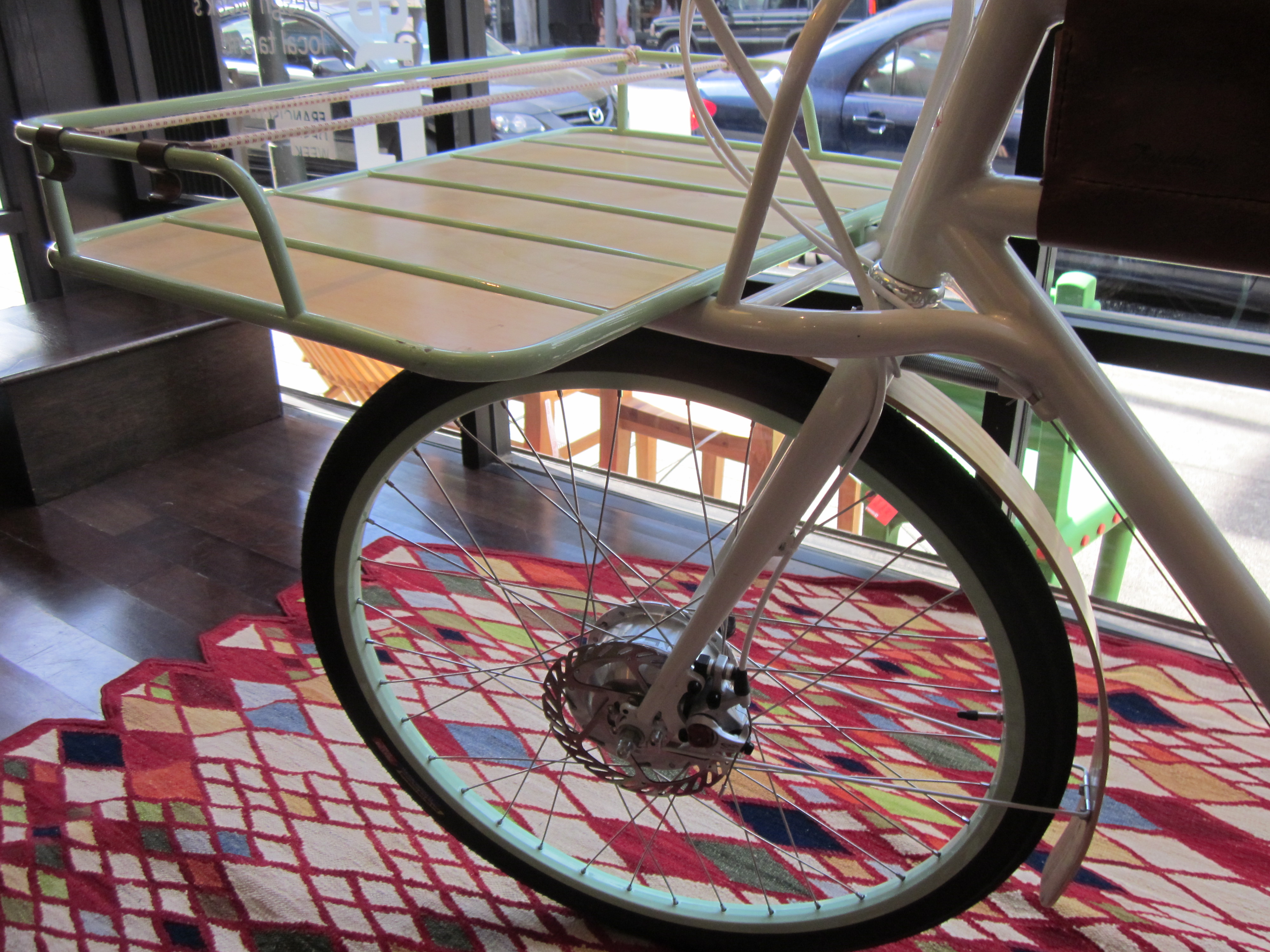
I met my sister at Propellor, which is kind of a hyper-local version of Design Within Reach. Propellor was an odd location to find a bicycle, other than the one I’d locked up outside, but a bicycle there was. It was, in fact, an electric bicycle, the Faraday Porteur, a creation of IDEO/Rock Lobster that was the Oregon Manifest People’s Choice winner. Oregon Manifest was a 2011 competition intended to encourage designers to create the ultimate utility bike. Given that hauling kids was not even a criterion in the Oregon Manifest, it was hard for me to take much of an interest. But although the Faraday reflects the goals of the Manifest rather than of many actual utility cyclists, it is an interesting bike nonetheless.

There are some issues that arise when attempting to market a bike in a modern housewares store. The main one is that the people staffing the store clearly had no idea what they had in their window, other than that it was an electric bike, and then only because it said so on the sign. I had a lot of questions, and they didn’t have a lot of answers. Eventually they found a brochure, and that helped. They are planning to sell the Faraday, which is actually going into production. With luck they’ll have someone in the store who can explain what it actually does by then. I’m interested to see how the whole sales process goes. They’re clearly reaching a market of people who would not normally spend a lot of time in bike stores. What will happen after one of them actually buys a bike is something of a mystery.

Front hub motor, apparently

The Faraday Porteur is clearly an effort to make utility bikes seem cool. I recognized from the front hub that it was an electric bicycle even without seeing the sign, but couldn’t spot the batteries. The brochure revealed that they were packed into the double top tube.  Although I think packing the batteries in the frame is a fantastic idea, I wonder about the choice to put them in a double top tube. You can forget about adding a rear child seat given that frame; you’d roundhouse your kid every time you got on the bike. Putting that much weight in the top tube seems like it would make the bike harder to balance, and my brother-in-law wondered what happened when someone needed to replace the battery. And the whole bike seemed designed for a sporty ride; there’s no way to ride upright on that frame. Maybe it’s meant to appeal to people who would otherwise ride fixies?

Those quibbles aside, there is a lot the Faraday gets right. The frame-mounted front rack comes off and on with one hand, and it is large enough to haul serious cargo. The mount for that rack has two headlights built into it, and the rear of the bike has an integrated taillight. They were very, very sweet. The electric assist (which is a pedal assist, but I got that from the website, not from the confused staff at the store) is beautifully integrated into the bike, looking exactly like a left-hand shifter. It’s not a particularly powerful assist, but for this kind of bike, I doubt it needs to be. And there is no question: this is a very pretty bike.

Pretty, but vague on the details

The Faraday got a lot of attention while we were there, from people who didn’t have my kinds of questions. Theirs were more along the lines of, “When will you have them in stock?” and, “How much will they cost?” The store couldn’t answer those questions either.

In a neighborhood like Hayes Valley, a bike built to carry a case of beer easily, rather than a kid, is right on target. The Faraday, which takes the brutality out of climbing the city’s hills and makes it possible to haul everything a single person could need,  was clearly making riding a bike seem practical to people who would never consider it otherwise. I hope they sell thousands of them, and that the next time I’m in Hayes Valley, I see them everywhere.

1 Comment

Filed under cargo, commuting, electric assist, San Francisco