Category Archives: San Francisco

We tried it: Yuba elMundo

I didn’t manage to get good photos of the elMundo I rode, so here’s a nice-looking Mundo. Imagine a battery behind the tube holding up the seat and you’re mostly there.

I have said before that Yuba is the Ikea of bicycle manufacturers. This sometimes gets taken as a slur against Yuba, but I intend no disrespect. Ikea meets a market demand that no one previously realized was there: at certain points in their lives, people want cheap furniture that looks decent. Yuba realized there was a market demand that no other manufacturer was meeting directly: inexperienced riders wanted inexpensive bikes that could carry a bunch of stuff.

Xtracycle pioneered that market with the FreeRadical longtail extension, but there are some limitations to their model. The first is that the FreeRadical will fishtail and flex under weight (that means you feel like the bike will fall apart while riding it loaded, even if it won’t—although with sufficient weight, in difficult conditions, it actually might). The second is that installing it onto an existing bike frame, or for that matter even understanding how it works, requires a certain baseline level of comfort with bicycles. Xtracycle attempted to address the second problem with the release of the Radish, but as the Radish is simply a FreeRadical attached to a bike frame, there are still problems with flex. They addressed the problems with flex by partnering with Surly to create the Big Dummy, which uses a solid frame, but that bike is substantially more expensive, and offers some complicated choices. Having talked to a lot of inexperienced riders, I can attest that although the Xtracycle line of products is incredible (seriously, it’s awesome), it can seem very confusing.

Enter the Mundo. Yuba keeps it simple. (I rode a Mundo for a couple of weeks earlier this year and reviewed it here.) For $1200 you get a bike with a strong frame that can carry massive amounts of weight, mountain bike gears to climb hills, fenders for foul weather, and a lot of cargo and kid-carrying options (these cost extra). Hitting that price point means that Yuba has made certain compromises: there is no free lunch in the world of cargo bikes. For one thing, the bike is heavy, and even with a lot of gears, getting up steep hills involves major-league suffering. Thus Yuba created the elMundo, the electric-assist version of the Mundo.

I found riding the elMundo fascinating. If you’ve read my review of the Mundo, most of the reasons the Mundo wasn’t the right bike for us are still an issue with the electric assist version.  The elMundo is not our future bike. However our situation is somewhat unusual, and after riding the elMundo I think that unless there is a sea change in what other manufacturers are doing, it will soon dominate the family/cargo bike market.  That is in large part because Yuba has created a bike that is simple enough, cheap enough, and capable enough that it is drawing in people who had previously never imagined that they might commute by bike with their kids. There aren’t a lot of choices to make with the Yuba line, and that can be a good thing.

The pros of the elMundo:

  • Longtails ride a lot like normal bikes. The learning curve is minimal. I’ve gotten comments that I harped excessively on getting used to a bike in my reviews of front box bikes, but I think it’s important for people to have a sense of how long that might take, or they will rule certain bikes out the first time they get on them. (There are multiple attempted reviews of the Bullitt, for example, that essentially say: “Yuck, I couldn’t ride it.”) The elMundo is no exception to the general “easy to ride” rule; although of course it gets tougher with the kids on deck because they squirm and that can mess with balance.
  • Both the Mundo and elMundo can carry major amounts of weight without the bike feeling unstable or fishtailing. Yuba claims that you can carry over 400 pounds of cargo on the rear deck. A very nice (although somewhat out of date) summary of cargo bikes from JoeBike notes that cargo bikes can usually safely carry rather less weight than their manufacturers suggest, and other bike shop owners have told me the same thing. However the Mundo line is still rated to carry twice what other longtail bikes can.
  • Unbeatable price! The elMundo lists for $2600, basically the price of a Mundo with the assist thrown in at what must be very near manufacturer cost. There is no other electric assist cargo bike I have heard of that approaches this figure. For example, the hopefully-soon-to-be-released Xtracycle Edgerunner, which looks to be a very nice assisted longtail, is supposed to list for $3500. That’s a good price for an assisted cargo bike too, but it’s still almost $1,000 more than the elMundo. Novice riders in particular are extremely price-sensitive.
  • The elMundo, like the Mundo, has good acoustics. This sounds like a weird thing to say, but having the kids behind you instead of front means that you can’t see what they’re doing. Being able to hear them reasonably well as a rider helps smooth the ride (kids, left unobserved together, will eventually fight). Plus it’s entertaining. You as the rider still can’t be heard by them, but it’s better than nothing.
  • The elMundo has a good kickstand, which now comes standard (the older versions of the Mundo had the better kickstand as a more expensive option). Poor kickstands are legion among longtail and midtail bikes. Putting live weight on a bike is different from putting dead weight on it, and having a decent kickstand is critical to being able to load the bike safely with two younger kids, or being able to add cargo to a bike with kids on it (and kids come with a lot of stuff). You can’t put the kickstand down without getting off the bike, but the bike is unlikely to topple while parked.
  •  The electric assist, which works using a twist-throttle on the right hand grip, is very simple to operate and powers smoothly up mild to moderate hills. The further you turn the throttle, the more power you get from the motor. I always overheated getting the Mundo up San Francisco hills, which was extremely undesirable given that I commute in work clothing. The elMundo is better.
  • Both the Mundo and elMundo are relatively short for cargo bikes, at just shy of 7 feet, and that means that they are much less painful to park and store. Although the Mundo is wide in back, you’ll be able to fit it into a normal bike corral if you roll in forward. However you will still need walk-in parking, or close to walk-in parking, and there is no way you could carry the bike upstairs. The Mundo takes up a lot of room at the conventional San Francisco “bike rack”, which is a parking meter, but it won’t completely block the sidewalk as a Bakfiets or trike would.
  • The elMundo (as well as the Mundo) can take an infant seat on the front, which makes it possible to carry three kids (two on the deck, one in front) with minimal squabbling.
  • The elMundo can carry a lot of cargo in addition to kids. Yuba’s Go-Getter bags, which are Mundo-specific panniers on the rear rack, are gigantic and don’t sag because they are supported by the side beams on either side of the rear wheel. If you don’t like the Go-Getter bags, you can install Xtracycle FreeLoaders (this would be my choice). The optional front Bread Basket is frame-mounted. It takes some getting used to, because it doesn’t turn with the bike’s front wheel, but that frame mount means that it can carry a lot of weight. For example, friends with an elMundo bungeed a 16” kid bike with training wheels to it last weekend. We carried a week’s worth of shopping on a Bread Basket.
  • The Mundo and elMundo have some nice design features. For example, the side beams that stick out on either side of the rear wheel can be used as footrests for riders on the deck or as a way to easily haul a second bike. The bike is accessible to riders of a range of heights with an adjustment of the quick-release seat. A front wheel stabilizer to keep the bike from toppling due to the weight of the front wheel is standard. The deck and optional foot boards are made from bamboo; very pretty. The color choices (orange and black) are more attractive than most. And if you don’t have much storage space, the Yuba can be balanced “standing up” on the back of the frame (photo here), assuming that you don’t have a child seat on the end of the deck.

The cons of the Mundo:

  • The eZee electric assist on the elMundo is underpowered. I had heard reports that it failed on steep hills, which I believe. It struggled on moderate hills, slowing substantially on the longer ones, even with no kids on deck or other cargo. (My definition of a moderate hill is roughly 10% grade, which is maybe atypical but is consistent with San Francisco topography. However note that the bike was unloaded.) Ultimately I climbed hills faster by turning on the assist for a while, then turning it off and pedaling for a bit, then turning it on again, etc. This worked but did not improve my mood. A BionX assist is much more efficient and did not struggle at all on comparable grades, even with a two-kids-and-all-their-gear load. However a BionX assist is substantially more expensive, and a BionX rear wheel is only rated to carry 220 pounds. Given that safe cargo weight limits on longtails can be exaggerated this might not make much practical difference. However several hundred dollars in price difference for a BionX assist is not trivial.
  • The eZee battery is very wide, and that means that the elMundo has lost the Mundo’s front triple ring, because there is not room at the back for the chain to run freely with three front rings. The elMundo has only seven gears in the back instead of the 21 gears on the Mundo (3 in front x 7 in back). Converting a Mundo into a elMundo costs ~$2000 at San Francyclo, more than the $1400 price difference between the two bikes at purchase, in part because of the parts swap on the front ring.
  • The eZee assist is a throttle assist rather than a pedal assist. (There are after-market eZee assists that have a pedal-assist option, and evidently at least one person has put one on a Mundo, but I’m focusing on the stock elMundo.) This is a personal preference, but I am much happier using a pedal assist, in part because the effort of pedaling is multiplied when riding instead of replaced. When I turned the throttle on I stopped pedaling, and this made riding the elMundo feel like switching between a bike and a moped.
  • Front hub motors like the eZee are somewhat noisy. The sound of the motor, when it was on, negated some of the good acoustics I liked when riding the bike unassisted. The motor wasn’t nearly as obnoxious as after-market mid-drive motors—the one I tried was like a Vespa—but it was louder than manufacturer-installed mid-drive motors like the Panasonic, and I found even that mild rattle vaguely annoying when I tried it.
  • The Mundo and elMundo both have cheap parts. What that means from a practical perspective is that they can be less than fun to ride at times. There is mild rattling while the bike is moving and I noticed bad pavement more than usual (and this bike was better maintained than the Mundo I rode earlier in the year). When I tried to shift gears, sometimes it worked and sometimes it didn’t. That probably wouldn’t matter much to me if I lived in Chicago, where people can ride for hours without changing gears, but I live in San Francisco, and I rarely ride for more than a few minutes without needing to shift. Having ridden bikes with better components, and discussed these issues with the shop, I feel confident that this is not my incompetence; instead, it’s that the stock gearing uses cheap parts. Similarly, the stock brakes on the elMundo are terrible. Not only is there a rim brake on the front wheel, the rear disc brake was weak and slow to stop the bike, even when it was unloaded (the Madsen has a similar setup, which I also disliked, but the brakes on the Madsen worked better; I have no idea why). Again, maybe a San Francisco-specific issue; I am paranoid about bicycle stopping power.
  • The elMundo felt sluggish. This is difficult to explain, and I doubt that I would have noticed if I hadn’t spent a few weeks riding many other cargo bikes. However after that my conclusion was that some bikes like to go fast (Big Dummy, Bullitt), and some bikes want to go slowly (Bakfiets, elMundo, Mundo). I felt like I was constantly fighting the elMundo to get up to the speed I wanted to travel.
  • When I rode the Mundo, I had issues with the side loader bars that stick out from either side of the rear wheel. In many ways these are very handy, because they provide nice footrests and support the Go-Getter bags. However for me their width was frustrating on city streets in narrow bike lanes. I was never sure whether I could thread through pinch points in traffic, particularly at intersections when cars move to the right curb and block half the lane. With Go-Getter bags the problem is exacerbated, as they’re so big that the width of the bike in the rear then becomes almost 36 inches, wider than most bicycle trailers. For this reason, I thought that the Mundo, when I rode it, was more of a suburban or small city bike than a big city bike.
  • From a parental perspective, riding with the kids in back is less fun than riding with the kids in front, because you can’t really talk to them. Moreover you can’t easily break up fights. Technically there is room on the back deck for three kids (and the Mundo/elMundo can certainly handle the weight) but putting three kids in close proximity like that is like putting both of our kids on the deck of our Kona MinUte: sometimes we get lucky and they get along swimmingly on a long ride, and sometimes they start smashing helmets in less than a minute, at which point we have to walk the bike.
  • With a longtail loading the bike is more complicated than it is with a box bike. Box bikes don’t have any issues with, say, a mega-pack of toilet paper. However if you ride a longtail there’s always going to be some repacking with bulky items.
  • My daughter, who is three, can’t climb up to the deck and into the child seat unassisted. It is useful when kids can load themselves onto the bike, although this issue is less critical given that the elMundo has a good kickstand.
  • Both the Mundo and elMundo are very difficult to walk while loaded and to start up an incline while loaded without tipping over. I dumped my kids on the Mundo, and given time, the same thing would happen with the elMundo. Although I often feared dumping my kids with the front box bikes, it never actually happened. Longtails are less stable than box bikes.
  • The top tube on the Mundo and elMundo is fairly high. That’s part of the reason it can carry so much weight without complaint, and that’s no small thing, but I suspect that shorter riders would have trouble getting on and off the bike for this reason. It involved more contortion than I would have liked and I’m 5’7”. Update: Check out the comments below for a nice discussion of how a 5’2″ rider gets on and off the bike.
  • Like most of the longtails, the elMundo comes without any of the commuting accessories that make bikes easier to ride in a lot of situations.  Although fenders are standard, there is no chainguard, there are no dynamo lights, and neither one appears to be an option. Adding a child seat is $170, the Go-Getter bags are $130 each, the front Bread Basket is $130, stoker bars for an older kid are $60, and seat cushions for the deck are $30 per kid. Getting the bike to the point where it can carry two kids and a reasonable amount of cargo would cost a fair bit on top of the list price of the bike.  And there is no rain cover for the kids. And I’d still have to tie up my pants.

When I rode the Madsen, I realized pretty quickly that I wouldn’t be comfortable riding it in San Francisco without substantially upgrading the parts. And frankly that seemed like too much work given that there were other choices. The same is true for the elMundo. Yuba sells a frame kit, and it is possible to buy that and build it up with much higher-quality parts: better brakes, better gearing, better tires, probably dynamo lights, a stronger assist, and so forth. I suspect that would resolve many of my issues with the elMundo: it could stop quickly, could climb hills better, wouldn’t resist shifting gears, and probably wouldn’t be as sluggish. The question is how much that would cost.

BionX Mundo. Nice!

Some parents at our son’s school recently bought a customized Mundo with excellent parts that had been returned to the shop by another customer.  The shop (Roaring Mouse) had also installed a BionX assist. It is a beautiful bike and they have zero problems climbing San Francisco hills—I saw the mom at Sunday Streets last weekend pedaling casually up to Alamo Square—but they said that their bike was quite expensive even though the price had been significantly reduced because it was a customer return. I suspect that a Yuba Mundo/elMundo upgraded to the point that I’d enjoy riding it would cost at least as much as a Surly Big Dummy. At which point I have to ask: why not buy a Big Dummy? It would be a lot easier.

And yet. I am picky about these issues because I live and work on steep hills in what I am told is the second hilliest city in the world (and this is not a competition you want to win). My situation is not typical, perhaps not even in San Francisco. I see a LOT of Mundos and increasingly, elMundos, in the city now, primarily in the Richmond and the Sunset. Families who live in these areas and commute to local schools and/or along the Wiggle have no need for a bike that can scale steep hills. There are few serious grades in those parts of the city, the streets are wide and mostly empty of moving cars, and they can rent a car if they want to go to the Randall Museum. I would be surprised if families who live on Nob Hill or Potrero Hill could make an elMundo work for them without serious after-market modifications, but there are lots of families who don’t need to go those places.

The elMundo is cheap and its parts are sufficient for most riders. This bike makes it easy to take up commuting by bike with kids, and in flat cities, the same is true of the Mundo. There are no complicated decisions to make, riding it is painless, the bike is inexpensive, and it will get most people where they need to go smoothly. This is why I think the elMundo will be a category-killer.

11 Comments

Filed under electric assist, family biking, reviews, San Francisco, Yuba Mundo

The mamachari returns

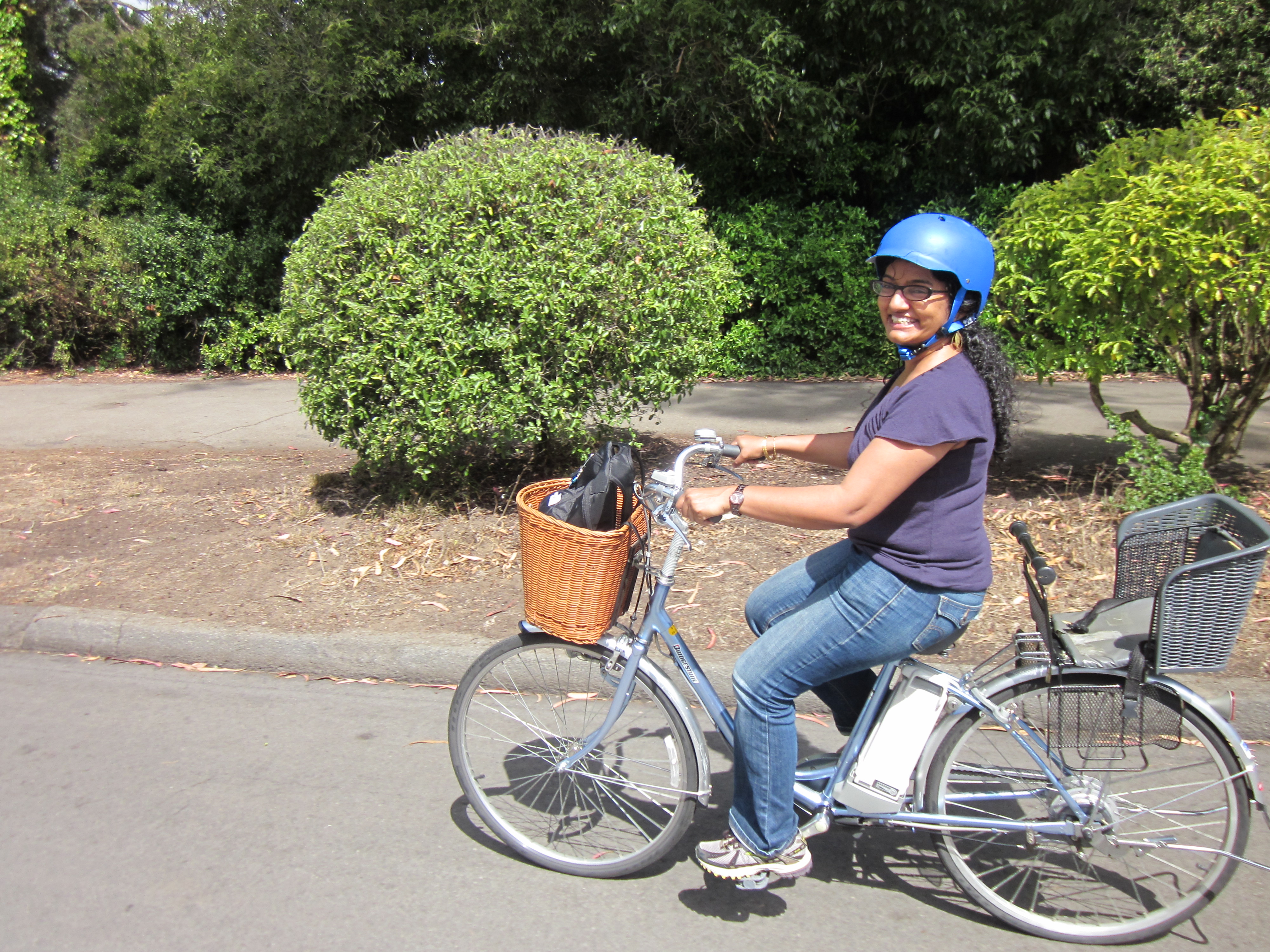
The resurrected mamachari graces the California Academy of Sciences bike racks.

When I left for our Pacific Northwest trip the mamachari was out of commission. With no working battery, my 65 pound single-speed bike was technically functional, but I had no interest in taking it out on hilly neighborhood streets.

Before we left I had written to Mama Bicycle, who has written many times about his willingness to try to export mamacharis to a soon-to-be-appreciative world. I asked him if he could identify a replacement for my mamachari’s battery, and if there was one, ship to the US. He was delighted to do it. I don’t think that bicycle people could possibly be nicer. Unquestionably, if you are interested in a mamachari and you live outside of Japan, he is your guy.

Oh, how I love Japantown. If Japan is anything like it, it must be totally awesome.

When I sent photos of the Bridgestone battery he identified the model immediately, found that they were still being sold in Japan, and figured out how to send one. I was so impressed! My mamachari’s battery is a NiCd, fortunately, which meant it was legal to send by air from Japan to the US (evidently newer lithium-ion batteries have an occasional spontaneous combustion issue, so they’re harder to ship). Nickel-cadmium batteries have their issues (charge memory, safe disposal, weight, range), but they have a couple of points in their favor too. One is that they seem to last forever—the original battery on my bike was in continual use for about six years. The other is that they’re fairly cheap. Even with the non-trivial cost of overseas shipping, it cost less than the least expensive lithium-ion battery sold in the US. For several more years with this bike it seemed more than worth the cost.

Although he was confident that he had identified and shipped the correct battery, I was nonetheless a little nervous about getting a battery shipped from Japan sight unseen. What if it wasn’t the right model, and I’d wasted my money on a battery that didn’t fit my bike? And I’m guessing he may have had some anxiety about shipping one to me, too, especially given that he couldn’t ask for payment until it arrived (his Paypal account had to be upgraded to take US dollars and it took a while).

New battery on top; old battery below. The only difference is that the new one holds a charge.

When I returned to San Francisco, our office receptionist was very excited to announce he had a package for me from Japan. I opened it up when I got home, and I’ll be: it looked identical to the old battery. It fit into the battery compartment perfectly. After a few hours of charging, I took it down to the basement, loaded it, and took the bike for a spin around our basement. WOW! Evidently the old battery was under-charging for quite a while, because the mamachari was suddenly extremely peppy.

The new battery didn’t have a connection to the backup battery like the old one, so given that and the new battery’s increased range and power, I took the spare battery off the bike. Now I’m riding a 50 pound mamachari. It makes a difference.

“I need a bike!”

We are back to having three working bikes: MinUte, Brompton, and mamachari. On Labor Day, when we were out with a neighbor, his son wanted to show off his new bike-riding skills. She hadn’t ridden a bike for over 20 years and she is short. So we loaned her the mamachari (the obvious choice as it is single-speed, hard to tip, and can nonetheless get up almost any hill) and headed to Golden Gate Park. She took off with a bit of a wobble, but after a block began yelling, “I need a bike! I need a bike! Look at me, I’m riding! I so need a bike!” Two hours later she was still yelling, “I need a bike!” By the end of the afternoon, another friend we’d met at the park had arranged to loan her their old folder.

So thank you so much, Mama Bicycle! You are awesome! The mamachari’s return has not only made our lives better, it also recruited another parent to family biking in its first week back in action.

And check out what I spotted at Western Addition Sunday Streets! Another (unassisted) mamachari!

My daughter loves being able to ride to preschool again. Like my son, when she arrives on a bicycle she is treated like royalty. Their friends jump up and down, waving wildly. “Turn on the pink power, mommy!” she yells. “I’m riding the mamachari! I’m riding the mamachari! Look at me, I’m riding the mamachari!”

16 Comments

Filed under electric assist, family biking, San Francisco

Shrader Valve

This is the Panhandle bike path marking for the upcoming Shrader Valve.

The connection from the Panhandle to Golden Gate Park is a bit complicated. Before the western edge of the Panhandle, bikes veer off the path to the right at Shrader Street. The bike light at Shrader Street directs you into a marked bike lane on Fell Street, which in turn leads to the protected bike lanes of Golden Gate Park. The turn is called the Shrader Valve.

Starting from Market Street at the Ferry Building, through the Wiggle to the Panhandle, and through the Shrader Valve to Golden Gate Park, you can ride a bike in marked lanes on a relatively flat route from San Francisco Bay at the eastern edge of the city to Ocean Beach at the western edge, and back again.

Bike light is green! Follow the arrow into the Fell Street bike lane, and it’s a straight shot from there to the ocean.

I finally got a picture of the Shrader Valve intersection this afternoon on the way home from Western Addition Sunday Streets. It’s not just for tires anymore!

2 Comments

Filed under commuting, San Francisco

The end of the road is not the end

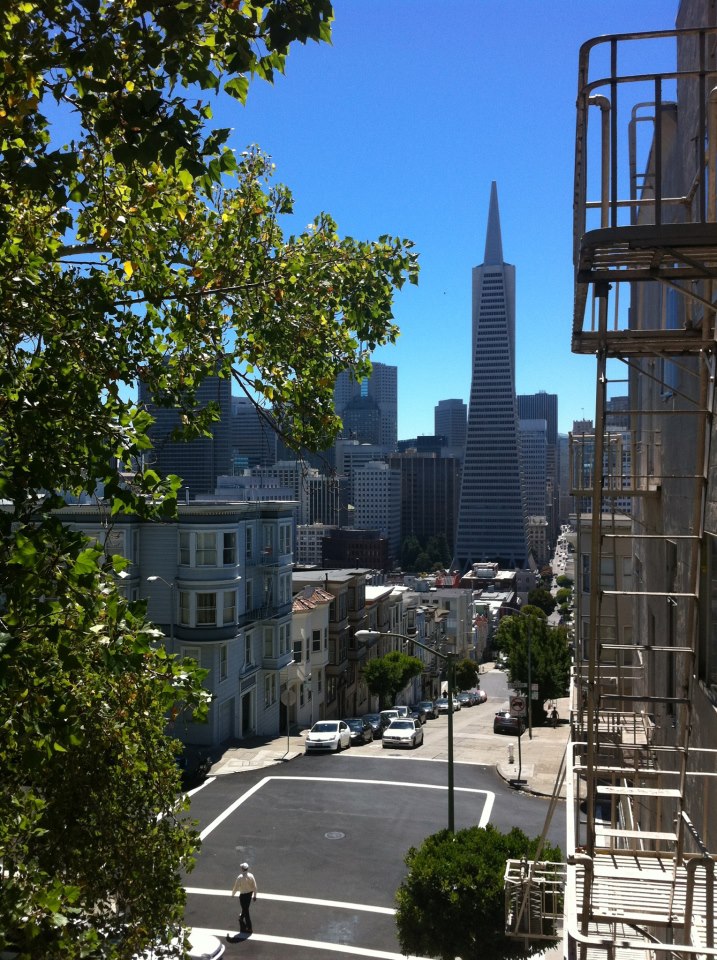
Looking up and looking down: welcome to San Francisco.

My sister took this photo on a lunch-time walk. Last week I mentioned the impressive 41% grade of Bradford Street, above the Alemany farmers market. However the steepest hills of San Francisco begin where the road ends. Some San Francisco hills (and neighborhoods), like this one, are only accessible on foot, by staircase. But what beautiful hills they are.

Leave a comment

Filed under San Francisco

Role models

On the first day of school our son asked to go by bike.

We have not been involved with family biking that long. One could argue that we make up for lost time with intensity. We have no car anymore, and we ride somewhere pretty much every day, although I know myself too well to track days or mileage, because that would inevitably lead to compulsion and madness. I learned that the hard way when my employer was handing out free pedometers. The day mine broke snapped me out of an obsession that had had me pacing around our bedroom at 11:59pm every night to break my steps record from each previous day.

Because I don’t track miles and I’m not riding a bike to get in shape, I am enjoying myself and so is everyone else. I realized that the other day when my kids found some old packing paper, spread it out into a makeshift course in the living room, and started racing each other using a ride-on hot wheels truck and a ride-on bumblebee. They called out, “I’m winning!” “No, I’m beating YOU! I turned on my electric assist!” “I’m pedaling faster than you!”

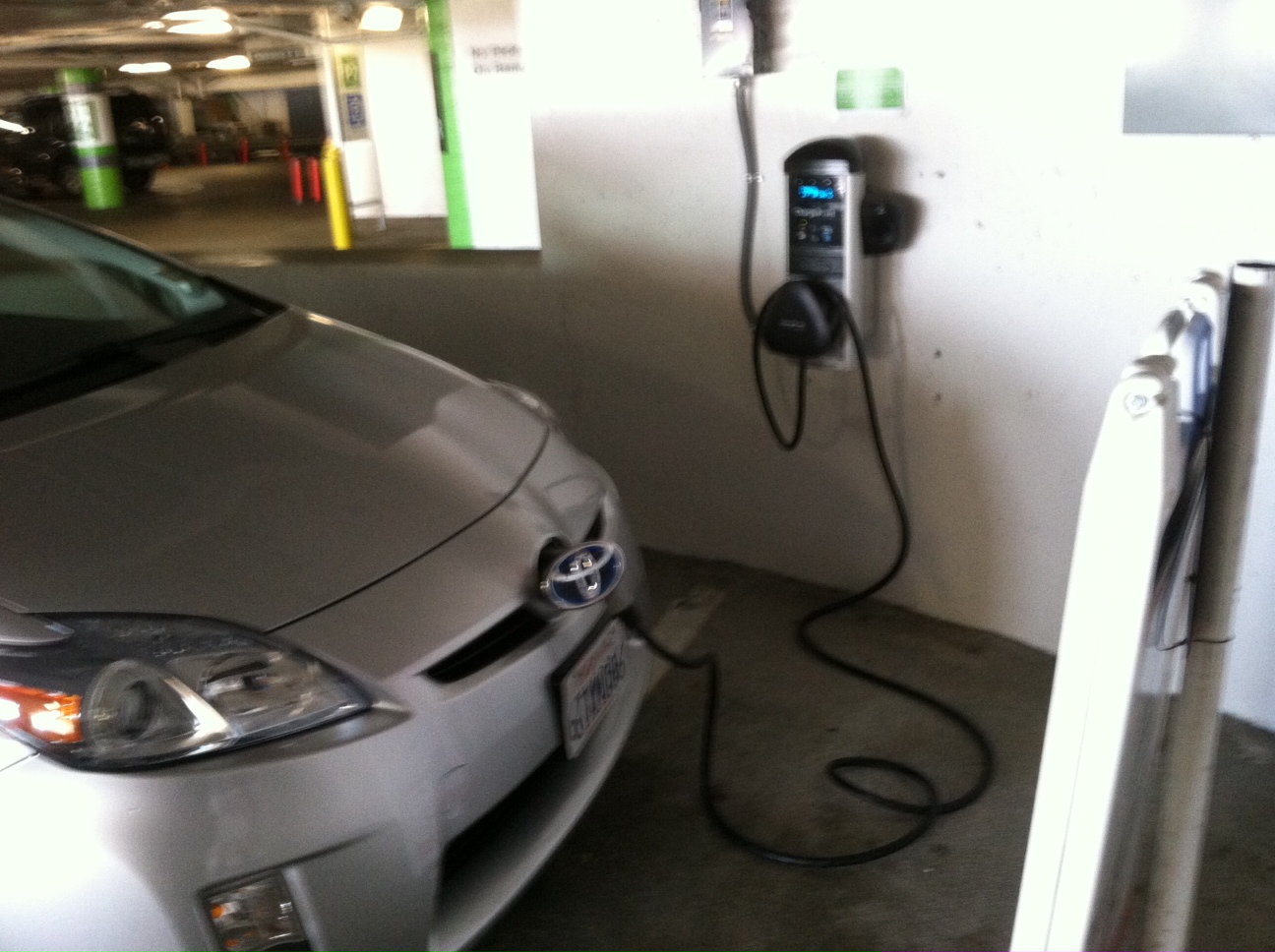
Our default rental car is now this plug-in hybrid (City Carshare is offering these at their lowest rate).

We have been in cars a lot in the last month: rides to the airport, rides to the train station, a week at my mom’s, a trip to Marin. We rented a car last week for one of our more intensive grocery runs, which involved refilling a gallon jug of olive oil and serious inroads into the bulk food bins. Altogether it’s worked to out about a dozen car days this month (although those were mostly clumped together while traveling, and astonishingly, all of them together still cost less than the lowest monthly tab of owning the minivan). This is apparently not enough driving to dislodge my kids’ new self-perception that riding a bike is what’s normal. On our trip to Marin, my daughter asked me whether it was possible to buy a car with electric assist that would make it go faster. I said that’s not really how electric cars work, and suggested that cars went fast enough already, but she remained unimpressed.

Although I’m not opposed to using a car occasionally, pretty obviously, not owning one has been liberating. When we drive I remember that being in a car kind of sucks: hello traffic, parking, and road rage. I definitely appreciate the increased range and time-savings over long distances (we won’t take BART to visit my in-laws again, it takes twice as long and is almost as expensive as renting a car), but altogether I’d rather be doing something else. My daughter’s preschool is closed this week, so on Monday we rode down to the Academy of Sciences, parked the bike at the (empty) rack by the front door, and walked right in. Watching other parents struggle out of their cars several blocks away or the subterranean parking lot, I thought, “I’m glad we’re not doing that anymore.”

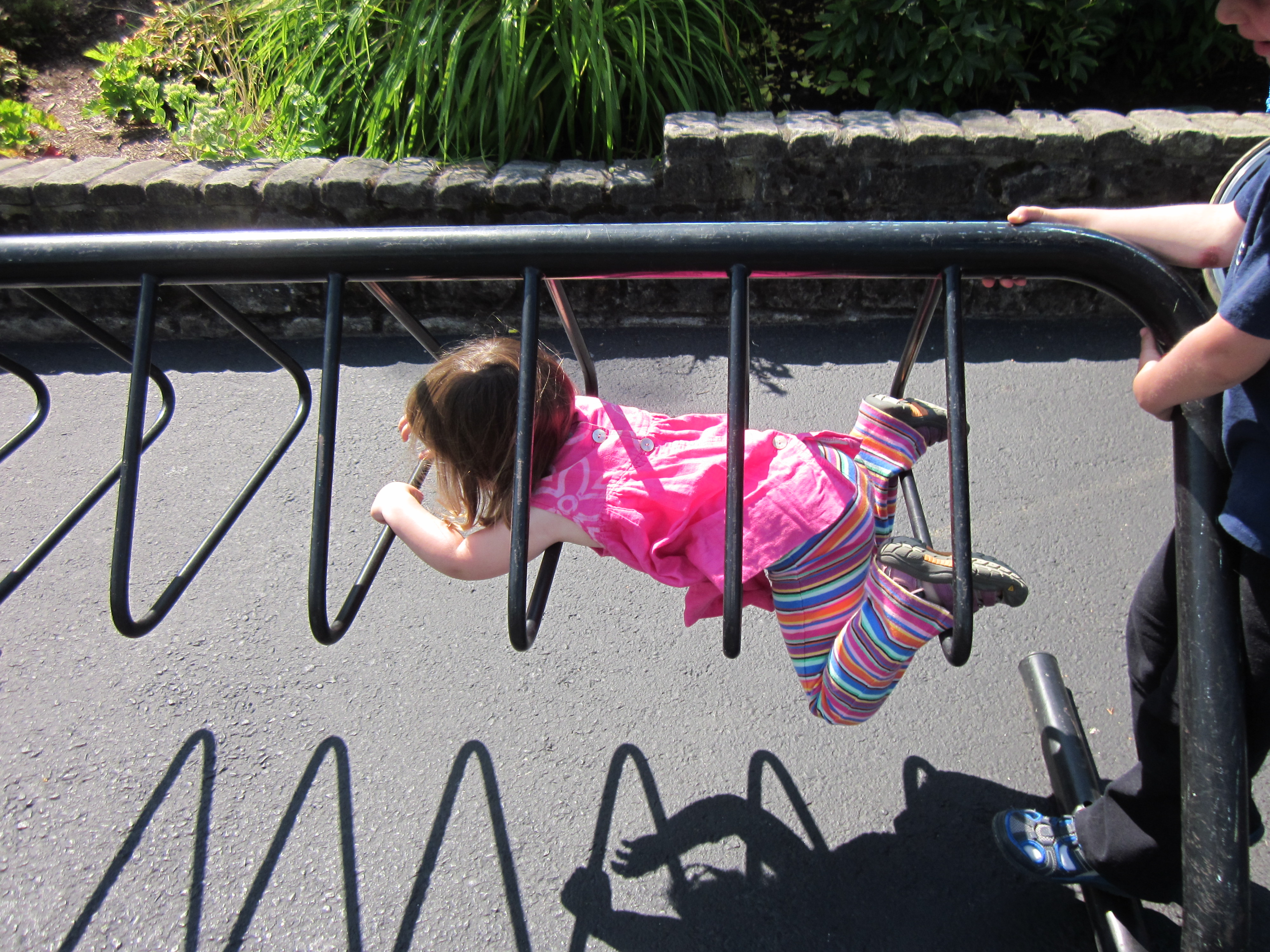
Kids on bike racks: it never gets old.

But that’s just me. Our kids get to live this way because it makes our lives easier, not because they chose it, although they were the inspiration. My kids are simpatico with our vegetarianism (which I realize is hopelessly retro of us in this brave new world of “primal” eating). I wondered if they would resist life without a car. We don’t spend much time talking about more general reasons we might want to reduce driving, as our daughter is three and our son worries way too much about doing the right thing already. We do our thing, and we told them we will rent a car whenever they want. And it turns out that’s fine with them. They like riding the bike and taking the bus and walking; it means we can pay more attention to them.

I have these occasional terrifying moments as a parent when I realize that literally everything we do defines our children’s understanding of what is normal. We view life as easier and better not that we drive (much) less and so do they. I like that our transportation choices are now more closely aligned with other things we want in our lives: quieter streets, cleaner air, and streets designed for people. And we are not totally unaware of the environmental implications. Without getting too deeply into our world views here, we have a compost bin and we’ve been known to use it.

She came up with this all by herself, before I had the chance to show her Loop Frame Love, who pioneered the bike rack tunnel.

So it turns out I like being this kind of role model. I like being happy with my commute and I like that I can share it with my kids. I like saving money. I like feeling less tied to things. And I like watching my kids pretend that their toy trucks are really bicycles.

(A shout-out goes to the infinitely readable Davey Oil for inspiring some of these thoughts.)

6 Comments

Filed under car-free, commuting, family biking, San Francisco

Our hills are bigger than your hills

I don’t know why I even bothered to write a post about the hills in our neighborhood, which top out at a pathetic 25% grade, when it turns out that someone else had already measured the grades of San Francisco for me. Down at the other end of the city, near a certain electric bike shop, there are hills that laugh at junior-league slopes like Mt. Sutro.

The steepest street in San Francisco? 41% grade. That’s right. We broke the 40% mark. Unless you live here too, your city just got pwned.

Go ahead, tell me a bicycle with electric assist is cheating. I’ll see you at the top of Bradford Street. Or rather, I’ll see you FROM the top of Bradford Street.

5 Comments

Filed under electric assist, San Francisco

Home again, home again, jiggety-jig

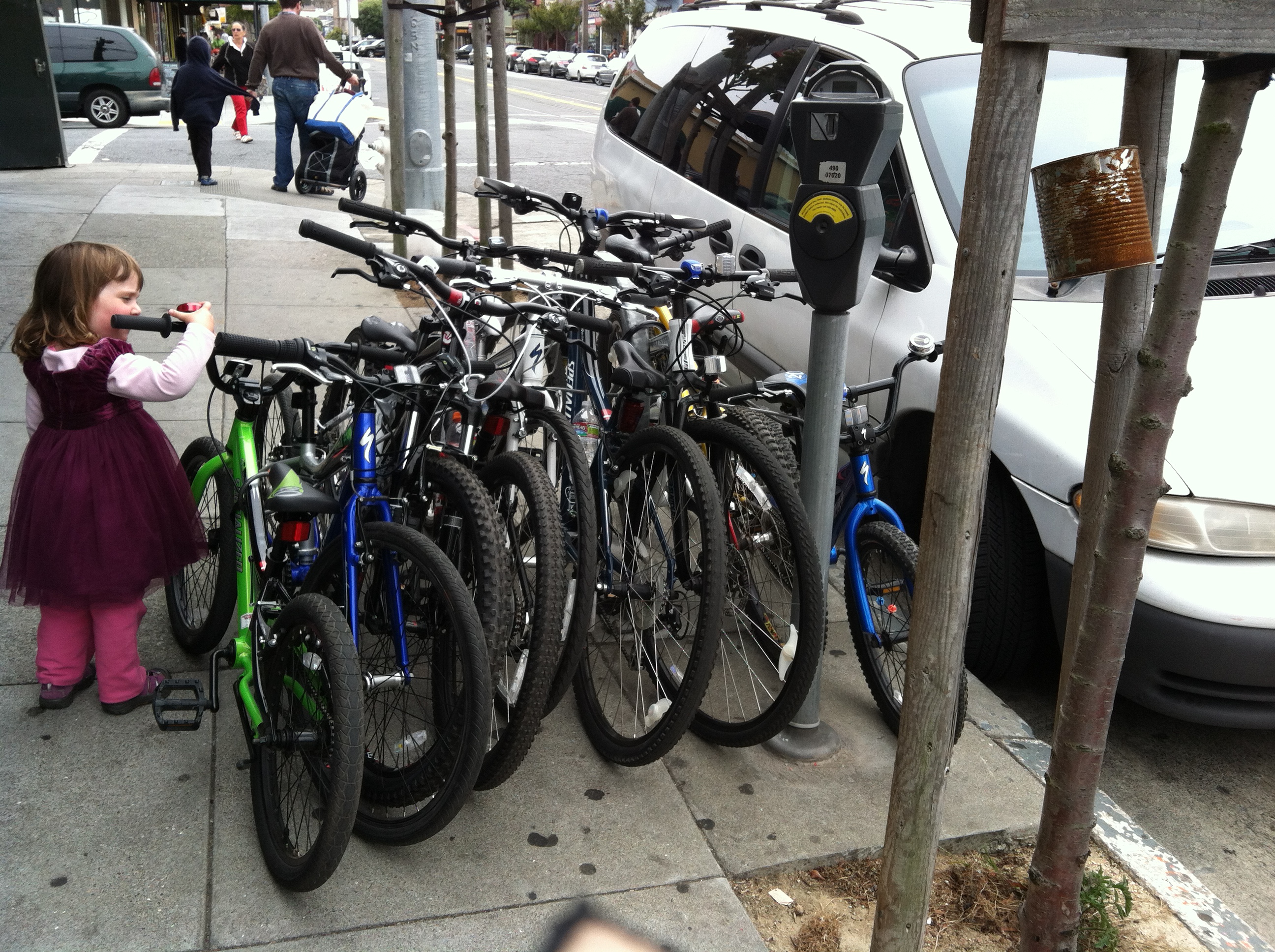
They’re running out of bike racks at the farmers market.

We got up on Sunday to catch a 5:30am flight from Portland to San Francisco. The kids wore their pajamas for the whole trip. When we got home, we remembered that we’d left nothing in the fridge when we left but soy sauce, lemons, and ollalieberry jam. So even before napping, we headed to the farmers market (fortunately a Sunday market) and the grocery store to buy: everything.

Staying in Portland made us want to live in Portland. Matt loved the idea that we might actually buy a house, and I loved the idea that we might actually have a yard where we could garden. And there were all those bikes. We even saw a double trail-a-bike, something I had heard existed but never spotted in the wild. And all those clearly marked bike paths, that made it possible for newbies like us to get where we were going, eventually.

San Francisco greeted us with fog and temperatures in the mid-50sF (where they have remained). It was a culture shock to return to such a dense city, in both a good and a bad way. There are no unattached houses in our neighborhood and no front yards. It is impossible to grow tomatoes on this side of the fog line, and anything metal left outside grows rust and/or moss. But having such an easy walk to the farmers market and the grocery store was so nice. We always see friends there, and Sunday was no exception. Everyone admired our bike trailer/hand cart. In California, the produce is always local. And when we couldn’t bring ourselves to actually make dinner after making the week’s lunches, we walked across the street for sushi.

The last couple of family bikes after our late departure

San Francisco has more bikes now too, it turns out. This morning was our son’s first day of second grade. I can’t believe how much he’s grown! I ruined my street cred by renting a City CarShare to carry all our gear on the first day of school (I couldn’t get both it and my daughter there on the Brompton). But Matt rode with our son to school on the MinUte, joined by at least five new biking families! Three Yuba Mundos (at least one assisted), one Trail-Gator, one trailer. One mom asked, “Are you Hum of the city?” Well, whoa. Yes I am. My name is Dorie, by the way, and I need to update that About page.

Before we left on our trip, our kids begged to plant poppies. We found some pots and bought some seeds and prepared to console them when such sun-loving plants gave up before blooming. But when we returned, we found, to our enduring surprise, the first flower. We are glad to be home.

2 Comments

Filed under family biking, San Francisco

Homesick for the north, homesick for the south

Our first trailer ride

From Bellingham to Seattle to Portland: we have arrived, and so excited to see daddy again. I haven’t had much chance to update while gamboling around the Pacific Northwest mostly solo with two kids, but I’ve also been constrained by the constant barrage of fun. I grew up in Seattle and Bellingham and I was overwhelmed by homesickness. They are both really good places to ride bikes with kids.

So eight family bikers lock up together…

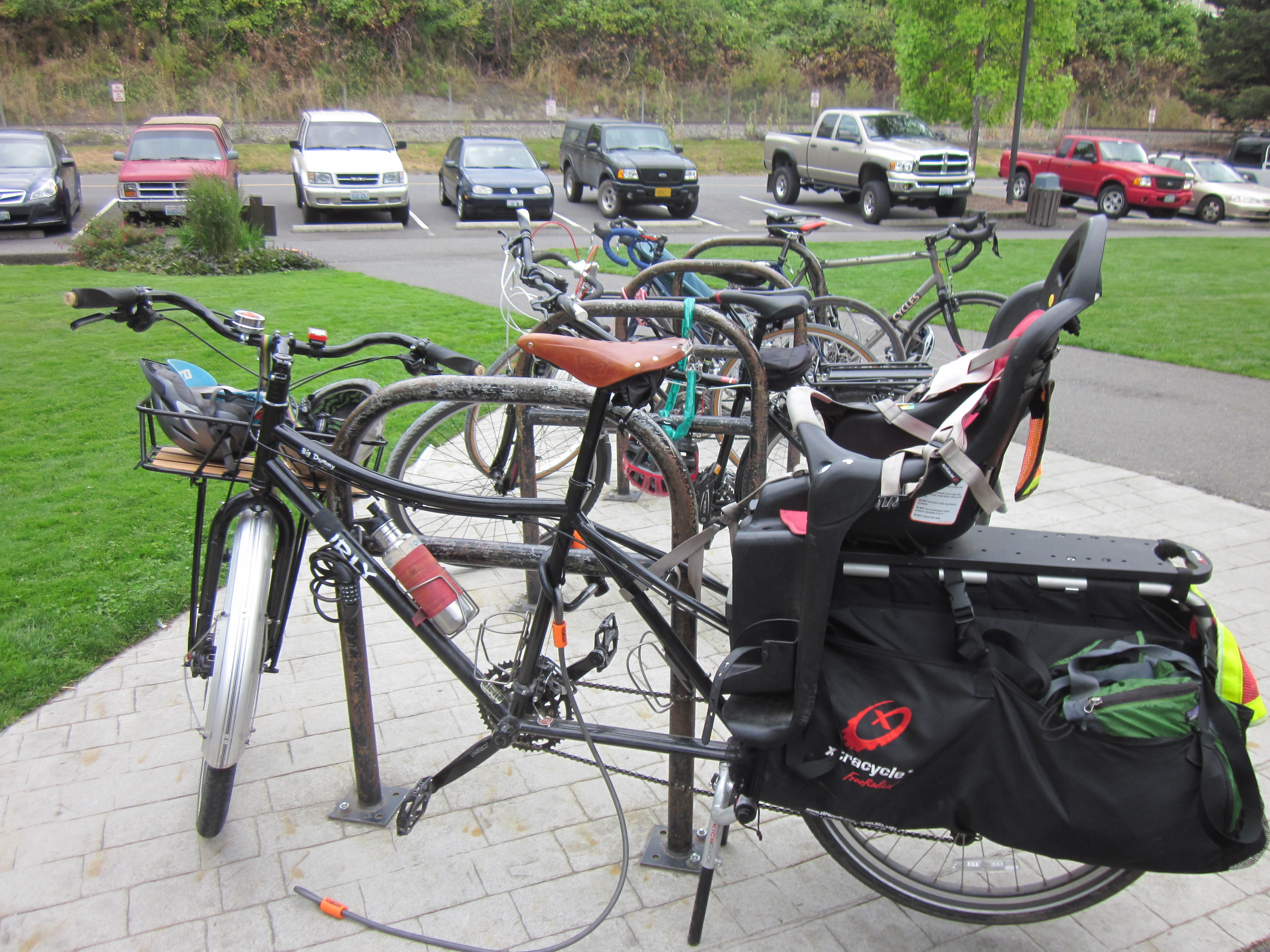
We stayed with my mom and rented a bike and trailer (the kids loved their first trailer ride). Then we stayed with the always awesome Family Ride and rode a Madsen, her pink Big Dummy, and a MinUte. We went to a Seattle Summer Streets and got to see Jen of Loop-Frame Love again. At the Seattle Cargo Bike Road Call my kids rode in a Cetma cargo bike and a Bakfiets and got chauffeured by Davey Oil around Gas Works Park in an amazing electric-assist trike. My son got to ride a handful of kids’ bikes and learned how to shift gears! Then we took an Amtrak ride south from Seattle to Portland. It is a good way to travel with kids, especially given that they seated us near the bathroom, which made it easy to clean up various spills.

Barbecue in Portland

Matt, although he is a committed Californian, loves Portland. He arrived before we did and went grocery shopping for us. Seeing the rib joint nearby, with its “Try our new vegetarian fare!” sign was almost enough by itself to convince him Portland should be our new home. We have seen many, many family bikes, mostly of the traditional variety with child seats and trailers, but I’ve always liked child seats on bikes. I’m coming around to trailers as well, at least in flat cities with limited car traffic.

My kids were the ones chanting “Amtrak! Amtrak! Amtrak! Amtrak!” in car #9 for most of the ride down from Seattle. I apologize.

We’ll be here for a week trying out even more cargo bikes, not to mention cargo trikes. The kids are so excited to see their dad again after a week away that I might even have some time to write about all that’s happened (and to answer a bunch of questions I’ve been asked in the comments).  In the meantime I hope everyone else is having a week just as awesome.

And I almost forgot: I just found out that San Francisco will be holding its first Kidical Mass on September 28th! Thanks so much, MizShan! The ride will meet at 6pm at the fountain at the southeast corner of Justin Hermann Plaza and head to Dolores Park. We will be there!

3 Comments

Filed under family biking, San Francisco, travel

Uphill, downhill: the limits of cargo bikes

This what hills in Bellingham look like. A 10% grade according to the signs, not too bad, especially given the killer views.

I complain a lot about going up San Francisco hills. What can I say? It often sucks. Something I’ve only mentioned in passing, but that we think about quite a lot nonetheless, is going downhill. While going uphill is literally a pain in the legs (and chest, when gasping for air) it is not as dangerous as going downhill can be.

We carry our kids on our bikes, and we go down steep hills regularly. We learned quickly that loaded cargo bikes (and trailers) need extra time and distance to stop when going downhill. It can be deeply disconcerting to brake and brake and brake, and only slowly drift to a stop. At first there were occasions that we overshot the lines at stop signs and red lights, and we are cautious riders. At times we take less steep routes on the way down than we do on the way up. We learned good braking habits very quickly and have internalized them to the point that I often forget to mention them.

Although we are scrupulous about maintaining our brakes, they occasionally fail. We replace pads on the bikes with caliper brakes on a schedule that raises eyebrows among people from outside San Francisco—roughly once a month—and that meets with knowing sighs among friends who ride in the city. The stock disc brakes on the Kona MinUte failed repeatedly and were on an every-other-week maintenance schedule until our local bike shop finally lost patience, called Kona, and asked for a credit to upgrade us to hydraulic brakes. And they got us one, which made the upgrade expensive rather than wildly expensive. The new brakes are amazing, with unbelievable stopping power, and the MinUte now only needs a brake adjustment every other month. We never, ever skip this maintenance.

The other problem that can crop up going downhill, which mercifully we have never experienced, is shimmy, aka death wobble. This is when the bike starts shaking uncontrollably and violently while going down hills, and is the kind of thing that typically only road racers experience, because it usually happens at high speeds. But some bikes can also shimmy at lower speeds, say, the kind of speed that a loaded cargo bike would approach while rolling down a steep hill. Having a top tube apparently provides stability that helps reduce the risk of shimmy, which is why I’ve been encouraged to abandon step-through frames. Better brakes help too. But the risk can only be reduced, not eliminated.

As annoying as all of this can be, we have gotten used to it. However these issues arose again when we started calling around asking about family bikes we could test ride, and why there were so few electric assist cargo bikes designed to handle steep hills in the US. There aren’t many electric assist cargo bikes anyway. When you start asking about taking them up mountains, or adding an electric assist to a bike like a Bakfiets, bike shops often get very quiet. A few shops claimed that electric assists were only designed for mild hills and to go longer distances, not to haul heavy loads up steep hills. This is clearly not true, as there are electric assist cargo bikes all over Europe designed for hills: e.g. an assisted Workcycles FR8, an iBullitt, and according to the German bakery we visited in Bellingham, every delivery bike used in Germany. The whole situation was starting to tick me off. I could get strong enough to haul my kids on long distance rides (and I have). I cannot get strong enough to haul my kids up truly steep hills as they get heavier, and even if I wanted to, putting them on the back of the bike on a steep hill has sometimes led to the front wheel lifting off the ground. They’re not strong enough to ride uphill themselves, and there’s too much traffic for them to be safe even if they could. People who want to ride an extra couple of miles don’t need an electric assist like people who live on the top of steep hills do. WTF, bike manufacturers?

I give Portland family bike shops (and a couple of San Francisco bike shops, Everybody Bikes and The New Wheel) credit here because when I asked this they gave me honest answers. It is, evidently, not a huge problem to put an electric assist on a bike to get it up a steep hill. It can, however, be a huge problem getting the bike+cargo back down that same hill safely. We rolled our eyes a little when we heard that because we’re already going down those kinds of hills fully loaded, so no new news here. But manufacturers are apparently concerned about the limits of bicycle brakes going downhill. The brakes on many cargo bikes are not up to the task; as proof, there’s our experience with the MinUte.

Evidently manufacturers are also concerned about the liability they’d face if someone who wasn’t attuned to these problems had the worst happen going downhill on an assisted cargo bike. Personally I think that’s a copout. I know parents who’ve been pulled or pushed down hills by trailers, who’ve broken spokes or had rear wheels taco or screwed up frames and gearing carrying kids up and down steep hills (cough cough… me). They don’t sue the bike or trailer or wheel manufacturers. They start looking for a better cargo bike. But there are currently very few better bikes, at least in the US, and the ones that do exist have appeared in the last year or two. So most parents in our situation have either kludged something together or started driving.

A Big Dummy in Bellingham: it is no accident that you can spot this bike all over in hilly cities

At any rate, although we’ll be trying out a lot of family bikes over the next couple of weeks, we have been told in advance that many of them aren’t going to work for us. Xtracycle and assist a commuter bike? Wobbles and fishtails when loaded on steep hills. Bakfiets and trikes? The brakes can’t handle steep downhills and can’t be upgraded, and the bikes themselves are so heavy that better brakes might not work effectively even if they could be added. And so forth. Although we’ll be riding lots of bikes for our own edification, the list of plausible candidates that we could take home to the hills of San Francisco is actually very short, at least for now. I don’t like this, but I have to live with it.

11 Comments

Filed under commuting, family biking, San Francisco, Uncategorized

The costs of living without a car

In brief: they are significantly less than living with one.

We don’t even need to park the bike at our son’s summer camp. Matt just rides into the middle of the field to pick him up. The other kids were so jealous.

I wrote earlier about the monthly costs of keeping our minivan ($400-$600/month), but I realized I forgot one expense: parking. Parking for one car is included in our rent at home, and although the market value of that space is ~$250/month, we’re not allowed to rent it if we don’t use it so it’s a wash. But whenever we drove the minivan anywhere else, we almost always had to pay to park. Our weekday driving primarily came when Matt drove to work because he was going out of the city for business. However, even though he’s not normally a car commuter, if he stopped at the office before or after, paying for parking was his responsibility. Because hey, it was just his normal commute, right? The same was true for me. The cost of parking where we work is $15-$20 per day. It worked out to between $50-$100 per month, conservatively. Plus on the weekends we had to feed meters. So the cost of owning the car was really somewhere between $450-$700/month, depending on how much we drove. It shocks me just writing those numbers. And we owned the minivan outright, so no car payments in that calculation. (If you ignore depreciation and only count actual out-of-pocket expenses it was still $250-$500/month.)

A portion of our newfound savings, admittedly, went to a new helmet.

This is still better than when we were car commuting and paying $140/month for a campus parking permit on top of the occasional downtown parking. My god, that car was expensive! No wonder Uber is making a killing in San Francisco. I could take daily limo rides without running up a $600-$850 monthly tab (or $400-$650 ignoring depreciation again).

Anyway, now that Matt has to rent a car for his business trips, the company pays for parking the rental car at the office, because he obviously wouldn’t be driving a rental car on his regular commute. Ha. Ha ha.

My son, passed out on my lap on Muni. (The Brompton continues to reign supreme in practicality; there was only space on the bus bike rack for one more bike–my son’s.)

In this first car-free month I was curious how much alternative transportation would cost us. It was a weird month. Matt had a series of meetings in the South Bay, so got a rental car for one week through work. By coincidence that was the same week that his mother went in for brain surgery in Redwood City, so there was a lot of extra driving to see her on top of those meetings. And we took a long BART ride one weekend to visit her in Berkeley after she went home. What can I say? We worry. We had planned to rent a car (and will next time we go; the round trip on BART is 4+ hours) but the San Francisco Marathon shut down the city. The MinUte went back to the bike shop while the N-Judah line was under construction, so we tried out ride sharing one weekend. And our son had a week of bike camp across town when Matt was away, which given the need to carry his bike implied a couple of trips using car share as well–we tried it once on Muni but (a) it’s so slow that we were late and the camp called us wondering where he was and (b) he was exhausted all day after riding over from the bus stop. And then the mamachari died.

Coming out of the tunnel on BART

I realize that every month is unique in its own way, but ironically, we drove more in July without a car than in any of the previous three months when we actually owned one. However no one else we know has brain surgery plans and the N-Judah is back in business, so this was probably an expensive month by the standards of car-free life, although having our bike collection radically thinned isn’t helping. Overall I hope that the next few months are much less exciting regardless of cost. (Matt’s mom is fine, by the way, although her surgery would have been better timed around Halloween, when she could have gotten some serious mileage out of the staples ringing her scalp. Oh well, hindsight.)

So our transportation costs for the month (rounded up to whole numbers):

  • fares for extra Muni and BART rides: $44
  • City CarShare rentals, meter parking, and Lyft ride: $48
  • maintenance on the Kona MinUte (bent derailleur repair): $24
  • rental car through work (including parking): $0 for us!

The total damage (for a very heavy month of auto  travel by our  standards even without the rental car through work): $116. Seriously? And we actually drove more than usual? Well hello, college savings. Even if we didn’t own bikes and took car share, ride share and Muni everywhere, we’d still save money by not owning a car. I am still sideswiped by disbelief. No pun intended.

4 Comments

Filed under car-free, commuting, San Francisco