The EdgeRunner has landed

Here it is.

Here it is.

Last week I heard from Clever Cycles that they had the new Xtracycle EdgeRunner in stock. And they have the pictures to prove it. On the way to work last week, I saw one parked outside a local bike shop. What a good-looking bike! When I test-rode the EdgeRunner at Xtracycle world headquarters, I wasn’t sure when they’d be in stores. They’re here now.

The EdgeRunner is the longtail we would probably buy if we were in the market for a longtail, which we totally are not, even though the Bullitt is in the shop for a while. 

Test-riding

Test-riding

The Xtracycle website offers the specs on the electric version (which I did not ride)—the assist is the latest from eZee and there are photos of the new system and new console. The total weight of the assisted version is, according to the website, an astonishing 65 pounds, which is less than many unassisted cargo bikes weigh.  And it comes with a built-in front headlight! I am seriously in love with Xtracycle for making lights on a cargo bike stock (even though they didn’t include a rear light).

I’m not in the market for another cargo bike, but I’m feeling the urge to take another cargo bike test ride. We’ll ride some hills this time.

4 Comments

Filed under electric assist, family biking, San Francisco, Xtracycle

How much does a bike like that cost?

Apparently these bikes are interesting.

Apparently the Bullitt is interesting.

People like to ask me how much our bikes cost. Usually this question comes when we’re riding the interesting bikes. I understand the impulse, but I almost never get these questions from the kind of people who normally ride bikes, people that I know have a sense of what bikes actually cost. It usually comes from the kind of people who say in the next breath, “It looks like it would be expensive; like: $200!”

Yes, sure. My “expensive” bike cost less than your mattress or the flat-screen television you keep in the kitchen. Riding bikes for transportation is cheap, but unless you get the bike for free, it’s not that cheap. And nobody picks up a free Bullitt at the dump.

The Bullitt is an expensive bike (and if you really want to know what it and bikes like it cost, check out my family bike reviews). Announcing how much we spent while standing around the park seems likely to encourage eavesdroppers to try stealing it. I finally came up with some decent answers. “It cost less than half of what we got for selling our six-year-old minivan!” I say. “Can you believe it?” Here in San Francisco, there are other meaningful comparisons. I sometimes tell people it costs about as much as a Vespa (this is true). “But a Vespa couldn’t carry my kids, of course, and I don’t have to pay for license or registration or gas—it costs a few cents to charge this bike up and ride for 30 miles! Or more!—and the maintenance cost is basically nonexistent. Can you believe it?”

I suppose I should use another picture of the Brompton sometime.

I suppose I should use another picture of the Brompton sometime.

I still never know what to say when people ask me what our Brompton cost. Usually something like, “Well, it depends on the options.” This is true, but it’s kind of lame.

Luckily for me, bikes really do cost less to maintain than scooters or cars, because right now the Bullitt is in the shop and won’t be fixed until Splendid Cycles comes back from vacation next week at the earliest (something has gone awry with our customized front shifter). Its long vacation has turned out to be a bigger hassle than I expected given that we have backup bikes. Now that we’re used to having a real cargo bike, it’s crazy-making to not be able to haul big loads and cover the kids in the cold or the rain.

Come back, Bullitt.

Come back, Bullitt.

But it’s not going to cost a thousand dollars to fix. It’s not like repairing a car. And this confidence I have that even the most depressingly expensive bike repair is easy to cover from our monthly cash flow is probably the best news of all. How much does a bike like that cost? Over the long term: nothing worth mentioning.

2 Comments

Filed under bike shops, Brompton, Bullitt, family biking, San Francisco

How to get a bike for free

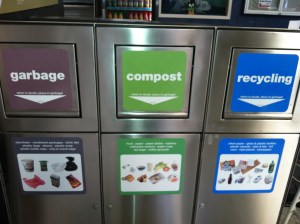
One of these things is not like the other.

One of these things is not like the other.

Recently I visited San Francisco’s waste management center. My university is a shared governance institution (often more in name than in deed) so I am expected to do service. One of my appointments is to the campus-wide Sustainability Committee. I also had to pick a sub-committee, and I asked for Transportation, because I am all about the bikes. But everybody wanted Transportation and I’m pretty junior, so they put me on Zero Waste instead. Anyway, all members of the Zero Waste sub-committee were asked to take a tour of San Francisco’s waste management centers. My first field trip!

San Francisco’s waste management is run by Recology, one of the country’s largest employee-owned cooperatives. San Francisco diverts 80% of its waste from landfills, better than any other municipality in the US and most countries in the world. The city’s goal is to be zero-waste by 2020. The university, which is Recology’s 2nd largest account, is hanging in at 63%. San Francisco has reached this point by implementing aggressive recycling efforts (including prosecuting recycling poachers), creating a hugely successful composting program (in part by instituting a $1,000 minimum fine for throwing compostables in landfill bins), and to a certain extent, by taking advantage of a quirk in how diversion rates are calculated (albeit no more than other cities and countries do).

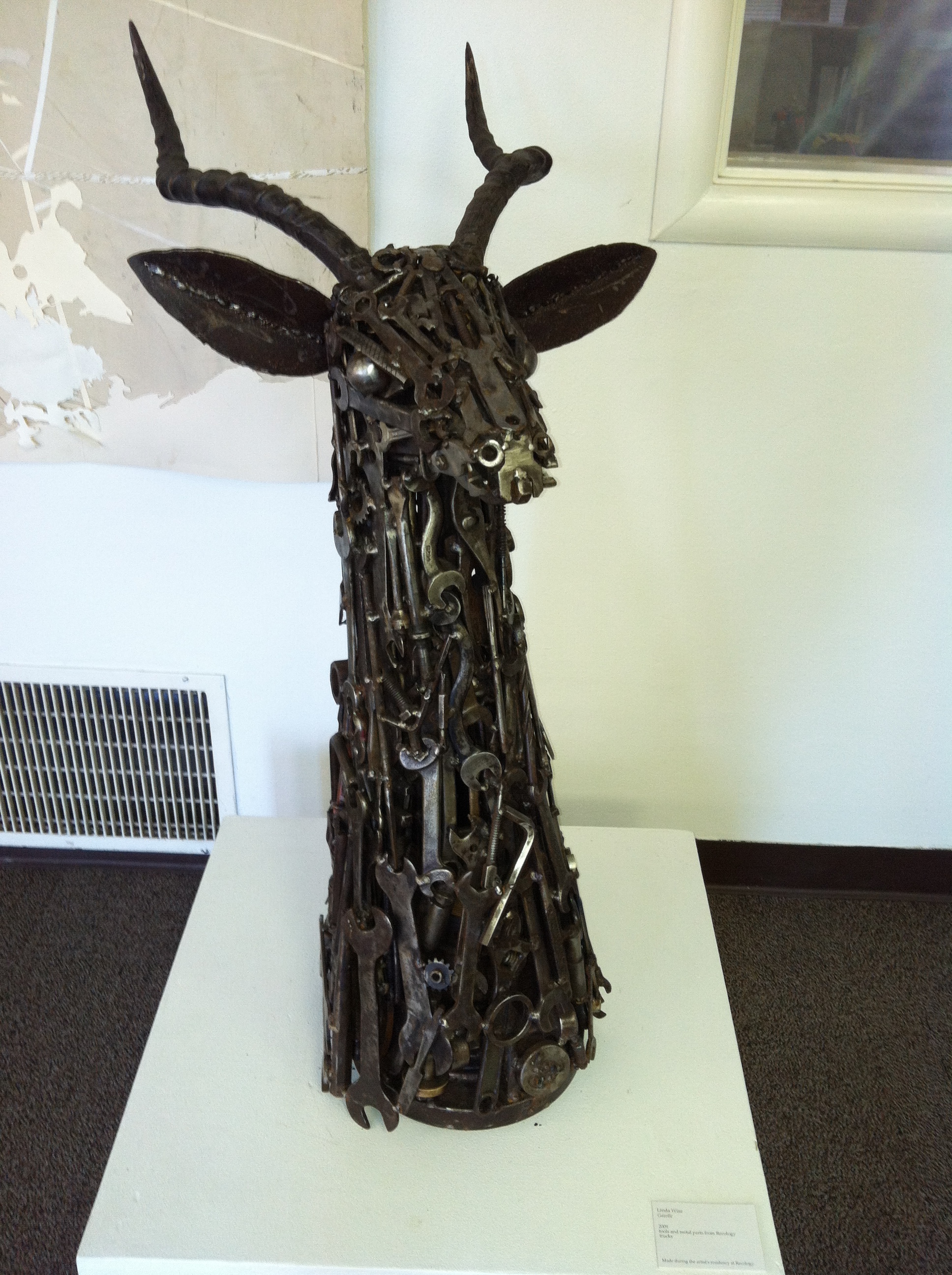
This is some of the art made from found materials at the transfer station.

This is some of the art made from found materials at the transfer station.

Our tour was absolutely fascinating. Recology does not allow photos of most of its operations, because there are apparently trade secrets in the world of waste management. I realize that the dump is not a traditional tourist attraction, but if you happen to be in San Francisco, it is definitely worth checking out.

Our visit started at the business office, where we picked up hard hats and met the sales staff. “I’m Maria,” said one woman who looked like a supermodel heading down the catwalk. “I handle the city accounts, and I’m a dumpster diver.” From there we headed to the recycling transfer station.

If you have seen Toy Story 3, the recycling transfer station will feel somewhat familiar. Trucks enter the building (1/3 of its power is generated by solar panels on the roof, because that is how Recology rolls) and dump recyclables onto the floor. From there they are moved by giant front loaders onto even more giant conveyer belts that sort out paper, plastics, metal and glass as they lift materials to the second floor. The Toy Story 3 feeling comes both from being surrounded by garbage and from feeling like a tiny mote in a giant machine. The amount of material being moved through the transfer station is simply mind-boggling. It was difficult to grasp its scale. On the second floor, the materials the machines could not handle are hand-sorted. Watching this process made me despair for humanity, as my fellow San Francisco residents seem unable to grasp the concept of what belongs in the recycling. Dozens of workers attempted to pick out plastic bags, clothing, plastic bottles of motor oil, ad infinitum, from paper destined for bundling and eventual recycling. It was impossible. They aim for 90% appropriate materials in the bales, we were told. That should be easier than it is. The relentless efforts of the hundreds of garbage-snatching seagulls didn’t help matters either.
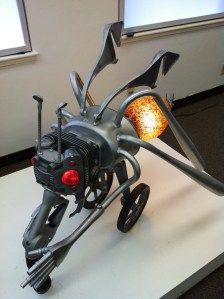
Is artistic reuse recycling, upcycling, or something else entirely?

Is artistic reuse recycling, upcycling, or something else entirely?

Recycling is a tricky concept. Some things are recycled and some are only kind of recycled. Glass and metal containers and shards are melted down and turned into more glass and metal containers. Concrete is smashed into sand and turned into more concrete. Although the process is energy intensive, these are closed loops.  These products are recycled. Paper is kind of recycled. High quality paper, like office paper, is usually turned into low-quality paper, like paper bags. Low-quality paper is turned into even lower-quality paper, like tissues and toilet paper. The tissues can go into the compost, but the toilet paper goes to landfill by way of the sewer system. The more non-paper waste that gets mixed into the paper, the less likely it can be reclaimed for higher-quality recycled paper. Rigid plastic is down-cycled. Assuming it isn’t thrown away outright, it gets one more use; bottles turn into plastic lumber or carpet or fleece, but once these materials wear out, they all go to the landfill. And soft plastics all go directly to the landfill, although only after Recology workers spend six hours out of every 24 picking plastic bags out of the recycling machinery. Less than thirty minutes into the tour, I was completely convinced that I should never buy another item wrapped in soft plastic. This is surprisingly hard, even in San Francisco.

The university facilities representative leading our group was less sanguine about San Francisco’s 80% diversion rate. Diversion rates are calculated by weight, and San Francisco recycles a lot of concrete. By volume, the endless sea of plastic is a much bigger problem, and landfills, of course, are packed by size and not by weight. Other universities in California also claim diversion rates of 80% but only, he said, “because they tear down buildings or repave parking lots every year.” Construction and demolition, as well as aggressive composting at San Francisco’s many restaurants and parks, boosts the calculated diversion rate. He estimated, glumly, that San Francisco residents are recycling and composting at most 40% of the waste that they could. And that this is the best rate in the country.
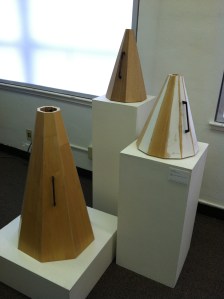
More art from reclaimed waste

More art from reclaimed waste

From the recycling transfer station, we headed to the main facility, where household waste, compost and landfill waste are packed up for their eventual destinations. Recology served us a nice lunch on plates and silver diverted from landfill, showed us an upbeat little movie, and answered questions. I was not brazen enough to ask whether the food was dumpster-dived, but after seeing what people throw away in this city, I would not be surprised if it was. We had lots of questions. I learned that you can recycle (okay, down-cycle) dental floss containers because they are rigid plastic; removing the metal cutter is nice but not necessary. Dental floss itself, however, is uniformly made of plastic and messes with sorting machinery and should always go in the landfill bin. Toothpaste tubes, tetrapaks: landfill. The soft plastics “recycling” bins at grocery stores that supposedly send plastic bags to be turned into park benches? Our facilities representative reported that almost no store will say where they’re actually going, so they’re probably being sent straight to the landfill.

The most hated word at Recology turned out to be “biodegradable.” Nearly everything is biodegradable eventually, they said. But people think that means it can be composted. It cannot. “Compostable” is a legally binding term in the state of California; if an item says it is compostable and it’s not, the state will levy massive fines. Biodegradable is a weasel word intended to sidestep the law. So “biodegradable” materials and bioplastics: landfill. The plastic keeps the biological material from composting, and the biological material contaminates the plastic. That was depressing.

More art from the gallery

More art from the gallery

Much less depressing was the visit to the Artist in Residence program, where artists are sponsored to create projects out of whatever they can find on site. Much of the art was wildly impressive, and there are regular shows where it can be viewed, as well as an outdoor sculpture garden. Many of the other sites showed where visitors came to drop off household waste sorted through it; construction debris is sorted, furniture is donated to thrift stores, electronic waste and batteries are sorted by type. Recology was also pioneering Styrofoam recycling; clean packing materials were compressed into thin, heavy sticks that could be used for things like crown molding. The process is hopelessly expensive and energy-intensive so it’s more of a demonstration project than a feasible way to handle waste, but it was interesting. The inevitable seagulls were controlled by an on-site falconer who kept four hawks circling all day. Recology had tried bottle rockets, netting and dogs, but the hawks were the most effective. We did not get to tour the compost transfer station, probably the biggest success of the program; San Francisco’s compost is used by California wineries and farms. And I got to take some compost home to show my kids what putting food waste in the compost bin, which they do diligently, really meant. They were completely floored.

Our old seat cushion went to the Pit. Is there any alternative?

Our old seat cushion went to the Pit. Is there a better alternative?

Our last stop was The Pit. Everything that goes into a black bin in San Francisco is dumped, unsorted, into The Pit, shoveled into tractor-trailers, and trucked to the landfill. The Pit is huge. It runs 24 hours a day and seven days a week. There is a smell. Trucks enter at the top level and drop their loads. The sounds of breaking glass and the efforts of occasional seagulls to snatch food make it pretty clear that a lot of what’s in The Pit could be recycled or composted (efforts to assess it suggest that two-thirds of what’s in The Pit could be diverted). Bulldozers shovel the waste into waiting tractor-trailers below. The process never stops. It is difficult to describe the feeling of watching massive piles of trash build and be shoveled away, endlessly. It turns out that material in landfills does not biodegrade. Everything that goes into the landfill is forever. I will never look at a garbage can the same way again.

This is how we shop now.

This is how we shop now.

I see now why were asked, as part of our service on the Zero Waste sub-committee, to visit Recology. This is the best that the United States currently has to offer in terms of waste management, and that was sobering. At home, post-tour, we are now uncompromising in using cloth produce bags (we had always used cloth grocery bags) at the farmer’s market and we don’t shop at Trader Joe’s much anymore, because there’s almost nothing to buy there that’s not wrapped in plastic. We now buy milk and yogurt in glass, and everything else in bulk. But mostly, we are buying less, because everything we buy must eventually be handled somehow, and packaging is not free.  It is probably not a coincidence that this month’s grocery bill is half of last month’s.

I am familiar with life-changing experiences by now, and this one didn’t require a trip to Copenhagen. I only had to ride across town.

But I promised to tell how to get a bike for free. The answer is to work for Recology. One of the tour guides mentioned that he never had to take his own bike to site visits and lock it outside, because he could always pick out a nice bike from the garbage. Recology workers never have to worry about San Francisco’s rampant bike theft. He admitted that the last bike he picked up was better than his commuter bike, “way more gears for the hills.” It’s entirely possible that anyone could show up at the dump and ask for a bike.

This is our refrigerator post-tour. We are trying harder.

This is our refrigerator post-tour. We are trying harder. (The glass jars are sold by Cole Hardware in San Francisco for thrift store prices, luckily for us.)

At Recology they suggest people stop calling the things in bins “garbage.” A better word for the many unnecessary things we throw away is “waste.” And a free bike is the least of it.

10 Comments

Filed under advocacy, commuting, San Francisco, zero waste

Ch-ch-ch-changes

Note that the kids don't necessarily bother to dress for the weather anymore.

Note that the kids don’t necessarily bother to dress for the weather anymore.

It’s been cold in San Francisco. Yesterday my kids found that a cup of water they’d left on the back deck had frozen. Since when does that happen? When I took them to school this morning they refused to get out from under the Bullitt’s canopy, which basically functions like a greenhouse (that Splendid canopy was worth every penny). After we dropped off my son, my daughter slept in the box all the way to preschool, and that is the kind of thing that definitely draws envious looks from other parents on bikes. But even with two pairs of gloves and the canopy covering my hands, they were freezing. At the Rosa Parks drop-off I talked with another parent and my son’s teacher about trying to find decent gloves for our rides to school–it is amazing how many parents are on bikes at school now. These are my people! Mighty mighty Dragons! Anyway Matt and I went to a sporting goods store a couple of weeks back and all their winter gloves and mittens were sold out already.

It could be worse. Matt is in upstate New York this work, where temperatures promise to be in the mid-teens. What’s more, he drew the short straw and is his group’s designated driver. Next week I’m heading to Atlanta, but I never get to go outside when I’m working in Atlanta, so I’ve stopped checking the weather for these trips. It’s all: airport to taxi to hotel to taxi to 16-hours-in-a-windowless-meeting-room, then reverse.

Like it or not, we're on the move.

Like it or not, we’re on the move.

But the biggest news around the HotC household is that everything is changing. We received notice last month that the cooperative university preschool my daughter attends was being sold off to a for-profit corporation. Much of our winter break was spent unsuccessfully searching for a new preschool. A couple of weeks ago I got notice that the university was selling off the campus where I work, although it lacked information about trivial details like where we’d all be moved when this happened. Then on Friday afternoon we were notified that the university is also clearing out the faculty housing where we live. Over a hundred tenants will be kicked out in July, and the rest, including us, will be kicked out next year. At least we’re in the second group, I guess.

In summary, it was not exactly a low-stress weekend. I’d like to know where I’m going to be working before we try to move house, and the preschool situation is too depressing to think about altogether. I realize that it’s not progress when everything stays the same, but this feels like a lot at once. At least I like my bike. When Matt’s away I spend almost two hours a day doing drop-offs and pickups on the Bullitt, and despite the cold it’s hard to stay frustrated on the bike (although lately there have been times that I’ve managed it). For this reasons, among others, updates are likely to be light-to-nonexistent over the next couple of weeks.

No way are we getting out from under here.

No way are we getting out from under here.

One thing for sure: we’ll be looking to live in a flatter neighborhood. Tips welcome.

8 Comments

Filed under Bullitt, car-free, family biking, San Francisco

What I got for Christmas

We have four bikes, but only one of them regularly carries two kids. That’s the Bullitt. Our son and daughter go to different schools, and we go to different offices, so as often as not on weekdays, we’re each carrying one kid. The other three bikes—the Kona MinUte, the mamachari, and the Brompton—can usually carry one kid apiece (although both the MinUte and the Brompton have pinch-hit as two-kid haulers).

Bullitt and mamachari, better together.

Bullitt and mamachari, better together.

If Matt’s on the Bullitt and my route is going to be hilly or long, I’m most often on the mamachari, because it has an assist. Unfortunately it’s also slow and it was, from the start, a cheap bike, so it’s showing its age. Our kids had been complaining for months that their seat was uncomfortable, which was understandable given that the seat cushion was thin to begin with, and by the time we found it on craigslist it had been mostly ripped to shreds, at which point I’d wrapped it in duct tape. For Christmas I asked Matt to find me a new seat cushion. Given that bikes and seats like mine aren’t exactly thick on the ground in the US, this wasn’t the easiest request.

At least the duct tape matched the cushion.

At least the duct tape matched the cushion.

Matt started his search at cushion stores. They were happy to sell him foam but they couldn’t make a cushion or supply waterproof fabric. But there are countless discount fabric outlets in San Francisco, especially in our part of town, which is like an adjunct Chinatown. He took the kids to one of them to pick out a remnant they liked. Someone, we figured, could surely make a new cushion given these raw ingredients. We briefly considered using my sister’s sewing machine to DIY, but it was the kind of job that required an industrial machine, plus we’d be left with the problem of figuring out how to attach it.

How stylish is that? It outclasses the bike.

How stylish is that? It outclasses the bike.

I don’t know where Matt got the insight, but it turns out there is an easy place to get custom bike cushions made. As improbable as it sounds, when he called the local auto upholstery shop they said they could do what we wanted in a couple of days. I guess by comparison to auto upholstery, our needs were pretty simple. It was cheap, too. So I got a new mamachari cushion for Christmas, and now the kids want to ride my bike again.

We like it so much (and it cost so much less money than expected) that Matt’s going to have them make a custom cushion for the MinUte now. (Kona hasn’t shown nearly as much interest in family biking as Xtracycle or Yuba, so there is nothing available off-the-shelf.) Happy new year!

Matt is jealous of my cushion.

Matt is jealous of my cushion.

The mamachari won’t last forever. It makes occasional disturbing noises now and the mechanics at our local bike shop roll their eyes and laugh when I admit that it’s still rolling along. But I like that I can take it anywhere, even the grungiest parts of town, without worrying about it getting stolen (it’s not very desirable to thieves, but even if they stole it, which is certainly possible, it was cheap enough that I would be sad but not financially devastated). And I don’t have to sweat the hills. It might be ridiculous to have had a custom cushion made for a junker bike, but I’m delighted.

Leave a comment

Filed under family biking, San Francisco

How much can a Bullitt bicycle haul? 1 kid, 2 kids, 3 kids, 4!

Yep, that's two kids on one Brompton bicycle. We are our own clown car.

Yep, that’s two kids on one Brompton bicycle. We are our own clown car.

A while ago my brother-in-law suggested that I was perhaps overly aggressive in testing the limits of our cargo bikes. I can’t deny it. I put two kids on a Brompton folding bicycle (and it was so much fun that I haven’t exactly stopped, although it I am sure the manufacturer’s lawyers would have aneurysms).

Biking with Brad demonstrates how much you can haul on a Big Dummy.

Biking with Brad demonstrates how much you can haul on a Big Dummy.

But I’m hardly alone. Family Ride is a one-woman toy shop on a Big Dummy, and A Simple Six put five people on a Yuba Mundo. I saw a photo of a dryer being carried on a Bullitt. When the Yuba Boda Boda and Kinn Cascade Flyer midtails came out, one of the first questions I heard people ask was whether there was a way to squeeze two or three kids on there. Definitely two: I’ve carried both my kids on the back of the MinUte when they’re not in a fighting mood. Something about cargo bikes makes you want to tempt fate.

Even last summer when we rented the Bullitt, both kids were sometimes willing to ride together.

Even last summer when we rented the Bullitt, both kids were sometimes willing to ride together.

So it is perhaps no surprise that Matt has now gotten in on the act. We’d had the Bullitt for less than a month when Matt took our son to a birthday party on it. When he came home he mentioned that he’d taken a ride with a few kids. On further questioning he admitted it was four kids, all in the box at the same time. I didn’t even think this was possible unless they were really little, but found out that the kids in question were a 7-year-old, his 5-year-old sister, and a pair of 4-year-old twins. I was depressed that he didn’t get a picture, but I can’t really complain, because I also didn’t get a picture when I hauled our PTA president (over six feet tall and wearing in a three-piece suit) in the box of the Bullitt. And we have the standard narrow box, not a custom box intended to carry multiple kids.

Loading up: three kids in the box of our Bullitt bicycle.

Loading up: three kids in the box of our Bullitt bicycle.

Over the winter break we met some friends at the San Francisco Children’s Creativity Museum, which our daughter is finally old enough to really enjoy. Because it was a cold day we had the rain cover on the Bullitt, so I was a little skeptical when they wanted to try riding in the box with our son (our daughter was busy climbing the bike racks and wasn’t interested).  But to my surprise, you can in fact pack two 7-year-olds and a 5-year-old in the box of a Bullitt with a rain cover on top. They didn’t have helmets so Matt rode them slowly around Yerba Buena Gardens, but credit to him; it may have been a slow ride but he took them up and down two stories of elevation.  It looked pretty cramped in there, but their verdict was, “It was AWESOME!” I completely underestimated the bike when we tried it last summer.

So how many kids could you put on a Bullitt? Up to four kids in the box if the weather is good and they don’t need the cover. Matt didn’t put any of them on the top tube, but he says he could have handled it. And our son sometimes rides on the Roland add+bike in back as well. I wouldn’t take a bike loaded up that way either up or down a hill. But if I ever see anyone try it, I’ll definitely take a picture.

5 Comments

Filed under Bullitt, family biking, San Francisco

What we did on our winter vacation

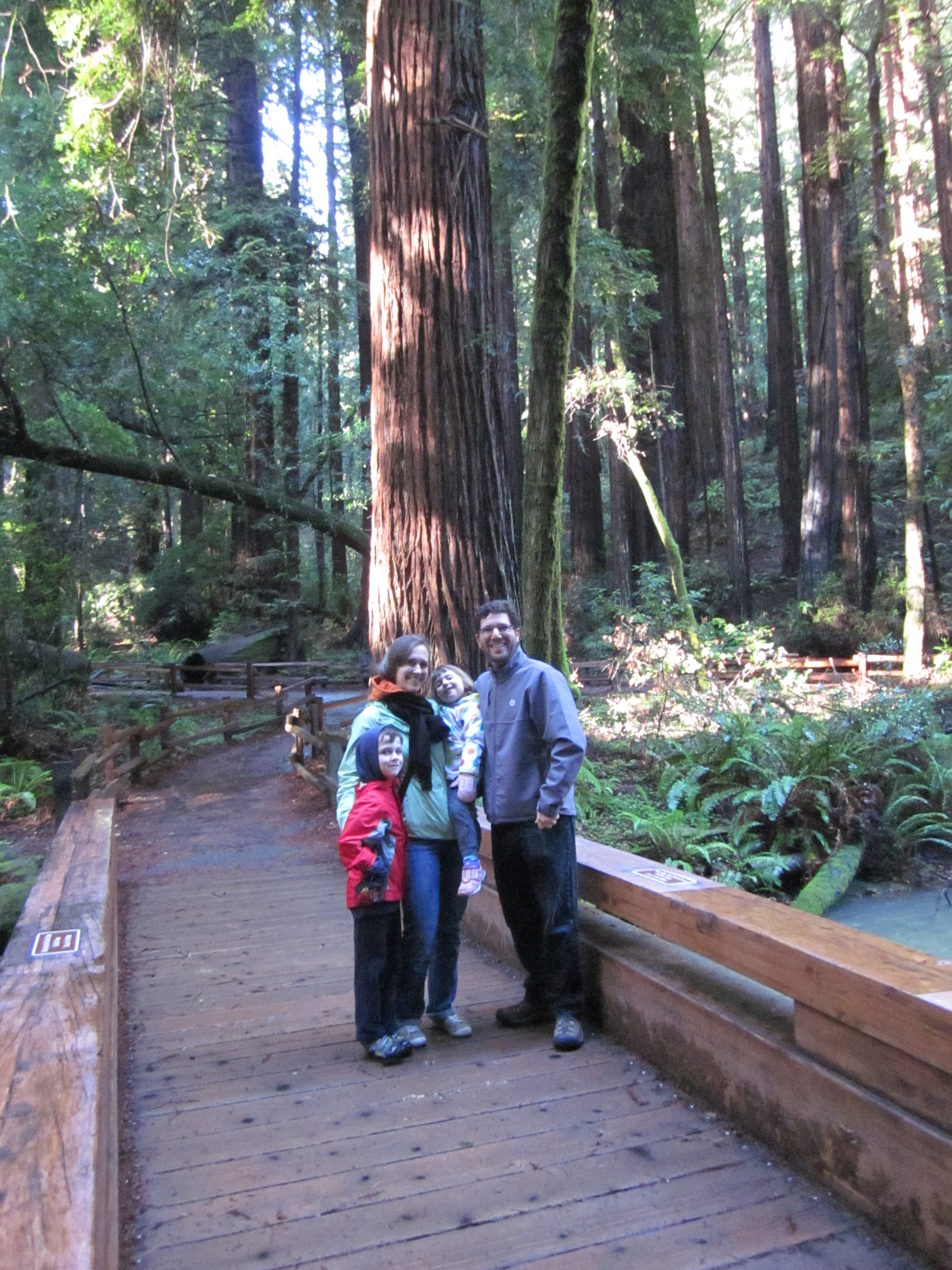
There were enough other people at Muir Woods on Christmas Eve to get a family picture.

There were enough other people at Muir Woods on Christmas Eve to get a family picture.

There are some things we do every year over winter break. The main one is to go to Muir Woods on Christmas Eve. We rented all-electric Leaf this year (the trip up and down the mountainside is sobering even with the help of a motor) and had the unnerving experience of watching the “miles remaining” gauge tick away rapidly as the car grunted up the hills. Then we earned them all back as we coasted back down. This year half the road had washed out, and there were temporary stop signs where passing cars had to take turns, because one lane had crumbled away and dropped into the forest below. When we got to Muir Woods some of the trails were blocked by fallen trees due to all of the rain. But anything that discourages visitors is good from our perspective, and as usual it was quiet and peaceful, as long as listening to our kids yell, “Where are the beavers?!? Can I climb that stump?!?” fits your definition of peaceful.

It turns out that reindeer hate rain. Who knew?

It turns out that reindeer hate rain. Who knew? (at the California Academy of Sciences)

It would be an understatement to say that it rained the first week of our vacation. It poured. Trees fell over, and garbage cans rolled down the street. Astonishingly, our basement did not flood. When the kids got stir-crazy enough we finally packed them up and headed to the California Academy of Sciences, the closest indoor attraction to home. And thank goodness we sprung for the Bullitt rain cover last month. Matt rode the kids right up to the front door and dropped them off, and picked them up at the end of our visit the same way. We were soaked but they were completely dry. They could easily have done the whole trip in slippers. As we rode through the park, watching the wind make actual waves in the streets filled with rain and people walking back to their cars struggle to keep their umbrellas right side out, while our kids sung songs obliviously, we felt like parents of the year.

Our kids mostly ignored the view from the tower of the de Young museum.

Our kids mostly ignored the view from the tower of the de Young museum.

Eventually it stopped raining but it stayed cold. Happily the cover handles that as well. We packed up the kids for trips to the Children’s Creativity Museum, the Japanese Tea Garden, the de Young museum, and parks, and most of the time they refused to even put on a sweater. At the same time, I was wearing two pairs of socks, two pairs of gloves, and long underwear, and shivering. Matt had initially had second thoughts about getting a box bike rather than a longtail, but after the last two weeks, we’re both really glad we got the kind of bike that comes with a kid-cover.

The Children's Creativity Museum has its own carrousel.

The Children’s Creativity Museum has its own carrousel.

It can be hard to get on the bike when it gets cold. These days, however, because we don’t have a car sitting in the garage, if we want to go anywhere we’re going to get cold and/or wet no matter what. Most of the time, unless we’re leaving the city altogether, it’s easier to get on the bikes than to hike over to a car share pod. And we’re always glad when we ride. Matt and I took several trips downtown and beyond, beyond our usual stomping grounds, and it was good to be moving. Especially after a few days trapped indoors, even riding in a downpour so thick it’s impossible to see a block ahead seems appealing. At least, it does now that I have decent rain pants.

Check it out: we're all trend-setting and stuff.

Check it out: we’re all trend-setting and stuff.

We saw many more bikes on the road this year than we did the same time last year. But the biggest change was the massive increase in assisted bikes we’ve seen. I used to snap photos when I saw an electric assist in San Francisco. Now that I see at least one every day, even on the hills near home, it hardly seems worth the effort. We went electric in 2012, but for once it seems as though we were cutting edge. If we saw is any hint, it’s 2013 that will be the year of the electric assist.

4 Comments

Filed under Bullitt, car-free, family biking, San Francisco

The end of the world (or at least the end of the year)

I miss November.

I miss November.

It’s the end of the world. It’s the winter solstice. It’s the last day of school. And at the end of the day today, my office will turn off the heat until January 2013. It’s a giant hint that we shouldn’t be here, and after last year, when I had to come in anyway to work on a grant proposal, I’ve learned my lesson.

When the weather's better, they want to try riding with both of them on the tube (I don't, though).

When the weather’s better, they want to try riding with both of them on the tube (I don’t, though).

It hasn’t been the easiest December. It is often hard for me to get on the bike in the winter, even in temperate San Francisco. Temperatures have been lower than usual many days, and when it hasn’t been cold, it’s been pouring rain. Drivers are rushed and rude, passing too close and gunning though red lights. And in the afternoon and evening, there are delivery trucks blocking the bike lanes on every street and pushing me into traffic. The racks at the office these days hold only two bikes, mine and my friend Libby’s. For the first mile of any ride, I am always grouchy. The other day, for the first time in months, I thought “maybe I should just take the shuttle home.”

This is the Bullitt's Splendid canopy, worth every penny.

This is the Bullitt’s Splendid canopy, worth every penny.

But it gets better after that first mile. I have gear to handle the rain, and our kids are content under the Bullitt’s (awesome!) cover for the whole ride.  And other people make it easier. My friend Libby admired our dynamo lights when I left the office yesterday. On the Bullitt the other day I was fuming after my son and I were trapped behind two FedEx trucks, when another rider came up behind us. “I love your cargo bike!” he yelled. “It’s fantastic!” This morning, in the pouring rain, I saw Matt coming back from dropping off our son as I returned from dropping off our daughter, and we stopped to talk. One of my daughter’s preschool teachers walking to school stopped on the sidewalk next to us and shook her head. “You guys,” she said, “are so cool.” Who knew?

The fake snow at the Academy of Sciences is the only snow my kids have ever seen.

The fake snow at the Academy of Sciences is the only snow my kids have ever seen.

San Francisco is a big city, but on our bikes, it’s a small world. And it’s a friendly one. Thanks, everybody.

It can't be overstated how much kids love Engine Engine Engine.

It can’t be overstated how much kids love Engine Engine Engine.

There is so much I still mean to write about. What it was like to ride in Seattle and Portland (Families Ride again!), and both cities’ cargo bike roll calls (which were completely different); trying out new ride share services; how we set up our Bullitt; our son’s new bike and how he learned to use gears; how using the electric assist has made me a stronger rider; our trip to Davis and the World Cycling Hall of Fame; my battle to get more bike racks at our son’s afterschool program because the current ones are packed with family bikes. People have asked me to put together a summary of all the child seats we’ve tried; thanks to all those bike rentals, we’ve tried almost a dozen.  We have two friends who switched from driving to family biking just this month (in December! They rock!) San Francisco is adding bicycle infrastructure at such a rapid pace I can’t keep up. Next year, we hope to try our first cycle truck, a Workcycles Fr8, and a tandem or two.  And in April, when Golden Gate Park closes the streets to cars on Saturdays again, I’ve promised myself I’ll organize a Kidical Mass ride.

Another day at the Rosa Parks drop off, which has less and less room for all the bikes

Another day at the Rosa Parks drop off, which has less and less room for all the bikes

But it’s been a big year already, so for the rest of it, I think I’ll be taking a break from everything except family. If you’re in San Francisco, you might spot us at museums around the city over the next two weeks. Just look for the “one less minivan” stickers on the bikes parked by the front door.  And if you’re not in San Francisco, hope to catch you in 2013.

1 Comment

Filed under Uncategorized

A front child seat for older kids

We have a history with front child seats. The first one we tried fell apart on the bike, nearly dropping my daughter back into traffic. That particular seat is really only appropriate for a certain kind of bike.

Yep, that's two kids on one Brompton bicycle. We are our own clown car.

My Brompton with one kid on the IT Chair and one on the rear rack (more stuff I don’t recommend doing even if it is a total blast)

But I do love front child seats. The one on my Brompton, which is infinitely more stable, is a joy to ride with both my kids. I still carry my son on it sometimes, who is now a tall seven year old and may not be able to ride it much longer. And for our real cargo bike we went all-front-seat-all-the-time and bought a Bullitt. It’s more fun for everyone with the kids in front. But it is often not cheap. There is an exception, however, which is the “stick a saddle on the top tube” option that I have now seen three parents using in San Francisco with older kids.

mountain bike + spare saddle on the top tube

mountain bike + spare saddle on the top tube

The first, a dad at Rosa Parks, literally slaps a spare saddle on his top tube, and his daughter rides it with her feet resting on the bike’s fork. She’s now in first grade, going on seven years old, and has been riding with her dad this way since preschool. Anyone with a spare saddle can do the exact same thing at their own risk.

The second, a mom at my son’s after-school program, has a much more solid looking saddle screwed to the top tube and footrests on the downtube. She has been carrying her first-grader on this rig at least since kindergarten. When I asked her where came from, she said, “Somewhere in Europe; I don’t know.” The third parent is a dad I’ve seen riding in Golden Gate Park with exactly the same setup carrying what looks to be a seven year old. I was very interested in this seat because it’s so rare to find front seats suitable for a kid over the age of three, other than the front seat specific to the Workcycles Fr8.

This is the Oxford Leco top tube seat (footrests not shown)

This is the Oxford Leco top tube seat (footrests not shown)

I have now found it. The seat these two parents are using is the Oxford Leco Top Tube Seat (with footrests), and as far as I can tell it’s only sold in the UK. I called My Dutch Bike in the Bay Area to see if they stocked it, and although they’d heard of it they said: No way. They noted that the seat was only appropriate for heavy city bikes and that typical American mountain and road bike frames would not safely support the weight. They wouldn’t sell it because they feared they’d be liable when some parent tried to mount it on a lightweight bike anyway (and you know someone totally would).

However there are some shops in UK that will ship to the US. Even with international shipping, it costs about $40. I could imagine putting it on a midtail and making it a real two-kid hauler; another dad who saw it wanted to put it on a Big Dummy. Here’s a family that put it on a regular bike with a rear seat to get two kids on one bike. They look crazy-good.

A final shout-out goes to the Brompton, carrying my four-foot-tall seven-year-old on the IT Chair.

A final shout-out goes to the Brompton, carrying my four-foot-tall seven-year-old on the IT Chair.

I thought I’d mention it because I suspect that other parents might want to do the same thing if they knew the seat existed. But if you want to try it, please be cautious. My Dutch Bike is right that this seat is most appropriate for a heavy bike, and the reviews on UK Amazon also suggest that it’s best suited for a bike with a flat top tube. Try something else, and like some unhappy British reviewers on Amazon UK, you too may end up complaining about how the seat dented the tube or slid down it, dropping the kid. The parents in San Francisco I’ve seen with this seat ride Dutch-style steel bikes. Parents on cargo bikes would probably be fine too. Someone riding a light American road or mountain bike or, worse, a cheap Walmart bike, will not. Please don’t make the same mistake I made, mount a child seat to an inappropriate bike, and drop your kid in traffic. If you do, I totally told you not to do it. Nonetheless, for people with the right kind of bike: interesting option, yes?

15 Comments

Filed under family biking

You can’t win them all: 2012 Holiday Lights Ride

Last night we headed out on for the 2012 San Francisco Bicycle Coalition Holiday Lights Ride. We loved this ride in 2011. And we were feeling pretty good, as we were lighted up like Christmas trees. Literally. We’d picked up some light strings at Ikea on the way back from a Hanukkah party for $2 apiece. We’re hard to miss these days.

Light strings, dynamo front and tail lights, reflective sidewall tires and jackets: we like visibility.

Light strings, dynamo front and tail lights, reflective sidewall tires and jackets: we like visibility.

For the first time, we also set up the Bullitt with the Roland add+bike trailer bike. We may be one less minivan, but with that setup we’re almost as long as a minivan. But our son was really excited that he’d get to pedal on this ride without risking falling behind. He has complained about boredom when he’s riding as a passenger.  Our daughter was thrilled that she’d have room as the sole occupant of the box to stretch out and take a nap.

Even with our efforts to pack her in under a rain skirt, our preschooler was not enjoying this ride on the Bullitt.

Even with our efforts to pack her in under a rain skirt, our preschooler was not enjoying this ride on the Bullitt.

When we rolled outside, however, we realized that in the time it took to set up the kids and the bikes, it had started raining hard. Even with excellent rain gear, having rain driving into our faces was making us and the kids miserable. We headed over to the Panhandle statue anyway, figuring that we’d at least get a brief trip on the trailer-bike in for fun. Astonishingly, the ride was not called for rain. However instead of the hundreds of riders who’d showed up last year, there were maybe a dozen people.

The bedraggled riders slosh home.

American Gothic, in which the bedraggled riders decide discretion is the better part of valor and slosh home.

We didn’t make it far on that ride. Our son had rain pants, but had decided against boots, and although he was really enjoying pedaling he complained that his shoes were filled with water. We weren’t doing much better. When the ride headed into Golden Gate Park, we headed back up the hill toward home. We dried them off and took them out for udon noodles across the street as an apology. By then it had mostly stopped raining. Better luck next year.

Our son was actually so thrilled to be on the Roland trailer-bike he was willing to gut it out longer than anyone.

Our son was actually so thrilled to be on the Roland trailer-bike he was willing to gut it out longer than anyone.

2 Comments

Filed under Bullitt, family biking, rides, San Francisco