Tag Archives: San Francisco

Preschool EdgeRunner

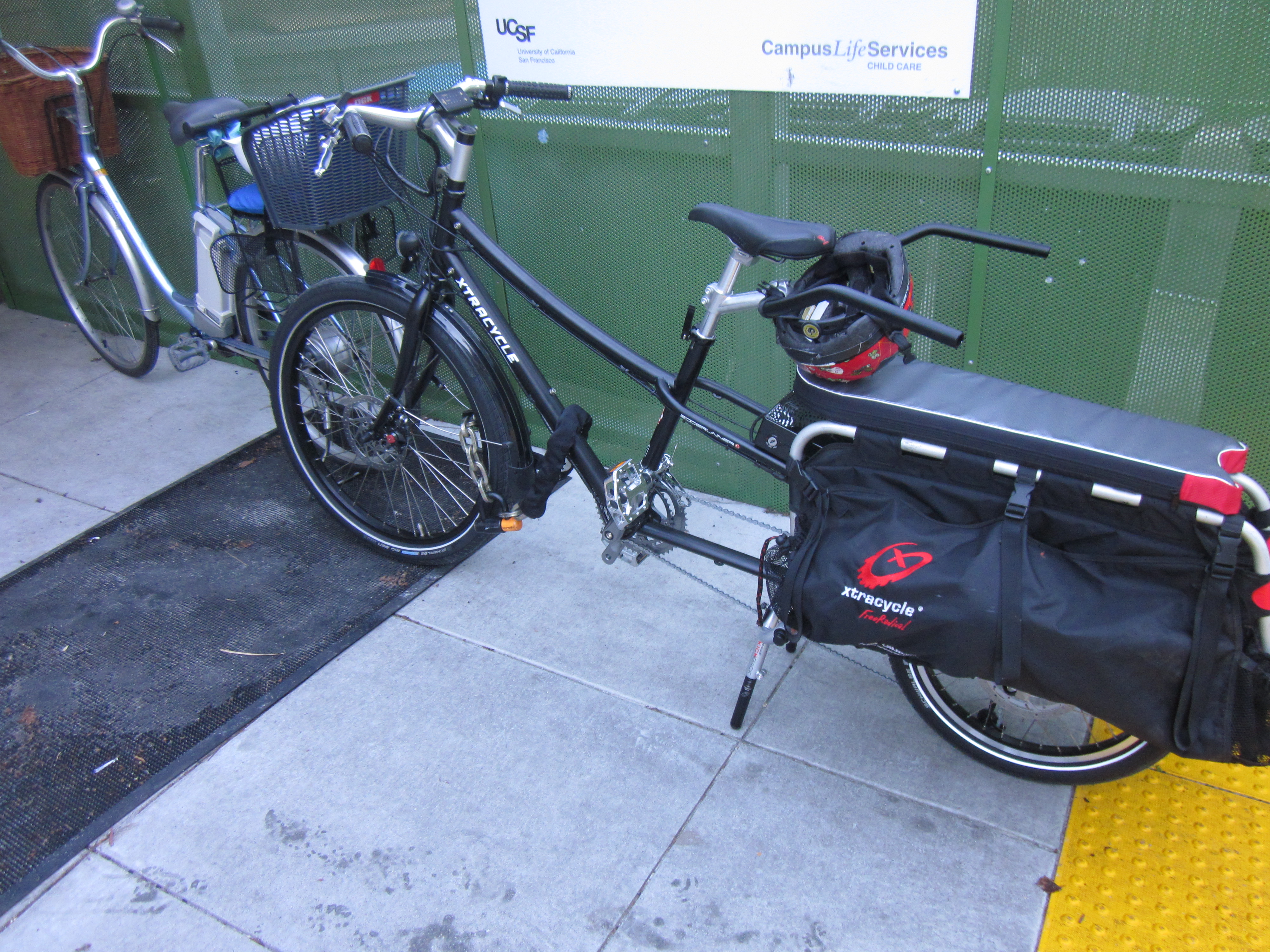
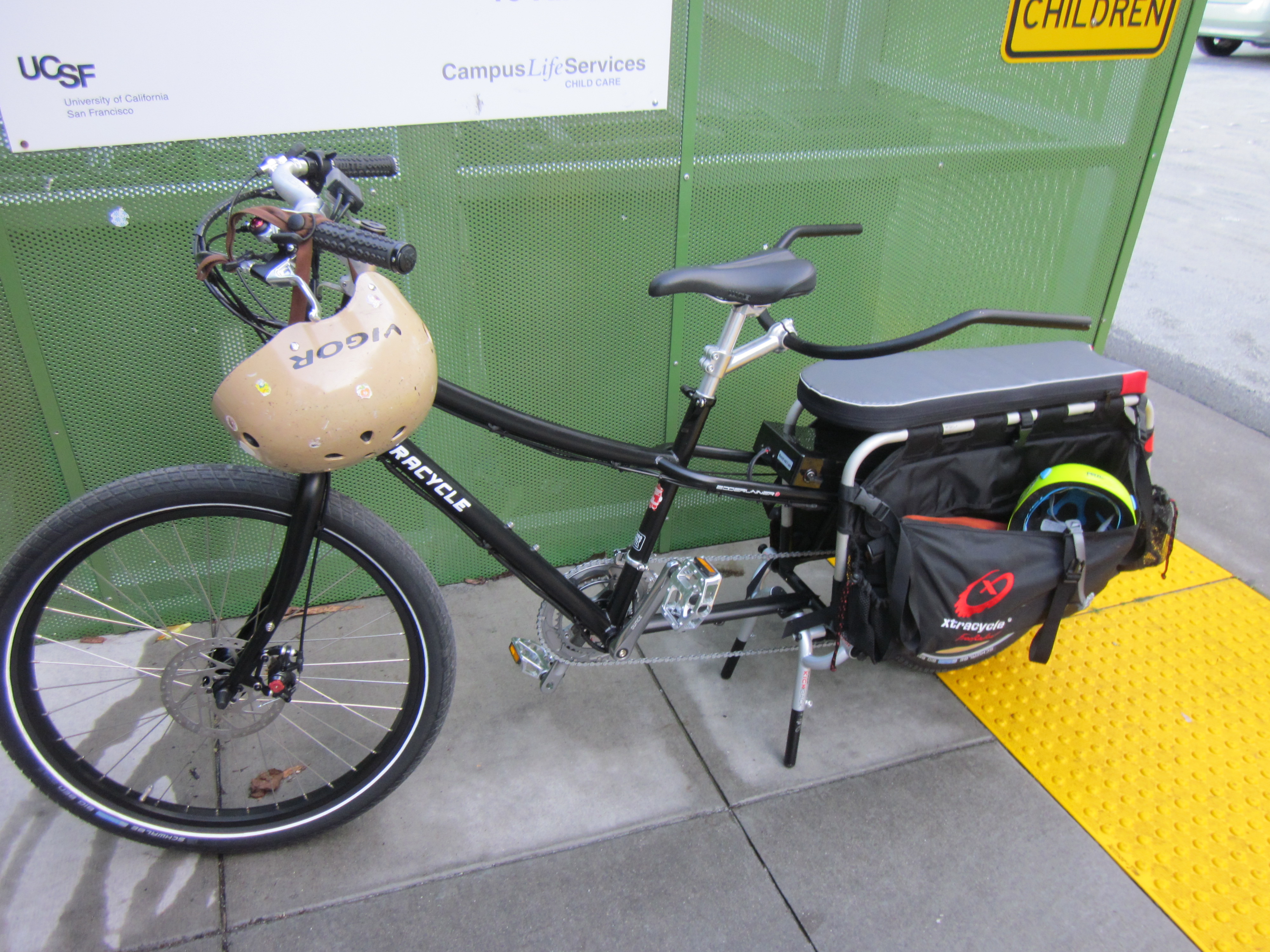
Finally, another bike at preschool.

Finally, another bike at preschool.

This morning I saw the EdgeRunner I’d spotted last week parking next to my mamachari outside preschool as I was leaving. As the dad was unloading the bike and his son, Walking Mom came up the hill. Walking Mom is a friend from preschool who pushes her 3 and 5 year old five miles from home and up preschool hill in a double stroller every morning. Then she goes to work all day, and comes back in the evening to pick the boys up and walk them the five miles home. She is incredible. “We saw you going up the hill!” she yelled to the EdgeRunner dad , “That was AWESOME!”

When I talked to him he was still panting. “Well,” he said, “[gasp] we made it! [pant] I’m [wheeze] getting old.”

I sound exactly like that every morning.

“It’s just a really steep hill,” I said, “even with the assist.”

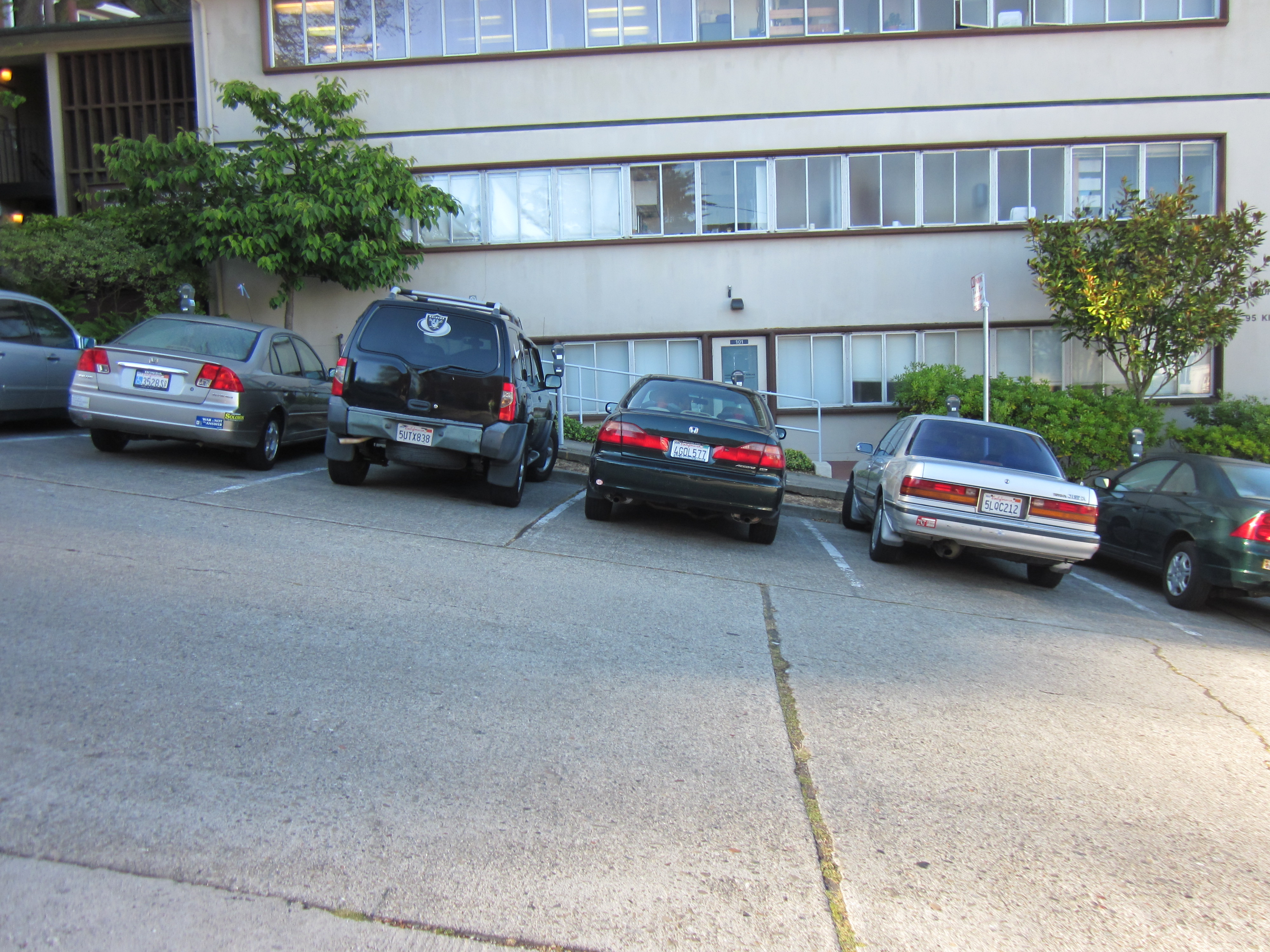
It's possible to ride up this part of the hill unassisted, but probably not with a four-year-old passenger.

It’s possible to ride up this part of the hill unassisted, but probably not with a four-year-old passenger.

Every morning I feel like that dad. I’m simultaneously grateful and vaguely disbelieving that we made it up preschool hill again, even with the assist, even after almost a year. Looking up the hill I’m never quite sure I’ll make it.

When I look at the assists on our bikes I feel so happy that they’ve made something possible that was previously impossible. Anyone who calls an electric assist cheating can meet me at the top of preschool hill.

4 Comments

Filed under car-free, electric assist, family biking, San Francisco, Xtracycle

Xtracycle erumpent

Another EdgeRunner!

Another EdgeRunner!

Last week I spotted the first EdgeRunner I’d seen in the wild. I did a double-take last weekend when I saw it again at the Botanical Gardens. Except that it had different stoker bars. Given that stoker bars aren’t an accessory that people swap out casually, I realized it was an almost-identical EdgeRunner. This bike has been available for what, a month? And I’ve already spotted two? Evidently I’m not the only person who found it appealing. I think this one is a Rosa Parks bike, as I either saw it again or there is a third (!) EdgeRunner in our usual haunts–yesterday morning when I got to school with my son there was yes, a black EdgeRunner parked in the school yard. What’s more, we had dinner with friends last weekend, and the mom, who is in the market for a new family bike, is coveting the EdgeRunner as well.

On Monday, when we were walking with Matt’s parents to brunch, we spotted another Xtracycled bike heading up the hill the other way. Although it was moving fast, I realized it was a Cargo Joe, the folding Xtracycle, and given the speed it was ascending Mt. Sutro and the low hum it made as it went, it was clearly an electric-assist folding cargo bike. We puzzled over that one for a moment, but realized that here in San Francisco, there are thousands of people living in apartment buildings that lack dedicated bike parking (or any kind of parking) but do have elevators. In a hilly city of small spaces, there is evidently a previously untapped market for an assisted folding cargo bike.

We have missed our Bullitt sorely the last few weeks that it has been in the shop.  With it, we don’t need to organize our lives around not having a car. Riding the bike is always better. But not everyone can manage the parking demands and expense of an assisted front-loading box bike, and in San Francisco, which has so few families, the advantages of the front loaders are less widely relevant anyway. As I watched that Cargo Joe glide smoothly to the top of the hill, I couldn’t help thinking that I was seeing the future.

4 Comments

Filed under car-free, electric assist, family biking, folding bicycle, San Francisco, Xtracycle

Unusual child seats, continued

This was the most distinctive child seat I've seen in quite a while.

This was the most distinctive child seat I’ve seen in quite a while.

Last week I wrote about packing two children on a folding bike (arguably inappropriately). Evidently this is my week for spotting ad hoc child seats, because parking at the office I saw another one. This rider put a seat cushion/saddle (?) on the rear rack and hacked a piece of pipe as a footrest onto the rear wheel. Although this is a normal-sized bike and the frame itself is probably fine carrying more than one person, I have to wonder whether the rack is really rated for the weight of a kid old enough to sit without a harness or back rest.

What amused me most about the setup, though, was that the owner of the bike had carefully locked the scavenged seat and the “I sawed off a piece of aluminum tubing” footrest to the bike with old bike chains. Finally I have spotted a rider who is even more ridiculously paranoid than I am about bike theft.

Maybe I’m living dangerously, but dude, I think the footrest is safe from tweakers.

5 Comments

Filed under family biking, San Francisco

Scaling preschool hill

This is the approach to preschool hill, in a drier season.

This is the approach to preschool hill, in a drier season.

Lately the road to preschool has been slick due to a mysterious water leak, and with the cold the street is icing up. The university put down sand but cars are still slipping backwards on the hill (which actually happened to us once too, back when we owned a car, and which is absolutely terrifying).

Mornings this week I’ve come out to the sound of motors gunning as people try to power through the ice slick. San Francisco hills are far too steep to be scalable if there were actually ice on any regular basis.

But our assisted bikes are okay even on a steep and slick hill. It’s still not a fun trip, but it beats walking, and I when I see or hear cars losing traction I can peel off onto the sidewalk. But most drivers wait at the bottom of the hill until we get to the top. Even when the street is dry, they slow down to avoid passing us. Everyone moves pretty slowly on the uphill trip no matter what, frankly. Preschool hill is steep. It makes me paranoid about my brakes.

Anyway, I don’t see a lot of other parents riding bikes, although last year I met one dad on an assisted bike (a Walmart type model scored on craigslist), whose daughter is now in kindergarten. And occasionally there are parents who try the hill unassisted while hauling a trailer or child seat, walk in dripping with sweat, and vow while gasping for breath to never do it again.

At last there are two bikes at preschool drop off.

At last there are two bikes at preschool drop off.

That is, until yesterday, when I saw another bike snuggled up to the mamachari after I dropped my daughter off. I could hardly believe my eyes until I got outside: it was an assisted EdgeRunner! It was made exactly for this kind of job. I still don’t know who’s riding it, but it’s nice to have company at last.

1 Comment

Filed under electric assist, family biking, San Francisco, Xtracycle

My Brompton gets schooled (2 kids on a folding bike, redux)

Here we go again.

Here we go again.

Over Christmas I started riding the Brompton occasionally with both kids on board. At the time, and again now, I noted that this almost certainly voided any manufacturer warranty and was nothing that I could in good conscience officially recommend, etc. etc.  I’m not sure how much it matters anyway, as the Brompton is not the cheapest folding bike, plus the IT Chair required to ride with a kid in front, which is awesome, is laughably expensive. We were only comfortable dropping that kind of dosh to celebrate my promotion last year. So this option is not likely to appeal to lots of people.

That's a rear child seat, a double front saddle, and a front cargo basket on a folding bike. Damn!

That’s a rear child seat, a double front saddle, and a front cargo basket on a folding bike. Whoa!

But it seems I’m not the only person to think about ways to squeeze a couple of kids on a folding bike. At my son’s after-school program, one parent is doing it on the cheap. I was awed when I saw this folding bike, which offers a way to haul a rider, two kids, and a fair amount of a cargo in the front basket, with even smaller wheels than the Brompton, and with parts that looked like they could easily be scored secondhand. I wouldn’t call the results pretty, but you know what? This bike could be put on a city bus and take up less room than a folded stroller, and I’m guessing the total rig would cost very little even if assembled brand new. Well played, mystery parent. Well played.

3 Comments

Filed under Brompton, family biking, folding bicycle, San Francisco

Soldiering on

Destination unknown

Destination unknown

I have been feeling embattled over the last few weeks. Blah blah blah housing, blah blah blah office move. Our daughter’s preschool changed hands and for the last week, has been run by a for-profit corporation. (We are familiar with the company and did not have a good experience.) As a result of this transition, many of our friends from preschool are leaving the city over the next six months.

At one point I said, “Well, at least everyone’s healthy.” Jinx. Our son ended up in the emergency department, on oxygen, with a tentative diagnosis of pneumonia. It wasn’t pneumonia, and after a week at home he was feeling better, thank goodness.

Going in circles, for now.

Going in circles, for now

The weather has been colder as well. It makes it just that extra bit harder to get on the bike. But given that we’ve chosen to live without a car, we mostly do it anyway.  We just keep swimming, more or less literally last Thursday morning, when the rain was coming down so hard that the street turned white. But my rain gear is incrementally improving every season, and I got to work dry. By mid-morning it was sunny again.

So far the preschool situation is hanging fire. There are many new teachers who are stymied when we show up on the bike every morning, who cannot really believe yet that there are people who ride to school (admittedly the hill is a beast even with the assist). But nothing bad has happened yet.

This week I finally ended up meeting with my school’s dean. I wanted to know where things were going, professionally speaking. It was a very reassuring conversation. Among other things, it turns out that a dean is more powerful than the university housing office. Things are going to be okay.

What we sent to the landfill last week: medical waste from ER visit, birthday party odds and ends, random odds and ends, and a XL serving of smug.

This is the total of what we sent to the landfill last week: medical waste from ER visit, birthday party odds and ends, and an extra-large serving of smug.

We keep doing what we’re doing. We are buying no new plastic and thus producing much less garbage, and to my surprise this transition has been fairly painless. Our son is fervently on board, for reasons I haven’t really figured out. We’ll be rooting out odds and ends of pre-packaged things for some time yet, but using up what we already have is good preparation for our eventual move. Riding with my daughter to the cheese shop last week (which sells cheese and hummus and crackers in bulk and is delighted to put them in our containers and basically makes this whole endeavor far less onerous) I thought: oh my god, we are those people. I am riding my bike with my kid on board to buy self-consciously local food in reusable glass jars and cloth bags. It must look appallingly smug. What’s next, an annual pilgrimage to Burning Man?

But a synonym for “smug” is “contented.” We soldier on, and it feels like life coming into balance.

5 Comments

Filed under car-free, commuting, family biking, San Francisco

The city and the city

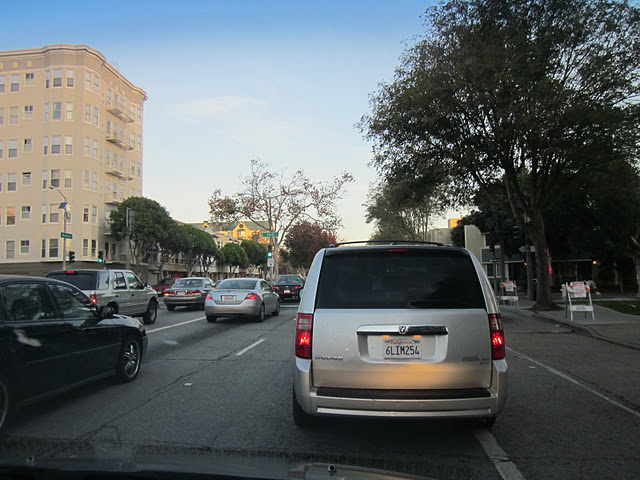
This is light traffic by the standards of a driving commute in San Francisco.

This is light traffic by the standards of a driving commute in San Francisco.

Today, thanks to a complicated sequence of planned afternoon events, I took the shuttle to work. I was surprised to realize that this is the first time I’ve ridden a bus instead of a bike in months.

The university shuttle, compared to Muni, is fairly palatial. You always get a seat, there are no stops between most destinations, and people are quiet. A lot of people work on the shuttle, but now that we drive so rarely, I’ve found that I, like the kids, tend to get a little carsick. So I looked out the windows instead, which helps.

The city that I saw on the shuttle is very different than the city I see on a bike. The bus got caught in traffic at one point, which was unnerving (San Francisco keeps postponing the implementation of Bus Rapid Transit lanes). And most of what I saw on the way to work was roads and cars, an endless expanse of gray asphalt and metal. It was unpleasant. The bus is high enough that I could look down on cars, which were filled, almost without exception, with drivers texting on their cell phones. I did not find that reassuring. And from my perspective, every car I saw, even the “compact” cars, was comically oversized for its typical load of one or two people. People on foot sprinted across major intersections. The city I traveled in today is filled with noise and fumes and traffic. It feels dangerous and unwelcoming.

At the Japanese Tea Garden in Golden Gate Park

At the Japanese Tea Garden in Golden Gate Park

I normally ride to work through Golden Gate Park and on back streets, and aside from a few transitions on major roads, the trip is quiet. I ride either in the park or on back streets lined with trees. My city is mostly filled with bird song and nature and brief conversations with people walking to work. “Please,” I say, “go ahead.”

No cars allowed

No cars allowed

I live in one place, but it contains two cities. I realize now why I haven’t ridden the shuttle in months. Why would I want to?

Leave a comment

Filed under commuting, San Francisco, traffic, Uncategorized

How much does a bike like that cost?

Apparently these bikes are interesting.

Apparently the Bullitt is interesting.

People like to ask me how much our bikes cost. Usually this question comes when we’re riding the interesting bikes. I understand the impulse, but I almost never get these questions from the kind of people who normally ride bikes, people that I know have a sense of what bikes actually cost. It usually comes from the kind of people who say in the next breath, “It looks like it would be expensive; like: $200!”

Yes, sure. My “expensive” bike cost less than your mattress or the flat-screen television you keep in the kitchen. Riding bikes for transportation is cheap, but unless you get the bike for free, it’s not that cheap. And nobody picks up a free Bullitt at the dump.

The Bullitt is an expensive bike (and if you really want to know what it and bikes like it cost, check out my family bike reviews). Announcing how much we spent while standing around the park seems likely to encourage eavesdroppers to try stealing it. I finally came up with some decent answers. “It cost less than half of what we got for selling our six-year-old minivan!” I say. “Can you believe it?” Here in San Francisco, there are other meaningful comparisons. I sometimes tell people it costs about as much as a Vespa (this is true). “But a Vespa couldn’t carry my kids, of course, and I don’t have to pay for license or registration or gas—it costs a few cents to charge this bike up and ride for 30 miles! Or more!—and the maintenance cost is basically nonexistent. Can you believe it?”

I suppose I should use another picture of the Brompton sometime.

I suppose I should use another picture of the Brompton sometime.

I still never know what to say when people ask me what our Brompton cost. Usually something like, “Well, it depends on the options.” This is true, but it’s kind of lame.

Luckily for me, bikes really do cost less to maintain than scooters or cars, because right now the Bullitt is in the shop and won’t be fixed until Splendid Cycles comes back from vacation next week at the earliest (something has gone awry with our customized front shifter). Its long vacation has turned out to be a bigger hassle than I expected given that we have backup bikes. Now that we’re used to having a real cargo bike, it’s crazy-making to not be able to haul big loads and cover the kids in the cold or the rain.

Come back, Bullitt.

Come back, Bullitt.

But it’s not going to cost a thousand dollars to fix. It’s not like repairing a car. And this confidence I have that even the most depressingly expensive bike repair is easy to cover from our monthly cash flow is probably the best news of all. How much does a bike like that cost? Over the long term: nothing worth mentioning.

2 Comments

Filed under bike shops, Brompton, Bullitt, family biking, San Francisco

How to get a bike for free

One of these things is not like the other.

One of these things is not like the other.

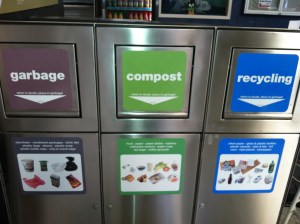
Recently I visited San Francisco’s waste management center. My university is a shared governance institution (often more in name than in deed) so I am expected to do service. One of my appointments is to the campus-wide Sustainability Committee. I also had to pick a sub-committee, and I asked for Transportation, because I am all about the bikes. But everybody wanted Transportation and I’m pretty junior, so they put me on Zero Waste instead. Anyway, all members of the Zero Waste sub-committee were asked to take a tour of San Francisco’s waste management centers. My first field trip!

San Francisco’s waste management is run by Recology, one of the country’s largest employee-owned cooperatives. San Francisco diverts 80% of its waste from landfills, better than any other municipality in the US and most countries in the world. The city’s goal is to be zero-waste by 2020. The university, which is Recology’s 2nd largest account, is hanging in at 63%. San Francisco has reached this point by implementing aggressive recycling efforts (including prosecuting recycling poachers), creating a hugely successful composting program (in part by instituting a $1,000 minimum fine for throwing compostables in landfill bins), and to a certain extent, by taking advantage of a quirk in how diversion rates are calculated (albeit no more than other cities and countries do).

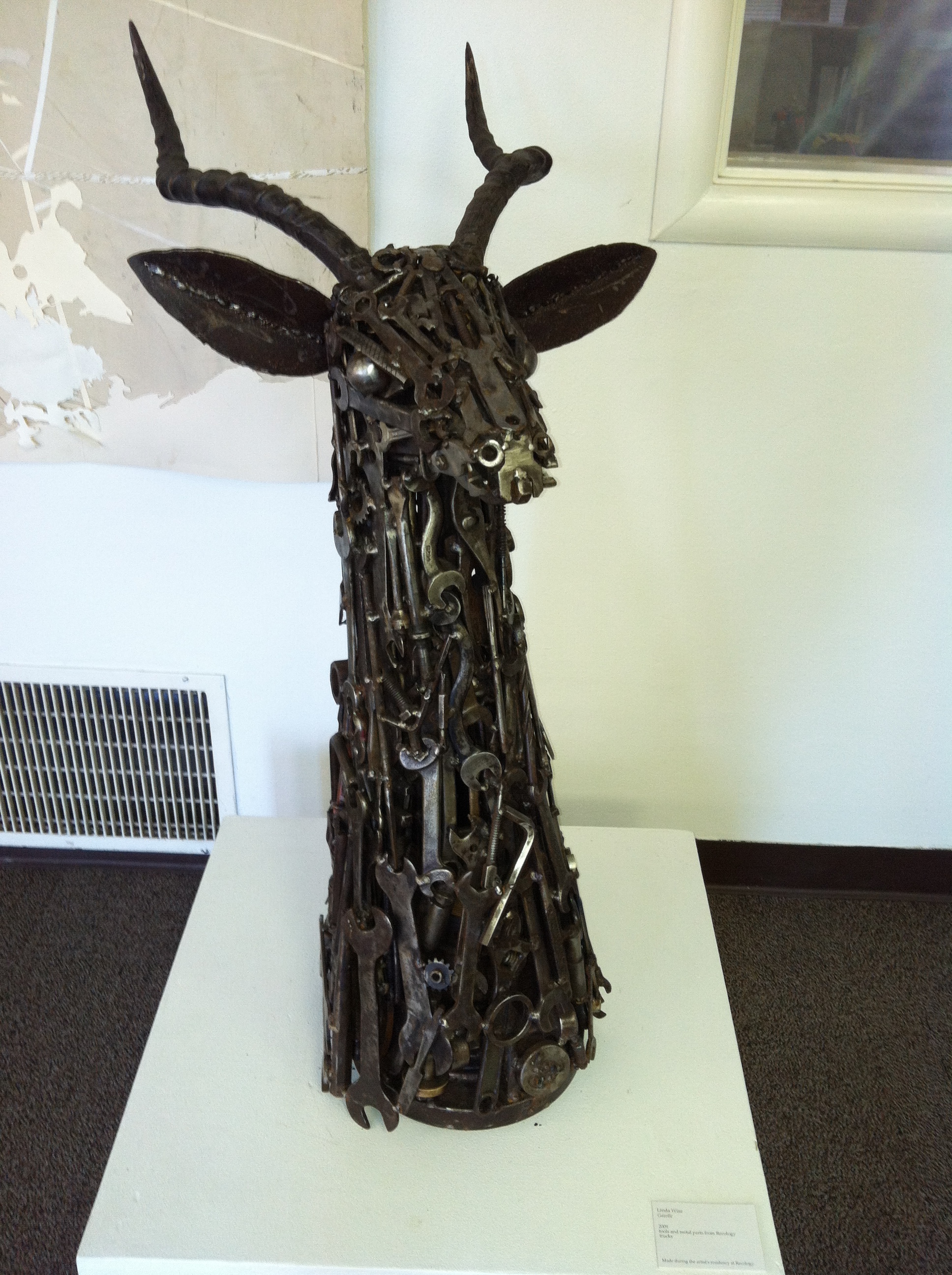
This is some of the art made from found materials at the transfer station.

This is some of the art made from found materials at the transfer station.

Our tour was absolutely fascinating. Recology does not allow photos of most of its operations, because there are apparently trade secrets in the world of waste management. I realize that the dump is not a traditional tourist attraction, but if you happen to be in San Francisco, it is definitely worth checking out.

Our visit started at the business office, where we picked up hard hats and met the sales staff. “I’m Maria,” said one woman who looked like a supermodel heading down the catwalk. “I handle the city accounts, and I’m a dumpster diver.” From there we headed to the recycling transfer station.

If you have seen Toy Story 3, the recycling transfer station will feel somewhat familiar. Trucks enter the building (1/3 of its power is generated by solar panels on the roof, because that is how Recology rolls) and dump recyclables onto the floor. From there they are moved by giant front loaders onto even more giant conveyer belts that sort out paper, plastics, metal and glass as they lift materials to the second floor. The Toy Story 3 feeling comes both from being surrounded by garbage and from feeling like a tiny mote in a giant machine. The amount of material being moved through the transfer station is simply mind-boggling. It was difficult to grasp its scale. On the second floor, the materials the machines could not handle are hand-sorted. Watching this process made me despair for humanity, as my fellow San Francisco residents seem unable to grasp the concept of what belongs in the recycling. Dozens of workers attempted to pick out plastic bags, clothing, plastic bottles of motor oil, ad infinitum, from paper destined for bundling and eventual recycling. It was impossible. They aim for 90% appropriate materials in the bales, we were told. That should be easier than it is. The relentless efforts of the hundreds of garbage-snatching seagulls didn’t help matters either.
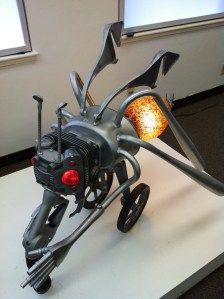
Is artistic reuse recycling, upcycling, or something else entirely?

Is artistic reuse recycling, upcycling, or something else entirely?

Recycling is a tricky concept. Some things are recycled and some are only kind of recycled. Glass and metal containers and shards are melted down and turned into more glass and metal containers. Concrete is smashed into sand and turned into more concrete. Although the process is energy intensive, these are closed loops.  These products are recycled. Paper is kind of recycled. High quality paper, like office paper, is usually turned into low-quality paper, like paper bags. Low-quality paper is turned into even lower-quality paper, like tissues and toilet paper. The tissues can go into the compost, but the toilet paper goes to landfill by way of the sewer system. The more non-paper waste that gets mixed into the paper, the less likely it can be reclaimed for higher-quality recycled paper. Rigid plastic is down-cycled. Assuming it isn’t thrown away outright, it gets one more use; bottles turn into plastic lumber or carpet or fleece, but once these materials wear out, they all go to the landfill. And soft plastics all go directly to the landfill, although only after Recology workers spend six hours out of every 24 picking plastic bags out of the recycling machinery. Less than thirty minutes into the tour, I was completely convinced that I should never buy another item wrapped in soft plastic. This is surprisingly hard, even in San Francisco.

The university facilities representative leading our group was less sanguine about San Francisco’s 80% diversion rate. Diversion rates are calculated by weight, and San Francisco recycles a lot of concrete. By volume, the endless sea of plastic is a much bigger problem, and landfills, of course, are packed by size and not by weight. Other universities in California also claim diversion rates of 80% but only, he said, “because they tear down buildings or repave parking lots every year.” Construction and demolition, as well as aggressive composting at San Francisco’s many restaurants and parks, boosts the calculated diversion rate. He estimated, glumly, that San Francisco residents are recycling and composting at most 40% of the waste that they could. And that this is the best rate in the country.
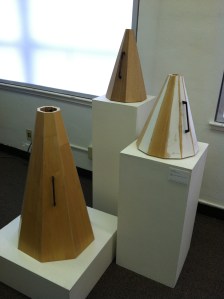
More art from reclaimed waste

More art from reclaimed waste

From the recycling transfer station, we headed to the main facility, where household waste, compost and landfill waste are packed up for their eventual destinations. Recology served us a nice lunch on plates and silver diverted from landfill, showed us an upbeat little movie, and answered questions. I was not brazen enough to ask whether the food was dumpster-dived, but after seeing what people throw away in this city, I would not be surprised if it was. We had lots of questions. I learned that you can recycle (okay, down-cycle) dental floss containers because they are rigid plastic; removing the metal cutter is nice but not necessary. Dental floss itself, however, is uniformly made of plastic and messes with sorting machinery and should always go in the landfill bin. Toothpaste tubes, tetrapaks: landfill. The soft plastics “recycling” bins at grocery stores that supposedly send plastic bags to be turned into park benches? Our facilities representative reported that almost no store will say where they’re actually going, so they’re probably being sent straight to the landfill.

The most hated word at Recology turned out to be “biodegradable.” Nearly everything is biodegradable eventually, they said. But people think that means it can be composted. It cannot. “Compostable” is a legally binding term in the state of California; if an item says it is compostable and it’s not, the state will levy massive fines. Biodegradable is a weasel word intended to sidestep the law. So “biodegradable” materials and bioplastics: landfill. The plastic keeps the biological material from composting, and the biological material contaminates the plastic. That was depressing.

More art from the gallery

More art from the gallery

Much less depressing was the visit to the Artist in Residence program, where artists are sponsored to create projects out of whatever they can find on site. Much of the art was wildly impressive, and there are regular shows where it can be viewed, as well as an outdoor sculpture garden. Many of the other sites showed where visitors came to drop off household waste sorted through it; construction debris is sorted, furniture is donated to thrift stores, electronic waste and batteries are sorted by type. Recology was also pioneering Styrofoam recycling; clean packing materials were compressed into thin, heavy sticks that could be used for things like crown molding. The process is hopelessly expensive and energy-intensive so it’s more of a demonstration project than a feasible way to handle waste, but it was interesting. The inevitable seagulls were controlled by an on-site falconer who kept four hawks circling all day. Recology had tried bottle rockets, netting and dogs, but the hawks were the most effective. We did not get to tour the compost transfer station, probably the biggest success of the program; San Francisco’s compost is used by California wineries and farms. And I got to take some compost home to show my kids what putting food waste in the compost bin, which they do diligently, really meant. They were completely floored.

Our old seat cushion went to the Pit. Is there any alternative?

Our old seat cushion went to the Pit. Is there a better alternative?

Our last stop was The Pit. Everything that goes into a black bin in San Francisco is dumped, unsorted, into The Pit, shoveled into tractor-trailers, and trucked to the landfill. The Pit is huge. It runs 24 hours a day and seven days a week. There is a smell. Trucks enter at the top level and drop their loads. The sounds of breaking glass and the efforts of occasional seagulls to snatch food make it pretty clear that a lot of what’s in The Pit could be recycled or composted (efforts to assess it suggest that two-thirds of what’s in The Pit could be diverted). Bulldozers shovel the waste into waiting tractor-trailers below. The process never stops. It is difficult to describe the feeling of watching massive piles of trash build and be shoveled away, endlessly. It turns out that material in landfills does not biodegrade. Everything that goes into the landfill is forever. I will never look at a garbage can the same way again.

This is how we shop now.

This is how we shop now.

I see now why were asked, as part of our service on the Zero Waste sub-committee, to visit Recology. This is the best that the United States currently has to offer in terms of waste management, and that was sobering. At home, post-tour, we are now uncompromising in using cloth produce bags (we had always used cloth grocery bags) at the farmer’s market and we don’t shop at Trader Joe’s much anymore, because there’s almost nothing to buy there that’s not wrapped in plastic. We now buy milk and yogurt in glass, and everything else in bulk. But mostly, we are buying less, because everything we buy must eventually be handled somehow, and packaging is not free.  It is probably not a coincidence that this month’s grocery bill is half of last month’s.

I am familiar with life-changing experiences by now, and this one didn’t require a trip to Copenhagen. I only had to ride across town.

But I promised to tell how to get a bike for free. The answer is to work for Recology. One of the tour guides mentioned that he never had to take his own bike to site visits and lock it outside, because he could always pick out a nice bike from the garbage. Recology workers never have to worry about San Francisco’s rampant bike theft. He admitted that the last bike he picked up was better than his commuter bike, “way more gears for the hills.” It’s entirely possible that anyone could show up at the dump and ask for a bike.

This is our refrigerator post-tour. We are trying harder.

This is our refrigerator post-tour. We are trying harder. (The glass jars are sold by Cole Hardware in San Francisco for thrift store prices, luckily for us.)

At Recology they suggest people stop calling the things in bins “garbage.” A better word for the many unnecessary things we throw away is “waste.” And a free bike is the least of it.

10 Comments

Filed under advocacy, commuting, San Francisco, zero waste

Ch-ch-ch-changes

Note that the kids don't necessarily bother to dress for the weather anymore.

Note that the kids don’t necessarily bother to dress for the weather anymore.

It’s been cold in San Francisco. Yesterday my kids found that a cup of water they’d left on the back deck had frozen. Since when does that happen? When I took them to school this morning they refused to get out from under the Bullitt’s canopy, which basically functions like a greenhouse (that Splendid canopy was worth every penny). After we dropped off my son, my daughter slept in the box all the way to preschool, and that is the kind of thing that definitely draws envious looks from other parents on bikes. But even with two pairs of gloves and the canopy covering my hands, they were freezing. At the Rosa Parks drop-off I talked with another parent and my son’s teacher about trying to find decent gloves for our rides to school–it is amazing how many parents are on bikes at school now. These are my people! Mighty mighty Dragons! Anyway Matt and I went to a sporting goods store a couple of weeks back and all their winter gloves and mittens were sold out already.

It could be worse. Matt is in upstate New York this work, where temperatures promise to be in the mid-teens. What’s more, he drew the short straw and is his group’s designated driver. Next week I’m heading to Atlanta, but I never get to go outside when I’m working in Atlanta, so I’ve stopped checking the weather for these trips. It’s all: airport to taxi to hotel to taxi to 16-hours-in-a-windowless-meeting-room, then reverse.

Like it or not, we're on the move.

Like it or not, we’re on the move.

But the biggest news around the HotC household is that everything is changing. We received notice last month that the cooperative university preschool my daughter attends was being sold off to a for-profit corporation. Much of our winter break was spent unsuccessfully searching for a new preschool. A couple of weeks ago I got notice that the university was selling off the campus where I work, although it lacked information about trivial details like where we’d all be moved when this happened. Then on Friday afternoon we were notified that the university is also clearing out the faculty housing where we live. Over a hundred tenants will be kicked out in July, and the rest, including us, will be kicked out next year. At least we’re in the second group, I guess.

In summary, it was not exactly a low-stress weekend. I’d like to know where I’m going to be working before we try to move house, and the preschool situation is too depressing to think about altogether. I realize that it’s not progress when everything stays the same, but this feels like a lot at once. At least I like my bike. When Matt’s away I spend almost two hours a day doing drop-offs and pickups on the Bullitt, and despite the cold it’s hard to stay frustrated on the bike (although lately there have been times that I’ve managed it). For this reasons, among others, updates are likely to be light-to-nonexistent over the next couple of weeks.

No way are we getting out from under here.

No way are we getting out from under here.

One thing for sure: we’ll be looking to live in a flatter neighborhood. Tips welcome.

8 Comments

Filed under Bullitt, car-free, family biking, San Francisco