This Friday is the opening day for Bay Area Bike Share. I knew, idly, that it was coming, but hadn’t really paid much attention, as the station route map reveals it is too far east for me to use much. I forgot, of course, that Matt works downtown. There is a new bike share station right outside his office! My sister has one outside both her home and her office (and mystifyingly, she does not plan to join. Yet.)
Of course Matt rides to work already, but riding a big cargo bike around the Financial District is not always the most convenient option, especially since one time that he did that, his (U-locked) bike was stolen. At noon. In a location with lots of foot traffic. By a thief using a handheld angle grinder. At work, we can bring our bikes inside. Personally, if I had the option, I’d leave my bike inside all day and ride a bike share bike to meetings when I needed to leave the office. I think a docking station is designed to lock up a bike better than I ever could, and I suspect that it would be too tough to sell a bike share bike to make stealing one tempting. Not that it matters, because stolen bike share bikes wouldn’t really be my problem anyway.
Although I am not in the neighborhood and I can’t haul my kids on a bike share bicycle, I will eventually make it over to that part of the city (which is flat!) and try one out. You’ll hear about it here first.
However the grand opening of bike share is not the only reason that this will be a great weekend. This is also the long weekend of the empty city. On Wednesday night, the Bay Bridge was closed so that Cal Trans can transition the earthquake-damaged eastern span over to the new bridge. Virtually all of the traffic from the East Bay has evaporated. I noticed even this morning that there were far fewer cars on the road, which is always welcome. We have had this experience before during bridge closures, as well as on Thanksgiving and Christmas—visitors leave the city, and everything is suddenly completely accessible to those of us who live here. Restaurant reservations are available all evening and the lines at museums disappear. I’m sure that it’s not great for business, but it’s sometimes nice to have the city be a place just for its residents. Happy Labor Day!
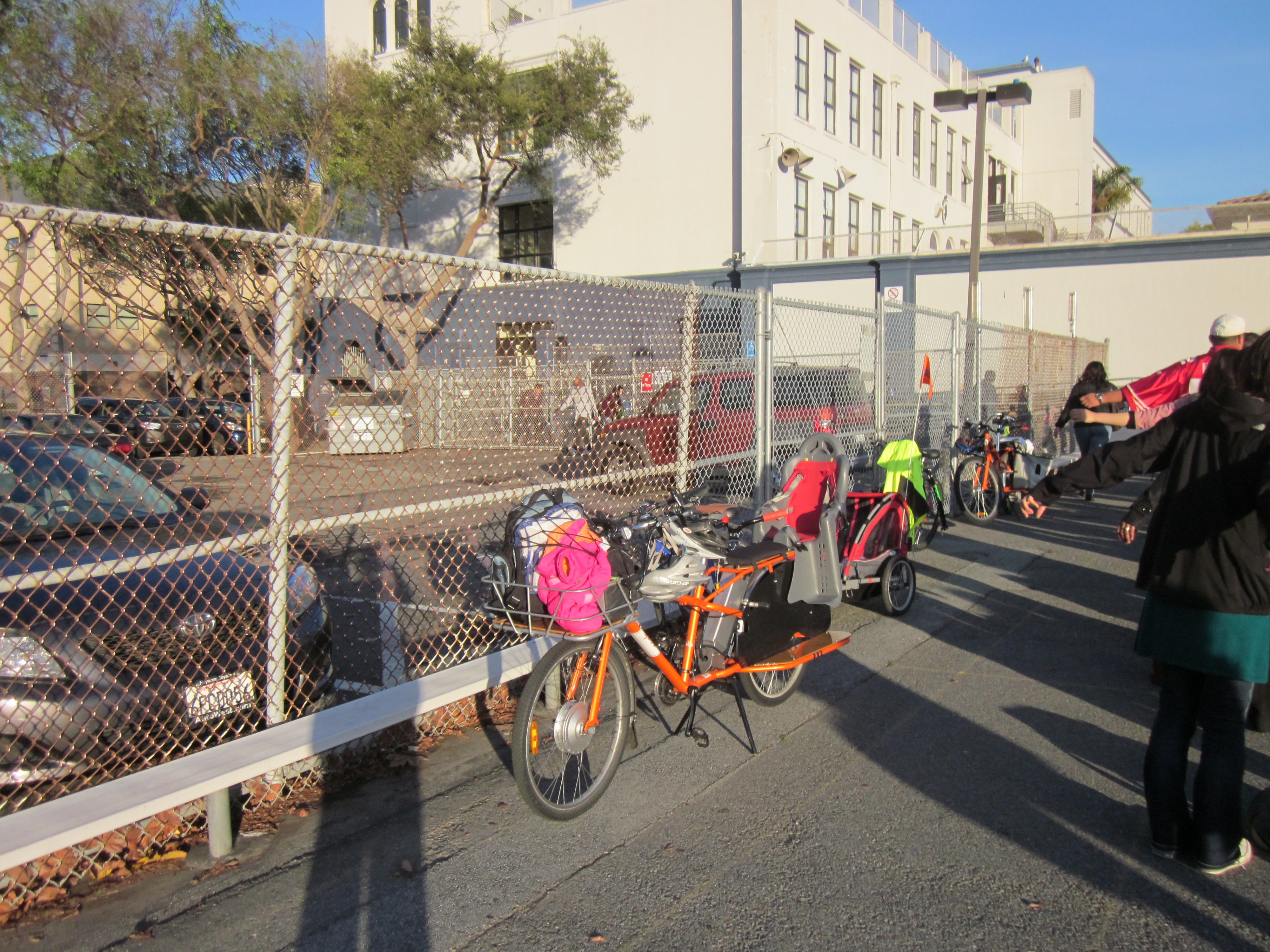
Rosa Parks bikes rolling in… every day is like a cargo bike roll call!
San Francisco schools start mid-August, so we’ve been taking our son in for a week now. Now that our daughter is finally in a new preschool (at a Japanese immersion program a few blocks from Rosa Parks that we love) we have, for the first time ever, a shared commute. And for the new school year, there are new bikes to see as well. We arrived early on the first day of school, and we had to rent a car because our daughter woke up vomiting, but there were plenty of bicycles to see nonetheless.
Front seats rule!
Last year I wrote about the Oxford Leco top tube seat, and we were lucky enough that friends from Rosa Parks picked up for us one while they were in the UK. Circumstances conspired, so we have not installed our seat, but they are already using theirs. On the first day of school it was carrying their son (who goes to preschool with our daughter) but this is typically the way they take their daughter, now in the first grade, to school. They told me that the kids fight for the chance to sit in the front seat, which does not surprise me: front seats are fun!
This bike is too fast to catch in motion.
For a couple of years another family was also using an ad hoc top tube seat in the form of a spare saddle stuck on the top tube, but their daughter, in 2nd grade, has grown too tall for this option. Now she rides behind her dad, standing on the foot pegs he’s installed on his rear wheel and holding onto his shoulders. I continue to be impressed at the way he’s managed to haul a kid for six years now with the absolute minimum cost and hassle. They cut a mighty figure rolling through the streets—since he’s kept his bike so light they move very fast, unlike those of us on cargo bikes.
This is the second BionX Mundo I’ve seen at Rosa Parks.
At the welcome breakfast for new families there were: more bikes! And check out that newly assisted Yuba Mundo with BionX. This particular rack usually holds kids’ bikes that have been disengaged from their Trail-Gators and are locked up until the parental pick up later in the day, rather than this collection of parental bikes, because it’s inside the locked courtyard.
There is so much awesome in this bike that I cannot do it justice.
Most impressive of the new bikes was the Xtracycled tandem! This is the same family that formerly rode the Bike Friday triple tandem (aka Shrek 2). Their oldest is now riding solo, so they swapped the triple tandem for the Xtracycle tandem, and now they can carry three kids. And they do: they are the neighborhood bike-pool. Cargo bikes may be slow, but have their uses.
This is the way we ride to preschool.
And although we did not ride to school on Monday due to sick kid, we did ride for the rest of the week. I took our daughter to preschool solo twice last week, and picked her up too. I still get tired much too easily, so I can’t ride every day, or for that matter go to work every day (I’m still on half-time disability). Yet riding is still easier than driving+walking—even with my handicapped parking sticker, we can rarely park close enough to our destination that it’s an easy walk for me. People are still surprised to see me on the bike again, but riding is still so much easier than walking that it almost feels like cheating.
Even more astonishing, I’m not the only one back in action.
I have been trying to practice riding more, although I have hit some limits. Riding two days in a row, I have learned, now leaves me saddle sore. I get a little antsy when I have to go through the intersection in Golden Gate Park where I was hit, which is unfortunately en route to almost everything, but it’s been reasonably mellow other than that. I don’t have the stamina or strength to go long distances or up hills, but hey, that’s the kind of thing electric assists were made to fix.
Now that I am riding every other day or so, I remember what I like about riding my bike. I’ve been in cars and buses a lot in the last few months, and it is isolating. Plus, even though I now have a handicapped placard, I end up having to walk a lot when we drive somewhere because the competition for handicapped parking places is ferocious. But on the bike the world returns to human scale (plus I can park by the front door). When I was coming back from grocery shopping—my current level of grocery shopping competency by bicycle involves carrying one glass jar of yogurt—two guys on the corner waved me over to ask about my bike. On my way to the office, the only other person who stopped at the red light besides me struck up a conversation. “I can’t believe I get grief about not wearing a helmet sometimes from people who run red lights,” he said. I agreed that this was pretty irritating. This nice man was in the full roadie kit; not the usual stop-at-red-lights type in my experience. I am learning not to judge hastily.
I get a lot of funny looks when I get off the bike and unfold my cane. This amuses me. In physical therapy I can do exactly zero of the exercises I’m supposed to be able to do 25 times in a row when I’m fully recovered. I am still a slow walker, and I limp, and I can’t go far on foot, but on my bike I’m almost as fast as everyone else. On the bike no one knows I’m still crippled.
[Note: As of April 2014, release of the Ridekick child trailer has been postponed to 2015.]
When I thought about getting back on the bike after my injury, I thought immediately about electric assist. We live on a big hill. I was surprised that I could get up part of it on the Brompton by myself when I tried riding for the first time last weekend. But a little more experimentation made it clear that I wasn’t able to ride up all of it. This is better than I’d expected, but still: not useful. It doesn’t help much to go partway up the hill. And when I tried to walk the bike up the hill instead, it made the pins in my leg ache so badly that I had to lie down. This was predictable but still unwelcome.
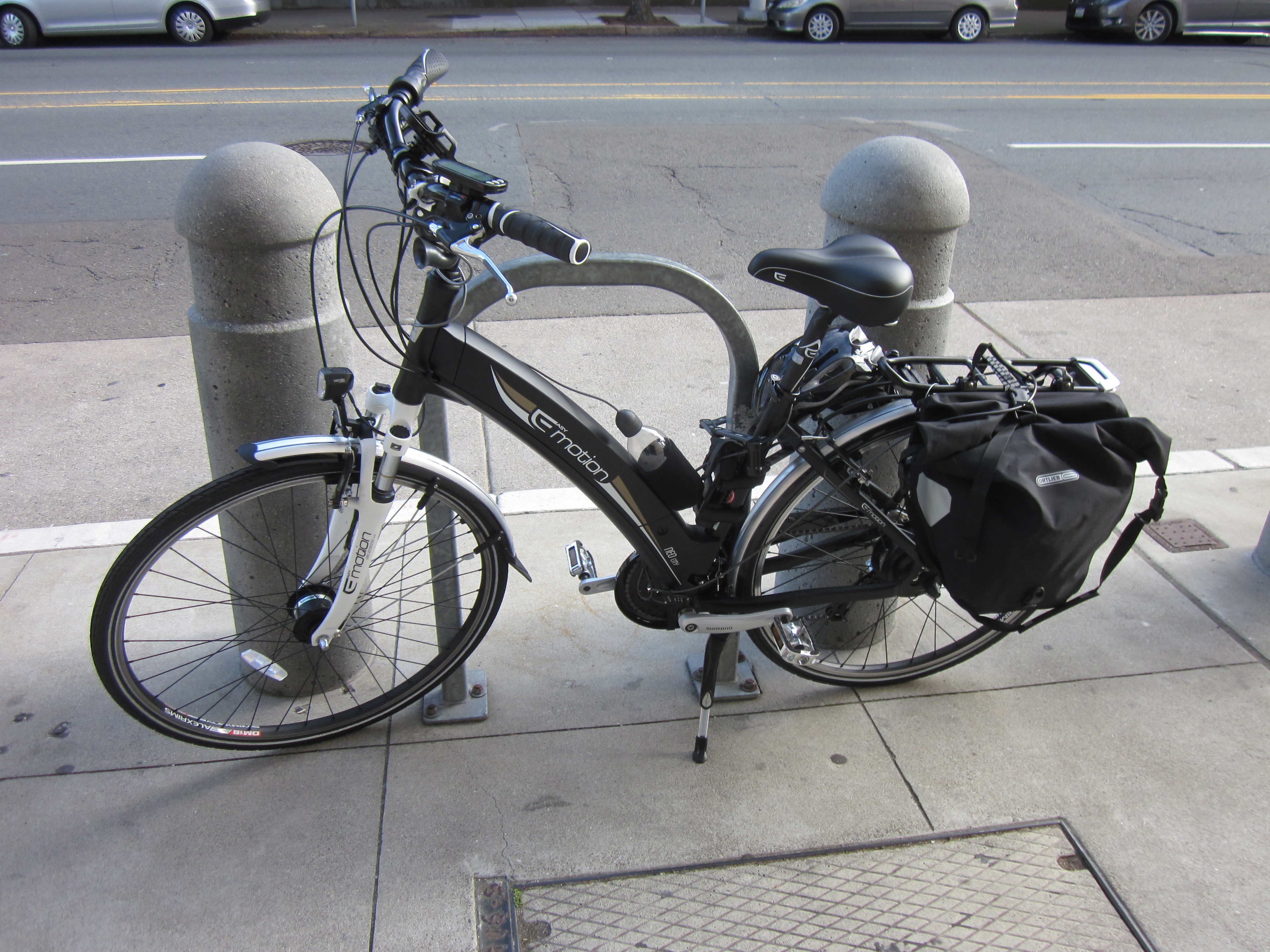
A mid-drive spotted near work
What’s more, it’s not very useful to be riding again if I can’t pick up and drop off a kid occasionally. I figured I would get my strength back eventually, but in the meantime I needed a better solution. Option one is a new mid-drive electric-assist bike, but that’s really expensive for short-term use and depending on how much strength I got back, could potentially be overkill in the long term. Ideally I wanted a temporary assist that I could stick on the Brompton, which is basically the only bike we have that I can use right now given my limited strength and range of motion. I did try getting on the MinUte, and technically it’s possible, but it wouldn’t be safe yet with a kid on the deck. I can get on and off the Bullitt, but it’s too heavy for me to ride for the time being.
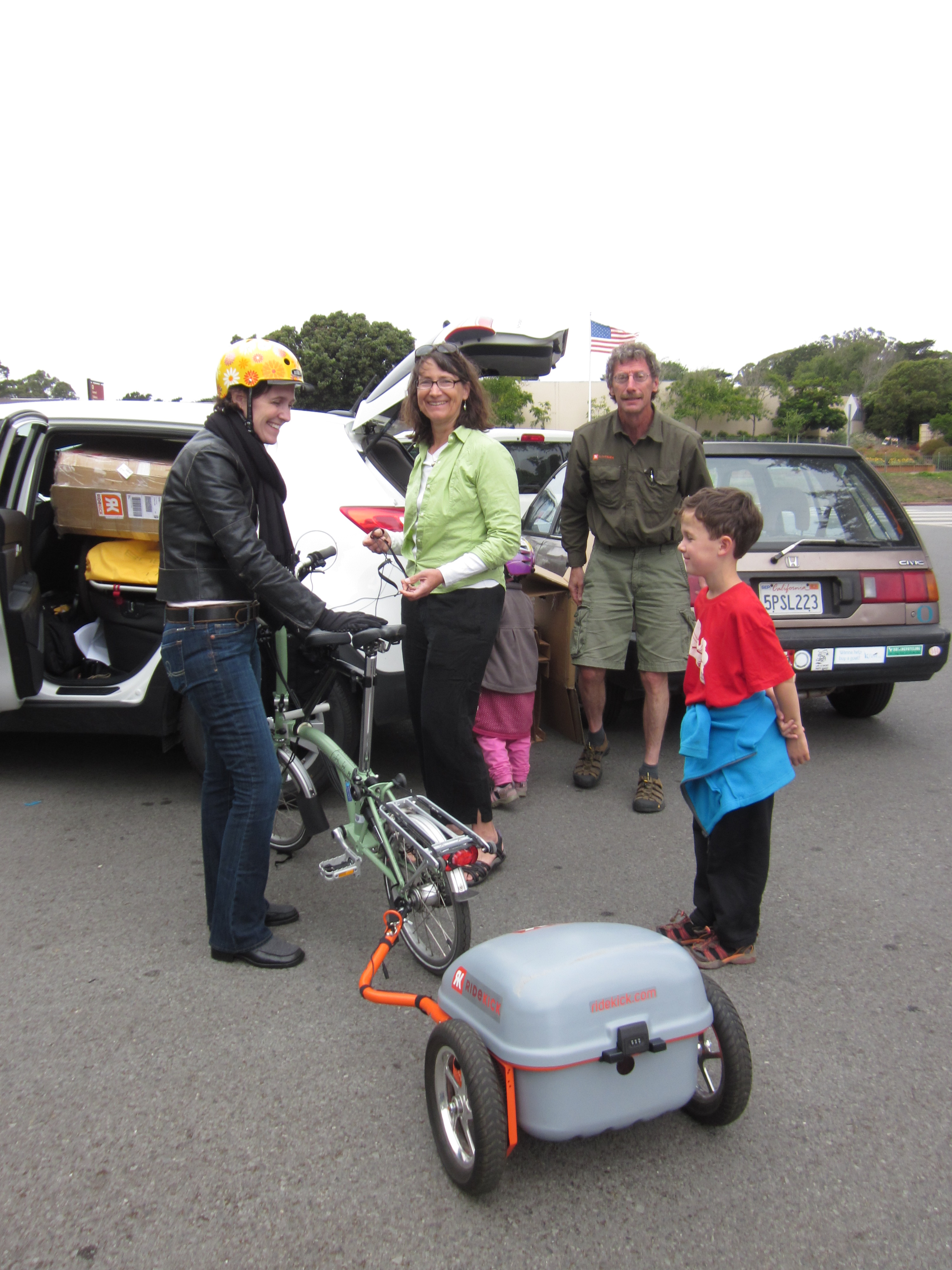
Introducing: the Ridekick electric assist trailer!
I knew what I wanted, but unfortunately I didn’t know of any temporary, immediate on-off electric assists currently in production. At least, I didn’t until a blog reader pointed me to the Ridekick trailer (thanks David!) The only Ridekick currently on the market is a small cargo trailer with an electric assist built in. It was cute and it looked like it would do what I wanted, but when I went to their website, I saw that they were taking pre-orders for what looked like my rehabilitation holy grail: an electric assist child trailer.
This is a complete stealth assist system, if you want to look super-tough on hills.
Although I’m not the world’s biggest child trailer fan (hard to see in city traffic, don’t always fit in urban bike lanes, won’t make it up many San Francisco steep uphills, can be terrifying on many San Francisco steep downhills, we prefer to have the kids in front), we had been considering getting a bike trailer for travel, and for upgrading our one-kid bikes to two-kid bikes on occasion. The trailer also has the advantage of offering weather protection, just like the Bullitt, but in a far more portable package. The Ridekick assisted child trailer also seemed way more promising than an ordinary trailer because with an assist we’d no longer have to worry about drag on the bike. The pull of a weighted trailer can really be a problem on hills and in strong winds, both of which San Francisco has in abundance. And if the assist were up to it, I could attach it to any bike and make it up hills with one or both kids even in my reduced state.
So I wrote to Ridekick, hoping against hope that the child trailer was close enough to production that I could get one by August. The answer was no. But they were coming to San Francisco in August with the prototype to look for venture capital funding, and would I like to try it? Yes!
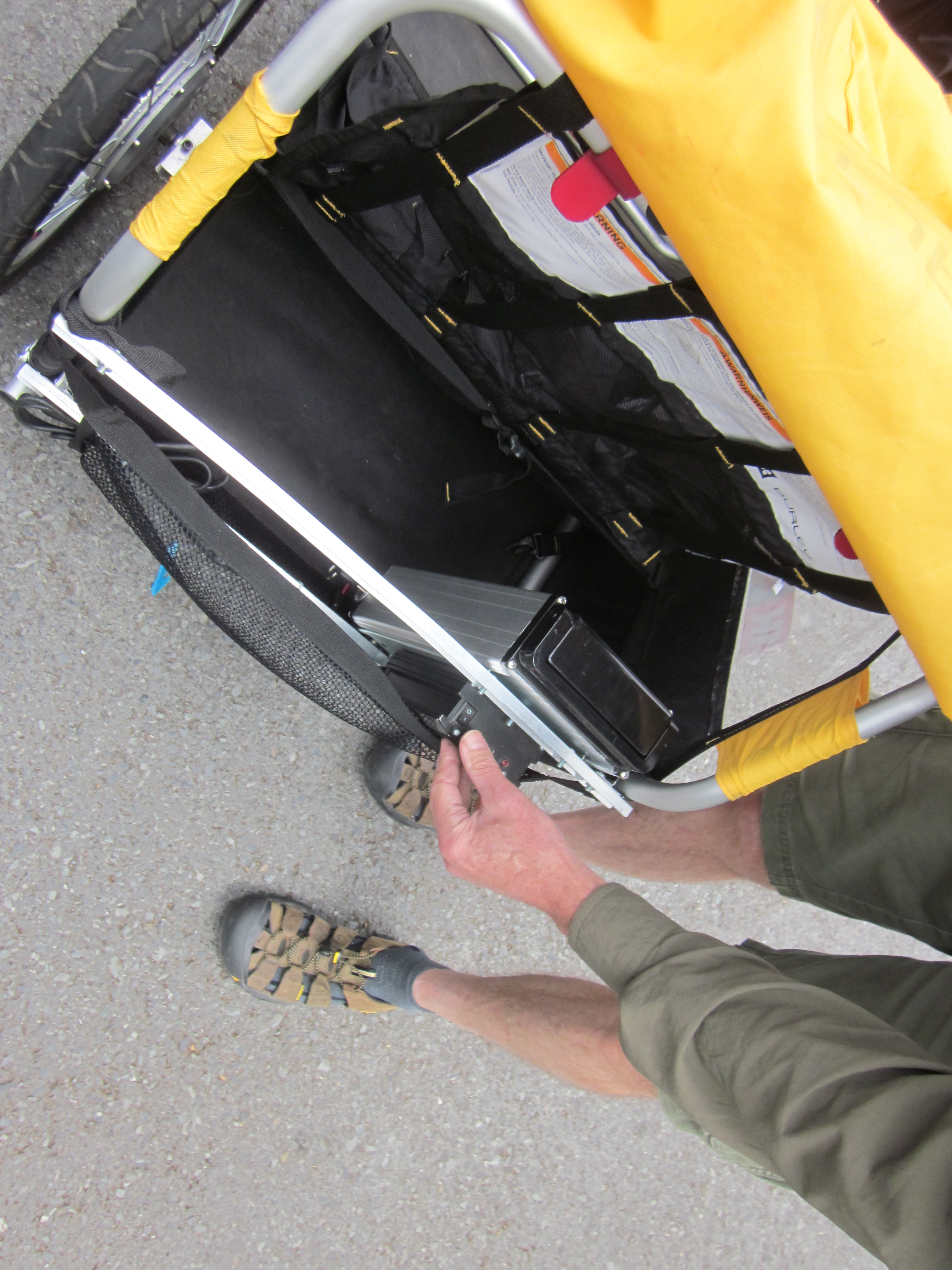
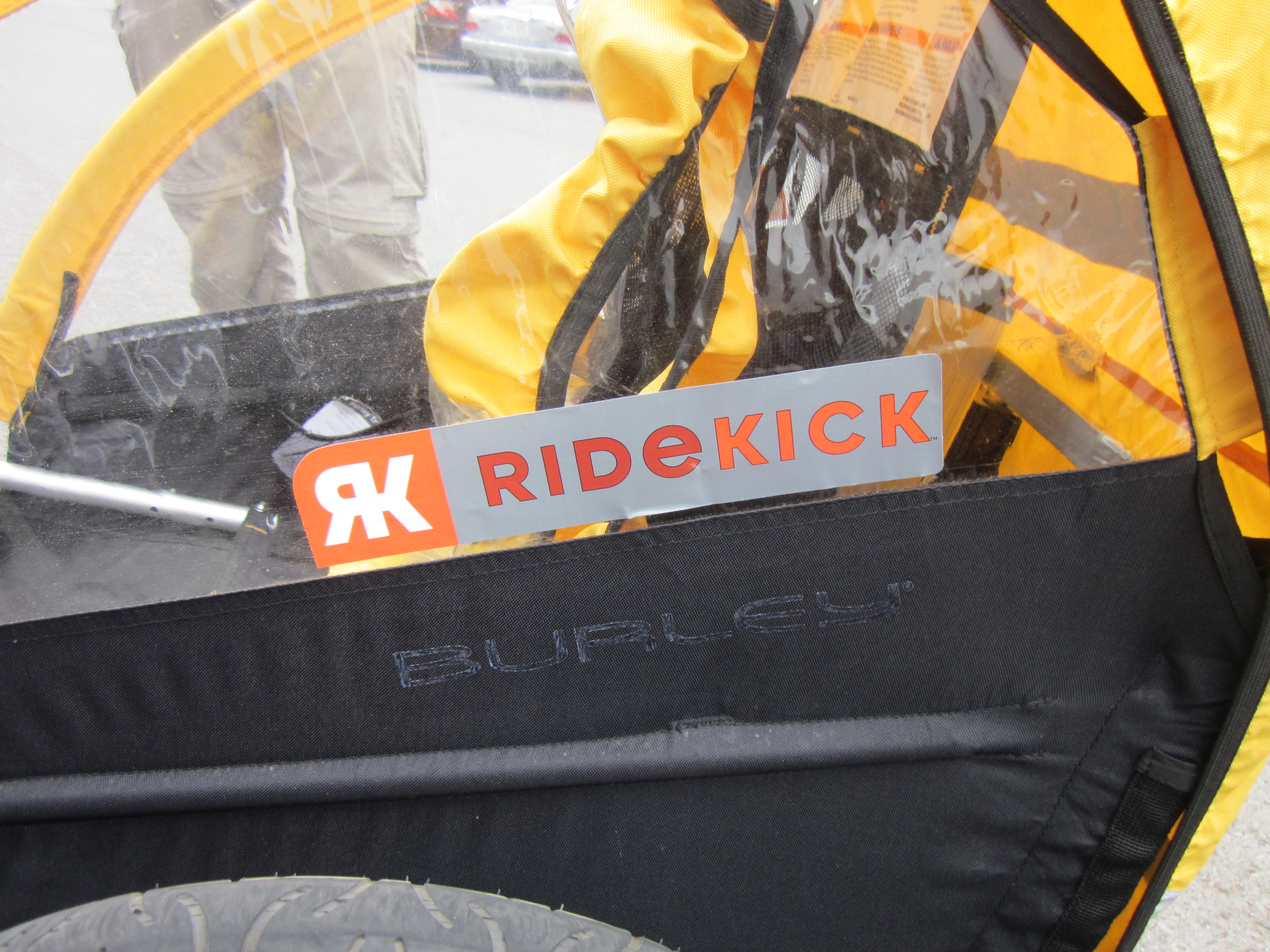
This is the cargo hold with the battery for the assist.
We met Dee and Mark from Ridekick in Golden Gate Park. They are great people. The prototype trailer that they brought is built up from the same Burley Bee model that we rented last year when we visited my mom in Bellingham. To my surprise, the assist doesn’t really intrude into the trailer’s cargo space. There’s a lithium ion battery with an on-off controller attached, about the size of a hardback book, that slides into the rear cargo compartment and that’s basically it. There is a throttle attachment that they Velcro-tied onto our handlebars, and then strung the wire for it back along the frame with more Velcro ties. It clipped into the wire coming from the motor at the rear wheel bolt, which is the same place that the trailer itself attaches. For novices like me: a Burley trailer attaches with a hitch plate that is threaded onto the same bolt that holds the rear wheel onto the bicycle frame. The trailer frame has a drop-in pin that goes through the hole in the hitch plate, with a back-up strap that loops around the bicycle frame in case it fails. Ridekick estimates that the trailer can go about 15 miles on a charge, depending very much on local conditions (how much weight and how big a hill?)
Technically both boys are too old for the trailer, but we never pay attention to stuff like that.
“Oh, if I must.”
My kids hadn’t ridden in a trailer for a year and were thrilled to get back in one. They also brought a friend. For our first test ride, we attached the assisted trailer to the Kona MinUte and then Matt took the two 7-year-olds for a spin through Golden Gate Park.
Something I may not have mentioned before is that Matt is less enamored of new bike experiences than I am. He mostly just treats all the experimentation I do like my weird hobby. He’s not big into optimizing his riding experience. The first bike he got was the Kona MinUte, and when it was stolen, he bought another one just like it. I got him a new pannier for Christmas one year when he complained that the ones that come standard on the MinUte were not office-appropriate (definitely true), but he has never used it. When we got the Bullitt he said for two months that we should have replaced the car instead, although he has since come around. So Matt was actually pretty grouchy about coming down to Golden Gate Park on a Saturday morning for “another bike thing.” He had had other plans.
It is in this context that I say that Matt loved the Ridekick child trailer from the moment he started riding with it. Generally neither of us is a big fan of throttle assists (the kind that go when you push the button, whether you are pedaling or not), but in the context of pulling well over a hundred pounds of weight behind the bike, the throttle assist is extremely appealing, especially at intersections. At steep intersections it is sometimes impossible for us to start a heavily loaded bicycle, even with the BionX, because the BionX doesn’t kick in until your speed exceeds 2 mph. Although Golden Gate Park is a little thin on steep hills—its grades top out at about 12%—Matt took it on a moderate hill, probably 10% grade, behind the Conservatory and had no trouble hauling both 7-year-olds up. When you’re riding with an assisted trailer, you don’t have to feel like you’re dragging an anvil.
It was a struggle to get him out of the trailer so his sister could have a turn.
When he came back I took our daughter for a solo turn around the park on the bike. Despite the fact that I was on the MinUte, which is a huge hassle to get on and off for me at the moment, I loved the Ridekick child trailer too. It resolves a lot of child trailer problems all at once. There’s no drag from the trailer unless you want to work harder. When you get tired, you can have it push you along for a little while. Taking breaks like this, interspersed with pedaling, got me up the same hill behind the Conservatory that Matt had ridden. That felt amazing! And it’s something that is currently completely out of reach for me on an unassisted bicycle.
There is probably a limit to the Ridekick’s capabilities. We have the advantage that we are using to riding up hills, and so we just need an extra boost now and again when we have extra weight on the bike. Even I, in my reduced state, tended to use the assist for a while, then pedal solo for a little bit, then repeat. My guess is that a weak rider could burn it out on the steepest hills, given that Matt has overheated the BionX on the steeper hills in our neighborhood occasionally. We’d have to ride with it a lot more to be sure. Then again, how many families really deal with hills like ours on a regular basis?
In the world of trailers, which tend to be useful but not that fun, the Ridekick assisted child trailer is a killer app, both useful AND fun. Normal trailers drag, and pulling them can be exhausting. As a result, even though most cargo bikes ride like tanks, cargo bikes are a lot easier. Still, in a situation where one parent drops off and another one picks up, you’d need two cargo bikes (which is exactly what we have now, but that’s a big commitment to start). But an assisted child trailer? Awesome! The assist means that riding is not a chore, it could be passed between parents’ bikes as needed, and it can keep the kids warm and dry, all for a (suggested) price of a single unassisted cargo bike. And as a rehab tool, it would be amazing.
If we could have, we would have bought it on the spot. But there is only one in the entire world. Our kids were crushed. “Can we keep it, please?” our daughter begged. “It goes fast! Can we keep it?” Alas, no.
Evidently Ridekick has gotten a fair bit of interest from parents who would like an aftermarket kit to assist their existing trailers. This doesn’t surprise me, but they still don’t even have the basic model in production. Ideally they could find a partner with an existing child trailer company (e.g. Burley, Chariot, Wike) and add the assist option to their standard product lineup. I’m sure there is sufficient demand.
This trailer is so much fun!
How cool is the Ridekick assisted child trailer? It’s so cool that if it had been on the market when we started riding with our kids, we might never have gotten cargo bikes. Even with my misgivings about the width of trailers versus bike lanes and having the kids behind me in city traffic instead of in front, having a trailer that could glide up hills, as well as being able to swap it between bikes, would be worth compromising in other areas. I have zero regrets about getting cargo bikes, especially given that the Ridekick child trailer isn’t actually available yet, but an assisted trailer would have been a much lower stakes way to ease into family biking, and it would travel well. I could be biased by the fact that this trailer allowed me to ride up hills that I couldn’t have otherwise attempted, but I loved the Ridekick.
Over winter break we noticed a lot more bicycles on the streets than there were at the same time last year. It’s now rare that I’m the only rider on the streets on my route, whatever route that might happen to be. Last week, riding from our son’s school to downtown, I was surrounded by so many other riders that in combination with being tailed by a bus, which blocked cars from potentially rear-ending any of us, I relaxed and started looking at other people’s bikes instead of focusing on traffic.
As is increasingly common, there was an assisted bike in the group, this one ridden by an older gentleman dressed up for work in the Financial District. He looked like the kind of person who wouldn’t be riding an unassisted bike. On most work days I look like that kind of person myself.
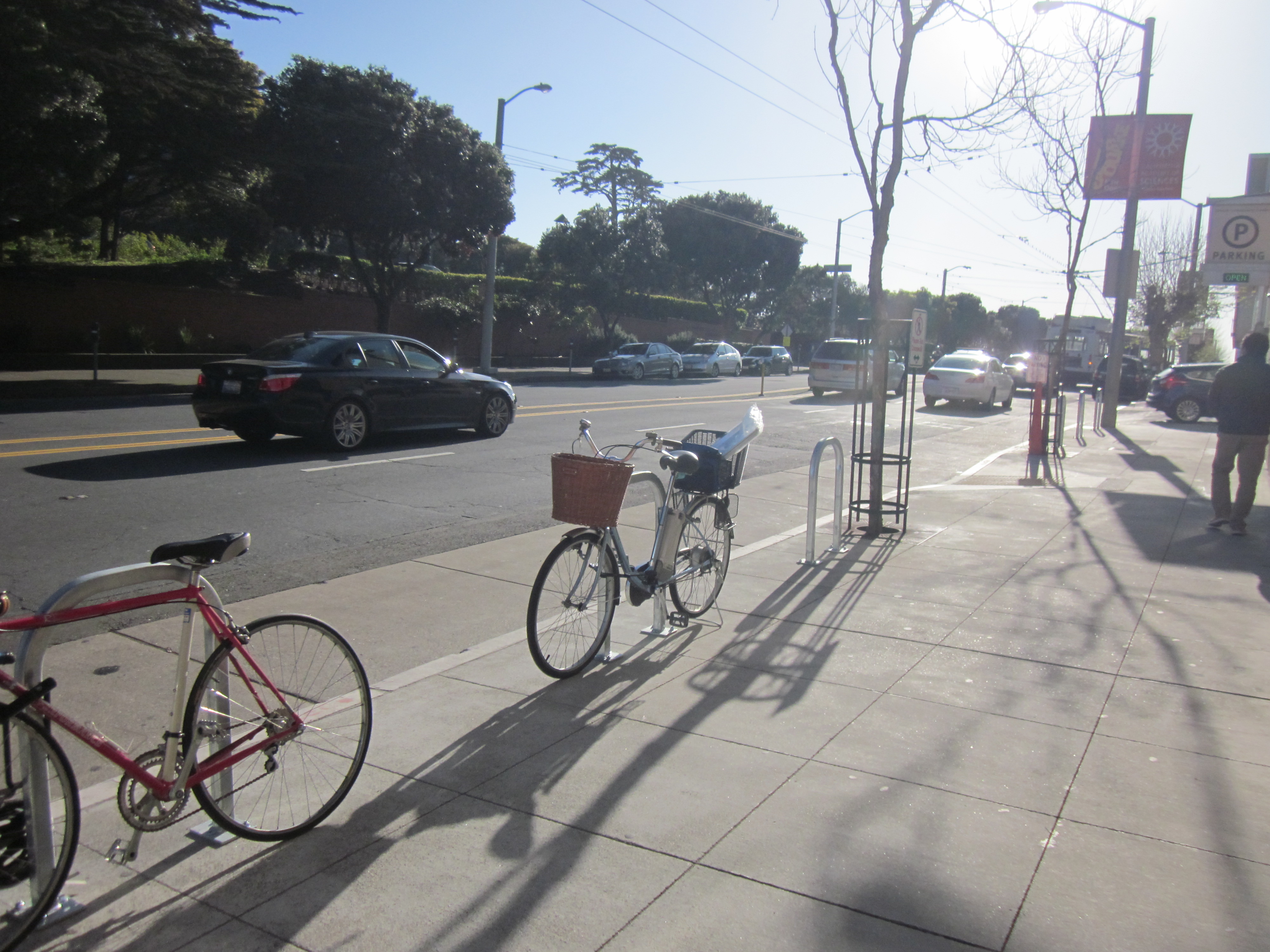
Spotted near work
It is no accident that I pretty much stopped taking transit entirely when an assisted bike (the mamachari) entered our lives. We live on the top of one big hill and I work on top of another, and before that particular craigslist score there was always calculation involved in riding to work: “Am I going to have to look presentable today?” (I don’t have the patience or free time to carry a spare set of dress clothes and shower at the office, assuming that my office even had a shower, which it does not.) With an assisted bike that problem disappears. I can choose to work harder on the way home at the risk of sweating, and I often do. But I can also choose to use enough assist that I arrive at work with no more evidence of having ridden a bike than rosy cheeks and the complete absence of commuter rage. “Wait, what? You came here on a bike?” is the kind of thing I hear a lot these days.
It’s coming up on a year of electric assist for us, and there’s no question it’s been life-changing. Example: we sold our only car (30 Days of Biking is no challenge whatsoever this year). To my surprise, because we’re about as fashionable as any other harried parents (which is to say: not at all) we appear to have been out in front on this issue. From what I’ve seen so far, 2013 is the year of the electric assist in San Francisco. Assisted bikes are everywhere; I spot them while riding around, while walking in our neighborhood, and there’s always at least one locked up nearby every time I stop to park my bike. Cargo bike riders who don’t have one typically say they want one, even if the need to carry a bike up a flight of stairs or the extra cost makes adding an assist unfeasible.
Look, there’s another one
I don’t ride much where it’s flat, but people who do seem to ride more with assisted bikes as well. The assist is like the cover on the Bullitt; in winter we could dress up our kids to ride without it, but it’s easier to get them out the door by skipping the cold weather gear and letting them cozy up under the cover. I could get myself out the door on an unassisted bike, and I have, but it’s a lot easier knowing that I can get a little help when the hills get steep or the wind gets fierce or when I’m tired at the end of the day. It’s also easier to take a bike knowing that I’m not going to walk into a meeting at work dripping with sweat. Unless I’m crossing the bay (and sometimes even then), it’s always easier to ride a bike now. And so that’s what we do.
Late last week I went to pick up my son at afterschool with some trepidation. The 5pm pickup is the most crowded at the bike racks, and this is often a nightmare. However thanks to the much-appreciated efforts of one of the afterschool staffers, we now have a passcode to enter a secured courtyard at the side of the building with its own bike rack. I have been parking there most days, even though it means a lot of extra walking around the building.
I was shocked when I rode up and saw a bona fide miracle: an empty bike rack in front of the building. I sped up before someone else could get there first. Then I looked again: there were five empty bike racks! They hadn’t been there when I walked by earlier in the day. And they were not placed against the bollards—bikes could be parked on both sides! Our son’s afterschool program had installed six new bike racks as promised. (And despite the fact that they’d been in place for only hours, they were already filling up—one family had gotten there before me and parked at the sixth rack already.)
Last year I successfully advocated to have a new bike rack installed at my office, which filled up immediately on installation. And now this year the internet has scored some outstanding cargo-bike friendly racks at our son’s afterschool program. They were filling up by the time I came back outside with my son. If you build them, they will come.
When I rode into work the other day I saw a man lock up his bike then look thoughtfully at the bike next to him. When I came closer, he said, “This bike here is unlocked, and there’s a lock on the ground. I’m wondering whether they forgot to lock up?”
This is a tough one: what do you do? The lock looked as though it had its key in it. Should we lock up the bike and then bring the key to security?
Evidently a standard U-lock isn’t enough to prevent bike theft in San Francisco.
Then we took a closer look. What we’d seen wasn’t actually a key but a piece of the lock, which had been neatly cut, probably by an angle grinder. It was one of the locks that secures only one end of the U, rather than both, so once cut it pulled right open. That was unnerving. The bike racks at my office are generally pretty safe, in part because there is a security guard patrolling the area on foot. But apparently not that safe.
We’ve long since upgraded our locks from a standard U-lock to a Abus lock that secures both ends, and that is made out of stronger metal so it’s harder to cut through (and that costs a fortune). Our bikes also have frame locks, and they’re Pitlocked, and they’re registered with the San Francisco police. And they’re listed on our renters insurance in the event that they get stolen anyway. But on some days I wonder whether I’m paranoid enough.
Sometimes The Onion says it best: there is a vocal contingent of people who claim that only privileged, able-bodied, middle class people ride bikes. I am usually dumbfounded when I hear this.
“We don’t need more bike lanes for trust-fund hipsters in San Francisco!” they fume. “Families can’t ride bikes! They need cars! We need to make it easier for families to drive in this city.”
When I tell them that I ride with my kids, as do many of the parents at our kids’ schools, they look aghast. “How can you risk your kids’ safety that way?” they say. “It’s not safe to ride a bike with kids in San Francisco.”
“I hope you’ll support more separated bike lanes, then,” I say. Then they stomp away.
This is an expensive bike, but it cost less than half of what we got when we sold our car.
I think it’s easy to confuse people who ride bikes with people who write about riding bikes. Am I privileged, able-bodied, and middle class? You betcha. But that’s basically what defines a blogger, not what defines a bike rider. If you look at blogs, everything from riding bikes to dumpster diving to gardening to worrying about money looks middle class. Talking about ourselves and our first-world problems is just what we privileged, able-bodied, middle class people do. It’s appalling, I know.
Who do I see riding bikes in San Francisco? I see families like ours, and road racers, and homeless guys carrying giant bags stuffed with aluminum cans on their shoulders, and men in suits going to work in the Financial District, and last week, a dad in a security guard uniform with his son balanced on a pillow over the top tube. I see the man with no legs passing me when I ride along the Panhandle, and the grandfather with his oxygen tank in his trike on the Embarcadero. I’m least likely to see other moms with kids, but we’re out there too.
I like that when I ride my bike I’m part of a community that isn’t defined by privilege. I work with surgeons who complain about how poor they are, even though a first year surgeon at my university earns (much) more than my husband and I do together. They’re comparing themselves to investment bankers at their kids’ private schools and they feel poor. But riding around the city I see how lucky we are.
These are some of the ways parents like us get to school (at Rosa Parks Elementary).
At our son’s school I was talking with a friend who just started riding her daughter to school last year. Like us, she sold her car when she bought a cargo bike. Unlike us, they are a one-income family, which is painfully difficult in San Francisco (except for investment bankers). “I’m so happy now,” she said. “We maxed out the credit card trying to maintain that car. For the last repair before we sold it, we had to pull money from the savings we’d managed to put away for our daughter. Now we’re paying off our debt and I finally see the light at the end of the tunnel.” Matt and I both work, and we’re not that close to the edge. We’re lucky! But there’s no question that getting rid of our car made it easier to live in San Francisco, where even surgeons feel poor. Owning cars is expensive, and especially so in San Francisco. It’s not something you can afford if you’re not privileged.
Bicycles aren’t just for the middle class, or even just for the able-bodied. However, for now at least, they are still just for people willing to look at the world a little differently, whether by choice or by necessity. We chose to ride bikes when we could drive, and being able to make that choice is what makes us privileged. But when we chose, we joined the legions of people who have no choice but to ride bikes or transit. When we ask for more support of alternative transportation, we’re asking to make their lives better too.
It sometimes strikes me as excessive that Matt and I have four bikes between us. Yet we are close enough in height that we can share, or perhaps we would have even more bikes. Matt rides the Kona MinUte to work, and I am the only one who rides the mamachari (it’s too girly for him). We both use the Bullitt to haul our kids around and for major shopping. And the Brompton, although it’s kind of slog getting it the hill where we live, is handy for multimodal trips (and it’s not actually necessary to ride it up the hill, not when there is an elevator, and buses).
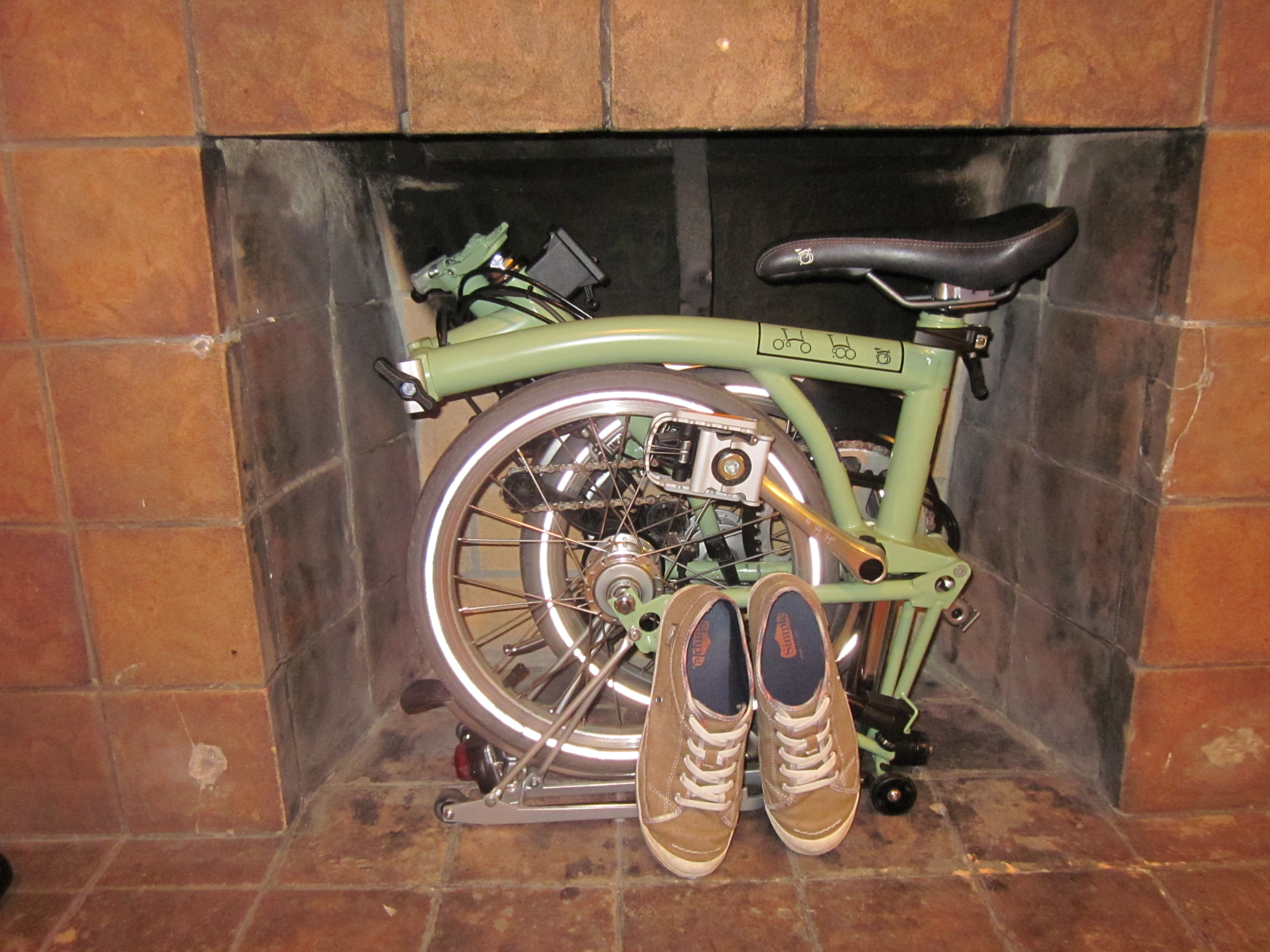
Home storage of the Brompton (with my sneakers for scale)
Although four bikes, even if one fits in our boarded up fireplace, feels like a lot, we do actually use them all. Admittedly, our kids also each have a bike, and then there is the trailer bike. But when I thought about it, it didn’t feel outrageous to have all these bikes because we actually used them all last weekend. And this weekend wasn’t that different from most weeks.
Yes, the MinUte is a real cargo bike.
Matt rides the Kona MinUte to work by preference, although he sometimes takes the Bullitt and has occasionally taken the Brompton. The MinUte is most useful for his commute because it can carry one kid and stuff like work supplies and groceries, but is roughly the size of a normal bike. The bike traffic on Market Street, which is his route downtown, can be pretty heavy, which makes a full-size cargo bike tough to maneuver, and there are often heavy winds, so although taking the Bullitt is nice for the kids, it isn’t the greatest without them. (Last week he had to take the wind cover off the Bullitt while he was downtown to keep it from blowing over once he dropped our son off—with weight in the bucket, wind isn’t an issue, and even if it were it would be worth it with kids aboard. But without them that cover is like a giant sail.) Matt also takes the MinUte to his martial arts class in the evenings, so he can pick up groceries on the way home. It’s not bad for dropping off library books on the weekend either.
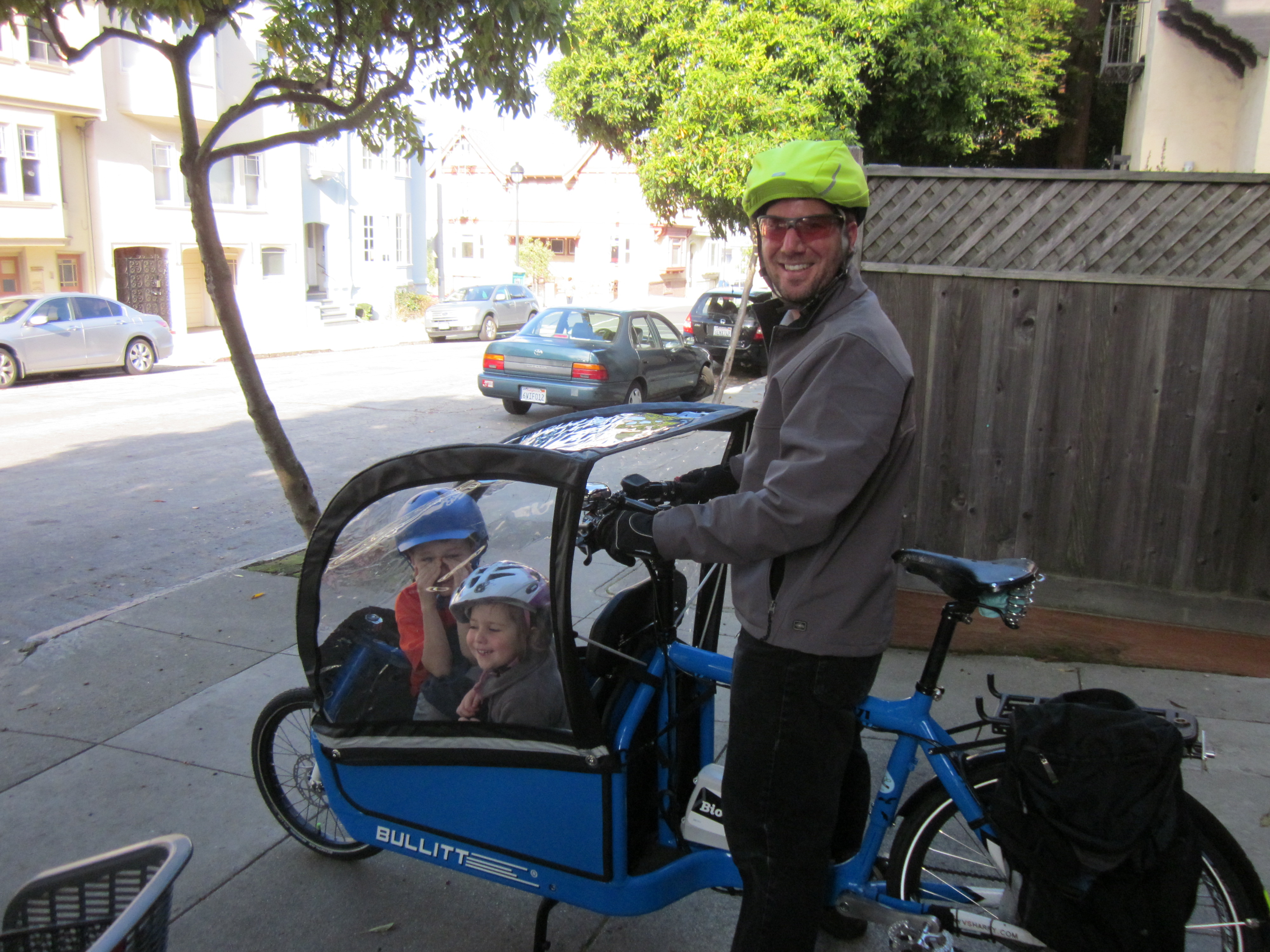
Loading up: three kids in the box of our Bullitt bicycle.
The Bullitt, ah the Bullitt. We take the Bullitt when we’re riding with the kids. At this time of year, they are positively obnoxious about the thought of riding on any other bike. They like the comfy seat and the weather cover and the fact that they can sit and read in the bike and talk to us. They like asking their friends to join them in the bucket. The wails that ensue when our daughter learns that our son got to ride the Bullitt to school are matched only by the wails that ensue when our son learns that our daughter got to ride the Bullitt to preschool. We also take the Bullitt for trips when we know we’ll be carrying heavy loads.
Half a dozen pizzas? Please.
On Saturday morning, while Matt and our daughter were taking a martial arts class, I loaded up our son and headed to Rainbow for groceries. Taking the Bullitt to Rainbow is fabulous because we can do all our shopping while cars are idling outside waiting for a spot to open up in the lot. Also I enjoy riding to Rainbow because their lovely, cargo-bike friendly racks have stickers on them saying, “Thank you for biking!” It was a lot of shopping and thus a little cramped in the bucket for our son on the way home, but we’ve yet to throw a load at the Bullitt that it can’t handle. However, like any cargo bike, the Bullitt can be a bear to park in San Francisco—parking is our number one topic of discussion with other cargo biking parents in San Francisco. I also worry about it being stolen in certain neighborhoods. And without the kids, it can be a lot of bike. Even so I’d probably ride it all the time if it weren’t for the parking issue.
Parking wasn’t a tight squeeze on this trip, but you never know.
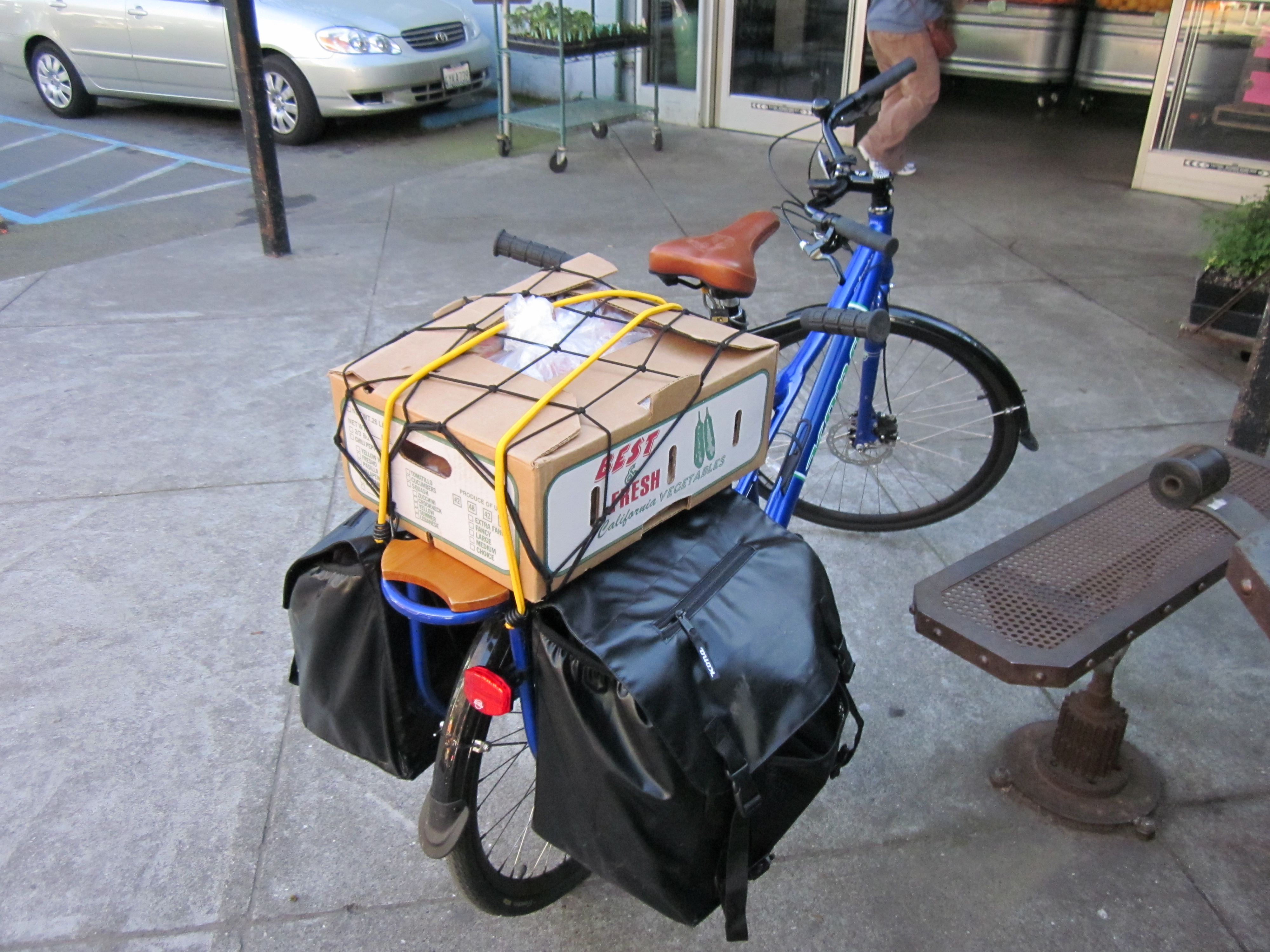
The mamachari is what I ride when I am going someplace where I’m worried about bike parking or bike theft, or when Matt has the Bullitt. It is slow but assisted and can carry either kid. I rode it to the Rosa Parks school auction on Saturday night because Matt rode the Bullitt, and also because the mamachari has a step through frame and I was wearing a dress. Then I took it to the farmers market on Sunday morning, because it’s a small enough bike that I can walk it right up to the stands, at which point I can dump whatever produce we buy directly into the baskets. As a result, our farmers market shopping takes about 15 minutes these days.
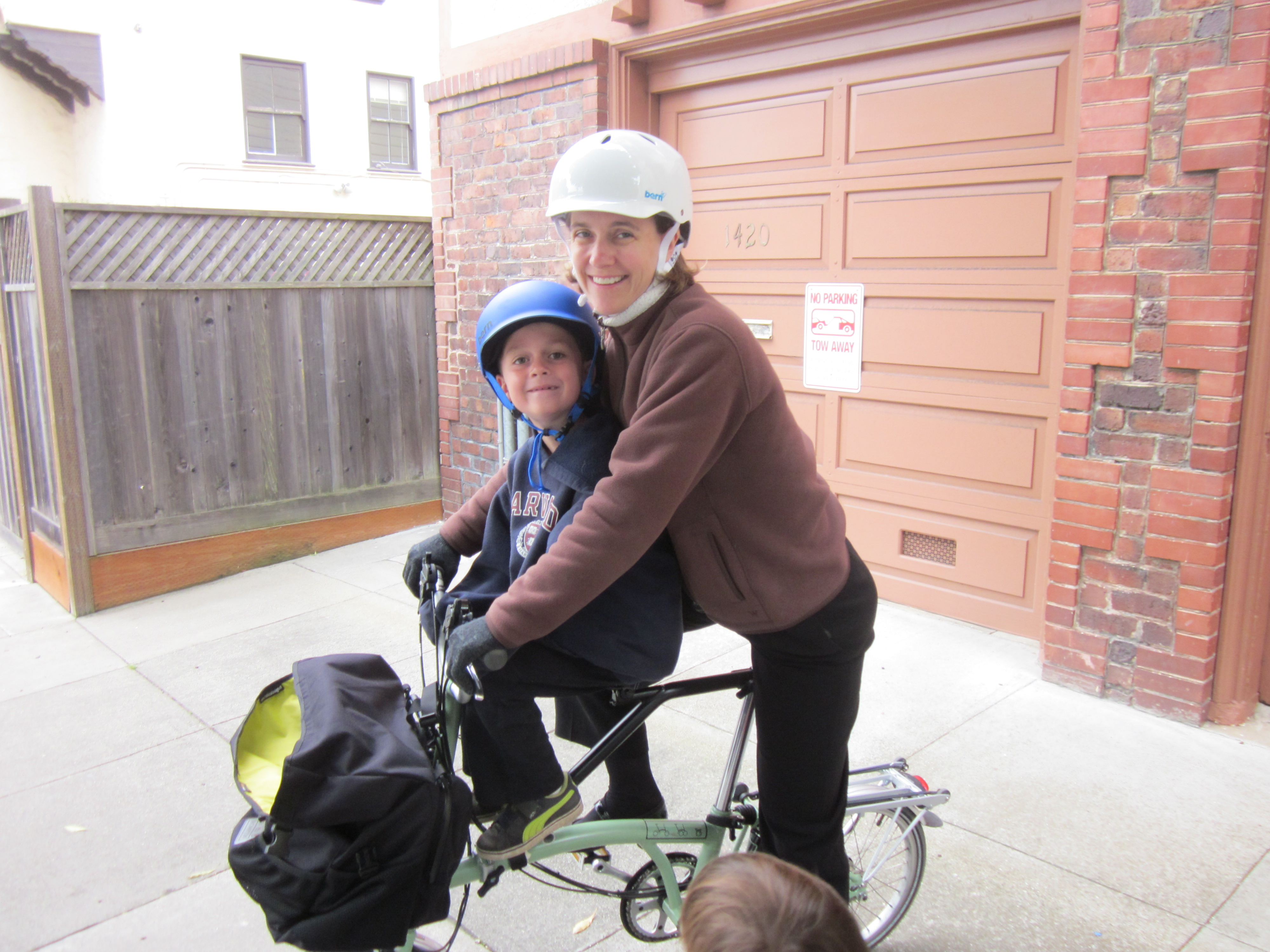
Our son is now well over four feet tall and he still fits on the Brompton.
I rode the Brompton down to Golden Gate Park on Sunday afternoon to meet a lovely family considering buying their own IT Chair (and not for the first time, either). I would ride the Brompton more if it weren’t for the big hill we live on, but I’ve taken it to the park many times because it’s easy to stash it in odd corners and because the kids love to ride it when the weather is nice. If they can’t be in the Bullitt, the other bike with a front seat is the bike they choose. Even at seven years old, our son still likes riding it. And for days that involve a bus ride or a train ride or meeting Matt somewhere after he’s taken a business trip that involved a rental car, there is no better choice than the Brompton. It is also our alternate farmers market bike, although the bag is not quite as great for produce as the mamachari’s double baskets.
Two adults and four bikes: we could certainly survive with fewer, but this turns out to be the right number to make our lives easy. It’s true that added together, our four very nice bikes cost almost as much as a cheap used car, but they cost almost nothing to own and maintain (we could have bought a fifth bike with what it cost to replace the tires on our old minivan). Plus it’s easier to get around the city on our bikes than it was with one car and transit. And given that we literally swapped our car for our bikes—plus a car share membership for trips out of town—we feel like we’ve come out ahead.
Truthfully, the mamachari works best as a “ride right up to the farmers market stands and dump produce in the baskets” bike. I’ve got a reputation.
Last week Matt left the Bullitt in his office for a few days when he was away on business, so I ended up taking my son to school on the mamachari. Our kids prefer to be in the Bullitt for every trip so this never makes him happy. (I could go either way depending on the day: the Bullitt is faster, has more range, and carries more, plus there’s less whining, but then again it’s harder to park.)
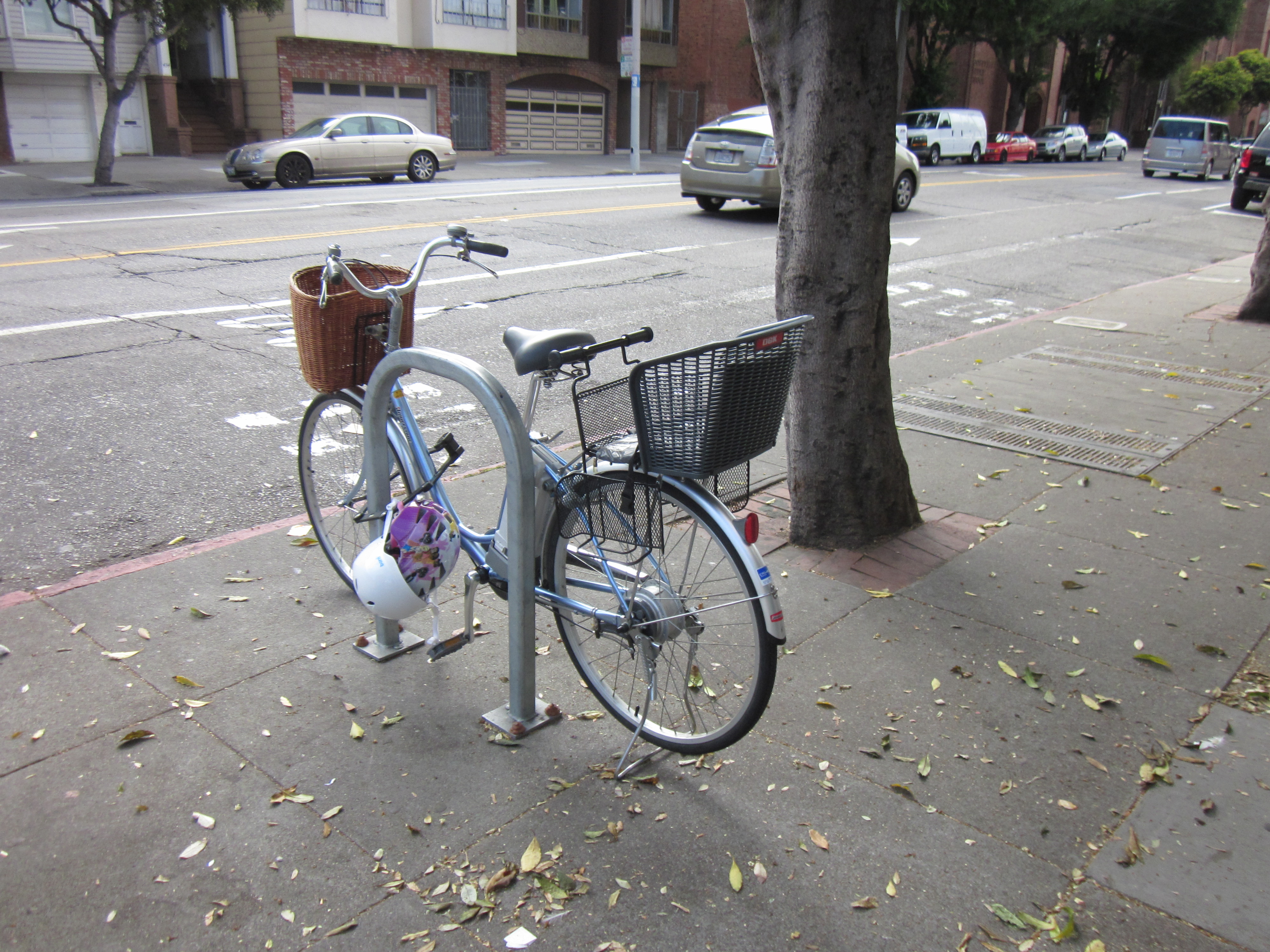
No question that as rear child seats go, this one rocks.
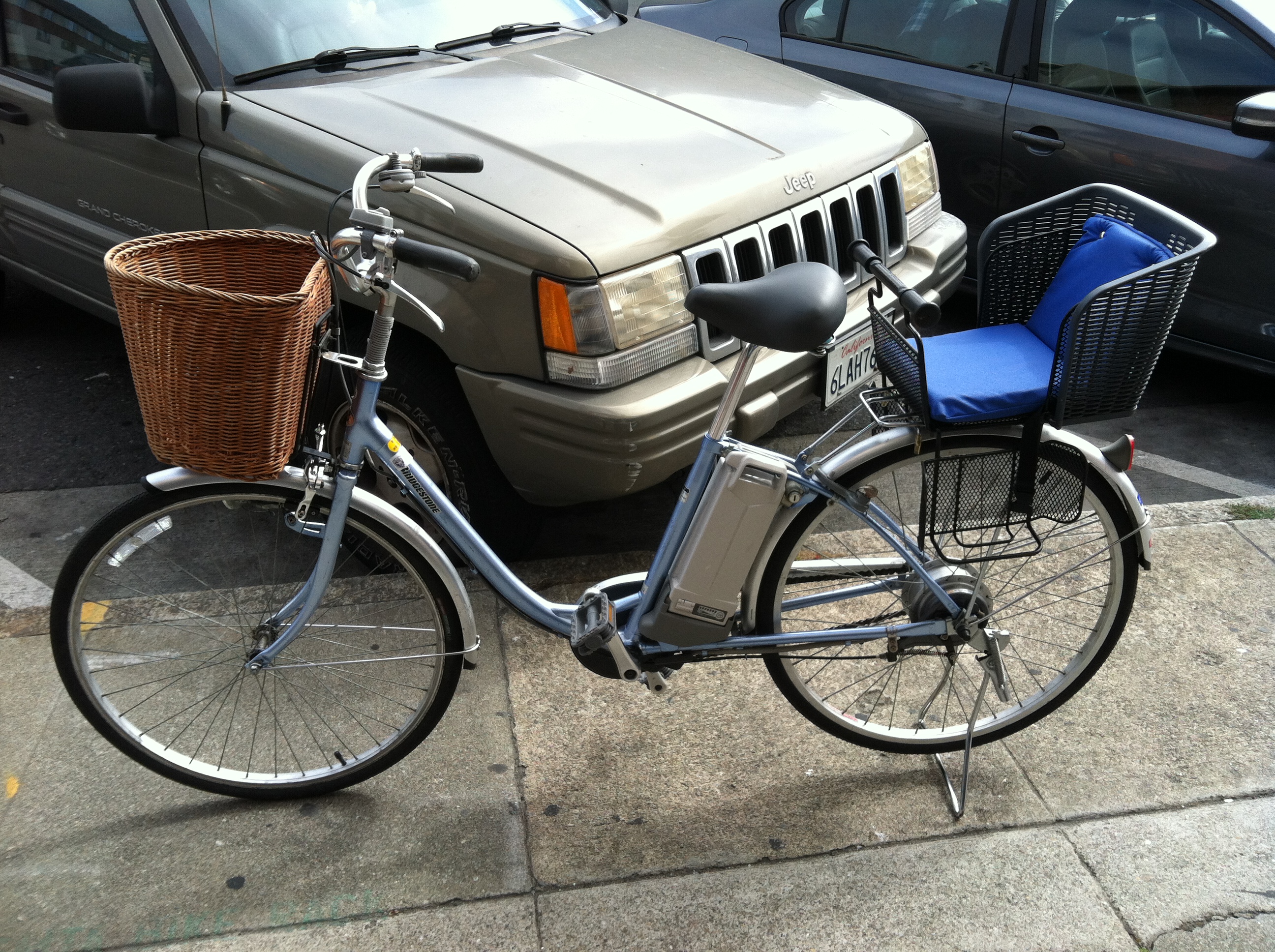
On the Bullitt I’m used to a lot of attention by now—sometimes it verges into dangerous attention, as passing cars will slow and veer over when they see us—but to most people the mamachari just looks like an old bike (although parents are always asking me about the child seat). But on Friday on the Panhandle, at Masonic, another rider stopped to ask me about it. “Just how old is that bike?” he wanted to know. “I haven’t seen a Bridgestone sold in decades.” I think the idea of a decades-old bike with an electric assist was throwing him off.
I told him it was probably ten years old, but it came from Japan where Bridgestone was still selling new bikes. But I was completely distracted because his bike had a large “One Less Fixie” sticker on it even though the bike itself looked like a fixie. It was weirding me out. It was only when he grabbed onto a sign at a stop and spun the pedals backward without actually moving that I realized it was a single-speed non-fixie. As he rode ahead (everyone rides faster than I do when I’m carrying my son on the mamachari) I thought: a single speed bike advertising against fixies; now that’s really, really obscure.














 Hum of the city