Category Archives: San Francisco

We tried it: BionX v. Stokemonkey

Test riding the stoked EdgeRunner in Seattle. Thanks to Davey Oil for the chance to ride, and Madi Carlson for the great photo!

Test riding the stoked EdgeRunner in Seattle. Thanks to Davey Oil for the chance to ride, and Madi Carlson for the great photo!

One of my colleagues recently taught me two great tricks. The first is to never use the word “but” when talking to people because it  always ticks them off. The second was that anything could be summed up in exactly six words. She writes six-word biographies for every graduating student in her program. It is amazing. Given that I am a chronic offender in the Too Long: Didn’t Read sweepstakes, I’ve decided to open all of my reviews with the six word summary. Here’s one now.

BionX: Easy to use

Stokemonkey: Powerful

I’m sure that the respective producers of BionX and Stokemonkey electric assists now wish that they could reach through the screen and punch me in the face. Good thing it’s a virtual world.

There are basically two heavy-hitters in the world of electric assists for cargo bikes. They are BionX, which is a rear-wheel assist (motor on the rear wheel hub), and Stokemonkey, which is a mid-drive assist (motor on the frame running through the chain). The Stokemonkey was out of production for a long time, and now it’s back. I had the chance to try both assists on the same bike, the Xtracycle EdgeRunner, while we were visiting Seattle over spring break, thanks to the lovely G&O Family Cyclery. G&O was the only shop I have ever seen that had both kinds of assists on the same model of bike, which I rode on the same hills on the same day, with both my kids on the back. It made for a near-perfect comparison. The kids ate a few crackers between the Stokemonkey ride and the BionX ride, but still.

I have already written about other brands and types of assists—there are front wheel assists, like on the original Yuba elMundo, and other companies make both rear wheel and mid-drive assists. I’m concentrating on BionX and Stokemonkey because most people shopping for an add-on family bike assist end up choosing between these two, for reasons that center around power and reliability. Both have good odds of hauling a loaded cargo bike around, and they have the reputation of being the least likely to die within a few months of purchase (or immediately after the warranty expires). People who know a lot about electric assists may end up finding or hacking something better. Nevertheless your average rider wants something that does not require the patience and ability to read through and comprehend the forums on Endless-sphere. (Note: when I refer to “pedal assist” here and everywhere else, I am using the EU legal definition, meaning an assisted bike that will only move if you are already pedaling. Although there are other definitions, this is the one that most people I speak with intuit when they hear the term pedal assist.)

BionX

We have a lot of familiarity with the BionX, because it’s the system on our Bullitt. It has served us well, although it is not perfect.

  • How much does a BionX cost? $1800 installed by The New Wheel in San Francisco (SF-suitable system with 48v battery)
  • How much does a BionX weigh? 14.1 pounds including battery

What I like about the BionX

  • The BionX is easy to use. This is a set-it-and-forget-it system combined with a throttle. You can get a boost across intersections by pushing the red button (the throttle), or set a level of assist from 1 to 4 and feel super-powered as you blaze through the city. The pedal assist is the best of any electric assist that I have tried, and I have tried a lot of them now. The BionX was the first assist that I ever tried, and in a way it spoiled me for other assists, because it is truly intuitive to use. There is no learning curve. Anyone who has ever ridden a bike can master it immediately. Many people end up leaving the bike in a relatively high gear and using the different assist levels as gears, and this actually works pretty well.
  • It is pretty powerful. BionX systems come in different flavors, and we got the most powerful, with a 48v battery. It works well in San Francisco on our daily rounds, which feature a number of serious hills (Twin Peaks, Alamo Square, Lone Mountain) and various unnamed elevation changes that would qualify as hills in a less topographically challenging city. Families in Seattle, which has less steep hills yet is nonetheless pretty hilly, seem content with the 36v battery system. The cheapest and least powerful systems are probably best for handling stiff winds in areas with mild hills.
  • It requires minimal maintenance. There are people who will argue this point. The consensus from the bike shops that we patronize is that they use their assists in a different way than we do. We rarely use the throttle; instead, we use the assist levels to maintain a steady speed and effort level. We do not burn through power trying to race other riders. We have the shop check the wiring every few months. With one major exception, which is that we initially had spokes on the rear wheel that were too thin, which broke by the dozen, the system has not given us grief. We replaced those spokes with much thicker ones and haven’t had issues since.
  • It is silent. Lots of assists make a humming noise, or much louder noises. The front wheel assists I have tried definitely sound like motors, and the EcoSpeed mid-drive frankly sounds like a motorcycle. One of the reasons we like riding bicycles is the relative quiet and the opportunity for conversations with our kids, and so the noise of some of these systems was a deal-killer for us. This is not an issue with the BionX. It is the ninja of electric assists.
  • It has regenerative braking. This means that you can use the BionX system to slow (or stop) the bike and recharge the battery while going downhill. It is debatable whether regenerative braking adds much to battery capacity—there is loss in any system. In an area like San Francisco, where steep hills abound, careful route planning can actually mean you get some power from the regenerative braking, although this may not apply outside the city. It is inarguable, however, that using the regenerative braking through the motor saves a lot of wear and tear on the bike’s brakes. And it offers me a lot of peace of mind, given that we have had brakes fail in the past. I view the BionX regenerative braking like skydivers view a backup parachute.

What I don’t like about the BionX

  • Starts can be slow and difficult. The system is set up to kick in once the bike reaches 2mph. If you are trying to start a loaded bike from a dead stop on a steep hill, you may have trouble getting to that speed. This is particularly the case if, like me, you have a bad leg. Outside of G&O, which is on a moderate hill, I could not get started with both kids on board. I had to walk to bike to a level area. This is evidently something that can be modified—you can reset the controller so that the assist kicks in at a much lower speed [update: as low as 0.5 kph]. Now that I know this, it is high on our to-do list. That modification would help a lot, yet it does not change the fact that no matter what, the initial effort on the start is going to be human-powered. This is our biggest issue with the BionX. It was less of a big deal before I was injured.
  • It gives up on really steep hills. There are hills in San Francisco that we cannot get up with a fully-loaded bike—the system overheats, which means it’s back to pure pedal-power at the worst possible time. For people outside of San Francisco, this may be no limitation whatsoever, because SF is the second-hilliest city in the world, also very windy, blah blah blah. This actually turned out not to be a huge deal for us. The system is powerful enough that it can handle most of our trips, and we prefer to take alternate routes for 18%+ grades whether we are riding assisted bikes or not. On the extremely rare occasions where there there is no alternative, there’s always transit or car-share.
  • The proprietary battery limits the range. Also it’s annoying. The BionX system is completely self-contained. It’s like Apple computers. You can’t get a battery any more powerful than the battery they supply. You can’t set up a backup battery to extend your range, except by carrying another battery and swapping it in, and their batteries are expensive. There is a big logo on it, which is irritating. However the main issue is that you have no way to control the range other than by picking one of their batteries: you get what you get. The range is not unreasonable, and it handles most of our needs, but there are times when we have to be sure to carry the charger and find a place to plug it in, or suck it up and accept that some of the trip home will be exclusively human-powered. Thankfully that is a much less painful prospect now that we no longer live on a steep hill.
  • The system can be finicky.  Matt has dropped two controllers and when you drop them, they break. In one case, the controller seemed to be fine but then the bike started jerking when the assist was on max, because it wasn’t really fine. Replacing the controller costs $100. Argh! The bike shop suggested that we super-glue the third controller in place. There is a certain amount of loose connection hassle with some of the controller parts—the wire to the regeneration system sometimes works loose, and so on. We have the wiring checked regularly and so we haven’t had those problems. I classify this in the same category as our constant brake checks. A certain amount of attention is required.

Stokemonkey

And then there is the Stokemonkey. I’ve ridden a stoked bike for exactly one day, so I can’t offer an opinion that is nearly as informed, and for obvious reasons I have no idea about maintenance.

  • How much does a Stokemonkey cost? $1250, not including the battery (varies) or installation ($125 at Clever Cycles in Portland)
  • How much does a Stokemonkey weigh? 21 pounds, not including the battery

What I like about the Stokemonkey

  • It is incredibly powerful. I would go so far as to say it is virtually unstoppable. The chain or the frame will break before the assist gives out. This is not always obvious when you are riding, because weirdly, it doesn’t feel like it is helping. However I know that the ease I was feeling while hauling 100 pounds of my children up a big hill was not natural, especially with a broken leg. If I hadn’t been sure while I was riding the stoked EdgeRunner,  it became obvious when I rode the BionX EdgeRunner, because it took a lot more effort to get up the same hill. Neither was particularly hard, but the Stokemonkey was definitely easier. I doubt there is any hill that would overpower it. Maybe a vertical wall.
  • Starting on a hill is easy. When you push the throttle, the pedals start moving and the bike starts moving. Even with warning, it was hard to be prepared for this. However I had no fear of stopping mid-hill on the Stokemonkey. It cranks right back up to full when you hit the throttle. Starts are my biggest weakness, and so this feature was, for me, the Stokemonkey’s greatest appeal. It destroys all fear of hills. No matter what the incline, it will always start.
  • It is compatible with multiple batteries. If BionX is the Apple of electric assist, Stokemonkey is the Windows environment. You can wire any battery into it, or, if you are like me, your bike shop can do it. That is a cost savings, and there is also a learning curve involved—I have no idea how to pick a battery. Any shop installing the Stokemonkey should have a good idea though.
  • It is pretty quiet. It is not totally silent like the BionX, and I don’t think that any mid-drive assist could be that quiet, because mid-drive motors run through the chain and there is some noise involved with that movement. I found it unobjectionable. There is one exception to the generally quiet nature of the Stokemonkey. If it is installed on a box bike it will be pretty loud, because the noise of the chain will echo through the box.

What I don’t like about the Stokemonkey

  • It is controlled by a throttle only. If you want the assist to kick in, you have to hold the throttle down. It did not take long for my thumb to get sore doing this. I might get used to it over time, but I doubt that I would ever stop finding it annoying.  There is not set-it-and-forget-it option with the Stokemonkey. I’ve ridden enough assisted bikes to know that this is not really workable for us. There are too many hills and too many places where we need to take our hands off the handlebars to signal.
  • It is not pedal assist, yet you must pedal. Truly, the Stokemonkey is neither fish nor fowl. When the assist comes on, the chain moves, and so the pedals also move. You have be right there ready to move your legs. Even with warning, I kept whacking my ankles on the pedals on starts because I wasn’t ready for this. On the flip side, when you release the throttle, the pedals keep moving for a little bit on their own, so again, whacked ankles. Personally I found this a small price to pay for instant starts on hills, but still: ouch. Word from people who have stoked bikes is that you get used to this and adjust relatively quickly. In the interim, wear thick socks.
  • The learning curve is not insignificant. Using a Stokemonkey was described to me as being a bit like driving a manual transmission car. Amusingly enough this analogy came by way of Davey Oil, who does not drive. Nonetheless it is pretty accurate.  The bike will start to shudder if the Stokemonkey thinks you are in the wrong gear, and then you have to shift down to make it settle. My son, sitting on the back of the bike, noticed this immediately, and he found it both fascinating and disconcerting. “You need to shift, mommy!” In combination with the pedals whacking me in the ankles, it required a lot more attentiveness to the assist while riding than I was expecting. This comes at the price of paying attention to other things, like traffic. With this system I would need to spend time getting comfortable on quiet streets without the kids on board before I would feel confident taking it out on a daily commute.
  • The Stokemonkey is only really suitable for certain bikes, mostly longtail bikes. [update: I was wrong, modifications to the original statement follow.] Stokemonkeys are not appropriate for early-model Bakfietsen with roller brakes, or presumably any bike with borderline brakes, because the bike can then get up hills that it can’t safely get down. The mounting of a Stokemonkey is evidently somewhat complicated. This seems to be the case for a lot of mid-drive assists.

The winner: everybody

That was our experience, and to my surprise, it did not feel like a definitive win for either the BionX or the Stokemonkey. I had assumed that when I tried the Stokemonkey I would feel like an idiot for getting the demonstrably less powerful BionX (not that we had a choice at the time) and that I would immediately want to swap out to a Stokemonkey. Although I was really impressed with the Stokemonkey, I didn’t feel like it was a BionX-killer. Moreover, I have no good sense of what I would want when we get a new bike, which for various reasons is on the horizon.

Both systems have strengths and weaknesses, and moreover, both systems can be tweaked/are currently being re-engineered. Grin is working on a pedal-assist, set-it-and-forget-it version of the Stokemonkey, suitable for EdgeRunners only, which [update] has just been released. This resolves my biggest issue with the Stokemonkey (and it means I could probably justify buying an EdgeRunner to myself). On the other hand, resetting the BionX controller to a lower start speed would probably resolve our issues with starts on hills, and San Francisco has a dedicated BionX shop that can handle any maintenance issues. In contrast, getting a Stokemonkey would be a long-distance operation for us. Moreover, BionX is releasing a higher-torque model suitable for super-steep SF hills this year. There isn’t an easy answer. On the other hand, there are no bad decisions to make here either.

In the meantime, I’m incredibly grateful to have had the chance to try both systems on the same bike (which is, incidentally, an awesome bike). Thanks G&O! Thanks Xtracycle!


21 Comments

Filed under bike shops, EdgeRunner, electric assist, family biking, reviews, San Francisco, Seattle

Punk’d

When we went to visit my mom for spring break, we brought our rain gear. It rains a lot in Seattle. Unfortunately I lost my rain pants while I was there. That was a bummer—they’re great rain pants—but not a short-term crisis. It rarely rains in San Francisco after February, and never after March. And this is a drought year anyway. I figured that if they didn’t show up by October or so, I’d have to buy new gear, because an El Nino year is on the way. And I had already promised myself that next rainy season, I’d try a Cleverhood, but it wasn’t exactly on the top of my to-do list.

I also assumed that California’s weather system had better things to do than punk me, like empty out the state’s reservoirs. I was wrong.

This morning we woke up to rain. Of course it is welcome, because of the drought, but I was vaguely annoyed about my missing rain pants. Rain in San Francisco is like hills in San Francisco: hard and intense, although it comes and goes. But how bad could it be? I thought, with the casual ignorance of someone who has not gone outside in suspicious weather without wearing full rain gear since 2011.

Really, really bad, it turns out. By the time we’d gone a few blocks, my pants were soaked. By the time we hit the Panhandle, they had dripped an inch of water into each of my rain boots. And because the boots are waterproof, all that water just stayed there. By the time we dropped off our son, I was shivering. When I finally got to work, I had to empty my boots into the kitchen sink.

There will be no pictures with this post. I look like I was fished from a pond, and I’m walking around the office barefoot. I am just grateful that typically only one other person works in the office on Fridays.

When people say there is no bad weather, only bad gear, they are basically right. Until today I’ve loved riding in the rain. Super-cautious drivers, empty streets, respect or actual awe from my coworkers: what’s not to like? Having good gear is like having the right bike. It makes everything easier. With the Bullitt’s rain cover, the kids have never had complaints about riding in the rain either.

But without it, misery is never far away. This morning as I was sloshing through the halls, I thought, “This sucks. Maybe we should buy a golf cart.” This is the route to madness! I should buy some new rain gear. Preferably before 5pm. If only Instacart delivered clothing.

3 Comments

Filed under commuting, San Francisco, Uncategorized

Who protects us from you?

We were hit at the intersection here, in front of the Conservatory of Flowers.

We were hit at the intersection here, in front of the Conservatory of Flowers.

Today is the one year anniversary of the Sunday that a driver hit us while we were riding in Golden Gate Park. Last Thursday, Matt took our son to court to get a settlement from the driver’s insurance company for his injuries. It wasn’t much money, roughly equivalent to the cost of the ambulance ride to San Francisco General. We pursued the claim on principle, because higher insurance rates are the only consequence that the driver, Michael O’Rourke, is ever likely to face.

Last August, a bike commuter was mowed down by a truck in SOMA. Afterward Sergeant Richard Ernst of the SFPD showed up at her street-side memorial to claim that according to the police report, her death was her own fault. How he could possibly have known that is a mystery, because SFPD also claimed that there was no video of the event. He did this after parking his car in the bike lane and demanding that the people at the memorial, including her family members, admit that her death was her own fault. If they didn’t, well, the cyclists who’d been forced by his parking in the bike lane into the kind of traffic that had just killed someone were just going to have to suffer.

His claim, however, turned out to be wrong. The San Francisco Bicycle Coalition canvassed local businesses, only to find that not only had SFPD not bothered to ask for video, but that a local business with a street camera had a video of the truck mowing her down. Then, belatedly and as far as I know without apology, SFPD decided that the truck driver was in fact at fault. Activism like this is why we have doubled our membership contribution to SFBC every year. I wish we could afford to give them millions.

I digress. As someone who was run over from behind by a driver in front of a stop sign, this news doesn’t particularly surprise me. Drivers run stop signs and threaten pedestrians and cyclists all the time. They don’t even feel guilty about it. The driver who hit us said, as every driver in his situation seems to, that he “never even saw us.” Even though a statement like that offers evidence that he should immediately have his license suspended—if you can’t see what’s on the road in front of you, then you’re not competent to drive—he viewed this as a completely reasonable justification for hitting people. And he viewed it that way because the police in San Francisco, and many other places as well, are looking to make excuses for drivers when they hurt people.

Before I was hit, I was not so cynical. I was raised to believe that the police were there to help people and protect the innocent. The collision changed me. When my son and I had our injuries assessed, the paramedics took off our helmets (and cut off the rest of my clothes as well). For the next half hour that we were in the ambulance as the police took the report, I was asked repeatedly whether we had been wearing helmets. “Were you sure you were wearing helmets? You’re not wearing helmets now. If you were really wearing helmets, where are they? Were you really wearing a helmet?” Then they asked my son whether we were really wearing helmets. My husband showed them our helmets.  “Were they wearing those helmets when they were hit?” The paramedics said we were wearing helmets, that they had taken off our helmets. “Did you see the helmets on them?” They asked the (many, many) witnesses, “Were they wearing helmets?” They said yes. “Are you sure?” As an aside, we did not have head injuries. Our heads never touched the ground. If only I had had a leg helmet!

In the meantime, they told Michael O’Rourke to go ahead and drive home. He was never charged.

It is pretty hard to excuse a driver for ramming into someone from behind. But even though the police finally decided that he was technically at fault for hitting us from behind in front of a stop sign while driving 15 miles per hour, they had to get their digs in. The police report says that I “moved left too soon” when I got out of the protected bike lane to make my left turn. However there is only one place to get over before making that left turn, because the protected bike lane is protected by parked cars. As I lack the ability to transmute my bicycle through two tons of metal, I moved left before I reached the row of parked cars directly in front of the stop sign. Not that it matters, as there is no such thing as taking the lane “too soon” under the California Vehicle Code. Nor should anyone be moving at 15 miles per hour a few feet from a stop sign, even if there weren’t two people on a bicycle in front or a half-dozen people in the crosswalk. Nonetheless, the police report says that I moved left “too soon.” That’s pretty much saying that they thought it was our fault we were hit.

At the beginning of this year, the San Francisco Board of Supervisors voted to pursue Vision Zero for San Francisco, a program to eliminate traffic deaths pioneered in Sweden in 1997. Versions of Vision Zero seek to limit speeds, redesign streets and change legal penalties so that driving causes less carnage. Although it’s been successful in other countries, I am somewhat pessimistic about this effort in San Francisco, given how little the SFMTA spends on infrastructure for safe streets, and how limited its ambitions are for the future. However San Francisco’s police culture would cripple safe streets no matter how much the SFMTA agreed to spend. As long as the people sworn to uphold the law choose to blame victims and excuse perpetrators instead of protecting the innocent, change is virtually impossible.

14 Comments

Filed under advocacy, injury, San Francisco

Hills v. hills: San Francisco and Seattle

Mugging for the camera at the airport

Mugging for the camera at the airport

Last week was our spring break, and the kids and I headed north to visit my mom while Matt flew to Australia for work. This kind of thing is why I make no pretense that our car-free, zero waste schtick is carbon neutral. That said most of our travel is for business, and I believe I speak for both of us when I say that a tax on business travel that would ensure we did far less of it would be pretty awesome.

Anyway, we took the Brompton, which in circus-mode can carry both me and the kids. Flying with the Brompton was an unrelieved nightmare, due to Allegiant Airlines. They are dead to me. Their motto should be: “We will terrify your children.”

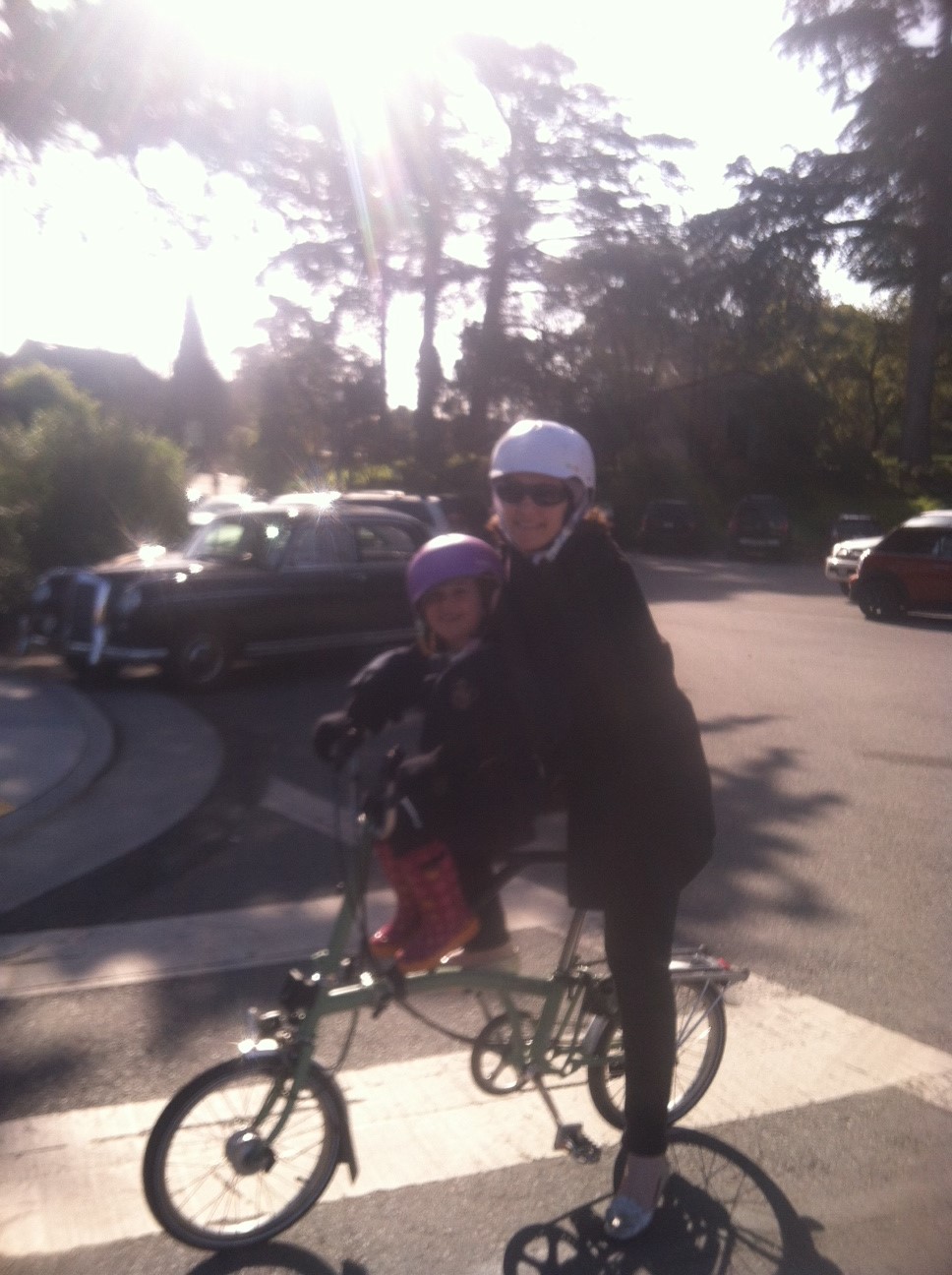
Madi demonstrates the two-kids-on-a-Brompton option.

Madi demonstrates the two-kids-on-a-Brompton option.

Nonetheless it was nice to have the bike once we got to Seattle. However I was surprised to find that despite the photos I have posted, even people who know family biking were impressed that it is possible to carry two kids on the Brompton. It’s fun, although not something I would do regularly on long rides. And I asked my son to run up the hills because I’m not the rider I used to be. And this brings me to: hills. Seattle is a hilly city, but hills in Seattle are different than hills in San Francisco.

A lot of San Francisco was built on landfill, which means that there are large chunks of the city (e.g. the Marina, the Financial District) that are perfectly flat. San Francisco doesn’t have a fixie culture because everyone is a masochist. It has a fixie culture because it’s possible to live without ever leaving the Mission. However once you want to go somewhere else, it gets tricky. The hills loom like walls, and although it’s possible to thread the needle sometimes using routes like the Wiggle, eventually people like us who go to work in offices (in Laurel Heights) and have kids in school (on the other side of Lone Mountain) have to start climbing. And San Francisco hills take no prisoners. Once we load 1-2 kids on deck, even with an assist we’re working hard. So riding in San Francisco is often: la-la-la-la-OMFG-OMFG-OMFG-wheeee!-la-la-la, etc.

Seattle is hilly in a more consistent way. In comparison to the totally-in-your-face hills of San Francisco, Seattle’s hills feel almost passive-aggressive. They meander up and down and up and down and up and down and up and down and up and down. I kept wondering where the steep hills were, because from my perspective there weren’t any. However the relentless low-key up and down is not the kind of terrain I’m used to riding and it wore me out (this has happened before—I got smoked by Madi from Family Ride on a deceptively mild-looking but seemingly endless hill in August 2012, while being fried by the equally foreign 80+F temperatures).

Bullitt-surfing is understandably more of a San Francisco thing.

Bullitt-surfing is understandably more of a San Francisco thing.

From the hill perspective, if riding in San Francisco is like occasionally ripping off a band-aid and screaming in agony, then riding in Seattle is like slowly peeling band-aids off by the dozen while feeling the adhesive tug on every single hair. Except that riding bikes is way more fun than that, of course. There’s nothing wrong with having to make an effort, it proves I’m alive and makes me stronger. I’m sure that if we lived in Seattle I would get used to Seattle hills and find them normal. Admittedly sweating on the way to work is a non-starter in my life, but this is why the universe has provided electric assists.

And speaking of assists, on this trip we stopped by the newly-opened G&O Family Cyclery, which had the Holy Grail of assist comparisons available for test rides: a Stokemonkeyed EdgeRunner and a BionX EdgeRunner. I love EdgeRunners (I-will-not-buy-another-bike-I-will-not-buy-another-bike-I-will-not-buy-another-bike) but had never tried an assisted version before. They are even better than the unassisted versions. We took the stoked and BionX EdgeRunners up and down the hills of Seattle, and if it wasn’t the same kind of challenge we face in San Francisco, it was still a fascinating experience.

My dissertation advisor had five mottos. One of them was, “Whenever you go away on a week of vacation, there’s always two weeks of work waiting for you when you come back.” Alas, this is painfully true, so coming soon: BionX v. Stokemonkey.

9 Comments

Filed under bike shops, Brompton, EdgeRunner, electric assist, San Francisco, Seattle

How we roll

Riding the Brompton with a kid never gets old

Riding the Brompton with a kid never gets old

We have had some crazy weekends lately—as mentioned, we recently dragged ourselves over to Berkeley, and next week I’m flying north with the kids to see my mom while Matt goes to Australia on business—but most of the time, we keep it local. Usually weekends mean riding around doing whatever it is we want to do. Sometimes we take Muni downtown instead of the bikes. But as we learned at Santacon, riding bikes means never having to worry about traffic or street closures. We wander into whatever event is happening and wander out. There is always an event of some kind in San Francisco.

Painting flowers for the garden

Painting flowers for the garden

If it weren’t for the times we rent cars, we would have forgotten entirely what it was like to get stuck in traffic or be unable to find parking. We never have to pull over on the bikes to let one of the kids throw up into the gutter. When we see something interesting we stop and check it out. When we run into friends on the way we ride with them for a while and chat. We spend bupkis on transportation. It’s difficult to overstate how much of a difference all of this has made in the quality of our lives. The only downside is that occasionally we get cold or wet, unless we want to rent a car instead. This seems like a more than fair exchange.

She learned how to mix in white paint to make light colors.

She learned how to mix in white paint to make light colors.

Last Saturday was a garden fundraiser at Rosa Parks, so we rode over with the kids to paint flowers for the fence. There are so many biking families at Rosa Parks now that we are, I’ve recently learned, sort of our own gravitational force. We attract a few more families away from their cars every year. For this event the organizers put the entrance next to garden courtyard, expecting that there wouldn’t be space for all the bikes otherwise. That assumption was correct. The school finally got that extra bike corral rack in front of the building, in red because the district had run out of blue racks. It fills up too.

They're finally getting over the daylight savings switch, but they still get tired sometimes.

They’re finally getting over the daylight savings switch, but they still get tired sometimes.

On Sunday we wandered down to the farmers’ market and then down the street for brunch. Matt and our son rode out afterward to pop popcorn for a school fundraiser, then to the library and the grocery store (we won’t run out of milk THIS week). I made nettle pizza with our daughter for dinner and then the kids and I made tortillas. Movies were watched and books were read. Everyone got a nap at one point. It was the kind of weekend I had imagined when we first thought about having kids. They come more often now.

We sold our car almost two years ago. It’s hard to believe it’s been that long.


2 Comments

Filed under Brompton, car-free, family biking, San Francisco, traffic

Game changer

It's more powerful than it appears.

It’s more powerful than it appears.

When we sold our car, I switched from a dumb phone to a smartphone. I wanted to be able to check bus schedules and arrange rental cars or rides easily, and for those purposes, the smartphone has performed admirably. I’ve also become one of those people who texts my husband from the bedroom while he’s in the kitchen. This is arguably less admirable, although I prefer to think of it as modeling a way to communicate without yelling. Goodness knows that message hasn’t taken yet with our kids.

Although I try not to make my attachment to the phone a 24/7 thing—I put it away at least one weekend day and am obligated to turn it off for almost all work meetings—I am more engaged with my phone than with any other device I’ve ever owned. I’m not unique in this. And in many cases this is a clear win for humanity: since the advent of camera phones, for example, reports of UFO sightings have pretty much disappeared, and that’s a mercy. Nevertheless, it’s been hard not to notice the increasingly vehement urging that people should put their phones down. In some cases this makes sense to me: I embarrass myself when I am checking the phone as my kids are talking to me. Bad parent!

I’m far less impressed with recent arguments that people should put their phones down while walking. If you don’t pay attention to traffic, the argument goes, you’ll be run over. The San Francisco police department had a whole campaign along these lines, and I found it offensive. Trust me, you can be run over while paying plenty of attention to traffic. I speak from experience. More to the point, though, no one should ever be run over in a crosswalk. Only reckless drivers pay so little attention that they run people over, and they can manage that whether you’re paying attention to the road, paying attention to your phone, or you’re a little kid crossing the street with the light while holding your dad’s hand. Pedestrians don’t kill themselves. Drivers kill them.

I am, in contrast to SFPD, a huge fan of people using their phones while walking. And the reason why became very clear recently while I was walking with my kids down Fillmore. A driver making a left turn slammed into a motorcycle, toppling it over and knocking its rider into the street. A dozen people with their phones in their hands began taking pictures the second it happened, and kept taking pictures and videos as the motorcycle rider staggered up and the car started to drive away. I didn’t have my phone out and so I watched the driver, who looked back at the motorcycle lying in the road, started to accelerate the heck out of there, and then noticed two people in the crosswalk filming his car and zooming in on his license plate. At that point, he decided to pull over after all. People walking with their phones out prevented a collision from becoming a hit-and-run that evening.

Something very similar happened when we were hit last year. Golden Gate Park is full of walkers, and they had their phones out, taking pictures, when they saw what had happened. There was also a sheriff’s deputy in the crosswalk who ran over to us yelling, “I’m a sheriff’s deputy!” so it’s hard to say whether the driver who ran us down was ever tempted to hit-and-run. However if he had been, we would have had recourse, because of all those people who ignored the advice to put their phones down.

When I see people walking and using their phones now, I am grateful. I feel that way even if they’re distracted and they sometimes walk into me. Bumping into me is annoying, true, but nothing that I don’t get already from my kids. More importantly, though, it’s a price I’m happy to pay because I know that the more phones that are out, the safer I am walking and riding on the streets. My smartphone is useful and fun and it makes my life easier. But it’s a game changer because it keeps people from getting away with murder.

3 Comments

Filed under advocacy, San Francisco, traffic

Even yet more San Francisco family bikes

It’s been a while since I posted about some of the bikes we see around town, which is misleading because I see more family bikes every day. Red Bullitts are so thick on the ground that I think they might have their own gang. Who knew that going with a blue Bullitt would be so passé? And I’m still trying to get a picture of the CETMA I see near our son’s school sometimes, but the dad riding that bike is just too fast for me. In the meantime, there are others.

This Surly has the motor on the front wheel, along with the clever wheel lock.

This Surly has the motor on the front wheel, along with the clever wheel lock.

The most common family bike we see is an assisted longtail, like this one. The EdgeRunner made a big splash in SF, but there are also a lot of pre-EdgeRunner Xtracycle options running around the city. I liked this assisted Surly because I thought the front wheel lock was a clever addition. The family riding this bike parked it outside the Jewish Community Center while we were there for an event with only the wheel lock, so they didn’t need a rack. I thought that was tempting fate when I first looked at it, but realized that without the need for a rack, they could park right in front, in full view of the security guard standing at the door. The bike was still there after our 3-hour event, and I saw it parked there again a week later, so it was evidently safe enough.

Bakfiets short from My Dutch Bike, which I am discouraging my daughter from climbing into when this photo was taken

Bakfiets short from My Dutch Bike, which I am discouraging my daughter from climbing into when this photo was taken

This Bakfiets short belongs to our neighbor up the hill, and is well-known in the city because the owner works for the San Francisco Bicycle Coalition, which is a totally awesome organization to which we donate an increasing amount of money every year. I am grateful for their tireless efforts to create world-class bicycle infrastructure here, and that infrastructure is a big part of the reason that I get the opportunity to photograph many awesome family bikes. Thank you, SFBC! I tell all my friends to join! The Stokemonkey (now back in production!) is a recent addition, which made it possible to ride up the hills around here with kids on board. I was surprised that she reported that it is kind of noisy, given that I had heard it was silent. But if it kills the hills, it’s probably worth it.

Cannondale tandem hanging out at work

Cannondale tandem hanging out at work

This Cannondale tandem appeared recently at the bike rack at my office. It’s been there every morning for the last few days at least. It looks like it might be set up for two adults, or maybe an older kid. I’m surprised it has so little carrying capacity—just one rack for two people? But maybe as kids get older you end up hauling less crap around as parents. That would be something, wouldn’t it? I like big bikes (and I cannot lie) but the prospect of being able to ride a lighter bike one day… I admit, this has some appeal.

6 Comments

Filed under advocacy, Bullitt, family biking, San Francisco, Xtracycle

San Francisco problems: bike racks

It seems tasteless to complain about the limits of San Francisco’s bike racks, a real bicycle first-world problem. Many cities are still trying to increase the number of riders on the streets, and here I am frustrated with the fact that I’m finding it increasingly difficult to find a place to park my bike. Part of the reason it’s irritating, though, is that it’s such an easy problem to fix. Bike racks are cheap, there’s plenty of room for them, and the city will install them on request (at no cost to the requestor), but you can end up waiting a long time. Demand is high.

Preschool parking at the street cleaning sign.

Preschool parking at the street cleaning sign.

Last year my problem was my son’s afterschool program, which is no longer a problem because they installed a bunch of new bike racks. This year I’m still waiting for the request placed at my daughter’s preschool to make its way to the top of the list. In the meantime, we juggle with other families on bikes to lock up to the street cleaning sign. Unfortunately one (non-biking) family has a really aggressive dog that they like to tie up to the same sign (because he’s too aggressive to be around kids at the preschool itself), and although I’ve asked them politely if they could tie him to a tree instead and they said okay, they sometimes forget. The dog will attack me and my bike, and my kids understandably run away screaming when they see him, which means I’m stuck waiting for that family to leave if they arrive first.

Every morning is a cargo bike roll call at Rosa Parks.

Every morning is a cargo bike roll call at Rosa Parks.

Our son’s school has lots of racks, but there are no longer enough to meet demand. The school district has found another large bike rack for us and is working on scheduling its installation, but it’s not there yet, so the school bike racks remain pretty packed. There are street cleaning bus zone signs we can lock to if necessary, but it will be nice to have another real rack.

Around our neighborhood and my office, there’s a different problem: non-bike competition.

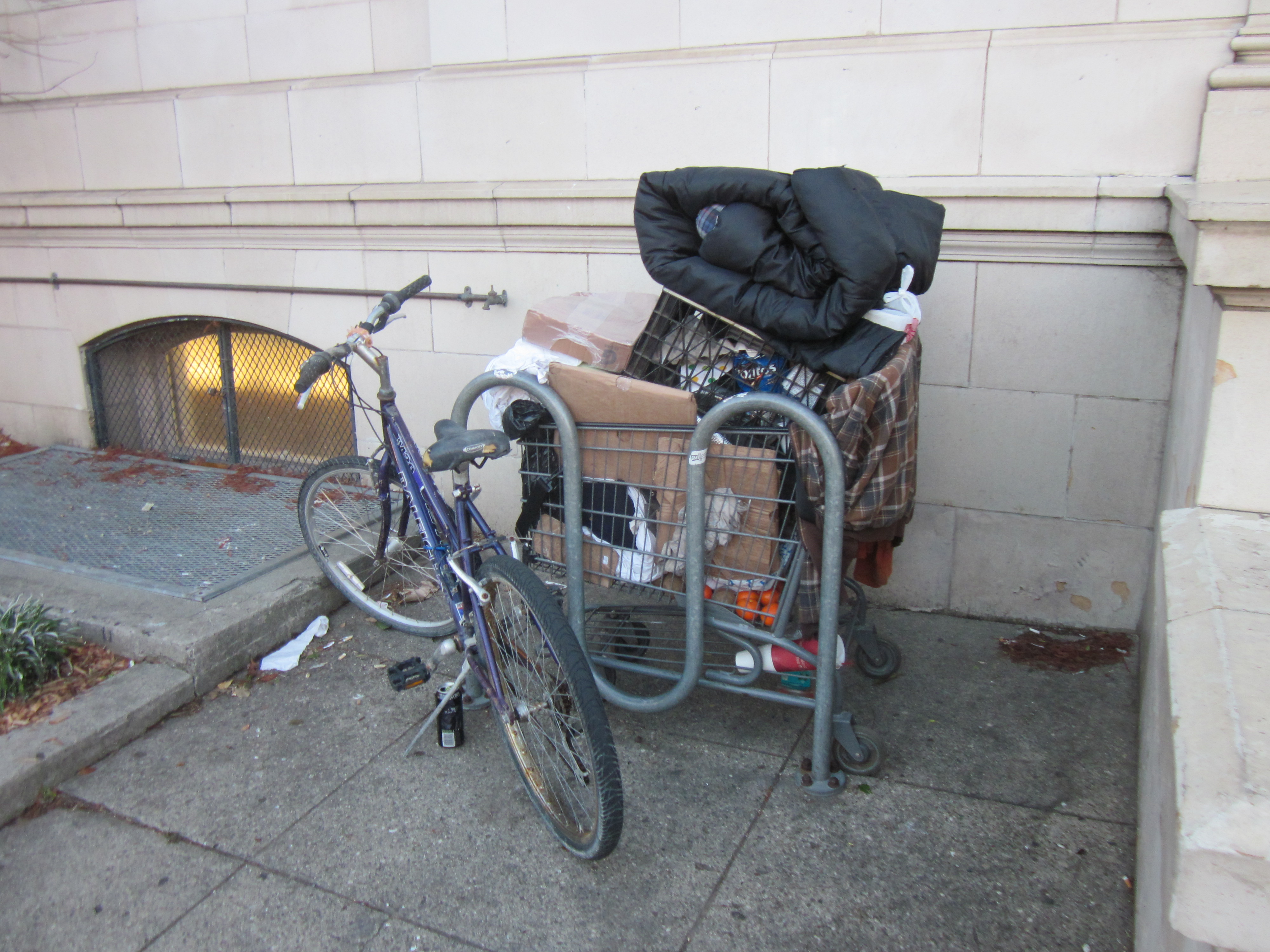
A bike rack can't hold much more than one shopping cart.

A bike rack can’t hold much more than one shopping cart.

We live on Parnassus Heights and thus we are well above what’s referred to locally as “the shopping cart line,” but most of our local haunts are in the flats. The library, for example, has a pretty small bike rack anyway, and it’s often occupied by a stolen shopping cart filled with someone’s worldly goods. There is increasing evidence that homelessness is a problem that can be resolved pretty cheaply by giving homeless people places to live (relative to paying for the health care and jail costs of having people live on the streets). But in a city like San Francisco, which is reluctant build new housing even for billionaires, it does not surprise me that subsidized housing is scarce.

At work the bike racks are often occupied by motorcycles and scooters, despite multiple signs saying that this is not allowed, which also direct their riders to the designated motorcycle parking area. There’s usually room for bikes as well, but the motorcycle riders always take the spot closest to the door, and motorcycles are so big that walking around them means walking into a driving lane, and they smell awful, and it’s all just annoying.

Everyone, it seems, is beginning to discover what we’ve discovered: riding a bike is the easiest way to guarantee VIP parking wherever you go.  Even when I have to lock to a parking meter or a stop sign, it only takes one attempt to drive in the city again to make me realize how good we have it still.

3 Comments

Filed under commuting, family biking, San Francisco

Mixed messages

Nearly every day on the bike I’m confronted with a mixed message. Most often, it’s the sign on a sidewalk curb cut that says “NO BICYCLES.” This wouldn’t be a problem if it weren’t for the fact that bicycle RACKS are placed on sidewalks, typically a good distance away from the only access, which is that same curb cut. The signs don’t say “no bicycle riding on the sidewalk, not even to get to the bike rack” although that would be annoying enough. Nobody is ever forced to get out of their car and push it on foot to a parking place. The signs say “NO BICYCLES.” That means that there is often no legal way to lock a bicycle on a bicycle rack. (There may also be signs insisting that I not lock my bicycle to anything that I could reach from an area where bicycles are legally allowed.)

So I break the rules. If there aren’t people walking in the area, I ride right over that “NO BICYCLES” sign to the nearest rack to lock up. If there are people walking in the area, I usually get off and walk the bike to the rack. But in both cases I’m doing something I’ve been told I shouldn’t do.

There is no real space for bicycles, so when I’m riding my bike I’m constantly confronted with rules that contradict each other. As a result, at least once a day I have to make a decision about which rule I’m going to have to break so that I can follow a different rule.

When people complain that bicycle riders are “scofflaws” I think: how could riders be anything else? In San Francisco, I am legally forbidden from riding on the sidewalk, even though the sidewalk is the only place I can find a bicycle rack (or a meter). That’s before you even consider the road rules that drivers routinely ignore. In California, cars making a right turn across a bicycle lane are supposed to pull into the right lane near the corner, where the bike lane has dashed lines, before making a turn. If they are, as a result, stuck behind a bicycle that has reached the intersection first and is going straight: so be it. It is like being stuck behind a car going straight when you want to turn right. You have to wait for the car in front to go. When I’m on a bicycle, drivers assume that they can pull in front of me from the left lane and make a right turn on red, or block me from going straight on green, just because they’re in a car. It happens every single day. Some days I have had two cars make right turns on a red light in front of me at the same time, one from the right side (using an open parking spot) and one from the left side (using the car lane). Apparently bicycles don’t count as vehicles. Often drivers will start honking if there isn’t enough room for them to make a right turn on red light in front of me. I’m never sure what they want me to do, exactly. Maybe they want me to ride on the sidewalk. As a result, every day I have to worry that I’m going to be right-hooked at a dead stop.

The same drivers that I see doing these things, or rolling through stop signs without slowing, or stopping at red lights and checking for cross traffic and then cheerfully running right through them, insist that all bicycle riders should follow the rules of the road to the letter. Which rules? Should I risk being run over (again) by an angry driver to follow the rules of the road, or should I risk being run over (again) by an angry driver who’s insisting that I break the rules of the road? Decisions, decisions. PS: way to set a good example, guys.

When bicycle riders ask for separated infrastructure, they’re not asking for special privileges, they’re asking for clarification. For now it is simply impossible to do the “right” thing as a bicycle rider in the United States. That would be easy to change, and we’d all be a lot safer—everyone, whether traveling on foot, on a bike, or in a car or bus or train—if it did change.

7 Comments

Filed under advocacy, commuting, San Francisco

It’s the most wonderful time of the year

2013: not my favorite year. Some jerk ran me over with a car. It ruined most of 2013 for us, but with my full recovery estimated for (most likely) 2015, it’s kind of a gift that keeps on giving. But 2013 decided to slam the door on the way out, too. Over the winter break, I got conjunctivitis in both eyes. Between the infection gluing my eyes shut and the antibiotic ointment fuzzing over what was left of my vision, I couldn’t ride much (or read much, or walk much).

Rest in peace, buddy.

Rest in peace, buddy.

We did go out on Christmas Eve for Chinese food, which was fun (if kind of blurry for me, I rode slowly) until we came home and found that our elderly cat had had a stroke and was immobilized by the front door. Of course our vet closed for the holidays, so we ultimately bundled his poor trembling, incontinent body up in a blanket in front of a heating grate for the next 36 hours or so. On Boxing Day he was still unable to eat or walk so we euthanized him. (“Merry Christmas, kids! We killed your cat.”) I realized as we watched him go that it was the first time I had seen him relax in as long as I could remember. It was the right decision, but crappy timing.

Then when we went to Japantown for mochi making a few days later, the Bullitt’s saddle was stolen. Matt had adjusted the seat and forgotten to put the Pitlock back in place, so it was just a matter of time. That sucked. Then on New Year’s Eve at around noon, the water was shut off, thankfully temporarily. I opened a bottle of wine to welcome 2014, which at that point could not come soon enough.

Let's be friends, 2014.

Let’s be friends, 2014.

So far 2014 has been a relief. Unless you count my son falling over on his bike going up a hill on New Year’s Day—which I don’t, because he’s fine—nothing bad has happened yet. My vision is back to normal, the weather is unseasonably warm, and we are riding every day. Our son is riding his own bike more, and our daughter is mastering the idea of pushing the pedals forward on the trailer-bike.

This promises to be a busy month. One of my dissertation advisor’s rules was: whenever you go away for a week of vacation, there’s always two weeks of work waiting when you get back. Alas, so true.  But I appreciate the return to a familiar routine. I try not to take life for granted too much, and most days, it’s nice just to be able to ride again. Here’s to a lot more of that in the new year.

5 Comments

Filed under family biking, San Francisco