Tag Archives: family biking

You cannot run faster than a Bullitt

This weekend, the Bullitt arrived. We immediately took it out for an 11 mile ride with the kids. Here’s what I’ve learned.

  • After two months without riding a Bullitt I was nervous about my ability to pick it up again. I got the trick of steering it back in about 20 feet.
  • Even with the BionX, San Francisco hills are much steeper than Portland hills. Going up to Bernal Heights I did use the highest level of assist, and I would have been delighted if it went “to 11.”
  • Thank goodness we got the lightest cargo bike.
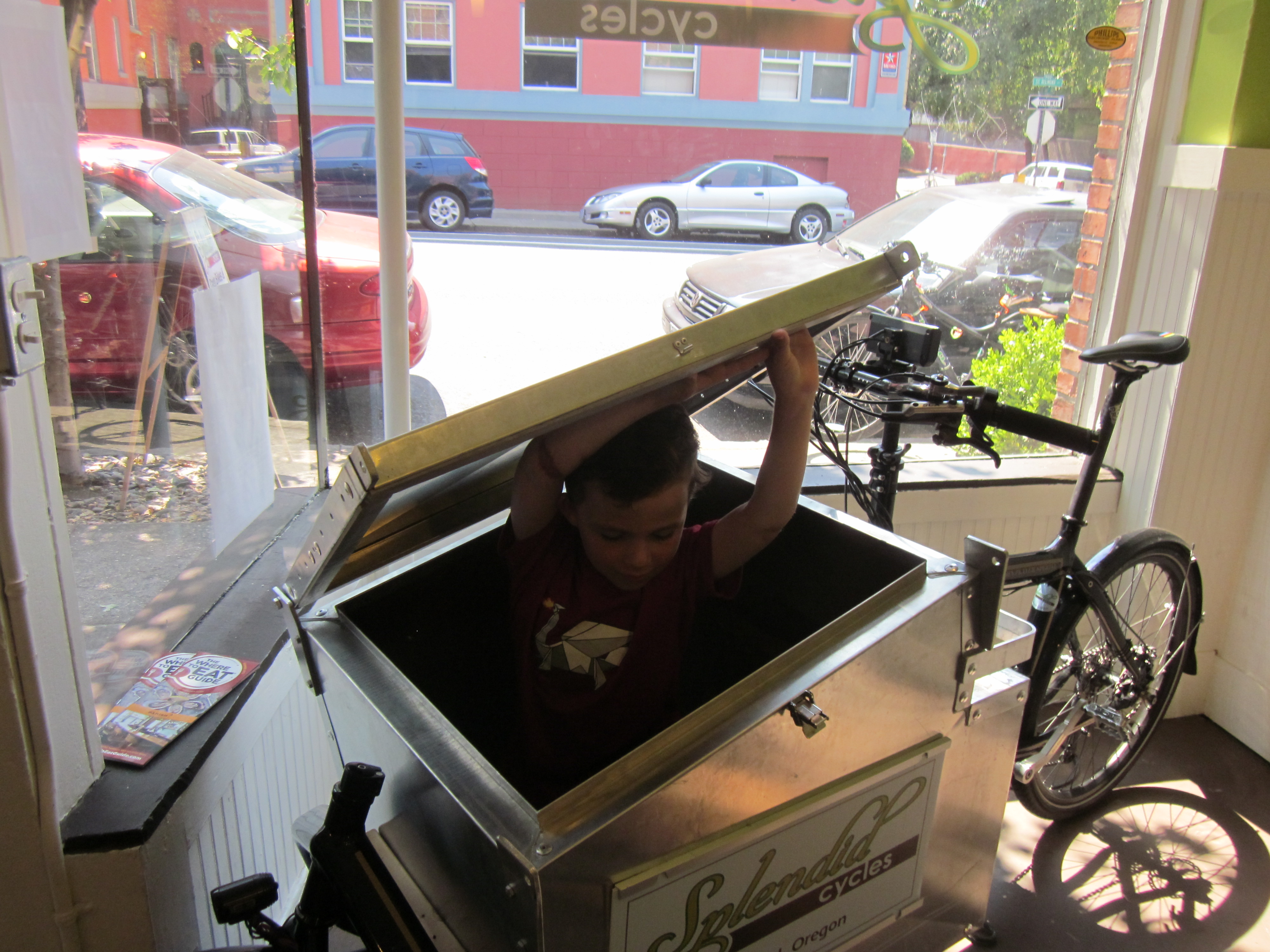
  • To my surprise, my kids decided to ride together in the box. It’s not all that roomy in there for two older kids, but they were happy. At one point my daughter even stretched out for a nap, although she did not actually nap.
  • The preferred entertainment for two kids in a Bullitt is singing “99 bottles of beer on the wall.” On a five mile ride, that song can stretch into negative numbers. Adding a sound system to this bike has been upgraded from “nice to have” to “critical need.”
  • An unexpected disadvantage of a low box is that the kids assume that they can reach out and pick up anything on the street that interests them while we are moving. We had to have a conversation about that.
  • It is impossible to overestimate how much attention a Bullitt will get on the streets of San Francisco. Lots of drivers pulled up right next to us to ask questions. “I love your bike!” said one.
  • Other bike riders will assume that a Bullitt belongs to a man, and ask my husband questions about it. In response, he will stare at them.
  • This bike can go anywhere in this city with two kids and whatever else we pick up along the way.

On the way back home, on the Panhandle, we spotted: another Bullitt! That was unexpected. It was a milk-white Bullitt (unassisted) with a kid box like mine, but the rider was carrying a big black dog. Given that there are no Bullitt dealers in San Francisco, we were both nonplussed. “Nice bike!” I said. “Yay, BULLITT!” he said. Based on his accent, I think he was Danish. The other riders on the path looked dumbfounded.

On Saturday night before the Bullitt arrived, we had to do a longer-distance errand at night with both kids, and given the distance and the fact that it was dark and our lack-of-a-two-kid-cargo-bike situation, we rented a Nissan Leaf from City Carshare for a little while. We were stuck in traffic for most of the trip. We couldn’t find parking. The kids got fussy. Matt and I were both struck by the fact that we used to do this EVERY SINGLE DAY. We were relieved to return that car. “Okay, that sucked,” said Matt.

Worth the wait

In light of this experience, I hesitate to call the Bullitt a car replacement, although that is arguably the closest equivalent. But the Bullitt is better. Within city limits, it is faster than a car, because it doesn’t get stuck in traffic. With rare exceptions, it can carry more than a car. It can park by the front door of any destination. Our kids enjoy the ride. It turns out we weren’t looking for a car replacement. What we wanted all along was a totally awesome cargo bike.

7 Comments

Filed under Bullitt, car-free, electric assist, family biking, San Francisco, traffic

A series of electric assists

This is the first assisted bike I ever rode, a Surly Big Dummy with BionX.

I first tried a bike with an electric assist last March, just over six months ago, a BionX assisted Surly Big Dummy at Splendid Cycles in Portland. It made quite an impression. Later I tried a mid-drive assist at The New Wheel in San Francisco. Then I tried another mid-drive assist and a front hub motor.  Less than a year ago, I could not have identified the difference between these assists with schematic diagrams and prompts from their designers. I wish I knew then what I know now.

The electric assists I have tried:

  • A front hub motor operated by a throttle on the handlebar (eZee)
  • A mid-drive motor operated by a throttle on the handlebar (EcoSpeed)
  • A mid-drive pedal-assist motor (Panasonic)
  • A rear hub pedal-assist motor that responds to torque (BionX)

I have pretty strong feelings about what kind of assist I prefer after trying all of these (BionX, although it’s not perfect). Maybe you have no idea what I’m talking about, but wish you did because you’ve been hearing about this electric assist thing and it sounds kind of cool, but you couldn’t pick an electric assist bike out of a lineup. Read on, friend.

General thoughts

Electric assist bicycles are interesting because they are true car replacements for ordinary people. I have met lots of committed, fiercely strong riders who not only ride to work and for errands and on weekends, but also head for the steepest grades in the city to improve their hill-climbing chops. These guys (they are almost always men) are inspiring, but your average mom of two isn’t going to look at them and say: “Yeah! That could be me!” But put an electric assist on a cargo bike and you are looking at a transportation system that can haul the kids, handle a week’s worth of groceries, dodge traffic, and park right next to the front door of any destination in the city—at the same time. All of this for minimal operating and capital costs, plus enough exercise that you no longer get depressed about not making it to the gym since the kids were born. Many of the factors that make riding a bike seem intimidating—I can’t sweat because I need to look decent for work, no way can I make it up that hill, how am I going to carry the kids, I can’t handle the wind—disappear with an assist. All that’s left to worry about is wet weather. I personally got some waterproof outerwear and found out that I liked riding in the rain, but if I had hated it, heck, we could rent a car on every rainy day in San Francisco without coming close to the cost of owning a car. (In other climates people worry about snow, but from what I’ve read this involves getting some studded winter tires and a cover for the kids and then you’re good.)

Some people like throttle assists (operated by a grip on the handlebar, independent of pedaling) and some people like pedal assists (which multiply your effort as you pedal). My anecdotal impression is that people who come to electric bikes from bikes prefer a pedal assist because it feels like riding a bike. Whereas people I’ve met who ride both bicycles and mopeds, or bicycles and motorcycles, seem to prefer having a throttle. Everybody likes what’s familiar. I came to electric bikes from riding a bicycle as my kids’ weights edged up toward 100 lbs. I didn’t care for the throttle assists I tried.

None of the electric assist systems cost much to charge. Efforts I’ve seen to estimate power costs sort of peter out because they’re so trivial. NYCE Wheels, which sells a lot of assisted bikes and has some great articles on their website about the technology, estimated the cost per charge at maybe 18 cents in New York City, but of course prices depend on local rates. The better systems estimate that a charge can carry an assisted bike at the highest level of assist for 20-45 miles.

Currently there are three kinds of batteries that can power the motor on the market (that I know of): sealed lead acid (SLA), nickel-metal hydride (NiMH) or nickel cadmium (NiCd), and lithium-ion polymer (LiPo). The technology for batteries on electric assists is still considered somewhat experimental. Getting the longest possible warranty from a reputable manufacturer is a really good idea. Expect the battery to last only a little longer than the warranty and you won’t be disappointed. Battery replacement is the true cost of maintaining an assisted bike. Compared to the costs of maintaining a car, it’s still bupkis: with a good warranty, it will run $500-$900 every two years at the most.

  • SLA batteries are the least inexpensive electric assist battery. They’re incredibly heavy and take several hours to charge. Bikes with these batteries tend to have limited range (maybe 5 miles). When SLA batteries won’t hold a charge anymore, they have to be disposed as hazardous waste. These batteries are common on e-bikes in China. If you buy an e-bike at a big box store it will have an SLA battery, and it won’t last long. You’ll be replacing entire bikes more frequently than other people replace their bike’s batteries.
  • NiMH (more common) and NiCd (less common) batteries are somewhat more expensive, still heavy, and bikes with these batteries tend to have greater range (maybe 10 miles). They were considered an upgrade from SLA batteries at one time, but they have their little issues. One of these is charge memory; occasionally you have to drain the battery down or it will stop fully recharging, and you won’t be able to go as far. When they won’t hold a charge anymore, they will not win any awards for environmental stewardship. However in San Francisco, Sunset Scavenger will recycle them if they’re left taped up in plastic on top of a black can. It’s almost impossible to find these batteries on new bikes, as they’ve been supplanted by LiPo batteries.
  • LiPo batteries are the most expensive, most energy-dense, and lightest weight battery option. LiPo batteries largely dominate the market now. Bikes with these batteries tend to have greater range (20-90 miles). Using them with inappropriate chargers or puncturing them can make them explode (exciting!) They can be stored for long periods (1-2 months) without losing charge.

Front hub throttle assist

I tried the eZee front hub motor that comes standard on the Yuba elMundo. This is a 500 watt motor. You can tell there is a motor on the bike because the front wheel has an oversized hub. There are lots of other manufacturers that make front hub motors, and kits made in China, where electric bikes are fairly common, are often found on eBay. However eZee seems to be one of the more reputable manufacturers. On the elMundo there is also a battery attached to the frame, just behind the seat tube (that’s the part of the frame that attaches to the seat) and in front of the rear wheel; however the battery could be placed somewhere else on other bikes (a rear rack, a down tube, anyplace that would hold the weight). The suggested range for this assist system is 20 miles.

  • How it works: You activate the motor by twisting the right handlebar grip away from you. The more you twist, the more assistance you get. When the motor is on, your pedaling appears to add nothing. You can turn the motor on and off with a controller on the left side of the handlebars. The controller is pretty basic; just a switch with lights. The look screamed “high school science fair project” to me.
  • What it feels like: It feels like skitching. Skitching is when you are pulled along by something other than the bike, like when lunatic bike messengers grab onto a passing car. You’re hitching a ride. I have never skitched on a bike because that would be insane, but I have skied. Using a front-hub throttle motor feels a lot like being pulled on a rope tow while on skis (except obviously you’re on a bike).
  • Noise level: Medium. I definitely noticed the sound of the motor while I was riding. I wouldn’t call it noisy, but people walking along the sidewalk alongside noticed the sound, and it also muffles the noise of passing traffic somewhat.
  • Pros: You never have to work going uphill. The eZee motors work with many batteries. They are the Microsoft Windows of electric assists. The system is reasonably priced as electric assists go, although not so cheap that you wonder whether they’re a fly-by-night manufacturer.
  • Cons: A downside of using any of the throttle assist motors is that your power is limited to what the motor can pump out. Pedaling adds nothing. Unfortunately a 500 watt eZee front hub motor didn’t really have the kind of power needed to get two kids up steep hills in San Francisco. I saw one elMundo overheated and out of commission (two older kids on deck, bike on a hill) during our recent Kidical Mass/Critical Mass ride. I have heard other similar stories, although I haven’t personally witnessed them. There is also something weird going on with eZee right now; none of its products seem to be in stock. Using a throttle-operated assist doesn’t feel like riding a bike.
  • Battery type: LiPo. I’ve seen warranties on eZee batteries of either six months or a year.
  • Cost: around $1450 for this motor with a 36v battery.

Mid-drive throttle assist

This is the EcoSpeed Bullitt; the motor is not visible, but note the console above the handlebars.

I tried the EcoSpeed aftermarket mid-drive assist mounted on a Bullitt at Portland’s Splendid Cycles. This is either a 1000 watt or 1500 watt motor; the answer seems to depend on how you frame the question. Mid-drive motors are more efficient than hub motors, so comparing watts between systems isn’t helpful. Unlike many assist systems, the controller did not limit the maximum speed (many state laws limit the top speed on assisted bicycles to 20mph). This discovery led to the following entertaining conversation. Me: “Uh, is this system even legal in California?” Splendid: “Well… no. Maybe. It’s a gray area, legally speaking.”

You can tell there is a mid-drive motor on the bike because there’s a bulbous protrusion near the chain wheel attached to a second chain. The motor drives the second chain and pulls the bike along. On the Bullitt, the batteries were mounted under the front box. You can fit a lot of batteries under the pallet of a long john, and mid-drive motors are pretty efficient; EcoSpeed claims their system can go 35-45 miles.

  • How it works: Twist the right handlebar grip and away you go. More twist, more speed. You can spin the pedals for fun but it’s not necessary, nor does it add any power or speed. The controller is a complicated-looking little computer on the handlebars that details the remaining battery power, speed, mileage, etc.
  • What it feels like: Hard to describe. It’s kind of like riding a train? I could feel that the motor was moving the bike underneath me, but it didn’t feel like I was being pulled; it wasn’t like a front hub motor.
  • Noise level: Unbelievably loud. It sounded like a moped.
  • Pros: This is an insanely powerful motor. It would be great for a construction company. Attach a trailer and you could haul, I don’t know, a load of concrete blocks up steep hills for miles on end. It would be overkill for hauling my kids around the city. Nonetheless, they thought it was wildly entertaining. They still ask about “the fast motor” sometimes.
  • Cons: It’s really noisy and really expensive. It may or may not be street-legal. The motor is so powerful that evidently it sometimes breaks chains on bikes. Using a throttle assisted bike doesn’t feel like riding a bike. To be honest the EcoSpeed scared me a little. I think this assist is best suited to someone who really understands the mechanics of electric assists. I am not that person.
  • Battery type: LiPo. The battery supplied by EcoSpeed has a two year warranty. There’s an option to supply your own battery.
  • Cost: $4,195 for the motor with battery, $150 for the computer.

Mid-drive pedal assist

Two types of bikes at The New Wheel: the Focus has a mid-drive pedal assist, the Ohm next to it has a BionX assist.

I tried a Panasonic mid-drive pedal assist on a purpose-built electric bike at The New Wheel in San Francisco, a BH Emotion Diamond Wave+. Some of the European assisted bikes have really weird and complicated names, I’m sorry to say. I’m going to refer to this bike as the Emotion because that was the name emblazoned on the down tube.

The Emotion has a 250 watt motor that’s built into the frame of the bike; you can tell it’s there because the chain guard looks really fat, like it’s been pumped up on steroids. Because the manufacturer built the system into the bike the torque/motion sensor is hidden inside the frame. There is also a battery mounted behind the seat tube and in front of the rear tire. Like many of the higher-end electric assist bikes, it comes with lights, fenders, chain guard and rack; this bike is designed to be used for transportation, not as a toy.

Mid-drive motors are so efficient that it would be a mistake to think that the comparatively low wattage means that you’re sacrificing power. On this bike I could easily scale hills that I’m fairly certain would have knocked out the eZee entirely. (The New Wheel is cleverly located near some of San Francisco’s more scorching hills. In my neighborhood the hills top out at a 25% grade; there are steeper hills near the shop.)  The BionX and EcoSpeed motors could handle the same hill; in fact I was riding with a friend who was on a BionXed bike (350 watt motor) at the time and he was just peachy. However the suggested range of the Emotion was 45 miles, whereas the suggested range of the BionX bike he was riding (an Ohm) was 35 miles.

  • How it works: There is a controller on the left side of the handlebars where you set an assist level of low, medium, or high (or off). Once it’s on it sends power as you pedal to multiply your effort. On low I wanted to gear down to make pedaling comfortable. On high, gearing down for the hill was optional.
  • What it feels like: Using the mid-drive pedal assist motor felt like riding a beach cruiser along the waterfront regardless of how steep a hill I attempted to scale. People do that kind of thing for fun on vacation. If you ride on a lot of hills already, the experience of using a mid-drive pedal assist is both intoxicating and a little spooky. If you always wanted to ride a bike but don’t because you live on a steep hill, this bike is a dream come true.
  • Noise level: The motor itself is silent. There was a slight rattling from the chain when the motor was running. It was fairly quiet but I noticed it, although someone walking on the sidewalk next to me wouldn’t have.
  • Pros: I like all of the pedal-assist systems because they feel like you’re riding a bike, but you don’t have to suffer (unless you want to). However this system is probably the most sophisticated I’ve ever used in that it doesn’t require you to think about how you’re riding: set the assist and forget it. The mid-drive motor works with internally geared hubs. The motor and battery are unobtrusive. There is a neat feature on most of the European assisted bikes, the “walking assist”, where you can push a button and the bike gives a trickle of power that makes it feel like you’re walking a bike that weighs 10 pounds instead of 50 pounds.
  • Cons: The biggest con is that these systems are currently only built into one-person commuter bikes (but see below for notes on the Stokemonkey). So although you could add a child seat to a bike like this, there isn’t any way to use the assist system to haul serious cargo or two kids, even though the motor is capable of handling those loads. Beyond that there’s only trivial stuff. If you’re using to riding a bike on hills, learning to use this kind of assist appropriately can be a little weird. The goal is to maintain a steady pedaling rhythm and not bear down on the hill, or even necessarily shift down (unless it would make it easier to maintain cadence). I had to remind myself not to *try* to climb the hill. It was like The Matrix: “There is no hill.” But if you haven’t been riding on hills a lot, this won’t be an issue. You’ll take to it immediately. Another minor issue is that people who like to tinker get frustrated that these are closed systems; you can’t mess around with the bike. However I have trouble believing that people like that would have the slightest interest in this kind of bike anyway.
  • Battery type: LiPo. The entire bike has a two-year warranty.
  • Cost: The entire bike, including the electric assist, costs $3,300 at the New Wheel; they offer 12-month 0% interest financing as well.

The Stokemonkey

Once upon a time, there was an aftermarket mid-drive pedal assist system specifically meant for cargo bikes , the Stokemonkey (designed and sold by Clever Cycles in Portland). Although the motor was created for longtail cargo bikes, Stokemonkeys have also been used on front loading box bikes (this is not recommended by the manufacturer, however).  I have, sadly, never ridden a bike with a Stokemonkey. However reports from people who have ridden them claim that the motor is silent, the assist is seamless, and that a stoked, fully-loaded cargo bike can easily climb any hill. The Stokemonkey was withdrawn from production when the cost of parts increased, but is apparently coming back at an unknown (to me, at least) future date and price. Yeehaw!

Rear hub assist that responds to torque

The BionX system can go on any bike with a rear derailleur, including this Yuba Mundo.

I have now ridden two different bikes with aftermarket BionX pedal assists, both in Portland: a Surly Big Dummy and a Bullitt. In both cases the motor was the PL-350 (350 watts), which is the model recommended for climbing steep hills. The BionX controller gives you the option of choosing between four levels of assist, which range from a 75% assist to 300% assist. There is also a thumb switch that acts as throttle, giving the bike a burst of power at the highest level. This is a handy feature when you’re crossing an intersection. The BionX system only provides an assist if you’re moving at least 2 mph, however, so the initial start has to be powered by the rider. This ensures that the bike won’t jerk forward if you accidentally brush a pedal while stopped.

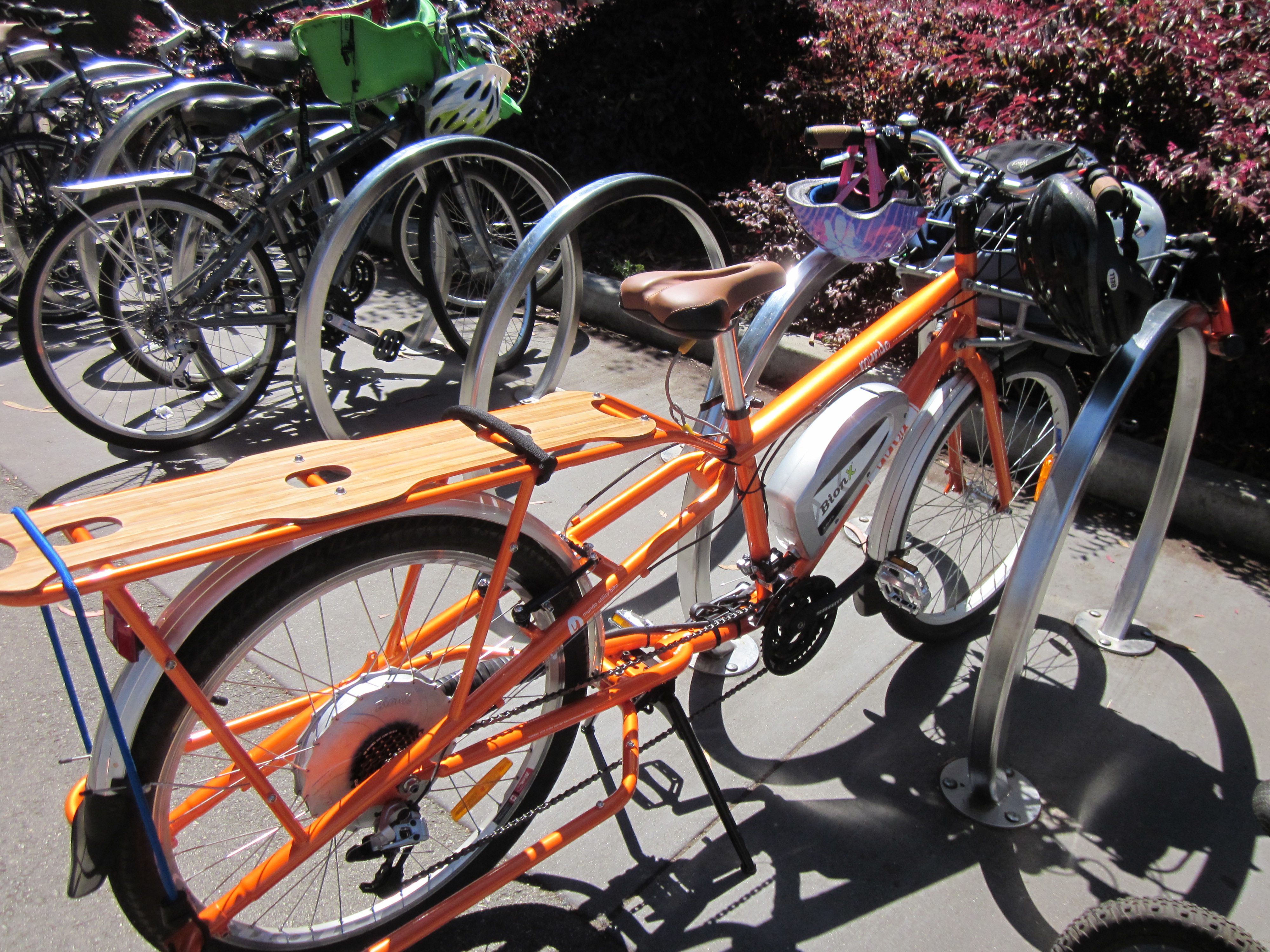
The BionX is a rear hub motor. You can tell it’s there because the hub of the back wheel is much larger than normal. The (proprietary) battery comes in two versions. One is an odd and obtrusive tear-drop shape, which can be mounted in a couple of different places but usually goes on the down tube. The other is a less-obvious flat pack that mounts below a special rack. Although the rack mount is unquestionably more attractive, I have heard from more than one bike shop that the rack mount can be problematic, because that much weight placed high on the back of the bike can make it very tippy. Add kids to the rear deck and the problem is intensified.

The BionX system is an unusual pedal assist system for two reasons: first, it responds to torque, and second, it has regenerative braking.

The BionX provides more or less assist depending on how hard you press on the pedals. For this reason, riding with an assist feels the same as riding without the assist, except you’ve grown massively stronger: push down hard on the pedals and you rocket forward. For people who’ve been riding on hills for a while without an assist this is an intuitive system to use because it mirrors the way they already ride.

Regenerative braking means that as you go downhill and brake, the battery recharges a little. This is a little bit of a gimmick, but not totally. For some reason, many people I talk to about electric assists to seem to think that pedaling the bike should provide all the charging they need for the assist system, as though an assisted bike were some kind of perpetual motion machine. I suppose this is technically possible, but only if you worked exactly as hard as you did on an unassisted bike, in which case, what would be the point of having an assist? Setting aside the expectation of a free lunch, however, regenerative braking has some advantages. The first advantage is that you can use the system to slow the bike while going downhill by setting the controller to a negative assist, turning it into a hub brake. On steep hills where brakes can overheat, which are all over San Francisco, this feature is outstanding. I am paranoid about brakes, so the news that BionX assists came with an independent second braking system had the same effect on me as a face mask full of nitrous oxide at the dentist. Whee! The second advantage is that regenerative braking can decrease range anxiety, because after going downhill you have a little bit more range.

  • How it works: There is a controller on the right handlebar that allows you to set an assist level; there are four levels of assist (and four levels of negative assist that act as a brake). There is also a thumb switch that acts like a throttle and gives a burst of power at the highest level of assist. The controller is also a computer that provides information on speed, distance traveled, and remaining battery life. It is a slick little machine, the iPhone of controllers. Once an assist level is set it sends power to multiply your effort. You can set an assist level and forget it, and just ride around faster than usual with no fear of hills.
  • What it feels like: They call this system BionX for a reason. When it’s on it makes you feel like you’ve suddenly developed super strength, but without the sordidness, health risks or expense of taking performance enhancing drugs. Because it responds to effort (torque), it really does feel just like riding an unassisted bike, except that the experience has become much, much easier. You still use the gears, but don’t ever slow down so much that you wobble on the hills.
  • Noise level: Completely silent.
  • Pros: This system feels more like riding a bike normally than any other assist I’ve used, and yet is powerful enough that I had no trouble hauling two kids up steep hills. In Portland, riding the BionXed Bullitt, I didn’t even need the highest level of assist to clear the local hills without difficulty on brutally hot days. On the hottest day we were in Portland (with a high of 105F), however, I did turn the assist to the highest level and it allowed us to go fast enough to catch a breeze even though I was putting in minimal effort because I feared I might pass out from the heat.
  • Cons: The BionX system currently only works on bikes with a rear derailleur and not with internally geared hubs (however BionX will be releasing a system with a 3-speed internally geared hub next year; this system will only be for purpose-built assisted bikes, however, as the torque sensor has to be built into the frame by the manufacturer). Having to get the speed up to 2mph before the assist kicks in can make starts on a heavily loaded bike very wobbly. There is no walking assist, which would be helpful. (If you make the mistake of trying to use the throttle button as a walking assist, as I once did, the bike will lurch ahead faster than you can follow it.) The BionX system is proprietary and does not allow the use of less expensive batteries from other manufacturers. This really ticks off people who like to tinker with their assists: BionX is the Apple of electric assists.
  • Battery type: LiPo. BionX offers a two year warranty.
  • Cost:  Ranges from $1200-$1800. The more expensive systems are better hill climbers and have greater range.

My conclusion

After riding all of these systems, the one that seemed best suited for our needs was the BionX (but how about a walking assist, BionX?) However, because the battery technology for all electric assists is still a little spotty, I wouldn’t get an assisted bike without the kind of gearing that would have a sporting chance of getting me up serious hills if the battery failed. Our new cargo bike has a wide range of gears.

Our needs are not everyone’s needs. I suspect a mid-drive pedal assist bike would be the best choice for an inexperienced rider facing steep hills. If I wanted to carry seriously heavy loads on a cargo bike, an EcoSpeed would be the better choice (or if it were available, a Stokemonkey). Personally, I didn’t really like being pulled along by a front hub motor, and the version I tried was underpowered for San Francisco hills. However many people like these motors better–I recently talked to one dad who wouldn’t consider any other kind of assist–and it’s possible to buy stronger assists for a front hub. Moreover there are some relatively inexpensive front hub systems available. Battery experience with these systems may vary.

No electric assist with any longevity is inexpensive, and some of them cost more than the bike itself. However I know many families in San Francisco who ride bikes but own a second car only to get the kids to school on top of a steep hill or because they can’t get a week’s worth of groceries home on a bike. Compared to car ownership, an electric assist is a bargain indeed.

15 Comments

Filed under car-free, cargo, electric assist, family biking, San Francisco

The traffic problem

Blah blah blah hills in San Francisco blah blah blah

When we started riding with our kids in San Francisco, we faced two big issues: hills and traffic. Okay, there was also the wind. It’s really windy. I’ve gotten a lot stronger, though, and what’s more, an electric assist will resolve nearly any hill and wind problem. Soon we’ll have two assisted bikes. So I label those problems: solved.

This is the western approach to my office at Laurel Heights. There are a lot of tight squeezes en route.

The traffic issue was initially really intimidating. It is illegal for adults to ride bikes on sidewalks in the city, for good reason: there are lots of people walking on them. There are a lot of cars on the street. Cars in San Francisco pass really, really close. They are occasionally going much faster than we are, although that happens less often than you might think. Yet cars are big and heavy and could quite literally crush us like bugs. When I started riding there were occasional moments of sheer terror, like when I hit an unexpected stale green light while crossing an eight-lane intersection, and it cycled through yellow and on to red before I’d made it halfway across. There were times that cars turning next to me felt so close that I seriously thought they were going to mow me down, and I ran the bike up onto the curb.

Cars tend to hug the yellow line when passing bikes on my morning commute.

Yet there were only so many perceived near misses I could experience before recalibrating my definition of what was dangerous. San Francisco drivers don’t give anyone much space, but I know from talking to them that they are not trying to be intimidating. The roads are narrow and people in cars are used to passing other cars with only inches to spare. Cars get dinged up in the city as a matter of course because the standard approach to parallel parking in a small space is to back up until you hit the bumper of the car behind you, then move forward until you hit the bumper of the car in front of you, etc. City cars carry scrapes along their sides from tight merges. By the standard drivers apply to each other, you actually get a lot of room on a bike. After experiencing the first thousand close passes I simply couldn’t perceive them as life-threatening anymore. Would I prefer a three-foot passing rule? Heck yeah. But thanks to AAA and Governor Jerry Brown, that’s not going to happen anytime soon in California.

The Market Street bike lanes never lack for excitement.

We have adjusted. By the standards of people outside the city, I realize we must now look like psychotic bike messengers. I have no problem weaving through a two-foot gap alongside a line of stopped cars. Matt and I have both threaded through spaces much narrower than that with our kids on deck by heading to the right hand curb, leaning the bike a little, and pushing along with the curbside foot until we’ve passed, say, a broken-down bus whose driver is trying to reattach it to the overhead wires. Yet I don’t think of myself as particularly aggressive. I don’t run red lights, and I stop at stop signs. I’m not thrill-seeking; squeezing through pinch points is par for the course when riding on certain streets. Nor, for that matter, is anything I’ve done remarkable by the standards of San Francisco cycling, with or without kids involved.

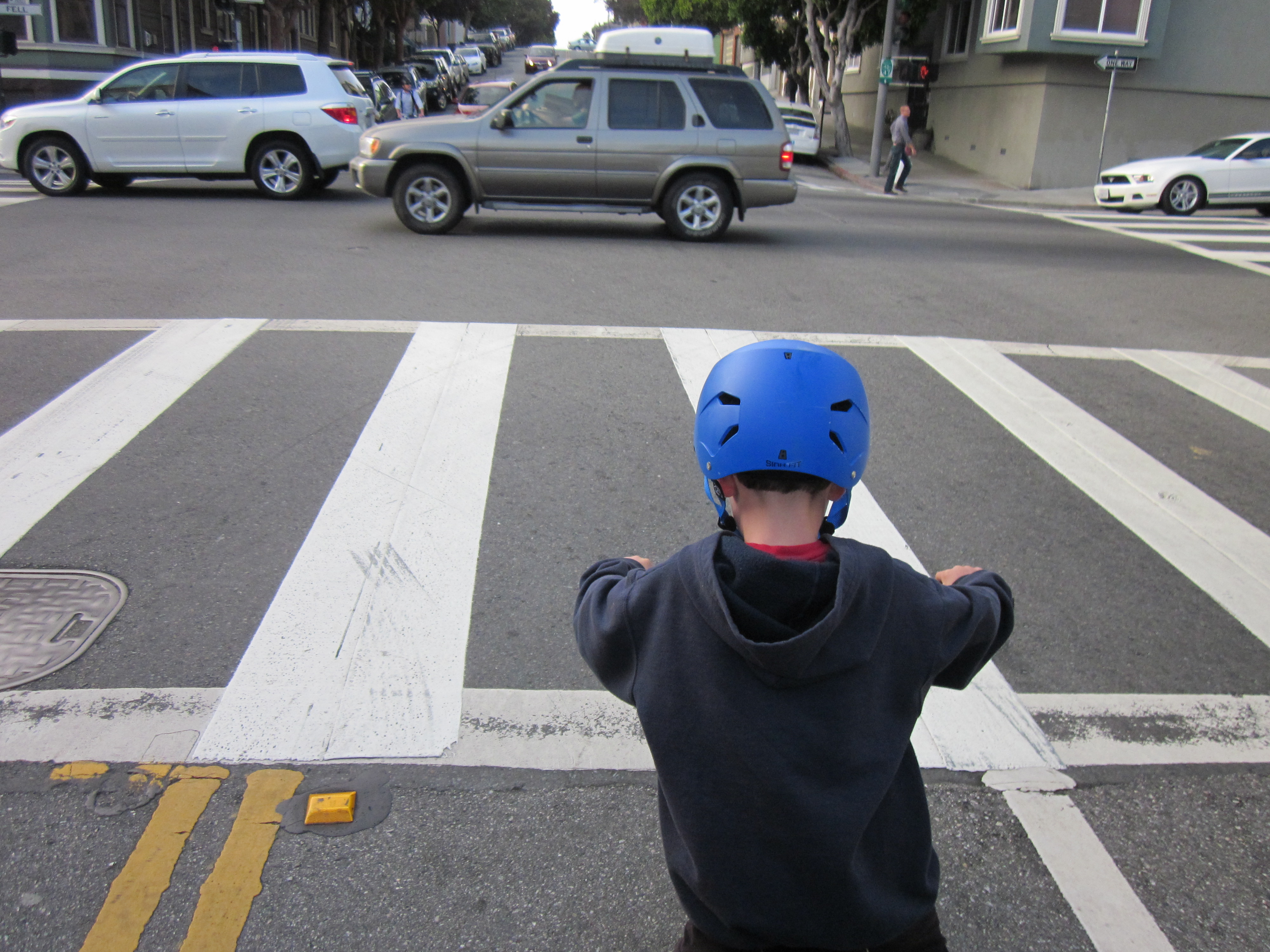
Our son waits for the left turn signal to merge from the Wiggle to Fell Street on a recent Sunday. He was singing to himself when I took this picture.

Our kids have adjusted to city traffic even better than we have. My daughter occasionally taps on the windows of cars that pull up next to us at a stop, just to say hi. We’ve often held conversations with drivers and passengers at intersections; in many cases they’ve pulled up within a few inches specifically to talk to us: “Did you know your daughter is sleeping in the back?” “Where did you get that bike?” My son is unperturbed by traffic that I still find intimidating, and we have had to convince him not to do his tricks (“Look! I can put both feet off to one side!”) Kids are allowed to ride on the sidewalk, and because he’s aware that he tends to weave a little going up hills, he peels off our little peloton to the sidewalk when we head uphill so he has some room, and then slips back between us at the next curb cut when the ground levels out again. Along the Wiggle, there is a merge point where bike traffic is shunted across the travel lane into a dedicated bicycle left turn lane that runs in the middle of the road for a full block, and he cheerfully navigates this lane with cars rumbling by a few inches away on either side.

Our son learned to ride on these streets and sidewalks in our neighborhood.

Normal is what you’re used to, and after the first couple of months of riding I never thought about any of this until my mom came to town. I wanted her to have a chance to ride the mamachari, her first spin on an assisted bike, and one that was her size to boot. I figured we could ride a little on (what I perceive to be) our quiet neighborhood street, which is where my daughter rides her balance bike. No problem, right? She was worried about the traffic. “What traffic?” I asked. By traffic she meant there were cars. There were cars driving on our street, maybe 3-4 every minute on a quiet afternoon. I said we could walk down the hill to the park and ride there, in the parking-protected bike lanes. I didn’t realize when I made this offer that she meant she wanted to ride someplace with no cars at all. It turned out that by her standards even the Panhandle path, which is completely separated from cars, was too busy (and I didn’t even consider taking her there because the access points to the Panhandle are too heavily trafficked).

Usually I feel pretty good about these parking-protected bike lanes in Golden Gate Park (even though cars park overlapping the buffer zone).

So I took my mom down the hill, and she gamely got on the bike. And every time a car came within five feet of her, which was basically constantly, she was so frightened that she fell off. Even the parking-protected lanes freaked her out. She asked me to ride ahead. It turned out that this was because at every intersection, she dropped the bike when cars pulled up alongside. All of the drivers who saw this politely stopped, waited for her to get back on, then moved forward as she did, and of course she would fall off again as a result. When I figured out what was happening I felt like such a jerk. By that point my mom was drenched in fear-sweat and trembling and begged to walk the bikes home. She was terrified to ride in the city. She barely got a chance to try the assist. She liked it though. That was the only redeeming feature of the whole experience.

So hey, I’m a lousy kid! I sent my poor mom into a tailspin of terror. My only excuse is ignorance. I had no idea. I guess people really can get used to anything.

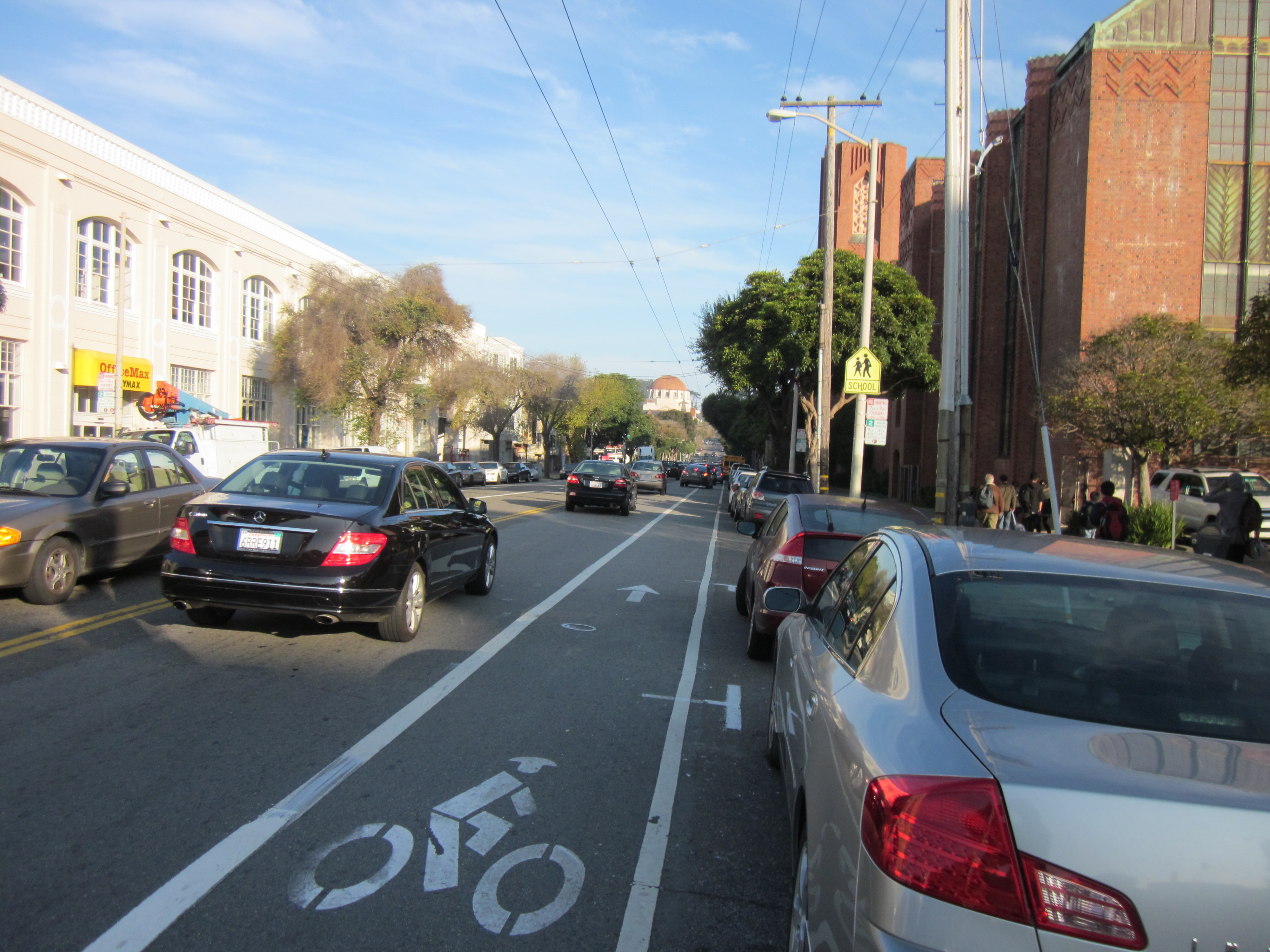
This is my normal route to work. Cars stop in the bike lane for school drop-offs; riders have to weave around. This registers as “annoying” now.

Whether people should have to get used to anything is a different question entirely. There is something deeply wrong with this city if its streets are terrifying to strangers, if they’re something that you have to get used to. And it’s not being on a bicycle that’s the issue: my mom won’t drive in San Francisco either. The result would be nearly the same: sure, she wouldn’t fall down behind the wheel of a car (yes, I’m a jerk) but she would still end up trembling and terrified. There is just so much going on. Drivers, particularly weekend drivers from out of town, get overwhelmed: on the way home from work on Friday night, I watched a distracted driver nearly roll his car over a pedestrian in a marked crosswalk (we talked after the oblivious driver had passed; he was shaken but fine). I can now spot suburban drivers out of their element pretty quickly and take evasive action, but why should this be necessary? A far better solution is many fewer cars moving much more slowly.

The Post Street bike route switches from sharrows to bike lanes. I see families riding this route fairly frequently on school drop-off mornings.

It may not sound like it reading this, but I feel much safer on a bike in difficult situations than I do in a car. I am not trapped in a lane. I can run up onto the curb or between parked cars if I feel threatened. In the worst case scenario, I can move onto the sidewalk and walk the bike. With rare exceptions, I do not travel on streets where traffic moves fast anymore, which inevitably merge with streets where traffic moves slowly, at which point there are collisions. We do rent cars occasionally, but I avoid it when I can because in a car, we are stuck in traffic. If a distracted driver becomes a threat, there is simply no place to go. Given that the current street design makes collisions inevitable, I’d rather be riding in a bus if we have to get involved. The bus always wins.

We ride on the Webster Street bike lanes to take our son to school. If our timing is good we meet other Rosa Parks families en route and make a bike train. If not, we wave to friends in cars.

Like everyone else I know who travels regularly by some mode other than a private car, I have always been a big fan of what advocate Gil Penalosa calls 8-80 streets: streets that feel safe to anyone from ages 8 to 80. Yet I never really understood what that meant until last week on a bike with my mom. I thought it meant things like the parking-protected lanes in Golden Gate Park where I like to ride with my kids, where they can bob and weave without risk of being run over. But those kinds of tricks with paint are the tiniest part of safe streets. In a parking protected bike lane my mom was still afraid. Riding with my kids, neither of whom is even eight years old yet, led me to underestimate the need for safer streets. My kids are fearless. They have adapted.

This is a safe street: on Sundays (and Saturdays from April to September), JFK Drive is closed to cars.

I realize now that safe streets are something else entirely. They would save us from ourselves. I’m glad I can navigate the streets of San Francisco as they are now on a bike, but I’m appalled that I didn’t remember that it was something I had to learn. If I hadn’t ridden with my mom last week, I would never have realized how much more change is needed.

5 Comments

Filed under advocacy, family biking, San Francisco, traffic

Boda Boda Boda Boda Boda

My daughter puts on her heaviest mittens for a test ride on a warm October day. Why ask why?

In honor of today’s half-hearted holiday, which has closed banks and K-12 schools yet left me with a day of teaching obligations, I offer a half-hearted post. Look what stopped by for a visit: a Yuba Boda Boda! This bike is a trip. My verdict: not bad at all. More to come.

Leave a comment

Filed under family biking

San Francisco Bicycle Coalition Family Bike Day

I spotted this amazing red Onderwater right away. What a beauty!

There are some insanely awesome family bikes in San Francisco. Granted, to the best of my knowledge no one in the city is hauling seven kids on a Bakfiets (although I hear there are a couple of Bakfietsen in San Francisco, in the Mission). However the fabulously varied terrain of the city has led to all kinds of family bikes on the move. We saw many of them at the SFBC Family Bike Day last Saturday.

My kids’ lust for a tandem has not dimmed in the last year, so we were all very excited to see our second Onderwater family tandem, now roaming the streets of San Francisco. This bike is so cool. The dad who rode it had gotten it from My Dutch Bike, and said that having the kids in front made a world of difference in riding with them. This was their school commute bike. It was amazing.

This is the rare and elusive Joe Bike, now discontinued

Almost as obscure was the now-discontinued Joe Bike Boxbike, which was evidently purchased sight unseen two years ago and shipped to the city from Portland. Most of the family bikes, like ours, were basically bikes with a child seat slapped on the back: child seats are a cheap and effective way to get a kid from here to there, but they lack some style when stacked up next to the dedicated family haulers.

The Rosa Parks crew was also there in force, some with bikes and some looking for bikes. Over the course of the day, as bikes came and went, I must have seen a dozen orange Yuba Mundos; a couple were assisted, including the unstoppable BionX Mundo that we see most days on the way to school. I am continually impressed at the way that Yuba has hit a price/functionality point that is getting so many families on bikes.

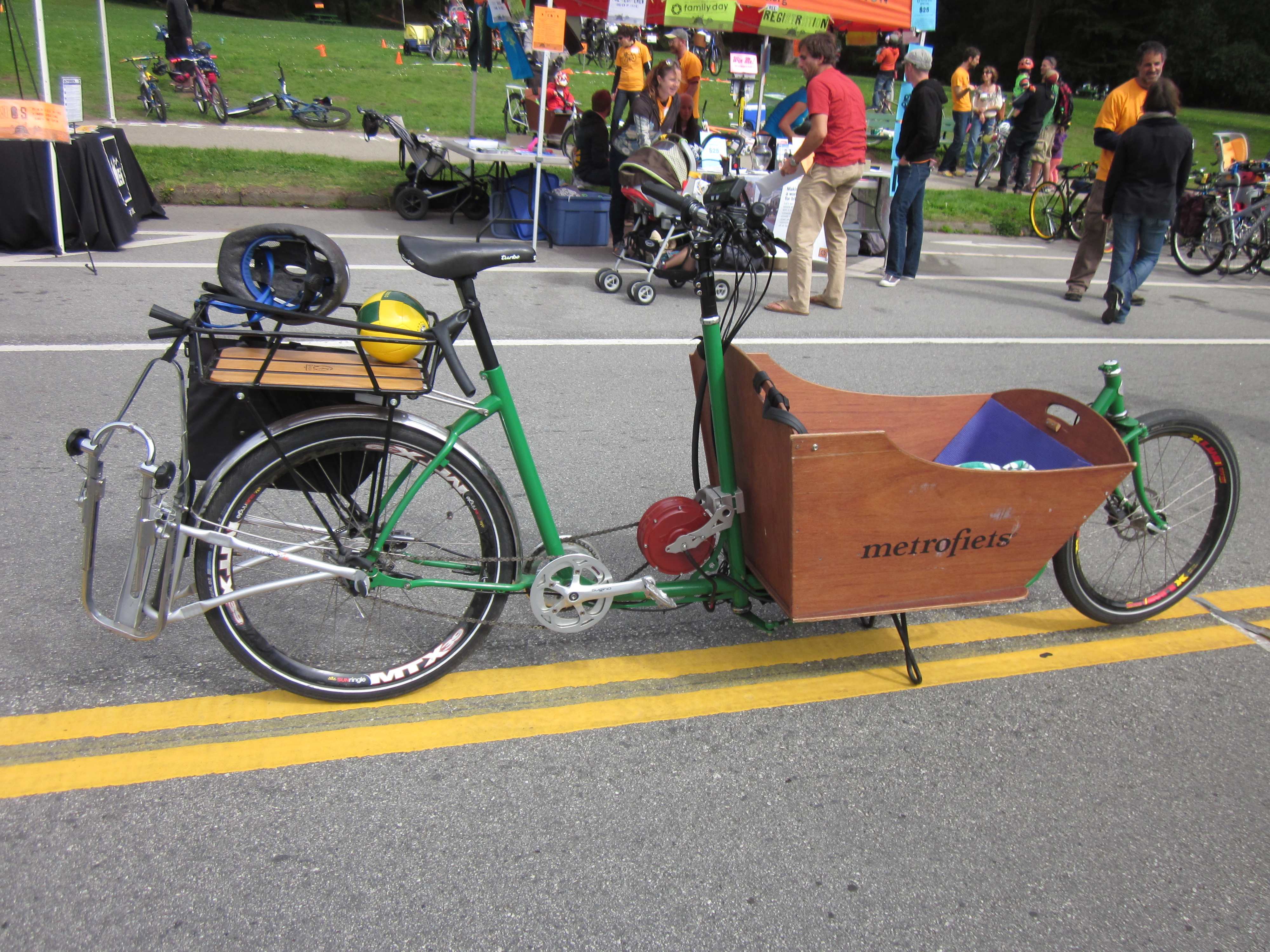
The Metrofiets had it all.

In the One Family Bike to Rule Them All category was the Metrofiets that showed up later in the afternoon, complete with (now discontinued) Stokemonkey assist and Follow-Me tandem. Jaws dropped. There is nowhere that bike cannot go. It got so much attention that I realized it must be a real burden sometimes to ride a bike that is such a work of art. I get enough attention as it is just on the mamachari and the Brompton, which are pretty weird by themselves, but they aren’t in the same class.

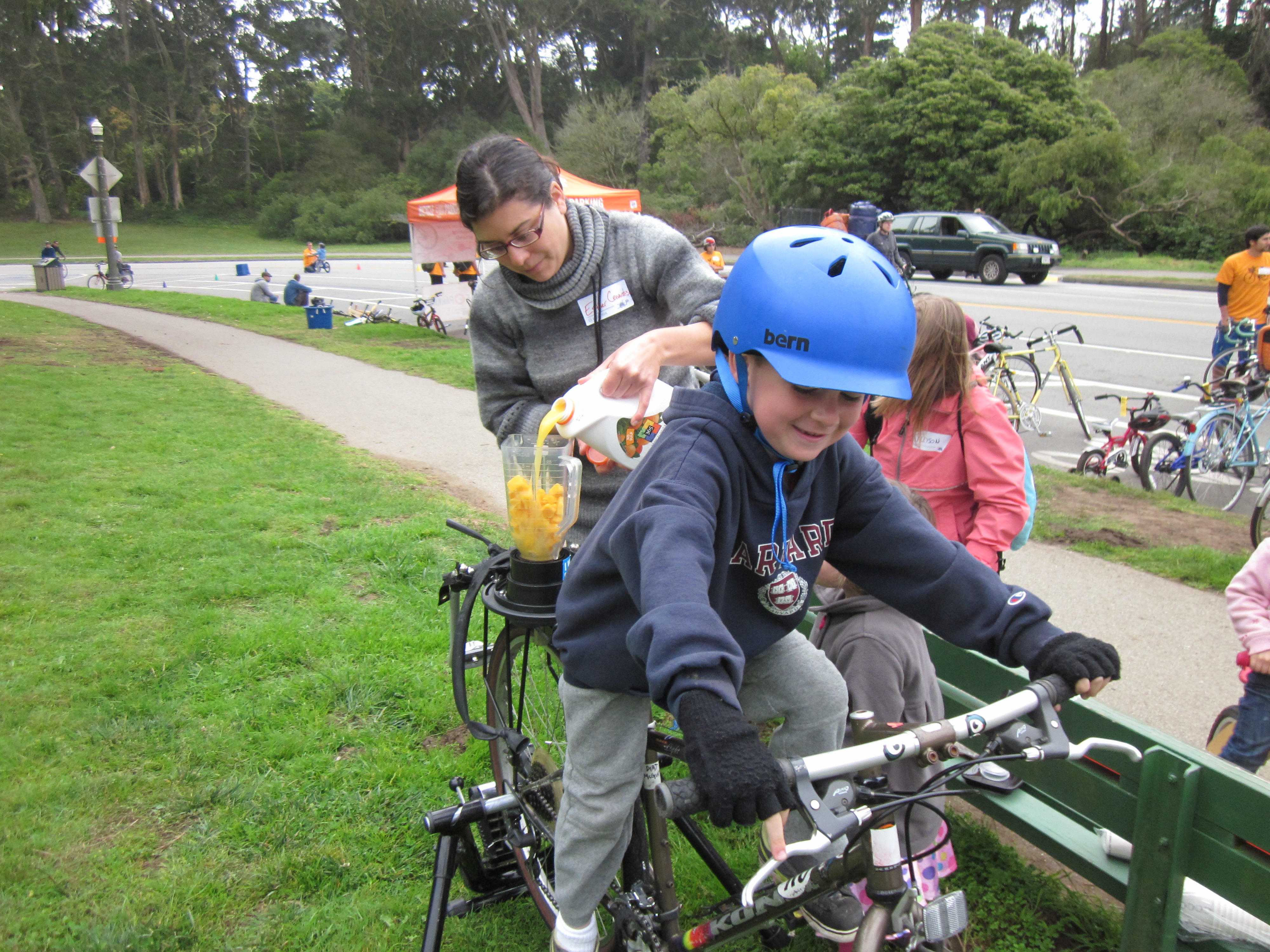
My son was a little short for the blender bike, but pedaled on for the promise of smoothies.

The Family Bike Day was partly about showcasing family bikes, but it wasn’t just a roll call. The SFBC had brought a bike blender, and my son was so delighted that he made four smoothies on it, stopping only when he got so tired that he smashed his crotch on the top tube. That was a bad moment. There were classes on Biking While Pregnant (pro tip: raise your handlebars) and Biking with Toddlers (world’s easiest class to teach: “Let’s go look at all the bikes people brought”). At one point attendees were asked to organize by neighborhood as a way to make friends—alas, we were the only representatives of the Inner Sunset, so ultimately we formed an unofficial alliance with Rosa Parks parents from the Haight and the Presidio. My kids bought t-shirts and played in the grass.

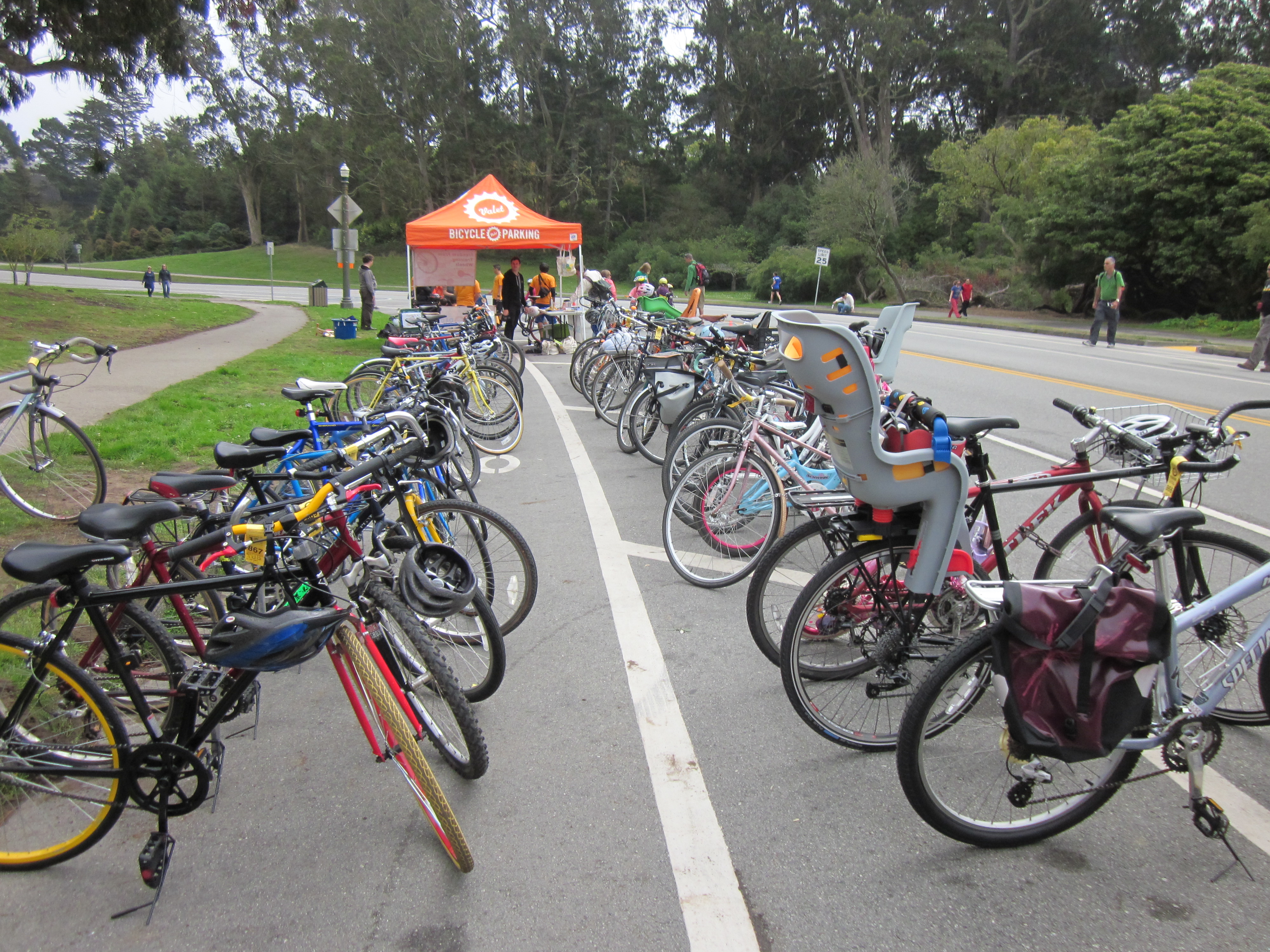
Bike parking for prospective family riders

I ended up talking with a lot of the volunteers from SFBC, one of whom commented that it was frustrating that San Francisco was so far behind Portland in family biking. “Half the people here bought their bikes in Portland,” she sighed. “Uh, we just did the same thing,” I admitted. The reason why is pretty obvious: Portland has three bike shops targeting family biking, and San Francisco, well, doesn’t. We went into one bike shop that got annoyed when we tried to try out their demo child seat by putting my daughter into it (*cough* PUBLIC! *cough*) However I think that child-friendly bike shops are the result of the city becoming friendly to family biking rather than the cause of it. Several years ago, Portland started aggressively putting in bicycle infrastructure that felt safe enough to draw families. (Plus it’s mostly pretty flat. Yes, there are some hills in Portland, but not on the same scale.) If San Francisco continues on the same path, why wouldn’t the results be similar?

“I go so fast! Whee!” San Francisco still lacks routes that she could ride.

Even so I see many, many more families riding in the city than there were even a year ago. I see it at our son’s school: the kindergarten class has more regular riders than the entire school did last year. It’s still primarily dads that I see on the streets with kids, but at Rosa Parks it’s mostly moms. More families appear on the streets and more lanes go in that feel safe to ride with kids, and then even more parents think about riding themselves. I talk to these on-the-fence parents every week. They want to try riding with their kids one day a week. They want to figure out a route that is safe for kids. If they live on hills, they are thrilled to learn that there is such a thing as an electric assist.

I think my kids will be grown before this shift away from always driving with kids is complete. But I’m glad it’s happening. I can imagine how welcoming San Francisco could be with safe streets every day. We have traveled enough that I know what a city designed for people feels like. It would be worth the wait.

6 Comments

Filed under advocacy, electric assist, family biking, San Francisco

Kidical Mass, Critical Mass

Getting to Critical Mass involved some serious traffic maneuvering. This bus was stopped completely, so we had to squeeze between it and the curb. And that is why I like narrow bikes.

It was a busy weekend for our bikes. On Friday, we attended San Francisco’s first Kidical Mass, which was an auxiliary of the 20th anniversary Critical Mass. We don’t live anywhere near the Financial District where the ride starts, plus we have little kids and almost never go out on Friday nights. As a result it had been years since we had any exposure to Critical Mass whatsoever, and we’d never ridden in one.

To make things more complicated, Matt had rented a car for a work meeting in the South Bay in the morning, had left late, and was caught in traffic returning to the city. He didn’t make it home until 40 minutes after we were supposed to leave. It is fair to say that his delay caused a modicum of tension in in the Hum household. If I had had the new cargo bike already, I would have taken both kids myself, but I had no way of doing that with our current bikes and I couldn’t take one kid and leave one home either. The list of things we could do if we had the new bike has reached the point where I now wonder a couple of times a week if waiting until October in exchange for free delivery was my best decision ever.

This woman had both a kid on the back and a dog in front!

So anyway, we got there late. Luckily for us, the ride started late too. Although many families had apparently left, pleading bedtimes, there were still a few people there with kids, and it was wonderful to meet them. I was particularly enamored of the family with stuffed animals zip tied to their helmets (who were understandably featured in all the local news coverage). The families riding in San Francisco are absolutely fabulous. Mostly I hang with the Rosa Parks parent crew, so I sometimes forget how many more people are out there.

This was a huge, huge ride, and as a result, there was about as much walking as there was riding. I was surprised at how philosophical many of the drivers caught in traffic were about the event. On some level, I suppose it is much like getting caught in traffic for any other event—game day, Occupy protest, whatever—just part of driving in the city. I am happy to have left this all far behind us.

Yes, there is a flaming broomstick on the back of that bike. It’s something to consider now that Jerry Brown has vetoed the 3-foot passing rule.

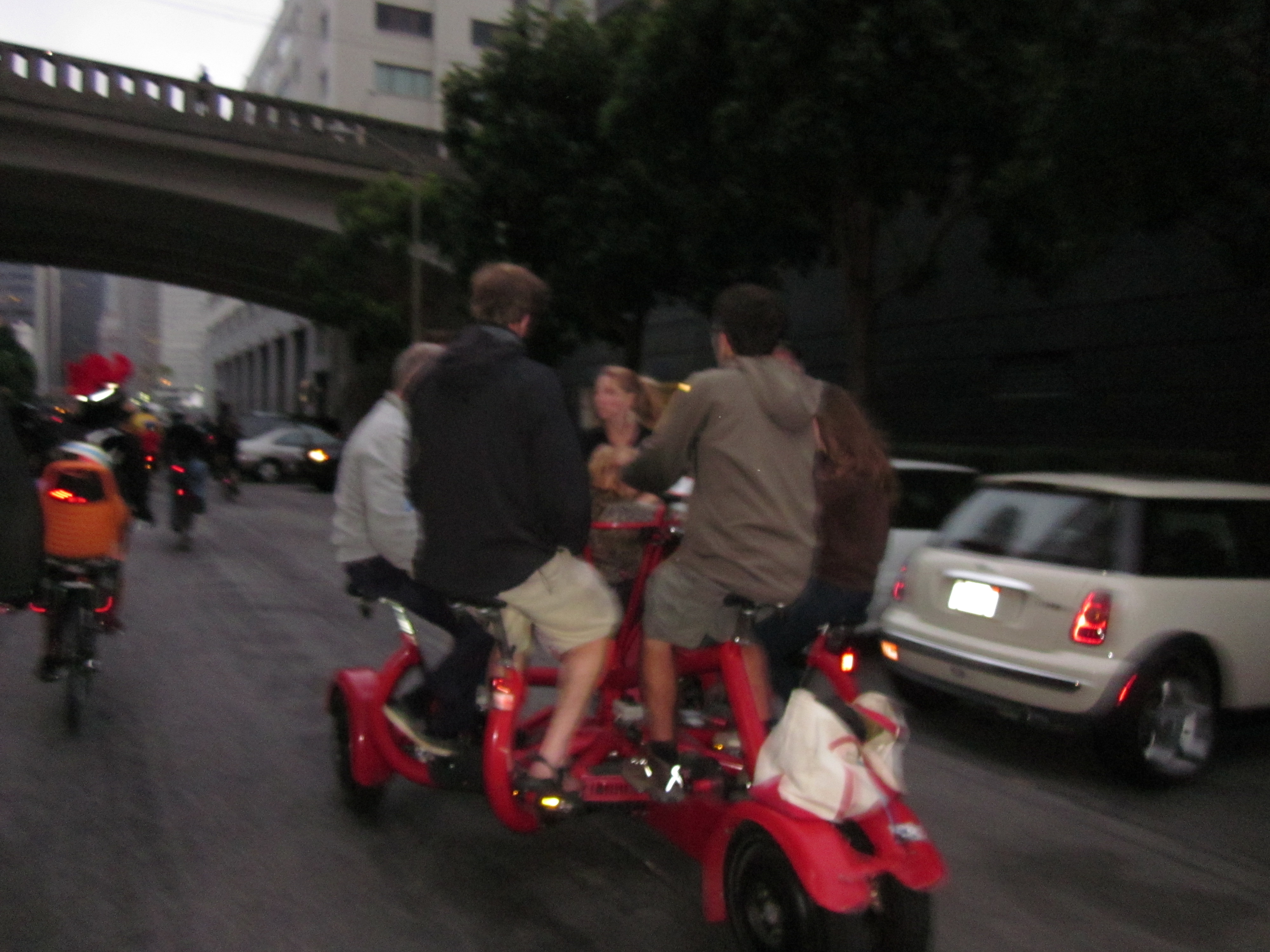
Although it was a new experience, and a slow ride, my daughter and I were having fun being around all the bikes, especially the unusual ones: tall bikes, conference bike, music bikes. We also saw a Yuba elMundo with two kids on board (not part of the Kidical Mass crew) stopped on the hill up Market Street because the motor had overheated. Unfortunately my son, who had spent the day running around for Undokai (Japanese Sports Day), was hungry, tired and frustrated and started crying and demanding to leave. We told him we would leave early and take him to a Mexican restaurant off the Wiggle on the way home, which improved his mood.

The conference bike had a little kid in the middle (a bad shot I realize).

And this is when the ride got funny. We peeled off from the main ride to the Market Street bike lanes heading west. “Where are all the bikes?” my daughter asked sadly. A few blocks later, the mass rushed into the lanes ahead of us. “Yay!” she said. We turned off from the ride and headed up another street. “Where are all the bikes?” A few minutes later, the mass rushed through the same street we turned onto. “Yay!” When we got onto the Wiggle, we rode for a few blocks on our own again, then whoosh! Critical Mass returned. We finally lost the ride for good when we headed directly up Page Street, which is far too steep for the fixie crew.

When we got home, my daughter was still missing all the bikes, and wondering at bedtime when they would come back. At the rate our ride was going, I think she expected them to show up in her room. But stuffed as she was on avocados and fried plantains, she fell asleep before she found out.

Our trip with the neighbors through Golden Gate Park seemed like a good potential Kidical Mass route.

I would love to try another Kidical Mass ride, independent of other rides on a more child-friendly schedule. We had a lovely ride with some neighbors on Labor Day in Golden Gate Park, which started with the kids running around at Koret Playground. From there were headed through the closed streets to the food trucks on the Music Concourse for ice cream and onward from there down JFK Drive. For kids on their bikes, practicing on streets closed to cars is very nice. Matt suggested that a future ride go along JFK all the way to the Park Chalet at Ocean Beach, which despite its horrific service and indifferent food has extensive bike parking, a huge open yard and seating, and interesting woods behind the yard where kids can play and parents can practice their free-range parenting skills. Any interest? If so, perhaps one of these upcoming Sundays could be another Kidical Mass.

6 Comments

Filed under advocacy, San Francisco, traffic, Yuba Mundo

Rosa Parks Fall BBQ

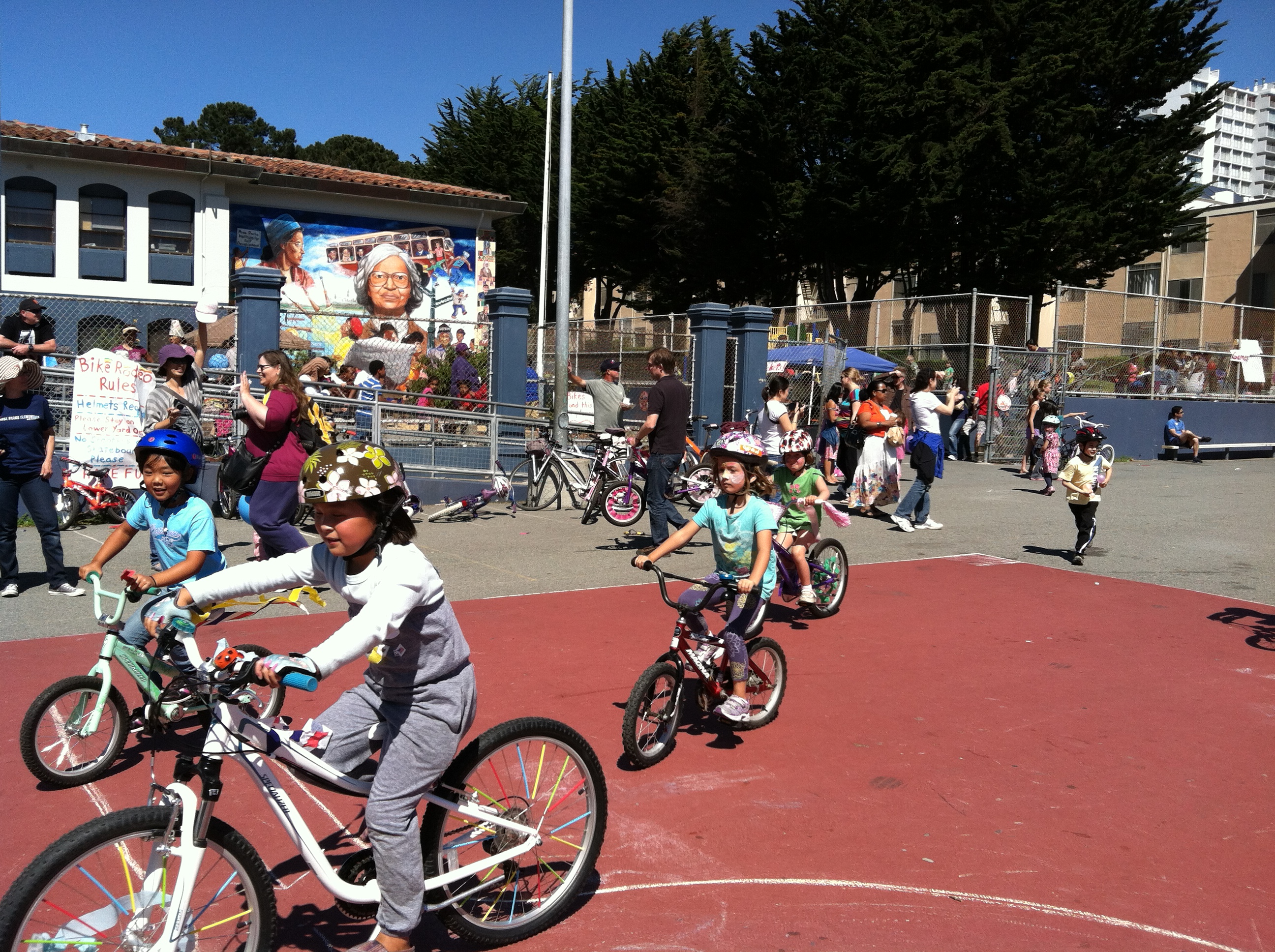
One part of the bike parade

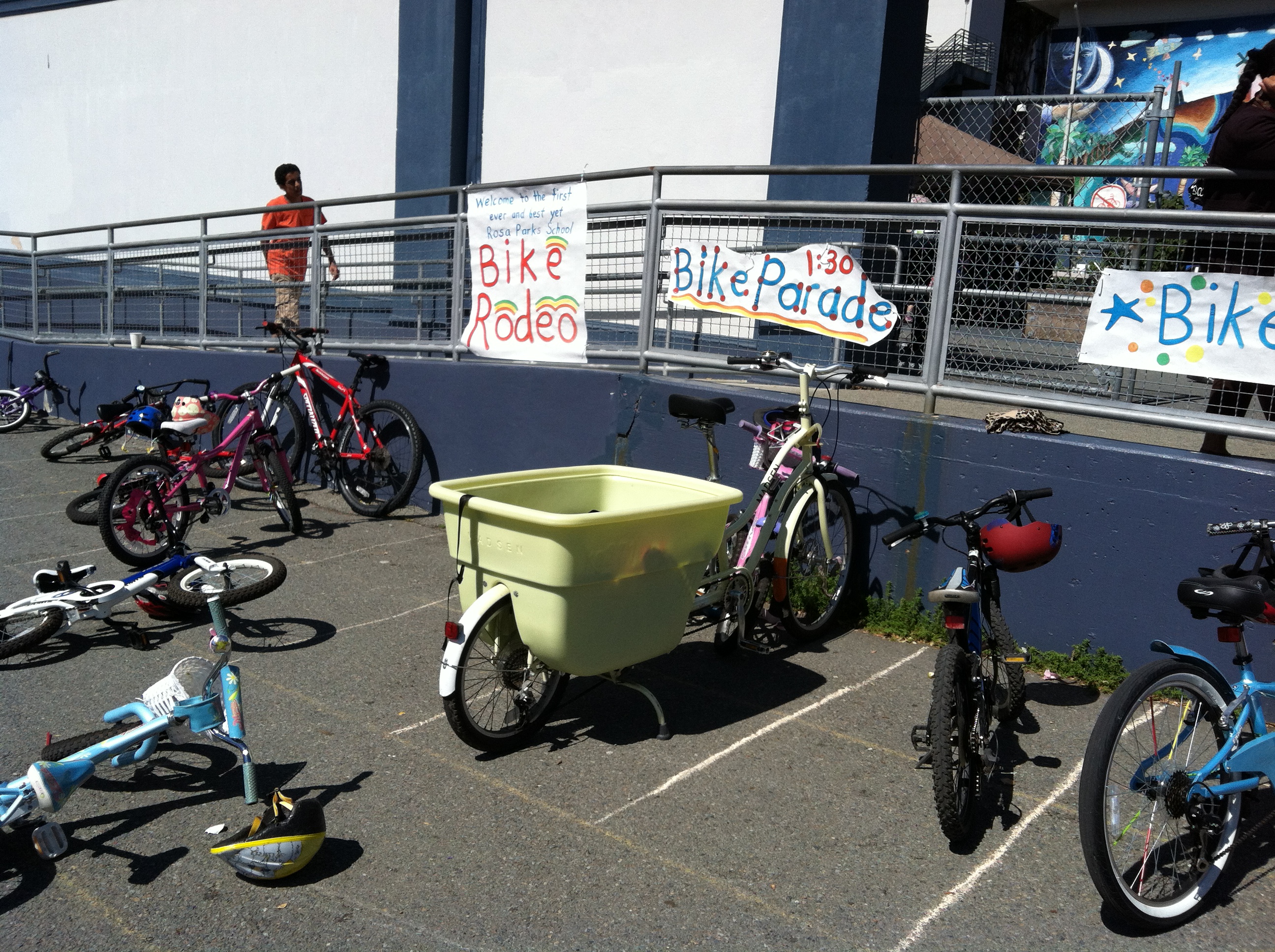
On Saturday we headed to the annual Rosa Parks PTA Fall BBQ. We have been there before, but this was the best year ever, because this was the first year there was a bike rodeo and a bike parade. Attendance exceeded previous records, and so many people came by bike that they had to create overflow parking. We are a mighty bike community.

The Madsen and a few other bikes stayed behind during the bike parade.

My husband says that bikes are to schools as lesbians are to property values: a marker of great things happening. I have been taking photos like crazy on school mornings because the amazing new kindergarten class at Rosa Parks is simply packed with family bike commuters—4 Yuba Mundos, a bike with a Trail-Gator, a bike with a trailer, and so on. Plus the families I wrote about last year keep on keeping on. Not only were many of these families there on Saturday, there was a new bike on the yard, a real-live Madsen. I didn’t meet the family riding it but was told that they recently moved to San Francisco from Japan. I assume that they must live close by because this was an unassisted Madsen.

Two kids on one 20″ bike slay the obstacle course. Who needs Fiets of Parenthood? We have Fiets of Childhood.

Kids on their own bikes were out in full force on the lower yard, and before and after the parade (which was led by the principal). Not every kid who wanted to ride had a bike so they began loading each other up on their bikes to make sure everyone got a spin. I had to laugh thinking about how much angst we’d had over child bicycle seats. With kids old enough to sit up, you can simply seat them right on the top tube. It worked in My Neighbor Totoro, it works for a dad at school still hauling his now-1st grader to school that way, and it definitely worked for the kids. Sure, a spare saddle or a foam pad is a nice addition, but it doesn’t seem to be necessary. And the weight distribution is very good, right between the wheels and probably better for the bike than a rear seat. When they couldn’t fit two kids on the top tube in front of a rider, they improvised, and put one kid on the top tube while the other stood on the back. I had no idea you could fit three kids on a such a little bike. And these kids went fast once they loaded up.

More of the bike parade whizzes by, and Rosa Parks smiles above it all.

I’ve written before about how much I love our son’s school, which not only is a wonderful community for our son but provides me with endless entertainment, including camping with friends from school and digging up tombstones at kids’ birthday parties. It just keeps getting better. The other morning my son and I met two families coming up Webster Street on the way to school and formed an impromptu bike train up to the school yard. This morning I rode and chatted with one of the Yuba moms on the way from school to work; she took that bike, with her preschooler on the deck, up the heinous Post Street hill. They went slowly but never faltered. I never dreamed that I could have so much fun commuting. Fortune smiled when the San Francisco school lottery sent us to Rosa Parks.

1 Comment

Filed under family biking, San Francisco, Yuba Mundo

Upcoming family biking events, in San Francisco and a bit yonder

San Francisco residents rejoice, for there are many exciting family biking events to attend as the weather clears up for fall. This week is a two-fer.

First, on Friday, September 28th, San Francisco families (or anyone who can make it here!) can join the city’s first-ever Kidical Mass ride, organized by the cheerful folks at sfbikingfamilies on Yahoo.

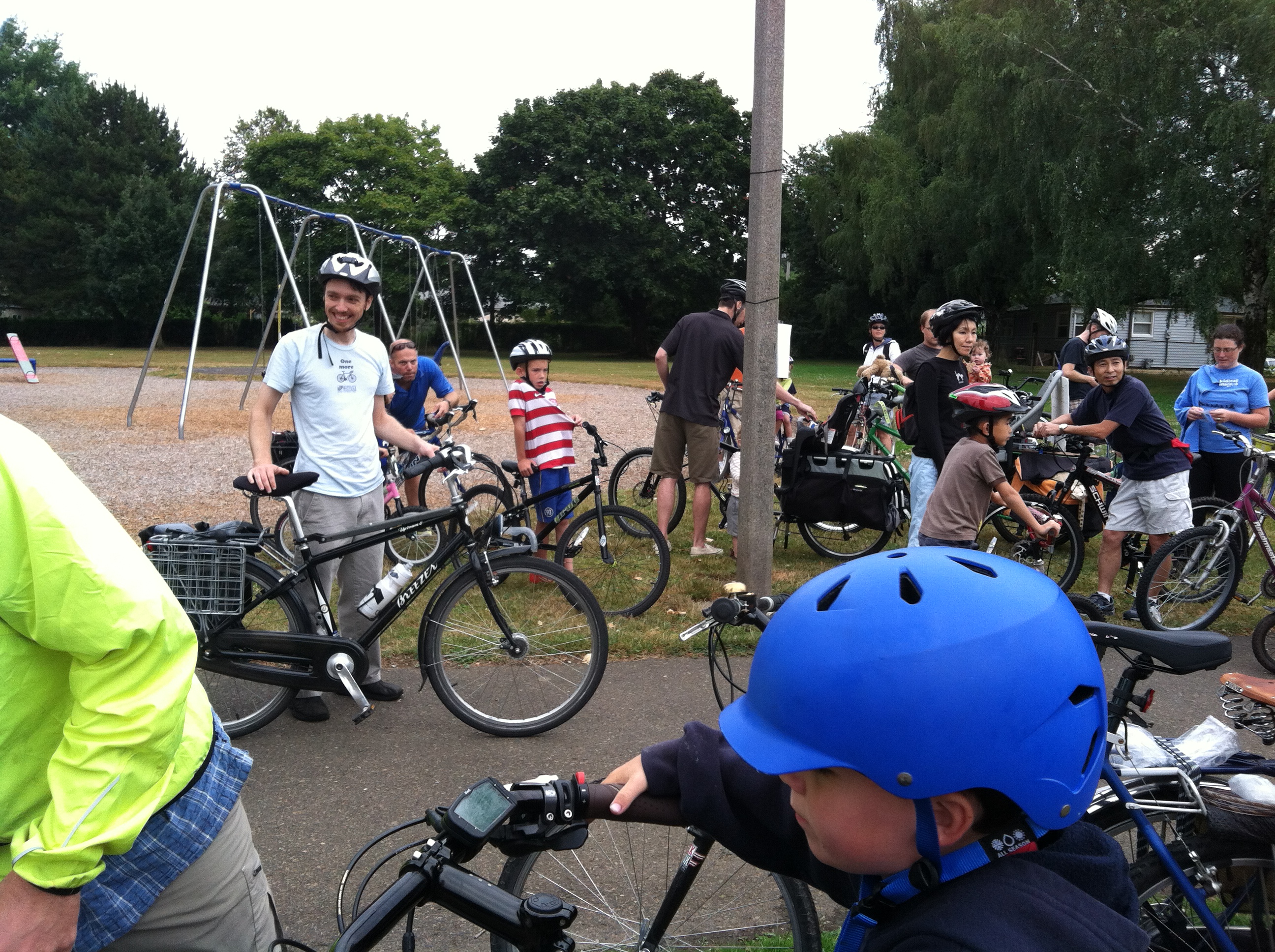
Rolling out with the Portland Kidical Mass crew. After six days in the high 90s to low 100s, it rained for the ride just as everyone headed to the ice cream stand. Surely we can do better than this.

From the Kidical Mass website: “The birthplace of Critical Mass, is holding our first Kidical Mass ride! Kidical Mass will be a contingent within the 20th Anniversary Critical Mass ride. Meet between 5:45 and 6pm, 9/28/12 at the SE corner of the big fountain in Justin Herman Plaza, where the fountain is closest to the grass. http://goo.gl/maps/0C3Ur . The plan is to peel off to end at Dolores Park around 6:45pm for an after-ride picnic.” The Hum of the city crew will be there for our own second Kidical Mass—we hit Portland’s party-rific afternoon ride in August.

Second, on Saturday, September 29th, the San Francisco Bicycle Coalition is hosting its 6th annual Family Day Celebration from 10am-2pm in Golden Gate Park, off JFK Drive at the 14th Avenue E picnic area (north of Stow Lake and east of the Transverse Drive overpass). Interested families can register online to get information about bike trains to the event and sign up for classes. We will be arriving late due to a critical ballet class, but will nonetheless be there in time for the 11:30am Family Biking Showcase, designed for those who are still on the fence about which rig might best suit their needs. Check out how to can carry multiple kids and fear no San Francisco hills! For those who have bikes already, the closing Family Bike Parade starts at 1:30pm.

Here’s part of the lineup at Portland’s Cargo Bike Roll Call. I’m assuming a similar scene in Fairfax.

Two weeks later, up in Fairfax, cargo bike enthusiasts can attend the Marin Biketoberfest’s Cargo Bike Jubilee. The event is on Saturday, October 13th, from 11am-6pm at the Fair/Anselm Plaza. Last year’s Jubilee included a bike art table, bike parade, bouncy house, and kid bike skills course, as well as the predictable display of cargo bikes. Attendees will include Splendid Cycles, traveling down the coast from Portland. We are unlikely to make it to the Jubilee because Matt will have just returned from Brazil. However our new cargo bike, a Bullitt Bluebird ’71 (“it’s superfly”), will be in attendance, so visitors can see it even before we do! Splendid Cycles offered to ship the bike to us in mid- to late-September, but given that they were planning to be here anyway in October, I chose the “free-to-me shipping because Joel and Barb are driving down anyway” option. Because our bike is occupying a space on their travel rack, it must pay its passage by spending a day entertaining the masses. I am already envying those will catch the first look.

Ride on, families!

4 Comments

Filed under family biking, San Francisco

Cargo bike pocket reviews

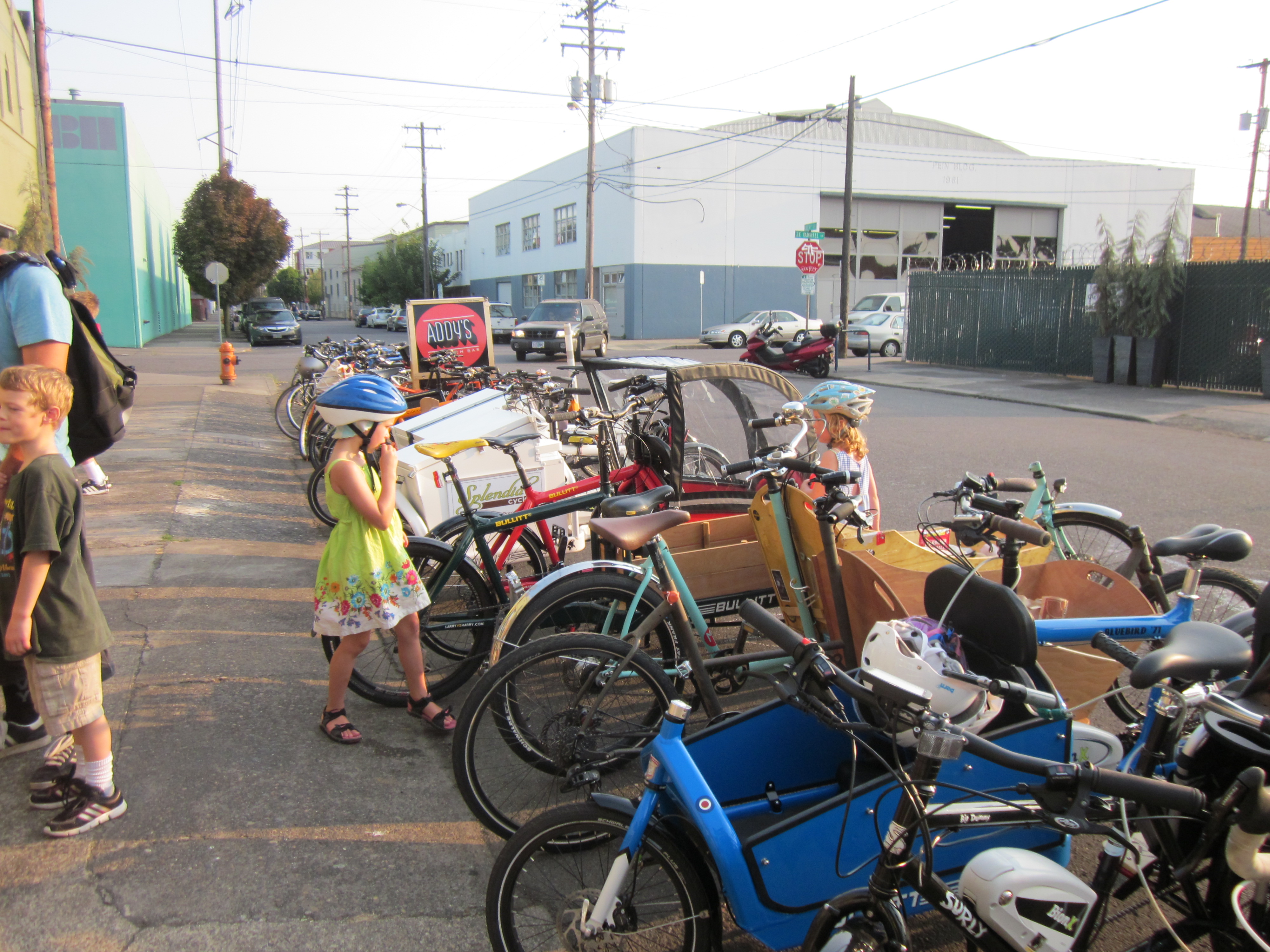
Bikes lining up at Seattle’s Cargo Bike Roll Call

We have tried riding a lot of family bikes over the last month, and for that matter, the last year. We didn’t try everything, although it sometimes felt like it. There are a lot of bikes left that could work for other people. I learned after reading Totcycle’s excellent review of midtails that it’s possible to review bikes you’ve never even ridden so: here goes!

Hard to categorize family bikes (that we have actually ridden)

There are some other configurations out there as well: Family Ride has a Bianchi Milano commuter bike fitted with both a front seat and a rear seat. However that kind of setup starts to get a little difficult once the combined ages of the kids get above about six years. Furthermore, a bike like that is going to need some aftermarket accessories: a decent center stand to keep it from falling over and some way to carry non-kid cargo (like diapers and snacks) are two big considerations.

Cycle trucks

A cycle truck doing a headstand at Seattle’s Cargo Bike Roll Call

Cycle trucks are bikes with a huge front-end loader that allows people to carry a ton of stuff there. Cycle trucks are similar to a normal bike with a frame-mounted front rack, but typically they have a smaller front wheel too. I don’t hear much about cycle trucks for family biking, as they’re mostly used as delivery bikes. However for one-child families, a cycle truck can be a neat way to haul a bunch of groceries and gear using the front rack/basket, with a younger kid in a front seat behind the handlebars, or an older kid in a rear seat. I could also  imagine putting two (younger) kids on a cycle truck, one in front and one in back, although you’d want to be careful about weight and balance.

Civia Halsted: The Halsted is recommended as a one-kid hauler by Joe Bike, who wrote an excellent summary of what it can do. I also recently learned there’s a family, bikeMAMAdelphia, riding with the Halsted and a cute little boy in a front Yepp seat. This bike looks like a lot of fun, and seems as though it would be good for city families given its relatively petite size. We didn’t take a test-ride because we didn’t make it over to Joe Bike but we knew we wouldn’t be getting one regardless because given our kids’ ages it would be a one-kid bike. The Halsted seems to run about $1,200.

There are some other cycle trucks out there, but this design hasn’t taken off as a kid-hauler in the way that other cargo bikes have.

Longtails

Family Ride carries my daugher and her youngest on her iconic pink Surly Big Dummy

Longtails are the bikes I see most often hauling kids and cargo here in these United States. They are competitively priced relative to most box bikes (e.g. “those bikes that look like wheelbarrows”) and most of them can handle hills, which feature prominently in the terrain of many West Coast cities, including mine. They look like normal bikes and ride like normal bikes except that someone streeeeeeetched the back out so they can be used to carry cargo and kids in the extra space between the rider and the rear wheel. Two kids can fit on the rear deck with enough space to limit fighting, and there’s also room for a front seat for little kids in the front. Reviews and links are in alphabetical order by manufacturer.

Kona Ute: The Kona Ute is the elder sibling of our first cargo bike, the Kona MinUte. Unlike the MinUte, the deck is long enough to hold two kids with breathing room. We could have managed a test ride of this bike through our local bike shop, but we ultimately didn’t because friends and acquaintances that had ridden it with kids all said that the rear deck is so high that the bike never really felt stable. Only people over six feet reported getting comfortable with it. As a cargo bike, with the load down low in the panniers, the Ute is apparently fantastic. However we didn’t find anyone who’d stuck with the Ute as a family bike long-term; they’d all switched to other bikes, most frequently the Big Dummy or the Mundo. There are great prices on this bike on secondhand, which may be worth investigating for tall parents. List price is $1,300.

Sun Atlas: The Sun Atlas is the cheapest of the longtails (cargo bikes are generally not cheap) at an astonishing price of less than $700. We didn’t take a test ride of this bike for two reasons: first, we didn’t make it to Joe Bike when we were in Portland and no one else had it in stock, and second, the components, as one might expect given the price, are not great. San Francisco is pretty hard on bikes and we have replaced many parts on the Kona MinUte already (brakes, wheels, pedals, tires, derailleur guide) due to local conditions. This has grown tiresome given that Matt needs to ride that bike almost every day, and the days he doesn’t need it, I usually do. We knew that we wanted a bike this time that wouldn’t constantly need to go to the shop. But for people who live in less difficult conditions or ride less frequently, this could be a good option. Carfree with Kids considered this bike, and there are discussions of it on the websites of Joe Bike and Clever Cycles. Note that there appears to be some disagreement as to whether it would work for shorter riders.

How to spend a Sunday afternoon: Meet friends from school, ride around on cargo bikes.

Surly Big Dummy: Our experience riding this bike is here. There are so many other reviews of this bike on the internet that I didn’t bother to sort through them.

Trek Transport/Transport+: Trek recently released the Transport and Transport+ cargo bikes; the Transport+ is sold with an electric assist. It has a very interesting rear bag design that looks as though it can carry quite a lot of stuff, but with those side loader bars this bike appears to be even wider than the Yuba Mundo. Trek specifically states that the Transport is not designed to carry passengers, not even on a child seat. We didn’t look for one to try because we wanted a bike to carry our kids.

Put a FreeRadical on it, Portland.

Xtracycle FreeRadical/Radish: The Xtracycle FreeRadical isn’t really a bike per se but a longtail attachment that can be added to an ordinary bike. It is the ancestor of the American longtail. The Xtracycle Radish is a FreeRadical attached to a donor bike for people who don’t have one of their own. We didn’t seriously consider a FreeRadical because they are reported to be unstable above about 70 pounds of weight and our kids together weigh more than that. They also have a reputation for flex on hills, and there are a lot of those where we live. But for people in flatter locales (which is, okay, basically everyone) or with younger kids, or a single kid, this is a very cost-effective way to start family biking. Plus it gives you access to the many wonderful Xtracycle accessories. The Xtracycle catalog is so extensive and complicated that I have trouble figuring out how much stuff costs though. Davey Oil keeps promising to write more about his beloved Wheelio, a Japanese mixte bike that he Xtracycled. Car Free Days has written for years about their Xtracycles, which did in fact make them car-free.

Xtracycle EdgeRunner: The Xtracycle Edgerunner (link goes to the Momentum review) is the first bike that seems to have been developed specifically for families who are riding in very hilly terrain. Thank you, Xtracycle! Our first experience test-riding this bike is here. Later I wrote an updated review of the 2014 EdgeRunner. The verdict: the EdgeRunner is a category-killer, the best longtail we have ever ridden.

Yuba elMundo: Our experience riding this bike is here.

Yuba Mundo: Our experience riding this bike is here.

Midtails

Our MinUte chats up some other school bikes at one of the courtyard racks

As of 2012, three companies had developed a new kind of cargo bike: the midtail. (Okay, update in December 2012: the first midtail was really the venerable Workcycles Fr8. At first I’d classified it as a longtail, but it is short enough–although much too heavy in its kid-hauling incarnation–to fit on a bus bike rack, so I’m now calling it a midtail.) The first American midtail was the Kona MinUte, and it was enough of a hit that two more companies have now developed similar designs: Yuba, a company in Sausalito developing heavy-duty family bikes, and Kinn, a new startup in Portland making only a midtail. As the name implies, midtails are like a longtail, but shorter. The big advantage of the shorter length is that (most of) these bikes are transit friendly: they can fit on a bus bike rack or Amtrak (given some maneuvering). The best place to learn about these bikes is Totcycle’s outstanding summary.

If your kids are widely-spaced, say more than three years apart, you could fit an infant seat on the front of a midtail and put the older one on the deck behind. Then when the little one outgrows the front seat, the older is likely to either be riding solo or riding a trailer bike. Or you might be able to swing a couple more years with one on the front using a Leco top tube seat (which–fair warning!–is not suitable for all bikes). The midtail, which has much more cargo-carrying capacity than a normal bike, also appeals to non-parents looking for a normal-looking bike to haul groceries and other loads that would otherwise require attaching a trailer.

Our first bike was a midtail, the Kona MinUte. Like all midtails it can carry one kid on the rear deck (two kids can fit there too, but only if they’re in a good mood). The rear deck can also be fitted with a child seat for younger kids. We’ve never found a seat necessary once our kids reached three years, but your mileage may vary, and there are seats for older kids if so (the Bobike Junior or Yepp Junior). Adding a seat cushion is a nice touch.

Kona MinUte: Our experience riding this bike is here. Kona can’t decide whether it’s going to keep making this bike or not. As of 2014, they are not producing it, but recently promised to resurrect it. I’ve posted a few times about our MinUte; it is an underrated bike, in large part I think because of Kona’s indecision about whether or not they really want to be in the cargo/family biking market.

I'm embarrassed that this is as far as we got on the Fr8. At three my daughter would be able to ride that front seat for a while.

I’m embarrassed that this is as far as we got on the Fr8. At three my daughter would be able to ride that front seat for a while.

Workcycles Fr8: The Fr8 is a European midtail that has the capacity, unlike most of these bikes, to carry an child in front that is over the length/weight limit of a normal front child seat. The front seat mounted to the top tube is a saddle, and really best for kids old enough to balance. A big advantage of the Fr8 is the ability to keep two kids separated and still carry a bunch of stuff (the Fr8 accepts standard panniers and has a huge front rack), or to carry three kids after adding two rear seats. However this is a Dutch bike designed for the flat flatlands of the Flatherlands and it weighs 75 pounds, reportedly can’t go up more than a mild hill, and isn’t recommended for an electric assist. (There is evidently a lighter version coming recently or soon called the Gr8.) We live in San Francisco: there is no way. I still feel like I should have ridden this bike when we were in the shop, and I regret that I didn’t. It was 100 degrees that day and we were just so tired because we’d already ridden a half dozen other bikes that morning. If I lived someplace flat I would not have skipped trying this bike, even though the base model costs $2,200. It looked indestructible and is supposed to have a very smooth ride, and there are a lot of nice features like lights, a full chain guard, and fenders included in the price. Mamafiets wrote a nice review of the Fr8.

Yuba Boda Boda: Our experience riding this bike is here.

Kinn Cascade Flyer: We didn’t try this bike in 2012 because it wasn’t released yet. The Kinn is a gorgeous midtail based on a mixte frame, which means that the top tube slopes down toward the seat so it’s easier to step on and off. There are some very clever features on this bike: part of the deck rotates out 180 degrees to hold wide loads or make a better seat; it has a lockbox integrated into the rear deck, the passenger footpegs are adjustable, and it appears to have bars below the deck that will hold standard panniers. The Kinn is the only midtail that allows the attachment of a Follow-Me Tandem. Regrettably, it was made by tall people and has huge wheels, like the MinUte, so may not be the best choice for shorter riders. We still have yet to ride it, because it is a hard bike to find. It went into a tiny production run in Fall 2012 (30 bikes) and sold them for about $2,000; a second small production run followed in 2013. The extra cost gives you those clever design features, nicer parts, and a bike built in the USA.

Box bikes
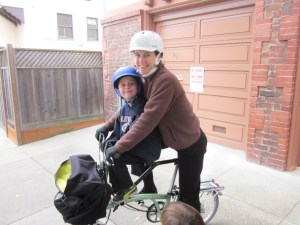
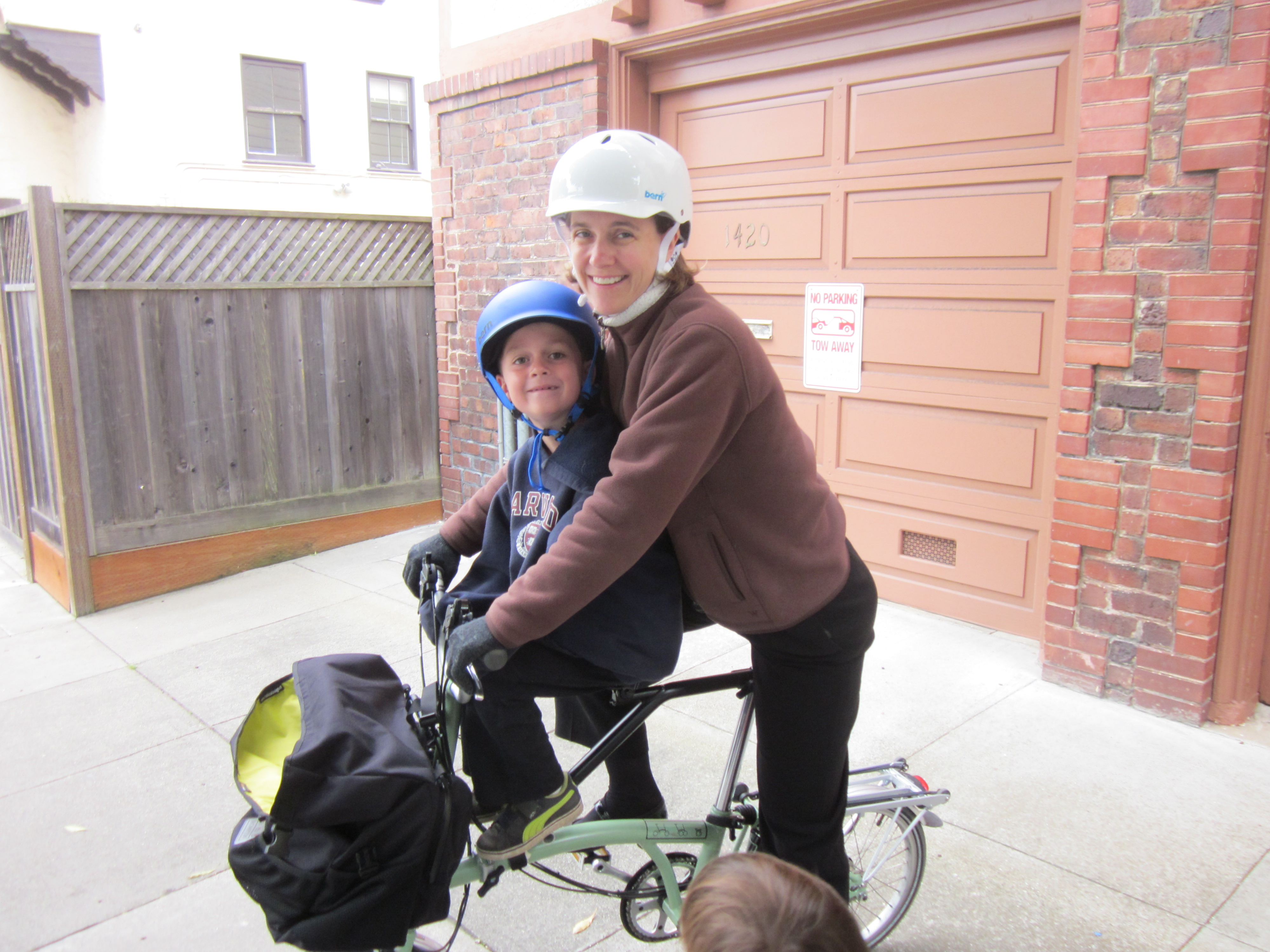
Our son is almost four feet tall and he still fits on the Brompton with me.

Most parents love front box bikes, aka long johns, aka “those bikes that look like wheelbarrows” because the kids are in front where you can see them and talk to them. When we first started thinking about biking with our kids this didn’t seem like an important consideration. The more we rode with them the more we started to care. I ride the Brompton, which has a front child seat, in places that I probably shouldn’t (it’s not a great hill climber) just because I love having my kids in the front. I can see them and they lean back and look at me. They get a great view and are much more engaged in what’s going on. And my son will sometimes throw his arms around mine to hug me while we’re riding the Brompton and shout, “I LOVE YOU, MOMMY!” I have no words. I will keep him on that seat until he’s taller than I am.
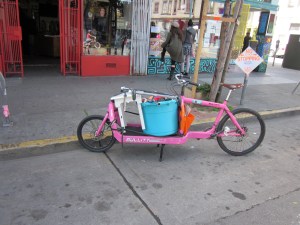
See what I mean? You can put all kinds of stuff in a box bike.

So: front box bikes are cool. They’re also really good haulers, because they have a cargo box. You can carry stuff in a box bike that would never fit in a car, like bookshelves. Front box bikes are also expensive relative to longtails, and most of them have virtually no hill climbing capability. So that’s a bummer.

Babboe: The Babboe is similar to the Bakfiets in looks, listing at around $2,500 instead of $3,500. This is evidently a very popular bike in the Netherlands, and they are planning a roll-out to the US in September 2014 (online at least). Here’s a 2012 review from a family in Ottawa, and a 2013 updated review from bikeMAMAdelphia. These reviewers suggest that the price difference may reflect to some extent what comes standard on the bike (e.g. the Bakfiets comes with a rear rack, the Babboe does not) and the quality of parts (e.g. saddles and tires), but many families are happy making those kinds of compromises for a more affordable price–the same kinds of decisions come up in shopping for longtails as well.

Bakfiets: This is the bike people think of when they think about family box bikes. Our experience riding it is here. There are many other reviews of this bike out there, but one of the best I found was written by a father on the one-year anniversary of getting the bike.

Bullitt: Our experience riding this bike is here. It is one of the rare front-loading box bikes that can climb hills. (This is the bike we bought.)

Four kids pile into the Largo. It was hard to get them to take turns.

CETMA Margo/Largo: I really wish I’d tried this bike too. There weren’t any in stock at the shops we visited (and for that matter, at the shops we didn’t visit). I did see one at the Seattle Cargo Bike Roll Call, and the kids loved it. They were piling four at a time into the box and riding around. The pros of the CETMA, from what I’ve read, are that it offers a very stable ride, can climb at least moderate hills, and that it’s relatively easy to add an electric assist, at which point it can climb steep hills. What’s more, the frame splits into two parts, making the resulting package small enough to transport easily. The CETMA costs $2,850 for a complete bike, although this price does not include the box, which sells for $300. When you add in all the extras you’d get on a Bakfiets, like lights, chain guard, fenders, seatbelts, and so forth, it’s probably comparable. However much of the bike can be customized, because all CETMA bikes are made by one guy who formerly lived in Eugene but recently moved to California. As a result, he stopped producing bikes in June 2012 and began filling them again in October 2012. This meant that we would have had to fall for this bike very hard, because getting one would involve a long wait indeed. Without a test ride that wasn’t going to happen. That said, one of the reasons we got the Bullitt was that its narrow profile made it easier to ride on the busy streets of San Francisco, and the CETMA bikes are definitely not that narrow. I found a video review from one happy customer (but: six months to get the bike!) and a written review from a less-happy customer.

[updated] Christiania 2-wheeler: This is a dark horse box bike that I had never even heard of until I read the comments on the original post. One mom riding a Christiania wrote an extremely detailed review of the bike, as well as how it works for their family, with some great thoughts on similar bikes in its class as well.

Gazelle Cabby: Clever Cycles used to stock the Gazelle Cabby, but they didn’t have one when we visited and no one else did either. The Cabby is distinctive in part because it has a fabric rather than a wooden box. The box actually folds up from the top, and with the top edges together it can be locked with stuff inside, which is pretty neat. In addition, the folding box means that the bike can be made very narrow, which makes parking it much easier. However I wonder about the durability of the fabric of the box, and like most box bikes it’s slow and supposedly hard to get up hills. It is a Dutch bike so it comes with lights, a chain guard, fenders, and a rear wheel lock. When it’s in stock Clever Cycles sells it for $2,800. Family Ride has ridden the Cabby twice (1, 2), and a couple of other families have written up their impressions as well. And in 2013, bikeMAMAdelphia weighs in again with a test ride.

Metrofiets: Our experience riding this bike is here. It can handle hills.

Shuttlebug (and Joe Bike Boxbike): These made-in-Portland bikes are no longer in production.

Urban Arrow: The Urban Arrow is a fascinating take on a front box bike. In 2014, we finally had the chance to ride it for a review. It has a lot of interchangeable parts, so the bike can switch from being a family bike with seats for kids to a cargo hauler with a locked box. It’s also possible to swap out the entire front end and turn it into a cycle truck. Unusually, it comes standard with an integrated mid-drive electric assist, so it is capable of handling hills. However when we were looking it wasn’t available in the US, and given the long lead time (it had been “coming soon!” for three years) I assumed it would never be. As of March 2013, the Urban Arrow is now available in the US: read about bikeMAMAdelphia’s test ride! Here’s a 2013 update on life with the Urban Arrow, again from bikeMAMAdelphia. This bike has become easier to find in the US as of 2014, but it’s still pretty elusive. Note that there have been reliability issues with the first-generation Daum motors, and a couple of shops have reported that Bosch’s support for the second-generation motors has been somewhat spotty. Buying from a trustworthy shop is critical for all assisted bikes. 

Winther Wallaroo: Our experience riding this bike is here.

Tandems

This is a tandem for grownups, but you could put kid-cranks on it.

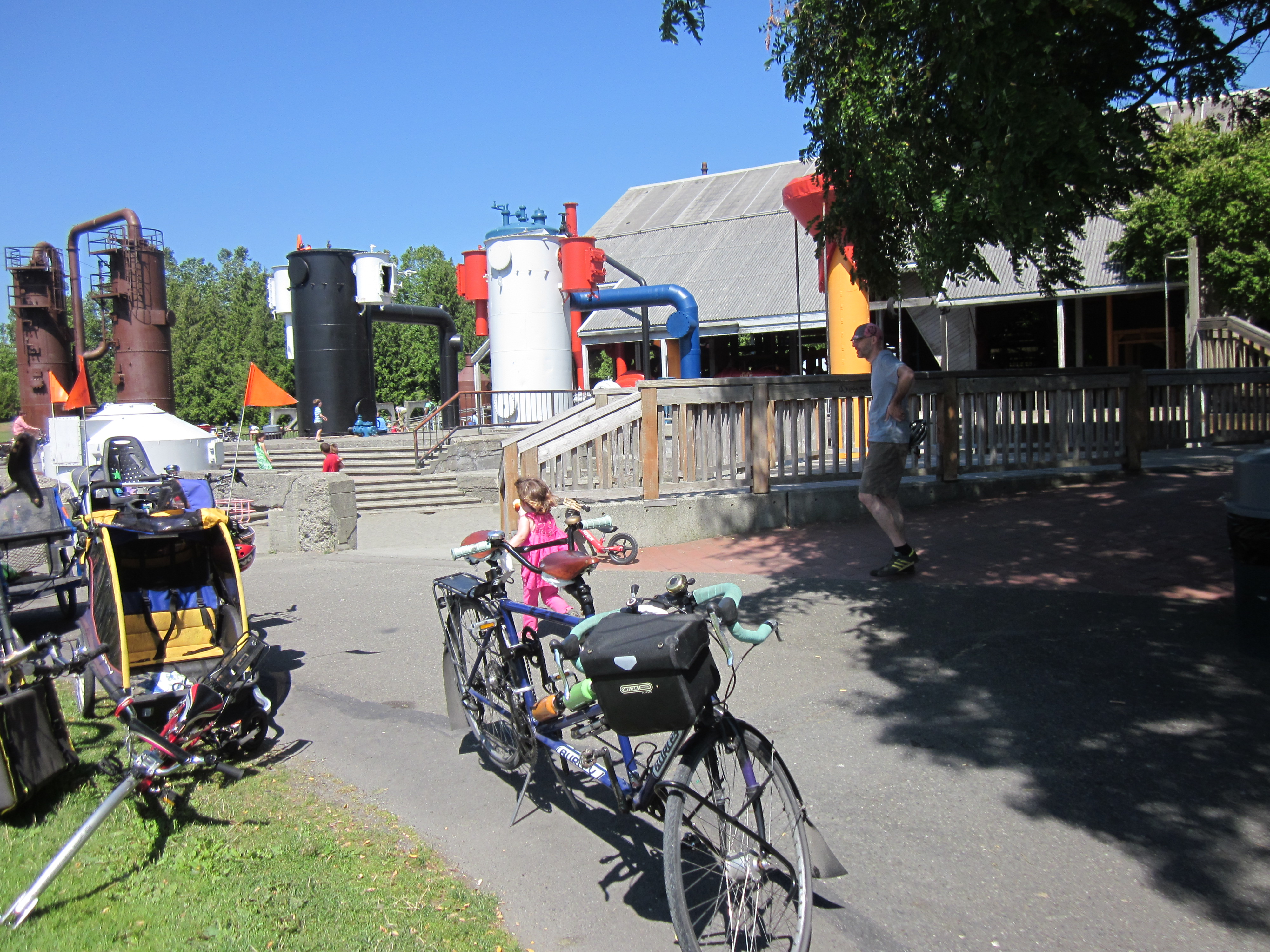
Tandems are fun! Okay, we’ve never ridden one, but they sure look fun. One friend rides a triple tandem with his daughters to school. Car Free Days just rode two tandems down the West Coast as a summer vacation. My kids are very excited about the idea of tandems, because riding a tandem would allow them to pedal, which they think is cool. Tandems are also interesting because as a couple of people have now pointed out to me, they have solved the cargo bike braking issue. Modern tandem bikes typically have two sets of brakes: hub brakes to slow the bike and wheel brakes to stop them. Both are controlled by the captain (the rider steering, who usually sits in front, although not always). With two sets of brakes, it’s possible to slow and stop a heavily loaded bike without the brakes overheating, and with a backup system you’re less likely to launch off the edge of a hill if one set of brakes doesn’t have enough stopping power by itself. When I learned that I was even more excited by the idea of a tandem bike. However a weakness of these bikes is that they’re not great for carrying cargo (they usually hold a set of standard panniers at most, plus whatever riders want to carry on their bodies). In addition, for situations where one person gets off one place and another gets off somewhere else, like our commute, it would be weird (and heavy) to haul around an empty bike. On the up side, with everyone on board and pedaling, they’re supposed to go really fast.

This is Shrek 2.

Bike Friday triple tandem: The PTA president at our son’s school and his partner bought a Bike Friday triple tandem on eBay to take their daughters to school. It is big and green, so they call it Shrek 2. My kids go nuts for this bike. ALL kids go nuts for this bike (except for their girls, who are used to it). They offered us the chance to ride it for a couple of weeks this summer while they were away and I was so excited. However our daughter, at age three, is still too small to fit on the bike and so we decided to wait until she was taller (otherwise there would be meltdowns when her brother could ride and she couldn’t). We had hoped to try riding this bike in 2013, but unfortunately I was hit by a car, and while I was incapacitated they swapped it for an Xtracycled tandem. The advantages of a triple tandem bike are pretty obvious: a parent can take two kids somewhere and get help going up hills, plus the kids are excited to help pedal and don’t get cold because they’re doing some work. Plus the coolness factor is off the charts; practically everyone riding in San Francisco recognizes this bike. A downside is that the bike is really long. I have no idea what a triple tandem would cost new; it was custom before they scored it on eBay.

Buddy Bike: The Buddy Bike is another Joe Bike production. It allows special needs kids to ride in the front of a tandem bike holding onto the handlebars. But because the handlebars are quite long the parent in back is really controlling the steering. This is such a lovely idea, although it’s a specialized market. We didn’t try it because our kids don’t fit the profile and because we didn’t make it to Joe Bike (which I am really kicking myself about as I write this).

Circe Helios family tandem:  I heard about the Circe Helios from a blog reader. It’s a longtail! It’s a tandem! It fits on public transit! It’s not available in the United States! [update: Yes it is! College Park Bicycles in Maryland is now importing the Circe Helios. They say it is in stock but have no details or prices on their website, which is bike123.com.] The Circe Helios has 20” wheels, in part to keep the length down to public transit compatibility (I’m not sure whether it would really fit on a bus rack, or just British trains). The back end can be switched from a long tail that holds to two child seats and cargo to a tandem seat with room for a rear child seat (and cargo bags). The stoker seat in the rear can be adjusted to carry any size rider from about a three-year-old to an adult. A couple could buy this bike and keep it through two kids learning to ride, then switch back to riding it solo as a longtail or as a couple in its tandem form when the kids grew up. It’s a lifelong bike.

Outside of Counterbalance Cycles, where we did not try riding a tandem.

Co-Motion PeriScope: When we were in Seattle we had the chance to try a Co-Motion PeriScope at the very friendly Counterbalance Bicycles, a shop located right on the Burke Gilman trail. Co-Motion makes tandems noted for their hill climbing chops. I spent a lot of time convincing my son, who was in a very grouchy mood after falling off a BMX bike he’d been riding, that he wanted to try this bike. It was very disappointing when we discovered he was still about an inch too short to reach the pedals. The Co-Motion is a sport tandem not set up for commuting in any way; it didn’t even have fenders. But it looked like it would go really fast. I like that. We will return to Seattle again; my mom lives up there. When my son is taller, we will ride this bike. The model we almost tried cost about $3,000.

KidzTandem: The KidzTandem is a kid-in-front tandem bike that Clever Cycles sells. Having the kids in front on a tandem has the same advantages as having the kids in front in a box bike. We were very excited to try this bike, even though no one seemed optimistic about its ability to climb hills, and the review I found agreed. Unfortunately Clever Cycles had just sold the only one they had had in stock (“This has never happened before!”) It costs $2,000 and eventually they’ll get another one in stock. I think you can rent it when that happens, and Clever Cycles has very reasonable rental rates.

My husband: “That Onderwater is the goofiest bike I’ve ever seen. It looks like something out of a Dr. Seuss book.”

Onderwater triple tandem: In one of those weird twists of fate, Clever Cycles did actually have a family tandem in the store, the Onderwater triple. It had been custom-ordered for another family and was already sold, so it wasn’t a bike we could test ride. It’s not a bike they usually stock. The Onderwater triple, like the KidzTandem, puts the kid in the front. Chicargobike has an Onderwater that they’ve written about. Like most of the Dutch bikes there are lots of creative ways to carry kids on this bike; in addition to the front stoker seats (up to two), there is an optional jump seat that can be attached in front of the parent, and it’s also possible to put a rear child seat on the back. So you could have up to five people on one bike, and three of them could pedal (no, Dutch families don’t wear helmets, thanks to all that protected infrastructure). Like all the Dutch bikes, it comes with all the goodies: lights, fenders, chain guard (on a tandem, no less). Like all the Dutch bikes, it weighs a ton and you couldn’t get it up a serious hill even if you were being chased by a horde of ravenous zombies. The triple tandem is a custom bike so pricing is unclear. [Update: There is now an Onderwater tandem roaming the streets of San Francisco–a dad riding his kids to school. He said that they make it up moderate hills.]

Tricycles

Matt is looking for a route that doesn’t have anything approximating a hill because we’re riding trikes.

We rode a couple of trikes, the Christiania and the Nihola. There are other trikes on the market (Bakfiets makes one, plus there’s the well-reviewed Winther Kangaroo, Family Ride rode the Triple Lindy, etc.), but I’ve never given them much thought because trikes are totally impossible on hills and we live in San Francisco. I think that they could be fun in flat cities.

Somebody stick a fork in me: I think I’m done for a while. Did I miss anything? Please let me know in the comments!

34 Comments

Filed under family biking, reviews

Last bike standing

Portland Cargo Bike Roll Call: decisions, decisions

In August we rode a lot of cargo bikes trying to find the one that would work for us. We wanted a car-replacement cargo bike that could take two kids and their gear up and down some of the steeper hills of San Francisco. We had headed to Portland to try every plausible option in the multiple shops catering to family bikers there. It felt like a charmed trip, a no-lose proposition.

But by the middle of our week in Portland I was feeling depressed. I had spent much of the day wobbling through the streets of Portland with all the grace of a concussed bumblebee on the rental Bullitt. Matt had dumped the kids on the way home on the rental Big Dummy. It was miserably hot. We had tried every reasonable two-kid hauler we could find, and we still couldn’t figure out what to get. There were other bikes we might have tried given more time, like the forthcoming Xtracycle Edgerunner or a CETMA Largo or the incredibly elusive Urban Arrow (no one can tell me whether this bike even exists), but for various reasons these bikes were unavailable for at least the next few months. And even if we waited there was no guarantee we’d like them.

In hindsight it sort of surprises me that at that point we didn’t bail and decide to buy another car. We had lived without a car long enough at that point that it didn’t seem like the answer (it’s not). I did seriously wonder whether we should just ditch the idea of getting a big cargo bike and stick with the MinUte (short answer: no). For a moment it seemed appealing because we liked the MinUte, we could both ride it without dropping our kids, and it could handle the hills. But as an everyday ride for  our two older kids: no way. When kids scuffle on a midtail deck it’s like a cockfight: there’s no place to run. Trying to ride with them on the MinUte sometimes works beautifully but often means making a City CarShare reservation. Having to do that once a week is not expensive compared to owning a car (about $6 per trip–unbelievable! the same as Muni fare!) but it’s a hassle. And we still get stuck in traffic and have to figure out where to park. For the sake of our sanity, we’d all rather be riding a bike.

To make living without a car workable right now, and for me to manage shuttling two kids around while still making it to work on time during Matt’s overseas business trips, we needed a bike I could use to carry both kids at once. After riding all those bikes, there were four that we believed could work for our situation (to recap: two kids ages 3 and 6 in different schools, steep hills, heavy car traffic). Two were front box bikes and two were longtails.

These are all great bikes, and all of them can be made into serious climbers with an electric assist. I’d recommend them to anyone looking for a family bike (and not just them). All of them make appearances in San Francisco. Of those four, we ruled out the Metrofiets and the Yuba based primarily on size and hassle factor. The Metrofiets is one of the longest front loading box bikes—we loved the space in the box on that bike, but pushing it out into intersections made us nervous even on quiet Portland streets, and parking it would be a challenge in San Francisco. The elMundo is short, but the bars sticking out from the sides in the back made the bike wide enough that it was difficult for me to feel comfortable navigating in traffic when I rode it. In addition, given the demand we’ve placed on our bikes in San Francisco (sometime I will list all the parts on the MinUte that we replaced after they broke due to the hills, crappy pavement, and dirt of San Francisco—thankfully under the first year’s warranty) we would only have considered buying the Mundo as a frame kit, building it up with much better parts than come stock, and upgrading the weaker eZee assist to a BionX. That seemed like a lot of work for a bike I hadn’t fallen in love with.

Splendid Cycles was right: the two bikes that seemed like the best bet after we’d ridden many bikes were the Big Dummy and the Bullitt. Both bikes could carry both kids and both bikes could handle the hills we threw at them. Both of them were narrow enough to handle tight squeezes, either on the move or when parking on the sidewalk. The Big Dummy was easy to ride and despite my initial concerns about weight limits, we saw ample evidence that people could take two older kids up hills on it (and sometimes three). But the kids were in back where we couldn’t talk to them and we kept dropping the bike. The Bullitt was a better climber, and allowed us to keep the kids in front and separated. But we were still having trouble with the steering.

I started considering stupid decision rules. Like: all the bikes I’ve owned start with the letter B! Breezer (RIP), Brompton, and Bridgestone (the mamachari). I should get the one that starts with the letter… shoot!

But then I remembered the advice that guided me to the Brompton, a bike I’ve never regretted getting: buy the cool bike. The person who wrote that was advising people to buy the bike that they most wanted to ride, even if it was impractical. But neither of these bikes was impractical. We couldn’t lose. So the next morning I loaded up the kids and got on the bike I most wanted to ride. We took off without a wobble. It felt like flying. It felt like a miracle. We bought the Bullitt.

28 Comments

Filed under electric assist, family biking, reviews, San Francisco