Tag Archives: family biking

A series of family biking events, 2014 edition

There is a lot to do if you are interested in family biking, mostly in San Francisco but also beyond. Here’s everything I know about this summer so far in date order—and don’t miss the good stuff at the end.

July 13th (11am-4pm): Richmond Sunday Streets

We went to Richmond Sunday Streets last year—this was a great event for kids to ride their own bikes because it was car-free all the way from Golden Gate Park to Clement Street. We had no worries about cross-traffic for miles.

July 19th (11am-5pm): Fiets of Parenthood and the Disaster Relief Trials, Portland, Oregon

We are finally going to make it to Fiets of Parenthood, which will be held at the Oregon Museum of Science and Industry on July 19th. Come to compete or to test out cool cargo bikes—Splendid Cycles claims they’ll have a Bullitt with the new extra-torquey BionX D system to try. There is also a new class in the Disaster Relief Trials, the non-competitive Replenish division, as well as the competitive classes competing for time (we are so not doing that). To participate in Replenish you have to haul a non-pedaling passenger (no tandems). Our California contingent will be easy to spot, as we’ll all be on child seat-equipped Bromptons. Go Grizzlies.

August 24th (11am-4pm): Mission Sunday Streets

Our first Mission Sunday Streets in 2012

Our first Mission Sunday Streets in 2012

Mission Sunday Streets is the first we ever attended and it’s always the most crowded, but it’s no less awesome for that. We usually hightail it to Dynamo Donuts first thing in the morning, then turn around and return at a more measured pace. Our bikes are easy to spot if you’re looking for us.

September 2nd (10am-11am): How would you make buying and using a cargo bike easier? A conversation with Vie Bikes at Koret Playground in Golden Gate Park (look for the sign near the Carousel)

Vie Bikes is a new company formed by three San Francisco cargo biking parents intent on making it easy as pie to find, buy and use the best cargo bikes on the market. Among other things, Vie will offer month-to-month leasing, and built-in quarterly service that comes to you. Vie is planning to launch in San Francisco in the coming months, and expand in to new cities thereafter. Stop by Koret Playground to talk with Vie’s founders, including long-time Hum of the City reader Kit Hodge. Vie is looking for feedback from both people who have cargo bikes and people looking for them regarding key aspects of our service.If you went through the process of shopping for a cargo bike again, what would you change?If you’re in the process now, what are you finding challenging? Be part of shaping a company that will transform cargo bike use across North America. RSVP to info@viebikes.com. Can’t make it but want to weigh in? E-mail info@viebikes.com with your thoughts. We’ve known Kit for a long time and were very excited about the idea of a cargo bike leasing company, which is both totally novel and totally cool. I hear there will be sample bikes to check out as well.

September 14th (11am-4pm): Western Addition Sunday Streets

Western Addition Sunday Streets 2013

Western Addition Sunday Streets 2013

Western Addition Sunday Streets is one of my favorites because a large section of it goes through neighborhoods rather than a major commercial strip. It’s also much less crowded because the route hauls people up over Alamo Square, so beware. We usually start at Chili Pies and Ice Cream and wander over toward Japantown.

The final two events are only relevant for Rosa Parks families, but if you are such a family (or you’d like to be eventually), please feel free to join our community even before school starts.

July 12th and August 16th (11am-1pm): Rosa Parks Incoming Kindergarten class family potlucks

Family bikes round up in the lower courtyard. Incoming kindergarteners can meet and play with each other and their future teachers. These are fun events—at the August potluck, classroom assignments should be out as well. We may miss the August potluck because of our Camp Mather trip, but we’re going to try to make it to both. Hope to see you there.

Happy riding this summer.

Leave a comment

Filed under Brompton, destinations, electric assist, family biking, Portland, San Francisco, Xtracycle

We tried it: Xtracycle EdgeRunner (assisted and unassisted)

Test riding the stoked EdgeRunner in Seattle. Thanks to Davey Oil for the chance to ride, and Madi Carlson for the great photo!

Test riding the stoked EdgeRunner in Seattle. Thanks to Davey Oil for the chance to ride, and Madi Carlson for the great photo!

In 2012 I rode the prototype EdgeRunner. It was a hard bike to review because it wasn’t really in production yet, so a lot of the specifics were unsettled. I liked it, but that review does a lot of blah-blah talking about longtail history as a result of my uncertainty about the ultimate production model.

Since then I’ve had the chance to ride real EdgeRunners, both unassisted (at Blue Heron Bikes) and assisted (both stoked and BionX, at G&O Family Cyclery). These are much easier to review, although I suspect my reviews will always be long reviews (not to mention they’re all my personal opinions and other informed observers may differ, YMMV, etc.) For those with shorter attention spans, here is the 6-word summary I’ve promised for all reviews going forward.

EdgeRunner: Best longtail ever. No contest.

I’ve mentioned before that my first impression of the EdgeRunner, when it was just a picture on the Xtracycle home page, was: “Wow, that is one ugly bike.” Let me officially eat crow: in person, the EdgeRunner is lovely. And it is awesome to ride.

What I like about the EdgeRunner:

  • The EdgeRunner feels like riding a regular bike. Cargo bikes, as a class, are the minivans of bicycles, and in general that is reflected in their handling and speed. They are typically a lot of work to ride. However the EdgeRunner is about as close as you can get to a cargo bike that rides like a normal bike without violating the laws of physics. (Our Bullitt is similarly nimble, but obviously, as a front loader, it is nothing like a regular bike.) This is a bike that a novice rider can pick up and ride with a minimal learning curve. That said the first test ride on any cargo bike should be sans cargo, especially live cargo.
  • The EdgeRunner is stable. My biggest concern in the past with longtail bikes (and the Madsen) has been that we both ended up dumping the kids. All that weight on the back of the bike can be very difficult to control while holding the handlebars in front—and neither Matt nor I is particularly lacking in upper body strength. The EdgeRunner’s big innovation is a smaller rear wheel (20”) which means the deck can be a few inches lower, and those few inches make a world of difference with respect to handling. Over the last year I became very cautious while walking a bike with my kids on it because on occasion my bad right leg would twist right from under me without warning. I was so confident while walking the EdgeRunner that I did things I probably should not have done, like walk into a shop holding the bike up with one hand and pushing the door open with the other. Yet I never felt that the bike would tip, and it never did. The lower deck also means that the EdgeRunner can take downhill turns at higher speeds. On longtail bikes with higher decks, the weight on the rear pulls against the turn, and it genuinely feels like the bike could tip over. This is not a concern with the EdgeRunner. The smaller rear wheel is truly a game changer.
  • This is a lightweight bike (relatively speaking—no cargo bike is truly lightweight). As a result, there is less of it to haul around. There are two places you can really feel this: when trying to go up hills, and when trying to start from a dead stop. These are also the two places where I feel the most vulnerable while riding—other traffic often fails to appreciate the slow starts endemic to cargo bike riding, and going up hills is its own horror story—the slower you go, the more the bike wobbles. Although there is sometimes a tradeoff to be made with respect to the weight of the bike and how much you can haul on it, happily the EdgeRunner also swallowed the weight of both my kids—now much heavier than they were over two years ago when we first went cargo bike shopping—without complaint.
  • The Xtracycle accessories are the best longtail family biking kits I have ever seen. In terms of family and cargo biking innovation, Xtracycle is unmatched. The deluxe models sold by most family bike shops even come with dynamo lights, which is nothing I’ve seen before on any non-European family bike. The deck is now designed to have Yepp seats pop directly in, while older kids can be corralled by the adjustable Hooptie (no need for stoker bars). The Xtracycle bags (recently upgraded) can haul almost anything, and do particularly well with long and skinny things that are tough to dump into a front loader. Add in various cushions and foot rests and the SideCar to haul cargo and this is an astonishingly versatile bike.
  • Longtails are easy to park. As much as we love our Bullitt, it can be a bear to park at normal racks, despite the fact that it is the skinniest front loader of them all. The EdgeRunner, like all longtails, can be bumped over curbs and at worst, will stick out a bit more than usual from a bike corral. This is a much more flexible way to travel than with a box bike or a trailer.
  • The parts are not crappy. To get cargo bikes down to price points that keep inexperienced riders from choking in disbelief, there are often compromises made with respect to the quality of the parts. This can be very scary indeed when it comes to, say, brakes, because a bike that is carrying 100 extra pounds is not a bike that should be skimping on stopping power. There are various models of EdgeRunner and the quality of the parts improves with each increased price point, but even the cheapest models do not compromise basic safety.
  • The EdgeRunner comes in multiple frame sizes. This matters less for me personally, given that Matt and I are similar heights and right in the middle of the size range that bike manufacturers consider normal. Other people are not so fortunate. Having different frame sizes expands the range of people who can ride the bike—and it means that more petite people aren’t trying to push a bike that’s heavier than they need.
  • The EdgeRunner is compatible with multiple assists. Lots of bikes can handle a range of aftermarket electric assists, but none more than the EdgeRunner. We tried the EdgeRunner with both the BionX and the (throttle) Stokemonkey, but it is also, at the moment, the only bike that can use the brand-new pedal assist/pedelec Stokemonkey. (When I say “pedal assist” I am using the EU legal definition, meaning an assisted bike that will only move if you are already pedaling. Although there are other definitions, this is the one that most people I speak with intuit when they hear the term pedal assist.) This gives a fair bit of freedom to find the kind of assist that works for whatever terrain and loads you’re hauling, or maybe more importantly, the kind of assist that’s supported by a local bike shop.
  • The EdgeRunner is relatively inexpensive. No cargo bike that can safely carry my kids could ever be called cheap. Extra parts and engineering are required to turn a basic one-person bicycle into a cargo bike. The base model of the EdgeRunner is $1500—this bike doesn’t have accessories or an assist, but it will get the job done. The deluxe EdgeRunner with a family kit (Hooptie, center stand), dynamo lights (totally worth it), upgraded brakes, and a BionX assist powered for San Francisco hills is $4700 at The New Wheel in San Francisco, and comparable elsewhere. In comparison, in 2012, when we priced a Big Dummy, the base model was $2000, while an assisted Big Dummy ran about $4500—but that was without dynamo lights or a Hooptie. Currently a base model Yuba Mundo is priced at $1300—$200 cheaper, but also much heavier. (A BionX Mundo with comparable accessories to a deluxe EdgeRunner is too complicated for me to want to price.)

What I don’t like about the EdgeRunner:

  • With all longtail reviews, I make my usual complaint that they’re not front loading box bikes, which is sort of unfair and sort of not. I like having our kids in front—we can hear them better, we can intervene if they start fighting, and the weather protection is unbeatable. For us, the rain/wind canopy has been the thing that lets us ride in any conditions—there is a point at which our children (who are wusses, it must be said) will wail without ceasing if asked to ride exposed to the elements. I also like that with the front loaders you just throw stuff/kids in and go—there is no need to pack stuff carefully or balance the load. We have been known to shove the kids in and let them sort out where they’ll sit after we start moving. The Bullitt can take it. However to be fair, our front-loading paradise is not without its serpents. Front loading box bikes cost a lot more than longtails, and learning to steer them can be harrowing for some people (like me). However these things are in our past so I can now safely ignore them.
  • The Hooptie, as awesome as it is when the bike is on the move, can be a bit of a hassle on starts and stops. Our kids are capable of climbing to the deck of an EdgeRunner without assistance, but they can’t maneuver on and off the Hooptied EdgeRunner by themselves because the rails are too narrow for their helmets to fit through. We have to lift them over. I suspect this might be an issue for our son and his giant head even if he were un-helmeted. There are circumstances where this could be a plus, but mostly I found it a pain. Update! This issue was resolved with practice. After a couple more rides, they learned to swarm onto that thing like a jungle gym, with no help needed from me.
  • The lower deck of the EdgeRunner means that older kids—even my not-especially-tall 5-year-old daughter—can drag their feet on the ground and slow or stop the bike whether I want them to or not (not). Sometimes on our rides my son didn’t even realize he was doing it. It’s pretty easy to tell when it’s happening from the sound and the fact that the bike becomes hard to pedal, and to tell them to stop, but it’s annoying, and it’s not doing the soles of their shoes any favors either. I would definitely be investigating some kind of deck for their feet if we rode this bike regularly.
  • Xtracycle is still ignoring the front of its bikes. It is understandable that a company that started by creating a longtail extension would be focused on the back of the bike, but one place where Yuba’s innovation reigns supreme is the creation of its front frame-mounted Bread Basket. Xtracycle has yet to release a comparable front basket, and this is a stupid, annoying omission. Front baskets are incredibly useful, and it is a waste not to use the space above the front wheel on a longtail cargo bike.
  • Speaking of accessories, the stock EdgeRunner saddle is the most uncomfortable anvil I have ever had the misfortune to ride. I am not very picky about saddles, as a rule, yet I wanted to rip this one off and throw it into San Francisco Bay. It’s not a very expensive upgrade to change out a saddle, but my guess is that pretty much everyone will want to budget for it.
  • Although the EdgeRunner has a relatively low top tube, it was still a bit of a trick for me to get a leg over it. That is because my leg is still vaguely mangled. I have the advantage, at least, of being relatively tall at 5’7”. I imagine that it would be worse for someone shorter, even if that person were more flexible than I am (yet—I am getting better quickly). I don’t really see any way around this one—the top tube provides a lot of the stability I like so much about the bike. But it’s something to consider if you are short or inflexible.
  • With longtail bikes, you need to pack the bags and balance the load. It’s not necessarily a big deal, but when conditions are unpleasant, or when you need to make multiple stops (each of which involves loading and unloading the bike) it can be something of a hassle. Squirming kids are also more noticeable on the back of a bike—you’ll do better with this issue on an EdgeRunner than on any other longtail because of the lower deck, and for that matter, relative to a normal bike with a rear seat. But it’s no issue at all on a Brompton with a kid seat, or on a front-loading box bike.

Overall, these are not big complaints, and there are kludges or fixes for the things that bother me. For our kind of riding, the EdgeRunner is a category-killer in the longtail class.

Seriously, these bikes are all over San Francisco now.

Seriously, these bikes are all over San Francisco now.

Would we buy an EdgeRunner? Will we? Well. Maybe?

My poor mamachari is essentially stroking out at this point. It was old and rickety before it got run over, and yesterday its power cord was crushed by the construction workers fixing the rotted wood in our garage. We had expected that the mamachari would be our second cargo bike until both kids were riding on their own bikes, but now I’m not so sure. And as much as we love the Bullitt, it would be far more practical to have a longtail and a front-loader than to have two front-loaders. So let’s say this is a question we’ve begun discussing seriously.

So I’m very glad that the EdgeRunner is available now, because if we do buy a longtail, the decision of which one to buy has become very simple indeed. There are reasons to buy other longtail bikes—the Mundo can carry extreme loads, and the Big Dummy can be more useful in certain conditions—but for the purpose of hauling kids around town, we found the EdgeRunner unbeatable.

29 Comments

Filed under EdgeRunner, electric assist, reviews, San Francisco, Xtracycle

We tried it: BionX v. Stokemonkey

Test riding the stoked EdgeRunner in Seattle. Thanks to Davey Oil for the chance to ride, and Madi Carlson for the great photo!

Test riding the stoked EdgeRunner in Seattle. Thanks to Davey Oil for the chance to ride, and Madi Carlson for the great photo!

One of my colleagues recently taught me two great tricks. The first is to never use the word “but” when talking to people because it  always ticks them off. The second was that anything could be summed up in exactly six words. She writes six-word biographies for every graduating student in her program. It is amazing. Given that I am a chronic offender in the Too Long: Didn’t Read sweepstakes, I’ve decided to open all of my reviews with the six word summary. Here’s one now.

BionX: Easy to use

Stokemonkey: Powerful

I’m sure that the respective producers of BionX and Stokemonkey electric assists now wish that they could reach through the screen and punch me in the face. Good thing it’s a virtual world.

There are basically two heavy-hitters in the world of electric assists for cargo bikes. They are BionX, which is a rear-wheel assist (motor on the rear wheel hub), and Stokemonkey, which is a mid-drive assist (motor on the frame running through the chain). The Stokemonkey was out of production for a long time, and now it’s back. I had the chance to try both assists on the same bike, the Xtracycle EdgeRunner, while we were visiting Seattle over spring break, thanks to the lovely G&O Family Cyclery. G&O was the only shop I have ever seen that had both kinds of assists on the same model of bike, which I rode on the same hills on the same day, with both my kids on the back. It made for a near-perfect comparison. The kids ate a few crackers between the Stokemonkey ride and the BionX ride, but still.

I have already written about other brands and types of assists—there are front wheel assists, like on the original Yuba elMundo, and other companies make both rear wheel and mid-drive assists. I’m concentrating on BionX and Stokemonkey because most people shopping for an add-on family bike assist end up choosing between these two, for reasons that center around power and reliability. Both have good odds of hauling a loaded cargo bike around, and they have the reputation of being the least likely to die within a few months of purchase (or immediately after the warranty expires). People who know a lot about electric assists may end up finding or hacking something better. Nevertheless your average rider wants something that does not require the patience and ability to read through and comprehend the forums on Endless-sphere. (Note: when I refer to “pedal assist” here and everywhere else, I am using the EU legal definition, meaning an assisted bike that will only move if you are already pedaling. Although there are other definitions, this is the one that most people I speak with intuit when they hear the term pedal assist.)

BionX

We have a lot of familiarity with the BionX, because it’s the system on our Bullitt. It has served us well, although it is not perfect.

  • How much does a BionX cost? $1800 installed by The New Wheel in San Francisco (SF-suitable system with 48v battery)
  • How much does a BionX weigh? 14.1 pounds including battery

What I like about the BionX

  • The BionX is easy to use. This is a set-it-and-forget-it system combined with a throttle. You can get a boost across intersections by pushing the red button (the throttle), or set a level of assist from 1 to 4 and feel super-powered as you blaze through the city. The pedal assist is the best of any electric assist that I have tried, and I have tried a lot of them now. The BionX was the first assist that I ever tried, and in a way it spoiled me for other assists, because it is truly intuitive to use. There is no learning curve. Anyone who has ever ridden a bike can master it immediately. Many people end up leaving the bike in a relatively high gear and using the different assist levels as gears, and this actually works pretty well.
  • It is pretty powerful. BionX systems come in different flavors, and we got the most powerful, with a 48v battery. It works well in San Francisco on our daily rounds, which feature a number of serious hills (Twin Peaks, Alamo Square, Lone Mountain) and various unnamed elevation changes that would qualify as hills in a less topographically challenging city. Families in Seattle, which has less steep hills yet is nonetheless pretty hilly, seem content with the 36v battery system. The cheapest and least powerful systems are probably best for handling stiff winds in areas with mild hills.
  • It requires minimal maintenance. There are people who will argue this point. The consensus from the bike shops that we patronize is that they use their assists in a different way than we do. We rarely use the throttle; instead, we use the assist levels to maintain a steady speed and effort level. We do not burn through power trying to race other riders. We have the shop check the wiring every few months. With one major exception, which is that we initially had spokes on the rear wheel that were too thin, which broke by the dozen, the system has not given us grief. We replaced those spokes with much thicker ones and haven’t had issues since.
  • It is silent. Lots of assists make a humming noise, or much louder noises. The front wheel assists I have tried definitely sound like motors, and the EcoSpeed mid-drive frankly sounds like a motorcycle. One of the reasons we like riding bicycles is the relative quiet and the opportunity for conversations with our kids, and so the noise of some of these systems was a deal-killer for us. This is not an issue with the BionX. It is the ninja of electric assists.
  • It has regenerative braking. This means that you can use the BionX system to slow (or stop) the bike and recharge the battery while going downhill. It is debatable whether regenerative braking adds much to battery capacity—there is loss in any system. In an area like San Francisco, where steep hills abound, careful route planning can actually mean you get some power from the regenerative braking, although this may not apply outside the city. It is inarguable, however, that using the regenerative braking through the motor saves a lot of wear and tear on the bike’s brakes. And it offers me a lot of peace of mind, given that we have had brakes fail in the past. I view the BionX regenerative braking like skydivers view a backup parachute.

What I don’t like about the BionX

  • Starts can be slow and difficult. The system is set up to kick in once the bike reaches 2mph. If you are trying to start a loaded bike from a dead stop on a steep hill, you may have trouble getting to that speed. This is particularly the case if, like me, you have a bad leg. Outside of G&O, which is on a moderate hill, I could not get started with both kids on board. I had to walk to bike to a level area. This is evidently something that can be modified—you can reset the controller so that the assist kicks in at a much lower speed [update: as low as 0.5 kph]. Now that I know this, it is high on our to-do list. That modification would help a lot, yet it does not change the fact that no matter what, the initial effort on the start is going to be human-powered. This is our biggest issue with the BionX. It was less of a big deal before I was injured.
  • It gives up on really steep hills. There are hills in San Francisco that we cannot get up with a fully-loaded bike—the system overheats, which means it’s back to pure pedal-power at the worst possible time. For people outside of San Francisco, this may be no limitation whatsoever, because SF is the second-hilliest city in the world, also very windy, blah blah blah. This actually turned out not to be a huge deal for us. The system is powerful enough that it can handle most of our trips, and we prefer to take alternate routes for 18%+ grades whether we are riding assisted bikes or not. On the extremely rare occasions where there there is no alternative, there’s always transit or car-share.
  • The proprietary battery limits the range. Also it’s annoying. The BionX system is completely self-contained. It’s like Apple computers. You can’t get a battery any more powerful than the battery they supply. You can’t set up a backup battery to extend your range, except by carrying another battery and swapping it in, and their batteries are expensive. There is a big logo on it, which is irritating. However the main issue is that you have no way to control the range other than by picking one of their batteries: you get what you get. The range is not unreasonable, and it handles most of our needs, but there are times when we have to be sure to carry the charger and find a place to plug it in, or suck it up and accept that some of the trip home will be exclusively human-powered. Thankfully that is a much less painful prospect now that we no longer live on a steep hill.
  • The system can be finicky.  Matt has dropped two controllers and when you drop them, they break. In one case, the controller seemed to be fine but then the bike started jerking when the assist was on max, because it wasn’t really fine. Replacing the controller costs $100. Argh! The bike shop suggested that we super-glue the third controller in place. There is a certain amount of loose connection hassle with some of the controller parts—the wire to the regeneration system sometimes works loose, and so on. We have the wiring checked regularly and so we haven’t had those problems. I classify this in the same category as our constant brake checks. A certain amount of attention is required.

Stokemonkey

And then there is the Stokemonkey. I’ve ridden a stoked bike for exactly one day, so I can’t offer an opinion that is nearly as informed, and for obvious reasons I have no idea about maintenance.

  • How much does a Stokemonkey cost? $1250, not including the battery (varies) or installation ($125 at Clever Cycles in Portland)
  • How much does a Stokemonkey weigh? 21 pounds, not including the battery

What I like about the Stokemonkey

  • It is incredibly powerful. I would go so far as to say it is virtually unstoppable. The chain or the frame will break before the assist gives out. This is not always obvious when you are riding, because weirdly, it doesn’t feel like it is helping. However I know that the ease I was feeling while hauling 100 pounds of my children up a big hill was not natural, especially with a broken leg. If I hadn’t been sure while I was riding the stoked EdgeRunner,  it became obvious when I rode the BionX EdgeRunner, because it took a lot more effort to get up the same hill. Neither was particularly hard, but the Stokemonkey was definitely easier. I doubt there is any hill that would overpower it. Maybe a vertical wall.
  • Starting on a hill is easy. When you push the throttle, the pedals start moving and the bike starts moving. Even with warning, it was hard to be prepared for this. However I had no fear of stopping mid-hill on the Stokemonkey. It cranks right back up to full when you hit the throttle. Starts are my biggest weakness, and so this feature was, for me, the Stokemonkey’s greatest appeal. It destroys all fear of hills. No matter what the incline, it will always start.
  • It is compatible with multiple batteries. If BionX is the Apple of electric assist, Stokemonkey is the Windows environment. You can wire any battery into it, or, if you are like me, your bike shop can do it. That is a cost savings, and there is also a learning curve involved—I have no idea how to pick a battery. Any shop installing the Stokemonkey should have a good idea though.
  • It is pretty quiet. It is not totally silent like the BionX, and I don’t think that any mid-drive assist could be that quiet, because mid-drive motors run through the chain and there is some noise involved with that movement. I found it unobjectionable. There is one exception to the generally quiet nature of the Stokemonkey. If it is installed on a box bike it will be pretty loud, because the noise of the chain will echo through the box.

What I don’t like about the Stokemonkey

  • It is controlled by a throttle only. If you want the assist to kick in, you have to hold the throttle down. It did not take long for my thumb to get sore doing this. I might get used to it over time, but I doubt that I would ever stop finding it annoying.  There is not set-it-and-forget-it option with the Stokemonkey. I’ve ridden enough assisted bikes to know that this is not really workable for us. There are too many hills and too many places where we need to take our hands off the handlebars to signal.
  • It is not pedal assist, yet you must pedal. Truly, the Stokemonkey is neither fish nor fowl. When the assist comes on, the chain moves, and so the pedals also move. You have be right there ready to move your legs. Even with warning, I kept whacking my ankles on the pedals on starts because I wasn’t ready for this. On the flip side, when you release the throttle, the pedals keep moving for a little bit on their own, so again, whacked ankles. Personally I found this a small price to pay for instant starts on hills, but still: ouch. Word from people who have stoked bikes is that you get used to this and adjust relatively quickly. In the interim, wear thick socks.
  • The learning curve is not insignificant. Using a Stokemonkey was described to me as being a bit like driving a manual transmission car. Amusingly enough this analogy came by way of Davey Oil, who does not drive. Nonetheless it is pretty accurate.  The bike will start to shudder if the Stokemonkey thinks you are in the wrong gear, and then you have to shift down to make it settle. My son, sitting on the back of the bike, noticed this immediately, and he found it both fascinating and disconcerting. “You need to shift, mommy!” In combination with the pedals whacking me in the ankles, it required a lot more attentiveness to the assist while riding than I was expecting. This comes at the price of paying attention to other things, like traffic. With this system I would need to spend time getting comfortable on quiet streets without the kids on board before I would feel confident taking it out on a daily commute.
  • The Stokemonkey is only really suitable for certain bikes, mostly longtail bikes. [update: I was wrong, modifications to the original statement follow.] Stokemonkeys are not appropriate for early-model Bakfietsen with roller brakes, or presumably any bike with borderline brakes, because the bike can then get up hills that it can’t safely get down. The mounting of a Stokemonkey is evidently somewhat complicated. This seems to be the case for a lot of mid-drive assists.

The winner: everybody

That was our experience, and to my surprise, it did not feel like a definitive win for either the BionX or the Stokemonkey. I had assumed that when I tried the Stokemonkey I would feel like an idiot for getting the demonstrably less powerful BionX (not that we had a choice at the time) and that I would immediately want to swap out to a Stokemonkey. Although I was really impressed with the Stokemonkey, I didn’t feel like it was a BionX-killer. Moreover, I have no good sense of what I would want when we get a new bike, which for various reasons is on the horizon.

Both systems have strengths and weaknesses, and moreover, both systems can be tweaked/are currently being re-engineered. Grin is working on a pedal-assist, set-it-and-forget-it version of the Stokemonkey, suitable for EdgeRunners only, which [update] has just been released. This resolves my biggest issue with the Stokemonkey (and it means I could probably justify buying an EdgeRunner to myself). On the other hand, resetting the BionX controller to a lower start speed would probably resolve our issues with starts on hills, and San Francisco has a dedicated BionX shop that can handle any maintenance issues. In contrast, getting a Stokemonkey would be a long-distance operation for us. Moreover, BionX is releasing a higher-torque model suitable for super-steep SF hills this year. There isn’t an easy answer. On the other hand, there are no bad decisions to make here either.

In the meantime, I’m incredibly grateful to have had the chance to try both systems on the same bike (which is, incidentally, an awesome bike). Thanks G&O! Thanks Xtracycle!


21 Comments

Filed under bike shops, EdgeRunner, electric assist, family biking, reviews, San Francisco, Seattle

Hills v. hills: San Francisco and Seattle

Mugging for the camera at the airport

Mugging for the camera at the airport

Last week was our spring break, and the kids and I headed north to visit my mom while Matt flew to Australia for work. This kind of thing is why I make no pretense that our car-free, zero waste schtick is carbon neutral. That said most of our travel is for business, and I believe I speak for both of us when I say that a tax on business travel that would ensure we did far less of it would be pretty awesome.

Anyway, we took the Brompton, which in circus-mode can carry both me and the kids. Flying with the Brompton was an unrelieved nightmare, due to Allegiant Airlines. They are dead to me. Their motto should be: “We will terrify your children.”

Madi demonstrates the two-kids-on-a-Brompton option.

Madi demonstrates the two-kids-on-a-Brompton option.

Nonetheless it was nice to have the bike once we got to Seattle. However I was surprised to find that despite the photos I have posted, even people who know family biking were impressed that it is possible to carry two kids on the Brompton. It’s fun, although not something I would do regularly on long rides. And I asked my son to run up the hills because I’m not the rider I used to be. And this brings me to: hills. Seattle is a hilly city, but hills in Seattle are different than hills in San Francisco.

A lot of San Francisco was built on landfill, which means that there are large chunks of the city (e.g. the Marina, the Financial District) that are perfectly flat. San Francisco doesn’t have a fixie culture because everyone is a masochist. It has a fixie culture because it’s possible to live without ever leaving the Mission. However once you want to go somewhere else, it gets tricky. The hills loom like walls, and although it’s possible to thread the needle sometimes using routes like the Wiggle, eventually people like us who go to work in offices (in Laurel Heights) and have kids in school (on the other side of Lone Mountain) have to start climbing. And San Francisco hills take no prisoners. Once we load 1-2 kids on deck, even with an assist we’re working hard. So riding in San Francisco is often: la-la-la-la-OMFG-OMFG-OMFG-wheeee!-la-la-la, etc.

Seattle is hilly in a more consistent way. In comparison to the totally-in-your-face hills of San Francisco, Seattle’s hills feel almost passive-aggressive. They meander up and down and up and down and up and down and up and down and up and down. I kept wondering where the steep hills were, because from my perspective there weren’t any. However the relentless low-key up and down is not the kind of terrain I’m used to riding and it wore me out (this has happened before—I got smoked by Madi from Family Ride on a deceptively mild-looking but seemingly endless hill in August 2012, while being fried by the equally foreign 80+F temperatures).

Bullitt-surfing is understandably more of a San Francisco thing.

Bullitt-surfing is understandably more of a San Francisco thing.

From the hill perspective, if riding in San Francisco is like occasionally ripping off a band-aid and screaming in agony, then riding in Seattle is like slowly peeling band-aids off by the dozen while feeling the adhesive tug on every single hair. Except that riding bikes is way more fun than that, of course. There’s nothing wrong with having to make an effort, it proves I’m alive and makes me stronger. I’m sure that if we lived in Seattle I would get used to Seattle hills and find them normal. Admittedly sweating on the way to work is a non-starter in my life, but this is why the universe has provided electric assists.

And speaking of assists, on this trip we stopped by the newly-opened G&O Family Cyclery, which had the Holy Grail of assist comparisons available for test rides: a Stokemonkeyed EdgeRunner and a BionX EdgeRunner. I love EdgeRunners (I-will-not-buy-another-bike-I-will-not-buy-another-bike-I-will-not-buy-another-bike) but had never tried an assisted version before. They are even better than the unassisted versions. We took the stoked and BionX EdgeRunners up and down the hills of Seattle, and if it wasn’t the same kind of challenge we face in San Francisco, it was still a fascinating experience.

My dissertation advisor had five mottos. One of them was, “Whenever you go away on a week of vacation, there’s always two weeks of work waiting for you when you come back.” Alas, this is painfully true, so coming soon: BionX v. Stokemonkey.

9 Comments

Filed under bike shops, Brompton, EdgeRunner, electric assist, San Francisco, Seattle

How we roll

Riding the Brompton with a kid never gets old

Riding the Brompton with a kid never gets old

We have had some crazy weekends lately—as mentioned, we recently dragged ourselves over to Berkeley, and next week I’m flying north with the kids to see my mom while Matt goes to Australia on business—but most of the time, we keep it local. Usually weekends mean riding around doing whatever it is we want to do. Sometimes we take Muni downtown instead of the bikes. But as we learned at Santacon, riding bikes means never having to worry about traffic or street closures. We wander into whatever event is happening and wander out. There is always an event of some kind in San Francisco.

Painting flowers for the garden

Painting flowers for the garden

If it weren’t for the times we rent cars, we would have forgotten entirely what it was like to get stuck in traffic or be unable to find parking. We never have to pull over on the bikes to let one of the kids throw up into the gutter. When we see something interesting we stop and check it out. When we run into friends on the way we ride with them for a while and chat. We spend bupkis on transportation. It’s difficult to overstate how much of a difference all of this has made in the quality of our lives. The only downside is that occasionally we get cold or wet, unless we want to rent a car instead. This seems like a more than fair exchange.

She learned how to mix in white paint to make light colors.

She learned how to mix in white paint to make light colors.

Last Saturday was a garden fundraiser at Rosa Parks, so we rode over with the kids to paint flowers for the fence. There are so many biking families at Rosa Parks now that we are, I’ve recently learned, sort of our own gravitational force. We attract a few more families away from their cars every year. For this event the organizers put the entrance next to garden courtyard, expecting that there wouldn’t be space for all the bikes otherwise. That assumption was correct. The school finally got that extra bike corral rack in front of the building, in red because the district had run out of blue racks. It fills up too.

They're finally getting over the daylight savings switch, but they still get tired sometimes.

They’re finally getting over the daylight savings switch, but they still get tired sometimes.

On Sunday we wandered down to the farmers’ market and then down the street for brunch. Matt and our son rode out afterward to pop popcorn for a school fundraiser, then to the library and the grocery store (we won’t run out of milk THIS week). I made nettle pizza with our daughter for dinner and then the kids and I made tortillas. Movies were watched and books were read. Everyone got a nap at one point. It was the kind of weekend I had imagined when we first thought about having kids. They come more often now.

We sold our car almost two years ago. It’s hard to believe it’s been that long.


2 Comments

Filed under Brompton, car-free, family biking, San Francisco, traffic

Destinations: Blue Heron Bikes

This is what you get when you go to Berkeley: wild turkeys.

This is what you get when you go to Berkeley: wild turkeys. It’s not safe crossing the Bay.

I’ve been disappointed for years now that San Francisco has no family/cargo bike shop. Things are certainly better than they were a couple of years ago, when we started looking for our 2-kid hauler, but shopping around for a family bike in the city still involves a lot of “around”: wandering from bike shop to bike shop, none of which are necessarily on the same transit lines (and none of which, pretty understandably, have any parking for cars.)

Welcome to Blue Heron. Let's ride some bikes!

Welcome to Blue Heron. Let’s ride some bikes!

Back in 2012, it was a no-brainer to tack a train ride to Portland for cargo bike shopping onto our summer trip to Seattle to visit my mom. At the time Portland had three cargo bike shops that seriously considered the needs of family riders. Last year, however, I started to hear from other families about Blue Heron Bikes in Berkeley, which opened shortly after we returned from Portland in 2012. They said it was a real family bike shop. They were right.

These people think of everything.

These people think of everything.

We didn’t make it over to Blue Heron until early 2014, but it was worth the wait. Having visited a few family bike shops already, we knew what to look for: kids’ bikes, cargo bikes, and a Lego table. Check, check, and check.  (Clever Cycles in Portland, which represents the pinnacle of family bike shops in the United States, also adds a large play space, inexpensive rentals of many of the bikes it sells, and FREE DIAPERS IN THE BATHROOM to that mix, but this is the result of years of practice.)

Hi, Rob!

Hi!

I no longer patronize bike shops that give me attitude—and anyone who’s walked into a typical bike shop with kids will know what I’m talking about here—so the other critical attribute of a family bike shop is being nice to anyone who walks in the door.  I’m no longer the best judge of that personally, given that my husband likes to walk into bike shops and announce, “This is my wife and she writes a blog about family biking!” However on our first visit to Blue Heron about half a dozen novice family bikers stopped by, and Rob (the owner) and his staff were lovely to all of them. Those poor families also had to endure us talking their ears off about the bikes they test-rode, but you can’t blame Blue Heron for that. Check Yelp for the many five-star reviews from people who showed up on other days.

The family bike corner

The family bike corner

What kind of bikes can you get at Blue Heron? Lots of bikes: they stock Bromptons, Bullitts (sent down from Splendid Cycles), EdgeRunners, and Yuba Mundos. I’ll admit that Bromptons aren’t usually considered family bikes, but that’s how we ride ours, and Emily Finch is now hauling four kids on a Brompton + Burley Travoy, so I think they qualify. Blue Heron also has some quirky stuff like a Japanese cargo bike that they’ve rigged with a rear child seat.  I haven’t ridden that bike, because I figured we’ve tried their patience enough. My kids wanted to ride all the bikes they had in front, and my son announced afterward that he wants a mountain bike. My daughter cried all the way home about our decision to not buy her the purple bike she rode while we were there, because “It’s near my birthday!”

Swoopy looking EdgeRunner

Swoopy looking EdgeRunner

The kids did not stop with the bikes in their own size. They also asked to ride the Bullitt with the large box, so we did, and I haven’t stopped hearing about how we should upgrade to that box since. And they also wanted to ride the EdgeRunner. The last EdgeRunner I had ridden was a pre-production model, but the 2014 EdgeRunner was significantly more awesome. We loved that bike. I haven’t stopped hearing about how we should get an EdgeRunner either. We’re going to try the assisted version next, and hopefully a Kinn Flyer and a Workcycles Fr8 too (more reviews!)

Although Blue Heron is located on the Ohlone Greenway in the flats, which makes for lovely test rides, Berkeley is not without hills, and they will also assist your family bike. They had BionX versions of a number of the cargo bikes they sell ready for test rides. Fortunately they didn’t have a BionX EdgeRunner in stock when we were there or we might not have escaped without buying another bike.

There's a largely unused parking lot behind the shop, great for kids' test rides

There’s a largely unused parking lot behind the shop, great for kids’ test rides

From my perspective, Blue Heron has only one dreadful, depressing flaw, and that is that it is in Berkeley. Getting to Berkeley is an all-day commitment for us, even now that our kids are older. However I understand why families in San Francisco are making the trek across the Bay. Getting a cargo bike from Berkeley to San Francisco is a real adventure—one dad took his new Bullitt on BART, which meant carrying it on the stairs, and another family rode theirs down to the ferry to get it home.  I’m not sure I’m ready to commit to that kind of adventure, but we’ve been there twice now and I have no doubt that we’ll return.

For us, a trip to Portland was the only way to compare the different possible bikes we could have bought. We wouldn’t have to make that same trip now. I’m glad we did go, of course, because if we hadn’t we would never had met the family biking crew in Portland, and we would have had to wait much longer to ride our bike. This is difficult and unpleasant to imagine. But if we were looking now, we’d start in Berkeley.

11 Comments

Filed under bike shops, Brompton, Bullitt, destinations, family biking, travel, Xtracycle, Yuba Mundo

Even yet more San Francisco family bikes

It’s been a while since I posted about some of the bikes we see around town, which is misleading because I see more family bikes every day. Red Bullitts are so thick on the ground that I think they might have their own gang. Who knew that going with a blue Bullitt would be so passé? And I’m still trying to get a picture of the CETMA I see near our son’s school sometimes, but the dad riding that bike is just too fast for me. In the meantime, there are others.

This Surly has the motor on the front wheel, along with the clever wheel lock.

This Surly has the motor on the front wheel, along with the clever wheel lock.

The most common family bike we see is an assisted longtail, like this one. The EdgeRunner made a big splash in SF, but there are also a lot of pre-EdgeRunner Xtracycle options running around the city. I liked this assisted Surly because I thought the front wheel lock was a clever addition. The family riding this bike parked it outside the Jewish Community Center while we were there for an event with only the wheel lock, so they didn’t need a rack. I thought that was tempting fate when I first looked at it, but realized that without the need for a rack, they could park right in front, in full view of the security guard standing at the door. The bike was still there after our 3-hour event, and I saw it parked there again a week later, so it was evidently safe enough.

Bakfiets short from My Dutch Bike, which I am discouraging my daughter from climbing into when this photo was taken

Bakfiets short from My Dutch Bike, which I am discouraging my daughter from climbing into when this photo was taken

This Bakfiets short belongs to our neighbor up the hill, and is well-known in the city because the owner works for the San Francisco Bicycle Coalition, which is a totally awesome organization to which we donate an increasing amount of money every year. I am grateful for their tireless efforts to create world-class bicycle infrastructure here, and that infrastructure is a big part of the reason that I get the opportunity to photograph many awesome family bikes. Thank you, SFBC! I tell all my friends to join! The Stokemonkey (now back in production!) is a recent addition, which made it possible to ride up the hills around here with kids on board. I was surprised that she reported that it is kind of noisy, given that I had heard it was silent. But if it kills the hills, it’s probably worth it.

Cannondale tandem hanging out at work

Cannondale tandem hanging out at work

This Cannondale tandem appeared recently at the bike rack at my office. It’s been there every morning for the last few days at least. It looks like it might be set up for two adults, or maybe an older kid. I’m surprised it has so little carrying capacity—just one rack for two people? But maybe as kids get older you end up hauling less crap around as parents. That would be something, wouldn’t it? I like big bikes (and I cannot lie) but the prospect of being able to ride a lighter bike one day… I admit, this has some appeal.

6 Comments

Filed under advocacy, Bullitt, family biking, San Francisco, Xtracycle

Nine months later

A couple of weeks ago I went to see my surgeon again for follow-up about my tibial plateau fracture (and the other, far less interesting fractures). This is always a saga. I am booked for two x-rays every time (top and side) and there is a lot of hand-waving and frustration when the x-ray technicians realize that I have too much hardware in my leg to capture in a single shot. Then the techs apologize about having to take four or six shots instead, because the radiation involved in the number of x-rays I’ve gotten over the last 12 months is not exactly trivial. On the up side, I can now put my kids to bed without a night light.

I’ve learned the hard way that I need to dress for the x-rays and the subsequent physical exam: wide leg pants or skirts only, with easily removable hosiery, because I’m going to have to go bare from ankle to thigh. Leg surgeons hate knee boots. But there is always something interesting to learn. This month I asked why the x-ray machine had a cup holder, because it’s not like the techs stand around next to it and would appreciate a place to put their coffee—they sprint out of the room as fast as possible. They told me it was to hold the cup of contrast dye that people who get live x-rays of esophageal function have to swallow. I was fascinated.

My first post-surgical x-rays back in April showed my tibia in pieces, which were held together with a bunch of screws and a metal plate. (My fibula looked like gravel as well, but it turns out that no one cares about the fibula. It’s not weight-bearing.) Later x-rays showed that the tibia was once again whole, but still had huge, ragged divots that made it look like something a dog had been chewing.  But this set of x-rays showed my tibia had completely healed, with smooth edges from knee to ankle. I couldn’t stop admiring it.

This was fantastic news, especially given that I was told that probably wouldn’t happen for a year. I have been healing fast. And it also meant that I could schedule my final surgery, when my surgeon will take all of that hardware out. We were all feeling so festive that we picked the next available date right then: June 3rd, 2014.

It's impossible to take a good picture of a knee. Anyway, my real knee is at the top, and the bulge below it is the plate. Would you believe that nine months ago this leg was covered with bright red scars?

It’s impossible to take a good picture of a knee. Anyway, my real knee is at the top, and the bulge below it is the plate. Would you believe that nine months ago this leg was covered with bright red scars?

Technically removing a plate like mine is optional, but in my case there is so much of it that leaving it in would be problematic. The plate is so obtrusive that I’ve started calling it my third knee, and the longer it stays in the worse it gets, because more bone grows over it. It prevents me from doing things like kneeling, because putting weight on that part of my leg feels a lot like being stabbed in the tibia, which is pretty much what is happening: the plate presses on the screws, which in turn press into the bone.  So giving the kids a bath is an issue. When people see me walking now, my gait looks normal, but there are quirks; I have trouble on stairs, especially at the end of the day, and as a result I have become that person who takes the elevator to travel just one floor. I can’t run to catch a shuttle bus, and sometimes I fall over unexpectedly. I could improve the situation by lifting weights more often (okay, ever) but only to a certain extent.

This has all been an interesting lesson about invisible disabilities, which I appreciate, because I used to be impatient about things like people taking the elevator to go one floor. I have been sensitized.

Anyway, one more surgery, and although I’m looking forward to the outcome, which is a near-complete recovery, it doesn’t come free. I’ll need to take another two months of disability, because once the screws come out, my tibia will be so riddled with holes that it will look like a piece of Swiss cheese. With the bone so fragile, a single fall could fracture it again. So although I’ll be partially weight-bearing after I get out, I’ll still need to go back on crutches, and I’ll also be almost completely housebound. With the fall risk preeminent, I’m also not allowed to ride anything but a stationary bike during those two months.

I’ve also realized that even a much-desired surgery looks a little scary when approached without the benefit of a serious narcotic haze. I went on a morphine drip as soon as the paramedics arrived after we were hit in April, and didn’t go off IV narcotics for even a minute until I was released two weeks later, after two surgeries and several days of inpatient rehab. I’m mostly looking forward to getting the plate out, but there are moments when I put my head between my knees and take deep breaths.

Overall, though, I mostly feel lucky. It was a serious injury, and I’m going to walk away from it (literally) almost unscathed.

My colleagues sometimes joke that they expect me to commute by tank now, instead of by bicycle. The irony is that I wasn’t injured commuting. I was hit on a Sunday in Golden Gate Park, and I still sometimes have uncomfortable flashbacks while riding in the park on weekends. But weekday commuting doesn’t feel dangerous. There is no objectivity in fear.

My daughter has no patience with knee photos, and insisted that we take a picture together instead. She has a point.

My daughter has no patience with knee photos, and insisted that we take a picture together instead. She has a point.

Looking back, what happens seems both crippling and distant. If I’d been told in early 2013 I would be hit and spend months on disability, with a full recovery not expected until 2015, it would have seemed impossible to survive. But time rolls on and even now life is pretty close to the old normal, and I can afford to rearrange life a little over the next few months to make it completely normal. We still commute by bicycle and walk around the neighborhood. I wouldn’t wish an experience like this on anyone, but having been hit once, I understand why people shrug off injuries and keep riding. I’ve had lots of occasions to compare travel by car and travel by bike in the last year, and riding is still easier most of the time. Even when I was still using a cane, riding a bike where I needed to go meant that I could minimize painful walking. Now that I’m walking unassisted again, why not keep it up? I think that streets should be much safer, but even if they’re not I’m not ready to give up riding.

2 Comments

Filed under injury

Return to Seattle: Snow day!

A couple of weeks ago I took a quick trip up to Seattle. I was technically there to present a poster, but given that it was an evening session, I got to sneak in lunch with my mom and some time with Family Ride before getting back on a plane the next day.

The conference was massive, but I learned enough from the discussants who stopped by that my poster was outdated by the time my session finished, which I count as a huge success, because (a) I learned something and (b) I didn’t have to carry the poster home. Win-win!

This is what winter looks like in Northern California.

This is what winter looks like in Northern California.

Madi had offered to bring me a bike, which was awesome in principle but seemed scary in practice, mostly because I am such a wimp about being cold and it was freezing in Seattle. Like: the temperatures were below freezing. Yeargh, are you kidding me? But after she towed a spare bike over on her iconic Big Dummy I couldn’t really skip the chance to take a ride. Also it would have been embarrassing to wimp out. Luckily I had thought to insulate myself to Michelin Man proportions, so it wasn’t nearly as bad as I had feared. We rode down to the Washington Bikes Bike Love party, where I had occasion to remember that there are lots of people who ride bicycles without children perched on them. Their bikes looked fast.

And then we rode back to the hotel and while we were riding IT SNOWED. I RODE IN THE SNOW. It was, by riding in snow standards, totally pathetic, a few flakes rather than the mega-dump that hit Seattle just a couple of days later. But I suspect that I’ll never have occasion to ride in any kind of snow ever again, so this will have to do. Snow is pretty.

I plan to use this experience to build up all kinds of cold weather cred back here in San Francisco. Our local bike shop owner complains that half his customer base won’t even ride in the fog, which in this neighborhood means that they’re using alternative forms of transportation something like 350 days of the year. I ride in both fog and snow, because I am hardcore like that.

An infinite series of air kisses go to Madi, the best host in all of Seattle, for making me look so much tougher than I actually am, and to Jen at Loop Frame Love for reminding me that grudgingly riding in snow in Seattle is still the epitome of cool in California. I couldn’t have asked for better company. This was a very short trip, but I’ll be back. I’m taking the kids to see their grandmother for their spring break in the first week of April while their dad is in Australia. And I’ll be back for yet another conference, without the kids, from April 17-20. (This is a ridiculous number of trips to take to one city in three months, but I promised my mom I would visit her before my next surgery, applied to multiple conferences in Seattle to make sure that I could deliver, and then had papers accepted at all of them.)

Look out, Seattle family bikers: I know how to ride in snow. Now nothing can stop me from visiting the already-famous G&O Family Cyclery.

7 Comments

Filed under destinations, travel

San Francisco problems: bike racks

It seems tasteless to complain about the limits of San Francisco’s bike racks, a real bicycle first-world problem. Many cities are still trying to increase the number of riders on the streets, and here I am frustrated with the fact that I’m finding it increasingly difficult to find a place to park my bike. Part of the reason it’s irritating, though, is that it’s such an easy problem to fix. Bike racks are cheap, there’s plenty of room for them, and the city will install them on request (at no cost to the requestor), but you can end up waiting a long time. Demand is high.

Preschool parking at the street cleaning sign.

Preschool parking at the street cleaning sign.

Last year my problem was my son’s afterschool program, which is no longer a problem because they installed a bunch of new bike racks. This year I’m still waiting for the request placed at my daughter’s preschool to make its way to the top of the list. In the meantime, we juggle with other families on bikes to lock up to the street cleaning sign. Unfortunately one (non-biking) family has a really aggressive dog that they like to tie up to the same sign (because he’s too aggressive to be around kids at the preschool itself), and although I’ve asked them politely if they could tie him to a tree instead and they said okay, they sometimes forget. The dog will attack me and my bike, and my kids understandably run away screaming when they see him, which means I’m stuck waiting for that family to leave if they arrive first.

Every morning is a cargo bike roll call at Rosa Parks.

Every morning is a cargo bike roll call at Rosa Parks.

Our son’s school has lots of racks, but there are no longer enough to meet demand. The school district has found another large bike rack for us and is working on scheduling its installation, but it’s not there yet, so the school bike racks remain pretty packed. There are street cleaning bus zone signs we can lock to if necessary, but it will be nice to have another real rack.

Around our neighborhood and my office, there’s a different problem: non-bike competition.

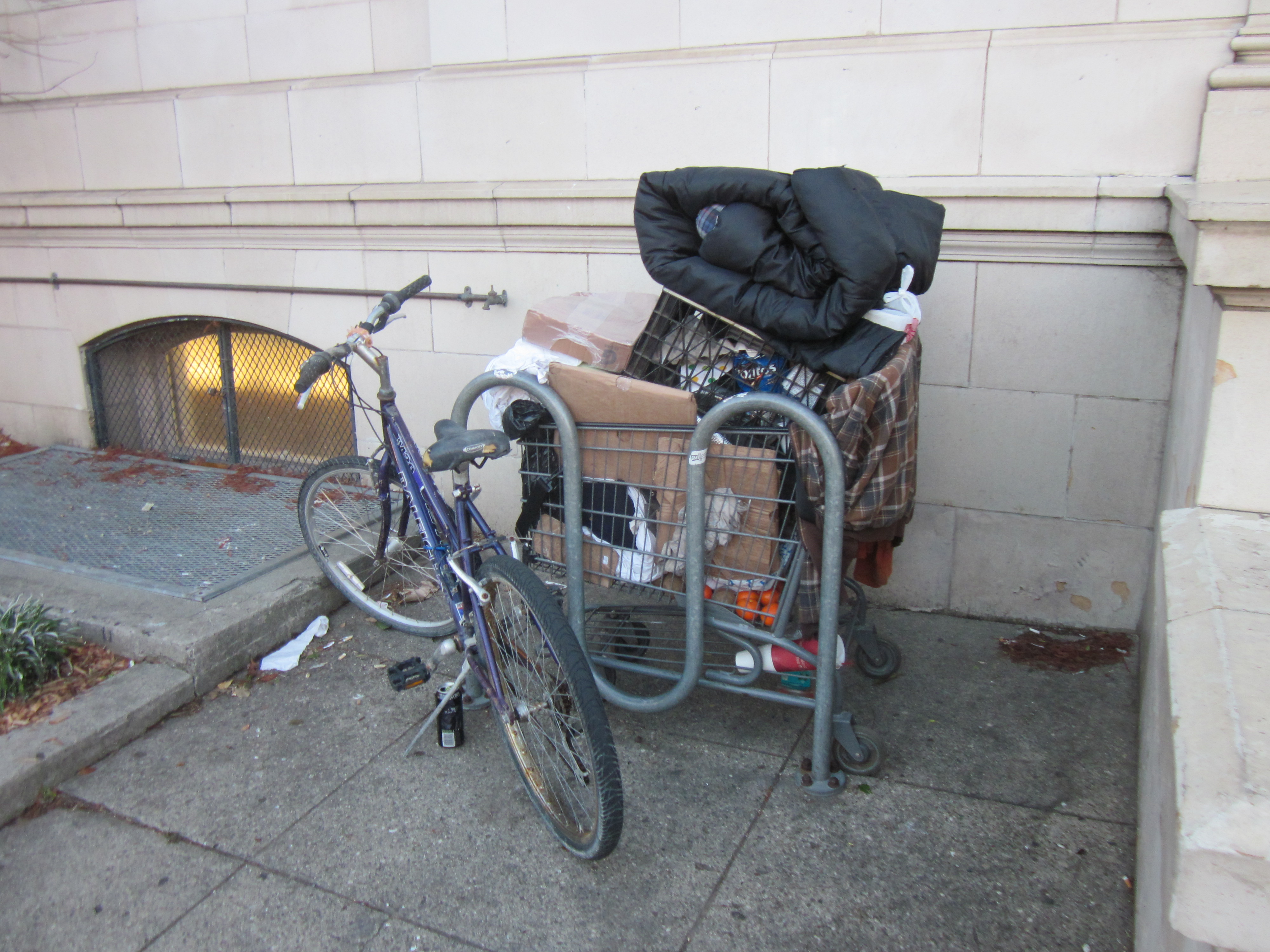
A bike rack can't hold much more than one shopping cart.

A bike rack can’t hold much more than one shopping cart.

We live on Parnassus Heights and thus we are well above what’s referred to locally as “the shopping cart line,” but most of our local haunts are in the flats. The library, for example, has a pretty small bike rack anyway, and it’s often occupied by a stolen shopping cart filled with someone’s worldly goods. There is increasing evidence that homelessness is a problem that can be resolved pretty cheaply by giving homeless people places to live (relative to paying for the health care and jail costs of having people live on the streets). But in a city like San Francisco, which is reluctant build new housing even for billionaires, it does not surprise me that subsidized housing is scarce.

At work the bike racks are often occupied by motorcycles and scooters, despite multiple signs saying that this is not allowed, which also direct their riders to the designated motorcycle parking area. There’s usually room for bikes as well, but the motorcycle riders always take the spot closest to the door, and motorcycles are so big that walking around them means walking into a driving lane, and they smell awful, and it’s all just annoying.

Everyone, it seems, is beginning to discover what we’ve discovered: riding a bike is the easiest way to guarantee VIP parking wherever you go.  Even when I have to lock to a parking meter or a stop sign, it only takes one attempt to drive in the city again to make me realize how good we have it still.

3 Comments

Filed under commuting, family biking, San Francisco