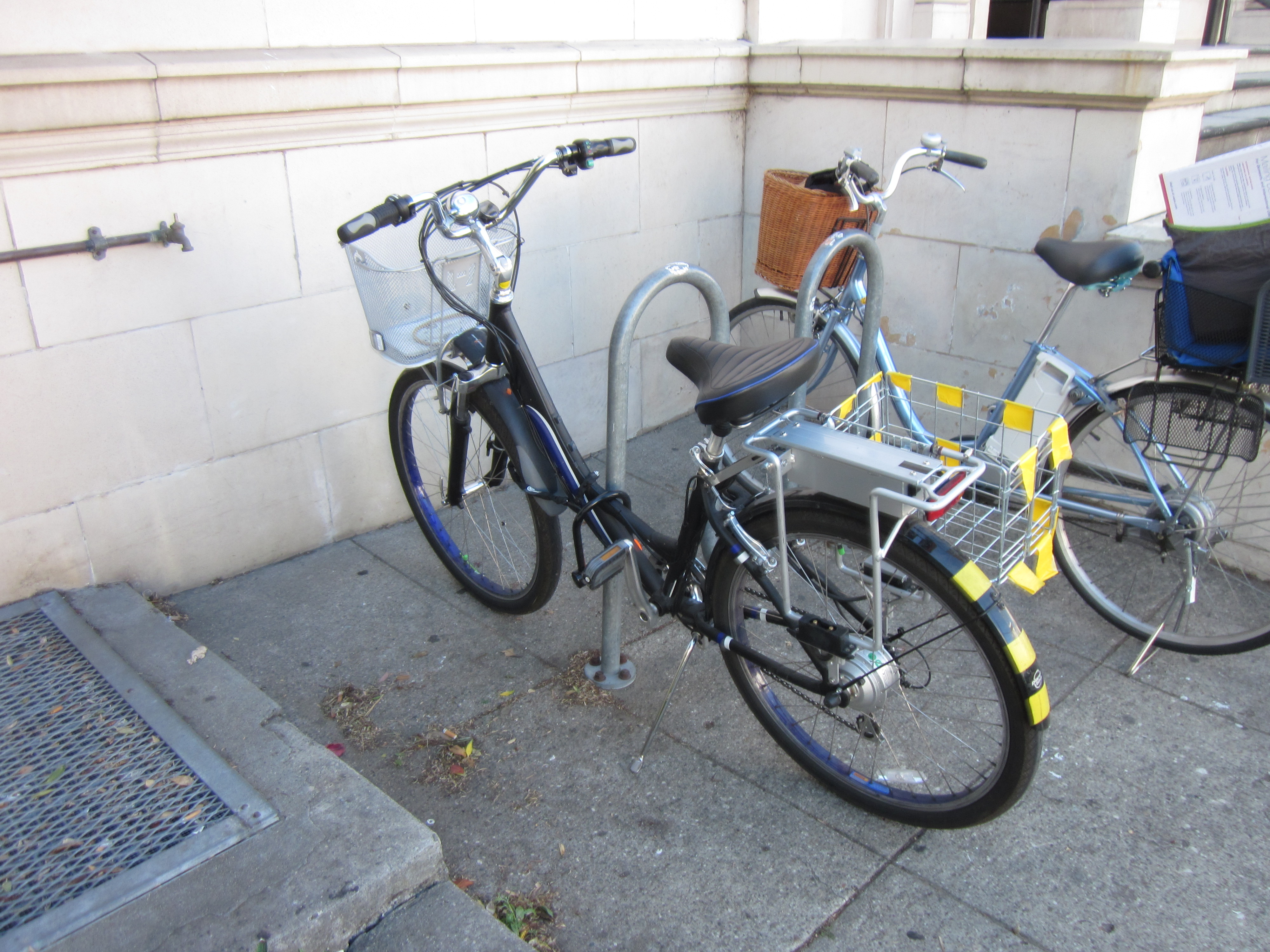
Electric assist is great when you have a lot of library books to carry.
At some point I speculated that 2013 would be the year of the electric assist bicycle. Not to toot my own horn here, but I was so right. The other day we stopped at an intersection and the rider next to us said, “Hey! All three of us are on electric assist bikes!” When I went to return books at the library the other day, the other bike on the rack was assisted. When I’m on the main campus, which is on a hill that could charitably be called “non-trivial” it is like an e-bike showroom up there. I would guess that about a quarter of the bikes I see hauling up our hill these days are assisted. That is new as of this year.
I get stopped at the bike racks at work by people wanting to know how to find cheap e-bikes on craigslist. Although I am admittedly kind of the poster child for that, I would only recommend doing that if you are comfortable replacing the battery shortly afterward (which is something I had to do). Very few people flog assisted bikes on craigslist until the batteries are on their last legs, and batteries are the most expensive part to replace. Caveat emptor.
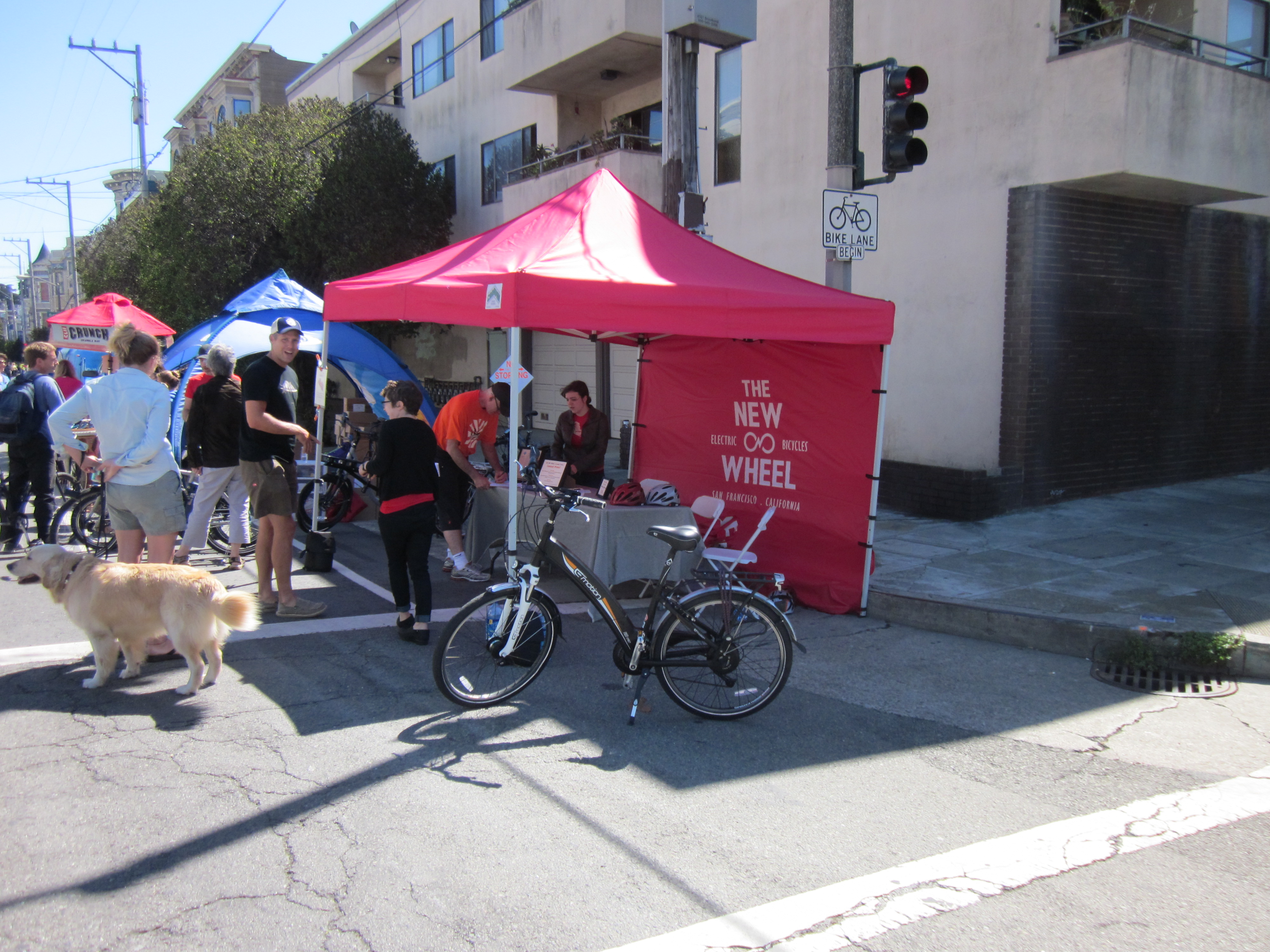
The New Wheel was giving test rides at Western Addition Sunday Streets–they must be doing a land office business.
There is really no such thing as a super-cheap electric assist bike, unless of course you are comparing them to a car, in which case every single one of them is laughably cheap. And I and everyone else riding one can testify that an assisted bike will make driving in the city seem ridiculous. I mean, my leg is still really weak, and the most recent x-rays show that the bones look like they’ve been attacked with a chisel–it surprised me that this is considered to be great progress–and I walk with a cane, and I now have a handicapped parking sticker. However it is still typically easier for me to go anyplace within about three miles on a bike (granted, an assisted bike) because I can park so much closer that I don’t have to hobble nearly as far. Riding a bike doesn’t stress my leg like walking on it does. When I talk to normal people with assisted bikes they say that they never tackled various hills until they put assists on their bikes. Then once they did, they started riding everywhere instead of driving. That’s pretty much how it went for us.
San Francisco is the kind of city that is made for assisted bikes. There are, famously, a lot of hills. It’s the second hilliest city in the world, and this is not a competition that you want your city to win (or show or place). To pile on the injury, it’s also extremely windy.
Going up a hill like this into a 10mph headwind is TOTALLY DIFFERENT from riding into a 10mph headwind on the flats.
Aside: I find it slightly annoying when people in flat cities claim that it’s hard to bike in their extremely flat city because of wind, or that a 10mph headwind is like a 14% grade. I ride up a 14% grade to our home every day and many of those days I ride into a 10mph or 20mph headwind AT THE SAME TIME. Riding into the wind is hard, but it’s not the same as riding up a hill. They’re both hard, but they’re a different kind of hard. The truth is that if you live somewhere flattish then it’s either easier or cheaper to ride bikes everywhere, so go ahead and cherish your good fortune.
Anyway, San Francisco: lots of hills, lots of wind, but also lots of great bicycle infrastructure. And we carry kids-as-cargo and groceries and library books and so on. Getting over ourselves and getting an assist was the smartest thing we’ve ever done, transportation-wise. In my current condition, I’m not sure I could ride in the city at all without one (and with the gimpy leg, walking the bike up hills is not a good option–I can do it, but the price is having to go back on my narcotics that evening). Our friends who have assisted their bikes will say the same thing: the assist is life-changing when you ride a bike for transportation. An assist makes driving not worth the bother. The sight of a bicycle being carried on an SUV now seems outrageously weird to me. Even if you’re hauling a racing bike, it would be cheaper and more fun to tow that baby on an assisted cargo bike.
Of course I am not opposed to straight pedal power under the right circumstances. Although even in a paddle boat I was pretty slow.
So for the people who keep asking me whether it’s worth paying so much to put an assist on a bike: if you’re already seriously considering it, then yes it is. And there are ways to make the cost less appalling up front; for example, The New Wheel in Bernal Heights will finance the purchase of an assisted bike or an after-market assist for an existing bike, plus they’re super-nice people. Is it necessary? It is for me (at least for now), but it’s not for everybody. For people who are enjoying the ride unassisted, there’s no need. But if you can’t bring yourself to ride every day just yet even though you want to, and are wondering whether the assist will tip the scales: it will.
Looking down at City Hall from Alamo Square–Postcard Row is hidden behind the tree on the right.
We went back to Western Addition Sunday Streets yesterday, mostly, I will admit, so that we could eat pie. Unfortunately for me, my camera was acting up, so here is a list of bikes I photographed but that my camera ate:
(1) A Zigo (a stroller attachment bike-trike thingy that never hit our radar because my brother-in-law threatened to break into our garage and throw it into Stow Lake if we ever seriously considered buying one)
(2) A red Bike Friday triple tandem, ridden by a dad and two daughters—ARGH! It was so awesome, I swear.
(3) A Bay Area Bike Share bike whizzing down the hill from Alamo Square. At least that image would be easy to replicate.
Instead I had to settle for panda shots and some other oddities.
In words of my husband: “Look! It’s Gimpy on her death machine.” Thank you very much.
Western Addition Sunday Streets is a bit quieter than Mission Sunday Streets. Overall it’s on less commercial streets, although I’m sure that the big hill up and down from Alamo Square helps keep the crowds down too. My leg is still way less than 100% so I didn’t ride the whole route this year, just the western approach and downhill for one block on the eastern side. Then we turned around and headed back. And from there we went to pick up some yogurt (returning the deposit glass jar, natch). I’m not usually a Sunday shopper but evidently all our neighbors are. Hi neighbors!
What’s not to like about family bikes?
Although I didn’t get to keep my photos of the most impressive family bike rigs (curse that camera) there were a lot of traditional family bikes out. Bikes with trailer-bikes, bikes with child seat—all the usual stuff that I tend not to post very often, but that I like seeing, especially en masse. It’s nice to feel like we’re not completely alone out there.
This assisted elliptical bike-thingy was new to me.
Per usual, the Bullitt got more than its fair share of attention. It can be weird to be out with it, because the novelty of our bike makes people massively curious even on a day that things aren’t going well. We are not always the role models we would like to be. Luckily for us San Francisco parents seem to be buying Bullitts, so with luck there will be less pressure as time goes on.
First aid by bicycle
Sunday Streets in the Western Addition is not quite as car-free as it is in some other locations. We were stopped by go-carts escorting local drivers occasionally, and some church traffic drove out of a parking lot last year—that was really distressing, because there were little kids playing in the street, which is sort of the point of Sunday Streets. However I was impressed to see that the official presence is more and more in the spirit of the event, including these bicycle-riding EMTs. Nice!
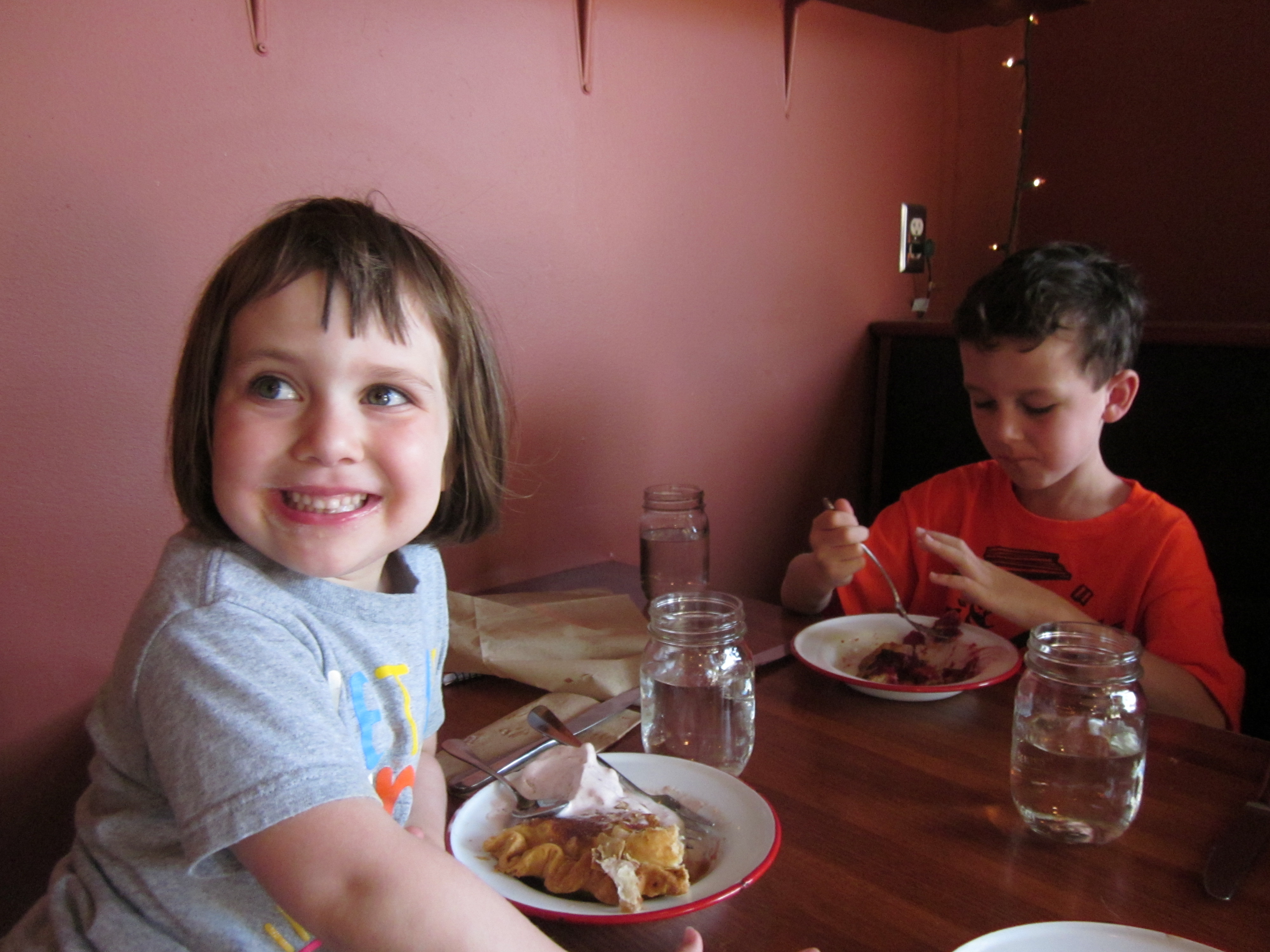
Pie is a good enough reason to hit the streets.
Still coming up this year: Sunday Streets in the Excelsior on September 29th (which is likely to be too much of a haul for us, or at least, for me), and the inaugural Sunday Streets in the Richmond on October 27th which will be linked with the normal Golden Gate Park street closures (wouldn’t miss it for the world!) Richmond Sunday Streets will run along Clement Street. Mmm, dim sum.
It’s only when I am with someone visiting from out of town that I remember that San Francisco has a definite vernacular architecture. People tend to think “Victorians” when they think of San Francisco, and most specifically, of Alamo Square’s Postcard Row (which we pass nearly every day en route to school). But although San Francisco is in fact filled with Victorians, what always seems to surprise people most is that almost none of them are single-family homes. This is a densely populated city, and what looks to suburbanites like a single family house from the outside is almost always a multi-unit building. It always seems to surprise visitors that that “house” they are admiring is in fact many homes. On the bike I always move at a slow enough speed to admire these homes, but lately I’ve been moving even more slowly so I get an eyeful.
Romeo flat on Beideman
I’ve never seen a Romeo flat anywhere but San Francisco, and even here they’re rare. Romeo flats are typically six units, two to a side on three floors, with open Juliet balconies between the floors. I pass this building on Beideman in the Western Addition when I’m riding with my daughter home from preschool. The Western Addition is considered to be kind of rundown but I like these pretty side streets. 49 Beideman in this building is actually listed for sale right now—2 bedrooms and 1 bath, 620sf, listed for $480,000, although it will undoubtedly sell for well above asking. Anyway, it’s a lovely building and next door to a pocket park, if you are in the market.
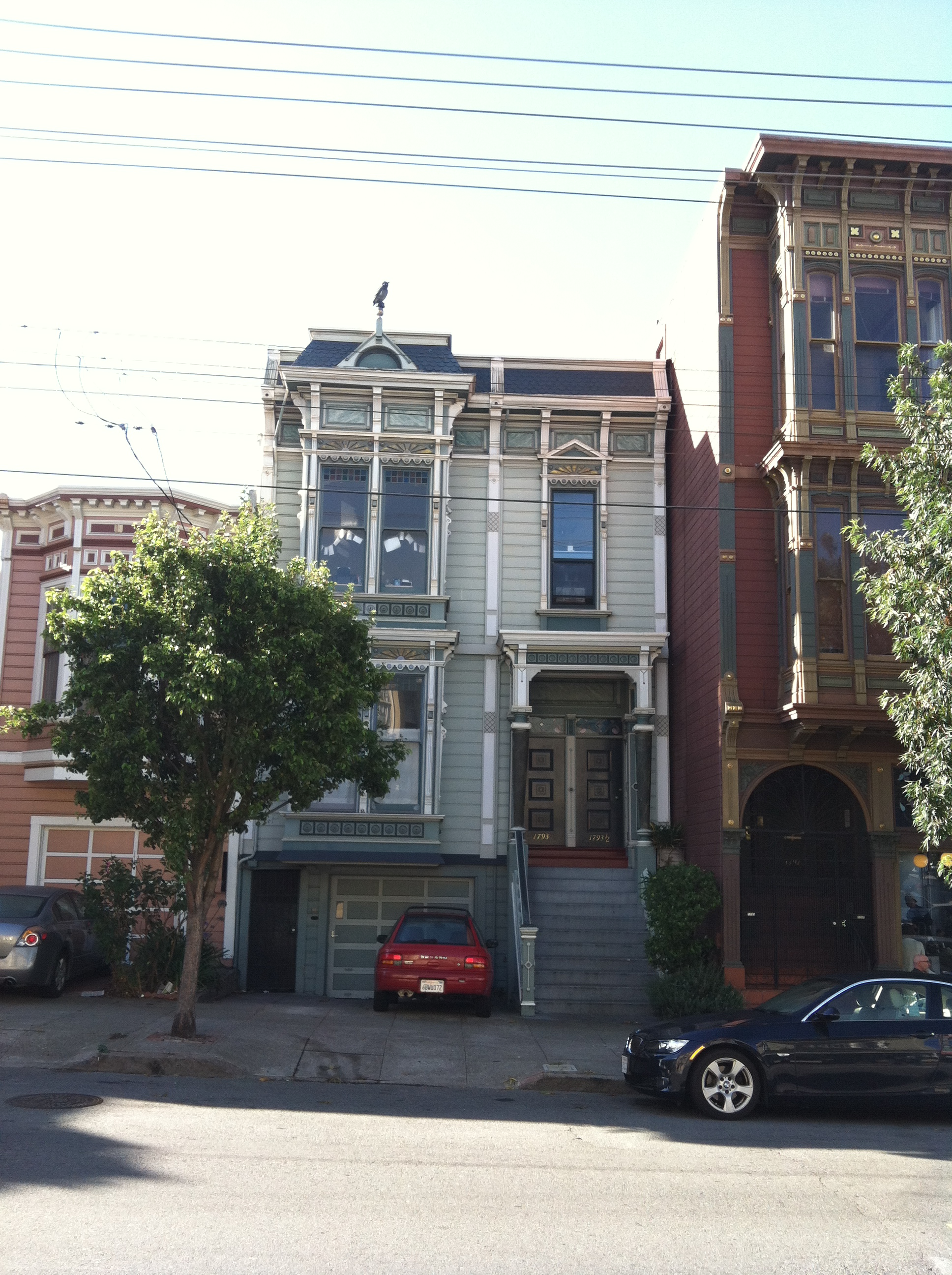
A Victorian with two units (at least) on Fulton
Much more typical are two-flats. Although this building is in the Western Addition on Fulton, our inner Sunset neighborhood is almost exclusively made up of two-flats, either like these or Marina-style that have a shared yard in the back, with large apartment buildings on the corners of each city block. Unfortunately I couldn’t photograph most of the more attractive versions of these buildings, which typically have trees in front of them that block a good picture. The basement tends to have either a shared garage and storage or a shared garage and a studio apartment (often unpermitted). Thanks to this density, trick or treating is laughably easy in our neighborhood, despite the endless hills and stairs.
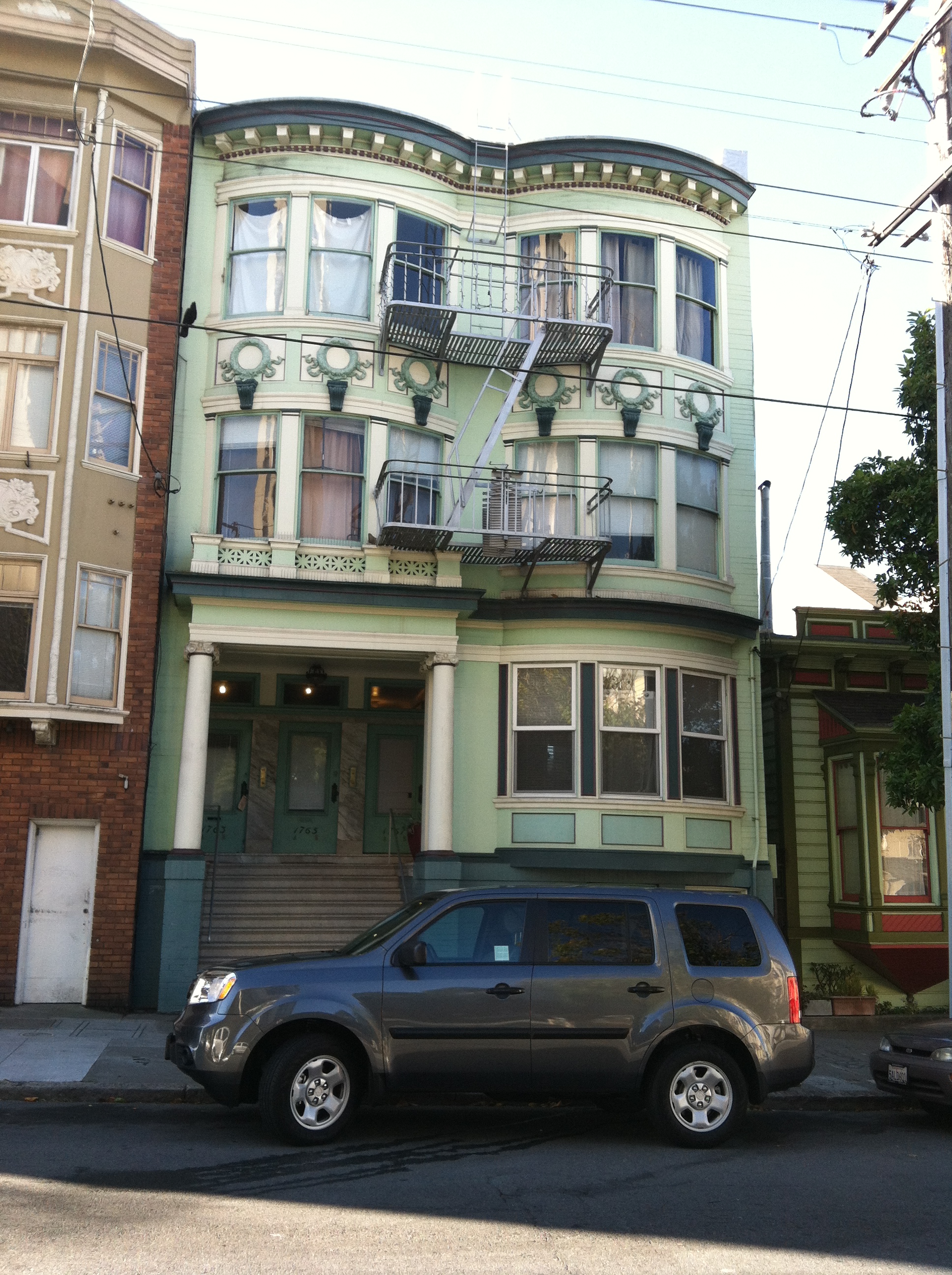
A three-flat building (three front doors) on Fulton
If the building has another story it’s a three-flat. The three flats with three front doors like this one are obviously multi-unit buildings once you look closely at the front porch, but it’s not uncommon for multi-unit buildings like these to have a shared front door. With a three-flat the first floor unit tends to be smaller than the other units, and we’ve met lots of families that use the space under the stairs as a kids’ bedroom. (There is a strong market in built-in bunk beds that can be squeezed in the Harry-Potter-bedroom-under-the-stairs in this town.) The premium on space is part of the reason it is rare to find families with more than two kids in San Francisco, unless the second pregnancy was twins.
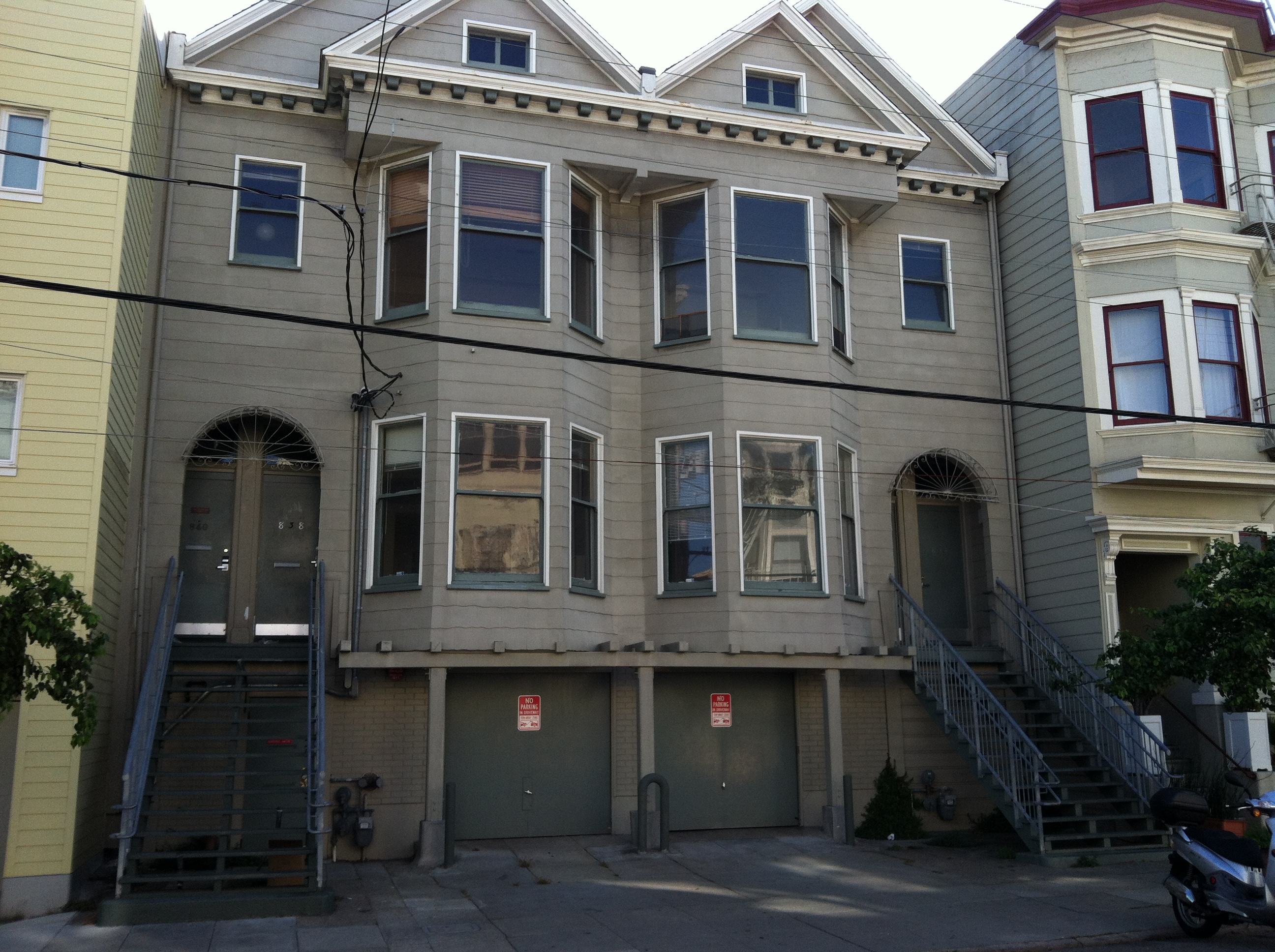
Double doors on each side of this building, four flats
With a slightly wider lot you can find four-unit and six-unit buildings, which are basically two-flat and three-flat buildings stuck together. I see a lot of these buildings in Lower Pacific Heights near my daughter’s preschool. This four-unit building is a particularly ugly version of the genre, but the prettier ones are hard to photograph because they typically have trees in front and a long flight of stairs up to the front doors.
Oddly, our street is one of the few that is made up of largely of single-unit buildings. The university converted all the houses it purchased on our street to clinics decades ago. Then when the neighborhood protested because of all the car traffic, the university turned the buildings back into housing. However approximately half of them were set up as student housing, with a shared common space and multiple rental bedrooms. Evidently you can cram more people into a building that way. These aren’t exactly single family homes, since they each contain at least a half dozen medical students, but technically they meet the definition.
It is no fun to live next to students, incidentally, even medical students. No matter how much homework I give them, they party all weekend well into the wee hours. It’s something about student culture. Even nice quiet professionals who go back to graduate school end up partying when they are students again. Every year we hope against hope in the fall when they return from their vacations that the ones with the gong have finally graduated—so far university police have not been able to identify which unit has the gong, to our despair. And despite the fact that fewer than 1% of physicians smoke, in their student years they smoke outside our building and leave butts all over the ground, which our kids are finally old enough not to put in their mouths, thankfully. They drive down the hill at breakneck speeds until the wee hours with the music blasting, or worse, sit in their cars outside our building and look completely shocked when we come out in our pajamas at 3:00am to say that we can in fact hear the thumping bass from three floors above. And to my everlasting regret, the university keeps all its housing units in good condition, and the most raucous parties always gravitate to the nicest space. Summer is always the nicest time of the year for us. Even though it is a violation of their leases to sublet their rooms in the summer, and even though every year someone gets kicked out for it, the students always sub-lease anyway, and the sub-lettors tend to be fearful and thus quiet. But I realize that it could be much worse. We could live next to undergraduates.
This Friday is the opening day for Bay Area Bike Share. I knew, idly, that it was coming, but hadn’t really paid much attention, as the station route map reveals it is too far east for me to use much. I forgot, of course, that Matt works downtown. There is a new bike share station right outside his office! My sister has one outside both her home and her office (and mystifyingly, she does not plan to join. Yet.)
Of course Matt rides to work already, but riding a big cargo bike around the Financial District is not always the most convenient option, especially since one time that he did that, his (U-locked) bike was stolen. At noon. In a location with lots of foot traffic. By a thief using a handheld angle grinder. At work, we can bring our bikes inside. Personally, if I had the option, I’d leave my bike inside all day and ride a bike share bike to meetings when I needed to leave the office. I think a docking station is designed to lock up a bike better than I ever could, and I suspect that it would be too tough to sell a bike share bike to make stealing one tempting. Not that it matters, because stolen bike share bikes wouldn’t really be my problem anyway.
Although I am not in the neighborhood and I can’t haul my kids on a bike share bicycle, I will eventually make it over to that part of the city (which is flat!) and try one out. You’ll hear about it here first.
However the grand opening of bike share is not the only reason that this will be a great weekend. This is also the long weekend of the empty city. On Wednesday night, the Bay Bridge was closed so that Cal Trans can transition the earthquake-damaged eastern span over to the new bridge. Virtually all of the traffic from the East Bay has evaporated. I noticed even this morning that there were far fewer cars on the road, which is always welcome. We have had this experience before during bridge closures, as well as on Thanksgiving and Christmas—visitors leave the city, and everything is suddenly completely accessible to those of us who live here. Restaurant reservations are available all evening and the lines at museums disappear. I’m sure that it’s not great for business, but it’s sometimes nice to have the city be a place just for its residents. Happy Labor Day!
Rosa Parks bikes rolling in… every day is like a cargo bike roll call!
San Francisco schools start mid-August, so we’ve been taking our son in for a week now. Now that our daughter is finally in a new preschool (at a Japanese immersion program a few blocks from Rosa Parks that we love) we have, for the first time ever, a shared commute. And for the new school year, there are new bikes to see as well. We arrived early on the first day of school, and we had to rent a car because our daughter woke up vomiting, but there were plenty of bicycles to see nonetheless.
Front seats rule!
Last year I wrote about the Oxford Leco top tube seat, and we were lucky enough that friends from Rosa Parks picked up for us one while they were in the UK. Circumstances conspired, so we have not installed our seat, but they are already using theirs. On the first day of school it was carrying their son (who goes to preschool with our daughter) but this is typically the way they take their daughter, now in the first grade, to school. They told me that the kids fight for the chance to sit in the front seat, which does not surprise me: front seats are fun!
This bike is too fast to catch in motion.
For a couple of years another family was also using an ad hoc top tube seat in the form of a spare saddle stuck on the top tube, but their daughter, in 2nd grade, has grown too tall for this option. Now she rides behind her dad, standing on the foot pegs he’s installed on his rear wheel and holding onto his shoulders. I continue to be impressed at the way he’s managed to haul a kid for six years now with the absolute minimum cost and hassle. They cut a mighty figure rolling through the streets—since he’s kept his bike so light they move very fast, unlike those of us on cargo bikes.
This is the second BionX Mundo I’ve seen at Rosa Parks.
At the welcome breakfast for new families there were: more bikes! And check out that newly assisted Yuba Mundo with BionX. This particular rack usually holds kids’ bikes that have been disengaged from their Trail-Gators and are locked up until the parental pick up later in the day, rather than this collection of parental bikes, because it’s inside the locked courtyard.
There is so much awesome in this bike that I cannot do it justice.
Most impressive of the new bikes was the Xtracycled tandem! This is the same family that formerly rode the Bike Friday triple tandem (aka Shrek 2). Their oldest is now riding solo, so they swapped the triple tandem for the Xtracycle tandem, and now they can carry three kids. And they do: they are the neighborhood bike-pool. Cargo bikes may be slow, but have their uses.
This is the way we ride to preschool.
And although we did not ride to school on Monday due to sick kid, we did ride for the rest of the week. I took our daughter to preschool solo twice last week, and picked her up too. I still get tired much too easily, so I can’t ride every day, or for that matter go to work every day (I’m still on half-time disability). Yet riding is still easier than driving+walking—even with my handicapped parking sticker, we can rarely park close enough to our destination that it’s an easy walk for me. People are still surprised to see me on the bike again, but riding is still so much easier than walking that it almost feels like cheating.
Even more astonishing, I’m not the only one back in action.
I have been trying to practice riding more, although I have hit some limits. Riding two days in a row, I have learned, now leaves me saddle sore. I get a little antsy when I have to go through the intersection in Golden Gate Park where I was hit, which is unfortunately en route to almost everything, but it’s been reasonably mellow other than that. I don’t have the stamina or strength to go long distances or up hills, but hey, that’s the kind of thing electric assists were made to fix.
Now that I am riding every other day or so, I remember what I like about riding my bike. I’ve been in cars and buses a lot in the last few months, and it is isolating. Plus, even though I now have a handicapped placard, I end up having to walk a lot when we drive somewhere because the competition for handicapped parking places is ferocious. But on the bike the world returns to human scale (plus I can park by the front door). When I was coming back from grocery shopping—my current level of grocery shopping competency by bicycle involves carrying one glass jar of yogurt—two guys on the corner waved me over to ask about my bike. On my way to the office, the only other person who stopped at the red light besides me struck up a conversation. “I can’t believe I get grief about not wearing a helmet sometimes from people who run red lights,” he said. I agreed that this was pretty irritating. This nice man was in the full roadie kit; not the usual stop-at-red-lights type in my experience. I am learning not to judge hastily.
I get a lot of funny looks when I get off the bike and unfold my cane. This amuses me. In physical therapy I can do exactly zero of the exercises I’m supposed to be able to do 25 times in a row when I’m fully recovered. I am still a slow walker, and I limp, and I can’t go far on foot, but on my bike I’m almost as fast as everyone else. On the bike no one knows I’m still crippled.
Surly Xtracycled Karate Monkey with Stokemonkey electric assist–so many kinds of awesome!
Now that I am getting out and about more, I can continue my effort to catalog every unusual bike in San Francisco. There are more interesting hobbies, I’ll admit, but it entertains me (my other hobby is the even more obscure effort to catalog every word that means its own opposite, e.g. sanction).
This bike isn’t a kid-hauler, which is my favorite kind of bicycle by far, but it could have been (update from a more observant friend: yes it is! check out those stoker bars). I was not familiar with the Surly Karate Monkey before I saw this Xtracycle outside a café one weekend morning. But check it out: it’s a Stokemonkeyed Karate Monkey! That’s an awful lot of monkeys on one bike. It must own the hills. I couldn’t tell whether the box was a battery backup, but this bike looks like it gets around. The sticker references a shop in Seattle. You’re a long way from home, monkeys.
[Note: As of April 2014, release of the Ridekick child trailer has been postponed to 2015.]
When I thought about getting back on the bike after my injury, I thought immediately about electric assist. We live on a big hill. I was surprised that I could get up part of it on the Brompton by myself when I tried riding for the first time last weekend. But a little more experimentation made it clear that I wasn’t able to ride up all of it. This is better than I’d expected, but still: not useful. It doesn’t help much to go partway up the hill. And when I tried to walk the bike up the hill instead, it made the pins in my leg ache so badly that I had to lie down. This was predictable but still unwelcome.
A mid-drive spotted near work
What’s more, it’s not very useful to be riding again if I can’t pick up and drop off a kid occasionally. I figured I would get my strength back eventually, but in the meantime I needed a better solution. Option one is a new mid-drive electric-assist bike, but that’s really expensive for short-term use and depending on how much strength I got back, could potentially be overkill in the long term. Ideally I wanted a temporary assist that I could stick on the Brompton, which is basically the only bike we have that I can use right now given my limited strength and range of motion. I did try getting on the MinUte, and technically it’s possible, but it wouldn’t be safe yet with a kid on the deck. I can get on and off the Bullitt, but it’s too heavy for me to ride for the time being.
Introducing: the Ridekick electric assist trailer!
I knew what I wanted, but unfortunately I didn’t know of any temporary, immediate on-off electric assists currently in production. At least, I didn’t until a blog reader pointed me to the Ridekick trailer (thanks David!) The only Ridekick currently on the market is a small cargo trailer with an electric assist built in. It was cute and it looked like it would do what I wanted, but when I went to their website, I saw that they were taking pre-orders for what looked like my rehabilitation holy grail: an electric assist child trailer.
This is a complete stealth assist system, if you want to look super-tough on hills.
Although I’m not the world’s biggest child trailer fan (hard to see in city traffic, don’t always fit in urban bike lanes, won’t make it up many San Francisco steep uphills, can be terrifying on many San Francisco steep downhills, we prefer to have the kids in front), we had been considering getting a bike trailer for travel, and for upgrading our one-kid bikes to two-kid bikes on occasion. The trailer also has the advantage of offering weather protection, just like the Bullitt, but in a far more portable package. The Ridekick assisted child trailer also seemed way more promising than an ordinary trailer because with an assist we’d no longer have to worry about drag on the bike. The pull of a weighted trailer can really be a problem on hills and in strong winds, both of which San Francisco has in abundance. And if the assist were up to it, I could attach it to any bike and make it up hills with one or both kids even in my reduced state.
So I wrote to Ridekick, hoping against hope that the child trailer was close enough to production that I could get one by August. The answer was no. But they were coming to San Francisco in August with the prototype to look for venture capital funding, and would I like to try it? Yes!
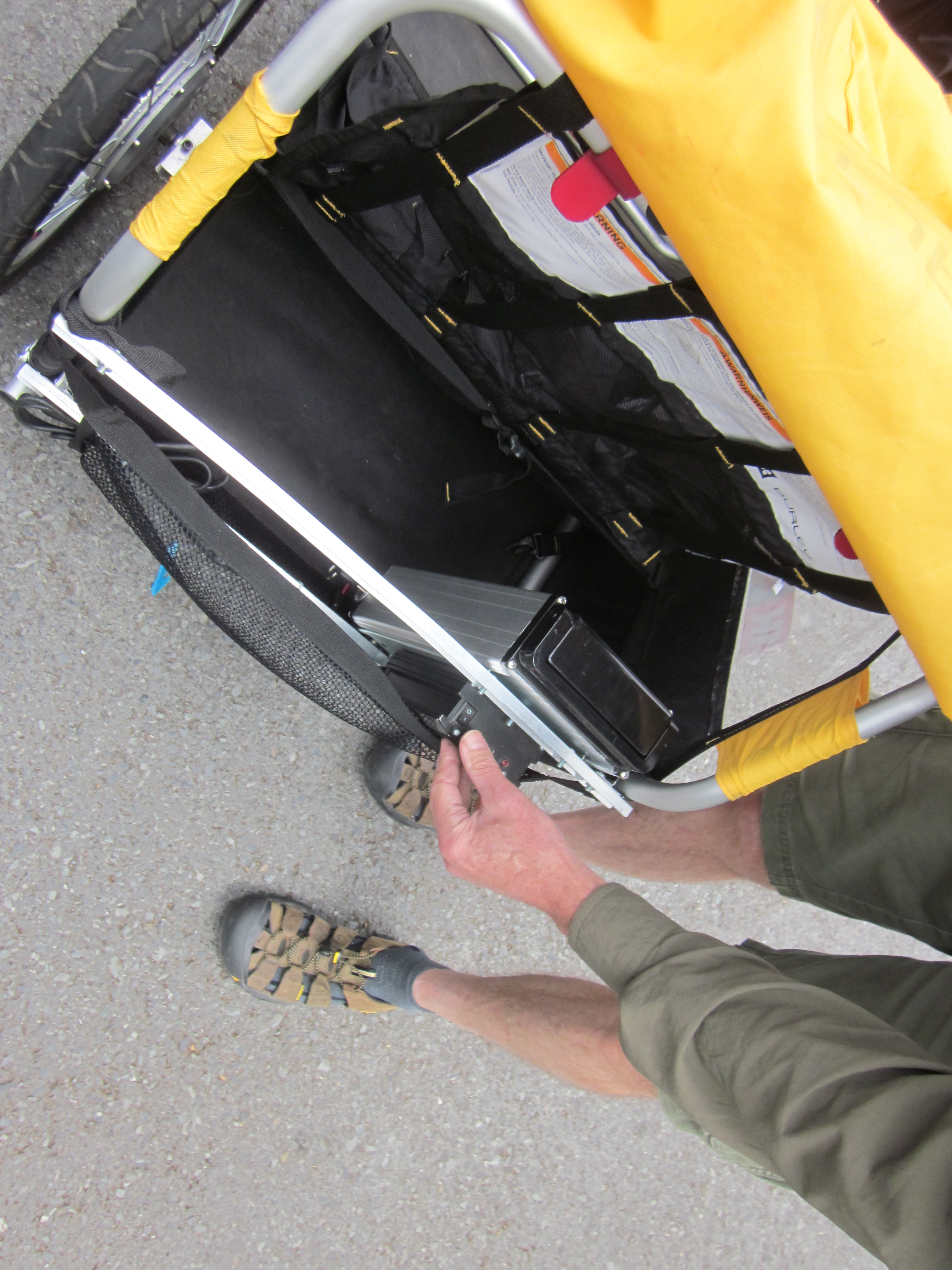
This is the cargo hold with the battery for the assist.
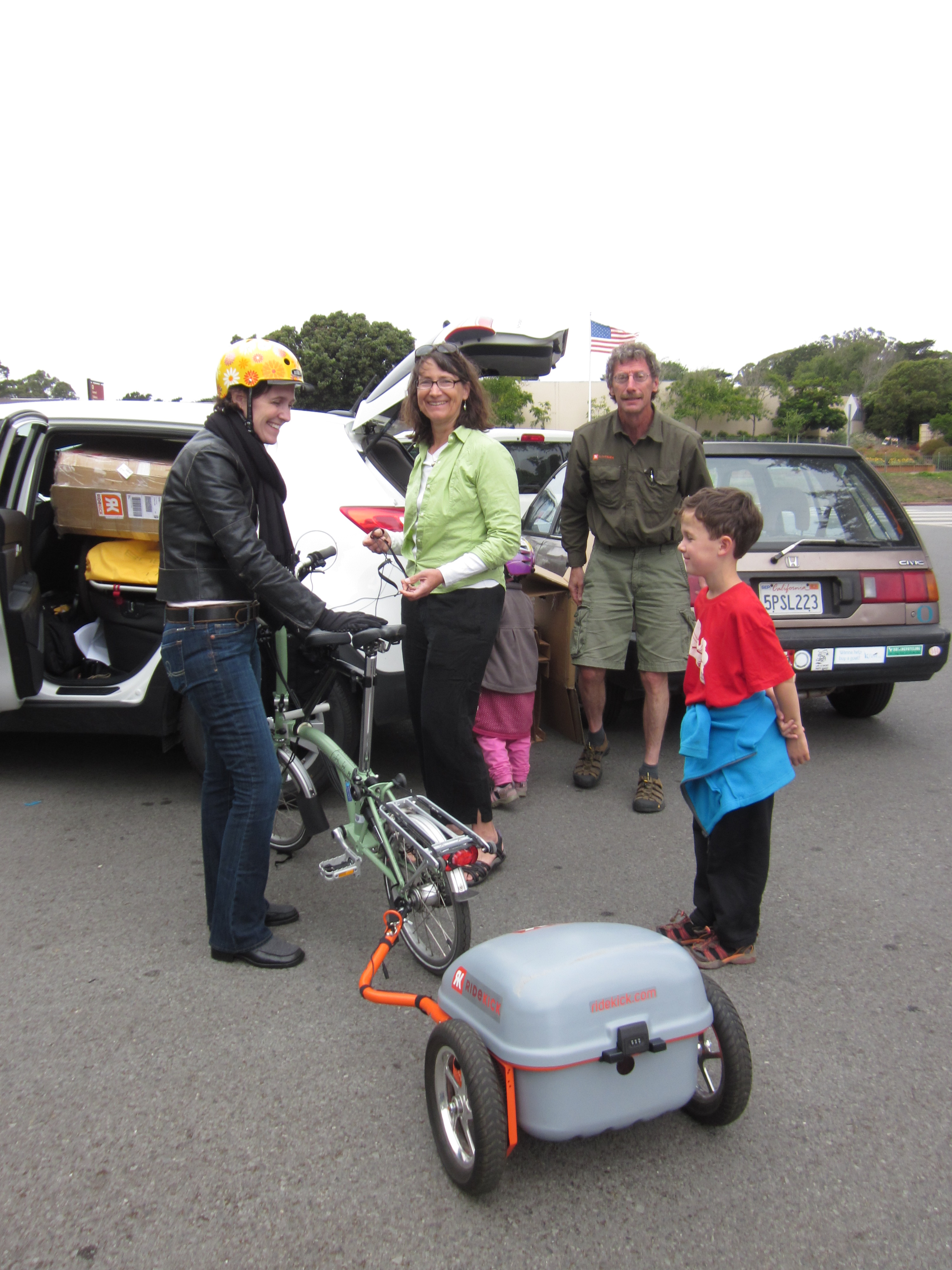
We met Dee and Mark from Ridekick in Golden Gate Park. They are great people. The prototype trailer that they brought is built up from the same Burley Bee model that we rented last year when we visited my mom in Bellingham. To my surprise, the assist doesn’t really intrude into the trailer’s cargo space. There’s a lithium ion battery with an on-off controller attached, about the size of a hardback book, that slides into the rear cargo compartment and that’s basically it. There is a throttle attachment that they Velcro-tied onto our handlebars, and then strung the wire for it back along the frame with more Velcro ties. It clipped into the wire coming from the motor at the rear wheel bolt, which is the same place that the trailer itself attaches. For novices like me: a Burley trailer attaches with a hitch plate that is threaded onto the same bolt that holds the rear wheel onto the bicycle frame. The trailer frame has a drop-in pin that goes through the hole in the hitch plate, with a back-up strap that loops around the bicycle frame in case it fails. Ridekick estimates that the trailer can go about 15 miles on a charge, depending very much on local conditions (how much weight and how big a hill?)
Technically both boys are too old for the trailer, but we never pay attention to stuff like that.
“Oh, if I must.”
My kids hadn’t ridden in a trailer for a year and were thrilled to get back in one. They also brought a friend. For our first test ride, we attached the assisted trailer to the Kona MinUte and then Matt took the two 7-year-olds for a spin through Golden Gate Park.
Something I may not have mentioned before is that Matt is less enamored of new bike experiences than I am. He mostly just treats all the experimentation I do like my weird hobby. He’s not big into optimizing his riding experience. The first bike he got was the Kona MinUte, and when it was stolen, he bought another one just like it. I got him a new pannier for Christmas one year when he complained that the ones that come standard on the MinUte were not office-appropriate (definitely true), but he has never used it. When we got the Bullitt he said for two months that we should have replaced the car instead, although he has since come around. So Matt was actually pretty grouchy about coming down to Golden Gate Park on a Saturday morning for “another bike thing.” He had had other plans.
It is in this context that I say that Matt loved the Ridekick child trailer from the moment he started riding with it. Generally neither of us is a big fan of throttle assists (the kind that go when you push the button, whether you are pedaling or not), but in the context of pulling well over a hundred pounds of weight behind the bike, the throttle assist is extremely appealing, especially at intersections. At steep intersections it is sometimes impossible for us to start a heavily loaded bicycle, even with the BionX, because the BionX doesn’t kick in until your speed exceeds 2 mph. Although Golden Gate Park is a little thin on steep hills—its grades top out at about 12%—Matt took it on a moderate hill, probably 10% grade, behind the Conservatory and had no trouble hauling both 7-year-olds up. When you’re riding with an assisted trailer, you don’t have to feel like you’re dragging an anvil.
It was a struggle to get him out of the trailer so his sister could have a turn.
When he came back I took our daughter for a solo turn around the park on the bike. Despite the fact that I was on the MinUte, which is a huge hassle to get on and off for me at the moment, I loved the Ridekick child trailer too. It resolves a lot of child trailer problems all at once. There’s no drag from the trailer unless you want to work harder. When you get tired, you can have it push you along for a little while. Taking breaks like this, interspersed with pedaling, got me up the same hill behind the Conservatory that Matt had ridden. That felt amazing! And it’s something that is currently completely out of reach for me on an unassisted bicycle.
There is probably a limit to the Ridekick’s capabilities. We have the advantage that we are using to riding up hills, and so we just need an extra boost now and again when we have extra weight on the bike. Even I, in my reduced state, tended to use the assist for a while, then pedal solo for a little bit, then repeat. My guess is that a weak rider could burn it out on the steepest hills, given that Matt has overheated the BionX on the steeper hills in our neighborhood occasionally. We’d have to ride with it a lot more to be sure. Then again, how many families really deal with hills like ours on a regular basis?
In the world of trailers, which tend to be useful but not that fun, the Ridekick assisted child trailer is a killer app, both useful AND fun. Normal trailers drag, and pulling them can be exhausting. As a result, even though most cargo bikes ride like tanks, cargo bikes are a lot easier. Still, in a situation where one parent drops off and another one picks up, you’d need two cargo bikes (which is exactly what we have now, but that’s a big commitment to start). But an assisted child trailer? Awesome! The assist means that riding is not a chore, it could be passed between parents’ bikes as needed, and it can keep the kids warm and dry, all for a (suggested) price of a single unassisted cargo bike. And as a rehab tool, it would be amazing.
If we could have, we would have bought it on the spot. But there is only one in the entire world. Our kids were crushed. “Can we keep it, please?” our daughter begged. “It goes fast! Can we keep it?” Alas, no.
Evidently Ridekick has gotten a fair bit of interest from parents who would like an aftermarket kit to assist their existing trailers. This doesn’t surprise me, but they still don’t even have the basic model in production. Ideally they could find a partner with an existing child trailer company (e.g. Burley, Chariot, Wike) and add the assist option to their standard product lineup. I’m sure there is sufficient demand.
This trailer is so much fun!
How cool is the Ridekick assisted child trailer? It’s so cool that if it had been on the market when we started riding with our kids, we might never have gotten cargo bikes. Even with my misgivings about the width of trailers versus bike lanes and having the kids behind me in city traffic instead of in front, having a trailer that could glide up hills, as well as being able to swap it between bikes, would be worth compromising in other areas. I have zero regrets about getting cargo bikes, especially given that the Ridekick child trailer isn’t actually available yet, but an assisted trailer would have been a much lower stakes way to ease into family biking, and it would travel well. I could be biased by the fact that this trailer allowed me to ride up hills that I couldn’t have otherwise attempted, but I loved the Ridekick.
After two weeks in the hospital, I have returned to our place. Despite the fact that I wasn’t allowed to leave until I showed I was able to hobble up and down stairs on crutches, doing this at home, where we have many, many stairs, has left me exhausted. It will be months yet before life is back to normal. I will not be allowed to put any weight on my right leg until August. At that point the real physical therapy will begin. The good news is that my surgeon (also a bike commuter!) expects I’ll regain full function.
Aside from the injury itself, we feel very fortunate. Our families have cleared their schedules to spend time helping us, friends have been ferrying our kids to school and back, and my coworkers made sure my hospital stay was as comfortable as it could have been. I am grateful, too, that we know so many people who have broken their ankles, knees, and hips, and who have loaned us crutches, a bath chair, and other bits of assistive technology that I never imagined needing before.
I really appreciate all the well wishes. I had no idea so many people were reading the blog and found it valuable. It was a very welcome thing to learn during a difficult time. Thanks so much.
I’m not sure what, if anything, I could write about for quite a while. Although I’m likely to have lots of spare time in the next few months, I won’t be able to spend any of it riding a bike. And it’s a bit embarrassing to think about zero waste after spending so much time in the hospital, a place where a single bandage change filled a large garbage can. Moreover, I’m mostly bed-bound for the next two weeks (coming soon: a synopsis of ceiling cracks!) I’m open to suggestions.
In the meantime, locals can still catch Matt and the kids out on the Bullitt. Be sure to tell him he’s awesome if you do. Thanks for hanging in.
One of Matt’s lunches: green onion pancakes, beans, orange
I have mentioned, off and on, that in the wake of my visit to the dump we have been attempting to move our household toward zero waste. Apparently, like the biking, this is now a happening thing. (Since when am I tuned into the zeitgeist?) The City and County of San Francisco has the same zero waste goal, scheduled for 2020.
People approach zero waste in different ways. The easiest definition of zero-waste is to send nothing into the landfill. There is sometimes an assumption that substituting recyclable packaging is fine. I didn’t make that assumption. Evidently I like to make things difficult for myself.
This is a pretty typical haul from the cheese shop: hummus, salad cheese, crackers.
I’ve since learned that we started somewhat ahead of the average American household. We swapped paper towels out for rags long ago and have always used cloth napkins and reusable lunch containers. But we now shop exclusively with cloth bags and our own glass jars, and we have become the kind of people who bring our own tableware to restaurants that use disposables. None of these changes was especially difficult, although it felt weird to do something different at first.
I go to the cafeteria once every two weeks, but my plate is recognized nonetheless.
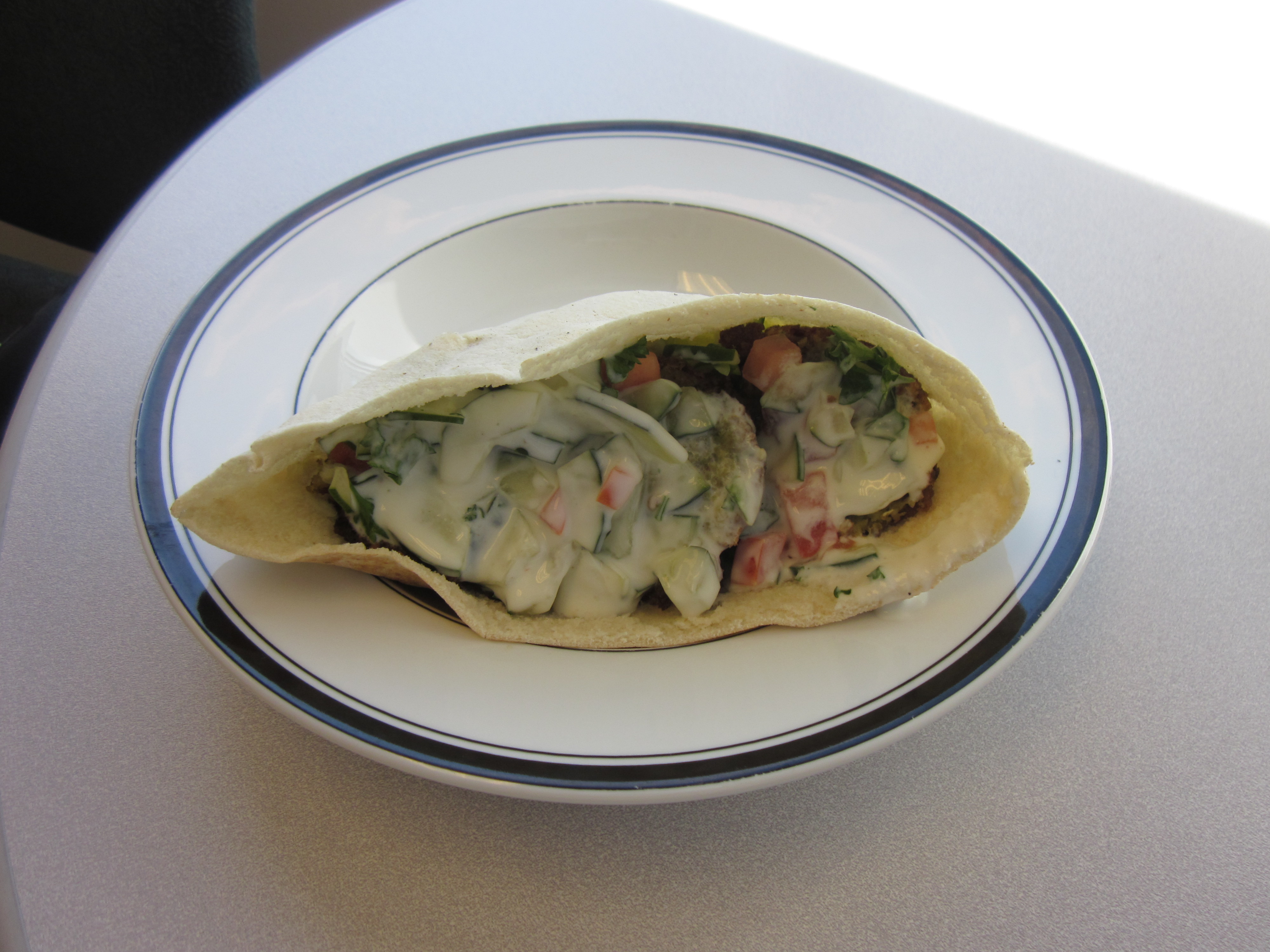
Zero waste efforts make you instantly recognizable. When I walk into the office cafeteria with my china plate, the sandwich guy immediately starts heating up falafel. When I go by the local cheese shop, the owner waves (“Look, it’s the woman who brings her own beeswax wrappers! On a bike!”) It can feel a little like the over-examined life. Mostly it’s good, though.
Sending as little as possible to the landfill (in San Francisco, the black bin) is a given in a zero waste household. Here in San Francisco, that means all soft plastics are basically out. Although Recology will take rigid plastics in the recycling bin, virtually all “recycled” rigid plastics are down-cycled—they get one more use as lumber or fleece then go directly to the landfill. So we don’t buy those either.
This was a week of landfill-bound waste last month, but it’s dropped since then.
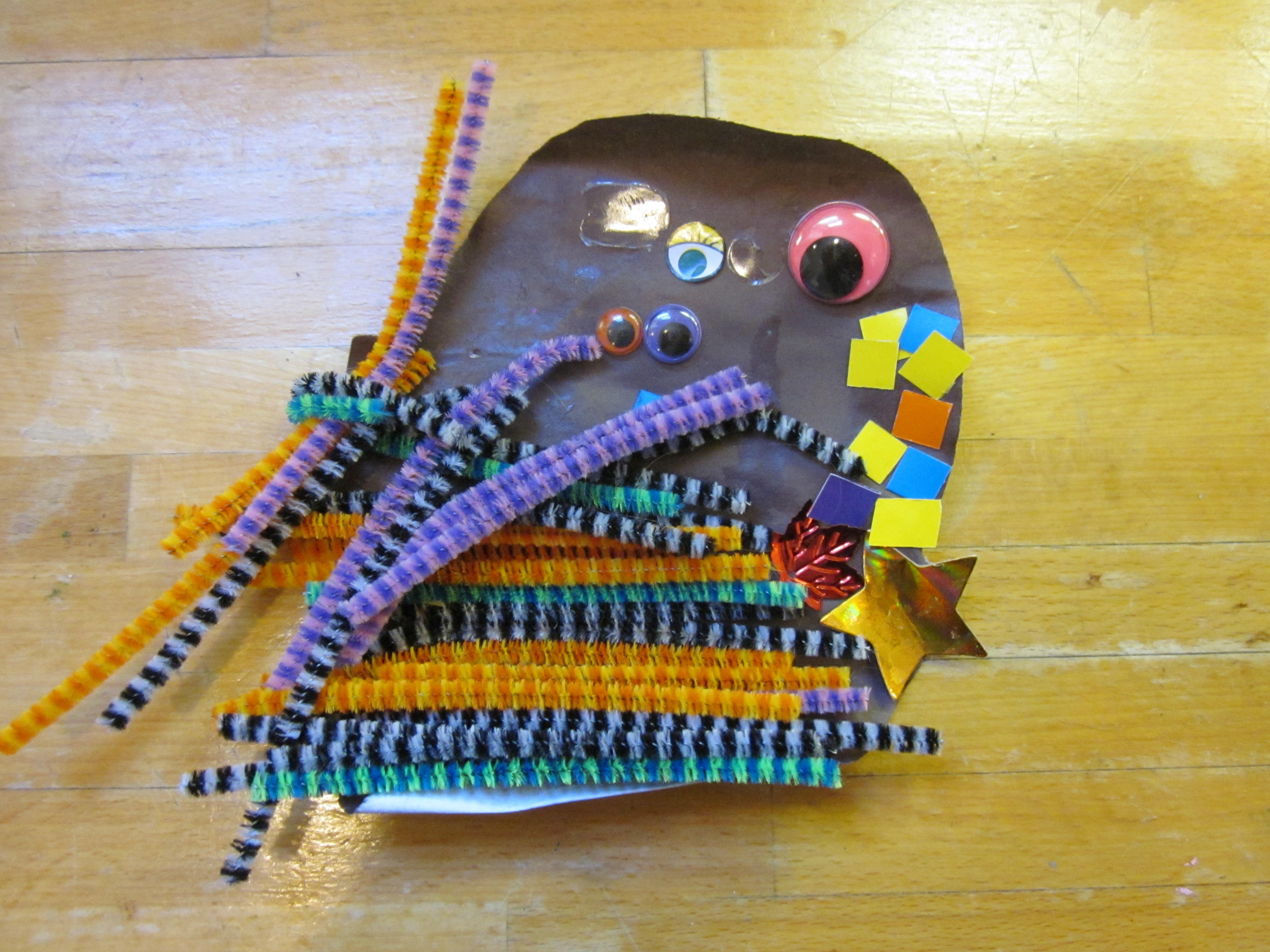
Our progress on landfill-bound waste has been pretty dramatic; most weeks, it easily fits into one of the old quart-sized Ziploc bags I keep finding around the house even now. Most of what’s left is preschool foam sticker art (which is being very slowly phased out at our request) and medical waste (e.g. bandages the kids come home with, and my new waste-nemesis, dental floss).
Sustainable preschool art is a continuing battle.
After my visit to Recology, I also viewed recycling (the blue bin) as a last-resort option. Recycling is energy-intensive at best and involves massive transportation costs because most recycling on the west coast is sent to China. And although paper can be recycled a few times, it degrades to a lower quality product each time–printer paper to paper bags to toilet paper– then it goes to the landfill too. Glass and metal are really recycled, but expensive to melt and reform. But when there appear to be no other alternatives, glass, metal, and low-quality compostable paper are the types of packaging we choose.
Minimizing our recycling has been very hard. We both have office jobs, our kids come home with papers from school, and junk mail is horribly persistent. However we are definitely producing less: on a good week our recycling barely covers the bottom of the blue bin.
Happily, composting (the green bin) is universally acclaimed. San Francisco has municipal compost pickup so we were already keeping food waste separated, but we started including odds and ends we hadn’t previously realized we could compost (e.g. hair, dryer lint, floor sweepings, waxed-paper butter wrappers). Food-soiled paper is compostable as well. We’re not yet at the point that I begrudge an occasional pizza box.
This is part of the “jar” section of Rainbow Grocery’s bulk zone: miso, tahini, nut butters, salsa.
However we don’t buy processed food because virtually none of it can be bought in bulk (this is evidently a quick way to lose weight). I find myself getting irritable when manufacturers expect me to take responsibility for dealing with their packaging or things they make that break. I wonder now why I once accepted the responsibility for disposing of whatever a retailer chose to throw at me. And it seems crazy, after only a few months, to buy something in a container that is used only once, to carry an item from one place to another, after which the container is put in a landfill until roughly the end of time. It is something I had never considered before this year, and now it seems like madness.
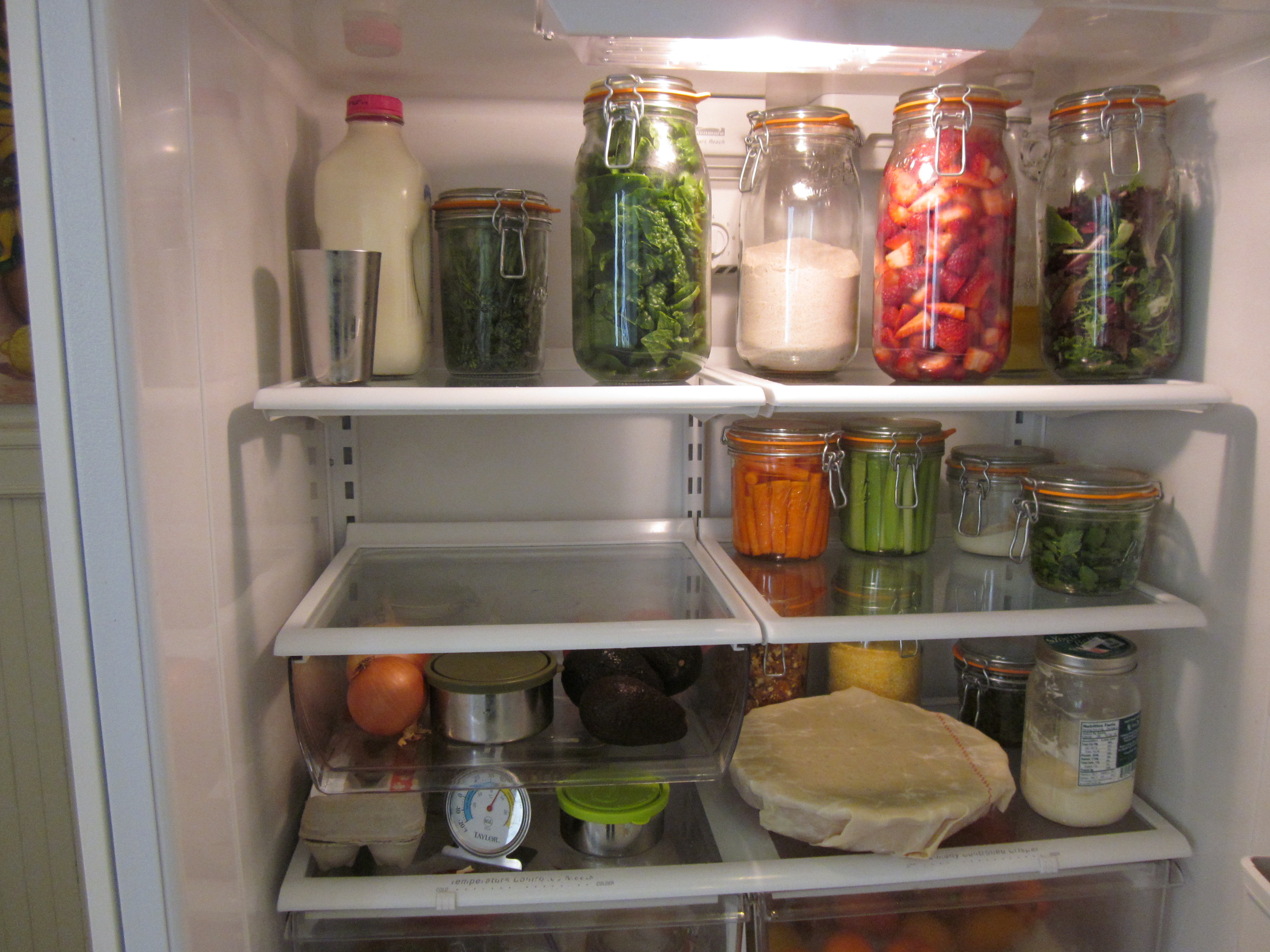
I’ll say this, though: our fridge looks awesome.
Overall we’re getting pretty crunchy over here, which honestly has never been a personal aspiration. The homesteading, back-to-the-land ethos of traditional hippies appeals to an urbanist like me about as much as firewalking. So I have been surprised at the response of people when they see me shopping, which is largely fascination. I’m frequently quizzed: “How do you store greens?” (Answer: in a glass jar in the fridge, they keep for over a week that way. Berries, too.) The idea of reducing waste seems universally appealing. I’m not really sure why.
This is not something we can do all at once. The bathroom is still challenging—contact lens solution, toothbrushes, toothpaste, dental floss. Matt and the kids pick up a lot of disposable packaging when they go out solo. There is a lot of meal planning. It’s a change, and change can be hard. Even so I feel no urge to go back to the way we were.



















 Hum of the city