Tag Archives: electric assist

Preschool EdgeRunner

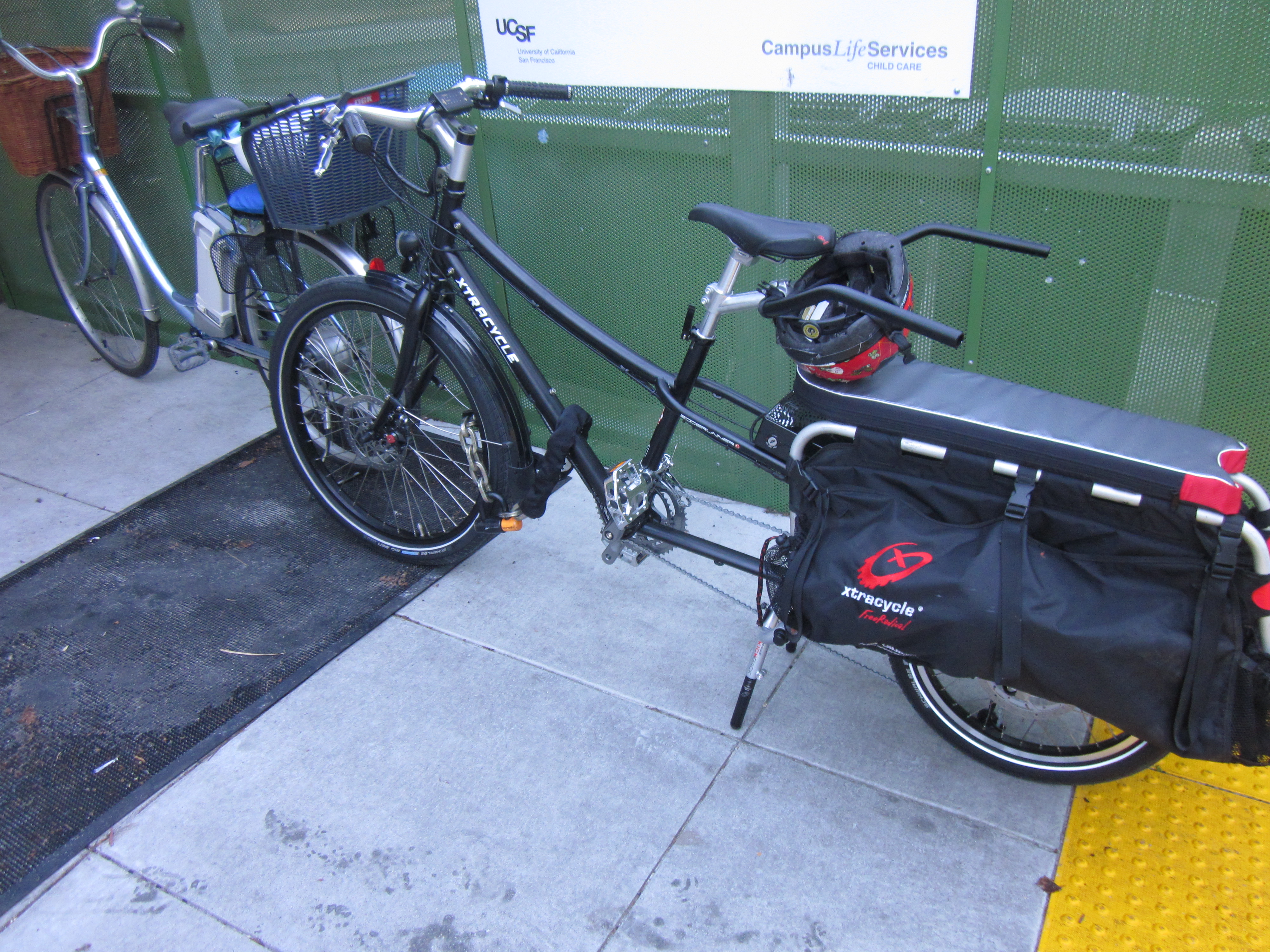
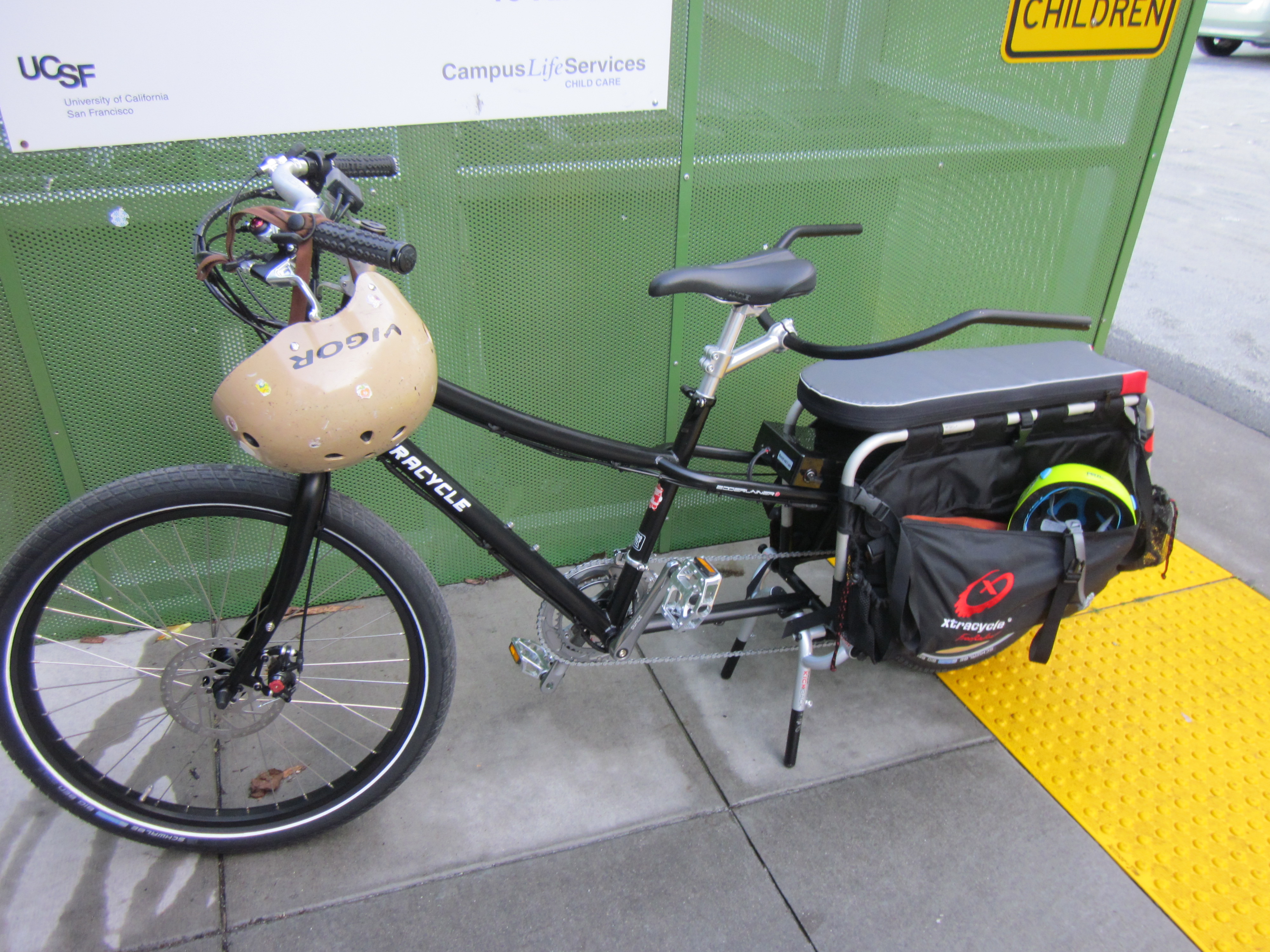
Finally, another bike at preschool.

Finally, another bike at preschool.

This morning I saw the EdgeRunner I’d spotted last week parking next to my mamachari outside preschool as I was leaving. As the dad was unloading the bike and his son, Walking Mom came up the hill. Walking Mom is a friend from preschool who pushes her 3 and 5 year old five miles from home and up preschool hill in a double stroller every morning. Then she goes to work all day, and comes back in the evening to pick the boys up and walk them the five miles home. She is incredible. “We saw you going up the hill!” she yelled to the EdgeRunner dad , “That was AWESOME!”

When I talked to him he was still panting. “Well,” he said, “[gasp] we made it! [pant] I’m [wheeze] getting old.”

I sound exactly like that every morning.

“It’s just a really steep hill,” I said, “even with the assist.”

It's possible to ride up this part of the hill unassisted, but probably not with a four-year-old passenger.

It’s possible to ride up this part of the hill unassisted, but probably not with a four-year-old passenger.

Every morning I feel like that dad. I’m simultaneously grateful and vaguely disbelieving that we made it up preschool hill again, even with the assist, even after almost a year. Looking up the hill I’m never quite sure I’ll make it.

When I look at the assists on our bikes I feel so happy that they’ve made something possible that was previously impossible. Anyone who calls an electric assist cheating can meet me at the top of preschool hill.

4 Comments

Filed under car-free, electric assist, family biking, San Francisco, Xtracycle

Xtracycle erumpent

Another EdgeRunner!

Another EdgeRunner!

Last week I spotted the first EdgeRunner I’d seen in the wild. I did a double-take last weekend when I saw it again at the Botanical Gardens. Except that it had different stoker bars. Given that stoker bars aren’t an accessory that people swap out casually, I realized it was an almost-identical EdgeRunner. This bike has been available for what, a month? And I’ve already spotted two? Evidently I’m not the only person who found it appealing. I think this one is a Rosa Parks bike, as I either saw it again or there is a third (!) EdgeRunner in our usual haunts–yesterday morning when I got to school with my son there was yes, a black EdgeRunner parked in the school yard. What’s more, we had dinner with friends last weekend, and the mom, who is in the market for a new family bike, is coveting the EdgeRunner as well.

On Monday, when we were walking with Matt’s parents to brunch, we spotted another Xtracycled bike heading up the hill the other way. Although it was moving fast, I realized it was a Cargo Joe, the folding Xtracycle, and given the speed it was ascending Mt. Sutro and the low hum it made as it went, it was clearly an electric-assist folding cargo bike. We puzzled over that one for a moment, but realized that here in San Francisco, there are thousands of people living in apartment buildings that lack dedicated bike parking (or any kind of parking) but do have elevators. In a hilly city of small spaces, there is evidently a previously untapped market for an assisted folding cargo bike.

We have missed our Bullitt sorely the last few weeks that it has been in the shop.  With it, we don’t need to organize our lives around not having a car. Riding the bike is always better. But not everyone can manage the parking demands and expense of an assisted front-loading box bike, and in San Francisco, which has so few families, the advantages of the front loaders are less widely relevant anyway. As I watched that Cargo Joe glide smoothly to the top of the hill, I couldn’t help thinking that I was seeing the future.

4 Comments

Filed under car-free, electric assist, family biking, folding bicycle, San Francisco, Xtracycle

Scaling preschool hill

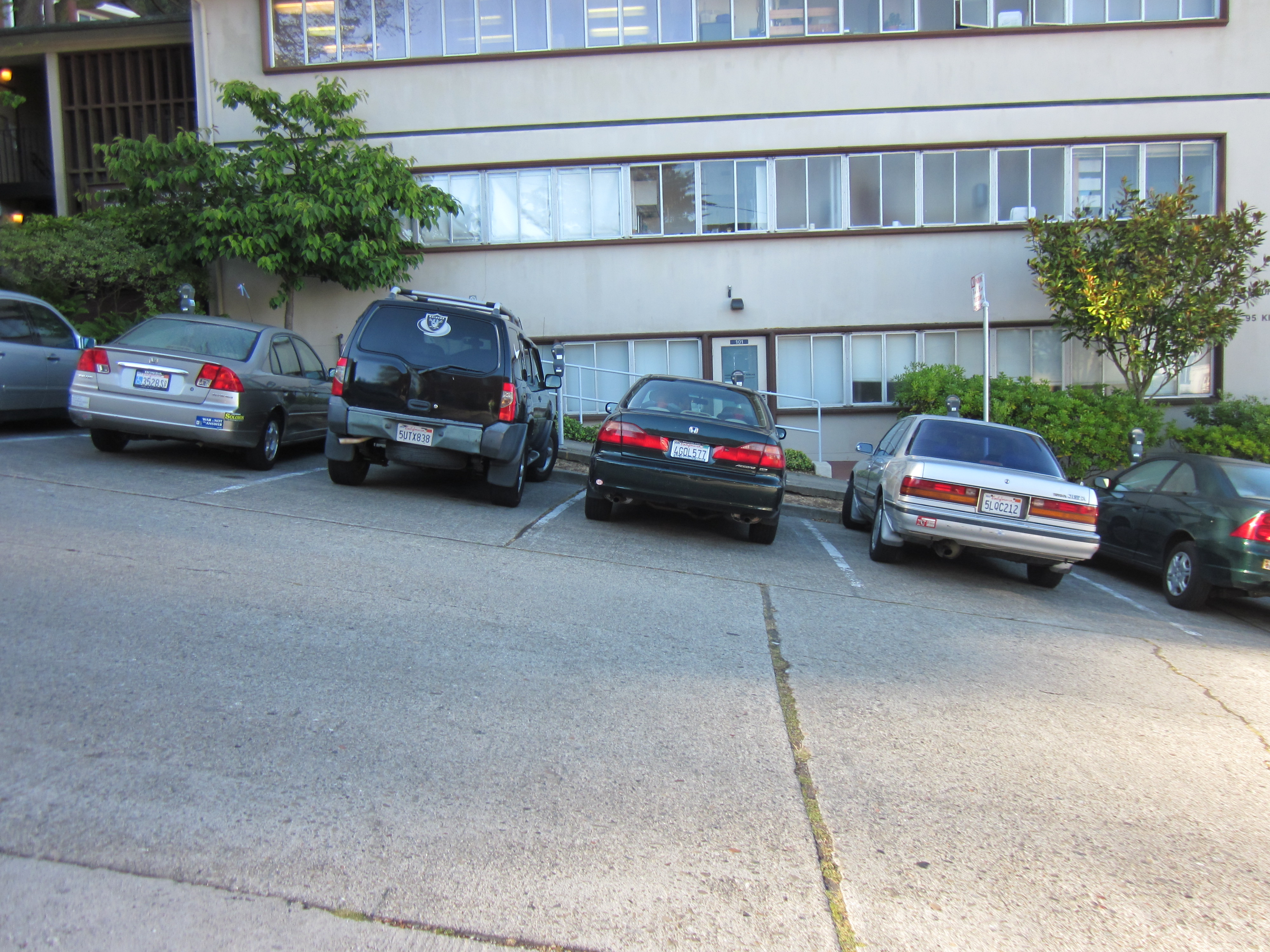
This is the approach to preschool hill, in a drier season.

This is the approach to preschool hill, in a drier season.

Lately the road to preschool has been slick due to a mysterious water leak, and with the cold the street is icing up. The university put down sand but cars are still slipping backwards on the hill (which actually happened to us once too, back when we owned a car, and which is absolutely terrifying).

Mornings this week I’ve come out to the sound of motors gunning as people try to power through the ice slick. San Francisco hills are far too steep to be scalable if there were actually ice on any regular basis.

But our assisted bikes are okay even on a steep and slick hill. It’s still not a fun trip, but it beats walking, and I when I see or hear cars losing traction I can peel off onto the sidewalk. But most drivers wait at the bottom of the hill until we get to the top. Even when the street is dry, they slow down to avoid passing us. Everyone moves pretty slowly on the uphill trip no matter what, frankly. Preschool hill is steep. It makes me paranoid about my brakes.

Anyway, I don’t see a lot of other parents riding bikes, although last year I met one dad on an assisted bike (a Walmart type model scored on craigslist), whose daughter is now in kindergarten. And occasionally there are parents who try the hill unassisted while hauling a trailer or child seat, walk in dripping with sweat, and vow while gasping for breath to never do it again.

At last there are two bikes at preschool drop off.

At last there are two bikes at preschool drop off.

That is, until yesterday, when I saw another bike snuggled up to the mamachari after I dropped my daughter off. I could hardly believe my eyes until I got outside: it was an assisted EdgeRunner! It was made exactly for this kind of job. I still don’t know who’s riding it, but it’s nice to have company at last.

1 Comment

Filed under electric assist, family biking, San Francisco, Xtracycle

The EdgeRunner has landed

Here it is.

Here it is.

Last week I heard from Clever Cycles that they had the new Xtracycle EdgeRunner in stock. And they have the pictures to prove it. On the way to work last week, I saw one parked outside a local bike shop. What a good-looking bike! When I test-rode the EdgeRunner at Xtracycle world headquarters, I wasn’t sure when they’d be in stores. They’re here now.

The EdgeRunner is the longtail we would probably buy if we were in the market for a longtail, which we totally are not, even though the Bullitt is in the shop for a while. 

Test-riding

Test-riding

The Xtracycle website offers the specs on the electric version (which I did not ride)—the assist is the latest from eZee and there are photos of the new system and new console. The total weight of the assisted version is, according to the website, an astonishing 65 pounds, which is less than many unassisted cargo bikes weigh.  And it comes with a built-in front headlight! I am seriously in love with Xtracycle for making lights on a cargo bike stock (even though they didn’t include a rear light).

I’m not in the market for another cargo bike, but I’m feeling the urge to take another cargo bike test ride. We’ll ride some hills this time.

4 Comments

Filed under electric assist, family biking, San Francisco, Xtracycle

How much does a bike like that cost?

Apparently these bikes are interesting.

Apparently the Bullitt is interesting.

People like to ask me how much our bikes cost. Usually this question comes when we’re riding the interesting bikes. I understand the impulse, but I almost never get these questions from the kind of people who normally ride bikes, people that I know have a sense of what bikes actually cost. It usually comes from the kind of people who say in the next breath, “It looks like it would be expensive; like: $200!”

Yes, sure. My “expensive” bike cost less than your mattress or the flat-screen television you keep in the kitchen. Riding bikes for transportation is cheap, but unless you get the bike for free, it’s not that cheap. And nobody picks up a free Bullitt at the dump.

The Bullitt is an expensive bike (and if you really want to know what it and bikes like it cost, check out my family bike reviews). Announcing how much we spent while standing around the park seems likely to encourage eavesdroppers to try stealing it. I finally came up with some decent answers. “It cost less than half of what we got for selling our six-year-old minivan!” I say. “Can you believe it?” Here in San Francisco, there are other meaningful comparisons. I sometimes tell people it costs about as much as a Vespa (this is true). “But a Vespa couldn’t carry my kids, of course, and I don’t have to pay for license or registration or gas—it costs a few cents to charge this bike up and ride for 30 miles! Or more!—and the maintenance cost is basically nonexistent. Can you believe it?”

I suppose I should use another picture of the Brompton sometime.

I suppose I should use another picture of the Brompton sometime.

I still never know what to say when people ask me what our Brompton cost. Usually something like, “Well, it depends on the options.” This is true, but it’s kind of lame.

Luckily for me, bikes really do cost less to maintain than scooters or cars, because right now the Bullitt is in the shop and won’t be fixed until Splendid Cycles comes back from vacation next week at the earliest (something has gone awry with our customized front shifter). Its long vacation has turned out to be a bigger hassle than I expected given that we have backup bikes. Now that we’re used to having a real cargo bike, it’s crazy-making to not be able to haul big loads and cover the kids in the cold or the rain.

Come back, Bullitt.

Come back, Bullitt.

But it’s not going to cost a thousand dollars to fix. It’s not like repairing a car. And this confidence I have that even the most depressingly expensive bike repair is easy to cover from our monthly cash flow is probably the best news of all. How much does a bike like that cost? Over the long term: nothing worth mentioning.

2 Comments

Filed under bike shops, Brompton, Bullitt, family biking, San Francisco

What I got for Christmas

We have four bikes, but only one of them regularly carries two kids. That’s the Bullitt. Our son and daughter go to different schools, and we go to different offices, so as often as not on weekdays, we’re each carrying one kid. The other three bikes—the Kona MinUte, the mamachari, and the Brompton—can usually carry one kid apiece (although both the MinUte and the Brompton have pinch-hit as two-kid haulers).

Bullitt and mamachari, better together.

Bullitt and mamachari, better together.

If Matt’s on the Bullitt and my route is going to be hilly or long, I’m most often on the mamachari, because it has an assist. Unfortunately it’s also slow and it was, from the start, a cheap bike, so it’s showing its age. Our kids had been complaining for months that their seat was uncomfortable, which was understandable given that the seat cushion was thin to begin with, and by the time we found it on craigslist it had been mostly ripped to shreds, at which point I’d wrapped it in duct tape. For Christmas I asked Matt to find me a new seat cushion. Given that bikes and seats like mine aren’t exactly thick on the ground in the US, this wasn’t the easiest request.

At least the duct tape matched the cushion.

At least the duct tape matched the cushion.

Matt started his search at cushion stores. They were happy to sell him foam but they couldn’t make a cushion or supply waterproof fabric. But there are countless discount fabric outlets in San Francisco, especially in our part of town, which is like an adjunct Chinatown. He took the kids to one of them to pick out a remnant they liked. Someone, we figured, could surely make a new cushion given these raw ingredients. We briefly considered using my sister’s sewing machine to DIY, but it was the kind of job that required an industrial machine, plus we’d be left with the problem of figuring out how to attach it.

How stylish is that? It outclasses the bike.

How stylish is that? It outclasses the bike.

I don’t know where Matt got the insight, but it turns out there is an easy place to get custom bike cushions made. As improbable as it sounds, when he called the local auto upholstery shop they said they could do what we wanted in a couple of days. I guess by comparison to auto upholstery, our needs were pretty simple. It was cheap, too. So I got a new mamachari cushion for Christmas, and now the kids want to ride my bike again.

We like it so much (and it cost so much less money than expected) that Matt’s going to have them make a custom cushion for the MinUte now. (Kona hasn’t shown nearly as much interest in family biking as Xtracycle or Yuba, so there is nothing available off-the-shelf.) Happy new year!

Matt is jealous of my cushion.

Matt is jealous of my cushion.

The mamachari won’t last forever. It makes occasional disturbing noises now and the mechanics at our local bike shop roll their eyes and laugh when I admit that it’s still rolling along. But I like that I can take it anywhere, even the grungiest parts of town, without worrying about it getting stolen (it’s not very desirable to thieves, but even if they stole it, which is certainly possible, it was cheap enough that I would be sad but not financially devastated). And I don’t have to sweat the hills. It might be ridiculous to have had a custom cushion made for a junker bike, but I’m delighted.

Leave a comment

Filed under family biking, San Francisco

We tried it: Xtracycle EdgeRunner (prototype)

The Xtracycle bike shop and cafe

The Xtracycle bike shop and cafe

[An updated review of the 2014 model is here.]

A few weeks back we headed over to Xtracycle’s World Headquarters in Oakland to take a test ride of their new EdgeRunner. This was a difficult bike for me to write about because first, our test ride was really short, and second, it’s not really in production yet and so some of the decisions about how it will look when it’s really for sale have not yet been settled. It doesn’t feel totally fair to compare the EdgeRunner to bikes that are actually on the market, but that’s all I’ve really got, so what can you do? Update in January 2013: The EdgeRunner is now available.
The EdgeRunner

The EdgeRunner is an innovative take on the longtail bicycle. Longtails are bikes with a long rear deck that allows you to seat a couple of kids or a grown-up, or to hang cargo off the sides. They offer a particularly good way to carry long loads like lumber, ladders and Christmas trees. Historically the longtail bike pioneered by Xtracycle with its FreeRadical involved essentially sticking an extra piece of frame between the front and rear wheel. Other people have written about the history of these bikes far better than I could. It was a neat idea, allowing people with ordinary bikes to turn them into cargo-hauling monsters, and people figured out pretty quickly that kids could be cargo too.

Unfortunately as used in San Francisco, the FreeRadical addition often had issues with flex. People I’ve met with FreeRadicals have, almost without exception, stuck them on mountain bikes scored for virtually nothing on craigslist. This hasn’t always made for the most stable combinations; when these bike are loaded up, particularly in hilly terrain, they can feel like they are going to twist apart. I’m informed by shops that build Xtracycles thoughtfully and with new frames, rather than by using the cheapest available donor bike, that they are far more reliable that way. But to address the inevitable urge to build a cheap cargo bike with whatever can be found lying around the garage, Xtracycle has developed an upgrade to the FreeRadical, the Leap, which is still coming soon, and probably worth waiting for. I digress.

The first innovation designed to address concerns about flex was the development of the Surly Big Dummy, which I’ve written about before. The Big Dummy frame is a single piece, so the flex issues pretty much disappear. The Big Dummy is an improvement on the FreeRadical for people with two older kids and other unusually heavy loads, or who live in areas with big hills (which basically describes us). However the bike is more heavy and more expensive and Surly, as a company, seems to be mostly uninterested in the family market, which is kind of annoying.
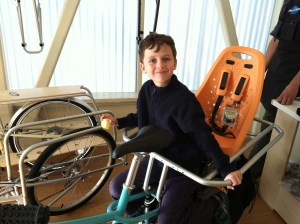
All aboard! Also, free apples at Xtracycle

All aboard! Also, free apples

Another issue that arose to some extent with all the longtails is that the rear deck is pretty high for carrying kids, particularly as they get older. This is a design issue that has unfortunately been recapitulated with the newer midtail bikes. My suspicion, which is not unique to me, is that most designers weren’t really thinking about kids as cargo when they imagined what people were going to do with cargo bikes. They imagined non-live cargo, like groceries, that could be hung from either side of the deck, and that would keep the bike’s center of gravity low. The traditional way to carry kids is on a long-john style bike like a Bakfiets, and there’s no question that once you master the linkage steering, having the kids down low and in front is much easier. But this option isn’t cheap, and longtails can also be used to carry kids and often have better range in hilly American cities.

As a result longtail parents have kids sitting on top of the deck, and having their weight up high can make the bike feel unstable, particularly on starts. The other issue we’ve discovered is that taking bikes with a higher rear deck downhill can be unnerving, because when we turn the rear of the bike will pitch away from the turn like it’s going to roll over thanks to all that kid weight on the deck. I feel this pitching even when riding our Kona MinUte, a midtail, which has a shorter deck. The pull is worse with longtails because the deck is longer. (I’ve found that dads, who typically have more upper-body strength, tend to notice this less than moms, who typically have less. It bothers me a lot. Matt notices it but it doesn’t bother him as much.)

So enter the EdgeRunner, which essentially reverses the long john design. Long johns aka front-loading box bikes aka “those bikes that look like wheelbarrows” have a small wheel in front, then a cargo platform/kid box, then the rider, then a bigger wheel in back. The Madsen and now the EdgeRunner have achieved some of the same stability by flipping that around: big wheel in front, then the rider, then the cargo platform/kid box, then a smaller wheel in back. With the heavy load near the smaller wheel, the center of gravity is lower and the bike is more stable.

Headed out on the EdgeRunner

Headed out on the EdgeRunner

Anyway I really liked the idea of putting the deck down low over a small rear wheel because my kids are getting bigger and it is increasingly hard to handle them on a traditional longtail here in hilly San Francisco, where sharp turns at the bottoms of steep hills are a fact of life. But I’ll admit that when I first saw pictures of the bike I thought it was really ugly. (Sorry, Xtracycle!) The good news is that in person, the bike looks much more attractive. The photos don’t do it justice.

Advantages of the EdgeRunner:

  • The low deck makes the kid weight much easier to control. I never felt like I was going to tip this bike. By comparison, we dumped our kids on both the Surly Big Dummy and the Yuba Mundo, and close calls were even more frequent.  (I didn’t get a chance to bomb down a steep hill and turn at the bottom because my test ride had no hills, but based on the feel of the ride I suspect that it would be more stable in this situation as well.) Both kids also found it very easy to climb on and off the deck given how much lower it was to the ground than a traditional longtail deck.
  • The bike is designed from the ground-up for electric assist. I used to worry whether I’d be judged for riding an assisted bike, but even my primary care physician advocates it. For carrying older kids in San Francisco he said my choices were either an assist or performance-enhancing drugs, and we both agreed that the assist was the superior choice. It is really a lot of work to haul that much weight around, particularly in cities that are unfortunately still designed for cars, with destinations spaced far apart and roads that take the most direct route rather than the most level one. I’ve met dads who power through these conditions with willpower, training, and a lot of sweat, but their strategy doesn’t appeal to a wide swath of parents. Besides stability, the other advantage of a smaller rear wheel is that a hub motor has a lot of torque and increased climbing power.  I can’t comment personally on the assisted EdgeRunner because I only rode the unassisted version. But the principle is sound and the testimonials from others sound compelling.
  • The EdgeRunner feels light for a longtail bike. I’ll note that this doesn’t appeal to everyone; Wheelha.us complained that it felt like the EdgeRunner was wobbling and shimmying on their test ride. I perceived the same thing as springiness and bounce and I liked it. Matt was somewhere inbetween. I suspect that this is one of those preferences that relates both to your strength and how much familiarity you already have with a heavy bike. But the EdgeRunner is easier to park than other longtails because it’s easier to move around, bump it over curbs, and so on. I wouldn’t want to carry any of these bikes up a long flights of stairs, but hauling this bike up a couple wouldn’t kill you.
  • Xtracycle has put nice components on this bike, and in combination with the stability of the rear deck, the EdgeRunner had the shallowest learning curve of any longtail I’ve ridden yet. I was a little wobbly at the start because I’d been riding the Bullitt all week, and it is tough to switch back-and-forth from linkage steering. But I got the feel of the EdgeRunner in a few pedal strokes. The bike also corners really well for a longtail.
  • Bike goes fast. My kids, riding on the back, were split on the appeal of this; my daughter thought the bike was “too fast” while my son urged me to go faster. I didn’t perceive the bike as being particularly fast, weirdly, although objectively-speaking I was moving at a pretty good clip.
  • The EdgeRunner has good acoustics. One of the disadvantages of the Big Dummy from my perspective was that it was very hard to hear my kids on the back. Like the Yuba Mundo, the EdgeRunner is better; I could hear them talking (and sometimes that’s enough that I can intervene before they start fighting).
  • The Xtracycle accessories all work with the EdgeRunner, and the Xtracycle accessories are hot. I was worried that the lower rear wheel would mean that a packed FreeLoader bag would drag on the ground, but there’s actually a reasonable amount of clearance there. The EdgeRunner is usually shown with Xtracycle’s new Hooptie, which on its wide setting can fit around a Yepp child seat. Xtracycle has a two-child seat cushion for the
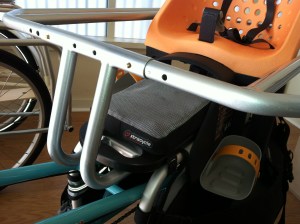
    This is the sweet little one-child cushion that fits in front of the Yepp Maxi (or whatever Xtracycle calls it).

    This is the sweet little one-child cushion that fits in front of the Yepp Maxi (or whatever Xtracycle calls it).

    deck, and we also got to try their experimental new one-child cushion that fits in front of a Yepp seat (the World HQ has all the cool toys). The modular accessories mean that this bike can carry little kids, big kids, and other kinds of cargo, often simultaneously. The Xtracycle centerstand is also pretty good; it’s not as slick as a Rolling Jackass, but it’s stable enough that my daughter could climb up and down on the EdgeRunner and under the Hooptie like it was a jungle gym, and it disengages when you lift the front wheel off the ground, which means you can just lift the wheel and go.

  • The EdgeRunner has a lower top tube to make it easier for shorter riders to climb on and off with kids on the back, and comes in two frame sizes rather than one-size-fits-all.
  • Supposedly the bike is a good climber (according not just to Xtracycle but to a Rosa Parks dad who test-rode one in the Oakland Hills, although he greatly preferred the assisted version), but given the short and level test ride I took, I can’t speak to this personally.
  • Xtracycle has made a big commitment to family biking. You see this in the accessories and on their website, which shows you how to use them. I heard it when I was talking to them, as they talked about developing a front rack and a Hooptie-based rain cover and a Hooptie-based bicycle towing attachment. We got to try their new seat cushions and my kids stacked up the various different kinds of footrests sitting on the shop shelves. And they were completely unfazed by my kids doing this (unlike me). We have bikes made by manufacturers whose commitment to family biking is half-hearted or nonexistent, and having to figure stuff out on our own or have our bike shop rig something up using their best guess is frustrating. We have friends with Madsens, which are really truly family bikes, and they do not have kind words to say about the rain cover that’s always coming “next year.” The Big Dummies are great bikes and compatible with the Xtracycle accessories, but Surly seems to be more interested in the cargo angle than the kid angle. One of the reasons I tend to suggest that families new to bikes go to Xtracycle or Yuba when they ask me for recommendations is that these companies have your back as family bikers. Even if there’s not an accessory or a bike that fills an obvious need now, you can rest assured that they’re thinking about how to get something to market. That kind of support is priceless.

Disadvantages of the EdgeRunner

  • I say this about all longtails, but it’s nicer to have the kids in front. You have to pay for that, literally, because front-loading box bikes are more expensive than longtails, but having the kids in front is better. You can talk to them and they can talk to you. There is less fighting.
  • For all longtails, including the EdgeRunner, weather protection is either do-it-yourself or planned for some unknown future date. That really limits the conditions where people are willing to ride with kids unless they are pretty handy. Freezing sleet storm? Not appealing on a longtail. By comparison, the kids are oblivious under the rain cover of a front box bike. Longtails are still not fully developed as kid-haulers.
  • The EdgeRunner is not inexpensive. The unassisted model lists for $2,000 and the assisted model for $3500. You get nice components and great design for that price and you will enjoy the ride. Moreover this is the kind of bike that can replace a car. But there are few people for whom money is no object, and a lot of new riders tend to be surprisingly price-conscious for people who would casually drop five figures on a car. But if you’re not totally sure it’s going to replace a car, these price tags can be scary. We sold our car before we bought a bike, so problem solved, but other people make different choices.
  • The low deck has some disadvantages. The main one that came up was that when my daughter complained that the bike was going too fast, my son (who is now seven) responded by dragging his feet on the ground to brake the bike. It was a very effective technique, and he found my annoyance so entertaining that he did it for much of the ride. Bike no longer goes fast. So with older kids, adding footrests is definitely not optional, and for intractable kids, this bike might not ever be the right choice. I would not buy this bike without personally testing whether adding footrests would keep my son’s feet off the ground most of the time.
  • Although the FreeLoaders didn’t drag on the ground as I feared, it also isn’t possible to pack them with the same devil-may-care attitude that is possible on a Big Dummy. The EdgeRunner is unlikely to hold the same volume of cargo as a Big Dummy or for that matter, a Yuba Mundo, simply because the deck is lower and there is less space to hang stuff off it. Tradeoffs!
  • My kids loved the Hooptie, and it’s really cool, but on the wide setting I would not feel comfortable riding with it around San Francisco (I didn’t get to try the narrow setting). Like the support bars on the Yuba Mundo, it is so wide that I would feel nervous navigating around the city’s narrow bike lanes and traffic pinch points. Unfortunately many of the best accessories (Hooptie, Sidecar) turn the EdgeRunner  (and for that matter the Big Dummy) into a bike that’s most appropriate for smaller locales. In defense of Xtracycle, these accessories are at least optional and not built into the frame. However I would find it frustrating to be able to get these accessories but know that I couldn’t use them safely. Not a problem for residents of smaller towns, but a problem for me.
  • Because this was a demo model, the bike we rode wasn’t the bike you’d buy. But: I found the shifters weird. They grew on me a little, because they shift perfectly, although with a slight delay, but they don’t allow you to see where you are on the rear derailleur, which was frustrating. Updates: I wasn’t sure what would come standard at the time, but the assisted EdgeRunner comes with a front headlight, and everything else should be obvious from a review of the website and/or a test ride. It does not appear to have fenders stock.  
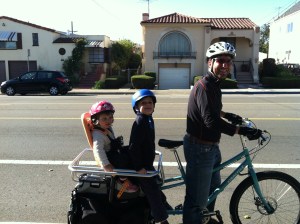
Matt takes the EdgeRunner out for a spin.

Matt takes the EdgeRunner out for a spin.

Overall, I liked the EdgeRunner. The lower rear deck made the bike incredibly stable and the light weight made it fast. The fact that it was designed with hilly terrain in mind makes it really appealing in San Francisco. Although I’d want to ride it again before considering it seriously, with both an electric assist and with some kind of footrests for my son, there was nothing about it that struck me as a deal-breaker. By comparison, the Yuba Mundo frame was too wide and heavy for our needs (and the elMundo was under-assisted), and the Surly Big Dummy, with its higher rear deck, felt far less stable. And on both of those bikes we kept dumping the kids. They’re the right bikes for other families, but they weren’t the right bikes for us.
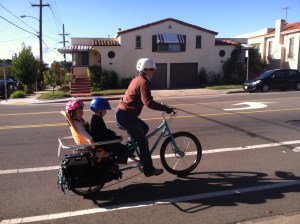
Riding off with my son's feet off the ground, for once.

Riding off with my son’s feet off the ground, for once.

Every family has specific priorities in shopping for a bike. Where we live and with our family, having a bike that can handle hills and that offers the least risk of dumping the kids are big priorities, and those are the reasons that our main kid-hauling bike, until very recently, was a midtail. The EdgeRunner appealed to me because of the stability of the rear deck and its hill-climbing focused design. We’re not in the market for a longtail bike; we like our Bullitt for the two-kid hauling errands (and we’ve purchased more than enough bikes this year anyway, thanks to having to replace a stolen bike). But if we were in the market for a longtail bike, I would be holding out for the EdgeRunner.

12 Comments

Filed under electric assist, family biking, reviews, Xtracycle

We tried it: Yuba Boda Boda

Hey, Boda Boda!

There are some new entries in the land of midtail cargo bikes. For the last year we’ve been riding the Kona MinUte, the first of these, and until pretty recently, the only bike in its class. Then it was stolen. That totally sucked. But given that we had to replace it anyway, we took a hard look at the two other midtails on the market now, the Yuba Boda Boda and the Kinn Cascade Flyer. Happily for us, Yuba, which is here in the Bay Area, let us ride one of their Boda Bodas for a while last month. Thanks, Yuba!

For background, midtail bikes are a new-as-of-2011 variation on longtail cargo bikes. As the name implies, they’re shorter. Instead of a long deck that can hold 2-3 kids, they offer a short deck that can hold 1-2 kids (as always, the number of kids you can successfully pile on the back of a cargo bike depends on their mood). The disadvantage of a midtail bike is obvious: it can carry less stuff and fewer kids. But there are payoffs for the reduced payload. Midtails look and feel like normal bikes; people who are nervous about handling a big bike will be more comfortable on a midtail than on a longtail. I have never dropped either the MinUte or the Boda Boda with the kids on board and I doubt I ever will. Midtail bikes can also be put on a bus bike rack and on Amtrak for longer trips. And it is a kind of bike that transitions easily from dropping off kids to riding into the office, which is how Matt used it.

Yuba moved into making a midtail bike with some major innovations. Although we liked our Kona MinUte, Kona is not a company that’s made much of a commitment to the family biking market, and that can be annoying. Yuba, on the other hand, cares very much about families. They created the Boda Boda explicitly to carry both kids and cargo, and it shows. The other big innovation is that they developed the Boda Boda with an electric-assist option integrated into the design. The only other cargo bike I know that was developed this way was Xtracycle’s EdgeRunner, a longtail. If you’re riding a cargo bike over a lot of hills or long distances, both these bikes should be on the short list.

The Boda Boda looks wildly different than the MinUte, even though they were both apparently designed by the same person. Putting them side by side in our garage made it very obvious that the MinUte was meant to look like a mountain bike, while the Boda Boda was meant to look like a cruiser. The Boda Boda looks friendlier and has a step-through frame option. Weirdly, the Boda Boda also looks bigger, although it is not in fact bigger. It was a strange and entertaining optical illusion.

Advantages of the Boda Boda:

  • This is an extremely easy bike to ride, both with and without kids aboard. The Boda Boda looks and feels like a beach cruiser, with wide handlebars and a relaxed and upright ride, but has massively increased carrying capacity. We had some friends who were only occasional riders try it, and even when it was loaded they took off without a wobble. This is common to some extent with all midtails, but our loaner Boda Boda had an advantage over the MinUte: a step-through frame. Even shorter riders could get on and off with contorting over the top tube or round-housing a kid sitting on the back deck.
  • The Boda Boda is a slender bike that can move easily through traffic. It has the same kind of rear supports as the Mundo, which are handy because they can hold up the bags or be used as footrests for older riders, but they are much narrower than the ones on the Mundo (as are the bags themselves). A Mundo with the Go Getter bags packed is three feet across, wider than many bike trailers, and it can be nerve-wracking to ride one in San Francisco’s narrow bike lanes and heavy traffic—as a result, I sometimes see Mundos riding on the sidewalk, even though this is illegal in San Francisco. The Boda Boda’s Baguettes, even fully packed, still lie pretty flat and make it possible to weave the bike through pinch points without a second thought (Baguettes can apparently be used on a Mundo as well, by the way).
  • It is very difficult to dump the kids on the Boda Boda (this is true for all midtail bikes). I never managed it, which is more than I can say for the longtails. The weight on the back is so close to the rider that it isn’t hard to handle.
  • The Boda Boda can easily carry one kid, or two kids if they’re in a good mood. The best application for this size of bike is to either carry one kid and a friend (siblings are more likely to fight) or for parents who have two kids and two bikes and are riding with them separately most of the time (that’s how we used our MinUte).
  • Happily, this bike is lightweight for a cargo bike. That means that although it’s not easy to carry, it’s possible. After seven straight years of lifting my kids overhead I have pretty decent arm strength, so needing to carry this bike up a few stairs wouldn’t intimidate me (unless I needed to carry a young child at the same time). However, the much heavier assisted bike: out of the question.
  • It is not appalling to ride this bike up hills. I have been riding a lot with an electric assist lately, because I don’t enjoy walking into meetings covered in sweat (both the campuses where I work are on the top of steep hills). As a result I was slightly depressed by the prospect of riding the unassisted Boda Boda around the city. Although the Boda Boda was, from my perspective, under-geared (see below), it wasn’t as bad as I’d feared. I was able to follow a friend who was riding my assisted mamachari and who had my daughter on board up a moderate hill without major effort. Frankly I think riding with the assist has made me stronger. But still, credit to the Boda Boda.
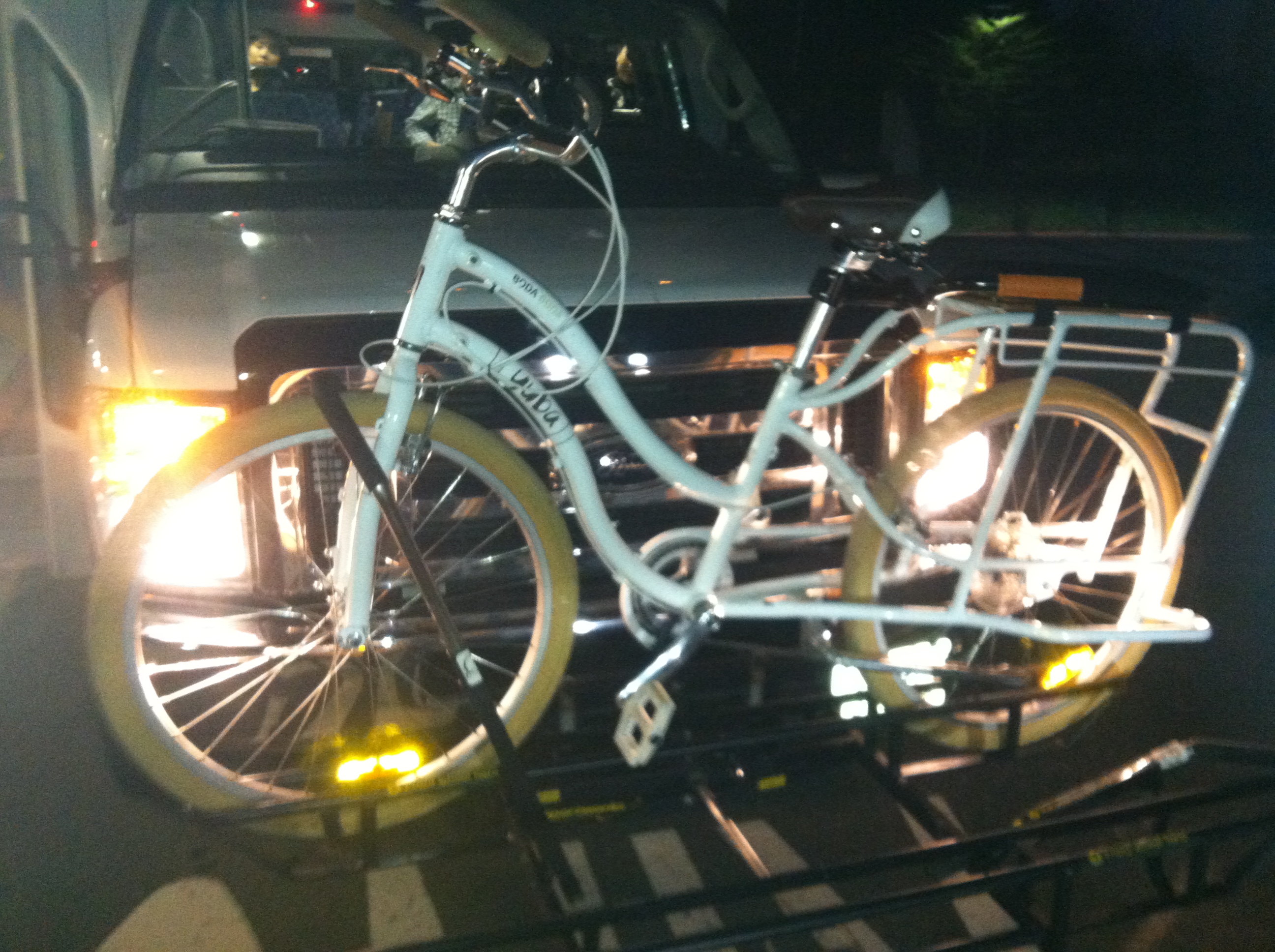
  • It took less than 30 seconds to load the Boda Boda on this rack. No wobbling on the ride either (which involved going up and down steep hills at speeds I’d prefer to forget).

    The Boda Boda fits on a bus bike rack, even a small rack like the one on the university shuttles. One evening when my son forgot his helmet at pickup we rode the shuttle home instead of riding. One of the reasons I really like the midtail size is the ability to do stuff like this instead of being stranded. I wrote once about flipping the front wheel to put the Kona Minute on a bus bike rack; we did the same thing with the Boda Boda. The bike is light enough that lifting it to the rack wasn’t a problem (note that this was the unassisted bike, which is ~15 pounds lighter than the assisted bike). And it definitely impressed the other shuttle riders. “What a great design!” The Boda Boda fits on the rack slightly better than the MinUte, actually, because it has smaller 26” wheels.

  • Yuba has designed some nice accessories for this bike. Unlike a lot of cargo bikes, it has a chain guard. Most of the other accessories are not included in the base price of the bike, but they are probably worth the money. The Baguette bags in particular impressed me; they hold a lot more than they look like they would, and still lie flat against the bike itself. The deck and running boards are bamboo, and they look classy. Some of the standard Mundo accessories, like the front basket and the seat cushion for the deck, also work on the Boda Boda.
  • Many cargo bikes are one-size-fits-all, but the Boda Boda (like all three midtails now on the market) comes in two different frame sizes. This is very nice for shorter and taller riders who report that some bikes are really one-size-fits-most rather than one-size-fits-all. The smaller size has a step through option.
  • Although I rode the unassisted version of the bike, Yuba designed the Boda Boda with the expectation that many people would want an electric assist. The assist system they chose, which is made by BionX, is excellent (the same one we have on our Bullitt). The deck is designed to hold the BionX rack-mounted battery underneath and it’s unobtrusive. For people in hilly cities like ours, this feature, in combination with the excellent accessories and light weight, makes the Boda Boda unbeatable for the family with one child.
  • I often call Yuba the Ikea of bike manufacturers because they make cargo bikes at very approachable price points, and the Boda Boda is no exception. The unassisted Boda Boda is $1000, and the assisted version is $2700. By cargo bike standards, these are excellent prices (the assisted version seems like a particularly good deal). The Kona MinUte has the same base price (and the bags are included, but unfortunately the MinUte bags kind of suck) and is also a good deal, but as noted above Kona is not a family-focused company and there is no integrated electric assist system. That might not be a problem if you have a family-oriented local bike shop, but could be frustrating if you don’t.

Disadvantages of the Boda Boda:

  • This is not specific to the Boda Boda but to its class: like many parents, I prefer to ride with my kids in front of me rather than behind me.  You can see them and talk to them and it’s altogether a better experience (it also feels safer to me, probably because experience suggests I’m less likely to dump a front-loading bike). Realistically, however, the kids in front option is expensive. If you have the money, by all means get a bike that puts the kids in front, because it is fabulous. But most people don’t walk into family biking yelling, “Money is no object!” Also you could never get a front box bike onto a bus.
  • The Boda Boda is really a bike suited for carrying one kid regularly and no more than that. Yes, it is possible to put two kids on the back of a midtail, maybe even three for a short ride. Yes, there are probably siblings in this world who could ride that way regularly without trying to kill each other. However such kids would be exceptional.  I’ve been able to ride a MinUte for almost an hour without my kids fighting on occasion, but more often the ride gets cut short when they start smashing helmets. So the Boda Boda is really a bike for a one-kid family or for a family where both parents ride and split up the kids, or where only the youngest needs to be hauled.
  • The Boda Boda is under-geared for San Francisco. It has eight speeds and they were not enough for riding around our neighborhood loaded and unassisted. Yes, I could climb moderate hills, but trying to get up the steep hill to the main campus on this bike left me dripping with sweat. However, this wouldn’t be an issue with the electric assist version.
  • More expensive cargo bikes come with better parts, and cheaper bikes come with parts that are less good. The Boda Boda comes with many of the same parts that are on the Yuba Mundo, which where we ride would mean making several upgrades, either all at once or over time as various parts on the bike broke. In defense of the Boda Boda, it is a much lighter bike than the Mundo, so the riding experience with those components was much better than on the Mundo (in particular, using rim brakes felt less like flirting with death). Also in defense of the Boda Boda, we had to do the exact same thing with our MinUte, which is also built with cheaper parts. The components may not be an issue for an occasional rider or for someone riding in less demanding conditions.  However I had the chain drop off the front ring twice while riding the bike, and it was a huge pain to rethread given the chainguard.
  • I suspect that Yuba had a price point in mind building this bike, and that was: less than the Mundo. As a result, the standard Boda Boda is pretty stripped down if you want to haul a kid on it. The stock kickstand is totally inappropriate for loading kids, the bike lacks fenders, there aren’t stoker bars or footpegs for a kid riding in the back, and the bags are not included. There is an optional center stand appropriate for loading kids, plus bags, and so forth, but the costs of these upgrades add up and should be kept in mind. The bike I rode, incidentally, came with Baguette bags, which have a neat center outside pocket where my seven-year-old son could tuck his feet, and I definitely think they’re worth the money.  However I suspect that many parents would appreciate a “family package” where the obvious upgrades were bundled together.
  • The Boda Boda is still somewhat in development, and the accessories designed to carry kids are not yet perfected. The Boda Boda deck is much higher than the Mundo deck, so the Mundo stoker bars are too low for kids to hold. When my daughter (three years old) tried using them she was frustrated that she had to stick her face into my butt. My son, who can stay on by himself (although he prefers having stoker bars) simply ignored them.  If Yuba doesn’t come up with stoker bars for the Boda Boda, it would be better to have a bike shop rig up something.  Similarly, foot pegs for smaller kids like my daughter, who couldn’t put her feet into the bag pockets, are apparently not available.
  • I learned recently that some accessories are not compatible with putting the bike on a bus rack. Many San Francisco transit services, for example, don’t allow you to load bikes with front baskets on the bus racks. Normally I would suggest putting Yuba’s Bread Basket on to increase the Boda Boda’s carrying capacity, especially given that it can be tough to use the rear bags if you’re carrying a younger kid in a child seat on the back (Yuba’s Peanut Shell is compatible with the Boda Boda). But for anyone planning to put this bike on the bus, definitely check with the local transit agency first, because the Bread Basket cannot be removed without tools.
  • As with all of the longtail/midtail bikes, there isn’t really good technology yet for covering up kids in bad weather on the Boda Boda. People have jury-rigged rain covers and bundled up kids, but this is one area where front-loading bikes really shine: most of these bikes come with covers.
  • I found the deck on the Boda Boda really high for carrying kids (this is also a problem on the MinUte, which has bigger wheels). On a longtail, this can make the load less stable, meaning you’re more likely to dump the bike and scrape up the kids. On a midtail like the Boda Boda dumping the bike is extremely unlikely; that’s an advantage of the short deck. But there’s still a cost to putting weight up so high. Where I feel the most unstable on midtails and longtails with kids on board is turning at speed (especially at the bottom of a hill), when these bikes will pitch away from the turn like they’re going to roll over. This feeling is very unpleasant, and is much less likely to happen with the load lower down. Yuba built a high deck so there would be space to hold the BionX rear-rack mounted battery. However the Boda Boda would feel much more stable if both the deck and the battery were lower.

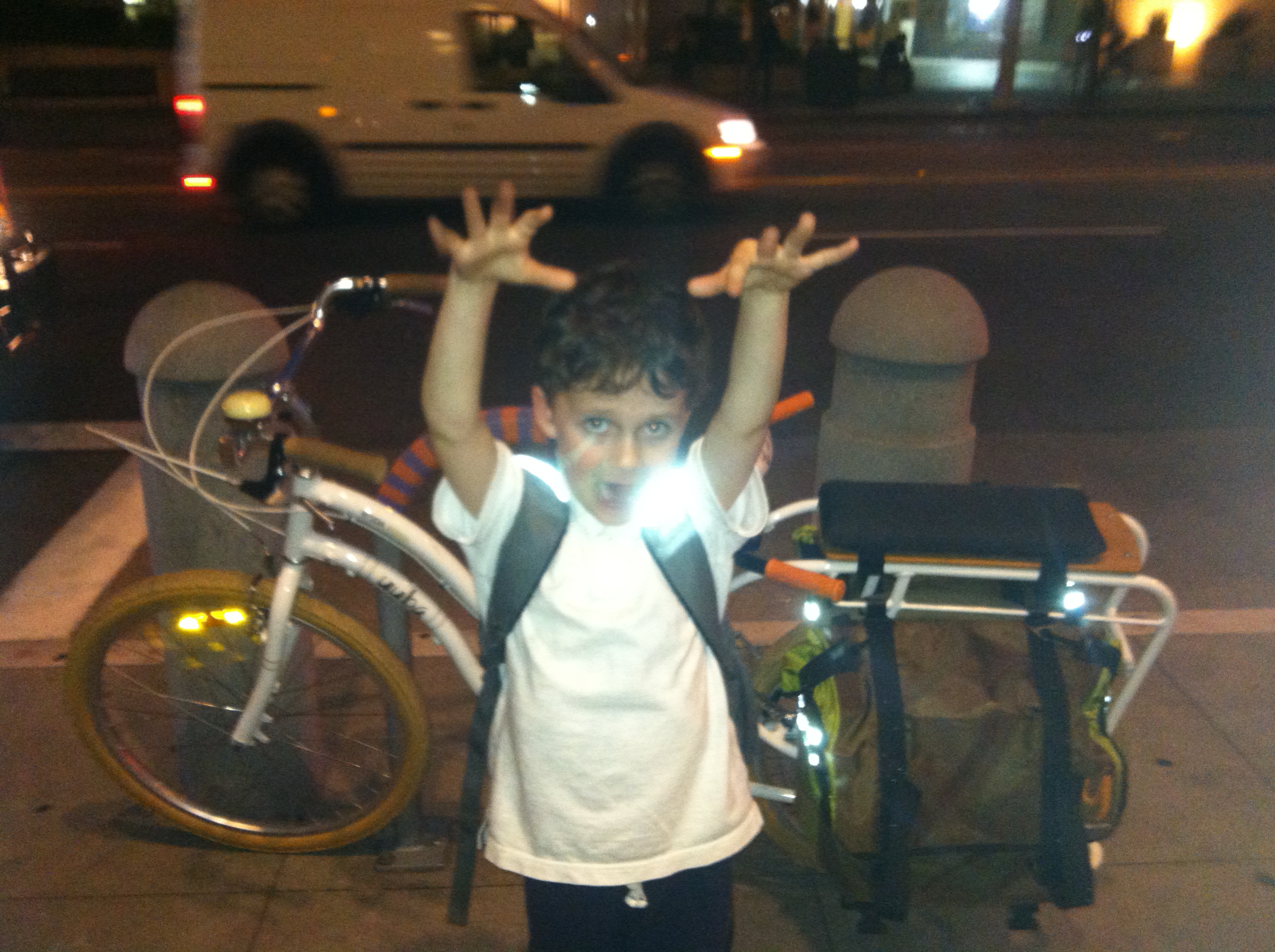
There’s been a lot of mugging for the camera lately. My son liked riding the bike. Hence the scary face, I am told.

Overall, I was impressed with the Boda Boda. It looks cute and easy to ride, and it is. That might sound trivial to people who already ride regularly who are considering a cargo bike, but for people who aren’t already riding bikes, it’s really important. The Boda Boda is very accessible.

I liked this bike so much that the electric assist Boda Boda is now what I recommend when San Francisco families with one child who are new to riding bikes ask me what bike they should get. So far two of them have gone for it (knowing that they’re probably going to have to upgrade some of the parts along the way).  Overall, for parents looking to start bike commuting with a kid, the Boda Boda is an excellent choice.

23 Comments

Filed under electric assist, family biking, reviews, San Francisco, Yuba

A week of riding

One kid on board, one kid yet to pick up

Earlier this week I found myself on the hook to pick up both kids because Matt was out of town. The complication was that I had to be in a Faculty Council meeting until 5pm. That meant I would have to run across campus to my daughter’s preschool, coax her out, then run across town to get my son at his after-school program before it closed at 6pm. I seriously considered hauling two car seats to my meeting and renting a car from the City Carshare in the preschool parking lot for this trip. Ultimately I decided against car share because I’d tried that once before and not gotten there in time—rush hour traffic is unbearable in the evening, and the after-school pickup line stretches back for three blocks. And after all, isn’t stuff like this what we got the Bullitt for?

With that in mind, I parked the Bullitt outside the preschool in advance. Then I sprinted out of my meeting at 5:01pm, hauled across campus to preschool, collected all of my daughter’s art for the day, and dragged her out with promises to finish the story they were reading at home. We got to my son’s after-school program at exactly 5:30pm (in the rain). That beats my previous record by car by almost 20 minutes. And that is why we got the electric assist! My son was the first kid in his class to be picked up. Unfortunately I’d forgotten the speaker, so I had to listen to “99 bottles of beer on the wall” all the way home. Nobody’s perfect, I guess. I cranked the assist up to “high” for the ride home to spare myself.

The New Wheel recently put together this drool-worthy BionX SOMA (also Pitlocked to the hilt).

I would actually have gotten to him even earlier if someone hadn’t tried to steal my saddle. The Bullitt came with a very nice Brooks saddle, so nice that I never would have purchased it on my own. Saddle theft is epidemic in San Francisco, and thieves learned years ago how to clip the chains traditionally used to lock saddles to frames. However on the advice of a friend whose very expensive SOMA bike has survived being locked up at SF General for five years without being stripped or stolen, the first thing I did when the Bullitt arrived was to take it to The New Wheel, where they put Pitlock locking skewers on everything, including on the seatpost and under the saddle screws. Thanks to that, the thief was able to loosen the saddle screws but not remove them. As a result my ride was slowed by the saddle slipping back and forth, and that was really, really annoying. But I am gratified that my paranoia has paid off, and that I still have my saddle. Two thumbs up for the Pitlocks!

The next morning, with the saddle screws re-tightened, I rode my son to school and came out to find the Bullitt being admired by two dads who work as contractors. When our PTA president rode up on his daughter’s bike, he looked at it and asked, “Will you give me a ride back to my bike?” and I said, “YEAH!” I didn’t get a picture, so you’ll just have to imagine me riding with a six foot tall man wearing a nice suit in the box. I can tell I’m getting better with the bike, because the prospect of carrying a heavy live load didn’t make me worry I’d dump the bike. And it was no problem at all.

What was a problem was an earlier morning ride I took with my daughter in Golden Gate Park. For the first time in my life a driver nearly clipped me while passing, ignoring the empty road to the left to gun past me ON THE RIGHT. It was terrifying. When I saw the car pulled over less than a block ahead I pulled over to ask, “WHY DID YOU DO THAT? Passing me on the right is incredibly dangerous!”  The driver turned to her husband in the passenger seat, who explained that she didn’t know the traffic rules and didn’t speak English. After he prompted her, she said, “Sorry! Sorry!” Okay, call me a xenophobe, but I feel that if you don’t know traffic rules or speak enough English to learn them, maybe you shouldn’t be driving. Although I’m glad that she wasn’t malicious, I suppose.

It’s been hard to get pictures of the kids on the bike; they jump off and run to make faces at the camera.

That, however, was an unusual event. In general riding the Bullitt is a daily party. When I ride people shout, “Cool bike!” and other riders pace me to ask where I got it. “I want one to carry my kids!” they say, and the parents at our kids’ schools say the same. I found the attention disconcerting at first, but I’ve found that as time passes that I like it. Our Bullitt is apparently a wildly compelling advertisement for family biking. And I never have to worry about not being seen by drivers. Admittedly the way that drivers drift out of their lane while staring with their mouths open can be unnerving, but hey, they’re not going to hit our bike—an oncoming car, possibly, but not us.

It seems like we’ve spent quite enough on this bike, but this cover is pretty tempting.

Last night I took my son home with groceries piled around him. He complained that the wind made him cold. I’m beginning to wonder whether I should have gotten the rain cover after all. It’s not like it rains much here in San Francisco, but the winds can be pretty brutal in the winter, and the kids are right in front taking the brunt of it. It’s not too late, I suppose. What would you do?

13 Comments

Filed under Bullitt, car-free, electric assist, family biking, San Francisco, traffic

Getting used to life with a real cargo bike

Heading for the Presidio on the party bike

We’ve had the Bullitt for a week now. Riding an assisted Bullitt in Portland was mostly effortless. Riding an assisted Bullitt in San Francisco is not effortless. I’ve now got two kids and cargo on my bike most of the time and on serious hills, even with a boost from the BionX it’s: “Oh hello, lactic acid.” In San Francisco, riding a loaded, assisted cargo bike on steep hills is the parental equivalent of training for the Olympics, difficult but gratifying. I’m not yet up to carrying this kind of load every day. However with Matt at home for a month or so, I have time to build up strength by switching out to an alternate bike sometimes with just one kid on board. But it sure is fun on the days that we do take the Bullitt. And on the flats we are so freaking fast.

We had an unexpected chance to race a car this weekend. Matt’s parents came to meet us for dim sum, then wanted to go shopping with us in the Presidio, then came home to play with the kids. They drove over from Berkeley. We met them at the restaurant; they arrived late because although miraculously they found parking immediately, they had to walk over from their car. When we left the Outer Richmond, we headed off separately to the Presidio. Ultimately we leapfrogged with them through light Sunday traffic. We all got lost thanks to the road construction, but ended up turning into the parking lot at the exact same time. Then we split up and headed home. I assumed they’d get there first because we had to climb both the Presidio hill and Mt. Sutro, but once again, we arrived simultaneously. On a weekday (or a busier weekend), with more traffic on the streets, we would have beaten them handily.

I’m still not used to the attention that we get on the Bullitt. After several rounds of my son singing “99 Bottles of Beer on the Wall” I caved and bought a speaker that works with my phone. So now I am whizzing around the city with two kids on board who are blasting TMBG’s “Alphabet of Nations” and dancing along in the box. We are a traveling party-bike. Passing drivers stare so long that they drift out of their lanes as they go by. We hear groans of envy from parents pushing heavy strollers up San Francisco hills. Little kids chase our bike. It is a blast, but disconcerting. “AWESOME BIKE!” is what we hear most often. “Wow, all of us could fit in that bike,” is an occasional addition from groups of people waiting at bus stops.

Because the Bullitt is such a slim cargo bike, it still slips through narrow bike lanes and alongside traffic pinch points. When I am riding it, it is the best of all possible worlds. It carries as much as a car and travels at least as fast, but can speed past stopped traffic and park in an ordinary bike rack by the front door of any destination. It eats up the hills. Next week, I am taking this bike to Costco. (The San Francisco Costco is unlike its suburban siblings; it is a three-story parking garage occupying an entire city block, and the store itself is located in the center of the second floor, and thus it gets a fair amount of bike traffic.)

Running for the Bullitt

I expected that the Bullitt would substitute for trips that we normally took using City Carshare. Historically that’s meant shopping trips on the far side of a big hill or two that we couldn’t manage with two kids and cargo simultaneously, or trips out of the city. Realistically, we could have used City Carshare for all of the trips that the Bullitt is now handling indefinitely. Our occasional car rentals are usually pretty cheap, maybe $6-$20 per trip depending on length, and even at a once a week pace, it would be a very long time before the bike paid for itself using offsets from car share rentals. But the bike is more convenient. We no longer have to worry about when we go someplace; we’re not going to get stuck in traffic and we won’t have to circle to find parking. And it is so much fun to ride! One week in, when given the choice between City Carshare and the Bullitt, we all run to the bike.

4 Comments

Filed under Bullitt, car-free, cargo, electric assist, family biking, San Francisco, traffic