Tag Archives: bike commuting

Grace

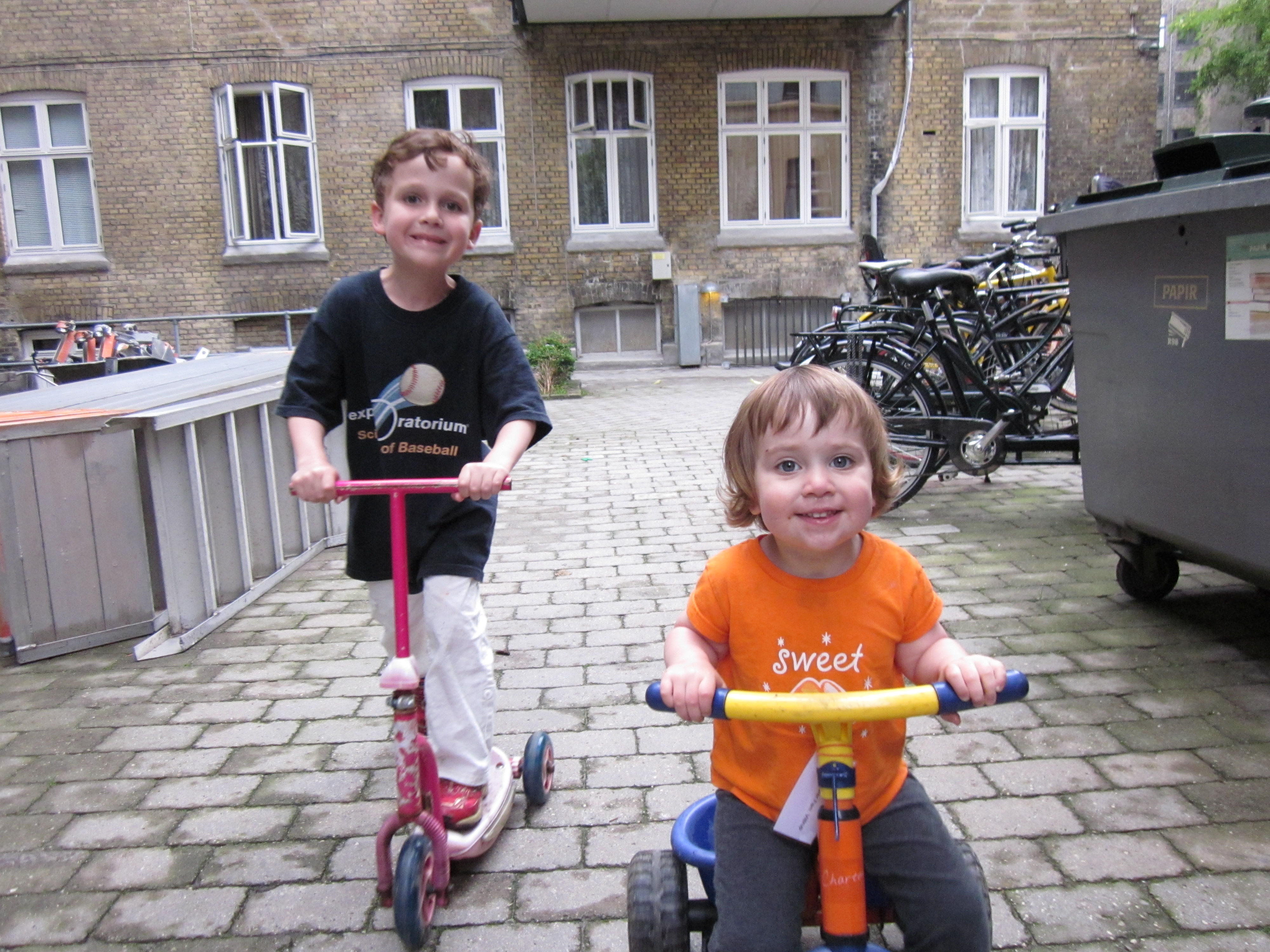
This is how our kids figured out bikes, in Copenhagen.

This is how our kids figured out bikes, in Copenhagen.

I remember my grandfather teaching me to ride a bike. There were tricycles at preschool that everyone rode, and my parents had gotten me a banana yellow Schwinn with training wheels—balance bikes were nothing anyone had heard of in suburban Seattle at the time—but I was afraid of falling down on a bike with only two wheels. Our parents rode bicycles, carrying us through the neighborhood in their front baskets or perched on a top tube, but didn’t have the time or patience to teach us to ride. My grandfather took the training wheels off my bike while visiting one summer, and ran up and down the driveway with me, holding onto the seat. After a while I realized he was running up and down with me and not holding onto the seat. Then I fell down.  By the end of the day I was riding by myself. For years afterward I never really thought about my riding skills again.
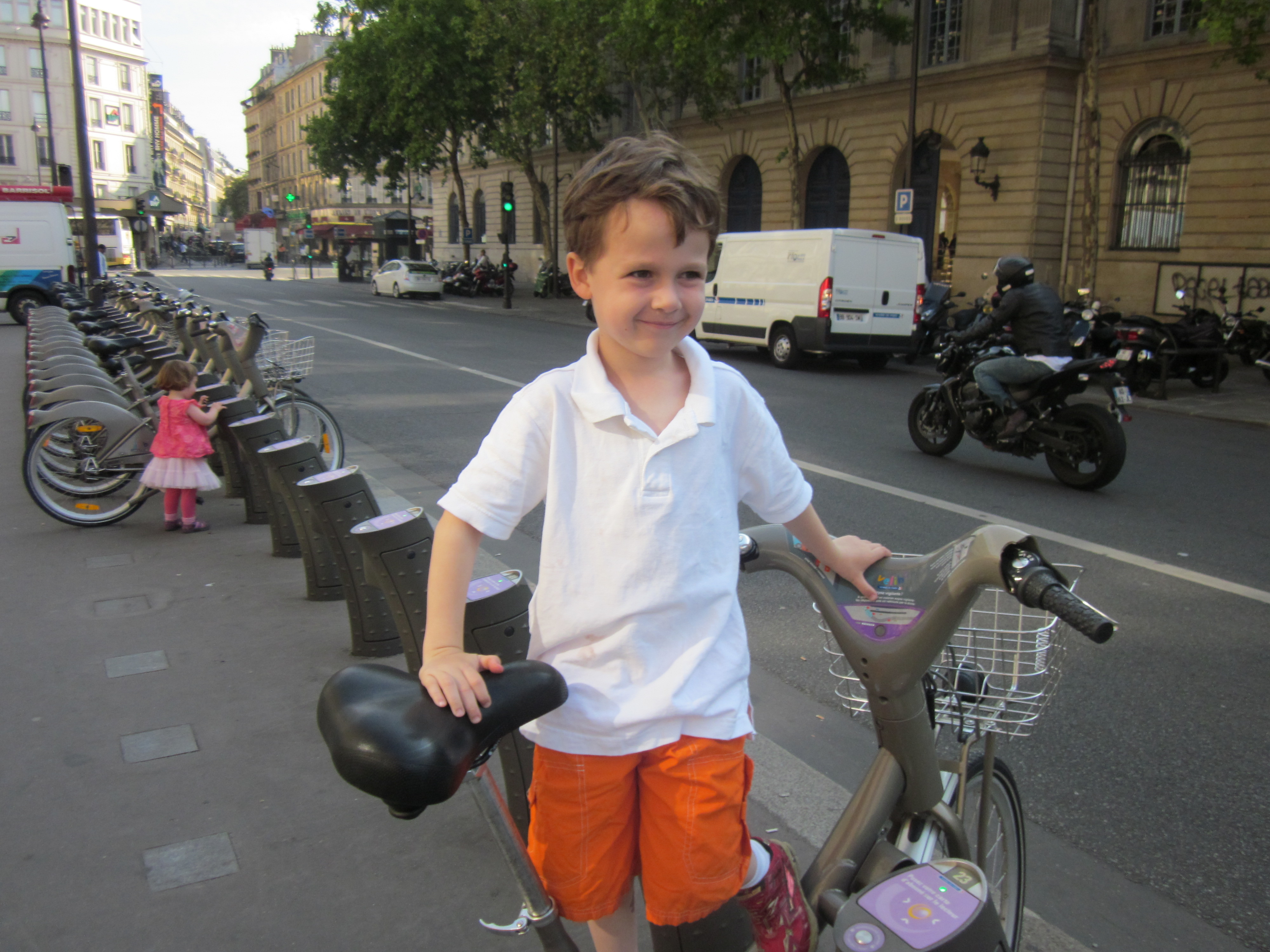
Velib, the Parisian bike share, only appeared after we lived there--sometimes I think how much sooner I could have gotten back on a bike.

Velib, the Parisian bike share, only appeared after we lived there–sometimes I think how much sooner I could have gotten back on a bike.

I grew up riding that bicycle and later, a 10-speed, to visit friends and parks. But like most of my friends, when I was old enough to drive I started taking many of those trips by car. After a while the only people I met on bicycles were the friends, like me, who’d kept their bicycles lying around. After I graduated from college I bought a car and left the bike in my mom’s garage. The car, along with almost everything else I owned, eventually got sold in one of the frequent moves around the country and the world. It became easier to rely on public transportation and my own feet, which were always with me no matter how skimpy the luggage allowance.
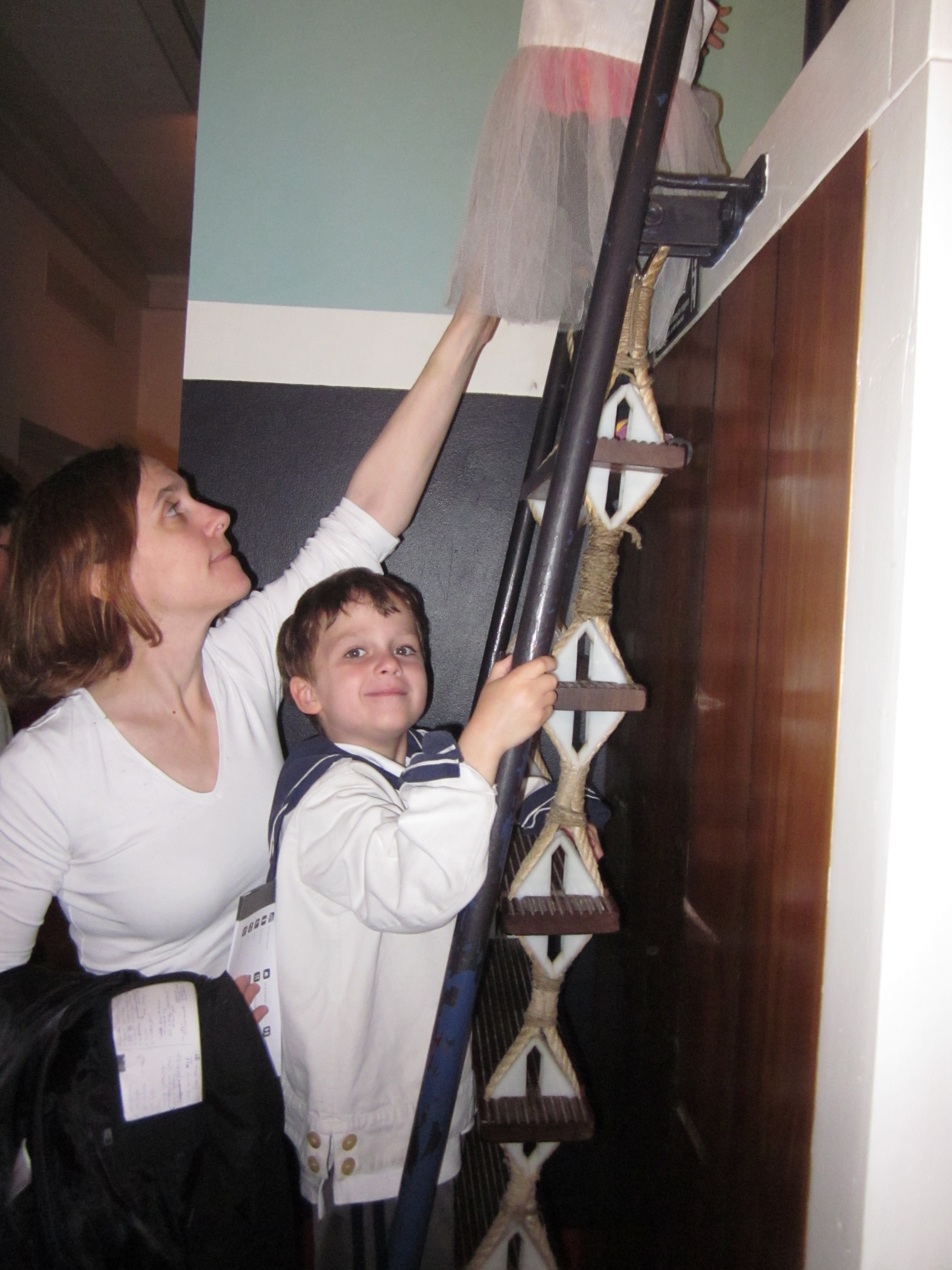
We rented bikes just to get to this museum, and what a great decision that was.

We rented bikes just to get to this museum, and what a great decision that was.

We had children and another car, a minivan, before I got back on a bike again during a visit to Copenhagen. It had been years, and climbing back on a rental bike with my daughter strapped into a seat on the back took some nerve. I was wobbly and nervous, but the infrastructure in Copenhagen is designed for that. My primary goal was not to fall down, and I managed that and more. By the end of that day I wanted to ride a bicycle everywhere with our kids, even the hills of San Francisco, and even though I was anything but graceful on that bike.
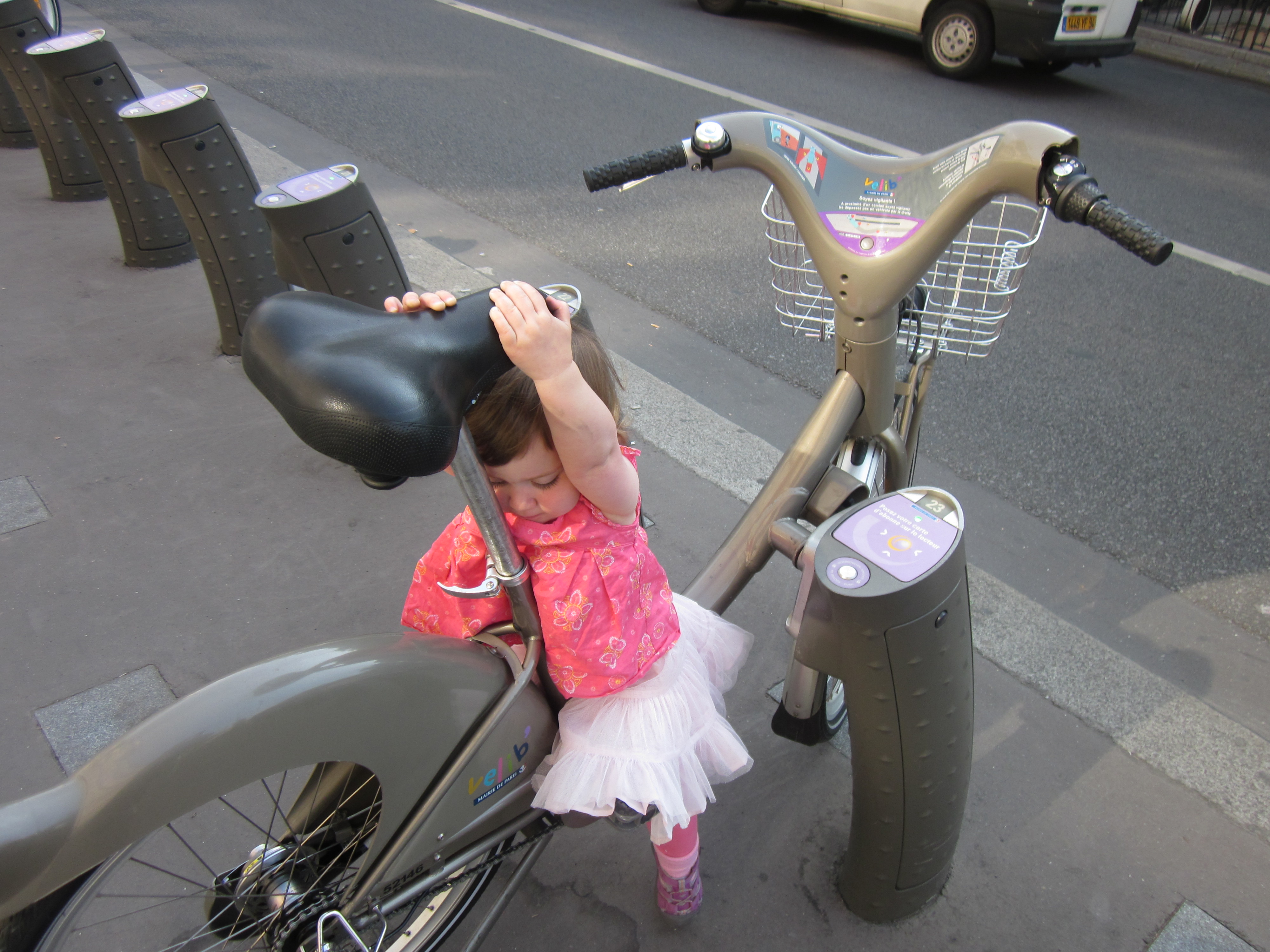
Once our kids discovered bicycles they wouldn't get off.

Once our kids discovered bicycles they wouldn’t get off.

Coming back to riding a bicycle after a long hiatus was humbling. Getting better at something, unfortunately, usually implies that you start out being really bad at it. Most of the families we meet on bikes are made up of people who never stopped riding. I can’t count the number of times I’ve watched someone test-ride one of our bikes and envied how easily they swung on and off it and how neatly they turned. For a long time I was not one with the bike. I rarely stopped exactly where I’d intended to stop, I tangled up my legs while getting on and off, and I dropped my poor bike many times. Even worse, the stakes were higher for me than for other riders, because I often had a kid on the bike.

Once you start noticing, there are cool bikes everywhere.

Once you start noticing, there are cool bikes everywhere.

Over time I got more graceful. Now I stop where I mean to stop. I still get a little thrill every time I successfully dismount in motion and pull up right at a rack where I want to lock up, or swing up onto the bike as I push off. I lost a lot of riding skills when I was disabled and couldn’t ride, but I’m still a better rider than I was two years ago. Sure, I’m horrible on an unfamiliar bike, and starting from a stop is difficult with my bad leg. Sometimes I drop my bike when walking it because I forget to compensate for my limp (although I don’t feel too badly about dropping a bike that’s already been run over). But I know that the grace I developed will come back eventually.

I spent a lot of my life being unhappy with my body, which is evidently the price of being a woman in America. From puberty onward I didn’t like how I looked, and when we decided to have children I despised my body for the seemingly endless miscarriages. A year after my daughter was born I still weighed 50 pounds more than I had five years earlier. I was glad when I lost that weight but I still didn’t feel that my body was worth appreciating much. It took developing a skill to do that, and to my surprise the skill that finally felt worth developing was riding a bicycle with my kids on it.
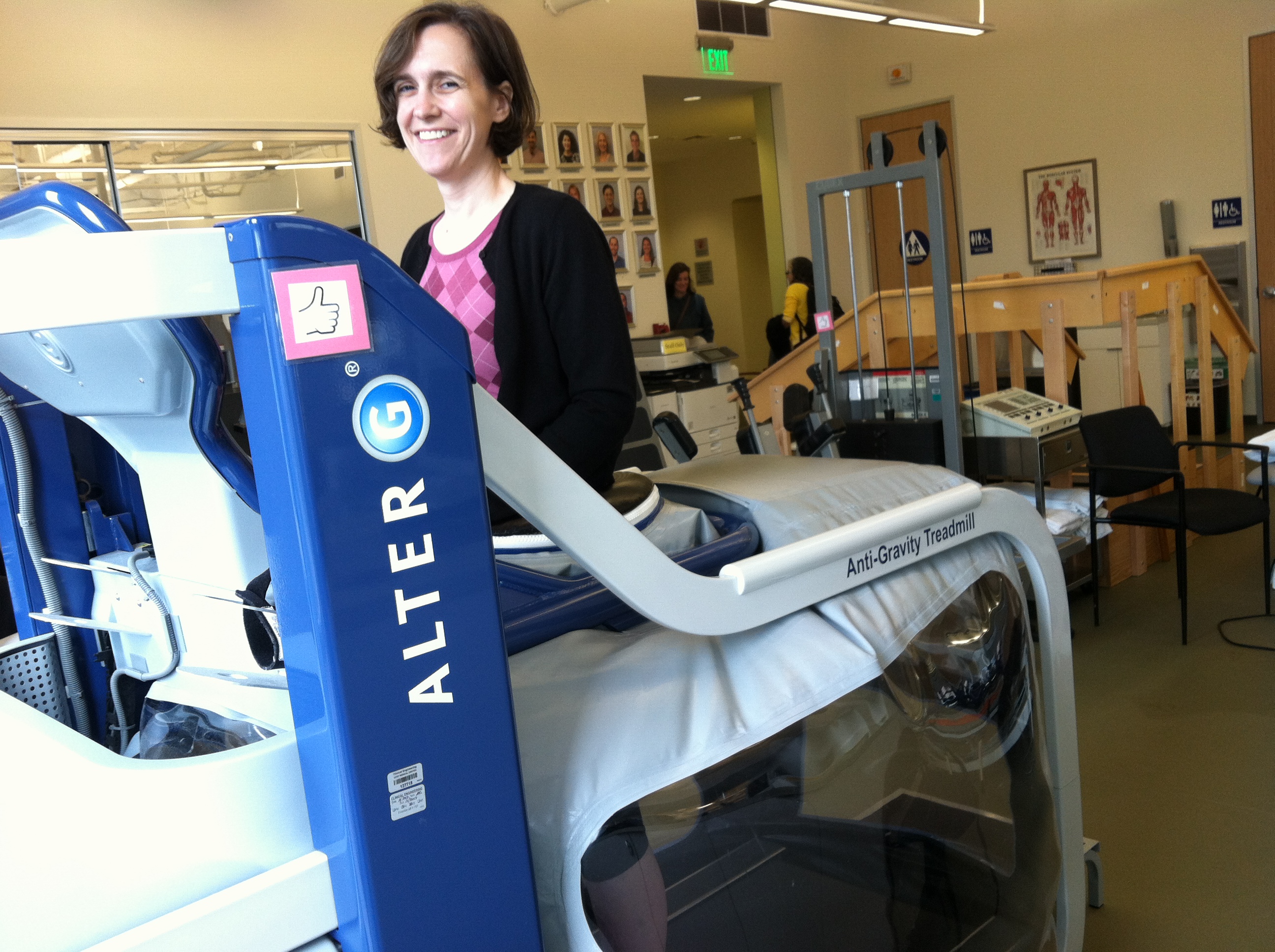
I learned how to walk again on the anti-gravity treadmill, but I don't need it anymore.

I learned how to walk again on the anti-gravity treadmill, but I don’t need it anymore.

Then being run over changed everything again. I was mowed down with a few thousand pounds of steel six months ago and now I am walking again without a cane. Granted I have a limp, but still: go, body, go! No one can tell I was even injured when I’m riding a bike. Now the scars on my legs are more noteworthy than anything else about how I look, and I find that having made peace with those scars—which are healing pretty well—I can’t really get uptight about wearing skinny jeans or a swimsuit. I am bemused to find, in the last few months, that when I think about my body I only feel gratitude, because it healed. Even though I’m still clumsy, I find it pretty easy to get around now. I have all the grace I need, and I earn a little more back every day. I couldn’t ask for more.

2 Comments

Filed under family biking, injury

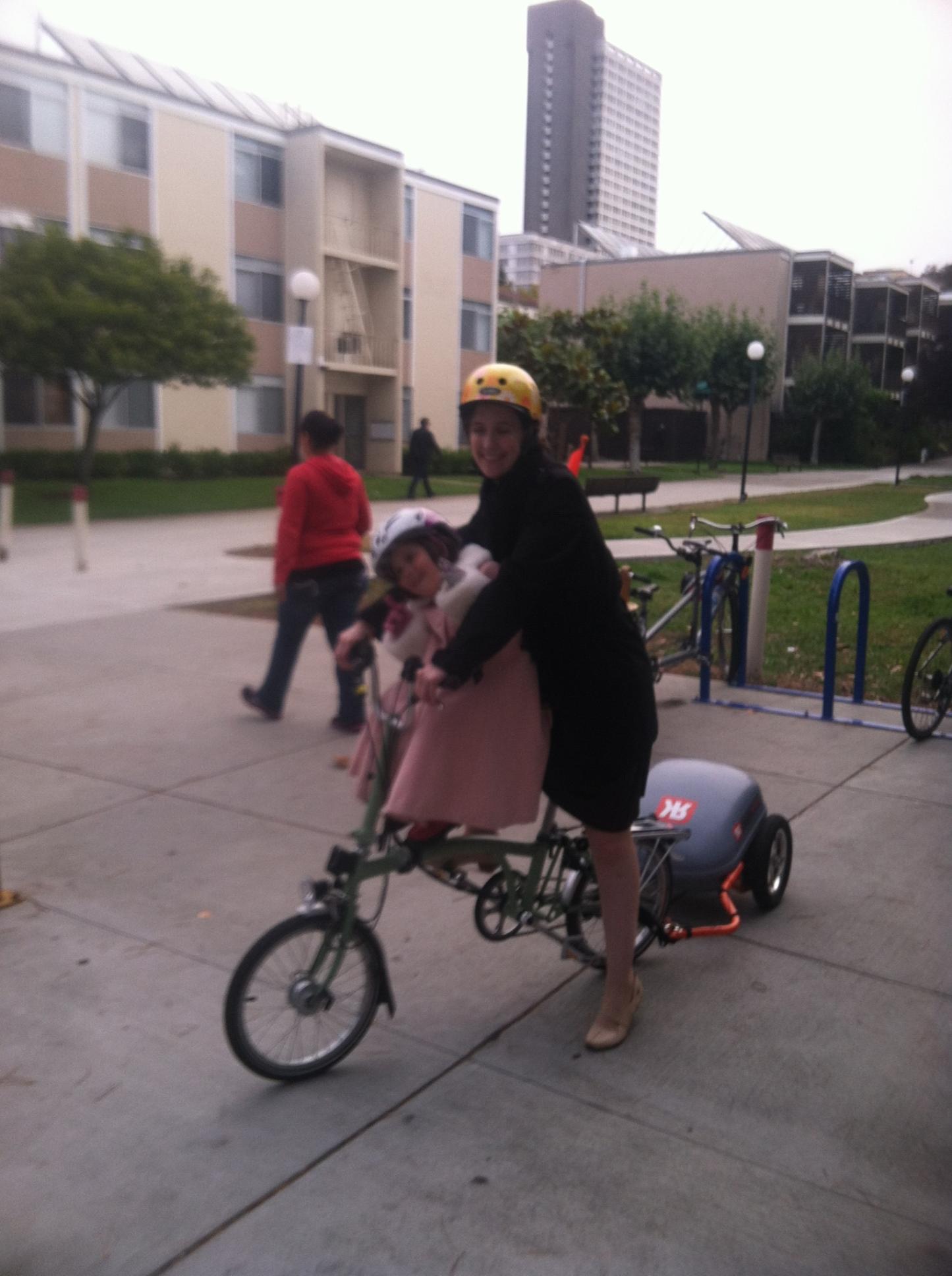
We tried it: Ridekick cargo trailer

The Ridekick cargo trailer, unattached

The Ridekick cargo trailer (unattached) with Brompton

I was pretty impressed with the Ridekick child trailer, but it’s still a prototype so you can’t buy it yet. However I did recently get to try the Ridekick cargo trailer, which anyone can buy right now.

I originally started looking at an assisted trailer as a possible way of getting around the city when I was just back to weight-bearing and much weaker. I had hopes that the San Francisco Bicycle Coalition offered one of them as a membership benefit—they do have other trailers for members to use. But no such luck. However Ridekick was willing to drop one off and let us use it for a while, which was absolutely fabulous of them.

The appeal for me of an assisted trailer was that it was a temporary solution to my problems getting around by bike while I figured out how much strength I’d get back in the longer term. Other people, I suspect, are interested in an assisted trailer for different reasons. My sense after riding with both trailers and assisted trailers is that they are a product for people who need to haul loads sometimes. If you are riding with your kids every single day and rarely ride without them, it probably makes more sense to jump right to a cargo bike or assisted cargo bike. It is more fun to ride with the kids on the bike, in cities with a lot of traffic it feels safer to ride with the kids on the bike, and some of the logistical issues with the trailer, like the fact that it can be a pain to park, go away. But if money is tight or if there are a lot of pickup and drop-off swaps between parents, then a child trailer makes a lot of sense. And if you are hauling a bunch of tools or equipment every day then you don’t need me to tell you to consider a Bikes At Work trailer or a cargo trike or whatever.

Learning to use the Ridekick in Golden Gate Park

Learning to use the Ridekick in Golden Gate Park

If you’re looking at an (assisted) cargo trailer, maybe you have a fast and light bike but want to do major grocery shopping on the weekends, or have a long commute and want to bring a week’s worth of clean clothes on Monday and haul them back on Friday. For that kind of thing, it doesn’t necessarily make sense to add a rear rack, and a trailer will probably carry more anyway. Some people will view hauling an unassisted trailer as strength training and other people not so much. If not so much, the Ridekick cargo trailer is worth a look.

What I liked about the cargo trailer:

  • It made heavy loads disappear. One day I packed it up with over a dozen hardback library books and then bought milk and yogurt (in glass bottles) and some other groceries. Starting to pull a load like that in the trailer nearly yanked my little folding bike backwards, but a push from the assist made riding normal again. We live on a fairly substantial hill, yet I had no fears about making it home.
  • The Ridekick trailer works with any bike! I had never seriously considered putting an assist on my Brompton, as that would make it too heavy to carry, and I got a folding bike specifically for times I needed to actually take a bike places I couldn’t ride one. But putting the Ridekick trailer on the Brompton was no problem. I wish that these trailers were more available as rentals because they’re also a great way to try out riding with an assist—not being able to imagine what an assist feels like and to judge whether it is worth it seems to be a real sticking point for people who are considering one. I think that is very understandable given the price and hassle of installing electric assist on a bicycle.
  • This may be my personal issue, but riding with a cargo trailer made me feel more protected from traffic. When I started riding again I was still pretty jumpy when cars pulled up behind me, given that I had been run over from behind. Although it’s a very unlikely way to get hit on a bicycle statistically speaking, I needed time to get over my wariness. With a cargo trailer behind me I knew that it was pretty likely any car would be slowed down significantly by running over the trailer before it managed to get to me. If that had happened I would, of course, have felt pretty bad about destroying Ridekick’s trailer, but not THAT bad. (This concern in reverse, however, is one of my greatest reservations about riding with a child trailer.)
  • I have tried a throttle assist on bicycles (the Yuba elMundo) and it wasn’t my favorite, but I may not have given it enough time because the throttle assist on the Ridekick really grew on me. As a weaker rider it was really nice to feel like I could push the throttle to the max and get pulled up the hill when I needed that. The throttle itself is a push toggle and it’s quite sensitive. By pushing it lightly I could keep the assist low enough that I actually felt like my pedaling was adding something. In practice because I was trying to build strength I tended to max the assist when I was fading and catch my breath, then let it go and use the momentum the bike had gained to pedal part of the way on my own again. This got me up quite a few big hills that I couldn’t have done solo, let alone with a kid on board (I usually have a kid on board). I suspect that a lot of people could use the Ridekick this way: to build up strength. For regular use I still prefer a pedal assist but for occasional use the throttle makes a lot of sense.
  • By comparison to a decent assisted bicycle, the Ridekick cargo trailer is pretty cost-effective at $700. Yes, there are big box store style e-bikes that sell for $500 but they are junk—they have very limited range, weigh as much as boat anchors, and have batteries that will die within a few months and can’t be replaced. The Ridekick has a lot more useful life than that. It’s not useful in all the ways that an assisted bicycle would be, but for many people’s needs, an assisted bicycle would be overkill.

My reservations about the Ridekick:

  • Probably my biggest problem with the cargo trailer was that I had the chance to try the child trailer first. I liked the child trailer much better, even as a way to haul cargo. The cargo trailer is much smaller, capable of holding a couple of bags of groceries. The child trailer could haul a couple of bags of groceries AND two seven year olds, or several bags of groceries and one kid, or a giant pile of donations to Goodwill. I kept thinking of the cargo version as a single person’s trailer. It wasn’t right for the volume of stuff that I wanted to carry. I don’t think I’m the target market for this trailer.
  • All trailers, including the Ridekick, can be tricky to park. It’s actually a lot smaller than child trailers, so it wasn’t that big a deal, but at the racks at my office, for example, I had to scoot it around a little to make sure it wasn’t hanging out into the car parking places where it might get run over.
  • The battery is in the body of the trailer itself, which is fine and makes sense given that batteries are heavy, but unfortunately that means there is no way to tell how much charge is left without stopping to open the trailer. So I had a fair bit of range anxiety at the end of the day when I was riding with it. This turned out not to be justified at any point, because its range was actually pretty generous—I rack up about 10 miles up and down some major hills just going to and from work and dropping off and picking up a kid or two—and I never actually ran the battery down despite using it, especially at the beginning, pretty profligately. However I never knew how much power was left until I stopped riding, and that made me edgy. This was particularly the case because at the time my limp was so pronounced that I had a lot of trouble walking my bike up hills.
  • I did not like the attachment for the trailer. It screws on using a plate attached through the rear axle, which is pretty traditional for trailers. My sense was that it was both too easy and too hard to release. It was too easy because there after a couple of weeks the trailer fell off the bike while I was riding—in regular use, you need to tighten the screw regularly. FYI. It was too hard because if the screw was tightened appropriately, you needed tools to take it off. Given that the market for this trailer is almost certainly an occasional user, I felt like it should work like the Burley Travoy, which has a snap-in attachment that can be operated by hand. The wiring for the assist, interestingly, worked just that simply. To remove the assist wiring from the bike you only needed to pull out the plug, and to reattach it to push the plug back in. I wanted the trailer itself to attach and release that easily.
  • An issue that I suspect is more Ridekick’s problem than mine is that everyone who saw me seemed to think the trailer was homemade. People told me it was very cool and then asked me how I’d put it together, which ha ha. I suspect that the Ridekick cargo trailer would sell better if it looked a little more professional, somehow. This is the market that I’m pretty sure the Burley Travoy is targeting—the ride to work on Monday with a bunch of work clothes in the bag and return with the trailer full of dirty clothes on Friday set.  Or maybe the Ridekick just needs a bigger logo. In neon colors. I don’t know.

So the Ridekick cargo trailer: pretty cool although it’s not quite right for us (the child trailer, on the other hand, I want for traveling).

The Ridekick is the only assist I know of that you can use with a Brompton and still have the ability to lift the bike up by hand.

The Ridekick is the only assist I know of that you can use with a Brompton and still have the ability to lift the bike up by hand.

Probably the greatest thrill of riding with the Ridekick attached was being able to take my Brompton anywhere with a kid on board. Getting it up the hill where we live was simply impossible for me for most of last year, if not to this day. The commutes with the Brompton+Ridekick were some of the most memorable I’ve taken all year because I had such great conversations with my kids during those rides. On one trip home my son (almost 8 years old and still fitting on the Brompton front child seat!) relayed me the entire plot of a series of Avengers comic books, which although it did not really interest me at all, was exciting because he was so excited about it. On another trip my daughter taught me some of the Japanese songs she learned at preschool. I love carrying my kids on that seat more than any other bike seat, but the Brompton gets less use than I’d like because of the hill. With the Ridekick cargo trailer, I could carry them and all our stuff and not have to worry about any of that. “Make it go fast!” they yell when we got to a hill. And I could.

4 Comments

Filed under Brompton, commuting, electric assist, family biking, folding bicycle, San Francisco

The only thing we have to fear

In words of my husband: "Look! It's gimpy on her death machine."

In words of my husband: “Look! It’s gimpy on her death machine.”

I get a lot of questions about how I’m getting around after being hit by a car. The answer is that I mostly ride my bike. It’s a lot easier than walking, I can always park right in front of where I’m going which means less walking than if we drove, and we still don’t have a car anyway. This often surprises people. They assume that I’ve taken up driving. “You’re so brave!” they say, which sometimes sounds a bit like “You’re crazy!”

I would be lying if I said there aren’t moments when I am afraid. It comes up particularly at intersections when I want to turn left, because, duh, I was run over from behind at a stop sign while trying to turn left. I make a lot of Copenhagen left turns now. Cars coming up behind me make me really nervous still. But it’s getting better. My personal experience notwithstanding, getting run down from behind is statistically speaking the least likely way to get injured while riding a bicycle. I just have put the time in so that my emotions can catch up with what I know.

We still haven't really missed the minivan.

We still haven’t really missed the minivan.

I’d also be lying if I said we didn’t consider buying a car. There was a lot of driving to appointments when I was incapacitated, and we didn’t know when I’d be mobile again. However our flirtation with the idea of getting a car was pretty brief. With my right leg broken, I couldn’t drive any more than I could walk, and if someone else was going to drive me, I might as well take a shuttle or call for a ride. Moreover, I learned from my surgeon and other patients that the most common cause of my particular injury—a shattered leg—was getting T-boned in a car. I talked to people who’d been trapped in their cars for hours while being sawed out and were understandably phobic about ever getting into one again (at least the EMTs could scrape me off the street and set up a morphine drip right away). A lot of people have had this experience, and they didn’t exactly sell me on the safety of driving in lieu of biking. On top of that, cars are really expensive, and we had plenty of other things to spend money on at the time. And I wasn’t really feeling very car-friendly after being smashed by one either.

For the first month after my surgeries, I was supposed to stay in bed for 23 hours a day. For entertainment, I could use the continuous passive motion machine, which slowly bent my leg for me to improve my range of motion, up to eight hours a day. It was very boring. I was surprised to learn how serious my surgeon was about not just staying in bed, but staying at home. Even though the steel plate he put in my leg supported the bones, they were still in pieces, and he would have preferred that I never went outside at all. Even being bumped by someone passing me on the street could knock the bones out of alignment and require them to be reset, which would also restart the clock on how long I had to stay off my leg. Every time I fell down while using crutches, he wanted to take another x-ray to see if the bones had shifted. During that time I left the house at most once a week, to go grocery shopping. Matt drove a rental car over so I could shop while riding an electric cart.  As pathetic as that was, it was still a total thrill compared to anything else I had going on at the time.

I think a lot about this when people ask me now about the risks of getting hit again while on a bicycle, which people often do although it is the last thing I want to contemplate. If we were really concerned about injury above all else, we should never leave our couches. Even walking around our neighborhood risks injury, and I could avoid that by never leaving the house. But no one would suggest that it was a good idea to sit on the couch all day to avoid the risk of getting hurt by tripping on the sidewalk or bumping into someone. Even my surgeon wants me to walk around now, so my bones will regrow faster. Staying inside is risky in a different way—bodies were meant to move, and sitting around all day makes people unhealthy. Instead of sitting “safely” on the couch, we’re all advised to get out of the house and rack up at least 10,000 steps per day, broken sidewalks or no.

It’s this that I think about when I think about driving instead of riding a bike. On a per mile basis, yes, bicycling has higher injury rates than driving, but of course people go much further distances when driving. On a per hour basis the risk of injury is very similar. But driving a car is the physical equivalent of sitting on a couch, and our bodies were meant to move. When the risks of chronic disease are included, riding a bike is several times safer than driving, despite the higher risk of injury. Those injuries are the statistical equivalent of tripping on the sidewalk, and most of them are about as dangerous—most injuries sustained on a bicycle involve only the rider and are preventable. What happened to me was terrifying and dramatic and depressing (especially the part where I learned yesterday that my leg probably won’t be fully healed until early 2015, so I am basically all about assisted bikes from this point forward) but it was also anomalous.

Ride on.

Ride on.

By the time I was allowed to actually bear weight on my leg, I was so stir-crazy that I would have tried almost any activity, but walking was hard (it’s still hard). Luckily for me, our bicycles were waiting in the basement. I can’t walk at normal speeds yet, and I get tired quickly, but I can ride like anyone else. And although some days I have more trouble believing it than I should, I know there’s really nothing to fear. In the long term, riding a bicycle is still the safest way to get around.

4 Comments

Filed under car-free, commuting, injury, San Francisco

Where’s your helmet, mom?

He can remember a stick and headlamp for a camping trip, but remembering jackets or a bike helmet: boring.

He can remember a stick and headlamp for a camping trip, but remembering jackets or a bike helmet: boring.

The other day when I picked up my son at his after school program, he ran over and started to hop aboard. “Where’s your helmet?” I asked. “Uh…” he said. “I guess I left it at school.”

This is not the first time that’s happened. Kids forget stuff. In the first year of kindergarten our son lost so many jackets we finally lost all patience and sent him to school in shirt sleeves in January (recall that we live in San Francisco: he was chilly but we’re not monsters). At that time, he was taking a school district bus to his after school program and they took all lost items to their central facility on the southeastern edge of the city. Those jackets were gone forever.

Our problems are compounded by the fact that his dad drops him off, and then he goes to an off-site after school program where I pick him up, but it happens even when we pick up our daughter, who stays in the same location all day but is missing one sock at pickup three days out of every five.

So what do we do when our kids forget their helmets? We take it on the chin. California has a helmet law for kids but not for adults, our kids have giant heads, and our helmets are adjustable. I give my son my helmet and I go bare. I don’t like doing this, AT ALL—I mean, I’m still recovering from being run over and I am basically still the world’s most paranoid bicycle rider—but it’s often the best of the available options. Some of our bikes fit on a bus bike rack, and we have done that once with a forgotten helmet, but it takes an extra half hour that we don’t always have.

As a parent, though, handing off your helmet to your kid for the ride home is a guaranteed ticket to heckling. People stop next to me and yell, “Where’s your helmet, mom?!? COME ON!” And I always reply wearily, “He left his helmet at school so I gave him my helmet.” And they say, “Oh.” But I know there are hundreds more people who say nothing right then but remain righteously indignant that there are parents! Who don’t wear helmets! Setting a bad example! On the streets! WHAT IS WRONG WITH THESE PARENTS!!! I see them at community meetings and they sure do fire up the internet.

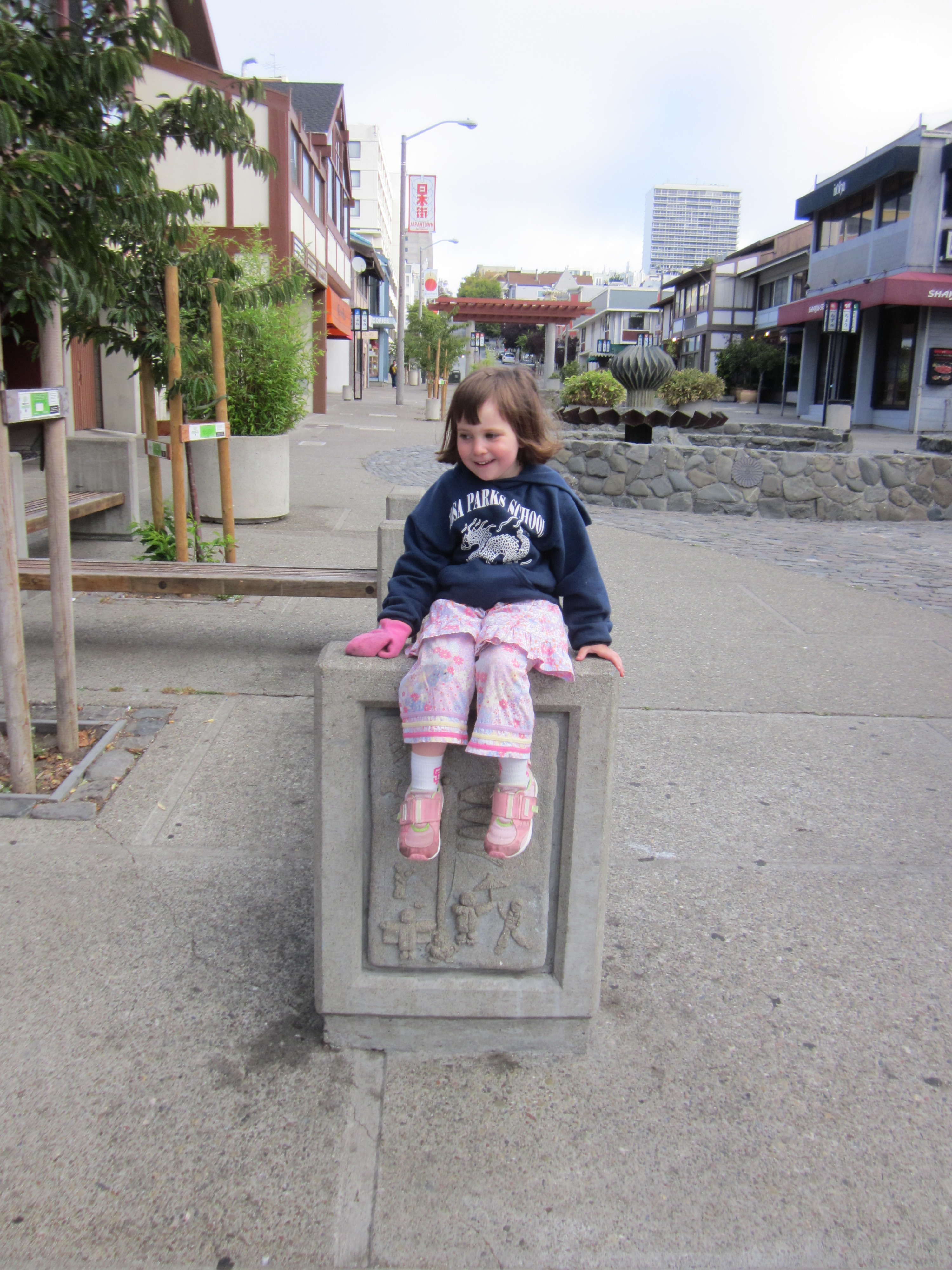
We notice the world when walking to school too, like these carvings in Japantown.

We notice the world when walking to school too, like these carvings in Japantown.

Being on a bicycle sometimes means that you can’t hide from your surroundings. That’s often a good thing. I like riding a bike in part because we’re engaged with the world around us. I like being aware of the weather outside, even if that means wearing rain gear. But while parents in cars don’t have to reveal that they forced a screaming toddler into that car seat or that they forgot the booster seat for the friend who they promised to take home, on a bike there’s no way to keep the world from seeing, and a lot of people don’t shrink from sharing their opinions. I don’t care about it that much, but at the end of the day when I am already tired, the judgment can get old. I don’t peek in car windows and criticize other people for putting a five year old in the front without a car seat, so it would be nice to get a break on the days my son forgets his helmet.

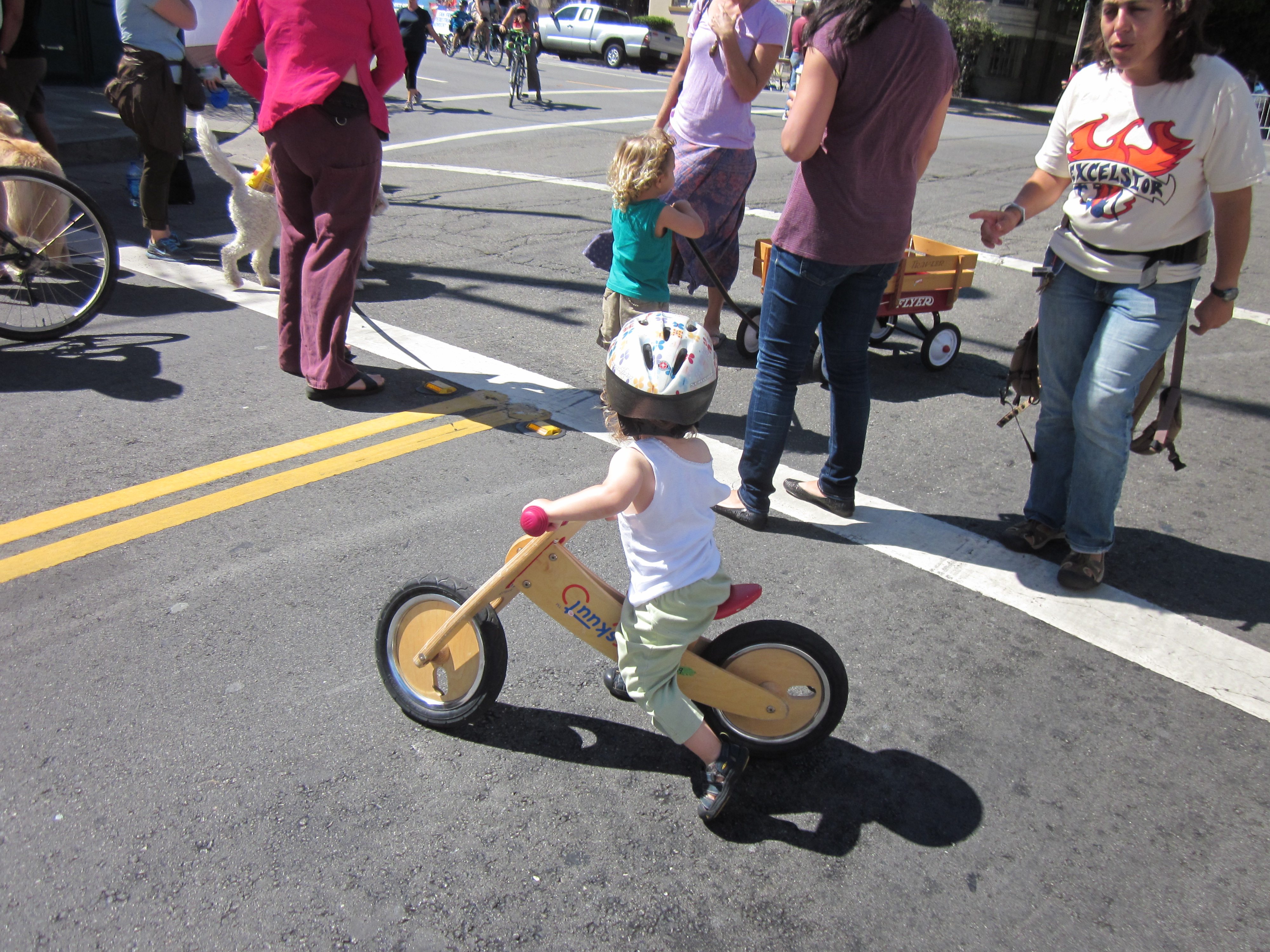
We live in a country where it seems normal that a kid on a balance bike at Sunday Streets would wear a helmet. I would like that to change.

We live in a country where it seems normal that a kid on a balance bike at Sunday Streets–where there are no cars–would wear a helmet. I would like that to change.

It would of course be even better to live in a place with safe infrastructure like a network of protected bike lanes, and laws that protected vulnerable road users, and 15mph speed limits, so that we wouldn’t even need helmets. But who am I kidding.

5 Comments

Filed under commuting, family biking, injury, San Francisco

The deceptively “empty” bike lane

New building with old exhibits.

New building with old exhibits.

This weekend we headed to the new Exploratorium. Because the Bullitt is in the shop with broken spokes (sigh), we took Muni.  That meant an unusual amount of walking for me, all the way from Embarcadero station to Pier 15 and back. It would have been a much better day to ride, both because the weather was outstanding and because the Embarcadero bike lanes had been expanded for the weekend due to the America’s Cup. And it would also have been a better day to ride because I still can’t walk very far on my bad leg so I passed out in exhaustion as soon as we got home. Such is life. I have no stamina.

Watching the traffic along the Embarcadero was fascinating, and because my kids are even slower and more easily distracted than I am, I had plenty of time to think about it.

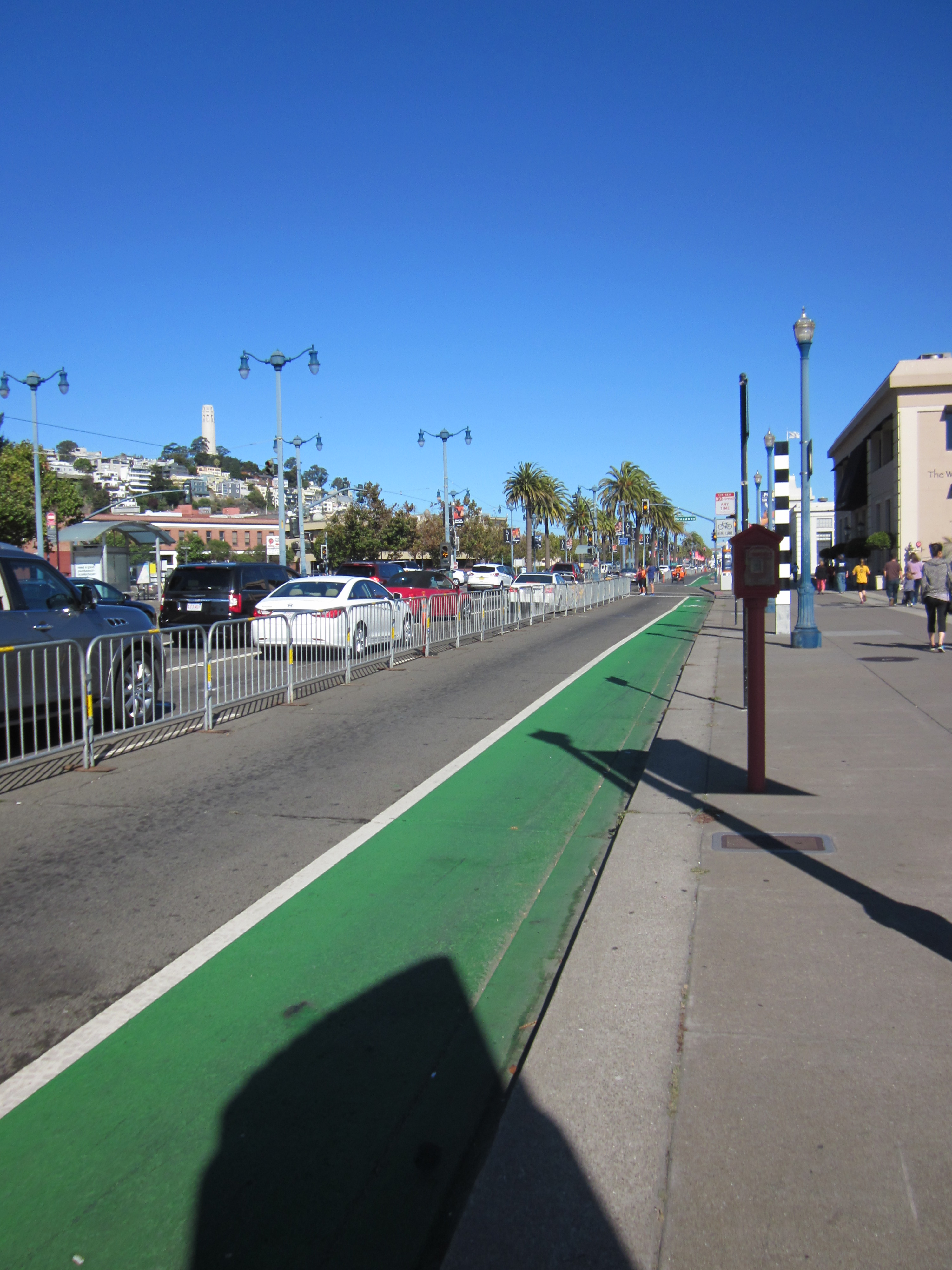
One painted lane and one temporary lane with barriers

One painted lane and one temporary lane with barriers

A while ago I read a fantastic book, Human Transit, which talked about how irritated drivers can get seeing “empty” bus rapid transit (BRT) lanes during car traffic jams. The perceived emptiness of the BRT lanes leads solo drivers to complain that these lanes take away capacity for solo drivers for no good reason. But as Walker (the author) points out, the “empty” BRT lane typically allows a fully-loaded bus to pass at least every five minutes, carrying 50-100 passengers apiece. Drivers see BRT lanes as “empty” because they are stuck in place, but their perception is flawed. Taking away the BRT would trade an hourly throughput of 600-1200 (at worst) people on buses for an hourly throughput of a few dozen people in automobiles (at best). Having the lane clear enough that buses whiz through uninterrupted is what makes BRT work.

Of course, buses aren’t full all the time. However they are almost always full when traffic is backed up, and no driver cares how many buses are in a BRT lane if private auto traffic is moving quickly. If moving people around is the goal, then pretty much every street that ever has a full bus should have a protected BRT lane. At which point more people will want to ride the bus, which would further reduce private auto traffic: it’s a virtuous circle. Everybody wins! The city is now providing less traffic for solo drivers and quicker trips for transit riders. Yet because of the false perception that the lanes are always “empty” installing protected BRT lanes has been incredibly controversial.

Rider approaching and moving fast; cars stopped dead

Rider approaching and moving fast; cars stopped dead

I thought about this as I watched drivers in cars fume in traffic on the Embarcadero, glaring at the usually-for-cars lane that had been removed to make a two-way (mostly) protected bike lane. To people stuck in the abysmal auto traffic along the Embarcadero, the bike lane looked “empty.” Early in the morning, when we were there, a bike (or group of bikes) passed northbound roughly every ten seconds, though that’s an average—sometimes a minute would pass with no bikes, then there would be a handful, etc.

Weekend riders--bikes with trailer-bikes.

Weekend riders–bikes with trailer-bikes.

The bikes passed much faster than we could walk, but because of the traffic we were walking faster than the people in cars. In about a half-mile of watching northbound traffic, I saw cars reach stop lights, lurch forward into the next clump of traffic, then wait several light cycles to get to the front of the line, and then repeat. I estimate that about 30 cars got as far as we did in 20 minutes—the same cars I saw when we started our walk. In the same amount of time, a northbound bike passed every 10 seconds, so that one bike lane moved 120 bikes. Now if you assumed that all those cars were holding four people (you would be wrong, most were solo drivers), that would mean that at 9am on a Sunday a single “empty” bike lane was moving as many people as multiple lanes dedicated to private auto traffic. However the cars were mostly filled with 1-2 people, even on a weekend. Moreover, weekend bike riders tend to be more family-oriented, so probably a quarter of the bikes we saw were hauling 1-3 kids in addition to the rider (the 3-kid bike was a BionX Madsen!) So the comparison is really more like throughput of:

  • 50 people in cars using 3 lanes vs.
  • 150 people on bikes using 1 lane.

And this was early in the morning—on the way back I gave up trying to count bikes because there were so many more of them in the lane by lunchtime. Car traffic was, if anything, more abysmal.

This BionX Madsen was assisted by The New Wheel over a year ago and has its own Facebook page.

This BionX Madsen was assisted by The New Wheel over a year ago and has its own Facebook page.

The irony, of course, is that these incredibly desirable “empty” lanes are public. They’re available to anyone who wants to use them. All you have to do is get on a bus or a bike—and if I can carry my kids on a bike even with a gimpy leg, and a senior on an oxygen tank can ride a trike while hauling his oxygen tank, and a man with no legs can hand-wheel his way along the same path, I have to think that nearly anyone can manage one option or the other. Really, the only way to take away the freedom to travel uninterrupted is to give that “empty” lane to cars.

4 Comments

Filed under advocacy, family biking, San Francisco, traffic

Tipping point

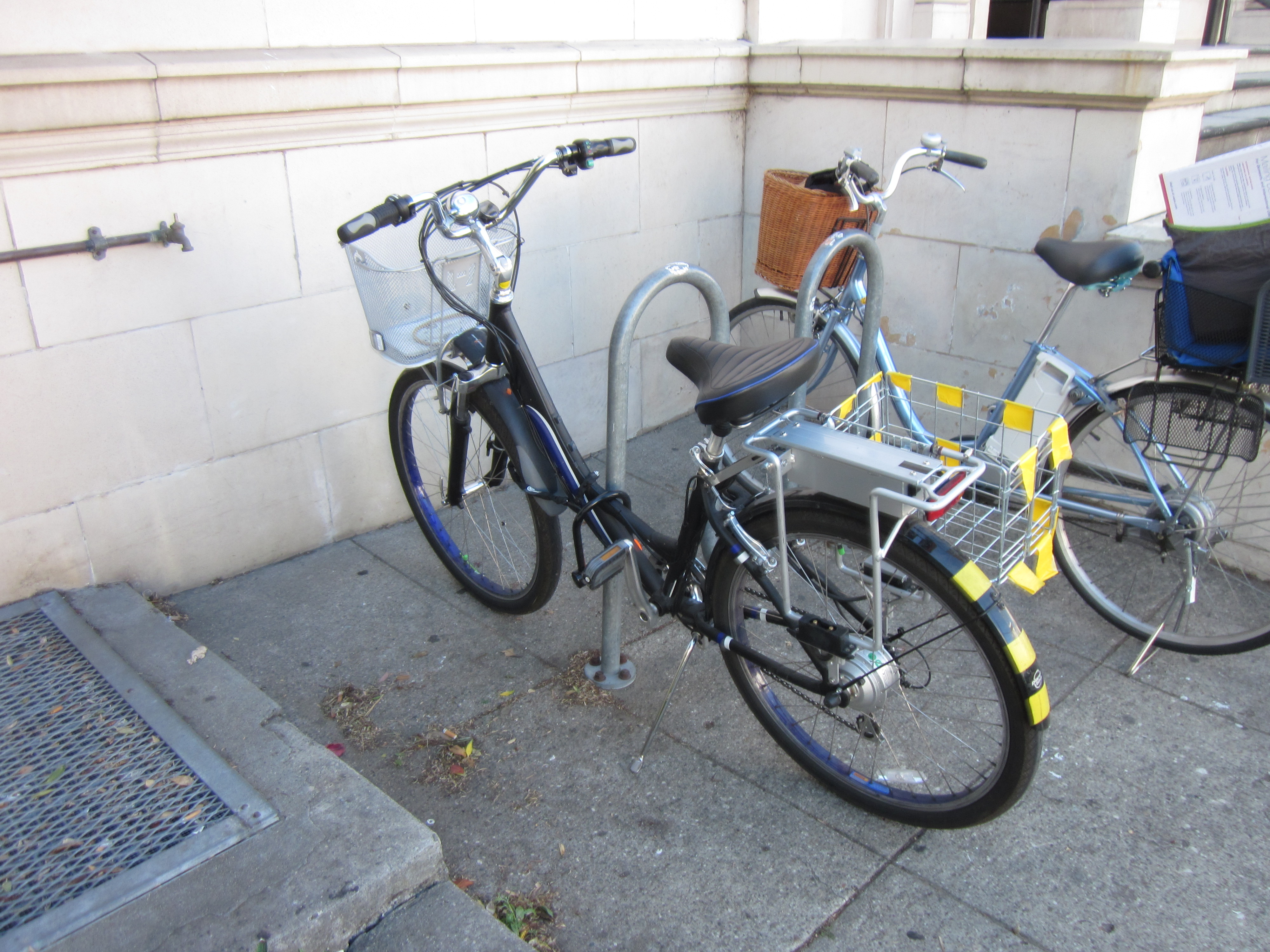
Electric assist is great when you have a lot of library books to carry.

Electric assist is great when you have a lot of library books to carry.

At some point I speculated that 2013 would be the year of the electric assist bicycle. Not to toot my own horn here, but I was so right. The other day we stopped at an intersection and the rider next to us said, “Hey! All three of us are on electric assist bikes!” When I went to return books at the library the other day, the other bike on the rack was assisted. When I’m on the main campus, which is on a hill that could charitably be called “non-trivial” it is like an e-bike showroom up there. I would guess that about a quarter of the bikes I see hauling up our hill these days are assisted. That is new as of this year.

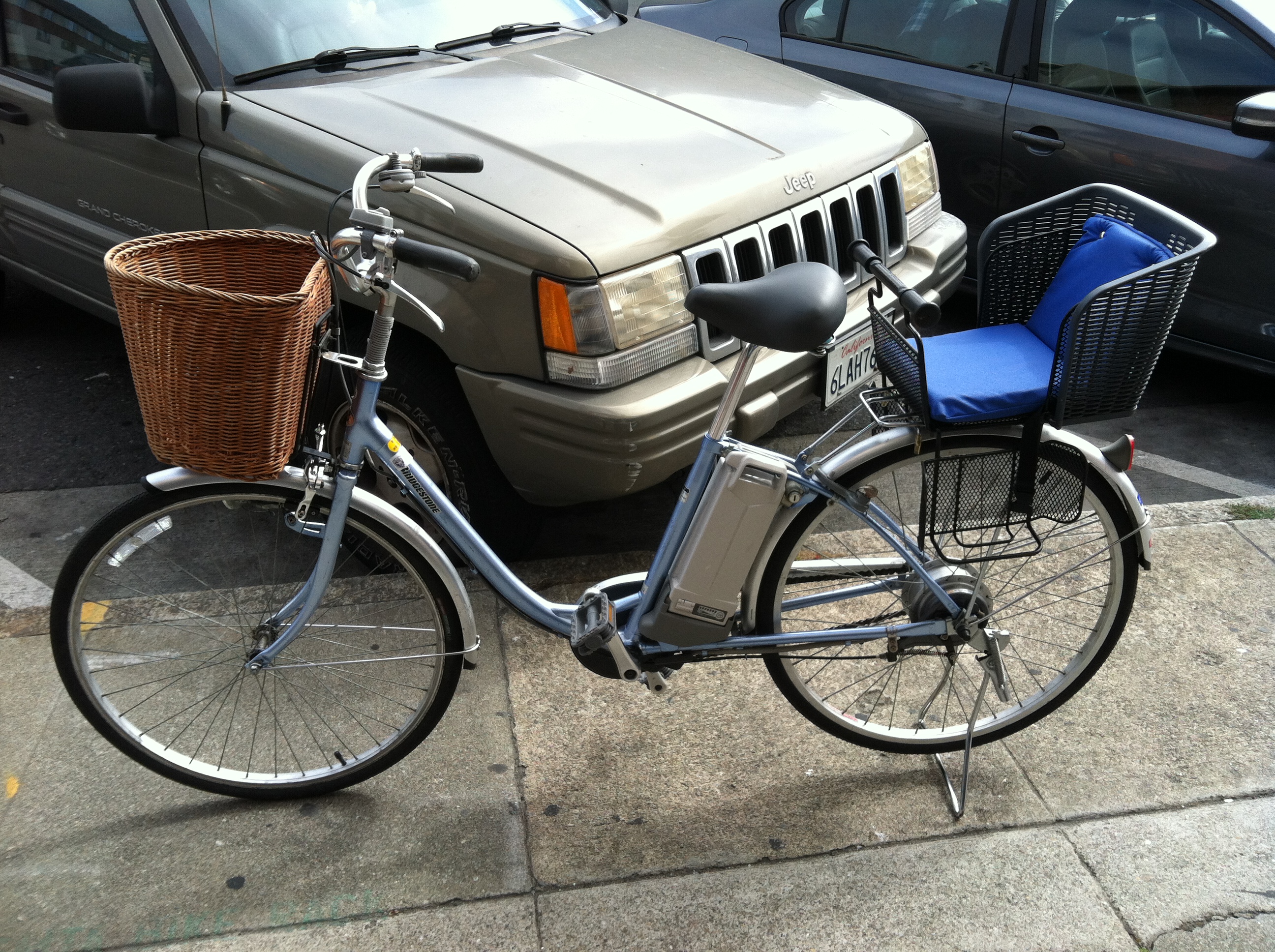
I get stopped at the bike racks at work by people wanting to know how to find cheap e-bikes on craigslist. Although I am admittedly kind of the poster child for that, I would only recommend doing that if you are comfortable replacing the battery shortly afterward (which is something I had to do). Very few people flog assisted bikes on craigslist until the batteries are on their last legs, and batteries are the most expensive part to replace. Caveat emptor.

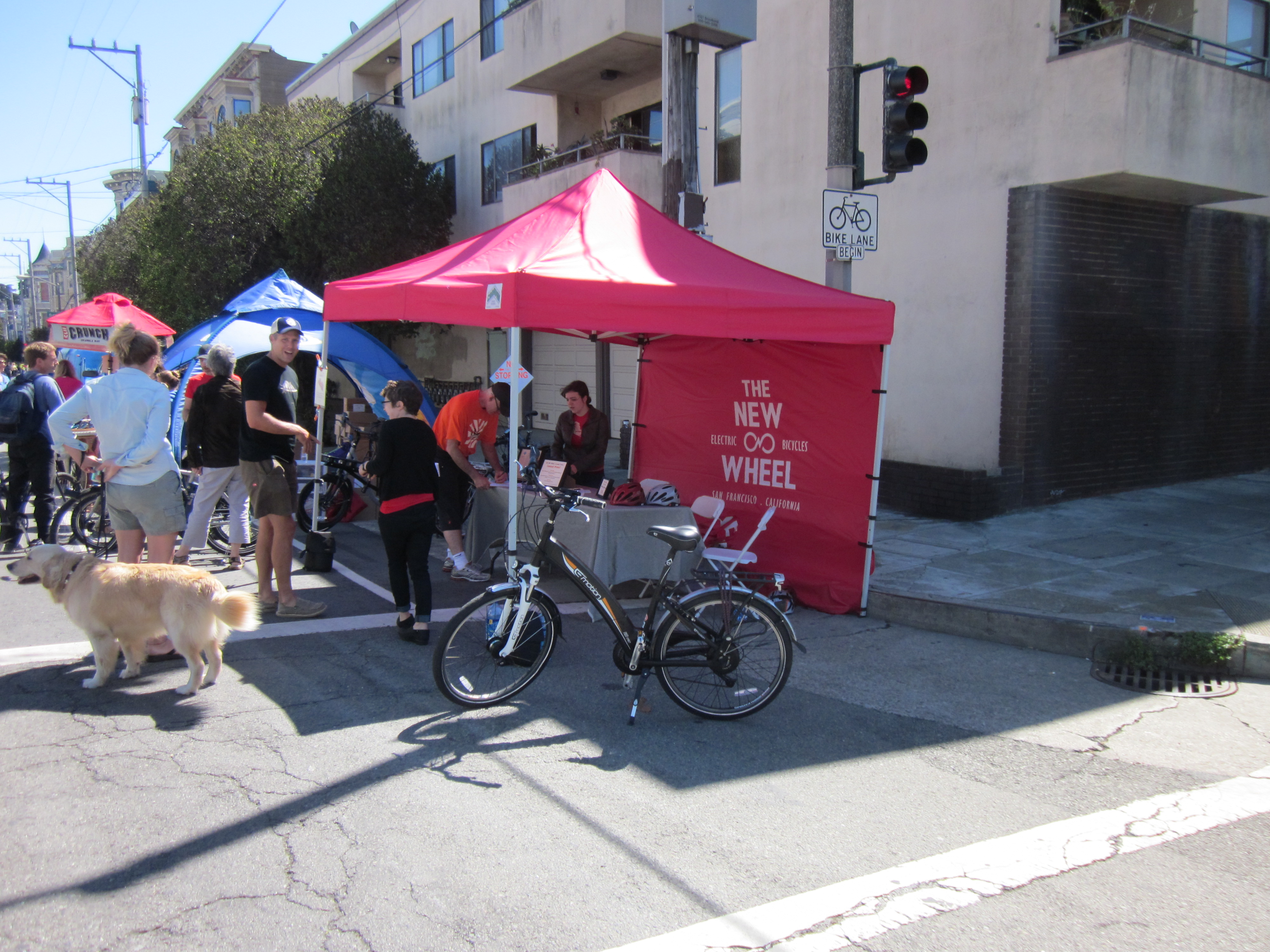
The New Wheel was giving test rides at Western Addition Sunday Streets--they must be doing a land office business.

The New Wheel was giving test rides at Western Addition Sunday Streets–they must be doing a land office business.

There is really no such thing as a super-cheap electric assist bike, unless of course you are comparing them to a car, in which case every single one of them is laughably cheap. And I and everyone else riding one can testify that an assisted bike will make driving in the city seem ridiculous. I mean, my leg is still really weak, and the most recent x-rays show that the bones look like they’ve been attacked with a chisel–it surprised me that this is considered to be great progress–and I walk with a cane, and I now have a handicapped parking sticker. However it is still typically easier for me to go anyplace within about three miles on a bike (granted, an assisted bike) because I can park so much closer that I don’t have to hobble nearly as far. Riding a bike doesn’t stress my leg like walking on it does. When I talk to normal people with assisted bikes they say that they never tackled various hills until they put assists on their bikes. Then once they did, they started riding everywhere instead of driving. That’s pretty much how it went for us.

San Francisco is the kind of city that is made for assisted bikes. There are, famously, a lot of hills. It’s the second hilliest city in the world, and this is not a competition that you want your city to win (or show or place). To pile on the injury, it’s also extremely windy.

Going up this hill into a 10mph headwind is TOTALLY DIFFERENT from riding into a 10mph headwind on the flats.

Going up a hill like this into a 10mph headwind is TOTALLY DIFFERENT from riding into a 10mph headwind on the flats.

Aside: I find it slightly annoying when people in flat cities claim that it’s hard to bike in their extremely flat city because of wind, or that a 10mph headwind is like a 14% grade. I ride up a 14% grade to our home every day and many of those days I ride into a 10mph or 20mph headwind AT THE SAME TIME. Riding into the wind is hard, but it’s not the same as riding up a hill. They’re both hard, but they’re a different kind of hard. The truth is that if you live somewhere flattish then it’s either easier or cheaper to ride bikes everywhere, so go ahead and cherish your good fortune.

Anyway, San Francisco: lots of hills, lots of wind, but also lots of great bicycle infrastructure. And we carry kids-as-cargo and groceries and library books and so on. Getting over ourselves and getting an assist was the smartest thing we’ve ever done, transportation-wise. In my current condition, I’m not sure I could ride in the city at all without one (and with the gimpy leg, walking the bike up hills is not a good option–I can do it, but the price is having to go back on my narcotics that evening). Our friends who have assisted their bikes will say the same thing: the assist is life-changing when you ride a bike for transportation. An assist makes driving not worth the bother. The sight of a bicycle being carried on an SUV now seems outrageously weird to me. Even if you’re hauling a racing bike, it would be cheaper and more fun to tow that baby on an assisted cargo bike.

Of course I am not opposed to straight pedal power under the right circumstances. Although even in a paddle boat I was pretty slow.

Of course I am not opposed to straight pedal power under the right circumstances. Although even in a paddle boat I was pretty slow.

So for the people who keep asking me whether it’s worth paying so much to put an assist on a bike: if you’re already seriously considering it, then yes it is. And there are ways to make the cost less appalling up front; for example, The New Wheel in Bernal Heights will finance the purchase of an assisted bike or an after-market assist for an existing bike, plus they’re super-nice people.  Is it necessary? It is for me (at least for now), but it’s not for everybody. For people who are enjoying the ride unassisted, there’s no need. But if you can’t bring yourself to ride every day just yet even though you want to, and are wondering whether the assist will tip the scales: it will.

5 Comments

Filed under electric assist, injury, San Francisco

San Francisco vernacular

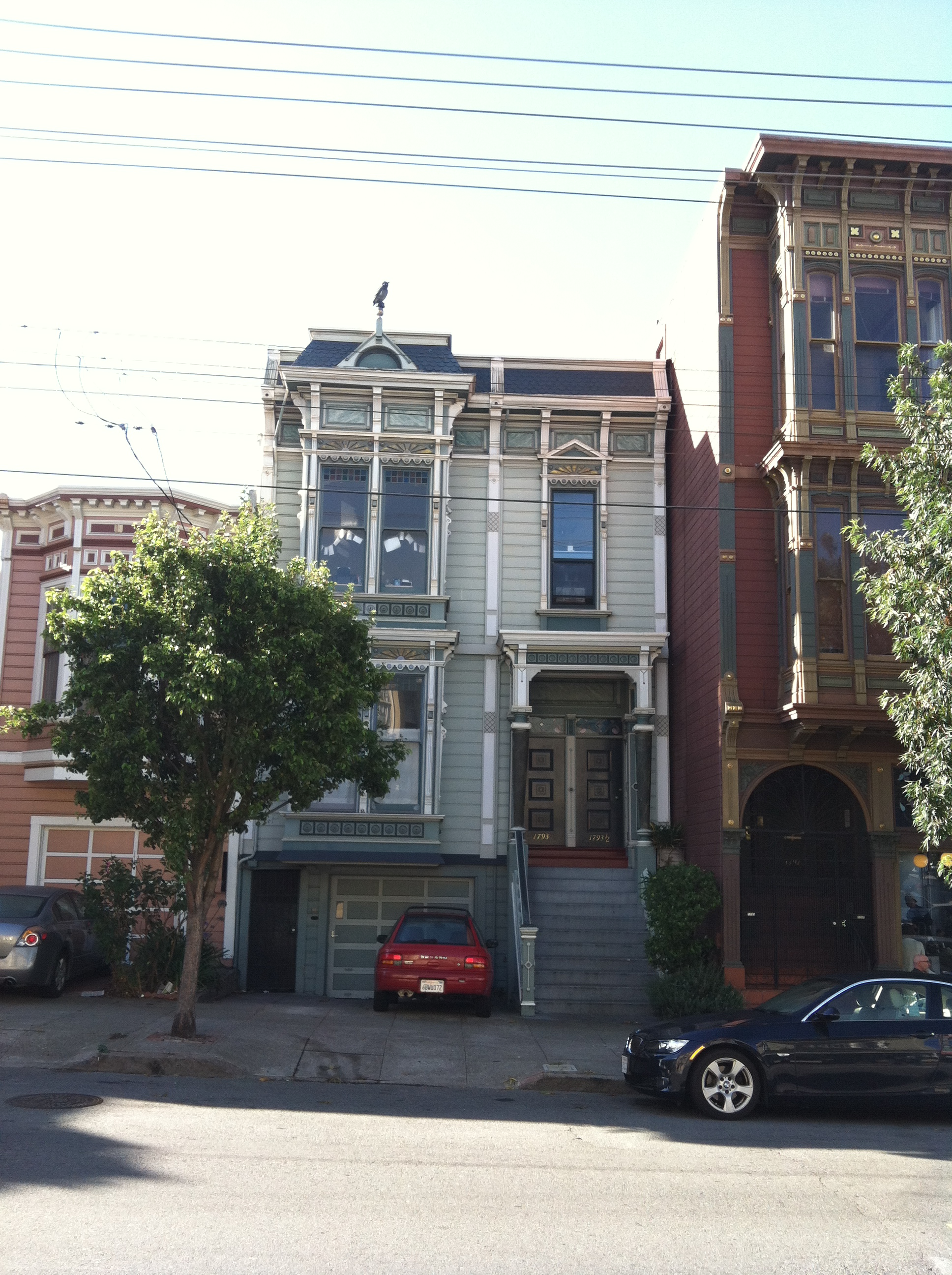
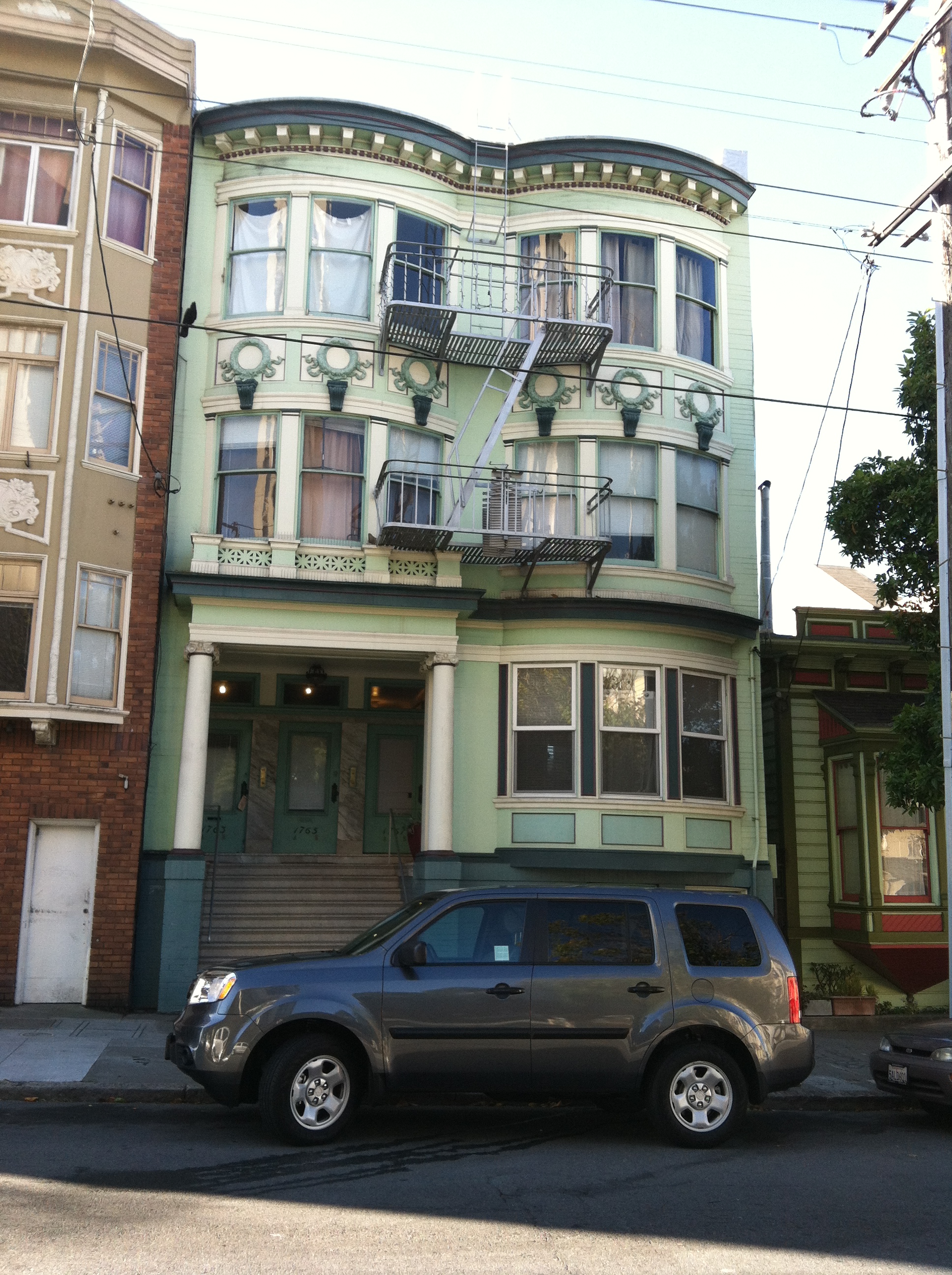
It’s only when I am with someone visiting from out of town that I remember that San Francisco has a definite vernacular architecture. People tend to think “Victorians” when they think of San Francisco, and most specifically, of Alamo Square’s Postcard Row (which we pass nearly every day en route to school). But although San Francisco is in fact filled with Victorians, what always seems to surprise people most is that almost none of them are single-family homes. This is a densely populated city, and what looks to suburbanites like a single family house from the outside is almost always a multi-unit building. It always seems to surprise visitors that that “house” they are admiring is in fact many homes. On the bike I always move at a slow enough speed to admire these homes, but lately I’ve been moving even more slowly so I get an eyeful.

Romeo flat on Beideman

Romeo flat on Beideman

I’ve never seen a Romeo flat anywhere but San Francisco, and even here they’re rare. Romeo flats are typically six units, two to a side on three floors, with open Juliet balconies between the floors. I pass this building on Beideman in the Western Addition when I’m riding with my daughter home from preschool. The Western Addition is considered to be kind of rundown but I like these pretty side streets. 49 Beideman in this building is actually listed for sale right now—2 bedrooms and 1 bath, 620sf, listed for $480,000, although it will undoubtedly sell for well above asking. Anyway, it’s a lovely building and next door to a pocket park, if you are in the market.

A Victorian with two units (at least) on Fulton

A Victorian with two units (at least) on Fulton

Much more typical are two-flats. Although this building is in the Western Addition on Fulton, our inner Sunset neighborhood is almost exclusively made up of two-flats, either like these or Marina-style that have a shared yard in the back, with large apartment buildings on the corners of each city block. Unfortunately I couldn’t photograph most of the more attractive versions of these buildings, which typically have trees in front of them that block a good picture.  The basement tends to have either a shared garage and storage or a shared garage and a studio apartment (often unpermitted). Thanks to this density, trick or treating is laughably easy in our neighborhood, despite the endless hills and stairs.

A three-flat building (three front doors) on Fulton

A three-flat building (three front doors) on Fulton

If the building has another story it’s a three-flat. The three flats with three front doors like this one are obviously multi-unit buildings once you look closely at the front porch, but it’s not uncommon for multi-unit buildings like these to have a shared front door. With a three-flat the first floor unit tends to be smaller than the other units, and we’ve met lots of families that use the space under the stairs as a kids’ bedroom. (There is a strong market in built-in bunk beds that can be squeezed in the Harry-Potter-bedroom-under-the-stairs in this town.) The premium on space is part of the reason it is rare to find families with more than two kids in San Francisco, unless the second pregnancy was twins.

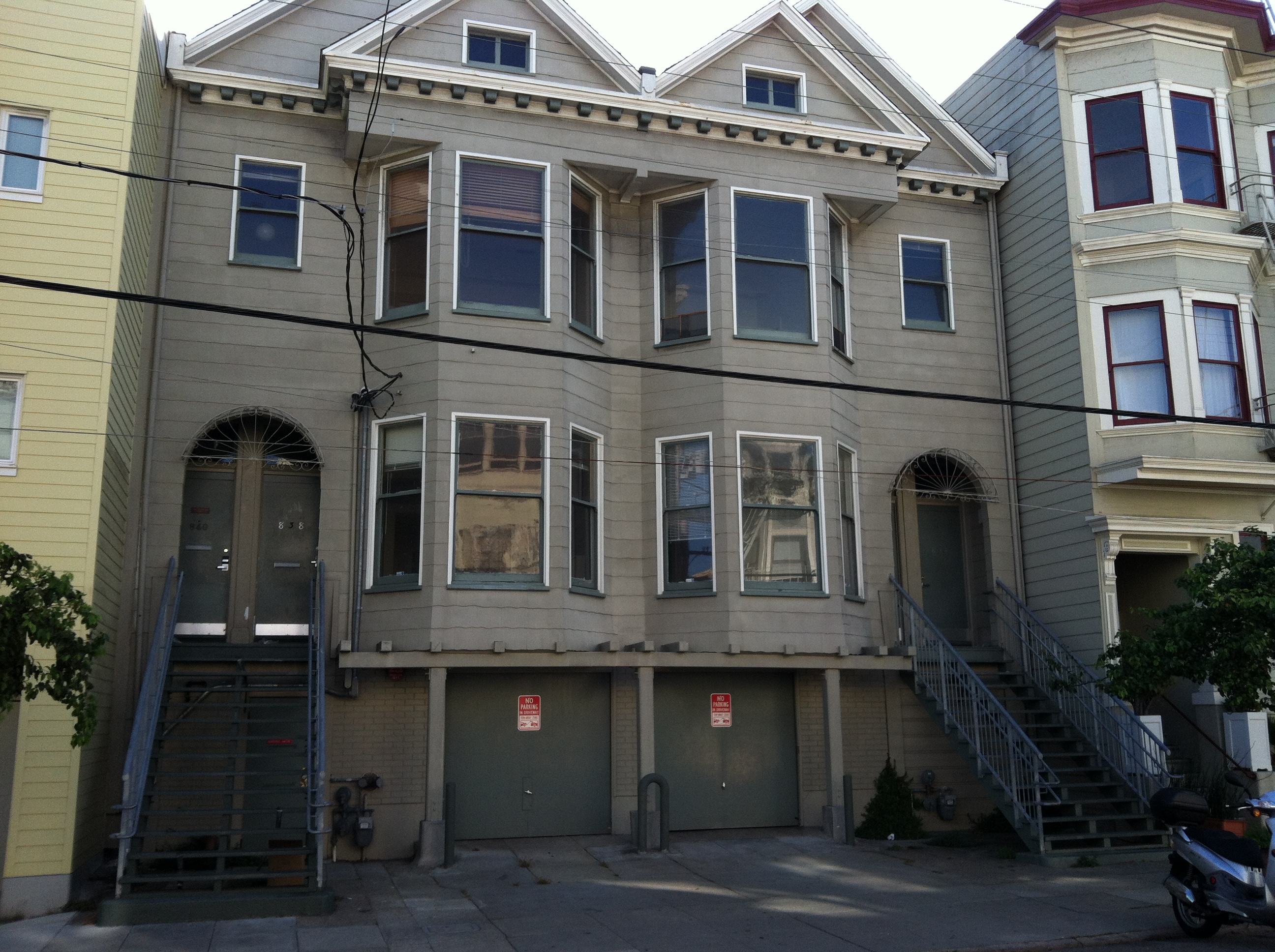
Double doors on each side of this building, four flats

Double doors on each side of this building, four flats

With a slightly wider lot you can find four-unit and six-unit buildings, which are basically two-flat and three-flat buildings stuck together. I see a lot of these buildings in Lower Pacific Heights near my daughter’s preschool. This four-unit building is a particularly ugly version of the genre, but the prettier ones are hard to photograph because they typically have trees in front and a long flight of stairs up to the front doors.

Oddly, our street is one of the few that is made up of largely of single-unit buildings. The university converted all the houses it purchased on our street to clinics decades ago. Then when the neighborhood protested because of all the car traffic, the university turned the buildings back into housing. However approximately half of them were set up as student housing, with a shared common space and multiple rental bedrooms. Evidently you can cram more people into a building that way. These aren’t exactly single family homes, since they each contain at least a half dozen medical students, but technically they meet the definition.

It is no fun to live next to students, incidentally, even medical students. No matter how much homework I give them, they party all weekend well into the wee hours. It’s something about student culture. Even nice quiet professionals who go back to graduate school end up partying when they are students again. Every year we hope against hope in the fall when they return from their vacations that the ones with the gong have finally graduated—so far university police have not been able to identify which unit has the gong, to our despair. And despite the fact that fewer than 1% of physicians smoke, in their student years they smoke outside our building and leave butts all over the ground, which our kids are finally old enough not to put in their mouths, thankfully. They drive down the hill at breakneck speeds until the wee hours with the music blasting, or worse, sit in their cars outside our building and look completely shocked when we come out in our pajamas at 3:00am to say that we can in fact hear the thumping bass from three floors above. And to my everlasting regret, the university keeps all its housing units in good condition, and the most raucous parties always gravitate to the nicest space. Summer is always the nicest time of the year for us. Even though it is a violation of their leases to sublet their rooms in the summer, and even though every year someone gets kicked out for it, the students always sub-lease anyway, and the sub-lettors tend to be fearful and thus quiet. But I realize that it could be much worse. We could live next to undergraduates.

2 Comments

Filed under San Francisco

Bay Area Bike Share in an empty city

The first bike arrives at the bike share station.

The first bike arrives at the bike share station.

This Friday is the opening day for Bay Area Bike Share. I knew, idly, that it was coming, but hadn’t really paid much attention, as the station route map reveals it is too far east for me to use much. I forgot, of course, that Matt works downtown. There is a new bike share station right outside his office! My sister has one outside both her home and her office (and mystifyingly, she does not plan to join. Yet.)

Of course Matt rides to work already, but riding a big cargo bike around the Financial District is not always the most convenient option, especially since one time that he did that, his (U-locked) bike was stolen. At noon. In a location with lots of foot traffic. By a thief using a handheld angle grinder.  At work, we can bring our bikes inside. Personally, if I had the option, I’d leave my bike inside all day and ride a bike share bike to meetings when I needed to leave the office. I think a docking station is designed to lock up a bike better than I ever could, and I suspect that it would be too tough to sell a bike share bike to make stealing one tempting. Not that it matters, because stolen bike share bikes wouldn’t really be my problem anyway.

Although I am not in the neighborhood and I can’t haul my kids on a bike share bicycle, I will eventually make it over to that part of the city (which is flat!) and try one out. You’ll hear about it here first.

However the grand opening of bike share is not the only reason that this will be a great weekend. This is also the long weekend of the empty city. On Wednesday night, the Bay Bridge was closed so that Cal Trans can transition the earthquake-damaged eastern span over to the new bridge. Virtually all of the traffic from the East Bay has evaporated. I noticed even this morning that there were far fewer cars on the road, which is always welcome. We have had this experience before during bridge closures, as well as on Thanksgiving and Christmas—visitors leave the city, and everything is suddenly completely accessible to those of us who live here. Restaurant reservations are available all evening and the lines at museums disappear. I’m sure that it’s not great for business, but it’s sometimes nice to have the city be a place just for its residents. Happy Labor Day!

1 Comment

Filed under bike share, commuting, San Francisco, traffic

New school year, new bikes at Rosa Parks

Rosa Parks bikes rolling in... every day is like a cargo bike roll call!

Rosa Parks bikes rolling in… every day is like a cargo bike roll call!

San Francisco schools start mid-August, so we’ve been taking our son in for a week now. Now that our daughter is finally in a new preschool (at a Japanese immersion program a few blocks from Rosa Parks that we love) we have, for the first time ever, a shared commute. And for the new school year, there are new bikes to see as well. We arrived early on the first day of school, and we had to rent a car because our daughter woke up vomiting, but there were plenty of bicycles to see nonetheless.

Front seats rule!

Front seats rule!

Last year I wrote about the Oxford Leco top tube seat, and we were lucky enough that friends from Rosa Parks picked up for us one while they were in the UK. Circumstances conspired, so we have not installed our seat, but they are already using theirs. On the first day of school it was carrying their son (who goes to preschool with our daughter) but this is typically the way they take their daughter, now in the first grade, to school. They told me that the kids fight for the chance to sit in the front seat, which does not surprise me: front seats are fun!

This bike is too fast to catch in motion.

This bike is too fast to catch in motion.

For a couple of years another family was also using an ad hoc top tube seat in the form of a spare saddle stuck on the top tube, but their daughter, in 2nd grade, has grown too tall for this option. Now she rides behind her dad, standing on the foot pegs he’s installed on his rear wheel and holding onto his shoulders. I continue to be impressed at the way he’s managed to haul a kid for six years now with the absolute minimum cost and hassle. They cut a mighty figure rolling through the streets—since he’s kept his bike so light they move very fast, unlike those of us on cargo bikes.

This is the second BionX Mundo I've seen at Rosa Parks.

This is the second BionX Mundo I’ve seen at Rosa Parks.

At the welcome breakfast for new families there were: more bikes! And check out that newly assisted Yuba Mundo with BionX. This particular rack usually holds kids’ bikes that have been disengaged from their Trail-Gators and are locked up until the parental pick up later in the day, rather than this collection of parental bikes, because it’s inside the locked courtyard.

There is so much awesome in this bike that I cannot do it justice.

There is so much awesome in this bike that I cannot do it justice.

Most impressive of the new bikes was the Xtracycled tandem! This is the same family that formerly rode the Bike Friday triple tandem (aka Shrek 2). Their oldest is now riding solo, so they swapped the triple tandem for the Xtracycle tandem, and now they can carry three kids. And they do: they are the neighborhood bike-pool.  Cargo bikes may be slow, but have their uses.

This is the way we ride to preschool.

This is the way we ride to preschool.

And although we did not ride to school on Monday due to sick kid, we did ride for the rest of the week. I took our daughter to preschool solo twice last week, and picked her up too. I still get tired much too easily, so I can’t ride every day, or for that matter go to work every day (I’m still on half-time disability). Yet riding is still easier than driving+walking—even with my handicapped parking sticker, we can rarely park close enough to our destination that it’s an easy walk for me. People are still surprised to see me on the bike again, but riding is still so much easier than walking that it almost feels like cheating.

Even more astonishing, I'm not the only one back in action.

Even more astonishing, I’m not the only one back in action.

7 Comments

Filed under commuting, family biking, San Francisco

What I like about bikes

I want to ride my bicycle.

I want to ride my bicycle.

I have been trying to practice riding more, although I have hit some limits. Riding two days in a row, I have learned, now leaves me saddle sore. I get a little antsy when I have to go through the intersection in Golden Gate Park where I was hit, which is unfortunately en route to almost everything, but it’s been reasonably mellow other than that. I don’t have the stamina or strength to go long distances or up hills, but hey, that’s the kind of thing electric assists were made to fix.

Now that I am riding every other day or so, I remember what I like about riding my bike. I’ve been in cars and buses a lot in the last few months, and it is isolating. Plus, even though I now have a handicapped placard, I end up having to walk a lot when we drive somewhere because the competition for handicapped parking places is ferocious. But on the bike the world returns to human scale (plus I can park by the front door). When I was coming back from grocery shopping—my current level of grocery shopping competency by bicycle involves carrying one glass jar of yogurt—two guys on the corner waved me over to ask about my bike. On my way to the office, the only other person who stopped at the red light besides me struck up a conversation. “I can’t believe I get grief about not wearing a helmet sometimes from people who run red lights,” he said. I agreed that this was pretty irritating. This nice man was in the full roadie kit; not the usual stop-at-red-lights type in my experience. I am learning not to judge hastily.

I get a lot of funny looks when I get off the bike and unfold my cane. This amuses me. In physical therapy I can do exactly zero of the exercises I’m supposed to be able to do 25 times in a row when I’m fully recovered. I am still a slow walker, and I limp, and I can’t go far on foot, but on my bike I’m almost as fast as everyone else.  On the bike no one knows I’m still crippled.

6 Comments

Filed under Brompton, commuting, injury, San Francisco